Entanglement Growth in Quench Dynamics with Variable Range Interactions
J. Schachenmayer,1B. P. Lanyon,2C. F. Roos,2and A. J. Daley11Department of Physics and Astronomy, University of Pittsburgh, Pittsburgh, Pennsylvania 15260, USA 2Institute for Quantum Optics and Quantum Information of the Austrian Academy of Sciences
and Institute for Experimental Physics, University of Innsbruck, Innsbruck, Austria (Received 2 June 2013; revised manuscript received 5 August 2013; published 13 September 2013)
Studying entanglement growth in quantum dynamics provides both insight into the underlying micro-scopic processes and information about the complexity of the quantum states, which is related to the efficiency of simulations on classical computers. Recently, experiments with trapped ions, polar mole-cules, and Rydberg excitations have provided new opportunities to observe dynamics with long-range interactions. We explore nonequilibrium coherent dynamics after a quantum quench in such systems, identifying qualitatively different behavior as the exponent of algebraically decaying spin-spin inter-actions in a transverse Ising chain is varied. Computing the buildup of bipartite entanglement as well as mutual information between distant spins, we identify linear growth of entanglement entropy corres-ponding to propagation of quasiparticles for shorter-range interactions, with the maximum rate of growth occurring when the Hamiltonian parameters match those for the quantum phase transition. Counterintuitively, the growth of bipartite entanglement for long-range interactions is only logarithmic for most regimes, i.e., substantially slower than for shorter-range interactions. Experiments with trapped ions allow for the realization of this system with a tunable interaction range, and we show that the different phenomena are robust for finite system sizes and in the presence of noise. These results can act as a direct guide for the generation of large-scale entanglement in such experiments, towards a regime where the entanglement growth can render existing classical simulations inefficient.
DOI:10.1103/PhysRevX.3.031015 Subject Areas: Atomic and Molecular Physics, Quantum Physics
I. INTRODUCTION
Advances with atomic molecular and optical (AMO) systems, including cold atoms, entangled photons, and trapped ions, have rapidly opened possibilities to explore many-body physics in a highly controllable way [1–3]. A key example of this is the new possibility to explore coherent nonequilibrium dynamics in a closed many-body system, e.g., the dynamics induced by quantum quenches [4–9,9–13]. There have been several recent quench experiments with cold atoms in optical lattices, which not only probe the microscopic behavior of the system, e.g., the propagation of quasiparticles [14], but also indicate the possibility to probe dynamics beyond the regimes that are currently accessible to classical simu-lations [15–17]. In this context, the growth of entanglement in the system underlies the complexity of simulating the dynamics classically. Demonstration of large entanglement growth after a quantum quench would be a crucial step in demonstrating the possibility to use these systems as con-trollable quantum simulators, effectively using experimen-tal systems to compute dynamics in a way that exceeds the capabilities of classical computations [18].
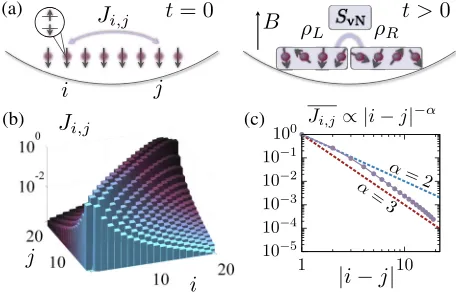
Systems of trapped ions are a very promising candidate for realizing a quantum simulator because of the control already demonstrated in the development of gate-based quantum computation and simulation [19–21] with these systems, and the ability to make measurements by state tomography [22]. Recently, analogue quantum simulation of interacting spin systems [23,24] was also realized in ion traps [25–27], with a key novel element being the possi-bility to realize variable-range interactions [28–33], as shown in Fig.1, in contrast to the short-range interactions of neutral atoms, or the dipole-dipole interactions possible with polar molecules.
So far, these variable-range interactions were discussed primarily in the case of ground-state calculations and near-adiabatic dynamics. Here, we explore nonequilibrium co-herent dynamics after a quantum quench in these systems, identifying qualitatively different behavior as the exponent
of algebraically decaying spin-spin interactions is var-ied. Beginning with all spins aligned with a transverse field, we use a combination of analytical and numerical methods to compute the dynamics after the Ising interac-tions are quenched on, incorporating matrix product op-erator techniques [34–41] to treat variable long-range interactions with up to 50 spins.
In particular, we investigate the buildup of bipartite entanglement in the chain as well as mutual information between distant spins [6–9]. For interactions with *1, we show that the behavior is qualitatively similar to nearest-neighbor interactions, with correlation buildup Published by the American Physical Society under the terms of
well described by the propagation of quasiparticles at a rate equal to or slower than the Lieb-Robinson bound [42–44]. This leads to a linear increase in bipartite entanglement in time, so that the dynamics cannot be efficiently computed in existing classical simulations beyond short times [16,17]. Interestingly, in this limit, we find that the maxi-mum growth rate of bipartite entanglement, even in small systems, occurs when we quench the interaction strength to the value corresponding to the quantum-phase-transition point, shifting accordingly for varying.
For interactions with &1, we observe qualitatively different behavior. Counterintuitively, quenches above the critical point for these long-range interactions lead only to a logarithmic increase of bipartite entanglement in time, so that in this regime, long-range interactions produce a slower growth of entanglement than short-range interac-tions. This can be understood by the fact that the dynamics is constrained to take place in a small part of the total available Hilbert space. In particular, in the case of infinite-range interactions, the system is described by the Lipkin-Meshkov-Glick (LMG) Hamiltonian [45,46], where the eigenspace of the model is spanned by relatively few Dicke states. We show that, in this case, the bipartite entanglement is bounded by a constant value, which grows logarithmically with the size of the system. For a large system size, this can be thought of as a mean-field limit, where the dynamics is simple to capture with a small number of basis states.
Finally, we discuss specific experimental parameters for the realization of different regimes in ion traps with finite chain lengths, and experimental measurement protocols for these effects, creating possibilities for the regimes consid-ered here to be observed in the laboratory. We show that the
crossover from linear to logarithmic entanglement growth can be observed also for inhomogeneously decaying inter-actions. Furthermore, we take typical experimental noise sources into account and show that the observable features are robust against these. The result that long-range inter-actions do not always give rise to strong entanglement in quench dynamics has implications for the realization of large-scale entanglement in quantum simulations in gen-eral systems with long-range interactions.
This paper is organized as follows. In Sec. II, we in-troduce the setup and the model, as well as the entangle-ment measures we compute. In Sec.III, we show how the entanglement growth depends on the model parameters and how the entanglement distribution mechanisms can be understood. In Sec.IV, we show entanglement growth for typical experimental parameters with inhomogeneously decaying interactions and how the entanglement behavior can be measured in noisy experiments. Finally, in Sec. V, we provide a conclusion and an outlook.
II. MODEL FOR A QUENCH WITH LONG-RANGE INTERACTIONS
In this paper, we study the nonequilibrium dynamics of spatial entanglement in systems with long-range interac-tions, especially as they are realizable with variable range in ion traps. In this section, we introduce the long-range transverse Ising model governing the time evolution, and the measures of entanglement we compute.
A. Transverse Ising model
We consider the transverse Ising model with long-range interactions, described by the Hamiltonian
^
H¼X
i<j
Ji;j^xi^xjþB
X
i
^
zi: (1)
Here, the^
i denote the local Pauli matrices (¼x,z),Ji;j
is a general interaction matrix with potentially long-range interactions, andBis the transverse field. This Hamiltonian can be realized experimentally, e.g., with a string of trapped ions that are harmonically confined in a linear trap, as depicted in Fig.1. Using two stable (or metastable) electronic states of these ions as local spin representations at sitei,j "iiandj #ii, it has been shown [23] that one can
use collective couplings of these local states to motional degrees of freedom of the whole chain to produce the effective spin model (1) [an example of Ji;j for the
ion-trap experiment, ‘‘case B’’ of Sec. IV, is shown in Figs. 1(b)and1(c)]. Note that, throughout this paper, we will deal with open boundary conditions, which are typical in ion-chain experiments.
We define the local eigenstates of^zi asj0ii j #iiand
j1ii j "ii, with eigenvalues1 and 1, respectively. We
consider a quench experiment [see Fig. 1(a)], where the system starts in the fully polarized state jc0i ¼
QM i j0ii,
[image:2.612.59.287.47.193.2](b)
which is the ground state forBðt¼0Þ ! 1. We are inter-ested in the nonequilibrium dynamics of the many-body quantum state under a coherent evolution, i.e., (@¼1):
jcti ¼ei ^Htjc
0i ¼
X
i1;i2;...iM
ci1;i2;...;iMðtÞY
k
jikik; (2)
withik 2 f0;1g.
We will concentrate on the case Ji;j>0 for all i, j.
However, we note that, nevertheless, we obtain solutions for both the ferromagnetic and the antiferromagnetic case. Since we start in a state with a real probability amplitude in the spin basis, the evolution for any observableO^z (with
^
Oyz ¼O^z), such as a density matrix of any subsystem, is
completely symmetric under the time-reversal transforma-tiont$ t. This can be seen by the fact that
hctjO^zjcti ¼ hc0jcosðHt^ ÞO^zcosðHt^ Þjc0i
þ hc0jsinðHt^ ÞO^zsinðHt^ Þjc0i
¼ hctjO^zjcti; (3)
where the cross terms have to vanish because of the real coefficients of the initial state and the fact that the expec-tation value must be real. Thus, the evolution of any observable is identical under both Hamiltonians H^ and H^. Therefore, the results we obtain forB >0 with the antiferromagnetic (Ji;j>0) model are identical to the fer-romagnetic model (Ji;j<0) with either a negative fieldB
or a rotated initial state.
In this paper, we will show how the entanglement growth behavior changes with the strength of the magnetic field and the range of the interactions. Initially, we will idealize the interaction matrix, taking the form
Ji;j¼
J
jijj; (4)
whereJ denotes the nearest-neighbor interaction strength andis the decay exponent. This gives a good represen-tation of the basic behavior of the interactions, but in real experiments, there are typically small deviations from the purely algebraic behavior of the interactions. In Sec.IV, we will consider a full interaction matrixJi;j for real experi-mental parameters, as well as the effects of noise in the experiment.
B. Spatial entanglement
In characterizing the growth of spatial entanglement in the spin chain, we will make use of two complementary measures: The von Neumann entropy for a bipartite split-ting of the chain in the center of the system, and the quantum mutual information between two distant spins. The former gives a measure of the overall entanglement buildup, and it also gives an idea of the complexity of the state being generated. The latter measure will give more detailed information as to how correlations propagate
spatially, and it will also help us to characterize what part of the entanglement buildup is due to propagation of quasiparticles produced in the quench and which part is due to direct interactions through long-range interactions. Both of these measures are accessible in experiments, though the mutual information is substantially less costly to measure (see Sec.IV Bfor more information).
1. Half-chain von Neumann entropy
Consider a chain ofMspins as depicted in Fig.1(a). We can split this system into two halves,LandR, in the center of the system. In the case that the (pure) state of the composite systemjcicannot be written as a product state of two states on the subsystems L and R, i.e., jci jcAijcBi, we call the state entangled. The reduced density
matrix of the subsystemLis defined viaLtrRðjcihcjÞ,
wheretrRdenotes the partial trace over the systemR. This
density matrix will only be pure for a product state, and in the case of an entangled state, the amount of bipartite entanglement is quantified by the von Neumann half-chain entropy of this matrix, which is defined as
SvN SðLÞ trðLlog2LÞ: (5)
The time-dependent growth of the half-chain entropy summarizes the buildup of quantum correlations between two halves of the system. In a sense, it also underlies the complexity of numerical simulations of the quench when using matrix product state (MPS) representations. As we show in AppendixA, the size of the MPS, represented by the bond dimension D, has to grow exponentially as a function of time in the case where SvN grows linearly. Regimes of linear entanglement growth in time are thus important in demonstrating the power of a quantum simu-lator since realizing such regimes is a necessary require-ment in order to observe dynamics that cannot be captured by state-of-the-art numerical techniques over long time scales [15,16].
2. Quantum mutual information
An alternative measure, which gives more information on the distance of correlations, is the quantum mutual information between two distant spins i and j. In an experiment, this is also more straightforward to measure than the von Neumann entropy for a bipartite splitting into two large blocks (see Sec.IV B), and it clearly allows one to distinguish different regimes of entanglement growth. The quantum mutual information is defined as
Ii;j¼SvNðiÞ þSvNðjÞ SvNðijÞ: (6)
Note that one has to be careful when interpreting the half-chain entropy and the quantum mutual information in an experiment in which the quantum state of the whole chain is, in general, mixed because of coupling to the environment and classical noise. In general, the von Neumann entropy for each reduced density matrix is expected to increase compared to the zero-temperature case [47]. We will consider these imperfections in Sec.IV.
III. ENTANGLEMENT GROWTH DYNAMICS
In this section, we study the evolution of the entangle-ment after the quench. We identify three very different regimes: (i) For relatively short-range interactions*1 (depending on the system size), we find a linear growth of the half-chain entropy as a function of time, which we can understand in terms of free quasiparticle propagation within an effective Lieb-Robinson light-cone. (ii) For long-range interactions 0:8, 0.9, 1, we find a regime where the half-chain entropy grows logarithmically. (iii) For nearly infinite-range interactions with &0:2, we find rapid oscillations of the half-chain entropy around small values, which we can understand in an effective Dicke-state model [48]. We treat case (i) in Sec. III A, case (ii) in Sec. III B 1, and case (iii) in Sec. III B 2. In Sec.III C, we show how the entanglement growth in re-gime (i) depends on the transversal fieldB, and we discover a connection between the entanglement growth rate and the underlying ground-state phase diagram of the model.
A. Entanglement dynamics for relatively short-range interactions (1)
1. Nearest-neighbor interactions
To understand the entanglement entropy growth behav-ior in this regime, it is instructive to first revise the case of nearest-neighbor interactions, i.e., an interaction matrix (4) with a decay exponent! 1, and discuss the dynamics
of the quantities we study here. In this limit, the model Hamiltonian (1) becomes a standard transverse Ising model of the form
H¼JX
i
xixiþ1þB
X
i
zi; (7)
which has been well studied in the literature. Note that since the spectrum of the Hamiltonian is symmetric under the exchange B$ B, the dynamics will not only be identical under a change of the sign of the total Hamiltonian, but also under a change of the sign of B, and we therefore focus onB >0here. The model (7) can be diagonalized analytically [49] (see Appendix B for more details). After performing a Jordan-Wigner transfor-mation and diagonalizing the quadratic Hamiltonian in quasimomentum space, the resulting diagonal model is a model of free fermionsq,
H¼X
q
q
yqq
1 2
: (8)
The q (yq) are the annihilation (creation) operators
for a fermionic quasiparticle with quasimomentum q, which obey the anticommutation relations fq;
y
pg ¼
q;p. In the thermodynamic limit, i.e., for a chain of
infinite length, the quasimomenta become continuous < qa < (a is the spatial separation between the spins), and the dispersion relation of the free particles is twofold degenerate for q¼ q0 and given by q¼
2pðffiffiffiffiffiffiffiffiffiffiffiffiffiffiffiffiffiffiffiffiffiffiffiffiffiffiffiffiffiffiffiffiffiffiffiffiffiffiffiffiffiffiffiffiffiffiffiffiffiffiffiffiffiffiffiJBÞ2þ4JBsin2ðqa=2Þ. The group velocity of qua-siparticle excitations in this system is given byvgðqÞ=a¼
dq=dðqaÞ. The maximum velocity of the quasiparticles
gives rise to the Lieb-Robinson bound, which defines an effective light cone for spatial correlations, outside of which the correlations are exponentially suppressed [42]. This sets an upper linear bound on the block entropy growth, as we will see below. It is straightforward to calculate that the fastest particles move at a Lieb-Robinson velocity vR¼maxjvgj ¼2aJ for BJ
andvR¼2aBforB < J.
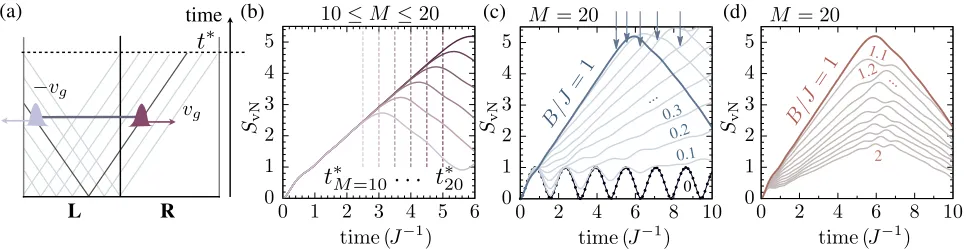
Following [43], we can understand the entanglement distribution mechanism in model (8) as follows: In a coherent time evolution, the initially excited state acts as a source for quasiparticle excitations. Pairs of the free fermions with quasimomenta p and p, which have been created at a certain point in space, are entangled pairs. These pairs move freely through the system with corre-sponding group velocitiesvgandvg, respectively. Parts
of pairs that have been produced in blockLand arrive in block R entangle the two blocks. An illustration of this mechanism is given in Fig. 2(a). Thus, the arrival rate in block R for quasiparticles belonging to a pair created in block Lis constant. Therefore, the increase of half-chain entropy is linear, and we expect SvN¼vgt, with some
constant . Since the group velocity is limited by the Lieb-Robinson bound,SvNvRt.
We can test this mechanism explicitly by making use of the boundary effects with open boundary conditions. Consider a quasiparticle pair, which has been created at the left edge of blockLand moves at the Lieb-Robinson velocity. As soon as the right-moving quasiparticle arrives in block R, the linear entanglement increase has to break down since there are no more entangled pairs available to the left that could further entangle blocksLandR. We can estimate the time at which this happens ast¼ ðM=2Þ=vR, which corresponds tot ¼ ðM=4JÞforBJand tot ¼
entropy starts to level off and remarkably reduces again after this maximum peak.
The quench experiment forB¼Jis special in the sense that this is a quench to the critical point of the quantum phase transition of Hamiltonian (7). We will now ask how the entanglement growth depends on B. In the limit of
B! 1, the initial state becomes an eigenstate of the
system and no evolution will take place, i.e., SvNðtÞ ¼0. On the other hand, in the limit ofB!0, the Hamiltonian has a spectrum with M degenerate levels, which are separated by an energy of 2J (spin flips). Thus, in the latter case, we expect dynamics which is dominated by oscillations between those levels at a frequency scale given by J. Indeed, for B¼0 it is straightforward to calcu-late analytically that SvNðtÞ ¼ cos2ðJtÞlog2½cos2ðJtÞ
sin2ðJtÞlog
2½sin2ðJtÞ. In Fig. 2(c), we find the expected
behavior forB < Jin an exact diagonalization simulation of a system with 20 spins. For increasingB, the oscillatory behavior of SvN (which fits the analytical result) breaks
down and changes into a linear increase before boundary effects become important. Since the Lieb-Robinson veloc-ity decreases withBforB < J, correspondingly the bound-ary effects shift to later times for smallerB[critical timest
are indicated as vertical arrows in Fig.2(c)]. It is interest-ing to note that in this case the maximum value ofSvNcan actually be larger than forB¼J. In Fig.2(d), we analyze the opposite case ofB > J. Remarkably, we find that, also away from the critical point, the half-chain entropy growth becomes slower with increasingB. Below, we will find that this also holds for finite-range interactions with*2and that the fastest entanglement growth precisely follows the point of the phase transition.
2. Finite-range interactions (*1)
We now investigate the situation of relatively short-ranged interactions, which extend beyond nearest neighbors
and decay algebraically with*1. In Fig.3, we demon-strate that the picture of entanglement distribution via entangled quasiparticle pair propagation also holds for a large range of finite*1(depending on the system size). We find that, despite the existence of direct spin-spin inter-actions over all distances, it is the propagation of quasipar-ticles that dominates the dynamics of entanglement growth over this range ofvalues.
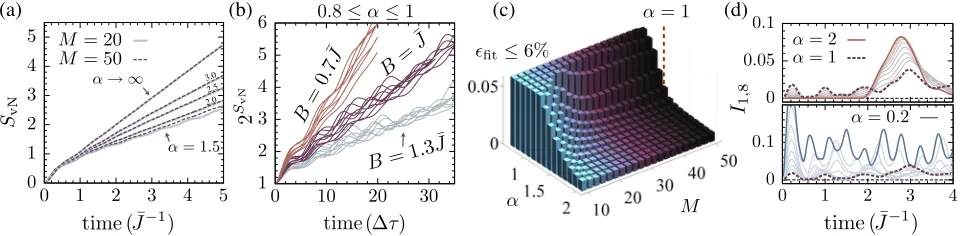
One marked signature of the linear half-chain entropy growth is that, before boundary effects become important, the rate of the growth is essentially independent of the size of the system, as shown in Fig.3(a). In this figure, we show the time evolution ofSvNafter the quench for various decay
exponents in the range1 1:5. The solid lines show an ED simulation for a system of 20 spins, and the dashed lines are for M¼50 spins. We obtain the results for large systems using time-dependent density matrix renor-malization group (t-DMRG) methods. Specifically, we use a matrix product operator (MPO) [34–36] of the Hamiltonian to time evolve a MPS via a Runge-Kutta– type method [50] (see AppendixAfor more details). In all cases with >2, we find that the two lines coincide and that the increase is linear. For ¼1:5, we find a slight change in the behavior in the sense that the results forM¼
20andM¼50start to differ. When we further increase the range of interactions, we find that this linear growth changes to a logarithmic one, as we demonstrate in Fig. 3(b)using a t-DMRG calculation with ¼0:8, 0.9, 1 and forM¼30, 40, 50. We treat this case in more detail in Sec.III B 1.
[image:5.612.65.548.46.171.2]increase (small error) breaks down at1. For smaller systems, boundary effects and finite-size effects become significant, and the linear regime breaks down at larger. Note that the change in behavior for large systems at1 can, in a sense, be understood since this marks the point at which, in the thermodynamic limit, the sum in the interac-tion term in the Hamiltonian begins to diverge with in-creasing system size.
We can also identify the regime of linear growth ofSvN
by looking at the mutual information between distant spins. In the upper panel of Fig.3(d), we plot the time evolution of the mutual informationI1;8, between sites 1 and 8, for
12 in a system of 20 spins and forB¼J. As a clear signature of the regime of linear growth of the half-chain entropy, we find that the mutual information remains nearly zero for a certain time until it suddenly peaks at a time corresponding to the arrival of an ‘‘entangling’’ qua-siparticle pair originally produced on a site between the two spins. For nearest-neighbor interactions, this arrival time is consistent with the analytically calculated Lieb-Robinson velocity (cf. Appendix B), and we find that the same mechanism still holds for rather long-ranged interactions of2. In contrast, for the regime of loga-rithmic growth of SvN, we find a markedly different
be-havior [lower panel of Fig.3(d)], which is discussed in the next section.
We emphasize that the fact that the entanglement growth mechanism is directly reflected in the time dependence of the mutual information between two distant spins is very important for experimental observations. Instead of having to reconstruct2ðM=2Þ2ðM=2Þdensity-matrix elements of a large block via quantum-state tomography, the growth
behavior of the half-chain entropy can be directly verified by measuring only 44density matrices for a system of two composite spins. In Sec.IV B, we will show how the measurement further simplifies for the particular quench we consider here.
B. Entanglement dynamics for long-range interactions
In this section, we study the entanglement growth for very long-range interactions with 1. In this regime, the picture of entangling quasiparticles that move freely within a light cone breaks down, and instead distant parts of the system can become almost instantaneously en-tangled based on direct interactions. We observe that for
0:8, 0.9, 1, the half-chain entropy can still increase steadily as a function of time for our quench, but that the increase becomes logarithmic instead of linear. When fur-ther increasing the range of interactions for &0:2, we find a regime where SvN oscillates rapidly around small
values. We understand this behavior via an effective model in a basis of Dicke states [48] for infinite-range interactions
¼0.
1. Logarithmic entropy growth
When increasing the range of interactions, eventually the linear growth of SvN breaks down, and the growth becomes logarithmic, as shown in Fig. 3(b). For very long-range interactions, the time scale of the dynamics is dominated by the interaction-energy term in the Hamiltonian. Thus, to make a valid comparison, it is favorable to measure the time in inverse units of the matrix norm instead of J. For Hamiltonian (1), we can calculate
[image:6.612.67.547.47.165.2](a) (b) (c)
FIG. 3. Entanglement growth after a quantum quench in the transverse Ising model in which algebraically decaying interactions are introduced suddenly. (a) Time evolution of the half-chain entropy after the quench forB¼1and varying decay exponents¼1:5, 2, 2.5, 3, and1(from bottom to top). Solid lines are ED results for M¼20spins; dashed lines are MPS/MPO results for 50 spins (converged with MPS bond dimensionD¼192). For2, the growth is clearly linear and independent of the system size. (b) Time evolution of2SvN. Each of the three bundles of lines contains the results forM¼30, 40, and 50 spins and¼0:8, 0.9, and 1 (MPS/
the Frobenius norm as kHk¼2M=2 ffiffiffiffiffiffiffiffiffiffiffiffiffiffiffiffiffiffiffiffiffiffiffiffiffiffiffiffiffiffiffiffiffiffiffiffiffiðPM j>iJi;j2 þMB2Þ
q
. The2M=2prefactor is due to the exponential growth of the
Hilbert space withM, and we define the time unit per spin realistically as 1 ¼kHk2M=2. In Fig.3(b), we plot
the evolution of the von Neumann entropy in these units for system sizes ofM¼30, 40, 50, for¼0:8, 0.9, 1 and for
B¼0:7 J,1 J,1:3 J. If, ideally, the entropy increases log-arithmically without oscillation,SvN ¼log2ðCtþ1Þ, with
some constantC. On an exponential scale, i.e., by plotting 2SvNðtÞ, we would see a straight line. In Fig.3(b), we indeed
find oscillations around a straight line. It is remarkable that, for a fixed value ofB, independently of the system size and for all¼0:8, 0.9, 1, we find roughly the same constantC
in units of 1. With decreasingB, i.e., for quenches that put an increasing amount of energy into the system, the constant increases. For interactions with&0:7, the os-cillations become more dominant so that the logarithmic increase is hard to verify.
Also, the time evolution of the mutual information be-tween distant spins shows a completely different qualitative behavior for&1than for*1. In Fig.3(d), we show the evolution ofI1;8after the quench for a system of 20 spins
(B¼J) for20:2. In the upper panel of Fig.3(d), we find that the incoming-wave picture breaks down when
decreases from¼2to¼1. In the latter case, we find a mixed behavior, where a wave peak is still roughly visible aroundtJ3; however, peaks also appear for very short times. These peaks indicate that, because of the long-range part of the interaction, distant parts of the system become rapidly entangled with an immediate increase in correla-tions after the quench. When further increasing the interac-tion range [lower panel of Fig.3(d)], these contributions to
I1;8become dominant and the quasiparticle peak disappears
completely. While for 1, I1;8 still shows some slow overall increase as a function of time, in the case of nearly infinite-range interactions (&0:2), we only find rapid oscillations around a constant value of I1;80:1. In an
experiment, the decrease in the height of the short-time peak of the mutual information could be used as an indicator for the crossover from the logarithmic half-chain entropy growth regime to the linear one. Furthermore, we find that this height, in contrast to the frequency of the oscillations, is independent of the system size.
2. Entanglement dynamics for infinite-range interactions
To understand the rapid oscillations and small half-chain entropy for decay exponents of&0:2, it is instructive to consider the case of infinite-range interactions, i.e.,¼0. In this limit, each spin interacts with equal strength with all others and the (‘‘mean-field’’) Hamiltonian reads
^
H¼JX
M
i<j
^
x i^xjþB
XM
i
^
zi: (9)
As in the nearest-neighbor case, this limit is analytically exactly solvable. We can introduce effective spin-M=2 operators Sx;y;zPM
i ^ x;y;z
i . With these, we can rewrite
Hamiltonian (9) as
^
H¼J
2S
2
xþBSz
J
2M: (10)
In the literature, this model is well known as the LMG model, and its entanglement properties have been studied, e.g., in [45,46]. A basis for Hamiltonian (10) is given by Dicke spin-M=2states, which are defined as
S¼
M
2 ; mS¼n1
M
2
Sjfn0; n1gi: (11)
Here, n0, n1 denote the number of spins (down and up,
respectively), and S is the symmetrization operator. For example, for a system of four spins, we would have an effective spin-2 model, and one particular Dicke state would be jS¼2; mS ¼ 1i ¼ ðj0001i þ j0010i þ j0100i þ j1000iÞ=2. In this picture, the quench experiment is equivalent to a free evolution under Hamiltonian (10) with the initial statejc0i ¼ jS¼M=2; mS¼ M=2i.
It is straightforward to calculate the half-chain von Neumann entropy for an arbitrary Dicke state [51] (see AppendixBfor more details). One finds that
SvN¼
X
l
pllog2ðplÞ; (12)
plðn1Þ ¼ M=2
l
M=2
n1l
M n1
; (13)
where plare combinatorial factors depending only on the
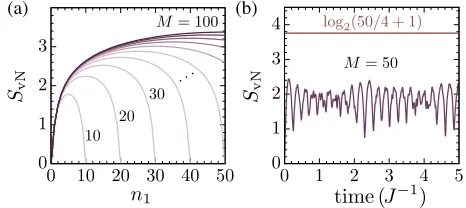
number of single up spins of the corresponding Dicke state and0lM=2. Example results are plotted in Fig.4(a), and it is important to note that, simply because the sum in (12) contains a maximum ofM=2þ1terms, the entropy is bounded bySvNlog2ðM=2þ1Þ.
[image:7.612.320.553.538.642.2](b) (a)
In our quench, the time-dependent state will assume a superposition of Dicke states,jcðtÞi ¼PmcmðtÞjM=2; mi,
with cmðt¼0Þ ¼m;M=2. In the small Dicke Hilbert
space, the time evolution can be easily numerically simu-lated, and we can, at any instance in time, construct the reduced density matrix for one half of the system. From this density matrix, the von Neumann entropy can be readily calculated, and examples are shown in Fig.4(b). Again, we find, simply by noting that the dimension of theM=4Dicke subspace is M=2þ1, that for an arbitrary Dicke-state superposition, the von Neumann entropy is limited by
SvNlog2ðM=2þ1Þ. However, for our specific experi-ment, a tighter bound can be found. Since the Hamiltonian (10) only couples spin states with mS¼ 2, the time-dependent coefficients cmðtÞ can only be nonzero for states with m¼ M=2;M=2þ2;. . .; M=2. Assuming an even number of spins, the entropy is then limited by
SvNlog2ðM=4þ1Þ, which is in agreement with the ex-act von Neumann entropy evolution, as shown in Fig.4(b).
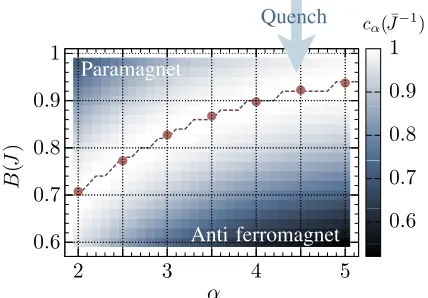
C. Ground-state phase-transition point and entanglement growth
In this section, we study how the linear growth ofSvNfor
2depends on the value ofBand the decay exponent
. We focus on the caseJ¼1,B >0. For ground states, as for the nearest-neighbor transverse Ising model, the long-range model undergoes a quantum phase transition from an antiferromagnetic to a paramagnetic phase at a critical field
Bcfor all decay exponents[52,53]. For example, for¼
3it has been calculated thatBc 0:83[54]. As shown in Ref. [54], we can estimate the point of the phase transition by locating the discontinuity of the transverse magnetiza-tion, i.e., the jump ind2m
z=dB2, wheremz¼
P
mhzmi. In
order to do this for moderately large systems, we use a
MPO Lanczos diagonalization for 100 spins. In Fig.5, we compare this ground-state phase-transition point for a moderate system size to the linear growth rates of the von Neumann entropy in a small systems of only 20 spins as a function ofandB. It is remarkable that the point of the ground-state phase transition is not only reflected in the scaling behavior of the block entropy in the ground state [53], but we also find that in the evolution following the quench from Bðt¼0Þ ¼ 1 !B, the growth rate of the von Neumann entropy as a function of time is largest at the critical pointsBc. Since the entangling quasiparticles are bounded by the Lieb-Robinson bound, this effect is independent of the system size up to timestwhen bound-ary effects limit the quasiparticle propagation.
IV. ENTANGLEMENT GROWTH AND MEASUREMENT USING TRAPPED IONS
A. Entanglement growth for realistic experimental parameters
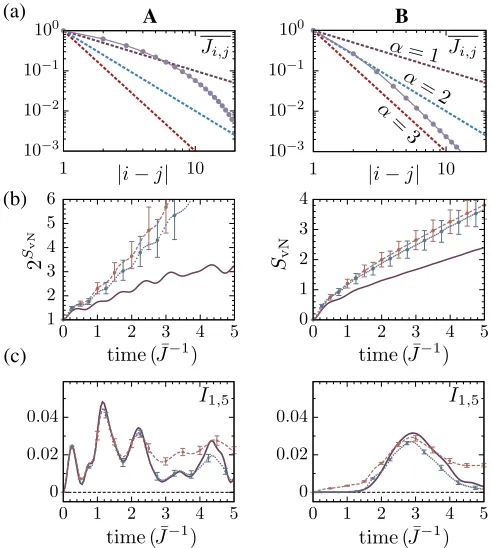
In this section, we ask to what extent the effects shown in the previous sections are experimentally observable in ion traps. Therefore, we consider two experimentally realistic full interaction matricesJi;j, which show the characteristic
behavior of linear entanglement growth and logarithmic growth. In case A, over short distances, the averaged interactions decay as <1(logarithmic growth regime), and in caseB, they decay as2(linear growth regime), as depicted in Fig. 6(a). We define the energy unit by the largest element ofJi;j, which we denoteJin this section.
We consider a linear chain of 20 ions that interact via the mechanism described in [31,32]. In summary, a force is applied that couples the electronic ‘‘spin’’ state of the ions to the spectrum of closely spaced (nearly frequency degen-erate) vibrational modes transverse to the ion string. By setting the driving force to be far off resonance, the phonon states can be adiabatically eliminated, allowing an ana-logue simulation. While the simulations presented are for
40Caþ ions driven with bichromatic laser fields, similar
interaction matrices can be derived in a number of other systems. The exact experimental parameters considered are given in AppendixC.
We show the evolution of the half-chain entropy and the mutual informationI1;5in Figs.6(b)and6(c), respectively.
As expected from the averaged decay of the interactions in both casesAandBand from the previous discussions, we find that for the case B, SvN increases linearly in time,
[image:8.612.68.282.481.630.2]while for A, the growth behavior is logarithmic. Accordingly, we find the behavior of the mutual informa-tion as we have found it for the case of homogeneously decaying interactions: In case B, the initial mutual infor-mation is zero, and a peak appears at a time around2:8=J. In caseA, in the logarithmic regime, we find an instanta-neous increase of I1 due to the long-range part of the interactions, which entangles distant parts instantaneously. FIG. 5. The half-chain entropy growth ratecfrom a linear fit
0< tJ < 3after the quench (M¼20, ED). Eachc is
normal-ized to its maximum value in the range 0:6< B <1, c¼
½dSvN=dt=max½dSvN=dtðBÞ. The dashed line is the contour for maximum growth, i.e., c¼1=J. The points show the
In a realistic experiment setup, the string of ions will be subjected to noise. Here, we consider the two most signifi-cant imperfections: (i) fluctuations in the energy splitting of the electronic states used to encode a spin (e.g., due to ambient magnetic field fluctuations) and (ii) fluctuations in the coupling strength between the spin-dependent force mechanism and the ions (e.g., due to laser-intensity fluc-tuations). Noise of the form (i) will lead to a correlated rotation of the qubits around thezaxis, while noise of type (ii) causes a stochastic fluctuation of the overall interaction strengthJ. We idealize both cases as white noise fluctua-tions ðtÞ, ð0ÞðtÞ ¼sðtÞ with strength s (the bar denotes the time average). The evolution of the state can then be described by a Stratonovich stochastic Schro¨dinger equation [55,56]
djci ¼ iH^jcidti ffiffiffiffiffis
p ^
LjcidWðtÞ; (14)
wheredWðtÞis the Wiener increment, andL^is the noise
( jump) operator. For case (i),L1 ¼B
P
i^zi; for case (ii),
L2¼Pi;jJi;j^x
i^xj. Equivalently, we can derive a master
equation for the evolution of the full density matrix,
d dt ¼ i½
^
H; s
2 ½L^;½L^; : (15)
In the long-time limit, the master equation drives the system into a state that commutes with the jump operators. For noise of type (i), this is a state diagonal in thezbasis, and for type (ii), it is a state diagonal in thexbasis. For the time scales of the experiment, the dynamics consists of a complicated interplay between the coherent evolution and the dissipative part. In general, we expect that noise of type (i) leads to a global dephasing in the sense that it will reduce the purity of the full state and thus result in a slightly higher measured entropy, whereas noise of type (ii) can be more complicated because an overall fluctuation of Jacts with different strengths between dif-ferent spins according toJi;j. We can simulate the
evolu-tion of the master equaevolu-tion numerically by evolving the stochastic Schro¨dinger equation in time using a first-order semi-implicit method with strong order 1.0 convergence [55] and statistically averaging over a large amount of trajectories.
In Figs.6(b)and6(c), we find that, as expected, the noise adds an additional entropy growth as a function of time for both the half-chain entropy and the mutual information. However, the underlying entropy features, which arise from the entanglement buildup in the coherent evolution, remain clearly visible. For example, instead of the short-time initial mutual information being zero in the regime of the linearSvN growth regime, for noise of type (i) we find
an overall increase of I1;5 as a function of time. Nevertheless, the quasiparticle peak clearly remains ob-servable even in the presence of the noise. In general, we find that the overall entropy growth that is induced by the fluctuations onBis larger than the one induced by fluctua-tions on Ji;j. In particular, we find that the mutual
infor-mation between distant spins is very robust against noise on the coupling strength because of the decay ofJi;jwith
distance. In case A, we find that for long times, the char-acteristic logarithmic growth eventually breaks down be-cause of the entropy increase from the noise; however, for
tJ&3, it remains observable. In general, these results suggest that the mutual information is a very robust ex-perimental measure for the entanglement growth behavior of the systems, which, furthermore, can be easily extracted from experimental data, as we show in the next section.
B. Measurements of block entropies and mutual information
We will now briefly review how the entanglement mea-sures we used in this paper can be measured experimen-tally. To calculate the von Neumann entropy of a subsystem A of lspins (which do not have to be next to each other), one can simply measure the reduced density (b)
(a)
(c)
[image:9.612.53.299.46.320.2]B
matrix of that block. While the process of measuring this matrix is known as quantum-state tomography, we show that for our particular experimental setup, this tomography simplifies significantly.
The reduced density matrix ofA, after tracing over the remaining system, is
~
A¼
X
;
~
jihj; (16)
where bold greek symbols denote the set of indices for the subsystem of spins, i.e., all2MA binary representations of
MA spins: ¼ ð1; 2;. . .; MAÞ with k2 f0;1g. The diagonal elements of ~A can be easily measured. They
are the probabilities for finding the spin combination ,
p. The off-diagonal elements are more challenging but reduce to the measurement of spin correlations.
For our experimental situation, we can make use of the fact that for any time-evolved statejcðtÞi ¼PcðtÞji,
cðtÞ ¼0,M
M
k
k¼1; (17)
whereL denotes the sum modulo 2. This result is easily verified by the fact that the matrix elements of any power of Hamiltonian (1) hjH^nji ¼0 for LM
k k
LM
k k.
Thus, since we start in the state withcðt¼0Þ¼;0, the
time-evolution operator expðitH^Þ¼Pn¼0ðitH^Þn=n!
can only produce states with nonzero coefficients cðtÞ
for which LMk k¼0. Thus, half the elements of any
reduced density matrix calculated from the time-evolved statejcðtÞiwill always remain zero. The remaining spin-spin correlations consist only ofx andyterms.
We illustrate this here for the example of a subsystem of a single spin (l¼1) and two spins (l¼2) and show how to reconstruct the corresponding density matrix. In the case of a single spin, the density matrix will be diagonal:
~
1 ¼p0j0ih0j þp1j1ih1j: (18)
Here, the off-diagonal part completely vanishes since trivi-ally, for all~with,¼1. For a block of two
spins, the density matrix becomes
~
2¼
p00 0 0 p1100
0 p01 p10 01 0
0 ðp1001Þ p10 0
ðp1100Þ 0 0 p11
0 B B B B B @
1 C C C C C
A: (19)
The six density-matrix values are all that have to be mea-sured. To experimentally obtain the off-diagonal elements, one has to measure the real and imaginary parts of11
00and 10
01. This can be done by expanding those elements into
spin-spin correlations via
Reð11
00Þ ¼ ð^x^x^y^yÞ=4; (20)
Imð11
00Þ ¼ ð^x^yþ^y^xÞ=4; (21)
Reð1001Þ ¼ ð^x^xþ^y^yÞ=4; (22)
Imð11
00Þ ¼ ð^y^x^x^yÞ=4; (23)
which means that four spin correlations have to be mea-sured. Thus, for the whole density matrix ~2, a total of eight expectation values have to be experimentally deter-mined. Note that this is a simplified version of full quantum-state tomography for two qubits [22]; however, a full state tomography, i.e., a measurement of all density-matrix elements, might be useful to quantify the deviations of the other elements from zero and therefore get a measure for experimental deviations.
From the density matrices, one can directly extract the corresponding von Neumann entropy. Note, however, that one can also calculate Renyi entropies of arbitrary ordern. These entropies are defined asS½nðÞ¼log
2½trð~Þ=ð1nÞ
and can serve as lower bounds to the von Neumann en-tropy. In an analogous fashion, one can use these entropies to define mutual information.
A generalization of the density-matrix measurement to larger blocks is straightforward. In particular, for a block length of l sites, one has to measure a total amount of ½22l2þ2ðl1Þ density-matrix values. For example, to clearly observe a linear entanglement increase for ¼2, one would have to simulate the system until a time of2=J
[cf. Fig.3(a)]. Before finite-size effects of the block size play a role, one therefore has to consider a block with
l¼8. While this seems to be achievable in current experi-ments (full state tomography for systems consisting of eight ions have been reported in [57]), we emphasize that ultimately the direct measurement of entanglement entro-pies of larger blocks becomes essentially impossible. This result is due to the fact that the number of correlation functions that have to be measured experimentally in-creases exponentially with the block sizel. However, it is important to note that the mutual information can always be extracted by only using blocks ofl¼1andl¼2.
V. CONCLUSION AND OUTLOOK
We have studied the dynamical evolution of entangle-ment in quench experientangle-ments in ion traps. We found that a regime of linear half-chain von Neumann entropy growth is present even for relatively long-range interactions with interaction decay exponents of*1. The growth rate is sensitive to the underlying low-energy spectrum and nota-bly largest at the point of the quantum phase transition, which varies with changing . For longer-range interac-tions, we find a regime of logarithmic entropy growth (&1), and for infinite-range interactions (¼0), the entropy remains bound by a small constant and oscillates rapidly. We showed that mutual information between dis-tant parts of the system can be experimentally measured and used to distinguish the different regimes.
The entanglement entropy growth behavior has impor-tant implications for t-DMRG/MPS/MPO algorithms on classical computers since it underlies the complexity of these algorithms. For a specific experimental example, we have shown that this regime is in reach for an experimental quantum simulator, which means that we can find a regime in these systems that fulfills a necessary condition realiza-tion of a quantum simulator regime where state-of-the-art numerical simulations on classical computers can become inefficient. While this idea provides a general strong moti-vation for experiments in this regime, we emphasize that, in future work, the study of dynamics of different types of, e.g., multipartite entanglement as a resource for specific quantum-information applications could also be interesting. We emphasize that ion-trap experiments are not the only experimental realizations in which the entanglement dy-namics studied here could be observed. For example, ex-actly the same spin model [62] and also more complicated models with long-range interactions can be realized in systems with polar molecules [63,64] or Rydberg atoms [65–68] in optical lattices. These systems would have the disadvantage that the decay exponent is not directly tuna-ble; however, they could have the advantage that half-chain entropies might be easier to measure directly, by employ-ing schemes that rely on the preparation of multiple copies in an optical lattice [61].
In the final stages of preparing our manuscript, we became aware of some related work [69], in which alocal quench in an Ising model with algebraically decaying interactions is studied, together with the resulting spread of quasiparticles. Though our quenches are qualitatively different, and large-scale-entanglement growth cannot be observed in a local quench, Ref. [69] has interesting par-allels with what we observe here, and it identifies similar parameter regimes for dynamics with long-range and short-range interactions.
ACKNOWLEDGMENTS
We thank Rainer Blatt, Ignacio Cirac, Stephan Langer, Hannes Pichler, and Peter Zoller for stimulating
discussions. Work in Pittsburgh is supported by NSF Grant No. PHY-1148957, with code development sup-ported by AFOSR Project No. FA9550-12-1-0057. Computational resources were provided by the Center for Simulation and Modeling at the University of Pittsburgh. This work was partially supported by the Austrian Research Fund under Project No. P25354-N20.
APPENDIX A: NUMERICAL SIMULATIONS AND ENTANGLEMENT GROWTH
In this appendix, we will give more details about the connection of the entanglement growth behavior and the numerical algorithms we use.
1. MPS simulations vs entanglement growth
There is an interesting connection between the time-dependent growth of the half-chain von Neumann entropy and the possibility to simulate dynamics on classical com-puters. The dimension of the reduced density matrix for half of the system is dimðLÞ ¼2M=2 and thus grows
exponentially as a function of the system size. This ex-ponential Hilbert-space growth is the reason why exact numerical simulation becomes, in practice, impossible for large system sizes. The von Neumann entropy is de-fined as
SvNSðLÞtrðLlog2LÞ¼
XL
log2ðÞ; (A1)
where in the second equation we defined the eigenvalues of
L asand introduced the number of nonzero
eigenval-ues,LdimðLÞ.Lis called the Schmidt rank and can
be considered as an entanglement measure itself. Also note that the maximum possible Schmidt rank grows exponen-tially as a function of M, and correspondingly, the maxi-mum possible von Neumann entropy grows linearly as
S½vNmax¼M=2. However, the Schmidt rank for states as they occur in typical experiments can be much smaller than the dimension of L. The approximation, which is
made in numerical DMRG or MPS algorithms (see below), consists therefore of truncating the Schmidt rank (for all possible bipartite splittings) at a maximum value, which is called the bond dimensionD, thus effectively limiting the von Neumann entropy to S½vNMPSlog2ðDÞ. The error
made is called the truncated weight,D¼
PL
i¼Dþ1.
The truncation made in typical DMRG simulations is very significant. For example, considering a string of 50 spins, the dimension ofLis given by225. If one represents
a state of this system by a MPS with a bond dimension of
DM=2 ¼1024, the size of the effective Hilbert space for
for example, in Hamiltonian (1) we restrict the interaction to nearest neighbors (standard transverse Ising model), then it can be proven that for the critical model, i.e., for
J¼B, where for an infinite system the energy gap from the ground state to excited states disappears, the entanglement entropy scales with the block length as
S½LGSlog2ðLÞ. If the system is gapped, the entanglement
entropy scales asSLconst; i.e., it obeys an ‘‘area law’’ [70,71]. Thus, in the worst case (critical model), the bond dimension only has to grow linearly with the system size, and therefore ground states can be easily calculated up to a quasiexact precision with DMRG or MPS for systems of hundreds of spins.
It is obvious that, therefore, in a time-evolution simula-tion, whether the simulation of the system over long times with t-DMRG methods is, in practice, possible or not depends on how fast the entanglement grows. If, in our quench experiment with ions, the von Neumann entropy grows linearly as a function of time, in order to keepD
small,Dhas to grow exponentially as a function of time. The computational resources to store a MPS thus grow exponentially with the time the system is to be simulated, which becomes prohibitively expensive for large system sizes.
2. Exact diagonalization
Despite the exponential growth of the Hilbert space, quantum systems of moderate size can still be diagonalized exactly, simply by exploiting the sparseness of typical Hamiltonians. For example, for 20 spins, the full Hamiltonian is a 220220 matrix, which is too large to
even store in the memory of current computer hardware. However, the amount of nonzero elements of Hamiltonian (1) is only Oð220Þ, even for a full interaction matrix.
Therefore, one can use Krylov subspace projection tech-niques [72] to evaluate the matrix exponential of the Hamiltonian matrix, as well as semi-implicit first-order methods to propagate a state vector for systems of 20 spins in time.
3. MPO/MPS algorithms
For larger systems, one has to use an alternative approximate spin representation in the form of a matrix product state (MPS) [37–41]. A MPS is defined as the decomposition of the complex amplitudes of the full quantum state of a lattice system, jci ¼ P
fikgci1;i2;...;iMji1iji2i. . .jiMi(Msites with local basis states fjikig) into a matrix product. Specifically, we define a MPS
in its canonical form as
ci1;i2;...;iMA½i1
1 S ½1A½2
i2 S
½2. . .S½M1A½M
iM : (A2)
Here, the A½ik
k are complex unitary Di1Di matrices in an effective basis, and for open boundary conditions,
D0¼DM¼1. TheS½iare real diagonalD
iDimatrices
with unit norm, S½iyS½i¼1. Any arbitrary state can be
brought into the form (A2) by making use of subsequent singular-value decompositions of the M-dimensional ten-sor ci1;i2;...;iM (see, e.g., [40]). In general, the sizes of the matrix dimensions that are required to represent a certain state exactly are given by the Schmidt rank i for the
bipartite splitting between sites i andiþ1. Limiting all matrix dimensions by the bond dimension D limits the maximum allowed von Neumann entropy to S½vNMPS
log2ðDÞ. Note that in the case of D¼1,S ½MPS
vN ¼0, and
it is readily seen that the MPS reduces to a nonentangled product state.
We can study systems with long-range interactions numerically by making use of MPOs, which are as the MPSs, a decomposition of the now real 4M-dimensional
operator tensor of the full Hamiltonian H¼
P
fikg;fjkgo
j1;j2;...;jM
i1;i2;...;iMji1iji2i. . .jiMihj1jhj2j. . .hjMj into a ma-trix product. The long-range interaction Hamiltonian (1) with a decaying interactionJij ¼J= jijjcan be, up to a
very good approximation, implemented as a MPO with relatively small bond dimension, which can be achieved by expanding the power-law decay function into a sum of exponentials [34–36]. With the Hamiltonian in MPO form, it is then possible to implement time-evolution algorithms, using, e.g., a Runge-Kutta–type evolution scheme [50]. Alternatively, one can also use the original adaptive t-DMRG methods [37–39] and introduce swap gates, which interchange indices in a MPS. This has the advantage that arbitrary interaction matrices Jij can be implemented.
To calculate ground states, one can either evolve a MPS in negative imaginary time, or one can construct the local representations of the Hamiltonian expectation value by leaving the indices on a particular site open and contracting the remaining tensor network (see, e.g., [40]). We then use a local iterative Lanczos solver to find the local MPS matrix, which minimizes the corresponding energy. By sweeping through the system from site to site, this is a very efficient method to find the overall MPS ground state for large systems.
We checked the validity of all our results by comparing different methods, and we confirm the convergence in the bond dimension by running multiple calculations with increasingly largeD.
APPENDIX B: DETAILS ON ANALYTICAL CALCULATIONS
1. Quasiparticle contribution to the half-chain entropy growth
transformation, these operators can be mapped to anticom-muting quasiparticles via ci¼½expðiPi1
j¼1 þ
j
jÞ
i ¼
Qi1
j¼1ð12jþjÞi . We thus end up with a fermionic
Hamiltonian
H¼JX
i
ðcyi ciÞðciyþ1þciþ1Þ þB
X
i
ðcyicicicyiÞ:
(B1) Assuming translational invariance and expanding the qua-siparticle operators into plane waves, the Hamiltonian in quasimomentum space becomes
H¼X
q>0
cyq cq
~q 2iJsinðqaÞ
2iJsinðqaÞ ~q
!
cq
cyq
!
;
(B2) with anticommuting fermionscq,fcq; cq0g ¼q;q0and~q ¼
2JcosðqaÞ þ2B. ForMspins, the quasimomenta are given byq¼n2=ðaMÞ, whereais the separation of the spins, and n¼ M=2;. . .; M=21. The Hamiltonian can be diagonalized using a unitary (Bogoliubov) transformation, where the new fermionic quasiparticles are given by ðyq; qÞ ¼UBðc
y
q; cqÞ. Performing this transformation
leads to the diagonal model
H¼X
q
q
yqq
1 2
; (B3)
where the dispersion relation of the new particles is given byq ¼2pffiffiffiffiffiffiffiffiffiffiffiffiffiffiffiffiffiffiffiffiffiffiffiffiffiffiffiffiffiffiffiffiffiffiffiffiffiffiffiffiffiffiffiffiffiffiffiffiffiffiffiffiffiffiffiðJBÞ2þ4JBsin2ðqa=2Þ.
Example dispersion relations and corresponding group velocitiesvgðqÞ=a¼dq=dðqaÞare shown in Fig.7(a). At
the critical point, the gap closes, and the dispersion relation is linear aroundq¼0. In this regime, the particles with the Lieb-Robinson velocityjvRjare found forq0, whereas
for BJ, the fastest particles shift to larger jqj. For BJ andBJ, the fastest quasiparticles are found at
q =2.
We can analyze how the propagation of free quasipar-ticle pairs contributes to the entanglement growth by look-ing at the mutual information between distant spins. In Fig.7(b), we plot the mutual informationI1;jbetween site 1 andjwhile increasingj¼4;. . .;10for nearest-neighbor interactions and for¼2. We find that in both cases, for two particular spins that are separated by some distance, the mutual information remains nearly zero for a long time, until it suddenly peaks at a time corresponding to the arrival of a quasiparticle pair originally produced on a site between the two spins, which then entangles the two spins. After the quasiparticles pass, the mutual information remains at a value slightly greater than zero (barely vis-ible). We find that the time of the arrival of the wave at site
j is consistent with quasiparticles moving at the Lieb-Robinson velocity for nearest-neighbor interactions. Since the two sites become entangled once a quasiparticle that has been created in the middle of the two sites first
arrives at both spins, this time is given by tj¼
ðj2Þ=2vR ¼ ðj2Þ=2aJ and is shown as black bars in Fig. 7(b). In the lower panel, we find that even for
¼2, despite the rather long-range interactions, the characteristic behavior is the same. For longer-range interactions, we find that the wave moves more slowly. Furthermore, we note that for ! 1 one finds a much more ‘‘diffusive’’ behavior, in the sense that the peaks of mutual information broaden and become smaller with distance.
The peaks in Fig. 7(b)allow us to extract an effective velocity of the ‘‘wave’’ of entangling quasiparticles, vI.
We do this by fitting a line to the position of the peaks (in time) as a function of the distancejto obtain1=vI. As we show in Fig. 7(c), the rate of the half-block entropy increase (linear fit1tJ3) is directly related tovI. We
find that for*5,SvNðtÞ ¼vIt=awith0:253. For
&3, the proportionality constant starts to depend on
and <0:253. This means that for an increasing range of interactions, both the half-chain entropy growth rate andvI
reduce, and vI decreases less strongly. We note that, in
[image:13.612.318.558.47.261.2]general,also depends onB.
FIG. 7. (a) Quasiparticle dispersion relations for the nearest-neighbor Ising Hamiltonian for B¼0 and B¼J, q. The
corresponding group velocitiesvgðqÞ=a¼dq=dðqaÞare shown
as dashed lines (right axis). (b) The time evolution of the mutual information I1;j between the leftmost spin and j¼4;. . .;10
(ED,B¼1,M¼20; different I1;joffset by0:1for different
j, for better visibility). The upper panel is for! 1 (nearest-neighbor interactions), the lower panel for¼2. The vertical black bars indicate the analytical result of the entangled quasi-particle pair arrival, calculated from the group velocity. (c) The half-chain entropy growth rates (linear fit1< tJ < 3, ED,B¼ 1,M¼20) compared to the effective velocity of the entangling ‘‘quasiparticle wave’’vI(see text). We extractvI from a linear
2. Model for infinite-range interactions in the Dicke-state basis
Here, we give more details on our calculation for infinite-range interactions, i.e., a model where each spin interacts with equal strength with all others. As shown in the main text, in this regime the Hamiltonian for Mions becomes a spin-M/2 model, which is known as the LMG model [45,46,51],
^
H¼J
2S
2
xþBSz
J
2M; (B4)
with a basis given by the Dicke states S¼ M
2; mS¼n1
M
2
Sjfn0; n1gi: (B5)
We want to calculate the bipartite entanglement for a splitting in the center of the chain. Therefore, we make use of a formula for the Schmidt decomposition of Dicke states [51]. Specifically, any spin-M/2 Dicke state can be rewrit-ten as a sum over product states of two spin-M/4 Dicke states, for the left and right halves of the system, respec-tively. Forn1spins up, this decomposition can be written as M
2;n1
M
2
¼X
M=2
l¼0
ffiffiffiffiffiffiffiffiffiffiffiffiffi
plðn1Þ
q M 4;l M 4 L M
4;n1l
M 4 R : (B6)
Theplcan be found using combinatorical arguments,
plðn1Þ ¼ M=2
l
M=2
n1l
M n1
: (B7)
The von Neumann entropy of half the chain can be trivially extracted from theplsince they are simply the eigenvalues
of the reduced density matrix for half the chain. Therefore,
SvN¼
P
lpllog2ðplÞ.
In our quench experiment, initially the ion chain is in the Dicke statejM=2;M=2i, and the subsequent time evolu-tion will rotate the state vector in the Dicke manifold and therefore prepare a time-dependent superposition
jcðtÞi ¼X
m
cmðtÞjM=2; mi: (B8)
Numerically determining thecmðtÞ is easily achieved for large systems, since the dimension of the Hilbert space is only given byMþ1. However, when inserting the formula (B6) into (B8), the resulting decomposition is not a proper Schmidt decomposition anymore since the ‘‘Schmidt val-ues’’ can be complex now. Therefore, one has to construct the full reduced density matrix by tracing over one-half of the system,
L¼
X
mr M
4 ; mr cðtÞ
cðtÞ
M
4 ; mr
: (B9)
Performing the partial trace, we find
LðtÞ¼
X
l
X
~
m;m
cm~ðtÞ
ffiffiffiffiffiffiffiffiffiffiffiffi
plðm~Þ
q
cm~ðtÞ
ffiffiffiffiffiffiffiffiffiffiffiffi
plðmÞ
q M
4;m~þ
M
4l
M
4;mþ
M
4l L : (B10)
This matrix can then be easily diagonalized numerically, which allows us to time dependently calculate the half-chain entropy.
For the same reason as discussed in Sec.IV B, we find that half the coefficientscmðtÞwill always remain zero. The Hamiltonian only couples terms with m$m 2. Thus, the amount of nonzero eigenvalues of the matrix (B10) is limited by M=4þ1 (for even M). This gives the upper bound of the entropy,SvNlog2ðM=4þ1Þ.
APPENDIX C: REALISTIC EXPERIMENT WITH 20 IONS
In Sec. IV, the entanglement growth is analyzed in experimentally realistic situations. Here, we give details on the exact experimental parameters considered. In each case, we consider a string of 20 ions in a 3D harmonic trap with highest transverse motional frequency !t¼
24:9 MHzand variable lowest axial frequency0:1< !z=2 <0:5 MHz. A state-dependent driving force is
simulated at a fixed detuning ¼ þ280 kHz from
!t. These three parameters are sufficient to completely
determine the form of the interaction matrix [31,32]. In order to vary the interaction strength, we choose to vary !z, which has the effect of changing how closely
spaced the transverse modes are. For the cases shown in Figs. 6(a)–6(c), we choose !z¼20:45, 20:25,
and20:1 MHz, respectively. Alternatively, one could fix!zand change the detuning.
The absolute value of the interaction strength J is de-termined by the specific choice of driving-force mecha-nism, driving strength, ionic species, and electronic transition used to encode the spin. We consider an optical transition, at 729 nm, between theS1=2(m¼1=2), ground,
and metastable D5=2 (m¼3=2) states in 40Caþ.
Copropagating bichromatic laser fields at 729 nm drive the interaction, with a Rabi frequency of ¼2
0:5 MHz (if put on resonance with the electronic spin). For the highest transverse mode cooled to the ground state, the coupling strength on the upper vibrational sideband of the transition is therefore t¼222 kHz, where
t¼0:044 is the Lamb-Dicke parameter. In the case
t, the assumption that the phonon states can be
adiabatically eliminated holds. In our case, 4t. This approximation could be improved at the expense of a slower overall interaction strengthJ:
[1] I. Bloch, J. Dalibard, and S. Nascimbe´ne, Quantum Simulations with Ultracold Quantum Gases, Nat. Phys.
8, 267 (2012).
[2] R. Blatt and C. F. Roos, Quantum Simulations with Trapped Ions,Nat. Phys.8, 277 (2012).
[3] A. Aspuru-Guzik and P. Walther, Photonic Quantum Simulators,Nat. Phys.8, 285 (2012).
[4] M. Rigol, A. Muramatsu, and M. Olshanii, Hard-Core Bosons on Optical Superlattices: Dynamics and Relaxation in the Superfluid and Insulating Regimes, Phys. Rev. A74, 053616 (2006).
[5] M. A. Cazalilla, Effect of Suddenly Turning on Interactions in the Luttinger Model,Phys. Rev. Lett. 97, 156403 (2006).
[6] P. Calabrese and J. Cardy, Time Dependence of Correlation Functions Following a Quantum Quench, Phys. Rev. Lett.96, 136801 (2006).
[7] C. Kollath, A. M. La¨uchli, and E. Altman, Quench Dynamics and Nonequilibrium Phase Diagram of the Bose-Hubbard Model,Phys. Rev. Lett.98, 180601 (2007). [8] A. M. La¨uchli and C. Kollath, Spreading of correlations and entanglement after a quench in the one-dimensional Bose-Hubbard model,J. Stat. Mech. (2008) P05018. [9] H. Wichterich and S. Bose,Exploiting Quench Dynamics
in Spin Chains for Distant Entanglement and Quantum Communication,Phys. Rev. A79, 060302 (2009). [10] M. v. d. Worm, B. C. Sawyer, J. J. Bollinger, and M.
Kastner, Relaxation Timescales and Decay of Correlations in a Long-Range Interacting Quantum Simulator,New J. Phys.15, 083007 (2013).
[11] M. Foss-Feig, K. R. A. Hazzard, J. J. Bollinger, and A. M. Rey,Nonequilibrium Dynamics of Arbitrary-Range Ising Models with Decoherence: An Exact Analytic Solution, Phys. Rev. A87, 042101 (2013).
[12] K. R. A. Hazzard, S. R. Manmana, M. Foss-Feig, and A. M. Rey, Far-From-Equilibrium Quantum Magnetism with Ultracold Polar Molecules, Phys. Rev. Lett. 110, 075301 (2013).
[13] P. Sodano, A. Bayat, and S. Bose,Kondo Cloud Mediated Long-Range Entanglement After Local Quench in a Spin Chain,Phys. Rev. B81, 100412 (2010).
[14] M. Cheneau, P. Barmettler, D. Poletti, M. Endres, P. Schauß, T. Fukuhara, C. Gross, I. Bloch, C. Kollath, and S. Kuhr,Light-Cone-Like Spreading of Correlations in a Quantum Many-Body System,Nature (London)481, 484 (2012).
[15] S. Trotzky, Y.-A. Chen, A. Flesch, I. P. McCulloch, U. Schollwo¨ck, J. Eisert, and I. Bloch, Probing the Relaxation Towards Equilibrium in an Isolated Strongly Correlated One-Dimensional Bose Gas,Nat. Phys.8, 325 (2012).
[16] N. Schuch, M. M. Wolf, F. Verstraete, and J. I. Cirac, Entropy Scaling and Simulability by Matrix Product States,Phys. Rev. Lett.100, 030504 (2008).
[17] F. Verstraete and J. I. Cirac, Matrix Product States Represent Ground States Faithfully, Phys. Rev. B 73, 094423 (2006).
[18] J. I. Cirac and P. Zoller, Goals and Opportunities in Quantum Simulation,Nat. Phys.8, 264 (2012).
[19] H. Ha¨ffner, C. Roos, and R. Blatt, Quantum Computing with Trapped Ions,Phys. Rep.469, 155 (2008).
[20] D. J. Wineland and D. Leibfried, Quantum Information Processing and Metrology with Trapped Ions,Laser Phys. Lett.8, 175 (2011).
[21] B. P. Lanyon, C. Hempel, D. Nigg, M. Mu¨ller, R. Gerritsma, F. Za¨hringer, P. Schindler, J. T. Barreiro, M. Rambach, G. Kirchmair, M. Hennrich, P. Zoller, R. Blatt, and C. F. Roos, Universal Digital Quantum Simulation with Trapped Ions,Science334, 57 (2011).
[22] C. F. Roos, G. P. T. Lancaster, M. Riebe, H. Ha¨ffner, W. Ha¨nsel, S. Gulde, C. Becher, J. Eschner, F. Schmidt-Kaler, and R. Blatt,Bell States of Atoms with Ultralong Lifetimes and Their Tomographic State Analysis,Phys. Rev. Lett.
92, 220402 (2004).
[23] D. Porras and J. I. Cirac,Effective Quantum Spin Systems with Trapped Ions,Phys. Rev. Lett.92, 207901 (2004). [24] C. Schneider, D. Porras, and T. Schaetz, Experimental
Quantum Simulations of Many-Body Physics with Trapped Ions,Rep. Prog. Phys.75, 024401 (2012). [25] A. Friedenauer, H. Schmitz, J. T. Glueckert, D. Porras, and
T. Schaetz, Simulating a Quantum Magnet with Trapped Ions,Nat. Phys.4, 757 (2008).
[26] R. Islam, E. E. Edwards, K. Kim, S. Korenblit, C. Noh, H. Carmichael, G.-D. Lin, L.-M. Duan, C.-C. J. Wang, J. K. Freericks, and C. Monroe, Onset of a Quantum Phase Transition with a Trapped Ion Quantum Simulator,Nat. Commun.2, 377 (2011).
[27] K. Kim, S. Korenblit, R. Islam, E. E. Edwards, M.-S. Chang, C. Noh, H. Carmichael, G.-D. Lin, L.-M. Duan, C.-C. J. Wang, J. K. Freericks, and C. Monroe,Quantum Simulation of the Transverse Ising Model with Trapped Ions,New J. Phys.13, 105003 (2011).
[28] J. W. Britton, B. C. Sawyer, A. C. Keith, C.-C. J. Wang, J. K. Freericks, H. Uys, M. J. Biercuk, J. J. John, and J. Bollinger, Engineered Two-Dimensional Ising Interactions in a Trapped-Ion Quantum Simulator with Hundreds of Spins,Nature (London)484, 489 (2012). [29] R. Islam, C. Senko, W. C. Campbell, S. Korenblit, J.
Smith, A. Lee, E. E. Edwards, C.-C. J. Wang, J. K. Freericks, and C. Monroe,Emergence and Frustration of Magnetic Order with Variable-Range Interactions in a Trapped Ion Quantum Simulator,Science340, 583 (2013). [30] P. Richerme, C. Senko, S. Korenblit, J. Smith, A. Lee, R. Islam, W. C. Campbell, and C. Monroe, Quantum Catalysis of Magnetic Phase Transitions in a Quantum Simulator,arXiv:1303.6983.
[31] K. Kim, M.-S. Chang, R. Islam, S. Korenblit, L.-M. Duan, and C. Monroe, Entanglement and Tunable Spin-Spin Couplings between Trapped Ions Using Multiple Transverse Modes,Phys. Rev. Lett.103, 120502 (2009). [32] S. Korenblit, D. Kafri, W. C. Campbell, R. Islam, E. E.
Edwards, Z.-X. Gong, G.-D. Lin, L.-M. Duan, J. Kim, K. Kim, and C. Monroe,Quantum Simulation of Spin Models on an Arbitrary Lattice with Trapped Ions,New J. Phys.
14, 095024 (2012).
[33] C.-C. J. Wang, A. C. Keith, and J. K. Freericks, Phonon-Mediated Quantum Spin Simulator Employing a Planar Ionic Crystal in a Penning Trap,Phys. Rev. A87, 013422 (2013).