On: 24 October 2011, At: 08:36 Publisher: Taylor & Francis
Informa Ltd Registered in England and Wales Registered Number: 1072954 Registered office: Mortimer House, 37-41 Mortimer Street, London W1T 3JH, UK
Journal of Engineering Design
Publication details, including instructions for authors and subscription information:
http://www.tandfonline.com/loi/cjen20
Integrated product relationships
management: a model to enable
concurrent product design and
assembly sequence planning
Frédéric Demoly a , Xiu-Tian Yan b , Benoît Eynard c , Samuel Gomes a & Dimitris Kiritsis d
a
Department of Mechanical Engineering, Université de Technologie de Belfort-Montbéliard (UTBM), M3M Lab, Rue du Château, Belfort Cedex, 90010, France
b
Department of Design, Manufacture and Engineering
Management, University of Strathclyde, Design, Manufacture and Engineering Management, 75 Montrose Street, Glasgow, G1 1XJ, UK
c
Department of Mechanical Systems Engineering, Université de Technologie de Compiègne (UTC), Mechanical Systems Engineering, rue du Dr Schweitzer, BP60319, Compiègne, 60203, France
d
EPFL, Mechanical Engineering, STI-IGM-LICP, EPFL, Station 9, ME B1, Lausanne, 1015, Switzerland
Available online: 24 Oct 2011
To cite this article: Frédéric Demoly, Xiu-Tian Yan, Benoît Eynard, Samuel Gomes &
Dimitris Kiritsis (2011): Integrated product relationships management: a model to enable concurrent product design and assembly sequence planning, Journal of Engineering Design, DOI:10.1080/09544828.2011.629317
To link to this article: http://dx.doi.org/10.1080/09544828.2011.629317
PLEASE SCROLL DOWN FOR ARTICLE
This article may be used for research, teaching, and private study purposes. Any substantial or systematic reproduction, redistribution, reselling, loan, sub-licensing, systematic supply, or distribution in any form to anyone is expressly forbidden.
The publisher does not give any warranty express or implied or make any representation that the contents will be complete or accurate or up to date. The accuracy of any
instructions, formulae, and drug doses should be independently verified with primary sources. The publisher shall not be liable for any loss, actions, claims, proceedings, demand, or costs or damages whatsoever or howsoever caused arising directly or indirectly in connection with or arising out of the use of this material.
iFirst, 2011, 1–18
Integrated product relationships management: a model to enable
concurrent product design and assembly sequence planning
Frédéric Demolya,* Xiu-Tian Yanb, Benoît Eynardc, Samuel Gomesaand Dimitris Kiritsisd
aDepartment of Mechanical Engineering, Université de Technologie de Belfort-Montbéliard (UTBM),
M3M Lab, Rue du Château, Belfort Cedex, 90010, France;bDepartment of Design, Manufacture and Engineering Management, University of Strathclyde, Design, Manufacture and Engineering Management,
75 Montrose Street, Glasgow G1 1XJ, UK;cDepartment of Mechanical Systems Engineering, Université de Technologie de Compiègne (UTC), Mechanical Systems Engineering, rue du Dr Schweitzer, BP60319, Compiègne, 60203, France;dEPFL, Mechanical Engineering, STI-IGM-LICP, EPFL, Station 9, ME B1,
Lausanne 1015, Switzerland
(Received 12 November 2010; final version received 29 September 2011)
The paper describes a novel approach to product relationships management in the context of concurrent engineering and product lifecycle management (PLM). Current industrial practices in product data manage-ment and manufacturing process managemanage-ment systems require better efficiency, flexibility, and sensitivity in managing product information at various levels of abstraction throughout its lifecycle. The aim of the proposed work is to manage vital yet complex and inherent product relationship information to enable concurrent product design and assembly sequence planning. Indeed, the definition of the product with its assembly sequence requires the management and the understanding of the numerous product relationships, ensuring consistency between the product and its components. This main objective stresses the relational design paradigm by focusing on product relationships along its lifecycle. This paper gives the detailed description of the background and models which highlight the need for a more efficient PLM approach. The proposed theoretical approach is then described in detail. A separate paper will focus on the imple-mentation of the proposed approach in a PLM-based application, and an in-depth case study to evaluate the implementation of the novel approach will also be given.
Keywords: concurrent engineering; assembly-oriented design; relational design; product lifecycle man-agement; product relationships
1. Introduction
In today’s competitive market, companies are required to enable effectively concurrent engineer-ing (CE) (Sapuanet al.2006) and product lifecycle management (PLM) strategies (Liu and Boyle 2009). This allows the maintenance of their business drivers and their competitive edge – such as productivity, efficiency, and flexibility – especially at the beginning of product lifecycle. Within this context, a particular industrial requirement is needed for the integration of lifecycle con-siderations at different lifecycle aspects into the early product development process (Yanet al. 2001) with the related support of data–information–knowledge management systems (Burret al.
*Corresponding author. Email: [email protected], [email protected]
ISSN 0954-4828 print/ISSN 1466-1837 online © 2011 Taylor & Francis
http://dx.doi.org/10.1080/09544828.2011.629317 http://www.tandfonline.com
2 F. Demolyet al.
2005, Wognum and Trappey 2008, Holt and Barnes 2009, Liu and Boyle 2009). Additionally, current industrial practices in using PLM systems – such as product data management (PDM), computer-aided design (CAD), and manufacturing process management (MPM) systems – highlight some similar challenges to be tackled (CIMdata 2005). Indeed, the current geomet-ric product definition – based on data files and resulting from traditional part-oriented modelling approaches – only represents a limited view of product lifecycle information. This results in miss-ing the benefits of CE and PLM strategies (Brown 2006). To overcome these difficulties, this paper addresses the key issue by researching a better product information management strategy and associated tools. In such a context, this will promote high efficiency, flexibility, and sensitiv-ity at various abstraction levels through the product lifecycle and allow information flow among different systems (Sudarsanet al.2005).
In this context as a part of a larger PLM strategy project, the main objective of this paper is to focus on product and lifecycle process data and their relationships management, especially incorporating assembly process engineering which can have a major impact on design principles, product structure, product modelling, and therefore on the product design process (Whitneyet al. 1999). Assembly process information and knowledge are required to determine product lifecycle management requirements that have to be taken into account during the product development process using CE philosophy. Thereby, it is important to develop and stress the relational design paradigm by focusing on product relationships along the product lifecycle (Rechtin 1991, Bradley and Maropoulos 1998, Brown 2006, Rachuriet al.2006, Sy and Mascle 2011).
Based on previous research work related to assembly-oriented design (AOD) and PLM issues (Demoly 2010), the present research is to maintain information consistency and seamless flow between product design and assembly sequence planning (ASP) phases, which are traditionally considered as two distinctive lifecycle stages. Based on a mathematical model, the integration of an assembly sequence definition phase into the preliminary product development process has brought up some significant benefits to design practice from the proposed new CE (Demolyet al. 2010a, 2011a). Indeed, this achievement of integrating assembly planning issues into the design process has enabled a better understanding by product architects and designers about the impact of their design decisions on downstream processes. In addition, the act of defining an assembly sequence early allows the assembly planner and process engineers to work with preliminary information during the product design stages. Hence the proposed research work has generated an opportunity to enable the management of preliminary product and process information, so that it is possible to control product design and ASP phases in a concurrent way (Helms 2002).
The paper presents, in Section 2, a brief overview on concurrent product design and ASP approaches, and PLM systems application and adoption status in industry. Section 3 introduces the background of the proposed research by describing an integrated framework entitled Proactive ASsembly-Oriented DEsign (PASODE) (Demoly 2010) based on multiple views model called MUltiple Views Assembly Oriented (MUVOA) (Demolyet al. 2010b), in which an assembly sequence can be defined starting from part-to-part relationships and used for the definition of a skeleton-based assembly context in the preliminary product design process. In such a con-text, the last section (Section 4) introduces the proposed approach called Product RelatiOnships Management Approach (PROMA) to manage product relationships consistently, supporting the proposed framework PASODE and multiple views model MUVOA in the context of integrated product–process design and PLM.
2. Related works
This section aims to give a brief overview of the significant amount of reported research work on concurrent product design and ASP, and current industrial practices in using PLM systems,
so as to provide the foundation for the proposed approach based on the current status and challenges.
2.1. Concurrent product design and ASP
Introduced at the beginning of the 2000s, the issue of concurrent product design and ASP (Zha et al.2001, Zha and Du 2002, Barneset al.2004) has received much attention in research work during the last decade (Wanget al. 2009). These efforts are aimed at tackling difficulties and weaknesses encountered in design for assembly (DFA) and ASP approaches by introducing the concept of AOD (Mantripragada 1998, Zhaet al.2001).
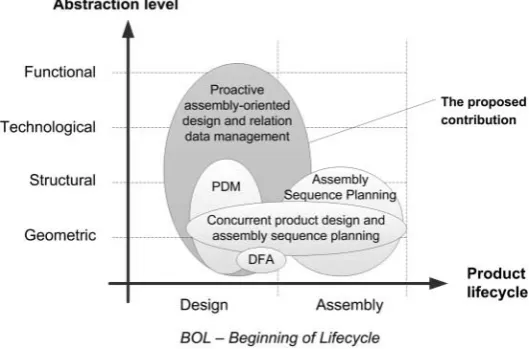
[image:5.493.115.380.472.646.2]Actually, most of the research work performed and reported in the field of DFA can be classified as semi-generative approaches based on heuristics and geometric rules in order to facilitate the assembly of the product (Boothroyd and Dewhurst 1983, Miyakawa and Ohashi 1986, Swift 1989). Based on detailed product geometry and a part-to-part-oriented evaluation, DFA approaches lead to a redesign of products (Barnes et al.2004). On the other hand, research work on ASP has resulted in generating, through algorithms, exact and heuristic methods – which are presented through graphs and diagrams – and evaluating assembly sequences with decision criteria from detailed product geometry and the related assembly relational models (Donget al.2007, Su 2009). In such a context, where product design and ASP are normally undertaken separately and sequentially, which results in missing the true integration between both phases (Delchambre 1996, Barneset al.2004), AOD is a promising way to tackle current engineering practices focused on detailed part geometry (Vielhaberet al.2004). Here, the assembly-oriented practice of product development can be considered as a top-down approach by proactively considering the assembly-related product design and their relationship issues in the early phases of the product development process (Yanet al.2001, Borget al.1999). This emergent trend highlights some challenges related to the relevant shift in engineering design that promotes the relationship-based modelling and man-agement paradigm (Brown 2006, Bradley and Maropoulos 1998). Thus, engineering requirements consist of closer integration of product design model and lifecycle models, earlier application of lifecycle knowledge in generating design decision consequences for informed design decision making, better traceability on various abstraction levels of the product (i.e. functional, behavioural, structural, geometric, technological, etc.) and rational and consistent information management support with the concept of ‘relational design’. Figure 1 presents a research map of past and
Figure 1. A research map of past and current approaches related to product design and ASP issues along the BOL and abstraction levels of product–process information.
4 F. Demolyet al.
current approaches developed for the beginning of life (BOL) (e.g. preliminary and detailed design, assembly process engineering, etc.) at the various abstraction levels, which is used to identify knowledge gap and areas for new research contribution.
2.2. Application status of PLM systems in industry
Initially introduced by the academic community, the PLM strategy consists of the management of the whole product data–information–knowledge for its entire lifecycle (Starket al.2004). This research topic has since also received much attention from industry where current practices are more focused on the management of product technical data and associated workflows through various engineering systems (Eynard et al. 2004, Burr et al. 2005). Indeed, many industrial engineering departments have tackled PLM issues, essentially in BOL and middle of life of the product, by implementing methodologies into various systems such as PDM, computer-Aided X (CAX), MPM, enterprise resource planning (ERP), and supply chain management (SCM) systems in a single digital chain, where all company departments have a role to play (Terziet al.2010).
In the above-defined context of CE, several research issues have to be investigated and tackled on current industrial practices in PLM systems, especially on PDM and MPM systems. Specifically, a PDM system is intended to ensure that the right information is available for the right person at the right time and in the right format by introducing various functionalities such as versioning, bill of material (BOM) management, workflow management, check-in/check-out procedures, change and configuration management, etc. Regarding engineering design data that consist of parts, sub-assemblies, BOMs, specifications, analysis results, configurations and so on, PDM systems can be considered as product model storage systems and still be centred on product information usually embedded in files and documents.
According to the above approaches, a lack of associativity in PLM systems was highlighted by Tremblayet al.(2006) where only ‘parent–child’ i.e. ‘is part of’ class) relationship exists. For a large-scale company, the management of relative positions of parts using matrices is imple-mented in PDM systems in order to be more closely related to geometric models embedded in CAD systems, and to facilitate change management and part positioning. During the last decade, (Weberet al.2003) have proposed an advanced PDM system based on a property-driven development/design approach by introducing the handling of predicted engineering characteris-tics (i.e. structure, shape, and material) and properties (i.e. product’s behaviour) of the product with their interdependencies in a separate manner. However, information related to product rela-tionships and assembly process engineering is not effectively treated in their proposal. More recently, PLM systems have moved towards Web-based and Web-service technologies, in order to facilitate information exchange and access in distributed and extended enterprises (Huanget al. 1999, Liu and Xu 2001, Georgievet al.2007). An additional effort towards ontology and semantic Web can also be found (Matsokis and Kiritsis 2010). According to the above applications and approaches, a lack of support of associability among product models using product relationships still exists and is a barrier for effective and integrated lifecycle-oriented design (Tremblayet al. 2006, Sy and Mascle 2011).
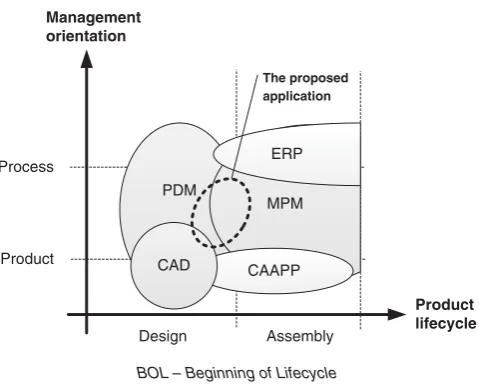
At the interface of computer-aided assembly process planning and ERP systems, MPM systems enable the management of all the information (i.e. assembly operation, assembly sequence, man-ufacturing BOM, resource, etc.) related to assembly process engineering in order to cope mainly with ASP and assembly line balancing issues. The future trend for these kinds of system is to integrate current procedures used in PDM systems, so as to provide an integrated management approach (i.e. multi-BOM, product/process configuration management, etc.) in the broader con-text of PLM (Gao 1999, Bowlandet al.2003, Minget al.2008). Figure 2 presents a research map of current PLM systems through the BOL (i.e. engineering design, assembly process engineering)
PDM
Product lifecycle Management
orientation
Design Assembly
Product Process
MPM ERP
CAAPP CAD
BOL – Beginning of Lifecycle
[image:7.493.128.368.70.262.2]The proposed application
Figure 2. A research map of PLM systems related to product design and assembly process planning along the BOL and the management orientation.
and the related orientation management in order to situate the proposed application focus, enabling a better interaction between product and process data management systems.
2.3. Research problem formulation
The outcome of the above review of the state-of-the-art research work on the related AOD issues and PLM systems application status in industry highlights the need for a new product engineering paradigm.
Currently, traditional part-oriented modelling and management approaches, undertaking part design and its data management before assembly and relationships design, are restrictive, can only achieve local optima in product development, and poses many problems (e.g. rework and poor efficiency). These problem statements can be further evidenced by the fact that current CAD systems are mostly oriented to part geometry modelling and processing, in which relational design only means the management of contextual links between parts and sub-assemblies’ CAD files. In reality, it is desirable to externalise the actual relationships among product design features, assembly features, and manufacturing features and so forth, so that a comprehensive relationship network can be established for relationship reasoning.
There is therefore a need to understand, elicit and manage information embedded in CAD files and BOMs in an intelligent manner (Brown 2006), especially product relationships with the support of an appropriate tool (Kimet al.2004, 2006, Rachuriet al.2006). Moreover, this paradigm requires the management of complex and interlinked relationships in product and life-cycle domains at various levels of abstraction and aspects of the product (Bouikniet al.2008), so as to realise a better interaction among lifecycle phases.
Following these review outcomes, the authors argue the added value of a PROMA by:
• Providing a better efficiency and interaction between the various co-existent engineering management approaches and related systems.
• Capturing, applying, and managing product relationships information and knowledge as early as possible in the product development process.
• Developing a product relationships management tool as an interface application enabling internal regulations procedures of information flow in the product development process.
6 F. Demolyet al.
In the following section, a framework and a multiple view model are introduced and described as a background which emphasises the need for this paradigm in the broader context of PLM.
3. Background of the proposed approach
This section describes the PASODE framework and the MUVOA model in the context of CE and PLM based on previous work on AOD issues (Demoly 2010).
3.1. The PASODE framework
The key objective of this framework is to enable and promote a concurrent and proactive approach to concurrent product design and ASP, especially in the early product development process before product conceptual design decisions on geometry, materials, and other related design aspects are completely committed. This framework is featured by a mathematical algorithm called Assembly Sequence Definition Algorithm based on DFA and ASP heuristics rules, associated with a tolerance analysis, which defines an optimal assembly sequence by incorporating the definition product relationships at various abstraction levels (Demoly 2010, Demolyet al.2010a, 2011a, 2011b).
In such a way, the act of defining an assembly sequence using product relationships informa-tion allows the definiinforma-tion of a skeleton-based assembly context related to lifecycle engineering issues for geometric product modelling in CAD systems (Rehman and Yan 2007, Demolyet al. 2011c). Fulfilling current stakes in AOD and PLM issues, the PASODE framework consists of var-ious steps, in which four stakeholders are involved, namely product architect, assembly planner, designer, and process engineer. Here the product architect can be considered as a highly skilled and experienced system designer who has an overall vision of the product or system definition and functionality. His major role is to define the product overall functionality and lifecycle require-ments and generate an architecture which fulfils functional and technical requirerequire-ments related to the product lifecycle stages. At lower abstraction levels, the designer is more concerned with the sub-assembly and parts definitions by taking into account the product architect’s definitions for each of these components or sub-assemblies. The assembly planner is concerned with planning task of putting parts together once they are completed and manufactured through the process engineer’s inputs. So this framework can be deployed as follows:
(1) Based on functional requirements, geometric requirements – such as performance key characteristics – are deployed into the PDM system through the engineering BOM (eBOM). (2) The assembly relationships modelling phase is developed by the product architect at various abstraction levels such as functional, behavioural, technological, and geometric. Each layer of relationships information is computed to optimise part number and generate admissible assembly sequences.
(3) For each admissible assembly sequence, a consistency checking procedure related to con-strained degrees of freedom is performed to highlight specific requirements, namely assembly key characteristics (AKC).
(4) All admissible assembly sequences and related AKC are introduced into a tolerance analysis tool in order to find which assembly sequence fulfils all geometric requirements of the product. (5) So the choice of the optimal assembly sequence can be carried out by introducing AKC
interval values.
(6) Once the assembly sequence is defined, several information embedded PLM system views can be generated, including manufacturing BOM (mBOM) in the MPM system, product structure and skeleton-based assembly context in PDM/CAD systems.
Analyse tolerances Define product relationships Identify geometric requirements (KC) Generate product structure Parts of the
product solution Engineering
Bill of Materials (eBOM) Define assembly skeleton Check the consistency of information Assembly operations Reduce parts number
AKC to be considered Evaluate all admissible assembly sequences Optimal assembly sequence CAD tool Define design skeleton Assembly skeleton PDM system Product structure Design skeleton Product architect Assembly planner Designers Expert Process Tolerances analysis application Mechanism Input/Output information Functional requirements Generate Assembly sequence Admissible assembly sequences Step by step automatic Taux de satisfaction des AKC Manufacturing context Legend
Find the best assembly sequence
[image:9.493.73.422.64.335.2]MPM system
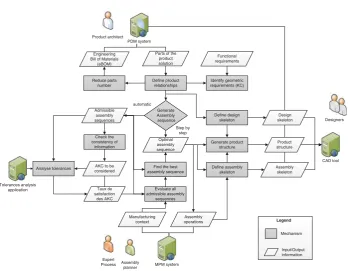
Figure 3. PASODE framework (Demoly 2010).
Figure 3 illustrates various mechanisms (grey boxes) and related input/output information (white boxes) to show the aforementioned steps. These allow improving traditional capabilities of PDM, MPM, and CAD systems by focusing on and processing product relationships at various levels of abstraction.
Indeed Figure 3 highlights the need for applying PROMA through a comprehensive set of mechanisms with a clear definition of dependencies between technical entities. This approach also enables the system to maintain the traceability of product–process information flow during the product development process. The next paragraph describes a multiple view model considered as a basis for the PASODE framework (Demolyet al.2010b).
3.2. The MUVOA model
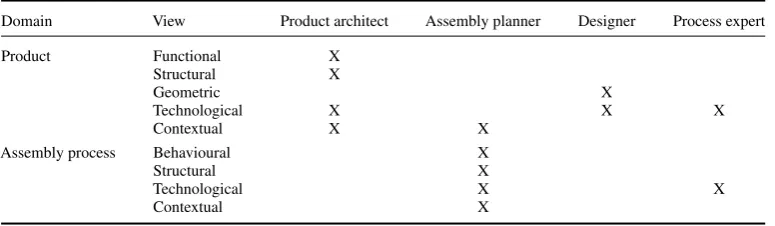
Focusing on the relationship entity, the MUVOA model has been proposed and it describes entities and their related associations which are handled in the PASODE framework (Demoly et al.2010b). The main objective of the model is to map concepts and related data structures in order to be used in an integrated and proactive manner. In such a way, this model can be broken down into several view models consistent with viewpoint, concern, and purpose associated with each stakeholder involved in product design and ASP domains. Figure 4 presents the MUVOA model and the various views from product and assembly process domains. Six kinds of views have been identified to describe the various product aspects, especially at the beginning of the product lifecycle. Table 1 presents the allocation of stakeholders involved in terms of product design and assembly process domains.
Thus, the proposed model is based on the consideration of multiple views which are at the same time also linked to the stakeholders involved in the product development. In addition, this model highlights the complexity of relationships among different stakeholders and multiple viewpoints
8
F
.
Demoly
et
[image:10.493.57.614.52.416.2]al.
Figure 4. UML class diagram describing the MUVOA model (Demolyet al.2010b).
Table 1. Allocation of stakeholders and views from product and assembly process domains.
Domain View Product architect Assembly planner Designer Process expert
Product Functional X
Structural X
Geometric X
Technological X X X
Contextual X X
Assembly process Behavioural X
Structural X
Technological X X
Contextual X
to which a similar complex multi-perspective views was identified in (Yan 2003). It is essential and important to have a full representation of these relationships (both in contextual view in product domain and assembly domain). Such a comprehensive representation will facilitate and propagate information flow towards other related views as well. Based on these relationships’ identifications and their representation, the next section presents the novel approach to product relationships management, to control the evolution of product information and more importantly make use of the information as early as possible so that a better support is enabled during the product development process.
4. Product relationships management approach
Built on the PASODE framework, and deploying the MUVOA model, this research derives a novel management approach – PROMA – to tackle product relationships. To realise a successful product development, it is vital to emphasise the importance and capture the representation of relationships between parts and sub-assemblies of a product. This provides the basis to promote and control information flow among lifecycle phases in a proactive and intelligent manner. Here, a relationship can be considered as the means to establish, represent, or maintain a consistent link between two technical entities.
Thus, the management of relationships provides essential information for an understanding of how parts can be assembled and connected with each other. This new PROMA enables the externalisation of an inside view of the relations within product–process definition in PDM, MPM, and CAD systems. PROMA hence provides an insightful design support to understand fully the relationships among all product components. In such a way, product relationships are defined and elicited, to support AOD by managing all information related to parts assembly at the interface of the product design and ASP domains.
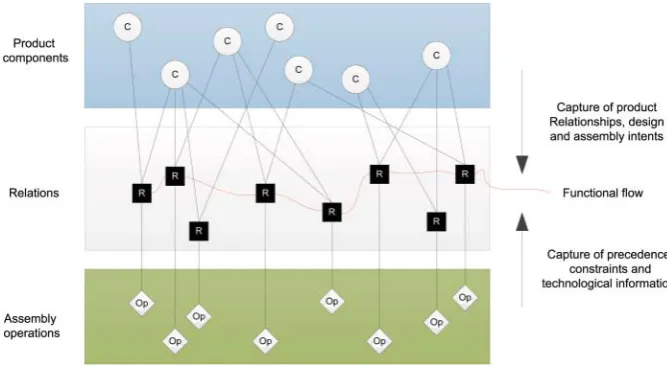
As illustrated in Figure 5, traditional engineering management practices consist of only manag-ing smanag-ingle domain entity networks – such as product components, assembly operations networks and so on – in separate systems (PDM, MPM). These approaches and associated systems there-fore result in interface and integration gap, missing a close interaction between both domains. To rectify this deficiency, the next paragraph introduces the concept of multiple relationships at various abstraction levels, which can provide a better interaction in concurrent product–process data management approaches.
4.1. Capturing and defining product relationships
In the previous section, representing and managing multiple product relationships have been high-lighted and considered as a new important concept enabling a better integration between product
10 F. Demolyet al.
Figure 5. Concurrent networks of product components and assembly operations.
and assembly process information. In this section, the capture and the description of relational information at the various abstraction levels, consistent with mechanisms of the PASODE frame-work and the MUVOA model, are introduced. Figure 6 illustrates the product relationships which are the results of elicitation of design and assembly intents as well as precedence constraints between assembly operations.
So, information relating product components and assembly operations networks can be captured and located in a separate way. A modification of a relation can therefore impact the networks associated with this new entity in a bidirectional manner. Based on the requirements of representing product function and assembly, it is proposed to capture four kinds of relationship as described below:
• Contact relation: physical contact relation between two components.
• Precedence relation: assembly logical order for two components in contact and in non-contact.
• Kinematic relation: additional information on contact relation which enables the description of constrained degrees of freedom (rotation and translation) for each part of the product.
• Technological relation: additional information on contact relation which enables the definition of the assemblability of the product, and therefore on the mating relation between two components in contact.
Figure 6. Capture of product relationships from product components and assembly operations networks.
[image:12.493.77.411.467.650.2]Thus, each level of abstraction provides relevant input information for the various mechanisms defined in the PASODE framework. For instance, contact and precedence relations are considered as input data for the definition of the optimal assembly sequence (in behavioural view from assembly process domain) and the product structure (in structural view from product domain). On the other hand, kinematic and technological relations can be used to define design and assembly skeletons (in geometric view from product domain), and assembly technologies (in technological view from assembly process domain) consistent with the early-defined assembly sequence. It is clear that these four types of relationship enable the cross domain product data associations which can potentially allow reasoning and intelligent design decision checking and suggesting. Starting from this classification and definition both in product and assembly domains, the next section introduces information flow between identified views in the MUVOA model, so as to provide internal regulation procedures in a new product–process data management approach.
4.2. Information flow used in PROMA
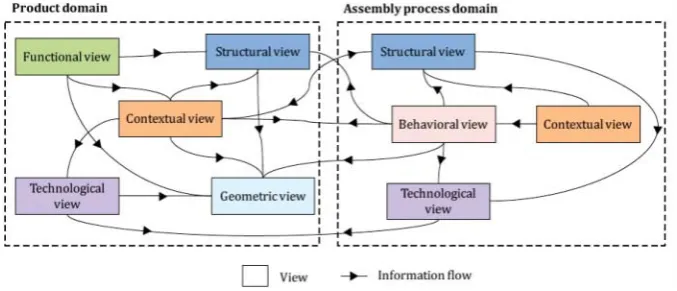
The introduction of relationships in the new product–process data management approach leads to drive some aspects of the product development – such as common views used in engineering systems and new ones defined in the MUVOA model – in a different and coherent manner. The proposed information flow depends on the order in which the mechanisms of the PASODE framework are applied. Figure 7 illustrates the information flow between views within the product domain and assembly process domain as well as cross both domains in the MUVOA model. In such a way, dependencies between views are highlighted for cross view relationship exploration and in this case two views have been identified with a major influence on the related ones, namely: ‘contextual view’ from product domain and ‘behavioural view’ from assembly process domain. These two views facilitate the capture of design and assembly intents of the product, therefore having a major role on the definition of product information in the BOL phase.
[image:13.493.77.416.506.651.2]Thus, information flow helps to identify the information propagation from one view to another, which is in correspondence with either product evolution or assembly process evolution in terms of the information’s level of abstraction. Here, the proactive feature of the PASODE framework is enabled and embodied by bidirectional arrows between views from product and assembly process domains. For instance, the assembly sequence defined in the behavioural view from assembly process domain influences the product structure in the structural view from product domain, and also the product geometry in geometric view as shown in Figure 7. This clear externalisation of
Figure 7. Description of information flow between views defined in the MUVOA model.
12 F. Demolyet al.
the dependent relationships among different views of a product is the key novel aspect of this work.
It is therefore critical to describe and control such an influence by introducing new associations between technical objects defined in the above MUVOA model, so as to propagate and update automatically information in each view. Section 4.3 presents the various kinds of associations introduced in the PROMA and the related functional procedures.
4.3. Association management in PLM systems
In addition to the associations which are currently used in PDM, MPM, and CAD systems, several new ones have been identified and represented in this research as described below:
• Composition link: describes a link between product and its components in product domain, and between assembly operations in assembly process domain.
• Interface link: describes a link between two components of the same assembly (internal interface link) or from different assemblies (external interface link).
• Representation link: describes a link between a technical object and a document.
• Projection link: describes a link between a technical object and a view.
• Precedence link: describes a logical order between two assembly operations.
• Temporal link: describes a lag between two assembly operations.
Based on all the above associations, it is now possible to describe the allocation of the functional procedures embedded in the future PROMA application, which is compatible and in coherence with mechanisms defined in the PASODE framework. With all these in place, should it be required, it is feasible to propagate relational information from the PROMA application to product compo-nents and assembly operations networks in PDM/CAD and MPM systems. For instance, Table 2 shows in the first raw the definition of a contact relation between two components which implies the creation of an interface link between these technical objects in the PDM system.
4.4. Definition of bill of relation
[image:14.493.55.441.512.668.2]The control of information flow and exchange requires the introduction of a new concept called ‘bill of relation’ (BOR). The concept of bill of X (BOX) – such as used in current PDM (eBOM), CAD (CADBOM) and MPM (mBOM) systems – allows for capturing the state of the product
Table 2. Management of associations in the PROMA application.
PASODE mechanism PROMA procedure Association PLM system
Define contact relations Create Interface link PDM Define precedence relations Create Precedence link MPM Define kinematic pairs Create Interface link CAD Define technological pairs Create Interface link CAD Define assembly sequence Create Temporal link MPM Check information
consistency
Modify kinematic pairs Projection link PDM
Define design skeletons Allocate kinematic and technological pairs
Composition and Interface links
CAD
Define product structure Allocate assembly sequence Composition and Interface links
PDM and CAD
Define assembly skeletons Allocate kinematic and technological pairs
Composition and Representation links
PDM and CAD
Define assembly operations Allocate technological pairs Composition link MPM
or the assembly process atttime in the product development process. Consequently, the concept of BOR provides a complementary view on the state of both domains (product and assembly process). In such a way, the role of BOR is to facilitate information propagation by establishing the relationship between eBOM and mBOM, eBOM and CADBOM, and CADBOM and mBOM in PLM systems as well.
To facilitate information exchange between the PROMA application and the related PLM systems, BOR are broken down into three orientations as described below:
• PDM-oriented BOR: describes composition, interface, and representation links between prod-uct components in the PDM system. This kind of BOR is generated and controlled by the contextual view from product domain and the behavioural view from assembly process domain, therefore enabling the definition of the product structure.
• MPM-oriented BOR: describes composition, precedence, and temporal links between assembly operations in the MPM system. This kind of BOR is generated and controlled by the contextual and technological views from product domain, and the contextual and behavioural views from assembly process domain, therefore enabling the definition of the assembly operations structure.
• CAD-oriented BOR: describes composition, interface links between skeleton entities of the product in CAD system. This kind of BOR is generated and controlled by the contextual and structural views from product domain, and the behavioural view from assembly process domain, therefore enabling the definition of the geometric skeletons structure.
These bills of relation therefore provide a better interaction between the PROMA applica-tion and the related PLM systems in coherence with the previously defined associaapplica-tions. In this section, a thorough method of capturing and defining four kinds of part-to-part relationships has been introduced. Using these relationship concepts and the method, it is possible to define a com-prehensive set of relationships between the product components and assembly operations. This provides a solid base for an exploration of them and for intelligent reasoning using these relation-ships. Building on these relationships, product view-based relationships can be established and identified for support relationship-based reasoning. In this research, the proactive reasoning and utilisation of these relationships across domains from product to assembly process are enabled to further proactively explore the use of these relationships to improve the design and assembly process. An enhanced set of associations in addition to commonly used associations by PDM, MPM, and CAD systems, have also been identified and introduced to provide deeper and fuller representations of complex relationships of the product from multiple perspectives. And finally these lead to an introduction of BOR, which is used to accommodate relationships commonly found in PDM, MPM, CAD systems, and the approach introduced in this paper. This full represen-tation hence provides a solid and comprehensive represenrepresen-tation of the relationships of a product from multiple views. The reasoning mechanism introduced in the MUVOA model and PROMA then can be fully deployed to undertake the intelligent and proactive relationship management.
4.5. Case study
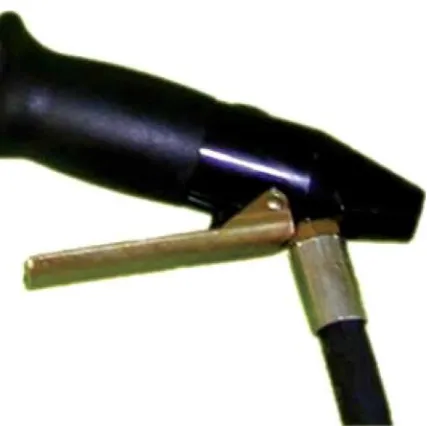
The above overall architecture and approaches have been implemented and applied to a company’s real product development as a case study. This is intended to demonstrate the potential benefits and relevance of such an integrated and proactive engineering relationship management paradigm, focusing on the product design and ASP views. The case study part is a pneumatic valve which is part of a pneumatic scraper designed by a small and medium enterprise (SME). Figure 8 shows a pneumatic valve developed previously. Due to space limit, this section only gives a brief overview of the case study and the detailed description of the implementation and the case study is described in Demoly (2010).
14 F. Demolyet al.
Figure 8. A pneumatic valve of a past design.
Currently, all product components are manufactured by subcontractors. Similar to many integrating companies, this mode of operation poses challenges for the company when it comes to assembly. The SME especially faces difficulties of assembling all parts made by different subcon-tractors, as a result of poor integration of assembly process planning and the product development process. This separate undertaking of assembly planning and product development resulted in much rework and poor product quality.
The PROMA in conjunction with the PASODE framework for a new pneumatic valve devel-opment was used as early as possible to illustrate the potential benefits. Figure 9 shows a 3D assembly model describing the geometry of the new pneumatic valve developed. The main bene-fits identified include reduced product development and assembly process lead time. The integrated approach enables the product architects, designers, and assembly planners to eliminate many of the problematic design decisions supported by the framework and the approach. These eliminated ‘problematic design decisions’ over assembly life phase have the potential to result in reduced rework, shortened product overall development, and production time. This naturally leads to an
Figure 9. A 3D view of a pneumatic valve of a new design.
[image:16.493.117.380.510.649.2]increased overall efficiency gain by reducing the iterations between product design and ASP all along the product development process. Other benefits include flexibility of relationship manage-ment by enabling the representations of comprehensive and complex relationships. A final benefit is the increased sensitivity of the overall relationship management capability. This is based on the fact that if a modification of a particular relationship between two product elements has been made during product development, these changes will be propagated as new information to the assembly planning and related assembly operations. This increased level of sensitivity ensures that the integrity of the product architect is intact and the product relationship definition is consistent and updated.
5. Conclusions
The paper has described the background of the research and building on previous work, a sys-tem framework entitled PASODE is presented. This comprehensive and innovative concurrent design and assembly process planning framework provides a theoretical foundation and a model for a closer product relationship-based concurrent product and manufacturing design approach. It supports designers and assembly process planners to use the identified relationships to generate solutions to meet the requirements from both viewpoints.
Similarly this framework, enables other stakeholders to use these complex relationships to evaluate solutions from their perspective. All capabilities are facilitated and enabled by a unique MUVOA model, which models a product from six distinctive yet linked perspective view-points. Based on this comprehensive multiple viewpoint model, a novel product relationship management approach entitled PROMA has been proposed and described. A concurrent net-work of product components and their assembly operations is established using PROMA, which can then be established and relationships identified among multiple viewpoints. With all these relationships established at one flat level inherently linked to different viewpoints, it is then possible to establish associated design parameters from different viewpoints. These parameters then are used as the basis to concurrently develop lifecycle phase solutions based on the prod-uct design information, at early design stage even when the design is incomplete and currently evolving.
This philosophically different concurrent design approach therefore significantly differs from a traditional approach, in which a product is designed followed then by the ASP. This approach essentially enables the concurrent considerations of both sets of design and planning requirements, supporting the elimination of design flaws caused by a lack of concurrent considerations of lifecycle requirements.
Due to space limit in this paper, the implementation of the approach within a PLM application will be reported in detail in a separate paper, containing also case studies to validate the approach and demonstrate the potential benefits. For information, the application of this approach has reduced semantics barriers between product lifecycle phases and has improved iteration efficiency. A gain of 50% has been targeted then obtained for product–process development lead time, given the CE and bi-directional aspects such as developed in the PROMA. From a quality point of view in engineering, the approach has increasingly reduced major iterations between design engineering and production departments by better understanding and exploitation of product relationship and associativity.
The challenge of making useful lifecycle-oriented decisions which could only be made at a par-ticular time or lifecycle phase based on the available information is inherently difficult. Without committing sufficient decisions relating to a particular lifecycle phase, it would be difficult for mechanisms such as the MUVOA model and PROMA to reason with sufficient information and
16 F. Demolyet al.
generate even more useful information or identifying any potential design deficiencies regarding lifecycle phase considerations. For example, if an assembly method decision is not committed by selecting either a manual or an automated assembly method, it would be difficult for the MUVOA model and PROMA to identify any potential design features which would cause prob-lems for either of the assembly methods. This can only be fully appreciated by such reasoning mechanisms once the assembly method is committed. Having appreciated this challenge and the potential complications when more lifecycle views are considered, the research work adopted a pragmatic approach and in the implementation there are programme codes written to ensure suf-ficient decisions have been made before any deduced decision or recommendations can be made. Users of such a system therefore need to understand this limitation. Another challenge is the level of concurrency of lifecycle phase design and analysis. Many lifecycle-oriented decisions can only be made if there is sufficient information about a particular phase available through committing to certain decision. The more decisions that are committed for an assembly process, the better the concurrency will be and the higher the quality of the decisions or recommendations made.
6. Future work
Having achieved a good level of closer integration for product design and assembly planning, future work will focus on making assembly information accessible and exploitable by data man-agement systems and computer-aided X tools in order to support product architects and designers. Product relationships will be described using the part-whole theory supported by mereology and its extension, mereotopology; and also implemented in an ontology in order to reuse this information in other lifecycle phases.
Another important area is the extension of the same framework and approaches presented in this paper to other product views. The product lifecycle views of considerations include overall manufacturability of a design solution over its alternatives, product commission view, service view; and environmental impact view in terms of carbon footage, energy consumption, recycling, or decommissioning. Challenges discussed will also be further investigated to identify exactly the minimal information required to achieve a satisfactory level of lifecycle-based reasoning. It is believed that through this comprehensive and thorough lifecycle consideration, a true lifecycle-based product development framework will be generated, validated, and eventually applied by many companies as a new generation design approach for realising many of the benefits discussed in this paper.
Acknowledgements
The authors thank MABI for this collaboration on the case study described in the paper.
References
Barnes, C.J., Jared, G.E.M., and Swift, K.G., 2004. Decision support for sequence generation in an assembly oriented design environment.Robotics and Computer-Integrated Manufacturing, 20, 289–300.
Boothroyd, G. and Dewhurst, P., 1983.Design for assembly. Amherst, MA: Department of Mechanical Engineering, University of Massachusetts.
Borg, J., Yan, X.T., and Juster, N.P., 1999. Guiding Component Form design using decision consequence knowledge support.Artificial Intelligence for Engineering Design, Analysis and Manufacturing, 13, 387–403.
Bouikni, N., Rivest, L., and Desrochers, A., 2008. A multiple views management system for concurrent engineering and PLM.Concurrent Engineering: Research and Applications, 16 (1), 61–72.
Bowland, N.W., Gao, J.X., and Sharma, R., 2003. A PDM- and CAD-integrated assembly modeling environment for manufacturing planning.Journal of Materials Processing Technology, 138 (1–3), 82–88.
Bradley, H. and Maropoulos, P., 1998. A relation-based product model for computer-supported early design assessment.
Journal of Materials Processing Technology, 76, 88–95.
Brown, J., 2006.Managing product relationships: enabling iteration and innovation in design. Business Value Research Series, June, AberdeenGroup.
Burr, H.,et al., 2005. CAx/engineering data management integration: enabler for methodical benefits in the design process.
Journal of Engineering Design, 16 (4), 385–398.
CIMdata, 2005.The value of digital manufacturing in a PLM environment? case study: Fiat auto. S.p.A.
Delchambre, A., 1996.CAD method for industrial assembly: concurrent design of products, equipment and control systems. New York: Wiley.
Demoly, F., 2010.Conception intégrée et gestion d’informations techniques: application à l’ingénierie du produit et de sa séquence d’assemblage. Thesis (PhD). Université de Technologie de Belfort-Montbéliard, France.
Demoly, F.,et al., 2010a. PLM-based approach for assembly process engineering.International Journal of Manufacturing Research, 5 (4), 414–428.
Demoly, F., et al., 2010b. Multiple viewpoint modelling framework enabling integrated product–process design.
International Journal on Interactive Design and Manufacturing, 4 (4), 269–280.
Demoly, F.,et al., 2011a.An assembly-oriented design framework for product structure engineering and assembly sequence planning.Robotics and Computer-Integrated Manufacturing, 27 (1), 33–46.
Demoly, F.,et al., 2011b. Proactive assembly oriented design approach based on the deployment of functional requirements.
Journal of Computing and Information Science in Engineering, 11 (1), 6.
Demoly, F.,et al., 2011c. Geometric skeleton computation enabling concurrent product engineering and assembly sequence planning.Computer-Aided Design, 43 (12), 1654–1673.
Dong, T.,et al., 2007. A knowledge-based approach to assembly sequence planning.International Journal of Advanced Manufacturing Technology, 32 (11–12), 1232–1244.
Eynard, B.,et al., 2004. UML based specifications of PDM product structure and workflow.Computers in Industry, 55 (3), 301–316.
Gao, J., 1999. A market survey of industrial – requirements for product data management and manufacturing planning systems.Proceedings of the 1999 IEEE international symposium on assembly and task planning, July, Porto, Portugal. Georgiev, L., Ovtcharova, J., and Georgiev, I., 2007. Modelling web services for PLM distributed system.International
Journal of Product Lifecycle Management, 2 (1), 30–49.
Helms, R.W., 2002.Product data management as enabler for concurrent engineering. Thesis (PhD). Eindhoven University of Technology, The Netherlands.
Holt, R. and Barnes, C., 2009. Towards an integrated approach to ‘Design for X’: an agenda for decision-based DFX research.Research in Engineering Design. London: Springer.
Huang, G.Q., Lee, S.W., and Mak, K.L., 1999. Web-based product and process data modeling in concurrent ‘design for X’.Robotics and Computer-Integrated Manufacturing, 15, 53–63.
Kim, K.Y.et al., 2004. Design formalism for collaborative assembly design.Computer-Aided Design, 36(9), 849–871. Kim, K.-Y., Manley, D.G., and Yang, H., 2006. Ontology-based assembly design and information sharing for collaborative
product development.Computer-Aided Design, 38, 1233–1250.
Liu, S. and Boyle, I.M., 2009. Engineering design: perspectives, challenges, and recent advances.Journal of Engineering Design, 20 (1), 7–19.
Liu, D.T. and Xu, X.W., 2001. A review of web-based product data management systems.Computers in Industry, 44 (3), 251–262.
Mantripragada, R., 1998. Assembly oriented design: concepts, algorithms and computational tools. Thesis (PhD). Massachusetts Institute of Technology, MA.
Matsokis, A. and Kiritsis, D., 2010. An ontology-based approach for product lifecycle management.Computers in Industry, 61, 787–797.
Ming, X.G.,et al., 2008. Collaborative process planning and manufacturing in product lifecycle management.Computers in Industry, 59, 154–166.
Miyakawa, S. and Ohashi, T., 1986. The Hitachi assemblability evaluation method.Proceedings of the international conference on product design for assembly15–17 April, Newport, RI.
Rachuri, S.,et al., 2006. A model for capturing product assembly information.Journal of Computing and Information Science in Engineering, 6, 11–21.
Rechtin, E., 1991.Systems architecting, creating building complex systems. Upper Saddle River, NJ: Prentice-Hall. ISBN 0 13 880345 5.
Rehman, F.U. and Yan, X.T., 2007. Supporting early design decision making using design context knowledge.Journal of Design Research, 6(1–2), 169–189.
Sapuan, S.M., Osman, M.R., and Nukman, Y., 2006. State of the art of the concurrent engineering technique in the automotive industry.Journal of Engineering Design, 17 (2), 143–157.
Stark J.,et al., 2004.Product lifecycle management – paradigm for 21st century. Berlin: Springer-Verlag.
Su, Q., 2009. A hierarchical approach on assembly sequence planning and optimal sequences analyzing.Robotics and Computer-Integrated Manufacturing, 25 (1), 224–234.
Sudarsan, R.,et al., 2005. A product information modeling framework for product lifecycle management.Computer-Aided Design, 37, 1399–1411.
Sy, M. and Mascle, C., 2011. Product design analysis based on life cycle features.Journal of Engineering Design, 22 (6), 1–20.
Swift, K., 1989. Expert System aids design for assembly.Assembly Automation, 9 (3), 132–136.
18 F. Demolyet al.
Terzi, S.,et al., 2010. Product lifecycle management – from its history to its new role.International Journal of Product Lifecycle Management, 4 (4), 360–389.
Tremblay, T.G.,et al., 2006. The role of associations in CAD and PLM for handling change propagation during product development.In: P. Ghodous, R. Dieng-Kuntz, and G. Loureiro, eds.Proceedings of the 2006 conference on Leading the Web in Concurrent Engineering: Next Generation Concurrent Engineering, 18–22 September, Antibes, France. Amsterdam, The Netherlands: IOS Press, 507–514.
Vielhaber, M.,et al., 2004. Assembly-oriented design in automotive engineering.International design conference, 1–8 May, Dubrovnik.
Wang, L.,et al., 2009. Assembly process planning and its future in collaborative manufacturing: a review.International Journal of Advanced Manufacturing Technology, 41, 132–144.
Weber, C., Werner, H., and Deubel, T., 2003. A different view on product data management/product life-cycle management and its future potentials.Journal of Engineering Design, 14 (4), 447–464.
Whitney, D.E.,et al., 1999. Designing assemblies.Research in Engineering Design, 11, 229–253. Wognum, N. and Trappey, A., 2008. PLM challenges.Advanced Engineering Informatics, 22, 419–420.
Yan, X.T., 2003. A multiple perspective product modelling and simulation approach to enhancing engineering design decision making.Concurrent Engineering: Research and Applications, 11 (3), 221–234.
Yan, X.T., Borg, J., and Juster, N.P., 2001. Concurrent modelling of components and realization systems to support proactive design for manufacture/assembly.Journal of Engineering Manufacture, Proceedings of the Institution of Mechanical Engineers Part B, 215,1135–1141.
Zha, X.F. and Du, H., 2002. A PDES/STEP-based model and system for concurrent integrated design and assembly planning.Computer-Aided Design, 34, 1087–1110.
Zha, X.F., Du, H.J., and Qiu, J.H., 2001. Knowledge-based approach and system for assembly oriented design, Part I: the approach.Engineering Applications of Artificial Intelligence, 4, 61–75.