City, University of London Institutional Repository
Citation
:
Scott, J., Nolan, J. and Plagnol, A. (2009). Panel data and open-endedquestions: Understanding perceptions of quality of life. Twenty-First Century Society: Journal of the Academy of Social Sciences, 4(2), pp. 123-135. doi: 10.1080/17450140902988891
This is the unspecified version of the paper.
This version of the publication may differ from the final published
version.
Permanent repository link:
http://openaccess.city.ac.uk/2554/Link to published version
:
http://dx.doi.org/10.1080/17450140902988891Copyright and reuse:
City Research Online aims to make research
outputs of City, University of London available to a wider audience.
Copyright and Moral Rights remain with the author(s) and/or copyright
holders. URLs from City Research Online may be freely distributed and
linked to.
PANEL DATA & OPEN-ENDED QUESTIONS:
UNDERSTANDING PERCEPTIONS OF QUALITY OF LIFE
Jacqueline Scott, Jane Nolan & Anke C. Plagnol
University of Cambridge
Twenty-First Century Society: Journal of the Academy of Social Sciences.
4(2), pp. 123-135 (June 2009)
Published version available at
http://dx.doi.org/10.1080/17450140902988891
PANEL DATA & OPEN-ENDED QUESTIONS:
UNDERSTANDING PERCEPTIONS OF QUALITY OF LIFE
Abstract
This paper describes the burgeoning interest in quality of life studies and suggests that as well as expert definitions, we need to consider people’s own perceptions of what matters. Using open-ended questions from the 1997 and 2002 waves of the British Household Panel Survey we analyse both quantitatively and qualitatively how perceptions of quality of life differ for men and women across the life course. Qualitative analysis reveals that key domains such as health, family and finances often refer, not to self, but to others. Longitudinal analysis demonstrates that people’s perceptions of quality of life change over time, particularly before and after important life transitions. Thus our findings challenge overly individualistic and static conceptions of quality of life and reveal quality of life as a process, not a fixed state.
Introduction: Quality of Life
When President Lyndon Johnson delivered his ‘Great Society’ speech in 1964 at the
University of Michigan, Ann Arbor, he made the statement that there is more to the ‘good
life’ than the acquisition of material wealth1. While he did not actually use the term
‘quality of life’ in this speech, his discourse was part of a zeitgeist which inspired a
generation of American social scientists to explore the concept in more detail and to
begin the challenge of finding adequate ways of measuring quality of life (e.g. Campbell
1972; Szalai and Andrews 1980). Since the 1960s there has been a huge growth of quality
of life studies throughout the world with a convergence of interest in the area by
economists (Layard 2005; Sen 1993, Easterlin 2001), economic historians (Offer 2006),
psychologists (Argyle 1996; Cummins 1997, Diener and Seligman 2004), philosophers
(White 2006), political scientists (Lane 1996) and sociologists (Veenhoven 2000).
However, there has not been much progress in reaching consensus on what we mean by
‘quality of life’. Do we mean ‘satisfaction’, ‘happiness’, ‘standard of living’, ‘well-being’
or some unspecified combination of all these things? Moreover, in what range of
circumstances, individual and/or social, might these terms be applied?
There is an increasing consensus that assessment of quality of life requires both objective
and subjective indicators. The distinction between objectivity and subjectivity is not an
easy one to make, however, as even objective indicators can be subject to perceptual
inconsistencies and give rise to reporting errors. Nevertheless there is a difference
between objective indicators which can be assessed by someone other than the person
whose life-quality is being measured and subjective indicators such as life satisfaction
which can not (Andrews 1980). We would argue, however, that the separation of the two
indicators in terms of the evaluation of quality of life is misguided.
Recent decades have seen some important advances in the way that quality of life is
conceptualized. For example, Veenhoven (2000) identifies four qualities of life that span
two conceptual dimensions. The first roughly corresponds to the objective - subjective
distinction referred to above, but in this classification it is called ‘outer’ and ‘inner’
aspects of life quality. The second dimension distinguishes life chances and life results.
The resulting typology can be seen on the left hand side of Table 1. In the upper half of
the table we see two variants of the potential quality of life (life chances). The top left
quadrant ‘the liveability of the environment’ denotes the meaning of good living
conditions. The top right quadrant ‘life ability of the person’ denotes inner life chances i.e
how well the person is equipped to cope with the problems of life. Life ability is quite
closely related to Sen’s (1993) more widely used concept of capability. Veenhoven
defends his use of ‘life ability’ as being a simpler term that contrasts well with liveability.
The lower half of the table is about quality of life results or outcomes. These outcomes
can be judged by their value for one’s environment and value for oneself. The external
worth of a life or the ‘utility of life’ is clearly related to the inner valuation ‘appreciation
of life’ but they are not synonymous.
A rather different typology is used to theorise the way that wellbeing is measured in the
European Social Survey (ESS). The ESS is an academically driven survey designed to
chart and explain the interactions between Europe’s changing institutions and the
attitudes, beliefs and behaviours of its diverse populations. The questionnaire has a core
component that is designed to measure change and continuities in a wide range of
socio-economic, socio-political, social-psychological and socio-demographic variables as well
as a rotating module that allows an in-depth comparative focus on a particular academic
and policy concern. In 2006 (the third wave) ESS fielded a new module on wellbeing
(Huppert et al 2008). This module was the first attempt to operationalise a wellbeing
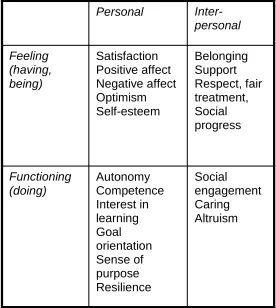
index, as proposed by Diener and Seligman (2004). The measures of wellbeing
distinguish four different aspects of subjective quality of life that are aligned along two
dimensions. The first dimension distinguishes between feeling and functioning. This
dimension has its origins in classical philosophy and creates a bridge between the more
private realm of personal happiness to the more public issues of competencies, freedoms
and opportunities. This distinction has been elaborated in the work of Sen (1999) which
highlights the necessity of freedom and democracy in order for individuals to develop
their capabilities and function effectively. The second dimension distinguishes personal
and interpersonal, creating a two-by-two conceptual space for wellbeing measures as
shown in the right hand side of Table 1.
While these attempts at typologies and the classification of quality of life serve useful
analytical purposes, they are moving quite some distance from the way quality of life is
distinction between “experience near” and “experience distant” concepts. He writes: “an
experience-near concept is, roughly, one that someone – in our case an informant – might
himself naturally and effortlessly use to define what he or his fellows see, feel, think,
imagine and so on, and which he would readily understand when similarly used by
others. An experience-distant concept is one that specialists use to forward their scientific
aims” Geertz’s interpretive method is to listen to the experience-near concepts with
which people express themselves, then connect these to theoretical (experience-distant)
concepts meaningful to social scientists working to understand the world. Schuman
(2003) suggests that survey researchers can also explore ‘experience near’ concepts by
using open-ended questions that allow people to describe in their own words some aspect
of their social world. Most contemporary surveys ignore this advice and avoid the use of
open-ended questions. This is not surprising as such questions are time-consuming to
collect and resource-intensive to process. However, verbatim responses to open-ended
questions, used sensitively, can provide a window into people’s understandings that no
“tick box” or pre-set response categories could adequately capture. In our case, the use of
responses to open-ended questions can help us understand what people perceive as
important for quality of life and also to track how perceptions change across the life
course, something few other studies have done.
In this paper we examine what people perceive as important for their own quality of life.
Because our data are part of an ongoing panel study - the British Household Panel Survey
- we can make inferences about what aspects of quality of life mattered most to people in
differ across different sub-groups of the population; for example, it seems likely that
younger people’s perceptions will differ from older age groups, and that men’s and
women’s perceptions will also differ. The huge advantage that a panel study has over
non-longitudinal forms of data is that it allows us to monitor individual level changes and
to give serious consideration to a life course perspective. Thus we can compare people’s
perceptions of quality of life before and after they experience important life course
transitions such as the move into a new job, becoming parents or, retiring.
In the next section, we explore in more detail the advantages of longitudinal data analysis
in general and panel data in particular. To illustrate the advantages that panel data offer
for social inquiry, we briefly examine why men and women’s perceptions of quality of
life are likely to change across the life course. We then discuss in more detail the unique
characteristics of the British Household Panel Survey, and the qualitative and quantitative
approaches we use to analyse perceptions of quality of life and how such perceptions
change over time. The final section of the paper discusses the implications of our study
for future work.
Advantages of Panel Research
Monitoring and explaining social change is at the heart of much social inquiry and
scrutinizing trends in attitudes, behaviours and experiences are extremely important for
social scientists and policy makers. Europe is undergoing remarkable changes including
population ageing, immigration, labour market change, and shifts in gender roles and
nations matters enormously. However, surveys like the ESS are cross-sectional.
Cross-sectional surveys can offer only a snap shot of what is happening at a particular time, in a
particular setting. Repeated cross-sectional surveys, such as the ESS, do of course allow
for the monitoring of trends, but only at the aggregate level because the samples are
drawn afresh for each survey.
The huge advantage of the panel study is that the same people are interviewed at
various points in time. This means that instead of looking at change at the aggregate level
we can examine change at the individual level. This is like moving from a snap shot to a
movie because we have a record of the way the life of an individual develops over time.
With household panel data, we can also compare how important life transitions affect the
different members of the household. As psychologists have noted, people tend to live
their lives ‘in convoy’ (Antonucci and Akiyama 1987). What happens to one member of
the household crucially affects the lives of other household members. Although in this
study we shall focus only on the individual’s perceptions of their quality of life, even here
we will see how this can be dependent on what is happening in the lives of significant
others. By drawing on household panel data, future studies could consider how this
individual-level perception is either shared or challenged by other household members.
The British Household Panel Survey began in 1991 and is a multi-purpose study whose
unique value resides in the fact that it: a) follows the same individuals over time; b) it is
household based, interviewing every adult member (sixteen and over) of the sample
of sub-populations groups. The first wave of the panel consisted of some 5500
households and 10,300 individuals, drawn from a proportionate representative sample of
250 postal areas in Great Britain (Taylor et al 2007).
An open-ended question is routinely included at the end of the individual questionnaire.
In Wave 7 (1997) and Wave 12 (2002), the question asked about people’s quality of life
was:
“The final question asks you to think about things that are important to you. There is a
lot of discussion these days about quality of life, yet that means different things to
different people. Would you take a moment to think about what quality of life means to
you, and tell me what things you consider are important for your own quality of life?’
The interviewer was instructed to probe each mention in more detail with the prompt: ‘In
what ways is that important to you?
In the following sections of the paper we present our analysis of the verbatim responses
to these survey questions. Although panel surveys and open-ended questions are not, in
themselves, new methodologies, they are rarely combined, perhaps because of a
continuing tension between the assumptions and techniques utilized by researchers from
the qualitative and quantitative traditions (Brannen, 1992; Bryman, 2008; Hammersley,
1992).
The open-ended questions in BHPS provide insight into the subjective experiences of
time. Of course, the extent to which we can really access subjective experience through
this approach is limited because we are working with information gleaned from the
responses to just two open-ended questions in the context of an interview which is based
largely on closed-question format. Thus, we are not suggesting that we have access to the
kind of in-depth qualitative data comparable to ethnographic, participant observation or
in-depth interview studies. However, we are suggesting that there is room for
methodological advancement in panel surveys through the inclusion of at least some
qualitative elements in questionnaires.
Our subsequent analysis of the data produced from this approach is also novel because it
draws on both statistical and qualitative techniques. Again, much can fall under the
general rubric of ‘qualitative analysis’ and we should emphasize that we have focused on
a grounded approach which prioritises coding techniques, a method which has been
criticized because of its tendency to fragment data (Coffey and Atkinson, 1996).
Nevertheless, given that the verbatim responses gathered here were often very brief, this
is not a significant problem for the kind of data used in this paper. Our analysis was
motivated by three main analytical questions. First, are there gender differences in what
people mention as important to their own quality of life? Second, are there age
differences? Third, how far do people’s perceptions of what matters vary over time and
do people change their views on quality of life before and after important life transitions?
In this study we focus on the transition to partnership and parenthood. Before we present
the results of our analysis, we first need to describe the detailed coding exercise that was
Perceptions of Quality of Life
As we were manipulating thousands of responses, some initial coding of themes was
necessary in order to aid the development of our qualitative analysis. First, a detailed
descriptive coding scheme was developed by the first author which captured the full
range of mentions across different domains such as health, family, finances, friends,
home comforts, leisure, employment, freedom, time for self, environment and
community. Each domain often had several sub-codes, for example, family is subdivided
into four – partner/marriage, children and grandchildren, other family members and
mentions of family in general. In all, the coding frame lists 77 substantive codes. Up to
four mentions were coded in the verbatim responses. We then carried out extensive new
qualitative analysis, using both the original verbatim responses and by re-grouping the
pre-coded material to better reflect the main themes that people mentioned.
*** Table 2 about here ***
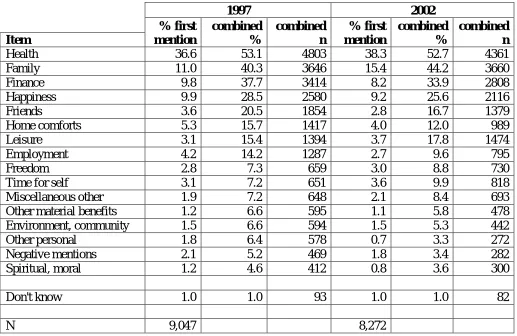
The next stage was to unpack precisely what things people considered to be important for
their own quality of life. The descriptive results of our substantive re-grouping of the
more detailed coding scheme are shown in Table 2. The 1st column and the 4th column
show the responses people cited first in 1997 and 2002 respectively, with percentages
adding to 100%. Thus, in 1997, 37% of people mention health as the first (or the only)
thing they cite and in 2002 the figure was 39%. The 2nd column (on which the rank order
a particular response at all. Thus in 1997 53% of our sample mention health (the most
frequently mentioned concern) whereas 47% (not shown) do not. Similar figures are
found for 2002 with 53% again mentioning health. As up to four mentions were coded
these columns do not add to 100%. We can see that three domains are mentioned by more
than one third of participants: health (53% both waves), family (40% in 1997, 44% in
2002) and finance (38% in 1997 and 34% in 2002). There are interesting things to be
said about other domains mentioned, like, for example, the relatively low mentions of
environment and community, which the literature suggests is a more prominent concern
(Rapley 2003). However this result may simply be due to the phrasing of the question.
More people might have mentioned ‘environment’ as important to their quality of life if it
had been suggested to them in the first instance. In this paper, therefore, we will confine
ourselves to the analysis of the first three categories only, as these are clearly the domains
which participants immediately defined as important for quality of life.
Having established the domains which were most important to our participants, we next
began to unpack the way in which gender and age was associated with each of the key
domains. In the section that follows our aim is to investigate similarities and differences
in the range of meanings attached to each key domain and we draw on both the 1997 and
2002 waves for illustrative quotes.
Qualitative and Quantitative Analysis of Key Domains
There is a large literature on preference-based measures of quality of life that focuses on
health (e.g. Lenert and Kaplan 2000). In our study too, we found that the majority of
statements in this domain showed a keen sense of the importance of good health as a
foundation from which to build a reasonable quality of life and examples of this
awareness can be found across all groups: 2Josh, 17, notes that without health you’re
nothing, likewise Lily, at 67 notes If you’ve got your health that’s all that’s important.
However, health is a more important factor for some groups than others in assessing
quality of life. It is a particular priority from the mid-30s onwards which may reflect a
growing awareness of decreasing energy levels as well as increasing functional
difficulties. It may also, as we will discuss later, indicate that health becomes more
salient for people when they have children themselves. While just under 25% of men
aged 15-19 mention health, nearly 70% of women aged 56-65 report it as important for
their quality of life. Indeed, in all age groups (except the over 75s) women are more
likely to mention health than men.
While younger participants tend to discuss health in the generic sense outlined above,
older participants are more likely to mention specific ailments or declines in cognitive
functioning. Older people focus on having their ‘marbles’ or keeping their ‘mobility’.
Thus our data confirm an emphasis that is already well documented in health-related
quality of life literature (Bowling, 1995). Joan, at 61, said: I suffer from sciatica and high
blood pressure so I know how much illness can affect my life and social activities.
2
Similarly, Will, 76, tells us: You need to have all your marbles; mobility is important and
to have all your thinking facilities.
However, while deterioration in the participant’s own health becomes more pronounced
in older age groups, another interesting finding was the way in which the role of the older
person as the carer of a partner in ill-health also has a bearing on their assessment of their
own quality of life. June, at 75 reflects on the impact of her husband’s illness on her own
quality of life: I haven’t got any quality [of life] at the moment as my husband has
Alzheimer’s. Similarly, men in the caring role also note the importance of the health and
well-being of significant others: Phillip, 63, tells us: If Ann (participant’s wife) was better
it would help. Ann is still waiting for her operation.
While the strains of being an older carer are well known, we find some examples of this
relational aspect of health echoed by both women and men in all age groups. Jack, 20,
notes the importance of My family’s health and well-being: including my own to his
quality of life. Sarah, at 38, answers Children’s health: because life is tough when they’re
not well – everything goes much smoother when they’re well. This ‘other orientation’ in
the importance of health for wellbeing is something that is easily overlooked in the
quality of life literature which tends to focus solely on the individual.
Family
Our next domain ‘family’ continues the theme of the relationship between self and other
coupled with social and economic changes, such as geographical mobility, increased
divorce rates, single-parenthood, women’s increased involvement in paid work, and
supposed increases in individualism make ‘family’ less important to people, both
emotionally and materially, than in previous eras (Beck, 1992; Giddens, 1992). However,
there is a significant literature which critiques and problematises these claims (Crompton,
2006; Duncan and Smith, 2004; Nolan and Scott, 2006; Williams, 2004). In our study,
too, we find further empirical evidence of the continuing importance of family,
particularly for women. We found women in all age groups are more likely than men to
mention family as important for their quality of life (though we would not wish to
over-emphasise the difference as family is clearly very important to men too). Interestingly,
however, it is the under 46s who are most likely to mention family. Nearly 60% of
women aged 26-45 mention family compared to around 25% of men aged 75+.
But what precisely do people talk about in relation to family and quality of life and what
differences do we find between women and men in different age groups? Perhaps the first
thing to mention is that, as with health, we find a common generic appreciation of family
which echoes across gender and age groups: Paul, at 27, notes The family’s the most
important part of my life and June, 61, describes the importance of Having family around
you. That said, however, there are, of course, differences in the kinds of support given
and received by different family members across the life course and not surprisingly, in
the under 25s we find reference to families as the providers of moral and material
family looked after me for a lot of my life. Similarly Cindy, 21, values family because
They give me moral support.
There were also some fairly gender stereotypical responses in relation to family and
quality of life. In the 26-45 age-group, we find more women than men mentioning the
importance of children’s well-being and men more likely than women to link the
importance of family to their role as breadwinners. There were, of course, occasions
when women discussed the importance of their breadwinning role for their family and
when men mentioned their concern with their children’s well-being, but the following are
typically representative statements of the members of this group: Amber, 28, for
example, tells us that what is important for her quality of life is: My children. How they
are how they eat and dress. Their education. And Luke, 41, notes that for him, quality of
life means: A secure job[which] enables me to buy things for my family. We see further
examples of this breadwinning theme as we turn to mentions of finance.
Finance
It is sometimes claimed that consumerism and lifestyle aspirations increasingly govern
values and quality of life (Rapley 2003). However, while over a third of our sample
mentioned finance-related matters as important for their quality of life, the key theme to
emerge from our qualitative analysis highlighted the importance of ‘not worrying about
money’. We don’t find people dreaming of winning the lottery nor do we find responses
which emphasize the importance of buying luxury cars, designer clothes or other
having to struggle financially (Duncan, 33); To not worry about paying bills and have
money for extra meals and holidays (Mandy, 38).
Examining group differences in this category, men in all age groups are more likely than
women to mention finance with over 45% of men aged 20-25 mentioning finance,
compared to just 16% of women aged 75+. Interestingly, however, qualitative analysis
shows that men in the 20-35 age range discuss finance in relation to quality of life in the
sense of being free from debt. From 36-54, however, an additional theme emerges which
illustrates, once again, the importance of the relationship between finance and
breadwinning identity. Rhys, 43, discusses finances in terms of Earning a decent wage;
to support my family financially. Likewise Roy, 38, notes I would say not having to
struggle. Being able to provide for the children and ourselves.
It is important, however, to highlight the ways in which our core themes are interlinked.
While counting the number of mentions of each theme provides us with a stronger base
from which to make generalizations, this form of ‘chunking’ qualitative data can gloss
over important information about processes. For example, our qualitative analysis shows
that health is often important because individuals need good health to care for others,
both financially and emotionally. To illustrate the point further, men in mid-life
mentioned health as important for work, which, in turn, was central to their breadwinning
role; as Sebastian notes, quality of life consists of My health, so I can run my business
and provide for my family. Likewise Phillipa, when asked why her health was important
to keep my health to look after my mam and my husband. At 26, and following a divorce,
Lily notes the importance of being healthy because she needed to be able to look after the
children by myself. Similarly, Charlie, 39 and divorced, says I need my health as I have 4
children to look after. In the following section we examine the influence of a key life
transition: family formation on perceptions of quality of life.
Family Formation and Changing Evaluations of Quality of Life
As indicated in the quotations above, the way people evaluate the wellbeing of others is
central to their assessment of their own quality of life. This is something few other
quantitative panel studies have investigated because, methodologically, they have not
been able (or inclined) to use tools which allow for ‘bottom up’ concept development. In
this section, we will focus specifically on how the transition to partnership and
parenthood influences an individual’s perception of what matters for quality of life. This
is principally because it is reasonable to argue that it is at this point in the life-course that
‘other orientation’ becomes more significant. Not surprisingly, however, we find that this
transition is somewhat different for women and men.
There were fifty one women who were single and under forty in 1997 and who were
living with both a partner and a child five years later in 2002. There are clear indicators in
the qualitative data of the way in which family formation brings changes to evaluations of
what’s important for quality of life. For example, in 1997, Olive emphasizes ‘financial
security, health and peace of mind’. In 2002, however, while she still emphasizes
immediate family are happy. Likewise, Sally mentioned financial and emotional security
in 1997, but, in 2002, the first thing she discusses is spending time with family at home.
The change in definitions of quality of life brought on by motherhood can be illustrated
by the following examples. Eleanor’s priorities in 1997 were ‘health and work’: giving
up smoking, health generally, expanding my career, making myself money, my future
generally. In 2002 however, her concerns are: my son and a good family life: that’s all
that’s important to me. For Mary her priorities in 1997 were ‘happiness and standard of
living’. In 2002, she emphasizes the importance of the health of my child and family –
they’re my whole life, what would I do without them. Similarly Carol, undergoes a shift
from placing importance on ‘good friends and a steady income’ in her first interview to
being with family; see baby grow up and being with partner.
Forming a family also changes the way in which men evaluate their quality of life. There
were seventy nine men who were single and aged under forty in 1997 and in a couple
with at least one child in 2002. Predictably, the way priorities change for men is often
linked to becoming the ‘breadwinner’. For example when Andrew was aged 26 what was
important to his quality of life was that he could go out and enjoy myself. At 31, as a
father, he now wants to be comfortable, not struggling as we do at the moment. If I could
get a better job, everything will be fine. Billy, at 23, was interested in a comfortable
income, nice food, nice place to live, nice clothes, spending time with my girlfriend. But
at 28 he was focused on making a living to keep us all happy. Likewise, at 22, Martin
later he defines quality of life as providing for my family, make sure they are happy. If the
family is happy, that’s all we need.
But the transition to family did not just influence quality of life in relation to the
importance of ‘providing’. The intimacy and companionship of family life were also now
more salient to definitions of quality of life. At 29, Ian first described quality of life as
being able to go out and enjoy yourself; later he focuses on being with my family; they
keep me happy; make me laugh. Similarly, Darren, at 24, wants money, friends, [good]
neighbourhood, health, socializing and confidence. At 29, he lists my daughter, my wife,
money, health: now Hannah and Vanda are in my life I couldn’t be without them.
Of course, there were both men and women who remained consistent in their views
across the waves, or whose perceptions changed in ways which are not linked with their
change in family status. Nevertheless, for most people the transition to partnership and
parenthood brings different priorities and quality of life had become more ‘other
orientated’.
Methodological Lessons and Future Directions for Research
In this section, we draw together some of the methodological lessons that can be drawn
from this study and consider how our analysis might help guide future research. We have
shown how qualitative analysis from a panel study can help further our understanding of
the way men and women interpret their subjective experiences. We have also
across time. We have highlighted the virtues of using open-ended questions and while, in
this particular study, we focus on perceptions of quality of life, the methodology is
equally applicable to other domains.
Because our data are from a panel survey, with sufficient numbers to observe patterns of
difference amongst different sub-groups, we were able to identify some important aspects
of quality of life that have tended to be overlooked in existing literatures. First, people’s
perceptions of what is important for quality of life is highly gendered. Our analysis
pointed not only to quantitative differences in what mattered to men and women, but also
to qualitative differences in how men and women perceive the importance of things like
family or finance. Second, we found that different age-groups differ markedly in terms of
what they see as most important for quality of life. Third, we found that people’s
perceptions of what matters varies over time and both men and women tend to change
their perceptions of what is important for quality of life when they make the transition to
partnership and parenthood. This demonstrates that quality of life is a process not a fixed
state, and future research is needed to explore what stays constant and what changes over
the life course.
One of the most interesting findings to emerge from this research is the importance of the
quality of life of others for an individual’s own quality of life. This is different than the
experts’ conceptions of quality of life that are depicted in Table 1. The ‘objective utility
of life’ (Veenhoven, 2000), although emphasizing others, focuses on the contribution the
feeling or functioning of the individual themselves. What we find is that people’s lives
are intrinsically inter-connected and the quality of life of others affects one’s own
perceptions of what matters, irrespective of whether there is anything one can do or
whether it changes the individual’s own feelings about social interactions.
There are many questions for future research. How do people’s perceptions of what
matters to their quality of life relate to their subsequent choices and behaviours? Another
issue to explore is how do perceptions of what is important for quality of life relate to
people’s subjective wellbeing, as reported in the standard measures of happiness or life
satisfaction? However, qualitative responses and panel data can get us only so far –
sociological imagination is needed to interpret people’s views of quality of life in a way
References
Andrews, F. (1980) ‘Comparative studies of life quality: comments on the current state of the art and some issues for future research’ in Szalai, A and Andrews, F. The Quality of Life: Comparative Studies. London: Sage
Antonucci, T and Akiyama, H (1987) ‘Social networks in adult life and a preliminary examination of the convoy model’. Journal of Gerontology, 42(5), 519-527.
Argyle, M. (1996) ‘Subjective wellbeing’. In A. Offer (ed) In Pursuit Of The Quality Of Life. Oxford: Clarendon Press
Beck, U. (1992) Risk Society: Towards a New Modernity. London: Sage.
Bowling, A. (1995) ‘What things are important in people’s lives: A survey of the public’s judgement to inform scales of health related quality of life’. Social Science and Medicine, vol 41 (1)) 1447-1462.
Brannen, J. (1992) ‘Combining qualitative and quantitative approaches: an overview’, in Brannen (ed) Mixing methods: qualitative and quantitative research. Aldershot:
Avebury.
Bryman, A. (2008) Social Research Methods. Oxford: Oxford University Press.
Campbell, A. (1972) ‘Aspiration, satisfaction and fulfillment’ in Campbell, A. and Converse, P. (eds) The Human Meaning of Social Change. New York: Russell Sage.
Coffey, A. and Atkinson, P. (1996) Making Sense of Qualitative Data: Complementary Research Strategies. California: Sage.
Crompton, R. (2006) Employment and the Family: The Reconfiguration of Work and Family Life in Contemporary Societies. Cambridge: CUP.
Cummins, R (1997) The Comprehensive Quality of Life Scale – Adult (COMQol-A5). (5th Ed). School of Psychology, Deakin University, Melbourne.
Diener, E. and Seligman, M. (2004) ‘Beyond money: towards and economy of well-being’. Psychological Science in the Public Interest, 5(1), 1-28.
Duncan, S. and Smith, D. (2006) ‘Individualisation versus the geography of 'new' families’,21st Century Society, 1 (2) 167-89.
Geertz, C. (1983) ‘From a native’s point of view: on the nature of anthropological understanding’ in Local Knowledge: Further Essays in Interpretive Anthropology. New York: Basic Books Classics
Giddens, A. (1992) The Transformation of Intimacy: Sexuality, Love and Eroticism in Modern Societies. Cambridge: Polity Press.
Hammersley, M. (1992) ‘Deconstructing the qualitative-quantitative divide’, in Brannen, J. (ed) (1992) Mixing methods: qualitative and quantitative research. Aldershot:
Avebury.
Huppert, F, Marks, N., Clark, A., Siegrist, J., Stutzer, A., J. Vittersø and M Wahrendorf (2008) ‘Measuring well-being across Europe: Description of the ESS Well-being
Module and preliminary findings‘, Social Indicators Research, Special Issue, forthcoming.
Lane, R (1996) ‘Quality of life and quality of persons: a new role for government’ In A. Offer (ed) In Pursuit Of The Quality Of Life. Oxford: Clarendon Press
Layard, R. (2005) Happiness: Lessons from New Science, London: Penguin.
Lenert, L and R Kaplan (2000) ‘Validity and interpretation of preference-based measures of health related quality of life’ Medical Care, Supplement II, Vol 38 (9) 138-150.
Nolan, J. and Scott, J. (2006) ‘Gender and kinship in contemporary Britain’ in Richards, M.
(ed) Kinship: Relationships and Law in a Changing Society. London: Hart
Offer, A. (2006) The Challenge of Affluence. Oxford Oxford University Press.
Radley, M. (2003) Quality of Life Research: A Critical Introduction, London: Sage.
Schuman, H. (2003) ‘Clifford Geertz and the interpretive attitude survey’, Culture, vol 17: 1, American Sociological Association.
Sen, A. (1993) ‘Capability and wellbeing’, in A Sen and M Nussbaum (eds.) The Quality of Life, Clarendon Press, Oxford UK, pp 30-53.
Sen, A. (1999) Development as Freedom. Oxford: Oxford University Press.
Szalai, A. (1980) ‘The meaning of comparative research on the quality of life’ in Szalai, A and Andrews, F. The Quality of Life: Comparative Studies. London: Sage
Szalai, A and Andrews, F. (1980) The Quality of Life: Comparative Studies. London: Sage
Colchester, University of Essex
(http://www.iser.essex.ac.uk/ulsc/bhps/doc/pdf_versions/volumes/bhpsvola.pdf), accessed 12-08-08.
Veenhoven, R. (2000) ‘The four qualities of life: ordering concepts and measures of the good life’, Journal of Happiness Studies 1:1-39.
White, N. (2006) A Brief History of Happiness. Oxford: Blackwell Publishing.
Table 1. Conceptual classifications
Four Qualities of Life (Veenhoven, 2000):
Four Aspects of Wellbeing
(Huppert et al. 2008)
Social engagement Caring Altruism Autonomy Competence Interest in learning Goal orientation Sense of purpose Resilience Functioning (doing) Belonging Support Respect, fair treatment, Social progress Satisfaction Positive affect Negative affect Optimism Self-esteem Feeling (having, being) Inter-personal Personal Subjective Appreciation of life Objective Utility of life
Table 2: Rank order of things which are important for your quality of life 1997 2002 % first mention combined % combined n % first mention combined % combined n Item
Health 36.6 53.1 4803 38.3 52.7 4361
Family 11.0 40.3 3646 15.4 44.2 3660
Finance 9.8 37.7 3414 8.2 33.9 2808
Happiness 9.9 28.5 2580 9.2 25.6 2116
Friends 3.6 20.5 1854 2.8 16.7 1379
Home comforts 5.3 15.7 1417 4.0 12.0 989
Leisure 3.1 15.4 1394 3.7 17.8 1474
Employment 4.2 14.2 1287 2.7 9.6 795
Freedom 2.8 7.3 659 3.0 8.8 730
Time for self 3.1 7.2 651 3.6 9.9 818
Miscellaneous other 1.9 7.2 648 2.1 8.4 693
Other material benefits 1.2 6.6 595 1.1 5.8 478
Environment, community 1.5 6.6 594 1.5 5.3 442
Other personal 1.8 6.4 578 0.7 3.3 272
Negative mentions 2.1 5.2 469 1.8 3.4 282
Spiritual, moral 1.2 4.6 412 0.8 3.6 300
Don't know 1.0 1.0 93 1.0 1.0 82
N 9,047 8,272