A NEW SHIP SAFETY MANAGEMENT APPROACH
- LEARNING FROM THE PAST, MANAGING FUTURE RISKS
Wenkui CaiABS Consulting Singapore Pte Ltd, Singapore 119958
Dimitris Konovessis
School of Mechanical & Aerospace Engineering, Nanayang Technological University, 50 Nanyang Avenue, Singapore 639798
Dracos Vassalos
The Ship Stability Research Centre, Department of Naval Architecture, Ocean and Marine Engineering, University of Strathclyde, Glasgow G4 0LZ, United Kingdom
ABSTRACT
Learning from the past has been recognised as an effective means to manage future challenges. This is particularly true for ship safety management in the maritime industry as the records of historical safety-related failures are generally accompanied by the losses of human lives, damage to the environment and the ships. However, the current “learning” practice is not rationalised to facilitate effective safety management both from design and operational points of view. By proposing a unique approach of “learning from the past”, this paper elaborates on a formal methodology towards ship safety management so that future risk control decisions can be made in an objective, transparent, and well-informed manner.
1. INTRODUCTION
The long standing history of mankind’s civilisation represents a learning process of human beings to better appreciate and understand the universe. In the course of this process, significant effort has been devoted to learn from past experience and prepare for the upcoming challenges in diverse disciplines [1] [2] [3] [4]. This process is accelerated by the rapid advancement of computer technology in the past decades, e.g. database technology and high-performance computing. Particularly in recent years, the trend of recording historical operational records of specific domains and transforming them into pertinent business intelligence has become an increasingly important means for modern business to obtain an informational advantage [5] [6] [7] [8].
The maritime industry, playing a key role in the globalisation process, has also been deeply involved in collecting ship operational data with the aim to improve the operational performance. For instance, IHS is one of leading maritime data supplier in providing worldwide shipping-related information [9]. Moreover, as far as ship safety is concerned, operators are required to report and analyse their operational non-conformities and incidents in order to comply with the International Safety
Management (ISM) code [10]. The latest adoption of the Casualty Investigation Code [11] at IMO, reached the culmination of the advocation of learning from the past. Despite these undertakings taking place originally at regulatory level, significant improvement has been achieved over the past decades, particularly in terms of the number of reported casualties worldwide [12].
high-profile accidents, whilst a large proportion of records are under-utilised and ignored.
In this respect, the current state of affairs with regards to maritime casualty data is that there are very limited formatted variables in the databases, while the “gold” is still largely hidden in the descriptive text [9] [13]. As a result, the subsequent findings will be naturally restricted to descriptive recommendations with undetermined enhancements [14] and high-level trending charts [12] [15].
Furthermore, although it is possible to implement some of the sophisticated root cause analysis techniques, e.g. the spray diagram from Lloyd’s Register [16], the loss causation model from DNV Maritime Solutions [17], and the root cause analysis map from ABS [18], to identify a list of loopholes for each record in the casualty database, it is still practically difficult to justify the ensuing corrective actions in terms of quantifiable cost and benefits.
Deriving from the aforementioned findings and on the basis of the philosophy of “learning from the past”, this paper aims to describe a formal methodology of ship safety management by deploying a new concept of maritime casualty database and advanced data analysis techniques. A new concept for the development of maritime casualty databases is introduced in Section 2, followed by a brief description of pertinent data mining techniques to transform the data into probabilistic knowledge models in Section 3. Section 4 elaborates on the use of such models for risk management followed by a case study in Section 5, which demonstrates the applicability of the concept proposed.
2. A NEW CONCEPT OF MARITIME
CASUALTY DATABASE
2.1 APPROACH
[image:2.595.322.547.72.202.2]An effective safety management throughout the ship life-cycle will be only achieved if its performance can be measured scientifically. Considering what constitutes ship safety, it is governed only by a handful of factors (undesirable events) which, when considered individually or in combination, define a limited set of scenarios, as illustrated in Figure 1. These factors represent major accident categories with calculable frequencies and consequences, which inherently control the life-cycle risk of a ship at sea.
Figure 1: Sequence of Scenarios [19]
In this respect, the term “total risk” of a ship has been put forward in [20]. The aim is to quantify the overall through-life safety level so that a tangible safety measure in risk lexicon can be readily employed for direct use in ship design and operation. As an example, in the case of passenger ships, a knowledge-intensive and safety-critical ship type, investigations suggest that flooding- and fire-related scenarios comprise over 90% of the risk (regarding loss of life) and almost 100% of all the events leading to decisions to abandon the ship [21]. In this way, it becomes apparent that by addressing the two principal hazards, namely flooding (due to collision and grounding) and fire in a consistent manner, the total risk of a passenger ship can be estimated and managed.
Considering what influences both the pre-casualty and post-casualty phases of principal hazards, as depicted in Figure 1, it is essential for the new database to contain key information of the following seven modules:
Vessel information: it aims to record the information about ship particulars that describing the key characteristics. This module should provide a throughout scan of the ship so that an overview can be gained and important information on ship parameters can be collected.
Voyage condition: historical tragedies suggest the environmental conditions play an important role for a fully-developed accident, hence, situation-specific variables (e.g. ship location, voyage phase, visibility, sea state, and wind speed) are included to describe the conditions of the surrounding environment.
systems, hull structures, steering and navigational systems, and electrical systems.
Collision: for the prevention of collisions/contacts, great attention has been paid to the bridge design. This module distinguishes powered collisions and drifted collisions as the energy released from the two categories varies dramatically. Moreover, the sequence of a collision is broken into phases containing event detection, manoeuvre planning and manoeuvre execution.
Grounding: ship grounding shares notable similarities with the collision, where early detection plays a significant role on the prevention of its occurrence. Grounding is more sensitive to safety culture and practice of ship operators regarding route planning and updating.
Fire: the fire event module deals with the factors influencing various phases of a fully developed fire: ignition, containment, escalation, and evacuation. Consequence: it is designed to capture
consequencues to the passengers, crew, the environment and the ship herself.
2.2 IDENTIFICATION OF DOMINANT VARIABLES
In pursuit of the new maritime casualty database, the key element would be a list of parameters to be recorded for each of the aforementioned modules. Certainly it would be practically infeasible to record hundreds of thousands of elemental parameters that determine the exact safety level of a ship. Therefore, an alternative is needed. In the knowledge that the fundamental objective is to provide a transparent and well-informed platform for decision making, it will be much more efficient to focus on the dominant variables and achieve a fast approximation of the risk level with sufficient accuracy.
A promising way is to rely on the latest understanding and up-to-date risk models, which take advantage of years or even decades of continuous effort and accumulation in understanding the underlying physical phenomena. Thus, an important assumption that can be made is that the variables included in the latest risk models, which are developed and refined through various research projects (HARDER, SAFEDOR, GOALDS, etc.) are sufficient to capture the key features of the main hazards of interest.
In order to facilitate the process of dominant variables identification, a hierarchical decomposition approach is proposed to systematically break down the total risk and
its constituent elements up to a stage where the physical parameters of significant importance to the safety performance can be identified. In this way, the proposed database structure provides a much larger and necessary amount of data stored and analysed as formatted variables, following the decomposition of this information from the usually descriptive text of the current maritime databases, thus achieving the main objective for the provision of improved and enhanced maritime databases.
To carry out this process, the emphasis is placed on the key risk contributors. For example, in the case of passenger ships, the total risk should be sought through analysing the principal hazards: collision, grounding and fire. Moreover, on the basis of the definition of the risk, its quantification of the concerning hazard can be estimated through the product of a number of probabilities defining critical scenarios and the ensuing societal consequences, as illustrated below [22].
𝑅𝑐𝑜𝑙𝑙𝑖𝑠𝑖𝑜𝑛= 𝑃𝑐𝑜𝑙𝑙𝑖𝑠𝑖𝑜𝑛× 𝑃𝑤𝑎𝑡𝑒𝑟_𝑖𝑛𝑔𝑟𝑒𝑠𝑠|𝑐𝑜𝑙𝑙𝑖𝑠𝑖𝑜𝑛
× 𝑃𝑓𝑎𝑖𝑙𝑢𝑟𝑒|𝑤𝑎𝑡𝑒𝑟_𝑖𝑛𝑔𝑟𝑒𝑠𝑠|𝑐𝑜𝑙𝑙𝑖𝑠𝑖𝑜𝑛
× 𝐶𝑐𝑜𝑙𝑙𝑖𝑠𝑖𝑜𝑛
𝑅𝑔𝑟𝑜𝑢𝑛𝑑= 𝑃𝑔𝑟𝑜𝑢𝑛𝑑× 𝑃𝑤𝑎𝑡𝑒𝑟_𝑖𝑛𝑔𝑟𝑒𝑠𝑠|𝑔𝑟𝑜𝑢𝑛𝑑
× 𝑃𝑓𝑎𝑖𝑙𝑢𝑟𝑒|𝑤𝑎𝑡𝑒𝑟_𝑖𝑛𝑔𝑟𝑒𝑠𝑠|𝑔𝑟𝑜𝑢𝑛𝑑
× 𝐶𝑔𝑟𝑜𝑢𝑛𝑑
𝑅𝑓𝑖𝑟𝑒= 𝑃𝑖𝑔𝑛𝑖𝑡𝑖𝑜𝑛× 𝑃𝑔𝑟𝑜𝑤𝑡ℎ|𝑖𝑔𝑛𝑖𝑡𝑖𝑜𝑛
× 𝑃𝑒𝑠𝑐𝑎𝑙𝑎𝑡𝑖𝑜𝑛|𝑔𝑟𝑜𝑤𝑡ℎ|𝑖𝑔𝑛𝑖𝑡𝑖𝑜𝑛× 𝐶𝑓𝑖𝑟𝑒
Each of the aforementioned risk elements (i.e. probabilities and consequences) can be further decomposed into various safety performance aspects. The identification of pertinent safety performance parameters should be considered from the point of view of estimating the effectiveness of various preventive and mitigative measures. Table 1 presents such a process for the cases of collision and grounding.
Table 1: Links between Risk Components and Safety Performance Parameters concerning Collisions and Groundings
Risk components Safety performance
parameters
𝑃𝑐𝑜𝑙𝑙𝑖𝑠𝑖𝑜𝑛
𝑃𝑔𝑟𝑜𝑢𝑛𝑑
Probability of collision/grounding
Reliability of navigation
Reliability of manoeuvrability
𝑃𝑤𝑎𝑡𝑒𝑟_𝑖𝑛𝑔𝑟𝑒𝑠𝑠|𝑐𝑜𝑙𝑙𝑖𝑠𝑖𝑜𝑛
𝑃𝑤𝑎𝑡𝑒𝑟_𝑖𝑛𝑔𝑟𝑒𝑠𝑠|𝑔𝑟𝑜𝑢𝑛𝑑
Probability of water ingress due to collision/grounding
Structural capacity (hull breach)
𝑃𝑓𝑎𝑖𝑙𝑢𝑟𝑒|𝑤𝑎𝑡𝑒𝑟_𝑖𝑛𝑔𝑟𝑒𝑠𝑠|𝑐𝑜𝑙𝑙𝑖𝑠𝑖𝑜𝑛
𝑃𝑓𝑎𝑖𝑙𝑢𝑟𝑒|𝑤𝑎𝑡𝑒𝑟_𝑖𝑛𝑔𝑟𝑒𝑠𝑠|𝑔𝑟𝑜𝑢𝑛𝑑
Probability of failure (capsize/sinking/collapse) due
to water ingress and collision/grounding
Time to capsize/sink/collapse
𝐶𝑐𝑜𝑙𝑙𝑖𝑠𝑖𝑜𝑛
𝐶𝑔𝑟𝑜𝑢𝑛𝑑 Severity of consequence
Post-accident system availability
Time required for abandonment
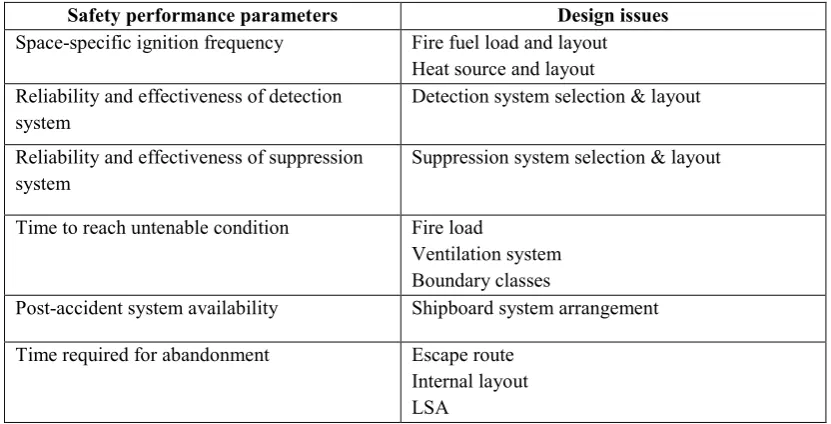
Table 2: Links between Safety Performance Parameters and Detailed Design Issues for the Fire
Safety performance parameters Design issues
Space-specific ignition frequency Fire fuel load and layout Heat source and layout Reliability and effectiveness of detection
system
Detection system selection & layout
Reliability and effectiveness of suppression system
Suppression system selection & layout
Time to reach untenable condition Fire load
Ventilation system Boundary classes
Post-accident system availability Shipboard system arrangement
[image:4.595.97.513.473.685.2]By doing so, the basic ship and operational parameters that play an important role in quantifying the aforementioned risk components can be identified, as illustrated in Figure 2. A unique advantage of such a structure is that the complexity of the problem under consideration can be greatly simplified as one can address a single design or operational issue at a time. Consequently, a new database platform containing the identified ship design and operational parameters can be developed for data collection.
Figure 2: Links between Basic Parameters and Ship Total Risk
3. DATA PROCESSING
The need for more sophisticated data analysis techniques is derived from the difficulties that classical regression analysis becomes inefficient to cope with a mathematical model containing more than a handful of variables at a time. The situation is exaggerated by the fact that physical casualty relevant parameters are often presented in discrete manner rather than continuous format (ship types, locations, onboard spaces, etc.). This has given rise to the use of data mining, which aims to transform a data set containing many variables into a meaningful and interpretable model through multivariate data analysis techniques.
Due to the diversity of data mining techniques, the identification of the most adequate platform and the associated “mining” techniques are of great importance. In this respect, Bayesian networks (BNs) [23], offer a
unique platform for fulfilling the intended goals. This is attributed to (i) their inherent capability for probability inference, (ii) the transparency and the flexibility of presenting complex relationships, and (iii) to the foundation that has been laid in the maritime industry [24] [25].
A Bayesian Network is a tool capable of describing complex cause-and-effect relationships probabilistically by using intuitive visual representations. A generic Bayesian network model is comprised of a set of variables making up the nodes in the network, a set of directed links (with arrows) connecting the nodes and representing dependent relationships, and an array of probability density functions/conditional probability tables (CPT) associated with each node describing the probabilistic influence of its parents. The key feature of a Bayesian Network is the ability to form a risk-knowledge model that enables reasoning about the uncertainty of the situation it describes.
Bayesian networks offer several advantages over conventional risk modelling techniques:
There is no need to assume independent relationships among events (as this is the case for the root events in a fault tree) as these can be described easily by directing arcs.
The intuitive visual presentation depicting causal relationships facilitates a reasonably realistic model that is logical, easy to understand and validate.
Different sources of information can be deployed concurrently for the population of CPTs in one model without conflict.
Bayesian networks can be easily updated locally with new information, without the need to recreate the whole structure of the network The information entailed in a network is
computed and propagated probabilistically, a feature which is consistent with the risk assessment paradigm.
The computations can be carried out using readily available tools, irrespective of the size and complexity of a model.
If the variables in the model are the key indicators/measures of a selected domain, the model would become a useful decision-support tool.
Despite the increasing applications of Bayesian networks in the maritime industry, questions remained to be answered are brought forth: “How to rationally identify
Risk
Safety performance parameters
Ship parameters
Operational issues
Operational parameters Design
issues
the complex causality relationships in the case of more than a few variables?” and “How to objectively quantify large conditional probability tables?”
In this respect, it is found that the applications also lead to mountainous research activities in identifying the influence relationships among the variables from observational records. Relevant learning techniques are developed so that a network can be constructed with minimal subjective intervention. Apart from eliciting the structure of a Bayesian network model from the data, formalised methods for populating the conditional probability tables have also been developed concerning the quantification of the network. With the detailed mathematical techniques described in [26], the following section briefly summarises the procedures to be followed.
3.1 BAYESIAN STRUCTURE LEARNING
The current approaches towards the learning of a network structure have been widely classified as:
constraint-based learning and scoring-based learning, in which distinct principles are adopted.
Constraint-based learning starts with the identification of dependent and conditional independent relationships among various variable combinations by using statistical measures. The traditional approach is to make null hypothesis testing of dependencies between two variables so as to identify the significance of an association which will be checked against a predefined confidence level. This approach is feasible in the case of two variables, but more advanced mathematical models are needed to identify conditional independent relationships among three or more variables. Under such circumstance, two mathematical models can be deployed for dependency analysis: logistic regression model and loglinear model.
With a collection of independent and conditional independent relationships, the next step is to construct a Bayesian network skeleton that entails all the discovered relationships. This can be achieved by utilising proper learning algorithm. One of the most widely accepted approaches, known as PC algorithm [27], was selected for Bayesian network structure induction. The PC algorithm is briefly introduced here:
Start with a complete undirected graph in which each variable is linked with all other variables with undirected arcs.
Iterate throughout the graph to remove the link, say (X − Y) from the graph if there is I(X, Y|S), where S denotes any node of the set of adjacent nodes of X and Y. I(X, Y|S) indicates that X and Y are conditionally independent given S. Iterate throughout the network with each
uncoupled meeting (X − Y − Z) and orient as (X → Y ← Z) if X and Z are found to be independent given a set of variables which do not contain Y. For the remaining links, the arrow should be directed in a way that no more “head-to-head” link will be created.
In contrast to the constraint-based learning, the scoring-based learning focuses on the identification of a Bayesian network structure as an integral unit. The principle is to evaluate the superiorities of all possible network skeletons using dedicated criterion functions and to select the one receiving the highest score. This implies that two components have to be properly addressed: a scoring criterion and a searching algorithm. Various score functions has been developed for acting as the criterion, e.g. Bayesian scoring criterion [28], Bayesian information criterion [29], Akaike information criterion [30], Minimum Description Length [31]. To obtain the optimal BN model, a heuristic searching algorithm can be adopted for generating all promising network patterns for evaluation [32].
3.2 BAYESIAN PARAMETERS LEARNING
The main objective of parameters learning is to quantify the obtained network skeleton with conditional probabilities, which will be derived purely on the basis of the collected data. This is achieved by assuming the various statuses of each parameter in the network are Dirichlet distributed [28]. In this way, the distribution function can be updated by additively taking into account of new evidence in the data.
4. RISK MANAGEMENT
Following the introduction of a new casualty database and the ensuing data mining techniques, it becomes straightforward to transform the collected maritime casualty data into probabilistic models which are materialised in the form of a Bayesian network. Nevertheless, it is important to ensure that the obtained models are intelligent enough for the purposes of the decision making process of safety management.
control options. The measures should focus on reducing the frequency of occurrence of a hazard (preventive) or mitigating the ensuing consequences. A high level list of generic risk control options is illustrated in Figure 3.
Figure 3: Generic Risk Control Options
Broad classification of the listed risk control options suggests that two types of variables influence the risk level of a specific design: design parameters and operational parameters. The design parameters refer to those parameters/features that can be controlled at the early design stage and determine the capability of a design to withstand/sustain accidents through preventive and/or mitigative means, e.g. installation of ECDIS system, watertight subdivisions, fire detection systems, suppression systems. In other words, there are parameters that are capable of leading to designs which are more tolerable to software and hardware failure and more resistive to catastrophic consequences following the initiation of an accident. On the other hand, the operational parameters are concerned with general practice and procedures to be followed during the ship operation stage for reducing the exposure to risky circumstances. For instance, scheduled maintenance, regular training of crews, establishment of contingency plan, etc., are all typical examples of operational means for safety assurance.
It is noted that apart from design and operational parameters there are certain environmental variables that influence the risk level as well, such as traffic characteristics, geography, time of the day, sea state, etc. These parameters can be referred to situation-specific parameters as a combination of different statuses would evidently lead to a unique analysing situation.
Deriving from the above, as the parameters recorded in the database focus mainly on the dominant influential design and operational factors and the timeline development of the hazards under consideration, it is
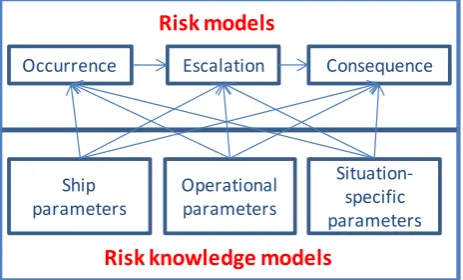
important to realise that the subsequently obtained Bayesian network models can easily accommodate the sequential events that lead to the manifestation of a specific hazard. For instance, they contain the occurrence of an event, its escalation, and ultimately, the possible consequences. As the information is stored probabilistically, such a model can be regarded as a generic risk model for risk level estimation. From this point of view, a Bayesian network model is equivalent to a conventional risk contribution tree (i.e. fault tree, event tree) for risk assessment.
On the other hand, with ship design, operational and situation-specific parameters recorded in the database and utilised for data processing, their influences on the scenario-defining variables in the aforementioned risk models can be established without much difficulty. In this case, the Bayesian network model can be regarded as a risk-knowledge model, where the knowledge of the interrelationships between manageable (physical) entities and the key risk components are stored and expressed probabilistically. In this way, the risk level of the interested hazard is ultimately conditional on the statuses of these three groups of parameters: ship design, operational, and situation-specific parameters. Figure 4 exhibits conceptually such unique characteristics of Bayesian network models.
Figure 4: A Conceptual Bayesian Network Model
On the basis of the foregoing, it becomes apparent that through the methodology of employing the new database and pertinent data mining techniques, the obtained Bayesian network model can be used as a tool for risk level estimation. In the meantime, it also facilitates a fast evaluation of various risk control options for effective decision making. A unique advantage of such an approach is that decisions can be made on a transparent and objective basis.
5. A CASE STUDY
Ship parameters
Operational parameters
Occurrence Escalation Consequence
Risk models
Risk knowledge models
[image:7.595.319.551.409.549.2]In pursuing a rational treatment of fire risk at the design stage, the proposed methodology will be demonstrated with a case study that starts with the identification of dominant variables, the database development, the BN model learning, the design of alternative scenario generation, and the decision-making on the basis of the whole process. The important variables are identified and listed as follows:
Date of event Time of event Vessel location Weather contribution Detection means Suppression means Ventilation system status Fire door status
Space occupancy status Crew status
Boundary cooling status Emergency response failure Containment failure Ignition in adjacent space
[image:8.595.319.546.133.432.2]A significant amount of operational fire accident/incident data (covering a reporting period of 3-4 years) is used. The data set was imported into the BN by a learning program developed in statistical computing software R (http://www.r-project.org/). Both constraint-based and score-based learning algorithms have been examined together with the parameter learning. The resulting network model is shown in Figure 5. Initial result suggests a good agreement with the output from similar data mining tools.
Figure 5: Constructed Bayesian Network Model (Constraint-Based Learning)
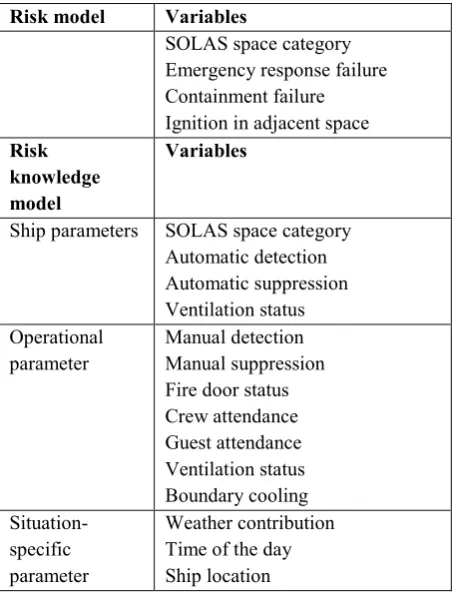
For this specific case, the trained Bayesian network can be considered as a risk sub-model and a risk knowledge sub-model that is depicting certain phases of a fully developed fire event. With respect to the risk knowledge model, it includes design, operational, and
situation-specific parameters. The detailed classification is tabulated in Table 3.
Table 3: Variables of the Developed BN Model
Risk model Variables
SOLAS space category Emergency response failure Containment failure Ignition in adjacent space Risk
knowledge model
Variables
Ship parameters SOLAS space category Automatic detection Automatic suppression Ventilation status Operational
parameter
Manual detection Manual suppression Fire door status Crew attendance Guest attendance Ventilation status Boundary cooling
Situation-specific parameter
Weather contribution Time of the day Ship location
For illustration purposes, the obtained Bayesian network model is utilised for risk management at the operational stage. Nevertheless, its application can be easily extended to risk management during the design stage.
[image:8.595.65.295.502.653.2]A number of risk control solutions can be generated for protecting the accommodation spaces, with particular reference to crew and passenger cabins. Main attention is paid to the prevention of cabin fire and mitigation of the ensuing consequences. Table 4 exhibits three control options in addressing the hazards in question.
Table 4: Risk Control Solutions (SOLAS Space Category 7, Accommodation Space: Cabin)
Solution Explanation
1 Improve patrolling
Fire started at night is more likely to escalate and lead to more serious consequence as the response time for fire detection and fighting can be significantly delayed; improving patrolling would shorten such delay 2 Invest in
fireproof
bins comprises 45% of all cabin fire; hence, by investing in fireproof bins to cut off the oxygen supply, it is expected to suffocate such fires at an early stage 3 Crew
awareness training
The collected historical fire incident data suggests that fire started in crew cabins comprises more than 40% of all cabin fires; hence, by conducting fire awareness training, both fire
prevention and mitigation performance can be improved
In pursuing a rational process that enables a scientific treatment of every aspect of ship performance, a transparent and systematic decision support framework plays a vital role. Regarding this, the approach proposed in [33], was adopted, in which pair-wise comparisons of risk control options with respect to their economic, technical, and safety performance are conducted.
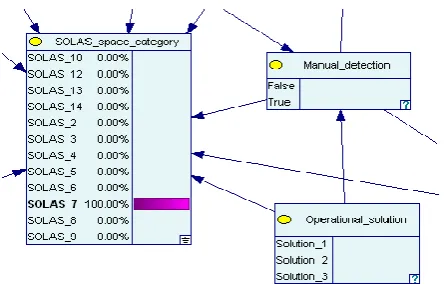
For this specific case, the impact of various control options on the overall fire risk is linked through the variables “SOLAS space category (ignition frequencies)” and “manual detection”, as shown in Figure 6. To quantify the associated conditional probability tables, domain knowledge can be derived from pertinent historical data or dedicated mathematical models. For demonstration, it is assumed that “solution 1” would have generally 20% improvement to the manual detection system in terms of the effectiveness of detecting fire incidents in cabin spaces, “solution 2” is estimated to lower the fire ignition frequency by 10%, and “solution 3” would improve the manual detection effectiveness by 10%. The ultimate influence can be
observed through the node
[image:9.595.56.298.70.218.2]“Emergency_response_failure”, as illustrated in Table 5.
[image:9.595.331.532.179.251.2]Figure 6: Details of the Bayesian Network Model (Risk Control Solutions)
Table 5: Results of the Bayesian Network Inference
Pemergency_failure|ignition
Solution 1 0.00306 Solution 2 0.00264
Solution 3 0.00299
[image:9.595.68.292.520.662.2]The subsequent pair-wise comparison with respect to safety performance is tabulated in Table 6, where the performance of risk control options is reflected through the estimated priorities.
Table 6: Pair-Wise Comparisons
S1 S2 S3 Priority S1 1 0.863 0.977 0.314 S2 1.159 1 1.133 0.364 S3 1.023 0.883 1 0.322
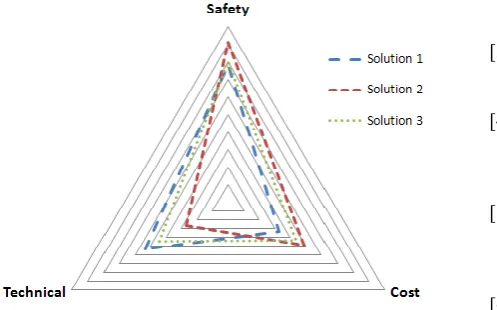
Apart from safety performance, there is also a need to consider other aspects in measuring the merits of various alternatives. The most important indicators for this specific application are technical indicators, incurred cost and safety. Similar study can be carried out accordingly. Consequently, priorities can be synthesised with overall performance evaluated, as shown in Table 7. Weighting factors can be assigned as well to stress the importance of their safety orientation. Figure 7 further exhibits the performance of three risk control solutions in safety, technical and cost aspects.
Table 7: Priority Synthesis (Emphasis on Safety)
Safety Technical Cost Priority 0.50 0.25 0.25
Figure 7: Risk Control Solutions Evaluation Diagram (Sample)
6. CONCLUSION
A unique methodology towards safety management has been presented in this paper. This is achieved by following the philosophy of “learning from the past, to manage the future risk”. Main emphasis is placed on the development of new casualty database system, the subsequent model training and applications within the context of safety management. The resultant situation is an objective evaluation of various risk control options that facilitate the decision-making process both at the design and operation stages. This will contribute positively to the ultimate goal of effective safety management.
Future development will focus on the development of an integrated risk management environment, in which the user interface for data input, relevant databases, data mining techniques, and graphic presentations of risk index would be accommodated.
Acknowledgements
We acknowledge the financial support received by the University of Strathclyde in the form of a postgraduate research scholarship for the duration of the first author’s PhD studies. The opinions are those of the authors and it should not be construed that reflect the opinion of ABS Consulting Singapore (S) Pte Ltd or any other organisation.
7. REFERENCES
[1] M. P. Moffatt and S. G. Rich, "Postage Stamps, Past and Present, as Avenues of Learning,"
Journal of Educational Sociology, vol. 24, pp. 110-119, Oct 1950.
[2] C. A. Doxiadis, "Learning from Past,"
Ekistics-the Problems and Science of Human Settlements, vol. 38, pp. 301-301, 1974. [3] K. Kraiger, "On Learning from the Past - a
Meta-Analytic Fable," Personnel Psychology,
vol. 38, pp. 799-801, 1985.
[4] A. Pingree, "Creating the future of faculty development: Learning from the past,
understanding the present.," Review of Higher Education, vol. 30, pp. 85-87, Fal 2006. [5] L. B. Romdhane, N. Fadhel, B. Ayeb, "An
efficient approach for building customer profiles from business data," Expert Systems with Applications, vol. 37, pp. 1573-1585, Mar 2010. [6] J. E. Cabral, J. O. P. Pinto, A. M. A. C. Pinto,
"Fraud Detection System for High and Low Voltage Electricity Consumers Based on Data Mining," 2009 Ieee Power & Energy Society General Meeting, Vols 1-8, pp. 2283-2287 5298, 2009.
[7] H. Xue, et al., "Data Mining Technique in Business Intelligence System for Supermarket,"
Proceedings of the 5th International Conference on Innovation & Management, Vols I and II, pp. 1539-1544 3371, 2008.
[8] E. Lazcorreta, F. Botella, A. Fernandez-Caballero, "Towards personalized
recommendation by two-step modified Apriori data mining algorithm," Expert Systems with Applications, vol. 35, pp. 1422-1429, Oct 2008. [9] IHS SeaWeb . Sea-Web Online Database.
http://www.sea-web.com/seaweb_welcome.aspx (Accessed 25 July 2014).
[10] IMO, International Safety Management Code (ISM Code) : international management code for the safe operation of ships and for pollution prevention: International Maritime
Organization, 1994.
[11] IMO, Casualty investigation code : code of the international standards and recommended practices for a safety investigation into a marine casualty or marine incident. London:
International Maritime Organization, 2008. [12] IMO, "Casualty Statistics and Investigations,"
London, 2005.
[13] IMO. GISIS: Marine Casualties and Incidents - Annex 1 submission: C0004154-A0101 LE JOOLA (9019901) [Online]. Available: http://gisis.imo.org/Public/
[14] IMO, "Outcome of the Seventeenth Session of the Sub-committee on Flag State
Implementation - Lessons Learned for Presentation to Seafarers," IMO, London FSI 17, 18 June 2010 2006.
[15] P. Graham, "International Union of Marine Insurance (IUMI) Hull Spring Statistics," IUMI Facts & Figures Committee31 December 2009. [16] V. Pomeroy and B. S. Jones, "Learning from
[17] T. Soma and C. Rafn, "Using risk assessment workshops in accident investigation," in
Learning from Marine Incidents III, London, 2006.
[18] D. B. McCafferty and C. C. Baker, "Trending the Causes of Marine Incidents," in Learning from Marine Incidents III, London, 2006. [19] Vassalos, D., Konovessis, D., 2008. The
thematic network SAFER EURORO: an integrated approach to safe European RoRo ferry design. Marine Technology 45 (1), 1-8. [20] D. Vassalos, "Risk-Based Ship Design -
Methods, Tools and Application," A.
Papanikolaou, Ed., ed Berlin: Springer, 2008, pp. ix, 376 p.
[21] Guarin, L., Konovessis, D.,Vassalos, D., Safety level of damaged RoPax ships: Risk modelling and cost-effectiveness analysis, Ocean
Engineering, Volume 36, Issue 12-13, September 2009, pp. 941-951.
[22] D. Vassalos, "A Risk-Based Approach to Probabilistic Damage Stability," in Proceeding of the 7th International Ship Stability Workshop, Shanghai, China, 2004.
[23] T. Koski and J. Noble, Bayesian networks : an introduction. Oxford: Wiley-Blackwell, 2009. [24] J. Wang and V. Trbojevic, Design for safety of
marine and offshore systems. London: IMarEST, 2007.
[25] A. Friis-Hansen, Bayesian Networks as a Decision Support Tool in Marine Applications: Dept. of Naval Architecture and Offshore Eng. Technical University of Denmark, 2000. [26] W. Cai, D. Konovessis, D. Vassalos, G.
Mermiris, "Total Risk Management through Data Mining using Bayesian Networks," in 4th International Martitime Conference on Design for Safety and 3rd Workshop on Risk-Based approaches in the Marine Industries, Italy, 2010.
[27] Peter Spirtes, Clark Glymour, and Richard Scheines, Causation, prediction, and search, Department of Philosophy, Carnegie Mellon University.
[28] R. E. Neapolitan, Learning Bayesian networks. Harlow: Prentice Hall, 2004.
[29] G. Schwarz, "Estimating Dimension of a Model," Annals of Statistics, vol. 6, pp. 461-464, 1978.
[30] H. Akaike, "New Look at Statistical-Model Identification," Ieee Transactions on Automatic Control, vol. Ac19, pp. 716-723, 1974.
[31] J. Rissanen, "Stochastic Complexity," Journal of the Royal Statistical Society Series B-Methodological, vol. 49, pp. 223-239, 1987. [32] K. B. Korb and A. E. Nicholson, Bayesian
artificial intelligence. Boca Raton ; London: Chapman & Hall/CRC, 2004.
[33] D. Konovessis, K. H. Chua, D. Vassalos, "Decision Support in Risk-based Ship Design,"
![Figure 1: Sequence of Scenarios [19]](https://thumb-us.123doks.com/thumbv2/123dok_us/1627695.115979/2.595.322.547.72.202/figure-sequence-of-scenarios.webp)