This is a repository copy of
Grounding language in perception for scene conceptualization
in autonomous robots
.
White Rose Research Online URL for this paper:
http://eprints.whiterose.ac.uk/81156/
Version: Accepted Version
Proceedings Paper:
Dubba, KSR, De Oliveira, MR, Lim, GH et al. (4 more authors) (2014) Grounding language
in perception for scene conceptualization in autonomous robots. In: Qualitative
Representations for Robots: Papers from the AAAI Spring Symposium. Technical report.
AAAI 2014 Spring Symposia, 24-26 March 2014, Palo Alto, California. AI Access
Foundation , 26 - 33. ISBN 9781577356462
[email protected] https://eprints.whiterose.ac.uk/
Reuse
Unless indicated otherwise, fulltext items are protected by copyright with all rights reserved. The copyright exception in section 29 of the Copyright, Designs and Patents Act 1988 allows the making of a single copy solely for the purpose of non-commercial research or private study within the limits of fair dealing. The publisher or other rights-holder may allow further reproduction and re-use of this version - refer to the White Rose Research Online record for this item. Where records identify the publisher as the copyright holder, users can verify any specific terms of use on the publisher’s website.
Takedown
If you consider content in White Rose Research Online to be in breach of UK law, please notify us by
Grounding Language in Perception for Scene Conceptualization
in Autonomous Robots
Krishna S.R. Dubba
School of Computing, University of Leeds, Leeds, UK
Miguel R. de Oliveira and Gi Hyun Lim and Hamidreza Kasaei and Lu´ıs Seabra Lopes and Ana Tom´e Instituto de Engenharia Electr´onica e Telem´atica de Aveiro, Universidade de Aveiro, Portugal
Anthony G. Cohn
School of Computing, University of Leeds, Leeds, UK
Abstract
In order to behave autonomously, it is desirable for robots to have the ability to use human supervision and learn from different input sources (perception, gestures, verbal and textual descriptions etc). In many machine learning tasks, the supervision is directed specifically towards machines and hence is straight forward clearly annotated examples. But this is not always very prac-tical and recently it was found that the most preferred interface to robots is natural language. Also the su-pervision might only be available in a rather indirect form, which may be vague and incomplete. This is fre-quently the case when humans teach other humans since they may assume a particular context and existing world knowledge. We explore this idea here in the setting of conceptualizing objects and scene layouts. Initially the robot undergoes training from a human in recognizing some objects in the world and armed with this acquired knowledge it sets out in the world to explore and learn more higher level concepts like static scene layouts and environment activities. Here it has to exploit its learned knowledge and ground language into perception to use inputs from different sources that might have overlap-ping as well as novel information. When exploring, we assume that the robot is given visual input, without ex-plicit type labels for objects, and also that it has access to more or less generic linguistic descriptions of scene layout. Thus our task here is to learn the spatial struc-ture of a scene layout and simultaneously visual object models it was not trained on. In this paper, we present a cognitive architecture and learning framework for robot learning through natural human supervision and using multiple input sources by grounding language in per-ception.
Introduction
One of the approaches to make autonomous systems and robots more robust is to impart them the ability to learn in open-ended environments, where they interact with non-expert users through multiple input sources. But the usual approach in machine learning as well as computer vision for building knowledge is using supervision in the form of la-belled (annotated) examples where the examples come from a single source. This approach is not convenient if a robot
Copyright c2014, Association for the Advancement of Artificial Intelligence (www.aaai.org). All rights reserved.
should follow a life-long learning strategy as providing la-belled examples is not natural to humans. Also the robot will come across different sources of input in several forms such as videos and images (perception), verbal, gesture and text (direct or indirect human supervision) etc. and combining these inputs to form a coherent source for learning is a chal-lenge for robots. In order to make robot learning more ro-bust and ubiquitous, we require the robot to cope with natu-ral human supervision (i.e. through gestures and natunatu-ral lan-guage description) (Scopelliti, Giuliani, and Fornara 2005) and multiple sources of input for learning. In this paper, we present a cognitive architecture and learning framework that enable robots to adapt to novel environments. These robotic systems must consist of many tightly coupled modules and handle large size data.
We motivate this approach using a scenario from the restaurant domain where the robot is an apprentice. The robot is trained on several objects to recognize them in a natural scene environment and then instructed to approach several tables and learn the table-top layouts on those ta-bles. The teacher gives a description of the layouts of the cutlery in natural language and the layouts have several ob-jects that the robot has not seen before during training. Then, the robot is instructed to approach another table and check if the table-top layout on that table is correct and also rec-ognize the never-seen-before objects during training. In this scenario, the robot is trained to recognize objects by point-ing at the objects and nampoint-ing them which is how humans normally teach others when introducing new objects. Also in table-layout analysis the robot has to analyse input from different sources, i.e. from perception by looking at the table and language (verbal/text description of scene by teacher).
Related Work
As robots are expected to increasingly interact and collabo-rate closely with humans, robotics researchers need to look at human cognition as a source of inspiration for developing robot capabilities that simplify and enhance this interaction and make robots more human-friendly. Such an ability al-lows the robot to adapt to new environments, improve their knowledge with accumulated experiences and conceptual-ize new discovered categories. Learning is closely related to memory in human cognition. In the cognitive science liter-ature, the existence of multiple memory systems is widely accepted. Recent literature converges on five major memory systems (Tulving 1991):Procedural memory, for sensory-motor skills;Perceptual representation memory, mainly for the identification of objects;Working memory, to support ba-sic cognitive activity;Semantic memory, mainly for spatial and relational information; andEpisodic memory, for spe-cific past happenings, enabling “mental time travel”.
In robotics, learning about spatial layouts of scenes clearly relates to human semantic memory and learning the time-independent features of objects can be related to per-ceptual representation memory. The architecture presented in this paper consists of multiple memory systems, includ-ingSemantic memory andPerceptual representation mem-ory. In support of computational efficiency, the architecture supports runtime multiplexing mechanism of object percep-tion pipelines, one for each tracked object. The architecture can also be configured to launch modules as independent processes or as threads in a single process.
There have been attempts to combine language and per-ception for smooth interaction of robots with humans. For example, the Grounded Situation Model (GSM) (Mavridis and Roy 2006) was proposed as a modular architecture for combining language, visual and proprioceptive inputs but conceptualization using past experiences is missing in the proposed work. Instead it ‘remembers’ past which is available for resolving temporal issues. Learning a joint model for language and perception has been attempted (Ma-tuszek et al. 2012) for the object selection task by inducing weighted groups of words where the weights correspond to the attribute classifiers the words are paired with. Note that this approach only handles attribute based concepts such as ’yellow’ etc. and cannot handle relations.
In (Seabra Lopes and Chauhan 2007), an open-ended ob-ject category learning system is described based on one-class learning (with support vector data descriptions) and human-robot interaction. The authors also proposed a teach-ing protocol for performance evaluation in open-ended learning. In (Seabra Lopes and Chauhan 2008), a system with similar goals is described. In this case, the learning approach is based on multiple representations, classifiers and classifier combinations, and a meta-learning component monitors classifier performance, reconfigures classifier com-binations and chooses the classifier to be used for prediction. This is related to attentional selection, a biological mech-anism for focusing on specific features or representations based on recent experience (Kruschke 2005). These works are based on 2D images collected in static scenes, when a target object is selected either by the user, or by the robot.
Since there is no continuous stream of data being stored, memory requirements are easily satisfied. A life-long learn-ing approach for interactive learnlearn-ing of multiple categories has been proposed (Kirstein et al. 2012) which involves se-lecting the most crucial features from a series of high di-mensional feature vectors that almost exclusively belong to that specific category. This work showed successful learn-ing of 5 color categories and 10 shape categories observed in 56 objects, just based on 2D images. However, the authors still follow a standard train-and-test procedure, which is not plausible in open-ended scenarios. Moreover, the authors did not provide details of their software architecture.
We use graph similarity for grounding language in per-ception. There has been significant work in graph similarity measures and the notion of graph similarity depends on the domain of interest. Graph similarity has been used in spatial-scene similarity queries (Nedas and Egenhofer 2008) where a spatial database and the query are converted to graphs and graph similarity is used to find the answer for the query. A generic approach for finding similarity of graphs based on node similarity was proposed in (Blondel et al. 2004). Hey-mans and Singh (HeyHey-mans and Singh 2003) also proposed a similarity measure between nodes of two graphs that are in turn used to compute the similarity measure between the graphs. They propose that not only the similarity between nodes but also dissimilarity between the nodes of graphs is important for computing the similarity measure for graphs. We extend this algorithm to graphs with labelled edges and discard certain terms in the similarity computation because they are no longer valid in our case.
Software Architecture
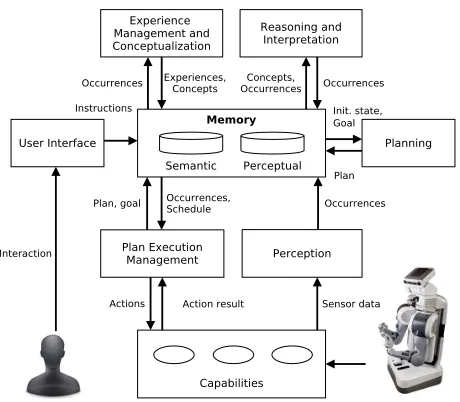
Figure 1: High level overview of the RACE architecture.
Multiple Memory Systems
The RACE software architecture accommodates two dis-tinct memory systems: Semantic Memory and Perceptual Memory. TheSemantic Memory(SMem) is implemented as a RDF database used as blackboard for all processes, the contents of which are similar to what can be found in an ABox in Description Logics. It is used for providing com-mon knowledge to all high level processes. To cope with per-ception and data functionalities, an additional memory sys-tem,s employed, the Perceptual Memory. Unlike the SMem, which is specifically designed to store small size seman-tic data, thePerceptual Memory (PMem) database should be able to store large amounts of data and be very effi-cient in doing so. The implementation is carried out using a lightweight NoSQL database developed by Google called LevelDB1. LevelDB is a fast key-value storage database that
provides an ordered mapping from string keys to string val-ues. NoSQL databases are known for their simplicity, flexi-bility and scalaflexi-bility, which are key requisites for our Per-ceptual Memory System (Cattell 2011). In addition, Lev-elDB operates in memory and is copied to the file sys-tem asynchronously, which significantly improves its access speed. LevelDB allows for simultaneous access to the stor-age.
The multiple memory system implemented in RACE is very effective at storing and retrieving both semantic and perceptual data, especially, conceptualizing objects and scenes and grounding linguistic descriptions necessarily in-volves memory systems for semantic information and per-ceptual information. These memory systems support learn-ing loops at multiple levels of abstraction from visual and text-based sources. In addition, there is strong evidence that human memory contains several memory systems (Tulving 1991).
1
https://code.google.com/p/leveldb/
Perception, Learning and Interface Modules
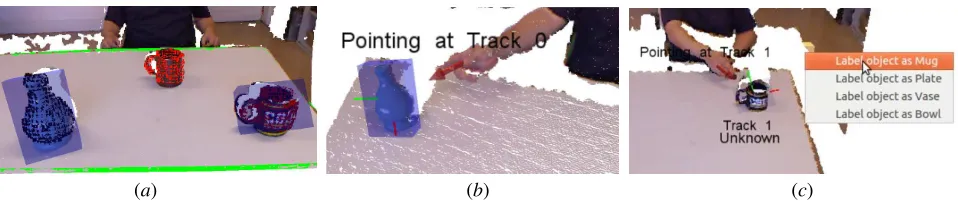
The Perceptionfunctional component is composed of two software modules: Detection and Multiplexed Object Per-ception. The Detection module is responsible for detect-ing novel objects in the scene. This module periodically re-trieves a list of all the objects currently on top of the ta-ble2(Rusu and Cousins 2011). Then it extracts from that listall objects that are not currently being tracked. For each of those, aMultiplexed Object Perceptionpipeline is launched. Figure 2 (a) shows an example where three objects are seg-mented, but only one is not currently being tracked, i.e., does not have a bounding box around it.
There is oneMultiplexed Object Perceptionpipeline run-ning for each object being tracked. Each pipeline provides tracking, feature extraction and object recognition function-alities. Tracking is based on a particle filter based approach3
that uses both geometric as well as color information. Peri-odically, features are extracted from the tracked object and then classified by the object recognition module. To provide a 3D object description, we use regional surface descriptors as proposed in (Johnson and Hebert 1999).
TheConceptualizationis triggered when a user provides a category label for an object. This operation is handled by theUser Interfacemodule, as will be discussed next. When triggered,Object Conceptualizer(OC) reads the current ob-ject categories from the PMem, as well as a set of features describing the labelled object. With this information, a new set of object categories is produced and written back to the PMem.
The User Interfacefunctional component is responsible for the interaction with the user. The user skeleton is tracked in real-time and pointing gestures detected by computing the direction of the forearm. When a pointing direction inter-sects a tracked object bounding box, it is assumed that the user is pointing to that object. To produce an object category label (which is sent to the Conceptualization), the point-ing detection must occur simultaneously with the object la-belling. In this way, the simplicity of the pointing detection mechanism does not cause any false positive detections. The object labelling mechanisms are implemented as rviz inter-active menu markers4. An example is shown in Fig. 2 (c).
Object Conceptualization By Grounding
Language In Perception
In order to adapt to new service environments, robots need to categorise physical objects and acquire vocabulary about them (Lim, Suh, and Suh 2011). We approach this problem from a long-term perspective and with emphasis on domain open-endedness, i.e. not assuming a pre-defined set of cat-egories (Chauhan et al. 2013), (Kasaei et al. 2013). If the robot does not know what a ‘mug’ looks like, it may ask the user to point to one. Such situation provides an opportu-nity to collect a training instance (an experience) for object
2http://wiki.ros.org/tabletop object detector
3
http://www.willowgarage.com/blog/2012/01/17/tracking-3d-objects-point-cloud-library
4
(a) (b) (c)
Figure 2: Examples of some of the software modules: (a) Object Detection; (c) Gesture Recognizer; and (d) Interface Manager.
conceptualization. Concerning category formation, the base-line is a purely memory-based (instance-based) learning ap-proach.
We adopt object-centered 3D shape features for object recognition. Firstly, a down-sampling filter based on oc-trees (Potmesil 1987), which keeps balance between com-putational efficiency and robustness, is applied to extract re-liable feature keypoints from objects. A spin-image descrip-tor, which is rotation, scale and pose invariant in 3D percep-tion (Johnson and Hebert 1999), is utilized to describe the surrounding shape in each keypoint.
In order to estimate the dissimilarity between a target ob-ject view, vt, and an object view contained in a category model in the PMem,vm, the following distance function is implemented:
DV vt, vm
=
Pq
l=1 minkd(vlt, vkm)
q (1)
where vtl and vkm represents the spin-image of the tar-get object and the model object, respectively.qis the num-ber of spin-image of target object view. A kd-trees based fast approximate method is utilized to search nearest neigh-bour in the high-dimensional feature spaces (Bentley 1975). The minimum distance between the target object and the in-stances of a certain category,C, is considered as the object-category distance:
DC vt, C
= min
vC∈CDV v t, vC
(2)
wherevCare the view instances of object categoryC. In 3D object recognition, views in same category are more sim-ilar than those in others. Thus,DC()can be utilized to distin-guish “unknown” from each “known” category with its nor-malized distance. Here the intra-category distance (ICD) of each object category is defined, as follows:
ICD(C) =
P
vi∈C
P
vj∈C,vi6=vj DV (vi, vj) n ·(n−1) (3)
wherenis the number of category instances, andviand vjare two different instances of categoryC. Finally, the nor-malized distance of object category, N D(), is computed based on dividingDC(vt, C)byICD(C), as follows:
N D(vt, C) =
DC(vt, C)
ICD(C) (4)
The normalized distance is utilized to classify target ob-jects. If the value is larger than a given threshold for all cate-gories, then the object is classified as “unknown”. Otherwise it is classified as the category which gives the smallest value forN D.
Grounding Language In Perception With
Graph Matching
In this section, we explain the grounding of language in per-ception using graph matching for scene layouts. We assume the robot has perceived the table layout and has a textual description of cutlery layout from a human. For our exper-iments, the textual description of laying out the cutlery and the perceived image of the final layout is taken from the wikihowwebsite5. In order to concentrate on the main task
of grounding, we hand annotated the objects in the image and the robot has no knowledge of the objects labels (ide-ally some of the object labels can be obtained from using the object conceptualization module explained in the previ-ous section). The textual description of the cutlery layout is converted to relational form manually6; care was taken to preserve the vagueness and incomplete nature of human instructions. For example, in one of the scripts for laying the cutlery for a formal dinner, the instructions say that the dessert fork should be above the dinner plate and the dessert spoon is also above the dinner plate, but it is not mentioned whether the dessert spoon should be above the dessert fork or vice versa. To simplify the task, we ignored the orienta-tion of the cutlery and alternative posiorienta-tions and other oporienta-tions mentioned in the instructions (these are addressed in future work). Also we assume that the robot knows the orientation of the scene i.e. the layout is seen and explained as if looking from the chair in front of the dinner layout.
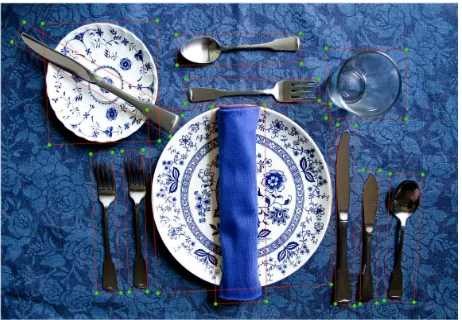
Relational Graph From Perception A spatial relational description is obtained from the bounding boxes of the an-notated objects in the image using the spatial relations in
5
The idea of using knowledge from wikihow to guide learning follows on from this approach in the Robohow project:http:// robohow.eu/project/approach
6
Fig. 4. Note that the textual description uses a subset of these relations to explain the layout. The relations are com-puted by projecting the bounding boxes toXandYaxes and then using the Rectangle Algebra (Balbiani, Condotta, and Del Cerro 1998) to obtain the relations.
Figure 3: An annotated table top. The bounding boxes for the annotated polygons are used for generating the spatial relations among the cutlery and crockery.
top, bottom, right, left, on, under, top right, top left, bottom left, bottom right,
Figure 4: Spatial relations used for obtaining a relational graph from perception.
A graph is constructed from this spatial relational descrip-tion of the layout by using each object as a vertex and the re-lation between a pair of objects as the label for the edge con-necting the corresponding vertices. The relations used are not symmetric and hence the graph is a directed graph. Also note that every pair of objects has a spatial relation resulting in a complete graph where every vertex is connected to every other vertex in both directions. In this experiment, the robot does not know the labels of the annotated polygons, hence vertices are given unique codes which we try to replace with correct object names using the textual description.
Relational Graph From a Description The manually generated spatial relational description is used to generate the graph where each object becomes a vertex and the spa-tial relations are used to label the edges between vertices. Note that unlike the graph constructed from an image, this graph is not a complete graph as the instructions do not ex-haustively list all the relations and it is not possible to infer them from available relations because of the inherent ambi-guity in the relations possible. Relations that are possible to be inferred are derived such as: if A is to the left of B, B is to the left of C, then it can easily be inferred that A is to the left of C. For the the experiments, we used two scripts with
instructions on how to set the table which we call script17 andscript28. Figure 3 corresponds toscript1though we use
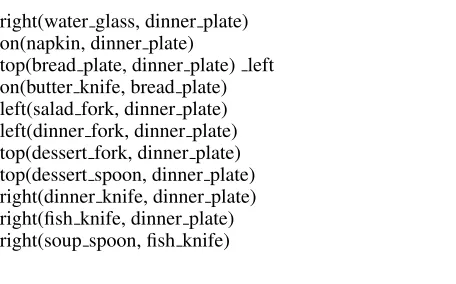
the same image forscript2to make the experiments more generic and interesting because some objects mentioned in the instructions fromscript2are not present in the image and also the number of objects mentioned in the textual descrip-tion is different from the number of objects in the image. The relational description that is manually derived fromscript1 is given in Fig. 7.
Similarity Scores Between Vertices In Graphs
Definition 1. A directed graph G is a 6-tuple G = (V, E, λ, α, LV, LE), whereV is the set of vertices (nodes),
E⊆V×V is a set of edges,λ:V →LV andα:E→LE
are functions assigning labels to vertices and edges respec-tively.
Definition 2. LetGbe a directed graph as defined above. Let Iv andOv be the set of incoming and outgoing edges of a vertexvinG. We can define a labelled edge histogram for each vertexvdenoted byHvwhich is computed fromIv
and Ov and each bucket is labelled by an edge label from the set LE and whether it is an incoming or an outgoing edge. LetBGbe the set of buckets inHv. Hence there are a total of2∗ |LE|buckets inHv. For example,Hv(li,1)and
Hv(lo,1)denote the number of incoming and outgoing edges for vertexvlabelled asl1respectively.
LetG1 = (V1, E1, λ1, α1, LV1, LE1), where|V1| = n1,
andG2 = (V2, E2, λ2, α2, LV2, LE2), where|V2|=n2, be two directed graphs. We aim to obtain an1xn2 similarity matrix S, where the entry S(a, b)expresses the similarity between nodesaandbwherea∈V1andb∈V2. Since we will be dealing with two graphs from the same domain, we expectLE1≡LE2.
Two nodes from different graphs can be similar not only because of their properties alone but also because of their neighbourhood. We first define a similarity measure Sim that depends only on the properties of the individual nodes and subsequently the similarity measure of their neighbours is added. Sim is also ann1 x n2 matrix where the entry
Sim(a, b) expresses the similarity between nodesa andb where a ∈ V1 andb ∈ V2 computed solely from aand
b without taking into account their neighbours. Sim(a, b)
captures the similarity by counting the types of incoming and outgoing edges for the two nodes as given below.
Sim(a, b) = X
a∈V1,b∈V2,l∈BG1∩BG2
min(Ha(l), Hb(l))
(5)
The similarity score matrixSis first initialized withS1=
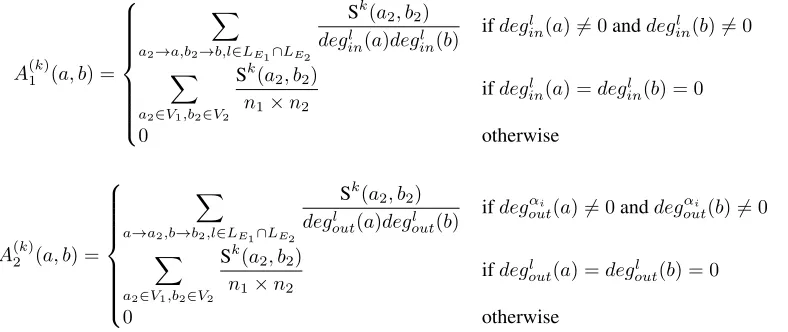
Sim and then iteratively updated (givingS2, S3, ...) using the following two scores which capture the similarity of the neighbourhood of two nodes. Equation 6 is based on the rule: the similarity of two nodes increases if they are referred
7http://www.wikihow.com/Set-a-Dinner-Table
8http://www.wikihow.com/
A(1k)(a, b) = X
a2→a,b2→b,l∈LE1∩LE2
Sk(a2, b2)
degl
in(a)deginl (b)
ifdegl
in(a)6= 0anddeginl (b)6= 0
X
a2∈V1,b2∈V2
Sk(a2, b2)
n1×n2
ifdegl
in(a) =deglin(b) = 0
0 otherwise
(6)
A(2k)(a, b) =
X
a→a2,b→b2,l∈LE1∩LE2
Sk(a2, b2)
degl
out(a)degoutl (b)
ifdegαi
out(a)6= 0anddeg αi
out(b)6= 0
X
a2∈V1,b2∈V2
Sk(a2, b2)
n1×n2
ifdegl
out(a) =deglout(b) = 0
0 otherwise
(7)
to (using incoming edges) by similar nodes by identically labelled edges and Eq. 7 is based on the rule: the similarity of two nodes increases if they refer (using outgoing edges) similar nodes by identically labelled edges. In the equations below,a →a2means there is an edge with the given label from nodeato nodea2 anddeginl (a)anddegoutl (a)gives the number of incoming and outgoing edges of vertexawith labell.
The above scores are computed in an iterative fashion (starting withk = 1) and the similarity matrix is updated using the following equation.
S(k+1)(a, b) = A
(k)
1 (a, b) +A (k) 2 (a, b)
2 xSim(a, b) (8)
Note that the similarity matrix has to be normalized (we use Frobenius norm) during every iteration and this is done as
shown below:
S(k+1)← S
(k+1)
kS(k+1)kF
where kAkF= [
X
i,j
abs(ai,j)2]1/2
(9) This iterative process is repeated until the similarity ma-trix stabilizes or until we exceed the specified number of iterations. When computing the similarity matrix is finished, the best matchings are obtained using the Hungarian algo-rithm (Kuhn 1955) on this similarity matrix.
There are other rules that are used by Heymans and Singh (Heymans and Singh 2003) but they are not rele-vant here noting the fact that the graphs in our domain are completely connected or are constructed using incomplete knowledge. Hence we cannot rule out the fact that there might be an edge between two vertices which is not present in our knowledge.
Experimental Results
This section presents a qualitative analysis of the object conceptualization module and results of graph matching for
grounding language in perception for scene layouts. For ob-ject conceptualization, a typical case study is shown where the system acquires knowledge about the objects through the interaction with the user.
Scenario-Based Tests
[image:7.612.114.508.62.228.2]To show the features and functioning of the complete object conceptualization system, a scenario-based test was made. The test consists of a sequence of about 1 minute long, where the user is moving several objects in front of the cam-era. During the experiment, the system must detect several objects and user pointing gestures that occur. It must also learn about new object categories when the user provides a category label. At the start of the experiment, the system had no prior knowledge, i.e., the PMem did not contain any data. Figure 5 shows that the proposed architecture is capable of functioning as an open-ended system. Objects that were unknown at first were later labelled by the user. After that, the system is capable of properly recognizing the objects.
Graph Matching for Scene Layouts
Figure 5: Key frames of the sequence presented in this case study. All images shown are automatically generated by the system.
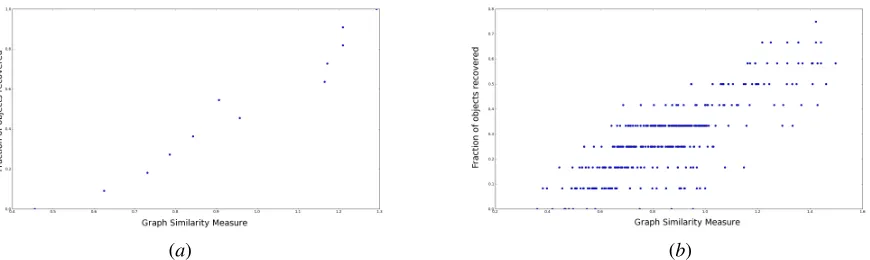
match. We experimented to test if overall graph similarity measure is a good metric to maximize correct object match-ings. Figure 6(a) shows different runs by choosing differ-ent subgraphs from the graph derived from text (each point in the plot corresponds to a subgraph) and the plot shows that the graph similarity measure is a good metric to maxi-mize the object matchings i.e. the higher the graph similarity measure, the more the number of objects matched. In order to test the robustness of the approach, we also used another script (script2) to see if the robot can learn any objects from a script not specifically describing the image in question. In this experiment there were more objects in the graph derived from text (15) compared to 12 objects in the image, hence we did several runs by choosing different subgraphs with com-binations of 12 objects from 15. The algorithm has to decide which subgraph to consider for finalizing the match and once again it is evident from the plot shown in Fig. 6(b)that the graph similarity measure is a good metric to decide which combination of objects to consider for best matching. Inter-estingly, it obtained better objects matchings and high graph similarity when it dropped objects that were not present in the image (such as wine glasses, champagne glass etc).
The results are significant in the contexts where the robot is asked to recognise place setting layouts and any mis-matches. This could be done from hand coded layout knowl-edge or from learned models such as we acquire here.
Conclusion and Future Work
In this paper, we proposed a cognitive architecture and learn-ing framework for robot learnlearn-ing through natural human su-pervision and using multiple input sources by grounding lan-guage in perception. The results obtained in the restaurant domain are encouraging though some of components (ro-bust perception and natural language parser) need to be im-plemented for the whole system to be completely automatic. Future directions include using ego-centric videos and ver-bal description as input for robot learning. The spatial prim-itives used in the current framework are very simple
(Rect-right(water glass, dinner plate) on(napkin, dinner plate)
top(bread plate, dinner plate) left on(butter knife, bread plate) left(salad fork, dinner plate) left(dinner fork, dinner plate) top(dessert fork, dinner plate) top(dessert spoon, dinner plate) right(dinner knife, dinner plate) right(fish knife, dinner plate) right(soup spoon, fish knife)
Figure 7: Spatial relations derived manually from script1 that describes a place setting on a table.
angle Algebra) and there is scope to use a combination of spatial calculi for providing the description of scenes to the robot. Another aspect to investigate is mapping the ground-ing problem to the problem of mergground-ing and alignground-ing ontolo-gies (Noy and Musen 1999) where the information extracted from text description and perception can be considered as two different ontologies that need to be aligned.
Acknowledgment
This work is supported by the EC Seventh Framework Pro-gram under Project RACE (Robustness by Autonomous Competence Enhancement, grant agreement no. 287752).
References
Balbiani, P.; Condotta, J. F.; and Del Cerro, L. F. 1998. A model for reasoning about bidimensional temporal relations. InPrinciples of KRR, 124–130.
[image:8.612.329.557.284.426.2](a) (b)
Figure 6: Results comparing graph similarity measure and the fraction of the objects matched correctly between textual de-scriptions (a - script1, b - script2) and perception.
used for associative searching.Communications of the ACM 18(9):509–517.
Blondel, V. D.; Gajardo, A.; Heymans, M.; Senellart, P.; and Van Dooren, P. 2004. A measure of similarity between graph vertices: Applications to synonym extraction and web searching.SIAM review46(4):647–666.
Cattell, R. 2011. Scalable SQL and NoSQL data stores. SIGMOD Rec.39(4):12–27.
Chauhan, A.; Seabra Lopes, L.; Tom´e, A. M.; and Pinho, A. 2013. Towards supervised acquisition of robot activity ex-periences: an ontology-based approach. In16th Portuguese Conference on Artificial Intelligence - EPIA’2013.
Cousins, S.; Gerkey, B.; Conley, K.; and Garage, W. 2010. Welcome to ROS topics [ROS Topics].Robotics Automation Magazine, IEEE17(1):12 –14.
Heymans, M., and Singh, A. K. 2003. Deriving phyloge-netic trees from the similarity analysis of metabolic path-ways. Bioinformatics19(1):138–146.
Johnson, A., and Hebert, M. 1999. Using spin images for efficient object recognition in cluttered 3D scenes. PAMI, IEEE Transactions on21(5):433–449.
Kasaei, S.; Seabra Lopes, L.; Tom´e, A.; Chauhan, A.; and Mokhtari, V. 2013. An instance-based approach to 3D object recognition in open-ended robotic domains. InProceedings of the 4th Workshop on RGB-D: Advanced Reasoning with Depth Cameras, RSS’2013.
Kirstein, S.; Wersing, H.; Gross, H.-M.; and K¨orner, E. 2012. A life-long learning vector quantization approach for interactive learning of multiple categories.Neural Networks 28:90–105.
Kruschke, J. K. 2005. Category learning. The handbook of cognition183–201.
Kuhn, H. W. 1955. The Hungarian method for the assign-ment problem.Naval research logistics quarterly2(1-2):83– 97.
Lim, G. H.; Suh, I. H.; and Suh, H. 2011. Ontology-based unified robot knowledge for service robots in indoor envi-ronments. Systems, Man and Cybernetics, Part A: Systems and Humans, IEEE Transactions on41(3):492–509.
Matuszek, C.; Fitzgerald, N.; Zettlemoyer, L.; Bo, L.; and Fox, D. 2012. A joint model of language and perception for grounded attribute learning. InICML, 1671–1678.
Mavridis, N., and Roy, D. 2006. Grounded situation mod-els for robots: Where words and percepts meet. In Intel-ligent Robots and Systems, 2006 International Conference on, 4690–4697.
Nau, D. S.; Au, T.-C.; Ilghami, O.; Kuter, U.; Murdock, J. W.; Wu, D.; and Yaman, F. 2003. SHOP2: An HTN plan-ning system.Journal of AI Research20:379–404.
Nedas, K. A., and Egenhofer, M. J. 2008. Spatial-scene similarity queries. Transactions in GIS12(6):661–681. Noy, N. F., and Musen, M. A. 1999. An algorithm for merg-ing and alignmerg-ing ontologies: Automation and tool support. InWorkshop on Ontology Management at AAAI-1999. Oliveira, M.; Lim, G. H.; Kasaei, H.; Chauhan, A.; Seabra Lopes, L.; and Tom´e, A. M. 2014. A software architecture for open-ended object conceptualization from experiences. InICRA 2014, submitted.
Potmesil, M. 1987. Generating octree models of 3D objects from their silhouettes in a sequence of images. Computer Vision, Graphics, and Image Processing40(1):1–29. Rusu, R., and Cousins, S. 2011. 3D is here: Point Cloud Library (PCL). InICRA, 2011, 1–4.
Scopelliti, M.; Giuliani, M. V.; and Fornara, F. 2005. Robots in a domestic setting: a psychological approach. Universal Access in the Information Society4(2):146–155.
Seabra Lopes, L., and Chauhan, A. 2007. How many words can my robot learn?: An approach and experiments with one-class learning. Interaction Studies8(1):53–81.
Seabra Lopes, L., and Chauhan, A. 2008. Open-ended cate-gory learning for language acquisition. Connection Science 20(4):277–297.