•
lR
UNION INTERNATIONALE DES RADIOECOLOGISTES INTERNATIONAL UNION OF RADIOECOLOGISTS
COMMISSION DES COMMUNAUTES EUROPEENNES COMMISSION OF THE EUROPEAN COMMUNITIES
ROLE OF MICROORGARISMS OR THE BEHAVIOUR OF RADIORUCLIDES IN AQUATIC ARD TERRESTRIAL SYSTEMS ARD THEIR TRABSFER TO MAR
.··-Proceedings of a Workshop held in Brussels, 25-27 April 1984, in cooperation with the
Institut Royal des Sciences Naturelles de Belgique.
Editors E.BONNYNS-VAN GELDER R.KIRCHMANN
•
lR
UNION INTERNATIONALE DES RADIOECOLOGISTES INTERNATIONAL UNION OF RADIOECOLOGISTS
COMMISSION DES COMMUNAUTES EUROPEENNES
~
COMMISSION OF THE EUROPEAN COMMUNITIES
~ROLE
OP KICROORGARISKS OB THE BEHAVIOUR OF RADIOBUCLIDES IR AQUATIC ABD TERRESTRIAL SYSTKKS ABD THEIR TRABSPER TO MAW---::::
~Proceedings of a Workshop~held in~Brussels, 25-27 April 198~
::;---in cooperation with the
Institut Royal des Sciences Naturelles de Belgique.
Editors E.BONNYNS-VAN GELDER R.KIRCHMANN
~<e-{\'<ye)
>JUNE 1984
'1--l-EDITORIAL NOTE
The papers and discussions have been edited by the Secretariat of I.U.R. to the extent considered necessary for the reader's assistance. The views expressed and the general style adopted remain, however, the responsibility of the named authors or participants.
The Proceedings have been printed by composi~ion typing and photo-offset lithography. Within the limitations imposed by this method, every effort has been made to maintain a high editorial standard.
SCIENTIFIC COMMITTEE
Messrs. S.I.AUERBACH. U.S. A. , Chairman D.VAN DER BEN. Belgiu~ Vice-Chairman P.O.AGNEDAL Sweden
P.BOVARD France
E.DUURSMA The Netherlands
G. GERBER c.c.E.
C.MYTTENAERE C. C. E.
R.KIRCHMANN Belgium, Scientific Secretary
ORGANIZING COMMITTEE D.VAN DER BEN Brussels (Chairman) R.KIRCHMANN Mol (Secretary) S.BONOTTO Mol
Z.MOUREAU Brussels
C.MYTTENAERE Louvain-la-Neuve
P.NIENHUIS Yerseke (The Netherlands)
Thanks are due to the following institutions for the financial support provided in organizing this Workshop.
- FONDS NATIONAL DE LA RECHERCHE SCIENTIFIQUE
OPENING ADDRESS
Prof.MISONNE, Director Kon.Belg.Inst.voor Natuurweten-schappen.
Ladies and Gentlemen,
It is my pleasure to welcome you - on behalf of the Direction · and all the Staff of our Institute - to this Workshop on radionuclides and
micro-organisms. I am indeed very happy to do so, not only because this is the first Symposium to be held in the new part of this building, but also for the following reason : if we are sometimes reproached - in these times of economic difficulties - to do research for its own sake, this remark certainly does not apply to works that will be presented and. discus-sed here during the next three days, and which are closely related to the preservation of our environment.
Of course, during your stay, you will be free to visit our Insti-tution. You may perhaps notice that it has two main parts : the "Museum" and the "Institute". The "Museum" part consists of exhibition rooms, offices of the Educational Service and the Documentation department, a lecture room, and finally, the Auditorium where we are right now.
I would particularly like to recommend you to visit the Iguanodons, the spiders vivarium, the Carpentier collection which is on display on the fourth floor, and also our temporary exhibitions.
The second part, or the "Institute", consists of research labo-ratories and administrative and technical services. There are four scien-tific Departments : Paleontology, Recent Vertebrates, Recent Invertebrates and the Department which concerns itself most closely with your work : the Department of Biology.
Ever since man has been adding induced radioactivity to the natural background radioactivity, a number of new problems have arisen, of which the main one stems from the long half-life of many radioisotopes. These treaten to spread into the environment, whatever precautions we may take. Moreover, we even witness the apparition of artificial isotopes such as 99-Technetium, which is not only radioactive but also chemically toxic. Since all these isotopes can concentrate along the food chains, they are higly dangerous for the organisms situated at the end of the trophic chains - and therefore for Man too.
If abundant literature can be found on the phenomenon of radio-nuclide concentration in macroscopic organisms, very little has been writ-ten, on the other hand, on the role of micro-organisms.
aspects of the question - that your work is so important for the health of humankind.
v
OPENING ADDRESS
Prof. C.MYTTENAERE., C.E.C. Bruxelles
Ladies and Gentlemen,
It is a great pleasure on behalf of the Commission of the Euro-pean Communities and on behalf of the IUR, to welcome the participants to this Workshop on the role of microorganisms on the behaviour of radionu-clides in aquatic and terrestrial systems and their transfer to man. In so doing, I would also like to thank the Belgian Royal Institute of Natural Sciences which assisted us very efficiently with the organization of the meeting.
For health reasons, Prof.AUERBACH, President of the UIR, was constraint to stay at home but he wished us a very good meeting.
In a number of energy forecasting surveys carried out at both national and international level, nuclear energy is regarded as a vital source of
electricity production, at least for the next few decades, even if other news methods of energy production are successfully developed. Like other industrial processes, the various phases of the nuclear fuel cycle produce waste, a large quantity of which,in this case,is radioactive.
There is therefore a growing interest in the study of the behaviour of radionuclides in the environment, particularly in connection with the increasing number of nuclear power plants and their associated fuel cycle facilities and with the establishment of repositories to meet their radio-active waste disposal needs.
Since a number of years the Commission has taken a close interest in the problems of contamination of the environment. The information has been helpful to radioecologists undertaking the study of the environmental radiocontamination and has contributed to the production of data in the different fields considered and in turn has contributed to the safeguar-ding of the quality of human life. Since several years the Commission is now helped within its task by the UIR.
Current mathematical models based on thermodynamic data and solubility equilibria are not sufficient for a satisfactory description of the beha-viour of long-lived radionuclides. The possible effects of the biological activity on the behaviour of long-lived radionuclides is not well known or ignored and few models have considered the role of these organisms on the radionuclides transfer in the foodchain.
From the results of limited studies of substrate chemistry, microbiology and availability of radionuclides and by reference from studies of the behaviour of trace metals in the environment, it may be concluded that the microflora could play a significant role in transformation governing the form and the long-term solubility and behaviour of radionuclides in soils, waters and living organisms.
Few information is now available on the role of living organisms in sedi-ments, soils, plants and animals. The role of the microflora and micro-fauna must thus be viewed as one contributory factor among a number of highly important physicochemical and biological phenomena influencing the behaviour of the radionuclides.
The two major objectives of the proposed seminar are :
- to provide an opportunity for scientists involved in radioecological studies to exchange informations on the role of micorfauna and micro-flora on the long-term availability of the radionuclides,
- to make available the more recent results in this field, and particular-ly in the modelling of pathways for the assessment of environmental impacts from nuclear facilities.
The papers presented during this meeting will surely serve as a guide not only for those interested in radioecology studies but also in the whole subject of environmental behaviour of nutrient elements.
I am very glad to welcome the speakers and participants to such a sympo-sium which surely will be beneficial to all of you and that will facili-tate an exchange of ideas on the actions and developments that are taking place in our respective countries.
The sponsoring organizations wish to express their thanks to the staff of the Belgian Royal Institute of Natural Sciences, whose efforts contributed greatly to the success of the meeting. Special gratitude is due to
Dr. VAN DER BEN who acted and played a central role in the conduct of the meeting.
I trust, Mr.Chairman, Ladies and Gentlemen, that you will find the confe-rence facilities in Brussels to your liking, and that after the working sessions you will be able to relax and have a chance to enjoy the delights of our small country.
SESSION I
Marine and estuarine microorganisms
(1) - Interaction of bacteria with long-life radionuclides in 2 marine and estuarine environments.
F • AZAM ( U. S . A. )
(2) - Concentration of twelve radionuclides by marine phyto- 8 plankton.
N.S.FISHER (Monaco, I.A.E.A.)
(3) - Transfer of radionuclides from sediments to the pelagic 20 system.
E.IIAMILTON (United Kingdom)
(4) - Laboratory studies on the role of marine unicellular 36 algae in accumulating radionuclides and transfering them
to primary consumers.
Y.WANG, Y.XIAO,M.ZHOU,W.TENG (People's Republic of China)
(5) - Mechanisms of radioecological processes, their models and 51 radiation effects in hydrobionts of the Black Sea.
(Read by title)
G.G.POLIKARPOV,V.N.EGOROV,A.Ja.ZESENKO,V.G.TSYTSUGINA, L.G.KULEBAKINA,N.S.RISIK,D.D.RYNDINA,G.E.LAZORENKO, L.A.RADCHENKO,I.I.RUDNEVA,A.V.PARKHOMENKO,N.V.DEMINA, S.M.FEDORIK (U.S.S.R.)
(6) - Problemes poses par !'incidence des micro-organismes du 53 milieu (sols,eaux) sur les transferts des transuraniens
dans l'environnement. Consequences pour le calcul de la dose par ingestion chez l'homme.
R.BITTEL (France)
(7) - Role of unicellular algae in the behaviour of tritium in 60 the aquatic systems.
G.ARAPIS,G.NUYTS,A.BOSSUS,S.BONOTTO,G.KOCH,G.B.GERBER R.KIRCHMANN (Belgium)
(8) - Uptake, distribution and biological effects of technetium 66 in aquatic microorganisms.
Z.MOUREAU,B.MANIA,M.TUAUX,J.VAN BAELEN,C.VERTHE,M.N.MAQUET, J.M.BOUQUEGNEAU,M.COGNEAU,D.VAN DER BEN,C.M.VANDECASTEELE, C.MYTTENAERE,S.BONOTTO (Belgium)
(9) - Fungal flora of marine macroalgae and its ecological significance. (Read by title)
F.CINELLI,V.CUOMO,G.PARDI,U.SALGHETTI,F.VANZANELLA, S.DE RANIERI, P.BELCARI (Italy)
(10) -Effects of nitrosyl complexes of Ruthenium on E.coli k 12 82 and yeast and the uptake of these complexes by marine
bacteria.
J.F.GIBSON,R.K.POOLE,M.N.HUGHES,J.F.REES (United Kingdom)
SESSION II
Freshwater microorganisms
(1) - Dynamic aspects of the planktonic food chain in lakes. 99 G.BALVAY (France)
(2) - Bilan de !'utilisation des cultures d'algues pour la 124 detection des radioelements presents dans les effluents
des installations nucleaires.
M.BOURDON,R.KIRCHMANN,J.BINET,E.FAGNIART,A.COLETTE (Belgium)
(3) - Detection of microorganisms in primary cooling systems 132 of nuclear reactors.
M.MERGEAY,M.BOURDON,W.HORSTEN,R.KIRCHMANN (Belgium)
(4) - Donnees experimantales preliminaires sur le role du 139 sediments et d'une micro-algue (chlorelle) dans le
transfert de radionucleides en eau douce. A.LAMBRECHTS,L.FOULQUIER,J.P.BAUDIN (France)
(5) - Interaction between technetium and nitrogen fixing 158 organisms.
C.M.VANDECASTEELE,A.DELMOTTE,J.HENROT,C.VAN HOVE, M.COGNEAU (Belgium)
(6) -Role of macroinvertebrates and microfungi in the 173 transfer of 32-P along detritus food chains in rivers.
(Read by title)
SESSION III
Terrestrial soil microorganisms
(1) - A review of models for the growth and disappearance 180 rates of microorganisms in soil.
M.FRISSEL,J.A.VAN VEEN,A.M.A.VAN DER LINDEN (The Netherlands) (2) - HT/HTO-conversion by soil organisms : Experimental 195
results and ecological studies. H.FORSTEL , F.FUHR (Germany)
(3) - Studies of the microbiological influence on the 207 behaviour of iodine-125 in humus soil.
S.STRACK,A.MOLLER (Germany)
(4) -
Investigations on the influence of microorganisms 219 on the translocation of radioiodine in soil.J.BORS,R.MARTENS,W.KOHN (Germany)
(5) - Influence of pH and redox-potential on the extracta- 228 bility of plutonium from soil. (Read by title)
J.F.STOUTJESDIJK,R.M.J.PENDERS,M.J.FRISSEL (The Netherlands) (6) - Anaerobic microbial transformations of radioactive 229
wastes.
A.J.FRANCIS (U.S.A.)
(7) - The microbiological examination of potential deep subterranean nuclear waste disposal sites.
N.CRISTOFI ,J.C.PHILP,J.M.WEST (United Kingdom) (8) - Modelling microbial contamination of a deep
geolo-gical repository for HWL.
I.G.Mc.KINLEY ,F. VA~ DORP,J.M.WEST (Switzerland)
239
SESSION IV
Microflora in higher trophic levels
(1) -The role of micro-organisms in the digestive tract of domestic animals and its consequence for the absorption of radionuclides. (Read by title) J.VAN DEN HOEK (The Netherlands)
(2) - Complexation of actinides by complexing agents of microbial origin.
R.A.BULMAN, T.E.JOHNSON (United Kingdom)
252
SESSION V
Panel Discussion
Report of the Chairman Session I/ A Session I/B Session II Session III/A Session III/B
General Discussion
Closing Session : P.Bovard
List of Participants
265 267 269 271 273
274 281
SESSION I
I/ A
I/B
Marine and estuarine microorganisms
Chairman Co-Chairman Chairman Co-Chairman
THE RADIOECOLOGICAL ROLE OF MARINE BACTERIOPLANKTON
F. AZAM
Institute of Marine Resources, A-018, Scripps Institution of Oceanography La Jolla, California USA 92093
1. INTRODUCTION
Recent discovery of a large and productive bacterial flora in the sea indicates that bacteria may play a quantitatively significant role in the
1-5
flows of matter, energy and pollutants in the marine ecosystems. In the past, bacteria were thought to have a role only as remineralizers while matter and energy were thought to flow mainly through the grazing food chain
(algae~erbivores+carnivores). It now appears that free-livingheterotrophic bacteria are important secondary producers. Also, in oligotrophic oceans the photosynthetic cyanobacteria (rather than diatoms and other algae) may be
.bl f f h i d . . 11 Fu h b . .
respons1 e or most o t e pr mary pro uct1v1ty. rt ermore, acter1a 1n 7-10
the sea are avidly preyed upon by a varf.ety of animals. These observa-tions have led to the development of a new paradigm of the microbial foodweb
3 5
with a significant bacterial component. ' It appears that 1/3 to 1/2 of the oceanic primary production is utilized by heterotrophic bacterioplankton and the resulting bacterial secondary production is channelled through a
microbial foodweb consisting of protozoans and other bacterivores ("microbial loop").3 This new paradigm has implications for the foodweb transfer and biogeochemical behaviour of radionuclides.
little information in the literature on radionuclide dynamics in the microbial loop. I will discuss probable scenarios, and suggest research needs and methodology for quantitative studies with radionuclides.
2. BACTERIOPLANKTON ABUNDANCE, BIOMASS, AND CELL-SURFACE AREA
By using epifluorescence microscopy, realistic estimates of bacterial abundance and biomass for many coastal and oceanic environments have been
1 9 10
made. This subject has recently been reviewed. ' In general, the bacterial abundance is highest in the euphotic zone (generally 10-20% of plankton biomass; 0. 5- 2xl012 bacteria m -3; 50-200 mg wet-weight m -3), declining gradually with depth to 10-30% of these values at lOOOm. Since phytoplankton biomass is limited to the top 50-100 m, bacterial biomass at depth dominates the microbial biomass.
In radioecological context, it is important to note that marine bacteria in nature are much smaller than the cultured bacteria. Most bacteria in the seawater are 0.2 ~m to 0.6 ~m in equivalent spherical
6
diameter , or 10-100 times smaller in volume than bacteria grown in
enriched media. Therefore they have a very large surface to volume~_ratio.
Calculations show that roughly 80% of bio-surface in the euphotic zone is 5
due to bacteria. If bacterial cell surface reactivity for radionuclides is assumed to be similar to that for other marine plankton then bacteria could, roughly speaking, account for 80% of radionuclide. surface adsorption of all biota. From first principles, then, the volume-concentration factors (VCF) of radionuclide uptake for bacteria might be even higher than those for microalgae. Preliminary results show that marine bacteria could have VCF of 106• Since bacterial uptake/adsorption is the main mechanism of injection of radionuclides into the microbial loop, it is important to obtain data on VCF of radionuclides using natural bacterial assemblages (methodology is discussed later).
3. BACTERIAL SECONDARY PRODUCTION AND ITS FATE
the coastal euphotic zone, and one .to,. a few days in the open sea. In the coastal euphotic zone the measured bacterial production rates would require 1/3 to 1/2 of the primary production to support it. Thus, bacterioplankton are amajor route (comparable in magnitude to the phytoplankton+herbivore
link) in the material and energy flux in the pelagic marine foodweb. It is important, therefore, to find out what implications this route might have for radionuclide fluxes in the ecosystem.
In radioecological context bacterioplankton production channels a significant fraction of the primary production into bacterial cells, which are very small and do not sink unless associated with larger sinking
particles (microscopic evidence shows >90% of bacteria to be free-living). Therefore, any radionuclide associated with free-living bacteria will remain in the same layer and not be subject to vertical transport.
4. THE FATE OF BACTERIOPLANKTON: CONSIDERATIONS FOR RADIONUCLIDE DYNAMICS Recent studies using natural populations of bacterioplankton (rather than larger, cultured bacteria) show that bacterivory is wide-spread among organisms ranging in size from few ~m (heterotrophic microflagellates; "~-flagellates") to many em (bivalves, salps). ~-Flagellates are the most effective known bacterivores in the water column (reviewed recently)7'9 but whether they consume most of the daily bacterial production depends on
their abundance. Larger animals may supplement their diet by feeding on bacteria, and autolysis and other unstudied fates of bacterioplankton may also be significant.
The efficiency of radionuclide transfer could vary greatly depending on the foodweb transfer pathway. The bacterial biomass consumed by
~-flagellates is likely to follow a high mineralization pathway {due to multiple trophic level transfers): bacteria~-flagellates+ciliates+
copepods+fish. This pathway would not be expected to transfer a
significant fraction of bacterial biomass to fish. It is possible that bacteria-associated radionuclides are largely mineralized (regenerated, solubilized) in this pathway.
It is known that radionuclides such as Am and Pu do not enter the cells -but are adsorbed on cell surface.12
~-Flagellates
are themselves single-cell organisms which prey on bacteria by phagocytosis, and this may be a unique mechanism for the transfer of surface-bound radionuclide intoTrophic transfer of some bacterial biomass may also occur via short pathways. The larvacean
OikopZeura dioica
can obtain its body-weightequivalent of carbon by consuming bacteria.8 Since
OikopZeura
can be eaten by juvenile fish,8 thebacteria~ikopZeura+fish
route would be short and efficient for the transfer of bacteria-associated radionuclides to fish. Likewise, bacteria may be consumed directly by bivalve molluscs.5. MICROBIAL LOOP AND VERTICAL TRANSPORT OF RADIONUCLIDES
The organisms comprising the microbial loop (bacteria, ~-flagellates,
ciliates) are all small. The fecal material produced within the microbial loop is also small, sinks slowly, and is likely to be mineralized within the mixed layer. The operation of the microbial loop should tend to retard the vertical transport of radionuclides from the surface waters. The
operation of the grazing chain, however, should tend to accelerate the vertical transport of material including algae-associated radionuclides. This is because the animals comprising the grazing food chain (and their feces) are larger and sink more rapidly.
6. THE ROLE OF BACTERIA IN ORGANIC PARTICLE HYDROLYSIS: IMPLICATIONS FOR RADIONUCLIDE DYNAMICS
Do particle-attached bacteria, in the process of remineralizing the organic matter of the particle, liberate particle-bound radionuclides? Or, might bacteria growing on sinking particles in fact scavenge more radionuclides from the seawater thereby enriching the particle with respect to
radionuclides? Both processes probably occur on sinking particles, but little is known about their relative magnitude.
Bacteria do not directly utilize particulate organic matter (POM); it must first be hydrolysed by exoenzymes (se~reted by attached bacteria) to DOM. During POM hydrolysis, radionuclides may be released. Since DOM is almost exclusively utilized by bacteria any part of POM which bacteria can solubilize (not necessarily take up immediately) becomes inaccessible to particle grazers. In this respect bacteria compete with herbivores and other particle grazers. It is tempting to hypothesize that attached bacteria act primarily to solubilize POM, by secreting excess hydrolytic enzyme in the particle microenvironment, thus enhancing DOM availability for bacterioplankton.- In the context of the release of
matter may be an important process, leading to rapid release of particle-associated radionuclides. Given the central importance of rapidly sinking particles to radionuclide vertical transport, it is critical to study the mechanisms of bacteria-POM interactions and attendant radionuclide dynamics. 7 • METHODOLOGY
It is essential thatradionuclide-bacteria interactions are studied in a realistic experimental system and in an ecosystem context, for the results to be of value in radioecological models. In general, this means that one does not rely on cultured bacteria for VCF determinations. Furthermore, the fate of bacterioplankton in a "complete ecosystem" should ideally be studied to elucidate the ecosystem transfer/biomagnification pathways for radionuclides. The use of mesocosms to study "captive ecosystems" is an attractive idea. For VCF measurements, the use of "seawater cultures"
(batch or continuous) has potential. Here, natural assemblages of
bacterioplankton are grown in particle-free, unenriched seawater. Also, recently developed methods for studying population dynamics of bacteria-plankton should prove useful in quantifying radionuclide fluxes through the
1-4
microbial loop. The methodology for studying bacterial processes in the sea is rapidly improving, and it should have applications in microbial radioecology.
8. CONCLUSIONS
The arguments presented here suggest that marine bacterioplankton may play a significant role in ecosystem dynamics of radionuclides introduced in the sea. Bacteria are important in material fluxes in the sea and, unlike phytoplankton, are present at all depths. The role of bacteria in radionuclide dynamics on rapidly sinking particles is a critical issue worthy of research emphasis at a mechanistic level. The need for realistic experimental systems and an ecosystem context is stressed.
9 . REFERENCES
1. J.E. Hobbie, R.J. Daley, and S. Jasper. Appl. Environ. Microbial., 33, 1225 (1977).
2. J.A. Fuhrman and F. Azam, Mar. Biol. 60, 201 (1980).
3. F. Azam, T. Fenchel, J.G. Field, J.S. Gray, LrA.Meyer-Reil, F. Thingstad. Mar. Ecol. 10, 257 (1983).
5. P.·J.leB. Williams. Kieler Meeresforschungen, Sonderheft Nr. 5., 1981. 6. J.A. Fuhrman, Mar. Ecol. Prog. Ser.
1,
103 (1981).7. F.T. Fenchel, in Flows of Material and Energy in Marine Ecosystems, edited by M.J.R. Fasham (Plenum Press, New York and London, 1984), pp. 301-316.
8. K.R. King, J.T. Hollibaugh, and F. Azam, Mar. Biol. ~' 49 (1980). 9. F.B. vanEs and L.-A. Meyer-Reil. Adv. Microb. Ecol. 6, 111 (1982). 10. H. Ducklow, Bioscience 33, 494 (1983).
11. T. Platt, D.V. Subba Rao, and B. Irwin. Nature 301, 702 (1983). 12. N.S. Fisher, B.L. Olson, and V.T. Bowen. Limnol. Oceanogr. 25, 823
(1980).
Session : I/A Paper by : F. Azam Comment by E.K. Duursma Text of comment
or author's answer
Your remark on the fact that Am is adsorbed to the bacteriaplankton is supported by the fact that the CF otherwise hardly could be 106 since
bacteria are 90% water and the organic tissue would be unable to go so far. Perhaps in the future a blank containing inert 0.2
pm
solid particles would be possible to carry out.I agree that intracellular accumulation to achieve CF
=
106 from 26 pM 241Am (the concentration used) would mean a very high value of 26 'mM. This may be an improbably high concentration. There is another reason to think that the association of 241Am with bacteria is adsorption : the up-take is essentially eliminated at pH 5 (although I cannot exclude the possibility of physiological damage to cells causing this).ABSTRACT
CONCENTRATION OF RADIONUCLIDES BY MARINE PHYTOPLANKTON
N.S. FISHER
International Laboratory of Marine Radioactivity I.A.E.A.
Musee Oceanographique MC 98000 Monaco
Marine phytoplankton, belonging to different taxonomic groups and main-tained in unialgal clonal cultures! ~ave been exposed to 14 differ~nt radionuclides ~60co, 65zn, 95mTc ° Cd, 110mAg, 113sn, 203Hg, 210Pb, 1°Po, 235Np, 237Pu, 41Am, 242cm and 2S2cf) under identical conditions. Up to seven different algal species were compared for any given metal. The kinetics of bioaccumulation were assessed for each metal and each species, with up to 13 different concentrations per metal. Cellular uptake of metal was generally rapid and increased hyperbolically with time. In all cases, an apparent equilibrium was reached within two days with respect to metal partitioning between particulate (ie., cell) and dissolved phases. Co~§entration factors for all_~etals on a volume/volume basis (ie., moles
~m cell divided by moles ~m ambient seawater at time of equilibrium) were determined, and ranged from <10 for Tc and Np to >10 5 for Pu, Am, Cm and Cf. There was relatively small (ie., <1 order of magnitude) variation among algal species for the concentration of any metal. An hypothesis is presented to explain the reactivities of the different metals.
CONTENTS
1 EXPERIMENTAL PROTOCOL 2 RESULTS
3 IMPLICATIONS
4
REFERENCES1 EXPERIMENTAL PROTOCOL
A series of laboratory experiments was conducted to explore the bioconcen-tration of select radionuclides in marine unicellular algae. Represen-tative species of the major taxonomic algal classes were investigated, including the centric diatom Thalassiosira pseudonana, the chlorophyte Dunaliella tertiolecta, the cyanophytes Synechococcus sp. and
Oscillatoria woronichinii, the prasinophyte Tetraselmis chuii, the cocco-lithophore Emiliania huxleyi, and the dinoflagellate Heterocapsa pygmaea.
. . · . 60 65 . 95m 109 110m 113 The rad1onucl1des exam1ned were Co, Zn, Tc, Cd, Ag, Sn, 203H g, 210Pb , 210p o, 235N p, 237p u, 241Arn , 242C m, an d 252Cf .
Experiments were conducted with living and heat-killed celJs to determine whether cellular accumulation of the metals was metabolically mediated. Cultures were also exposed to radionuclides in the 'light and in
the dark to see if illumination directly influences metal uptake. Typically, sterile-filtered Mediterranean surface sea water was inoculated with known quantities of cells and immediately exposed _to the radionuclides. Care was taken to construct metal "budgets" for all 'fl'asks over time to monitor partitioning of the metals between dissolved, particulate, and flask wall phases·. Periodically, cells were filtered out of their media using Nucle-pore polycarbonate filters and the radioactivity of the filters determined
2•10 210
using gamma spectrometry (except for Po· and Pb-- see ref. 1). Cell counts were made throughout the experiments and results expressed as metal accumulated per cell. Blank values, obtained from uninoculated control flasks, were generally negligible, and were subtracted from the culture
2
values. Since the dimensions of the cells were also known , it was poss-ible to calculate concentration factors at equilibrium on wet weight, and surface area bases. For example, a volume/volume concentration factor (VCF) is defined as atoms metal per
~m
3 cellJ'atoms metal~m
3 dissolved in water. Details of experimental protocel, counting methods and calculations2 RESULTS
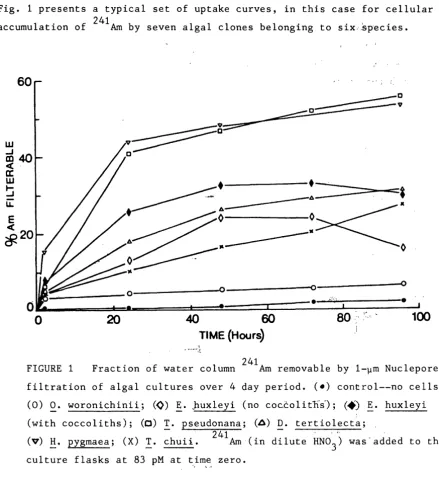
Fig. 1 presents a typical set of uptake curves, in this case for cellular accumulat 1. on of 241Arn by seven a ga 1 1 c ones 1 b 1 e ong1ng to s1x:spec1es. · · ' ·
60
·--~~,~··---·
20
40
60
80
100TIME (Hours)
FIGURE 1 Fraction of water column 241 Am removable by 1-~m Nuclepore filtration of algal cultures over 4 day period. (•) control--no cells; (0) ~· woronichinii; (¢) §.· _huxleyi (no coccolitn's);
<-*)
~· huxleyi (with coccoliths); (C) T. pseudonana; (A) D. tertiolect~;(v)
~·
pygmaea; (X)!· :huii. 241Arn (ind~lute
HN03) was·added to the culture flasks at 83 pM at time zero.
''l , ...
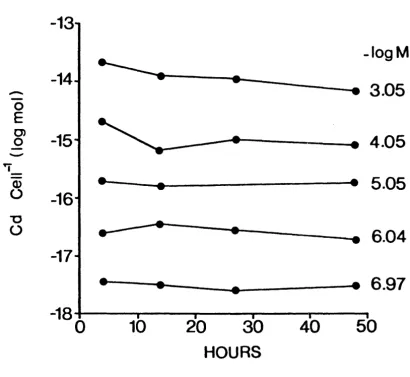
Radionuclide accumulation was generally complete within 1-2 days, as shown for example for 109cd uptake by the coccolithophore
~·
huxleyi (Fig. 2). The experimental results generally showed that light had no direct effect on algal accumulation of the nuclides2, that live ·and dead' ·cells Concen-trated equal amounts of radionuclides, and the metal accumulation per cell was related to the dissolved metal concentration (see, for example, ~ig. 3 f6r results with 109cd, 65zn, 110mAg and 203Hg) in actordance with [image:24.584.73.513.106.587.2]log C
m a log C t + b
where C m
-1
= moles cell at time of equilibrium
( Eq. 3 )
and C
=
total metal concentration at t • Thus adsorption to cellt 0
surfaces appears to be the principal process by which these metals associ-ate with the cells.
-13
~.
-logM
-14
•
~
• 3.05
0
E
())
-15
•
• 4.05
0
-"i
Q)
•
•
•
5.05
0
-16
"'0
•
0
....--
•
6.04
•
-17
•
•
•
• 6.97
-18
0
10
20
30
40
50
HOURS
FIGURE 2 Cd content of Emiliania huxleyi cells exposed to different Cd concentrations over a 48 h period. Note that the Cd accumulation by these cells was essentially complete at 4 h.
Using equilibrium data, a compilation of VCFs is presented in Table 1. The range of VCFs is from not significantly different from zero (eg., 95mTc
235 5 237 241 242 252
[image:25.585.77.487.227.604.2]diatom green coccolithopore blue-green
-12 Cd -14
-16
-18 - - -5 -4 -3 -2
/ / Y
-11 Zn
-13
-15~·
• •
-17 -7 -6 -5 -4 -3 -2
Zn •••
-7 6 5 4 3
-Zn
• •
-7 -6 -5 -4 -3 -2
~:~I~
-1~9
- -7 -6 -5 -9 -8 -7 -6 -5 -9 - -7 -6 -5
Ag
-14
Hg
-16
I?
~~g.
-18+---.----_7...--_...-6 __ ..,.5 __ ....,4- -9 -8 -7 -6 -5 -4 -9 -8 -7 -6 -5 -4
Metal Concentration in solution
<log M
>7 6 5 4 3
-Zn
-7 -6 -5 -4 -3 -2
FIGURE 3 Cd, Zn, Ag, and Hg contents of cells of a diatom, a green
alga, a coccolithophore, and a blue-green alga as a function of
ex-ternal metal concentrations. Each data point is the mean plateau
concentration at time of no change. Triangles denote live cells,
circles denote heat-killed cells (for diatom, green and blue-green);
squares denote heavy precipitation of Zn.
concentration factors observed among species for any one radionuclide. The
enormous differences noted in VCFs among the elements are in large part
attributable to the differential speciation of the metals in seawater (eg.,
Tc exists as the pertechnetate anion: Tc0
4-) although Hg, Ag, and Cd, for example, all exist in seawater principally as the chlorides5 but have very
different reactivities for algal surfaces. Such differences may be related
to atomic properties such as polarizing power (ionic charge2/ionic radius)
3 IMPLI~ATIONS
Considering the broad range of concentration factors observed, dictated
largely by the metal and to a much smaller extent by the algal species,
(Table I), an attempt was made to find some basis on which to predict the
bioaccumulation of the metals by phytoplankton in seawater. The results,
taking mean VCFs and pooling with other concentration factor values rep-6
orted for other algae and other elements suggest that the metal
concen-tration factors in phytoplankton are exponentially related to the solubility
T.ABLE 1 Volume/volume concentration factors (VCFs) of metals in
marine phytoplankton. nd
=
not determined.Osc ~
diatom green coccolithophore prasinophyte dinoflagellate blue-green blue-green
Co 1.0 E3 nd nd nd nd nd 4.0 E3
Zn 1.2 E4 1.0 E4 4.6 E3 nd nd 5.2 E3 3.2 E4
Tc 1.0 E1 < 1.0 EO < 1.0 EO 2 EO 1.7 E1 8.0 EO nd
Cd 3.0 E2 1.0 E3 3.7 E2 nd nd 1.0 E3 nd
Ag 3.4 E4 1.3 E4 2.4 E4 nd nd 6.6 E4 nd
Sn 1.1 E5 · nd nd nd nd nd 7.9 E5
Hg 9.3 E4 3.2 E4 9.5 E4 nd nd 7.6 E4 1.3 E6
Pb 2.9 E4 7.6 E3 nd nd nd nd nd
Po 1,2 E5 4.3 E4 nd nd nd nd nd
Np < 1. 5 E2 < 1.5 E2 <1. 5 E2 <1.5 E2 nd <1.5 E2 <1.5 E2 Pu 6.3 E5 2.2 E5 1.6 E5 4.0 E4 nd 1.7 E5 nd
Am 6.9 E5 1.8 E5 1.1 E5 3.0 E4 3.8 E5 3.0 E4 5.8 E5
CD 6.4 E5 1.2 E5 2.1 E5 nd 1.2 E5 2.6 E5 nd Cf 6.2 E5 4.1 E5 3.2 E5 9.0 E4 nd 1.3 E5 nd
products of the metal hydroxides (from ref. 7) (Fig. 4). Moreover, the
reactivity of metals for particles (as reflected in the phytoplankton VCF
data) correlates exponentially with the toxicity of the metals for
phyto-plankton (eg., EC
50•s for cell division rates), so that highly reactive metals (eg., Hg) are very toxic (Fig. 4; ref. 4). Therefore, metal
toxi-city is linearly related to solubility products of the metal hydroxides
(Fig. 4). Finally, since metals which are highly reactive for particles
unreactive metals, the mean oceanic residence times of metals should be inversely proportional to their affinity for particles. Fig. 4 shows that the VCFs of metals in phytoplankton correlate significantly (P< .001) with their mean oceanic residence times (from refs.
8,9;
Am and Pu residence12 times calculated from data in refs. 10,1~. Whitfield and Turner and Yamamoto et
~.
13 showed similarcor~elations,Thus,
it would appear poss-ible to predict the degree of bioconcentration of metals in phytoplankton, based on affinity for hydroxyl groups, and therefore predict the toxicity and oceanic residence times of the metals as well.6 (3) tb)
-~ -8
l"
~
-6~:
~-4
w -2
2oab
406
i
3
I
fD 2 4 5 6
-Kso MOH log VCF
-10 lCJ
tdl ~
E
~~-4
g
0
1-w -2
I I I I I I
0 10 20 30 1 2 3 4 5 6
-Kso
MOH log VCFFIGURE 4 (a) Correlation of log VCF of various metals in marine phytoplankton with solubility products of the corresponding metal hydroxides; r
=
.844. (b) Correlation of sublethal toxicity (Ec50 metal concentration) of metals with log VCF;- r
=
.929. (c)4 REFERENCES
1. N.S. Fisher, K.A. Burns, R.D. Cherry and M. Heyraud, Mar. Ecol. Prog. Ser.,
!!'
233 (1983).2. N.S. Fisher, P. Bjerregaard and S.W. Fowler, Limnol. Oceanogr., 28, 432 (1983).
3. N.S. Fisher, Environ. Sci. Tech., 16, 579 (1982).
4. N.S. Fisher, M. Bohe and J.-L. Teyssie, Mar. Biol., submitted.
5. D.R. Turner, M. Whitfield and A.G. Dickson, Geochim. Cosmochim. Acta, 45, 855 (1981).
6. ~G. Lowman, T.R. Rice and F.A. Richards, in Radioactivity in the Marine Environment, edited by A.H. Seymour (U.S. Natl. Acad. Sci., Washington, 1971), Chap. 7, pp. 161-199.
7. L.G. Sillen and A. Martell, Stability Constants, Chern. Soc. London, spec. publ. No. 17, 754 pp.
8. W.S. Broecker and T.-H. Peng, Tracers in the Sea (Eldigio Press, New York, 1982), 690 pp.
9. J.-M. Martin and M. Whitfield, in Trace Metals in Seawater, edited by C.S. Wong, E. Boyle, K. Bruland, J. Burton and E. Goldberg (Plenum, New York, 1983), pp. 265-296.
10. R. Fukai, E. Holm and S. Ballestra, Oceanol. Acta, ~' 129 (1979). 11. R. Fukai, S. Ballestra, M. Thein and J. Guion, in Impacts of
Radio-nuclide Releases into the Marine Environment (IAEA, Vienna, 1981), pp. 3-14.
12. M. Whitfield and D.R. Turner, in Trace Metals in Sea Water, edited by C.S. Wong, E. Boyle, K. Bruland, J. Burton and E. Goldberg (Plenum Press, New York, 1983), pp. 719-750.
13. T. Yamamoto, Y. Otsuka, M. Okazaki and K. Okamoto, in Analytical
Session :
I/A
Paper by : Fisher
Comment by R. Bittel (France) Text of comment
or author's answer
Pensez-vous que les resultats obtenus avec Pu237 (forte activite specifique) scient valables pour Pu239 (faible activite specifique)!
Session : I/A
Paper by : N.S. Fisher Comment by A. Cremers Text of comment
or author's answer
A. It appears that, in the cases studied, you are dealing with the formation of some sort of surface complex. I suggest you try to correlate CF values with the first hydrolysis constant of the various elements.
B. My second comment refers to the contents of the abstract stating that there is no effect of humic or fulvic acid. This is somewhat surprising in that one would expect some sort of competitive effects.
A. I have done this, and the results are comparable to those of solubility products.
B. I too was surprisedthathumic or fulvic acids of marine or1g1n, had no significant effect on the bioaccumulation of
Am
or Pu in marineSession : I/A Paper by : Fisher N.
Connnent by J. Vangenechten Text of connnent
or author's answer
Can you connnent about the pH-effect on the high correlation between the affinity of the metals for the cells and for the hydroxides
?
Session : I/A Paper by : Fisher Connnent by I.McKinley Text of connnent
or author's answer
Given the varying slopes of the Freundlich isotherms shown, how is the VCF defined ?
The VCF is calculated from the lowest concentration used. The VCF is thus experiment specific ?
THE TRANSFER OF RADIONUCLIDES FROM SEDIMENTS TO PELAGIC SYSTEMS
ABSTRACT
E.I. HAMILTON
Institute for Marine Environmental Research, Prospect Place, The Hoe, Plymouth, Devon PL1 3DH, U.K.
For the marine environment a major objective of radiological protection concerns the contribution to the radiation dose man receives from radio-nuclide contaminants derived from marine ecosystems (principally along foodchains), and any effects upon marine biota. For operational purposes considerable emphasis is placed upon various models (conceptual, applied, predictive) in order to provide information which can be used in decisions and control measures for the protection of man and the environment from undesirable hazards due to contaminant releases. The immediate concern is to provide protection over several decades and hopefully also for the next
~sOOy. Therefore, most models deal with average values based upon a consideration of first-order terms. Our understanding of long term processes which take place in the seas is often very poor, and until
improved many of the models are of limited value. For local releases and short term events, which may be important to the nuclear industry, we also lack sufficient understanding of the nature of marine processes and how they interact with the release of contaminants.
Considerable advances are required in marine sciences in order that models used for purposes of radiological protection may be based upon more quantitative information. The research requires long term stability, access to sophisticated technology and closer cooperation between marine scientists and those concerned with radiological protection. Webb (1984) comments on a need to direct effort from refining science of investigation toward the explanation of science which is required by politicians, the general public and environmental groups. As a short term measure this is essential, but if taken too far it could generate unwarranted complacancy; an ultimate acceptable solution to many areas of concern can only be
provided by substantial improvements in fundamental science.
Here I consider some areas of uncertainty with reference to effluents from the British Nuclear Fuels (BNFL) reprocessing plant at Sellafield, UK, which has labeled vast areas of the sea, but to no apparent detriment to marine ecosystems. An opportunity is provided to consider the value of radionuclide tracers in order to improve our knowledge of long term inter-actions between radionuclides and marine ecosystems; attention is focussed mainly on the long lived radionuclides Pu and
Am.
Improvements in the capability to predict concentrations (and therefore calculate dose) of relevant contaminants depends on obtaining further knowledge of critical processes to test the importance of various processes and assumptions1 • SOURCE TERM
If it can be assumed that the physical and chemical composition of the source term has no effect upon the transfer of radionuclides, then their
transfer in the marine environment can be determined from a consideration of stable element analogues. In marine systems radionuclides are
considered as dissolved forms and those associated with particulate materials; the use of first-order terms is acceptable as the mass of
radionuclide associated with transfer of one form to another is relatively small. However, radionuclides do have properties related to their for-mation; initially they will be carrier free and it will take some time, after release into the sea, before they are fully integrated into
those marine pathways which are characteristic for their stable element analogues. The process of radioactive decay can also exert an influence; for example, the selective loss of 234-U from 238-U, 238-Pu from 239-Pu, as a consequence of alpha particle recoil, also the decay of a parent nuclide to a daughter of a different element can create instability at the site of deposition.
Because of artifacts in preparatory and analytical schemes limitations are imposed upon identifying what is in true solution, and what is
present in particulate form. Hamilton (1983, 1984) identified the presence of hot particles derived from BNFL which were present in local estuarine sediments and at the sea surface, also hot particles which were formed by biological processes; the former have mean particle diameters of
<
10 ~m, and the latter up to several millimeters. Many of the smallparticles contain ~1 pCi of alpha activity which is of interest to radio-logical protection (ICRP 31). In sediments, hot particles tend to contri-bute to ~. 10% of the total alpha activity, but there are problems in identifying
<
1 ~m hot particles because of entrainment in floes and absorption of activity in such matrixes. Nuclear weapon testing also produces hot particles (Mamuro and Matsunami 1967, Adams et al 1960), but their stability and transfer in the sea is not unknown. Along the Cumbrian coast the highest levels of radioactivity are associated with fine grained sediment derived from marine and terrestrial sources. An association of alpha and gamma emitters in individual hot particles indicates a stable source derived from the BNFL effluent.In the absence of any quantitative data for the composition of the BNFL source term it is noted while the Pu/Am ratio has .decreased from ~ 9 in 1977 to ~ 2.5 in 1980, in sediments and mussels near the source
certainty.
2. GEOCHEMICAL CONSIDERATIONS
Under high temperature and pressure regimes,as an igneous rock magma solidifies the elements become partitioned into various mineral phases; entry is largely controlled by ionic size and charge. Sediments represent low temperature suites of rock-mineral debris, and to a large extent the characteristic parent rock element associations are retained and are of diagnostic value in identifying the presence of the parent rock type. Data for the partitioning of radionuclides in modern diagenetic mineral phases has not been described. By using various pairs of elements the
signature of a rock can be identified. Therefore by an examination of element abundances in sediment debris in the gut of a filter feeder such as the mussel Mytilus edulis, the mass of sediment can be determined, but of more interest is the extent to which the composition differs from that of the parent sediment, thus shedding some light upon possible processes common to the mussel which have altered the composition, for example the use of an element by the mussel for a particular biological process. For present purposes it is assumed that the aluminium content of individual tissues of the mussel reflects the presence of sediment; concentrations range from~ 7000ppmAl in the digestive gland to <80ppm in the muscle. For mussels from the Esk estuary based upon Al levels a total sediment load of 15.3mg is calculated; using iron as an index a load of 14.9mg sediment, and on the basis of ashed water insoluble residues of total soft tissues a value of 15.4mg sediment is obtained. Of all the stable
elements of the Periodic Table the rare earth elements (REE) are most likely to follow the same pathways as Pu and
Am;
the only other group of elements of possible interest are Ca Sr Ba Ra. By using the concentration of Al to subtract the sediment load the following observations are made;i) Greater than 90% of the total La load is not removed, while all the Ce is lost. Hence the animal contains a pool of labile La which is not related to the La held in mineral structures as determined by the La/ Ce ratio; because of the very large numbers of La atoms present, compared to the very few of
Am
and Pu,this element could provide a suitable carrier for the heavy radionuclides.ii) Carrying out the same procedure for Ba the subtraction leaves none in mussel tissues, with the exception of the byssal threads and periostracum which probably obtain their Ba from seawater.
iii) When the same calculation is performed using the
Am
and Pu content of the bulk sediment, >90% of each radionuclide cannot be accounted for on the basis of sediment load. Hence the mussel while taking in Pu and Am labelled sediment also contains another source which is not directly related to bulk sediment. Analysis ·-~ intestinal faecal source debris was shown to contain unaltered sediment Pu andAm
concentra-tions. Two possibilities can account for the non-sediment Pu andAm,
the first entry of these elements in dissolved phases from seawater and the second preferential uptake by the mussel of a phase enriched in these elements, for example that associated with organic detritus.iv) 200-molecular weight cut-off dialysis membrane tubes containing deionised water were emplaced into anaerobic surface sediments of the Esk for two days. The dialysate was removed and then oxygenated to precipi-tate iron (ie transfer of ferrous iron across the membrane in the
similar compositions for amorphous iron particles in lake sediments); no Ce was detected once more indicating the presence of a labile form of La; the dialysate also contained
Am
and Pu. Therefore the anaerobic surface sediments of the Esk contain a mobile pool of La which is a suitable carrier forAm
and Pu either as colloids or in true solution.There are numerous reports that heavy elements (Pu,
Am,
Th, Pb, Th, Pb, Po, see Santischi et al 1983) are associated with particulatematerials which determines the mobility of these elements, but little is known of the processes whereby they become associated with particulate phases. The flux of particulates to estuaries and near shore waters is dominated by seasonal influences; Sieglo and Helz (1981) have shown that winter colloidal debris is dominated by detrital clay minerals and iron oxides, while in the summer organic detritus derived from biological
processes is dominant; Hamilton and Clarke (1984) have also described such features for the Esk. In a recent accidental discharge of effluent by BNFL very high levels of radionuclides were found associated with "organic materials"; in the Esk detrital coal debris is also slightly enriched in alpha emitters.
There is considerable evidence that organic compounds associated with surfaces, together with colloids, play an important role in the transfer of radionuclides in the marine environment. The real problem concerns an identification of the nature of real surfaces, for example structure, ligands present, redox and pH conditions at the surface; current research tends to be directed towards a consideration of the bulk composition of materials.
By co-precipitation Wong et al (1978) have separated
Am,
Eu, Sb, Bi, Ru, Rh and Co from seawater onto freshly prepared manganese dioxide;at the sediment water interface of the Esk there is a flux of Mn which is mainly present at the turn of the tide because of resuspension of anaerobic organic rich sediments, and could provide a suitable surface for adsorp-tion and co-precipitaadsorp-tion of many elements. Eakins and Gomm (1968)obtained a quantitative recovery of all alpha emitters by adsorption onto glass fibre filter paper; the rate of uptake was increased in the presence of NaCl. Apart from the surfaces of silica grains in the estuary, there are many sources of silica (hydrated) which could provide suitable
surfaces for uptake of radionuclides. While quartz grains are attractive, because of abrasion as a result of movement it is unlikely that any
deposit will accumulate to any appreciable thickness, but in the Esk because of the much greater mass of sand compared with fine sediment the process could provide a significant flux of
Am
and Pu into overlying waters; in low energy regions where organic rich muds dominate adsorption may be more significant. Robinson (1970) has described the uptake of Pu by proteins.which are ubiquitous in the marine environment. The tanned proteins of the byssal threads and periostracum of the mussel are,relative to other tissues, associated with high concentrations of Pu andAm;
the distribution is diffuse, therefore uptake from seawater is most likely. There are many types of surfaces present in the sea and it is clear that uptake of dissolved species and particulate forms does take place. It would be useful if the nature of the surfaces could be identified and, if present, any common parameter responsible for uptake was identified. While the diffuse component can perhaps be understood, the particulate forms are more difficult to comprehend, unless of course they consist of very finely macerated organic debris which "sticks" indiscriminantly tocompound in coprecipitation and adsorption of h~avy radionuclides, often in a very selective manner. Apart from riverine inputs of dissolved barium interacting with sulphate ions of seawater, in the reduction of sulphate in anaerobic sediments a flux of labile barium is available. Bioturbation at the surface of sediments could release barium to overlying water and precipitate the sulphate which would be a suitable source which has a very large surface area for uptake of elements.
From a.consideration of the cosmogenic relationships between heavy radionuclides in natural siliceous melts, under reducing conditions, Pu+3 is more rapidly incorporated into mineral lattices than either U+4 or Th+4; a priori actinides are assumed to substitute for Ca+2 (ionic radius Ca+2-1.01, Am+3-0.99, Am+4-0.89, La+3-1.06, Th+3-1.05, Th+4-0.98, U+3-1.02 and U+4-0.03) because of the existence of Ca-lanthanide phosphates in meteorites (Benjanin et al 1983). In igeneous rocks Ca+2 also plays a.key role in the partition of REE, especially in late stage hydrothermal
conditions and early high temperature phases, eg apatites. In marine systems the association is not so direct as these elements have to cross biological barriers (membranes) before they are available for incorpora-tion into tissues and exoskeletons; skeletal debris of fish is often enriched in U, Th, REE, but mainly as a result of adsorption onto exposed surfaces. Folsom et al (1975) note the uptake of Pu onto the surfaces of algae in the oceans. Guary and ~raizer (1975) do not observe any
progressive enrichment of Pu through marine foodchains. Pentreath and Lovett (1976) note a concentration factor of <1 for Pu and ~5 for
Am
in fish over seawater for BNFL derived effluent. Shanbhay and Morse (1982) note that calcareous shells have an affinity forAm;
adsorption is high, and independent of the ratio of solid to dissolved phases; syntheticaragonite has a x40 greater uptake than synthetic calcite which is related to the Mg content of the calcite; the observed behaviour of Am with
calcium carbonate in shallow waters is predicted from the ratio of aragonite: Mg-calcite in sediments.
Seawater contains ~52ugBa/1 (Chow and Goldberg 1960) of which ~5% is in the undissociated form; at a depth of 5000m, because of pressure
effects, there is a 2.5-fold greater concentration of Ba. The Ba (and Ra) depth concentration profiles in seawater are similar to those for nutrients indicating an association with the biochemical cycle, especially with sulphate ions which could precipitate BaS04 and simultaneously scavenge REE and actinides in both dissolved and particulate phases. In oceanic depth profiles the increase in Ba is greater than that for Ra (Chan et al 1976), with a preference for refractory phases rather than transport by labile organic compounds. In the sea REE's are associated with calcareous foraminifera tests, but possibly with Fe-Me surface coatings rather than an involvement with the Ca biological pathways. In laboratory experiments Shen et al (1983) describe the rapid coagulation of Pu in estuaries, the rate of which increases with salinity and the preser _ of humic compounds and iron rich precipitates Anderson et al (1983) show that while Th and Pa do not show any preferential fractionation effects in nearshore marine particulates, this does not occur for oceanic particles, hence they are possibly different. Hunter (1983) has described an equilibrium model for scavenging of reactive metals in relation to the presence of organic coatings; the oceanic residence time for Th is ~22y and -180000y for Cd
common to humic substances. Hayase and Tsubota (1983) note that humic and fulvic acids have surface active substances; any particles in the sea-surface microlayer can therefore acquire an organic coat whether it be derived from natural products or oil slicks.
3. BIOLOGICAL CONSIDERATIONS
In tracing the transport pathways of heavy radionuclides from coastal waters to the open oceans with distance, the contribution of land derived organic coated particulates should decrease; for the upper layers of the seas biological debris should predominate, while at depth organic depleted material should occur. Aarkrog et al (1983) have shown that BNFL 137-Cs
134-Cs derived radionuclides can be detected in the Barent and Greenland Sea and in the East Greenland polar current; the transport time from
Sellafield is 6-Sy. As Cs is conservative in seawater the distribution is a reflection of water movements; there is no complimentary data for Cs associated with particulate phases. In the transport of radionuclides over large distances their pathways must cut across many different bio-logicel systems and they may or may not interact with them. Off the Hebridian shelf-edge Kremling (1983) has described strong salinity gradients (fronts) which mark the boundary between coastal and oceanic waters; these gradients are associated with a dramatic increase in inor-ganic nutrients and dissolved trace metals (Cd, Cu, Mn, 226-Ra) which reflects the mobilisation of partly reduced organic rich sediment. The BNFL effluent "plume" intercepts these regions and interactions are possible between radionuclides and particulate phases which may control the passage of species to the open oceans. Halligan et al (1983), from a study of satellite photographs, show that along the continental shelf high reflectance from substances present in surface waters contain large
amounts of coccolithophores (Emiliania huxleyi). Apart from providing potentially vast surfaces for adsorption of elements the concentration of calcium can reach 40g Ca2C03 m-2 for the upper 60m of water; in areas the animals cover 7200km of the sea and represent 7.2 x 10⁴ tonnes of Ca. As the lysocline for calcium dissolution in the N Atlantic is at c4600m there should be (over shelfs) a net deposition of tests to bottom sedi-ments. As the blooms tend to occur in the same geographical regions for defined times of the year they can be sampled by ships. Therefore
for
the UK (and maritime Europe}, radionuclides derived from land sites have first of all to survive the conditions existing in estuaries and near shore waters, and then "penetrate" regions of high particulate loading on the continental shelf.In the open ocean there are abundant data which describe the rapid transport of radionuclides in faecal pellets from surface waters to the ocean bottom (Osterberger et al 1967, Higgo et al. 1977). Based upon the pioneering work of A.P. Vinodragov (1953) for the concentration of
elements in marine organisms, supplemented by more recent compilations of data by Martin and Knauss (1976) and Eisler(1981), and the distribution of of radionuclides in marine ecosystems by Polikarpov (1966) the involvement of elements in marine organisms can now be considered, albeit in a cursory manner as most analyses are for total animals which will include gut
contents and those elements associated with surfaces rather than as a result of an involve•ent in metabolic processes.
Consideration of the Ca~sr~Ba~Ra~REE~actinide pathways in biological processes is of interest as both Sr and Ba are found in Radiolaria
(Acantharia-SrS04 skeletons) and deep sea rhizopods such as the
1953, Goodhay and Nott 1982). Their involvement in the transport of radionuclides in the oceans could be significant, however an artifact may be present in the interpretation of available data as the tests of Radio-laria and Acantharia dissolve with storage and may be missing in some collections. Phaeodarians Radiolaria (Takahashi et al 1982?, see also Renz 1976), dissolve in the deep oceans and hence are not preserved in bottom sediments; in the dissolution process more refractory forms of elements such as discrete phases or colloids may be formed and be trans-ported to the ocean floor. Bowen (1971) also notes that the strontium skeletons of Acantharia may be more abundant in the Atlantic than has been realised. In some of our own studies in the Atlantic (Williams, Hamilton 1984) it seems possible that Acantharia may be quite abundant in the Atlantic, but based upon observations of the relative abundance of net samples taken at the Weather Ship-India at the time of collection, after 12y none remain in the sample bottles; after 4y only c50% remain but little loss appears to have occured after preservation of ~3 months. Acantharia are also found in warm coastal waters (Schreiber et al 1963). There is also a possibly significant riverine input of Ba and Sr as many freshwater microorganisms, eg desmids, are enriched in these elements and contribute to estuarine particulate debris. Bowen and Sugihara (1961), after careful examination of long lived radionuclides in the surface water of the oceans note the presence of 90-Sr in seawater in the dissolved state, while lanthanide radionuclides are associated with particles and not organisms. Harley (1956) and Miyake (1955) note high concentrations of lanthanide radionuclides in plankton of the Pacific, possibly because less surface area is available for uptake by terrestrial derived parti-culate debris.
In order for models to describe, or account for the distribution of radionuclides in the marine environment to be of use they have to be valid
(or at least realistic) for the next ~100y. However such spans of time are beyond the realms of realistic predication for marine processes because the basic information is not available. While some of the processes discussed here may be of second order importance, one major issue which is seldom considered in modelling is the question of climatic change.
Since 1948 there has been a ~50% decrease in the abundance of zoo-plankton in theN Atlantic (Robinson 1984); this is possibly accompanied by a significant d~crease in the mass of phytoplankton while the depletion
in fish stocks for most major fishing areas is well documented. There is no evidence that the decrease in biomass has been compensated for by an increase in other species, hence for the open oceans at least the total load of particulate debris must also have decreased. Whether or not the process of scavenging is such that the impact frequency has also increased or saturation has never been achieved and therefore a reduction in the load of particulate debris in the sea is unimportant. However, if there has been a real decrease in the concentration of particulate debris then this should effect the transport of radionuclides in the oceans. Over the past 1000-2000y the climate in many parts of the world has changed