THESES, SIS/LIBRARY A.G. MENZIES BUILDING N02 Australian National University Canberra ACT 0200 Australia
USE OF THESES
This copy is supplied for purposes
of private study and research only.
Passages from the thesis may not be
copied or closely paraphrased without the
written consent of the author.
Telephone: +61 2 6125 4631 Facsimile: +61 2 6125 4063
IN AUSTRALIAN ABORIGINAL LANGUAGES
PETER ANDREW BUSBY
Submitted as partial requirement for admission to the Degree of Master of Arts at the Australian National
University.
Acknowledgements
I wish to thank my supervisor, Dr. David Bradley, for his untiring patience and guidance throughout the year. l~ithout his help I doubt that this thesis would have been completed.
I would also like to thank the following people:
Professor R.M.W. Dixon and Dr. M. Walsh for their advice with the preliminary analysis of phonemic types.
Ms. Robyn Baker of the Australian Institute of Aboriginal Studies, who provided a wealth of information on the content and availability of tapes in the Institute's archives.
Pat White and Don Baker deserve special thanks for their
kind understanding and help which enabled me to handle the
~anberra environment.
Sandra Bell for typing a difficult thesis with great accuracy
in such a short time; Hrs Val Lyon of the Department of Geography for helping me with the maps and figures, and Jeff Busby for the photographs in Appendix 8.
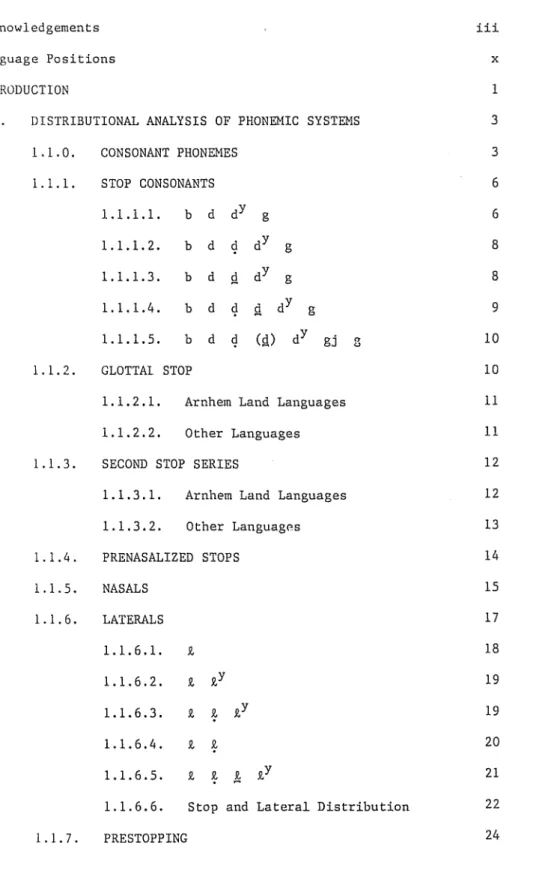
Table of Contents
Acknowledgements iii
Language Positions x
INTRODUCTION 1
1.
o.
DISTRIBUTIONAL ANALYSIS OF PHONEMIC SYSTEMS 31.1.0. CONSONANT PHONEMES 3
1.1.1. STOP CONSONANTS 6
1.1.1.1. b d dy g 6
1.1.1.2. b d
cl
dy g 81.1.1.3. b d g dy g 8
1.1.1.4. b d
cl
g dy g 91.1.1.5. b d d (g) dy gj 0 10
<J
1.1.2. GLOTTAL STOP 10
1.1.2.1. Arnhem Land Languages 11
1.1.2.2. Other Languages 11
1.1.3. SECOND STOP SERIES 12
1.1.3.1. Arnhem Land Languages 12
1.1.3.2. Other Languag<"s 13
1.1.4. PRENASALIZED STOPS 14
1.1.5. NASALS 15
1.1.6. LATERALS 17
1.1.6.1. J!. 18
1.1.6.2. J!. J!.y 19
1.1.6.3. J!. J!. J!.y 19
1.1.6.4. J!. ~ 20
1.1.6.5. J!. J!. & J!.y 21
1.1.6.6. Stop and Lateral Distribution 22
1.1.8. PREPALATALIZATION 24
1.1.9. RHOTIC RELEASE 25
1.1.10. LABIALIZATION 26
1.1.11. RHO TICS 27
1.1.11.1. R r 27
1.1.11.2 r 29
1.1.11.3. R v
29
r r
1.1.11.4. R 29
1.1.11.5. R J r 30
1.1.12. GLIDES 30
1.1.12.1 y 'f. w 31
1.1.12.2. y w w 31
1.1.13. FRICATIVES 31
1. 2.0. VOWEL PHONEMES 33
1.2.1. SYMMETRICAL SYSTEMS 35
1.2.1.1. i a u 35
1.2.1.2. i e a u 37
1.2.1.3. i e a 0 u 38
1.2.1.4. i e a 0 u a 38
1. 2. 2. SEMI-SYMMETRICAL SYSTEMS 39
1. 2. 3. UNGROUPED SYSTEMS 40
1. 2. 4. RESIDUE AREAL DISTRIBUTION 41
1.2.4.1. Vowel Systems 41
1.2.4.2. Length Distinction 42
2.0. ACOUSTIC ANALYSIS 44
2. 1. 0. LANGUAGE SELECTION 4S
2.2.0. METHODOLOGICAL PRELIMINARIES 47
2. 2.1. ACOUSTIC DATA SELECTION 47
2.2.2. THE STANDARDIZATION PROCESS 49
2.3.0. ARTICULATORY PLACE ANALYSIS
so
2.3.1 LATERALS
so
2. 3. 2. NASALS S3
2 .3. 3. VOWEL TRANSITIONS 57
2.3.3.1. The Environment [a] 60
2.3.3.2. The Environment [ i J 64
2.3.3.3. The Environment [u] 68
2.3.3.4. The Glottal Stop 68
2. 3 .4. POSITION OF ARTICULATION CORRELATES 72
2.3.4.1. The Palato-velar 7S
2.4 .0. RHOTICS 76
2 .4 .1. FLAPS AND TRILLS 77
2. 4. 2. THE GLIDED RHOTICS 77
2.S.O. GLIDES 78
2. 6.0. OTHER PHONEMIC PHENOMENA 78
2. 7. 0. VOWELS 79
2. 7 .1. VOWEL APERTURE 79
3. 0.
2. 8 .0. ARTICULATORY CORRELATES
2. 8 .1. PERIPHERALS 2.8.2. LAHINALS
2.8. 3. APICALS
2.8 .4. F2 PATTERN RELATIONS
2. 9 .0. CONCLUSION
DISTINCTIVE FEATURE SYSTEMS
3 .1.0. 3.1.1.
3 .1. 2.
CONSONANTS
PLACE OF ARTICULATION FEATURES
3.1.1.1. Jakobson-Halle
3.1.1.2. Chomsky-Halle
3.1.1.3. Ladefoged
3.1.1.4. Dixon
MANNER OF ARTICULATION FEATURES
3.1.2.1.
3.1.2.2. 3.1.2.3.
Primary Manner Features 3.1.2.1.1. 3.1.2.1.2. 3.1.2.1.3. 3.1.2.1.4. Jakobson-Halle Chomsky-Halle Ladefoged Dixon Rhotics and Glides
Secondary Manner Features 3.1.2.3.1. 3.1.2.3.2. 3.1.2.3.3. 3.1.2.3.4. 3.1.2.3.5. 3.1.2.3.6. 3.1.2.3.7.
Second Series Stops Prenasalization Pres topping
3.2.0. VOWELS 3.2.1. DIPHTHONGS
3.2.2. NASALIZED VOWELS
3.3.0. FANT FEATURES
3.4.0. A FEATURE INVENTORY FOR AUSTRALIAN LANGUAGES 3.4.1. POSITION OF ARTICULATION FEATURES
3.4.2.
3.4.1.1. Consonants
3.4 .1. 2. Vowels
MANNER OF ARTICULATION FEATURES 3.4.2.1. Primary Manner Features 3.4.2.2. Secondary Manner Features
CONC: .US ION
APPENDICIES
AREAL DISTRIBUTION OF PHONEMIC SYSTEMS 2 PHONOLOGIES OF THE LANGUAGES SELECTED 3 STATISTICAL FORMULAE AND TERMINOLOGY 4 STATISTICAL DATA OF LATERALS
'j STATISTICAL DATA OF NASALS
6 VOWEL TRANSITIONS
7 STATISTICAL DATA OF VOWELS
8 SPECTROGRAPHIC EXAMPLES
LANGUAGE BIBLIOGRAPHY GENERAL BIBLIOGRAPHY
Tables
1.
2.
3.
4.
Consonant Phonemes
Percentages of Stop and Lateral Distributions Vowel Phonemes
F3-F2 values of Apical Nasals and Laterals
5. Statistical Data on the Proportion of Long to Short Vowel Durations Figures 1. 2. 3. 5. 6. 7. 8. 9. 10. 11. 12. 13. 14. 15. 16.
95% confidence limits of laterals F
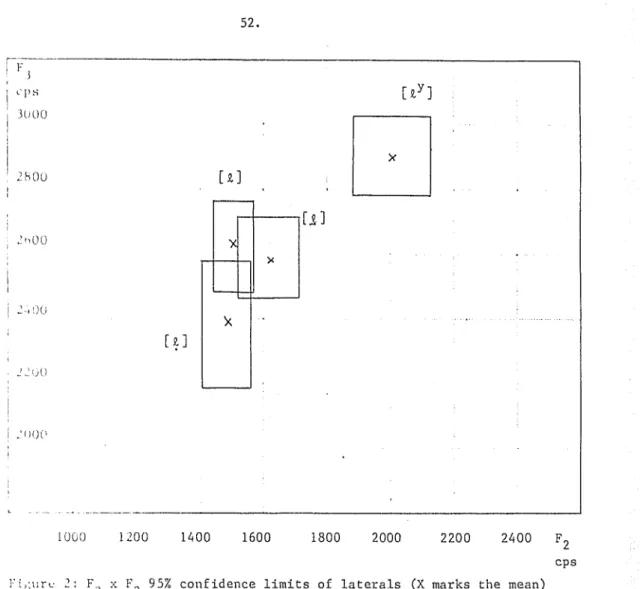
3 x F2 95% confidence limits of laterals 95% confidence limits of nasals
F
3 x F2 95% confidence limits of nasals
F2 x F1 95% confidence limits of [m] , [n] and
[Q]
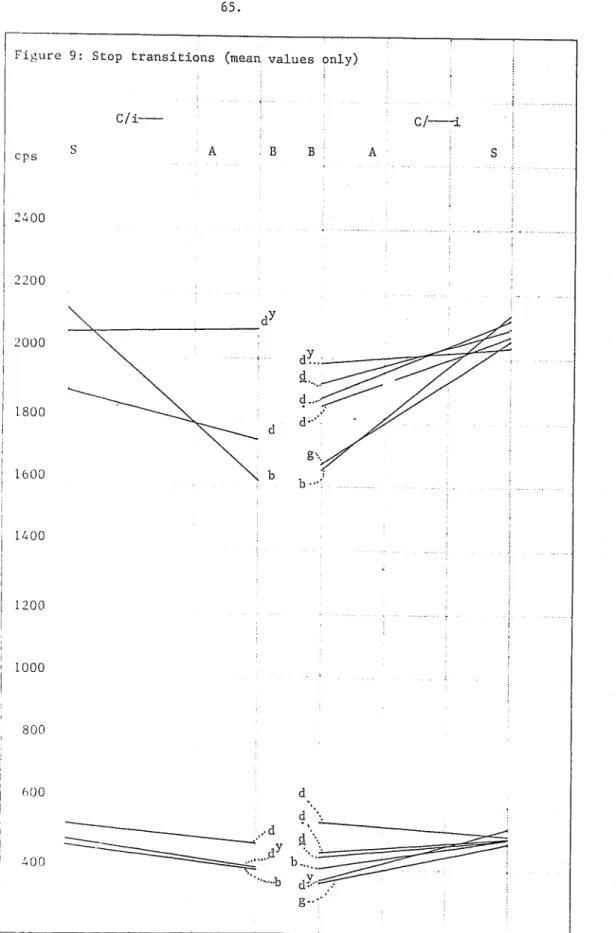
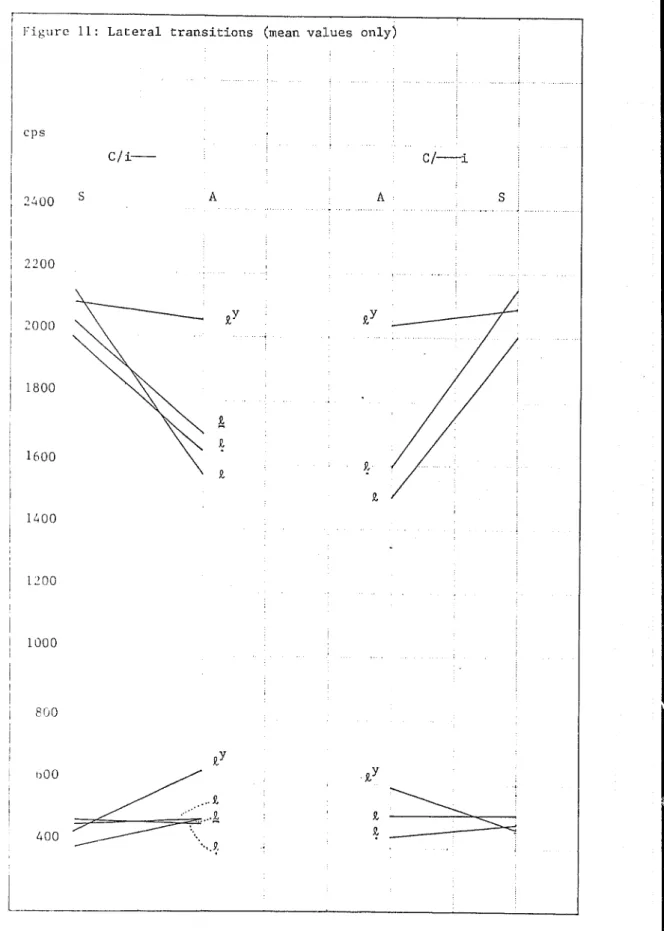
Stop Transitions: The environment [a] Nasal Transitions: The environment [a] Lateral Transitions: The environment [a] Stop Transitions: The environment [i] Nasal Transitions: The environment [i] Lateral Transitions: The environment [i] Stop Transitions: The environment [u]
Nasal Transitions: The environment [u] Lateral Transitions: The environment [u] F
3-F2 95% confidence limits of apical nasals and laterals F
2 x F1 vowels
Map 1: Language Positions
6 7 3 4
2
w
;i..
.A
()
0 500 lOOOkm
~lap 1 above gives the approximate locations of the languages studied. I have used the same area coding as the A.I.~.S. Tribal Bibliography. The languages and their respective numbers are as
AREA
s
YaralJl 3 Dhurga 4 Dharawal
2 Ngarigu
AREA D
Wemba-wemba 4 Nganjaywana 6 Hurawari
2 Madi-madi 5 Yuwaalaraay 7 Margany
3 Ngiyamba
AREA E
Waalubal 3 Waka-waka 5 Gungabula
2 Gidabal 4 Gureng-gureng 6 Bidyara
AREA y
Mbara 13 Gog-Nar 25 Ludigh
2 War•1ngu 14 Koko-Bera 26 Wikmumin
3 Wargamay 15 Kunjen 27 .Ndra?angid
4 Gugu-Badhun 16 Yir-Yoront 28 Awngdim
5 Dyirbal 17 Thaayore 29 Aridingidigh
6 Yidiny 18 Lama-lama 30 Nggod
7 Mbabaram 19 Umbuygamu 31 Lenngidigh
8 Djaabugay 20 Wikmunkan 32 Mpakwithi
9 Gugu-Yalanji 21 Wik-Ep 33 Mbalidjan
10 Mulurudji 22 Umbila 34 Mbeiwum
11 Guugu-Yimidhirr 23 Yinwum 35 Yathaikana
12 Kuku-Thaypan 24 Kuuku-Ya?u 36 Mabuiag
,\REA L
Malyangapa 3 Diyari 5 Wanggumara
2 Arabana 4 Yandruwandha 6 Wangganguru
AREA K
Ngarinjin 3 Djaru 4 Bard
AREA N
Murinbata 13 Gunwinggu 25 Ritharngu
2 Djamindjung 14 Maung 26 Bur era
3 Wadaman 15 Yiwadja 27 Djeebana
4 Ngangikurrungurr 16 Garawa 28 Yanhangu
5 Maranunggu 17 Yanyula 29 Djambarrpuynggu
6 Ngengomeri 18 Alawa 30 Gubabuyngu
7 Brinken 19 Mara 31 Wangurri
8 Wadyiginy 20 Nunggubuyu 32 Warramiri
9 Pungu-pungu 21 Andiljaugwa 33 Djabu
10 Malag-malag 22 Dalabon 34 Galpu
11 Tiwi 23 Rembarnga 35 Datiway
12 Mayali 24 Wagilak 36 Mandelbingu
AREA A
Mantj iltjara 3 Nyangumarda 5 Walmatjari
2 Bailko 4 Garadjari
AREA
c
Gu gad a 6 Andegeribina 11 Djingili
2 Andagerinja 7 Alyawarra 12 Ngarndji
3 Pitjantjatjara 8 Kaititj 13 Wambaya
4 Aranda 9 Walpiri 14 Gudandji
5 Pintupi 10 Waramunga
AREA G
Pita-pita 4 Ngawun 7 Kukatj
2 \fa~uwara 5 Yukulta 8 Kuthant
3 Kalkatungu 6 Lardil 9 Kurtjar
Al-\ EA
w
NjungaR 4 Yinytyiparnti 6 Nga~uma
2 Nanta 5 Kurama 7 Ngarla
INTRODUCTION
This classificatory study of phonemic systems is an attempt to provide an understanding of the structures and characteristics of
the phonologies of Australian aboriginal languages. In order to classify L.1e phonological systems we need to survey the languages and determine the types of systems that do occur. We also need to examine the acoustic structure of some phonetic characteristics of
the phonemes that make up these systems. Finally, the classification of phonemic types into systems involves an examination of distinctive feature systems and their applicability to the Australian situation.
The first section surveys 134 languages from the total of approximately 260 said to occur on the continent (Wurm, 1972 : 9). We
need to note the phonemes r '•'orded in language descriptions and their
distributions, both systemic and areal. General language surveys consisting of. a single chapter or short article capture some of the more obvious generalizations that can be said of Australian phonologic;iJ systems. With the exceptions of Dixon (1970b, 1972, forthcoming a) and Wurm (1972) for instance, there have been no systematic attempts to
describe the nature and significance of these generalizations. Once having specified the types of phonemes and their
distribution we turn to the acoustic study of some of th<: more pertinent phonetic, or segmental, characteristics; for example, Australian
languages can have a maximum of seven positions of articulation for stops and nasals, excluding the glottal stop. The analysis examines
aspects of segments which can be seen as some of the distinguishing parameters necessary for distinctions. Two excellent studies of
of Diyari and McDonald's (1977) Yaraldi analysis. Jernudd's (1974)
palatographlc analysis of Gunwinggu phonemes provides articulatory
evidence on the positions of articulation in Australian languages. The third and final section examines the relative abilities of distinctive feature systems1 to distinguish aboriginal phonological systems in light of the distribution of phonemes and their phonetic characteristics. In the development of universal distinctive features, little attention has been given to Australian languages. Chomsky and Halle mention only one Australian language, Aranda (Chomsky-Halle, 1968 : 312); Ladefoged mentions none. On the other hand, contrasted with these universally orientated systems, is Dixon's feature
in1entory, a system that is uniquely Australian in that it captures
~nerElizations which are characteristic oi aboriginal phonological qrganization.
T''e consequence of such r.m examination is the development of a feature system which is both capable of making the characteristic phonological distinctions and has regard for the acoustic structure of the phonetic realizations.
1.0. DISTRIBUTIONAL ANALYSIS OF PHONEMIC SYSTEMS
In the analysis of phonological systems of Australian aboriginal languages we need to examine the types of phonemes that
constitute a phonological system and the contrasting characteristics of the systemic arrangements. In the analysis that follows we find
that a large array of phonemes fall into a small discrete set of arrangements.
The approach adopted looks at the types of position of articulation arrangements within manner of articulation classes. Of dll the possible combinations that are permutable in each class of
sounds we find that only a small number are ever realized. For example, we do not find the stop arrangement of /b d
g
g/ for the only 4 - stop position arrangement occurring in Australian languages is /b d dy g/. Therefore, this method of analysis will enable us to specify the distributional patterns that occur in the phonologies of Australia.We can also examine the areal distributioPs of these
distributional patterns, and it should be noted that areal congruence is equally important as is areal diversity, for both can suggest
diachronic development and synchronic relations. In Appendix 1 we find
the areal distributions that correspond to the systemic arrangements.
1.1.0. CONSONANT PHONEMES
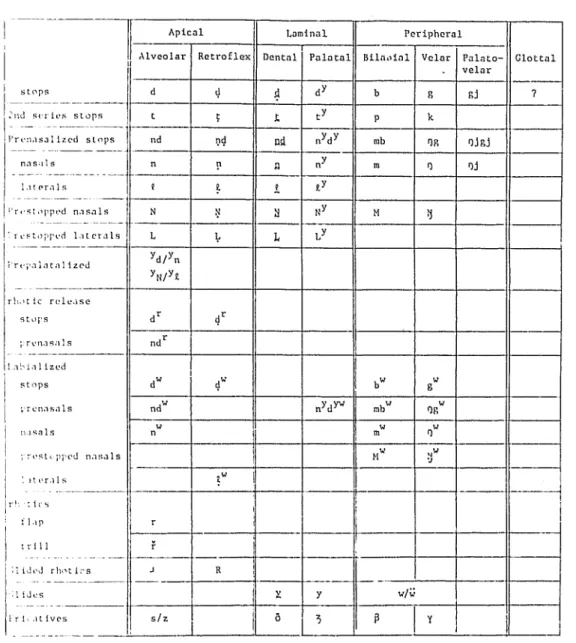
Table 1 below is a listing of the consonants that have been
recorded in the languages studied. The horizontal arrangement of positions of articulation reflects the preferred emphasis on the active articulator rather than the passive place of articulation2 (Dixon,
forthcoming a : 20). The vertical arrangement of manners of articulat·, 'n
represents the order of the analysis in the following sections.
TABLE 1 : CONSONANT PllONEMES
--i
Apical Laminal PeripheralAlveolar Retroflex Dental Palatal Bila.>inl Velar Palnto- Glottal
II
velar
-stcips d c) ~ dy b g gj 7
s stops
__
,____
t ~ );. ty p kPr1:n.1s.J 1 i zed stops nd i:i<! ml 1/dY mb !)g !)jgj
-n.1s;i ls n \1 ll ny m !) !)j
.
-l ,1 r c>ra l s e ~ ! iY
---- - 1
d n.1sa ls N ~ ti Ny M 1j ---
---· rt' f= tnp{'t' ct LitcrJls L ],. L i,Y
l izc<l yd/yn YN/Y~
le.1se
dr <!r
-ls ndr
stops
d
I
I
w
cl"' <! w bw g
~-r12n.1sa ls nd"' nydyw mb"' !)g w
11.1 sa ls n w m w !)w
I
w .,w
j'C'<l n.1,;al s I M 'J
s ~w I
---
r
r 1-, :_ 1 r <; I
I i
f J,1p tr i 11
r I
f
-r I
I
- - - -
---cit L·s J R I
'
- - - '
-.: y w/w
-I
I
s s/z 0
~
il y II
-The tabular representation given is also indicative of the sound re;n: esented by the symbol employed with the following exceptions. The choice of the voiced symbols for the stop series and the voiceless symbols for the second stop series does not necessarily indicate the true nature of the distinction in any languages (cf. 1.1.3. below). It is a devi_e which reflects a marking phenomenon in Australian
linguistics, for it is the normal practice for single stop series languages to be represented by either set of symbols. Some linguists prefer the voiceless symbol, others the voiced. The voiced symbols are used throughout this thesis for languages with no contrast between
the two manners of stop production, the voiceless symbols are used
when a contrast is present. In language names the presence of voiceless symbols does not automatically indicate the presence of a second
series of stops but is rather the preference of the linguist or an idiosyncrasy of mine. For example, Kalkatungu is a single series stop language, but Blake (1969) uses this representation with the voiceless symbols and I follow suit. Some modifications to language names have been made for ease of orthographic representation.
The use of capital letters to represent phonemes is restricted
to prestopping and rhotics, and is an orthographic standardization indicating thi.; phenomenon discussed in 1.1. 7. and 1.1. ll. below.
It could be argued that those sounds represented by two symbols, like prenasalized stops, prepalatals and labialized consonants could perhaps be better treated as clusters. However, for the purpose of systematic analysis author preference has been overlooked. Take for
exa~iple, prenasalized stops. Burera has initial homo:rganic nasal
and stop clusters which are treated as such (Glasgow, D & K, 1962 10);
I have treated both languages in the same manner and record them as
3
having prenasalized stops. However, in those languages where a
researcher has not marked initial clusters as prenasalized stops I
w i 11 in di ca te these by placing the word "initial" in brackets after
tlie language name.
Finally, a question mark in brackets after a language name
indicates uncertainty on the part of the researcher or myself.
1 • 1 . 1 • STOP CONSONANTS
We shall exclude the glottal stop from this section (see 1.1.2.
below) and examine the arrangement patterns of the seven remaining
stops. The following five arrangements are found, the distributions
are set out below:
b d dy g
b d ~ dy g
b d
g
dy g b d dg
dy gb d d (g) dy gj g
1. 1. 1. 1. b d dy g (21 15.67%) 4
Gt1ugu-Yalanj i Mabuiag Lenngidigh
Gidabal Mulurudji Lama-lama
Gureng-gureng Halag-malag Waka-waka
Ujaabugay Ngarigu Warungu
Dyirbal Ngengomeri Wargamay
Tiwi Nganjaywana Waalubal
Maranunggu Nyangumarda Yidiny
3. See 1.1 .4. below and my paper (1978b) for further discussion of prenasalization.
I
It should be noted that in the single laminal languages,
namely 1.1.1.1. and 1.1.1.2., some authors prefer to use the dental symbol rather than the palatal. The reason appears to rest in the
allophonic alternation of the two. In Tiwi, for example, /dy/ is found preceeding /i/, /g/ elsewhere (Osborne, 1974 : 10). Obviously the dental occurs in more environments than the palatal and thus the prd erred symbol is the dental. The other languages that have preference given to the denLal rather than the palatal are Habuiag, Lama-lama, Lennigidigh and in 1.1.1.2., Madi-madi. Preference is
given to uniformity and the laminal palatal symool is employed in languages with no laminal contrast. This type of phenomenon supports the diachronic evidence on the development of two laminals from one
(Dixon, 1970b : 92).
111e areal distribution of the 4-stop arrangement is found on Map 1, Appec.dix 1. This typE. occurs along the east coastal regions of Australia, Cape York and the Daly River region of the Northern Territory. Only one example, Nyangumarda, is found in Western
Australia. It appears that the central region is devoid of this
,~. The number and percentage figures that occur after each arrangement indicates the number of languages having this set of stop positions. The percentage is the proportion this group occupies out of the total number of languages sampled. The same use of figures applies throughout this section.
1.1.1.2. b d
q
dy g (29 = 21. 64%)Andagerinja Gugada NjungaR
Alawa Djaru Rembarnga
Bur era Djeebana Wadyiginy
Pungu-pungu Mayali Walpiri
Pintupi Mantjiltjara Wagaman
Bard Madi-madi Walmatjari
Pitjantjatjara Mara Waramunga
Gugandji Maung Wambaya
Garadjari Ngarinjin Yiwadja
Gunwinggu Ngarla
The double apical, single laminal languages are restricted to the western half of the continent. On Map 2 we see that Madi-madi is the only language that occurs east of the eastern Northern Territory South Australian north-south border.
1.1.1.3. b d
g
dy g (33 = 24. 63%)Aridingidigh Gog-Nar Hbabaram
Awngdim Koko-Bera Nbeiwum
Umbila Kuuku-Ya?u Mbalidjan
Umbuygamu Kuku-Thaypan Hpakwithi
Brinken Guugu-Yirnidhi'rr6 Mbara
Gugu-Badhun Thaayore Nggod
Kunj en Dhurga Ngangikurrungurr
Kurtjar Dharawal Ngiyamba
6. John Haviland (pers. comm.) reports the possibility of retroflex ~tops and nasals for he found the regular occurrence of initial retroflexes in a few cases. Initial ,)ccurrence is quite significant for it is in this position that
Ndra?angid Wik-Ep Yathaikana
Ludigh Wikmumin Yinwum
Wikmunkan Yir-Yoront Yuwaalaraay
On Map 4 we find the areal d~stribution of the double laminal single apical languages. They are predominantly restricted to the Cape York region, with two cases in the Daly River area: Brinken and Ngangikurrungurr. These are the only two examples west of the
eastern north-south Northern Territory-South Australian borders.
1.1.1.4. b d d ~ dy g (47 35. 07%)
And ilj a ugwa Kitja Nunggubuyu
Andegeribina Djamindjung Lardil
Alyawarra Djabu Ritharngu
Arabana Djambarrpuynggu Warramiri
Aranda Thargari Wangurri
Bidyara Dalabon7 Wagilak
Pita-pita Datiway Wanggumara
Bailko Diyari Wangganguru
Kaititj Malyangapa Wa:[.uwara
Gubabuyngu Hurawari Wemba-wemba
Galpu Margany Yanhangu
Gungabula Murinbata Yandruwandha
Kukatj Handelbingu Yinytyiparnti
Kuthant Ngawun Yukulta
Kalkatungu Nga:[.uma Yaraldi
Kurama Nanta
7. Dalabon may not have a dental series. O'Grady, VoegelinC
&
FThe distribution of this 6-stop arrangement, Map 3, is rather scattered, with only Cape York and the east coast being exempt.
Gungabula and Bidyara in Central Queensland and Murawari on the Queensland border are the most eastern occurrences. Yaraldi and Wemba-wemba
are the most southern.
1. 1. 1. 5 . b d d ( ~) d y gj g ( 4 2.99%)
Dj ingili Garawa
Ngarndji Yanyula
Of these four languages only Yanyula has the full seven stops, the other three lack the dental. We can see on Map 5 that these languages are restricted to a small area west of the southern end of
the Gulf of Carpentaria. Djingili and Ngarndji are in the Djingili-:\ambayan language family, whilst Yanyula and Garawa do not appear to be related despite their geographical closeness. Of all four, only
Yanyula is a prefixing language (Wurm, 1972 : 118-119). It is interesting to note that Gudandji, occurring between the two groups, is a double apical, single laminal language. Wambaya has the same system as (;udandj i and occurs south of Djingili.
1. 1.2. GLOTTAL STOP
Capell remarks that the glottal stop is found "almost exclusively in Cape York Peninsula and Arnhem Land" (Capell, 1967 91); with the
exrep~ion of Nanta in Western Australia, this statement holds true. In the Arnhem Land languages 8 present~d below, the glottal stop may be
01 syllable prosody (Dixon, pers. comm.), although only a few
researchers have recorded it as such.
1.1.2.1. Arnhem Land Languages
Gunwinggu9 Djambarrpuynggu Warrand.ri
Galpu Djabu Wangurri
Gubabuyngu Nandelbingu Wagilak
Datiway Ritharngu Yanhangu
Dalabon Rembarnga 10
1.1.2.2. Other Languages
Awngdim Murinbata 11 Lenngidigh
Umbuygamu Maung Lama-lama
Umbila Nggod Wikmunkan
Kuuku-Ya?u Ndra?angid Wik-Ep
Thaayore Nanta (?)12 Yinwum
!1pakwithi Ludigh Yir-Yiront
Mayali
Map 6 shows the areal distribution where we see that the one exception to Capell's observation of Nanta on the West Australian coast.
Y. The glottal stop in Gunwinggu is recorded as a syllable final prosody (Caroll, 1976 : 15).
10. Rembarnga, like Gunwinggu, is recorded with a syllable final glottal stop (McKay, 1975 : 14).
11. The glottal stop occurs in only one word in Murinbata; /mu?mun/ "water rat" (Walsh, 1976 : 25).
12. The source of the Nanta material is O'Grady, Voegelin C
&
F (1966 : 61) and not the result of an in-depth study. Their material varies in quality. In Aranda, for instance there is agreement with other researchers, whilst in others like Brinken, there are differences. Tryon recorded no retroflexes, no dentals except the stop, no vowel length and the possible occurrence of schwa (Tryon, 1974 : 71) in Brinken in comparison to the phonemic system given by O'Grady, Voegelin, C & F. In this instance I have1 .1.3. SECOND SERIES STOPS
In the analysis of languages under study there has been a niltural division in double stop phonologies. The first of these is
in Arnhem Land, represented below; the second is a more geographically diverse group. The same division is found with glottal stop
occurrence (see 1.1.2. above).
For those languages with a specification following, the lilbcl indicates the choice of the researcher.
1.1.3.1. Arnhem Land Languages
These languages appear to have a distinction only in certain environments and under some morphophonemic constraints. In Mayali, the distinction is found intervocalically and after some sonorants (Merlan, pers. comm); in Galpu the situation appears to be similar
(~ood, 1972 : 28).
Burera (?)13 Mayali [lenis/fortis]
Gubabuyngu [gem./non-gem.
J
Ngangikurrungurrl5Galpu14 Rembarnga [gem./non-gem]
Djambarrpuynggu Ritharngu [lenis/fortis]
Djabu Wangurri
Djeebana [gem./non-gem.] Warramiri
Datiway Wagilak
Mandelbingu Yanhangu
13. Burera is included even though the Glasgows (1962) dismiss the second series. Tryon reports them and states that their
behaviour is similar to others in this group (Tryon, 1974 : 231) (note also f.n. 15 below).
14. The distinction in Galpu is reported to be fortis, voiceless, geminate/lenis, voiced, non-geminate. (Wood, 1977 28). 15. ~:gangikurrungurr is reported as having a double stop system
1.1.3.2. Other Languages
Umbuygamu [voiced/voiceless] Kunjen [aspirate/non-aspirate] Djamindjung [voiced/voiceless]l6 Thargari [voiced/voiceless] Diyari [voiced/voiceless]l7 Murinbata [voiced/voiceless]l8 Margany [tense/lax]
Mbeiwum [voiced/voiceless] Nabuiag [voiced/voiceless] Wikmumin [voiced/voiceless] Wanggumara [voiced/voiceless] Waramunga [gem./non gem.]19 Wafuwara [voiced/voiceless]20 Yandruwandha [voiced/voiceless]
16. Djamindjung is like Murinbata and Ngangikurrungurr in that it lacks
/rJ./
and/n/.
Because of this peculiarity, Walsh sets up /1/ as a marginal phoneme, as he also does in Murinbata(Walsh, 1976 : 24
&
pers. comm.).17. Diyari has only two voiced stop phonemes, namely the apicals /d/ and
/9/.
(Austin, 1978 : 51).18. Refer to f.n. 15 and 16 above, and note that the distinction between the two series is not restricted to specific.
environments. For example we find a distinction between /bi/ "string" and /pi/ "mudfish" (Walsh, 1976 : 28), where in Ngangikurrungurr the distinction is not made word initially. 19. Hale (1959: 1) reports C -::-7[+ gem.]/ V _ _ _ •
[+stop] [+stress]
However, we find geminate nasals and laterals in his fieldnotes. It has also been reported that "all consonants except semi-vowels and the flap can be geminated" (Chakravar.ti, 1976 : 7). The phonemic status of this phenomenon is unclear.
20. The occurrence of voiceless and voiced stops in Waluwara is
It will be noted that the five methods of distinction: [voiced/ voiceless], [aspirate/non-aspirate], [tense/lax], [fortis/lenis] and [gcminate/non-geminate] are not mutually exclusive (c.f. f.n. 14 above); the choice of one or more as the "p1-10nemic" contrast is due to the linguist involved. There is obviously a need for acouotic study of these languages in order to describe more accurately the nature of the
distinctir-~ between the two series of stops (see also 3.1.2.3.1. and 3.4.2.2. below). The areal distribution of the second stop series is found on Map 7, Appendix 1.
1.1.4. PRENASALIZED STOPS
As well as the comments on prenasalization above (1.1.0.) I wish to make the further point that I am not making the claim that in
Australian languages the syllable structure is such that any word initial consonant will be a unit phoneme. The use of thP term prenasalized stops to describe initial clusters of a homorganic nasal and stop is a device to register similarity, thus recording the extent of initial clusters and prenasalized stops.
The occurrence of the word "initial" in brackets indicates the recording of initial clusters which have not been described as prenasalized stops.
Alyawarra (?)21 Andegeribina
Alawa Burera (initial)
Aridingidigh (initial) Kalkatungu (initial)2 2
21. Alyawarra is included because prenasalized stops do occur phonetically; the analysis, however, is another problem.
(Koch, pers. comm.).
Kaititj (?)23 Mbalidjan
Kuku-Thaypan Ndra?angid (initial)
Mbabaram (initial) Nggod (initial)
Mbara Lama-lama
Mara Yanyula (initial)
Mpakwithi
Yinwum Mb eiwum (initial)
It should ~e noted that Jagst sets up a series of prenasalized stops in Walpiri on the basis of the recording on initial /mp/ in one form (Jagst, 197 5 : 21). However, on the basis of other data
(Dixon, pers. comm.) and because the cluster was recorded in only one instance, we will not include a series of prenasalized slops in Walpiri.
Map 8 shows the areal diversity of prenasalized stops. We
find that Cape York has a large percentage and these languages are known as being some of the Initial Dropping Languages24 (Sutton, 1976
102-124). Eastern Arnhem Land and Central Australia are the other are; here prenasalized stops are present.
1 . 1 . 5. NASALS
"The most powerful generalization opposed by not a single
'
.exception, is that the number of linear distinctions made among oral stops in a given language is identical with the number of linear
distinctions made among nasals" (01Grady, Voegelin C & F, 1966 : 57).
·1 his complements Ferguson 1 s universal claim that no language has more nasal positions than stop positions (Ferguson, C., 1966 : 57).
23. Kaititj has the same phenomenon as Alyawarra, c.f. f.n. 21 above.
Such a statement is fairly representative of the number of 11asals in Lhe majority of Australian languages. There are, however, a small group of languages which do not have a one-to-one correspondence of nasal and stop positions. The first type is found in Djingili and
Ngarndji (Cll & 12 on rrap 9) where the palato-velar nasal /Qj/ is not present (note, however, it was found in my acoustic analysis of Djingili (see 2.3.4.1.)). It is interesting to note that the other two languages with the equivalent stop arrangement, Garawa and Yanyula, have the corresponding nasal.
The second type of unequal correspondence involves the laminal nasal. In double laminal stop languages the dental nasal is either subphonemic or lacking. This is the case in the languages:
Djamindjung2 5 Wemba-wemba
P.urinbata Awngdim (?)
Ngangikurrungurr Brinken
Gugu-Badhun26
In the single laminal stop languages we find only two cases where the laminal nasal is lacking, Mabuiag and Lama-lama in Cape York. Map 9 shows that the languages where the number of nasals does not equal the number of stops are restricted to Cape York and the Nurthern Territory; Wemba-wemba on the Hurray River is the only exception.
It is important to note. that all languages have the same nu:nber of apical stops as apical nasals. Peripheral stops and nasals
25. Djamindjung and the following three languages also lack the voiced dental stop whilst the voiceless
It,/
is present (c.f. f.n. 16 above). 26. In Gugu-Badhun the distinction between the laminal stops isare also in a one-to-one correspondence excepting the palato-velar nasal as specified above. It is in the laminals that we find the cases where the number of stops does not equal the number of nasals.
1 . 1 . 6. LATERALS
Two points are worth noting in the discussion of the following position arrangements of laterals found in Australian languages. The first is directed at the type of analysis employed. Lateral position arrangements are discussed in terms of symmetry, where a one-to-one correspondence of laterals with non-peripheral stops is a symmetrical system. The non-symmetrical systems are listed according to stop arrangements. This gives us two sets of figures, discussed in 1.1.6.6. below.
The second point concerns the types of systems that do not occur. We do not find that the number of laterals is greater than the number of non-peripheral stops in any language. We also find that all languages with two laminal laterals also have two apical laterals. The single laminal lateral, single apical lateral type (1.1.6.2.) is
sr.ia 11 in number, suggesting that the laminal laterals are more phonologically complex. In nasals we saw that it was the laminal, or the Jaminal dental in double laminal stop arrangements, that was the subphonemic or lacking nasal. We may therefore suggest that L1minals, especially the laminal dental place of articulation is the r.1ore complex. 27
27. Complex is used in the sense of an implied hierarchy of L1honoJ ogical complexity, reflected by a greater number of positive values in a feature description. We find that only Chomsky and Halle's
(3.1.1.2.)
and Dixon's(3.1.1.4.)
systems express this distributional aspect.I
l
l
I
l
iI
I.
j
~
1.1.6.l. £ (51 38. 06%)
I
~
'Symmetrical: ¢
I
I
~on-svmmetrical:!
Stop Type 1 (b d dy g)
I
f.,
Gugu-Yalanji Tiwi Wargamay
I "
Gidabal Mulurudji Warungu
!
i
Gureng-gureng Mabuiag Waalubal
I
I
Djaabugay Haranunggu Waka-waka
I
I
Dyirbal Lenngidigh Yidiny
l
Lama-lama
l
Ii
Stop Type 2 (b d d dy g)
!
j ,, DjePbana
.. ---- i
---
dyI
Iscop Type 3 (b d
g
g) ~'Awngdim Kuuku-Thaypan Ngiyamba
(i
I
Aridingidigh Thaayore Ndra?angid
Umbila Dhurga Ludigh
Guugu-Yimidhirr Dharawal Wik.mumin
Gugu-Badhun Mbara Wik-Ep
Koko-Bera Hpakwithi Wikmunkan
Kunj en Mbalidjan Yathaikana
Kurtjar Mbeiwum Yinwum
Gog-Nar Mbabaram Yuwaalaraay
Kuuku-Ya?u Ngangikurrungurr Nggod
Stop Type 4 (b d d
g
d y g)Bidyara Lardil
On the Map 10 we see the areal distribution of the single
lateral languages restricted to Cape York and the east coast of
,\ustralia. The most inland languages are Wemba-wemba and Yuwaalaraay. In Arnhem Land we find the four languages Tiwi, Ng<!ngikurrungurr,
~lilranunggu and Djeebana.
1.1.6.2. £ £y (9
=
6.72%)This surprisingly is quite a rare system, occurring only in
the following nine languages. Snametrical:
Stop Type 1 (b d dy g)
Halag-malag Nganjaywana
Ngengorneri
~;on-symmetrical:
Stop Type 2 (b d
4
dy g) YiwadjaStop Type 3 (b d
g
dy g) .Ngarigu Nyangumarda
Urnbuygamu Brinken Yir-Yoront
There appears to be no areal congruence of this system. Map 11
shO\;s us Nganjaywana in the east for instance and the Daly River languages in the north-west of Arnhem Land.
1.1.6.3. £,
L~
(30S~·mr.:ctrical:
Stop Type 2 (b d d
Alawa Andagerinja Pitjantjatjara
dy
22.39%)
g)
Bard
Pin tu pi Gudandji
Garadjari
Madi-madi Ngarinjin Waramunga
Maung Ngarla Walmatjari
Mantj il tj ara NjungaR Wagaman
Mayali Wambaya Walpiri
Stop Type 4 (b d d $;! dy g)
Kitja Murinbata Malyangapa
Djamindjung Margany Nunggubuyu
Stop Type 5 (b d d ($;!) dy gj g)
'
Garawa Djingili Ngarndji
Areally, we find that there are only two cases east of the eastern Northern Territory-South Australian north-south border
Ubp 12). They are Margany and Madi-madi; the rest of the languages in this lateral arrangement are scattered over the western three-quarters of the continent.
1.1.6.4. £, £, (26 19 .14%)
Symmetrical: ¢
:\on-svmmetrical:
Stop Type 2 (b d cl- dy g)
Pungu-pungu Gunwinggu Rembarnga
Bur era Mara Wadyiginy
Stop Type 4 (b d d $;! dy g)
Gubabuyngu Kurama Datiway
Galpu Djabu Dalabon
Kukatj Djambarrpuynggu Mandelbingu
Kuthant Thargari Murawari28
Ngawun Ritharngu Wagilak Wangurri Warramiri Yinytyiparnti Yanhangu Yukulta
On Map 13 we notice that there is a concentration of languages
in eastern Arnhem Land, in the western area the Daly River lang11ages
f'ungu-pungu and Wadyiginy. In Western Australia we find a few cases,
but none are found in the central region of the continent. To the south
of the Gulf of Carpentaria we find a few languages, the most inland being
Ngawun. The most eastern case appears to be Murawari on the
Queensland-New South Wales border.
1.1.6.5. £ ~ ~ iY (18 13 .43%)
Svmr.1ctrical:
Stop Type 4 (b d d
d
dy g)Andegeribina Aranda Alyawarra Arabana Andiljaugwa Bailko Pita-pita Kalkatungu Kaititj Diyari Nga:[.uma
Stop Type 5 (b d d
Cd)
dy gj g) Yanyula~:cm-symmetrical: ¢
Nanta Wa:t-uwara Wanggumara Wangganguru Yaraldi Yandruwandha
~lap 14 shows that the 4-lateral type is found predominantly
in Central Australifl. Yaraldi on the mouth of the Hurray River is
the southern most language. Yanyula and Andiljaugwa in Arnhem Land
and a few cases in Western Australia are the only other cases
1. 1.6.6. Stop and Lateral Distribution
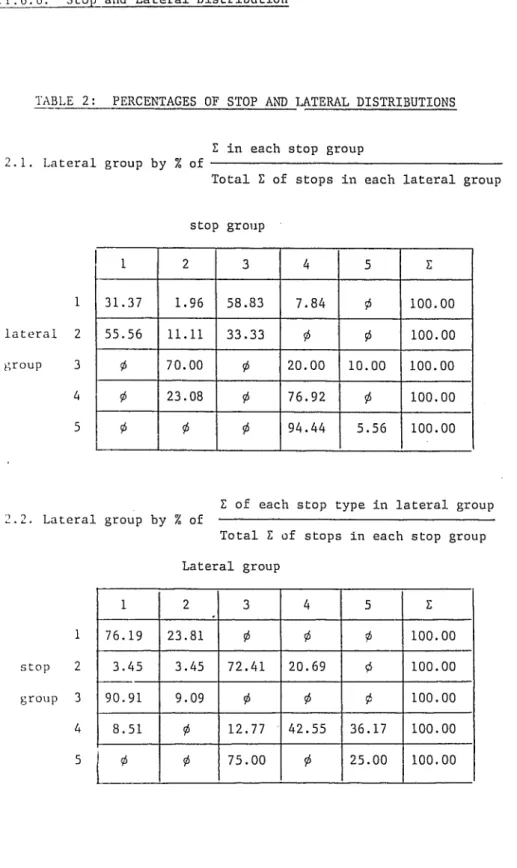
TABLE 2: PERCENTAGES OF STOP AND LATERAL DISTRIBUTIONS
E in each stop group
2.1. Lateral group by% o f
-Total E of stops in each lateral group
stop group
1 2 3 4 5 E
1 31. 37 1. 96 58.83 7.84 ¢ 100. 00
lateral 2 55.56 11.11 33.33 ¢ ¢ 100.00
group 3 ¢ 70.00 ¢ 20.00 10.00 100.00
4 ¢ 23.08 ¢ 76. 92 ¢ 100.00
5 ¢ ¢ ¢ 94.44 5.56 100.00
E of each stop type in lateral group
2.2. Lateral group by% of
Total E of stops in each stop group Lateral group
1 2 3 4 5 E
76 .19 23.81 ¢ ¢ ¢ 100.00
stop 2 3.45 3.45 72.41 20.69 ¢ 100.00
90.91 9.09 ¢ ¢ rl. 100.00
'J'
group 3
4 8.51 ¢ 12. 77 42.55 36.17 100.00
5
Table 2 (p. 22) shows the percentages of membership to each combination. The zero (¢) components are predictable in most cases for th•re cannot be a lateral which has no corresponding stop phoneme. Therefore type 1 stop system cannot occur with types 3-5 lateral systems. A type 3 stop system is a single apical and is
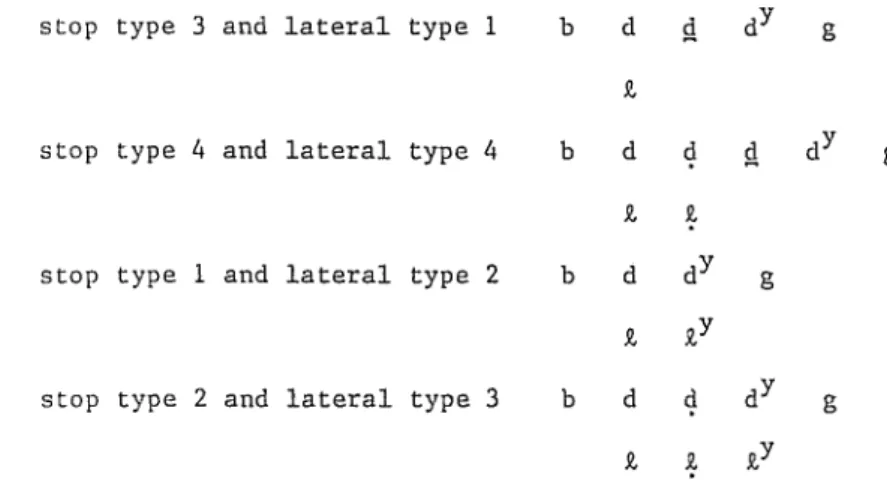
thus excluded from lateral system types 3-5. Type 5 stop system includes only four languages so we would expect gaps in its lateral series membership. However, we find the null set for type 4 stop system and type 2 lateral system. In other words, we find no instances of the stop and lateral combination of:
b d d g
It is worth noting the following more common combinations
fr0~ both tables:
stop type 3 and lateral type 1 b d
g
dy g)!,
stop type 4 and lateral type 4 b d d
g
dy g£. £.
stop type 1 and lateral type 2 b d dy g
£. .11.Y
stop type 2 and lateral type 3 b d d dy g
£. £. .11.Y
On the other hand, unlikely combinations are as equally relevant, for example:
stop type 2 and lateral type 1 b d d dy g
stop type 4 and lateral type 1 b
£.
Ii,
dy
(
d d
g
gi:
,l
£.
!I
stop type 4 and lateral type 3 b dy
!i
d d
g
g,,
1 . 1 . 7. PRESTOPPING
This section concerns prestopped nasals and laterals. It is felt that in terms of distribution, it is better to regard this phenomenon as prestopping rather than "stops with nasal release" (O'Gra<ly, Voegelin, C
&
F, 1966 : 59) and laterally released stops.Plwnotac tically, pres topped nasals for instance have the same
distribution as nasals in Kaititj (Koch, pers. comm.), and sometimes alternate with long nasals in both Kaititj and Alyawarra (Yallop,
1977 : 12).
Prestopped nasals occur in the following languages:
Aranda Arabana Kaititj
Alyawarra Kunjen Wangganguru
,\rabana and Wangganguru lack the retroflex and velar prestopped nasal,
thL' other languages have six except Kunjen with five, the retroflex is absent.
Prestopped laterals are found in Yandruwandha, Arabana and h',:rngganguru. Again, Arabana and Wangganguru do not have a full set of four; the retroflex is lacking.
It should be noted that the number of prestopped nasals does
not exceed the number of nasals and likewise for the laterals.
Excepting Kunjen, all the languages have six nasals and four laterals. Yan<lruwandha is the only language that has prestopped laterals but no
prestopped nasals.
Map 15 shows that Kunjen in western Cape York is the only language distant from the rest in the central region of Australia; otherwise this phenomenon is an areal feature.
1.1 .8. PREPALATALIZATION
in the data surveyed. This is a device employed to allow for a
morphophonemic two vowel system of a/a: (Breen, 1977 : 384) (see also 1.2.3. below). Andegeribina.is found in Central Australia, C6 on
~lap 15.
1.1.9. RHOTIC RELEASE
The rhotic release of apical stops and the alveolar prestopped nasal appears to be a different phenomenon from the prestopping of certain stops before rhotics (see also 3.1.2.3.5. below). In
~pakwithi for instance, rhotic released stops function phonotactically
as stops and not as rhotics (Crowley, pers. comm.). /dr/ is found in:
Awngdim Aridingidigh Mpakwithi /ndr/ is found in:
Mpakwithi
Yandruwandha
Ndra?angid Yinwum
Nggod Yandruwandha
Lenngidigh
Ndra?angid Yinwum
Breen regards the rhotic released stops in Yandruwandha as prcstopped trills (Breen, 1976b : 597), presumably on the basis of phllnological similarity with prestopped laterals. However, there is no evidence as to the phonotactic function of the rhotic release stops in Yandruwandha, whether they function in the same manner as stops or rhotics.
It is felt however, that they are best described as rhotic relea6eJ stops as opposed to prestopped tri. ls for we notice that /dr/ occurs elsewhere and functions phonotactically as a stop. It
d d d 'b /~r/ fl d
is also somewhat iscor ant to escri e as a retro ex prestoppe
I I r i
ll,,
If··"
'III
IIii '
I.I_,.
It'
:1
I
trill as opposed to a rhotic released retroflex stop.
Areal occurrence of the rhotic released stop is in Cape
York, with Yandruwandha in Central Australia the only exception, (see
~'.ap 16).
1.1.10. LABIALIZATION
Labialization is a phonotactic or prosodic device employed
to describe the rounding of certain consonants in a manner similar to the
phonological constructions of the preceding three sections. The languages
and their respective labialized consonants are:
Andiljaugwa g w I) w
Mbabaram (?) g w (l)w) dw n w
Andegeribina mbw l)g w bw g w m w I) w MW ~w
Tiwi : unknown (Breen, 1977)
Alyawarra : bw dw dw g w I) w 9,w (?)
It is important to note that Alyawarra and the other Arandic
languages in this study (Aranda and Kaititj) do have phonetic
rounding on some consonants, their status being a matter of
"iorpl10phonemic arrangement (Koch, pers. comm.). The Alywarra data
:ibove is taken as being phonemic by its researcher (Turtle, 1977 6). 29
We notice that mainly peripherals and apicals can be
labialized. Only one laminal, the palatal prenasalized stop in
Alyr.;arra (c.f. f.n. 29) was recorded. The manners of articulation
wher~ rounding occurs are stops, nasals, prenasalized stops and
prestopped nasals. Only one lateral, the retroflex in Alyawarra
1,as recorded.
29. Yallop record~, in Alyawarra the following consonants as being the first members of a cluster where the second is /w/:
::, ~· m, I), n, mb, nd, nYdY. (Yallop, 1977 : 43).
Geographically, Map 17 shows the Central Australian languages,
~!babaram in Cape York, Andiljaugwa on Groote Island and Tiwi on Melville and Bathurst Islands.
1.1.11. RHOTICS
In Australian languages four rhotics have been recorded; the ilap, trill and two glided rhotics, the retroflex and alveolar. The majority of languages, 80.60%, have two rhotics, the retroflex continuant /R/30 and the flap or trill /r/. 31 In the remaining four types of arrangement we notice that we do not find the flap and
trill without the retroflex continuant but do find just a flap or trill without the continuant. We also find only one doubtful case of
thl' continuant rhotic /R/ as the only rhotic present in the phonology
0[ a language. One language contrasts the two continuant rhotics, 1,·ith the trill or flap.
I. 1. 11.1. R r (continuant, trill/flap) (108 = 80. 60%)
Aridingidigh Andegeribina Bidyara
Awngdim Arabana Bailko
Andagerinja Umbila Bard
Alawa Umbuygamu Pitjantjatjara
Andiljaugwa Bur era Brin ken
Alyawarra Pungu-pungu Kaititj
Aranda Pintupi Galpu
30. I prefer to use /R/ and not
It!
(c.f. Dixon, 1972) for orthographic 0ase; it does not suggest a uvula trill as its IPA value might imply. IPA /J/ is conventionally not used in describing Australian langu;:iges and is reserved here for the alveolar glided rhutic in Murinbata (1.1.11.5. below).Garadjari Mbabaram Nunggubuyu
Kurama Mandelbingu Lenngidign
Gudandji Maranunggu Lardil
Kalkatungu Mbara Rembarnga
Kunjen Mbeiwum Ritharngu
Gungabula. Mantjiltjara Wadyiginy
Gugu-Badhun Mayali Wangganguru
Gubabuyngu Mara Warramiri
Guugu-Yimidhirr Maung Wangurri
Gar aw a Mpakwithi Wagilak
Kuku-Thaypan Mulurudji Wikmunkan
Gugada Murawari 32 Waka-waka
Koko-Bera Halag-malag Wik-Ep
Gunwinggu Margany Wagaman
Gugu-Yalanji Ngarndji Warungu
Kitja Ngarla Wa~uwara
Djamindjung Nganjaywana Wemba-wemba
Djeebana Ngengomeri Wargamay
Dyirbal Nggod Walmatjari
Djabu Ngiyamba Waramunga
Djaabugay Ngarinjin Wambaya
Djambarrpuynggu Ngawun Wikmumin
Dj ingili Ngangikurrungurr Yathaikana
Ljaru NyungaR Yanhangu
Thaayore Nyangumarda Yir-Yoront
Tiwi Ndra?angid Yukulta
Datiway Nan ta Yaraldi
Yinwum Yanyula Yinytyiparnti
Yiwadja 33 Yidiny Yuwaalaraay
1.1.11.2. r (trill/flap) (11
= 8.21%)
Gureng-gureng Dhurga Ngarigu
Gidabal Madi-madi Ludigh
Kuuku-Ya?u Mabuiag Waalubal
Dharawal Mbalidjan
Map 18 shows that the areal distribution of this system is restricted to the east coast of Australia. The most western lar,guage appears to be Madi-madi.
1.1.11.3. R r r v (continuant, flap, trill) (13 9. 70%)
Pita-pita Dalabon Lama-lama
Gog-Nar Diyari Walpiri
Kurtjar Malyangapa Wanggumara
Kuthant Nga+uma Yandruwandha
Kukatj
A fairly widespread areal distribution is found (Map 19) wilh Lama-lama in Cape York the most eastern language. Othenlise, predominance in the Gulf region and northern South Australia account
"nr most; Nga:J_uma is the most western language in this survey.
1.1.11.4. R (continuant) (1
=
0.75%)The single glided rhotic is found in one language. Thargari in 1-:estern Australia (see Map 20). I t has been recorded that [ r] is
;in allophone of /t/, for Klokeid lists /r/ with the stops in his
phonemic arrangements and states: "/r/ has voiced flap and trill
alloplDn"s which are in free variation in most environments with the
voice .' allophones, and are in fact more frequently occurring"
(Klokeid, d69 : 3). Austin (pers. comm.) has suggested that there
Ir.ay be two phonemes /t/ and /r/, but hP. is still unsure of their
true status.
Due to this being the only example of a language with a
retroflex glided rhotic and since researchers appear to eisagree,
the status and validity of thi.s rhotic system is in doubt.
1.1.11.5. r R J (trill/flap, retroflex and alveolar continuants)
(1 = 0. 75;;)
On Map 20 we note that the only language with this sys+-· m,
>1urinbata, is located in the Port Keats region of the Northern
r .. rritory. We may be tempted to dismiss this system on the grounds
t h1 t it occurs in only one language but it should be noted that its
u~:urrcnce is well documented (Walsh, 1976) and is acoustically
prl1v,,ble (see 2.4.2.). In fact, even the language name contains the
.ii vc.ilar glided rho tic, "muJinypata" (Walsh, 1976). The neighbouring
Lrnp1;iges, Dj amindjung and Ngangikurrungurr, which share many common
1 "1turcs (c.f. f.n. 16 abc.ve) do not have these three rhotics. They
;1 ive the more frequent system of two rhotics, /R/ and /r/.
1 . l . 12. CLl DES
Nearly all languages have two glides /w/ and /y/ (129
with some languages having three.
1.1.12.1. y y w (2 = 1.49%)
The extra glide is an interdental, occurring in only two
languages in Western Australia, Kurama and Yinytyiparnti (Map 21)
uf which not much detail is available. 34 This glide is apparently
produced with the sides of the tongue against the cheek, the tongue
is held flat and the tip is under the bottom teeth (Wordick,
pers. comm.).
1 . l . 12. 2. w w y (3=2. 24%)
Unrounded /w/, transcribed as
/w/
(IPA[w])
occurs in Kaititj, h'ik-lp and Wa~uwara (see Map 21). In Kaititj it has developed fromthe velar fricative, and in some instances is produced with some
fricLfon or allophonically alternates with the velar fricative
(t;,icil, pers. comm.).
1.1.13. FRICATIVES
Fricatives are found in Arnhem Land, Cape York and Central
Australia. Map 22 shows the areal distributi.on and we note that
Tharl'ari in Western Australia is the only language outside this area.
I have at tempted to standuttli.ze symbols employed by various
autlwrs. There is no need, for instance, to distinguish voiced and
voiceless fricatives in any language except Mabuiag. To use symbols
dL·not ing such a difference may be phonetically accurate but
phl'n<er..ically irrelevant. The voiced symbols will be used in the
s;i~:<e manner as was employed in the stop analysis (c.f. 1.1.0.). We
!ind the following types.
3:,. It has been suggested that the diachronic development of
/::/ has been P:.
>
,t(Workick, pers. comm.)
l
I~.
Ii
!I
ii
n
II
II.
ll
11
'.I
1.1.13.1. y (6 21.43% of languages with fricatives
4.48% of total number of languages)
Aranda Kuthant Maung (?)
Alyawarra Tiwi Yiwadja (?)
1.1.13.2. y
8
~ (14 50.00% of languages with fricatives10.45% of total number of languages)
Aridingidigh Kuuku-Thaypan Ludigh
A\mgdim Hbeiwum Lenngidigh
Umbuygamu Hbalidjan Yinwum
Kunjen Nggod Yathaikana
Kurtjar Ndra?angid
1.1.13.3. y ~ (1 3.57% of languages with fricatives
0.75% of total number languages) Gog-Nar
l.1.13.4. 8 (2 7.14% of languages with fricatives
1.49% of total number of languages) Thargari
Mbara (?)
1.1.13.5. 2. ~ (1 3.57% of languages with fricatives
0. 75% of total number of languages)
~;gengomeri (?)
1.1.13.6. $ L (1 3.57% of languages with fricatives
0. 75% of total number of languages)
1.1.13.7. y ,. ~ (1 3.57% of languages with fricatives
0.75% of total number of languages) Lama-lama
1.1.13.8. z ) ~ (1 3.75% of languages with fricatives
0.75% of total number of languages) Ngangikurrungurr
1.1.13,g, y ) 0 ~ (1 3.75% of languages with fricatives
0.75% of total number of languages) Mpakwithi, which has the largest number of fricatives in any one language surveyed.
In general, fricatives are uncommon sounds at the phonemic level, found in only twenty-eight languages (20.90%) in this study. The absence or relative scarcity of fricatives is a major Australian areRl characteristic.
1.2.0. VOWEL PHONEMES
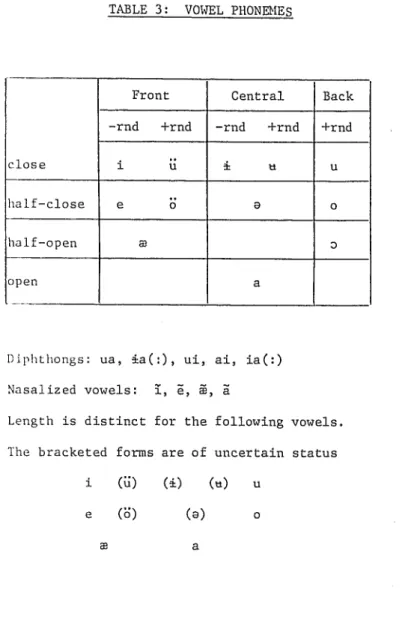
The vowel phonemes of Aboriginal languages, found on Table 3 (p. 3.'.i), have the same characteristics of distribution that we found in the consonants. Both vowels and consonants in the majority of languages fit into a small set of distributional combinations, wi~h
just a small number of aberrant languages. For example, the vowel~
system /i a u/ is found in 53.73% of all languages.35
TABLE 3: VOWEL PHONEMES
Front Central
-rnd +rnd -rnd +rnd
close i u :i: ti
half-close e 0 a
half-open @
open a
-Diphthongs: ua, :i:a(:), ui, ai, ia(:) Nasalized vowels: i,
e, re, a
Back +rnd
u
0
:::>
Length is distinct for the following vowels. The bracketed fonns are of uncertain status
i
e
(i.i) (Ci)
(:i:) ( tt) u
(a) 0
a
We can divide the vowel arrangements into three major types
in order to examine their distributions.
1.2.1. Symmetrical systems, where there is symmetry both in the
structure of the vowel dia'.;ram and in the presence and absence of
~ length distinction.
1.2.2. Semi-symmetrical systems, where there is some form of symmetry
1.2.3. Ungrouped systems; this being a collection of languages which
Jo not fit into the above two types. It should be noted that vowel systems falling into this group are the more aberrant forms, where one system is unique to one language. The exception is the system
I .
' l u a a:/ which has three members.
I. 2. 1. Symmetrical systems
i - - u 1.2.1.1.1. i a u
\
/
1.2.1.1.2. [±length]
a i a u
i - - u 1.2.1.2.1. i e a u
I
[± length]
e _ _ a 1.2.1.2.2. i e a u
i - - U 1.2.1.3.1. i e a 0 u
I
I
e 0 1.2.1.3.2. i e a 0 u [± length]
\ /
a
i - - U
l~1~l
1.2.1.4.1. i e a 0 u e1.2.1.4.2. i e a 0 u e [± length]
\
/
a
1.2.1.l. i a u
:lap 23 shows the distribution of the vowel system /i a u/ witLout regard for the length distinction. 'there appears to be no
1.2.1.1.1. i a u (23 = 17.16%)
Pita-pita Dyirbal WaJ;uwara36
Bidyara Tiwi Wambaya
Garawa Diyari Warungu
Gugu-Badhun Mara Wanggumara
Kunjen Ngawun Yanyula
Gungabula Nganjaywana Yaraldi
Gugu-Yalanji Ngarla Yandruwandha
Garadjari Wikmumin
I .2.1.1.2. i a u [+length] (49
= 36.57%)
Alyawarra Kalkatungu Datiway
Aranda Gugada Murawari
Arabana Galpu Mulurudj i 3 9
Andagerinja Kukatj38 Mantj iltjara
Umbila Djeebana Malyangapa
Pitjantjatjara Djabu Margany
Bailko37 Djingili Mandelbingu
Pintupi Djambarrpuynggu Ngiyamba
Guugu-Yimidhirr Djaabugay
Kuuku-Ya?u Thargari Ngarigu
Gubabuyngu Dharawal Nyangumarda
Kurama Dhurga Nanta
J6. Refer to f.n. 20 as to why the length distinction in Wa:[.uwara is not recorded here.
37. Bailko may not have a length distinction (O'Grady, Voegelin C & F, 1966: 85).
38. Kukatj may have schwa (Breen, 1976c : 154).
Ritharngu 40 Wangurri Yukulta
Waramunga 41 Warramiri Yanhangu
Walmatjari Wangganguru Yidiny43
Wargamay42 Walpiri .Yuwaalaraay
Wagilak
1.2.1.2. i e a u
Map 24 shows the areal distribution of this system. It appears that there are no cases in Central and Western Australia. We find languages in Cape York and the east coast, Hadi-madi in the south and a few cases in western Arnhem Land.
1.2.1.2.1. i e a u (8 = 5.97%)
Alawa Hadi-madi Ndra?angid
Djamindjung44 ~;;gangikurrungurr Yimvum
Murinbata Ngengomeri
1.2.1.2.2. i e a u [±length] (5 = 3.73%)
Gidabal Lardil Waalubal 45
Guren~-gureng Yathaikana
40. Rithangu has length on the first syllable of a word only (Heath, 1978 : 34).
41. \faramunga may not have a length distinction (Chakravarti, 1967 Hale, 1959; Ca9ell, 1953 : 298).
6·
'
, ') ~· ._
.
4 J.
Wargamay has length on the first syllable only (Dixon, forthcoming
b : 22) .
Yidiny has a length distinction only in non-initial syllables (Dixon, 1977 : 2-3) ,,
',
'-+"•. The status of /e/ is uncertain in Djamindjung (Walsh, pers. comm.).
1.2.1.3. i e a o u
Map 25 shows the sporadic occurrences of this vowel arrangement. One example in the south-west, NjungaR, but none are found south of the ~ew South Wales-Queensland border.
1.2.1.3.1. i e a 0 u (7 5.22%)
Burera 46 Mayali Wadaman
Gunwinggu Ngarinjin Yiwadja
NjungaR
1.2.1.3.2. i e a 0 u [±length] (5 3.73%)
Thaayore Maung Waka-waka
Mbara Wikmunkan
1.2.l.4. i e a o u e
The six vowel system has a restricted areal distribution
(~lap 26). Cases are found in Cape York and Arnhem Land, with \·:emba-wemba being the only language outside this area.
1.2.1.4.1. i e a o u e (5 3.73%)
Koko-Bera Rembarnga Wemba-wemba47
Lama-lama Yir-Yoront
1.2.1.4.2. i e a o u e [±length] (2 1. 49%)
Dalabon Mabuiag 48
1. 2.. 2.. Semi-Symmetrical Systems
Map 27 shows th~ position of the /i a o u/ vowel system, both languages are in Western Australia. The distribution of /i e a u a/ can be found on Map 28, an area restricted to the Daly River region and only one case in Cape York, Awngdim.
It is of interest to note that there are more cases of
/i e a u/ than of /i a o u/; disregarding length and s':hwa. :\ineteen cases are found of the former and only two of the latter. The following is a list of vowel systems and their language
r.1c'r.ibers.
i a u
C±
length] 0 (1 0. 75%)Bard
i a u
[±
length] o: (1 0.75%)Yinytyiparnti
e a u a (6 4.48%)
Awngdim Pungu-pungu Maranunggu
Brinken49 Malag-malag Wadyiginy
e a u i ( 1 0. 75%) Andiljaugwa 50
e a 0 u a 0 (1 0.75%)
Gog-Nar
i d; i1 u 51 (2 1.49%)
Ludigh
~!balidjan
49. tlrinken may not have schwa (Tryon, 1974 : 71).
SU. Dixon (pers. comm.) suggests that Andiljaugwa has the vowel
/i/
51. It appears that /re/ is not a notational variant of /e/ for the former is apparently common in Northern Farnan languages
(Hale, 1976 : 7-40).
I
"
f
i al a 0 u (1 = 0. 75%)
Lenngi.digh
1. 2. 3. UngrouEed Systems
i u a a: (3 = 2.27%)
Ngarndj i Nunggubuyu Djaru
i
+
u a a: (1 0.75%)Kitja
i e a 0 u ± 1:i [± length] (?) (1 0.75%)
~lbabaram52
e ii) a ;) 0 u ± (?) (1 0.75%)
Kuku-Thaypan
u ti al a (1 = 0.75%)
Aridir.gidigh
i u u e 0 a (1 0.75%)
M!Jeiwum
i u e 0 0 CB a (1 0. 7 5%)
Nggod
e a 0 u u 0 (±) (tt) [± length] (?) (1 0. 75%)
Wik-Ep
0 u a ±a ia [± length] ± (1 0. 75%)
Kuthant53
..
±a [± length]
l' u 0 a
Kurtjar
52. ~!babaram, like Kuku-Thaypan in the next arrangement is symmetrical
011 the vowel diagram.
i a u ua (1 = 0.75%) Umbuygamu
i a u ui ai (1
o.
75%) Gudandji2 vowel systems (2 = 1.49%)
Andegeribina54 a a:
Kaititj a a
Finally, the largest vowel system, Mpakwithi
i (:) I u u(:)
e (:)
e
Co)
0a; ( : ) ill
a (:)
a
1.2.4. RESIDUE AREAL DISTRIBUTION 1.2.4.1. Vowel Systems
Map 29 provides ~s with the occurrences of all languages that have not yet been geographically positioned, excepting the two vowel systems in Kaititj and Andegeribina. They include all of 1.2.3. and 1.2.2. except /i e a u a/ and /i a o u/, the former being found on Map 2S, the latter on 27. It is of interest to note that these languages are restricted to the northern quarter of the continent, with Cape York having the greater density.
~lap 30 indicates the occurrence of diphthongs in Umbuygamu (Yl9), Kuthant (GS), Kurtjar (G9) and Gudandji (Cl4). Nasalized vowels in Mpakwithi (Y32) and the two-vowel systems (C6 and CS) are also marked on this map.