
RIT Scholar Works
Theses
Thesis/Dissertation Collections
6-1-1974
Suggested guidelines for a printing program in
secondary education
Raymond Torella
Follow this and additional works at:
http://scholarworks.rit.edu/theses
This Thesis is brought to you for free and open access by the Thesis/Dissertation Collections at RIT Scholar Works. It has been accepted for inclusion
in Theses by an authorized administrator of RIT Scholar Works. For more information, please contact
Recommended Citation
by
Raymond
A.
Torella
A
thesis
submitted
in
partial
fulfillment
ofthe
requirements
for
the
degree
ofMaster
ofScience in
the
School
of
Printing
in
the
College
ofGraphic Arts
and
Photography
of
the
Rochester
Institute
ofTechnology
June,
1974
School of Printing
Rochester Institute of Technology
Rochester, New York
CERTIFICATE OF APPROVAL
MASTER'S THESIS
This is to certify that the Master's Thesis of
Raymond A. Tore11a
name of student
with a major in Printing Education
has been approved by the Thesis Committee as
satisfactory for the thesis requirements for the
Master of Science degree at the convocation of
June, 1974
date
Thesis Committee:
Paul McKinnon
~--~--~~---Thesis adviser
rad
Robert G. Hacker
Graduate adviser
I would. like
to
extend
my
sincere
appreciation
to
the
individuals
who
gave
sograciously
of
their
time
to
arrangeinterviews.
Without
their
efforts,
this
study
would
neverhave been
completed.
To
the
graduatecommittee,
a
sincere
thank
you
for
their
unselfishdirection.
To Professor Paul
McKinnon,
my
adviser,
without
his
guidance
and
encouragement
this
thesis
would neverhave
gotten
offthe
ground.
Finally,
to
my
wife
Rochelle for
without
her devotion
andlove
this
entire
thesis
would
neverhave been
possible.CHAPTER
PAGE
I.
INTRODUCTION
1
II.
THEORETICAL BASES
OF
THIS
STUDY
4
III.
METHODOLOGY
7
Description
ofCategories
andTheir
Related Attitudinal
S
tatements
10
Analysis
14
IV.
RESULTS
18
V.
CONCLUSIONS
44
VI.
RECOMMENDATIONS
54
LIST OF
REFERENCES
59
APPENDIX A
Research
Instrument Used
to
Investigate
the
Established
Categories
62
APPENDIX
B
High School
Educators'Individual
Responses
to
Statements...
67
APPENDIX C
Rochester
Institute
of
Technology Faculty
Members'Individual
Responses
to
Statements
69
CHAPTER
PAGE
APPENDIX D
Members
ofthe
Printing
Industry
Individual
Responses
to
Statements
71
APPENDIX
E
Mean Responses
for
the
Three Groups
Interviewed
73
APPENDIX F
Results
ofa
t-test
Used
to
Determine Whether
or
Not
aSignificant
Difference Exists
Between
the
Industrial Members
Average
Score
andthe
RIT
Faculty
Members Average
Score
74
APPENDIX G
Results
of
a
t-test
Used
to
Determine Whether
orNot
aSignificant Difference Exists
Between
the
RIT
Faculty
Members
Average
Score
andthe
High
School
Educators
Average
Score.
. .75
APPENDIX
H
Results
of
a
t-test
Used
to
Determine
Whether
orNot
aSignificant
Difference Exists
Between
the
High
School
Educa
tors
Average
Score
andthe
Industrial
Members
Average
Score.
76
APPENDIX I
Results
ofa
t-test
Used
to
Determine
Whether
orNot
a
Significant
Difference Exists
Between
the
Industrial Members
Average
Score
andthe
High School Educators
Average
Score.
. .77
CHAPTER
PAGE
APPENDIX J
Results
ofa
t-test
Used
to
Determine Whether
orNot
a
Significant Difference
Exists
Between
the
RIT
Faculty
Members
Average Score
andthe
Industrial Members
Average
Score
78
APPENDIX K
Results
of at-test
Used
to
Determine Whether
orNot
a
Significant
Difference Exists
Between
the
High
School
Educa
TABLE
I.
Responses
II.
Responses
III.
Responses
IV.
Responses
V.
Responses
VI
.Responses
VII.
Responses
VIII."Responses
IX.
Responses
to
Statements
to
Statements
to
Statements
to
Statements
to
Statements
to
Statements
to
Statements
to
Statements
to
Statements
Used
to
Used
to
Used
to
Used
to
Used
to
Used
to
Used
to
Used
to
Used
to
Investigate
Investigate
Investigate
Investigate
Investigate
Investigate
Investigate
Investigate
Investigate
Category
One.
.Category
Two.
.Category
Three
Category
Four.
Category
Five.
Category
Six.
.by
Raymond A.
Torella
An
Abstract
A
thesis
submitted
in
partial
fulfillment
ofthe
requirements
for
the
degree
ofMaster
ofScience
in
the
School
ofPrinting
in
the
College
ofGraphic
Arts
andPhotography
of
the
Rochester
Institute
ofTechnology
June,
1974
The
purpose
ofthis
study
was
to
develop
guidelines
for
a programof
Instruction
for printing
education.
The
guidelines
were
derived
by
researching
nine
categories
which posed questionsabout
the
methods,
procedures,
and
philosophies
possibly
usedin printing
.education.The
categories
were
developed using
the
premisethat
high
school
students
should
be
permitted
the
opportunity
to
obtain
an
overviewof
the
printing
industry
as
it
exists
today
and asit
may
existin
the
future.
A
programof
this
design
should
probably
include
areas ofscience,
business,
and
technology
as
they
relate
to
the
printing
industry.
Personal
interviews
with
high
school
printing
teachers,
faculty
members of
the
School
ofPrinting,
Rochester
Institute
ofTechnology,
and
members
ofthe
printing
industry,
wasthe
method
used
in
the
field
re-search.
The
interviewing
schedule
consisted ofthirty-three
structured
attitudinal
statements.
A
form
ofLikert
Scale
was
usedto
analyze
the
statements.
The
rating
scale
ranged
from
astrongly
agreewhich
received
a
value
of
five,
to
a
strongly disagree
which
received
a
value ofone.
The
raw
scoresfrom
each
group
were
usedto
determine
the
average
scorefor
the
group.
The
average
score
for
allthree
groups
was usedto
estab
lish
the
mean
scorefor
each
statement.
The
result
ofthis
study
was
establishment of15
recommendations
which
are
believed
relevant
to
printing
education.
Of
utmostimportance
is
the
understanding
that
high
schoolprinting
programs
needto
offerstudents
the
opportunity
to
gain
knowledge from
a programoffering many
Abstract
approved:
Jf-jy
^V^h^is
adviser
C^^Uz
TJ
/lr*-/
1,
title
and
department
3
7^7
INTRODUCTION
The
purpose
ofthis
thesis
was
to
suggest guidelinesfor
a
programof
instruction for
printing
education.The
guidelines werederived
from researching
ninecategories
which posed questions aboutthe
possible
methods,
procedures,
and philosophies usedin
printing
education.
The
categories
weredeveloped based
uponthe
belief
that
high
schoolstudents
shouldbe
permittedthe
opportunity
to
obtain an overview ofthe
printing
industry
asit
existstoday
and asit
may
existin
the
fu
ture.
A
program ofthis
design
shouldpossibly
include
areasof
science,
business,
andtechnology
asthey
relate
to
the
printing
industry.
Mod
ern
printing
technology
has begun
to
rely
upon areas of expertisefrom
outside
its
realm.The
printing
industry,
recognizing
that
if it
is
to
continue
to
thrive
asa
business,
mustutilize
similar
instruments
other
enterprises
have
found helpful.
Other industries have
reachedinto
the
areas of
science,
business,
andtechnology
to
help
their
respective
busi
nesses.
If
the
printing
industry
follows
suit,
many
individuals
from
different disciplines
andbackgrounds
willbe
needed.
For
the
purposeof
this
thesis
,the
wordprinting
is
defined
as allmethods
of
reproducing
animage;
the
support areasof
the
industry
(for
example,
the
paper andink
industries);
aspects
ofthe
industry
referred
to
asgraphic
communication,
visualcommunication,
andany
other wordprising
allpublishing,
packaging,
commercialprinting,
specialprinting,
etc.,
and
needed
support
areas
committed
to
supplying
the
requirementsof
these
businesses.
Supposing
a
program couldbe
organized sothat
its
subject areaswould
allow
high
school studentsthe
opportunity
to
make aninquiry
into
the
printing
industry.
After
completing
sucha
program,
it
may be
antic
ipated
that
high
school
students
wouldpossibly be better
acquainted withthe
applications
ofscience,
business,
and
technology
to
printing.What
ever
the
students'plans
may be
for
furthering
their
education,
be it
college,
technical
or
business
school,
they
shouldhave
attained somein
sight
into
printing
as
a
future
vocation.
Having
been
exposed
to
modernprinting
technology,
a studentmay
decide
that
a goodfuture
awaits
him
in
printing,
andmay
thus
seek post-highschool
training.
The
comprehensionof
concepts andfunctions
ofscience,
business
andtechnology
asa
part, ofprinting
may
be
important
for
students.
Advances
in science, business
and
technology
require peopleto
become
involved
in
this
era of change andenlightenment.
These
persons
should
be familiar
with
the
major components oftheir
changing
society
sothey
willbe
awareof
its
composition andbe ready
to
cope withmany
new and strangesitua
tions.
It
is
notthe
intent
ofthe
authorto
offerguidelines
to
makeprinting
"specialists"
of
high
schoolstudents.
A
specialist
is
a personwell
trained
in
aspecific
field,
On
the
high
schoollevel,
students
should
have every opportunity
to
gainfrom
alarge
number ofdifferent
experiences,
ratherthan
a
narrow,
limited
field.
However,
it
is be
nology.
The
enclosed
guidelines
(ref.
pages54-58)
are
notintended
to
replace
existing
programs.
The
opinions
and
attitudes
ofinstructors
and
industrial
peoplehave
been
utilized
in
an
attempt
to
recommendthese
guidelinesfor
a programof
instruction
which
might
help
meet
the
employment needs ofthe
printing
industry.
Educators
will
have
to
develop
their
ownlessons
using
the
suggested
guidelines.
The
lessons
will
conformto
their
individual
personalitiesand
allow
for
variations
in
teaching
facilities
.In
a
teaching
situation
the
author
believes
aneducator
requires
freedom
to
adjust
his
programto
THEORETICAL BASES
OF THIS
STUDY
Introduction
ofbroader
graphic
arts
programsin both high
schoolsand
colleges
are needed.In
a review of graphic artseducators,
the
point was made
that,
"we
are notattracting
enough peoplewho
have
quali
fications
and
ability
for
the
needs ofthe
industry-..."^Often,
high
schools
base
their
programs onthe
"shop
level,"therefore,
not attracting
those
whointend
to
goto
college.3
.
At
aGraphic
Arts
Technical
Foundation
annualmeeting
the
pointwas
made
that,
"...courses,
particularly
onthe
high
schoollevel,
mustbe
broadened
to
include
information
concerning
industry
provide service andjob
opportunities availablefor
those
entering
the
printing
field."Jerrold
A.
Nieminen,
assistantprofessor,
School
ofTechnology,
Purdue
University
states,
At
the
seniorhigh
school
or collegelevel,
advancedGraphic
Arts
courses(instruction
in
all methods ofreproduction)
orprinting
technology
wouldlead
to
the
development
of
specific
trade
or management skills.Printing
technology
programs would reflectthe
moretechnical
aspects ofinstruction,
suchas
the
study
ofprinting,
paper,
andinks
withthe
use ofin
strumentsfor
testing
andquality
control.5
A survey
ofthe
membership
ofthe
International
Graphic
Arts
Educa
tion
Association
indicated
that
83
per centbelieved...
getting
to
the
base
of
printing
educationthe
high
school and vocational school needto
revisetheir
programs.Such
curric ulumchange's,
made consistent withindustry
andadvancement,
pointed
out,
"...
although
an
evaluation
in
conceptbased
on
a
revolutionin
technology
has
occurred
in
the
industry,
the
high
schools
have
re
mained
static.
"7
The
problemof
high
schools
"remaining
static"
was
of
concern
to
the
author.
If
the
demand
for
qualifiedtrained
individuals
is
going
to
be met, secondary
education
will needto
take
amore
activerole
in
the
preparation
of
these
individuals.
Surveys
have
indicated
that
ofthe
30,000
secondary
schools
in.
the
United
States,
only
12
percent,
or
about
3,500
offer
printing
programs."Of
the
programsoffered,
too
few convey
atrue
pictureof
the
graphic
arts
industry.
In
his
keynote
address
to
the
43rd
Conference
ofthe
In
ternational
Graphic
Arts
Education
Association,
Art
Gardner
stated,
As
I
seeit,
the
high
school
curriculum mustbe
drastically
revamped
to
realistically
reflect
the
industry
as
it
nowexists,
and
to
convey
the
exciting
newdirections
in
whichit
is
headed
.^
If
the
employment
deficit
whichcurrently
existsin
the
printing
andpublishing
industry
is
to
be corrected, secondary
education
needs
to
help
lead
the
way."If
the
high
school canimplant
in
the
student adesire
to
direct
his
subsequent studiestoward
a
careerin
the
industry,
it
will
lnThe
1970
's:
Forecast
ofPrinting's
Future, Changing
Profile
of Education,"Printing
Production,
Vol.
98,
No.
9,
(June
1968),
116,
2Ibid.
,p.
117.
3Ibid.
, p.117.
^"Sell
The
Printing
Industry,
Educators
Say,"Printing
Production,
Vol.
98,
No.
9,
(June
1968),
119.
5"The
1970
's:
Forecast
ofPrinting's
Future, Changing
Profile
ofEducation,"
Printing Production,
Vol.
98,
No.
9,
(June
1968),
158.
6Ibid.
,p.
158.
Karen
Ibrahim,
"Graphic
Arts
Education:
Confusion
in
the
High
School,"Graphic
Arts
Progress,
Vol.
14,
No.
6,
(September
1967),
5.
Earl
Sundeen,
"Crisis
In The
Printing
Classroom,"Photoengravers
Bulletin,
(January
1967)
.Art
Gardner,
"Goals
for Graphic
Arts
Education,"Visual
Com
munication
Journal,
(1968-69)
."The
1970's:
Forecast
ofPrinting's
Future,
Changing
Profile
METHODOLOGY
Interviews,
with
educators
andprinting
industry
personnel,
werethe
method
ofthe
field
research
for
this
thesis.
During
the
interviews
pertinent
information
concerning
whatthese
individuals
believed
impor
tant
to
Graphic Arts
education
wasgathered.
The
interviewing
scheduleconsisted
ofa
series
of
structured
attitudinalstatements,
(see
Appendix
A,
pages
62-66)
.The
established suggestedguidelines,
(ref.
pages54-58)
arethe
cul
mination of
attitudes
andopinions
ofthe
individuals
interviewed.
To
alleviate
any misunderstanding
as
to
the meaning
ofthe
statements,
personal
interviews
wereconducted.
In
his
book,
Ques
tionnaire
Design
andAttitude
Measurement,
Oppenheim
pointedout,
"the
greatest advantage ofthe
interview.
. .isits
flexibility."
Flexibility
was
the
keyword
for
a
project
ofthis
nature.Personal
interviews
offered neededflexibility
so
that
individuals
being
interviewed
were ableto
understandcompletely
the
statements.If
anindividual did
nothave
a
completeunderstanding
of
the
statements
he
could
indicate
his
confusionto
the
researcher,
thus
enabling
clarification.
"The
interviewer
can make surethat
the
respond-ent
has
understood
the
statement andthe
purpose ofthe
research."Oppenheim
offered
further
groundfor
the
use ofinterviews
for data
collection
by
saying,
"...interviewers
can probefurther
when particularand
maintainrapport,
that
elusivemotivating force
that
willkeep
the
respondent
interested
and responsiveto
the
end
of
the
interview."Ker
linger,
in
his
book
Foundations
ofBehavioral
Research,
adds,
"the
interview.
. .is a psychologicalmeasuring
instrument...."-1
He
continues,
"...it
canbe
used
asthe
maininstrument
ofthe
research.
In
this
case,
questions
designed
to
measure
the
variables ofthe
research
c
will
be included
in
the
interview
schedule."The
interviews
were conductedin
the
following
fashion.
The
personbeing
interviewed
was
asked
to
read
and
respond
to
one statementfrom
the
interviewing
schedule
(see
Appendix
A,
pages62-66).
Each
statementhad
a
rating
scale
which
was usedto
reflect
the
feelings
ofthe
individuals.
The
individuals
wereinstructed
to
respond
to
the
statements
based
on arating
scale(a
form
ofLikert
Scale)
ranging
from
a value offive
for
strongly
agree,
to
avalue
of
one
for strongly disagree.
If
anindividual
strongly
agreed
with astatement,
he
would
check
the
appropriate column.This
type
ofinterviewing
is
described
by
Kerlinger
asbeing
structuredor
standardized.
"In
the
standardized
interview,
the
questions,
their
sequence,
and
their
wording
are
fixed."'They
are arrangedaccording
to
the
objectives
ofthe
researcher.
"Standardized
interviews
useinterview
schedules
that
have
been
carefully
prepared
in
advanceto
obtaininformation
Q pertinent
to
the
research
problem.Three
groups
ofindividuals
wereinterviewed.
Each
group
consistedof
individuals
involved in
printing;
be
it
industry,
education,
orboth.
One
group
contained membersof
the
printing
industry
in
the
Rochester,
ture
employers
of
high
school
graduates.The
printing
industry
deserves
the
opportunity
to
make
known
their
opinionspertaining
to
the
training
requirements
of
future
employees.
The
second
group
consisted ofsecondary
school educatorsin
the
Rochester
area.In
selecting
individuals
for
this
phaseof
the
research,
the
secondary
schools
weredivided
into
four
classifications;
vocational,
regular
or
general,
specialtraining
programs,
andjunior
high
schools.Rochester
presented
a
rather unique situationin.
that
there
was availablea mixture
of
urban orcity
schools
together
with a suburban and ruralpublic school system.
For
this
reason,
personsto
be
interviewed
werefirst
selected
according
to
the
school system with whichthey
were
in
volved,
andsecondly
by
those
whowould
grantinterviews.
The
third
group
wascomprised
of
faculty
membersof
the
School
ofPrinting,
Rochester
Institute
of
Technology.
The
faculty
membersfrom
RIT
wereselected
because
the
authorbelieved
they
bring
together
a variety
ofbackgrounds
representing
the
most up-to-dateprinting
technology.
All
the
individuals
selected
werebelieved
to
be
knowledgeable,
concerned,
and opinionated aboutprinting
education.
Below
is
adescription
of
the
individuals
interviewed.
Members
ofthe
printing
industry
1.
A
production supervisor(1)
2.
An
industrial
supplier with an educationdivision
(1)
3.
A
trade
journalist
(1)
4.
Two
Directors
ofGraphic Arts
Education
Associations
(2)
Secondary
school
printing
educators
1.
Vocational
schools
a.
in
the
city
of
Rochester
(1)
b.
suburban
or
ruralRochester
area(1)
2.
High
schools
a.
in
the
city
ofRochester
(3)
b.
suburban
Rochester
areas(1)
c. rural
Rochester
area
(1)
3.
Special
training
center(2)
4.
Junior high
school(1)
Faculty
members atthe
Rochester
Institute
of
Technology
1.
Individuals
who possessedsecondary
schoolteaching
experience(4)
2.
Individuals
whopossessed
anindustrial
back
ground with no
secondary
schoolteaching
experience
(4)
3.
An
individual
whohad
experiencein
the
indus
try,
andhas
workedin business
or productionmanagement
(1)
4.
An individual
who possessed an overall view(knowledgeable
about allprinting
processes)
of
the
printing
industry (1)
Once
the
data had been
collected andanalyzed,
suggested
guidelines
for
a programin
printing
weredeveloped.
The
collecteddata
served asthe
basis from
whichthe
guidelines were created.The
guidelines wereestablished
based
uponthe
development
of
ninespecific
categoriesto
be
explained
in
the
following
text
.Description
ofCategories
andTheir
Related
Attitudinal
Statements
Nine
categories weredeveloped based
uponbeliefs
the
author gathexperience
and
verbal
interactions
withmany
individuals
throughout
his
teaching
experience.
Utilizing
the
author's aforementionedexperiences,
each
category
was
developed containing
information
believed worthy
of
investigation.
The
statements
included
in
the
questionnaire were usedto
discover
underlying
opinions
and
attitudes
toward
specific
phases of graphic artseducation.
An
explanation
is
presented
sothe
reader mighthave
a greaterunderstanding
ofthe
reasonsfor presenting
each statement.Category
One:
A theoretical
understanding
asopposed
to
a
practicalunderstanding
ofthe
printing
processes mightbe
necessary
for high
schoolstudents.
The
following
statements
were usedto
determine
wherethe
respondents
thought
emphasis
shouldbe placed,
on atheoretical
understanding
or a practicalunderstanding.
High
schoolstudents
studying printing
needto
obtain aprac
tical
understanding
ofthe
processes usedin
the
printing
industry^
Students
benefit
from
atheoretical
understanding
ofthe
printing
industry.
On
the
high
schoollevel,
the
learning
ofconcepts
(understand
ing
aprocess)
.is notimportant
for
the
student.Color
separationtheory
is
too
involved for
high
school studentsto
understand,
therefore,
it
should
notbe
taught
in
ahigh
school
printing
class.Student
involvement
in
practicalprinting
applications,
is
need
ed
in high
school programs.Printing,
being
a skilledtrade,
should
be
taught
so
that
stu-dentsbecome
accomplished craftsmen.Photographic
theory
need notbe
taught
in
ahigh
school printing
program.To
makethe
high
schoolprinting
experience moremeaningful,
ed
ucators shouldonly
teach
printing
processesthat
aredirectly
Category
Two:
The
following
statementswere
usedto
determine
whether
it
was
more
beneficial
for
studentsto
acquire practical experience(direct
student
involvement
with
equipment)
or
for
educatorsto
give
de
monstrations
of
the
different
processes.Demonstrations
shouldbe
usedextensively
in printing
education.
Students
should
have
more"hands
on"
practice with equipment.
Having
students
working
in
the
lab
is
morebeneficial
than
giv
ing
a
demonstration
to
the
class.
Category
Three:
The
effect
of visualaids
in
a
program could possibly
enhance
the
course.The
following
statementswere
developed
to
dis
cover
whether
ornot
the
respondents
thought
visual aidshave
arole
in
graphic
arts
education.Gathering
visual materials(slides,
charts,
transparencies,
etc.)
from
the
printing
industry
shouldbe
acommon
practice.The
printing
industry
providesinformation
to
produce visualaids.
Audio-visual
materials aredifficult
to
incorporate into
a
printing
program.
Category
Four:
Due
to
the
rapid
growth
and
advances ofthe
industry,
it
might
be difficult
for'individual
educatorsto
be
the
only
source ofinformation.
The
practice ofinviting
guest
speakers
into
aclass
and
the
use offield
trips
might
help
reduce
this
problem.
The
following
statements
were
designed
to
gatherresponses
which
would
indicate
to
whatdegree
guestspeakers
and
field
trips
shouldbe
used as ateaching
aid.
Field
trips
to
printing
firms
canbe
replaced with a gooddis
cussion of
the
particular
plant.
It
wouldbe
advantageous
to
exposestudents
to
guest speakersfrom
the
printing
industry.
Teachers
from different departments
in
the
high
school shouldbe brought
into
the
printing
lab
to
discuss
the
applicationsHaving
resource peoplefrom
the
industry
comeinto
your classand
speak
withyour
students about careersin
the
industry
is
a goodprocedure.
Category
Five:
These
statements
weredeveloped
to
determine
under
lying
feelings
asto
which
group,
(school
districts,
orindustry)
had
the
responsibility for
improving
graphic
arts programs.School
districts
shouldimprove
their
ownprinting
programswithout
the
assistanceof
the
printing
industry.
Meaningful
learning
in
printing
classes cannottake
place unless
industry
donates
equipment and/ormoney
to
purchaseequip
ment and supplies.
Category
Six:
Course
improvement
and
up-dating
mightbe
affected
by
the
instructor's
self-improvement.These
statements weredesigned
to
de
termine
if
the
subjectsfelt
that
up-dating
of courses ofstudy
had any
relationship
to
the
instructor's
self-advancement of currentknowledge
and
techniques.
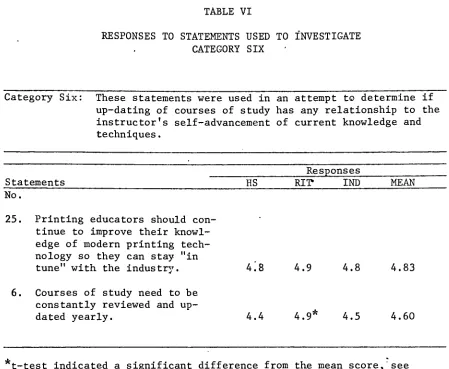
Printing
educatorsshould
continueto
improve
their
knowledge
of modernprinting
technology
sothey
canstay
"in
tune" with
the
industry.
Courses
ofstudy
needto
be
constantly
reviewed and up-dated yearly.Category
Seven:
These
statements weredesigned
to
discover
whetheror not related
materials,
andthe
involvement
of
activities
in
the
high
school,
may have
allowedthe
studentto
gain abetter
insight
into
the
industry
andits
referenceto
otherindustries
anddisciplines
in
his
environment.
'
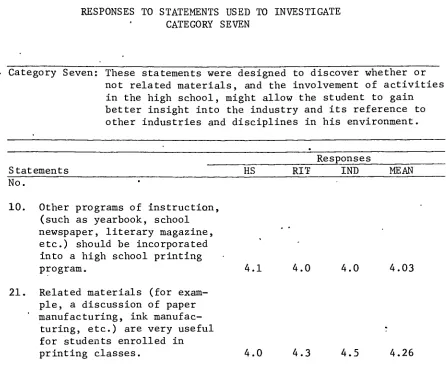
Other
programs ofinstruction,
(such
asyearbook,
school newspaper,
literary
magazine,
etc.)
shouldbe
incorporated
into
ahigh
schoolprinting
program.Category
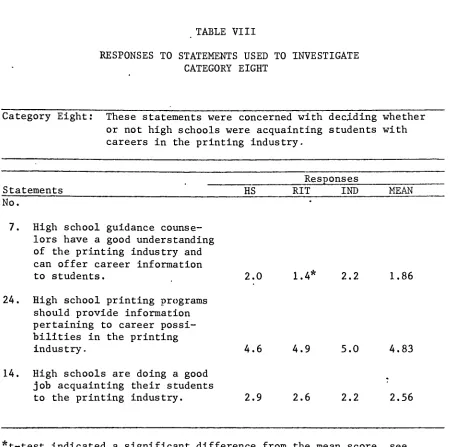
Eight:
These
statementswere
concerned withdeciding
whether
or
not
high
schools
are
acquainting
students with careersin
the
printing
andpublishing industry.
High
school
guidance
counselorshave
a goodunderstanding
ofthe
printing
industry
and
can
offer careerinformation
to
students.
High
school
printing
programs should provideinformation
pertaining
to
career
possibilitiesin
the
printing
industry.
High
schools
aredoing
agood
job
acquainting
their
studentsto
the
printing
industry.
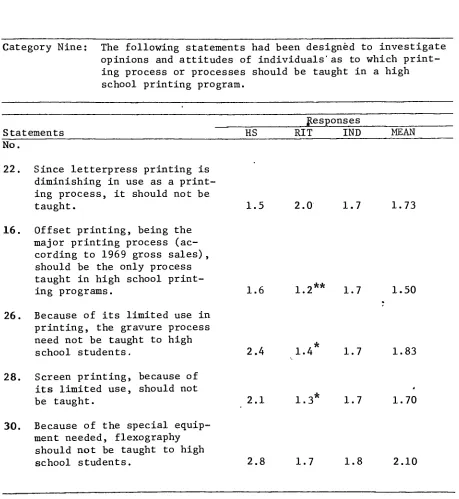
Category
Nine:
The
following
statements weredeveloped
to
exposeopinions
and
attitudes ofindividuals
about whichprinting
processesshould
be
taught
in
ahigh
school
graphic
artsprogram.
Since
letterpress
printing
is
diminishing
in
use asa
printing
process,
it
should notbe
taught.
Offset
printing,
being
the
majorprinting
process(according
to
1969
gross
sales)
, shouldbe
the
only
processtaught
in
high
schoolprinting
programs.Because
ofits
limited
usein
printing,
the
gravure processneed not
be
taught
to
high
schoolstudents.
Screen
processprinting,
because
ofits
limited
use,
should notbe
taught.
Because
ofthe
special equipmentneeded,
flexography
should
notbe
taught
to
high
school
students.Due
to
the
technical
nature ofthe
subject,
xerographic principles
would
confusestudents,
therefore,
this
process shouldnot
be
taught
to
high
school students.Analysis
A form
ofLikert
Scale
was
used asthe
scoring
instrument
for
the
statements.
The
rating
scale rangedfrom
astrongly
agree whichreceived
a
value offive,
to
astrongly disagree
which receiveda
value ofone.
four
was
rated
as
agreeing;
three
wasthe
neutralor
undecidedposition;
and
a
two
indicated
that
the
persondisagreed
withthe
statement.After
the
interviews,
the
numerical responsesfor
each statement wererecorded
on
a
group
tally
sheet.The
responsesfor
eachindividual
scores
(X's)
wereutilized
to
determine
the
average score(X)
for
eachgroup,
(see Appendices
B, C,
andD)
.The
average scores werethen
usedto
es
tablish
the
mean score (X)*for
allthree
groups,
(see
Appendix
E)
.Mean
scores
(X)
were
employedto
confirmthe
rating
eachgroup
had
placed on
each
statement.
The
mean scores werethen
putto
usequalify
ing
the
statements
within
the
different
categories,
(see
Tables
I-IX)
.The
numerical
valuesfor
the
mean score(X)
wereinterpreted
according
to
the
rating
scale.
Having
compiled
the
meanscore,
the
authorbelieved it
necessary
to
discover
whether
or
notthe
individual group
average score(X)
differed
significantly
from
the
mean scores(X)
for
allthree
groups.To
achievethis
at-test
was conducted.*-If
the
mean scores areto
be
utilized as
the
measure of opinions andattitudes,
the
question aroseas
to
whether or notthe
mean score(X)
for
the
three
individual
groups
real
ly
represents or reflects-thefeelings
ofthe
groupsincluded.
Before
the
t-test
wasperformed,
the
nullhypothesis
neededto
be
established.
This
portionof
the
study
wasconcerned
withdiscovering
whether or not
the
group
average(X)
represented
the
sameinformation
in-dicated
by
the
mean score(X)
.If
the
t-test
indicated
there
was no*The
mostgenerally
useful,
and
mostcommon,
measure of centralsignificant
difference,
the
null
hypothesis
(H
:
X
=X)
wouldbe
accepted.
The
alternative
hypothesis
(H
.:
X
>
X)
statesthat
the
averagescore
(X)
must
be
greater
than
the
mean score(X)
.If
the
t-test
indicates
significance,
the
nullhypothesis
is
rejected
andthe
alternativehypothe
sis
accepted.
Having
established
which average scores weresignificantly
different
from
the
meanscore,
it
wasnecessary
to
perform anothert-test.
The
data
was
examined
in
an attemptto
discover
if
the
average score(X)
for
each *group differed
from
the
mean scorefor
the
two
groups
(X
)
.To
accomplish
this
operation another nullhypothesis
was established.The
secondnull
hypothesis
stated(H
:
X
=X
)
that
the
group
average score(X)
mustbe
equalto
the
mean scorefor
the
two
groups
(X
)
.The
alternativehy
pothesis
(H.:
X
>X)
statesthat
the
group
average score mustbe
greaterj-
tg
than
the
mean scorefor
the
two
groups,
(see
Appendices
F-K)
.Completion
ofthe
secondt-test
indicated
which,
if
any- scores weresignificantly
different.
Having
this
information
allowedthe
researcher
to
further
investigate
his data
andtry
to
determine
wherethe
significant
differences between
the
averagegroup
score(X)
andthe
mean scorefor
the
two
groups(X
)
waslocated.
A
significantdifference indicated
that
the
group
being
tested
be
lieved
differently
than
the
othergroup.
The
meanscores
were used as anindicator
of
opinion asto
the
inclusion
of aparticular
subjector
areaFOOTNOTES
FOR CHAPTER
III
^A.N.
Oppenheim,
Questionnaire
Design
andAttitude
Measurement,
(New
York:
Basic
Books,
Inc.,
Publishers,
1966),
p.31.
2Ibid,
,p.
31.
3Ibid.
,p.
31.
4
Ibid.,
p.31.
Fred
N.
Kerlinger,
Foundations
ofBehavioral
Research,
(New
York:
Holt",
Rinehart
andWinston,
Inc.,
1964),
p.168.
6Ibid.
,p.
468.
Ibid.,
p.469.
8Ibid.
,p.
469.
Q
A.N.
Oppenheim,
Questionnaire
Design
andAttitude
Measurement,
(New
York:
Basic
Books,
Inc.,
Publishers,
1966),
p.133.
Albert D.
Rickmers
andHollis
N.
Todd,
Statistics
An
Introduction,
(New
York:
McGraw-Hill
Book
Company,
1967),
p.62-91.
CHAPTER
IV
RESULTS
This
study
was concerned withthe
investigation
of nine categoriespreviously
established anddiscussed
(ref.
to
pages10-14).
Individuals
were
requested
to
respondto
specific
statementsin
order
that
their
attitudes
and opinions mightbe
recorded.
The
responsesto
the
statementswere used
to
report
the
results setforth in
this
study.The
results
to
be
reportedhelp
to
point outthat
printing
educationis
changing.
For
aneducator
to
assisthis
studentsin
their
searchfor
knowledge,
he
mustevaluate,
reorganize,
and continueto
learn
the
procedures and
technology
ofthe
modernprinting
industry.
The
results are reportedfor
each
category,
followed
by
adiscussion
of
the
reported
information.
Printing
has
traditionally
been
considered a skilledtrade.
Within
recent years changes
occurring
in
the
industry
have
produced
extraordinary
outcomes
(e.g.,
use of alaser
to
etch gravureprinting
cylinders).
These
changes
have been
producedby
technological
andscientific
advances.As
the
printing
industry
continuesto
grow andimprove
its
products,
many
t
people will
be
needed who possessknowledge
which canbe
applied
to
the
industry.
However,
whatkind
of
individuals
are necessary?Table
I
il
lustrates
the.
responsesto
the
statements
usedto
investigate
Category
One,
(ref.
to
page19)
whichdealt
withthis
problem.TABLE
I
RESPONSES
TO
STATEMENTS USED
TO
INVESTIGATE
CATEGORY
ONE
A
theoretical
understanding
asopposed
to
a
practical
understanding
ofthe
printing
processesmay
be necessary
for high
school
students.
Category
One:
Statements
Responses
HS
RIT
IND
MEAN
No.
1.
High
school
students
study
ing
printing
needto
obtain
a
practical
understanding
ofprocesses
usedin
the
ing
industry.
4.5
11.
"Students
benefit
from
a
theo
retical
understanding
ofthe
printing industry.
3.7
27.
On
the
high
school
level,
the
learning
ofconcepts
(under
standing
aprocess)
is
not
important
for
the
student.
1.6
31.
Photographic
theory
need notbe
taught
in
a
high
school
printing
program.
1.9
32.
To
makethe
high
school
ing
experience moremeaningful,
educatorsshould
only
teach
printing
processes
that
aredirectly
related
to
the
avail
able
equipment
in
their
class
room.
2.0
18.
Color
separation
theory
is
too
involved
for high
school
stu
dents
to
understand,
therefore,
it
should
not
be
taught
in
a
high
school
printing
class.
2.2
4.9
3.8
1.1
1.4
4.2
4.5
1.3
1.7
4.53
4.00
1.33
1.66
1.5
1.5
1.66
TABLE
I
cont.Category
One:
A
theoretical
understanding
as
opposedto
a practicalunderstanding
of
the
printing
processesmay
be necessary
for
high
schoolstudents.
Responses
Statements
HS
RIT
IND
MEAN
No,
17.
Student
involvement
in
prac
tical
printing
applications,
is
neededin high
schoolprograms.
4.7
4.9
4.3
4.63
29.
Printing,
being
a skilledtrade,
shouldbe
taught
sothat
students
become
accomplished craftsmen.
.
**
2.7
1.6
2.3
2.20
*t-test
indicated
a significantdifference
from
the
meanscore,
seeAPPENDICES
B
andC.
**
understanding
asopposed
to
a
practicalunderstanding
is
neededin
ahigh
school
printing program,
does
notdraw
a
clearline
ofdifference
between
the
two
principles.
Concerning
statement1,
the
groupsfavored
astrong
ly
agreed
response,
(see
Table
I,
page19).
The
average scorefor
the
RIT
group
(4.9)
was
significantly different
from
the
mean score(4.53).
It
is
interesting
to
note
that
ofthe
4
statements usedto
determine
if
apractical
knowledge
ofprinting
is
necessary
for high
schoolstudents,
the
RIT
group
average
score
was
significantly different
from
the
other scores.Responses
to
statements
1,
27,
17,
and29
(see
pages19
and20)
indicated
that
the
RIT
group believed
most
strongly
that
high
school students needto
understandpractical
operations ofthe
printing
industry.
Upon
further
analysis ofthe
data,
it became
evident
that
the
RIT
faculty
membersbelieved
that
most
high
school students wouldbenefit
from
having
acquireda
practicalknowledge
ofprinting
from
their
studies.The
results
ofthe
secondt-test,
usedto
determine differences
between
groups,
indicated
that
the
RIT
group
was
notonly
significantly
different
in
opinionwhen
compared
to
the
meanscore,
they
alsohad
astronger
opinion when compared
to
the
individual
groups.The
data
gathered
in
responseto
statement
17
indicates
that
the
RIT
group
believed
that
student
involvement
in
practical operationsis
needed.The
high
school andindustrial
groups werein
agreement withthe
RIT
group,
However,
the
industrial
members
did
notfeel
asstrongly
asthe
othertwo
groups
toward
this
point.
The
scoresfor
allthree.
groupsindicated
they
agreed with
the
statement.
Responses
to
statement
29
areinteresting
when
the
aboveresults
are
the
high
school
group.
The RIT
members
favored
a
studentobtaining
anoverall
exposure
to
the
printing
industry,
ratherthan
limited
experiences
with
onepiece
ofequipment.
They
did
notbelieve
that
atthe
high
school
level
time
should
be
spent
ona
concentrated areaof
study.A
student
should
have
abroad,
generalbackground in
the
high
school programs.Statement
11,
showed
a significantdifference
between
the
industrial
members
andthe
high
school respondents.Although
the
average scoreswere
not
significantly
different,
the
mean scoreof
the
industrial
group
*strongly favored
the
inclusion
of
printing
theory
into
high
school programs,Statements
11, 31,
32
and18,
dealt
with atheoretical
understanding,
and
showed
no significantdifferences
of opinionamong
the
groups.Ob
servation of
the
data indicates
that
the
averagescores
were similarto
the
meanscores.
Further
investigation brings
to
light
that
the
high
school
teachers
andindustrial
personnelhad
similar responsesto
all
statements used
to
make-up
this
category.Concerning
statements whichdealt
with atheoretical
understanding
the
RIT
group
agreed withthe
meanscore,
but
showed significantdifference in
their
opinions
and attitudeswith reference
to
statements whichdealt
with apractical
understanding.The
total
responseto
the
statements
showedthat
all groupsbelieved
that
there
is
a need and aplace
for both
atheoretical
and
a practicalunderstanding
ofthe
printing
processes
in
high
school classrooms.How
ever,
the
responsesfrom
the
RIT
group
indicated
that
high
schoolsshould
present more practical operations
together
with atheoretical
understanding
ofthe
printing
industry.
Category
Two
wasdeveloped
to
examine which wouldbe
morebeneficial;
the
different printing
processes.
Table
II
representsthe
computedre
sponses
to
the
statements.
It
became
evidentthat
the
responsesto
the
statements
in
this
category
presenteda
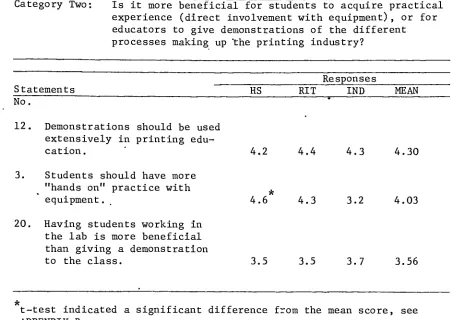
contradiction.Statement
12
(ref.
page
24)
was usedto
obtain
a
pointed
response,
in
whichthe
mean score(4.30)
resulted
in
anagreeing
position.The
mean scorefor
statement20
(3.56)
indicated
that
having
students workin
the
classroom/laboratory
would
tend
to
be
morebeneficial
than
having
the
instructor
givea
demon
stration.
The
response
rating
to
this
statementwas^
between
the
neutraland
the
agreeing
position.During
the
interviews,
individuals
remarkedthat
extenuating
circumstances mighthave
an affect ontheir
response.To
make ablanket
statement with regardto
this
topic
is
not
easily
justi
fied.
The
objectives ofthe
program,
the
stage of progress of studentsand
the
attitude ofthe
educatortoward
the
program are considerationswhich would affect
the
response.
The
high
school teachers' average score(4.6)
wassignificantly
different
than
the
mean score(4.03)
with respectto
statement3
whichdealt
withallowing
studentsto
have
"hands
on" practice
with equipment.Comparing
the
average scores of eachgroup,
the
high
schoolgroup
had
a
different
opinionthan
did
the
RIT
and
industrial
members.The
high
school members
strongly
favored
students
working
withequipment.
It
is
worthy
to
notethat
atthe
confidencelevel
of .10
,the
RIT
group
showed
a
significantdifference
of opinionfrom
the
industrial
members.The
dif
ference
favored
the
inclusion
ofstudents
utilizing
equipment.
The
in
dustrial
group
took
a
neutral
position.
According
to
the
responsesin
this
category,
aneducator
who- canin
TABLE
II
RESPONSES
TO
STATEMENTS
USED TO
INVESTIGATE
CATEGORY
TWO
Category
Two:
Is
it
morebeneficial
for
studentsto
acquire practicalexperience
(direct
involvement
withequipment)
, orfor
educators
to
givedemonstrations
ofthe
different
processes
making
up 'the
printing
industry?
Responses
Statements
HS
RIT
IND
MEAN
No.
~
*
12.
Demonstrations
shouldbe
usedextensively in printing
edu
cation.
4.2
4.4
4.3
4.30
3.
Students
shouldhave
more"hands
on"practice with
A
equipment.
,4.6
4.3
3.2
4.03
20.
Having
studentsworking
in
the
lab
is
morebeneficial
than
giving
ademonstration
to
the
class.
3.5
3.5
3.7
3.56
t-test
indicated
asignificant
difference
from
the
meanscore,
see [image:35.557.46.499.158.478.2]with
the
printing
processes
oroperations,
wouldhelp
his
studentsgain
a
most
beneficial
education.
The
point
was madethat
"to
seesomething
happening
is
good,
however
doing
is
muchbetter."
Category
Three
was
concerned
withdetermining
the
role
that
audio
visual
aids
play
in printing
education.
Table
III,
page26,
represents
the
responses
to
the
statements
usedin
this
category.It
becomes
evident
that
high
schoolprinting
educators should usevis
ual aids
as
part
oftheir
instructional
methodology
for
the
course.Each
printing
instructor
should
makeevery
attemptto
collect and gather appro priatevisual
materials
which wouldpossibly
enablehis
studentsto
visu
alize
what
the
instructor
is
discussing.
During
the
interviews,
muchinteresting
discussion
wasset
forth
pertaining
to
statement
19.
One in
dividual
statedthat
it
is
quitehypocritical
of aprinting
educator whois
teaching
communicationsto
expect
to
communicatesolely
withhis
mastery
of
the
English
language.
He
should alsobe
communicating
through
the
use of visual objects andillustrations.
Educators
agreedthat
visual materialsare
beneficial;
however,
they
stated
that
they
cannotobtain
visual materialsfrom
the
printing industry.
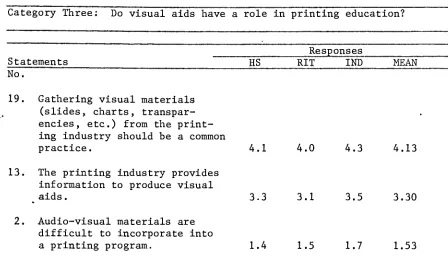
Statement
13 dealt
withthe
above problem.The
mean
response
to
this
statement
(3.30)
wasneutral,
with aslight
tendency
toward
the
agreeing
side of
the
scale.
Statement
2
investigated
another problem whichhas
plaguedprinting
educators,
or atleast
it
is believed
this
problemis
currentto
many
teaching
situations.Some
printing
educatorsfeel it
is
difficult
to
in
TABLE
III
RESPONSES
TO STATEMENTS USED
TO
INVESTIGATE
CATEGORY
THREE
Category
Three:
Do
visual
aidshave
a
role
in
printing
education?
Responses
Statements
HS
RIT
IND
MEAN
No.
19.
Gathering
visual
materials
(slides,
charts,
transpar
encies,
etc.)
from
the
ing industry
should
be
a
commonpractice.
4.1
4.0
4.3
4.13
13.
The
printing
industry
providesinformation
to
produce
visual3.3
3.1
3.5
3.30
2.
Audio-visual
materials
aredifficult
to
incorporate into
[image:37.557.52.500.149.416.2]Figure
Related documents