www.electrochemsci.org
Properties of Lithium bis(oxatlato)borate (LiBOB) as a Lithium
Salt and Cycle Performance in LiMn
2O
4Half Cell
Sai Wang, Weihua Qiu*, Tao Li, Bitao Yu, Hailei Zhao
Department of Inorganic Nonmetallic Materials, School of Materials Science and Engineering,University of Science and Technology Beijing, Beijing 100083, China
*E-mail: [email protected]
Received: 7 July 2006 / Accepted: 22 August 2006 / Published: 1 September 2006
Crystalline LiBOB which we prepared in our lab was observed by SEM method. Impurities of product were examined by XRD experiment. The decomposition voltage under a deoxidized current was 1V vs.Li+/Li, and under a oxidized current the electrochemical stabilities is up to 5V vs.Li+/Li. The conductivity of two kinds of LiBOB based electrolytes were both lower than that of LiPF6 based
electrolyte. Through galvanostatic cycling test of the half cells it could be observed that LiBOB cell has a better capacity retention than that of LiPF6 cell.
Keywords: Lithium-ion battery , electrolyte, LiBOB
1. INTRODUCTION
Since a new lithium salt-lithium bis(oxalate)borate (LiBOB) was disclosed by Lischka et al[1] , in 1999 firstly, a series studies of its properties were carried on[2] . It meets the basic requirements for a salt to be used in lithium-ion cells: acceptable conductivity at ambient temperature, wide electrochemical window[3], the ability to form SEI layer on electrodes[4] and the ability to passivate aluminum current collector from anodic dissolution[5] . Though a thorough knowledge of this salt still hasn’t been acquired, some unique properties especially for the thermal stability arouse much interesting. Unlike LiPF6 decomposing to LiF and PF5 at high temperature LiBOB is stable until
302oC. This unique property is regarded to solve capacity fading of LiMn2O4 spinel cathode cycling at
high temperature. LiMn2O4 spinel degrades in LiPF6 based electrolyte at high temperature and leads to
a severe capacity fading during cycling[6].This phenomenon is attributed to Mn dissolution from the spinel cathode induced by HF acid generated by the reaction of LiPF6 with trace water at elevated
In this paper, we investigated the general properties of LiBOB which we prepared in our lab and electrochemical characters of LiBOB based electrolyte firstly. Then we adopted two kinds of electrolyte systems (LiPF6 based electrolyte and LiBOB based electrolyte) to compare the capacity
performances of the LiMnO2/Li cells at different temperature.
2. EXPERIMENTAL PART
LiBOB was prepared and purified in our lab through the procedures as described in our previous publications [8]. Battery level EC, DEC and EMC were purchased from Beijing Institute of Chemical Reagents. In an argon-filled glove box, the solution of 0.7M LiBOB in 1:1(v:v) ethylene carbonate(EC) and ethylmethyl carbonate(EMC) mixture or EC, Dimethyl Carbonate (DMC), EMC mixture were prepared. 1M LiPF6 in 1:1:1(v:v:v) EC, DMC, EMC electrolyte was purchased from
Beijing Institute of Chemical Reagents. LiMn2O4 was prepared in our lab through the procedures as
described in our previous publications [9]. The positive electrode was fabricated with: LiMn2O4 as
active material, acetylene black as conducting additive, and teflon as binder by a weight ratio of 85:10:5. The mixture was stirred, dried and then pressed into a thin film. Subsequently, the as-prepared electrode film was dried and degreased in a vacuum pipe for 24h at 120 oC to remove the surface
solvents.
The cells were assembled and sealed in an argon-filled glove box with the electrode film as the cathode, lithium foil as the anode, Celgard 2400 polyethylene/ polypropylene as the separator and filled with either 0.7 M LiBOB/EC:EMC(1:1.v/v) or 1M LiPF6/EC:EMC:DMC(1:1:1,v/v/v) as
electrolyte. The cells were tested on a LAND BT-10 tester (Wuhan, China), and were charged/discharged galvanostatically at a current of 0.5C in the voltage window of 3.3-4.35V. The cells were cycled at room temperature (25 oC) or 65 oC in an oven to compared cycle performances at
different temperature. X-ray diffraction (XRD) was carried out on LiBOB with a Rigaku D/max-A (Japan) machine. LiBOB powder was observed using Hitachi S3500N (Japan) scanning electron microscope (SEM). A three-electrode system was employed for solution conductivities and decomposition voltages with a CHI660A electrochemical workstation (Shanghai Chenhua) with Li foils as counter and reference electrodes.
3. RESULTS AND DISCUSSION
3.1 General properties of LiBOB
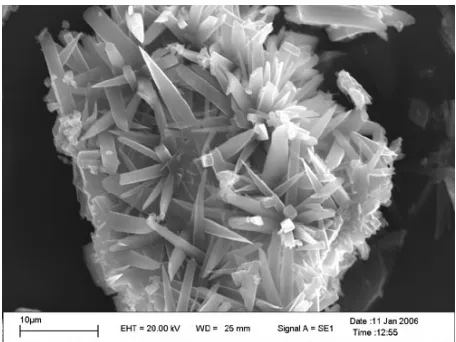
Figure 1 shows SEM micrograph of the purified crystalline LiBOB. From the image it can be observed that LiBOB has good crystalline form after purified procedure. Every needle-shape particle is about 10 m long and 2 m wide.
identified to be HBO2, HC2O4Li and Crystalline water. After being purified, the solubility of LiBOB in
[image:3.612.196.424.131.302.2]solvents increased to 0.7mol/L.
Figure 1. SEM image of purified LiBOB crystal.
10 20 30 40 50 60
0 10000 20000 30000 40000 50000
In
te
ns
ity
(c
ps
)
2θ(°)
After
0 30000
Before
20.3 29.7
22.3
28.0
HBO2(blue)
LiHC2O4(red)
Crystalline water (green)
[image:3.612.172.437.406.602.2]11.3
Figure 2. XRD patterns of LiBOB before and after being purified
3.2 Electrochemical analyzed of solution
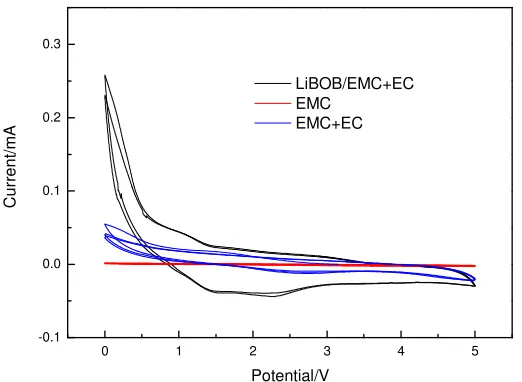
was observed. After adding EC or LiBOB into EMC solvent, the redox current occurred. After comparing the different of the CV between 0.7M LiBOB/EC:EMC(1:1,v:v) and EC+EMC solvent(1:1,v:v), the deoxidized current from 1.35V is attributed to the decomposition of LiBOB salt, and the decomposition voltage of LiBOB based electrolyte can be identified from 1.35V to 0V vs.Li+/Li under a deoxidized current. Under a oxidized current, the electrochemical stabilities is up to 5V vs.Li+/Li.
0 1 2 3 4 5
-0.1 0.0 0.1 0.2 0.3
LiBOB/EMC+EC EMC
EMC+EC
C
ur
re
nt
/m
A
Potential/V
Figure 3. Cyclic voltammogram of 0.7M LiBOB/EC:EMC(1:1,v:v), EMC and EMC+EC(1:1,v:v) (scan rate: 5mV/s and 0-5V vs. Li+/Li) at room temperature
Figure 4 shows comparison of the conductivity among 1M LiPF6/EC:EMC:DMC(1:1:1,v:v:v), 0.7M
LiBOB/EC:EMC(1:1,v:v) and 0.7M LiBOB/EC:EMC:DMC(1:1:1,v:v:v). All of three increased with temperature gradually. LiPF6 based electrolyte shows much higher conductivity than LiBOB based electrolytes.
3.3 Galvanostatic cycling test of the half cells
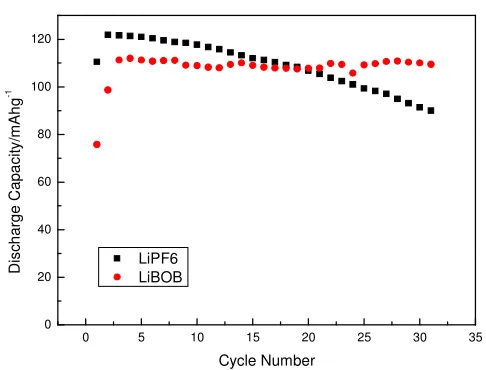
Figure 5 shows comparison of the capacities between the testing cells cycled at room temperature (25 oC). The current density of charge and discharge were both 0.5C (70mA/g).The cell in LiBOB based electrolyte has an inferior capacity than the counterpart in LiPF6 based electrolyte during the first 20 cycles. But the cell containing LiBOB shows a higher efficiency (about 99% after formation cycles). The capacity retention of LiPF6 cell is 73.88% which is much lower than 98.4% of LiBOB
[image:4.612.177.438.223.414.2]cycles the gap became narrower prominently (102mv at 60mAh/g of LiPF6 cell and 157mv at
55mAh/g of LiBOB cell). The difference between the gap of median voltage in two cells indicates the difference of resistance induced by different electrolytes.
0 20 40 60 80
2 4 6 8 10 12 14 16 18 20 22
C
on
du
ct
iv
ity
/m
S
cm
-1
Temperature/o
C LiPF6-EC-EMC-DMC LiBOB-EC-EMC LiBOB-EC-EMC-DMC
Figure 4. Change of conductivity with temperature for 1MLiPF6/EC:EMC:DMC(1:1:1,v:v:v)
0.7MLiBOB/EC:EMC(1:1,v:v) and 0.7MLiBOB/EC:EMC:DMC(1:1:1,v:v:v)
0 5 10 15 20 25 30 35
0 20 40 60 80 100 120
D
is
ch
ar
ge
C
ap
ac
ity
/m
A
hg
-1
Cycle Number LiPF6
[image:5.612.179.421.155.336.2]LiBOB
Figure 5. Cycle performace for LiMn2O4/Li cells using LiBOB- and LiPF6-based electrolytes at room
[image:5.612.186.429.467.652.2]0 20 40 60 80 100 120 140 3.2 3.4 3.6 3.8 4.0 4.2 4.4 V ol ta ge /V
Discharge Capacity/mAhg-1
1st 2nd 3rd
0 20 40 60 80 100 120
3.2 3.4 3.6 3.8 4.0 4.2 4.4 V ol ta ge /V
Discharge Capacity/mAhg-1
1st 2nd 3rd
Figure 6. Charge and discharge profiles for LiMn2O4/Li cells using (a)LiPF6- and (b)LiBOB-based
electrolytes at room temperature
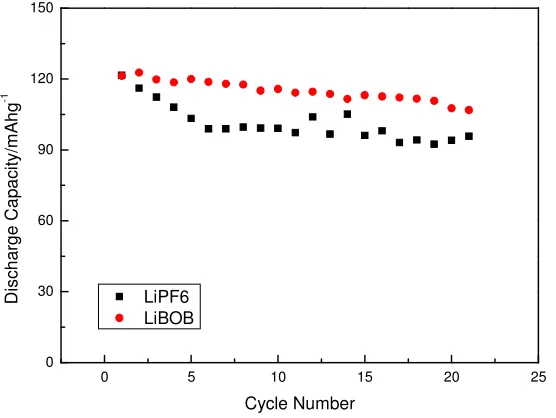
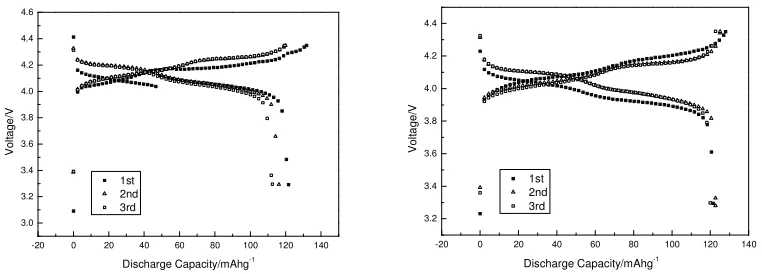
Cycle performances of two cells at elevated temperature are shown in Figure 7. Different from the performance at room temperature, LiBOB cell has better cycle performance than LiPF6 counterpart.
0 5 10 15 20 25
0 30 60 90 120 150 D is ch ar ge C ap ac ity /m A hg -1 Cycle Number LiPF6 LiBOB
Figure 7. Cycle performance for LiMn2O4/Li cells using LiBOB- and LiPF6-based electrolytes at 65 oC
Though LiPF6 based electrolyte has higher conductivity than LiBOB counterpart, it is not induced
higher capacity in half cell at elevated temperature in this current (40mA/g).At elevated temperature because of the increase of diffusion coefficient the discrimination of median voltages decreased (98mv at 55mAh/g of LiPF6 cell and 73mv at 60mAh/g of LiBOB cell) which were shown in Figure 8.
[image:6.612.164.442.360.569.2]cycling, the cells in two kinds of electrolytes almost have the same capacity. But the cell in LiPF6
based electrolyte exposed a lower durability. The capacity of LiPF6 cell went down by 19% after 5
cycles and due to the dissolution of Mn in LiPF6 based electrolyte at elevated temperature the cell
capacity was unstable in cycling. Unlike LiPF6, LiBOB is stable at high temperature and no HF is
produced by salt decomposition. This character enabled LiBOB to have a stable cycle performance at high temperature.
-20 0 20 40 60 80 100 120 140
3.0 3.2 3.4 3.6 3.8 4.0 4.2 4.4 4.6
V
ol
ta
ge
/V
Discharge Capacity/mAhg-1
1st 2nd 3rd
-20 0 20 40 60 80 100 120 140
3.2 3.4 3.6 3.8 4.0 4.2 4.4
V
ol
ta
ge
/V
1st 2nd 3rd
[image:7.612.95.476.197.334.2]Discharge Capacity/mAhg-1
Figure 8. Charge and discharge profiles for LiMn2O4/Li cells using (a) LiPF6- and (b)LiBOB -based
electrolytes at 65 oC
4. CONCLUSIONS
After being purified, LiBOB formed a good crystalline phase and as shown in XRD patterns, the impurity reduced. The conductivity of LiBOB based electrolyte is the half of that of LiPF6 counterpart
from 0 oC to 80 oC. In half cell, LiBOB has a superior charge-discharge capacity at elevated
temperaturethan that of LiPF6, which could be result from the dissolution of LiMn2O4 in LiPF6 at
elevated temperature which induced a lower capacity retention.
ACKNOWLEDGMENT
The authors would like to acknowledge the National Natural Science Foundation of China (50472093) for their kind support in these series of researches.
References
1. U.Lischka,U.Wietelmann and M.Wegner, German Pat,DE 19829030C1(1999)
2. W.Xu and C.Austen.Angell, Electrochemical and Solid-State Letters, 4(1): (2001) E1-E4 3. U.Wietelmann,U.Lischka and M.Wegner,US Pat.US6506516B1(2003)
4. K.Xu,S.S.Zhang,B.A.Poese and T.R.Jow, Electrochemical and Solid-State Letters,5(11) (2002) A259- A262
7. K.Amine,J.Liu,S.kang,I.Belharouak,Y.Hyung,D.Vissers and G.Henriksen, Journal of Power Sources ,129(2004)14
8. B.T.Yu , W.H.Qiu, F.S.Li and G.X.Xu, Electrochemical and Solid State Letters,9(2006),A1 9. T.Li, W.H.Qiu and H.L.Zhao, Material Letter,60(9-10) (2006)1251