')
.... · .
. •
l . l
COMMISSION OF THE EUROPEAN COMMUNITIES
\
Brussels, 12.06.1997
C'OM(97) 240 final
95/0340 (SYN)
Amended proposal for a
COUNCIL DIRECTIVE
amending Directive 90/219/EEC
on the contained use of genetically modified micro-organisms
' ...
(presented
by
the Commission pursuant to Article 189 a (2)· of theEC-
Treaty)
·
. . ; . :~
r: i : ··'·'·
· .. .'·.:
. ; " ' ·. ·.·:· ,. ,:;·
...
· ' · · ; · ; '··:·· .... ' :
... , .. ··'.·.
·.'
.. :. ·\ .
.<
.·.·,
,-"c•,, •
·· .. •
¥.' ~ ..
:·•' '··
,.·
. : . ;
EXPLANATORY MEMORANDUM
Pursuant to Article 189 (a) paragraph 2 of the EC treaty; the Commission submits an amended proposal for a··council Directive amending Directive 90/219/EEC onthe contaim;d use of ·.genetically modified micro-organisms.' The amended proposal takes account of a number of
··• .. _·-.· .. · amend~~1ents from the European Parliament adopted at itsMarch 1997 Plenary Session. . ..
....
. •:
·c-·.
, , • In addition the Commission can partially accept amendments 4, 11, 27, 30 (merged with 29),
··. ' ' / . . ' . .
; · - 37, 38, 39, 43, 47, 48, 54 and 55. Commentary on these amen_dments
follows:-. Amendment 4 (Article 2 (a)) seeks to delete the words "including viruses, viroids, animal and
'plant cells in cultme,.but excludi~g naked nucleic acid molecules.". The-Com~ission accepts
. the deletion of "but excluding naked nucleic acid molecules"; but wishes to retain the other·
words to assist clarity and rn.aintain the intended scope of the .pirectiye. .
Amendment 11 makes a textual change inArticle 6 (a) (1) deleting the \YOl:d risk and adding
the plural form of activity. The Commission accepts this but has substituted contained use{s) in-place of activities to be consistent with other amendments.
. .. . .
Amendment 27 requires in At:ticle 14 '(b) 'information on safety measures to be included,.
regional administrative authorities to be informed and a system of co-operation be established
to guarantee public info~ed in detail. . The Commission accepts, with rewording, the
requirement for information on safety J?easures which must be relevant to the emergency . plans. However the Commission cannot accept that the Directive would require the
implementation of a regional system for co-operation within a Member State to guarantee the .
public_are informed in detail. This is under the ~esponsibility of the Member S~ate.
Amendment 3 0. the restriction of serio.us dam~ge to public health or the environment in
Article--15.1 is not acceptable
to
the Commission. An acci.dent is defined in Article-·2(f} arid theproposed wording 'implies that damage must have occurred, whereas the current definition· ·, covers the potential hazard from the accident. The proposed addition of the words "and
·uninteriiionally- released" added at end of the second· Indent of Arli~le 15.1 has not· been
·· ;iccepted ·beeai1sc· it ·restricts the article to not covering accidents by self inoculation.
'· (injection). . The dcle~ion of the word emergency ih the fo11rth i~dent of Article 15.1 is
already in the Proposal. The replacement of the word avoid with prevent in Article 15.2 is
.accepted by rhe Commission. .
. Amendment 37 (Article 20) seeks to limit the annexes that can be
modifi~d
by the committee. procedure to Annex: III par. ( -5 and annexes IV & V. The Commission accepts that annexes I
·· · .•. _&liB (shoulci be only amend.able.by the full proc~dure. The Commission is unabk
tb
ac~eptt-:
!-• ( ·f.
)
l
' (
L
·l
i
r
I,. I.
I
j
'
..
II I
! r
l
I
I
II would prevent the operation of the list of types of GMMs shown to be safe for human
health and the environment. It wo~ld also prevent tlie rapid modification of annex IIA which
lists techniques of genetic modification not leading to a GMM should- an, as yet unknown, safety issue indicate the need to further restrict this annex. The exclusion of some parts of
annex III would complicate amendments to the annex as a whole.
-A.mendment 38
requir~s
in Article 20 (a) (new) that within 6 months Of implementation oftheDirective., following a Commission proposal, the criteria ·defining GMMs suitable for inclusion into Annex II B shall be made in accordance with Article 1 OOa of the EC Treaty: The Commission has accepted this, but not the suggested Treaty base of 1 OOa since the
Directiv~ is made under_ Article 130Sl. L
Amendment 39 concerns Article 21. The Commission has accepted a 2a comitology procedure which gives flexibility to the Council to adopt different measures to those proposed by the Commission instead of the 3b procedure contained in the Commission Proposal for the
modification of Directive 90/219/EEC. Concerning the report of experience with the Directive· the-commission considers that this requirement is present in Article 18.3 and the report wiU be made available to Parliament. However the proposal in the amendment that the decisions and minutes of the committee are made available to the public is not acceptable to the Commission, since it conflicts with the agreement between the Commission and the European Parliament (applicable from 1.12.1996) on transparency and publicity of committee meetings .
Amendment 43 proposes in Annex III new wording for par.2 a and a specific reference to Directive 90/679/EEC on the protection ofworkers from biological agents in_ par. 3. These
changes are acceptable to the Coinmission. The addition of a specific risk assessment procedure for human health is ·not acceptable to the Commission since the Directive covers human health and the environment. The Commission feels specific guidance of this natlu-e \Vould best be produced in guidance to the Annex. The Commission has accepted text from par. Sa and par. 5b which assist the clarity ofthe_Commission Proposal.
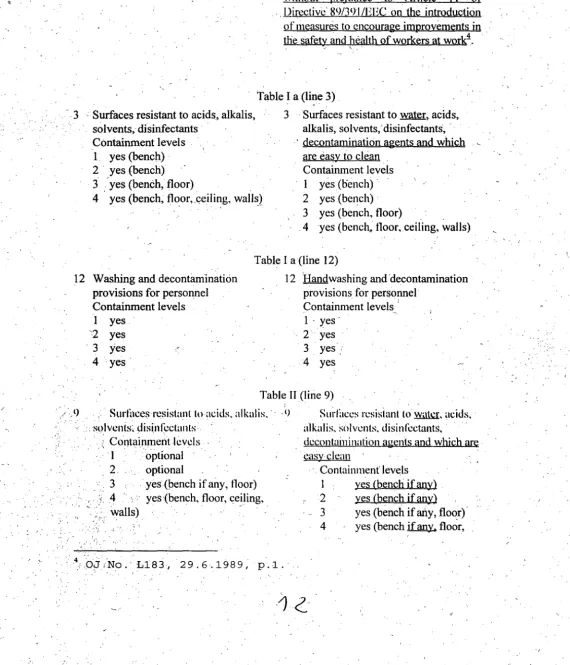
Amendments 47 and 48 (Ailllex IV Table Ia) amend the requirements for surfaces in laboratories. TI1e Commission accepts that the surfaces should be resistant to water, decontamination agents and easy to clean: The Commission has not accepted the change i.n
specification for floors walls and ceilings which are in exc~ss of the requirements of Directive
. 90/679/EEC on the proteCtion of workers from biological agents, which also covers GMM~,
since this measure is primarily related to worker protection.
Am~ndn~ents 54 and 55 (Annex IV Table ll).amend the requirements for surfaces in facilities
!'i.w other activities. The Commission accepts that benches, if fitted, should be included at all
lcvds and that the surfaces should be resistant to water and decontan1ination agents. The
Commission has not accepted the change in specification for floors walls ~d.ceilings. The·
requirement that floors must be resistant at level2 should remain to be applied on a case by case basis depending on the risk assessment which considers the size of the operation. The
alterations at levels 3 and 4 are not required due to the absence of very large scale production of those agents,
The Commission can accept in principle amendments 7, 8, 14, 15, 21, 22, 23, 24,25,35 and ·. · 68. Commentary on these amendments
.,
...
· .. .Amendment 7 concerning Article 2 (c) is acceptable with a minor rewording to refer to annex II
_··-.c .. ·
. ·-
.
.
Ani~ndment Slinks the risk assessment to the containment and control meastires in Article 6a,· -the Commission accepts the principle but has altered tQ.e wording to assist clarity.
. . - ~ ..- . ~
.
Amend~ents
14 and 15 seek to introduce the·principle of good microbiological practice and the · · requirement to review its application in the workplace in Article 6a (2). The Commission ; accepts the inclusion of the principle in the. Directive, butfeels.that such technical measures arcbest located in the preface to Annex IV which details the containment and control measures-to
be appl_ied, .
~--\ . '
. . . .
. Amendments 21, 22, 23, 24, 25,arid 3Sintroduce the separation of classes 3 and 4 for different · notification requirements in Articles 10, 11, 12 and 18, requinng an explicit consent for
·: ; _. ·subsequent activities for class 4 and implicit consent for class 3. The Commission accepts the
< ;·
principle of these a'inendments to strengthen the_administrative controls for high risk work but·. <:intends to retain the equal treatment of classes 3 & 4, accordingly making both subject to .
. explicit consen~/or all uses in Article 10a'(3). · · .
Amendment 68 seeks to amend the definition of contained use in Article 2 (c) to avoid possible
confusion over the use of the word liniit. The Commission accepts the principle of this
amendment but proposes to replace "avoid their contact with'~ by expressing the principle aim
of the Directive using the words "provide a high· level ofsafety for".
·The Commission has not accepted amendments 1, 6, 12, 13, 18, 20, 26; 28, 32, 33, 34, 36, 40, _ 44, 45, 46, 50, 51, 52, 53, 57 and 58. Commentary on these amendments
follows:-Amendment 1 proposing to change the legal basis of the Proposal from 130S.1 to 1 OOA is not acceptable to the Cohlmission .. Legally, sincy the scope of Directive 90/219/EEC is not. being significantly altered, _·and it does not impact directly on the functioning of the harmonised ·
market, there is no legal argument to change the legai basis of the Directive fro~ 130S 1
to
1 OOA. lri addition the change of legal base· would prevent Member States from providing in . ·. :..theirnationallegislationcontainment and control measures which are more stringent thari those
. provided for in the Directive.
Amendments 18 & 20 . seek to separate class 3 and 4 activities for different notification
· requirements ·are not acceptable because the Commission believes that such a separation would complicate the operation of the Directive and could lead to confusion.
· , Amendments 44~ 45 and 46 which seek to rei~tro_duce the distinction of purpose into the .
· ·· revision of the Directive, arc nohtcceptablc to the Commission. The Commission seeks to
: regulate the. ~1ctivity, ·lor example laboratory work, im;spective · ofthe final purpose lor· which
the work is -being undertaken.
Amendments 2'6, 3.6,
57
and 5S have not been accepted by the Commission. These amendments. seck to limit the inform<ltion available· to the public or aspects of activities that can be subject to pubiic consultation to solely health and environmental protection and emergency plans. The
Commission feels that these restrictions will not improve public confidence in the regUlation of . this technology,
·Amendments 32 and 33 seek to restrict iriformation required to be given to Competent Authorities and the Commission in the event of an accident, to that which presents possible . serious damage. Under these amendments the choice of what is covered by health and -environmental protection and emergency plans is left with the notifier. These amendments are
not accept!}ble to the Commission.
Amendments 13 and 28 deal with the .issue of liability insurance and the provision of financial
security and are not acceptable to the Commission. The subject of IlabilitY is under
consideration by the Commission, which intends to produce a white paper on environmental_
liability. The Commission wishes 'to deal with tills matter in a horizontal manner to avoid
different liability requirements in different
Directives.-·_Amendments 6, 12 and 34 have not been accepted by the Commission because they duplicate - provisions presentin Article 2(h), 12.2 and duties present in Articles·&, 9 and tO respectively.
Amendment 40 has not been accepted by the Commission because it produces a duplication of ·existing text within the same mmex, which does not assist the clarity of the text.
Amendments 50 and 51 have not been · accepted by the Commission. ·These amendments increase the burden of controi measures, by making them requirements, without the option to
decide if they are necessaryin
all
cases. These measures will not always be required and thusnot always increase safety levels.
Amendment 52 has not been accepted by the c;ommission. This precautionary measure should
not be specifically required for class· 2 activities. The amendment is in excess of the
requirements of Directive -90/679/EEC on the protection, of workers from biological agents, which covers .GMMs, and this measure is .primarily related to worker protection. ·
Amendment 53 is technically invalid since the genetically modified micro-orgamsms are not
·,
'· .
!.~
.--·-'. ' .
. I
Am~nded.Proposal for a
. COUNCIL DIRBCTIYE. ,
. amending Directive 90/219/EEC
on. the contained use of genetically modified rriicro~organisms
·· .(pre~ented by the Com!llission pursuant to Article 189a pa,ragraph 2 ofthe EC Treaty)
COMMISSION PROPOSAL
,·
AMENDED·PROPOSAL
Recital 3a (new)
Whereas the principle of good
microbiological practice and the principles of safety and health at work laid down in · the relevant Community laws should apply · to all activities iri •which genetically
modified· micro-organisms
are
used: ·· Recital4a.(new)
Whereas specific . measures·. should . be
adopted and . used for ·the control of· the
. . disposal of material from the activities of .
. the contained' use :of genetically modified ·
micro-organisms; . .
. · '··. . . . Article 2(a) ~·. .
.. (a) The folloWing .. words are added at.the (a) -The following words are added at the
end of paragr~ph (a): ''including viruses,· end of paragraph (a): "including viruses,
. viroids ·and animal· and plant _cells in viroids and animal and plant ·cells in
... , · culture but. excluding naked nucleic ·acid ·culture (WOtds deleted)."; .. ·
·molecules~"; · .. ·. . · · · •· · ·
. . Article 2(c) . . .. .
(c) _"contained use" shall mean: .'any:. (c) •. ·~contai~ed u~e~' .. shall mean~ any . '
operation in which, · mi~ro-organisms are operation in _which micro-organisms are
genetically modified pr in which: such ·genetically. modified or ·in w.flich ·such.
· . genetically modifi~d.micro-organisms .are· •: .genetically modified micrO-organisni~ are .··
... ' ctiltur~d, ,' stored, .· ;~~ed, : ;Ji'an~port~d or ':; cultlired, store~, .~sed, ,: transporte'ci ~ .• or.'
. · ·ctestr()yed
·I
delt:te(F·:WordsJ~ ·',apd.:for .. which··· ',destroyed ·.[deleted .. ·words],··ano
.(pt : w4ich· ·• .· :physicaL · oart:ieis; ::9r. ·.a.·! ¢olnbination, of:·:. physical, :·,barriers; .. or . a .. combin~t~~ni. of. '
- . ·physical. ~arrit:rs ·,,Jbgethq):: with .. ·~h~n1ic<11 ,: physical' .. :b~iy~s;: 'togethe~ · with,. ,i,ch¢.mic<,~,f. ·.
. ·.and/or QiologicaLbaftiers~. ah~ ~sed 1tq, limit
i:
arid/or.' biological- barriers; :are J used~ to . '. :·their, contacf~~"Yit_h' ·.the'· g~ncr~U, P9Ptilat~on ··provide a· high· ,;level of safety,. ·for' the ·.
:, ~d .the .. env,1t;oninent~
.:or
·,any' activity· ·in' 'general' populf1t,ion '_and the environment;::'which··.'. gerietical,ly<'.~'·;ni,oditied .·.:::. :'ijticro::
··or
any ..
actiyHy" .. in . which \geqetically .. ·.···.· .. ; .organisms:. are:'· dispo~ed.;. 'llL •···for'·":whi.ch .. :: ··modified' rriicrp.:.organisms.'are.disposed·.of;.. . .
. physical or .. cherhical .or .. biolngi<t~Lbarfiers, ·· f~w ~hich physicaJ . or · cbb:nical :. or ·
. ·. or any coinbiilatipn: of:· th~s~: .J:Ypes; . are biological. barriers, :or ·any combination .of - ·
:used. toJimiJ:their·coritaet with the genen11. these; typ~; ary_used to provide a hi~h
population apd the·eiwironmcntt ' ' ',. '. . . level /of
safety:
·for the general population· · and the envir<?nment~" · ·
., .. ,(__
,·,
. ·.: .. ~
' .... ·.~. '
-Article 3·
This Directive shall not apply· where This Directive shall not apply where, · genetic modification is . obtained. through genetic modification is . obtained through · .. the use of the techniques or methods listed the use of the techniques or methods listed
in Annex II, or for contained-use activities ·in Annex II,
or
for contained-use activities · ..· involving other types · of genetically involving · other types of · genetically ·•· ·
modified micro-organisms known to. be ' modified micro-organisms known -to· be··
. safe for human health . and the safe for human . health and · the
.·----:.. · .. _ envir6nment. Such types of genetically environment. Such types of genetically·.
1
· . , -modified micro-organiSI!lS and . their modified micro-organisms artd . their· ..
r .i
characteristics are listed in Annex II, Part characteristics are listed in Annex II, Part
'B . . _Band Part C;
Article 6 (3)
3 .. The assessment should resuh iri the
J.
The assessment shali result in the finatcategorization . of the contained-use. categorization of ·the contained-use ·
activities in the following .four classes of .activities in the following four' <(lasses of ·
risk: .. · risk and serve to · detennine the level of
containment and control measures m
·accordance with Article 6a:
. Arti~le 6 (3a) (new). ·
3a Where there is doubt
as
to which of· two classes of risk is appropriate for the . proposed contained-use adivity(ies); the . ·
higher classification should · be assigned . until sufficient evidence justifies the Use of
lhe lower clas.sitication.
Article 6 (4a) (new)
4a ..
When assessing the risk entailed.in
an
. activity involving genetically inodified' micro-organisms. the qyestion ·of disposal . shall be taken especially into· account. · . Where appropriate, the necessary · safety·
measures shall be implemented in order to : · ·
, protect human health and the environment. ·.
. Article 6a. (1)
1. The user shall apply the containment 1 ~- The user shall apply .the containment
and control measures from the appropriate and control measures from the appropriate Table(s) in Annex IV corresponding to the Table(s) in Annex IV corresponding to the
risk class of the activity, S() as· to class of the contained use(s). so as to
keep workplace · and environmental keep workplace · and environmental
exposure to any genetjcally ·modified exposure to any genetically modified _ micro-organisms to the lowest reasonably micro-organisms to the lowest reasonably ·.practicable level, and so that a high leycl ·practicable level, and so that a high level
of safety is ensured." of safety is ensured."
.. ··,, .. ' •
.
..
,l
~ ..
. Article 10(1) ·
1. For the first and subseque-nt Class 2 1. · . For the first and subsequent Class 2
·· activities to. be carried out in premises contained use(s} . to be carried out in .·notified-. in accordance with, Article- 8, a · premises notified in-- accordance with
· ·· · · · notification containing the information Article 8, a notification. containing the
listed in Annex
V.,
Part' B shall be information listed in Annex V, Part B shall· submitted. be submitted. ·
. '
Article 10
(2a) (nevv)
2a. The applicant can. however. himself
. request · a decision on a formal
authoti7,ation from the ·competent
authority. This decision must be made
within a maximum of 45 ·days from the
notification. '
. . · Article_ I Oa (2)
.. 2: ·
If no previous notification has· b~en 2:. Ifno-previous notification has' been'... , ·• submitted for Class 3 or ·a higher ~lass· of . submitted for Class 3 or
a
higher Class of ·.. activities; the .contained use may not contained-use, the contained :use may not , · proce~d ~. Withqut .. ·the consent · of · the . proceed without the <;onsent of the
.· compet¢nt, .authority. . The ·competent competent authority. The .. competent
,·., ·· .. :· .... authoricy.sh8.ll·coriimunjcate it$ decision in _authority s~all communicate its decisio~ in
· 1
•::., ·Writing: · at : , the: · latest 90 days after writing at the · latest 90 · days after .
submission
of
the notification.· submission of~e notification.·' . ·'
· ' Article 1 Oa (3)
: 3. · . '
lf
_a 'p~viotis notification has been 3. . . If a previous notification has been. submitted for; Class 3 or a higher class of submitted for Class 3 or a higher class of ..· activities ·ahdi the'· associated consent activities and the associated consent ·
' · requiremel}ts ::··have -been satisfied, the .· requirements have been satisfied for• the
. contained l;lSe may in absence of any same· or higher class. the contained use
indi~ation
to ',
the . :contrary from the may not proceed without the consent of,'competent autfiprity proceed 45·days after·. the competent authority. The ·competent .
·submission . of- the new notification, or .authority shall communicate its decision in. I
·earlier ·
with · '
the agreement of . the writing at the latest 45 . ·days.· after ·comp~tent_auth()rity." submission ofthe notification.. · ·
. . Article 14{b) .
.. (b). . . Infqrffiation . .
ort . ·
emergency\ (b).· . , ; Information ·on emergency plansplans'is·stippliediliar,t appropriate inanner, .. and relevant safety-measures is s~pplied in .
··:1 • and. Without th~,ir; .. having. to. ·request , it, to· . <lQ appropriate ·.manner, and. without. their . '.' .
, bodies •artd.:a4ili~rities liable tp
pe
affected :• having , ''to request'. it; to ' podies • and :',,I ~.. by th~ acCident;:Th~jnfortpation·· shall be· authorities; liable. tb <be . affected by the:• .. ·: ... ·
, ,·:·~pdat~d<: ~t . ap_Rtop.ii~te: i~tet~als ..
It
s~all '· aecideht. T~e jl:l_forn1atio!1-1Sh~Lbe ;updated,:'': \ . , : .. _. also P¢made:P,Ublu~ly,' axaJlapJe. ·, . . at appropnate,. ,I~tervals. _Jt·,'shall ,.also_' .. be ',' . , . , ·
_... · ,_ ~.·:·· . · ' ,.: ·_, !)';.:·.'· · ·.. · made publicly':available. . · · · .· ,' 1,
' ' 0
" 0 ~:. ,. ' •' ':· 1
:, , I , '1·,' ... 1 , 1 'o • '1 '
0
•, 0 o
1
1
1
.',.O ': J .')
·. 1: ... · . ·.· · ...
'.:·· .... '
·~·ArtiCle ts~(2).
..\I·:·
J( .· · .. :· . , ,. ·: ' :-: '' :· ': ' . . '· ,•',· (a1 . ' il1 'the >se~ond indent. ··the word.: '' ·' '.:'
... . . ··· "avoid" is replaced by the word '~preyerit" · ,. · · ~· ...
' ' .; • • ~ ! , ... ' •' •' ···-. ''. ', ·, ... ·' . .''·::·· .: .. ;::
>:
''· ·.: · ....
/
Article 16 (1) (a) (new)_
In point (a) of paragraph I of Article 16.
the word .. liable" is replaced
by
the word ·"likely".
Article 20
In Article 20, the words "Ail.Jiexes II to V'' In Article 20, the words ''J\nnexes II to. V''
are replaced l•y the words "Annexes I to are replaced by the word:; "Annexes II
paq
. V''. . ·A. II part C and annexes III bV".
·,.
B: . Types of gene~ically 1.ftodified
Article 20a (new)
· Within six m,onths of the implementation
date of this Directive Sl'C.::ified in Article 2. ·
the criteria ·for the inclusion of certain . types of ·genetically · modified · micro- · ·
organisms in Annex IL Part B. shall be
laid down in accordance with Article
· 130Sl ofthe EC Treaty. ·
Article 21
3. · The Commission · shall adopt
measures which shall apply immediatelY. However, · if these measures ·are not in
accordance · ·with the opinion of the
committee-, they shaH be communicated by
the Commission to the Council forthwith.
In that ev¥J11 the Commission may defer ·
application of the meapres which it has
decided for a period of uot more than one .
month from the . date . of such
communication.
The Council.·. acting by a Q,Ualified
m<ijority. may · tak;e a different decision
within the time-limit rderred to in the
previous subparagraph.
Annex II part B
micro-organisms which have ,been shown
to be. safe for mrnan health ar~d the
B. Criteria establishing the safety of genetically modified mido'-.organisms to hiunait health and the environment. environment :rid which are, therefore,
excluded fran t the Directive:"
:Annex II
part
C (new) .L. Typt:s of itCnetjcally ·modified
niicro-m:ganisms which
meet
he criteria listedin part
a
Atmex Ill par. 2 ·. ·
. (
··,• ..
/ . .
2. a. The assessment referred to in ·2. The assessment referred to in Article·
Article . 6 should be based on. the 6 should be based on· the following:
· · · · following:
a. The identification of any. potentially
harmful· effects of the ,_..Operation . in particular any ·potentially ·bannful· effects caused by:
_, .. -:
.the recipient micro-organism;·
(ii} · the ·material;
inserted · (donated)
· · (iii) the ve~tor;
genetic·
(i). the recipient micro-organism;
(ii) the
(iv) the· donor micro-organism (if the material;
inserted . {donated) genetic
.. donor micro-organism is used during_ the ·operation);
{v) · the resulting genetically moditi~d ·
micro-organisms.
.(iii) the vector;
(iv) the donor micro-organism (if the donor rilictti-orgaJ1ism is used during the ,operation);
b. · The. severity of the. potentially · (v)
harinful effects. the resulting genetically modified
. c.· The likelihood of the potentially
hairn.f?l.effects being realized. ·
Pl"()Cedure ·
micro-organisms .
- b. The severity of the potentially
harmful effects .
. c. The likelihood of the potentially
harmful effects being realized.
Anriex III par. 3
Procedure
3. In order to arrive at the categori:lation 3. In order to arrive at the categorizatiori ..
of a particular activity, as referred to in of .a particular activity, as relerred to iti Article 6, the user may take ·_into Article 6, the user .. may· take into consideration the · risk . class of the consideration the ·risk class of · the
.. . recipient, the vector· and, · if applicable, recipient; the vec~or and, if applicable.
donor inicro:-organisni as given 'in .. other donor micro-organism as given in other
Community legislation, international or . Community · legislation, in .particular
national schemes (e.g. WHO,. NIH etc.). Directives 90/679/EEC1 on the protection.
-These classification schemes · of workers from risks related to exposure
. ··concern natural micr~.-~rga:nisms -and are_ to biological agents at work as· amended
usually based on the 'ability ofmicro- by Directive 93/88/EECf. and· adapted
~
. organisms to cause discase:to humans or - · International or national schemes. (e.g . t_echnical progress by Directive 95/30/EC ...
. ;mimals, and ontli.eseverity and ·.WHO, NIH etc.) and their revisions due to
.. : .· 'transmissibility ·ofthe· diseas-e likely. to be · new ·scientific knowledge and :technical · .
, caused. The-u.ser.:rnay also take intn progress may also he oonsidered.
. . consideration 6tassiticittion schemes . These classi lication schemes
. ref~rring to plant pathogens (whicl1 are concern_nalural micro-organisms and are
-tisually based on the ability
~fmicro_-.·, usually established on a 1"!-ational basis).
organisnis to cause disease to humans or
1
OJ No L , 3
7
4 31 .i
2 . 19 9 0 p . 1 .. 2: Qj Not 26~ 29.10;i993 p. D071
. . 3 OJ No L 155: 06.07.1995 p. 004i
. ,-.·
. -t•."
The above mentioned classification schemes give only a provisional indication · of the risk class of the activity and the . corresponding set of containment and
control measures required.
animals, and on the severity and
transmissibility of the disease likely to be caused. Directive 90/679/EEC classifies micro-organisms. as biological agents. into folir classes of risk on the basis of potential · effects on a healthy human adult. · These
classes of risk can be used as guidance to the categorization of the contained use activities in the four Classes of risk . referred to in Article 6(3). The user may
also take into consideration classification schemes referring to plant pathogens (which are usually established on a national basis). The above mentioned classification· schemes give only a
provisional indication of the risk Class of the activity and the corresponding set of containment and control measures required.
Annex Ill par.5b (new)
5b. Risk assessments for human health and the environment may give rise to different classifications of the contained use. Where this oCcurs. the final
classification will be the higher of the
two
, classifications with its accompanying . containment and control measures. Annex IV Preface (new paragraphs)
As a minimum. in addition to specific safety 'measures. the ·following principles of good microbiological practice at work shall invariably · apply to genetically modified micro-organisms:
(a) when necessary. tests· shall · be
carried out to ascertain the presence of viable used organisms outside the physical
boundaries within which they are
primarily contained:
· (h) · provision shall he made for basic
and rc~ular further trainin~ of personnel;
(c) bioloi;ical safety con]mittees or
subcommittees shali be setup accordin~ to
requirements:
shall· be drawn up and enforced to; ensure the safety of personnel.
. ' ' .
. The application· of 'Good rriicrobiological practice' shall be reviewed by the user
periodically: · The persons. employed in
'this area shall take part in the review.
without prejudice · to ·Article ll . of
.. Directive' 89/391/EEC on the Introduction of measures to encourage improvements in . the safety and health ofworkers at work!.
[image:12.600.14.584.158.822.2]• ./ t.. • .
Table I a (line 3)
··. . . 3 · Surfaces resistant to acids, alkalis, 3 ·Surfaces resistant to ~. acids,
alkalis, solvents,· disinfectants, ·
· · ' · · solvents,· disinfectants
I ' ' '
Containment levels
L
yes (bench) ·2 · yes (bench) 3 yes (bench, floor)
· · decontamirtation agents and which are easy to clean
Contaimnent levels
I yes (bench) ·
4 yes (bench, fl~or,.c;eiling, wall~} 2 yes (bet~ch) ·
12 Washing and decontamination provisions for personnel Containment levels
1 yes
'2 yes
· 3 yes
-4 ··yes
3 yes (bench, floor) . . .
. 4 yes (bench. floor, ceiling, walls)
Table I a (line 12)
12 ·Hand washing and 'decontamination provisions for personnel
Containment levels :
1 · ~es · 2 ·yes 3 yes,/
4 yes
Table II (line 9)
/· .. 9 Surh1cesresistant to acids, alkalis,·· -9
· .. Sl),lvents: disi.nf~ctants ·.
Surlltccs rcsisiant to~. acids, ·
.• ·_:1
. i~ Containment levels
.. · I · .. optional .
2. optional
. 3 . yes(pench if any, floor)
. , . ~· 4 ·, . yes '(bench, floor, ceiling,
,_ . , ... walls)
... .,-'.:: .j .,
4
.OJ;.No.· L183, 29.6.1989, p.l. ',..
' . .
. :.'
<tlkalis, S(llvcnts~ disinf~ctantS,
dccontainination agents and which are easy clean
Containment' lev(;!ls
I yes (bench if any)
2 yes (bench if any)
3 yes (bench if any, flo~r)
4 yes (bench if.any. floor,
' ..
ceiling, walls)
.Table II (line 16)
16 \ Washing and a/contamination ·16 . Handwashing and decontamination
provisions for personnel provisions for personnel
Containment levels Containment levels
1 yes 1 yes
2 yes 2 yes
3 yes 3 yes
4 y~ 4 yes
•,'_.
; ::-. . · .. . ,·,. ' (."
. -- '·
::-.
. . · .. ~ .
.. ';,i '
-~
: . . ~.' · ....
':-. . ~ .
: ·_;.
ISSN 0254.:1475 ·
COM(97) 240.final
·noCUMENTS
EN
. 05 14
15.' .
~ . ~-.· . ' ; .
. : ·.·
: . . . .
. '
····> .-·: .. ·· ..
"···. . . ' .. ~- . ~
· .. · .. ·,.·· I , ( _ . , '.:... ~
!.·· ...
I_',.
. . ' . .
. :· •, ,. ·. l
·:.·. . . : . .
·. ,· ..
~ .. ~. . . . . : . . ; I · · · : _ : . , : · ..
. _( ' . ' . ~: . .··· y: .. " :. . ' .
. I
. . '
Catalogue number :
CB-C0-97-232~EN-C~ .
ISBN
92~78-J9877-3·Office for Official Publications oft)le
Eur~pean
Communities·~ L-2985 Luxembourg