-><
w
w
Analysis
.
o.f
rec
.
ent results
from
EC
.
res.
earcb a
.
nd tec
.
bnologlc
.
al
development
.
actfo
,
ns,
Directorate-General
Science, Research and Development
Environment and Climate Programme
HYDROLO:G.ICAL RISKSa
~
Analy·sls of
recent
results from
EC resea.r·ch and technological
development actions
Edited by
R. Casale (DG XII/D-2: Climate and Natural Hazards Unit)
P.G. Samuels (HR Wallingford)
Directorate-General
Science, Research and Development
Environment and Climate Programme
1998
. I. " ... .)
'.
Foreword
Many uncertainties in predicting Climate Change are due to our imperfect understanding of hydrological processes. These processes have to be studied in-depth in order to answer the questions such as whether Climate Change is already affecting the hydrological cycle. In parallel, for the mitigation of the risk of flooding, it is essential to investigate the causes and take stock of the advances in research and technological developments. This is timely in view of the preparation of the -Vth- Framework Programme ofEC.
Flooding poses the greatest natural risk to life of the citizens of Europe. This paper describes the research advances and outputs of selected EC funded projects in the area of hydrological risks. The projects have been supported under the Third and Fourth Framework Programmes. Major advances in knowledge and understanding have been made, for instance, in:
• radar-based estimation of rainfall • real-time flood forecasting • risk from debris flow • flood risk assessment.
However, many issues remain for future research and development, the most pressing being:
• linking of meteorological and hydrological forecasting
• understanding and quantifying the uncertainty in flood forecasts • quantitative understanding of radar imagery of precipitation patterns • transfer of information between different spatial and temporal scales
• development of integrated approaches to river basin modelling for long-term assessment of environmental change.
I am convinced that this document will be useful both for the scientific research and management community and the policy makers concerned with natural risks.
3
AnverGHAZI
CONTENTS
Foreword
1 Background
1.1 Flooding as a natural risk
1.2 EC RTD actions in hydrological risk 1.3 The quality ofEuropean research
1. 4
An
international perspective of European expertise2 Advances in Understanding and Research in Progress
2.1 Weather Radar
2.2 Hydro-meteorological modelling 2.3 Flood Forecasting
2.4 River Basin Modelling 2.5 Debris and Sediments 2.6 Flood Risk Assessment
3 Practical Benefits
3.1 Research demonstration and pilot applications 3.2 Formal research outputs
4
Challenges for the Future
5
Conclusions
6
Acknowledgements
ANNEXES
Annex 1 Research Projects and Coordinators
Annex 2 Analysis of publications and citations in hydrology and water
resources (1981 -1996) ,
1 Background
1.1 Flooding as a natural risk
In recent years much attention in the European and International media has been given to floods. For example, in France 42 people died in 1992 during the flash flooding in Vaison-la-Romaine, basin wide floods caused widespread disruption and losses in the Rhein and Meuse basins in 1992, 1993 and 1995, and exceptional flooding struck the Po in 1994. Internationally in the 1990's, severe flooding has devastated the Mississippi basin, and many thousands of lives have been lost directly or indirectly from flooding in many countries including Bangladesh, China, Somalia and South Africa.
The hazard persists. In 1997 severe flooding occurred in several parts of Europe, both as localised flash floods and as basin-wide floods on major river systems causing loss of life, distress and disruption. The year started with flash flooding in Athens in mid January and then in July exceptional rainfall in the Czech Republic and Poland caused catastrophic flooding on the Oder river killing over 100 people and laying waste to vast areas of the countryside. Again, in early November, flash floods occurred, this time in Spain and Portugal with over 20 people losing their lives.
Floods pose the greatest overall and most widely distributed natural risk to life within Europe, whereas other natural risks such as avalanche, landslide, earthquake and volcanism are more regional in their distribution. There are several different types of flooding and it is important to take account of their characteristics in developing mitigation and alleviation measures. Flooding may be:
• localised or distributed
• fast response or slowly developing
• generated by precipitation, by the failure of a structure or from marine conditions.
In addition severe meteorological conditions may trigger instabilities · in the land surface generating debris flows, particularly in mountainous areas. Within Europe all these characteristics are found at one location or another. This document describes research sponsored by the Directorate General of Science Research and Development (DG XII) of the European Commission (EC) into the cause and mitigation of river flood risks from hydrological conditions (as opposed to flooding from extreme marine conditions).
1.2 EC RTD actions in hydrological risk
The European Commission has supported research and technological development (RTD) on flood hazard under several framework programmes, specifically:
• Climatology and Natural Hazards (86-90), • Epoch (89-92),
• Environment (91-94), and · • Environment and Climate (94-98).
Natural and technological risk has also been identified as a continuing priority research need at European level for the forthcoming Fifth Framework Programme.
Within these research programmes, real-time flood risk management has played a prominent and an important role. However, many issues still remain in both the detailed understanding and simulation of processes involved in flood propagation and also in the best practice for management of the river and its catchment. In 1995, DG XII organised an expert workshop to discuss the state-of-the-art and research needs in the area of river flood modelling and management. As a consequence, DG XII funded the RIBAMOD Concerted Action as a part of the Fourth Framework Research programme and this current document has been compiled as one of the actions of RIBAMOD. The document covers the activities of 9 completed or continuing projects (see Annex 1}
1.3 The quality of European research
An important factor in the evaluation and award ofEC research projects is the scientific quality of the research which the Commission funds to produce advances in knowledge and understanding. Also the research should benefit the citizens ofEurope through wealth creation and enhancing the quality of life.
It is hard to measure directly the quality of research at universities and research institutes, but two common metrics are the number of papers published in refereed scientific journals and citations of these papers by others. In order to investigate the relative international position of European hydrological science, an analysis has been undertaken of the citations of European based research in selected journals. Fuller details are presented in Annex 2. The key statistics are:
• the number of publications from the EU is now over 50% of the number from the US in the journals analysed,
• over the past 10 years there is a significant trend with the percentage ofEU publications of the international total rising over time (see Figure 1 in Annex 2},
• the ratio of the number ofEU to US papers published has increased from 0.38 for the period 1981-85 to 0.49 for the period 1992-96,
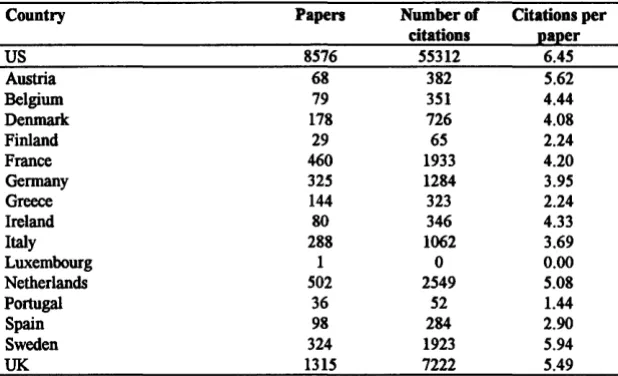
• the citation rate (6.45 per paper) is higher for US authored papers
than
for EU authored, but the citation rate for papers from four EU states (between 5 and 6) lies relatively close to that of the US.The EU research is clearly of international significance accounting for about 25% of publications. The proportion of international publications from the EU is seen to rise steadily from 1987 and also the rate of growth for the EU publications exceeds that of US authored papers. It is interesting to note that the EC research on hydrological risk commenced in 1986, but no specific investigation of the content of the papers has yet been undertaken to establish any direct causal link between the Commission's research funding and the increase in EU authored papers. Also, it should be recognised that some of the journals analysed do have a national bias in authorship which indicates that conclusive inferences on the relative quality of the EU and US research should not be drawn.
!)
This analysis provides a clear indication that there is a continuing need for the dissemination of advances made on EC projects though publication in key international journals; this may also improve the citation rate for EU based research.
1.4 An international perspective of European expertise
Water management in all its aspects is a critical technology for civilisation. The ancient Egyptian civilisation depended upon the measurement and management of the annual flows in the Nile. Two thousand years ago in the Roman Empire there were sophisticated systems for supply and drainage of water. In the industrial revolution and the colonial era, European engineers designed and constructed:
• dams for water supply,
• navigation and irrigation systems, • sewerage and water treatment systems
and these were based upon scientific advances across the continent. Today, one of the broader benefits of the Commission's research to the Member States is that it provides the background knowledge and understanding for European industries to maintain and develop their competitive position in the international market. It is difficult to measure the complete international position of European organisations since the work of Small and Medium Enterprises (SMEs} is diffused widely across the Member States. However, in terms of the major consulting engineering organisations the position is clear, European-based companies have a significant lead in the Water Sector of the international market.
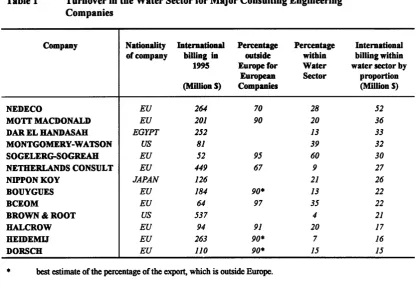
Although the world's largest engineering design firms are dominated by US companies, this is not the case in the Water Sector. The yearly Top 200 of International Design Firms shows a remarkable dominance of European companies in the Water Sector. The most recent published list (Engineering News-Record, July 22, 1996} ranks the following companies as the largest exporters in this sector.
Europe can be seen to dominate the international export in this sector with 9 out of the 13 largest exporters being of European origin. For the European companies, the comparison is based on the export outside EU from these companies. The European export of consultancy services in this field amounts in itself to billions of dollars per year, and the follow up in form of implementation and construction projects will be orders of magnitudes more. It is thus of both strategic and economic interest for Europe to keep its leading position in this sector.
Table 1 Turnover in the Water Sector for Major Consulting Engineering Companies
Company Nationality International Percentage Percentage of company billing in outside within
1995 Europe for Water European Sector (MillionS) Companies
NEDECO EU 264 70 28
MOTT MACDONALD EU 201 90 20
DAR EL BANDASAH EGYPT 252 13
MONTGOMERY-WATSON
us
81 39SOGELERG-SOGREAH EU 52 95 60
NETHERLANDS CONSULT EU 449 67 9
NIPPONKOY JAPAN 126 21
BOUYGUES EU 184 90* 13
BCEOM EU 64 97 35
BROWN&ROOT
us
537 4HALCROW EU 94 91 20
HElD EMU EU 263 90* 7
DORSCH EU 110 90* 15
•
best estimate of the percentage of the export, which is outside Europe .2 Advances in Understanding and Research in Progress
2.1 Weather radar and other remotely sensed information
International billing within water sector by
proportion (MillionS) 52 36 33 32 30 27 26 22 22 21 17 16 15
For over two decades weather radar has been used to estimate the spatial distribution of precipitation. Radar imagery potentially provides a powerful means of measuring the rainfall distribution over large areas in real time. Research funded by many agencies has led to a greater understanding of the strengths and limitations of radar as a means of rainfall estimation. Several Member States of the EU are subject to "flash" floods for which the advance warning available from good radar estimates of rainfall will lead to substantial benefits. Hence the EC continues to fund research into the use of and interpretation of weather radar under the DARTH and HYDROMET projects. In addition to ground based radar, other data over large areas can be gathered from satellite imagery and the use of this technology has too been funded under the MEFFE project. For "now-casting" of precipitation over coastal areas, knowledge of precipitation over the sea is vital. Satellite and weather radar provides the most promising means of estimating rainfall over the sea, where a network of gauges is not feasible.
For weather radar much effort h~ been devoted to recognising the information contained in the signals received from the weather systems and the performance of different radar bands. The research projects have examined polarisation data, differential attenuation, reflectivity of hail. and different raindrop sizes, and the conjunctive use of overlapping radar images to estimate wind-fields.
Specific results from the EC funded projects DARTH and HYDROMET include the following.
• The influence of orography has been highlighted both in regards to storm dynamics and environmental fields which modify the instability conditions. In one pilot application, the role played by the Adriatic Sea in supplying moisture to sustain a storm was analysed during a super-cell event.
• Hail identification in radar echoes has been seen to be possible with the use of polarisation, but the identification is made more difficult because of the effects of differential attenuation.
• The use of Doppler processing of radar reflectivity has been shown to improve the estimation of
rainfall
in mountainous terrain.• Research has shown that a 2-dimensional wind-field can be constructed from the data from two neighbouring operational radars in (part of) their overlapping coverage area. • Rainfall estimates have been improved by introducing an operational algorithm to treat
anomalous propagation ("anaprop") in which the radar beam is deflected from its normal path. In practice, over the Baltic Sea anaprop can be a particular problem. • Study of different polarisation systems has shown that:
>
C-hand data suffers from significant attenuation in heavy rain. The effects aremost evident in polarisation data, and often not noticed in reflectivity images.
>
Circular and Slant (linear rotatedby
45' reveal more information than does the standard, linear (vertical or horizontal) polarisation.>
Polarisation-diversity radar systems need careful hardware design in order toobtain useful
data.
• A detailed study investigating the relationship between radar reflectivity and drop-size distribution in extreme precipitation events has been commenced. A new model has been developed and this model is being validated with data from a range of events observed within the Barcelona region with an S-Band radar.
The DARTH project is assessing the benefits of advanced radar technology (such as Doppler processing and polarisation diversity) to operational meteorology and hydrology. Research to date suggests it may have a significant impact on the quality control of radar data, the improved retrieval of rainfall rate, and provide an enhanced capability for short-term forecasting. It remains unclear whether the detrimental impact on flow forecasts of errors in the radar estimates of precipitation negates the benefits that radar can offer through wide area coverage from a single location in near real-time. Investigations are in progress on how a river catchment model reacts to particular types of measurement error.
Within HYDROMET a procedure is being developed and implemented for the correction of range-related radar biases due to the variability of reflectivity in the vertical direction. This vertical variability, which has several origins, is characterized by a function called the Vertical Profile of Reflectivity (VPR). The correction procedure identifies the VPR by using voluminal radar data and at spatial scales consistent with hydrological requirements. Preliminary applications of the procedure have shown that it allows to improve significantly the accuracy of radar measurements, particularly for stratiform precipitation conditions and in hilly and mountainous areas.
The MEFFE project is exploring the use of satellite observations for improving short-term precipitation forecasting. Satellite sensors are ideal for monitoring large areas uniformly, and
for pin-pointing severe weather systems in their entirety, key features generally lacking in all other observational networks. MEFFE is examining the use of visual and infra-red images from existing satellites together with microwave radiometry from space, which has great potential for estimating rainfall because the upwelling radiation over the cloud is responsive to precipitation microphysics. However, satellite measurements are not free of difficulty for the type of high spatial scales intrinsic to the water sheds of some locations. The measurements suffer from ground resolution problems (with polar orbiters generally superior to geo-synchronous orbiters), and time sampling problems (with geo-geo-synchronous orbiters far better than polar orbiters). There is the added difficulty of having to convert the radiation signals into precipitation estimates, which is a non-trivial and elusive retrieval problem given today's sensors which were never really optimised for the problem of precipitation measurement.
2.2
Hydro-meteorological modellingOperational flood forecasting depends upon predicting the state of the river basin and the weather conditions over the catchment. The difference in spatial and time scale for real applications may be:
• flood forecasting up to, say, 72 hours ahead in major basins (over 10 000 km2) based
upon monitoring river and weather conditions and upon synoptic scale weather forecasts, and
• flood "now-casting", say 3 or 6 hours ahead in flash flood catchments (some less than 100 km2
) preferably using quantitative precipitation forecasts based upon real-time
meteorological observations and models of storm development and movement.
A recurring theme in the discussions at the RIBAMOD Concerted Action events has been the need for better communication between hydrologists and meteorologists. These professional communities need both to be involved in developing and operating real time forecasting systems and there remain particular issues in overcoming the disparities of scale in the information generated and used in meteorological and hydrological forecasting. Some of these issues are being tackled in the EC projects TELFLOOD, HYDROMET and MEFFE.
TELFLOOD aims to develop and test the scientific basis for forecasting floods in steep catchments and especially those which cause flooding in urban areas in their floodplains. In
steep catchments there is a relatively short time between precipitation and the subsequent flood in which traditional flood warning methods, based on real-time measurements of either water levels in rivers or of precipitation (either terrestrial or radar}, do not give adequate advance warning of a flood. To extend the lead-time of the warning the precipitation itself must be forecast in advance and so meteorological modelling must be included in the warning system. The project aims to produce the scientific components for such a system and test them for catchments in Ireland, Sweden and Italy.
The TELFLOOD project is working with the high resolution limited area meteorological model, HIRLAM, because it is under active development and is run in many Member States. When the project began, typical grid resolutions were 25 km, but now there is a research version at a 5 km resolution and this is under evaluation for precipitation forecasting. The overall forecast quality depends on the terrain and the type of rainfall. Forecasts are good in areas of strong topographic relief where this produces a significant orographic character to the
(3)
rainfall. Forecasts over water or over flat terrain are not as good at the 5 km grid scales. The
total quantity of precipitation forecast depends strongly on the horizontal diffusion parameter of the model, which may require special "tuning" for specific areas for an operational system. Early indications are that useful precipitation forecasts will be possible for the steep catchments in the project. There are indications that, once the grid resolution goes below 15 to 20 km, the resolution alone is not the limiting factor on the accuracy of the forecasts. The project has also investigated how to link together forecast fields of precipitation from meso-scale meteorological models with the hydrological and hydraulic models necessary to forecast timing, severity and extent of flooding. The main difficulties arise because of the different scales of the processes involved and of the models used to represent them.
The HYDROMET project is developing a short-range quantitative precipitation forecasting scheme, able to assimilate data from ground-based meteorological stations, multi-scan radar and satellite observations. This numerical scheme aims to improve flood warning of short response time catchments and urban hydrological systems. In this approach, the precipitating cloud is conceptualised by an atmospheric column whose response time depends on microphysical parameters and the vertical profile of rainwater content. The global dynamics is derived from the continuity equations for the water vapour, cloud water and rainwater. Additionally, laws of thermodynamic and cloud microphysics are applied to derive a basic parameterisation of the governing equations of model dynamics. The model incorporates also a scheme for the simulation of the rainfall enhancement due to orographic influence. The model is being evaluated using data from the 86-88 Cevennes Experiment in France and from the Monte Grande weather radar in Italy.
The MEFFE project aims to mitigate flood risks by improving methods for estimating rainfall intensity using a variety of "now-casting" techniques. Specific project tasks are to:
• develop better knowledge of meteorological systems generating different flood events, • couple satellite and radar data with numerical limited area meteorological models
(LAMs),
• improve algorithms for precipitation retrieval from microwave and visual-infra-red imagery,
• improve numerical weather models (LAMs and cloud meso-scale models) that combine surface and upper air measurements, and radar -satellite data, and
• define the characteristics of "now-casting" procedures for rainfall intensity.
The work within MEFFE on remotely sensed data is described in Section 2.1 above. Algorithms to interpret microwave images will be based on the use of cloud-radiation databases, whose cloud portion will be generated either by radar observations or by means of time dependent, three-dimensional cloud I mesoscale models. The University of Wisconsin -Numerical Model System will be adopted; this produces six species of hydro-meteors (including rain drops, ice crystals and snowflakes) as a function of space and time. The corresponding radiation database will be generated by using these radar and cloud model data as an input to a radiative transfer model. The MEFFE project also is investigating the combination of meteorological satellite, radar systems (individual and network) and conceptual models. Meteorological radar is enhanced by operating in networks; this improves the knowledge of meso-scale precipitation systems and is crucial in the study of storms and convective systems. The role of radar networks is particularly important in mapping precipitation fields and estimating precipitation intensity. For this, the interaction with satellite
meteorology is crucial to provide the "ground-truth" and in characterising the precipitating structures.
The FRIMAR project on flood risk in mountain areas also has tackled the use of information from general circulation models (GeMs) for hydrological forecasting. From the climatological studies it was found that for small mountain environments downscaling of the GCM results is a very crucial aspect. Downscaling was successfully done with a weather generator together with synoptic weather modelling taking the orography of the catchment into account. Furthermore it was found necessary to extend the initially anticipated hydrological approach with (simple) modelling of the snow pack and the temporal storage of precipitation. An
important issue was the large difference in space and time step between GCMs and the other models that are used to stimulate the effects of heavy precipitation events on the river system.
The coupling between hydrological and climate models is also important in assessing the influence of long-term climate change on flood risks. Following the FRIMAR project an additional study of different approaches recently used to determine the effect of climate change on flooding risks (including the one developed under the FRIMAR project) were compared. This has resulted in guidelines on which methodology should be used for a particular case. It
was found that the most decisive factors are:
• size of the catchment and the topography of the catchment (determining the degree of downscaling required and whether a quasi-steady approach is acceptable),
• the spatial distribution of the altitude of the catchment (determining whether snow and snow-pack have to be included), and
• the dynamics of the mountain environment.
2.3
Flood ForecastingFlood forecasting models are a core component of most modem operational flood warning systems. These models may be conceptual or physically based and they account for the processes of transforming precipitation (measured and forecast) into river flow conditions. There is a need to balance the degree of sophistication of the forecasting models with the forecast requirements and the quality of information available on precipitation and on the catchment state. The EC has supported research on flood forecasting models under the Framework programmes and this Section describes the work in this area of the AFORISM and HYDROMET projects.
AFORISM was supported by the EC Environment (EPOCH) programme and has recently been completed. AFORISM had two key components:
• an inter-comparison on a variety of catchments of different approaches to rainfall-runoff modelling and their use both for planning and real time flood forecasting and management, and
• a feasibility study, based upon the Reno river catchment (4172 km2), aiming at
integrating innovative technologies in an operational decision support tool for flood forecasting and flood impact analysis.
The project has been successful involving both scientific advances and addressing more practical communication problems among the different disciplines involved in flood forecasting and warning. Specific achievements were:
• identifying the most important features to be retained in a real time rainfall-runoff flood forecasting model as the dynamic variation of the directly contributing saturated surfaces, combined with the filling and depletion of the soil moisture storage, and • setting up and calibration of a prototype for the real time flood forecasting system of
the Reno river, with the identification of all the interconnections needed and the pitfalls to be resolved for the development of an operational system.
The technological demonstration on the Reno river identified:
• how to make best use of the available data by extrapolating the precipitation measurements on the basis of the Limited Area Precipitation model forecasts, and • how to assess the effect of flood management decisions by means of flood plain
modelling and impact analysis as a support to the decision makers.
The three-year HYDROMET project commenced in late 1996 and is considering both weather radar (see Section 2.1) and flow forecasting. A study has commenced to identify the sensitivity of distributed flood simulations to the errors inherent in radar-rainfall measurements. This work is still at an early stage, but is using real data from a number of well-documented events to generate accurate assessments of this problem. A distributed, grid based, model for flood flow forecasting has been developed and preliminary tests using the same data used to assess the lumped rainfall-runoff model have been completed. The model shows considerable promise but several parameters remain to be optimised.
2.4 River Basin Modelling
A fundamental part of a flood forecasting or flood management system is a model of the river basin. There are many forms of model which might be used ranging from lumped, conceptual hydrological models through to detailed multi-dimensional computations of flood propagation in rivers and flood plains. Simulation modelling has been a core component of many of the EC funded RTD projects described in this paper, but the focus of the projects has mostly been on using models as research tools rather than on fundamental model development. The RIBAMOD Concerted Action was established specifically to examine river basin modelling in the context of flood mitigation to establish the state-of-the-art and further research needs. Important conclusions from RIBAMOD include:
• many models and modelling systems are available for components of river basin modelling, progress will be made by integration of models across the disciplines involved
• there is a danger that the end-user requirements of models will move beyond the fundamental capability of the conceptualisation and numerics of the calculation "engines",
• a topic of particular concern is the need to model processes an integrate data at different temporal and spatial scales according to the application and this will increase
in importance as modelling is used to explore the impacts on flooding of long-term environmental change.
Within the AFORISM project, several types of model were coupled with an expert system to support flood forecasting and flood management. The FLOOD AWARE project is combining hydrological, hydraulic and digital ground modelling to facilitate the production of flood risk maps. Under the FRIMAR project specific modelling issues have been addressed for steep mountainous rivers with the correspondingly highly energetic flows.
2.5
Debris and SedimentsFlooding in mountainous areas is often compounded with the additional natural hazards of debris flows and large-scale release and transport of sediment. Modelling the occurrence of landslides was an important part of the recently completed FRIMAR project. In this work empirical relations for the occurrence of landslides were derived, the validity of which for other mountain regions still has to be tested. An important part of the hydraulic and morphological studies was to what extent simplified models requiring less computational time can be used. This was an important achievement in view of the small time steps these models require due to the high Froude numbers usually present in the mountain rivers. Recommendations for allowable simplifications plus an indication of the consequent degree of uncertainty were developed.
The DEBRIS FLOWS project was completed in 1996. In this a methodology was developed for the analysis of a debris flow prone catchment. A general, structured way for debris flow assessment of a given catchment was defined through a proposed debris flow standard form. This standard from incorporates three distinct stages.
1. Debris Oow predisposition factors are identified from a description of the debris flow prone cachment in order with special attention given to geomorphological and geological features, soil erodibility and unstable slopes, superficial deposits and geodynamic processes.
2. Data from past debris Oow events are gathered, with detailed descriptions about climatic conditions, the debris flow event itself and the corresponding damage. The objective is to identify the triggering and unfavourable factors as well as the mechanisms of initiation, propagation and deposition, and the dynamics of the debris flow events. In particular, the material source areas and associated upslope water contributing areas have to be identified.
3. The risks and safety measures are assessed by the comparison between the technical data related to the debris flow hazard and the vulnerability of the area.
The DEBRIS FLOWS project also achieved scientific progress in the modelling of initiation mechanisms, propagation and deposition phenomena. A typology of debris flow initiation mecha-nisms was produced from the analysis of the various physical and mechanical roles played by water as a triggering factor of debris flows. For a given meteorological event, such as a heavy rainstorm, various initiation mechanisms can occur in several places of the catchment, in the upper slope, as well as in the stream bed. Understanding of the relationships between the triggering climatic events and the debris flow events was improved by analysis of radar imagery of rainfall events to identify
rainstorms as triggering events and a study of the material source areas in several Alpine torrent catchments.
The project also included numerical and physical modelling of propagation and deposition phenomena and dynamic forces on structures. Special attention was paid to the flow of debris through channels and to the extension of the deposition areas of lobes or sheets of debris. For muddy debris flows, the flowing material behaviour is now well known and knowledge on the behaviour of granular debris flows has also improved. Mathematical models were implemented which can account for two-dimensional deposition phenomena, with possible applications concerning land use planning related to alluvial fan areas. Lastly, the dynamics of unsteady debris flows and the problems of shock front impacts on structure was investigated, with promising results for the design of civil engineering structures.
2.6
Flood Risk AssessmentThe risk of flooding in a river valley can never be wholly eliminated by structural flood defences and warning measures. At the First RIBAMOD workshop (Delft, February 1997) it was identified that the standard of residual societal risk of flooding which can be tolerated varies in each Member State. For example in the UK indicative standards of protection are set according to the damage potential (or wlnerability) of the land at risk (typically 1 in 100 years for urban areas) where this defence standard can be justified through cost-benefit analysis. In the Netherlands, however, there is a statutory standard of defence to be provided (typically 1 in 10 000 years to 1250 years) with a statutory periodic review procedure. A key European dimension to flood risk is that on trans-boundary rivers, such as the Rhein, the engineering of the river for flood defence, navigation, drainage etc in one country can affect the standard of flood defence in others.
Public tolerance of natural risks is also changing with social and economic development. Although formal risk assessment procedures are well developed in certain industries ( eg nuclear power, chemical plants, oil), in many Member States the application of these methods to the provision of flood defence is in its infancy. The EC has been funding research on producing methods for assessing, mapping and communicating flood risk, this being the specific focus of the FLOODAW ARE project, and also as a component of other projects ( eg FRIMAR and AFORISM see Sections 2.2 and 2.3 above).
Within FLOODAW ARE a framework for flood risk assessment is being developed. This is an integration of new and established techniques for:
• hydrological modelling within a flow-duration-frequency (Qdf) framework • river flow simulation with mathematical modelling
• digital terrain modelling to determine flood extent from the flow simulation • land use assessment to indicate vulnerability
• risk mapping overlaying vulnerability and flood extent
The risk mapping provides a vehicle for communicating the degree of flood risk to the authorities and the public enabling an open debate on the most appropriate flood prevention and protection measures. The FLOODAW ARE methodology is being tested through demonstration applications in several countries.
The FLOOD AWARE project is making specific scientific advances in the understanding and parameterisation of Qdf and other hydrological assessment procedures for several countries with different flood climates. The estimation of rare and especially extreme floods must exploit more systematically knowledge of the corresponding precipitation. A considerable amount of rainfall data may be needed due to the spatial scale of heavy rainfall events and to the need for regional approaches for extending inadequate local information at the catchment scale (possibly augmented by rainfall simulation and atmospheric modelling).
An important element of the FRIMAR project was the development of a methodology to assess flooding risks in mountain areas. A major problem in mountain environments is the frequently poor correlation between mass movements like landslides on the one hand and the precipitation on the other hand. This is due to many other factors than precipitation alone being influential. The methodology developed under FRIMAR considers only short-term events, but takes the effect of long-term after effects of the previous conditions (like previous rainfall and past bed aggravation) into account in a stochastic way. The methodology was shown to be feasible in a demonstration application to the Mallero catchment.
3 Practical Benefits
3.1 Research Demonstration and Pilot Applications
A feature of almost all the RTD projects described in this paper is their use of data from real-world measurement as opposed to a reliance on laboratory experiment or theoretical development. Thus the practical basis and relevance of the work can be clearly seen. Within some projects, collaboration with executive agencies and operating authorities has resulted in a working prototype system at the completion of the research project, which is of continuing value to the partner and the public. Some of these direct practical benefits of the research are illustrated below (mainly from completed projects).
The contractor for the HYDRO:MET project has implemented a new real time flood forecasting system in the South West region of the Environment Agency
in
the UK. This is now being used within the project as a test bed for new algorithms for updating parameters on-line.In the AFORISM project, the integration of all the technical components of the work was demonstrated on the Reno river catchment. The Reno river was chosen following the strong interest expressed by the Authority responsible for the forecasting and control of floods and, in the project, . links were created with the Reno River Authority, the Hydrographic and Mareographic Service, the Emilia-Romagna Regional Authorities responsible for Civil Protection. Further practical implementation of the results of the AFORISM are being undertaken in the SUPREME project, recently approved by ENEA which
will
produce a prototype decision support system to be used by the Italian Authorities, with models running on a high performance computer. In France the work of AFORISM has been further tested in the "ARDECHE River Project" funded by the Plan Etat-Region Rhone Alpes, which has tested in real-time an integrated flood forecasting system.The DARTH project has led to the co-operation of the operation agencies for two weather radar installations in Italy 80 krn apart with overlapping fields of view. This has led to some of the scientific advances described in Section 2.1 above and to improved operational effectiveness.
Research results from the DEBRIS FLOW project on initiation mechanisms, propagation and deposition phenomena has been used for the design of sediment retention structures and engineering works in real cases in France, Italy and Switzerland.
The research results the FRIMAR project have been demonstrated on the Mallero River in Northern Italy to produce an assessment of flood risk in this mountainous catchment.
3.2
Formal Research OutputsFormal outputs from the RTD projects include
• technical papers published in scientific journals and conference proceedings, • interim project reports,
• final project reports, and
• guidelines for use of the research advances in practice.
In addition several of the projects have disseminated information via the Internet through web sites constructed for the projects. The research outputs on each project is available from DG XII or the co-ordinator as given in Annex 1.
4 Challenges for the Future
Many issues remain to be addressed in the area of flood risk reduction and alleviation. It is anticipated that the forthcoming Fifth Framework RTD Programme of the EC will contain a key action on natural and technological risk. Key areas for future research and development include
• the need to continue to improve the coupling of meteorological and hydrological forecasting for improved flood warning,
• the need for monitoring river and catchment conditions
• the need for improved estimation of flood discharge conditions over a variety of catchment sizes,
• the need for integrated approaches to flood management over whole river catchments and
• the need for integrated catchment models to examine issues of long-term environmental change.
These areas are further elaborated below.
Meteorological and hydrological forecasting
Advanced radar systems can differentiate rain from clutter, hail, and bright-band echoes, and can detect significant attenuation. They thus clearly provide better qualitative rainfall monitoring, but a full description of their quantitative capability has yet to be obtained. Forecasting of rainfall from current radar analysis needs further research taking account of atmospheric physics and the immediate past storm conditions. For example, can wind information from Doppler radar measurements improve the advection of convective storms and thus provide improved rainfall forecasting in severe storms? Further research should improve the precipitation forecasts in the context of flood forecasting
• from limited area meteorological models using information from the radar and of the conventional precipitation gauge network.
• from the use of satellite imagery to produce quantitative precipitation forecasts.
Research is needed to determine whether it is the hydrostatic assumption or the parameterisations which limit the quality of hydrostatic meteorological forecast models at high (< 10 km) grid resolutions. The performance of non-hydrostatic meso-scale models should be investigated. Study of precipitation patterns and internal structures is required for use in filtering forecast precipitation fields.
Improved understanding is needed of how errors in radar rainfall measurement affect the prediction of river flows. This is coupled to understanding the role of soil moisture in runoff forecasting, its integration into hydrological modelling and the associated effects of scale.
Monitoring river and catchment conditions
In the context of debris flow prediction, the monitoring of catchment and stream beds is clearly inadequate and insufficient. The installation of meteorological stations and various devices aimed at monitoring initiation areas and recording debris flow events is needed. Increased financial support by operating agencies as well as research founders is necessary and would be essential for practical applications.
Unfortunately, in some countries the extent and availability of hydro-meteorological data for research is affected by the commercialisation of the agencies involved and the focusing of effort on monitoring to ensure compliance with water related directives. There is need to identify the true value of long term monitoring of climate and streamflow for assessing potential environmental change and to identify the best means of access to this data to the research community and institutions involved in long-term planning.
Improved estimation of flood discharge
For the planning and design of flood defences it is necessary to assess the "design" river flow conditions according to the level of residual risk that is acceptable to the community. Hydrological models, in general, tend to be focused on water resources investigations where the overall water balance is of primary concern and calibrations tend to produce models which
compromise in accuracy between the low and the high flows. Flood risk research needs to concentrate on the appropriate modelling approach in cases where accurate estimation of the flood peak is paramount both in the planning and design context and also for flood forecasting when good forecasts are available of precipitation.
It is important to take account of non-stationarity of past data series and the possibility of future environmental change. The most appropriate estimation methods need to be established for different basin scales, climatic type and severity of event. In particular, the relative merits and applicability of continuous simulation, flow-duration-frequency (Qdf) and unit hydrograph approaches need research. For the investigation of the effects of climate change on flood risk, a key research issue is the generation of precipitation fields at the appropriate spatial and temporal scale from the results of GCM simulations of future climate scenarios.
Integrated approaches to Oood management
The overall objective of flood management is to minimise losses within a river basin over time subject to constraints, such as society's attitude to risk, level of expenditure, etc. Thus a holistic view should be taken of flood management with distinct activities of:
• Pre-flood preparedness • Operational flood management • Post-flood response
The key actions in this area lie mainly in the development and dissemination of best operational practice (as begun in the RIBAMOD Concerted Action). In all flood defence activities it is essential to consider the impact of interventions on the flood risk in the river system as a whole and not just at the location of a particular project. This should be facilitated by the implementation of integrated catchment modelling and management information systems as these become available.
Integrated catchment models
There are many models available which are used in the overall assessment and management of flood risk. However, these mostly only tackle specific issues and there is a need to combine or couple models together to provide decision makers with tools which address the practical management of river systems. A particular challenge is the linking of models of water movement and riverine ecology. It is important that any framework produced should be built as an "open system" which will not be tied to specific proprietary software packages for particular tasks.
In addition to the integration of existing process models, research is needed on the interactions between different natural processes ( eg sediment, vegetation, flow resistance, discharge time series, climate and water quality) and the complexity and level of integration of these interactions in an overall catchment simulation. Integrated catchment simulations may also address issues of other areas of the water sector apart from flood risk. Transformations between different resolutions can present difficulties, requiring aggregation or disaggregation
of data, model parameters and model results. The appropriate representation of the hydro-meteorological system may itself change with the scale of the river catchment.
In some areas, improvements in process modelling are needed' to meet the needs of the potential us~r. These include:
• processes triggering 'debris flows • sediment transport in "real~' river cases • cohesive sediment transport,
• long term river morphology (plan form and section shape) • interaction of pollutant with sediments, and
• flow simulation in steep and mountainous rivers.
The use of integrated catchment models also raises issues on the management of complex modelling tools, their data and results to deliver information for non-specialists. This leads to the need for decision support and expert advice to be available though the modelling systems.
5 Conclusions
This section restates some of the key themes from the analysis and discussion of the Commission's research given above.
The research which the Commission has funded, and is continuing to fund, in the area of hydrological risk, has led to scientific advance on several fronts.
Of equal importance is the direct application of the research in mitigating flood risks in several Member States and internationally through associated demonstration studies and implementation on other projects.
The analysis of the scientific publication in the area of hydrology and water resources indicates that there has been a significant increase in the number and proportion of papers published from the EU states, particularly since the mid-1980's.
Major European enterprises have an international lead in consultancy in the water sector and the EC research in this area is important to maintain the knowledge base and competitive position ofEU firms.
The EC research projects have facilitated many productive partnerships between universities, research institutes, small, medium and larger enterprises, public authorities and operating agencies in the area of flood mitigation developing a creative synergy and providing scientifically sound inputs for policy makers.
6 Acknowledgements
This document was prepared from contributions of all the EC RTD project coordinators listed in Annex 1. Karsten Havtl0 of the Danish Hydraulic Institute contributed the information in Section 1. 4 The analysis of the international position of EU hydrological research in Annex 2 was undertaken by Dr M Borga of the University ofPadova using information supplied by lSI.
Annex 1 Research Projects and Co-ordinators
AFORISM - A comprehensive forecasting system for flood risk mitigation and control Professor E. Todini
Universita di Bologna
Istituto di Costruzioni ldrauliche Viale del Risorgimento 2 1-40136 Bologna
D~TH - Development of advanced radar technology for application to hydrometeorology
Professor A.R. Holt University ofEssex
Department ofMathematics Wivenhoe Park
Colchester
UK-Essex C04 3SQ
DEBRIS FLOW - Debris flow management and risk assessment in the Alpine region Dr. R. Cojean
Centre de Geologie de l'Ingenieur Ecole Nationale des Ponts et Chaussees 60 Boulevard Saint Michel
F-75272 Paris Cedex 06
FLOOD AWARE - Applied researches on a transferable methodology, devoted to .flood awareness and mitigation, helping the decision and negociation processes, ad~pted to a changing environment, and respecting the water resources
Dr. N. <iendreau CEMAGREF
Dept <iestion des Milieux Aquatiques Division Hydrologie Hydraulique Quai Chauveau 3 - BP 220 F-69336 Lyon
FRIMAR- Flooding risks in mountain areas Dr G. Klaassen
Delft Hydraulics Rotterdamseweg 185 PO Box 177
NL-2600 :MH Delft
HYDRO MET - The development of active on-line hydrological and meteorological models to minimise impact of flooding
Professor I.D. Cluckie
University ofBristol
Water Management Research Centre
Lunsford House, Cantocks Close
UK-Bristol B58 1UP
MEFFE - Satellite and combined satellite-radar techniques in meteorological forecasting for Oood events
Professor F. Prodi
Universita degli Studi di Ferrara
FISBAT-CNR
Via Gobetti
1011-40129
Bologna
RIBAMOD - River basin modelling, management and flood mitigation concerted action
Dr. P.G. Samuels
HR
Wallingford Ltd
Howbery Park
Wallingford
UK-Oxon
OX10SBA
TELFLOOD - Forecasting floods in urban areas downstream of steep catchments
Dr.
M.Bruen
University College Dublin
Centre for Water Resources Research
Earlsfort Terrace
IRE-Dublin 2
Annex 2
Analysis of Publications and Citations in Hydrology and Water
Resources, 1981-1996
1
Introduction
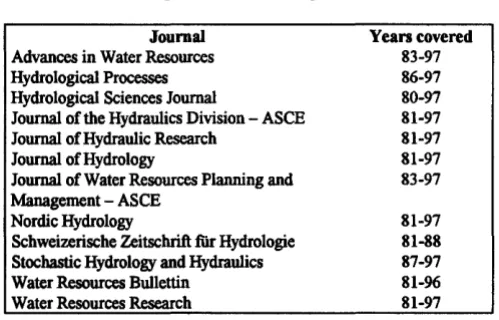
We report here some statistics drawn from a Topical Citation Report on hydrology ~d water resources provided by lSI (Institute for Scientific Information, Pennsylvania, USA). These statistics refer to a wide-variety of subjects (about of 17312) related to hydrology, published, during 16 years (from 1981 to 1997), in 12 different journals taken into consideration by lSI.
[image:26.481.99.349.252.412.2]We have counted the total number of citations by items received in the period from 1981 to June, 1997.
Table 1 Journals in the Topical Citation Report, 1981 - June, 1997
Journal
Advances in Water Resources Hydrological Processes Hydrological Sciences Journal
Journal of the Hydraulics Division- ASCE Journal of Hydraulic Research
Journal of Hydrology
Journal of Water Resources Planning and Management- ASCE
Nordic Hydrology
Schweizerische Zeitschrift fiir Hydrologie Stochastic Hydrology and Hydraulics Water Resources Bullettin
Water Resources Research
Yean covered 83-97 86-97 80-97 81-97 81-97 81-97 83-97 81-97 81-88 87-97 81-96 81-97
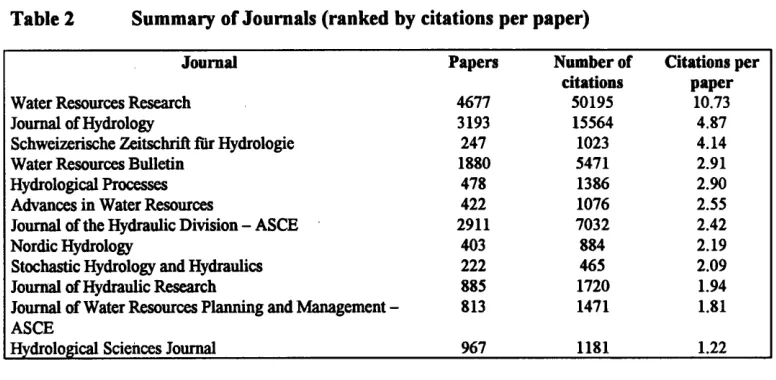
In the Table 1 we report the number of papers, the number of citations and the citations per paper. We have defined the citations per paper as the number of citations of the papers published in a particular journal with respect to the total number of articles published in that journal. For the target journals, this statistic can by used as surrogate of the "impact" factor (obtained by dividing the number of all current citations of papers published in a particular journal during the previous two years by the number of articles that journal published in those two years). The citation per paper could be therefore considered as a significant parameter which measures the quality of the paper. However, this statistic, as presented here, might be biased due to the advantage that older journals have over newer journals in attracting submissions and also some journals have a national bias in their submissions. Furthermore, it is important to remember that citation habits differ among fields and so comparing disparate journals can be difficult.
Table 2 Summary of Journals (ranked by citations per paper)
Journal Papers Number of Citations per
citations paper
Water Resources Research 4677 50195 10.73
Journal of Hydrology 3193 15564 4.87
Schweizerische Zeitschrift fiir Hydrologie 247 1023 4.14
Water Resources Bulletin 1880 5471 2.91
Hydrological Processes 478 1386 2.90
Advances in Water Resources 422 1076 2.55
Journal of the Hydraulic Division- ASCE 2911 7032 2.42
Nordic Hydrology 403 884 2.19
Stochastic Hydrology and Hydraulics 222 465 2.09
Journal of Hydraulic Research 885 1720 1.94
Journal of Water Resources Planning and Management- 813 1471 1.81 ASCE
Hydrological Sciences Journal 967 1181 1.22
2 Overall statistics on articles from US and EU Countries for 1981-1996
[image:27.480.52.443.361.441.2]It should be noted that membership in the EU rose during the surveyed period, from 10 nations in 1981 to 12 in 1986 and, ultimately, to 15 in 1995 and the re-unification of Germany also occurred in this period. Table 3 reported below lists the involved countries.
Table 3 List of EU Countries considered
Austria Belgium Denmark
Finland France Germanv (FRG, DDR and Germany)
Greece Iceland Ireland
Italy Liechtenstein Luxembour2
Netherlands Norway Portu231
Spain Sweden UK
Table 4 and Figure 1 have been obtained considering only the nationality of the first author. As
can be seen, there is a significant difference between the publication rate per papers written in the EU Member Countries with respect to those written in the USA. The EU research is of international significance accounting for about 25% of publications even though the citation measures chosen lie below those for the US (See Section 3 below).
Table 4
Figure 1
0.5
0.4
~
--
c:::: 0.3Q)
~
Q)
a.. 0.2
0.1
Number of papers in the database, by year, for the world, EU and US (EU and US expressed also as percentage of the world production)
Year' Total number of papen EU
us
1981 862 139 (0.16) 455 (0.53)
1982 1029 236 (0.23) 431 (0.42)
1983 977 149 (0.15) 480 (0.49)
1984 990 194 (0.20) 532 (0.54)
1985 847 170 (0.20) 444 (0.52)
1986 873 198 (0.23) 436 (0.50)
1987 1130 185 (0.16) 619 (0.55)
1988 977 182 (0.18) 498 (0.51)
1989 996 191 (0.19) 516 (0.52)
1990 1035 232 (0.22) 517 (0.50)
1991 1067 243 (0.23) 538 (0.50)
1992 1120 270 (0.24) 550 (0.49)
1993 1140 261 (0.23) 574 (0.50)
1994 1131 257 (0.23) 587 (0.52)
1995 1108 252 (0.23) 549 (0.50)
1996 1282 362 !0.28l 606 (0.47)
Percentage of world science published in journals for hydrology and water resources
Year
Note: Statistical analysis reveals a increasing trend for EU (highly significant: p<0.005)
[image:28.481.43.432.339.601.2]3 Citation rate
Table 5 reports the number of citations of papers written in USA with respect to papers
written in the EU Member Countries. As can be easily seen, for the US papers, the citation rate exceeds the value of 6 per paper whereas, for four of the EU Member Countries the citation rate is between 5 and 6 citations per paper. However, some of the journals taken into
[image:29.479.113.423.231.423.2] [image:29.479.113.422.232.420.2]consideration have a national bias in authorship. This indicates that conclusive inferences on the relative quality of the EU and US research should not be drawn.
Table 5 Number of papers, number of citations and citations per paper for US and EU Countries
Country Papen Number of Citations per
citations J!&J!er
us
8576 55312 6.45Austria 68 382 5.62
Belgium 79 351 4.44
Denmark 178 726 4.08
Finland 29 65 2.24
France 460 1933 4.20
Germany 325 1284 3.95
Greece 144 323 2.24
Ireland 80 346 4.33
Italy 288 1062 3.69
Luxembourg 1 0 0.00
Netherlands 502 2549 5.08
Portugal 36 52 1.44
Spain 98 284 2.90
Sweden 324 1923 5.94
UK 1315 7222 5.49
Note: The statistics for Germany cover also the former DDR.