A TANGIBLE PROGRAMMING SOLUTION TO DEVELOP
COMPUTATIONAL THINKING: PROGRAMMING BLOCK RECOGNITION USING CONVOLUTION NEURAL NETWORK
CHIN KHAI HONG
A TANGIBLE PROGRAMMING SOLUTION TO DEVELOP COMPUTATIONAL THINKING: PROGRAMMING BLOCK RECOGNITION USING CONVOLUTION
NEURAL NETWORK
CHIN KHAI HONG
This Report Is Submitted In Partial Fulfillment Of Requirements For the Bachelor Degree in Electronic Engineering (Industrial Electronic)
Fakulti Kejuruteraan Elektronik dan Kejuruteraan Komputer Universiti Teknikal Malaysia Melaka
UNIVERSTI TEKNIKAL MALAYSIA MELAKA
FAKULTI KEJURUTERAAN ELEKTRONIK DAN KEJURUTERAAN KOMPUTER
BORANG PENGESAHAN STATUS LAPORAN PROJEK SARJANA MUDA II
Tajuk Projek : A TANGIBLE PROGRAMMING SOLUTION TO DEVELOP
COMPUTATIONAL THINKING: PROGRAMMING BLOCK DETECTION USING CONVOLUTION NEURAL NETWORK
Sesi Pengajian : 1 6 / 1 7
Saya CHIN KHAI HONG
(HURUF BESAR)
mengaku membenarkan Laporan Projek Sarjana Muda ini disimpan di Perpustakaan dengan syarat-syarat kegunaan seperti berikut:
1. Laporan adalah hakmilik Universiti Teknikal Malaysia Melaka.
2. Perpustakaan dibenarkan membuat salinan untuk tujuan pengajian sahaja.
3. Perpustakaan dibenarkan membuat salinan laporan ini sebagai bahan pertukaran antara institusi pengajian tinggi.
4. Sila tandakan ( √ ) :
SULIT* *(Mengandungi maklumat yang berdarjah keselamatan atau kepentingan Malaysia seperti yang termaktub di dalam AKTA RAHSIA RASMI 1972)
TERHAD** **(Mengandungi maklumat terhad yang telah ditentukan oleh organisasi/badan di mana penyelidikan dijalankan)
TIDAK TERHAD
___________________________ (TANDATANGAN PENULIS)
Disahkan oleh:
____________________________________ (COP DAN TANDATANGAN PENYELIA)
iii
“I hereby declare that the work in this project is my own except for summaries and quotations which have been duly acknowledge.”
Signature :
Author : CHIN KHAI HONG
iv
“I acknowledge that I have read this report and in my opinion, this report is sufficient in term of scope and quality for the award of Bachelor of Electronic Engineering
(Industrial Electronics) with Honours.”
Signature :
Supervisor’s Name : DR. SOO YEW GUAN
v
vi
ACKNOWLEDGEMENT
At here, I would like thanks to everyone who aided me to complete this project. Firstly, I would like to thank to Dr. Soo Yew Guan who guided me from A to Z. Without your kindness and willing to share your knowledge, I would not able to complete this project. Secondly, I would like to say thank you to my co-supervisor, Dr. Lim Kim Chuan and postgraduate students. They gave their heart to help me in the machine learning session which is the majority knowledge required in this project. With their help and effort, I able to complete this project in the given timeframe. I would like to take this opportunity to express my appreciation to all those who helped me throughout my final year project.
I also would like to extend my appreciation to my family and friends. Thanks to their support and encouragement in spiritual and financial. Besides that, I would like say thank you to my partner who accompany me along all the ups and downs in this project.
vii
ABSTRACT
viii
ABSTRAK
ix
TABLE OF CONTENT
NO TITLE PAGES
DECLARATION APPROVAL DEDICATION
ACKNOWLEDGEMENT vi
ABSTRACT vii
ABSTRAK viii
LIST OF FIGURE xii
LIST OF TABLE xv
LIST OF ABRREVIATIONS AND ACRONYMS xvixvi
I INTRODUCTION
1.1 Project Overview 1
1.2 Objective 2
1.3 Problem Statement 2
1.4 Scope of Work 3
II LITERATURE REVIEW
2.1 Tangible Programming 4
2.1.1 Implementation Technologies 5
2.1.1.1 Radio Frequency Identification (RFID) 5
x
2.1.1.4 Previous Work 7
2.2 Convolutional Neural Network (CNN) 8
2.2.1 Major Component in Convolutional Neural Network
(CNN) 9
2.2.1.1 Convolutional Layer 9
2.2.1.2 Pooling Layer 11
2.2.1.3 Rectified Linear Units (ReLU) Layer 12
2.2.1.4 Fully Connected Layer 14
2.2.1.5 Loss Layer 15
2.3
Region with Convolutional Neural Network 16
III PROJECT METHODOLOGY
3.1 Flow Chart of Design Methodology 18
3.2 Development Tools Identification 19
3.3 Training Image Acquisition 20
3.4 Training Image Labeling 21
3.5 Convolutional Neural Network Model Training 22 3.6 Region with Convolutional Neural Network Training 23
3.7 Trained Model Evaluation 23
3.8 Webpage Development 24
3.8.1 Node JS Server 25
3.8.2 MATLAB Server 27
IV RESULT AND DISCUSSION
4.1 Convolutional Neural Network Training Result 29 4.2 Training Image Acquisition and Labeling 32
4.3 Transfer Learning 34
4.4 Analysis of R-CNN Object Detector 36
4.4.1 Case 1 – Single Class, Single Object with Different
xi
4.4.2 Case 2 – Single Class, Multiple Object with Different
Orientation 38
4.4.3 Case 3 – Multiple Class Object in Different
Orientation 40
4.4.3.1 Multiple Class, Single Object and Well-Oriented 40 4.4.3.2 Multiple Class, Multiple Object and
Well-Oriented 41
4.4.3.3 Multiple Class, Multiple Object and Random
Position 42
IV CONCLUSION
5.1 Conclusion 48
5.2 Recommendation 49
xii
LIST OF FIGURE
NO TITLE PAGES
Figure 2.1 A group of kids interacting with Algoblock. 5 Figure 2.2 The working principle of RFID technologies. 6 Figure 2.3 An early Convolutional Neural Network (Le-Net5) design
used for handwritten digit recognition, designed by Yann LeCun (1989).
8
Figure 2.4 Visualization of 5 x 5 filter convolving around an input volume and producing activation map. [15]
10
Figure 2.5 An example on maximum pooling. 12
Figure 2.6 ReLU relationship graph. 13
Figure 2.7 (a) Hyperbolic function. (b) Sigmoid function. 14 Figure 2.8 A simple three-layer neural network. 15 Figure 2.9 R-CNN proposed the regions and classify the region
proposals.
16
Figure 3.1 Project Flowchart. 18
Figure 3.2 The default window of MATLAB R2016b. 20
Figure 3.3 Logitech C210 USB Webcam. 21
[image:13.612.116.519.218.690.2]Figure 3.4 The example of using training image labeler. 22
Figure 3.5 Exported ROIs in MATLAB workspace. 22
Figure 3.6 The overall operation of the simulation (from front-end to back-end).
xiii
Figure 3.7 The user interface to simulate the overall system of tangible programming with virtual maze and bot.
25
Figure 3.8 The flow of the Node JS server. 26
Figure 3.9 The flowchart of the MATLAB server. 27
Figure 3.10 Object Detection Function 28
Figure 4.1 The network structure of the composed CNN and its corresponding hyperparameter.
30
Figure 4.2 The training accuracy and loss with CIFAR-10 dataset. 31 Figure 4.3 The pre-trained CNN model after the network is trained
with CIFAR-10 dataset.
32
Figure 4.4 Training images labelling. 34
Figure 4.5 The field of the trained R-CNN object detector. 35 Figure 4.6 The fine-tuned CNN layers and its corresponding
hyperparameter.
35
Figure 4.7 The output result of the prediction with the trained R-CNN model.
36
Figure 4.8 The detection result for class (a) ‘Down’, (b) ‘Up’, (c) ‘Right’ and (d) ‘Left’ (boxed with prediction label on the top of each bounding box).
37
Figure 4.9 : The detection result of multiple object of class (a) ‘Down’, (b) ‘Up’, (c) ‘Right’ and (d) ‘Left’ with the red colored boxed the result with error.
39
Figure 4.10 The detection result of single object from each class at different orientation.
41
Figure 4.11 The detection result of 2 τ-blocks (grouped-up) from 4 different classes.
42
Figure 4.12 The detection result of 2 τ-blocks from 4 different classes (red-colored box indicated the detection with errors).
43
Figure 4.13 Two labels on the same τ-block. 44
xiv
Figure 4.15 The detection result with the label and the value of the bounding box annotated on the top of the corresponding bounding box.
45
xv
LIST OF TABLE
NO TITLE PAGES
xvi
LIST OF ABRREVIATIONS AND ACRONYMS
ConvNet CNN R-CNN RFID STEM RGB Maxpool ReLU FC DNN GPU ROI JSON AJAX IoT
Convolutional Neural Network Convolutional Neural Network Region with Convolutional Neural Network
Radio-Frequency Identification
Science, Technology, Engineering, Mathematics Red, Green, Blue
Max Pooling Rectified Linear Unit
Fully Connected Deep Neural Network Graphics Processing Unit
Region of Interest JavaScript Object Notation Asynchronous JavaScript And XML
1
CHAPTER I
INTRODUCTION
1
This chapter generally described the overview of the project ‘A Tangible Programming Solution to Develop Computational Thinking: Programming Block Recognition using Convolutional Neural Network’. This section consists of 4 subsections: introduction, objectives, problem statements and scope of work.
1.1 Project Overview
Computational thinking describes a set of thinking skills, habits, and approaches that are integral to solving complex problems using a computer. Computational thinking is important and it provokes analytical ability which is important particularly in Science, Technology, Engineering and Mathematics (STEM) education for children. Although computer programming has been identified as the common method to cultivate computational thinking, but the effectiveness of word-based programming language is much lower than tangible programming due to its complexity[1]. Tangible programming is to make programming become an activity that is accessible to the hands and minds of young children by making it more direct and less abstract.
2
out with physical contactable objects that allow young children learn in better understanding and conceptual. In contrast, tangible programming is a considerable solution that allow young age to establish computational thinking and logical thinking.
In this project, a tangible programming solution (τ) is developed to expose computation thinking to young children. The overall system consists of three major components: τ-block, τ-bot and τ-maze. However, this project is focus on the algorithm development to help the τ-bot to recognize the dedicated command and arrangement of the τ-block by the user. By just connecting the τ-block, a series of actions is formed and to be executed by the τ-bot to solve the presented τ-maze problems. Both τ-bot and τ-maze allows a real-world interaction for the children instead of sitting behind large computer monitors and correcting programming syntax error.
This project is inspired by Google Inc. which launched their open source research project, Google Project Bloks, in June of year 2016. Although, this project used a different approach which is deep learning but both projects are heading toward a mutual goal, to provide tangible programming experiences to young age.
1.2 Objective
The objectives of the project are as followed:
i. To develop an algorithm to localize and classify τ-block using Convolutional Neural Network (CNN) approach.
ii. To develop a program to determine the arrangement of τ-block and transfer the command sequentially to the τ-bot wirelessly.
1.3 Problem Statement
Nowadays, most of the programming language in the market are word-based high level languages Each of these programming languages consist of different syntax and programming architecture. As example, to execute exponential operation. In object-oriented programming language, Python, the syntax is C = A ∗∗ B where as in procedural
programming language, C language, the syntax is C = pow(A, B). These diversity makes
3
indirectly focusing on the programming syntax rather than the problem solving and analytical ability.
Besides that, from the existing tangible programming tools, [2]–[4] most of the tangible programming blocks existed are built with microcontrollers and integrated circuits (ICs). In shorts, these projects faced a difficulty in function expansion. All the existed programming blocks need to be reprogrammed in order to compatible with the newly-add blocks.
1.4 Scope of Work
In this project, the block building area is defined as the area that covered by the vision of the USB webcam. The direct distance between the building area and the USB webcam is more than 0.5 meter and less than 1 meter. The USB webcam have specification of minimum resolution 480 x 360 pixels. The block detection and recognition algorithm
is developed with MATLAB program and not deployed to any standalone microcontroller. The web server is developed using Node.js framework and hosted in the same machine as MATLAB server is held.
4
CHAPTER II
LITERATURE REVIEW
2
This chapter covered the all the studies regarding the project. In this chapter, the previous work and project is studied and critically analyst the effort of the pioneer. The chapter is divided into two major section: tangible programming and convolutional neural network, the backbone of object detection and recognition. The technologies available to for tangible programming realization is studied and reviewed. The basic working principle of the artificial intelligence, specifically convolutional neural network is also covered in this chapter. This chapter is results from studies of knowledge from journals, books, internet resources etc.
2.1 Tangible Programming
5
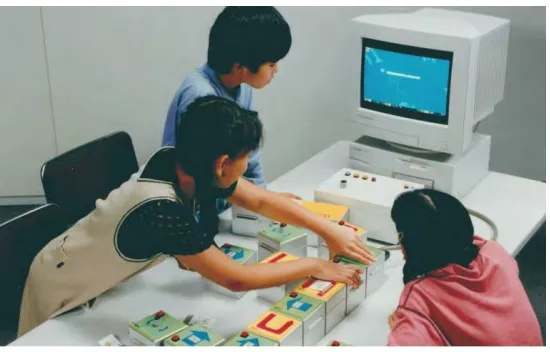
Figure 2.1: A group of kids interacting with Algoblock.
Figure 2.1: A group of kids interacting with Algoblock. Figure 2.1 displayed three primary school children building the command program using the Algoblock. Each of the block is interconnected to the previous and next building block and sent the command to the computer. The computer program respond the building block’s instructions built.
2.1.1 Implementation Technologies
This subsection explained what technology can be used to implement tangible programming in life. Three different technologies are covered in the following section: RFID, computer vision and microcontroller [5]. This subsection also explained how these technologies can revolute the market of tangible programming.
2.1.1.1 Radio Frequency Identification (RFID)
6
[image:23.612.239.453.205.388.2]Typically, most of the RFID-based tangible user interface employ passive and cheap RFID tags [5]. This is because of each item or element in the entire system, from base to every single block, required a RFID tag. In other words, the RFID reader required to pick up multiple signals at the same time. It might prone to signal overlapping and tag collision. This is a drawback of RFID based user interface which is not suitable to be implement in the τ-block due to multiple blocks is required to be detect.
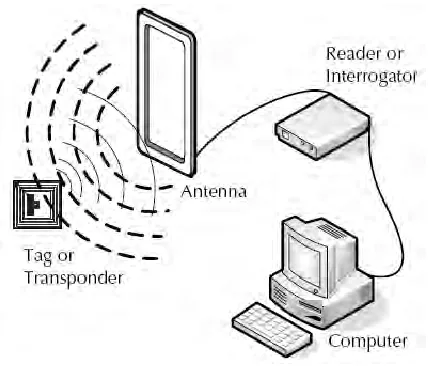
Figure 2.2: The working principle of RFID technologies.
Figure 2.2 showed the graphical working principle of RFID. As the antenna need to pick up the signal transmitted from the tag or transponder, hence multiple tag in the effective radius of the antenna can be pick up. Hence, this approach is not applicable in this project.
2.1.1.2Computer Vision
Computer vision is a type of computer application that made computer to gain high-level understanding to images. The final aim in computer vision is to make computer can operate and complete task as human-being do [6]. Traditionally, computer vision is completed in conventional image processing method. Methods like acquisition, pre-processing, feature extraction, detection or segmentation, high-level processing etc.
7
time to fully cover and consider different lighting condition. The lighting condition can affect the robustness of the algorithm in such way. Computer represent image in digital form which transform every pixel to a range of number between 0 to 255 (3 different channel in RGB model). Different lighting condition will affect the pixel values in an image. Therefore, different condition must consider and encounter.
With the effort by Yann LeCun in convolutional neural network, [7] a huge step forward in computer vision has been made. Feature extraction can be done automatically with process such as 2-D convolution, gradient descent, backpropagation etc. The details about convolutional neural network will be discuss in Section 2.2.
2.1.1.3 Microcontrollers, Sensors and Actuators
Microcontroller-based tangible user interface is the most frequent approach that used in the previous work. For example, AlgoBlock by H. Suzuki and H. Kato and Tangible Programming Bricks by T. McNerney [2], [3]. These previous works used microcontroller and integrated circuit (IC) to communicate with the computer to display the output of the constructed bricks [8]. Signal is picked up by the sensors and processed by the microcontroller. Bricks can communicate to each other and processed by the central node.
However, in term of product sustainability, whenever a new functional brick is required to add into the system, the other existed bricks required to be reprogrammed to make the newly added functional brick compatible to the existed system. This is difficult to achieve and almost impossible to be done for a commercialized product.
2.1.1.4Previous Work