
THE
ISSN 1025-9384" ~ '
IPrsREPORT
E d i t nl h y t h t' I n s t i t u t e f o r· P r o ;; p t' I' t i v t' T t' (' h n o I o g i c a I S t u d i t• s ( I PT S ) a n d i ;; s u t' d ml'ooperation with the Europt>an S&T Ohst·r·vatorit•s Nt>twor·k
£
''
i '
DECEMBER
1996
..
+ -~ \ '
- :,
,_
--
-* • *
.
.
EUROPEAN COMMISSIONw
w
0..
..
. .
.. * ..~ ·-'
• Solar Thermal Energy Technology: Potential for a Major European Industry • Diffusion of Energy Technologies:
The Influence
of
Increasing Returns • European Craftsmanship and theMultimedia Information Society • Supporting Decision Processes:
Data Constraints and the Role of Knowledge-based Tools
T h e I P T S R e p o r t N o 1 0 D e c e m b e r 1 9 9 6
he JP'!:\' R£po11. launched m December 1995 on the request and under the auspices (if the Comm1ss1onerfur Sc1ence, Research and Dez•e!upment. Ed1th Cressun, has IZOU' completed 1ts pilot phase What seemed lzke a dawztmg challenge in late 1995. appears IWU' 111 retrospect as a cmcial
galmmser of the IPTS energies and skzlls
7he Rep011 has puhlzshed a11zcles 111 a numher of areas, keepmg a rough balance among them and e:'(p/ozting mterd1Sc1p!znari~v as much as pusszble Al1icles are deemed prospectll'e~v relemnt' if they e."<plore 1ssues u•h1ch are either not yet on the polzcymaker~~ agenda rbut due tu be there sooner or later), or aspects of issues u•hich although on the agenda their 1111po11ance has nut been fulry appreciated
The thorough drajt1ng and redrafting process. hased on continuous mteract1ue consultatwn u•zth our col/aboratzng netu•ork of mstitlltes, u•hzch ll'Zll prugressu·e~)' hecome ezxn more inmlz•ed in the process, guarantees qualzry control
The first, and poss1b~l' most szgnzficant. mdicatur
(if
success is tbat the Repu11 1s being read Issue 00 (December 1995J- ufu•lncb 2000 copies were printed m u•hat seemed tu he an optmllStic projectwn at the tzme- has become a collector's ztem. Since then cirw!atzon has nsen tu 6000 Requests for subscriptions haue come not un~vfrom all ol'er Europe but also from the LZ'i. japan, Austra!ta. Latin America, N. Africa, etc.The positiz•e comments our e./Jo11s hal'e receil'ed haue been h1gh~l' gratzfving and the constmctu•e and engagmg crit1c1sm of our readershzp has jbrmed pan of the ongoing process of improvement The comments ll'e hal'e recezl'ed range from the 11zjorma/, formal commumcations (in paper or electronic form), and take m as u•el/ as a Reader Sun•ev commzssioned by IPTS
Readers' direct engagement u•ith the content fi[the repol1's a111cles has led Its to mc!ude a Letters-to-the-Edztur sectzon, whzch sta11ed 111 the june issue
The nszng esteem 111 u·hich the pub!icatwn is held is also making zt mcreasmgl)' attractil•eforauthorsfrom
outszde the Commission We hm•e alrea{{v publtshed contnbutions by authors from such renouned institutions such as the 7NO in Holland, the ~DJ 111 Germany. the ENEA in Ita~)'. the Council of Strateg1c and Internatwnal Studzes in the US. etc
The Repo11 1s produced simultaneuztsl)• in four languages (English, French, German and Spanish), by IPTS. to these one could add the Jtalzan translatzon z•ulunteered hv ENEA (yet another szgn of the Repo11's mcreasmg l'iszb1/z~vJ 1be fact that it is not on~v ami/able in seuera!/anguages. hut also large~)' prepared and produced 011 the Internet's World Wzde Web, makes If quite an uncommon zmde11akmg
We will continue to stril'e to meet the expectations of our z•et)' dzuerse readershzp, to avoid the traps of ol'ersimplifzcation. encyclopaedic rez•zeu•s or the maccesszhzlz~v of academic joumaL~ The key is to remind both ourseh•es and our readers, that u•e cannot be all things to all people, that it ts rmpo11ant to can;e out our mche and keep on e:>.plonng and e.>.plottzng If. hoping to illwmnate topics under a new. ret•ealing hght. for the ben'{jit of the readers, to prepare the1n to manage the challenges ahead
N o 1 0 D e c e m b e r 1996 T h e I P T S R e p o r t
© IPTS- JRC - Se\ 1lle, 19q,,:,
uropean 'l(esearcfi anti 'Tecfino[ogica[ 'lJeve[opment ('l(PJJ) po[icy is a6out to untfergo a reorientation. 'l!iis fact was e?(pressetf in tfie principfes anti goafs untferpinning tfie new 'Jiftfi '}'ramewor!(Programme wfiicfi were outfinetf in tfie [ast preface to 'lfie IP'TS report. 'l!iis retfiinf:jng of 'l(PJJ po[icy, dear[y going 6eyontf tfie norma[ uptfating of precetfing programmes, fias 6een triggeretf 6y tfiree main tfevefopments in recent years.
- 'first of a[~ so[ving severa[ of tfie most important cfia[fenges to society anti economy is now regartfetf to 6e crucia[[y tfepentfent on successju[ tecfino[ogica[ innovation. 'lfie competitiveness of 'European intfustry, emp[oyment creation anti wfiat cou[tf 6e ca[[etf sustaina6[e tfevefopment in its witfer socia~ economic anti environmenta[ sense fiave 6een given a prominent position on tfie pofitica[ agentfa. 'l(esearcfi anti 'Tecfino[ogica[ 'lJevefopment are e?(f'ectetf to provitfe options atftfressing tfiese pro6fems.
- Secontf[y, new insigfit into tfie processes tfriving tfie emergence anti aiffusion of new
tecfino[ogies fias fiat£ an impact on our approacfies to 'l(PJJ po[icy. 'lfie researcfi wor!( wfiicfi fias 6een carrietf out in tfie [ast tfecatfe on tecfino[ogica[ innovation itself fias sfiown tfiat tfie e?(Jifanatory anti pretfictive power of very simp[istic motfe[s anti especia[{y of tfie finear motfe[ of tecfino[ogica[ cfiange is e)(_fiaustetf. We neetf to consitfer simu[taneous[y tfie impact of new scientific finaings, of marl@t opportunities, of societa[ neetfs anti of tfie conte)(_tua[ contfitions for 'l(&'lJ [if@ etfucation, training, regufation, anti cu[ture. On{y sucfi a mu[tifacetetf view on tecfino[ogica[ innovation can fie{p to acfiieve an efficient anti targetetf use of scarce researcfi funtfs.
- '}'ina[[y, tfie app[ication of tfie principfe of su6sitfiarity sfiou[tf fiave fie[petf to avoitf tfie
tfup[ication of researcfi efforts 6y putting more empfiasis on tfie co-ortfination of 'European anti nationaf researcfi activities. 'European researcfi programmes are not meant to su6stitute nationa[ ones, 6ut to tfea[ witfi tfie 'European tfimension of tfie issues at stal@ anti to create synergies witfi tfie nationa[ programmes.
T h e I P T S R e p o r t N o 1 0 December 1996
Some initia[ steps nave a[ready been ta/(gn in recent years to address these organizationa[
questions. %e tasfJorces nave been created as a means of co-ordinating po[icies fwrizonta[[y
and to acfiieve a deeper invo[vement of industry and otfier societa[ interest groups in l(gy
po[icy areas [il(g transport or water. 5tnd tfie recent Commission documents, especia[{y tfie
(jreen Paper on Innovation, nave taf(gn severa[ of tfie new insigfits on board, preparing tfie
ground for 11Wre specific measures.
'l(fiated to these institutiona[ issues is tfie situation of tfie Commission's own researcfi
activities in tfie institutes of tfie Joint 'l(esearcfi Centre. %ey are el(fected to contribute to
dea[ing witfi these new cha[[enges. %e J'l(C is part of tfie institutiona[ structure of tfie
'European Commission, and it fulfi!s tfie ro[e of a neutra[ body wfiicfi supports tfie 'European
institutions - on scientific matters - in tfie fonnu{ation and imp[ementation of tfieir po[icies.
%e fiigfi comp{e;'(j.ty of innovation processes and tfie corresponding need for R!Jow[erfgeab[e,
independent and competent advice tfierefore gives tfie J'l(C a very important function. It is
obvious, that tfiis function can on[y be fu{jif[ed
if
tfie J'l(C is open to new rfevdopments insociety and ab[e to adjust its researcfi activities to tfie needs out{ined above. %e deeper
invo[vement of tfie J'l(C -institutes in competitive and socia[(y driven researcfi fias been a first
step in tfiis direction. In tfie coming 11Wntfis tfie shaping of tfie :Jift/i :Jramewori(Programme
wi[[ be an opportunity to carry past kssons furtfier, not on[y for tfie J'l(C but for 'European
'l(TD po[icy as a wfio[e.
December
THE I P T S REPORT
DECEMBER 1 9 9 6
EDITED BY THE INSTITUTE FOR PROSPECTIVE TECHNOLOGICAL STUDIES (IPTS) And issued in Cooperation w1th the European S& T Observatories Network PUBLISHED BY THE EUROPEAN COMMISSION
Joint Research Centre ISSN: 1025-9384 Catalogue Number GK-AA-96-10-EN-C
DEPOT LEGAL: SE-1937-95 DIRECTOR Herbert J. Allge1er
EDITOR-IN-CHIEF Dimitros Kyroakou EDITORIAL BOARD
H.J. Allgeier (chairman), C. Tahir, G. Fahrenkrog, P. S0rup, C. de la Torre, I Maghiros, J. Naegele
(Subject Ed1tor transport), D. Papameletiou (Subject Ed1tor Environment), A. Soroa (Subject
Ed1tor Energy), J. Gavigan (Subject Editor Technology-Employment-Competitiveness), K.
Beese (Subject Editor Biotechnology), and D. Kyriakou (Subject Editor Information and
Telecommunication Technologies). PRODUCTION
CINDOC-(SIC/CL SERVICIOS UNGOfSTICOS PRINT
Graesal TRANSLATION
CINDOC-CSIC/CL SERVICIOS UNGUfSTICOS
COPYRIGHT
The views expressed in this publication do not necessarily reflect those of the European
Commission (EC).
The IPTS retains copyright, but reproduction is authorised prov1ded the source is mentioned: the EC may not be held responsible for the use
made of the information. THE IPTS REPORT is published in the first week of every month, except for the months of January and August. lt is ed1ted in English and is currently available free of charge, in four languages: English, French,
German and Spanish.
SUBSaiiPTIONS
For a free subscription to The IPTS Report, or to amend an existing subscription, please write
with full details to: The IPTS Report Secretaroat
IPTS, JRC Sev1lla World Trade Centre
lsla de la CartuJa E-41092 Sevilla, Spa1n
Tel: +34-5-44 88 284 Fax: +34-5-44 88 235 E-ma1l: ipts_secrOJrc es
Web address: WWW.Jrc es/1ptsreport!subscribe.html
"' IPTS W< - Se.:llt', 1396
1 9 9 6 T h e I P T S R e p o 1
4 Editorial
Energy
5 Solar Thermal Energy Technology: Potential for a Major
European Industry
Solar thermal energy ts a mature technology relauve to most other renewable energy sources Its present potential as a source of electnctty combined wllh future potential for production of fuels make 1t attractive as part of a renewable energy portfolio Moreover growing energy demand m many sun-belt countnes gtves this European controlled technology attractive export potenttal
10 Diffusion of Energy Technologies: The Influence of Increasing
Returns
Technology adoptton deCisions taken early on in the diffuston process may determme which technologies survtve, regardless of thetr mtnnstc value, on account of the return on adoption phenomenon The potenttal dommance of sub-optimal technologtes means there is a need for consctous preservation of dtversity against the 'lockmg-m· tendency of some technologies
Information Technology
17 European Craftsmanship and the Multimedia Information
Society
The state of IT cannot be measured by hardware mdtcators alone, ,oftware now ts raptdly becoming the crucial factor The avatlabthty of up-to-date skills 1s now a key to sector performance and successful training, gmded by rehable indicators of technology trends and market needs, can be mstrumental m fine-tumng skills supply to demand.
Methods
22 Supporting Decision Processes: Data Constraints and the Role
of Knowledge-based Tools
Dectston-makers have to deal with ever larger volumes of mformauon and wtth more complex system' A vanety of approaches to extractmg knowledge from information exist, parttcularly using knowledge-based techniques drawn from AI, and they have a role to play in the construction of management mformauon .md dectston support systems.
Environment
28 Biodegradable Plastics from Renewable Sources
Envtronmental concern about the problems of waste dispo,al and danger to wtldhfe presented by durable plastics 1s turnmg attentiOn to biodegradable plastics. Promtsmg technologtes are becommg avatlable, but standard' and biodegradabthty labels need to be estabhshed and effective tests of compliance developed tf they are to yteld the benefits hoped for
35 Brief Notes
T h e I P T S
4
R e p o r t
The first article in this issue examines the prospects for solar thermal technology (STT), a renewable energy technology which can already provide 80-100 MW power plants at near-competitive costs. With government support for R&D and, critically, for the construction of plants during the early stages, STT will be able to compete with fossil fuels by 2010. This has a number of implications, amongst which the fact that STT could become part of a more sustainability oriented energy supply. Climatic factors mean the benefits of STT are more direct in the southern, less favoured regions of Europe. Moreover, the European industry's early lead can be consolidated and export markets can be exploited in sun-belt regions worldwide.
The second article argues that recent academic studies and policy reports have (again) underlined the importance of increasing returns, as well as factors often overlooked by analysts, such as technology lock-in, irreversibility, etc. The presence of such phenomena (along with other market failures and/or deviations from perfect competition) may cause markets to pass over the most desirable technology, as witnessed in the cases of the energy technology examples presented in the article. In such instances, the article argues, proactive technology watch and preservation of technological diversity may be the most appropriate response.
The third article argues that software development could become the bottleneck for the emergence of the information society, as well as an area which Europe in particular may well need to emphasise.
N o 1 0 December 1996
Software production still remains a craft-like, labour-intensive process, often crucial for the success of industrial products. The article advocates emphasising training atmed at improving software skills, as well as collecting appropriate statistics on the demand and supply of the requisite skills in order to fine tune skills supply to market demand.
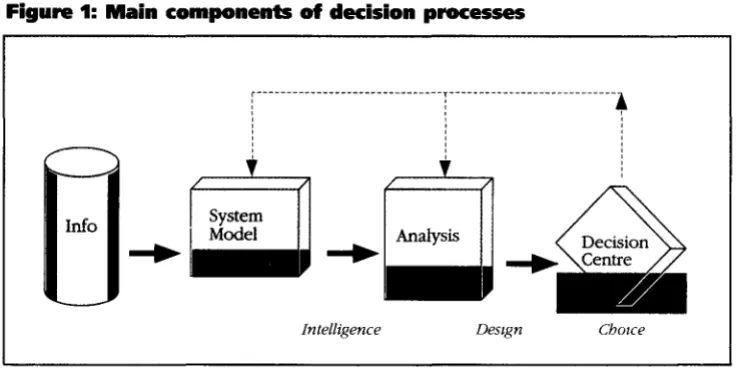
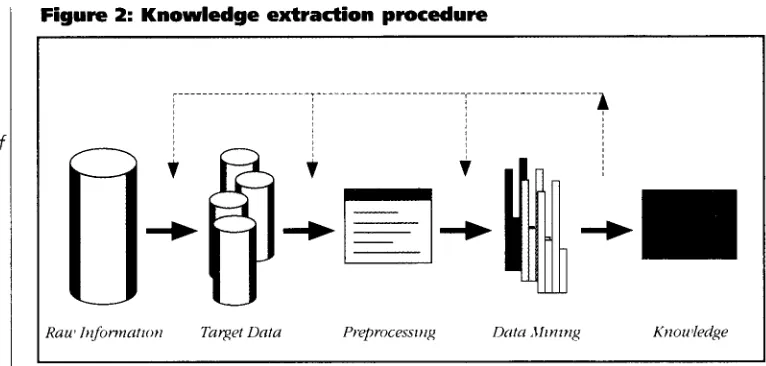
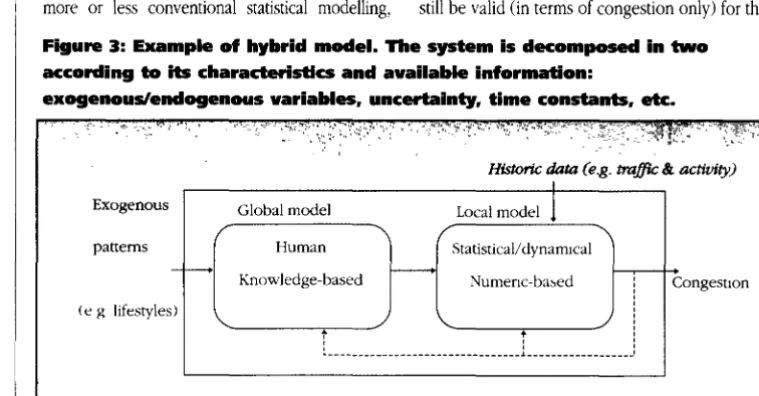
The penultimate article does not deal with an individual problem, but with the problem-solving, decision-making process itself. It suggests that the ever-increasing amounts of information decision-makers have to consider are not best dealt with by most standard decision support system (DSS) tools. More emphasis may be needed on analysis and knowledge extraction, rather than information collection. The article argues that artificial intelligence techniques/tools (e.g. neural networks, fuzzy logic, etc. ) could enrich DSS tools in order to enhance knowledge acquisition, extraction and representation, especially in those all too common cases in which information is expressed in non-quantifiable, natural language form.
The final article projects a bright future for biodegradable plastics thanks to their energy-saving and positive environmental impact characteristics, made possible by recent technological developments. The article suggests this positive profile, and the interest expressed worldwide in this potentially very important market, may call for a review of waste management policies in Europe and the adoption of appropriate standards.
N o 1 0 December 1996 The IPTS R e p o r t
Solar Thermal Energy Technology:
Potential for a Major European Industry
lrving Spiewak
The European Parliament resolution on renewable energies has called for a large increase in the European use of renewable energies, with a target of 15o/o of the primary energy mix by 2010 (European Parliament, 1996). This represents a formidable challenge to the national governments of the EU, since the current use of renewables amounts only to 6o/o. The resolution argues that such an increase is JUStified to conserve the limited resources of fossil fuels, to reduce dependence on imports, and to begin a serious effort to reduce the build-up of greenhouse gases in the atmosphere. Of the renewables, only wind has been positioned to contribute a significant share of any increase in the use of renewables. Solar-thermal technology has also progressed to the point of readiness to use on a large scale, and could reach commercial competitiveness by 2010 given appropriate government support
Solar thermal has an anticipated economic potential for about 23000 megawatts of electricity in the Mediterranean region by 2025 (DG XVII Expert Group, 1996l. About 2/3 of this
© IPTS- JRC- Seville, 1996
economic potential is in the northern Mediterranean countries (H. Klaiss et. al., 1991 ), while the bulk of the physical potential resides m Africa. If the EU countries introduce a "C02 reduction" scenario, the solar capacity in the Mediterranean region could reach 13500 MW by 2005 and 63000 MW by 2025. This might include substantial transport of solar power from North Africa to Europe.
There are 350 MW of operating parabolic trough solar plants that have demonstrated high reliability and outstanding ability to meet peak load demands in California for a decade. Power from these plants is available on demand by means of hybridization with natural gas. European-owned industry controls this technology and could undertake at least 80 MW per year of new projects with the present manufacturing plant capacity.
The present costs of electricity from solar thermal power plants are about twice the costs of the best fossil fuel technology. It is anticipated that a
The European Parliament has called for an mcrease of renewable energy's share from 6% to
7 5% Solar-thermal technology could giVe v1tal support to wmd energy m the effort to meet th1s target
In Cal1fornia solar thermal energy has demonstrated 1ts rel!ab!l1ty and ab1l1ty to meet demand for over a decade
T h e I P T S R e p o r t
As well as formmg part of a mtxed technology generation scenario, solar thermal energy could be used to generate clean fuel for transportation to where tt ts needed
The current trend towards globalizatiOn of the energy market makes production in sun-belt countnes for consumption in the north a possible future optton
6
properly focused development strategy could cut the solar plant costs in half by 2010. Such a strategy would include the construction of plants with the best available technology to build utility capabilities, and sustained technology improvement and demonstration. The present European lead in this area could be maintained and strengthened. This would, however, require that the European industry intensify its technology development and actually build commercial plants.
Beyond 2010, solar-thermal, together with wind and hydropower, could provide the bulk of central-station renewable electricity. This would be supplemented by distributed power generation by photovoltaic cells and biomass. There are also excellent prospects for the penetration of solar thermal technology into the production of dean fuels for transportation and distributed electricity generation via high temperature thermo-chemistry, using technology based materials processing in a high-temperature solar furnace. Initially, natural gas, biomass or coal could be converted to methanol or hydrogen in such solar furnaces operating at 800-900 degrees Celsius. Eventually, we could anticipate water-splitting processes operating at 1300-1500 degrees to produce hydrogen as a major energy supply vector.
European Solar-thermal Experience
Many solar-thermal projects were undertaken in response to the oil price crises of the 1970's. These included the construction of four solar tower prototypes in France, Italy and Spain, and a parabolic trough prototype in Spain. These early solar power plants failed to reach the desired performance levels and currently only those built at Almeria, Spain are operated, as research facilities. They constitute the main European solar research centre (the 'Plataforma Solar de Almeria'). No solar -thermal power plants have been built in Europe since the early 1980s because of the low price of fossil fuels. The unsuitability of the northern European climate for this technology has been a factor in dtscouraging investment by some national governments. However, current trends to
N o 1 0 December 1996
the globalization of energy markets implies that the potential of this industry should not be underestimated.
Active research and development has been supported in the EU at the national level, notably in Germany and Spain, at a rate of about US$23 million per year. EU national programs constituted 43% of the OECD world-wide budget for solar-thermal R&D during 1991-3 (International Energy Agency, 1994) and were approximately the same as the US government expenditures.
Status
of
Technology and CostsSolar-thermal technology was commercialized by the Luz Co. (Israel) that built the series of plants in California from 1984 to 1990. Their parabolic trough technology was similar to that demonstrated earlier at Almeria. Luz was forced into bankruptcy in 1991 when previously available government subsidies were terminated and they were unable to get the necessary financing for the next plant. Their technology and manufacturing assets were purchased by a Belgian company, now Solei Solar Systems, Ltd. Pilkington Solar International GmbH (Germany) built the mirrors for the California plants and they, together with Sole!, are actively marketing the Luz technology. They are able to supply power plants of up to 80-100 MW at costs of about US$2800/kW.
The competitiveness of these plants depends strong4' on the underlying interest rate and other local factors. For a real interest rate of 8%, a subsidy of about 1/3 of the capital cost is needed to compete with fossil fuel-fired plants. Once the plant enters operation, the power sales should substantially exceed the costs of operation and create a positive cash flow to recoup the investment cost.
The plants currently being offered are far superior to the early prototypes in that they incorporate the learning based on many years of operation and offer firm power via fossil fuel backup, including the optional combination with highly efficient and
N o . 1 0 December 1996
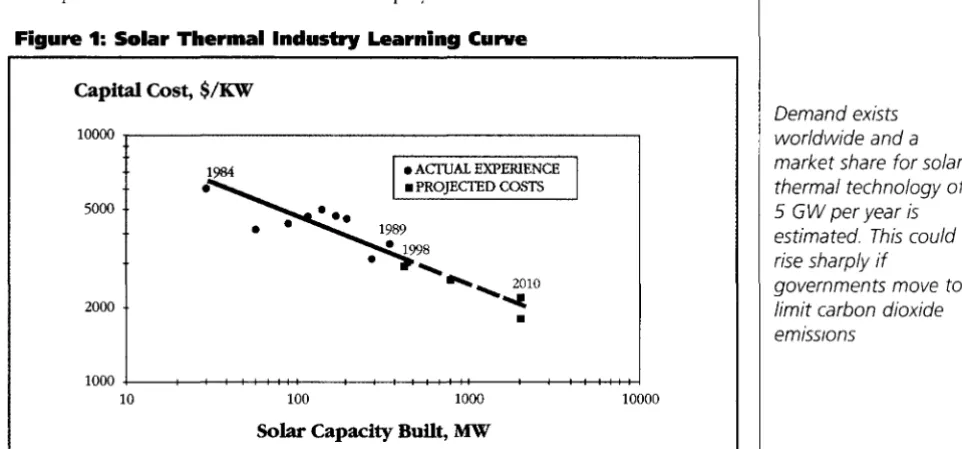
economical gas turbine plants. More advanced parabolic trough and tower plants are being developed in Europe, Israel and the USA. With an appropriate program of development and plant construction, solar-thermal electricity costs should be fully competitive by 2010 in the Mediterranean and other sun-belt regions. See Figure 1 for the solar thermal industry learning curve.
Cost reductions of up to 50% are expected, relative to current solar-thermal power costs as a result of a combination of the following factors:
• Development of innovative mirror systems, the solar collectors constituting 30-40% of present plant investment cost.
• Development of simpler and more efficient heat transport schemes such as direct steam generation and superheat in parabolic trough geometry.
• Higher temperature, more efficient receivers and power cycles, including Brayton (gas turbine) cycles.
• Novel optical systems such as beam-down power towers that provide close physical coupling of the receivers and power block • Improved integration of solar and fossil-fuel
inputs to hybrid plants.
• Benefits of learning and scale in larger plants and factory mass production of solar components.
Market for Solar thermal Technology
T h e
Projections of future demand for electricity indicate world-wide growth of 2.00/o to 3.3% per year between 1995 and 2015 (E!A,1996). This requires addition of about 90 GW of capacity per year. Growth is particularly strong in the developing world, including a number of sunbelt countries with large populations. Feasibility studies of solar-thermal power plants have been conducted, under various sponsorship. These indicate potential markets in southern Europe, North Africa, Jordan, Israel, India, the USA, Mexico, and Brazil. We have carried out an analysis of potential market growth following commercial maturity and competitiveness. We estimate a market share of 5 GW per year for solar-thermal in a business-as-usual scenario. A much faster growth would be feasible in response to government stimulation, for example if needed to reduce carbon dioxide emissions.
Requirements for a Self-sustaining Industry
A significant contribution of solar-thermal power to the European Parliament's 2010 target cannot be achieved without a higher than present rate of investment in R&D and demonstration plants. Any self-sustaining renewables industry cannot develop rapidly based on market forces alone because of
Figure 1: Solar Thermal Industry Learning Curve
Capital Cost, $/KW
10000 r---~
5000
•
2000
e ACTIJAL EXPERIENCE •PROJECTED COSTS
1989 • 1998
'
... , 2010""""
•
1000 ~--~-+-+~~~----~4-+-~~~--~~+-~~~
10 100 1000 10000
Solar Capacity Built, MW
© IPTS- JRC- Sev1lle, 1996
I P T S R e p o r t
Solar thermal plants can offer firm output by hybrid1zat1on with fossil fuel generation technology
Demand exists worldwide and a market share for solar thermal technology of 5 GW per year is estimated. This could rise sharply if
governments move to limit carbon dioxide emiss1ons
[image:9.544.23.504.475.699.2]T h e I P T S R e p o r t
H1gh R&D costs make 1t difficult for this sort of technology to be developed rapidly on the bas1s of market forces alone
Moreover, 1t rece1ves little fundmg relatiVe to other renewable energy technologies
The European mdustry enjoys a technological lead and prox1mity to many consumer countnes wh1ch could gJVe 1t an important pos1t10n on the world market
it has been estimated that each solar-thermal project w1ll create
7 000 man-years of employment m the host country during the manufactunng/ construction phase and 50 jobs for plant operat1ons during 20-30 years
8
the high cost of the R&D and demonstration steps, and the long time required to recover these costs. The introduction of renewable' 1s currently supported hy OECD national government R&D budgets of about US$700 million annually, of which the EU countries contribute about $300 million (International Energy Agency. 1994) plus some additional incentives for commercial sale of clean energy. The EC Fourth Framework Program allocates an additional 4)5 million ECU (about US$540 million) over four years 1994-98 Solar-thermal R&D gets about 811/u of the national renewables budgets and only 1.2% of the EC Program's renewable energy budget. Renewahles in total received only 7.2% of the total OECD budgets for energy R&D in 1991-3.
Manufacturing experience can he gained only by building plants and constitutes one of the essential ingredients to a self-sustaining solar-thermal industry. S!milarly, the engineering- construction companies, the utility operators, and government regulators in the technology user countries need to be 1m·oh·ed at an early date to develop a demand for. and confidence in, solar energy. This process requires funding hy international hanks and national governments. The World Bank is considering support to several proposals for solar-thermal power plants. We have estimated that supplementary funding of 400 to 700 million ECU over a 12 year period hy a combination of mternational, national bodies and the EC would lead to a self-sustaining industry. The European industry is well positioned to gain a leadersh1p role because of its existing capabilities and 1ts proximity to the major user countries.
Special mention must he made of the importance of North African countries in this process. They are already becoming linked to the European electrical grid. Because the peak demand for power in Africa occurs later in the clay than in Europe, it is logical to exchange solar power generated in Africa for base-load power generated in Europe during the evening. In Africa the solar resources are superior and labour costs lower, so African countnes could supply cheap low-technology component~ to he integrated into the high-technology European solar products. After
N o 1 0 D e c e m b e r 1996
2010, we may expect breakthroughs in superconductor technology (New Technology Week, 1996 l that would reduce the costs of long-distance power transmission across the Mediterranean.
Benefits and Impacts
It has been estimated that each solar-thermal project will create 1000 man-years of employment in the host country during the manufacturing/construction phase and 50 jobs for plant operations during 20-30 years. Depending on the capabilities of the local industry. it has been estimated that 40-50% of the mitlal costs will he spent m the host country (Pilkington, 1996). The host countries would benefit from the electricity production using mdigenous resource,. Their foss1l fuel purchases would he reduced, or in the ca'e of fuel-exporting countries. their exports could be increased. ProJects of this kind will create employment for engineering and manufacturing in the European Union. The European industry is poised to assume a world leadership role in this 1mportant technology.
If there were a massive increase in the use of renewable energy, it would serve to reduce market pressure on fuel prices at a time when fuel resources might be less abundant, thereby increasing the stability of fuel prices. The operating solar plants would reduce the output of carbon dioxide and other greenhouse gases, compared to alternative electricity generation based solely on fossil fuels. On the negative side, expanded use of renewables, while increasing overall employment, would reduce employment in other energy sectors, principally coal mining.
Beyond Electricity
Research has demonstrated the feasibility of high-temperature ( thermochemical l gasification of carbonaceous materials such as biomass, coal or oil-shale at 800-900 degrees Celsius to produce a fuel gas mixture of hydrogen and carbon monoxide. This syngas can be further processed into methanol or pure hydrogen. The expected advantages of such processing carried out in a solar furnace are yields of fuel products with
N o 1 0 December 1996
calorific values above those of the carbonaceous feedstocks, and the ability to process low-grade and waste materials with essentially no emissions to the atmosphere other than small amounts of
co
2. Exploratory research at higher temperaturesof 1300-1500 degrees with metal oxides indicate that eventually it will be possible to separate water into hydrogen and oxygen at reasonable cost.
Solar thermo-chemistry could therefore play a major role m replacing fossil fuels, not only in the production of electricity, but also in transportation and heating fuels. The largest cost component, here again, would be the solar collectors. The innovations in optical systems in solar electricity production could also be utilized in the production of solar fuels.
Keywords
T h e
Conclusions
Solar thermal technology can make a major contribution toward the replacement of fossil fuels with renewables, leading to a sustainable energy system. The European industry is in an excellent position to assume a world leadership role in such a process. There would be significant job creation in such an industry. However, government support for research, development and construction of early plants would be required during the initial phase. It is expected that, with such support, a self sustaining and expanding solar electricity industry would be viable by 2010. Beyond 2010, solar thermal technology could contribute to the production of solar transportation and heating fuels, particularly hydrogen and methanol. •
electricity generation, solar energy, renewables, C02 emissions, environmental protection
References
• DG XVII Expert Group (1996), Assessment of Solar Thermal Power Plant Technologies, European Commission, Brussels.
• Energy Information Administration (1996),/nternational Energy Outlook 1996, DOE/EIA
0484(96), U.S. Department of Energy, Washington, D.C.
• European Parliament, July 4, 1996, Promotion des energies renouvelables, A4-0188/96, Resolution sur un plan d'action de la Communaute pour la promotion des energies renouvelables.
• International Energy Agency (1994), Energy Policies of /EA Countries, 1993 Review, OECD/IEA, Paris.
• H. Klaiss, F. Staiss, and C.-J. Winter, (1991), Systems Comparison and Potential of Solar
Thermal Installations in the Mediterranean Area, Workshop on Prospects for Solar
Thermal Power Plants in the Mediterranean Region, Sophia-Antipolis, France.
• New Technology Week, June 17, 1996, Superconductor Market Proving Larger, Broader
Than Expected,King Communications Group, Inc., Washington, D.C.
• Pilkington Solar International GmbH, (1996), Status Report on Solar Thermal Power
Plants, Cologne, Germany.
Contad
lrving Spiewak, IPTS,
tel: +34-5-448 83 86, fax: +34-5-448 83 59, e-mail: [email protected]
© IPTS - JRC - Seville, 1996
I P T S R e p o r t
Thermochemtcal gastficat10n of low-grade fuels to produce htgher-grade syngas and the direct splitttng of water tnto
hydrogen and oxygen are two further applicattons of solar thermal energy that may be feastble in the future
About the author
lrving Spiewak holds a Master of Soence degree tn Chem Engineenng, from the Massachusetts Institute of Technology Before joining the IPTS as a
Visiting Soenttst, specialtztng tn technology watch in solar thermal energy and other renewables he worked as a research sctenttst and program manager at Oak Rtdge Nattonal Lab, USA, and a research scientist at the Wetzmann Institute of Soence, Israel. His research interests tnclude the energylenvtronment fteld
T h e I P T S R e p o r t N o 1 0 Dece'T1ber 199fl
Based on
Schumpetenan ideas, Evoluttonary Economtc Theory focuses on the integratiOn of the dynamtc components of technologtca! change tn the dtffus10n of technologtes
10
Diffusion of Energy Technologies:
The Influence of Increasing Returns
Stephane lsoard
Issue:
The. recent publication of the Comrmssion Green Paper on Innovation hasbrought to the forefront concepts embedded in the mainstream of evolutionary theory thinking.-The Joule
m
program also devotes particular attention to the analysis of energy teChnology dynamjcs and its. environmental .and economic consequences. Recent advances in mathematical and mbdelling techniques now make the formalization of this approach poS$ible and perm~t the quantitative assessment of the theory.Relev~nce:
From~he pe~sl)ectllle
ofincreasi~~
returns, the most efficient technology · ·is riot guaranteed to prevail in: the marke~. nor ·tWen to survive in it. Therefore, R&D policy mayryeed
toconcenttate_~n ~ricouragfng
technofogical watch and on preserving technotogical diversity.In
comPeting technology systems, l~stitutional organizations mayhave
a role to playin
pron:iotiflg ~ooaf!V and eovironment~lly desirable technologies when~lterO<i1tives
have'serraus,_
i~tfections,
.thereby securing the most beneficialtechnology path.· ·
lntrodudion constant returns to scale are assumed in order to ensure the unity, stability and predictability of the Mainstream economic models often make strong economic equilibrium, obtained as a solution of assumptions regarding perfect competition within
markets, characterize technology as a free commodity and assume the maximizing behaviour of agents. Some emerging disciphnes, such Evolutionary Innovation Economics, Industrial Economics and the Sociology of Technology, have, in recent years, developed alternative paradigms of technological diffusion processes. The Evolutionary Economic Theory, mainly built upon Schumpeterian ideas, has focused in particular on the integration of the dynamic components of technological change in the diffusion of technologies: technological uncertainty, externalities, diversity and market selection mechanisms have been introduced and recently formalized.
The issue of returns perhaps deserves special attention. Within conventional economic theory, decreasing returns to factors of production and
an optlmisation problem. This, however, means it is often impossible to explain the technology lock-in phenomena related to competing technology systems. The integration of the dynamics of technological change with evolutionary economic theory can provide new insight into these technology diffusion processes. The presence of increasing returns (to scale, to adoption, etc.) may be interpreted as the consequence of learning effects which endogenize technological change and lead to irreversibility and path-dependent phenomena. This approach may be adequate for describing the diffusion of some energy technologies and the corresponding energy tech11ology trajectories.
We will point out several examples, among them the competit10n between engine technologies as a power source for automobiles and competition between different nuclear reactor technologies.
N o l 0 December 9 9 6
This analysis should provide new thinking which may be relevant for the implementation of energy R&D policy.
Increasing Returns Framework
Individual technologies may present increasing returns to scale and to adoption. The former is related to decreasing unit costs related to production increase (]earning by doing), whereas the latter reflects the fact that, the more technologies are adopted, the more is learned about them (]earning by usingJ and the more incentive there is for further adoptions. Increasing returns lead to self-reinforcing processes: which means that a technology that gets ahead, tends not
only to stay ahead, but consolidate its position as leader Whereas the competing technologies have progressively greater difficulty in entering or surviving in the market. Positive and negative self-reinforcing processes characterize the presence of increasing returns. When technologies exhibiting increasing returns compete, small events may possibly give one of them an initial advantage, favouring its adoption. Then, thanks to these early events that induce more improvements in this technology than in the others, it may attract a broader proportion of potential adapters, and, fmally, lock-in the market. These 'small events' that might affect technological choices may be the strategies of individual entrepreneurs, prior experience of technology developers, political circumstances or simply the timing of contracts. They are typically unknown to the adopter~ before the outset of competition. and so are not endogenized in their strategic choices
This positive feedback can be a source of instability in the economy. It magnifies the random events which historically could accumulate and over time determine which competing technology will emerge and eventually lock-in the market. Thus. systems of competing technologies are charactenzed hy the multiplicity of potential outcomes.
Evolutionary economic theory, which takes into account the impact of increasing returns, provides a model of the economy as a complex system. From this perspective it is not deterministiC, not predictable. hut mstead. process-dependent and
© IPTS - JRC - Seville, 1996
T h e
constantly evolving. Therefore, the economy we are looking at is, in part, the result of it' own historical path. It creates and imposes path-dependent processes such that. m the end, the market structure is selected by a process that is at least partly random.
Moreover. the technology that comes to dominate
is not necessari~v the most efficient. Early events can
Jock the market into an inferior technological path. Technologies which impro\'e slowly at fiN but have huge long-term potential. may he locked-out. Finally, once a technological and orgamzational structure has prevailed and benefits from its increasing returns, it is difficult to change it (the required subsidy to shift from a technologiCal path to an other increases with the degree to which the process is locked-in). Then, for a firm which ha~
made the wrong choKe between technologie,, the strategy shifts to one in which they try to anticipate the next technological trajectory, the next innovation wave, and to position technologically and co-operatively (ie hy establishing partnerships with other actors) in order to exploit it.
We have by now outlined the three theoretical concepts characterizing competing technology systems with increasing returns: non-predictabili(v of the outcome, possible sub-fJptimal efficiency of the selected path, and stmctura/ inertia to shift to an other (perhaps more efficient) path. A model that integrates the lock-in phenomena caused hy random historical events, induced by learnmg effect.-; and increasing returns, leading to path-dependency and irreversibility, may be well-suited to describing the diffusion of competing technolog1es.
Modelling
of
Path-DependentDiffusion Processes
We will present here a simplified example of the way in which the competing technology systems can he modelled in order to explain the long run adoption shares in such a dynamic process. Particular attention should be paid to the two following concepts:
( 1 l the fact that the choice between alternative technologies may be affected by the rate of adoption prior to the time of choice, and
I P T S R e p o r t
Traditional econom1cs 1s often unable to explam the technology lock-m phenomenon m wh1ch one technology effectively excludes even supenor competitors from the market
The more a technology IS adopted, the more is learned about 1t, and the more incentive there is for further adoptions
The present economy 1s the result of 1ts own h1stoncal path; once a technology has prevailed under mcreasmg returns 1t IS difficult to change the Situation
Small, apparently unimportant, events may shape ult1mate outcomes m a way that mfluence or constram cho1ces about wh1ch
technology to adopt
T h e I P T S
12
R e p o r t N o 1 0 December 1996
Figure 1: Adoption Function
1
=
0.80 ·.:~
c.
~
0.6....
0
~
0.4i
1
0.2 00 0.25 0.5 0.75 1
Market Share
(2) the fact that small events - possibly random ones - may influence adoptions.
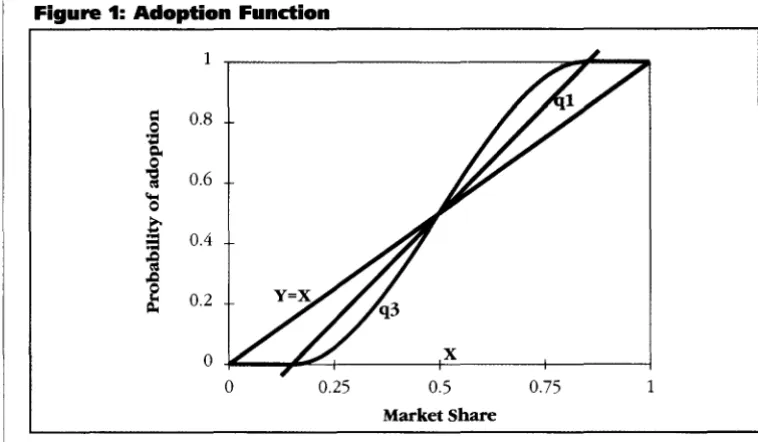
Let us take the case of a market where a typical investor has to choose among K possible technologies at a gtven time. An individual adoption is made of a gtven technology with a probability that is a function of the present market-shares of technologies. Increasing returns to adoption of a parttcular technology are then characterized by a more than proportional effect of its market-share increase on its probability of being chosen and adopted. The probability of a particular technology being adopted at any moment is not necessarily equal to its market-share. It depends
Figure 2: Adoption Function
1
0.9
!
0.7 0.8~
0.6'S
0.5~
0.4i
0.31
0.2 0.10
0 0.25
rather on an adoption fimction which maps the market-shares into selection probabilities. The characteristics of this adoption function entirely determine the different outcomes (the technologies which may lock-in the market, or the ones which will survive on it) which are supposed to emerge. For this simple discrete sequential-choice problem, we will demonstrate how different events at the outset of the path can dynamically select completely different final structures.
The function q1 in Figure 1 plots an adoption function when there are two competing energy technologies (for instance, renewable 1 and 2). When the probability of adoption is higher than the
0.5 0.75 1
Market Share
[image:14.544.139.518.70.291.2] [image:14.544.141.516.464.703.2]N o 1 0 December 1996 T h e
market-share, there are increasing retums to potential alternative technologies: the steam
adoption. the technology tends to lock-in the engine, gawline engine and electric motor The market, and vice versa. The overall outcome gasoline engine was thought to he an inferior depends on the accumulation of the random events
that occur in the launching phase of the process. On the other hand, some functions may have, in the long run. a unique 'table equilibrium. The function q2 in Figure 2 will lead the two competing energy technologtes to ,]me the market equally, with 50% each. Therefore. it appears that the technology will either lock-in or be locked out of the market if and only if ( 1) up to a certain market-share x, there are increasing returns (cf. function q1l, or at least posittve feedback (cf. function q3) and that (2) by x, there are decreasing returns ( cf. functlon q1) or at least negative feedback (cf. function q3J. Therefore, the diffusion process will be path-dependent since the prohahility of adoption of technologies does not equal thetr market-share,.
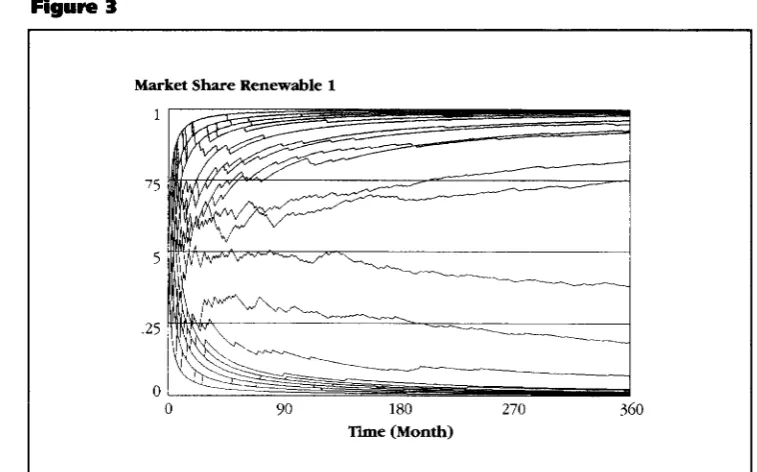
Figure 3 plots the results obtained with this model, with an adoption function of type q3. It shows the path-dependency of the different simulated technological traJectories. The studied technology locks-in or is locked out of the market on the basis of the random historical events which select the path of diffusion This emphasizes the dynamic and realistic properties of such modeb. The obvious non-linearity of competmg technology diffusion processes makes this model integrating and simulating realistic patterns look particularly interesting.
The Diffusion
of
EnergyTechnologies
We will now examine four historical examples of lock-m phenomena concerning energy technologies. They highlight the relevance of such a model with path-dependent dynamics and a multiplicity of possible outcomes for describing the emergence of technological structure in competing technology systems.
The ftrst example concerns the competition of engine technologies a' power source for automobiles. In the 1890's, there were several
© IPTS - JRC - Sevrlle, 1996
option because it was noisy. dirty and unsafe. Moreover, it required complicated technical developments in a new technological area But a series of early small events mfluencing some key developers gave the gasoline engme the opportunity to lead and eventually to lock-in the market by 1920. Both increasing returns to scale and to adoptton may have been operating and may he invoked to explain the way in which gasoline engine achieved its dominant position The example shows the non-predtctabihty of the wmning technology and the non-supenonty of the selected path. It has been widely argued that if the steam engine had heen developed to the same extent as gasoline, it might lm e been superior on technical and envnonmental pomts of vie\v Obviously. 'tructural rigidity keeps the 'infenor' choice dominant, in part due to the worldwtde diffusion of the gasoline engine. This technological, organizational and mfrastructural lock-in makes a huge effort necessary in order to initiate another technological path today, for instance. one including electnc cars. It also reinforces the difficulties facing centralised authorities and the need to promote the diffusion of technologie,.
Another example that may show lock-m through increa,ing return' and learning effects, ts that of the competition between nuclear reactor technologie' in the 1950's and 1960's. At the outset of competition four opttom were inventoried: light-water. heavy-water. gas and liquid sodium cooled reactors. In fact. the LTS nuclear industry locked-in to light-water wry qUickly. Among the factors which can he invoked, the role of the US Navy in first reactor construction contracts, the destre of the National Security Council to get a reactor at any price, the Euratom program and political considerations all acted early on to favour light-water reactor Construction experience induced learning effects which m turn gave a lead to this technology and finally intttated the lock-in phenomena. The selected path was unpredictable and increasmg returns to adoption
I P T S R e p o r t
Dunng the early years of the motor car a cho1ce ex1sted between three propuls1on technologies. The petrol engine was arguably not the 1deal cho1ce, but structural ngid1ty has kept 1t dommant
The nuclear mdustry prov1des an example of how, once a cho1ce has been made about wh1ch technology to develop, construction expenence gamed w1th this technology can giVe 1t the lead
T h e I P T S R e p o r t N o 1 0 December 1996
In the technology-based sectors of the economy the free compet1t1on
mechamsm does not guarantee the surviVal of the best technology
Environmentally and sooally deS/Table technologies may reqwre
encouragement from InStitUtiOnal
orgamzat1ons
[image:16.542.144.523.72.308.2]14
Figure
JMarket Share Renewable 1
75
5
90 180
Time (Month)
270 360
and to scale as well as structural inertia of this type of production reinforced the leadership of the light-water technology. Whether an other technological trajectory would have been superior in the long run, is still under debate.
The third example concerns the competition between photovoltaic electricity technologies: the crystalline-silicon and amorphous-silicon panels. Early developments for providing electric system to NASA satellites and the interest of the electronic industry to supply the crystalline-silicon component acted in favour of the former technology. Increasing returns to scale induced learmng effects which maintained its advance and launched the lock-in. The selected path is still unpredictable We may argue that, due to the still limited contribution of solar energy to electricity production, the emerged structure remains more flexible than the others pointed out before. Intensive research in alternative semi-conductors may be able to moderate this lead.
Finally, the analysis of the institutional behaviour may also be relevant for describing lock-in and path-dependent phenomena. For instance, different views among policy-makers on electricity have resulted in completely different final technological structures. While in France electricity
was viewed as a public service, which lead to a public electricity sector devoted to nuclear technology, it was viewed in other countries as a commodity, inducing diversified market structures and learning effects. In France, early public decisions locked-in the market to nuclear technology and initiated path-dependency. Structural-inertia again characterizes this technological trajectory. The same situation arose in the case of the decision process surrounding liquefied natural gas (LNG) projects. Cultural specificities of countries and the different risk-aversion behaviours of the actors induced highly contrasted institutionalized decisions.
Policy Implications
In the increasing returns cases, there are arguments both for and against allowing a product or a firm to dominate a market. A locked-in product may provide advantages to consumers, but, at the same time may obstruct technological progress by diminishing incentives for other companies to develop alternatives. Letting the most efficient technology win the market by itself, on the basis of 'markets forces' alone, may be invoked in the case of constant and decreasing returns. In the technology-based sectors of the economy where increasing returns dominate, the
N o 1 0 December 1996
free competition mechanism does not guarantee that the best technology successfully gains a market share, nor even survives. Under these circumstances, encouraging and preserving incentives to product and process innovation by R&D seems crucial. Special attention may be dedicated to high-tech sectors. Incentives to firms for joint-ventures, for sharing the huge costs of R&D, for exchanging on networks technical and experience knowledge might be relevant. Therefore, technological diversity provides the opportunity for selecting the socially desirable technological path.
Increasing returns models suggest also that policy may pay particular attention to timing when initiating new research: markets which are already locked-in, or close to being so, are of less interest for policy support programs. Effective policy may concentrate on encouraging the development of promising but less attractive technologies that might turn out to be, in the long run, the superior technological path.
Early adopters act and impose externalities on later ones by contributing to the selection of the final technological structure. Special attention to such events is required in order to maximize the social benefits (producers' plus consumers' surpluses) of these different technological trajectories. In competing technology systems, environmentally and socially desirable technologies may require encouragement from institutional organizations when alternatives have strong imperfections in terms of negative externalities. For instance, renewable energies might not be already
© IPTS - JRC - Sevllie, 1996
T h e
competitive and attractive for producers at micro-economic level, but in promoting these technologies, public policies tend to maximize social welfare. It leads them, in the long run, to be competitive, and in addition, it helps to avoid running up against a environmental constraint. These externalities, related to C02 emissions, are managed and the environmental objective is partly achieved by initiating a socially more beneficial technology path. Technology watch is then strongly recommended in order to be attentive to the signs at the outset of new technological trajectories. In order to avoid having to face structural inertia if a inferior path has been already taken, it is necessary to integrate long term views, externalities, etc. and act early.
On the other hand, subsidized and sponsored technologies are priced and strategically manipulated. R&D public funds can be used for other purposes by opportunist firms ('Free Rider' behaviour). Private and public R&D results can also fail to be introduced on the market if they compete against an already commercialized product of the company which performed the research. In addition, the arguments against a wait-and-see policy (initiating technological trajectories) assume that institutional organizations know a priori which type of returns (increasing, decreasing, constant) occur in sectors and technologies. Institutions face several technologies on which they have to bet. Moreover, it may be hard to initiate a path in a market before it is even fully defined. Therefore, the possibility of lock-in on an inferior technological path remains, even in a regulated market.
I
I P T S R e p o r t
T h e I P T S R e p o r t N o 1 0 December 1996
About the author
Stephane lsoard holds a master's degree m Economic Modellmg and a post-master's degree (DEA) from the UniVersity of Pans I Pantheon-Sorbonne m Mathematical
Economics and Econometncs Before commg to the !PTS, he earned out assessment stud1es on public energy pol1cy and on the 1mplementat1on of macro-econometnc models, m the work of ERASME research group (Ecole Centrale Pans) related to the Comm1ssanat General du Plan proJects He IS
currently researchmg for a Ph D. m Modelling the DiffusiOn of New Energy Technolog1es (particularly renewable energ1es) and m quant1tat1ve analys1s of Energy R&D policy
16
Keywords
Increasing Returns, diffusion of new technologies, Evolutionary Economic Theory, R&D policy, technological change
References
• Argote L. and Epple D., (1990), Learning Curves in Manufacturing, Science, vol. 247, 920-924.
• Arthur W.B., (1996), Increasing Returns and the New World of Business, Harvard Business Review, July-August.
• Arthur W.B., (1983), Competing technologies and lock-in by historical small events: the dynamics of allocation under increasing returns, International Institute for Applied Systems Analysis Paper WP-83-92, Laxenburg, Austria.
• Arthur W.B., Ermoliev Yu. and Kaniovski Yu., (1987a), Path-dependent processes and the emergence of macro-structure, European Journal of Operational Research, vol. 30, pp 294-303.
• Dosi G., Ermoliev Yu. and Kaniovski Yu., (1994), Generalized urn schemes and technological dynamics, Journal of Mathematical Economics, 23, 1-19.
• Dosi G., Freeman C., Nelson R., Silverberg G. and Soete L. (eds), (1988), Technical Change and Economic Theory, Pinter Publishers.
• Marchetti C., (1993), Nuclear Energy and its Future, International Institute for Applied Systems Analysis, Laxenburg, Austria.
• Marchetti C., (1980), Society as a Learning System: Discovery, invention and innovation cycles revisited, Technological Forecasting and Social Change, 18, 267-282.
• Nakicenovic N. and Grubler A. (eds), (1991), Diffusion of Technologies and Social Behavior, International Institute for Applied Systems Analysis, Springer-Verlag.
• Nelson R.R. and Winter S.G., (1982), An Evolutionary Theory of Economic Change, Harvard University Press.
Contacts
Stephane lsoard, IPTS
tel.: +34-5-448 83 66, tax: +34-5-448 83 59, e-mail: [email protected] Antonio Soria, IPTS
tel.: +34-5-448 82 94, fax: +34-5-448 82 79, e-mail: [email protected]
N o 1 0 December 1996 The IPTS R e p o r t
European Craftsmanship and the Multimedia
Information Society
Juan Stamm'ler Jaliff
Issue;
st"'ti~~o»
on
information,te<;hnoJogy infraStnicture·tendtoJocus~nhardware
e.g.' : ,' " - - ' f '
stationar}t Ol' mobile phones· per capita, bandwidth of the information I highways, home
computers
per
family, InternetUserS
or nodes by cguntry:However,
theSe;indicators
dormt
reflect consttaints-On software
infr~structure
develbprrient
broughta~
by tnsl,lf;fidentPersonnel
skills.
Europe-wlde Statisti(s showingthe
fine structure of supPly and demandfor
neW
rr
.skillsare
not avajlable. ,· ' . . :'~'"~:In Spit~
ofrecent
~elopToents
in
t ..
wideilying.t,_chi'tol<'!~··pr~~~ion
of· -$ottware
col\tinues-tobe
tabour-intensive,
mo~,ota
c:r~·.thana
manu
actucing process;
·The
~a- ~pplication-Qf prQ9ramm.d-,s~~re
to all
kindsot·~~ds.and-~es
isturning
th~
:availability of' Sl;,lch.craftsmanshiP·
intoa·
determinant. of i rtdustrial success.Recent-:
E.an·'
surve~
ShoW
that~sonnet
'With
,sJ<ills-
m
ne.w- ted:lnolOgleS
'are.'rieces~rY tor:5uc:~wi
$otiware~wto-. E!;l~on-
and ttainingJ~itiat~es
.coUJd
be
·
fi~:~e•wned ;~. tnatchthe
'structureof
-faborn: ·
SUpPly
and
def1laNd,
'jvith
the.lieip
o1·
appf_opriate·~~istks._-· · · ·· ""·
I'
Software applications are rapidly finding their way into all consumer and industrial products. Among the main contributing factors are access to inexpensive computing power and the rise in communications network connectivity. The latter is further enhanced by ongoing convergence in network-wide protocols for distributed client-server applications and so-called Intranet applications, which use Internet standards for corporate solutions. Even industrial I&C (Instrumentation & Control) systems, e.g. for process control, have switched from hardwired analogue controllers to distributed digital ones with programmed applications.
Whole new software-based industries are in the making, such as multimedia entertainment and educational software. There are plenty of opportunities for new businesses and virtual enterprises. But even traditional European industries (manufacturing, finance, insurance,
© IPTS - JRC · Seville, 1996
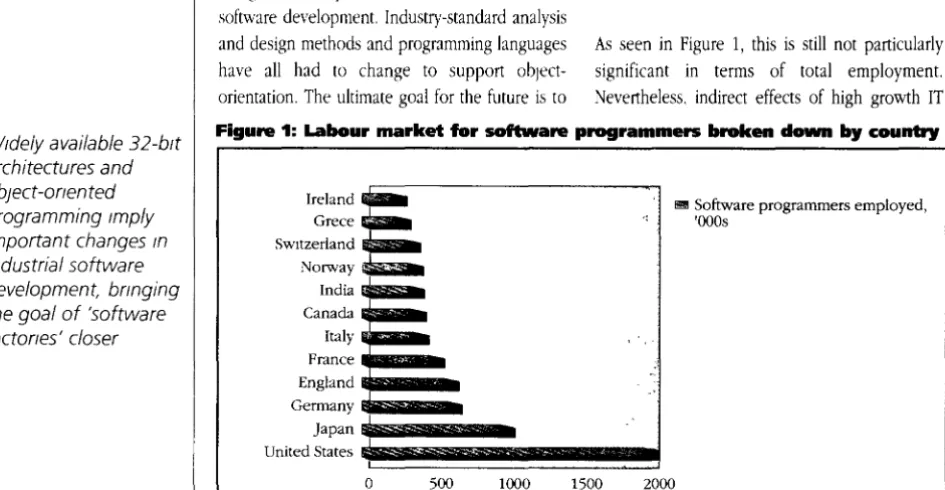
process, etc.) are becoming more and more dependent on software, and have to modernise their software development organizations. In both cases, a critical factor is the access to personnel with new software technology skills. It is estimated that the half-life of skills in software is two years. Recruitment of recent university graduates does not solve the problem on its own, for several reasons. Firstly, the bulk of existing personnel must also be extensively retrained. Secondly, university degree curricula often do not reflect the critical technical skills required for application development in time. Thirdly, software development is still much of a craft: programs are mostly custom-made by individuals who produce and interpret specifications. Very little of the software production process has yet been automated. The individual level of craftsmanship is still very important. A software engineer is an apprentice until he learns to master his craft. Europe could develop a competitive advantage by
Increased network connectiVIty and convergence m network-w1de protoco/s are intens!fymg the penetration of software applications mto all consumer and mdustrial products
![Table 1: Biodegradable plastics in Europe: business examples [18]](https://thumb-us.123doks.com/thumbv2/123dok_us/7730195.162618/36.544.23.436.75.232/table-biodegradable-plastics-in-europe-business-examples.webp)
