IMPORTANT NOTE
This guide is a follow up to a previous version. It is an initiative of the Coordination of Evaluation Unit, Directorate-General XVI Regional Policy and Cohesion, European Commission. The guide is prepared by Prof. M. Florio. It aims to offer an agenda for the appraisal of costs and benefits of major projects under Structural Funds and Cohesion Fund financing, in the context of EC regional and cohesion policies.
The current version offers an entirely new section with specific suggestions for project analysis of different kinds of infrastructures and productive investments.
The economic, political, administrative and legal situation in different Member States and in different regions and sectors may influence issues and techniques of project appraisal. The methods and examples given in this guide cannot be transferred without careful adaptation to individual cases. Nevertheless, the guide draws from a standard body of project appraisal techniques and from wide international experience. Thus the guide offers useful indications for the cost-benefit analysis of major projects proposed for financing by Structural Funds and Cohesion Fund.
The Coordination of Evaluation Unit working group received useful feedback and suggestions from a number of Commission units, from participants in seminars where the guide was presented and discussed, and from independent experts. Further suggestions are welcome.
Guide to
Cost-Benefit Analysis
of Major Projects
Table of
contents
Introduction
Structure of the guide
SECTION ONE
Major projects in the framework of the Structural Funds and the Cohesion Fund
1.1. Scope and objectives 1.2 Definition of major projects 1.3 Responsibility for prior appraisal 1.4 Information required
1.5 Reports and publicity
SECTION TWO
An agenda for the project examiner
Overview
2.1 Project identification 2.2 Objectives
2.3 Feasibility and option analysis 2.4 Financial analysis
2.5 Socio-economic costs 2.6 Socio-economic benefits 2.7 Discounting
2.8 Economic rate of return 2.9 Other evaluation criteria 2.1 0 Sensitivity and risk
SECTION THREE
Outlines of project analysis by sector
Overview
3.1 Energy transport and distribution 3.2 Energy production
3.3 Roads and highways
3.4 Surface and underground railways
3.5 Ports, airports and infrastructure networks 3.6 Water supply, transport and distribution 3.7 Sewers and depurators
3.8 Refuse and waste treatment 3.9 Training infrastructures
3.1 0 Museums and archaeological parks
3.1 I Hospitals and other health infrastructures 3.12 Forests and parks
3.13 Telecommunications infrastructures 3.14 Industrial estates and technological parks 3.1 5 Industries and other productive investments
3
4
5
6
7
9
II 12
IS 16 16 17 19 20 21 25 28 28
30
31
33 34 34
36 39 41
44
46 49 51
54
56
59 61
64
67
APPE.NDICE.S
A. Outline of an Appraisal Report 74
A. I Summary 74
A.2 Socio-economic environment 74
A.3 Demand and supply of the project's outputs 75 A.4 Technology options and production plan 75
A.5 Human Resources 76
A.6 Location 76
A.7 Implementation 77
A.8 Financial analysis 77
A.9 Socio-economic Cost-Benefit Analysis 78
A.IO Risk analysis 78
B. Glossary 79
C. Reference by main sectors 81
I. General 81
2. Experience 81
3. Energy 81
4. Transport (General) 82
5. Roads 82
6. Railways 82
7. Ports 82
8. Airports 82
9. Water 83
10. Environment 83
II. Education 83
12. Tourism 83
13. Health 83
14. Forestry and agriculture 84
15. Telecommunications 84
16. Industrial projects 84
Acronyms
CBA Cost Benefit Analysis ESF European Social Fund CF Cohesion Fund EU European Union CIF Cost, Insurance, Freight FIFG Financial Instrument of
Fisheries Guidance
CSF Community Support Framework FNPV Financial Net Present Value DG Directorate General FOB Free on Board
EAGGF European Agriculture Guidance and FRR Financial Rate of Return Guarantee Fund
Introduction
The analysis of the socio-economic costs and benefits of major projects is explicitly requested by the new EC Regulations governing Structural Funds (SF). Such an analysis is also required by the Cohesion Fund (CF) Regulation, regardless of the size of the project co-financed. In the expectation that Member States will take the responsibility for prior appraisal and provide the Commission with the relevant information, the Commission itself should in turn carefully assess the quality of such an appraisal.
This guide
This guide offers Commission officials, external consultants and any other interested parties, an agenda for the process of checking the appraisal of major projects under SF financing, including FIFG (Financial Instrument of Fisheries Guidance) and CF. The text is specifically designed for Commission officials, who are not specialists in Cost-Benefit Analysis (CBA). At the same time, the text gives some indications to external experts, who may need to understand the Commission's specific needs for information on costs and benefits of proposed projects.
Cost-Benefit Analysis. A procedure for evaluating the desirability of a project by weighting benefits against costs. Results may be expressed in different ways, including internal rate of return, net present value and benefit-cost ratio.
A relatively short text such as this cannot cover all the aspects of CBA that a project examiner has to deal with.
There are important differences between investments in infrastructure and in productive sectors; there are great disparities among regions and countries, leading to differences in crucial aspects of project appraisal; there are different theories, styles and shortcuts behind a number of practical approaches to CBA, as used by government and private bodies.
Nevertheless, most major projects share some common key-issues and their analyses should be expressed in a common language.
While this document does not provide strict guidelines about the preparation and the evaluation of major projects, it may help Commission officials in discussing with their counterparts in Member States ways of reducing costs and of improving the socio-economic benefits of the projects. In some cases, Commission officials may use this agenda to suggest a revision of the project analysis. This revision work may lead to a new project design or even to its abandonment in favour of other more promising projects.
Checking for costs and benefits is a vehicle for dialogue among partners, between the Member States and the Commission, between project proposers, officials and consultants: an instrument for collective decision-making.
In this respect, the guide is more about how to establish good communications than about technicalities. Some technical issues may require some training or further reading as suggested in Annex C.
Structure of the guide
The guide is in Three Sections. The First Section gives an overview of the appraisal of major projects under SF assistance and of projects financed by the CF.
The Second Section is a structured path leading to the assessment of the quality of CBA. No pretence is made of providing a systematic introductory text, nor is this possible in such a short space. However, the guide offers a presentation of the key-issues in the project appraisal.
The Third Section offers some useful material concerning major projects in specific sectors of relevance for EC regional and cohesion policies. Each chapter in this section is about a crucial item on the agenda of a project examiner, and we recommend seeing it as a sequence of checks and controls to be tried, rather than as chapters of a manual to be read. References to appropriate text-books are provided for some technical aspects of CBA.
Appendix A contains some additional tools that may help practical work. This includes a comprehensive check-list for a typical Project Appraisal Report. Appendix B is a Glossary which may help the reader who is less familiar with the jargon of project appraisal. For the reader's convenience, Glossary items and examples are also to be found in boxes in the main text. Appendix C is a structured bibliography by sector (transport, agriculture, energy, etc.) and it gives a very selective list of state-of-the-art manuals and other reading material that may set a standard of quality for CBA of major projects under SF financing.
A reference text for Structural Funds and Cohesion Fund is:
European Commission, Structural Funds and Cohesion Fund 1994-99, Regulations and Commentary, Brussels, I 996.
A series of seven handbooks on methods for evaluating actions of a structural nature have been prepared by the Centre for European Evaluation Expertise (Lyon) in the context of Means programme, on behalf of European Commission DG XVI/G2, Coordination of Evaluation.
Section One
Major projects in the
framework of the
1.1. Scope and objectives
Major projects co-financed by Structural Funds are an important part of the implementation of EC regional policy. They are explicitly mentioned in different articles of SF Regulations where it is understood that major projects may be either a component of operational programmes or individual actions. The success or failure of major projects may have a crucial impact on the whole EC regional policy in some countries, and this justifies a careful appraisal.
The need to assess the socio-economic costs and benefits of major projects is also mentioned in different articles of the Structural Funds Regulations.
Under these Regulations both infrastructure and productive investments may be co-financed by one or more Community financial instruments: grant instruments (Structural Funds, Financial Instrument of Fisheries Guidance and Cohesion Fund) and loan or guarantee instruments (European Investment Bank, European Investment Fund, Financial Mechanism of the European Economic Area, etc.).
This guide was specifically designed for the process of appraisal of projects co-financed by grant instruments. Obviously. this does not mean that it cannot also be applied to projects co-financed by other instruments, especially as the same project may in many cases benefit from financial contributions which combine grants and loans (Art. 5 (4) of Reg. 2081/93).
It should be pointed out that when the guide mentions Structural Funds in general, this also implicitly includes the Financial Instrument of Fisheries Guidance (FIFG), since this is also subject to the provisions of the Framework Regulation (Reg. 2081/93) and the Coordination Regulation (Reg. 2082/93) of SF.
The CF finances projects that, for the specific purposes of this guide, may in many respects be similar to the major projects under SF assistance. Similar treatment is further justified by the fact that Art. 10 (5) of the Council Regulation (EC) No 1164/94 establishing the Cohesion Fund explicitly requests an appraisal of "the medium-term economic and social benefits (of projects), which shall be commensurate with the resources deployed" and states that "an assessment shall be made in the light of a Cost-Benefit Analysis". There is already a wealth of experience on major investment projects implemented by the "first and
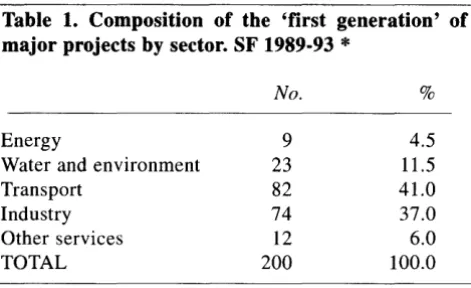
second generations" of reformed Structural Funds and by the Cohesion Fund. Table 1 gives the distribution by sector of a survey of 200 major projects co-financed by SF between 1989-93. Table 2 gives the same kind of information for a sample of 200 major projects financed by ERDF for the period 1994-99 and by CF between 1993-96. Elsewhere we shall consider data drawn from the cumulative sample of 400 projects. EU Structural Funds may support a very wide range of projects, both in terms of sectors involved and in terms of size of investment.
While the CF exclusively finances projects in the transport and environment sectors, the SF, and the ERDF in particular, may also support projects in the energy, industry and service sectors. The scope of SF activities includes agriculture, fisheries and water-culture if we also consider the European Agricultural Guidance and Guarantee Fund (EAGGF) and the Financial Instrument of Fisheries and Guidance (FIFG).
Since, in principle, for projects related to the environment and to infrastructure linked to trans-European transport networks, there could be some overlapping of grant instruments (CF, on the one hand; ERDF and, to a certain extent, also the EAGGF, Guidance Section on the other), Art. 9 (1) of the CF Regulation states that no item of expenditure of the same project may benefit both from the Cohesion Fund and from one of the Structural Funds. This does not however mean that different phases of the same major project may not be financed separately by the CF and by the SF. Anyway, the same Article permits assistance from the CF to be combined with that from other financial instruments, such as those set up under the EU transport and environment policies, provided that total Community support granted to a project does not exceed 90% of total and related costs. Either CF or SF support may be combined with loan instruments such as EIB financing.
A good appraisal of the investment decisions in such a wide range of sectors may improve their success rate and thus strengthen development opportunities in the general framework of regional and cohesion policies. It
Table 1. Composition or the 'first generation' or major projects by sector. SF 1989-93
*
No. %
Energy 9 4.5
Water and environment 23 11.5
Transport 82 41.0
Industry 74 37.0
Other services 12 6.0
TOTAL 200 100.0
*
The table is based on an ad hoc survey carried out in 1994 by a working team of the Evaluation Unit, DG XVI Regional Policy. It is not necessarily representative of the composition of the larger number of major projects co-financed by SF in the period 1989-93.Table 2. Composition or the 'second generation' or major projects by sector. ERDF 1994-99 and CF 1993 .. 96
*
No. %
Energy 3 1.5
Water and environment 41 20.5
Transport 97 48.5
Industry 47 23.5
Other services 12 6.0
TOTAL 200 100.0
*
In 1996, the Evaluation Unit carried out a new survey of a sample of 200 major projects. In addition to the second generation of projects co-financed by the ERDF (1994-99), the analysis was extended to projects co-financed by the CF since its temporary establishment in 1993 (as "Cohesion Financial Instrument"). Although CF projects generally carry an investment cost of at least 10 million ECU, for ease of comparison with projects co-financed by ERDF, only CF projects with a minimum investment cost of 25 million ECUwere considered in the survey. Once again the new sample is not necessarily representative of the composition of the larger number of major projects co-financed by SF and CF in the period concerned.
1.2 Definition of major
projects
As far as the SF are concerned, Art. 16 (2) of Council Regulation 2082/93 (Coordination of Structural Funds) defines major projects as ''those the total cost of which taken into account in determining the amount of Community assistance is, as a general rule, greater than ECU 25 million for infrastructure investments or greater than ECU 15 million for productive investments".
For such major projects the proposer is required to prepare an in-depth socio-economic appraisal and to give the Commission detailed information on its results. Obviously, the Commission expects that an appropriate investment appraisal be done by proposers for smaller projects as well, but normally the Commission will focus on the evaluation of programmes and of major projects. The requirement of detailed information on the appraisal of major projects is strictly binding both when they are part of a wider programme, or when individual projects are proposed to the Commission for co-financing.
The above mentioned limits of 25 million ECU for infrastructure and 15 million ECU for productive investments are to be understood as follows:
a) the relevant economic dimension is the total amount of investment costs. In order to assess this figure, one ought not to consider sources of finance (e.g. public sector finance only, or the EC co-financing only) but the overall economic value
The following list gives some examples of the sectors supported by the ERDF, which is the SF most frequently involved in part-financing of suitable projects.
Transport. Railways, airports, roads and highways, ports, underground, trans-European networks (Objective I Regions)
Water and environment. Aqueducts, dams and irrigation; depurators, waste treatment plants and other environmental works
Energy. Energy production, energy distribution, trans-European networks (Objective I Regions)
Other services. Health and education (Objective I Regions), culture, arts, telecommunications {including trans-European networks for Objective I Regions), tourism, research and technological development, and other services to enterprises
[image:10.575.33.269.79.223.2] [image:10.575.32.268.318.471.2]of the proposed infrastructure or of the productive investment;
b) if investment costs are expected to be incurred over different years, one has to consider their sum across the years;
c) while one has to consider investment costs only, excluding running costs, it is advisable also to include in the calculation of total investment cost any once-for-all expenditure such as recruitment and training costs, licences, preliminary studies, design and other technical studies, price contingencies, allocation for net working capital, etc.;
d) in some cases a group of small projects is so interwoven that it is better understood as one large project (e.g. five sections of the same highway, each section at a cost of 6 million ECU, should be treated as a major project of 30 million ECU).
Major projects, as defined above, may be financed, in principle, by different Structural Funds and by FIFG (see Art. 5, Reg. 2081/93), by the Cohesion Fund and by other means of assistance.
As far as the CF is concerned, support is exclusively in the form of financing of projects, stages of a project or groups of projects (see Art. 1, Reg. 1164/94). Art. 10
(3) of Council Regulation 1164/94 establishing the Fund states that "Projects, including groups of related projects, shall be of a sufficient scale to have a significant impact in the field of environmental protection or in the improvement of trans-European transport infrastructure networks. In any event, the total cost of projects or groups of projects may in principle not be less than ECU 10 million", with duly justified exceptions.
For such significant projects, whatever the size, the proposer is required to prepare a Cost-Benefit Analysis, including the direct and indirect effects on
The CF finances projects in the fields of the environment (aqueducts, dams and irrigation; depurators, refuse and waste treatment plants and other environmental works, including reforestation, erosion control, nature conservation, beach resetting, etc.) and trans-European transport infrastructure networks (railways, airports, roads and highways, ports) in Member States with a per-capita GNP of less than 90% of the Community average and with a programme leading to the fulfilment of the conditions of economic convergence as set out in Art.
I 04c of the EU Treaty (Greece, Ireland, Portugal and Spain).
The EAGGF (Guidance Section) and the FIFG may participate in the co-financing of investment projects in the agricultural, forestry and silviculture sectors, and the fishing and water-culture sectors, respectively. In the case of less developed Regions, the EAGGF may also finances projects in the fields of environment, energy, roads, irrigation and other water related programmes, as well as investments in the tourism and craft sectors.
The kind of projects co-financed by the ESF (vocational training and employment incentives) are not covered by this guide, due to their specific nature.
Art. 5, Reg. 2081/93 (SF Framework Regulation). Forms of assistance
"I. Financial assistance under the Structural Funds, from the EIB and the other existing Community financial instruments shall be provided in a variety of forms that reflect the nature of the operations. 2. In the case of the Structural Funds and the FIFG, financial assistance may be provided principally in one of the following forms: (a) part-financing of operational programmes; ... (d) part-financing of suitable projects;( ... )"
This guide concerns both major individual projects and those which are a part of an operational programme.
Art. I, Reg. I 164/94 (Regulation establishing the CF). Definition and objective "3. The (Cohesion) Fund may contribute to the financing of:
- projects, or
- stages of a project which are technically and financially independent, or - groups of projects linked to a visible strategy which form a coherent whole."
employment, possibly integrated with other evaluation methods. in the case of projects in the environmental field.
It is clear that the considerations listed above for identifying major projects under SF assistance (see points a) to d) above) are also pertinent in the case of projects financed by CF.
1.3 Responsibility for prior
appraisal
The regulations governing the SF and the CF both establish similar responsibilities for the prior appraisal of investment projects. Our analysis below will be based on the more general norms of the SF, while the corresponding provisions of the CF Regulation governing responsibility for project appraisal will be shown in boxes.
According to Art. 14 of Reg. 2082/93 ''Applications
shall contain the information the Commission needs in order to assess them". The responsibility for appraisal and evaluation of major projects is, as for any other aspect of SF implementation, a joint-venture between the Commission and the Member States. Art. 26 of Reg. 2082/93 states ''Appraisal and evaluation shall be the responsibility both of the Member States and the Commission and be carried out within the framework of the partnership". The appraisal must show "medium term economic and social benefits commensurate with resources deployed".
Art. 26 ( 3) states that "in vetting individual applications for assistance, the Commission shall take into account the findings of appraisal and evaluation".
Art. 26, Reg. 2082/93 (SF Coordination Regulation). Appraisal and evaluation
"I. appraisal and evaluation shall be the responsibility both of the Member States and the Commission and be carried out within the framework of the partnership. The competent authorities in the Member States shall contribute in such a way as to ensure that this appraisal and evaluation can be carried out in the most effective manner. In this connection, appraisal and evaluation shall make use of the various particulars that the monitoring arrangements can yield in order to gauge the socio-economic impact of the operations, where appropriate in close association with the monitoring committees.
Assistance will be allocated where appraisal shows medium-term economic and social benefits commensurate with the resources deployed ( ... )."
Art. 13, Reg. 1164/94 (Regulation establishing the CF).Appraisal, monitoring and evaluation
"2.1n order to ensure the effectiveness of Community assistance, the Commission and the beneficiary Member States shall, in co-operation with the EIB where appropriate, carry out a systematic appraisal and evaluation of projects.
3. On receipt of a request for assistance and before approving a project, the Commission shall carry out a thorough appraisal in order to assess the project's consistency with the criteria laid down in Art. I 0 (5) (medium-term economic and social benefits shall be commensurate with the resources deployed). The Commission shall invite the EIB to contribute to the assessment of projects as necessary".
It is therefore clear that Commission decisions on major projects must be based on in-depth appraisaL in the first instance by proposers. When the appraisal presented by the proposer is not deemed sufficient and convincing, the Commission may ask the proposer for a revision or an extension of the analysis, or the Commission may also prepare a project appraisal exercise of its own, and - when necessary - ask for independent evaluation. In this respect, in the specific case of the Cohesion Fund, the regulation states that the Commission may avail itself of the assistance of the European Investment Bank in the evaluation of projects, where appropriate. In practice, recourse to the expertise of the EIB is most common in the case of larger projects, regardless of whether or not they are co-financed by the EIB itself.
In any case, the Commission decision will be the outcome of a dialogue and of a joint-effort with the proposer, in order to achieve the best investment results.
Member States often have their own internal structures and procedures for the evaluation of large projects, but in some cases there may be difficulties in the implementation of quality appraisal. The Commission may help to overcome these difficulties in different ways. Technical assistance in the preparation of project appraisal may be co-financed in the context of the relevant Community Support Framework.
The proposer is advised to ask the Commission services for any information he/she needs about these aspects. In principle there is no lack of means for an appropriate appraisal of projects: the Commission asks Member States to perform such a task, difficult as it may be, but also offers financial and technical help for its better implementation.
Art. 14, Reg. 2082/93 (SF Coordination Regulation). Processing of applications for assistance
"2. Applications shall contain the information the Commission needs in order to assess them where this is not already included in the plans, including a description of the proposed measure, its scope, including geographical coverage, and specific objectives. Applications shall also include the results of prior appraisal of the medium-term economic and social benefits of the proposed measures commensurate with the resources to be deployed, the bodies responsible for implementation, the proposed beneficiaries and the proposed timetable and financing plan, together with any other information necessary to verify that the measure concerned is compatible with Community legislation and policies".
Art. I 0, Reg. 1164/94 (Regulation establishing the CF). Approval of projects
"4. Applications shall contain the following information: the body responsible for implementation, the nature of the investment and a description thereof, its costs and location, including, where applicable, an indication of projects of common interest situated on the same transport axis, the timetable for implementation of the work, a Cost-Benefit Analysis including the direct and indirect effects on employment, information enabling possible impact on the environment to be assessed, information on public contracts, the financing plan including, where possible, information on the economic viability of the project, and the total financing the Member State is seeking from the Fund and any other Community sources. They shall also contain all relevant information providing the required proof that the projects comply with the Regulation and with the criteria set out in paragraph 5, and particularly that there are medium-term economic and social benefits commensurate with the resources deployed.
5. The following criteria shall be applied to ensure the high quality of projects:
their medium-term economic and social benefits, which shall be commensurate with the resources deployed; an assessment shall be made in the light of a Cost-Benefit Analysis,
(
...
)the contribution which projects can make to the implementation of Community policies on the environment and trans-European networks,
(
...
)1.4 Information required
Whilst establishing that projects requesting support from the Fund must contain an adequate socio-economic appraisal, the CF regulation also gives some indications of the evaluation methods that can be used: a Cost-Benefit Analysis integrated, in the case of projects related to the environment, with other evaluation methods possibly of a quantitative type such as multi-criteria analysis (see Art. 10(5), Reg.
1164/94, and Statements added to Council minutes). Other information that applications for CF assistance should contain are: an appraisal of the direct and indirect effects on employment; an indication of the contribution of the project to the EC environment policy or trans-European networks policy; a ''financing plan including, where possible, information on the economic viability of the project" (see Art. 10 (4). Reg. 1164/94).
In the case of the SF, the ERDF regulation gives indication of the evaluation methods that should be employed. Art. 5 of Reg. 2083/93 states that applications to ERDF concerning both individual projects and those within an operational programme,
Art. 5, Reg. 2083/93 (ERDF Regulation). Projects
must provide additional information, besides that specified in Art. 14 of Reg. 2082/93. Whilst this can be sent to the Commission at a "later date" when the project is part of an operational programme, for individual projects such additional information must be considered as an essential part of the application. For investments in infrastructure, an "analysis of costs and socio-economic benefits of the project'' is in the forefront of the information requirements. For productive investments market outlook, profitability and employment are the criteria mentioned.
A project examiner should consider these and similar lists in legislation more as a general indication of information requirements rather than a rigid set of criteria. In some cases, external social benefits and costs may also be important also in productive investment projects, and it would be a mistake to disregard them.
On the other hand, even when infrastructure projects financed by the public sector are considered, it is advisable to conduct a financial analysis. As we shall explain in the second section of the guide, it is particularly important to understand to what extent,
"In addition to the information specified in Article 16 of Regulation (EEC) No 4253/88, applications for ERDF assistance for the projects referred to in Article 5 (2) (d) of Regulation (EEC) No 2052/88 submitted individually or within the framework of an operational programme shall provide the information set out below. However, in the case of projects forming part of an operational programme, the information may be sent to the Commission at a later date."
The information shall cover:
(a) for investment in infrastructure:
- analysis of the costs and socio-economic benefits of the project, including an indication of the expected rate of use,
- the expected impact on the development or conversion of the region concerned,
an indication of the consequences that Community participation will have for the completion of the project;
(b) for productive investment:
an indication of the market outlook for the sector concerned, the effects on employment,
an analysis of the expected profitability of the project".
Timing of information may be different between individual projects and those within an operational programme. But the information requirement is the same.
Statement added to Council minutes (during negotiations on the Cohesion Fund Regulation)
over the course of the years, the capital invested in the project may be at least partially recuperated. This can be achieved, for example, by means of sales of services, when this is contemplated, or by other non transitory funding mechanisms which may generate financial inflows large enough to cover the outflows for the whole horizon of the project.
Another reason for which a consistent financial analysis is important for all projects, regardless of whether they generate revenue or not, is that this analysis is the basis for CBA and its availability would improve the quality of project appraisal (see paragraph 2.4 of the guide).
This guide will help to better understand the Commission's information requirements in subjects mentioned in the previously cited articles of ERDF and CF regulations and elsewhere, such as how to assess costs and socio-economic benefits; how to consider the impact on regional development and environment; how to weight direct and indirect, immediate and permanent effects on employment; how to assess economic and financial profitability. etc. There are different ways to respond to this information requirement: the guide focuses on some key-issues, methods and criteria.
1.5 Reports and publicity
Under the new Regulations of the Structural Funds and the CF Regulation, the Commission's task in connection with major projects may be summarised as follows:
a) to identify, following proposals by Member States, major projects (ibid.) that qualify in principle for SF (or CF) assistance;
b) to collect the relevant information on the economic and social appraisal of these projects, as prepared by the proposers, and to consider with the proposer, any need for further appraisal and evaluation;
c) to take the necessary administrative decisions; d) to report regularly to the European Parliament, the
CounciL the Economic and Social Committee and to other concerned bodies about the evaluation of these projects.
With reference to the SF, in addition to the usual auditing and reporting procedures, Art. 26 (5) Reg. 2082/93 states an obligation for the Commission to inform the European Parliament and the Economic and Social Committee by appropriate reporting on ex-ante and ex-post evaluation. This provision is reinforced for major projects by Art. 31 (1 ), which states that "The annual reports referred to in the first subparagraph of Article 16 of regulation (EEC) No 2052/88 shall review, inter alia ...
Art. 26, Reg. 2082/93 (SF Coordination Regulation). Reports and publicity
"5. The results of the appraisals and evaluations shall be submitted to the European Parliament and the Economic and Social Committee within the framework of the annual report and the three-yearly report provided for in Article 16 of Regulation (EEC) No 2052/88."
Annex to Annex II, Art.
J,
Reg. I 164/94 {Regulation establishing the CF). Information "The annual report shall provide information on the following: ( ... )9. The preparatory studies and technical support measures financed, including a specification of the types of such studies and measures;
the list of major productive investment projects which benefited from assistance granted under article 16(2); these projects should be the subject of a concise evaluation".
Also, in the case of the Cohesion Fund the Commission is obliged to present an annual report on the activities of the Fund to the same bodies mentioned above and to the Committee of the Regions (Art. 14 of Reg. 1 164/94). Included in the information to be given in the annual report (see Annex to Annex II, Reg. 1164/94) there is a description of the results of appraisal, monitoring and evaluation of projects, including a specification of the types of preparatory studies and technical support measures financed.
Art. 10 (7) of Reg. 1164/94 made it compulsory for the Commission to provide precise information about the projects, by stating that "The key details of the Commission's decisions shall be published in the Official Journal of the European Communities''.
Thus, major projects are m the focus of the Commission's need for public information. transparency and co-responsibility with Member States in the appraisal process.
This guide is part of such an effort, in the expectation that the implementation of better investment appraisal will enable the Commission to ensure greater effectiveness in decisions and a higher standard of reporting and publicity by all parties concerned.
Recent EC Reports concerning the implementation of Structural Funds include the following: • European Commission, European Regional Development Fund, 1992, Brussels 1993
• European Commission, Cohesion Financial Instrument and Cohesion Fund, Combined Report 1993-1994, Brussels, 1995
An agenda for the
project examiner
Overview
In this Section we offer a quick overview of the essential checks the Commission official or an external consultant is advised to make when assessing the quality of Cost-Benefit Analysis of major projects. The analysis may be presented in different documents, for instance as a project appraisal report attached to the application forms for assistance by ERDF, or the Cohesion Fund or other financial instruments; or it may be part of a wider evaluation exercise. We are not discussing here specific administrative arrangements for the preparation of the supporting documentation, but we suggest a broad and flexible approach to reading and assessing the quality of the project analysis as it reflects itself in the various documents transmitted to the Commission by the proposer.
The agenda is structured in ten steps. Some of these steps are preliminary but necessary requirements for Cost-Benefit Analysis.
1 Project identification 2 Definition of objectives 3 Feasibility and option analysis 4 Financial analysis
5 Socio-economic costs 6 Socio-economic benefits 7 Discounting
8 Economic rate of return 9 Other evaluation criteria 10 Sensitivity and risk analysis
2.1 Project identification
V" The project must be a clearly identified unit of analysis.
V" Part of a larger project is not a well defined object for the purpose of CBA.
V" An assembly of smaller, not interconnected, independent projects is not a project either (it may be a programme or part of it). Programme evaluation is not covered by this Guide which focuses on project analysis.
While the Regulations mentioned in Section One seem to trace a clear dividing line between ''large" and "small" projects, e.g. the lower limit of 25 Million ECU for infrastructure financed by ERDF. sometimes an appropriate CBA needs to go beyond the administrative definitions. The proposer should produce a suitable appraisal not just for the part of the project that qualifies for SF or CF assistance, but also for those other parts which are closely connected. Examples:
a highway project connecting town A with town B, that is justified only by the expectation that an airport will be located near town B and that the main traffic will be between the airport and A: the project should be analysed in the context of the airport-highway system as a whole;
a hydroelectric power station, located in X, and supposed to serve a new energy-intensive plant: again, if the two objects are mutually dependent for the assessment of costs and benefits, the analysis should be integrated, even if the SF assistance is only requested for the energy supply component; a major productive forest project, financed by public funds, justified by the opportunity to supply a private cellulose company: the analysis should consider both costs and benefits of the forest project and of the industrial plant.
The ten steps and the definitions of technical terms will be presented, step by step, in the following paragraphs. Definitions of technical terms are also to be found in the Glossary (Appendix B).
In all these cases, the appropriate unit of analysis may be much larger than its individual components. It is clear that CBA of just one component may be misleading. Should the examiner receive a dossier about an incomplete appraisaL he is advised to ask for a more comprehensive assessment.
Obviously this also applies if the dossier comprises only some initial steps of the investment, whose success depends upon completion of the investment as a whole: it is particularly important to stress this point. because in practice the administrative decision taking process may need to split projects in subsequent tranches.
In some cases there may also be a different problem: a comprehensive project is considered, but co-financing is requested only for individual components. and it is not clear whether other crucial components will be eventually implemented.
Identification and definition of projects that need a better appraisal may imply, in some cases, asking Member States to reconsider some individual sub-projects as one major project and to produce the additional information, including CBA, as requested by the above mentioned regulations.
See also the objectives and identification paragraphs of the outlines by sector, Section Three.
2.2 Objectives
tl The application should state which are the key socio-economic objectives that the project aims to influence.
tl Particularly the applicant should say which one of the main objectives of the EV regional and cohesion policies could be achieved by the project
and how the project itself, if successful, is supposed to influence the attainment of the objectives.
The appraisal report should state which relevant socio-economic objectives the project is liable to influence. The applicant should indicate which objectives of the EU regional and cohesion policies are to be achieved by the project and. in particular, how the project can influence the attainment of these objectives.
Objectives should be socio-economic variables and not just physical indicators. The objectives should be logically connected with the project and there should be an indication of how to measure changes in the level of attainment.
It is important to avoid some frequent errors:
a vague statement that the project will promote economic development or social welfare is not a measurable objective;
hectares of new forests are easily measurable, but they are not themselves a social objective: they are project outputs, not outcomes;
per-capita GDP within a given region 1s a measurable social objective. but only very large projects, probably those of interregional or national scale may have a measurable impact on it; only in such cases it may be worthwhile trying to forecast how aggregate regional GDP will change in the long term. with and without the project. While the assessment of prospective social benefits of any project depends upon the policy goals of the different partners, the crucial check from the Commission perspective is that the project is logically related to the main objectives of the Structural Funds. The legislation concerning SF, particularly Reg. 2081/93 gives some broad indication of the relevant social objectives. These are also relevant for major projects.
We do not want to discuss here the whole range of objectives of the Structural Funds and the Cohesion Fund.
How to measure these objectives, how to weight them and how to consider additional criteria, are discussed below, but it is important to stress that the spirit of Cost-Benefit Analysis is to condense as far as possible most of this information in the calculation of simple and comparable indicators, such as the economic rate of return.
tl' A project expected to have a high economic rate of return, is sociaiJy efficient.
tl' It creates social benefits greater than social costs. An efficient project generates social profits. GDP in principle is increased by any increase of social profits.
tl' Internal economic rate of return of a project is a microeconomic projection, which may be easier to estimate than macroeconomic projections, such as per capita GDP.
Firstly, in very broad terms any investment project has an impact on social welfare of residents in the concerned region and maybe elsewhere as well. Social welfare is a multidimensional concept, including components which are more correlated to income (consumption, investment, employment) and other components which are less strongly influenced by income (equity, health, education and other aspects of human well-being). A project draws resources that have a social value and produces outputs that have a social value as well. These values may be fully reflected by prices that investors pay to buy project inputs and consumers pay to buy project outputs. However, in many cases prices fail to play this role, particularly in public sector projects, or where there are externalities or other market failures. In such cases social benefits and social costs, if it is possible to measure them in money terms, may differ from private values. The key question is: can we say that the overall welfare gains arising from the project are worth its cost?
Secondly, as already stated, welfare changes may have a number of components. An investment project may increase income of residents and in principle this may be measured by local or regional GDP statistics, if available. Moreover, future income may be influenced by increased competitiveness of the regional economic structure. Employment conditions may become better because formerly unemployed labour is hired during the construction phase or permanently: this effect may be measured by the consideration of trends in the labour market. Environment may become better because the project reduces the emission of pollutants: environment impact analysis may help to quantify this aspect. Some of these income, employment and environment aspects may generate indirect benefits as well: for example a better environment may sustain tourism and hence additional income, and additional employment opportunities; additional income in turn may contribute to better environment because it allows higher safety standards. All these benefits may have their counterparts: income generated by the project may be partially compensated by income lost elsewhere in the economy; some projects may affectthe environment to some extent; etc. All these aspects should be consistently considered in the framework of project appraisal.
Thirdly, it may often be difficult to forecast all the impacts of the project. For example, usually regional data do not allow us to make reliable estimates of the overall impact of individual projects on trade with other regions; indirect employment effects are sometimes difficult to forecast; competitiveness may depend upon external trade conditions, exchange rates, changes in relative prices, all variables for which it may be too expensive to make project-specific analyses. Because of these difficulties it may be wise to focus on a small number of key-data: the financial and economic rate of return of the project, and some simple indicators of environment and employment impact or of additional criteria. if they are relevant for the concerned region. We give a number of suggestions below on how to calculate some of these indicators.
Objective I Regions are those whose per capita GDP, on the basis of the figures for the last three years is less than 75% of the community average.
GOP. Gross domestic product.
2.3 Feasibility and option
analysis
II'
The applicant should give evidence that the project is the best option among other feasible projects and that the particular option that is being proposed for EU assistance is feasible. This should be documented by detailed support studies (e.g., engineering, marketing, management, implementation analysis, environmental impact statements etc.).In some cases a major project could be considered positive in terms of CBA, but inferior to alternative options. The Commission official in charge of reviewing a major project, before making his own assessment of the social impact of the project, should check two crucial, connected issues:
Firstly, has the applicant given evidence of the
feasibility of the project?
This may be documented by the existence of a feasibility report and support studies. A typical feasibility report for a major infrastructure may contain information about the economic and institutional environment, forecasted demand (either market or non-market), available technology, production plan (including the utilization rate of an infrastructure), personnel requirements, scale of the project, location, physical inputs, timing and implementation, phasing of expansion, financial planning, environmental aspects. In most cases, major project analysis implies detailed support studies (engineering, marketing, etc.)
Secondly, has the applicant given evidence that other options have been properly considered?
In some cases a project can pass a CBA test, yet it may be socially inferior to other alternatives. Typical examples are transport projects where different routes and/or different technologies may be considered; large hospital buildings against a more diffuse offer of health
capacity; plant location in area A, as against area B; different peak-load arrangements for energy supply; energy efficiency improvements instead of (or in addition to) new plant construction; etc.
The project examiner should be convinced that an appropriate study of feasibility and option analysis has been carried out by the applicant. If there is not enough evidence of this, he/she may suggest implementing it and reconsidering the project design accordingly. Appendix A offers a detailed table of contents for a typical Appraisal Report, while Section Three offers some useful material concerning major projects in specific sectors of relevance for EU regional policy.
Table of contents of a typical appraisal report
A.l Summary
A.2 Socio-economic environment
A.3 Demand and supply of the project's outputs A.4 Technology options and production plan A.S Human resources
A.6 Location A. 7 Implementation A.8 Financial analysis
A.9 Socio-economic Cost-Benefit Analysis A.lO Risk analysis
Feasibility. The financing proposal should be based on appropriate previous feasibility studies. See also Appendix A particularly A.3, A.4, A.S, A.6, A.7.
2.4 Financial analysis
II' The future of the project should be forecast over its useful life and for a period long enough to understand its likely medium/long term impact. II' For most infrastructure this time horizon is (indicatively) not less than 20 years; for productive investment, again indicatively, about 10 years. See also chapter 3.
II' Nevertheless, the time horizon should not be so long as to exceed the economically useful life of the project.
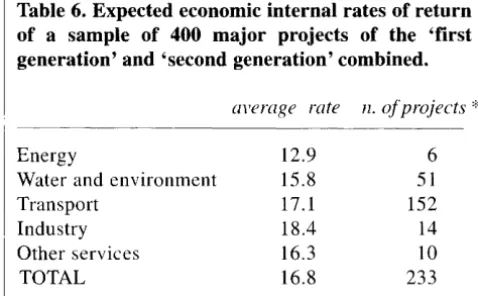
II' The project data must contain information about physical inputs and outputs on an annual basis and on financial inflows and outflows. II' The examiner should check that a consistent financial analysis is available. This implies a forecast of the internal rate of return of the project , or of its net present value. It is important that · these calculations be supported by a full set of financial projections (income statement, balance sheet, cash flow).
While CBA goes beyond the consideration of the financial returns of a project, most of the project data on costs and benefits is provided by a fairly detailed financial analysis. This analysis will give the examiner essential information about forecasted inputs and outputs in physical terms, their prices, and the overall timing structure of inflows and outflows. The existence of such data will greatly increase the possibility of appraising the social impact of the project, because it will be possible to use it as a base for appropriate corrections and additions of data for CBA.
First, the future of the project should be forecast for a period appropriate to its economically useful life and long enough to understand its likely medium/long term impact. For infrastructure, a reasonable time horizon is not less than 20 years; for productive investment about 10 years (see Table 3). For the final year, one has to estimate the residual value (e.g. of standing debt, standing assets, such as building and machinery, etc).
Second, the project data must contain information about physical inputs and outputs on an annual basis. Inputs include personnel, raw materials, purchases of energy and any other relevant physical item, investment goods, etc: output will include units of service and/or of product supplied year by year.
Third, one has to select an appropriate unit of account: when values are expressed in ECU, this will be of help to the Commission assessment.
Fourth, prices must be given to each item. The best practice is to consider current prices and forecast their different trends. One can work with forecasted
constant prices, but then one has to adjust for forecasted changes in relative prices. A survey of major project analyses concluded that too often this issue was not studied in depth by the proposers.
Fifth, financial planning should show that the project does not risk running out of money: the timing of the inflow and outflow of funds may be crucial in implementing the project. Proposers should show how, in the project time horizon, sources of financing (including revenues and any kind of cash transfers) will consistently match disbursments year by year. There is ample evidence that quite often project proposers overlook this important analysis.
Finally, the applicant should show the best estimate of the internal financial rate of return (FRR) of the project or of its financial net present value (FNPV).
Net present value of a project is defined as the difference between the present values of its future cash inflows and outflows. This means that all annual cash flows should be discounted to the start time at a predetermined discount rate.
Internal rate of return. The discount rate at which a stream of costs and benefits has a net present value of zero.
Discount rate. The rate at which future values are discounted to the present. Usually considered roughly equal to the opportunity cost of capital. A clear exposition of the logic of discount rate is in: Bridges G.A., Winpenny J.T, Planning development projects, HMSO, London, 1992.
Constant prices. Prices fixed at a base-year in order to adjust for inflation.
A very low or even negative financial rate of return does not necessarily mean that the project is not in keeping with the objectives of SF. CBA may give a positive socio-economic appraisal of such a project.
The Commission should, in any case, be aware of the net financial burden of the project and should be sure that the project, even assisted by co-financing, does not risk being stopped by lack of cash. At this stage the Commission does not suggest a minimum required financial rate of return, or a financial discount rate for all countries and sectors. International experience and the Commission's own experience with the first and second generation of major projects under SF, however, gives some useful indication.
For productive investments, such as industrial plants, financial rates of return are usually well above 10% (real).
For infrastructure, financial rates of return are usually lower and negative, partly because of the tariff structure of these sectors.
Table 3. Time horizon (years) in the appraisal of a sample of 400 major projects of the 'first generation' and 'second generation' combined
average time lzori:on
Energy
Water and environment Transport
Industry Other services TOTAL
Source: see Tables 1 and 2.
24.7 29.1 26.6 8.8 14.2 20.1
( *) Projects for which data were available.
number* of projects
9 47 127 96 10 289
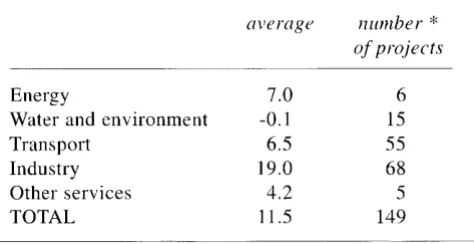
Table 4. Expected financial internal rates of return of a sample of 400 major projects of the 'first generation' and 'second generation' combined
average number* of projects
Energy 7.0 6
Water and environment -0.1 15
Transport 6.5 55
Industry 19.0 68
Other services 4.2 5
TOTAL 11.5 149
Source: see Tables 1 and 2.
(*) Projects for which data were available.
In any case, financial rates of return should be calculated on total investment, net of tax and subsidies, thus excluding granted funds from financial returns.
2.5 Socio-economic costs
V' The project examiner should check if the
proposer has considered social costs of the project that may go beyond its money expenditures. These may occur when:
V' actual prices are distorted by monopolies,
trade restrictions, etc.
V' wages are not linked to labour productivity
V' taxes or subsidies influence price structure
V' there are externalities
V' there are non-monetary effects, including
environmental impacts.
While the previous steps are necessary and important, in a sense they are just preliminary to the assessment of social benefits and costs. The project examiner is advised to start with a check of how the proposer has treated social costs in his own appraisal.
[image:24.571.281.518.126.248.2]Price distortions of inputs and of
outputs
A general goal of the European Union is to complete its internal market. In spite of decades of efforts and of recent moves in that direction, there are still important price distortions among Member Countries and on the border between the EU and the rest of the world. Current prices as they emerge from imperfect markets and from public sector pricing policies, may fail to reflect the opportunity cost of inputs. In some cases this may be important for the appraisal of major projects, and financial data may thus be misleading as welfare indicators. Examples:
a land intensive project, e.g. an industrial site, where land is made available free of charge by a public body, while it may otherwise earn rent; an agricultural project which depends upon water supply at a very low tariff. heavily subsidized by the public sector;
an energy intensive project which depends upon the supply of electricity under a regime of regulated tariffs, when these tariffs are different from long run marginal costs.
In some cases prices are regulated by States so as to compensate for perceived market failures and in ways that are consistent with their own policy objectives; e.g., when indirect taxation is used to correct externalities. But in other cases, actual prices are distorted because of monopoly power, of historical reasons, of incomplete information, or other market imperfections.
Whenever some inputs are affected by strong price distortions, the proposer should consider the issue in the project appraisal and use accounting prices that may better reflect the social opportunity costs of the resources. The project examiner needs to carefully assess and consider how the social costs are affected by departures from the following price structures:
marginal cost for internationally non-tradeable goods. such as local transport services
border price for internationally tradeable goods, such as agricultural or manufactured goods.
In fact, there are often good economic arguments for using border prices and/or marginal costs as accounting prices, when actual prices are deemed to diverge widely from social opportunity costs. However this general rule may be checked under the circumstances of the specific project under examination.
V' Border price. For internationally tradeable goods and services, prices on the international market are usually the appropriate opportunity costs. The particular good can always be sold or purchased at its world price. For marginally imported goods, the accounting price is its CIF (Costs, Insurance, Freight) price; for marginally exported goods, its FOB (Free on Borad) price.
V' For mostly intra-Community tradeable goods there are not important differences between domestic and border prices. But for some extra-Community tradeables, such as some industrial and agricultural goods, and thus in the appraisal of related major projects, there may be significant price differences.
Opportunity cost. The economic value of an input in the best possible alternative use.
Marginal cost is the increase in total cost when production increases by an additional unit.
Border price. For most EC internal market trade domestic prices do not differ much from border prices. But
the~e may be important differences for extra-Community trade and for some related industrial and agricultural prOJeCtS.
Wage distortions
V' In some cases, a crucial input of large projects, particularly of infrastructure, is labour. Current wages may be a distorted social indicator of the opportunity cost of labour because labour markets are imperfect.
Examples:
some people, particularly in public sector employment, may receive wages above or below their counterparts in the private sector for similar work;
in the private sector, costs of labour for the private company may be less than the social opportunity cost because the State gives special subsidies to employment in some areas;
there may be legislation fixing a minimum legal wage, even if under heavy unemployment there may be people willing to work for less.
The proposer, in such cases, may resort to a correction of nominal wages and to the use of an accounting wage.
While the Commission does not recommend a specific accounting wage formula, the proposer needs to be prudent and consistent in his own appraisal of labour social costs. For further reading see Appendix C.
Tax aspects
Market prices include taxes and subsidies, and some transfer payments, that may affect relative prices. While in some cases it would be extremely difficult to estimate net-of-tax prices, some rough, general rules can be laid down to correct such distortions:
prices of inputs to be considered for CBA should be net of VAT and of other indirect taxes;
direct taxes should be included in costs: thus one has to consider wages gross of income taxes, and profits gross of corporate taxes;
pure transfer payments to individuals, such as social security payments, should be omitted; in some cases indirect taxes/subsidies are intended as correction of externalities. A typical example are taxes on energy prices to discourage negative environmental externalities. In this case, and in similar ones, it may be justified to include these taxes in project costs, but the appraisal should avoid double counting (e.g. including both energy taxation and estimates of external environmental costs in the appraisal).
Obviously, the treatment of taxation should be less accurate whenever it has minor importance in project appraisal, but overall consistency is required.
External costs
Any social costs that spill over from the project towards other subjects, without compensation, should be accounted for in CBA in addition to its financial costs.
Examples:
loss of agricultural product because of different use of land;
additional net costs for local authorities to connect a new plant to existing transport infrastructure; increase in sewage costs.
The project examiner should check that these kinds of costs have been identified, quantified. and given a realistic monetary value, if possible. If this is not possible, see next paragraph.
Accounting wage or shadow wage. The highest possible remuneration the labour employed in the project could have earned elsewhere. Because of minimum wage laws, regulations and other rigidities, wages actually paid may not be a correct measure of the real cost of labour. In an economy marked by extensive unemployment or underemployment, the opportunity cost of labour used in the project may be less than actual wage rates.