Rochester Institute of Technology
RIT Scholar Works
Theses
Thesis/Dissertation Collections
5-1-1995
Defense mechanisms
Pamina Traylor
Follow this and additional works at:
http://scholarworks.rit.edu/theses
This Thesis is brought to you for free and open access by the Thesis/Dissertation Collections at RIT Scholar Works. It has been accepted for inclusion
in Theses by an authorized administrator of RIT Scholar Works. For more information, please contact
Recommended Citation
ROCHESTER
INSTITUTE OF
TECHNOLOGY
DEFENSE MECHANISMS
A Thesis
Submitted
to the
Faculty
ofThe
College
ofImaging
Arts
andSciences
in
Candidacy
for
the
Degree
ofMASTER
OF
FINE
ARTS
By
Pamina
Traylor
Rochester,
NY
Approvals
Adviser: Michael Taylor
Date:
.:s-
\~.g~
-Associate Adviser: Stev
7
Loar
_
Date:
£;·\CO·,\\.
Associate Adviser: Susan Ferrari-Rowley
_
Date:
5/lj/q~
7
7
-Chairman for the
School of American Crafts: Michael White.
_
Date:
-S:-/l411fj~
.
....
I, Parnina Traylor, prefer to be contacted each time a request for production is
made. I can be reached at the following address:
Parnina Traylor
3186 Bremerton Place
La Jolla, CA 92037
TABLE
OF CONTENTS
LIST OF ILLUSTRATIONS
hi
INTRODUCTION
1
ARTISTIC INFLUENCES
3
DISCUSSION OF
THE SCULPTURES
9
CONCLUSION
20
TECHNICAL INFORMATION
21
The
Process
for
Casting
the
Large
Concrete Forms
The Process
Used
for
C02
Sand-casting
The Process Used
for
Kiln-casting
SOURCES
CONSULTED
25
LIST OF ILLUSTRATIONS
Figure
Page
1.
Martin
Puryear, Bower,
1980
4
2.
Howard
Ben
Tre,
8th
Figure.,
1988
6
3.
Beverly
Pepper,
Normano
Column,
1980
7
4.
Habitude,
1993
10
5.
Habitude,
detail,
1993
11
6.
Sentient,
1994
12
7.
Sentient, detail,
1994
13
8.
7/
J
torcrure...,
1994
15
9. Internal
Peril,
1994
17
10. Infers/
Peril, detail,
1994
17
11.
untitled,
1994
18
INTRODUCTION
This
thesis
is
the
result of years of effort onthe
part ofmy
artinstructors
to
get meto
focus.
I
have
alwaysbeen drawn
to
experiment withdifferent
techniques
andideas,
all atthe
sametime.
It
was,
therefore, very difficult for
meto
settle upon onetheme,
onebody
of workthat
wasconceptually
andvisually
cohesive.
I
spentthe
better
part ofmy
first
yearin
graduate schoolwildly
moving
from
oneidea
to another,
experimenting
withevery
technique
for
working
withglassthat
I
couldcomeup
with.It
wasn't untilthe
end ofmy
third
quarterthat
I began
to
recognize conceptsthat
had been
recurring
in
my
workfor
the
pastfew
years.My
personalstruggles were reflectedin
my
workagainand
again,
specifically
my
struggleto
allowmyselfto
be
vulnerable,
a struggle whichon somelevel is
universal.As
awomanin
our presentsociety,
I
have
received,
andsubsequently
project,
mixed messagesin
terms
ofestablishing
independence
andrequiring
protection.Personally,
I
sometimesfind
myselftrying
sohard
to
standstrong
and
be
independent
that
I
am afraidto
let
go,
to
let
peoplein,
to
makemistakes,
or show signs ofvulnerability.
While
I
may
notexperiencethe
pain associatedwith
opening
up,
I
alsomiss out onsomeofthe
more rich andemotionally
satisfying
interactions.
The
aimofthis
body
of workis
to
explorethe
overwhelming
urgethat
peoplehave
to
protectthemselves
from
pain,
eitherphysicaloremotional.
I have
attemptedto
visually
display
the
confining
naturewere
thus
intended
to
projectboth
fragility
andstrength.Glass
was anideal
choice
in
that
it
can appear solid and massive as well asfragile
andeasily
shattered.
It is intended
to
metaphorically embody
the
human
spirit.The
use ofstrong
contrastin
these
sculpturesis
intended
to
emphasizethe
duality
in
ourown
existence,
andto
expresstension.
The
othermaterials used werechosenspecifically
for
their
striking
contrastto
glass andfor
their
associationwithARTISTIC INFLUENCES
I
was exposedto
a greatdeal
of art as achild,
especially
while welived
in
Germany
for
a year whenI
was eleven.I
remember quiteclearly
traveling
around
Europe
andbeing
dragged
to what,
atthat
time,
I
felt
was an overload ofmuseums.
I
evenlearned
about religionsthrough
art.Having
been
raisedin
anatheist
environment,
it
wasn't untilnumerous visitsto
churchesto
seethe
architecture and art work
that
I
learned
aboutthe
Bible. I
clearly
rememberlooking
at paintings and stained glasswindowsin
churches andhaving
my
mother recount
to
methe
Bible
storiesdepicted
in
the
paintings.I
loved
these
parables and
believe
that this
has had
alasting
impression
on mein
terms
ofseeing
art as a vehiclefor
communication;
away
to tell
one's stories.Although
this
first
exposureto
art wasthrough
narrativework, the
workwhich
later interested
me mosttended to
be
moreabstract,
verging
onminimalism,
while stillretaining
signs ofthe
maker.During
my first
yearofgraduate school
I
had
the
opportunity
to
see a retrospective exhibit ofMartin
Puryear's
workin
Philadelphia.
I
was overwhelmedby
the
sense ofhistory
andemotion achieved
by
some ofhis very
simpleforms.
Additionally,
sinceI
tend to
work
concurrently
ondifferent
types
ofwork,
I
washeartened
to
see such a widevariety
of stylesto
his
work.In
his
sculptures,
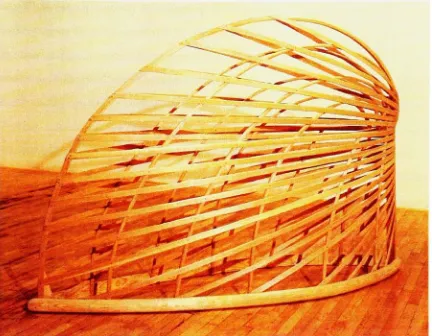
simple relationshipsbetween
volume,
line
and colorbecome
poetic(figure
1). He
statesthat
"the
strongesttension
andthe
ability
to
containopposedideas."1This
is
clearly
evidentin
his
workand
is
something
whichI
have
tried to
achievein
my
body
of work.I
alsofind
the
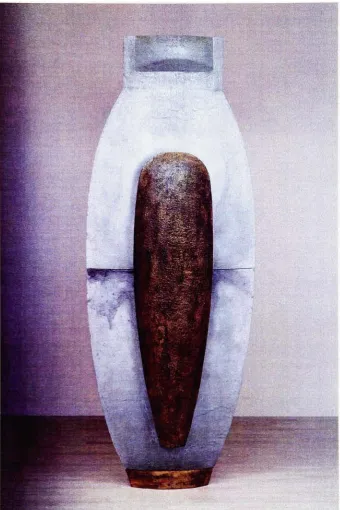
work ofHoward
Ben Tre
(figure
2) extremely
forceful. His
work
has been accurately
described
as"indebted
to the
purist esthetics andreductive
forms
ofMinimalism,
but
[are]
charged with personal and universalcontent and
references,
resulting
in
powerful worksthat
manageto
speakto
abroad
audience and yet still maintainthe
integrity
ofhis
uniquevision."2His
workreferences ancient ruins and
industrial
mechanisms,
leading
the
mindto
journey
into
the
past aswell aspondering
the
future. The human
scale ofsome ofhis
sculptureleads
us alsoto
identify
withthese
objects asfigures,
possessing
gestural qualities meshed with an
industrial
sense.I
was alsoinspired
by
his
useof cast glass combined with metal.
I
have
tried to
learn from his harmonious
union of
two
materials which are sodissimilar.
Beverly
Pepper's
later
work(figure 3)
is
created with a similar estheticbut
on a more monumentalscale.
I
enjoy her
use of simpleforms imbued
withemotionthrough
her
manipulationofform, light,
and negative space."Her
sculptures
may
be
read astimeless
referencesthat
nevertheless maintain a vitaldialogue
between
past andpresent,
between
primary
sculpturalformswhether
geometric or organic-and
the
antecedents of ceremonial1 Martin
Puryear,
"Conversations
withMartin
Puryear,"interview
by
Hugh M.
Davies
andHelaine
Posner,
Martin
Purvear.
ed.Karen
Koehler,
(Worcester,Mass.:
Commonwealth Press
for
University
ofMassachusetts
atAmherst,
University
Gallery, 1984)
23.
Figure
3.
Normano
Column,
Beverly
Pepper,
1980
architecture."3
I
find her
work
invests
the
surrounding
area with a sense ofpowerand
timelessness.
3Douglas
G.
Schultz,
introduction
toBeverly
Pepper;
Sculpture
in
Place
by
Rosalind
E. Krauss (New York:
Abeville
Press
for
theAlbright-Knox
Art
Gallery,
1986)
18.
DISCUSSION OF
THE
SCULPTURES
Uncertainty
anddanger
are natural parts oflife.
For
this reason,
overthe
years we
learn
to
be
wary, to
create ourfacades,
to
protectourselves.These
forms
of
protection,
however,
can undermine ourability
to
enjoy
newexperiences.While
aware ofthis, it
canstillbe difficult
to
venturebeyond
the
familiar.
This
group
of sculpturesdepicts varying
stages of awareness ofthese
issues.
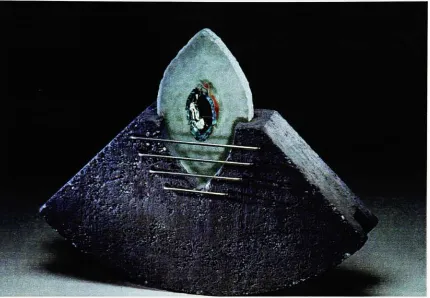
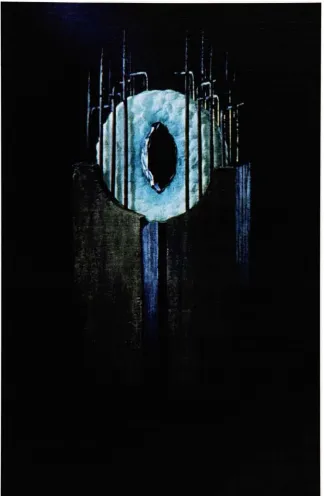
Habitude
(figure
4),
addressesthe
hesitancy
to
break from habit
orcomplacency
withuncomfortable circumstances.
I
choseto
usethe
image
of a cradle or rockerfor
the
base
ofthis
sculpturein
orderto
create a sense ofimbalance
oruncertainty
aswellas a reference
to the
nurturing
environment of our childhood.Because
onedoes
notusually
associatelifeless
concrete with anurturing
environment, the
useof such an
industrial
materialfor
this
image
lends
a sense ofirony.
Set into
the
concrete
base is
sand-castglass,
ovalin
form,
withahole
through the
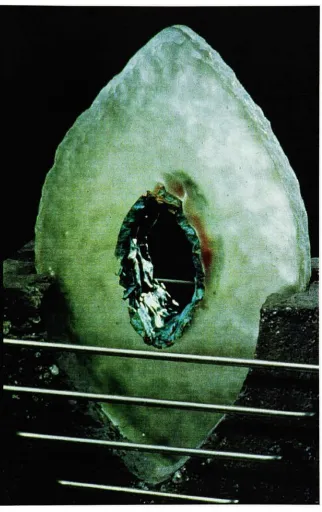
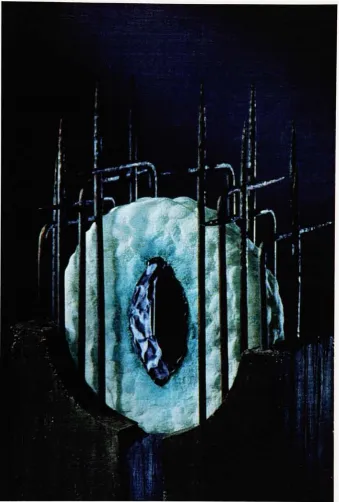
center.The
colorless glass
is
translucentwith abattuto
(hammered)
texture
on one side(figure
5)
and anundulating
sandy
texture
onthe
other side.These
textures
wereused
to
createa softsensualfeel
to the
glass.Although
the
glassis
solid andheavy,
its delicate
naturelends
afragile
quality
to the
piece.The
glassis
notcompletely
enclosedby
the
metalbars,
yet remainsin
this cold,
hard
environment.
Sentient (figure 6
and7)
containsthe
most aggressive andliteral
representation ofentrapmentandprotection
in
this
body
of work.The
centralPhoto
by Geoffrey
TeschFigure
4. Habitude
[image:16.577.77.508.129.427.2]Photo
by Geoffrey
TeschFigure 5.
Habitude,
detail
Photo
by Geoffrey
Tesch
Figure
6.
Sentient
[image:18.577.156.481.55.552.2]Photo
by Geoffrey
Tesch
Figure
7.
Sentient,
detail
[image:19.577.145.485.55.558.2]side
has
anorganic,
uneventexture
whilethe
othersideis
smoothwithvisiblecracks
radiating
from
the
center.The
cracks givethe
ratherlarge
andweighty
glass
form
asenseof vulnerability.It is
supportedby
two
geometric concretecolumnswith a
gap between
them.
Emanating
from
the
concrete andsurrounding
the
glassis
aforest
offorged
steel rods which are rough andthreatening.
I
forged
them
into
sharp
points and placedthem
in
such away
asto
strike out
towards
the
viewer whilesimultaneously
entrapping
the glass, thus
serving
as abarrier
to
both
protect and containit. In
terms
of stages of selfawareness,
Sentient is just
atthe
point ofbecoming
aware,
stillimprisoned in its
own armor.It
was created atroughly
human
scaleto
induce
the
viewerto
identify
withit,
to
feel
personally
threatened
by
the
spikes andsimultaneously
empathize withits
plight.The
large
scale anddangerous
quality
ofthis
piece evokes animmediate
visceral response.As
onebecomes
aware ofbarriers;
personal, cultural,
or otherwise, onemight
develop
the
urgeto
movebeyond
these
barriers.
If
I
Venture
(figure 8)
represents a
tentative
venturebeyond
confinement,
questioning
whatlies
beyond.
For
this piece, the
sharp
spikes andlarge
scale werediscarded
to
providea more
intimate
setting
andless
threatening
tenor
for
this
symbolicfirst
peekout ofthe
cage.This
sculptureis formed
by
a circular enclosure of steel rodsheld
together
by
two
concrete rings.The
glassform is
suspendedin
the center,
held
on eithersideby
the
concrete.The
glass comesto
a point andprotrudesslightly
through
the
concrete on either side.The
central portion ofthe
glasshas
atexture
whichwinds aroundit,
reminding
one of growthrings on atree,
implying
ahistory
of change and movement.The
ends ofthe
piece arehighly
polished,
allowing light
into
the
glassand perhaps a view out.My
naturaldefenses
and unconscious signals can sometimes createPhoto
by Geoffrey
Tesch
Figure
8.
If
I Venture
[image:21.577.76.507.129.419.2]extremely
uncomfortable
circumstancesfor
myself.At
times
in
my
life,
I have
felt
that
I
ammy
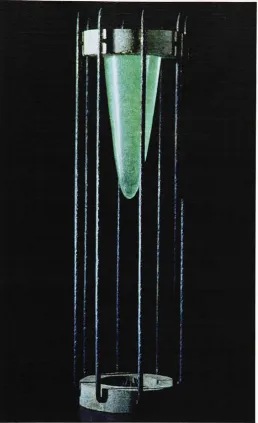
own worstenemy.Internal Peril (figure
9)
is
adepiction
of our ownprotective
layering
asjust
that,
the
enemy.I
choseto
usea steel and concretestructuresimilar
in
form
to that
ofIf
I
Venture,
but
placedit vertically
creating
areference
to
abird
cage,
preventing any possibility
offlight. The
cageis
constructedof
roughly
hewn,
forged
steelheld
together
by
cement rings attop
and
bottom.
The
glass containedwithinthe
top
ring
streamsdown like
anicicle,
hanging
oversharp
steelpointswhichjut
up
out ofthe
bottom. The
cageprovides support
for
the glass,
keeping
it
safefrom
the
steelpointsbelow,
but
the
steel rods
that
form
the
cage also extendinto
the
concreteatthe
bottom
andcurve upward
to
form
the sharp,
dangerous
points(figure
10).
The
steelstructure
thus
providessimultaneously
the
element of support andthe
elementof
danger. When
lit
from
above, the
highly
polished ends ofthe
glass conedraw
light
into
the
piececreating
the
illusion
that
it is
glowing
from
within,
shining
brightly
despite
its
cage.The
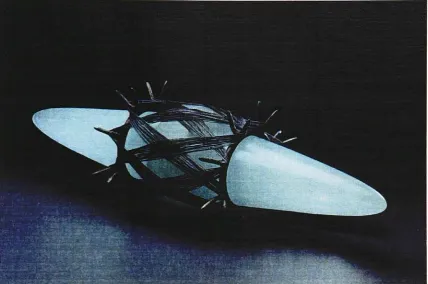
last
sculpturefor
my
thesis
exhibit(figure
11)
is
the
final
stage ofthe
progression
depicted
in
this grouping; that
of adesire
to
pushbeyond
the
boundaries.
Because I
wantedto
set afuturistic tone,
I
choseto
imbue
this
sculpture with a much more
industrial
sense.The
glassis
paleblue
in
color witha smooth satin surface.
It
is
translucentbut
nottransparent,
relinquishing
the
vulnerability
producedby
the
ability
to
look into
the
piece.The
density
ofthe
glass and slick surface give
it
an aura of strength.The
glassis
supportedby
two
forged,
spiked,
steel rings which arelashed
to the
piece with a web ofiron
wire.I
wanted
the
wireto
hold
the
form
together
andprovide a pattern andevidenceofthe
making
ofthe
piece.The
actofwrapping
the
piecetook
time
and repetitionwhich
is
clearly
evidentin
the
density
ofthe
wirebundles. While
the
wireforms
1
HI
*
1
W.
' ; 1h
l r / * ?i
1
;1
1
r !\
: IIffe^.'
i ' i1
tI
t 'I
1 ;|
' i.\
\
1
Figure
9.
Internal Peril
Figure
10. Internal
Peril,
detail
Photo
by Geoffrey
Tesch
Photo
by Geoffrey
Tesch
[image:23.577.183.442.57.481.2] [image:23.577.196.425.523.670.2]Photo
by Geoffrey
TeschFigure
11.
untitled [image:24.577.93.522.130.414.2]a
distinct
pattern,
it is
wovenwithirregularity
giving
evidence ofthe
human
touch to the
otherwisesharp
andindustrial form.
The
wirewrapping
evokesimages
ofhand
madebaskets
anddrums
as well asindustrial
cables,
calling
into
question
the
relationship
between
nature andtechnology.The
glassbulges
outwhere
the
wireis
wrapped,
and onthe
sides extends wellbeyond
the
steelenclosed area as
if
growing
out ofthese taught
bonds.
CONCLUSION
In
general, I
amhappy
withthe
way
this
body
of work matured and wasvery
pleasedwiththe
responseatthe
thesis
show.The different
stages ofawareness seemed
to
be
clearly
readby
those
I
spoke with.Many
ofthe women,
in
particular,
seemedto
identify
withthe
emotions and concernsdealt
within
this series of work.
It
was alsosurprising
to
mehow
many
studentsboth
maleand
female
weretouching
on similarissues in
theirwork.I
canonly
concludethat
in
this time
ofredefining
of our genderroles,
many
people arehaving
difficulty
adapting.Men
arebeing
taught to
be
moresensitive,
womento
be
morecompetitive and
independent,
both
unsure ofthis
new ground andthe
newrules
for
interaction. This
uncertainty,
coupled withthe
estrangement causedby
the
everincreasing
mechanizationof oursociety,
has
produced newlayers
ofwalls
between
us and a subsequentlack
ofintimacy. In
making
this
series ofwork,
I
was ableto
examine moreclosely
the
difficulties
that
I
have
in
pulling
back
the
layers,
andletting
peoplein. I
look forward
to
continuing
to
explorethese
issues
andthis
marriage ofglass and metal.TECHNICAL INFORMATION
The
Process for
Casting
the
Large
Concrete
Forms
One
difficulty
I
had
in
working
withHabitude
andSentient
wasthat
the
concrete was
extremely
heavy. To
reducethe
weight ofthe
concreteforms
I
made
them
withafoam
core sothat the
concrete was no morethan
1
1/2"to
2"thick.
I
found
the
pieces were stilltoo
heavy
whenusing ready
to
mixconcrete,
therefore
I
mixedmy
own concreteusing
alight
weight aggregate.The
proportions were
5
partsaggregate,
2
partssand,
3
parts cement.I
added acommercially
available powderedconcretedye
to the
dry
mixturefor
Habitude.
For
Sentient,
I
paintedthe
surface aftercuring using
a sponge andextremely
dilute
acrylic paint.The
moldsfor
the
concrete weremade with plywood.The
curved areaswere shapedwith
Styrofoam
whichwasinset into
the
plywood mold andthe
holes for
the
steel rods were createdusing
woodendowels
which were removedfrom
the
concrete whileit
was stillwetroughly
8-10
hours
afterthe
form
waspoured.
The
Process
Used for
Sand-casting
The
glass portion ofHabitude
andSentient
were castusing
a method calledbonded
C02
sand-casting.The
form
to
be
castis
usually
modeledin
clay first
and while still wet
is
covered with a mixture of sand and aliquid
rigidizer(sodium
silicate).The
moldis
then
exposedto
C02
whichactivatesthe
rigidizerand
the
moldbecomes
hard
at which pointthe
clay
positive canbe
dug
out ofthe
mold.
This
hard
sand moldis
then
ready
to
have
moltenglass pouredinto it
orit
can
be
carvedfor
additionaldetail.
I
usedStyrofoam
ratherthan
clay
to
createmy
form. It
was quicker and more accurate giventhe
size andsimplicity
ofthe
forms
I
wantedto
cast.I
madethe
Styrofoam
forms
solid;
withoutthe
hole
through the
center.Instead,
I
made a separateform
out of copperflashing
which wouldbe
placedin
the
moldto
createthe
hole
in
the
center.This
copperform
was
filled
with a50/50
plaster/silica
investment
sothat
it
wouldnot collapsewhen
the
glass was poured aroundit. A
container wasthen
constructed which was2"deeper
and2"
widerall around
than the
Styrofoam
form. I
used2"
thick
foam
to
form
the
base
andthen
wrappedtar
paper aroundit.
Next,
sodium silicate was mixed with grade one silica sand.More
sodium silicatein
the
mixture creates a
harder
mold,
however,
too
much can causeit
to
bond
withthe
glass and crack
the
glass.After
sometesting
I
found
that
6%
sodium silicate would workbest for
my
needs.This
mixture was placedinto
the
container andthe
foam
positive wasthen
pressedinto
the
sand andthe
sand packedtightly
aroundit. Quarter inch
woodendowels
werethen
placed aroundthe
sides andbottom
ofthe
moldto
createholes
wherethe
nozzle whichemitsthe
C02
wouldbe
inserted.
Releasing
the
gas all aroundthe
moldin
this
way
insures
that the
C02
permeatesthe
entire mold andthat the
entire moldbecomes
rigid.Some
dowels
wereplacedvertically;equally
spaced aroundthe
form
extending
through the
sandto the
bottom
ofthe
container.Other
dowels
werealso placedhorizontally,
atthe
base
ofthe mold,
piercing
the tar
paper andradiating
towards the
centerofthe
mold.Next
the
Styrofoam
positive was pulled out ofthe
sand mold andthe
copperform
was presseddown into
the
center sothat
it
would setinto
placewhenthe
sandbecame
rigid.The
entire mold wasthen
placed
in
alarge
plasticbag
in
preparationfor
adding
the
gas.The
C02
tank
had
to
be
fitted
with a regulator andhose
whichextendedinto
a piece of copperrefrigerator
tubing
into
which smallholes
had been drilled
sothat the
gas wouldbe
dispersed
allalong
the
metal probeThe
woodendowels
werethen
removedand
this
probe wasthen
placedinto
the
mold.With
the
bag
closedaroundthe
hose,
gas was releasedfor
roughly
20
secondsinto
each ofthe
holes. I
thenfilled
the
bag
which enclosedthe
mold one moretime
andtied
it
offto
sitfor
anhour.
At
this time the
entire mold wasrigid, the
bag,
tar
paperandfoam
base
couldbe
removed
I
choseto
alterthe
molds atthis
point and carvedthe to
create anorganic surface on
the
glass.The Process
Used
for
Kiln-casting
The
glassportionofthe two
untitledpieces wereboth
madeusing
the
kiln-casting
process.One
clay
original was usedto
make allthese
glassforms.
The
buff
colorclay
wasfirst
thrown
solid on awoodenbat. It
wasthen
coveredwitha one
inch layer
of plaster-basedinvestment
whichwasin
turn
coveredwitha
half inch layer
ofrefractory
cement(AP Green
KS-4 PLUS).
To
preparethe
mold
for
investing,
a smalldam
wallabout2"
high had been
placed aroundthe
clay
mold about ahalf
inch
away from it
andbacked up
with smallbead
of wetclay
to
preventleaking.
The investment
whichI
used was one partPottery
Plaster
#1,
one part300
mesh silicaflour,
andone partdental
plaster(Miles
Inc.
T-60).
These ingredients
weremixeddry
andthen
sifted over waterin
a5
gallonbucket
untila mound ofdry
materialappears overthe
water.I
do
not measurethe
amount of waterI
use.Having
mademany
plaster moldsin
the
pastI
amable
to
judge
by
eyeroughly how
much water will make enoughinvestment for
my
piece.The
mixturewasthen allowedto
standfor
2-3
minutes until allthe
dry
materialwassoaked up.
The
materialsweremixedby
hand
until an evenconsistency
was reached.While
the
investment is
still quiteliquid,
I
poura smallamountof
it
overthe
mold andtap
the
woodenbat gently
to
remove airbubbles.
This
splash coatforms
athin
layer
overthe
piece withnobubbles. I
then
waitfor
the
investment
to thicken
up
to the
consistency
ofthick
creamor peanutbutter
sothat
I
can slatherit
onby
hand
andit
willmaintainits form. The
pieceis
then
covered
evenly
withahalf inch
layer
ofinvestment
with alittle
moreatthe
top
to
form
aflat base
on whichit
can sit whenturned
over.When
the
investment
becomes
hard
the tar
paperis
removed and aputty
knife
usedto
cleanup
the
edges and remove
any sharp
or uneven spots.The
refractory
cementis
then
placed
in
a shallowmetalcontainer(I
used a50
gallondrum
whichI
had
cutin
half
withanoxy/
acetylenetorch)
andwaterslowly
added and mixedin
untilit
becomes
a ratherthick
creamy
consistency.The
investment
moldis
then
wetdown
withwater sothat the
cement will stickto the
sides andthe
cementis
applied
by
hand
to
form
ahalf inch
layer
all around.Thick
rubbergloves mustbe
used when
applying
the
cementasit is
extremely
causticto the
skin.The
entiremold
is
then
covered withplastic and allowedto
stand undisturbedfor
aday.
The
plasticmay
thenbe
removed and after another24
hours
the
mold canbe
turned
over andthe
woodenbat
pulled upwardremoving
the
clay
positivefrom
the
investment. After
the
molddries for
about a weekit is ready
to
be
cast.It is
placed with
the
opening
up
onabed
of sandin
the
kiln.
When
the
moldhas
reached
temperature
it is filled
withglassfrit(small
pieces ofbroken
glass).If
smaller size glass
frit is
usedthe
final
piece willbe
more opaque.Larger
chunksof glass willproducea moretranslucentproduct.
I
chose glassfrit
aboutthe
sizeof a
kernel
of cornfor
Internal Peril
andslightly
smallerfrit
for
the
untitled piece.SOURCES
CONSULTED
Goodman,
Nelson.
Languages
ofArt: An
Approach
to
aTheory
ofSymbols.
Indianapolis:
The
Bobbs-Merrill
Company,
Inc.,
1968.
Ben
Tre,
Howard. Howard
Ben Tre.
n.p.:Meridian
Printing,
1988.
Lundstrom,
Boyce.
Glass
Casting
andMold
Making.
Vitreous
Publications,
1989.
Puryear,
Martin. "Conversations
withMartin
Puryear."Interview
by
Hugh M.
Davies
andHelaine
Posner.
ed.Karen Koehler. Martin Puryear.
Worcester,
Mass.:
Commonwealth
Press
for
University
ofMassachusetts
atAmherst,
University
Gallery,
1984.
Krauss,
Rosalind
E.
Beverly
Pepper:
Sculpture
in Place.
New
York:
Abeville
Press for
the
Albright-Knox Art
Gallery,
1986.
Zelevansky,
Lynn.
Sense
andSensibility: Women Artists
andMinimalism
in
the
Nineties. New York: The Museum
ofModern
Art,
1994.