R E S E A R C H
Open Access
Identification and characterization of alternative
splicing in parasitic nematode transcriptomes
Sahar Abubucker
1†, Samantha N McNulty
1†, Bruce A Rosa
1and Makedonka Mitreva
1,2,3*Abstract
Background:Alternative splicing (AS) of mRNA is a vital mechanism for enhancing genomic complexity in eukaryotes. Spliced isoforms of the same gene can have diverse molecular and biological functions and are often differentially expressed across various tissues, times, and conditions. Thus, AS has important implications in the study of parasitic nematodes with complex life cycles. Transcriptomic datasets are available from many species, but data must be revisited with splice-aware assembly protocols to facilitate the study of AS in helminthes. Methods:We sequenced cDNA from the model wormCaenorhabditis elegansusing 454/Roche technology for use as an experimental dataset. Reads were assembled with Newbler software, invoking the cDNA option. Several combinations of parameters were tested and assembled transcripts were verified by comparison with previously reportedC. elegansgenes and transcript isoforms and with Illumina RNAseq data.
Results:Thoughtful adjustment of program parameters increased the percentage of assembled transcripts that matched knownC. eleganssequences, decreased mis-assembly rates (i.e., cis- and trans-chimeras), and improved the coverage of the geneset. The optimized protocol was used to updatede novotranscriptome assemblies from nine parasitic nematode species, including important pathogens of humans and domestic animals. Our assemblies indicated AS rates in the range of 20-30%, typically with 2-3 transcripts per AS locus, depending on the species. Transcript isoforms from the nine species were translated and searched for similarity to known proteins and functional domains. Some 21 InterPro domains, including several involved in nucleotide and chromatin binding, were statistically correlated with AS genetic loci. In most cases, the Roche/454 data explored in this study are the only sequences available from the species in question; however, the recently published genome of the human hookwormNecator americanusprovided an additional opportunity to validate our results.
Conclusions:Our optimized assembly parameters facilitated the first survey of AS among parasitic nematodes. The nine transcriptome assemblies, their protein translations, and basic annotations are available from Nematode. net as a resource for the research community. These should be useful for studies of specific genes and gene families of interest as well as for curating draft genome assemblies as they become available.
Keywords:Parasitic nematodes, Transcriptomes, Alternative splicing, Next-generation sequencing
Background
Alternative splicing (AS) is a post-transcriptional, mRNA modification process that allows a single gene to give rise to multiple protein isoforms [1,2]. These spliced isoforms can have distinct molecular functions and biological roles and may be differentially expressed among tissues, life
cycle stages or environmental conditions [3], resulting in involvement in more genetic interactions and biochemical pathways compared to non-AS genes [4]. Therefore, AS provides a significant boost to genomic complexity with-out necessitating a proportional increase in genome size. AS takes place to some extent in most eukaryotic organisms [5-7], and has been studied extensively in
humans and model species, including Caenorhabditis
elegans [8-12], but has not received much attention in
parasitic nematodes. In fact, information on AS in parasitic nematodes is extremely sparse, and existing * Correspondence:[email protected]
†Equal contributors
1
The Genome Institute, Washington University School of Medicine, 4444 Forest Park Boulevard, St. Louis, MO 63108, USA
2
Division of Infectious Diseases, Department of Internal Medicine, Washington University School of Medicine, St. Louis, MO 63110, USA Full list of author information is available at the end of the article
reports have focused on a few or single representative gene(s) [13-16].
High throughput cDNA sequencing is the preferred method for detecting and quantifying AS. Today’s most prevalent sequencing protocols (e.g., 454, Illumina, Ion Torrent, etc.) involve fragmentation of nucleic acid mole-cules, construction of sequencing libraries, and generation of many thousands to millions or even billions of short reads. In the absence of a well-curated genome for com-parison, these reads must be re-assembled de novo into contiguous sequences (contigs) that faithfully represent the full-length transcripts from which they were derived. Graph-based assembly algorithms have been developed to maintain associations between transcripts with shared contigs, making it possible to identify different isoforms of the same gene [17]. However, this procedure is computa-tionally challenging, and various studies have shown that
de novocDNA assemblers typically overestimate the
num-ber of isoforms associated with a given locus and that many of the predicted isoforms are illegitimate [18-21]. Care must be taken to optimize assembly parameters to minimize errors and maximize accuracy and coverage.
cDNA sequencing is a cost-effective means of gene discovery in non-model organisms, so it often serves as the first line of investigation into an organism’s genetic complement. Thus, the transcriptomes of many parasitic nematodes (often including multiple sexes and life cycle stages) have been sequenced and relevant datasets are
readily available [22]. Several de novo transcriptome
assemblies have been reported [23-30], but most were generated with software that did not account for AS (e.g., Newbler prior to version 2.3, CAP3, etc.). Revisiting existing datasets with a cDNA-specific, splice-aware, assembly protocol would provide a far more accurate impression of AS in parasitic nematodes, a factor that can have important practical implications with respect to pathogenesis, drug susceptibility/resistance, vaccine de-velopment, etc. [31,32]. For example, the broad-spectrum anthelmintic drug ivermectin is known to bind tightly to one isoform of the α3 glutamate gated chloride channel subunit but not another, and these isoforms appear to be differentially expressed in susceptible versus resistant strains of the cattle parasites Cooperia oncophora and Ostertagia ostertagi[13,33].
In this study, we used cDNA data from the well-characterized model organismCaenorhabditis elegansto define a set of optimized parameters for high-confidence splice isoform prediction using the Newbler assembler. The optimized protocol was then applied to existing and novel cDNA sequences from a diverse array of parasitic nematodes, includingAncylostoma caninum,C. oncophora, Dictyocaulus viviparus, Necator americanus, Oesophagos-tomum dentatum,Onchocerca flexusoa,O. ostertagi, Tela-dorsagia circumcincta, and Trichostrongylis colubriformis
[23-30] in the first broad survey of AS among parasitic worms. Our assemblies offer a better impression of genetic and transcriptional complexity in these non-model species and will aid in studies on specific genes/gene families and for annotating and curating draft genomes as they become available.
Methods
454/Roche library construction, sequencing and data cleaning
One splice-leader (SL1) and four oligo(dT) cDNA
librar-ies were constructed from DNase treated C. elegans
(Bristol N2) RNA according to previously described methods [26]. Libraries were sequenced with a GS 454 FLX pyrosequencer using a standard protocol [34], and raw reads were deposited in the NCBI sequence read archive (SRA) under project number SRP003926. Parasitic nematode sequences were mostly obtained from previous studies, but novel sequences were produced and submit-ted to the SRA in the same manner (see Additional file 1: Table S1 & [23-30]).
Raw reads were edited and filtered prior to assembly. Relevant adapter sequences were removed with Cutadapt [35], and reads with an overall quality score less than 20 and an overall dust score less than seven were removed using seq_crumbs software (http://bioinf.comav.upv.es/ seq_crumbs/). The remaining reads were aligned to rRNA [36,37] and bacterial [38] sequence databases with Bowtie2 (version 2.1.0, default parameters [39]) and to the human (hs37) genome and relevant host genomes with Tophat2 (version 2.0.8, default parameters [40]) for contaminant re-moval. Host genomes, obtained from GenBank, included:
Canis lupus famliaris (CanFam3.1) for A. caninum; Bos
taurus(Btau4.6.1) for C. oncophora,D. viviparus, andO. ostertagi; Sus scrofa (Sscrofa10.2) for O. dentatum; Ovis aries(Oar3.1) forT. colubriformisandT. circumcincta. O. flexuosa, a parasite of European red deer (Cervus elaphus),
and N. americanus, maintained in golden hamsters
(Mesocricetus auratus), were screened againstBos taurus (Btau4.6.1) and the GenBank rodent database (gbrod, downloaded April 24, 2013), respectively, as close substi-tutes for the unavailable host genomes.
Cleaned C. elegans Roche/454 reads were mapped to
C. elegans coding sequences (WormBase [41] release
WS236) with Bowtie2 (version 2.1.0, default parameters [39]) in order to assess the scope of the dataset prior to assembly. The coverage of each feature was assessed using RefCov version 0.3 (http://gmt.genome.wustl.edu/ gmt-refcov/) and coverage was reported in Additional file 2: Table S2.
Assembly and evaluation
Cleaned, decontaminatedC. elegansRoche/454 reads were assembled into isotigs (transcript isoforms) and clustered
Abubuckeret al. Parasites & Vectors2014,7:151 Page 2 of 12
into distinct isogroups (putative genetic loci) using the Newbler assembler (version 2.6, mapasm454_source_ 10142011), invoking the cDNA option. Various combina-tions of parameters were tested (see Table 1), and the iso-tigs from each assembly were compared to theC. elegans coding sequences (CDSs) and coding transcripts (CDS + UTRs) included in WormBase [41] release WS236 by BLAST + (version 2.2.27) with a cutoff of≥90% sequence identity over ≥75% the isotig’s length in a single high-scoring segment pair. BLAST + was also used to identify chimeric transcripts with non-overlapping, top BLASTN hits to separate chromosomes or BLASTP matches indi-cating multiple open reading frames coding in opposite directions. Fragmentation (percentage of matched ref-erence genes with multiple, non-overlapping hits) was calculated from WU-BLAST alignments to CDSs using in-house scripts. To further validate our isoform pre-dictions, Illumina RNAseq libraries were generated from
C. elegans RNA as previously described [42] (SRA
num-bers: SRR868958, SRR868932, SRR868957, SRR868939, SRR868942), and the resulting raw reads were mapped to assembled isotigs using Bowtie2 (version 2.1.0, default parameters [39]). The coverage of each isotig, as assessed
using RefCov version 0.3 (http://gmt.genome.wustl.edu/ gmt-refcov/), is reported in Additional file 3: Table S3.
Parasitic nematode transcriptomes were assembled with parameters that showed the optimal performance
onC. elegansdata (minimum overlap of 100 bp and 95%
identity, minimum contig length of 30, and heterozygos-ity specified). Large or complex datasets were reduced to a manageable size by digital read normalization prior to assembly using khmer with a word size of 31 bp (http:// ged.msu.edu/papers/2012-diginorm/). N. americanus iso-tigs were compared with transcript isoforms reported
along with the genome ofN. americanus[43] by BLASTN
(cutoff of≥90% sequence identity over≥75% length of the isotig in a single high-scoring segment pair).
Annotation of parasitic nematode transcriptomes
Parasite isotigs were searched against the GenBank non-redundant protein database (downloaded July 9, 2013),
and non-overlapping top hits with e-value ≤1e-5 were
[image:3.595.59.540.401.684.2]recorded (Additional files 4, 5, 6, 7, 8, 9, 10, 11 and 12: Tables S4-S12). Prot4EST [44] was used to generate translations from the parasite isotigs, and InterPro pro-tein domains and gene ontology terms were predicted
Table 1Caenorhabditis eleganstest assemblies1
cDNA default cDNA -urt cDNA -het cDNA -icl 10 cDNA -icl 30 cDNA -icl 50 cDNA -het -icl 30 -mi 95 -ml 100
Assembly statistics
% Aligned reads 97.37% 99.09% 97.34% 97.36% 97.37% 97.37% 96.70%
Isotigs 16737 25776 16868 16548 16263 16130 16772
Isotig N50 658 563 658 659 662 662 598
Isogroups 15403 24523 15404 15401 15380 15358 15940
AS Isogroups 824 (5.35%) 823 (3.36%) 824 (5.35%) 802 (5.21%) 741 (4.82%) 674 (4.39%) 691 (4.34%) Ave. isotigs per
AS isogroup
2.62 2.52 2.78 2.43 2.19 2.15 2.20
Accuracy
fragmentation 9.40% 20.70% 9.40% 9.40% 9.40% 9.40% 9.90%
trans-chimeric isotigs2 397 (2.37%) 407 (1.58%) 398 (2.36%) 398 (2.40%) 397 (2.44%) 385 (2.38%) 148 (0.88%) cis-chimeric isotigs3 165 (0.99%) 185 (0.72%) 209 (1.24%) 195 (1.18%) 148 (0.91%) 145 (0.90%) 104 (0.62%) BLASTN v. CDSs
Isotigs with match4 6155 (36.77%) 10604 (41.14%) 6158 (36.51%) 6083 (36.76%) 6022 (37.03%) 5996 (37.17%) 6385 (38.07%) Isogroups with match5 5937 (38.54%) 10400 (42.41%) 5940 (38.56%) 5933 (38.52%) 5913 (38.45%) 5901 (38.42%) 6294 (39.49%) C. elegansgenes represented 5602 (27.31%) 8470 (41.29%) 5604 (27.32%) 5599 (27.29%) 5583 (27.21%) 5579 (27.19%) 5727 (27.92%) BLASTN v. CDS + UTR
Isotigs with match4 11418 (68.22%) 17031 (66.07%) 11456 (67.92%) 11217 (67.78%) 11053 (67.96%) 10984 (68.10%) 11778 (70.22%) Isogroups with match5 10811 (70.19%) 16512 (67.33%) 10816 (70.22%) 10815 (70.22%) 10789 (70.15%) 10777 (70.17%) 11540 (72.40%) C. elegansgenes represented 9600 (46.79%) 12129 (59.12%) 9600 (46.79%) 9598 (46.79%) 9575 (46.67%) 9564 (46.62%) 9748 (47.52%) 1
Newbler parameters are as follows: urt, include unaligned read tips; het, heterogeneous population; icl, isotig contig length threshold; ml, minimum overlap length; mi, minimum overlap identity.
2
Trans-chimeric isotigs refer to misassembled transcripts with multiple open reading frames coding in opposite directions. 3
Cis-chimeric isotigs refer to misassembled transcripts containing sequences derived from distinct regions of the genome assembly. 4
Matches were required to meet a cutoff of≥90% nucleotide sequence identity over≥75% of the length of the isotigs in a single high-scoring segment pair. 5
from translated proteins using InterProScan [45,46]. Transcript sequences, peptide translations, and anno-tations are reported in Additional files 4, 5, 6, 7, 8, 9, 10, 11 and 12: Tables S4-S12 and are available from Nematode.net [22].
Enrichment of AS isogroups associated with functional domains
The number of alternatively spliced and non-alternatively spliced isogroups associated with each InterPro domain was counted (Additional file 13: Table S13), and a non-parametric binomial distribution test was applied to each InterPro domain to test for enrichment of AS isogroups using the following input parameters: (i) the background frequency of AS isogroups across all species (40.5%); (ii) the number of AS isogroups associated with the InterPro domain across all species (i.e., number of“successes”); (iii) the total number of isogroups associated with the InterPro domain across all species (i.e., number of“trials”). In order to reduce false positives resulting from poorly represented domains, domains represented by fewer than ten iso-groups or fewer than four species were ignored, reducing total number of domains considered from 5,190 to 3,141 (a 39.5% reduction; Additional file 14: Figure S1).Pvalues calculated for each domain were population corrected using False Discovery Rate (FDR) correction [47], and a significance threshold of 0.01 on the corrected P values was used to determine which InterPro domains were significantly more often associated with AS isogroups than non-AS isogroups.
Results and discussion
Optimization of assembly parameters
cDNA libraries were generated from mixed stageC.
ele-gansworms and sequenced using Roche/454 technology.
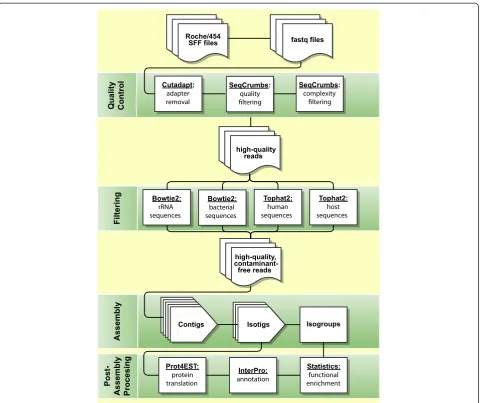
Our workflow, from the processing of raw reads to the annotation of transcript isoforms and isogroups, is outlined in Figure 1. After trimming, filtering, and contam-inant removal, 1,746,642 high-quality reads were mapped toC. elegansCDSs to assess the scope of the dataset prior to assembly, and 8,391 CDS isoforms from 7,487 of the 20,515C. elegansgenes (36.5% of all genes) showed≥50% breadth of coverage. This level of coverage is comparable to the level seen in previous transcriptomic surveys of non-model organisms [26,28,29] and is sufficient for test-ing assembly protocols. It was not our intention to perform a thorough study of AS inC. elegans; studies of this nature have been reported elsewhere [11].
The Newbler assembler, distributed by 454 Life Sciences, is considered the gold standard for Roche/454 read assem-bly. Using the cDNA option, Newbler identifies regions of shared sequence, termed contigs, and compiles them into full-length transcripts, termed isotigs. Isotigs with shared contigs, theoretically derived from AS of the same gene,
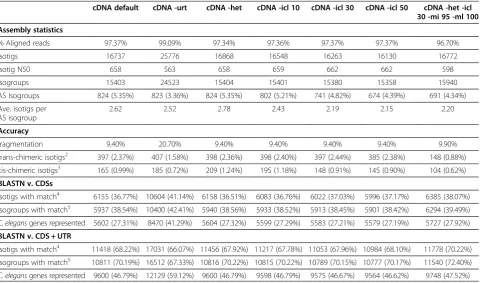
are clustered into isogroups representing distinct genetic loci. We tested various combinations of program parame-ters in order to reduce assembly errors and increase the percentage of isotigs and isogroups that accurately repre-sent knownC. eleganssequences (Table 1). The best results were obtained with a contig length of 30 bp, minimum read overlap of 100 bp, minimum sequence identity of 95% (Table 1, last column). The heterozygous mode had little effect on ourC. elegansassemblies, but we chose to invoke this option to accommodate the genetic heterogeneity of our parasitic worm datasets. Using these parameters, 96.7% of the clean reads were assembled into 15,940 isogroups containing 16,772 isotigs. Some 691 (4.3%) of these iso-groups are associated with more than one isotig, with an average of 2.2 isotigs per AS isogroup (Table 1). Approxi-mately 17% of theC. elegansgenes reported in WormBase build WS236 are associated with more than one CDS isoform with an average of 2.6 isoforms per AS gene [41], and a 2011 study reported that at least 25% of allC. elegans genes undergo AS [11]. The relatively low rate of AS detected in our test assembly is probably a reflection of the clonal worm population that, despite being mixed-stage, was dominated at the tissue level by the relatively large adult hermaphrodites. Sampling each sex and life cycle stage independently could have provided greater resolution of AS events; however, the aim of this exercise was to optimize assembly protocols, not to explore AS in the model worm.
By adjusting assembly parameters, we were able to increase the number and percentage of isotigs and isogroups that accurately reflected known CDSs, increase the coverage of the gene set, and reduce the rates of misassembled transcripts (i.e., cis- and trans-chimeras). In the best version of our transcriptome assembly, 38.07% of the isotigs were matched to 7,027 distinct CDS isoforms from 5,727C. elegansgenes (Table 1, last column). Match rates increased when isotigs were compared to coding transcripts (CDSs plus untranslated regions) rather than CDSs, indicating that a portion of our sequence data corresponds to untranslated regions at the extreme ends of the transcript.
Despite careful control of assembly parameters, approxi-mately 30% of the assembled isotigs failed to find a
BLAST match to a coding transcript isoform (≥90%
sequence identity over≥75% of the length of the isotig in a single high-scoring segment pair). The identification of novel AS isoforms and genes is to be expected given that the reported rates of AS in C. elegans have steadily in-creased over time (Table 2). Therefore, we sought to verify the remaining isotigs using data from another sequencing platform. Of the 4,994 un-matched isotigs, 478 showed 100% breath of coverage with Illumina RNAseq reads, a strong indication that they reflect real, expressed transcript isoforms, not sequence misassembles (see
Abubuckeret al. Parasites & Vectors2014,7:151 Page 4 of 12
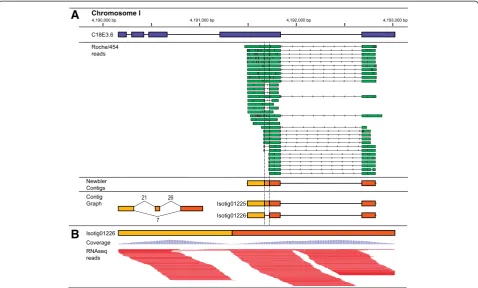
Additional file 3: Table S3). An example of this is illustrated in Figure 2. Isogroup00600 contains two distinct isotigs derived from C. elegans gene C18E3.6. One isotig corresponds perfectly to the gene model while the other is missing a 50 base pair segment of
the gene’s fourth exon. Sequence reads generated on
the Roche/454 and Illumina platforms both support the sequence gap despite the fact that this isoform is not represented in WormBase release WS236.
[image:5.595.59.543.87.490.2]Altogether, 12,265 of the 16,772 isotigs included in our best transcript assembly (73.1%) were verified either by a match to previously reported transcript isoforms in-cluded in WormBase or by our orthologous sequencing Figure 1Roche/454 read processing, decontamination, assembly and annotation.Raw Roche/454 reads were converted from sff to fastq format for editing and assembly. Relevant adapter sequences were trimmed, and reads failing to meet quality and complexity thresholds were removed. Reads that successfully map to rRNA, bacterial, human or host sequences were also eliminated. The remaining, high-quality, species-specific reads were assembled with Newbler’s cDNA specific protocol using our optimized parameter combination, translated using Prot4EST [44], and annotated using InterProScan [45,46]. Statistical analyses can be carried out at the level of isotigs (unique transcripts) or isogroups
(unique genetic loci) depending on the nature of the investigation.
Table 2Caenorhabditis elegansassembly statistics1
Build Date Gene sequences Unique CDS isoforms
WS150 Oct 2005 20066 20066
WS166 Oct 2006 20082 23207
WS183 Oct 2007 20155 23541
WS196 Oct 2008 20191 23902
WS208 Oct 2009 20238 24202
WS220 Oct 2010 20405 24842
WS228 Oct 2011 20484 25391
WS246 Oct 2012 20537 26041
WS240 Oct 2013 20538 26769
1
[image:5.595.56.291.594.724.2]chemistries. Given the limitations presented by today’s sequencing technologies and assembly software, no com-bination of parameters will provide a perfect assembly. Some rate of error is to be expected given the challenges presented by complex, dynamic eukaryotic transcrip-tomes (e.g., varying expression rates, RNA half-life, secondary structure, AS, etc.). However, the error rates we detect are lower than those reported in other studies (particularly those involving shorter reads and deBruijn graph assemblers [50,51]). Clearly, we were able to show improvement over default program parameters using our test dataset, and we expect that the impact of parameter optimization could prove even more vital as the size and complexity of the dataset increases.
The Newbler assembler relies on overlap-layout-consensus (OLC) algorithms for read assembly. These OLC algorithms may be less likely to overestimate the number of isoforms associated with a given gene compared to de Bruijn graph assemblers [18-20,52], but they are computationally intensive and sensitive to the size and complexity of a dataset. Large datasets with
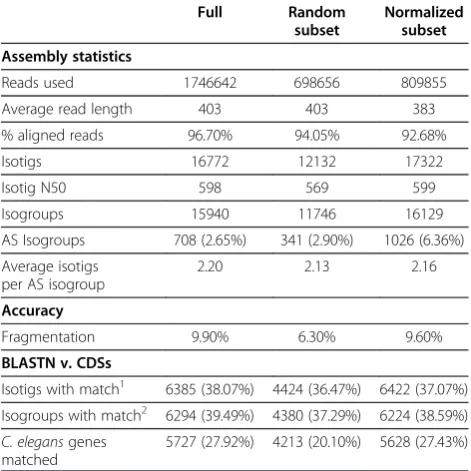
many millions of reads from multiple life cycle stages must be reduced prior to assembly. Our optimized proto-col performed well with both randomly down-sampled and digitally normalized read sets (Table 3). Interestingly, digital read normalization eliminated nearly half of the reads without much impact on the quality of the assembly, so we have adopted this as our preferred method for data-set reduction prior to assembly.
Parasitic nematode transcript assemblies
We re-visited previously published Roche/454 data from C. oncophora [27],O. flexuosa [28], O. ostertagi [27],T. circumcincta[29], andT. colubriformis[25], re-screening and re-assembling with up-to-date, cDNA specific assembly software and our optimized parameters. Additional life cycle stages were sequenced and
added to available datasets from A. caninum [30], D.
viviparus [23], N. americanus [26], and O. dentatum
[image:6.595.59.538.89.377.2][24] prior to assembly (see Additional file 1: Table S1). Together, these nine species represent a diverse array of parasitic nematodes, in terms of biology as well as Figure 2Alternative splicing ofC. elegansgene C05B5.5. (A)Isogroup00600 from ourde novocDNA assembly contains two isotigs derived fromC. elegansgene C18E3.6 (exons depicted as blue bars in top track). Alignment of Roche/454 reads (green bars with arrowheads indicating directionality) gave rise to three distinct contigs (dark, medium and light orange bars). These contigs were pieced together to form isotigs 01225 and 01226 based on read support displayed in the contig graph. Isotig01225, which contains all three contigs, corresponds perfectly to the gene model (blue bars). However, isotig01226 includes only the first (light orange) and third (dark orange), which results in a 50 bp gap with respect to isotig01225 and the gene model.(B)Illumina RNAseq reads (dark purple, horizontal bars) mapped to isotig01226 further verifies the junction between the first (light orange) and third (dark orange) contigs, with proportional coverage indicated (light purple, vertical bars). This figure was adapted from alignments visualized using the Integrated Genomics Viewer [48,49].
Abubuckeret al. Parasites & Vectors2014,7:151 Page 6 of 12
phylogeny. Necator americanus, one of the two human hookworms, is thought to infect hundreds of millions of people across the Americas, Sub-Saharan Africa and Asia, and is a leading cause of morbidity in children. A. cani-num, the canine hookworm, is an important pathogen in domestic dogs and a model for the study of human hook-worm infections. O. flexuosais a filarial nematode and a close relative ofOnchocerca volvulus, the causative agent of African river blindness. O. flexuosa is unique among the Onchocercids in that it is devoid of the bacterial endo-symbiont required for development and reproduction in its sister taxa. D. viviparus, the bovine lungworm, is the only Trichostrongylid nematode that resides in the lung during its adulthood.C. oncophora,O. dentatum, O. oster-tagi,T. circumcincta, and T. colubriformus are all intes-tinal worms of livestock animals and are responsible for significant financial losses in the beef, dairy, sheep, goat and pork industries. Projects have been initiated to sequence the genomes of these species (see Table 4
for BioProject ID numbers), but N. americanus is the
only species for which a draft genome is presently available [43].
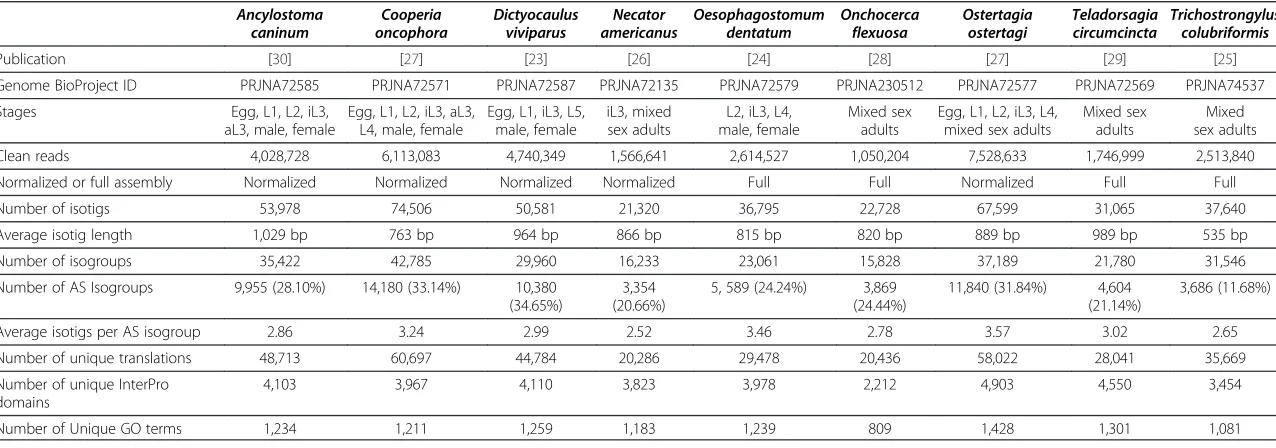
Parasitic nematode transcriptome assembly statistics are reported in Table 4. The datasets range in size and complexity from approximately one million reads derived from adultO. flexuosato upwards of 7.5 million reads de-rived from eggs, larvae and adults of two geographically
distinct strains of O. ostertagia. As previously discussed, there is a limit to the amount of data that can be proc-essed by OLC assembly algorithms like those imple-mented by Newbler, so several datasets had to be reduced by digital read normalization prior to assembly (Table 4). Our tests seem to indicate that the complexity of the transcriptome has a greater impact on assembly efficiency than the absolute number of reads. For instance, we were able to assemble some 2.5 million reads from mixed sex adult T. colubriformis, whereas a full assembly of the 1.5 million reads derived from L3 and mixed sex adult
N. americanus was not possible.
The number of isogroups obtained from each assembly ranged from 15,828 fromO. flexuosa to 42,785 from the more thoroughly covered transcriptome ofC. oncophora. Detected rates of AS, as measured by the number of isogroups associated with multiple isotigs, mostly fell within the 20-30% range, with a maximum AS rate of 34.65% in D. viviparus (Table 4). The AS rates seen in the parasitic nematodes were expected to be similar, as previous studies have shown that splice events are highly
conserved among Caenorhabditis species despite
hun-dreds of millions of years of evolutionary separation [53,54]. It is also reasonable to expect that the parasitic nematodes, especially those with extremely complex life cycles like N. americanus and D. viviparus, would have higher rates of AS than free-living worms likeC. elegans due to the increased genomic complexity that may be required to interact with multiple hosts/vectors, host/ vector tissues, and environmental conditions. We did not make an effort to classify or compare the nature of these AS events (e.g., alternative starts and/or stops, intron retention, exon skipping, etc.), but we expect that this will be possible in future studies aimed at exploring AS profiles of particular species in greater detail.
It stands to reason that sampling and sequencing more life cycle stages would lead to increased resolution of AS events. Indeed, including more stages tended to increase the number of isogroups (i.e., genetic loci) identified, but overall AS rates and the average number of isotigs asso-ciated with each isogroup remained relatively consistent with the notable exception of T. colubriformis. The AS
rate reported for T. colubriformis (11.68%) was much
lower than AS rates reported for other species repre-sented by a single cDNA library derived from mixed-sex
adults (24.44% AS in O. flexuosa and 21.14% AS in T.
circumcincta). This disparity may be due to decreased
transcriptomic complexity in T. colubriformis, but there may be other explanations. In the case of T.
colubrifor-mis, material was obtained from an inbred laboratory
[image:7.595.56.292.112.348.2]strain [25], whileO. flexuosa and T. circumcintamaterial were collected in the field [28,29].O. flexuosanodules tend to be dominated by large, adult females [55]. Likewise,
Table 3 Assembly of down-sampledCaenorhabditis elegansread sets
Full Random
subset
Normalized subset
Assembly statistics
Reads used 1746642 698656 809855
Average read length 403 403 383
% aligned reads 96.70% 94.05% 92.68%
Isotigs 16772 12132 17322
Isotig N50 598 569 599
Isogroups 15940 11746 16129
AS Isogroups 708 (2.65%) 341 (2.90%) 1026 (6.36%) Average isotigs
per AS isogroup
2.20 2.13 2.16
Accuracy
Fragmentation 9.90% 6.30% 9.60%
BLASTN v. CDSs
Isotigs with match1 6385 (38.07%) 4424 (36.47%) 6422 (37.07%) Isogroups with match2 6294 (39.49%) 4380 (37.29%) 6224 (38.59%) C. elegansgenes
matched
5727 (27.92%) 4213 (20.10%) 5628 (27.43%)
1
Matches were required to meet a cutoff of≥90% nucleotide sequence identity over≥75% of the length of the isotigs in a single high-scoring segment pair.
2
Table 4 Parasitic nematode transcript assemblies
Ancylostoma caninum
Cooperia oncophora
Dictyocaulus viviparus
Necator americanus
Oesophagostomum dentatum
Onchocerca flexuosa
Ostertagia ostertagi
Teladorsagia circumcincta
Trichostrongylus colubriformis
Publication [30] [27] [23] [26] [24] [28] [27] [29] [25]
Genome BioProject ID PRJNA72585 PRJNA72571 PRJNA72587 PRJNA72135 PRJNA72579 PRJNA230512 PRJNA72577 PRJNA72569 PRJNA74537
Stages Egg, L1, L2, iL3,
aL3, male, female
Egg, L1, L2, iL3, aL3, L4, male, female
Egg, L1, iL3, L5, male, female
iL3, mixed sex adults
L2, iL3, L4, male, female
Mixed sex adults
Egg, L1, L2, iL3, L4, mixed sex adults
Mixed sex adults
Mixed sex adults
Clean reads 4,028,728 6,113,083 4,740,349 1,566,641 2,614,527 1,050,204 7,528,633 1,746,999 2,513,840
Normalized or full assembly Normalized Normalized Normalized Normalized Full Full Normalized Full Full
Number of isotigs 53,978 74,506 50,581 21,320 36,795 22,728 67,599 31,065 37,640
Average isotig length 1,029 bp 763 bp 964 bp 866 bp 815 bp 820 bp 889 bp 989 bp 535 bp
Number of isogroups 35,422 42,785 29,960 16,233 23,061 15,828 37,189 21,780 31,546
Number of AS Isogroups 9,955 (28.10%) 14,180 (33.14%) 10,380
(34.65%)
3,354 (20.66%)
5, 589 (24.24%) 3,869
(24.44%)
11,840 (31.84%) 4,604
(21.14%)
3,686 (11.68%)
Average isotigs per AS isogroup 2.86 3.24 2.99 2.52 3.46 2.78 3.57 3.02 2.65
Number of unique translations 48,713 60,697 44,784 20,286 29,478 20,436 58,022 28,041 35,669
Number of unique InterPro domains
4,103 3,967 4,110 3,823 3,978 2,212 4,903 4,550 3,454
Number of Unique GO terms 1,234 1,211 1,259 1,183 1,239 809 1,428 1,301 1,081
Abubucker
et
al.
Parasit
es
&
Vectors
2014,
7
:151
Page
8
o
f
1
2
http://ww
w.parasitesand
vectors.co
m/content/7/1
T. circumcinta is a polymorphic species with sex ra-tios biased towards females [56]. This is significant due to the fact that a patent female represents a broad survey of adult female tissues, embryos in various stages of develop-ment, and even stored sperm from males, all of which contribute to diversity in the transcript population. Sequencing additional life cycle stages ofT. colubriformis or specifically studying adults of other species would provide additional data needed to better understand the obtained results.
The assembled sequences from these nine species, as well as their functional annotations and predicted trans-lations are available from Nematode.net [22] for use by the wider community. Although genome sequencing projects are currently underway, the transcriptomes presented here represent a significant proportion of the sequence data available from these species at this time. These datasets are, therefore, a vital source of information on the genetic content and complexity of these parasites and will remain so even after draft genomes are published as genome sequencing does not, in and of itself, provide any information on AS. Historically, initial reports of draft genomes rarely comment on AS [57-64]. For instance, the
draft genome of the well-studied filarial nematode B.
malayi was published in 2007, but the report made no
mention of AS [59]. The most recent dataset available
from WormBase (B. malayi WS236) includes multiple
isoforms for 16% of the reported genes, but no compre-hensive studies on the subject of AS in B. malayi have been reported despite an abundance of representative RNAseq data [65]. The recently publishedN. americanus genome paper was unique in that it included an estimate of AS based on Illumina RNAseq data generated from L3 and adult worms. Multiple isoforms were identified from approximately 25% of the 19,151 predicted protein coding
genes. Some 1,209 of the 3,354 AS isogroups from N.
americanus match 1,114 genes reported as AS in the
genome study (≥90% nucleotide sequence identity
over ≥75% of the length of the isotigs in a single
[image:9.595.56.542.391.719.2]high-scoring segment pair) [43], while another 65 AS isogroups matched genes that previously lacked evi-dence for AS. Clearly our assemblies, performed with a special emphasis on AS, will be a useful complement to genome sequencing studies and transcriptome studies performed using orthologous sequencing and assembly approaches.
Table 5 Enrichment of InterPro protein domains among alternatively spliced isogroups
InterPro protein domain Number of
species with domain
Total number of Isogroups containing domain
Percentage of isogroups with domain that are AS*
P value for enrichment**
IPR000504 RNA recognition motif domain 9 858 50.7% 2.1E-06
IPR016197 Chromo domain-like 9 128 64.1% 3.8E-05
IPR012677 Nucleotide-binding, alpha-beta plait 9 1037 48.7% 4.2E-05
IPR006092 Acyl-CoA dehydrogenase, N-terminal 8 53 73.6% 2.0E-04
IPR013786 Acyl-CoA dehydrogenase/oxidase, N-terminal 9 68 69.1% 3.2E-04
IPR003593 AAA + ATPase domain 8 189 57.7% 3.6E-04
IPR001412 Aminoacyl-tRNA synthetase, class I, conserved site 8 43 74.4% 6.6E-04
IPR006091 Acyl-CoA oxidase/dehydrogenase, central domain 9 70 67.1% 7.6E-04
IPR009100 Acyl-CoA dehydrogenase/oxidase, N-terminal and middle domain
9 93 63.4% 8.9E-04
IPR011993 Pleckstrin homology-like domain 9 474 50.4% 1.7E-03
IPR014001 Helicase, superfamily 1/2, ATP-binding domain 9 317 52.1% 3.7E-03
IPR023780 Chromo domain 9 79 63.3% 3.6E-03
IPR000953 Chromo domain/shadow 9 85 62.4% 3.7E-03
IPR015421 Pyridoxal phosphate-dependent transferase, major region, subdomain 1
9 275 52.7% 3.8E-03
IPR002194 Chaperonin TCP-1, conserved site 8 55 67.3% 3.6E-03
IPR003954 RNA recognition motif domain, eukaryote 9 41 70.7% 4.5E-03
IPR006020 PTB/PI domain 9 71 63.4% 5.7E-03
IPR001650 Helicase, C-terminal 9 298 51.7% 6.8E-03
IPR017998 Chaperone tailless complex polypeptide 1 (TCP-1) 9 66 63.6% 7.6E-03
IPR011545 DNA/RNA helicase, DEAD/DEAH box type, N-terminal 9 275 52.0% 7.3E-03
IPR002495 Glycosyl transferase, family 8 7 11 90.9% 7.2E-03
Protein domains associated with alternative splicing
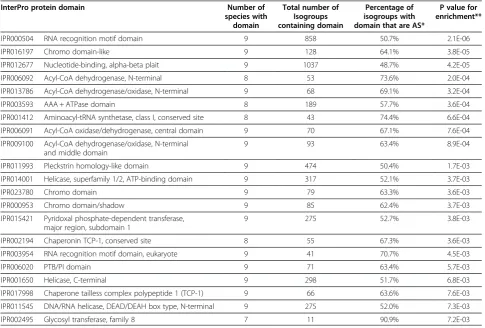
Given the fact that in AS, both the patterns of splicing as well as the spliced exons themselves, tend to be evolutionarily conserved [53,54], we wanted to explore potential links between AS and genetic function. Coding sequences were predicted for each of the transcript assemblies and these were searched for similarity to Inter-Pro protein domains. A total of 5,692 unique InterInter-Pro do-mains were identified from all species included in this
study, with counts ranging from 4,904 domains in O.
ostertagito 2,212 inO. flexuosa (Table 4). Some 40.5% of all isogroups associated with an InterPro domain are AS, and 21 InterPro protein domains were significantly cor-related with AS isogroups (Table 5). Functions cor-related to nucleotide binding are prevalent in this list. Nucleic acid binding proteins have a wide variety of functions, localization patterns, and binding preferences that can certainly be affected by AS [66-68]. For example, AS of the UNC-62 transcription factor produces two distinct isoforms inC. elegans. These isoforms localize to different tissues, exhibit different temporal expression patterns, and seem to bind different DNA consensus sequences due to alterations in the DNA binding domain [69,70]. Chromo (CHRomatin Organization Modifier) and chromo-like domains interact with histones and nucleic acids, and studies have shown that AS of these proteins can have major implications on function, which, in turn have impli-cations on gene expression and organismal development [71]. Future studies will be required to further explore the link between AS and protein function in parasitic nematodes, as well as to elucidate its specific biological consequences.
Conclusions
De novotranscriptome assembly is a complicated
proced-ure that is confounded by varied gene expression patterns, such AS of mRNA. Transcriptome assemblies benefit from the use of optimized parameters designed to increase accurate coverage of the gene set and minimize assembly error. The set of parameters we described was thoroughly tested withC. elegansdata and verified using well-curated sequences available from WormBase as well as data from an unrelated sequencing chemistry. Our optimized param-eters are offered as a guide to assist in the assembly of other nematode transcriptomes, and updated, annotated transcript assemblies from nine species of parasitic worms are offered as a resource to the research community. Rates of AS seem to be similar among the species studied, and 21 InterPro protein domains appear to be enriched among AS transcripts. This represents a first step in exploring AS among parasitic nematodes, an important and relevant topic that should be further investigated in future sequen-cing studies.
Additional files
Additional file 1: Table S1.454/Roche sequencing of parasitic nematode transcriptomes.
Additional file 2: Table S2.Coverage ofCaenorhabditis elegansCDSs with Roche/454 reads.
Additional file 3: Table S3.Coverage of assembledCaenorhabditis elegansisotigs with Illumina RNAseq reads.
Additional file 4: Table S4.The annotated transcriptome of
Ancylostoma caninum.
Additional file 5: Table S5.The annotated transcriptome ofCooperia oncophora.
Additional file 6: Table S6.The annotated transcriptome of
Dictyocaulus viviparus.
Additional file 7: Table S7.The annotated transcriptome ofNecator americanus.
Additional file 8: Table S8.The annotated transcriptome of
Oesophagostomum dentatum.
Additional file 9: Table S9.The annotated transcriptome of
Onchocerca flexuosa.
Additional file 10: Table S10.The annotated transcriptome of
Ostertagia ostertagi.
Additional file 11: Table S11.The annotated transcriptome of
Teladorsagia circumcincta.
Additional file 12: Table S12.The annotated transcriptome of
Trichostrongylus colubriformis.
Additional file 13: Table S13.Alternatively spliced and non-alternatively spliced isogroups associated with InterPro protein domains.
Additional file 14: Figure S1.Representation of InterPro protein domains among parasitic nematode species and isogroups. The plot indicates the total number of isogroups (from all species) associated and parasitic nematode species associated with a given InterPro protein domain. In order to reduce false positives resulting from poorly represented domains, InterPro domains represented by fewer than ten isogroups and/or fewer than four species were excluded from enrichment analyses. Red lines indicate cutoff values.
Competing interests
The authors declare that they have no competing interests.
Authors’contributions
SA and MM conceived the study. SA and SNM processed and assembled
C. eleganscDNA data and tested the assemblies. SNM processed and assembled parasitic nematode cDNA data and annotated the parasitic nematode transcriptomes. BAR performed statistical analyses. SA, SNM and MM drafted the manuscript. All authors read and approved the final version of the manuscript.
Acknowledgements
The authors acknowledge The Genome Institute production team for assistance with cDNA/RNA-seq library construction and sequencing and John Martin for providing technical support. This work was supported by NIH grant to MM.
Author details
1
The Genome Institute, Washington University School of Medicine, 4444 Forest Park Boulevard, St. Louis, MO 63108, USA.2Division of Infectious Diseases, Department of Internal Medicine, Washington University School of Medicine, St. Louis, MO 63110, USA.3Department of Genetics, Washington University School of Medicine, St. Louis, MO 63108, USA.
Received: 17 January 2014 Accepted: 14 March 2014 Published: 1 April 2014
Abubuckeret al. Parasites & Vectors2014,7:151 Page 10 of 12
References
1. Breitbart RE, Andreadis A, Nadal-Ginard B:Alternative splicing: a ubiquitous mechanism for the generation of multiple protein isoforms from single genes.Annu Rev Biochem1987,56:467–495.
2. Sammeth M, Foissac S, Guigo R:A general definition and nomenclature for alternative splicing events.PLoS Comput Biol2008,4:e1000147. 3. Nilsen TW, Graveley BR:Expansion of the eukaryotic proteome by
alternative splicing.Nature2010,463:457–463.
4. Talavera D, Sheoran R, Lovell SC:Analysis of genetic interaction networks shows that alternatively spliced genes are highly versatile.PLoS One
2013,8:e55671.
5. Kim E, Magen A, Ast G:Different levels of alternative splicing among eukaryotes.Nucleic Acids Res2007,35:125–131.
6. Brett D, Pospisil H, Valcarcel J, Reich J, Bork P:Alternative splicing and genome complexity.Nat Genet2002,30:29–30.
7. Irimia M, Rukov JL, Penny D, Roy SW:Functional and evolutionary analysis of alternatively spliced genes is consistent with an early eukaryotic origin of alternative splicing.BMC Evol Biol2007,7:188.
8. Zahler AM:Pre-mRNA splicing and its regulation inCaenorhabditis elegans.WormBook2012:1–21.
9. Venables JP, Tazi J, Juge F:Regulated functional alternative splicing in Drosophila.Nucleic Acids Res2012,40:1–10.
10. Pan Q, Shai O, Lee LJ, Frey BJ, Blencowe BJ:Deep surveying of alternative splicing complexity in the human transcriptome by high-throughput sequencing.Nat Genet2008,40:1413–1415.
11. Ramani AK, Calarco JA, Pan Q, Mavandadi S, Wang Y, Nelson AC, Lee LJ, Morris Q, Blencowe BJ, Zhen M, Fraser AG:Genome-wide analysis of alternative splicing inCaenorhabditis elegans.Genome Res2011,21:342–348. 12. Harrow J, Frankish A, Gonzalez JM, Tapanari E, Diekhans M, Kokocinski F,
Aken BL, Barrell D, Zadissa A, Searle S, Barnes I, Bignell A, Boychenko V, Hunt T, Kay M, Mukherjee G, Rajan J, Despacio-Reyes G, Saunders G, Steward C, Harte R, Lin M, Howald C, Tanzer A, Derrien T, Chrast J, Walters N, Balasubramanian S, Pei B, Tress M,et al:GENCODE: the reference human genome annotation for The ENCODE Project.Genome Res2012, 22:1760–1774.
13. El-Abdellati A, De Graef J, Van Zeveren A, Donnan A, Skuce P, Walsh T, Wolstenholme A, Tait A, Vercruysse J, Claerebout E, Geldhof P:Altered avr-14B gene transcription patterns in ivermectin-resistant isolates of the cattle parasites,Cooperia oncophoraandOstertagia ostertagi.Int J Parasitol2011,41:951–957.
14. Liebau E, Hoppner J, Muhlmeister M, Burmeister C, Luersen K, Perbandt M, Schmetz C, Buttner D, Brattig N:The secretory omega-class glutathione transferase OvGST3 from the human pathogenic parasiteOnchocerca volvulus.FEBS J2008,275:3438–3453.
15. Lu SW, Tian D, Borchardt-Wier HB, Wang X:Alternative splicing: a novel mechanism of regulation identified in the chorismate mutase gene of the potato cyst nematodeGlobodera rostochiensis.Mol Biochem Parasitol
2008,162:1–15.
16. Massey HC Jr, Ranjit N, Stoltzfus JD, Lok JB:Strongyloides stercoralisdaf-2 encodes a divergent ortholog ofCaenorhabditis elegansDAF-2.Int J Parasitol2013,43:515–520.
17. Miller JR, Koren S, Sutton G:Assembly algorithms for next-generation sequencing data.Genomics2010,95:315–327.
18. Clarke K, Yang Y, Marsh R, Xie L, Zhang KK:Comparative analysis of de novo transcriptome assembly.Sci China Life Sci2013,56:156–162. 19. Yang Y, Smith SA:Optimizing de novo assembly of short-read RNA-seq
data for phylogenomics.BMC Genomics2013,14:328.
20. Zhao QY, Wang Y, Kong YM, Luo D, Li X, Hao P:Optimizing de novo transcriptome assembly from short-read RNA-Seq data: a comparative study.BMC Bioinforma2011,12(14):S2.
21. Cahais V, Gayral P, Tsagkogeorga G, Melo-Ferreira J, Ballenghien M, Weinert L, Chiari Y, Belkhir K, Ranwez V, Galtier N:Reference-free transcriptome assembly in non-model animals from next-generation sequencing data.
Mol Ecol Resour2012,12:834–845.
22. Martin J, Abubucker S, Heizer E, Taylor CM, Mitreva M:Nematode.net update 2011: addition of data sets and tools featuring next-generation sequencing data.Nucleic Acids Res2012,40:D720–D728.
23. Cantacessi C, Gasser RB, Strube C, Schnieder T, Jex AR, Hall RS, Campbell BE, Young ND, Ranganathan S, Sternberg PW, Mitreva M:Deep insights into Dictyocaulus viviparustranscriptomes provides unique prospects for new drug targets and disease intervention.Biotechnol Adv2011,29:261–271.
24. Cantacessi C, Jex AR, Hall RS, Young ND, Campbell BE, Joachim A, Nolan MJ, Abubucker S, Sternberg PW, Ranganathan S, Mitreva M, Gasser RB:A practical, bioinformatic workflow system for large data sets generated by next-generation sequencing.Nucleic Acids Res2010,38:e171. 25. Cantacessi C, Mitreva M, Campbell BE, Hall RS, Young ND, Jex AR, Ranganathan S, Gasser RB:First transcriptomic analysis of the economically important parasitic nematode,Trichostrongylus
colubriformis, using a next-generation sequencing approach.Infect Genet Evol2010,10:1199–1207.
26. Cantacessi C, Mitreva M, Jex AR, Young ND, Campbell BE, Hall RS, Doyle MA, Ralph SA, Rabelo EM, Ranganathan S, Sternberg PW, Loukas A, Gasser RB: Massively parallel sequencing and analysis of theNecator americanus transcriptome.PLoS Negl Trop Dis2010,4:e684.
27. Heizer E, Zarlenga DS, Rosa B, Gao X, Gasser RB, De Graef J, Geldhof P, Mitreva M:Transcriptome analyses reveal protein and domain families that delineate stage-related development in the economically important parasitic nematodes. Ostertagia ostertagi and Cooperia oncophora.
BMC Genomics2013,14:118.
28. McNulty SN, Abubucker S, Simon GM, Mitreva M, McNulty NP, Fischer K, Curtis KC, Brattig NW, Weil GJ, Fischer PU:Transcriptomic and proteomic analyses of aWolbachia-free filarial parasite provide evidence of trans-kingdom horizontal gene transfer.PLoS One2012, 7:e45777.
29. Menon R, Gasser RB, Mitreva M, Ranganathan S:An analysis of the transcriptome ofTeladorsagia circumcincta: its biological and biotechnological implications.BMC Genomics2012,13(7):S10. 30. Wang Z, Abubucker S, Martin J, Wilson RK, Hawdon J, Mitreva M:
CharacterizingAncylostoma caninumtranscriptome and exploring nematode parasitic adaptation.BMC Genomics2010,11:307. 31. Bracco L, Kearsey J:The relevance of alternative RNA splicing to
pharmacogenomics.Trends Biotechnol2003,21:346–353.
32. Hagiwara M:Alternative splicing: a new drug target of the post-genome era.Biochim Biophys Acta2005,1754:324–331.
33. Laughton DL, Lunt GG, Wolstenholme AJ:Alternative splicing of a Caenorhabditis elegansgene produces two novel inhibitory amino acid receptor subunits with identical ligand binding domains but different ion channels.Gene1997,201:119–125.
34. Margulies M, Egholm M, Altman WE, Attiya S, Bader JS, Bemben LA, Berka J, Braverman MS, Chen YJ, Chen Z, Dewell SB, Du L, Fierro JM, Gomes XV, Godwin BC, He W, Helgesen S, Ho CH, Irzyk GP, Jando SC, Alenquer ML, Jarvie TP, Jirage KB, Kim JB, Knight JR, Lanza JR, Leamon JH, Lefkowitz SM, Lei M, Li J,et al:Genome sequencing in microfabricated high-density picolitre reactors.Nature2005,437:376–380.
35. Martin M:Cutadapt removes adapter sequences from high-throughput sequencing reads.EMBnet J2011,17:10–12.
36. Pruesse E, Quast C, Knittel K, Fuchs BM, Ludwig W, Peplies J, Glockner FO: SILVA: a comprehensive online resource for quality checked and aligned ribosomal RNA sequence data compatible with ARB.Nucleic Acids Res
2007,35:7188–7196.
37. Quast C, Pruesse E, Yilmaz P, Gerken J, Schweer T, Yarza P, Peplies J, Glockner FO:The SILVA ribosomal RNA gene database project: improved data processing and web-based tools.Nucleic Acids Res
2013,41:D590–D596.
38. Consortium THM:A framework for human microbiome research.Nature
2012,486:215–221.
39. Langmead B, Salzberg SL:Fast gapped-read alignment with Bowtie 2.
Nat Methods2012,9:357–359.
40. Kim D, Pertea G, Trapnell C, Pimentel H, Kelley R, Salzberg SL:TopHat2: accurate alignment of transcriptomes in the presence of insertions, deletions and gene fusions.Genome Biol2013,14:R36.
41. Yook K, Harris TW, Bieri T, Cabunoc A, Chan J, Chen WJ, Davis P, de la Cruz N, Duong A, Fang R, Ganesan U, Grove C, Howe K, Kadam S, Kishore R, Lee R, Li Y, Muller HM, Nakamura C, Nash B, Ozersky P, Paulini M, Raciti D, Rangarajan A, Schindelman G, Shi X, Schwarz EM, Ann Tuli M, Van Auken K, Wang D,et al:WormBase 2012: more genomes, more data, new website.
Nucleic Acids Res2012,40:D735–741.
42. Rosa BA, Jasmer DP, Mitreva M:Genome-Wide Tissue-Specific Gene Expression, Co-expression and Regulation of Co-expressed Genes in Adult NematodeAscaris suum.PLoS Negl Trop Dis2014,8:e2678. 43. Tang YT, Gao X, Rosa BA, Abubucker S, Hallsworth-Pepin K, Martin J, Tyagi R,
Zhan B, Hotez PJ, Sternberg PW, Dougall A, Gaze ST, Mulvenna J, Sotillo J, Ranganathan S, Rabelo EM, Wilson RK, Felgner PL, Bethony J, Hawdon JM, Gasser RB, Loukas A, Mitreva M:Genome of the human hookwormNecator americanus.Nat Genet2014.
44. Wasmuth J, Blaxter M:Obtaining accurate translations from expressed sequence tags.Methods Mol Biol2009,533:221–239.
45. Hunter S, Jones P, Mitchell A, Apweiler R, Attwood TK, Bateman A, Bernard T, Binns D, Bork P, Burge S, de Castro E, Coggill P, Corbett M, Das U, Daugherty L, Duquenne L, Finn RD, Fraser M, Gough J, Haft D, Hulo N, Kahn D, Kelly E, Letunic I, Lonsdale D, Lopez R, Madera M, Maslen J, McAnulla C, McDowall J,et al:InterPro in 2011: new developments in the family and domain prediction database.Nucleic Acids Res2012,40:D306–D312. 46. Quevillon E, Silventoinen V, Pillai S, Harte N, Mulder N, Apweiler R, Lopez R:
InterProScan: protein domains identifier.Nucleic Acids Res2005, 33:W116–W120.
47. Benjamini Y, Hochberg Y:Controlling the false discovery rate: a practical and powerful approach to multiple testing.J R Stat Soc Ser B Methodol
1995,57:289–300.
48. Thorvaldsdottir H, Robinson JT, Mesirov JP:Integrative Genomics Viewer (IGV): high-performance genomics data visualization and exploration.
Brief Bioinform2013,14:178–192.
49. Misner I, Bicep C, Lopez P, Halary S, Bapteste E, Lane CE:Sequence comparative analysis using networks: software for evaluating de novo transcript assembly from next-generation sequencing.Mol Biol Evol2013, 30:1975–1986.
50. Bao E, Jiang T, Girke T:BRANCH: boosting RNA-Seq assemblies with partial or related genomic sequences.Bioinformatics2013,29:1250–1259. 51. Robertson G, Schein J, Chiu R, Corbett R, Field M, Jackman SD, Mungall K,
Lee S, Okada HM, Qian JQ, Griffith M, Raymond A, Thiessen N, Cezard T, Butterfield YS, Newsome R, Chan SK, She R, Varhol R, Kamoh B, Prabhu AL, Tam A, Zhao Y, Moore RA, Hirst M, Marra MA, Jones SJ, Hoodless PA, Birol I: De novo assembly and analysis of RNA-seq data.Nat Methods2010, 7:909–912.
52. Irimia M, Rukov JL, Penny D, Garcia-Fernandez J, Vinther J, Roy SW: Widespread evolutionary conservation of alternatively spliced exons in Caenorhabditis.Mol Biol Evol2008,25:375–382.
53. Rukov JL, Irimia M, Mork S, Lund VK, Vinther J, Arctander P:High qualitative and quantitative conservation of alternative splicing inCaenorhabditis elegansandCaenorhabditis briggsae.Mol Biol Evol2007,24:909–917. 54. Plenge-Bonig A, Kromer M, Buttner DW:Light and electron microscopy
studies onOnchocerca jakutensisandO. flexuosaof red deer show different host-parasite interactions.Parasitol Res1995,81:66–73. 55. Craig BH, Pilkington JG, Pemberton JM:Sex ratio and morphological
polymorphism in an isolated, endemicTeladorsagia circumcincta population.J Helminthol2010,84:208–215.
56. Bai X, Adams BJ, Ciche TA, Clifton S, Gaugler R, Kim KS, Spieth J, Sternberg PW, Wilson RK, Grewal PS:A lover and a fighter: the genome sequence of an entomopathogenic nematodeHeterorhabditis bacteriophora.PLoS One
2013,8:e69618.
57. Desjardins CA, Cerqueira GC, Goldberg JM, Dunning Hotopp JC, Haas BJ, Zucker J, Ribeiro JM, Saif S, Levin JZ, Fan L, Zeng Q, Russ C, Wortman JR, Fink DL, Birren BW, Nutman TB:Genomics ofLoa loa, aWolbachia-free filarial parasite of humans.Nat Genet2013,45:495–500.
58. Ghedin E, Wang S, Spiro D, Caler E, Zhao Q, Crabtree J, Allen JE, Delcher AL, Guiliano DB, Miranda-Saavedra D, Angiuoli SV, Creasy T, Amedeo P, Haas B, El-Sayed NM, Wortman JR, Feldblyum T, Tallon L, Schatz M, Shumway M, Koo H, Salzberg SL, Schobel S, Pertea M, Pop M, White O, Barton GJ, Carlow CK, Crawford MJ, Daub J,et al:Draft genome of the filarial nematode parasiteBrugia malayi.Science2007,317:1756–1760.
59. Godel C, Kumar S, Koutsovoulos G, Ludin P, Nilsson D, Comandatore F, Wrobel N, Thompson M, Schmid CD, Goto S, Bringaud F, Wolstenholme A, Bandi C, Epe C, Kaminsky R, Blaxter M, Maser P:The genome of the heartworm,Dirofilaria immitis, reveals drug and vaccine targets.
FASEB J2012,26:4650–4661.
60. Jex AR, Liu S, Li B, Young ND, Hall RS, Li Y, Yang L, Zeng N, Xu X, Xiong Z, Chen F, Wu X, Zhang G, Fang X, Kang Y, Anderson GA, Harris TW, Campbell BE, Vlaminck J, Wang T, Cantacessi C, Schwarz EM, Ranganathan S, Geldhof P, Nejsum P, Sternberg PW, Yang H, Wang J, Wang J, Gasser RB:Ascaris suumdraft genome.Nature2011,479:529–533.
61. Laing R, Kikuchi T, Martinelli A, Tsai IJ, Beech RN, Redman E, Holroyd N, Bartley DJ, Beasley H, Britton C, Curran D, Devaney E, Gilabert A, Hunt M,
Jackson F, Johnston SL, Kryukov I, Li K, Morrison AA, Reid AJ, Sargison N, Saunders GI, Wasmuth JD, Wolstenholme A, Berriman M, Gilleard JS, Cotton JA:The genome and transcriptome ofHaemonchus contortus, a key model parasite for drug and vaccine discovery.Genome Biol2013,14:R88. 62. Mitreva M, Jasmer DP, Zarlenga DS, Wang Z, Abubucker S, Martin J, Taylor
CM, Yin Y, Fulton L, Minx P, Yang SP, Warren WC, Fulton RS, Bhonagiri V, Zhang X, Hallsworth-Pepin K, Clifton SW, McCarter JP, Appleton J, Mardis ER, Wilson RK:The draft genome of the parasitic nematodeTrichinella spiralis.
Nat Genet2011,43:228–235.
63. Schwarz EM, Korhonen PK, Campbell BE, Young ND, Jex AR, Jabbar A, Hall RS, Mondal A, Howe AC, Pell J, Hofmann A, Boag PR, Zhu XQ, Gregory TR, Loukas A, Williams BA, Antoshechkin I, Brown CT, Sternberg PW, Gasser RB: The genome and developmental transcriptome of the strongylid nematodeHaemonchus contortus.Genome Biol2013,14:R89. 64. Choi YJ, Ghedin E, Berriman M, McQuillan J, Holroyd N, Mayhew GF,
Christensen BM, Michalski ML:A deep sequencing approach to comparatively analyze the transcriptome of lifecycle stages of the filarial worm,Brugia malayi.PLoS Negl Trop Dis2011,5:e1409.
65. Wollerton MC, Gooding C, Robinson F, Brown EC, Jackson RJ, Smith CW: Differential alternative splicing activity of isoforms of polypyrimidine tract binding protein (PTB).RNA2001,7:819–832.
66. MacMorris MA, Zorio DA, Blumenthal T:An exon that prevents transport of a mature mRNA.Proc Natl Acad Sci U S A1999,96:3813–3818. 67. Van Nostrand EL, Sanchez-Blanco A, Wu B, Nguyen A, Kim SK:Roles of the
developmental regulator unc-62/Homothorax in limiting longevity in Caenorhabditis elegans.PLoS Genet2013,9:e1003325.
68. Van Auken K, Weaver D, Robertson B, Sundaram M, Saldi T, Edgar L, Elling U, Lee M, Boese Q, Wood WB:Roles of the Homothorax/Meis/Prep homolog UNC-62 and the Exd/Pbx homologs CEH-20 and CEH-40 in C. elegans embryogenesis.Development2002,129:5255–5268.
69. Van Nostrand EL, Kim SK:Integrative analysis ofC. elegansmodENCODE ChIP-seq data sets to infer gene regulatory interactions.Genome Res
2013,23:941–953.
70. Boije H, Ring H, Shirazi Fard S, Grundberg I, Nilsson M, Hallbook F: Alternative splicing of the chromodomain protein Morf4l1 pre-mRNA has implications on cell differentiation in the developing chicken retina.
J Mol Neurosci2013,51:615–628.
71. Kita Y, Nishiyama M, Nakayama KI:Identification of CHD7S as a novel splicing variant of CHD7 with functions similar and antagonistic to those of the full-length CHD7L.Genes Cells2012,17:536–547.
doi:10.1186/1756-3305-7-151
Cite this article as:Abubuckeret al.:Identification and characterization of alternative splicing in parasitic nematode transcriptomes.Parasites & Vectors20147:151.
Submit your next manuscript to BioMed Central and take full advantage of:
• Convenient online submission
• Thorough peer review
• No space constraints or color figure charges
• Immediate publication on acceptance
• Inclusion in PubMed, CAS, Scopus and Google Scholar
• Research which is freely available for redistribution
Submit your manuscript at www.biomedcentral.com/submit
Abubuckeret al. Parasites & Vectors2014,7:151 Page 12 of 12