REVIEW
Transmission-blocking strategies:
the roadmap from laboratory bench to the
community
Daniel Gonçalves
*and Patrick Hunziker
Abstract
Malaria remains one of the most prevalent tropical and infectious diseases in the world, with an estimated more
than 200 million clinical cases every year. In recent years, the mosquito stages of the parasite life cycle have received
renewed attention with some progress being made in the development of transmission-blocking strategies. From
gametocytes to late ookinetes, some attractive antigenic targets have been found and tested in order to develop a
transmission blocking vaccine, and drugs are being currently screened for gametocytocidal activity, and also some
new and less conventional approaches are drawing increased attention, such as genetically modified and
fungus-infected mosquitoes that become refractory to
Plasmodium
infection. In this review some of those strategies
focus-ing on the progress made so far will be summarized, but also, the challenges that come from the translation of
early promising benchwork resulting in successful applications in the field. To do this, the available literature will be
screened and all the pieces of the puzzle must be combined: from molecular biology to epidemiologic and clinical
data.
Keywords:
Transmission blocking strategies, Refractory mosquitoes, Gametocytocidal drugs, Malaria vaccine
© 2016 Gonçalves and Hunziker. This article is distributed under the terms of the Creative Commons Attribution 4.0 International License (http://creativecommons.org/licenses/by/4.0/), which permits unrestricted use, distribution, and reproduction in any medium, provided you give appropriate credit to the original author(s) and the source, provide a link to the Creative Commons license, and indicate if changes were made. The Creative Commons Public Domain Dedication waiver (http://creativecommons. org/publicdomain/zero/1.0/) applies to the data made available in this article, unless otherwise stated.
Background
Why block transmission?
Malaria remains one of the most prevalent tropical and
infectious diseases in the world, both, in terms of
mor-bidity and mortality, with around 200 million cases
estimated in 2013 alone [
1
]. Four different species
con-sistently infect humans:
Plasmodium
falciparum
,
Plas-modium
vivax
,
Plasmodium
malariae
, and
Plasmodium
ovale
. From these,
P.
falciparum
and
P.
vivax
are the most
common with the former being by far the most lethal
[
2
–
5
]. Recently, different accounts of human malaria by
another species,
Plasmodium knowlesi
, which usually
infects macaque monkeys, have been reported in
South-east Asia [
6
].
Since the beginning of the twenty-first Century there
has been renewed attention towards the disease, and in
2007 an official research and development agenda for
malaria eradication (malERA) was established [
7
]. The
goal is to completely eliminate and, if possible, eradicate
the disease from as many areas as possible and control
the others. The main strategies being followed include:
the increase of insecticidal nets reach, especially
long-lasting insecticidal nets (LLINs), within affected
com-munities; use of artemisinin-based combination therapy
(ACT) as first-line treatment; and, support the
develop-ment of a vaccine, with RTS,S/Mosquirix the first being
made available and recently approved by the European
Medicines Agency (EMA) for children aged 6 weeks to
17 months (exclusively against
P. falciparum
) [
8
]. Data
from 2013 showed that since the beginning of the
pro-gramme the malaria mortality rate decreased 26 %, even
with an increase of 43 % in population living in
transmis-sion areas [
1
]. In the 2015 report, WHO estimates that
malaria control interventions averted a total of 663
mil-lion malaria cases between 2001 and 2015 in sub-Saharan
Africa, which 69 % are accounted to the use of
insecti-cide-treated mosquito nets (ITNs), 21 % due to ACT and
10 % due to indoor residual spraying (IRS) [
9
].
Open Access
*Correspondence: [email protected]
While these numbers may be interpreted as progress
towards winning this war, recent findings revealed some
worrying indicators that
Plasmodium
is fighting back.
Artemisinin and its derivatives are considered the current
last line of defence and have been used in combination
with other anti-malarials to avoid resistance
develop-ment, but artemisinin-resistant strains of
P. falciparum
have appeared in Southeast Asia with strong indications
of rapid spread [
10
–
16
]. Another worrying indicator is
Anopheles gambiae
(the predominant vector in Africa)
resistance to pyrethroids in various sub-Saharan regions
[
17
–
20
]. The combined proportion of affected
popula-tion in sub-Saharan Africa with access to IRS and ITNs
increased from 2 % in 2000 to 59 % in 2014 [
9
], and is
responsible for reducing child deaths by an average 18 %
[
1
,
21
,
22
], but also for spreading pyrethroid resistance.
There are four different classes that can be used in IRS,
but only pyrethroids are currently recommended for
LLINs [
1
,
21
].
In recent years, there has been wider interest in
mos-quito stages as potential targets for new
transmission-blocking strategies (TBS) that could help to control,
and ultimately, eliminate the disease. New TBS being
studied differ mainly from the classical vector control
approaches, such as the use of insecticides, because they
are designed for mosquito survival, thus avoiding
selec-tive pressure towards resistance [
23
,
24
]. Two of the
major metrics for malaria transmission intensity are: the
basic reproductive number (R
0) representing the
num-ber of new cases deriving from one untreated case in an
infinite and susceptible human population; and, the
ento-mological inoculation rate (EIR) that measures the rate
of
Plasmodium
-infected mosquito bites per person, per
year [
25
]. Both are of extreme relevance to TBS, not only
to provide insights on the impact, but also to set
‘criti-cal numbers’ as goals for a successful strategy [
26
–
30
].
Mathematical modelling based on available field data
shows that it should be enough to reduce transmission to
R
0< 1 for a certain period of time to irreversibly
compro-mise the sustainability of the disease [
31
–
34
]. In addition,
because malaria transmission is a local feature with the
source of infection (breeding site) located within a
maxi-mum of a 1-km perimeter [
29
,
35
,
36
], TBS are
particu-larly suited to circumscribe small pockets of malaria in
isolated communities.
There are three main TBS that are being pursued:
gametocytocidal drugs, transmission-blocking vaccines
and shifting mosquitoes towards refractory traits. Each
of these will be briefly reviewed and a short outlook will
present bench progress and challenges, especially
large-scale implementation and ethical issues, referenced,
when possible, with clinical, entomological and field data.
Plasmodium
life cycle
Due to the apicomplexan nature of the
Plasmodium
life
cycle which allows it to survive in different
environ-ments, the parasites are well adapted to their obligatory
hosts: a vertebrate and the female of the
Anopheles
genus
[
37
–
39
].
In humans, the first target of the parasites are the liver
cells (hepatocytes), until the point they are released into
the blood stream to invade red blood cells in the form
of merozoites; it is estimated that each sporozoite that
enters the body originates approximately 1000
erythro-cyte-infective parasites [
40
]. Once inside, they reproduce
asexually in a (48-h cycle for falciparum) while also
form-ing agglomerates of infected cells to avoid spleen
clear-ance [
41
]. Eventually, some of the merozoites develop
into gametocytes, the sexual form of the parasite,
matur-ing inside the parasitophorous vacuole until released to
the peripheral blood, waiting for another mosquito bite
to propagate the disease [
42
]. Parasitaemia in
sympto-matic infected humans can range from 100 to more than
250,000 parasites per µl of blood (hyperparasitaemia) [
43
,
44
].
When a female
Anopheles
mosquito bites an infected
vertebrate host, it results in the ingestion of a certain
number of gametocytes. Within 15 min, the midgut
lumen environment triggers the gametocyte egress and
differentiation into micro and macrogametes [
45
,
46
].
The following fusion leads to diploid cells (zygote) that
will undergo meiotic division resulting in motile
ooki-netes [
45
,
46
]. The main goal of ookinetes is to
physi-cally traverse a thick (1–20 µm) chitin-based peritrophic
membrane (PM) formed upon blood ingestion, and the
midgut epithelium [
47
–
49
]. The midgut invasion is not
pacific and leads to apoptosis of the invaded cells [
50
,
51
].
After establishing itself at its basal side, a few parasites
(less than ten in average) will develop into the oocyst
form, concluding one of the most critical stages in whole
life cycle (Fig.
1
) [
45
,
46
].
Mitotic divisions start occurring at this stage and
ulti-mately sporozoites are formed. Upon egress from mature
oocysts, sporozoites travel via the haemolymph and
can be found throughout the mosquito haemocoel until
some of them reach the salivary glands [
45
,
46
,
52
]. Less
than 20 % of the sporozoites entering the haemocoel
will establish themselves in the salivary gland with the
remaining being eliminated [
52
].
Transmission of sporozoites occurs when the mosquito
ejects saliva into the skin, probing for a blood vessel.
Despite some mosquitoes can harbour as many as
thou-sands of sporozoites in their salivary glands, only a small
number (10–200) are ejected from the salivary ducts [
53
,
find and invade a hepatocyte as soon as possible before
detection of the immune system and continue the cycle
[
55
].
In summary, the main differences between the
mos-quito and humans stages are:
•
the mosquito the parasites are exclusively
extracellu-lar;
•
there are, on average, fewer parasites in the vector
comparing to the human host (Fig. 1);
•
there are no antibodies produced against
Plasmo-dium
in the mosquito despite other mechanisms are
available to detect and eliminate the parasites [56,
57];
•
morphology and proteome of
Plasmodium
differ
completely from stage to stage, and the only
com-mon cells between hosts (excluding the short period
of gametocytes in the mosquito) are the sporozoites
[58, 59];
•
mosquito infection is not lethal
per se
but can be a
metabolic and cellular burden, especially during the
midgut crossing stage. If this comes with a fitness
cost to the mosquitoes in the field is still not clear,
with contradictory claims in the literature [60–62].
Gametocyte density and prevalence
The proportion of merozoites committed to sexual
devel-opment and the exact mechanism (including sex ratio
determination) are not yet fully understood [
63
–
70
].
Gametocytogenesis differs between
Plasmodium
species:
while all of them undergo a five-stage maturation
pro-cess (with some morphological differences), falciparum
gametocytes, for example, take the longest (10–12 days
as opposed to less than 48 h for the majority) and are not
produced simultaneously with the asexual stages. Mature
gametocytes persistence in the peripheral blood is
esti-mated to be lower in
P. vivax
(approximately 3 days) than
in
P.
falciparum
(3.4–6.5 days) [
43
,
70
–
72
].
High circulating gametocyte numbers do not
neces-sarily result in mosquito infection, and low gametocyte
densities do not exclude infectivity; a self-regulated or
host-induced response (fever, antibodies, cytokines) still
remains unclear [
66
,
73
,
74
]. Even so, evidence suggests
that transmission success is highly dependent on the
pro-portion of mature gametocytes [
75
].
[image:3.595.58.537.89.329.2]technologies in the field when the available resources,
both human and capital, are already scarce. Thus, a
thor-ough analysis from local authorities and health policy
makers to invest in the right resources should be made,
being it microscopy, rapid diagnosis tests (RDT) or
more advanced molecular biology tools (or a
combina-tion of all), resulting in a clear diagnosis strategy defined
according to: epidemiological settings of prevalence and
density; the health impact of the disease using metrics
like the disability-adjusted life year (DALY) in the local
population; and economical, not only immediate, such as
throughput and cost per unit/case and treatment costs
avoided, but also long term, factoring the costs of
mor-bidity and mortality in the socioeconomic advancement
of the affected society [
80
–
83
].
Various studies have also attempted to estimate the
relative contribution to mosquito infection of
differ-ent patidiffer-ent age groups [
68
,
84
–
88
]. Despite some
evi-dent differences in gametocyte density and prevalence
between adults and children, the data are not
conclu-sive and are hard to compare due to lack of consistency
in gametocytes estimation methods but also in infection
models (skin or membrane feeding assays) [
29
,
89
]. The
non-linear relation, especially at low densities, between
human parasitaemia and mosquito infectiousness, and
differences in the endemic settings further enhances the
challenge in drawing conclusions from these studies.
A thorough understanding of the factors determining
transmission would not only allow mathematical models
to predict the relative contribution of different groups to
transmission, but also help to find the most efficient way
to implement a TBS and measure its impact.
Transmission‑blocking strategies
Gametocytocidal drugs
One of the first approaches to be explored was the
gametocytocidal activity of commercially available
anti-malarial drugs [
90
]. The rationale was to block
transmis-sion by clearing most gametocytes in the human host
to render those patients non-infectious to mosquitoes.
ACT (artemisinin-piperaquine) combined with a low
dose of primaquine (PQ) has been used to help eliminate
malaria from 17 Cambodian villages [
91
], although it is
hard to make a clear distinction between the direct effect
on gametocytes clearance and the indirect one of ACT
reducing the numbers of asexual parasites that could
develop into gametocytes [
92
]. Nevertheless,
recogniz-ing the importance of reducrecogniz-ing transmission, in 2010
WHO recommended a single dose of PQ of 0.75 mg/kg
as a gametocytocidal agent (not sufficient for
hypnozo-ite clearance in
P. vivax
infections), in combination with
ACT making it the first TBS to be endorsed for field
application. However, this dose level has restrictions as
it should not be given to pregnant women or small
chil-dren and because there is the risk of haemolysis in
peo-ple affected with glucose-6-phosphate dehydrogenase
(G6PD) deficiency, although it most be said that the
defi-ciency is originated from different variants that
trans-late into different phenotypes (from mild to severe) that
must be accounted when determining PQ safety in such
patients [
93
–
95
]. Finally, in 2012, WHO revised their
rec-ommendation to 0.25 mg/kg in a single dose, but this is
still not advised for pregnant women and infants [
96
].
Responsiveness to drugs is something difficult to
com-pare between
Plasmodium
species. For
P. vivax
only a
few clinical data are available because continuous ex vivo
culture methods are not yet ready to screen drugs for
gametocytocidal activity [
70
,
97
–
102
]. Even with in vitro
culture, where different protocols of sexual stages of
P.
falciparum
from gametocytes to ookinetes have been
recently made available [
103
,
104
], a relevant limitation
in screening anti-malarials and new molecular entities
(NMEs) for gametocytocidal activity is the throughput of
such models. It certainly opened the door for a wide
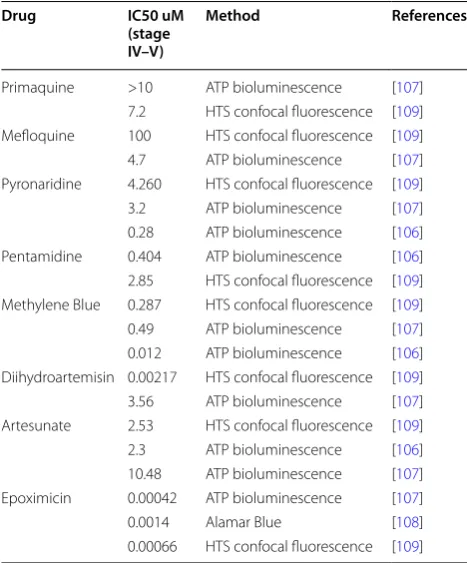
vari-ety of drugs to be tested using different methods such as
ATP bioluminescence, confocal fluorescence and
Alarm-Blue oxireduction [
105
–
109
], but the variability between
activity measurements of the same drug, sometimes
even with the same method (Table
1
), and the lack of a
true high-throughput model that is able to screen more
than 1000 molecules at a time to effectively search for
leads and new scaffolds to design the best drugs for these
stages, indicates there is still a lot of progress to be made.
There have been some efforts and advances in this
direc-tion [
110
–
112
] but still far from the standard screening
models available for asexual stages [
113
].
Most of the research is focused on the late gametocyte
stage but it is also possible to target the mosquito stages
of the parasites (sporontocidal activity), as demonstrated
with proguanil, pyrimethamine and most endoperoxides
[
70
,
105
]. The rate and timing at which gametocytes are
cleared or neutralized (transmission time-window) is a
factor to take into account when considering a
transmis-sion blocking drug, for example a single dose of PQ that
has very short-live and targets only late gametocytes, may
leave a certain number of gametocytes behind that will
eventually mature and able to infect mosquitoes [
114
–
116
]. This would not be the case if used in combination
with a sporontocidal drug, but on the other hand the long
half-life needed to be effective, is a major challenge to
overcome.
suggest resistance is spreading faster at both ends of the
transmission-intensity spectrum [
117
–
120
], this
possi-bility has not been conclusively confirmed or refuted by
empirical data and, probably, the implications for
super-infection (simultaneous super-infection with multiple
geneti-cally distinct parasites) should also be accounted [
121
].
Another model suggested that increasing ACT
cov-erage would outperform the addition of any specific
gametocytocidal drug in reducing transmission [
122
],
but even if true, the spreading of artemisinin resistance
and PQ side effects should suffice for investing time and
resources in the development of a novel, efficacious,
late-gametocyte/gamete inhibitor.
Transmission‑blocking vaccine
During 2013, the Malaria Vaccine Initiative (MVI)
updated its roadmap and included the development
of vaccines interrupting malaria parasite transmission
(VIMTs) as one of its strategic goals for the next years
[
123
,
124
]. The vaccine approach aims to achieve
trans-mission reduction through an immunological attack on
sexual or mosquito stages of the life cycle. To this end, an
immune response in the human host directed to
stage-specific targets is required.
Surface proteins of gametocytes and gametes (Pfs 2400,
Pfs 230, Pfs 48/45, Pfg 27), zygote and ookinete stages (Ps
25, Ps 28) have been the principal candidates [
70
,
125
–
128
], but other epitopes from later stages (Ps 21),
mol-ecules such as chitinase, which is important for PM and
midgut traversal, and alanyl aminopeptidase (AnAPN1),
an antigen in the midgut surface, important for ookinete
recognition, were identified as potential targets [
129
,
130
]. Since there is a population chokepoint occurring,
the appeal, in terms of resistance spread and
elimina-tion purposes, of targeting later stages in the mosquito
infection is obvious, even if the quantitative translation
of reducing parasite numbers in different stages into a
successful transmission and propagation of malaria is not
well enough understood [
45
,
46
,
124
,
131
].
To develop a successful vaccine, choosing the best
target is just the first step, and the need to find a good
production and delivery system, complemented by an
appropriate formulation and potential adjuvants, is also
important [
132
,
133
]. Apart from killed or attenuated
whole pathogens (non-practical for mosquito stages)
[
134
,
135
], large-scale production of protein antigens is
doable using various recent technologies, either
syn-thetic or recombinant, but correct folding, a prerequisite
for achieving highly specific high titres in humans is still
a challenge [
136
–
138
]. In the case of malaria and
trans-mission-blocking vaccines (TBVs) in particular, several
expression systems for recombinant antigens have been
used, including
Escherichia coli
,
Lactococcus lactis
bac-terium models,
Baculovirus
, yeast (
Pichia pastoris,
Sac-charomyces cerevisae)
, plant-based systems, and algae
[
138
–
144
]. Particle-delivery technology, such as
virus-like particles (VLP) and nanoparticles, are also being
pursued [
143
,
145
], and the recently developed DNA
vac-cine technology has been tried but it is still in a very early
stage of development [
146
–
148
].
Some candidates using different antigens, production
and delivery strategies are currently in preclinical stage
and being considered for the first tests in humans [
149
],
and others, such as AnAPN1, are still at earlier stage but
nevertheless promising because the antibodies produced
appear to inhibit both
P. falciparum
and
P. vivax
[
129
].
Targeting
P. vivax
is of particular importance since this
parasite can stay undetected in the liver in the
hypnozo-ite dormant over 2 years, with PQ being the only
medi-cine to target them at the moment [
150
]. Two different
recombinant strategies (using virus-like and
conjugat-ing with
Pseudomonas aeruginosa
exoprotein A)
target-ing Pfs25 antigen are already in phase I of clinical trials
[
151
,
152
], and are the first official candidates for VIMTs
targeting sexual, sporogonic or mosquito-stage antigens
(SSM-VIMT) but are still a small fraction of the malaria
vaccine pipeline [
153
].
In addition to the development of a stand-alone
SSM-VIMT, which would not confer immediate benefit to a
Table 1 Comparison of in vitro gametocytocidal activities
with different methods and anti-malarial drugs
Drug IC50 uM (stage IV–V)
Method References
[image:5.595.56.290.114.396.2]vaccine recipient, a vaccine targeting both SSM and other
stage-malaria antigens is being studied. Examples of such
an approach are the fusion of circumsporozoite protein
(CSP), Pfs 25 and glutamate-rich protein (GLURP) with
Pfs 48/45 [
154
–
156
]. Just as targeting antigens from
multiple parasite stages may create synergies, the use
of a vaccine and drug together could also maximize the
impact on transmission for a longer period than a drug
alone could. It was also suggested that a SSM-VIMT
could be coformulated or co-administrated with another
health intervention (as Mosquirix with hepatitis B) that
targets the same population to render it directly
benefi-cial to recipients, and overcome some of the ethical issues
associated with this kind of intervention [
157
,
158
].
Refractory mosquitoes
Mosquitoes have their own natural mechanisms to fight
Plasmodium
, with a small percentage of them being
refractory to the infection [
38
,
56
,
57
]. Researchers have
recently started to explore possible ways to exploit this
observation in the malaria elimination effort. The idea
is to (naturally or artificially) emulate the refractoriness
processes in the laboratory and somehow introduce it in
the field, in such a way that will eventually shift the
mos-quito population towards a
Plasmodium
-resistant vector
phenotype. Some of the strategies were borrowed from
other vectors and disease control programmes and are
already tested in the field on a small scale, and others still
are in an early stage of research [
158
–
161
]. They fall into
three categories: population replacement, artificial gene
drive mechanisms and third-party modified organisms as
delivery systems. Their common feature is the expression
of at least one effector molecule responsible for malaria
refractoriness. Since this requisite is not met with
popu-lation suppression methods, such as the release of insects
carrying a dominant lethal genetic systems (RIDL), it is
not included in this topic.
An ideal effector molecule will not convey a fitness
cost to the insect host and could be used in combination
to target different stages of the parasite development.
Some candidates already tested include phospholipase
A2 (PLA2), shown to inhibit ookinete invasion through
an unknown mode of action [
162
], and salivary gland and
midgut peptide 1 (SM1) that is thought to block
recogni-tion sites for sporozoites and ookinetes [
163
].
Population replacement can be achieved by
releas-ing either genetically modified (GM) mosquitoes that
express a killing or disabling agent for the malaria
para-sites [
164
], or naturally refractory mosquitoes
previ-ously selected and reared in the laboratory [
162
]. For
large-scale implementation in the field, mosquito releases
would probably need to be preceded with intensive insect
elimination campaigns to reduce the native population.
Release should be done in a controlled manner backed
up with a mathematical model giving insight for the
stage, numbers, timing, and location that would
maxi-mize the desired genetic shifting of the population [
165
].
Even if the fitness cost of the desired trait is designed to
be minimal, it is very likely that this shifting will not be
incremental and self-sustainable, and in order to
main-tain the modifications, periodic releases of additional
insects might be needed [
161
]. Not only is it difficult and
costly to rear such large numbers of mosquitoes to have
a meaningful impact on levels of transmission of the
dis-ease, there is also the ethical issue behind releasing
bit-ing female
Anopheles
, and before being implemented, a
careful sensibilization campaign should be made within
affected communities.
As an alternative strategy, gene drive mechanisms have
been explored to reduce the number of insects needed
(males only) to propagate in a self-sustainable manner
without additional releases [
161
,
164
]. Many solutions
have been studied, starting from transposable elements
that will be integrated randomly across the genome, or
‘selfish genes’, such as the homing endonuclease genes
(HEGs) that are transmitted horizontally within a
popu-lation by using the host cell DNA repair machinery. The
linkage between the drive mechanism and the
refrac-tory system deserves special attention and must be
engi-neered in a way that, in case it is broken, there is a safety
system to prevent modified insects overtaking the
popu-lation [
161
,
164
]. A system consisting of synthetic genetic
elements, with mosquito regulatory regions and the HEG
I-SceI11-13, has already been demonstrated to
substan-tially increase its transmission to the progeny of
An.
gam-biae
[
166
], and very recently a Cas9-mediated gene drive
mechanism was published with very interesting results
[
167
–
169
].
Finally, life organisms, such as bacteria and fungi [
170
–
172
], and even viruses [
173
], have been proposed to be
engineered as expressing systems for refractory genes
inside the mosquitoes. The diversity of the midgut flora
in adult
Anopheles
is well known and includes
Escheri-chia, Alcaligenes, Pseudomonas, Serratia
, and
Bacillus
,
which could be used as paratransgenesis vehicles [
174
].
One such system has been demonstrated with
Escheri-chia coli
expressing a fusion protein of ricin and a
single-chain antibody against Pbs2, inhibiting oocyst formation
by 95 % in
Anopheles stephensi
[
175
]. The bacterium
Wolbachia
is a special case that has received much
atten-tion lately, as it was observed that infected
Anopheles
Wolbachia
inserts a drive mechanism through
cytoplas-mic incompatibility, meaning that only when both female
and male are infected, the fertilized eggs will hatch
nor-mally and the bacteria is transovarially transmitted to
the next generation [
160
,
161
,
176
]. Another possibility is
the use of entomopathogenic fungi: fungal spores may be
extremely robust and have the advantage to infect
mos-quitoes directly via the cuticle. Fungal spores can be
inte-grated into a number of delivery systems, such as indoor
spraying or odour-baited traps [
159
,
177
,
178
]. One such
example is
Metarhizium anisopliae
, modified to express a
fusion protein between SM1 and scorpine (antimicrobial
toxin), which was able to reduce
P. falciparum
sporozoite
counts by 98 % in
An. gambiae
[
178
].
Future perspectives
A successful wide-scale implementation of TBS for
malaria elimination campaigns is still some way in the
future. Each strategy has its own unique challenges but
there are some common questions and technical
limita-tions that need to be overcome and answered. One of
the central questions in TBS research is the
quantita-tive and qualitaquantita-tive relationship between transmission
reduction and its impact in the parasite reservoir.
Sev-eral studies have been made [
45
,
46
,
69
,
84
–
88
,
124
,
131
],
but there is still a huge knowledge gap to be filled. Better
data are needed for human-to-mosquito (and vice versa)
transmission rates, prevalence and density of different
mosquito stages, and the relation with geographic and
demographics (both human and mosquito). The current
limited availability of such data is both a challenge and
an avenue for further research to translate TBS from the
laboratory bench to the field.
Testing the efficacy of a future transmission-blocking
drug or vaccine is a further important requirement.
Ran-domized cluster approaches can be used but the
end-points to assess the clinical relevance of such therapeutics
are still not clear [
137
,
157
,
179
]. The ideal endpoint
should be the reduction of new human infections from
the same epidemiological source following the
introduc-tion of the intervenintroduc-tion, but is very difficult to achieve in
the field. An alternative is to measure the reduction in the
total number of cases, but then it is impossible to assess
the direct contribution of the treatment. Whichever
end-point is chosen, the real world will require a compromise
between directly quantifiable impact and epidemiological
relevance.
A major concern of TBS is regulatory approval, because
a clinical development plan for TBS will certainly be
dif-ferent from those applied to other malaria vaccines and
drugs. Encouraged by the US Food and Drug
Adminis-tration (FDA) which clearly states that there is no legal
opposition to licensing, and in view of the momentum of
new SSM-TBV projects reaching clinical testing, a work
group of international experts was established to assess
the requirements of an eventual SSM-VIMT Phase III
trial [
179
]. One of the conclusions highlighted the critical
importance of identifying the minimally required efficacy
(and coverage) and the need for specific criteria that will
inform early clinical decision-making.
Both, compartmental and mechanistic mathematical
modelling, are paramount for the progress of any of the
strategies discussed above [
180
–
182
]. This was also one
of the lessons learned during the previous Global Malaria
Eradication Programme (GMEP) during the 1950s and
1960s, where dichlorodiphenyltrichloroethane (DDT)
was widely used as insecticide until the programme was
discontinued due to a combination of resistance,
finan-cial constraints and negative environmental impact [
183
].
Some studies suggest that despite the immediate
suc-cesses of the programme in certain regions, in others,
the gain was lost with resurgence appearing in endemic
proportions [
184
]. Thus, the aim should be a long-term
strategy, able to measure and predict its impact locally in
a specific set of conditions. This will then allow informed
decisions on how, where, and when is the best way to
implement a certain TBS, and good models and data are
crucial to reach that goal [
185
,
186
].
Finally, there is the ethical issue behind using
medi-cines without direct therapeutic benefit to patients, even
considering the decreased probability of re-infection.
Even if there were no direct benefits, one can argue that
individuals taking TB medicines or vaccines is a matter of
public health. Education and population sensibilization
prior implementation, maybe even more than cost and
efficacy, is therefore crucial for any strategy to succeed.
On the other hand, all strategies presented in the
‘refractory mosquitoes’ topic are far from
implementa-tion; despite some promising results, more knowledge
such as the epidemiological effects of releasing modified
mosquitoes and biopathogens in the field, is needed [
164
,
191
]. Such unconventional approaches might disfavour
public awareness and support, but if enough evidence
of the positive impact for malaria elimination is
gath-ered and its scalability is proven, then they could become
another weapon in the TBS arsenal.
Conclusions
While it is not expected that TBS will be sufficient to
eliminate the disease on their own, their application
has the potential to boost other strategies. TBS should
be aimed to the lowest endemicity level areas possible
(R
0< 10) with frequency and timepoints optimized,
tak-ing into account not only the immediate impact in the
human reservoir of parasites, but also the long term. In
addition, efforts to find the best solution for endpoints
and regulatory challenges at clinical trials still need to
be made and sensibilization campaigns in affected
com-munities to educate about the beneficial issues of TBS
should be a priority.
[image:8.595.59.538.87.456.2]until they are rendered ineffective. To achieve malaria
elimination, all stages should be targeted, preferably at
once, and some of the TBS described here, or others to
come, most certainly will have a major role to play.
Authors’ contributionsDG drafted the first version and PH reviewed and approved for submission. Both authors read and approved the final manuscript.
Acknowledgements
The authors want to thank the Swiss Nanoscience Institut for funding and support.
Competing interests
The authors declare that they have no competing interests.
Received: 5 December 2015 Accepted: 11 February 2016
References
1. WHO. World malaria report 2014. Geneva: World Health Organization; 2014.
2. Guerra CA, Gikandi PW, Tatem AJ, Noor AM, Smith DL, Hay SI, et al. The limits and intensity of Plasmodium falciparum transmission: implications for malaria control and elimination worldwide. PLoS Med. 2008;5:e38. doi:10.1371/journal.pmed.0050038.
3. Guerra CA, Howes RE, Patil AP, Gething PW, Van Boeckel TP, Temperley WH, et al. The international limits and population at risk of Plasmo-dium vivax transmission in 2009. PLoS Negl Trop Dis. 2010;4:e774. doi:10.1371/journal.pntd.0000774.
4. Malaria Atlas Project. University of Oxford, UK. 2006. http://www.map. ox.ac.uk/explorer/ Accessed 21 Aug 2015.
5. Murray CJL, Rosenfeld LC, Lim SS, Andrews KG, Foreman KJ, Haring D, et al. Global malaria mortality between 1980 and 2010: a systematic analysis. Lancet. 2012;379:413–31.
6. Kantele A, Jokiranta TS. Review of cases with the emerging fifth human malaria parasite, Plasmodium knowlesi. Clin Infect Dis. 2011;52:1356–62.
7. WHO. MalERA update. World Health Organization, Geneva. http://www. who.int/malaria/elimination/maleraupdate.pdf of subordinate docu-ment. Accessed 13 June 2015.
8. EMA. First malaria vaccine receives positive scientific opinion from EMA—London, The European Medicines Agency. http://www.ema. europa.eu/docs/en_GB/document_library/Press_release/2015/07/ WC500190447.pdf of subordinate document. Accessed 3 Feb 2016. 9. WHO. World malaria report 2015. Geneva: World Health Organization;
2015.
10. Dondorp AM, Nosten F, Yi P, Das D, Phyo AP, Tarning J, et al. Arte-misinin resistance in Plasmodium falciparum malaria. N Engl J Med. 2009;361:455–67.
11. Amaratunga C, Sreng S, Suon S, Phelps ES, Stepniewska K, Lim P, et al. Artemisinin-resistant Plasmodium falciparum in Pursat province, western Cambodia: a parasite clearance rate study. Lancet Infect Dis. 2012;12:851–8.
12. Kyaw MP, Nyunt MH, Chit K, Aye MM, Aye KH, Lindegardh N, et al. Reduced susceptibility of Plasmodium falciparum to artesunate in southern Myanmar. PLoS ONE. 2013;8:e57689. doi:10.1371/journal. pone.0057689.
13. O’Brien C, Henrich PP, Passi N, Fidock DA. Recent clinical and molecular insights into emerging artemisinin resistance in Plasmodium falciparum. Curr Opin Infect Dis. 2011;24:570–7.
14. Phyo AP, Nkhoma S, Stepniewska K, Ashley EA, Nair S, McGready R, et al. Emergence of artemisinin-resistant malaria on the western border of Thailand: a longitudinal study. Lancet. 2012;379:1960–6.
15. Hien TT, Thuy-Nhien NT, Phu NH, Boni MF, Thanh NV, Nha-Ca NT, et al. In vivo susceptibility of Plasmodium falciparum to artesunate in Binh Phuoc province, Vietnam. Malar J. 2012;11:355.
16. Ashley EA, Dhorda M, Fairhurst RM, Amaratunga C, Lim P, Suon S, et al. Spread of artemisinin resistance in Plasmodium falciparum malaria. N Engl J Med. 2014;371:411–23.
17. Ranson H, N’Guessan R, Lines J, Moiroux N, Nkuni Z, Corbel V. Pyrethroid resistance in African anopheline mosquitoes: What are the implications for malaria control? Trends Parasitol. 2011;27:91–8.
18. Protopopoff N, Matowo J, Malima R, Kavishe R, Kaaya R, Wright A, et al. High level of resistance in the mosquito Anopheles gambiae to pyrethroid insecticides and reduced susceptibility to bendiocarb in north-western Tanzania. Malar J. 2013;12:149.
19. Toé KH, Jones CM, N’Fale S, Ismail HM, Dabiré RK, Ranson H. Increased pyrethroid resistance in malaria vectors and decreased bed net effec-tiveness, Burkina Faso. Emerg Infect Dis. 2014;20:1691–6.
[image:9.595.57.540.90.293.2]20. Trape JF, Tall A, Diagne N, Ndiath O, Ly AB, Faye J, et al. Malaria morbidity and pyrethroid resistance after the introduction of insecticide-treated bednets and artemisinin-based combination therapies: a longitudinal study. Lancet Infect Dis. 2011;11:925–32.
21. Malaria Consortium. Malaria prevention: insecticides. http://www. malariaconsortium.org/userfiles/file/Malaria%20resources/Insecti-cides%202.pdf of subordinate document. Accessed 6 Sept 2015. 22. Eisele TP, Larsen D, Steketee RW. Protective efficacy of interventions
for preventing malaria mortality in children in Plasmodium falciparum
endemic areas. Int J Epidemiol. 2010;39:88–101.
23. Ramirez JL, Garver LS, Dimopoulos G. Challenges and approaches for mosquito targeted malaria control. Curr Mol Med. 2009;9:116–30. 24. Nwane P, Etang J, Chouaїbou M, Toto JC, Koffi A, Mimpfoundi R, et al.
Multiple insecticide resistance mechanisms in Anopheles gambiae s.l.
populations from Cameroon, Central Africa. Parasit Vectors. 2013;6:41. 25. Smith DL, McKenzie FE. Statics and dynamics of malaria infection in
Anopheles mosquitoes. Malar J. 2004;3:13.
26. Smith DL, McKenzie FE, Snow RW, Hay SI. Revisiting the basic reproduc-tive number for malaria and its implications for malaria control. PLoS Biol. 2007;5:e42. doi:10.1371/journal.pbio.0050042.
27. Kelly-Hope LA, McKenzie FE. The multiplicity of malaria transmission: a review of entomological inoculation rate measurements and methods across sub-Saharan Africa. Malar J. 2009;8:19.
28. Smith DL, Dushoff J, Snow RW, Hay SI. The entomological inoculation rate and Plasmodium falciparum infection in African children. Nature. 2005;438:492–5.
29. Bøgh C, Lindsay SW, Clarke SE, Dean A, Jawara M, Pinder M, Thomas CJ. High spatial resolution mapping of malaria transmission risk in the Gambia, west Africa, using LANDSAT TM satellite imagery. Am J Trop Med Hyg. 2007;76:875–81.
30. Smith T, Schapira A. Reproduction numbers in malaria and their impli-cations. Trends Parasitol. 2012;28:3–8.
31. Blagborough AM, Churcher TS, Upton LM, Ghani AC, Gething PW, Sinden RE. Transmission-blocking interventions eliminate malaria from laboratory populations. Nat Commun. 2013;4:1812.
32. Macdonald G, Goeckel GW. The malaria parasite rate and interruption of transmission. Bull World Health Organ. 1964;31:365–77.
33. Johnston GL, Smith DL, Fidock DA. Malaria’s missing number: calculat-ing the human component of R0 by a within-host mechanistic model of Plasmodium falciparum infection and transmission. PLoS Comput Biol. 2013;9:e1003025. doi:10.1371/journal.pcbi.1003025.
34. Tusting LS, Bousema T, Smith DL, Drakeley C. Measuring changes in
Plasmodium falciparum transmission: precision, accuracy and costs of metrics. Adv Parasitol. 2014;84:151–208.
35. Trape JF, Lefebvre-Zante E, Legros F, Ndiaye G, Bouganali H, Druilhe P, Salem G. Vector density gradients and the epidemiology of urban malaria in Dakar, Senegal. Am J Trop Med Hyg. 1992;47:181–9. 36. Midega JT, Mbogo CM, Mwnambi H, Wilson MD, Ojwang G, Mwangangi
JM, et al. Estimating dispersal and survival of Anopheles gambiae and
Anopheles funestus along the Kenyan coast by using mark-release-recapture methods. J Med Entomol. 2007;44:923–9.
37. Francia ME, Striepen B. Cell division in apicomplexan parasites. Nat Rev Microbiol. 2014;12:125–36.
38. Ferreira UM, Nunes MS, Wunderlich G. Antigenic diversity and immune evasion by malaria parasites. Clin Diagn Lab Immunol. 2004;11:987–95. 39. Kirkman LA, Deitsch KW. Antigenic variation and the generation of
diversity in malaria parasites. Curr Opin Microbiol. 2012;15:456–62. 40. Prudêncio M, Rodriguez A, Mota MM. The silent path to thousands
of merozoites: the Plasmodium liver stage. Nat Rev Microbiol. 2006;4:849–56.
41. Miller LH, Ackerman HC, Xin-zhuan S, Wellems TE. Malaria biology and disease pathogenesis: insights for new treatments. Nat Med. 2013;19:156–67.
42. Eichner M, Diebner HH, Molineaux L, Collins WE, Jeffery GM, Dietz K. Genesis, sequestration and survival of Plasmodium falciparum gameto-cytes: parameter estimates from fitting a model to malaria therapy data. Trans R Soc Trop Med Hyg. 2001;95:497–501.
43. McGuinness D, Koram K, Bennett S, Wagner G, Nkrumah F, Riley E. Clinical case definitions for malaria: clinical malaria associated with very low parasite densities in African infants. Trans R Soc Trop Med Hyg. 1998;92:527–31.
44. Wilairatana P, Tangpukdee N, Krudsood S. Definition of hyperpara-sitemia in severe falciparum malaria should be updated. Asian Pac J Trop Biomed. 2013;3:586.
45. Baton LA, Ranford-Cartwright LC. Spreading the seeds of million-murdering death: metamorphoses of malaria in the mosquito. Trends Parasitol. 2005;21:573–80.
46. Angrisano F, Tan YH, Sturm A, McFadden GI, Baum J. Malaria parasite colonisation of the mosquito midgut—placing the Plasmodium ooki-nete centre stage. Int J Parasitol. 2012;42:519–27.
47. Vega-Rodríguez J, Ghosh AK, Kanzok SM, Dinglasan RR, Wang S, Bongio NJ, et al. Multiple pathways for Plasmodium ookinete invasion of the mosquito midgut. Proc Natl Acad Sci U S A. 2014;111:492–500. 48. Hegedus D, Erlandson M, Gillott C, Toprak U. New insights into
peri-trophic matrix synthesis, architecture, and function. Annu Rev Entomol. 2009;54:285–302.
49. Abraham EG, Jacobs-Lorena M. Mosquito midgut barriers to malaria parasite development. Insect Biochem Mol Biol. 2004;34:667–71. 50. Han YS, Thompson J, Kafatos FC, Barillas-Mury C. Molecular interactions
between Anopheles stephensi midgut cells and Plasmodium berghei: the time bomb theory of ookinete invasion of mosquitoes. EMBO J. 2000;19:6030–40.
51. Han YS, Barillas-Mury C. Implications of time bomb model of ookinete invasion of midgut cells. Insect Biochem Mol Biol. 2002;32:1311–6. 52. Hillyer JF, Barreau C, Vernick KD. Efficiency of salivary gland invasion by
malaria sporozoites is controlled by rapid sporozoite destruction in the mosquito hemocoel. Int J Parasitol. 2007;37:673–81.
53. Medica DL, Sinnis P. Quantitative dynamics of Plasmodium yoelii sporo-zoite transmission by infected anopheline mosquitoes. Infect Immun. 2005;73:4363–9.
54. Rosenberg R, Wirtz RA, Schneider I, Burge R. An estimation of the num-ber of malaria sporozoites ejected by a feeding mosquito. Trans R Soc Trop Med Hyg. 1990;84:209–12.
55. Amino R, Thiberge S, Martin B, Celli S, Shorte S, Frischknecht F, et al. Quantitative imaging of Plasmodium transmission from mosquito to mammal. Nat Med. 2006;12:220–4.
56. Cirimotich CM, Dong Y, Garver LS, Sim S, Dimopoulos G. Mosquito immune defenses against Plasmodium infection. Dev Comp Immunol. 2010;34:387–95.
57. Malaguarnera L, Musumeci S. The immune response to Plasmodium falciparum malaria. Lancet Infect Dis. 2002;2:472–8.
58. Hall N, Karras M, Raine JD, Carlton JM, Kooij TW, Berriman M, et al. A comprehensive survey of the Plasmodium life cycle by genomic, tran-scriptomic, and proteomic analyses. Science. 2005;307:82–6.
59. Florens L, Washburn MP, Raine JD, Anthony RM, Grainger M, Haynes JD, et al. A proteomic view of the Plasmodium falciparum life cycle. Nature. 2002;419:520–6.
60. Ahmed AM, Baggott SL, Maingon R, Hurd H. The costs of mounting an immune response are reflected in the reproductive fitness of the mosquito Anopheles gambiae. Oikos. 2002;97:371–7.
61. Hurd H. Manipulation of medically important insect vectors by their parasites. Annu Rev Entomol. 2003;48:141–61.
62. Sangare I, Michalakis Y, Yameogo B, Dabire R, Morlais I, Cohuet A. Study-ing fitness cost of Plasmodium falciparum infection in malaria vectors: validation of an appropriate negative control. Malar J. 2013;12:2. 63. Carter R, Miller LH. Evidence for environmental modulation of
gameto-cytogenesis in Plasmodium falciparum in continuous culture. Bull World Health Organ. 1979;57:37–52.
64. Bruce MC, Alano P, Duthie S, Carter R. Commitment of the malaria parasite Plasmodium falciparum to sexual and asexual development. Parasitology. 1990;100:191–200.
65. Smith TG, Lourenço P, Carter R, Walliker D, Ranford-Cartwright LC. Commitment to sexual differentiation in the human malaria parasite,
Plasmodium falciparum. Parasitology. 2000;121:127–33.
66. Mitri C, Thiery I, Bourgouin C, Paul RE. Density-dependent impact of the human malaria parasite Plasmodium falciparum gametocyte sex ratio on mosquito infection rates. Proc Biol Sci. 2009;276:3721–6. 67. Baker DA. Malaria gametocytogenesis. Mol Biochem Parasitol.
2010;172:57–65.
69. Kuehn A, Pradel G. The coming-out of malaria gametocytes. J Biomed Biotechnol. 2010;2010:976827. doi:10.1155/2010/976827.
70. Bousema T, Drakeley C. Epidemiology and infectivity of Plasmodium falciparum and Plasmodium vivax gametocytes in relation to malaria control and elimination. Clin Microbiol Rev. 2011;24:377–410. 71. Bousema T, Okell L, Shekalaghe S, Griffin JT, Omar S, Sawa P, et al.
Revisiting the circulation time of Plasmodium falciparum gametocytes: molecular detection methods to estimate the duration of gametocyte carriage and the effect of gametocytocidal drugs. Malar J. 2010;9:136. 72. Smalley ME, Sinden RE. Plasmodium falciparum gametocytes: their
longevity and infectivity. Parasitology. 1977;74:1–8.
73. Schneider P, Bousema JT, Gouagna LC, Otieno S, van de Vegte-Bolmer M, Omar SA, et al. Submicroscopic Plasmodium falciparum gametocyte densities frequently result in mosquito infection. Am J Trop Med Hyg. 2007;76:470–4.
74. Eckhoff P. P. falciparum infection durations and infectiousness are shaped by antigenic variation and innate and adaptive host immunity in a mathematical model. PLoS ONE. 2012;7:e44950. doi: 10.1371/jour-nal.pone.0044950.
75. Da DF, Churcher TS, Yerbanga RS, Yaméogo B, Sangaré I, Ouedraogo JB, et al. Experimental study of the relationship between Plasmodium gametocyte density and infection success in mosquitoes; implications for the evaluation of malaria transmission-reducing interventions. Exp Parasitol. 2015;149:74–83.
76. Bousema T, Okell L, Felger I, Drakeley C. Asymptomatic malaria infec-tions: detectability, transmissibility and public health relevance. Nat Rev Microbiol. 2014;12:833–40.
77. Wampfler R, Mwingira F, Javati S, Robinson L, Betuela I, Siba P, et al. Strategies for detection of Plasmodium species gametocytes. PLoS ONE. 2013;8:e76316. doi:10.1371/journal.pone.0076316.
78. Schneider P, Schoone G, Schallig H, Verhage D, Telgt D, Eling W, et al. Quantification of Plasmodium falciparum gametocytes in differential stages of development by quantitative nucleic acid sequence-based amplification. Mol Biochem Parasitol. 2004;137:35–41.
79. Karl Stephan. Comparison of three methods for detection of gameto-cytes in Melanesian children treated for uncomplicated malaria. Malar J. 2014;13:319.
80. WPRO. Determining cost effectiveness of malaria rapid diagnostic tests in rural areas with high prevalence—Manila. World Health Organiza-tion Western Pacific Region. http://www.wpro.who.int/malaria/NR/ rdonlyres/0A45DF24-4245-4BF3-96E7-5F1150AF333B/0/Determin-ingCostEffectivenessofRDTsinruralareaswithhighprevalence.pdf of subordinate document. Accessed 3 Feb 2016.
81. Hansen KS, Grieve E, Mikhail A, Mayan I, Mohammed N, Anwar M, et al. Cost-effectiveness of malaria diagnosis using rapid diagnostic tests compared to microscopy or clinical symptoms alone in Afghanistan. Malar J. 2015;14:217.
82. Ansah EK, Epokor M, Whitty CJ, Yeung S, Hansen KS. Cost-effec-tiveness analysis of introducing RDTs for malaria diagnosis as compared to microscopy and presumptive diagnosis in central and peripheral public health facilities in Ghana. Am J Trop Med Hyg. 2013;89:724–36.
83. Cook J, Aydin-Schmidt B, González IJ, Bell D, Edlund E, Nassor MH, et al. Loop-mediated isothermal amplification (LAMP) for point-of-care detection of asymptomatic low-density malaria parasite carriers in Zanzibar. Malar J. 2015;14:43.
84. Githeko AK, Brandling-Bennett AD, Beier M, Atieli F, Owaga M, Collins FH. The reservoir of Plasmodium falciparum malaria in a holoendemic area of western Kenya. Trans R Soc Trop Med Hyg. 1992;86:355–8. 85. Bonnet S, Gouagna LC, Paul RE, Safeukui I, Meunier JY, Boudin C.
Estimation of malaria transmission from humans to mosquitoes in two neighbouring villages in south Cameroon: evaluation and comparison of several indices. Trans R Soc Trop Med Hyg. 2003;97:53–9.
86. Churcher TS, Bousema T, Walker M, Drakeley C, Schneider P, Ouédraogo AL, et al. Predicting mosquito infection from Plasmodium falciparum
gametocyte density and estimating the reservoir of infection. Elife. 2013;2:e00626. doi:10.7554/eLife.00626.
87. Drakeley CJ, Bousema JT, Akim NI, Teelen K, Roeffen W, Lensen AH, et al. Transmission-reducing immunity is inversely related to age in Plasmodium falciparum gametocyte carriers. Parasite Immunol. 2006;28:185–90.
88. Haji H, Smith T, Charlwood JD, Meuwissen JH. Absence of relationships between selected human factors and natural infectivity of Plasmodium falciparum to mosquitoes in an area of high transmission. Parasitology. 1996;113:425–31.
89. Bousema T, Churcher TS, Morlais I, Dinglasan RR. Can field-based mosquito feeding assays be used for evaluating transmission-blocking interventions? Trends Parasitol. 2013;29:53–9.
90. Pukrittayakamee S, Chotivanich K, Chantra A, Clemens R, Looareesuwan S, White NJ. Activities of artesunate and primaquine against asexual- and sexual-stage parasites in falciparum malaria. Antimicrob Agents Chemother. 2004;48:1329–34.
91. Song J, Socheat D, Tan B, Dara P, Deng C, Sokunthea S, et al. Rapid and effective malaria control in Cambodia through mass administration of artemisinin-piperaquine. Malaria J. 2010;9:57.
92. Graves PM, Gelband H, Garner P. Primaquine or other 8-aminoquinoline for reducing Plasmodium falciparum transmission. Cochrane Database Syst Rev. 2015;6:CD008152. doi:10.1002/14651858.CD008152.pub4. 93. Maude RJ, Socheat D, Nguon C, Saroth P, Dara P, Li G, et al. Optimising
strategies for Plasmodium falciparum malaria elimination in Cambodia: primaquine, mass drug administration and artemisinin resistance. PLoS ONE. 2012;7:e37166. doi:10.1371/journal.pone.0037166.
94. Baird JK, Surjadjaja C. Consideration of ethics in primaquine therapy against malaria transmission. Trends Parasitol. 2011;27:11–6. 95. Eziefula AC, Bousema T, Yeung S, Kamya M, Owaraganise A, Gabagaya
G, et al. Single dose primaquine for clearance of Plasmodium falciparum
gametocytes in children with uncomplicated malaria in Uganda: a randomised, controlled, double-blind, dose-ranging trial. Lancet Infect Dis. 2014;14:130–9.
96. WHO. Guidelines for the treatment of malaria. 3rd ed. Geneva: WHO Library Cataloguing-in-Publication Data; 2015.
97. Pukrittayakamee S, Imwong M, Singhasivanon P, Stepniewska K, Day NJ, White NJ. Effects of different antimalarial drugs on gametocyte carriage in P. vivax malaria. Am J Trop Med Hyg. 2008;79:378–84.
98. Nacher M, Silachamroon U, Singhasivanon P, Wilairatana P, Phumratan-aprapin W, Fontanet A, et al. Comparison of artesunate and chloroquine activities against Plasmodium vivax gametocytes. Antimicrob Agents Chemother. 2004;48:2751–2.
99. Zeeman AM, der Wel AV, Kocken CH. Ex vivo culture of Plasmodium vivax and Plasmodium cynomolgi and in vitro culture of Plasmodium knowlesi blood stages. Methods Mol Biol. 2013;923:35–49.
100. McClean CM, Alvarado HG, Neyra V, Llanos-Cuentas A, Vinetz JM. Opti-mized in vitro production of Plasmodium vivax ookinetes. Am J Trop Med Hyg. 2010;83:1183–6.
101. Fivelman QL, McRobert L, Sharp S, Taylor CJ, Saeed M, Swales CA, et al. Improved synchronous production of Plasmodium falciparum gameto-cytes in vitro. Mol Biochem Parasitol. 2007;154:119–23.
102. Roncalés M, Vidal-Mas J, Leroy D, Herreros E. Comparison and optimization of different methods for the in vitro production of
Plasmodium falciparum gametocytes. J Parasit Res. 2012;2012:927148. doi:10.1155/2012/927148.
103. Ghosh AK, Dinglasan RR, Ikadai H, Jacobs-Lorena M. An improved method for the in vitro differentiation of Plasmodium falciparum game-tocytes into ookinetes. Malar J. 2010;9:194.
104. Bounkeua V, Li F, Vinetz JM. In vitro generation of Plasmodium falcipa-rum ookinetes. Am J Trop Med Hyg. 2010;83:1187–94.
105. Delves M, Plouffe D, Scheurer C, Meister S, Wittlin S, Winzeler EA, et al. The activities of current antimalarial drugs on the life cycle stages of Plasmodium: a comparative study with human and rodent parasites. PLoS Med. 2012;9:e1001169. doi:10.1371/journal.pmed.1001169. 106. Peatey CL, Leroy D, Gardiner DL, Trenholme KR. Anti-malarial drugs: how
effective are they against Plasmodium falciparum gametocytes. Malar J. 2012;11:34.
107. Lelièvre J, Almela MJ, Lozano S, Miguel C, Franco V, Leroy D, et al. Activ-ity of clinically relevant antimalarial drugs on Plasmodium falciparum
mature gametocytes in na ATP bioluminescence “transmission block-ing” assay. PLoS ONE. 2012;7:e35019. doi:10.1371/journal.pone.0035019. 108. Tanaka TQ, Williamson KC. A malaria gametocytocidal assay using
oxidoreduction indicator, Alamar Blue. Mol Biochem Parasitol. 2011;177:160–3.
109. Duffy S, Avery VM. Identification of inhibitors of Plasmodium falciparum
110. Buchholz K, Burke TA, Williamson KC, Wiegand RC, Wirth DF, Marti M. A high-throughput screen targeting malaria transmission stages opens new avenues for drug development. J Infect Dis. 2011;203:1445–53.
111. Peatey CL, Spicer TP, Hodder PS, Trenholme KR, Gardiner DL. A high-throughput assay for the identification of drugs against late-stage Plasmodium falciparum gametocytes. Mol Biochem Parasitol. 2011;180:127–31.
112. Miguel-Blanco C, Lelièvre J, Delves MJ, Bardera AI, Presa JL, López-Barragán MJ, et al. Imaging-based high-throughput screening assay to identify new molecules with transmission-blocking potential against
Plasmodium falciparum female gamete formation. Antimicrob Agents Chemother. 2015;59:3298–305.
113. Gamo FJ, Sanz LM, Vidal J, de Cozar C, Alvarez E, Lavandera JL, et al. Thousands of chemical starting points for antimalarial lead identifica-tion. Nature. 2010;465:305–10.
114. Rieckmann KH, McNamara JV, Frischer H, Stockert TA, Carson PE, Powell RD. Gametocytocidal and sporontocidal effects of primaquine and of sulfadiazine with pyrimethamine in a chloroquine-resistant strain of
Plasmodium falciparum. Bull World Health Organ. 1968;38:625–32. 115. Wilairatana P, Krudsood S, Tangpukdee N. Appropriate time for
pri-maquine treatment to reduce Plasmodium falciparum transmission in hypoendemic areas. Korean J Parasitol. 2010;48:179–82.
116. Lawpoolsri S, Klein EY, Singhasivanon P, Yimsamran S, Thanyavanich N, Maneeboonyang W, et al. Optimally timing primaquine treatment to reduce Plasmodium falciparum transmission in low endemicity Thai-Myanmar border populations. Malar J. 2009;8:159.
117. Hastings IM. Gametocytocidal activity in antimalarial drugs speeds the spread of drug resistance. Trop Med Int Health. 2006;11:1206–17. 118. Talisuna AO, Okello PE, Erhart A, Coosemans M, D’Alessandro U.
Inten-sity of malaria transmission and the spread of Plasmodium falciparum– resistant malaria: a review of epidemiologic field evidence. Am J Trop Med Hyg. 2007;77:170–80.
119. Talisuna AO, Langi P, Bakyaita N, Egwang T, Mutabingwa TK, Watkins W, et al. Intensity of malaria transmission, antimalarial-drug use and resist-ance in Uganda: What is the relationship between these three factors? Trans R Soc Trop Med Hyg. 2002;96:310–7.
120. Artzy-Randrup Y, Alonso D, Pascual M. Transmission intensity and drug resistance in malaria population dynamics: implications for climate change. PLoS ONE. 2010;5:e13588. doi:10.1371/journal.pone.0013588. 121. Klein EY, Smith DL, Laxminarayan R, Levin S. Superinfection and
the evolution of resistance to antimalarial drugs. Proc Biol Sci. 2012;279:3834–42.
122. Johnston GL, Gething PW, Hay SI, Smith DL, Fidoc DA. Modeling within-host effects of drugs on Plasmodium falciparum transmission and prospects for malaria elimination. PLoS Comput Biol. 2014;10:e1003434. doi:10.1371/journal.pcbi.1003434.
123. WHO. Malaria Vaccine Funders Group. Malaria vaccine technology road-map. 2013. http://www.who.int/immunization/topics/malaria/vaccine
roadmap/TRM update nov13.pdf of subordinate document. Accessed 6 Sept 2015.
124. Willyard C. Malaria eradication: blocking transmission to mosquitoes. Pharm J. 2015;294:7843–4.
125. Carter R. Transmission blocking malaria vaccines. Vaccine. 2001;19:2309–14.
126. Pradel G. Proteins of the malaria parasite sexual stages: expression, function and potential for transmission blocking strategies. Parasitol-ogy. 2007;134:1911–29.
127. Saxena AK, Wu Y, Garboczi DN. Plasmodium p25 and p28 surface proteins: potential transmission-blocking vaccines. Eukaryot Cell. 2007;6:1260–5.
128. Tomas AM, Margos G, Dimopoulos G, van Lin LH, de Koning-Ward TF, Sinha R, et al. P25 and P28 proteins of the malaria ookinete surface have multiple and partially redundant functions. EMBO J. 2001;20:3975–83. 129. Tsai YL, Hayward RE, Langer RC, Fidock DA, Vinetz JM. Disruption of
Plasmodium falciparum chitinase markedly impairs parasite invasion of mosquito midgut. Infect Immun. 2001;69:4048–54.
130. Armistead JS, Morlais I, Mathias DK, Jardim JG, Joy J, Fridman A, et al. Antibodies to a single, conserved epitope in Anopheles APN1 inhibit universal transmission of Plasmodium falciparum and Plasmodium vivax
malaria. Infect Immun. 2014;82:818–29.
131. Churcher TS, Dawes EJ, Sinden RE, Christophides GK, Koella JC, Basáñez MG. Population biology of malaria within the mosquito: density-dependent processes and potential implications for transmission-blocking interventions. Malar J. 2010;9:311.
132. Wen EP, Ellis R, Pujar NS. Vaccine development and manufacturing. New York: Wiley; 2015.
133. Wu Y, Ellis RD, Shaffer D, Fontes E, Malkin EM, Mahantyet S, et al. Phase 1 trial of malaria transmission blocking vaccine candidates pfs25 and pvs25 formulated with montanide isa 51. PLoS ONE. 2008;3:e2636. doi:10.1371/journal.pone.0002636.
134. Epstein JE, Richie TL. The whole parasite, pre-erythrocytic stage approach to malaria vaccine development: a review. Curr Opin Infect Dis. 2013;26:420–8.
135. Seder RA, Chang LJ, Enama ME, Zephir KL, Sarwar UN, Gordon IJ, et al. Protection against malaria by intravenous immunization with a nonrep-licating sporozoite vaccine. Science. 2013;341:1359–65.
136. Wu Y, Przysiecki C, Flanagan E, Bello-Irizarry SN, Ionescu R, Muratova O, et al. Sustained high-titer antibody responses induced by conjugating a malarial vaccine candidate to outer-membrane protein complex. Proc Natl Acad Sci U S A. 2006;103:18243–8.
137. Cheru L, Wu Y, Diouf A, Moretz SE, Muratova OV, Song G, et al. The IC50 of anti-Pfs25 antibody in membrane feeding assay varies among spe-cies. Vaccine. 2010;28:4423–9.
138. Kumar R, Angov E, Kumar N. Potent Malaria transmission-blocking antibody responses elicited by Plasmodium falciparum Pfs25 expressed in Escherichia coli after successful protein refolding. Infect Immun. 2014;82:1453–9. 139. Theisen M, Roeffen W, Singh SK, Andersen G, Amoah L, van de
Vegte-Bolmer M, et al. A multi-stage malaria vaccine candidate targeting both transmission and asexual parasite life-cycle stages. Vaccine. 2014;32:2623–30.
140. Kocken CH, Jansen J, Kaan AM, Beckers PJ, Ponnudurai T, Kaslow DC, et al. Cloning and expression of the gene coding for the transmis-sion blocking target antigen Pfs48/45 of Plasmodium falciparum. Mol Biochem Parasitol. 1993;61:59–68.
141. Kaslow DC, Bathurst IC, Lensen T, Ponnudurai T, Barr PJ, Keister DB. Saccharomyces cerevisiae recombinant Pfs25 adsorbed to alum elicits antibodies that block transmission of Plasmodium falciparum. Infect Immun. 1994;62:5576–80.
142. Zou L, Miles AP, Wang J, Stowers AW. Expression of malaria transmis-sion-blocking vaccine antigen Pfs25 in Pichia pastoris for use in human clinical trials. Vaccine. 2003;21:1650–7.
143. Jones RM, Chichester JA, Mett V, Jaje J, Tottey S, Manceva S, et al. A plant-produced Pfs25 VLP malaria vaccine candidate induces persistent transmission blocking antibodies against Plasmodium falciparum
in immunized mice. PLoS ONE. 2013;8:e79538. doi:10.1371/journal. pone.0079538.
144. Gregory JA, Mayfield SP. Developing inexpensive malaria vaccines from plants and algae. Appl Microbiol Biotechnol. 2014;98:1983–90. 145. Cherif MS, Shuaibu MN, Kodama Y, Kurosaki T, Helegbe GK,
Kikuchi M, et al. Nanoparticle formulation enhanced protective immunity provoked by PYGPI8p-transamidase related protein (PyTAM) DNA vaccine in Plasmodium yoelii malaria model. Vaccine. 2014;32:1998–2006.
146. Ferraro B, Talbott KT, Balakrishnan A, Cisper N, Morrow MP, Hutnick NA, et al. Inducing humoral and cellular responses to multiple sporozoite and liver-stage malaria antigens using exogenous plasmid DNA. Infect Immun. 2013;81:3709–20.
147. Kongkasuriyachai D, Bartels-Andrews L, Stowers A, Collins WE, Sullivan J, Sattabongkot J, et al. Potent immunogenicity of DNA vaccines encod-ing Plasmodium vivax transmission-blocking vaccine candidates Pvs25 and Pvs28—evaluation of homologous and heterologous antigen-delivery prime-boost strategy. Vaccine. 2004;22:3205–13.
148. Doolan DL, Hoffman SL. DNA-based vaccines against malaria: status and promise of the multi-stage malaria DNA vaccine operation. Int J Parasitol. 2001;31:753–62.
149. Nikolaeva D, Draper SJ, Biswas S. Toward the development of effec-tive transmission blocking vaccines for malaria. Expert Rev Vaccines. 2015;14:653–80.
150. Wells TN, Burrows JN, Baird JK. Targeting the hypnozoite reservoir of