RIT Scholar Works
Theses
Thesis/Dissertation Collections
1995
Mental pictures drawings and objects
Deborah Rieders
Follow this and additional works at:
http://scholarworks.rit.edu/theses
This Thesis is brought to you for free and open access by the Thesis/Dissertation Collections at RIT Scholar Works. It has been accepted for inclusion in Theses by an authorized administrator of RIT Scholar Works. For more information, please [email protected].
Recommended Citation
MENTAL
PICTURES
DRAWINGS
AND
OBJECTS
GRADUATE
THESIS
B
Y
DEBORAH RIEDERS
19 9 5
SCHOOL OF PHOTOGRAPHIC ARTS& SCIENCES
TH ESIS BOARD:
RICI< HOCK
ALEX MIOI<OVIC
ELAI N E O'N ElL
J
EFF WEI 55 (ON 5AB BATI CAL)
usur ur nru pef san sins. Now day that ofthe
_
<=><4>^^
pu er qeres
it is at thesarcophagus of
_____ _____
u
-=___
III =__> ^^
tntn h~ ,..._
Figure 1. Anexample ofhierogylphics from theEgyptian BookoftheDead.
Many
artists of the 20th century haveprophesied a worldinwhich symbols
will eventually replace alphabetic language as the
most accurate and effective means ofcommunicating
inour
increasingly
technologicalworld.Eversincetheappearance of
Sanskrit,
the world's earliest known phoneticlanguage,
symbolshaveoftenbeenviewedas anawkward andcumbersome way to
describe the world around us. While
pic-tographic languages such asHieroglyphics
require an infinite
number of symbols
thatincrease proportionatelyto thenumbers of objects in the material world, phonetic languages utilize a restricted and oral alphabet in order to describe the
minutedetailsofeveryday life(fig. 1). Inpicture-writ
ing,
the images themselves "constitutetheir ownlan guage...the writer and reader may use words to describe and interpret the pictorial message, but themessageisnot weddedtoanyparticularsetof
words,"
as itwouldbe inan alphabeticlanguage.1
By
thestan dardsof phoneticwriting,pictographiclanguageoften appears both imprecise and open to discursive inter pretation. In my currentbody
of work, MentalPictures,
I hope to explore the confusing and often humorous terrain of our culture as the pictographic language ofthe digital age threatens to subsume lan guageandpermanently alterhistory
asweknowit.In spite oftheircontingentnature, pictograph icsymbolshaveoften played animportantroleinsoci
ety throughouthistory.
They
have servedimportantly,
and often controversially, as religiousicons,
trademarks, secret codes, public displays for advertising,
and universal signage to convey information across linguistic barriers. Over the last century,
technology
has brought us more symbols than the restofhistory
combined.They
have beenbrought to us through the
invention and popularization
of photography, cheap print
ing,
television, motion pictures, fax machines, and now,
most significantly, computers
and digital media. The chal
lenge of revealing the power
OfSymbols inthe 20thCentU- Figure2. Filippo Tommaso Marinetti,
ry has beentakenup
by
many"scRABrrRn-oaNNG,", 1919. artists whose work has influ
enced this current project. Before
delving
into my work, I would like tobriefly
discuss some of theseartists inorderto provide abroader historicalcontext for myproject.
In the early part of this century both the
Dadaists and the Futurists recognized the
impending
transformation of language into the symbolic realm. Thepolitical posters madeby
thefuturist Marinetti inthe early part of the
century transform text
into symbols in order
to challenge the con struction of meaning
in a violent culture
dominated
by
mechan- Figure 3.Duchampand Man Ray,"Rotoreliefs,"
1935. ical reproduction (fig.
2).
Duchamp
andManRay
reflected ratheramusingly
upontheblurring
oflines betweenword andimagesspin with the
help
of a ratherflimsy
mechanicaldevice,
nonsensical constructions ofwords blend intoabstract geometric
backgrounds,
making the textsabsolutely impossibletodecipher. Beforethesepieces
inevitably
break down due tofaulty
mechanisms, thewordsthemselvesbecome lost intheblurof theoffset
printeddesigns on the front. More recently, the work
ofJasper Johnsrecognizedthe tremendousimportance
ofthesesymbols
by
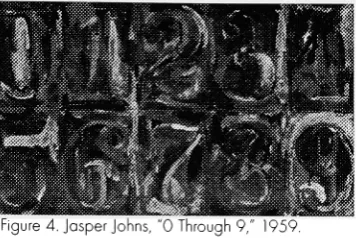
askingus to"lookat,ratherthan through"language inordertolocate meaning (fig. 4).2
By
isolating
the alphabet in his letter and numberpaintings Johns re-imbues language with ritualistic
meaning
by
equatingthemwiththesymbols ofpre-lit-eratecultures.
The
Pop
Artists predicted the enormousimpact reproductive technologies would have on our
personal iconography's
by
utilizing these very sametechniquesintheirartwork.
By
creatingmultiplesilk-screens, Warhol suc
cessfully distilled the
political complexities
of an entire decade
into one graphic rep
resentation, the head
ofJackie Onassis (fig.
5). This image alone
became the "archetypal image that crystallized
American political and social history."3
Roy
Figure5.AndyWarhol,"Jackie IILichtenstein,
on the otherhand,
incorporated the benday
dot pattern and the cartoonbubble into hispaintings
inordertoremakethe artistic
canon according to the pre
sent-day stylistic conventions
of mass-production and
pop-fPpz
ular culture. Paintings fabri- Fl9ure 6- RyLichtenstein,
"StudyforTemple II,"
1965.
catedinthisstyle,such ashis
classical remake
Study
for TempleII,
for example,evokean
interesting
paradox(fig. 6). Ontheonehand,
they
poke fun at thecanonby
"reducing
his subject matterto stylistic absurdity."4 Onthe other
hand,
theverysubject matteritselfseems overwhelminglypre
occupied with maintaining the legitimization of the
canoninspite oftechnologicalchanges.
By
specifically isolating
the recognizable elements of the greatmasterpieces, Lichtenstein's paintings become "ele
vatedto the status ofsigns",andinturnstarttoreveal themakingofstereotypes in industrialculture.
During
this time theminimalistsstarting usingindustrial fabrication techniques tocreate tautological
worksthat shut outthe"din andcacophony of
[their]
sensory overloaded world."5 The
conceptual artists
adopted similarreductive strategiesinordertoaddress
morespecificallythephilosophicalrelationshipoflan
guagetocontemporary life.
Taking
linguistictheory
astheir point of
departure,
conceptual artists such asJoseph Kosuth made workthat
directly
addressedthedisparity
betweentextandimage. In Kosuth'sfamouspiece,OneandThree
Chairs,
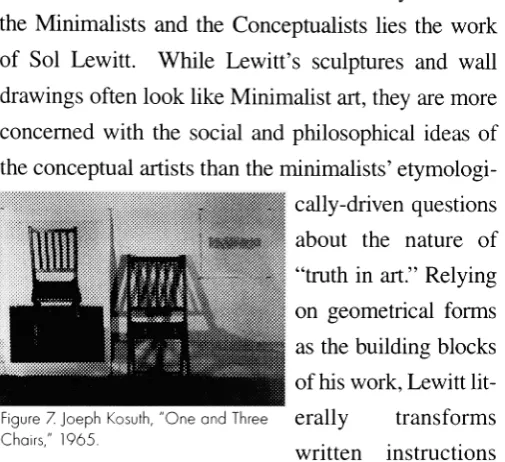
heplaces achair, a pic ture of a chair, and thedefinition of"chair,"in aline [image:5.564.63.242.42.161.2]:fM-2MK.. :y22> >mm':':';':':o:':'::':::'
w.
Thisjuxtaposition forces us to confront the fact that
the object is perhaps no more "real," than either its
descriptionorits image. Languageand visual symbol
become
interchangeable.
Located somewhere uncomfortably between
the Minimalists and the Conceptualists lies the work
of Sol Lewitt. While Lewitt's sculptures and wall
drawingsoftenlook like Minimalistart,
they
are more concerned with the social and philosophical ideas of theconceptual artiststhan theminimalists'
etymologi-|H
cally-driven questionsabout the nature of "truthin art."
Relying
on geometrical forms
asthe
building
blocksofhiswork,Lewitt lit
erally transforms
written instructions into symbolicforms. In his early Language
Drawings,
for example, Lewitt
logically
forms words into sen tences that describe their exact location on thepage. These pieces suggest thedifficulty
oftransforming
symbols into language while atthe same time act as"wry
commentaries on technicallanguage,
including
the impenetrable texts written about conceptual art."6Claiming
Muybridge as one ofhis majorinfluences,
Lewitt works in a serial and repetitive manner that seems a"perfect exam ple
[of]
the machine which makes art and a sort of language."7 His Wall Drawings are allcreated
by
craftspeopleFigure8. SolLeWitt,"ThreetoNine according tO explicit Pointed Blue StarswithYellowBorders . . ,
andRed
Backgrounds,"
1983-88. instructionsand
maque-Figure 7. JoephKosuth, "OneandThree
Chairs,"
1965.
ttes provided
by
Lewitt (fig. 8). While Lewitt plans these pieces in advance, he always allows, andembraces, the
irrationality
ofthe collaborative effort.According
toLewitt,
"irrational judgments leadtonew experience...irrational thoughts should be followedabsolutelyandlogically."8 . Atthesametime
they
alsotake a political stance
by defetishizing
the aestheticobject itself. Most
interesting
to me,however,
is the fact that Lewitt engages in a philosophical dialogueabout art-making with his audience while concomi
tantly
creatingtruly
expressive paintingsthatreference real world experience.Two German photographers often interpreted in thecontext oftheMinimalistandtheconceptualist
art movements, the
Bechers,
have had a tremendous influenceon my work foryears.By
exhibiting serialgridsofindustrialstructures,theBechers'workacts as
bothanindex and exploration ofour changing indus
trial society. While their seemingly straightforward approach reveals a rigorousadherence toformal con
cerns, theresulting worksmanifesttheways inwhich technological developments influence cultural prac
tice.
By
emphasizing the research process, images suchasBlast FurnaceHeads,
successfullytransform banal industrialobjectsintoculturalicons loadedwith historicalsignificance(fig.9).They
alsoallow usentry into their anthropomorphicqualities andinturn"allowus to
identify
with the individualityofstructures
[by
conveying]
qualities ofbeauty
andhumor."9
Both Jennifer Bartlett
andEva Hesse systematically
approach their artistic media
^9^
9. Bemdand H.lla [image:6.564.15.268.127.358.2]with the hope of yielding irrational results. Once
again,bothoftheseartists engagein serious
notation-al research which mimic the habits of the engineer.
While Hesse kept extensive notebooks outlining her
future paintings and
drawings,
Bartlett employedmathematical systems
from the start as a
means of
"getting
work done."10
By
applying these artifi
cial systems to their
Figure 10. EvaHesse, "Untitled," 1964.
artwork, I believethat
bothartistseventuallyarrivedat a placeinwhichtheir
artworktranscended theirwritten instructions.
Hesse,
ontheone
hand,
usedthese planstoeventually createiconic drawings and sculpture which mirrored their
mechanisticbeginnings. Her drawings fromthe early
60's,
for example, are describedby Lucy
Lippard as"shapesorganicinsource,
humorously
combined withmachineappurtenances,
joints,
nozzles,rims,cords."11These drawings were the predecessors of her more
well-known sculptures inwhich she combinesindus
trialdebris in a minimalist mannerthatoftensymbol
ically
allude to sexual and psychological states (fig.10). Like
Hesse,
Bartlett's linguistic systems also ledto the
discovery
ofher signature style; the steel platefabricated into graph paper.
By
systematically applying
model paints to these modular units, Bartlett'swork often mirrorsthe
pixelatedscreen ofthe
computer.Inthepiece
Chicken
Tracks,
Bartlett specifically
references the para
doxical terrain Of the Figure 1]JenniferBartlett, "Chicken
Tracks," 1973.
digitalworld
by
givingus chaos out of order and reality
out of a virtual world of abstractions (fig. 1 1).A loose groupingofartistscallingthemselves
theNeo-Geo movement emergedin theeightiesin an
attempttochallengethesymbolic order of signs mul
tiplying
in conjunction withdigital technologies. Thefounder of this group, artist and critic Peter
Halley,
posited this movement within an environment he
described as one in which "hard geometries [ofthe
industrial revolution] have given way to the soft
geometries of interstate
highways,
computers, andelectronic entertain
ment."12 Influenced
by
the writings ofboth Foucault and
->
"-^j
K\'t'j?*C
~f
Baudrillard,
theirUj
gang
work undertakes a fJfA'
rjj-i-N
jjf
~Y']-J[
-Vdeconstructive cri- Figure 12. BernardTschumi,"M24,The
Block," 1981.
tique of geometric
form inour publiciconography. Drawingssuch asThe
Block,
by
Bernard Tschumijuxtapose human behavior(walking),
withtheregimented and gridded streets ofthe modem city in order to critique the geometric
imperatives advanced
by
theBauhaus movement andcurrently embraced
by
the corporate world (fig. 12).By
reducing human behavior andliving
spaceto diagrams, much of this work alludes to the negative
aspects of
living
in atechnocraticworld.The work ofthese artists also recognizes the
often duplicitous nature of digital technologies
by
visually
incorporating
the same seductive symbolismthey
attemptto critique, as describedby
PeterHalley
We are
today
enrapturedby
the very geometries thatonce represented coercivediscipline.
Today
children sit for hours fascinatedby
the day-glogeometricdisplaysof video games... asadults we
finally
gain accesstoparticipationinour cybernetic
hyyperreal,
with its chargecards, answering machines and professional hierarchies...we can play the corporate game,
theinvestmentgame,or eventheartgame.13
Thepaintings ofRoss
Bleckner,
forexample,dazzletheviewer withtheiroptically lushapplications ofcolor and
symbolism(fig. 13). Oftenregarded as meditationson
the natureof
death,
especially in the age ofAIDS,
hispaintingsreflect the human impulsetowards transcen
dentalismintroubledanddestructivetimes.Thecircuit
paintings ofPeter
Halley
emit a similar mysticismintheir
dazzling
use ofcolor,especially goldandfloures-Figure 13. RossBleckner, "Two
Knights Not Nights,"
1988.
cents. In Halley'swork,
however,
we seethegeometric formof the circuit employed as a simulation of a
worldinwhich allreality has beenreducedtoa system
of abstract signs(fig. 14).Halley'swork embodiesthe
notionthatwelive ina
"hyperreal"
worldinwhich all
referents have been destroyed and replaced
by
fallaciousgeometric signifiers of meaning.
TwoCellswith
ConduitondUnderground
Chamber," 1983.
Figure 15. MattMullican, "Cosmological
Model," 1991.
Theageof simulationthusbeginswithaliqui
dationofallreferentials-worse:
by
theirartificial resurrection in systems ofsigns, a more ductilematerial than meaning, in thatit lends
itselfto all systems ofequivalence, all
binary
oppositions, andallcombinatoryalgebra.14
Since the 1970's Matt Mullican has been cre
ating symbols that simulate catalogues ofeverything
from domesticobjectstocosmology (fig. 15).
Many
ofthese symbols have been rendered as mass-produced
objects and then placed back into the context ofthe
real world asan exploration ofthewaysin whichthe
viewercompletes meaning based on personal experi
ence.
Means of representation fromthe applied arts
provides a way of realizing signs, extending them to specific contents of experience..
.by
using these different objects, he represents
social relationships which form the basis of
our assimilation
in,
or orientationto,reality.15While Mullican continues to explore the geometric
terrain of the Neo-Geo artists, the self-conscious
placement ofhis symbols outside ofthe gallerymore
[image:8.564.100.205.331.509.2]forms in our everyday lives.
By
juxtaposing
his banners, for
instance,
withthe signage ofthereal world,Mullican
immediately
revealsthewaysinwhich symbols of commercial culture subtly infiltrate our sub
conscious mind.
They
alsodrawattentionto theubiquitouspresence of symbolsinourindustrial landscape
by
appropriating the already establishediconography
ofthecorporate world.Ina seriesofbannersmadefor
a public installation in
Paris,
forinstance,
heusestheAT&Tglobelogoas a representationofwhathecalls
the World Unframed. This banner
ironically
uses thevisual strategies of the corporate world in order to
reflect upon ourgrowing global economy, as compa
nies now spend "millions of dollars
developing
orchangingthepicture sign
by
whichitwillbe identifiedtomillions ofcustomers."16As
multinational compa
nies continue to grow, we start to see a shifting of
nationalboundaries based oneconomicexpediencies.
On the one
hand,
symbols offer an effective way tocommunicate between nations whose phonetic lan
guages often differ greatly.
Paradoxically, they
alsofurtheradvancethe
technocracy
by
manipulatingconsumers on aninternational scale.
Throughout hiscareer,Bruce Nauman hasalso
recognized the power of signs in oureveryday lives.
By
preemptingvernaculardevices for hisown creativeexplorations, he provides us with awitty and somber
reminder of the ambiguity of language. In his neon
pieces, called specifically
"signs"
andnot sculptures,
Nauman transforms words into abstract symbols that
obfuscate theiroriginalmeanings. His piece,
My
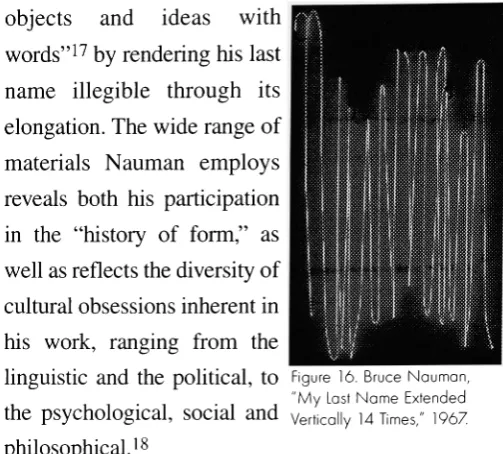
LastName Extended vertically 14
Times,
addresses theaudienceinadirect waythrough theclarityofitscon
struction, the neon
tubing
(fig. 16). It also,however,
dramatizes "the abstraction inherent in
identifying
objects and ideas with
words"17
by
rendering his lastname illegible through its
elongation.Thewiderange of
materials Nauman employs
reveals both his participation
in the
"history
of form," aswell as reflectsthe
diversity
ofculturalobsessionsinherent in
his work, ranging from the
linguistic and the political, tO Figure 16. BruceNauman, "MyLast NameExtended
the psychological, SOCial and
Vertically 14Times," 1967
philosophical.18
Like the
Minimalists,
Felix Gonzales-Torresalso recalls the tenets of modem capitalism, namely
repetition andreproducibility,asaninvitation forusto
participate in the construction of meaning. His work
reveals a strugglewiththe"informationexplosion,and
his attempts to reshape this huge mass of material
through its relationship with his own lived experi
ence."19 He
accomplishes this goal
by
translating
theabundance ofinformation in our world into personal
narrativesthatinvolvetheaudienceas collaborator.In
Untitled, 1989,
forexample,Torres displayed ablackbillboard on Christopher street, above a cigar store,
with the words "People with
AIDS Coalition 1985 Police
Harassment 1969 Oscar
Wilde 1895 Supreme Court
1986
Harvey
Milk 1977March on Washington 1987
Stonewall Rebellion 1969,"
printedin relatively small let
ters atthe bottomofthe sign F^uTe 17 Fei gonzoiez
(fig. 17). The words them- Torres,
"Untitled,"
[image:9.564.296.548.40.267.2]selves refer
enigmatically
andabstractlyto thehistory
of the area, most specifically its involvement in the
Gay
Rights movement. The emptiness of the blackarea atthetop,meanwhile,invitesustoplace animage
ofour own
devising
abovethesepoliticallysuggestivewords, recognizing once again the contingency of
meaning inlanguage. Thiswork subvertsthecustom
aryobjective ofthebillboard
by imbuing
thesite withanambiguitythat contradictstheconventional aims of
advertising.Atthe sametimeit drawsourattentionto
thefactthatperhapslanguage plays aduplicitous role
intheadvancementof politicaland economic agendas.
Torres doesnot,
however,
cynicallyregardthemass-production of commercial objects as a perma
nent threat toourhappiness. Piecessuch ashis candy
and paper stacks manipulate modem-day excess in a
way which ultimately rescues us fromthe alienating
mechanisms of con
temporary life,
including
everything fromfactoriesto ourcultur
al institutions them
selves (fig. 18). The
stark andpristine exe
cution of the pieces
themselvesfurtherthisnotion
by
appealingtobothourromantic and whimsical sensibilities. In my opinion,
theinherent dualitiesofhiswork, aswell asthatof all
the aforementioned artists
(public/private,
political/personal,intellectual/emotional, systematic/
chaotic), ultimately averts the charge of pedantry
attributed to a lot of artists playing in the forest of
signs.
As the first half of this paper has probably
madeclear,I'vespentthelastcouple of years
looking
Figure 18. FelixGonzalez-Torres, "Untitled,"
1991.
seriously at the work of many contemporary artists
engaged in avisual dialogue withlanguage.
My
current work straddles the line between the fictional
worlds ofliterature
(my
undergraduatemajor)andmymore pragmatic forays into adulthood
trying
to supportmyselfinour
increasingly
technological world.Upon graduation fromcollege I sought out a
curatorial positionin photography. When this proved
tobe animpossible waytomake a
living,
my interestin imagesand wordsledmenaturallyto thecomputer.
Ispentfouryears aftercollege earningmy
living
as agraphic designer whilemaking photographs of urban
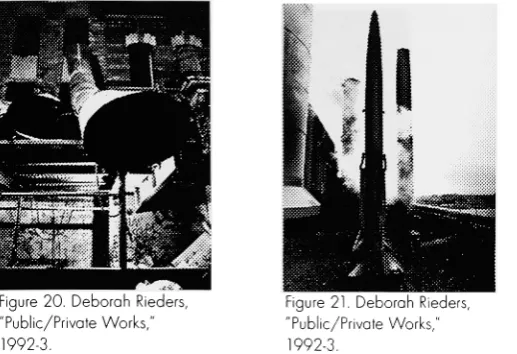
landscapesontheside(fig.
19, 20,
21). While I didn'trealizeit atthetime, this period ofmy lifewas over
shadowed
by
theoppressive architecture ofthe city. Iworked in claustrophobic office buildings
during
theday,
and triedto live intiny
apartments in badneighborhoodsatnight.ThephotographsImade
during
thisperiod ofmy lifearebest described intheoverly dra
matic words ofPeter
Halley,
inreferenceto theRobertSmithson's photographs of Paramus New
Jersey,
as"geometric monuments of the enlightenment trans
formed into instruments of sadomasochistic confine
ment and torture."20
Eventually
safety issues led metopursue escortedvisits to publicworks sitesaround
the city. This began my
journey
into the world ofresearchthathas informed my imagesever since.
When IcametoRochester Icontinuedtopur
sue industrial photog
raphy for awhile. For
thefirstreviewImade
a series of pictures
that attempted to re
write the
history
oftheworldaround
Figure 19. Deborah Rieders, "Public/PrivateWorks,"
Figure20. Deborah Rieders,
"Public/PrivateWorks,"
1992-3.
Figure 21. Deborah Rieders,
"Public/PrivateWorks,"
1992-3.
industrial refuse (fig.
22,
23).By imposing
pseudo-historicaltexts
directly
ontomyphotographs,I hopedtoremake
history
according tomyown personal associationsbetween industrialandhistoricalrelics.In my
opiniontheseattempts failedtobemore thanone lin
ers, and I quickly started a project informed
by
mynew suburbansetting, thegrowing hype around com
puters, and my extensive study of contemporary art,
inspired
by
my re-entry intograduateschool.This project appropriated the first mass-pro
duced video-game,
Pong,
and inserted it into a dialoguewith conceptual art.FirstIusedthecomputerto
recreatethe fontusedin theoriginal game created
by
Nolan Bushnell in 1972. Then I recreated 10
Pong
screenson alargescale andinstalledthemaroundthe
periphery of a studio (fig. 24).
Accompanying
theseimageswastheoriginal sound split
by
afourtrackintothe left and right
speakers of a stereo.
This piece subverts
the original aims of
the minimalists
by
translating a relic of
mychildhoodintothe
W^PPPPP. :P:2]P.:-^
'iSJxSj-;!:! :.:::."'.
':..:;' . . *i houseda varictvofwild
ani-m lis:.beforetfieywereallowedto combat on-Kanorjier.ie'tltedeath inthesteal
*sc_mgames, liueto thecombined
stenchofanimal.fecesanddyingflesh stir-rmtttd-imthese cages,tfteywereusually rclc-;gatedto th*outskirts
of townwherethe cjaa classfrequented onlyas occasional
Iterto.-tlieselfetck.roussportingevents.
Figure22. DeborahRieders,
"Cages,"
1994.
"central, frontal,
regular,
repetitive,black,
empty"
format of an
Ad Reinhardt painting
(fig. 25). These
images re-examine
the purpose Of art
by
Figure23. DeborahRieders,"Balance,"
. '
1992-3.
suggesting that artists
no longer bear the responsibility of
finding
"highertruth,"
but
instead,
revealthewaysin whichtechnology informs cultural practiceandperception.
Figure24. DeborahRieders,"Pong,"
1994.
When automatism frees millions ofhours for
leisure,
art should gain ratherthandiminishinimportance,
forwhile art is notjust play, it isthecounterpointtowork. Thetimemay come
when art is everyone's
daily
occupation, though there is no reason to think that thisactivitywillbecalledart.21
In the above paragraph Lippard aptly describes the
prevailing attitudes oftoday's society in which desk
top
computingoftenmasquerades as art practice.Thisattitude manifests itself in the relationship between
rapidly shrinking art budgets and the skyrocketing
sales of video games andentertainment.In 1993 Time
magazine reportedthat"video-gamesrakein$5.3bil
[image:11.564.16.275.39.216.2] [image:11.564.351.497.244.352.2]Figure 25. Ad Reinhardt,"Abstract Painting,"
1963.
exceed $10billion each
year."
Meanwhile,
artsorganization and galleries are shutting down in droves
across thecountry.
We live in a world that clearly holds digital
entertainment in much higher esteem than art. With
thisinmind, I've continuedtoexplore theconceptual
boundaries ofdigital technologies in my work inthe
hope of
inviting
my audience to meditate on theseissues through both humor and
beauty,
rather thanpoliticalpedantry alone.
Excited
by
the reductionist qualities ofPong,
andtoo greatly discouraged
by
theweathertocontinuephotographingoutside,I startedusingthecomput
ertoconvert art
history
intoa series of symbolicdrawingsthatremakethe
history
of art as stickfigures. Thesourceforallofthisworkis Gardner'sfamousarthis
tory
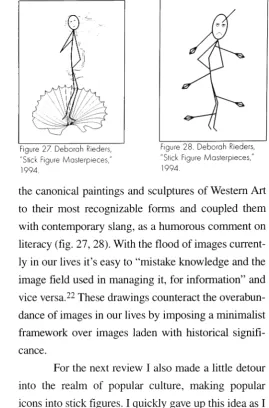
survey textbookArt Through theAges (fig. 26).The first drawings I made for this project were the
Stick FigureMasterpieces. InthesepiecesIreduced
seventh edition
Art
through the
Ages
Figure 16. Gardner's "Art Throughthe Ages."
Figure 27.DeborahRieders, "Stick Figure Masterpieces,"
1994.
Figure28.Deborah Rieders, "Stick FigureMasterpieces,"
1994.
the canonicalpaintings and sculpturesofWesternArt
to their most recognizable forms and coupled them
withcontemporaryslang, asahumorouscomment on
literacy
(fig.27,
28). Withthefloodofimagescurrently
inourlivesit's easyto"mistake knowledgeandtheimage fieldusedin managing
it,
forinformation"
and
viceversa.22Thesedrawings
counteracttheoverabun
danceofimages inourlives
by imposing
a minimahstframework over images laden withhistorical signifi
cance.
Forthenext reviewI also made alittle detour
into the realm of popular culture, making popular
icons intostickfigures. I quicklygaveupthisideaasI
decidedthatIam moreinterested inpicturesaboutpic
tures that the
furthering
and revealing of culturalstereotypes.
Whenitcametime tobegin my thesis, I decid
edtogiveup the textual accompaniment,asitalways
seemed alittle
forced,
but Ireturnedtoan explorationof art
history,
as it seemed more laden with multiplereadings thanpopularculture
by
itself. Atthis pointIstartedto see if I could create symbols based on the
history
of artthat also referenced contemporary cultureall-in-one, muchinthe waythata corporatelogo
[image:12.564.77.221.44.202.2]figure and symbolic form are the visual language of
thenon-artist and artist alike.
They
are alsothe toolsofchildren, universal signage, and "primitive" cultures.
By
reducingthehistory
of arttoabstraction,I hopedtoshow the ways in which "high-art," mirrors and
informspopular culture.In the end,all oftheart gen
resI'vechosentosymbolize
(battles,
sex, architecture,landscape,
and stilllife)
reference abstractly the violence,
sex, environment,and economicissues featuredeverynight ontelevision.
Withthe
help
ofRolandBarthes' methodology for
"reading"
photographs, as outlined in Camera
Lucida,
I startedtoremakethehistory
ofartintosymbols based on its appearance as photographic repro
ductions in books. In Camera
Lucida,
Barthes deducesa dualistic formula for reading pictures that includes
the "studium" and the "punctum." Studium refers
specificallyto thepleasure we elicitfroma photograph
based ourabilitytoplaceit within a
historical,
political or philosophical
framework;
what he calls "anaverage effect
[derived]
froma certaintraining, including
a kind of general, enthusiastic commitment."23Punctum,
on the otherhand,
refers to the irrationalbliss one feels when
looking
at a photograph thatstems from its relationship to the viewer's personal
background. "Punctum isacastofthedice...thatacci
dentwhichpricksme(butalsobruisesme,ispoignant
tome)."24This
philosophical systemallowsBarthesto
explain why two viewers respond
differently
to thesame photograph
by
expanding the criteriaby
whichwejudge imagestoincludetherandomness of private
experience.
By
choosing to execute my drawingsaccording to this model of
interpretation,
I hope toreflect, oftenwhimsically,upon thecontingentnature
ofsymbolsincontemporarylife.
As our society commits to adigital model of
the world,Iwantto analyzethe
history
ofrepresentation according to these new conventions. Just like
postmodern artists such as Barbara Kruger and
Richard Princehaveemployedthevisual strategies of
mass media(bold graphics andbillboard
imagery)
inorder to deconstruct
it,
I thought it was important toexploit the conceptual potential of the computer in
order to make my work (fig.
29,
30). The computerpossesses characteristics absentfrommoretraditional
Figure 29. Barbara Kruger, "Untitled,"
[image:13.564.287.545.241.401.2]1988.
Figure 30. Richard Prince, "Untitled,"
1980-84.
drawing
tools,anditwastheseattributesthatledmetoimplement it intheproduction ofthiswork.
Thecomputerinterface itselfprovidestheper
fect model for this pursuit, as it relies solely on its
iconstocommunicatewiththeuserandinturn"gives
a renewed prominence to the
long
discredited art ofwriting with pictures."25 Both
the Macintosh system
softwareandWindows "speak"to theirusers through
cutesy
desktop
icons (fig. 31). In order to becomecomputer
literate,
we must learnthemeaningoftheseiconsand incorporate themintoour visual vocabular
ies. In my drawings I'm creatingsymbolsthatfunction
as mnemonic devices for the
learning
of arthistory
____.
IIP
Interface.
Classical rhetoric
often employed the
model of a visual gar
den inwhichdifferent
ideas are storedin the
brain according to
their relationship to
pictorial images
stored in thebrain. In
keeping
withmy thesis thatsymbolsfunctiondiscursively,
ratherthanlogically,
however,
I don't want these symbols to function exactly incorrelationwiththeirreferent.UnlikethetrashcanontheMacintosh
desktop,
I want my symbols to provoke questions rather than tell the audience whatto do.
Using
thefloorplans of thegreatcathedrals as a point ofdeparture,
forexample, I've tried to make connections between
history
andcontemporary life. Withabitof artistic embellish
ment, for example, the
Salisbury
Cathedral starts to takeon characteristics of agun,whileChartresnostalgicallyreferstoa more naive version of50's America
completewith anice creamsodafortwo(fig.
32,
33). In Untitled(Landscapes),
thefirst known landscape, a wall
drawing
from CatalHyuk,
looks morelikeacontemporary Nam June Paikwall ofTVmoni
tors than a volcano, while a normally tranquil
Southwest landscapealludesto thereligious mytholo
gyoftheunderworld. In Untitled (Battle
Scenes),
thehangedman ofGoya's Tampocobecomesa woman
Figure 32. Deborah Rieders,"Untitled," 1995.
A
[image:14.564.276.545.45.702.2]SD sn snsn
Figure 34, Deborah
Rieders,"Untitled,"
1995. Figure 33. DeborahRieders,
"Untitled,"
1995.
clutching herpocketbook,whiletheArgonautsresem
ble Batman (fig. 34-37). In all ofthese symbols, and
many more, I'm asking the audienceto complete the
meaning based on their
own culturalandperson al experiences, rather
thanacceptingthestatus
quo as advanced
by
thetechnocracy,as wouldbe
the case with Windows
95,
for example. AsFigure 35. Deborah Rieders,
David Bolter says, "the "Untitled,"
1995.
computer vacillates between intuitive and
highly
abstract
modes,"
and in turn imbues its icons with
hermeneuticqualities.26
The computer also lends itselfwell to quota
tion,andin turn,seemswellsuitedto theact of"mak
ing
art aboutart."
[image:14.564.61.226.573.654.2]First,
itallowsmetocreate seamlessFigure 36. Deborah Rieders
"Untitled,"
1995.
Figure 37.Deborah Rieders,
line drawings
by
eliminating erasure marks with itshandy
undo commands. In PictureTheory,
WJTMitchellspeaks aboutthevisualqualitiesof
"metapic-tures,"
and their ability to encourage dialogue
"between interpretations of said picture."27 He
cites,
for example, the simple duck-rabbit line
drawing
madefamous
by
Wittgensteinthatthrowsthenotion ofvisual objectivity into question. In this
drawing
youmay be
looking
at aduckor you may belooking
at arabbit. Regardless of what you see, pictures such as
these"revealthepresence of a mind'seye,
interpreting
pictures,seeing differentaspects ofthem."28Thename
ofmythesis show,Mental
Pictures,
refersto a modelof perceptioninwhichthebrainand eyetogethermust
complete meaning.
In Untitled (Still
Lives),
I've reduced a stapleofthestilllifegenre, dead fowlanddeadrabbits,to a
symbolthat
humorously
alludesto theduck/rabbitparadigm,
by
literally,
turning
it on it's head (fig. 38).These black and white drawings also emulate
Rorschachtestsandinturnengagetheviewerinadia
logueabout cultural stereotypes and expectations.
In Untitled (Sex
Positions),
for example, I'veattempted a reinterpretation oftheRoman Fresco from
"VillaoftheMysteries"(fig. 39). In my
drawing
Iconvertedthe
dancing
Roman figuredepicting
therites ofthepre-Christianmysterycultsinto a
dominatrix,
or apowerful female figure. In myopinion, thisenigmatic
fresco always warranted more attention than Gardner
afforded it in Art Through the
Ages,
by
representingone ofthe
first,
andonlyexamples of sado-masochismin the
history
of art.By
rendering thisdrawing
in arudimentarystyle, I hope to
ironically
opentheinterpretation to include at least any and all of the above
interpretations.
Figure38.Deborah Rieders, "Untitled,"
1995.
Figure 39. DeborahRieders,
"Untitled,"
1995.
The memory capability of the computer also
encourages the copying and storing of libraries of
imagery
forour ownindividualneeds. Ourparticipationin the act ofimagemanipulation destabilizes the
notion of authorship, and in turn threatens the very
foundation of capitalist society
by
circumventing afundamentaleconomicprecept;copyrightlaw.
Ideally,
but unlikely, thiscouldlead to thedemocratizationof
art
by
puttingvisualpowerintothehandsof everyonewith a computer.Fora nominalfeethese
days,
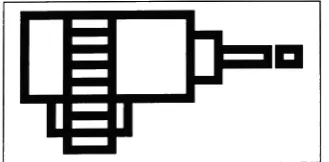
anyonecan
buy
bitmappedor simple vector-graphic clipart attheirlocalcomputer store andincorporate it into
then-own work(fig. 40). I wantmy workto reference this
store-bought, canned art, and for this reason also, I
chose to render my work as black & white vector
drawings;
theleast memory intensive andleastexpensive graphic form currently available.
By
translating
"famous"
works of art into these simple graphics I
suggestthatcanonical wisdom "never comesintothe
worldpurelytransparentanddisembodied,"butrather
through themediation of economic and cultural expe
diencies.29This workcomments somewhat
cynically
on afuture in whichtheconstruction ofmeaning will
be
largely
dependent upon those with access to thegreatest amount of artificial memory; most
likely
the [image:15.564.281.550.44.189.2]4*i
Withtherecent
acceptance of digital
media
by
thecommercial world,thesedraw
ingsalsotranslate
easi-Figure 40. Incidentals(Dingbats)
Adobe Fonts.
ly
to other media. Iagree that symbols are
"bestshownin
display
mode."30I quickly discovered
whilemakingthisworkthatalmosteverytypeof com
mercial fabricator wouldgladlytransfermy drawings
toanypossible objectIcouldimagine. I
finally
decided onthreeformats in whichto
display
thisworkthatbest accommodated both my ideas and my
budget;
signs, miniatures,and photographs.Thesethreeforms
move my icons from the public to the private realm,
withthehopeofengagingtheaudience on a multitude
of experiential levels.
Withthe regulationstreetsigns, I reflect upon
whatI see as agrowingtrendinour culturetowardsa
generalperceptionthatlife imitatesart,ratherthan the
Aristotelian reversal.
According
to a very recent NYTimes survey, 55% of adults in this country attribute
teenage violence to portrayals of violence in movies
and music. This figure demonstrates the enormous
power Americans ascribe to art. It also confirms
Baudrillard'spredictions whenhe saysthatwelive in
a world in which simulation has destroyed the "dis
tinctionbetweentrueand
false,
real andimaginary."
OverthelasttwoyearsI'vespent an enormous
amount oftimeonthe
highway
driving
backandforthinordertolookat art and workin NYC. Boredout of
my mind on thesedrives down Rt.
17,
1 realizedthatmostAmericans spend a lot more timereading street
signsthan
looking
at art.By
makingmy symbolsintosigns andplacing them aroundthe campus and park
ing
lots ofRTT,
I hope to encourage a microcosm ofourculture, theacademiccommunityto, in thewords
of Bruce
Nauman,"Pay
Attention! to art."31While
their context
by
no means guarantees a captivatedaudience, the institutional space of the RTT campus
encourages mental digression at every turn. Whether
driving
up thelong
driveway,
or walking from thehuge parking lotto the
buildings,
thesignsfunction asa
humorous,
ifnot educational break fromthe emptyhorizon and architectural monotony now occupying
this former swampland.
They
also seem a logicalextension ofmypreviouslandscapework
by
allowingmetofurther mysatirical exploration ofthelandscape.
While in myprevious workItried todraw visualpar
allels between
history
and the contemporary landscape, this work even more graphically makes these
visual connectionsthrough the actual alteration ofthe
landscapeitself.
At the entrance to River
Rd.,
near the RedBam,
sits a symbol representing a Dutch landscape(fig. 41). Theplacement ofthis sign calls ontheaudi
encetonotice thesimilaritiesbetween Holland in the
16th century, and Rochester today. In spite of vast
technological changes in the world, we still continue
toromanticize our agricultural origins.Forthis reason,
theRed Bam has remained oncampusin spite ofthe
factthatitexists as anemptysignifier,bereftofits fer
tile
land,
farmanimals andfieldworkers.Nowitprovidesthe
Outing
Clubwith a simulatedenvironmentinwhich students practice rock-climbing on wooden
walls.
Atthe
top
ofV-Lot isa symbol forthekitschy
sunrise/sunsetimagesmadefamous
by
photographerssuch as Joel Meyerowitz (fig. 42). Sandwiched
over-Figure 41. DeborahRieders,modeldrawing for "Untitled(Sign),"
1995.
looking
thehorizon,
itironically
suggeststheabsurdity
ofteaching
landscape photography in aninstitutionwhen the real world lies right outside its doors.
Paradoxically,
I would also like tobelieve, however,
that the geometric qualities of the symbol itself sug
gest something ineffable beyond a mere institutional
critique.As
kitschy
asthey
may havebecome,
sunrises and sunsets stillsignify thecycles ofnature,andif
hard-pressed,
most of us stillbelievein theirredeeming
qualities.These signs also attempt to bridge the gap
betweentheartsandsciences at a school well-reputed
for
both,
butoften experiencingdepartmental conflictfromwithin. The signlocatedin E-Lotrepresents the
swordbladespaintedin Uccello's famouspaintingThe
Battle at San Romano (fig. 43). This painting repre
sents atransitional time inthe
history
ofartas artistswere
beginning
to perfect the science of perspectivedrawing
that has since come to represent theRenaissance.
By
placing this signin thecenter oftheparking
lot,
I hopeto locate RTT ata similarjuncturebetween the study of art and science.
Immediately
uponmy arrival at RTT Inoticedagooddeal often
sionbetweentheschools of art and sciences.Withthis
signIwouldliketo suggesta moreharmoniousunion
Figure42. Deborah Rieders,modeldrawing for"Untitled(Sign),"
1995.
ofthetwoschoolsinthe
future,
especially inan agesodependent upon the meaningful and creative imple
mentation oftechnology.
Thesesignsalso situatetheuniversitycampus
amongst some well-known mythologies, in order to
elucidateits function in contemporary society.At the
exit ofLomb Memorial
Drive,
forinstance,
I'veplaceda sign that depicts the Expulsionfrom the Garden of
Eden,
made famousby
Massacio (fig. 44).Visually,
thissign referencesthe"peoplecrossing"
signswe see
everywhere.
By
placing this sign at the exit to theschool I'm
literally
asking drivers to watch out fornakedpeople
hiding
theirgenitals andexitingthecampus. This sign metaphorically posits the campus as
Edeninrelationto thereal world. Itexemplifieshow
culture often idealizes college as our last bastion of
freedom before entering thereal world as an adult. It
also points to the general perception thatuniversities
tolerate naive intellectual pursuits untainted
by
thecompetitionofthebusinessworld.
I'vealsoincorporateda number ofvisualpuns
intothese signs inorder to indexthepersonal experi
ences we
bring
to bear on the signs around us."Through
[visual]
punning, the symbol bears theweight of a thousand words on all sides ofits
[image:17.564.286.493.45.217.2] [image:17.564.64.214.49.219.2]Figure43.DeborahRieders,modeldrawing
for "Untitled(Sign),"
1995.
Figure44. Deborah Rieders,modeldrawing
for"Untitled(Sign),"
1995.
ryits
creation, itsreading, and atevery scene of mis
apprehension."32Placed
nextto thestop sign,in front
ofG-Lot I'veplaced a symbol derived fromBirkerts'
famous Federal Reserve Bank (fig. 45). The average
person
looking
at this sign will probably notice itsresemblanceto aguillotine, nottheallusiontoabank.
While the reference may be vague, I think thatjust
aboutevery student (andprofessor), canrelate to the
feelings ofdistress that accompanythe financial bur
dens of university life. Ever since the French
Revolution,
theguillotinehassignifiedthedestruction(beheading)
of authoritarian rule. With theplacementof this sign in the center ofcampus, I'm
hoping
toequate this revolution to the student discontent that
accompanies rising educational costs and
declining
educational quality.
In the gallery I've placed eight large pho
tographs that
display
all of my symbols in groupsaccording to theirspecific artistic genre (fig.
46,
47).In my opinion, these symbols always seemed an
extension ofphotographyinthat
they
are"profoundly
ideological,
forthey
eternalize a moment orinstanceofthetypicalinthesamewaythata
[photograph]
captions amoment."33 Like
photography,
they
selectivelyframe the elements that I think are important in the
Figure45. DeborahRieders, model
drawing
for "Untitled(Sign),"1995.
reproductions of art appearing in Gardner's "Art
through the Ages." The difference
being
thatthey
functionas"2ndorderdiscourse" thatreflects on"1st
order discourse," in other words, pictures about pic
tures, rather than pictures about the real world.
By
placingthesesymbolsin
dizzying
lines I hopetocom ment upon theself-referentiality
and circularity thatoften results in
trying
to reduce pictures to language.The resulting "whirlpool"
of symbols in these pho
tographs "suggests awayofspecifying (or picturing)
the multistability effect in a graphic
form,
what wemight calltheVortex
Effect",
or whatIwould call ver [image:18.564.287.539.49.664.2]At the sametime,
they
attemptto aestheticizephoto-mechanical reproduction
by
drawing
the audience inthrough the ethereal qualities oftheirweight
less lines.
By
using extremely high resolution negatives
(3600dpi)
madedirectly
from the computer inorder to achieve this almost translucent line quality,
this work capitalizes on "certain physiological
processes in the eye andbrainwhich we are not nor
mally aware of in ordinary
vision."
To quote Cyril
Barret,
the main defender of Optical Art in the 50 'sand
60's,
"what at first confronts us is a stable andoften monotonous repetition oflines...but as we con
tinue tolook it beginstodissolve before our eyes...the
lines undulate and patterns which were not there
before suddenlymaketheirappearance and asquickly
disappear."35 Unlike
Op
Art, however,
the subject ofmy work encompasses
history
as well asform. Thislends the work a thematic weight often subsumed in
Optical Art
by
itstechnicalwizardry (fig. 48).pp&P^(pypff;pppp:MP<
<gpMP&
^kM'tSO
WiOi>'JV#>t!4_
.;,.!,!.;Wf 3,4,
amppp^ <SPMPP
Ji^c.
Pi
"i".-<PPMPM 'XP>Pb-2-<_.A4c#'f _-f Ns?f_____)"LSy
:pPMPM
- Sp--f ' <fi.^ao.KW
PMJ:P*
5P . : , "7' c 'Mi<>
HHN#^Lt
uPPMWPm* <&&&?rMA<& P:&iPhMMA<>>.
p
m^WfQ^Pemt4.4mt>ppD
o PPapPPfMP^
^_MtA^(-C>
T '-^W^iSI
__:..,*i j-7!
S
-f*.CkTbSJM^
\V7Hi^./tv ' CO. '.-^-M ', T C, . * " '
7_ '
mPMKpP^k^W^PP.<&PP,
Figure47 DeborahRieders,"Untitled (BattleScenes),"
1995.
Thecomputer'sabilitytofacilitate cutting and
pasting also playsinto thedecorative qualities ofthis
work.Like Warhol's Cow
Wallpaper,
I'm interested insubverting this tradition. On one level these pho
tographsgive us a succinct and easyto digestversion
of art
history
as ornamentation, asGautier saysinreference toWilliam Morris' wallpaper "auseful ency
clopediatostudy whilewaiting forthesoup."36Upon
closer
inspection, however,
some of their contentreveals the perversions of sensationalist pop-culture,
namelysex andviolence,"too prettytobe art,andtoo
outrageousfordecoration."37
This consideration of Victorian wallpaper
moves us
finally
to an analysis of the etched Luciteminiatures. In 19th century
England,
thewealthywerefond of
displaying
nature samples under glass. Inmanyofthese symbols,Ireduce art
history
tosymbolsthatemulate theinsect and nature specimens so trea
sured
by
theVictorians. The book and hourglass still#jfa6s#nswM__*wr;i__;;&
^mkcmmm^Mn*^__.saip*_a*
&_.#njiSns#nH<&(ffii__nmf;.__-;-&
.*;,e*
[.'.", A:.'.-'
__f3#.i %\Pkf> %kf, *__<$?! ;ti4>*i; *T^Pktx i_#J !#; %-ifPki &!_#i %-t'->>kf *!I#4 %__f
tJ^SF*_
m^M^.i.in^'a'n&iSs^Eiw !li__tS'*nB.iCAi W", !'
[image:19.564.61.222.383.647.2] [image:19.564.285.503.384.649.2].'t-K
|j].f.#;4^ttJin#7_._iiiil.a'#_l^
lffli_6S,#nB.&AH.wr;;.4'-.::-Mt>
mjgiiJi.n#^_:ftS#Ei*
|lBt_'S'#ni,it:]iaM&-W,\h>:':-<it>
W.#^i'&.Cl$'_3't_Sll_ii'#HA
?lSSt_'S'#nM@.|-Wfii44't4>
mjgi[%i@san*,&Sii.'ig#_ia
TO^iti&swn#'SQiiiiiL_i'#_S4f
[lsiE_s"*niii;- fft mra,<;a>^
W.#/Si'-4?Mn#'H'6ii"l_i'#g'_. ilsi)i_s,#nM^!Kifuwv;iA'v-tf
TO-#l/5,l%_.n*S,ai_ll_l#-3h_.
m^iSt^in#'Btiiii._i#_i&
!.-44- !
"!"'-4-;7-irr.im_y#ii^r
IJfi._^*riitr|'4-:lf4 ,Wf.^#
*__#yiSiit66#n&[email protected];\Mi't^
Figure46. Deborah Rieders,"Untitled(Architectural Sites),"
Figure 48. VictorVasarely,
"Vega,"
1956.
life,
forinstance,
becomes a spider, while theCanterbury
cathedral resembles abeetle (fig.49,
50).By
metamorphosing the art canon into the shape ofspecimens, Tm suggesting thatwe subject the canon
toa more rigorous examination.Atthesametime I'm
once again
implying
that thereal world oftenimitatesart, and for this reason, we should not undervalue its
importance. Ireflect uponthe transformational power
of art
by
privilegingeach ofthese symbols on a shelfofitsown,illuminatedfromwithin
by
alight box.The Victorians also considered glass to be a
purifying substance that maintains the boundaries
betweenthegrotesque andthedecorativewhile"max
imizing
thepossibilities oftranscendentvision."38By
employing
Lucite,
afauxglass,I'mironically
alludingto the
fallacy,
or simulation oftruth in symbolic language. Miniatures have been regarded
historically
asemblems ofthe self, their small scale acting as per
sonaltalismans forprivatecontemplation.
Contrary
towhat one might think, this "reduction in dimension
doesnot produce acorrespondingreductioninsignif
icance;
indeed,
the gem-like properties ofthe miniaturemaketheseformsespeciallysuitable containers of
aphoristic and didactic thought."39 Their small scale,
furthermore,
transfers the construction ofmeaningtotheexperiential realm ofthe individual. Inthewalnut
Figure49. DeborahRieders,model drawingfor "Untitled (Vanitas),"
1995
Figure 50. DeborahRieders,model
drawingfor"Untitled(Pilgrimage)," 1995.
still
life,
forexample, the symbol resembles ahumanbrain (fig. 51).Thissymbolimplicatestheindividual's
intellect intheconstruction of artistic meaning.
The etchings themselves were paradoxically
created
by
a computerized router that lends them ahand-made appearance, as evincedinthe varyingand
imperfect linestyle.
They
reflect uponthe tenuousstatus oforiginality in a digitizedworld,
by
embodyingthe"tensionbetweentheuniqueness ofthe
pre-indus-trialworld and therepetition of mass
production." In
the revolutionary war ship etching, for
instance,
thesymbol itself suggests our nostalgic
longing
forColonial America (fig. 52). Its stylistic execution as a
"hand-made"
collectible, meanwhile, suggests the
rapid commodification of historical objects in our
increasingly
ephemeral world of digital information. [image:20.564.290.488.41.387.2]Figure51. Deborah Rieders,modeldrav
ingfor "Untitled(Nuts),"
1995.
Figure 52. DeborahRieders,model drawingfor "Untitled(Vessel),"
1995.
The resemblance of these objects to trophies further
signifies the collection ofknowledge one both inter
nalizes and externalizes.
By
choosing to depicteroticposes from the
history
of art on the majority ofthesepieces, I hope to
humorously
contrast our mentalstorehouses of privateknowledge withthe more pub
lic
display
ofart collectionsin bothmuseumsand corporate collections(fig.
53,
54). Thisalsotranslatesintothe
blurring
oflines between our public and privatelivesthat accompaniestheencroachment oftechnolo
gy-While I've given some interpretations for this
work,Iwouldliketoconclude
by
sayingthat theseareby
no meanstheonlyinterpretationsofthesesymbols.Many
peoplehave seenthingsin thesesymbols thatInever realized werethere myself,andtheseinterpreta
tionsarejustasvalid,and much
funnier,
thanany I had [image:21.564.78.243.44.350.2]originally intended. The continued interpretation of
Figure 53. Deborah Rieders,model drawingfor "Untitled (Kiss),"
1995.
Figure 54. DeborahRieders,model drawingfor "Untitled (OralHistory),"
1995.
these symbols in thepublic and private spheres reju
venates the work and furthers the critical analysis of
imagery
that I see as anincreasingly
important functionofcontemporary society.
The
[image:21.564.283.491.44.372.2]ENDNOTES
1
Jay
DavidBolter,The ElementsofWriting,Writing Space: The Computer. Hypertext, andthe HistoryofWriting. (New Jersey:Lawrence ErlbaumAssoc), 1991,p.46.2Richard
Lanham, Digital RhetoricandtheDigital Arts. The Electronic Word. (Chicago:University
ofChicagoPress), 1993, p.45.
3Roberta
Bernstein, Warholas Printmaker,Andy Warhol Prints. (New York: Ronald Feldman), 1984, p.15.4Robert
Pincus-Witten, Mondrian Meets Dagwood: The DrawingsofRoy
Lichtenstein,Roy
Lichtenstein:A Drawing Retrospective. (New York: James GoodmanGallery),
1969, 1.5Reinhardt,
Ad. LACounty
Museum Retrospectivecatalog.6Franz
Kaiser,Drawing
asNotation-or JustDrawing,Sol Lewitt Drawings 1958-1992. (Netherlands: HaagsGemeentemuseum), 1992, intro.
7Trevor
Fairbrother, Sol LeWitt Drawingsandtheart of"logicalstatements"Sol Lewitt Drawings1958-1992. (Netherlands: HaagsGemeentemuseum), 1992,intro.
8Fairbrother,
intro.9Gary
Garrels,Photography
inContemporary
German Art: 1960to thePresent. (Minneapolis: Walker ArtCenter), 1992,15.10Calvin
Tompkins,Drawing
andPainting.JenniferBartlett. (Minneapolis: Walker ArtCenter), 1989, 17.11
Lucy
Lippard, Eva Hesse. (New York: New YorkIniversity
Press), 1976,32.12Peter
Halley,The Crisis inGeometry. (New York:Sonnabend), 1987,95.13Peter
Halley,DeploymentoftheGeometric. (New York:Sonnabend), 1987, .14Jean
Baudrillard, The PrecessionofSimulacra,Art After Modernism:Rethinking
RepresentationiNewYork: The New Museum ofContemporary
Art), 1984,254.15Kasper
Konig, Works 1972-1992, Matt Mullican, (Dusseldorf: Centre NationalD'Art), 1992, 92.16Bolter,
50.17Brenda
Richardson, BruceNauman:Neons, (The BaltimoreMuseumofArt)1983, 24.18Richardson,
35.19Russell
Ferguson, The PastRecaptured, Traveling-FelixGonzalez-Torres. (LosAngeles: MOCA), 1994,26.20Halley,
The Crisis in Geometry,86.21
Lucy
Lippard, Overlay: Contemporary ArtandtheArtofPrehistory. (New York: Pantheon), 1983, 96.220ng,
Knowledgeandthe FutureofMan. (Holt & Rinehart), 1968.23Roland
Barthes,Camera Lucida. (NewYork:Hill &Wang), 1981, 26.24Barthes,
27.25Bolter,
46.26Bolter,
50.27WJT
Mitchell, PictureTheory. (Chicago:TheUniversity
ofChicago Press), 1994, 38.28Mitchell,
51.29Lanham,
37.30Stewart,
53. 31Richardson,24.
32Stewart,
50.33Stewart,
49.34Mitchell,
75.35Cyril
Barrett,An Introductionto OpticalArt. (New York:Dutton &Co.), 1971, 11.36Marilyn
OliverHapgood,WallpaperandtheArtist. (NewYork:AbbevillePress), 1992, 33.37Roberta
Bernstein, WarholasPrintmaker,Andy
Warhol Prints. (New York: Ronald Feldman), 1984, 17.BIBLIOGRAPHY
Barrett,
Cyril. An IntroductiontoOptical Art. New York: Dutton &Co.,
1971.Barthes,
Roland. Camera Lucida. New York: HillandWang,
1981.Bartlett,
Jennifer. Jennifer Bartlett. Ed. MargeGoldwater,
New York: AbbevillePress,
1989.Budge,
Wallis E.A. The Egyptian BookoftheDead. New York: DoverPublications,
1967.Carrier,
David andNeville Wakefield."Mourning
Glory: Ross Bleckner inRetrospect."Artforum
February
1995: 68-74.Garrels,
Gary.Photography
inContemporary
German Art: 1960tothePresent. Minneapolis: Walker ArtCenter,
1992.
Gudis,
Catherine. Helter Skelter: LA Art inthe 1990's. Los Angeles: Los AngelesCounty
MuseumofArt,
1992.Hall, Nina,
Ed.Exploring
Chaos: A Guideto theNew ScienceofDisorder. New York: WW Norton &Co.,
1991.HaUey,
Peter. Collected Essays 1981-1987. New York: SonnabendGallery,
1987.Hapgood,
Marilyn Oliver. WallpaperandtheArtist: From PurertoWarhol. New York: AbbevillePress,
1992.Holtzman,
Stephen. Digital Mantras: The ImagesofAbstractandVirtual Worlds.Cambridge: MITPress,
1994.Kosuth,
Joseph. ArtafterPhilosophy
andAfter: Collected Writings. 1966-1990. Ed. Gabriele Guercio. Cambridge: MITPress,
1991.Krauss,
Rosalind. "TheOriginality
oftheAvant-Garde: A PostmodernistRepetition."Art After Modernism. Ed. BrianWallis. New York: The New Museumof
Contemporary
Art,
1988. 13-29.Lanham,
Richard. The Electronic Word: Democracy.Technology
andtheArts. TheUniversity
ofChicagoPress,
1993.
LeWitt,
Sol. Sol LeWitt Drawings 1958-1992. Ed. Susanna Singer. The Netherlands: HaagsGemeentemuseum,
1992.
LeWitt,
Sol. Wall Drawings 1968-1984. Ed. Susanna Singer. Connecticut: WadsworthAtheneum,
1984.Lichtenstein,
Roy.Roy
LichtensteinCatalog. Ed. DianeWaldman.New York: The Solomon R. GuggenheimMuseum,
1980.Lichtenstein,
Roy.Roy
Lichtenstein. ADrawing
Retrospective.Ed. Robert Pincus-Witten. New York: JamesGoodman
Gallery,
1969.Lippard,
Lucy. Eva Hesse. New York: NewYorkUniversity
Press,
1976.Lippard,
Lucy. Overlay:Contemporary
ArtandtheArtofPrehistory. New York:Pantheon,
1983.Gonzalez-Torres,
Felix. Felix Gonzalez-Torres.Int. TimRollins,
New York:Artpress,
1993.Gonzalez-Torres,
Felix. Traveling. FelixGonzalez-Torres. Ed.AnnGoldstein,
LosAngeles, MOCA,
1994.Gudis,
Catherine Ed. A ForestofSigns: Art intheCrisisofRepresentation. Cambridge: MITPress,
1989.Mitchell,
William.City
ofBits: Space.Place andtheInfobahn. Cambridge: MITPress,
1995.Mitchell,
WJT.Picture Theory. Chicago: TheUniversity
ofChicagoPress,
1994.Mullican,
Matt. Matt Mullican Works 1972-1992. Ed. Ulrich Wilmes. Dusseldorf: CentreNationalD'Art,
1992.Nauman,
Bruce. BruceNauman. 1972-1981. Ed.KatharinaSchmidt. Amsterdam:Rijksmuseum,
1981.Nauman,
Bruce. ExhibitionCatalog
andCatalogue Raisonne. Ed. Joan Simon. Minneapolis: Walker ArtCenter,
1994.
Nauman,
Bruce. Workfrom 1966-1972. Ed. Jane LivingstonandMarcia Tucker. New York: LosAngelesCounty
Museumof
Art,
1973.Reinhardt,
Ad. Ad ReinhardtandColor. Ed. Margit Rowell. New York: The Solomon R. GuggenheimMuseum,
1980.
Reinhardt,
Ad. Ad Reinhardt: Black Paintings. 1951-1967. Ed. Harvard ArnasonandBarbara Rose. New York:Marlborough
Gallery,
1970.Rorty,
Richard. Contingency,Irony
and Solidarity. CambridgeUniversity
Press,
1989.Stewart,
Susan. On Longing: NarrativesoftheMiniature, theGigantic, theSouvenir. The Collection. DukeUniversity
Press,
1993.Warhol,
Andy.Andy
Warhol Prints. Ed.Fray
da Feldman andJorg
Schellman. New York: RonaldFeldman,
1984.White,
Edmund."Philip
Taaffe: AlQuasbah,
1991."ArtforumSummer 1994: 66-67.Wittgenstein,
Ludwig. PhilosophicalInvestigations.Trans. G.E.M.Anscombe. New York: MacMillanPublishing
Co.,
1953.