White Rose Research Online URL for this paper: http://eprints.whiterose.ac.uk/135054/
Version: Accepted Version Article:
Bahnmueller, Julia, Göbel, Silke M. orcid.org/0000-0001-8845-6026, Pixner, Silvia et al. (2 more authors) (2018) More than simple facts: : cross-linguistic differences in place-value processing in arithmetic fact retrieval. Psychological research-Psychologische forschung. pp. 1-10. ISSN 0340-0727
https://doi.org/10.1007/s00426-018-1083-7
[email protected] https://eprints.whiterose.ac.uk/ Reuse
Items deposited in White Rose Research Online are protected by copyright, with all rights reserved unless indicated otherwise. They may be downloaded and/or printed for private study, or other acts as permitted by national copyright laws. The publisher or other rights holders may allow further reproduction and re-use of the full text version. This is indicated by the licence information on the White Rose Research Online record for the item.
Takedown
If you consider content in White Rose Research Online to be in breach of UK law, please notify us by
IN PRESS IN: Psychological Research
More than simple facts: cross-linguistic differences in place-value processing in
arithmetic fact retrieval
Julia Bahnmueller
Leibniz-Institut für Wissensmedien, Tuebingen, Germany, Department of Psychology and LEAD Graduate School and Research Network, University of Tuebingen, Germany
Silke M. Göbel
University of York, United Kingdom
Silvia Pixner, Verena Dresen
UMIT – The Health and Life Science University, Hall, Austria
Korbinian Moeller
Leibniz-Institut für Wissensmedien, Tuebingen, Germany, Department of Psychology and LEAD Graduate School and Research Network, University of Tuebingen, Germany
Author Note
Julia Bahnmueller, Junior Research Group Neuro-Cognitive Plasticity, Leibniz-Institut für Wissensmedien, Tuebingen (Schleichstraße 6, 72076 Tübingen), Germany and Department of Psychology, University of Tuebingen, Germany; Silke M. Göbel, Department of Psychology, University of York (YO10 5DD), United Kingdom; Silvia Pixner and Verena Dresen, Learning and Learning Disorders Working Group, Department of Psychology, The Health and Life Science University, Hall (Eduard-Wallnöfer-Zentrum 1, 6060 Hall), Austria; Korbinian Moeller, Junior Research Group Neuro-Cognitive Plasticity, Leibniz-Institut für Wissensmedien, Tuebingen (Schleichstraße 6, 72076 Tübingen), Germany and Department of Psychology, University of Tuebingen, Germany, and LEAD Graduate School, University of Tuebingen, Germany.
Correspondence concerning this article should be addressed to Julia Bahnmueller, Leibniz-Institut für Wissensmedien, Schleichstraße 6, 72076 Tuebingen, Germany. Email: [email protected], Phone: +49 7071 979-263
Acknowledgements
Abstract
Linguistic specificities such as the inversion property of number words (e.g., in German 43 is spoken dreiundvierzig, literally three and forty) moderate Arabic number processing. So far, cross-linguistic studies have mostly focused on inversion-related effects on simple (number comparison) and calculation-based (multi-digit addition) magnitude processing of numerical information. Despite the assumption that multiplication facts are represented in verbal format, not much attention has been paid to inversion-related influences on multiplication fact retrieval. Accordingly, the current study evaluated inversion-related effects on the processing of place-value information in multiplication. In a verification paradigm, the decade consistency effect (i.e., more errors when the decade of a solution probe shares the decade digit with the correct solution) was larger for English- than German-speaking participants for table-related probes. Processing of decade digits might be prioritised in English-speaking participants because the decade-digit is named first in English number words whereas in German number words the unit-digit is named first. Our results indicate that i) the influence of specificities of a verbal number word formation on place-value processing generalise to arithmetic fact retrieval and ii) inversion of number words might even be advantageous in specific cases.
Word count Abstract: 188
Word count text body including references: 6653
Keywords
Introduction
An important milestone in early numerical development is the ability to associate specific quantities with symbolic Arabic digits. Once this association is established and two-digit numbers are encountered, children additionally need to learn that our Arabic number system is organised in a place-value structure: the numerical value of a digit depends on its position in the digit string differentiating units, tens, hundreds, etc.. Early place-value understanding was shown to predict later arithmetic abilities (Moeller, Pixner, Zuber, Kaufmann, & Nuerk, 2011) and, thus, seems to be a precursor for later numerical
achievement. Moreover, highly automated processing of place-value information as reflected by the componential processing of tens and units (following the place-value structure of the Arabic number system) was found for a variety of different tasks and for both adults and children from early elementary school onwards (see Nuerk, Moeller, Willmes, 2015 for a review). Furthermore, differences between number word systems across languages, such as, for example, the inversion property of German number words (e.g., 63 spoken as
linguistic differences on processing place-value information generalise to multiplication fact retrieval.
Processing place-value information of multi-digit numbers
Evidence for the componential processing of multi-digit numbers complying with the place-value structure of the Arabic number system comes from a broad variety of tasks ranging from simple magnitude comparison to more complex numerical and arithmetical tasks. For instance, the unit-decade compatibility effect is one indicator of the componential processing of tens and units in number magnitude comparison (Nuerk, Weger, & Willmes, 2001): number pairs for which separate comparisons of tens and units yield compatible decision biases (e.g., 42_57; 4 < 5 and 2 < 7) are responded to faster and with fewer errors than number pairs for which these separate comparisons of tens and units yield incompatible decision biases (e.g., 47_62, 4 < 6, but 7 > 2, e.g., Ganor-Stern, Tzelgov, & Ellenbogen, 2007; Kallai & Tzelgov, 2012; Macizo & Herrera, 2013; Moeller, Klein, Nuerk, & Willmes, 2013; see also Bahnmueller, Moeller, Mann, & Nuerk, 2015, Korvorst & Damian, 2008, for evidence on three-digit numbers).
For more complex numerical and arithmetical tasks, there is also accumulating
evidence that numbers are processed componentially complying with the place-value structure of the Arabic number system. For example, for a verification version of the number bisection task, Nuerk, Geppert, van Herten, and Willmes (2002) observed that participants’
units, tens plus tens, etc., e.g., Moeller, Klein, & Nuerk, 2011). In this context, processing of place-value is of particular relevance for addition problems with a carry operation. For these problems (e.g., 26 + 47) it is not enough to add tens and units column-wise. Instead, it is necessary to consider the decade digit of the unit sum (i.e., 6 + 7 = 13) when computing the sum of the tens (i.e., 2 + 4 + 1 = 7) to come to the correct result (e.g., Deschuyteneer, De Rammelaere, & Fias, 2005, Klein et al., 2010). This clearly reflects the componential processing of multi-digit numbers (cf. Nuerk et al., 2015 for a more elaborate discussion). Importantly, these findings suggest that the componential processing of multi-digit numbers may not be an exception but rather the rule that generalises across a broad variety of
numerical tasks.
Domahs and colleagues further showed that the decade consistency effect was more pronounced for a long as compared to a short stimulus onset condition (SOA). This indicates that the decade consistency effect reflects interference between a solution option (i.e., the correct result) already activated in long-term memory and a presented lure. In case the solution option is not yet (fully) activated – as in the short SOA condition – interference should be smaller if not absent. This substantiates the argument that componential processing of tens and units generalizes to arithmetic fact retrieval.
Influences of linguistic specificities on place-value processing
The processing of place-value information in multi-digit numbers, in particular the componential processing of units, tens, etc., is modulated by linguistic specificities of different languages in number word formation. Generally, transparent number word systems (e.g., English), in which the order of number words reflects the order of digits in the Arabic number system, were observed to be advantageous for children’s numerical development (e.g., Miura, Okamoto, Kim, Steere, & Fayol, 1993). However, in several languages (e.g., German, Dutch, Arabic), the order of tens and units in number words is inverted in relation to the symbolic Arabic notation (e.g., in German 63 is spoken as dreiundsechzig, literally three and sixty). Comparing numerical performance in language groups with inverted vs. non-inverted number words revealed that the lack of transparency with regard to the place-value structure of the Arabic number system is a significant disadvantage in a variety of different tasks (e.g., addition: Göbel et al., 2014, Lonnemann & Yan, 2015, Xenidou-Dervou, Gilmore, van der Schoot, & van Lieshout, 2015, but see Brysbaert, Fias, & Noël, 1998; number
numerical skill acquisition but negative inversion-related effects are also evident in educated adults. For instance, Nuerk et al. (2005) as well as Moeller et al. (2015) demonstrated that the unit-decade compatibility effect is larger for adult speakers of languages with inverted
number words. These authors argued that the interference caused by the irrelevant unit digit in incompatible trials (e.g., 47_62, 4 < 6, but 7 > 2) is increased in inverted languages because the unit digit is named first in the respective number words. Importantly, these studies show that place-value information is processed because otherwise no such moderation by language specific number word formation should have been observed. Moreover, these and other results (e.g., Kalai & Tzelgov, 2012) indicate that place-value information of the constituting digits of a multi-digit number is processed in a highly automated fashion and moderations through linguistic properties of a language occur even in numerical tasks that do not require explicit verbal processing.
The latter is of particular interest for the current study, because multiplication facts are assumed to be stored in a verbal format in long-term memory. Accordingly, compared to other tasks such as magnitude comparison or addition/subtraction problem solving, multiplication is thought to rely more strongly on verbal processing components (e.g., Chochon, Cohen, Van De Moortele, & Dehaene, 1999; Lee, 2000; for behavioral evidence see, e.g., De Smedt & Boets, 2010; Lee & Kang, 2002; Moeller, Klein, Fischer, Nuerk, & Willmes, 2011). For instance, this notion is corroborated by the results of Lee and Kang (2002). The authors applied a dual task paradigm requiring participants to solve multiplication or subtraction problems while concurrently performing a phonological or visual-spatial
This specific reliance on verbal processing components in multiplication fact retrieval is also reflected in the currently most influential model of number processing (the Triple Code Model, e.g., Dehaene et al., 2003) which associates multiplication fact retrieval with brain areas specifically involved in language-mediated (numerical) processes such as the left angular gyrus as well as left-hemispheric perisylvian language areas. Therefore, if
multiplication facts are indeed stored and/or accessed verbally, specific differences in number word formation -such as the inversion property- should influence place-value processing during the retrieval process even in a non-verbal task setting.
To our knowledge, the study of Noël and colleagues (Noël, Fias, & Brysbaert, 1997) is so far the only study addressing inversion-related influences in multiplication fact retrieval. In a production paradigm, the authors investigated whether inversion-related differences in number words led to the preactivation of different solution options in the arithmetic fact network. More precisely, assuming that the two operands are read as a two-digit number, the problem quatre × huit (four × eight) should, for example, preactivate quarante-huit (forty eight) in French, whereas vier × acht (four × eight) should preactivate vier-en-tachtig (four and eighty) in Dutch. Because of different place-value assignments in number words, reading the operands was hypothesised to result in specific differences in operand intrusion errors. No empirical evidence substantiating the notion of an inversion-related effect of the operands on the preactivation of specific incorrect solutions was observed by Noël and colleagues.
However, results do not answer the question of whether or not number words of already activated solution options (e.g., table-related ones, decade-consistent ones, and also the correct result) interfere with the retrieval process.
The present study
we investigated whether number word inversion influences the multiplication fact retrieval process by means of specific modulations of the decade consistency effect. Thus, in the current study native speakers of German (with inversion) and English (no inversion) were asked to solve simple multiplication problems (single-digit times single-digit). We used the same verification task (including the stimulus set) previously employed by Domahs et al. (2007) to prevent any confounding verbal processes related to the active production of the (correct) result. Stimuli were presented in Arabic digit notation to ensure that interferences due to number words are not a simple artefact of verbal in- or output information processing. Moreover, we also adopted the manipulation of stimulus onset asynchrony (SOA) used in Domahs et al. (2007) to maximize comparability across studies and to evaluate potential influences of the time course of arithmetic fact retrieval on the effects under investigation.
Paralleling the study of Domahs and colleagues (2007), we evaluated both the effects of decade-consistency and table-relatedness. Generally, we expected to replicate the main effects of decade-consistency (i.e., more errors and slower RTs for decade-consistent than decade-inconsistent lures) and relatedness (i.e., more errors and slower RTs for table-related than table-untable-related lures).
processing in multiplication fact retrieval in a very specific way. In particular, we expected that the decade consistency effect should be larger for English- than German-speaking participants because the decade digit is named first in English, but last in German two-digit number words. In turn, this should lead to an enhanced activation of the decade digits in English compared to German and thus increased interference caused by decade-consistent incorrect solution probes in English.
Methods
Participants
A total of 48 university students participated in the study. In each language group one participant was excluded because their overall error rate exceeded 33% (50% was guessing rate). The remaining 23 German-speaking participants were on average 24.48 years old [SD = 4.99, range 20-42, 8 male] and were tested at the UMIT in Hall in Tyrol, Austria. The
remaining 23 English-speaking participants were on average 20.52 years old [SD = 2.52, range 18-29, 8 male] and were tested at the University of York, UK. All participants were native speakers of their respective language, right-handed, had normal or corrected to normal vision, and did not report a history of neurological or psychiatric diseases. The study was approved by the ethics committee of the Department of Psychology, University of York (UK).
Task, stimuli, and design
the factors relatedness (table-related vs. not table-related) and consistency (decade-consistent vs. decade-inconsistent). Eighteen multiplication problems were presented eight times, once per lure type (related and consistent, related but inconsistent, unrelated but consistent, unrelated and inconsistent) and four times with the correct solution. In addition, 44 multiplication problems were inserted to balance the frequency of presenting a specific number as a correct result or a lure (e.g., the problem 8 × 2 = 16 was included because in the experimental stimulus set the solution probe 16 was a lure once more than it was the correct result). The resulting 188 stimuli were presented once per SOA condition (short (50ms) vs. long (450ms)). For a complete list and a more detailed description of the stimulus set see Domahs et al. (2007).
Procedure
The experiment was presented on a 19” screen driven at a resolution of 1024 x 768 pixels. Participants sat approximately 60 cm in front of the screen. After giving their written informed consent, they were instructed to indicate as quickly and accurately as possible whether or not a presented probe was the correct solution to a presented multiplication
problem. In case the solution probe was correct, participants should press the right ctrl-button of a standard keyboard, whereas the left ctrl-button had to be pressed when the probe was not the correct solution to the presented problem. Stimuli were presented in white against a black background in Courier New font type (bold; font size: 24) at the centre of the screen. The two operands were presented simultaneously and were separated by two blank spaces. No
Each trial started with the presentation of a fixation cross (×; 300ms) which was followed by a blank screen (200ms). Subsequently, the multiplication problem was displayed briefly (100ms), again followed by a blank screen (short SOA: 50ms, long SOA: 450ms). Directly following this blank screen, a solution probe was presented which stayed on the screen until either a response was given or the time limit of 2000ms was reached. The inter-trial interval was 800ms. Participants did not receive feedback.
All stimuli were presented in both a short and a long SOA condition separated into two blocks (one block per SOA). Each block started with ten practice trials that were not part of the stimulus set. Block order was counterbalanced across participants. Within each block, trial order was randomised individually for each participant. After the practice trials as well as after every 47 trials, participants had the possibility to take a short break. In total, the
experiment lasted approximately 30 minutes. The same experiment was used for both language groups.
Results
Error rates
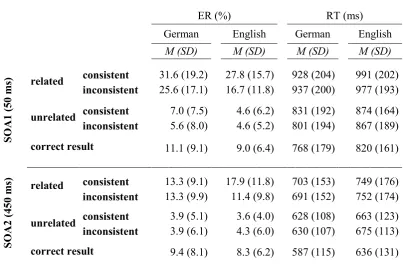
Table 1. Means (M) and standard deviations (SD in parentheses) of error rates and reaction times separated for stimulus conditions and language groups.
ER (%) RT (ms)
German English German English
M (SD) M (SD) M (SD) M (SD)
S O A 1 (5 0 m
s) related consistent 31.6 (19.2) 27.8 (15.7) 928 (204) 991 (202) inconsistent 25.6 (17.1) 16.7 (11.8) 937 (200) 977 (193)
unrelated consistent 7.0 (7.5) 4.6 (6.2) 831 (192) 874 (164) inconsistent 5.6 (8.0) 4.6 (5.2) 801 (194) 867 (189)
correct result 11.1 (9.1) 9.0 (6.4) 768 (179) 820 (161) S O A 2 (4 50 m
s) related consistent 13.3 (9.1) 17.9 (11.8) 703 (153) 749 (176) inconsistent 13.3 (9.9) 11.4 (9.8) 691 (152) 752 (174)
unrelated consistent 3.9 (5.1) 3.6 (4.0) 628 (108) 663 (123) inconsistent 3.9 (6.1) 4.3 (6.0) 630 (107) 675 (113)
correct result 9.4 (8.1) 8.3 (6.2) 587 (115) 636 (131) Note. Related: problems with table-related lures; unrelated: table-unrelated problems; consistent: decade-consistent lures; inconsistent: decade-inconsistent lures; correct result: probes presented with the correct result.
Overall, the two language groups did not differ in ER [F(1,44) = 0.30, p = .590; German: M = 13.0%, SD = 14.8%, English: M = 11.4%, SD = 12.6%]. We observed a reliable effect of decade consistency [F(1,44) = 16.37, p < .001, p² = .27] indicating that more errors
were made in response to decade-consistent probes [consistent: M = 13.7%, SD = 15.0%, inconsistent: M = 10.7%, SD = 12.1%]. The main effect of decade consistency was further qualified by the two-way interaction of decade consistency and table relatedness [F(1,44) = 13.39, p = .001, p² = .23]. This interaction indicated that the effect of decade consistency
probes [M = 0.2%, SD = 3.8%; p = .053]. In contrast to our expectations, the interaction of language and decade consistency was not significant [F(1,44) = 2.27, p = .139]. However, the three-way interaction of table relatedness, decade consistency and language was significant [F(1,44) = 11.67, p = .001, p² = .21]. Breaking down this three-way interaction into the two
two-way interactions of decade consistency and language for table-related and table-unrelated problems, respectively, revealed that the two-way interaction of language and decade
consistency was significant for table-related problems [F(1,44) = 12.41, p = .001, p² = .22]
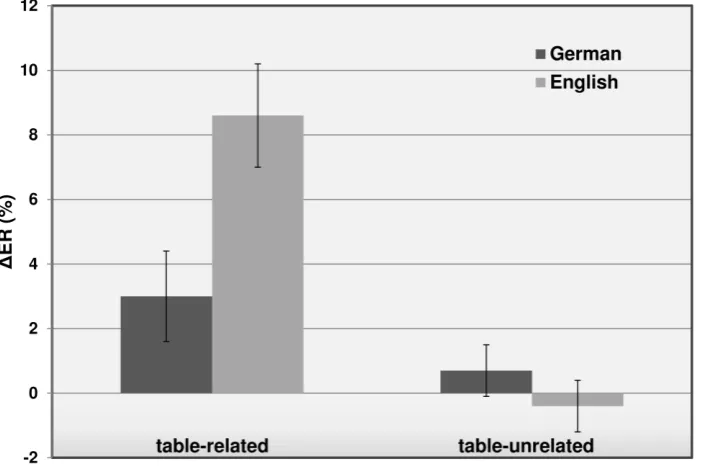
but not for table-unrelated problems [F(1,44) = 1.11, p = .298; see Figure 1]. For table-related probes, the decade consistency effect was significant for both the German [M = 3.0%, SD = 6.8%; p < .001] and English group [M = 8.6%, SD = 8.1%; p < .001], however, the interaction indicates that the effect was larger for the English group.
[image:15.595.110.462.385.619.2]Further results were also consistent with the results reported by Domahs and
colleagues (2007). The main effects of SOA [F(1,44) = 25.46, p < .001, p² = .37] as well as
table relatedness [F(1,44) = 151.68, p < .001, p² = .78] were significant. The effect of SOA
indicated that responses were less error-prone in the long SOA condition [short: M = 15.5%, SD = 16.2%; long: M = 8.9%, SD = 9.6%]. Furthermore, more errors were made for table-related probes [M =19.7%, SD = 15.0%] as compared to table-untable-related probes [M = 4.7%, SD = 6.1%]. The interaction of SOA and table relatedness was significant [F(1,44) = 31.20, p < .001, p² = .42] indicating that the effect of table relatedness was larger in the short SOA
condition [short: M = 20.1%, SD = 12.4%, long: M = 10.0%, SD = 8.1%]. No other interaction effects were significant.
Reaction times
Problems were only entered into the analyses when the lure was correctly indicated as an incorrect result of the given problem. Additionally, RTs were excluded separately for each
participant when they deviated from the participant’s mean response time of the respective
stimulus condition by more than +/- 3SD. This trimming procedure resulted in an overall loss of 1.0% (SD = 0.8%) for the German- and an overall loss of 0.2% (SD = 0.3%) for the
English-speaking sample. RT data were z-transformed (zRT) separately for each language group prior to analyses to control for possible differences in general processing speed between language groups. Results are given in zRT and in ms.
A 2x2x2x2 mixed model ANOVA was conducted on zRT with the within-subject factors SOA, table relatedness and decade consistency as well as the between-subject factor language group. As expected due to prior z-transformation, no significant difference in zRT was observed between language groups [F(1, 44) = .12, p = .728; German: M = 0.13 (769ms), SD = 0.36, English: M = 0.12 (818ms), SD = 0.29]. With respect to the main research
consistency and language was significant [F(1,44) = .86, p = .360 and F(1,44) = .44, p = .510, respectively]. However, replicating results of Domahs et al. (2007) and consistent with ER analyses of the present study, the main effect of SOA as well as the main effect of table relatedness was significant [F(1,44) = 9.31, p = .004, p² = .18 and F(1,44) = 90.84, p < .001,
p² = .67]. Accordingly, responses were faster in the long as compared to the short SOA
condition [long: M = 0.08 (686ms), SD = 0.28; short: M = 0.16 (901ms), SD = 0.36] as well as for unrelated problems compared to related problems [unrelated: M = -0.06 (746ms), SD = 0.24; related: M = 0.30 (841ms), SD = 0.29]. Furthermore, the interaction of SOA and table relatedness was significant [F(1,44) = 11.19, p = .002, p² = .20] indicating that the effect of
table relatedness was larger in the short SOA condition [M = 0.45 (115ms), SD = 0.35] as compared to the long SOA condition [M = 0.27 (75ms), SD = 0.28; t(45) = 3.34, p = .002]. No other interactions were significant.
Discussion
The current study investigated linguistic influences on place-value processing in multiplication fact retrieval in a cross-lingual study involving German- and English-speaking participants. In a verification paradigm (cf. Domahs et al., 2007), participants were asked to indicate whether a probe was the correct solution to a simple multiplication problem. Generally, the overall pattern of results was very similar to the pattern reported by Domahs and colleagues corroborating the regularity of errors in multiplication fact retrieval in terms of table relatedness and decade consistency. However, most importantly, in addition to
replicating Domahs et al.’s findings, the size of the decade consistency effect in error rates
was moderated by language group: in line with our expectations, the effect was more
place-value processing of multi-digit numbers is not restricted to simple (number comparison) and calculation-based (e.g., multi-digit addition) magnitude processing of numerical
information but generalises to arithmetic fact retrieval.
In general, the presence of the decade consistency effect provides evidence that place-value information of single constituting digits is also accessed in arithmetic fact retrieval (cf. Domahs et al., 2006, 2007). The decade consistency effect reflects interference caused by single digits (as opposed to processing numbers as integrated entities) or, more specifically, between decade-digits of activated solution options (e.g., the correct result and the presented lure) to a multiplication problem. In contrast to results by Domahs et al. (2007), the
interaction of decade consistency and SOA was not significant. Thus, the current data corroborate the claim of componential processing in multiplication fact retrieval but do not substantiate the finding that the decade consistency effect only occurs when more/enough time is granted to the activation of a solution option (i.e., the correct result) in long-term memory.
disadvantages in number processing (e.g., an increased carry effect in mental addition (e.g., Göbel et al., 2014) or increased interference in number magnitude comparison (e.g., Nuerk etal., 2005), this finding further suggests that inversion can actually be advantageous for the retrieval of the correct solution of a multiplication problem. Especially in case of decade-consistent solution options, it is inevitably necessary to consider the unit digit to identify the correct solution. Naming the unit-digit first, seems to reduce the interfering effect of the decade digit in terms of decade consistency and might thus promote more effective
multiplication fact retrieval. Importantly, linguistic differences were observed in a paradigm for which no verbal processes related to the active production of a result or other verbal in- or output information (e.g., visually presented number words) was required. This suggests that the moderation through linguistic specificities does not depend on the explicit activation of number words resulting from specific task-related verbal in- or output requirements and provides further evidence that retrieving multiplication facts involves the processing of facts in verbal format - irrespective of additional verbal task requirements. However, it remains to be clarified whether the observed processing advantage is also present in more common retrieval situations in every-day life (e.g., requiring the active production of results and including an unrestricted stimulus set).
Importantly, however, differences due to specificities in the respective number word system only became evident for table-related problems in the error data.
evidence for the familiarity argument can be found in the significant interaction of table-relatedness and SOA showing that the effect of table table-relatedness is more pronounced in the short compared to the long SOA condition. More precisely, this might indicate that, because unfamiliar lures are discarded more easily as the correct result at an early processing stage, additional interference due to consistency between decade-digits of the lure and the correct response might be reduced or even absent for table-unrelated lures.
strategies might be the predominant or even single strategy for some problems, it is not a sufficient strategy for others.
Error rates have been proven to be specifically informative on and sensitive to
multiplication fact retrieval. Accordingly, it was often the (qualitative) analysis of errors that gave insights into processes during multiplication fact retrieval. In particular, tie problems (e.g., 4 × 4) and problems involving five (e.g., 4 × 5) have been observed to be solved comparably fast and with only few errors (e.g. Campbell & Graham, 1985; LeFevre et al., 1996). However, for problems not falling into one of these two categories, it was shown that rather than occurring randomly, errors are more likely to include an intruding operand
(operand intrusion errors, e.g., 4 × 7 = 27, e.g., Campbell, 1997), and that errors increase with problem size (e.g., the sum of the two operands of a problem; e.g., Campbell & Graham, 1985, LeFevre et al., 1996). Furthermore, errors are more likely to be close to the correct result (Campbell, 1995, 1997) and to be table-related as well as decade-consistent with the correct result (e.g., Campbell, 1994, 1997; Domahs et al., 2006, 2007). Thus, the presence and analysis of errors allows for precise inferences about the regularities and exceptions (e.g., tie problems) of fact storage as well as about (numerical) determinants influencing the retrieval process (e.g., problem size, table-relatedness). In line with this, the inversion-related influence was clearly present in the error data, however, no significant interaction of decade consistency and language group was observed for reaction times. In fact, and in contrast to Domahs and colleagues (2007), we did not observe a significant overall effect of decade consistency in the reaction time data. This finding was unexpected and is in our opinion unlikely to be due to methodological differences between the studies because the study designs were largely
measures might be subject to larger interindividual variations between or processing preferences of individuals in a respective group. Although instructions did stress neither accuracy nor speed explicitly (neither in Domahs et al. (2007) nor in the present study), participants of the present study compared to participants in Domahs et al. (2007) might have accepted increased uncertainty with respect to the correctness of their answers more easily due to higher perceived time pressure. Such a behavior could lead to no observable
differences in reaction times but still result in an effect on error rates (see also, e.g., Ratcliff, Thompson, & McKoon, 2015, for a diffusion model approach addressing differential effects of reaction time and error data). This is of course a post hoc explanation that needs further testing, for instance, by explicitely manipulating the instruction (stressing either correctness or speed) or the time to solve multiplication problems.
In contrast to Noël and colleagues (1997) who did not find evidence for inversion-related effects with respect to intrusion errors, the present study shows that inversion did influence multiplication fact retrieval. At a first glance, the idea of the two studies looks very similar. Both studies aim at identifying possible influences of non-inverted vs. inverted number words on multiplication fact retrieval. However, Noël and colleagues used a
production paradigm investigating the influence of reading-based associations on the active production of intrusion errors. In contrast, the present study evaluated inversion-related influences on the decade-consistency effect in a verification paradigm. Thus, the studies clearly differ with respect to the paradigm, the effect of interest and, with that, also on the task processing level at which linguistic influences were expected to occur. Although the study by Noël and colleagues provided no evidence for an effect of inversion on reading-based
Although the present results are not informative with respect to the storage format of multiplication facts, specific insights are provided with respect to the retrieval process. First, differences in the decade consistency effect between language groups corroborate earlier suggestions indicating that facts are retrieved verbally or at least that verbal information is co-activated in a highly automated fashion even when no verbal input is given (e.g., Lee & Kang, 2002; Moeller et al., 2011). Moreover, the present difference between language groups
implies that the decade consistency effect cannot be a simple perceptual artefact resulting from the matching of the decade digit of the (external) probe and the decade digit of the (internal) correct result in digital Arabic format. Finally, the present study indicates that an assumption of purely verbal retrieval of multiplication facts is not justified either because the observed influence of inversion on place-value processing of multiplication facts (as indicated by the decade consistency effect) can only occur when both verbal information (number words) and place-value information of the visually presented Arabic digits interact during the retrieval process.
In conclusion, the findings of the present study generalise the observation of inversion-related influences on place-value processing from simple magnitude comparison and calculation-based tasks (e.g., multi-digit addition) to arithmetic fact retrieval. By demonstrating an influence of this linguistic specificity on a numerical task as automated as the retrieval of arithmetic facts, the present results further substantiate that place-value
Compliance with ethical standards
Ethical approval: All procedures performed in this study were in accordance with the ethical
standards of the ethics committee of the Department of Psychology, University of York (UK) and with the 1964 Helsinki declaration and its later amendments or comparable ethical standards.
Conflict of interest: The authors declare that they have no actual or potential conflicts of
interest concerning this work.
Informed consent: Informed consent was obtained from all individual participants included
in the study.
Data availability
References
Bahnmueller, J., Moeller, K., Mann, A., & Nuerk, H.-C. (2015). On the limits of language influences on numerical cognition–no inversion effects in three-digit number magnitude processing in adults. Frontiers in Psychology, 6. doi: 10.3389/fpsyg.2015.01216
Brysbaert, M., Fias, W., & Noël, M. P. (1998). The Whorfian hypothesis and numerical cognition: istwenty-four'processed in the same way asfour-and-twenty'?. Cognition, 66(1), 51-77. doi: 10.1016/S0010-0277(98)00006-7
Campbell, J. I. D. (1994). Architectures for numerical cognition. Cognition, 53, 1-44. doi:10.1016/0010-0277(94)90075-2
Campbell, J. I. D. (1995). Mechanisms of simple addition and multiplication: A modified network-interference theory and simulation. Mathematical Cognition, 1(2), 121-165. Campbell, J. I. D. (1997). Reading-based interference in cognitive arithmetic. Canadian
Journal of Experimental Psychology, 51, 74-81. doi:10.1037/1196-1961.51.1.74 Campbell, J. I. D., & Graham, D. J. (1985). Mental multiplication skill: Structure, process,
and acquisition. Canadian Journal of Psychology/Revue canadienne de psychologie, 39(2), 338. doi:10.1037/h0080065
Chochon, F., Cohen, L., Van De Moortele, P. F., & Dehaene, S. (1999). Differential contributions of the left and right inferior parietal lobules to number processing. Journal of Cognitive Neuroscience, 11(6), 617-630.doi:10.1162/089892999563689 Dehaene, S., Piazza, M., Pinel, P., & Cohen, L. (2003). Three parietal circuits for number
processing. Cognitive Neuropsychology, 20, 487–506. doi:10.1080/02643290244000239
Domahs, F., Delazer, M., & Nuerk, H. C. (2006). What makes multiplication facts difficult: Problem size or neighborhood consistency?. Experimental Psychology, 53(4), 275-282. doi:10.1027/1618-3169.53.4.275
Domahs, F., Domahs, U., Schlesewsky, M., Ratinckx, E., Verguts, T., Willmes, K., & Nuerk, H. C. (2007). Neighborhood consistency in mental arithmetic: Behavioral and ERP evidence. Behavioral and Brain Functions, 3(1), 1. doi:10.1186/1744-9081-3-66 Deschuyteneer, M., De Rammelaere, S., & Fias, W. (2005). The addition of two-digit
numbers: Exploring carry versus no-carry problems. Psychology Science, 47(1), 74-83.
Ganor-Stern, D., Tzelgov, J., & Ellenbogen, R. (2007). Automaticity and two-digit numbers. Journal of Experimental Psychology: Human Perception and Performance, 33, 483-496. doi:10.1037/0096-1523.33.2.483
Göbel, S., Moeller, K., Pixner, S., Kaufmann, L., & Nuerk, H.-C. (2014). Language affects symbolic arithmetic in children: the case of number word inversion. Journal of Experimental Child Psychology, 119, 17-25. doi:10.1016/j.jecp.2013.10.001
Helmreich, I., Zuber, J., Pixner, S., Kaufmann, L., Nuerk, H.-C., & Moeller, K. (2011).
Language effects on children’s mental number line: How cross-cultural differences in
number word systems affect spatial mappings of numbers in a non-verbal task. Journal of Cross-Cultural Psychology, 42, 598-613. doi:10.1177/0022022111406026 Imbo, I., Vanden Bulcke, C., De Brauwer, J., & Fias, W. (2014). Sixty-four or four-and-sixty?
The influence of language and working memory on children's number transcoding. Frontiers in Psychology, 5, 313. doi:10.3389/fpsyg.2014.00313
Klein, E., Moeller, K., Dressel, K., Domahs, F., Wood, G., Willmes, K., & Nuerk, H.-C. (2010). To carry or not to carry – is this the question? Disentangling the carry effect in multi-digit addition. Acta Psychologica, 135, 67-76. doi:10.1016/j.actpsy.2010.06.002 Korvorst, M., & Damian, M. F. (2008). The differential influence of decades and units on
multidigit number comparison. The Quarterly Journal of Experimental Psychology, 61, 1250-1264. doi:10.1080/17470210701503286
Lee, K. M. (2000). Cortical areas differentially involved in multiplication and subtraction: a functional magnetic resonance imaging study and correlation with a case of selective acalculia. Annals of Neurology, 48(4), 657-661. doi:10.1002/1531-8249(200010)48:4<657::AID-ANA13>3.0.CO;2-K
Lee K. M., & Kang, S. Y. (2002). Arithmetic operation and working memory: Differential suppression in dual tasks. Cognition, 83, B63-B68. doi:10.1016/S0010-0277(02)00010-0.
LeFevre, J. A., Bisanz, J., Daley, K. E., Buffone, L., Greenham, S. L., & Sadesky, G. S. (1996). Multiple routes to solution of single-digit multiplication problems. Journal of Experimental Psychology: General, 125(3), 284. doi:10.1037/0096-3445.125.3.284 LeFevre, J. A., Bisanz, J., & Mrkonjic, L. (1988). Cognitive arithmetic: Evidence for
obligatory activation of arithmetic facts. Memory & Cognition, 16(1), 45-53. doi:10.3758/BF03197744
Lonnemann, J., & Yan, S. (2015). Does number word inversion affect arithmetic processes in adults?. Trends in Neuroscience and Education, 4(1), 1-5. doi:10.1016/j.tine.2015.01.002
Macizo, P., & Herrera, A. (2013). The processing of Arabic numbers is under cognitive control. Psychological Research, 77, 651-658. doi:10.1007/s00426-012-0456-6
Miura, I. T., Okamoto, Y., Kim, C. C., Steere, M., & Fayol, M. (1993). First graders’
comparisons – France, Japan, Korea, Sweden, and the United States. Journal of Educational Psychology, 85, 24-30. doi:10.1177/016502549401700301
Moeller, K., Klein, E., Fischer, M. H., Nuerk, H.-C., & Willmes, K. (2011). Representation of multiplication facts – Evidence for partial verbal coding. Behavioral and Brain Functions, 7:25. doi:10.1186/1744-9081-7-25
Moeller, K., Klein, E., & Nuerk, H.-C. (2011). (No) small adults – Children’s processing of carry addition problems. Developmental Neuropsychology, 36, 702-720. doi:10.1080/87565641.2010.549880
Moeller, K., Klein, E., Nuerk, H.-C., & Willmes, K. (2013). Magnitude representation in sequential comparison of two-digit numbers is not holistic either. Cognitive Processing, 14, 51-62. doi: 10.1007/s10339-012-0535-z
Moeller, K., Pixner, S., Zuber, J., Kaufmann, L., & Nuerk, H.-C. (2011). Early place-value understanding as a precursor for later arithmetic performance – a longitudinal study on numerical development. Research in Developmental Disabilities, 32, 1837-1851. doi:10.1016/j.ridd.2011.03.012
Moeller, K., Shaki, S., Göbel, S. M., & Nuerk, H.-C. (2015). Language influences number processing – A quadrilingual study. Cognition, 136, 150-155. doi:10.1016/j.cognition.2014.11.003
Noël, M. P., Fias, W., & Brysbaert, M. (1997). About the influence of the presentation format on arithmetical-fact retrieval processes. Cognition, 63(3), 335-374. doi:10.1016/S0010-0277(97)00009-7
Nuerk, H.-C., Geppert, B. E., van Herten, M. & Willmes K. (2002). On the impact of different number representations in the number bisection task. Cortex, 38, 691-715. doi:10.1016/S0010-9452(08)70038-8
(Eds.): Oxford Handbook of Mathematical Cognition (pp. 106-139). Oxford University Press, Oxford, UK.
Nuerk, H.-C., Weger, U., & Willmes, K. (2001). Decade breaks in the mental number line? Putting the tens and units back in different bins. Cognition, 82(1), B25-B33. doi:10.1016/S0010-0277(01)00142-1
Nuerk, H.-C., Weger, U., & Willmes, K. (2005). Language effects in magnitude comparison: Small, but not irrelevant. Brain and Language, 92(3), 262-277. doi:10.1016/j.bandl.2004.06.107
Ratcliff, R., Thompson, C. A., & McKoon, G. (2015). Modeling individual differences in response time and accuracy in numeracy. Cognition, 137, 115-136. doi: 10.1016/j.cognition.2014.12.004
Van Rinsveld, A., Schiltz, C., Landerl, K., Brunner, M., & Ugen, S. (2016). Speaking two languages with different number naming systems: What implications for magnitude judgments in bilinguals at different stages of language acquisition?. Cognitive Processing, 1-17. doi:10.1007/s10339-016-0762-9
Verguts T., & Fias W. (2005). Interacting neighbors: A connectionist model of retrieval in single-digit multiplication. Memory & Cognition, 33, 1-16. doi:10.3758/BF03195293 Xenidou-Dervou, I., Gilmore, C., van der Schoot, M., & van Lieshout, E. C. (2015). The
developmental onset of symbolic approximation: beyond nonsymbolic representations, the language of numbers matters. Frontiers in psychology, 6, 487. doi:10.3389/fpsyg.2015.00487
Figure captions
Fig. 1 Decade consistency effect (computed as %ER for decade consistent – decade