Europeanisation and the Third Sector: The Implementation of the 2000-2006 South Yorkshire Objective 1 Programme1
Rachael Chapman Department of Politics The University of Sheffield
[Draft: Please do not quote]
Paper presented at the ESRC/UACES conference ‘Britain in Europe and Europe in Britain: The Europeanisation of British Politics’ Sheffield Town Hall,
16th July 2004
1
1. Introduction
Within the EU and UK, increasing emphasis has been placed on partnership working
in regional policy. In the context of the EU Structural Funds, greater partnership
working between the Commission, the member states and authorities at national,
regional and local levels has been encouraged in both the development and
implementation of its programmes (see regulation (EEC) 2052/88)2. This approach is
seen by the European Commission as a means of improving the effectiveness of the
Structural Funds in reducing social and economic disparities through the inclusion of
actors deemed to be most familiar with the problems and priorities of targeted areas
(see Thielemann, 1999, 6; Bache and Jones, 2000, 1). The requirement to adopt this
approach was initially formalised through the introduction of the EU partnership
principle in the 1988 structural fund reforms.
The introduction, and extension of the partnership principle in 1993 to include
economic and social partners (principally business and trade union representatives)
sparked considerable academic interest and research aimed at exploring and
explaining its political impact within member states (see for example Hooghe, 1996;
Thielemann, 1999; Martin and Pearce, 1999; Bache, 2000; Sutcliffe, 2000). Central
to this research has been the debate surrounding the extent to which national
governments have lost or retained control over the formulation and implementation of
the Structural Funds in light of new opportunities open to the European Commission
and sub national actors (Bache, 2001, 3; see for example, Marks, 1993; Pollack, 1995;
Hooghe, 1996; Smyrl, 1997, Bache, 1998 and Sutcliffe, 2000). Within this debate, it
has been argued that the partnership principle can be taken as evidence of the
emergence of a system of multi-level governance in which decision-making
competencies are shared by a multitude of actors operating at different levels –
supranational, national and sub national - as opposed to being monopolised by state
executives (Marks 1993, 402-3; Marks, Hooghe and Blank, 1996, 346; Bache and
2
Jones, 2000, 1). However, the extent to which the inclusion of multi-level actors in
regional policy constitutes multi-level governance has been challenged (see Smith,
1997; Bache, 1999). More specifically, it has been argued that state executives
continue to be dominant and have significant gatekeeping powers (see Pollack, 1995;
Bache, 1999).
In line with increased academic interest in the impact of the EU partnership principle,
and EU developments on member state domestic politics more generally, have been
calls for theoretical and conceptual innovation to help guide analysis and further
understanding (Buller and Gamble, 2002). One response has been to draw on, and
develop concepts broadly encompassed under the term Europeanisation. Whilst there
are variations on the use and definition of Europeanisation, an increasing amount of
empirical work has used it as a conceptual starting point for studying the impact of
European integration on domestic politics. These studies have highlighted significant
variations in the impact of the EU on domestic politics both across countries and
between different policy areas (Borzel and Risse, 2000, 4; Buller and Gamble, 2002).
Accounting for, and explaining such variances represents a key research challenge
emerging from these studies. So far, two key sources of variability have been
identified within the literature (Olsen, 2002, 933-934, Bache, 2003, 5). The first
relates to differences in pressures coming from the EU level, and the second, to
variances in the response of domestic actors and institutions to these pressures. With
respect to the latter, the literature indicates domestic actor responses may vary
according to: existing domestic institutional structures, resources and traditions; the
prevailing domestic ideological and policy context; and the belief systems and
preferences of relevant domestic policy communities (see Buller and Gamble, 2002).
What is evident within the academic debates and empirical work surrounding
partnership working, (multi-level) governance and Europeanisation to date, is the
limited attention paid to the role and significance of the third sector, and more
specifically, the voluntary and community sector (VCS) in the development and
implementation of the EU Structural Funds3. Yet, there has been increasing emphasis
3
at the EU level on involving the VCS in the structural fund policy process. Despite
the lack of formal published EU regulations enforcing VCS participation, it is seen by
the European Commission as one of several social partners whose inclusion is
required under the EU partnership principle. VCS involvement has also been
instrumental in the implementation of community economic development (CED)
priorities within EU Community Initiatives and mainstream structural fund
programmes within the UK, particularly towards the end of the 1990s4 (see
Armstrong et al, 2002, 10-11). These developments suggest a need for more research
to help account for, and explain the level, nature and significance of VCS
involvement in the EU Structural Funds.
In addressing this research agenda, this paper draws on notions of Europeanisation to
frame an investigation surrounding the impact of EU structural fund policy and
programme level negotiations on VCS participation. Not only does this offer the
opportunity to explore the role and nature of VCS participation, it may also provide
empirical data that could help substantiate and further conceptual developments
relating to Europeanisation. In adopting this approach, this paper draws on a case
study of the 2000-2006 South Yorkshire Objective 1 Programme to examine the
extent, nature and significance of VCS involvement in programme delivery. This will
form the basis for a discussion concerning potential ‘Europeanisation effects’. With
respect to this, the South Yorkshire Objective 1 Programme offers a highly interesting
case study given the development of recent innovative approaches offering increased
opportunities for VCS engagement in the development and delivery of CED aims and
may be informal groups and networks that may be included in the community sector but excluded in third sector definitions (see Kendall and Anheier, 1999, 303). Difficulties emerge when using these terms in practice given the extent to which the boundaries of the various sectors can overlap. This paper does not attempt to resolve such terminology issues. Instead, it will use and define the term voluntary and community sector in a way that is appropriate to the specific purposes of this paper. Here the term voluntary and community sector refers to the range of formal and relatively informal not-for-profit, self-governing groups/organisations and their representatives involved in the implementation of the Objective 1 Programme. These include: community groups, forums or partnerships concerned with a locality or local issues, local charitable organisations, voluntary and community sector umbrella organisations and other ‘not-for-profit’ organisations such as community development trusts.
4
objectives. This paper focuses on two such approaches. The first relates to the
establishment of a single VCS umbrella forum, called the South Yorkshire Open
Forum (SYOF), to represent and co-ordinate VCS participation in Objective 1. The
second relates to the development of the Community Action (CA) Plan initiative, in
which new opportunities have arisen for community sector organisations/partnerships
to act as vehicles for citizen and community engagement in the development and
delivery of local strategic action plans.
The remainder of the paper is set out in five sections. The next section (section two)
defines the term Europeanisation as it applies to this paper. This is followed, in
section three, by an examination of EU level pressures surrounding VCS participation
in the delivery of the Objective 1 Programme. The next two sections (sections four
and five) explore VCS participation and policy-making influence in Objective 1
Programme delivery and examine the ways in which EU pressures appear to have
shaped this. With respect to this, section four deals specifically with VCS
involvement in CED strategy development via SYOF and, section five, with
community sector participation in the development of strategic action plans under the
CA Plan initiative. The final section (section six) presents the main conclusions of
the paper.
2. The Concept of Europeanisation
According to Olsen (2002, 921), “Europeanisation is a fashionable but contested
concept” that has been applied “in a number of ways to describe a variety of
phenomena and processes of change”. In light of this, a number of commentators
have sought to map out and categorise different uses of the concept (see for example
Buller and Gamble, 2002; Olsen, 2002, 921-952; Bache and Jordan, forthcoming). At
least five different uses of the term Europeansiation have been identified, in which it
is seen as a:
• A top down process of domestic change deriving from the EU
• The creation of new EU powers
• The creation of a new, European lodestar of domestic politics
• An increasingly two-way interaction between states and the EU (Bache and Jordan, forthcoming)
In adopting a top-down approach for understanding the impact of EU membership on
British politics, Bache and Jordan (forthcoming) define Europeanisation as:
“the reorientation or reshaping of aspects of politics in the domestic arena in ways
that reflect the policies, practices and preferences of European level actors, as
advanced through EU initiatives and decisions”.
Such a definition, which forms the conceptual starting point for the discussion in this
paper, encourages analysis of how politics in the domestic arena has been affected by
EU policy-making in ways that are consistent with the goals and objectives of EU
initiatives and decisions.
In applying this definition to the Objective 1 case study, this paper will focus on
changes in VCS participation and influence in sub-regional and local regeneration
governance structures (the dependant variable). For the purposes of establishing
potential ‘Europeanisation effects’, this paper focuses on the impact of EU structural
fund policy regulations and guidelines, and more specifically, on the outcomes of the
Objective 1 programme strategy negotiations as set out in the South Yorkshire Single
Programming Document (SPD). Given the limited scope of this paper, these are
treated largely as independent variables, although it is recognised that EU level
initiatives and developments can themselves be influenced by member state domestic
policies and practices, a feature that has been termed ‘uploading’ within the
Europeanisation literature.
With this in mind, the next section will attempt to identify EU pressures surrounding
VCS participation and empowerment associated with EU structural fund policy
3.VCS Participation: EU Structural Fund Policy and the Objective 1 Programme According to a study by Armstrong et al on the role and emergence of the third sector
in UK structural fund programmes, EU level pressures have been a key factor behind
the growth of VCS participation in regional policy since 1994 (2003, 4-12). Such
pressures have emerged through the emphasis on partnership working and the
inclusion of CED priorities in these programmes. With respect to partnership
working, the extension of the EU partnership principle in the 1993 structural fund
reforms to include economic and social partners formally opened up opportunities for
the inclusion of non-governmental actors in partnerships. The VCS is regarded as one
such partner whose inclusion is supported by the European Commission on the basis
of potential performance benefits gained from drawing on their specialist and
localised knowledge, which can help ensure programmes are tailored to the real needs
and priorities of targeted areas (European Commission Interviewee, 2004).
The push towards the inclusion of CED priorities by the European Commission in the
1994 to 1999 Objective 2 UK structural fund programmes provided further
opportunities for greater VCS engagement (Armstrong et al, 2003, 5). At this point in
time, CED was a new approach within mainstream structural fund programmes that
had been introduced prior to the Objective 2 negotiations in Merseyside’s 1994-99
Objective 1 programme strategy. The approach, which was subsequently set out
within the Lloyd Report (European Commission, 1996), entails targeting programme
resources on the most disadvantaged communities with the eventual aim of linking
them back into the mainstream economy and society. More specifically, it involves a
‘bottom-up’ approach to economic development and capacity building that required
the engagement and empowerment of communities, and other VCS organisations, in
the economic and social development of their areas. At the national policy level,
‘bottom-up’ approaches and the engagement of the VCS in employment creation had
also gained support within the UK national governments’ own policy priorities and
preferences, including those embedded in the Single Regeneration Budget and New
Deal for Communities initiatives.
Together, these trends and developments were seen to open up a ‘window of
opportunity’ to allow for even deeper VCS involvement in the 2000-2006 structural
could play in the development and delivery of structural fund programmes,
particularly with respect to tackling social and economic exclusion within CED
priorities, had become “an accepted part of the EU structural policy thinking by
2000”. Such thinking was subsequently reflected in the South Yorkshire Objective 1
programming negotiations and SPD, in which the VCS was identified as the lead
partner on Driver Partnership 4 (DP4), which would be set up as an operational
partnership responsible for delivering CED priority aims and objectives under Priority
4 5. The need to support the VCS in undertaking such a role was recognised. More
specifically, the SPD proposed that Objective 1 Technical Assistance funds would be
available to help strengthen the capacity of the VCS to fulfil its role as lead partner.
Agreement was also reached during programming negotiations that the VCS would be
included as a partner in all of the remaining driver partnerships responsible for
delivering other Priority aims and objectives. The SPD also envisaged that the South
Yorkshire Open Forum (SYOF), a sub-regional VCS umbrella organisation that
evolved during the Objective 1 programming negotiations, would continue to develop
as a VCS consultative and advocacy mechanism during the delivery phase of the
Programme.
In summary, the push to engage the VCS in the delivery of CED aims and objectives
was clear within the policies, practices and preferences of actors operating at the EU
level. Even so, previous research has shown that EU level pressures do not
necessarily or maybe even primarily, dictate or determine all outcomes at the delivery
stage. Whilst EU programmes and policies can promote institutional designs that
favour particular outcomes, there is often scope for flexibility and innovation in their
implementation. This point was made by McAleavy (1995) who referred to EU
structural fund programmes as ‘incomplete contracts’ that leave scope for outcomes to
be shaped by domestic actors. A similar point was made by Olsen (2002, 936), who
5
noted that “European-level developments do not dictate specific forms of institutional
adaptation but leave considerable discretion to domestic actors and institutions”.
With this in mind, the next two sections will examine the actual nature and extent of
VCS participation in the delivery of Objective 1 CED aims and objectives with a view
to discussing what impacts EU level developments have had. Section four focuses
specifically on VCS participation in strategy development within DP4, whilst section
five on community sector involvement in the delivery of the Community Action Plan
initiative.
4. VCS Participation in Driver Partnership 4 (DP4) 4.1 The nature and extent of VCS Involvement
The driver partnerships were set up around June 2000, prior to the Objective 1
Programme Directorate being fully staffed6. In line with the SPD, the VCS undertook
the lead partner role on DP4 and a VCS representative chaired the partnership
meetings. Other representatives from the voluntary and community sector also sat on
the partnership, meaning that VCS membership would account for around 1/3rd of
DP4 membership, i.e. approximately eight out of 23 members, with remaining
partners drawn from the statutory sector (Programme Directorate, 2001a, 7)7.
As members of DP4, VCS representatives attended formal monthly partnership
meetings and scheduled workshop events. They also participated in informal dialogue
and networking with Priority 4 Programme Directorate staff. Together, these forums
were used to help identify and ‘sound out’ options and ideas and provided the basis
for the discussion of issues and endorsement of decisions concerning detailed Priority
4 strategy and delivery arrangements.
Also envisaged in the SPD was the continuing consultative and advocacy role and
development of SYOF in the delivery of the Objective 1 Programme. In the event,
SYOF became the key co-ordination point for VCS engagement and representation in
6
The Programme Directorate is responsible for the day-to-day delivery of the Objective 1 Programme and undertakes project development, selection and monitoring activities.
7
the Objective 1 Programme, as well as other South Yorkshire regeneration
partnerships. With respect to this, SYOF has two main roles. Firstly, it is responsible for appointing VCS representatives, called SYOF advocates, to sit on Objective 1
partnerships, including DP4. Secondly, it seeks to provide a more democratic,
representative and inclusive framework surrounding VCS participation. This involves
a process whereby advocates attending partnership meetings would report back to
SYOF, who would in turn inform wider VCS groups and SYOF members (see below)
of Objective 1 developments and provide opportunities for such groups to engage in
relevant discussions and consultations. A number of mechanisms, aimed at providing
information to, and inviting feedback from VCS groups and SYOF members are in
place to achieve this. These include: monthly SYOF meetings at which individuals
from the VCS are invited; informal contacts e.g. face to face, telephone, email; a
web-based bulletin board; formal consultation and research exercises; workshops, seminars
and study trips. These forums provided the opportunity for wider VCS groups and
individuals to contribute to Objective 1 debates and discussions, which could
subsequently be drawn upon by SYOF to help identify VCS issues, principles and
practices and inform the strategies and positions advocates took up in DP4
decision-making.
In addition to co-ordinating and facilitating VCS involvement in the Objective 1
Programme, SYOF also has a remit to provide practical support to help the VCS
access funding opportunities (SYOF, 2001, 18). To help fulfil these roles, SYOF
secured additional resources in the form of £1.8 million Objective 1 Technical
Assistance funding to cover the period October 2000 to 2008 and appointed a team of
staff to manage and facilitate its activities.
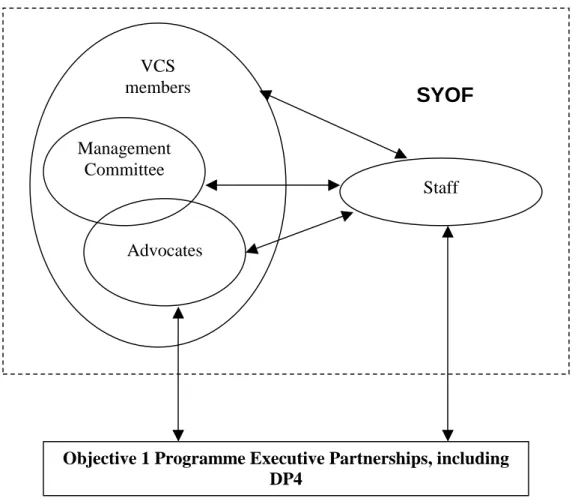
Figure 1 illustrates the structure of SYOF and shows how this formally feeds into
Priority 4 decision-making. As already noted, formal and direct opportunities for
VCS participation and influence via SYOF was primarily through its advocates on
DP4. The co-ordinator of SYOF (the staff member responsible for managing SYOF)
also attended DP4 meetings. Advocates on DP4 work closely with SYOF staff and
members of the management committee in order to exchange information and discuss
key issues, interests and strategies. The management committee, responsible for
co-options to ensure balanced representation with respect to gender, ethnicity,
disability and geography. The Management Committee is elected for a three-year
period by SYOF members. Membership of SYOF is open to any South Yorkshire
voluntary or community sector organisation.
Figure 1: SYOF Structure and Links with DP4
4.2 VCS Empowerment and the Partnership Restructure
So far, the nature and extent of VCS participation in DP4 has been examined.
However as previous research has shown, participation is not enough to ensure
influence, and it is not uncommon for partnerships to be characterised by
asymmetrical power relationships in which the VCS has been considered to lack any
‘real’ power (see Scott, 1998; Bache, 1998, 155; Foley and Martin, 2000, 485;
Southern, 2002, 21). With respect to the Objective 1 case study, interview evidence
suggests some VCS representatives have had an influential role in shaping policy and
in upholding underlying notions and core beliefs surrounding the need for genuine
community engagement and empowerment in Priority 4 delivery (Public Sector and Management
Committee
Advocates VCS members
Staff
SYOF
VCS Interviewees, 2003). This was felt to be particularly true of those VCS
representatives that chaired DP4 and who worked closely with Programme
Directorate staff, and less true of other VCS representatives who were considered to
be “more disruptive” (Public Sector and VCS Interviewees, 2003).
Even so, the nature and level of VCS participation in Priority 4 changed as the
Programme progressed. The main reason for this was a partnership restructure that
took place towards the end of 2001. This led to the replacement of all six driver
partnerships with three strategic groups (Business and Economy, People and Skills
and Communities) and a series of time limited task groups focusing on specific issues.
The restructure followed a review of the driver partnerships undertaken by
Programme Directorate staff. Whilst acknowledging the positive contribution of
driver partnerships, this review concluded that they were less appropriate as the
programme moved from strategy development to the delivery phase (Programme
Directorate, 2001b, 7 to 8). Reasons for this included:
• The overlapping roles between driver partnerships and the core functions and responsibilities of Programme Directorate staff
• The areas in which there was a strategic role for driver partnerships, such
as drawing links between other priorities and cross-cutting themes, were
perceived not to be working well
• The existence of “too many groups associated with the Objective 1 Programme” which were considered to be “in danger of becoming an
industry in itself”: rationalisation was required
• The lack of understanding of the role and responsibilities of driver partnerships
• An external perception that driver partnership membership consisted of “the usual suspects with vested interests”, which was considered to have a
damaging affect on the legitimacy of the Programme
(Programme Directorate, 2001b, 7 to 8)
Although SYOF advocates would sit on the new strategic groups and task groups, the
restructure affected both the nature and extent of their involvement in Priority 4. In
examining issues across the programme in the strategic groups or specific task-related
delivery issues within task groups. Unlike the driver partnerships, strategic groups
would have no formal decision-making powers: their role was to provide expert
support, advice and recommendations to the Programme Directorate. Strategic groups
would also meet quarterly, as opposed to monthly in the case of the driver
partnerships.
Together, these changes meant that many VCS representatives that sat on DP4 were
less involved in formal decision-making regarding Priority 4 delivery and had less
access to detailed information that would enable them to have a more informed input
(VCS and Public Sector Interviewees, 2002/3). Interview evidence suggests that this
had a significant impact on VCS influence. According to one VCS interviewee,
abolishing the driver partnerships meant that the VCS “no longer had much
influence”. The interviewee went on to explain that DP4 had kept partners up to date
on progress, events and issues. Since the restructure, the VCS was less well informed,
which made having any influence more difficult (VCS Interviewee, 2003). Other
interviewees stated that the restructure had the effect of “reducing the ability of the
VCS to influence what was going on in Priority 4 to a great extent” and was viewed
as a means by which the Programme Directorate could regain control over programme
delivery (VCS and Public Sector Interviewees, 2003). More generally, there was a
feeling amongst the VCS of exclusion (Public Sector Interviewee, 2002).
4.3 VCS Participation and Empowerment: Evidence of Europeanisation?
The discussion so far reveals that the South Yorkshire Objective 1 programme has
had a significant impact on VCS participation in regional policy within South
Yorkshire. In particular, it has provided the VCS with considerable participatory
opportunities and support to engage in, and lead operational partnerships such as DP4.
As a result, VCS representatives have been able to play an active and influential role
in formulating and upholding strategies and core beliefs concerning the delivery of
CED aims and objectives. This can be taken as evidence of direct Europeanisation to
the extent that these outcomes were intended by, and are consistent with the Objective
Even so, EU level programming negotiations, regulations and guidelines did not
dictate and/or envisage all developments and factors that have shaped VCS
participation. This was true of the partnership restructure, which had a significant
affect on VCS participation in Priority 4. The impetus behind the restructure and the
formulation of proposals for the new structure was heavily influenced by Programme
Directorate Officials at the programme delivery stage, although the European
Commission was informed of, and supported the changes (Public Sector Interviewee,
2002). This serves to emphasise the point that EU level developments leave
considerable room and discretion to domestic actors and institutions to both shape and
revise institutional structures and processes according to their preferences, practices,
beliefs and domestic policy environment.
The importance of the domestic political environment and responses of actors
involved in programme delivery in shaping VCS participation and influence is also
evident in at least two other ways. Firstly, the motivation and choices made by key
VCS actors to develop SYOF and engage in the Objective 1 Programme is clearly
important. As Casey notes (2004, 250), VCS organisations must first choose to
participate and have the organisational skills and the resource capacity to bear the
transaction costs of such a choice. With respect to the Objective 1 case study, key
VCS actors decided to engage in the development of the South Yorkshire Objective 1
Programme, to develop SYOF as a consultative and networking forum and to
undertake the lead partner role in DP4. These decisions and developments may have
been influenced by a combination of factors, and may themselves have shaped the
actual VCS participatory opportunities presented to them through the Objective 1
Programme. The complexity of determining the extent of Europeanisation pressures
in the domestic arena is highlighted by the possibility that some factors influencing
VCS choices and decisions may be EU related, such as securing Objective 1 funding
assistance to enhance capacity, whilst others may be internal to the organisation, such
as their culture, ideology and history.
Secondly, the nature and characteristics of networks and individuals involved in
Programme delivery has been a significant factor affecting VCS participation and
influence. A number of VCS interviewees noted, for example, that DP4 operated in
Objective 1 Priority 4 staff in which particular VCS representatives would be
contacted in order to discuss and ‘sound out’ ideas. The fact that some VCS
representatives had a close relationship with Priority 4 staff and were regarded as
more influential than others suggests a smaller, more informal policy community type
network of individuals may have been operating beneath the more formal DP4.
Moreover, several interviewees highlighted the importance of individuals and ‘strong
personalities’ as a key factor shaping VCS influence and policy outcomes (VCS and
Public Sector Interviewees, 2003).
So far, this paper has examined the role of the VCS in Priority 4 CED strategy
development. The next section will move on to consider the role of the community
sector in delivering CED strategy.
5. Community Sector Participation and the Community Action Plan Initiative 5.1 An Outline of the Community Action (CA) Plan initiative
The CA Plan initiative was developed by Programme Directorate Priority 4 staff and
DP4 as part of the strategy for delivering CED aims and objectives in the Objective 1
SPD. The initiative adopts a commissioning approach whereby targeted Priority 4a
communities are encouraged to draw down pre-allocated Objective 1 funding by
developing and managing the delivery of a strategic community action plan. These
plans should bring together a package of projects and activities that address priority
issues, problems and goals identified through consultation with residents and other
stakeholders. The plans may cover a locality or activities that fall outside the Priority
4a/Objective 1 remit, although it is necessary to find other funding sources for these.
A total of £21 million Objective 1 funding, making £42 million when matched by
domestic funds, was ring-fenced for targeted Priority 4a communities within 39 CA
Plan areas. These areas have been identified as being amongst those most severely
deprived and having a relatively low level of community development.
The process of drawing up and delivering a CA Plan seeks to encourage and empower
people and organisations to work together to define key issues, goals and solutions
within targeted communities. By doing so, it provides opportunities for community
sector organisations/partnerships, residents and other stakeholders to engage in, and
regeneration of targeted areas. This process reflects a strong commitment within
Priority 4a to transfer a degree of ownership, responsibility and control for capacity
building and economic and social regeneration to communities.
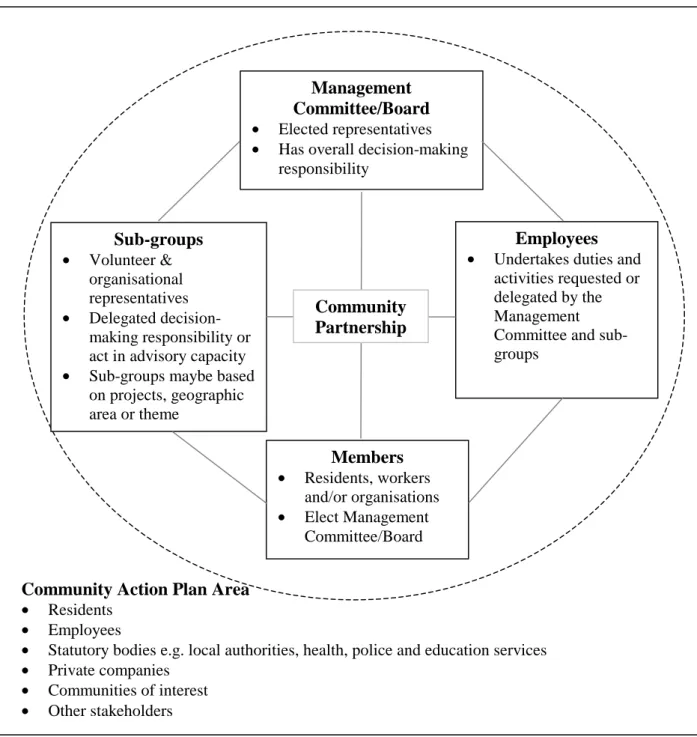
Community sector organisations, referred to as ‘community partnerships’, lie at the
heart of this process. They provide the key vehicle for wider community participation
and empowerment in local strategic action planning and delivery. Community
partnerships consist typically of four key components: a management committee or
board, sub-groups, employees and partnership members (see figure 2 below)8.
Management committees/boards have overall management and decision-making
responsibly within community partnerships. They consist of unpaid representatives or
trustees, with membership drawing on local residents and councillors together with
representatives from local community and voluntary sector organisations, public
services such as health and education, private businesses and the faith sector.
Management committees/boards may delegate some duties and decision-making
powers to sub-groups or, alternatively, use sub-groups in an advisory capacity. These
sub-groups may deal with particular aspects of community partnership operations
(e.g. finance or policies), geographical areas or themes (e.g. environment, crime,
sport). Membership on sub-groups is unpaid and varies considerably, depending in
part on the nature of the sub-group in question. Members may include: residents,
people employed in the area, local councillors together with other representatives
from local authorities, the police, health and education services and private
businesses.
Sub-groups and management committees may have some support from paid
community partnership employees. These may include: finance managers/officers,
community planning or development officers, community partnership officers,
volunteer co-ordinators and administration/monitoring workers.
8
Partnership members form the remaining component of community partnerships.
Generally speaking, anyone living or working in the target area can become a member
of a community partnership, although in some cases there are restrictions (e.g.
individuals must be 18 years or more) or members are organisations rather than
individuals. Membership of a community partnership entitles individuals to elect
management committee/board members at Annual General Meetings (AGM’s).
Figure 2: A Typical Community Partnership Structure
Management Committee/Board
• Elected representatives
• Has overall decision-making responsibility
Members
• Residents, workers and/or organisations
• Elect Management Committee/Board
Employees
• Undertakes duties and activities requested or delegated by the Management Committee and sub-groups
Sub-groups
• Volunteer & organisational representatives
• Delegated decision-making responsibility or act in advisory capacity
• Sub-groups maybe based on projects, geographic area or theme
Community Action Plan Area
• Residents
• Employees
• Statutory bodies e.g. local authorities, health, police and education services
• Private companies
• Communities of interest
• Other stakeholders
5.2 Community Partnerships and Empowerment
The CA Plan process provides the opportunity for community partnerships to
strengthen their decision-making capacity both in the implementation of the Objective
1 Programme and at a local policy level. Through this approach, community
partnerships are responsible for making a variety of local policy decisions concerning:
• How problems and issues are defined, prioritised and overcome
• What key aims, goals and objectives should be included in the action plan
• What potential solutions, activities and projects should be taken forward
• What consultations should be undertaken and methods used
• What community partnership governance and delivery arrangements should be adopted. This includes decisions regarding the partnership structure,
membership, policies and procedures.
Interview evidence suggests that the strengthening of decision-making capacity in
these areas has gone some way to empowering community partnerships. The
development and management of community action plans has, for example, given
some community partnerships a sense of empowerment in respect to local action and
agenda setting. In the words of one interviewee:
“the CA Plan process has given some people who have had no say or power more
control over what is happening in their community: they can have a significant input
into things that affect the quality of life and what is happening” (Public Sector
Interviewee, 2003).
Similarly, a number of public sector interviewees (2003) noted that some community
partnerships have gained a significant degree of control and power within the local
community through the CA planning process.
Even so, whilst some community partnerships appear to have been empowered, they
operate within a policy context that both shapes and constrains their decision-making
capacity and influence. With respect to this, Objective 1 Programme Directorate
staff, in partnership with other domestic actors in DP4, have played a key role in
setting the precise ‘rules of the game’ surrounding the implementation of the CA Plan
initiative. In doing so, they determined what areas, activities and projects would be
procedures, processes and criteria community partnerships needed to adopt and/or
meet in order to get their action plans endorsed. In this way, Programme Directorate
staff and associated partnerships laid out the parameters community partnerships were
required to work within, which led one community partnership employee (2003) to
claim that they “effectively laid out what decisions needed to be made”.
Despite this, the Programme Directorate was keen to ensure that community action
plans were not just about Objective 1 funding and can/should include other projects
and activities to meet the needs and priorities of communities identified through
consultations (Programme Directorate, 2002, 17). It is not clear, however, that this
message got through to all community partnerships, particularly earlier in the action
planning process (Public Sector and Community Partnership Interviewees, 2002/3).
Even if it had, the availability of funding, whether from Objective 1 or from domestic
sources drawn upon to fulfil EU match funding requirements, would be expected to
have a direct and significant influence on the type of projects and activities contained
in the action plans. As noted by one interviewee, “at the end of the day the
community partnership has to do the projects for which they have funding”
(Community Partnership Interviewee, 2003). Similarly, another community
partnership employee noted that projects and activities were put into their plan in
order to get funding for the community. This was not always what the community
wanted, so even though people have been consulted, issues and projects would not be
taken forward for which they were unlikely to get funding (Community Partnership
Interviewee, 2003). The potential implications of this for community partnership and
wider community empowerment was summarised by one interviewee, who noted that:
“The Community Action Plan may be seen as a form of community development,
process and method. It may, on the other hand, be written with the intention of
jumping through the required hoops and hurdles to get the money. If it is viewed in
these terms, without the democracy side, it will be seen as an Objective 1 plan.
However, it should be a community action plan” (Community Partnership
Interviewee, 2003, emphasis added)
Local authorities have also affected the extent to which community partnerships have
been empowered. The provision of local authority (LA) support, funding and
membership of local councillors on community partnerships are seen to be key
community partnership structures, status and processes. According to one community
partnership interviewee, LAs have their own agendas and may try to get the
partnership on board to say they want a particular initiative. The interviewee went on
to explain that the LA has influenced the projects and activities detailed in their action
plan, but that:
“this is not all bad. It’s a balance of what the community and Local Authority want.
The Local Authority will fund things even if the community don’t want them and ‘the
community’ may decide to undertake an activity on the basis that they can get
funding for it” (Community Partnership Interviewee, 2003).
Interview evidence concerning the extent to which local authorities have been
influential indicates some variation across boroughs and community partnerships. In
respect to the latter, some community partnerships were identified where local
authority influence was seen to be less significant. According to an interviewee of
one such partnership, local councillors on management committees and sub-groups
were not so influential, although they seemed to view the community partnership as
‘stepping on their toes’ somewhat (Community Partnership Interviewee, 2003). Yet
examples were given where local authority councillors and officers have taken active
steps to resist community partnerships taking action plans forward. This resulted in
delays to the endorsement of at least two CA plans (Statutory and Community
Partnership Interviewees, 2003).
Despite the influence of the Objective 1 Programme and local authorities, there is
some indication of changes in the way that statutory agencies relate to community
partnerships. According to one interviewee, statutory agencies now come along with
an idea and ask community partnerships what they think rather than imposing things.
With respect to this, it was felt that community partnerships have given people in the
community the power to “say yes or no” to certain things that statutory agencies
5.3 Community Sector Participation & Empowerment: Evidence of Europeanisation? As the above discussion shows, the South Yorkshire Objective 1 Programme has had
a significant affect on the role of community partnerships in CED at the local level.
The availability of Objective 1 CED funding, through the CA Plan initiative, has
provided direct opportunities and support for community sector organisations and
partnerships in targeted areas to lead, and facilitate the development and
implementation of local strategic action plans. Not only has this support led to the
development and widening of the scope and project activities of community
partnerships and organisations, it has enhanced their decision-making capacity and
influence with respect to the social and economic regeneration of targeted
communities. It has also facilitated changes in community sector relations with the
wider community. There is some indication, for example, that the CA Plan initiative
has helped change the way statutory agencies relate to some community partnerships.
It has also encouraged community partnerships to think more deeply about how they,
themselves, relate to the wider community. As one interviewee noted, the action
planning process has focused minds further and has introduced community
partnerships to new ideas and approaches which has meant that concepts of
representation, inclusiveness, openness, equal opportunities and accountability have
been addressed more deeply and quickly than would otherwise have been (Public
Sector Interviewee, 2003).
These outcomes have emerged as a result of the opportunities and support made
available through the Objective 1 Programme. As such, they clearly demonstrate that
a ‘Europeanisation effect’ is taking place. Even so, EU level programming
negotiations, regulations and guidelines did not dictate the precise nature or level of
community sector participation and influence. Whilst a VCS role in CED is
envisaged at the EU level, the development of the CA Plan initiative and the decision
to place community partnerships at the heart of its delivery, took place at the
Programme delivery stage. Again, the preferences, practices and beliefs of domestic
actors, particularly Objective 1 Priority 4 staff and key partners within DP4, were
instrumental in shaping the precise nature and extent of opportunities afforded to the
community sector.
The importance of domestic actors and the domestic political environment in shaping
community sector participation at the programme delivery stage is also evident in at
least two other ways. Firstly, domestic actors were instrumental in shaping the
procedures, processes and criteria community partnerships needed to adopt and/or
meet in order to get their action plans endorsed. This had a significant effect on the
nature and influence of community sector involvement. Although the procedures and
criteria adopted were in accordance with broader EU regulations and the Objective 1
SPD, they were not dictated by them. Secondly, the local political and institutional
environment has been important in shaping community sector influence. For
example, local authorities have influenced the type of projects in the action plans as
well as community partnership structures, status and processes through the provision
of support and funding together with local councillor membership on community
partnerships.
5 Conclusion
This paper has shown that UK membership of the European Union has provided the
VCS with increased opportunities and support for engagement in CED policy-making
and delivery. One such opportunity arose through significant VCS representation and
lead partner role on DP4, on which some VCS representatives were considered
influential in shaping CED policy strategy and in upholding underlying notions and
core beliefs surrounding the need for genuine community engagement and
empowerment in the delivery of Priority 4. In support of this, Objective 1 Technical
Assistance funds were made available to enhance VCS capacity to undertake the role
of lead partner and continue developing SYOF as a key co-ordination point for VCS
engagement in the Programme. Other opportunities have arisen for community sector
participation in the delivery of CED strategy. The Community Action Plan initiative,
in particular, has opened up new opportunities and support for community
partnerships to strengthen their decision-making influence in building capacity and
overcoming social and economic exclusion in targeted communities. Interview
evidence suggests that this has gone some way to empowering community
partnerships within their communities.
The increased level and influence of VCS participation in CED strategy and delivery
intended by, and are consistent with the Objective 1 Single Programming Document,
the EU partnership principle and EU level preferences concerning CED and VCS
inclusion. However, as this paper has argued, EU level developments do not
necessarily dictate or determine all outcomes at the delivery stage. While EU
programmes can promote institutional and policy designs that favour particular
outcomes, there is scope for flexibility and innovation in their implementation. Some
evidence of this has been seen with respect to the Objective 1 partnership restructure
and the development and implementation of the Community Action Plan initiative. In
both cases, it was argued that the political environment and decisions made, and
driven forward by domestic actors at the programme delivery stage have been
significant in shaping the precise nature, extent, take-up and continuation of
participatory opportunities available to the VCS.
Together, these findings suggest that whilst some Europeanisation is evident, arising
from the provision of funding and the setting of broad policy aims, objectives and
‘rules of the game’, the preferences and actions of domestic actors involved in
programme delivery remains highly significant in determining ultimate outcomes.
This highlights the potential for the policies, practices, preferences and political
environment surrounding domestic actors involved in programme delivery to
constrain or facilitate the degree to which Europeanisation occurs. In this case study,
there is little evidence suggesting that domestic actors and the domestic political
environment have acted as a constraint to EU level pressures encouraging VCS
participation and empowerment in CED and programme delivery. On the contrary,
they have facilitated deeper VCS involvement and influence. Comments by a
European Commission Interviewee (2004) that EU “guidelines were responded to
well in South Yorkshire” and that “VCS participation in the UK is well ahead of other
Bibliography
Armstrong et al (2002), Research Working Paper Number 1: The Role of the Third Sector in
the Governance of Regional Policy in South Yorkshire, Sheffield: University of
Sheffield
Armstrong et al (2003), Multi-Level Governance, Regional Policy and the Role of the Third Sector: The Emergence of New Policy Networks in the United Kingdom?, Paper Presented to the Regional Studies Association Conference on Reinventing Regions in
the Global Economy, Italy, 12-15th April 2003
Bache, I., (1998), The Politics of the European Union Regional Policy: Multi-Level
Governance or Flexible Gatekeeping?, Sheffield Academic Press, Sheffield
Bache, I., (1999), The Extended Gatekeeper: Central Government and the Implementation of EC Regional Policy in the UK, Journal of European Public Policy, Vol. 6, No. 1, March 1999, 28-45
Bache, I., (2000), Government Within Governance: Network Steering in Yorkshire and the Humber, Public Administration, Vol. 78, No 3, 575-592
Bache, I., (2003), Europeanisation: A Governance Approach, Paper Presented at the EUSA
8th International Biennial Conference, Nashville, March 27-29 2003
Bache, I. and Jordan, A., (forthcoming), Britain in Europe and Europe in Britain: The
Europeanisation of British Politics,
Bache, I., Jones, R., (2000), Has EU Regional Policy Empowered the Regions? A Study of Spain and the United Kingdom, Regional and Federal Studies, Vol.10, No. 3, Autumn 2000, 1-20
Borzel, T.A. and Risse, T., (2000), When Europe Hits Home: Europeanisation and Domestic Change, European Integration Online Papers, Vol. 4, No. 15,
http://eiop.or.at/eiop/texte/2000-015a.htm
Buller, J. and Gamble, A., (2002), Conceptualising Europeanisation, Paper presented to the ESRC/UACES Study Group on the Europeanisation of British Politics and
Policy-Making, Sheffield, 29 November 2002
Casey, J., (2004), Third Sector Participation in the Policy Process: A Framework for Comparative Analysis, Policy and Politics, Vol. 32, No. 2, 241-257
European Commission, (1996), Social and Economic Inclusion Through Regional Development: The Community Economic Development Priority in European
Structural Funds Programmes in Great Britain (Lloyd Report), Luxembourg: Office
for Official Publications of the European Communities
Foley, E., and Martin, S., (2000), A New Deal for the Community? Public Participation in Regeneration and Local Service Delivery, Policy and Politics, Vol. 28, No. 4, 479-91 Halfpenny, P. and Reid, M., (2002), Research on the Voluntary Sector: An Overview, Policy
and Politics, Vol. 30, No. 4, 533-550
Hooghe L., (1996), Cohesion Policy and European Integration: Building Multi-Level
Governance, Oxford University Press, Oxford
Kendall, J. and Anheier, H. K., (1999), The Third Sector and the European Union Policy Process: An Initial Evaluation, Journal of European Public Policy, Vol. 6, No. 2, 283-307
Marks, G., (1993), Structural Policy and Mulitlevel Governance in the EC, in The State of the
EC: The Maastricht Debates and Beyond, vol. 2, A. W. Cafrung and G. G. Rosenthal
(eds.), Boulder, Colo.: Lynne Rirnner, 391-411
Marks, G., Hooghe, L., Blank, K., (1995), European Integration Since the 1980’s: State-Centric Versus Multi-Level Governance, Paper presented at the American Political
Science Association Meeting, Chicago, August 31 to September 3rd
Martin, S., Pearce, G., (1999), Differentiated Multi-Level Governance? The Response of British Sub-national Governments to European Integration, Regional and Federal
McAleavy, P., (1995), Policy Implementation as Incomplete Contracting: The European
Regional Development Fund, Unpublished PhD thesis, European University Institute,
Florence
Olsen, J.P., (2002), The Many Faces of Europeanisation, Journal of Common Market Studies, Vol. 40, No. 5, 921-952
Pollack, M., (1995), Regional Actors in an Intergovernmental Play: The Making and Implementation of EC Structural Policy, in S. Mazey and C.Rhodes (eds), The State
of the European Union, Vol.3, Boston:Lynne Riener
Programme Directorate, (2000), South Yorkshire Objective 1 Single Programming Document:
Part 3, Rotherham: Objective 1 Programme Directorate
Programme Directorate, (2001a), Priority 4 Prospectus: Developing Economic Opportunities
in Targeted Communities, Rotherham: Objective 1 Programme Directorate
Programme Directorate (2001b), South Yorkshire Objective 1 Driver Partnership Review, Rotherham: Objective 1 Programme Directorate
Programme Directorate, (2002), Objective 1 South Yorkshire: Community Action Plan
Handbook, Rotherham: Objective 1 Programme Directorate
Scott, J., (1998), Law Legitimacy and EC Governance: Prospects for Partnership, Journal of
Common Market Studies, 36:2, 175-194
Smith, A., (1997), Studying Multi-Level Governance: Examples From French Translations of the Structural Funds, Public Administration, Vol. 75, Winter 1997, 711-729
Smyrl, M., (1997), Does European Community Regional Policy Empower the Regions?,
Governance: An International Journal of Policy and Administration, Vol. 10,. No. 3,
July 1997, 287-309
Southern, R., (2002), Understanding Multi-Sectoral Regeneration Partnerships as a Form of Local Governance, Local Government Studies, Vol. 28, No. 2, 16-32
Sutcliffe, J., (2000), ‘The 1999 Reform of the Structural Fund Regulations: Multi-Level Governance or Re-Nationalisation?’ Journal of European Public Policy, 7:2, 290-309 SYOF (no date), The Involvement of the Voluntary and Community Sector in the
Development of the South Yorkshire Objective 1 Programme September 1998 – June 2000: A Diary Report, Rotherham: South Yorkshire Open Forum
SYOF, (2001), Supporting the Development of the Objective 1 Programme: South Yorkshire
Open Forum Business Plan 2000-2008, Rotherham: South Yorkshire Open Forum
Taylor, M., (2003), Public Policy in the Community, Hampshire: Palgrave Macmillan Taylor, M., (2004), A Sea Change or a Swamp? New Spaces for Voluntary Sector
Engagement in Governance in the UK, IDS Bulletin, Sussex: Institute of Development Studies, 35:2, 67-75
Thielemann, E. R., (1999), Institutional Change and European Governance: An Analysis of Partnership, Current Politics and Economics of Europe, Vol. 9, No. 2, 181-197 Wilson, D., (2003), Unravelling Control Freakery: Redefining Central-Local Government