Mingsarn Santikarn
A thesis submitted for the degree of Doctor of Philosophy
in the Australian National University
industrialisation policies to achieve growth objectives. At the same time direct foreign investment has been
encouraged to bring additions to the local stock of capital, management and technology. From the early 1970s, there has been growing disillusion about the benefits that a host country can gain from direct foreign investment. Direct
foreign investment has been attacked as bringing
inappropriate technology, inhibiting local learning and perpetuating technological dependence.
This thesis has taken Thai manufacturing industry as a case study. The study argues that modern large-scale manufacturing industries must be viewed as skills rather than employment generators. Employment objectives could not be achieved in any significant degree under the current
strategy regardless of channels for technology transfer. Part I examines the role of direct foreign investment and other channels for transferring technology to Thailand, the cost of importing technology through direct foreign investment
and technology contracts, and the relative efficiency of these channels in exploiting imported technology. Evidence suggests that the weakness of local technical and industrial expertise often makes direct foreign investment, especially joint venture arrangements, the preferred form of
transferring technology although its cost in terms of
royalty payments is slightly higher. Local sectors turned out to be relatively efficient in bargaining for technology. Other invisible costs and factors which affect the pricing of technology are also discussed.
The positive spill-over effects of direct foreign investment, though they exist, are weak. This is partly attributable to the early stage of industrialisation of
Part II of the thesis examines in some detail the fostering of human capital and the choice of techniques in the textile industry. On the production side, evidence suggests that technology has largely been transferred.
However, at the entrepreneurial level, the transfer has been inhibited by the desire (often of both local and foreign parties) to maximise efficiency.
It also reveals that both foreign and local textile firms are not significantly different in their choice of technology. Their choice has largely been affected by local factor prices which in turn are influenced by various local policy instruments. The relatively high productivity and profitability of foreign firms are attributable to their management rather than their machines.
ACKNOWLEDGMENTS
First, I would like to thank the Australian National
University for its generous scholarship and excellent
facilities for study and research. I owe a great debt to
my supervisor, Professor H.W. Arndt who patiently went
through many chaotic versions of this thesis until it reached
this final form. I am also very grateful to Dr R.M. Sundrum
for his invaluable critical comments. In the last stages,
Dr Peter McCawley gave me considerable assistance. Drs
P.J. Lloyd and C.T. Edwards were also helpful. I should
also like to acknowledge the help of the staff of Bradmill
Industries Ltd. who provided me with technical information
on textile technology and commented on the drafts of chapters
relating to textile technology.
In Thailand I benefited from the assistance of Dr Snoh
Unakul, the governor of the Bank of Thailand and his staff,
Professor Prachoom Chomchai and Dr Virapong Ramangkun of
Chulalongkorn University, and Mr Chira Phanupong, the Chief
Economist of the Board of Investment, and his staff. In
particular, Mr Thomrat Sivaranon from the Thai Textile
Manufacturing Association and Mr Vinij Konjanart from Thai
Textile Co. Ltd. gave me much fruitful information. From
Japan, I am grateful to Dr Makoto Ikema of Hitotsubashi
University and the member companies and their staff of Japan
Spinners' Association. As well as all this, my study would
not have been possible without the co-operation of numerous
Thai and foreign businessmen, engineers and employees of
manufacturing firms who gave up their precious time for
interviews.
It is impossible to name all the people who have helped
me. Among those who deserve particular acknowledgment are
Meredith Borthwick, Margaret Easton, N. Romayananda, Suan Tan,
A. Kaosa-ard, and F.J. Collis. The final manuscript has
been efficiently and beautifully typed by Marcia Milnes.
Finally, I wish to thank my parents for their unfailing
CONTENTS
Page
Abstract H i
Acknowledgments v
List of Tables and Figures ^x
Chapter 1: Introduction 1
Chapter 2: Major Issues in the Study of Technology
Transfer 8
2.1 Definitions and Concepts 8
2.2 Channels for Technology Transfer 14 2.3 Direct Foreign Investment as a Channel
for Geographical Transfer of
Technology 21
2.4 Major Issues in the Study of Technology
Transfer 24
Part I: Technology Transfer in
Some Manufacturing Industries in Thailand Chapter 3: Industrialisation and Government Policies
in Thailand 51
3.1 The Thai Economy 1855-1959 51 3.2 Planning for Industrialisation 53 3.3 Structural Change Since 1960 54 3.4 Expansion and Foreign Investment in the
Promoted Sector 59
3.5 Government Policy Instruments Since 1960 59
Chapter 4: Methodology 74
4.1 The Scope of the Study 74
4.2 Ownership and Control: Definitions of a
Foreign Firm 87
Chapter 5: The Role of Packaged and Unpackaged Mechanisms in the Transfer of Technology in Some Manufacturing
Industries in Thailand 95
5.1 The Packaged and Unpackaged Mechanisms
Used in Some Manufacturing Industries
in Thailand 96
5.2 Influence of Motives for Direct Foreign
Investment on Types of the Transferred
Technology 111
5.3 Foreign Investment and Domestic Productivity 130 5.4 Inter-industry Diffusion of Technology 136 5.5 Local Adaptations, Research and Development
under Packaged and Unpackaged
Page Chapter 6: The Purchases of Foreign Technology
Through Technology Contracts 149
6.1 The Data 149
6.2 Pattern and Sources of Industrial
Technology in Thailand 152
6.3 Nature of Technology Contracts 155 6.4 The Explicit Cost of Technology in the
Thai Manufacturing Industries 159 6.5 Conditions in Technology Agreements 174
6.6 Concluding Remarks 190
Part II: Technology Transfer in the Thai Textile Industry
Chapter 7: The Development of the Thai Textile
Industry 192
7.1 The Textile Industry in the Economy 192 7.2 The History and Development of the Thai
Textile Industry 195
7.3 Changes in the Pattern of Transfer
(1933-75) 201
7.4 The Growth of the Textile Industry 207 Chapter 8: Direct Foreign Investment in the Thai
Textile Industry and Domestic
Participation 211
8.1 Japanese Involvement in the Process of Technology Transfer in the Thai
Textile Industry 211
8.2 Other Investors 223
8.3 The Local Partners 225
8.4 Direct Foreign Investment and Wholly
Locally-owned Enterprises 232 8.5 Local Participation in Foreign Related
Enterprises 233
8.6 Training of Local Labour Force 243 8.7 Intra-firm Effects of Foreign Control 245 Chapter 9: Technological Progress in the Textile
Industry and Its Implications for
the LDCs 254
9.1 The Labour Intensive Textile Industry 254 9.2 Technological Progress in the Textile
Industry 257
9.3 Other Economic Merits of Modern Technology 261 9.4 Economies of Scale and Textile Technology 262 9.5 Employment Implications of R & D in
Textile Technology 265
9.6 Implications of Modern Technology for
Page Chapter 10: Technology, Employment and Skills
in the Thai Textile Industry 274 10.1 The Size Distribution of the Firms in
the Promoted Sector 274
10.2 Factor Intensity in the Thai Textile
Industry 278
10.3 Factors Affecting the Choice of Technology 285 10.4 Factors Influencing Entrepreneurs’
Decision on Factor Proportions 296
10.5 Hypothetical Calculation 301
10.6 Comparative Performance of Local and Foreign Firms with Different
Technologies 309
10.7 The Future Role of the Thai Textile Industry in Employment and Skill
Generation 312
Chapter 11: Conclusions and Some Policy
Recommendations 318
11.1 Summary of Findings 318
11.2 Policy Recommendations 323
APPENDIX A 332
APPENDIX B 333
APPENDIX C 342
APPENDIX D 345
APPENDIX E 350
APPENDIX F 351
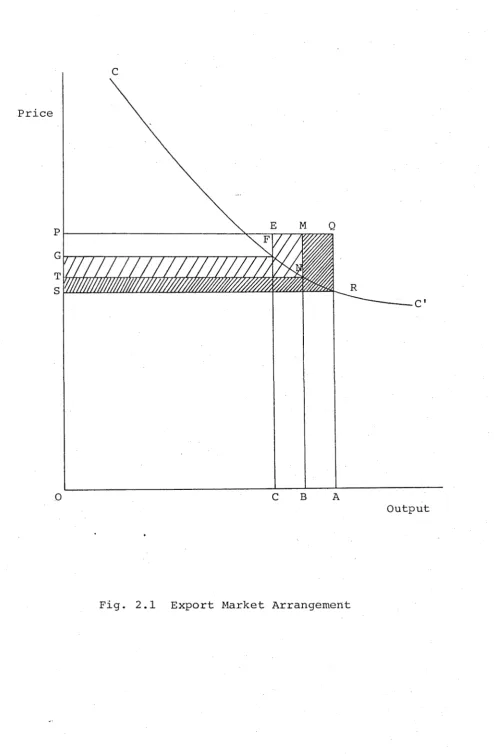
Fig. 2.1 Table 3.1
Table 3.2
Table 3.3
Table 3.4 Table 3.5 Table 3.6 Table 3.7 Table 4.1 Table 4.2 Table 4.3 Table 4.4 Table 5.1
Table 5.2
Table 5.3 Table 5.4 Table 5.5 Table 5.6
Table 5.7
Table 5.8 Table 5.9
LIST OF TABLES AND FIGURES
Export Market Arrangement
Shares of Value Added and Employment of Major Sectors in the Thai Economy
(selected years)
Indices of Value Added and Employment of Major Sectors in the Thai Economy
(selected years)
Average Growth in Value Added and
Percentage Shares of Major Industries in Total Manufacturing Value Added
(market price 1969-73)
Shares of Foreign Registered Capital in the Promoted Sector (October 1960-74) Consumer Price Indices (1965-74) for
Bangkok-Thonburi Labour Disputes (1969-74)
Labour Disputes in All Manufacturing and Textile Industries
Number of Firms in This Study Classified by Industry
Number of Promoted Firms Classified by Country of Origin
Firms Classified by Foreign Equity and Management Participation
Share of Interviewed Textile Firms Mechanisms of Technology Transfer in
Some Manufacturing Industries in Thailand
Contribution Expected from Foreign Partners by Thai Entrepreneurs in Their Joint Ventures
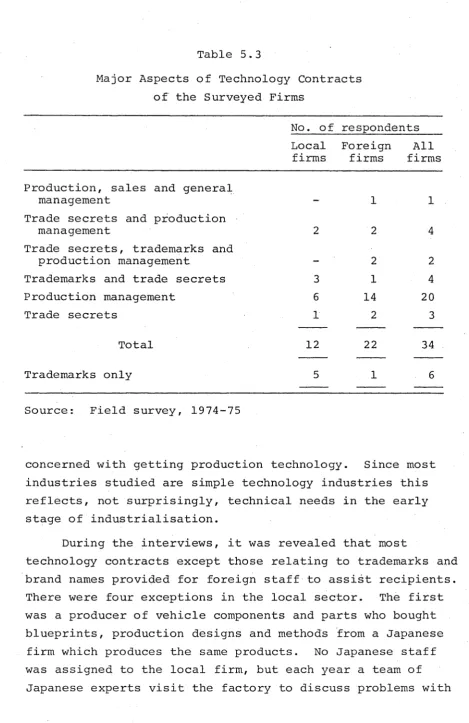
Major Aspects of Technology Contracts of the Surveyed Firms
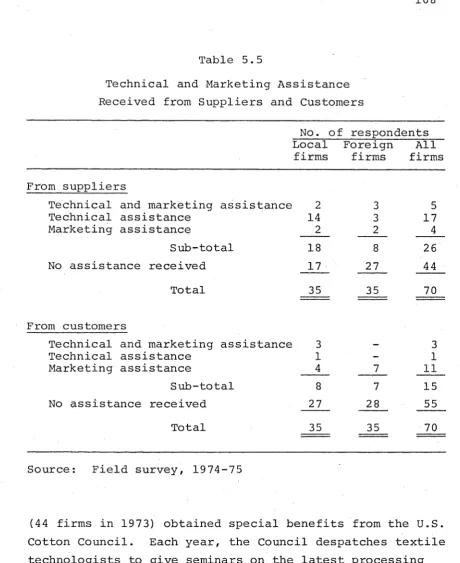
Sources of Machinery and Equipment for Some Manufacturing Firms in Thailand Technical and Marketing Assistance
Received from Suppliers and Customers Some Characteristics and Shares of
Foreign Investment in 21 Promoted Industries (1973)
Number of Foreign Affiliates Classified by Industry and by Source of
Ownership in the Promoted Sector (1973)
Comparison of Certain Characteristics of Foreign and Local Firms (1973) Comparison of Investment Characteristics
Page Table 5.10
Table 5.11
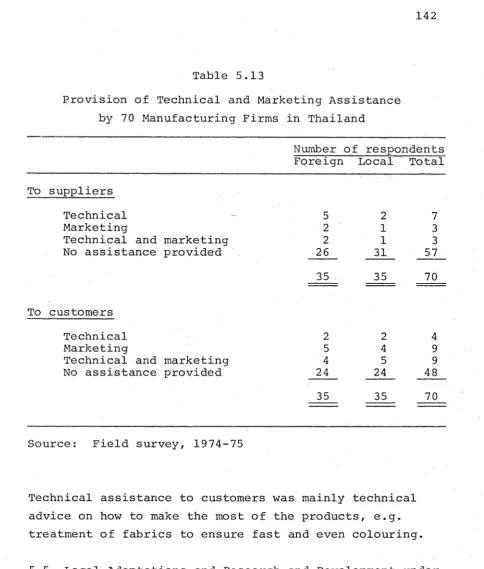
Table 5.12 Table 5.13
Table 6.1
Table 6.2
Table 6.3
Table 6.4 Table 6.5
Table 6.6 Table 6.7
Table 6.8
Table 7.1 Table 7.2 Table 7.3 Table 7.4 Table 7.5
Table 7.6
Table 8.1
Comparative Performance of Domestic and Foreign Sector (1973)
Determinants of Productivity of the Domestic Sector in Some Thai Manufacturing Industries Local Linkages in Some Promoted
Manufacturing Industries (1973) Provision of Technical and Marketing
Assistance by 70 Manufacturing Firms in Thailand
Technology Contracts Submitted by 1975 Classified by Industry and by Source
(184 contracts)
Duration of 252 Technology Contracts Submitted by 1975 Classified by Industrial Group
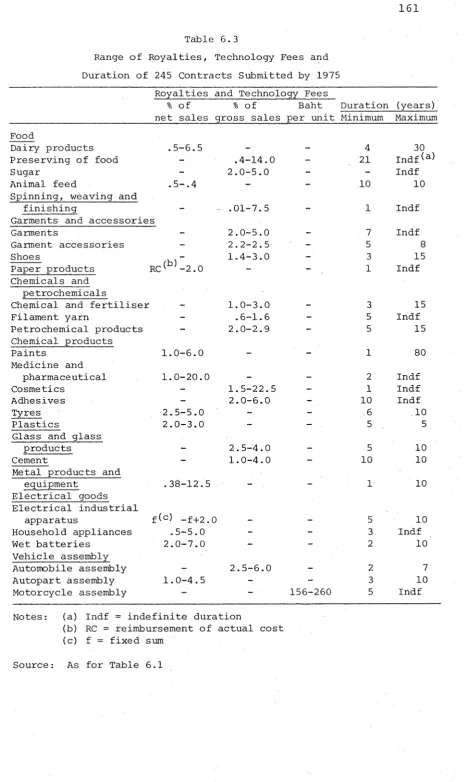
Range of Royalties, Technology Fees and Duration of 245 Contracts Submitted by 1975
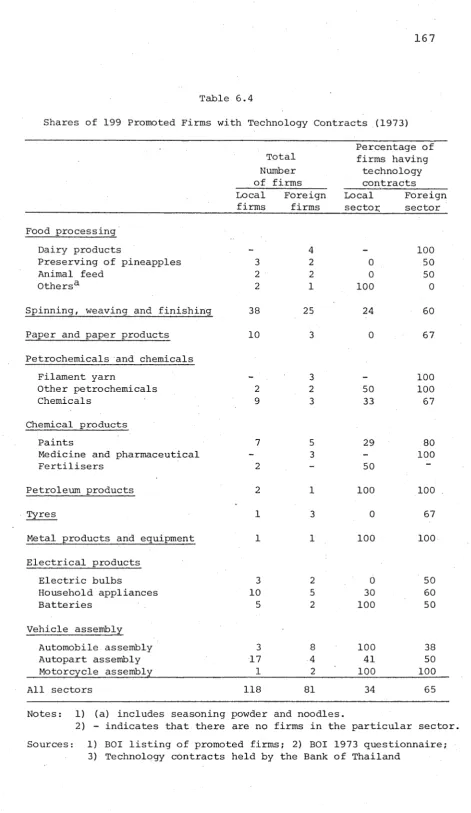
Shares of 199 Promoted Firms with Technology Contracts (1973)
Range of Royalties, Technology Fees and Duration of Contracts of Local and Foreign Firms Submitted by 1975 (128 firms)
The Average Ratios of Technology Fees to Net Profits in 62 Thai
Manufacturing Industries (1973) Clauses (in 184 Technology Contracts
submitted by 1975) Affecting
Marketing, Purchasing and Pricing Policies of Recipients
Clauses (in 184 Technology Agreements submitted by 1975) Affecting the Transmission of Technology
Shares of Textile Industry Employment (1973)
Foreign Ownership in the Promoted
Spinning and Weaving Industry (1974) Promoted Textile Firms Classified by
Nationality of Ownership (1974) Thai Textile Firms Classified by Type
of Operation and Control (1974) Capacity and Capacity Utilisation of
Cotton Textile Production (selected years)
Production, Consumption and Foreign Trade in the Thai Textile Industry
(selected years)
Japanese Investments in the Promoted Thai Textile Industry
Table 8.2 Major Suppliers of Textile Machinery for the Thai Textile Industry
Table 8.3 Japanese-Related Firms Classified by
Number of Japanese Corporate Investors
Table 8.4 Replacement of Foreign Staff in Foreign
Related Firms
Chart 8.1 Factory Organisation
Table 8.5 Training in the Thai Textile Industry
Table 8.6 Performance of Foreign and Local
Textile Firms (1973)
Table 9.1 Ranking of Textile Manufacturing
Activities on the Basis of Employment Potential
Fig. 9 .1 Cotton Yarn Manufacturing Sequence -
Actual and Potential
Table 9.2 Operating Speeds of Spinning Machines
Table 9.3 Output, Total Investment and Labour
Requirement under Different Technologies
Table 9.4 Open-end vs. Ring Spinning: Direct
Labour Requirement for Three Shifts
Table 9.5 Unit Costs of a Textile Product Under
Three Levels of Technology
Table 9.6 Skill Composition for Different Levels
of Technology
Table 10.1 Size Distribution of All Spinning Mills
in the Thai Textile Industry (1974)
Table 10.2 Size Distribution of Promoted Weaving
Firms in the Thai Textile Industry (1974)
Table 10.3 Technology Classification for the Thai
Textile Industry
Table 10.4 Classification of Firms According to
Types of Technology and Control
Table 10.5 Reasons for Choosing the Existing
Technology
Table 10.6 The Effects of the Government Tax
Concessionary Policy
Table 10.7 Hypothetical Unit Cost of Primary
Factors in the Thai Textile Industry
Table 10.8 Relative Factor Prices and the Optimum
Choice
Table 10.9 Comparative Performance of Spinning
Firms in Thailand
Table 10.10 Index of Labour Requirements for
Production of Yarn
Table 10.11 The Use of Technical and Production
Skills in the Thai Textile Industry
After a period when, under the influence of Keynesian economics and especially the Domar-Harrod model, development economists stressed the role of capital formation in the development process, the past two decades have witnessed an increasing shift of emphasis towards the role of human
capital and technology. The transfer of technology from advanced to developing economies has been considered as an important element in the process of development. It was not long before attention was drawn to direct foreign investment as an important mechanism for the transfer of technology. Apart from access to the parent companies' patented
inventions and production techniques, subsidiaries in LDCs can rely upon the parent companies' pool of industrial and marketing experience as well as organisation skills. It is not surprising that direct foreign investment has been
viewed as a speedy means of transferring technology. For instance, in 1967, Svennilson wrote:
... The most successful examples of the rapid
transfer of technology are found in the activities of subsidiaries, which are established by the
western firms in the underdeveloped countries. In such cases, often it has been possible, even in backward countries and within a few years, not only to establish a modern industry but to make it
operate effectively, (p.179)
Until recently, this could be regarded as the conventional view in the literature on the transfer of
economic development has shifted from "growth" to "equality" and to other social objectives, the capacity of industrial development to generate employment has come to be treated as an important criterion. This raises the question whether technology designed for the labour-scarce advanced countries is suited to labour-abundant LDCs. From this point of view, direct foreign investment has come into question as liable to transfer inappropriate technology to LDCs. There has, moreover, been increasing concern about the "packaged" nature of direct foreign investment. Direct foreign investment comes in a package of capital, management and production technology. This characteristic has allegedly facilitated transfer pricing and consequently "excessive" cost of technology. The self-contained characteristic of direct foreign investment is also claimed to "stunt local abilities" (Hirschman, 1969, pp.5-6) and perpetuate
"technological dependence". These concerns about the "packaged" nature of direct foreign investment have led many developing countries to call for "a code of conduct on
the transfer of technology" and "a code of conduct for multinational corporations", both of which have been under way within the United Nations framework. At the same time, the developing countries have been looking into the
possibility of "unpackaging" - that is to obtain capital, technology and management from different sources. The question of how efficiently a technology is utilised has been superseded by the question of who utilises the imported technology.
This thesis studies the process of technology transfer in the modern large scale manufacturing industries in
Thailand by contrasting direct foreign investment with other channels for transferring technology. Since 1960,
successive governments in Thailand have actively pursued industrialisation by protecting the domestic market to
massive inflows of direct foreign investment, notably from Japan in the manufacturing industries. Between 1960 and 1974, registered foreign capital in the "promoted"
(government-assisted) sector amounted to 3596 million baht and accounted for 29 per cent of total registered new
capital investment of all firms which were granted a
"promoted" status. Japanese direct investment constituted 42 per cent of total foreign investment.
Extensive foreign involvement often encounters
nationalistic resistance. In the early 1970s, the extent of Japanese involvement in the Thai economy came under
increasing criticisms from various sections of public
opinion. As is often the case in less developing countries, nationalistic sentiment was most strongly expressed by
student groups. The concern that was coming to be felt was illustrated in the Social Science Review, a magazine,
radical by Thai standards. The magazine put out a special issue called "The Yellow Peril" which set off the anti- Japanese movement. In its best known feature article, the authors, student activists, summarised the position of Japanese influence on the Thai economy as follows:
... If all the Japanese cars in Thailand were taken away, then all the roads in the country would be empty. If all the Japanese radios, televisions and electronic and electric appliances suddenly
disappeared from the Thai households, then all the households would be as silent as graves. If
clothing with Japanese trademarks were taken away from the Thai people, then all the Thais would be naked. How completely are the Thais under Japanese influence! (Phatsa<j5ng and Chingchit, 1972 , p.13) Anti-Japanese sentiment culminated in a ban on
purchases of goods from a Japanese-owned department store. Demonstrations and books on the "economic monster" soon crowded the local market. One of the major criticisms of Japanese investment was the alleged failure on the part of the Japanese firms to foster skills in the local work force and to allow local staff to take part in managerial
investment in extractive industries were also organised by the student movement. Despite such extensive public
resentment and journalistic attacks, there have been few in-depth studies in this area.
The main arguments and objectives of this study can be summarised as follows. In the first place, I shall argue that the strategy of restricting trade and promoting modern large scale industries on the basis of imported technology which has been adopted to achieve growth in many developing countries is likely to lead to an inevitable influx of
direct foreign investment particularly in these industries. This tendency will be reinforced by the dearth of human capital in the host countries. Consequently direct foreign investment becomes one of the most important means of
importing technology. Indeed, the experience of Thailand is a case in point.
However, this strategy of promoting large scale
manufacturing production based on imported technology may be inconsistent with the employment objective. Without any changes in the strategy, the discussion of "appropriate technology" is misplaced because, by its very nature, modern large scale manufacturing allows little room for
modification into "appropriate" forms. The most useful role of modern large scale manufacturing industry is in
generating skills rather than employment. Therefore, the contribution of direct foreign investment should be judged by its ability to generate or foster human capital in the host countries. This study is therefore concerned with the gain from, or the shortfalls of, foreign investment in the
formation of domestic entrepreneurship through joint
venture arrangement with foreign partners, and the training and participation of local staff in a foreign-controlled enterprise.
employment objective regardless of the channels used for transferring technology. In other words, foreign and local firms will not behave very differently in their choice of techniques.
In the second place, the thesis examines purchase of technology through technology and know-how agreements. It investigates three aspects of total technology cost, viz. explicit (monetary) cost, the implicit or invisible costs (such as restrictions on export franchise, tied purchases etc.), and the durations of contracts. The study will postulate that, if strictly enforced, the implicit costs,
through their potentially adverse effects on the economy, may be greater than the explicit costs. Some of these conditions could prevent the realisation of comparative advantage. Others are designed to restrict spill-over effects.
More specifically, this study will examine whether there are any differences in the price of technology to foreign and local firms. It is often assumed that a foreign subsidiary has free or cheap access to the
technology of the parent company, while an arm's length deal between buyers and sellers may result in high costs owing to imperfect knowledge on the part of buyers. By
contrast, it has also been alleged that since the allocation of cost among subsidiaries of a single foreign company is quite arbitrary, the cost of technology may in some cases be high. Moreover, if there is no time limit to payments, which is often the case for a subsidiary, the cost of
technology can be very high. The thesis attempts to show that the pricing of technology depends also on a number of other factors, such as the market structure of products, the source of technology and so on.
Much of the information for this thesis was obtained by questionnaire survey and interviews with entrepreneurs,
manufacturing industries in Thailand, especially the textile industry and their counterparts in the Japanese textile
industry. Another substantial part was obtained from the Board of Investment of Thailand which gave me access to its 1973 questionnaires and from the Bank of Thailand which released all information regarding technology contracts.
The study is organised as follows. The first part of the thesis provides an overall view of technology acquisition in some manufacturing industries in Thailand. The second part concentrates on the process of technology transfer in the textile industry.
The textile industry is one of the largest manufacturing industries in Thailand, with a great deal of foreign
involvement. For these reasons, the industry seemed a logical choice for the detailed analysis of interaction between foreign and local entrepreneurs and of differences in choice of techniques between the foreign and local firms.
The study does not present an econometric model of technology transfer, nor is there a transfer index to
summarise in a single figure the extent to which technology has been transferred, so that one could say, for example, that 80 per cent of the transmission of technology in the industry was attributable to foreign firms. The immediate problem with such a suggestion is that the transfer process involves interaction and repercussion effects both within and across industries. Even if one believed that the
construction of such an index is worthwhile, one could not be sure how extensively the index captures the spill-over effects (externalities) and in face of the severe
limitations of the available statistics, no attempt was made to quantify the overall intensity or effectiveness of transfer although some partial econometric estimations will be presented. The main emphasis will be on qualitative study of the behaviour of firms in the transfer of
The chapter outline is as follows. Chapter 2
introduces the concepts and definitions to be used. It outlines the general approach of the study, reviews the literature and presents some empirical findings of others who have worked in this area.
Chapter 3 outlines the industrialisation experience and policies of Thailand since 1960. In particular, it describes
government policies which affect the process of technology transfer. Chapter 4 discusses research methodology and field experience in Thailand and Japan. The definition of "foreign" firms used in this study is also explained.
Chapters 5 and 6, the first two chapters on empirical findings, provide an overall picture of the search for and purchases of technology in some manufacturing industries in Thailand. Chapter 5 examines the attempts of local
entrepreneurs to acquire new technology and to improve their productivity, interaction between foreign and local sectors, between suppliers and customers and the relative efficiency of foreign and local firms in utilising imported technology. Chapter 6 looks into the terms and conditions of technology contracts and the monetary cost.
The remainder of the thesis discusses the process of technology transfer in the Thai textile industry. Chapter 7 traces changes in the pattern of transfer of technology in the industry. Chapter 8 explains the parties involved in the formation of joint ventures and evaluates the extent to which local entrepreneurs, executives and local staff gain
from participation in joint ventures.
Chapters 9 and 10 concentrate on the production aspects of technology transfer. Chapter 9 outlines recent
technological progress in the textile industry and its
implications for skill and employment creation in the LDCs. Chapter 10 investigates choice of techniques by local and
In 1962, Denison's controversial findings on the sources of economic growth brought "advance in knowledge" into the foreground of economic debates. Since then,
technical progress has become a key element in the analysis of growth of modern economies. Although the causal
relationship between growth and technical progress is still in doubt (Nelson, 1974), many development economists as well as policy makers in developing countries themselves have started to consider the transfer of technology from developed countries as an important element for growth and prosperity.
The first part of this chapter presents the definitions and concepts to be used in the following discussion. In particular, it discusses the concept of technology transfer relevant for the LDCs. The second part explores the various ways in which technology can be imported, implanted in a
local work force and diffused to other productive units in an economy. It also contrasts the role and the efficiency of direct foreign investment with other channels for
transferring technology. The last part of the chapter examines the major issues in the study of technology
transfer. It suggests that the major role of large scale manufacturing industries should be in skill generation rather than employment generation. It summarises the main arguments of this study and presents relevant empirical findings by other investigators in connection with these issues.
2.1 Definitions and Concepts
has carried a much wider connotation and has been referred to as the application of science to the solving of well- defined problems, or as knowledge about physical
relationships systematically applied to useful purposes (Quinn, 1969; Hawthorne, 1971). In his study of
technological change and economic development, Strassmann (1968) defined technology as referring
... not only to tools, a stockpile of utensils, but a kind of tool using behaviour, a set of methods for making specific goods (p.2).
For the purpose of this study which emphasises
technology as an element in the industrialisation process, technology is defined in its broadest sense to mean
knowledge or methods that are necessary to carry on or to improve the existing production and distribution of goods and services. It includes entrepreneurial expertise and professional know-how. A word on each of these aspects is in order. First, entrepreneurial expertise consists of knowledge which helps an entrepreneur to make the right decision at the right moment on what, where and how to invest, expand or contract. In contrast to entrepreneurs in earlier times whose successes and failures rested largely on entrepreneurial instinct and imagination, a successful entrepreneur who wishes to be involved in large scale
production today needs a good knowledge of the size of risks involved in his project, the cost of finance, the possible expected returns, the source and range of available
techniques, market prospects, and so on. In modern
In the context of the transfer of technology, a good entrepreneur constantly searches for new and better sources of "innovations". This ability could be developed through education or through working with or observing more
experienced entrepreneurs.
The entrepreneurial ability in perceiving new
"innovations" was highlighted by Schumpeter (1911, 1939, 1949). However, for Schumpeter, entrepreneurship was
exogenous to the economic system and was determined by social conditions. Unlike the theory of capital and growth which suggests saving as the important endogenous factor in
economic growth, Schumpeter did not offer a solution for overcoming entrepreneurial bottlenecks in the LDCs.
It is argued here that entrepreneurial activities are not only socially conditioned but can also be stimulated and perhaps maximised by economic incentives. The promotion of industrialisation is one way of stimulating entrepreneurship. Industrialisation creates an awareness of additional
opportunities for traditional agricultural and handicraft activities to achieve improvement in material well-being, by exploiting surplus earnings. So long as such promotion is not carried to extremes which result in inefficiency in local production, industrialisation will encourage the accumulation of entrepreneurial expertise.
Secondly, professional know-how consists of managerial knowledge which involves corporate planning and control, an understanding of accounting procedures which enable the right assessment of the financial positions of firms to be made, engineering knowledge and production know-how which is necessary for the production process, and familiarity with sales and marketing technology which involves skills
for searching out and attracting more customers.
enterprise, the more complicated the organisation. Managers
will have to assign the right amount of responsibility to
the right persons. They must devise a check and evaluation
system and design an internal hierarchy of decision making.
Middle management staff have to carry out the supervision
and follow-up tasks. Modern managerial science is a totally
new technology for the less developed countries.
Engineering and production know-how includes a wide
range of elements such as plant layout, input and output
specifications, plant operation, repairs and maintenance,
quality control, research and development, and so on.
It is evident that technology is embodied in many forms:
in human capital, physical capital and in recorded
information. The most important form in LDCs seems to be
that technology which is embodied in human capital. It is
this which makes the transfer of technology difficult. To
the extent that technology can be totally embodied in
physical capital, the process of transferring technology is
a relatively easy task because it is reduced to the mere
relocation of production facilities.
There is another kind of technology which has not been
discussed so far. It is what Helleiner (1975) has called
consumption technology. This term refers to the use of new
products with a high income elasticity such as household
electric appliances (colour television) and other luxuries
(French perfume). These products are usually associated with
prestigious brand names. Although it is debatable whether
consumers in developing countries should actually be deprived
of consumption technology and should be obliged to be content
with basic products, it is clear that governments in many
developing countries are reluctant to allow exorbitant
payments for the purchases of such technology or to subsidise
the production of such products. However, consumption
many cases, when products have reached a mature stage,
producers need to rely on artificial barrier to entry in the
form of trade marks to maintain their markets.
2.1.2 Concepts of the transfer of technology. Topical
as it is, the concept of "transfer of technology" is rarely
clearly defined. Under the general heading of technology
transfer, different writers seem to employ different
concepts leading to different and sometimes conflicting
conclusions. I shall list the four concepts which are most
often found in the literature.
The first considers technology to be transferred when
it is used effectively in the new environment. No attention is
paid to the origin of inputs of production. As long as new
technology is employed efficiently, for example even the
whole factory is run by foreigners, technology has been
transferred.
Under the second concept, technology is transferred
when the local work force is able to take charge of the
imported technology and to do so efficiently. For example,
technology transfer occurs when local workers have acquired
the skill to operate machines correctly, to keep to a
meticulous maintenance schedule, to fix and repair machines;
and local managers are able to prepare input-output
schedules, marketing plans and so on.
According to the third concept, technology transfer
occurs when technology spreads to other local productive
units in the recipient economy. This can take place in a
number of ways, for example, through active dissemination
efforts of the initial recipient enterprises, sub-licensing
agreements, demonstration effects, and so on.
When imported technology is fully understood by local
workers, and when these workers begin to adapt the imported
technology to the specific needs of the local environment,
transferred according to the fourth concept. In the most
successful cases, local workers may discover and develop
new techniques on the basis of imported technology.
Capable local technicians may be able to copy machinery by
dismantling imported equipment - an act commonly known as
"reverse engineering".
These four concepts are not mutually exclusive. Nor
do they necessarily occur in any sequential order. For
instance, technology need not be efficiently utilised before
it is leaked to outsiders. Imported technology may be
adapted to suit local conditions before it is transmitted
to other enterprises.
Since this study is concerned with the role of human
capital in the development process, the relevant concept
must involve local participation. I shall define technology
transfer as the fostering of technology which did not
previously exist in the local environment in such a way that
the local work force can independently exploit and improve
the imported technology. Since local participation is a
necessary condition, the first concept is not relevant for
this study. It may be more appropriate for developed
countries where their own high level manpower can assimilate
new technology relatively easily. The concept used in this
study will include the second, third and fourth as long as
there is local participation.
To avoid confusion, I shall call the first concept,
the geographical transfer of technology; the second concept,
the transfer of technology into the local work force; the
third, technology transmission or diffusion; and the fourth,
technology adaptation and development. It is important to
use precise terms because a channel used for transfer of
technology may, for example, be extremely efficient under
the geographical transfer concept but may be less efficient
is often alleged to be a case in point. Moreover, a
technology which is easily operated by local workers, for example a push-button type operation, may be less amenable to adaptations to suit local conditions.
2.2 Channels for Technology Transfer
Technology can be diffused internationally through various mechanisms. Broadly speaking, there are two major categories of channels for the transfer. The first category can be termed "packaged transfer" or direct foreign
investment whereby technology is tied to other inputs of production, such as capital and management. In contrast, in the second category "unpackaged" channels include a wide range of activities which can be acquired independently of control and ownership of the sources of suppliers.
2.2.1 Unpackaged channels for transferring technology. For conventional technology and products, technology is fairly readily transferred through published information such as books, journals, trade exhibitions and international conferences. In many instances purchases of hardware are accompanied by technical services. Input suppliers and customers of finished products sometimes grant technical
and laboratory testing services or offer marketing assistance. Government research institutes are potential transferors,
adapters and innovators of new technology. The most common means, however, remains training and education conducted either locally or overseas.
Technology can also be obtained by concluding various kinds of technology contracts with experienced or consultant
firms in the developed countries. Such assistance ranges from feasibility studies to the actual management of
in specific firms, free-lance specialists can be hired.
When certain key elements are patented, licensing agreements can be concluded to obtain trade secrets or established
market goodwill. These channels may be used by themselves or together with one another.
2.2.2 Direct foreign investment. The special feature of direct foreign investment is that it offers technology in one package along with money capital and control. Direct foreign investment can take several forms viz. wholly owned foreign subsidiaries, foreign controlled and local
controlled joint ventures and wholly locally-owned firms.
I n this study, the former two will be treated as foreign firms
and the latter two as local firms.
Direct foreign investment can transfer technology in two ways. An "internal transfer" occurs when there is a flow of knowledge from foreign investors and experts to the local work force within foreign subsidiaries or foreign controlled joint ventures. This is what has been termed technology transfer into the local work force. An "external transfer" takes place when technology spreads from foreign firms to local firms either in the same or in other sectors.
Internal transfer could occur at all levels within a firm - through observation, through on-the-job training or through formal training. For instance, machine tenders
learn operative and other industrial skills on the job. From working with foreign employees, local technicians and
engineers may acquire maintenance and repair know-how; local staff may develop research and development ability;
managerial and organisational skills of foreign experts may be implanted in local counterparts.
Johnson (1970b, p.27) and Chang (1971, p.33) argued that since the costs of exporting skills from advanced countries were high, there was a profit motive for
staff to American parent companies for training of
managerial techniques. Two-year training courses in the parent company's factory were provided to Australian
technicians by an American car manufacturer. Philips N.V. of the Netherlands provided substantial training by
installing a small scale plant for the training of employees and for the solving of special problems in LDCs (Reuber
et at. , 1973, p.202). Multinational corporations in Singapore also provide substantial training to the local work force (Chia Siow Yue, 1977, p.17).
Joint venture arrangements could also enhance entrepreneurial activities. They offered local
entrepreneurs the opportunity to gain industrial experience with reduced capital risks. In LDCs where most businesses are family businesses, co-operation with foreign partners could introduce a new system of organisation and
recruitments. In addition, local executives may be brought into contact with more diversified sources of finances and technology. If the joint ventures export their output, local businessmen's trading horizons will be broadened. Needless to say, such internal transfers will be made possible only if local employees and partners take part in the running of the enterprises.
External transfers occur when trained local staff or skilled local entrepreneurs leave foreign subsidiaries or joint ventures and take with them those fostered skills which cannot be appropriated by transferors. They may go to other local firms in the same industry; local joint
venture partners may be able to start new ventures on their own; or they need not even remain in the same industry but shift to other sectors and so create a spill-over effect in the economy. This is in fact the process of technology transmission.
helps local entrepreneurs to be aware of new domestic production possibilities. The existence of foreign firms may force local entrepreneurs in the same industry to
increase their x-efficiency, either by adopting new
techniques or by searching for competitive innovations. In the long run, all such influences based on the observation of and the pressure from the operation of efficient firms will tend to upgrade the level of technology and technical efficiency in the recipient countries.'*'
Foreign firms may also provide training and know-how to suppliers and customers. Reuber (1973, pp.203- 5) reported that foreign firms often found it necessary to train local dealers and distributors. Innovations or
introduction of new techniques or products by foreign firms may force supplier firms in local industries to adopt more efficient techniques or conduct more effective quality control procedures.
However, it is also equally often asserted that excessive foreign control of the national economy may be detrimental to the development of local entrepreneurship and skill formation. Gonick (1970) wrote:
... Canadian capitalism and capitalists, emergent through much of the 19th century are now deeply submerged in American capitalism (p.65).
For instance if foreign firms are much more efficient and the size of the foreign sector continues to expand in anticipation of market growth, there may be little
opportunity for technology to be transferred in the short run. In fact an overdose of direct foreign investment may kill young and inexperienced local firms instantly. Being more efficient, foreign firms may wipe out all local firms by using aggressive pricing policies or introducing new
low-cost technology not available to local firms. They may also compete with local firms for the most talented local staff by offering higher wages and therefore stretching
scarce resources rather than accumulating more human capital. Foreign firms may be successful in keeping the labour
turnover rate low and thus reduce the leakage in know-how. Cohen (1973, p.192) found that the spill-over effect of training by American firms to Korean firms was minimal. Should they be international corporations, they might post talented staff overseas resulting in a brain drain and local firms will be starved of necessary human capital.
Foreign firms may also introduce luxurious consumption patterns through a demonstration effect and use goods with a high import content and thus retard the development of local input industries. They may also be subject to global strategies of their parent companies which may not at all coincide with the development goals of the host countries.
However, given a situation of workable competition,
direct foreign investment will enhance local entrepreneurship and skill formation. The suppression of domestic
entrepreneurs is not so much related to direct foreign investment per se but is more related to the oligopolistic market structures with which direct foreign investment is often associated. Moreover, industrialisation policies which favour large-scale production tend to give
multinational corporations a competitive edge over local firms. The larger the market and the more intense the competition, the more likely the local firms will be
pressured to observe, emulate and assimilate relatively more efficient technology.
As far as the transfer of technology is concerned,
process of technology transfer (Johnson, 1970; Kojima, 1973). However, strictly speaking, there is no gain to the host country if trained local employees never leave the foreign firms because those firms, acting rationally and with perfect knowledge, will provide just sufficient training for the
expected increase in the marginal productivity of the
trainees to equal to the marginal cost of their training so that the benefits from training will be internalised.
Indeed, direct foreign investment will bring extra benefits to the host country only if foreign firms over train, that is train more workers than they need. This is a very possible outcome of the run-in period or, that
period when the trained work force leave foreign firms for local firms (Helleiner, 1975), or, when foreign firms
provide training in related enterprises which cannot be fully appropriated through the price mechanism. In short, the host country gains when external effects have occured. Caves (1974) argues that:
... The host nation's private sector does not
benefit directly because the foreign subsidiary is efficient, or brings to its shores skilled
entrepreneurship or productive knowledge. Rather its gains depend on spill-overs of productivity that
occur when the multinational corporation cannot capture all quasi-rents due to its productive activities
(p.176).
In this study, the externality condition is not required for technology to have been transferred. Such external effects may often take time. Moreover, it is not known whether or when they will take place even assuming that they are obvious and quantifiable. Fieldwork,
the small size of the market) and the new foreign firms are
successful in keeping the turnover rate low and the import
content high. At the time of the survey, there may be no
sign that the local industry will revive. Following the
logic of the externality condition strictly, it might be
concluded that direct foreign investment is a bad channel
for transferring technology. Yet another study, undertaken
when local entrepreneurs, tempted by the high profits
earned by foreign firms on the basis of new technology, have
successfully entered the industry, will come to different
conclusions.
In fact, this is to admit that industries in LDCs may
not be good case studies of the externality effects of
technology transfer owing to their relatively small size and
their short industrial experience. Yet, some research must
be done, at least to indicate the benefits, even if they are
only internal. The less strict approach adopted in this
study, which does not insist that externalities be present,
is justified on the grounds that local employees are not
perfectly immobile between the foreign and the local
sector, that foreign firms do not have perfect knowledge as
to how far they should train local employees, and finally
that the host government is free and able, if it wishes, to
require foreign firms to divest themselves of their
investments (with appropriate compensations). Under these
circumstances, technology implanted and so far profitably
used only within foreign firms could then be spread
throughout the country - that is, internal economies could
be converted into external economies. If there is some
indication that these foreign firms could survive without
foreign control and management, then it is assumed in this
2.3 Direct Foreign Investment as a Channel for Geographical Transfer of Technology
Direct foreign investment can be expected to be the most important single means of transferring technology to LDCs and will be the most efficient mechanism for the exploitation of imported technology. This is because, on the supply side, it has been argued that technology suppliers are usually not willing to sell technology if full
appropriation of the benefits is possible only by having direct control. This is especially so in technologically intensive industries and is less applicable to the LDCs, unless such technologies are deliberately encouraged by host governments. However, even in relatively simple industries, industrialisation policies in favour of large scale
production for protected local markets often encourage foreign firms to invest behind tariff walls to preserve their markets. The large capital outlays required by these projects often put local entrepreneurs at a disadvantage.
On the demand side, the relative shortage of human capital in LDCs often limits potential transfer through
unpackaged channels. In view of all these supply and demand conditions, direct foreign investment in both its original and modified forms (as wholly owned subsidiaries or as joint ventures) is likely to become the preferred form of
geographical transfer of technology. Insufficient education and relative distance from the place of origin increase the cost of searching for the most efficient channels of
transfer and limit local entrepreneurs' access to relatively inexpensive channels such as published information and
international conferences. This problem is compounded for countries where western languages, in which most
technological information is recorded, are not widely used. As a consequence, the cost of investment in the search for such unpackaged channels is likely to be high for local
Attempts may be made to acquire technology by hiring foreign experts. These experts consequently act as a link to aid in the transfer of technology, and hence the cost of searching for technology to individual entrepreneurs may be reduced somewhat. The success of this channel of
acquisition depends on the type of technology wanted.
Certain types of technology will not be of a type in which individuals can be expert. In a study of the transfer of technology in the petrochemical industry, Stobaugh (1971) reported that in some instances where private consultants were hired, plants closed after few years and this led him to the conclusion that technological know-how resides
within the organisation of people rather than with individual experts.
A better solution, then, may be in the concluding of various kinds of technology contracts, namely, licensing agreements, management contracts, turnkey arrangements, and so on. These channels, however, presume the existence of
functioning enterprises and entrepreneurship and, in the case of licensing agreements, a certain degree of technical knowledge. If the local absorptive capacity is low, local
firms may have to rely on technology contracts for a considerable period of time and perpetual dependence on unpackaged channels is often not very different from direct foreign investment in the eyes of the host country.
Host countries may use education as a means whereby technology can be transferred on a large scale. The main weakness of this educative process is that it often takes a long time to produce engineering, accounting and
managerial graduates who will still, in any case, require intensive on-the-job training before they can embark on
independent industrial projects. Again, on-the-job training requires that functioning enterprises be in existence, and be preferably more efficient ones. Unfortunately, the LDCs do not have a large pool of such enterprises so direct
Furthermore, education systems have often been
criticised because of outdated curricula, curricula unsuited to the needs of the private sector, the lack of equipment for practice, and so on. The misconception of most people that education is merely a means to achieve white collar jobs also does not really aid the industrialisation process.
More importantly, industrial education also requires economies of scale. In the LDCs where industrialisation is a recent phenomenon and the industrial work force is small, formal technical education is costly to arrange. For a
textile engineering course in a university to be worthwhile, it is necessary to have a minimum work force of 50,000
workers in the industry. Education and training abroad can also confer technical skills but since the costs are very high, this can only be provided for a small number of people.
Given this bottleneck in human capital in the LDCs, it is likely that direct foreign investment will become the dominant means of transferring technology, especially for modern large scale enterprises. Though the untying of the
foreign investment package is desirable in certain
circumstances, it may not be successful at an early stage of industrialisation. The failure of the public sector in Sri Lanka provides an example (UNCTAD, 1975c).
The efficiency of direct foreign investment as a
channel for geographical transfer of technology rests on the belief that the various advantages of foreign firms have
over local firms more than compensate for their disadvantages in operating away from their home base. Among these,
The also rementioned shortcomings of other transfer mechanisms should not be taken to suggest that they are unimportant, costly and should therefore be dispensed with. These arguments only point out the relative importance of direct foreign investment as a channel for transferring technology at an early stage of industrialisation. The unpackaged channels can be expected in due course to become increasingly important and may eventually become a more suitable and cheaper means of transfer for certain
activities.
2.4 Major Issues in the Study of Technology Transfer The two major concerns of technology recipient
countries are that imported technology may not be suited to local factor endowments, resulting in the idleness of
abundant resources, and that the cost of imported technology may be excessive. These two issues will be looked at in
some detail.
2.4.1 Technology transfer and factor proportions. In recent years, employment generation for the burgeoning
labour force of the LDCs has occupied an enormous proportion
2
of the literature on economic development. One of the few points on which economists have reached agreement in the course of discussion is that the modern manufacturing sector does not come up to expectations as an employment generator
(M. Mehta, 1970). The experience of advanced countries
where rapidly expanding manufacturing industries were capable of absorbing labour released from agriculture is not, it
seems, being repeated in many developing countries today. The reasons for this situation are manifold. The import of foreign technologies from advanced economies is
alleged to be a major contributor to the problem. Since
technology is the application of science for certain specific purposes, technology created for one environment may not be suitable for use in a different environment. Production techniques developed for labour-scarce, capital-abundant advanced nations are unlikely to be suited to factor
endowments in developing countries. The application of such technologies in the LDCs will result in the concentration of scarce resources in one sector while others may be
stripped of necessary capital and a great deal of abundant resources, especially labour will be left idle.
It has been argued and is now widely accepted that resort to excessive economic stimuli in the form of tax concessions, overvalued exchange rates, subsidisation of capital investment, and so on, to encourage the production of import substitutes in developing countries has promoted the use of capital-intensive technology in capital-scarce developing nations (Little et al. , 1970; Mason and Sakong, 1971; Bruton, 1973). The problem may be compounded by a tendency for the distribution of income in developing nations to lead to a consumption pattern which aggravates
3 an inappropriate choice of techniques.
Moreover, the technological gap between rich and poor nations has been widening. The use of many modern
techniques is likely to have large labour-displacement
effects. At the same time, population in developing nations is growing at an alarming rate owing to better public health and medical service. Low income from agricultural production has caused a rural-urban drift and transformed part of rural underemployment into urban unemployment.
These facts have led to a call for "appropriate technology". This concept was succinctly defined by Morawetz (1974, p.517) as
... a set of techniques which makes optimum use of available resources in a given environment. For each product or process, it is the technology which maximises social welfare if factors and products are shadowed priced.
In relation to labour-abundant LDCs, the concept has become loosely connected with labour-intensive techniques.
The problem arises when there is a conflict between maximum output and employment (Stewart and Streeten, 1971). Supporters of employment objectives believe that if
potential rather than current production functions are considered, the range of production techniques will be substantially widened. If sufficient research and
development effort is invested in adapting past innovations and developing new ones, the conflict between maximum
output and maximum employment can be alleviated. Moreover, since the social cost of unemployment - including the
affront to human dignity - is so great, the optimum strategy is to select a labour-intensive product mix and relative labour-intensive techniques.
On the other hand, other economists argue that the elasticity of substitution between capital and labour in manufacturing industries is narrower than commonly assumed
(Arrow et al. , 1961; O'Herlihy, 1972) especially when skill constraints in LDCs are taken into account. Labour-
woven textiles belong in the same product group but, strictly speaking, have different specifications and are produced for different markets. Even in the product lines where there may be a fairly wide spectrum of techniques to be chosen, modern techniques may be important to reach certain specifications in international markets.
The empirical evidence for both sides of the arguments is inconclusive. Without entering this debate, some
questions relating to the earlier discussion may be raised. In the first place, it has been pointed out that urban unemployment and rural underemployment are the result of numerous factors apart from wrong choice of techniques. Since, characteristically, manufacturing industries in the LDCs account for a small proportion of economic activity in their economies, is it not over-optimistic to expect the modern large-scale manufacturing industries to make a decisive contribution to the solution of unemployment
problems? Is it, in fact, necessary for every technique in Morawetz1s set of techniques to be optimally labour-
intensive as long as the overall balance, taking into account all sectors including agriculture, trade and services, is optimal?
Moreover, should the concept of "appropriate technology" be applied indiscriminately? Should the problems of
unemployment not be considered within a macro rather than a micro framework? Within such a framework, different sectors may be allowed to play different roles using
different techniques with different factor proportions while making sure that the overall balance will not leave any
abundant resources idle.
roughly correct, such a strategy is unlikely to provide
appropriate technologies for recipient countries for several reasons. First, the bulk of R & D activities are
centralised in the activities of multinational corporations whose competitive edge depends on their technological lead. New technology, from the private point of view, is worth searching for or marketing only if it will be difficult to duplicate. But it is a characteristic feature of labour- intensive techniques such as those’ in agricultural
production or simple manufacturing tools that once
innovation has been developed it is relatively easy to copy. Therefore, it is unlikely to be in the interest of private enterprises, either foreign or local (and especially of multinational corporations), to invest in such R & D. If there is a choice between creating labour-intensive or
capital or skill-intensive techniques, the chances are that the development of labour-intensive techniques will be
retarded (Magee, 1976b). Secondly, the demand for labour- intensive technology of the LDCs is not sufficiently strong to induce economic production of such technology (Pack and Todaro, 1969) . Lastly, the cost of searching for
"appropriate technology" from an "international technology shelf" could prove to be a considerable strain on the meagre capital resources of entrepreneurs in LDCs.
Given the fact of life that many LDCs have adopted an industrialisation strategy based on modern large-scale manufacturing and imported technology and that there are other factors which hamper the introduction of more
appropriate technology, the focus of the discussions about the transfer of appropriate technology seems to have been rather misplaced. In other words, is it not inappropriate to judge large-scale manufacturing industries by the
employment criterion when all of the market and institutional incentives point in a different direction? The relevant