Int. J. Electrochem. Sci., 8 (2013) 1713 - 1721
International Journal of
ELECTROCHEMICAL
SCIENCE
www.electrochemsci.orgTechnical Report
Deburring Miniature Components by Electrochemical Method
Shuo-Jen Lee1, Chung Ping Liu2, Tien Jung Fan3, Yi-Ho Chen4*
1
Department of Mechanical Engineering, Yuan Ze University,
2
Department of Photonics Engineering, Yuan Ze University,
3
Department of Electrical Engineering, Yuan Ze University,
4
DEF Technology and Solution Co. Ltd.
*
E-mail: [email protected]
Received: 17 December 2012 / Accepted: 8 January 2013 / Published: 1 February 2013
Although deburring technology is used in precision manufacturing and high-quality machining, deburring is still considered a difficult problem. Precision parts require care to achieve precise dimensions and surface quality and in subsequent finishing operations. Deburring and edge finishing typically receive little attention from designers and manufacturing engineers. Due to deburring difficulties, it can account for more than 30% of the total production cost when components are small. Efficient and effective deburring of miniature and/or precision components is very difficult. Therefore, this work applies a highly efficient and fully automatic novel electrochemical system that uses a rotating barrel. The effects of the main factors, such as barrel rotational speed, electrical current density, electrolyte temperature and process time, are investigated. Finally, optimal conditions are identified by applying the design of experiment to the required edge quality. The burrs on brass gears are dissolved and removed properly and the radius of the fillet of the gears after deburring has a small standard deviation of 5.9 μm within only 5 minutes when using the proposed system of a rotational barrel with electrochemical deburring. This electrochemical system is an effective and efficient system to remove burrs from miniature metal parts.
Keywords: Electrochemical method; deburring; rotational barrel; miniature components
1. INTRODUCTION
high cost [2]. In thermal deburring, the process difficulties can be eliminated because the workpieces are subjected to a temperature in excess of 1000℃ for few seconds, causing the burrs to ignite and burn off. The thermal process requires high capital investment and has some technical problems [3, 4]. Typical abrasive methods are an abrasive jet flow, a water jet, barrel tumbling, spindle finishing, or sandblasting [5, 6, 7]. Due to the high initial cost and lack of adequate technical data, the use of abrasive jet deburring is also limited. Electrochemical deburring is based on the principle of the anodic dissolution process. Electrochemical machining (ECM) and electropolishing (EP) are the other two applications of anodic dissolution. The machining rate of the anodic dissolution reaction is governed by Faraday’s Law of Electrolysis. Electrochemical deburring (EDB) does not apply any mechanical stress or have thermal effects on a workpiece. In ECM and/or EDB, the machining rate is independent of the mechanical properties such as hardness and toughness of the machined materials [8]. The physical and chemical properties of a machined surface are not changed by ECM and/or EDB [9]. These features of EDB are both unique and attractive because no residual stress or heat affected zone exists on a processed surface. During an electrochemical reaction, current density at the peak of surface irregularities is higher than that elsewhere. Burrs are therefore removed preferentially and a workpiece becomes smooth [10]. Therefore, burrs are able to be removed by an electrochemical polishing process [11]. Figure 1(a) shows the novel electrochemical deburring system used in this study [12]. Figure 1(b) shows the brass gears with diameters of 7 mm to 10 mm, which are the workpiecs in experiments. As the gears are small, removing burrs using abrasive methods is difficult and hanging the gears on fixtures for electrolysis when the traditional electrochemical process is applied takes considerable time. A rotatable barrel can provide moderate agitation to improve electrolysis uniformity. Notably, the barrel can hold hundreds of gears in batch operation.
Figure 1. (a) Schematic of the electrochemical system of rotational barrel; (b) the pressed brass gears for experiment.
2. DEFINITION OF BURR SIZE AND EDGE QUALITY
[image:2.596.86.515.470.627.2]
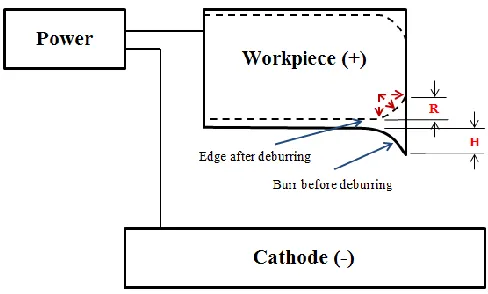
teeth. Therefore, burr height, H, is the index of the edge quality of a gear before deburring, and the fillet radius, R, is the index of gear edge quality after deburring. Figure 2 shows a schematic defining burr size and edge quality. The average H (118 μm, σ = 27 μm) is determined by measuring 20 gears before deburring. After EDB, the average R value is proportional to reaction time. A small R distribution indicates a very consistent deburred edge; therefore, the standard deviation of R (σR) is
also an important index. High R with low σR is this work’s goal. For each experimental, 100 brass
[image:3.596.175.419.216.363.2]gears are put into the reaction barrel and the fillet radius of 10 gears is measured after deburring.
Figure 2. Definition of burr size and edge quality
3. PRE-EXPERIMENT: PARAMETRIC EVALUATION
Before the rotatable barrel is used with electrochemical deburring, pre-tests are conducted to evaluate the effects of basic operational parameters, such as electrolyte composition, applied voltage, temperature, and process time, for each gear size. Once these effects are determined, experimental design strategies are applied to identify the optimal operational parameters for the subsequent experiments.
3.1 Electrolyte
Table 1. Conductivity values of electrolytes of different compositions.
Chemicals P: phosphoric acid
H3PO4 85%
W: water H2O
G: glycerin C3H8O3
Conductivity
(mS/cm) 86 0 0
Electrolyte Composition
P : W P : W P : W P : W : G P : W : G P : W : G P : W : G P : W : G P : W : G
5 : 1 5 : 2 5 : 3 4 : 1 : 1 5 : 1 : 1 5 : 2 : 1 5 : 2 : 2 5 : 3 : 2 5 : 3 : 3
Conductivity
(mS/cm) 128 160 186 86 87 144 85 104 80
3.2 Applied voltage
According to Faraday’s Law of Electrolysis, the mass of substance altered at an electrode during electrolysis is directly proportional to the quantity of electricity transferred at the electrodes. In the proposed electrochemical deburring system, the brass gears move in the rotating barrel during the deburring process such that the total reaction current could not be determined. A convenient way to control an electrochemical reaction is to control the applied electrical voltage. When the voltage is increased, the current also increases. The effects of three voltages, 6 V, 8 V, and 10 V, are investigated using the same electrolyte at the same temperature for 3 minutes. Analytical results show that as the voltage increases, the fillet radius increases; this follows Faraday’s Law of Electrolysis. Table 2 lists fillet radius after deburring with different applied voltage and barrel rotational speed.
3.3. Barrel rotational speed
Table 2. The average R and σR after deburring by different applied voltages and barrel rotational
speed.
Applied
Voltage Average R σR
6 V 24.3 μm 2.1 μm
8 V 26.7 μm 2.4 μm
10 V 29.5 μm 2.3 μm
Rotational
Speed Average R σR
2 rpm 25.6 μm 2.2 μm
10 rpm 12.1 μm 5.8 μm
The barrel can accommodate hundreds of brass gears. To ensure that each gear is uniformly distributed in the electrochemical reaction, the barrel rotates. The rotational speed of the barrel is 2 – 20 rpm. The effects of three rotational speeds, 2 rpm, 10 rpm, and 20rpm, are investigated with the same electrolyte at the same temperature and same applied voltage (Table 2). When the barrel rotates at a high speed, some gears may float in the electrolyte and lose contact with other gears. Consequently, the gears that are floating individually do not have electrical current passing through them and the electrochemical reaction cannot function. When the barrel rotates at 20 rpm, the average R is only 10.6 μm with σR of 6.7μm. This means that the electrochemical reaction is unstable when
barrel rotates rapidly.
4. FRACTIONAL FACTORIAL DESIGN
To optimize parameters of the electrochemical deburring process, fractional factorial design (FFD) is applied to further experiments. Based on previous experiments, the following EDB variables are investigated using FFD: (A) applied voltage (high: 12 V; low: 8 V); (B) barrel rotational speed (high: 4 rpm; low: 2 rpm); (C) electrolyte temperature (high: 50℃; low: 25℃); and (D) process time (high: 10 minutes; low: 5 minutes). Table 3 lists the design matrix and the experimental results of average R, and σR.
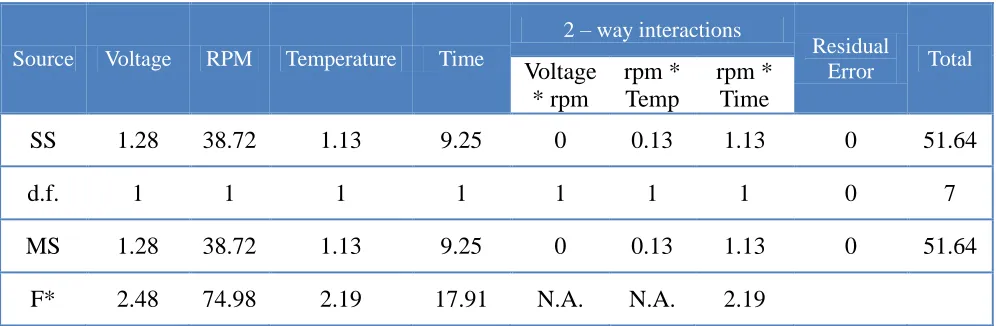
The average R is 21.6 – 65.3 μm, indicating that certain factors and/or interactions in the deburring process have significant effects on the average radius of fillets of deburred gears (Table 3). The standard deviation of the radius of fillets (σR) also varies. Thus, one or more variables may cause
electrochemical reaction instability. Hence, analysis of variance (ANOVA) is applied and statistical analysis results are summarized (Tables 4 and 5). In Tables 4 and 5, SSi indicates the sum of the square
corresponding to factor (or interaction) i. The quantities MSi = SSi/d.f.i and MSE = SSE/ d.f.error are
defined as the mean squares of factor (or interaction) i and the mean square of errors, respectively, and d.f.i and d.f.error indicate the degree of freedom for factor (or interaction) i and error, respectively. The
test statistics, F*, defined as MSi/MSE, is used to test the statistical significance of each factor and
interaction. If the value of F* is greater than that in the F table at a specific probability level (e.g., α = 0.05), the null hypothesis that factor i has no effect on results and is rejected. From the F table, F0.05(1,7) = 5.59 can be found. Therefore, no interaction is considered for further discussion for both R
and σR.
Figure 3(a) shows estimates of factors A – D with significance. Clearly, the sequence of factors decreasing the influence of R is C > A > D > B. Only factors B and D significantly influence σR.
Figure 3(b) shows plots of significant effects on σR. As mentioned, the electrochemical reaction is
Table 3. The design matrix, the experimental results of the average R and σR.
Run 1 2 3 4 5 6 7 8
Factor A + - - + + - - +
B + - + - + + - -
C - - + - + - + +
D - - - + + + + -
Average R (μm) 21.6 25.4 32.6 50.6 65.3 23.4 44.3 57.2
[image:6.596.52.549.332.494.2]σR (μm) 6.2 4.5 8.9 6.7 12.6 11.3 6.9 6.3
Table 4. Analysis of variance for the average R from 24-1 fractional factorial design.
Source Voltage RPM Temperature Time
2 – way interactions
Residual
Error Total
Voltage * rpm
rpm * Temp
rpm * Time
SS 559.13 149.65 768.32 273.78 6.48 93.84 61.61 0 1948.8
d.f. 1 1 1 1 1 1 1 0 7
MS 559.13 149.65 768.32 273.78 6.48 93.84 61.61 0 1948.8
F* 28.68 7.68 39.43 14.05 N.A. 4.81 3.16
Table 5. Analysis of variance for σR from 24-1 fractional factorial design.
Source Voltage RPM Temperature Time
2 – way interactions
Residual
Error Total
Voltage * rpm
rpm * Temp
rpm * Time
SS 1.28 38.72 1.13 9.25 0 0.13 1.13 0 51.64
d.f. 1 1 1 1 1 1 1 0 7
MS 1.28 38.72 1.13 9.25 0 0.13 1.13 0 51.64
[image:6.596.50.548.552.715.2]
Figure 3. (a) Effects to average R; (b) effects to σR . ((A) applied voltage; (B) rotational speed of
barrel; (C) temperature of electrolyte; and (D) process time)
5. OPTIMIZATION OF ELECTROCHEMICAL DEBURRING
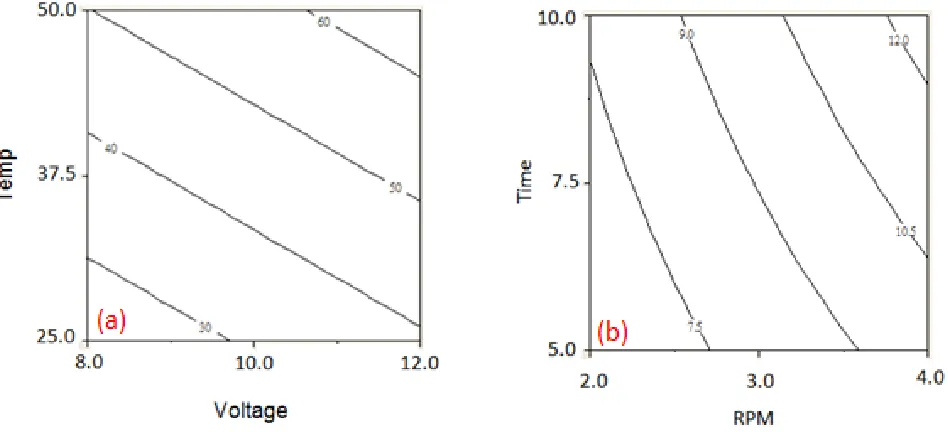
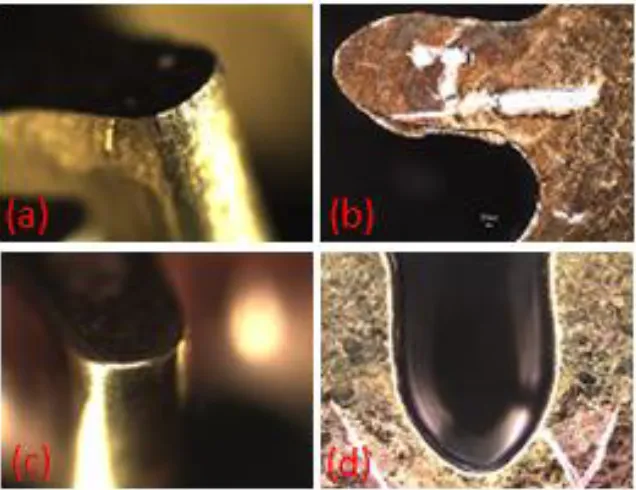
According to contour plots (Figs. 4(a) and 4(b)), the optimal deburring parameters are: applied voltage of 12 V; barrel rotational speed of 2 rpm; electrolyte temperature of 50℃; and process time of 5 minutes. A verification experiment is conducted using these parameters. The radius of the fillet of gears is measured and its standard deviation is calculated. R is 58.6 μm with σR of 5.9 μm. Figures 5(a)
– 5(d) show images of gears before and after deburring. The burrs on the brass gears are efficiently removed by the proposed electrochemical process.
[image:7.596.97.528.73.210.2] [image:7.596.65.539.435.651.2]
Figure 5. (a) and (b) gear tooth before deburring; (c) and (d) gear tooth after deburring. (Magnification : 10x10)
6. CONCLUSIONS
The key factors affecting the average R, which varies at 21.6 – 65.3 μm, are clearly identified by FFD. Applied voltage and electrolyte temperature are the two factors affecting electrochemical deburring. This is consistent with the typical physical and chemical behaviors of electrochemical reactions. The deburring rate is initially high because the sharp edges of burrs gather more electrons than elsewhere. As a burr decreases or dissolves, the edge of gears will have few electrons or current and the deburring rate decreases. This explains why processing time is not a significant factor. As initial burr height increases, the deburring time needed increases. However, 5 minutes of deburring is sufficient to remove all burrs on the brass gears in this work. Low barrel rotation speed can improve the uniformity of the electrochemical reaction for each gear. Conversely, if barrel rotation speed is high, the gears do not have good contact with other gears and the electrochemical reaction for each gear is not uniform or stable. Therefore, σR is high. The burrs on brass gears are dissolved and
removed properly within only 5 minutes when using the proposed system of a rotational barrel with electrochemical deburring. This electrochemical system is an effective and efficient system to remove burrs from miniature metal parts such as gears, screws, and cap nuts.
References
1. D.K. Pramanik, R.K. Dasgupta, S.K. Basu, Wear, 82 (1982) 309.
[image:8.596.140.458.71.316.2]
5. R. Balasubramaniam, J. Krishnan, N. Ramakrishnan, Journal of Materials Processing Technology, 79 (1998) 52.
6. G. Mathai, S. Melkote, International Journal of Machine Tools & Manufacture, 57 (2012) 46. 7. S. Yin, T. Shinmura, International Journal of Machine Tools & Manufacture, 44 (2004) 1297. 8. S. Sarkar, S. Mitra, B. Bhattacharyya, Journal of Materials Processing Technology, 147 (2004)
241.
9. H. Tipton, Preceedings of the Fifth International MTDR Conference, Birmingham, September 1964, Pergamon Press, Oxford (1965) 502.
10. I.-H. Choi, J.-D. Kim, International Journal of Machine Tools & Manufacture, 38 (1997) 29. 11. T. Schaller, L Bohn, J Mayer, K Schubert. Precision Engineering, 23 (1999) 229.
12. S.-J Lee, Y.-H. Chen, Patent No. M401212, Taiwan, R.O.C. April 2011. 13. K. Saptaji, S. Subbiah, J.-S. Dhupia. Precision Engineering, 36 (2012) 444.
14. A. M. Awad, N. A. Abdel Ghany, T. M. Dahy, Applied Surface Science, 256, 13 (2010) 4370.