Int. J. Electrochem. Sci., 11 (2016) 2130 - 2141
International Journal of
ELECTROCHEMICAL
SCIENCE
www.electrochemsci.org
Inhibitory Effect of Leaf Extract of Khaya senegalensis
(Mahogany) on C-steel Corrosion in 1.0 M Hydrochloric Acid
Solution
Ismat H. Ali
Chemistry Department, College of Science, King Khalid University, Saudi Arabia, Abha, P. O. box 9004
E-mail: [email protected]
Received: 13 October 2015 / Accepted: 14 January 2016 / Published: 1 February 2016
Acid extract of leaves of (Mahogany) Khaya senegalensis (LKS) plant was investigated as inhibitor for the corrosion of C-steel in 1.0 M HCl. Several methods were used to investigated the efficiency of LKS i.e. weight loss measurements, scanning electronic microscope, polarization curves and electrochemical impedance spectroscopy. Amount of corrosion in carbon steel and the inhibition effectiveness of the extract were determined. The results obtained show that the extract could be considered as a good inhibitor for the corrosion of C-steel in HCl media. Inhibition was found to increase with increasing concentration of the LKS. Studies were carried out at different concentrations of LKS and at various temperatures. Polarization study shows that LKS extract acts as a mixed-sort inhibitor with a major cathodic effectiveness. The increase in concentration of Mahogany extract shows a positive effect on inhibition efficiency while corrosion of the carbon steel increased with a rise in temperature both in the presence and absence of the LKS extract. Activation parameters were calculated. Surface of C-steel was investigated using scanning electron microscope (SEM).
Keywords: Steel; EIS; Polarization; SEM; Khaya senegalensis
1. INTRODUCTION
better corrosion protection. Therefore, green inhibitors have been extensively investigated for corrosion control in recent years. These green inhibitors are natural organic compounds and can be either manufactured or extracted from medicinal plants and herbs. The latest trends in the corrosion control seem to be shifting towards the use of plant extracts such as Pistachio essential oils, Ginger, Lavender oil, Limonene etc. This is due to their good combination of properties such as stability, price, ease of extraction, treatment, etc. Among the various plant extracts, those which contain atoms with high electronegativity is known as having probably the best protection [14-16].
Extracts of plants are usually contain huge amounts of natural components. Simple and cost effective procedures can be carried out to extract these biodegradable components. The use of these natural compounds extracted from different parts of plants as corrosion inhibitors have been reported by numerous authors [14-16]. Most of these products are nontoxic and biodegradable. Several researchers have inspected the effect of corrosion inhibition of extracts of natural substances such as Emilia Sonchifolia, Vitex Doniana extracts [17], aqueous extract of Hyptis Suaveolens leaves [18], Mansoa alliacea extract [19], Hibiscus Sabdariffa extract [20], Acacia senegal [21], Artemisia [22], These compounds showed high efficiency of inhibition for carbon steel in HCl medium.
The objective of this study was to study the corrosion behaviour of carbon steel in hydrochloric acid solution (1.0 M) in the presence of Mahogany leaf extract by weight loss, potentiodynamic polarization, electrochemical impedance and scanning electronic microscope. Furthermore, some thermodynamic parameters were evaluated.
2. EXPERIMENTAL SECTION 2.1 Materials preparation and solutions
A carbon steel with the following composition (in wt%) was used during all experiments 0.370 % C, 0.230 % Si, 0.680 % Mn, Ti, 0.054 %, 0.016 % S, 0.077 % Cr, 0.015 % Ni, 0.009 % Co, 0.160 % Cu and the rest is iron (Fe). 1.0 M hydrochloric acid was prepared by dilution of an Analytical Grade 37% HCl with deionized water. A molar hydrochloric acid solution was used throughout all experiments in the absence and presence of various concentrations of Mahogany extract (LKS).
2.2 Gravimetric analysis
The carbon steel specimens of 2.0 cm x 1.0 cm x 0.5 cm sizes were pre-treated and weighed accurately using an analytical balance (precision ± 0.1 mg) before each immersion; the specimens were immersed in 100 ml of hydrochloric acid in the absence and presence of various concentrations of LKS. After immersion period (6h), the steel samples were withdrawn, prudently washed with bi-distilled water, ultrasonic cleaning in acetone, dried at room temperature and then weighed. Each experiment was repeated three times and the mean value was calculated.
2.3 Polarization curves
All measurements were carried out by using a potentiostat model (PGstat 302N). This potentiostat is linked to a cell with three electrode thermostats. An auxiliary electrode (Pt electrode) and reference electrode {saturated calomel electrode (SCE)}. The third one is the working electrode which was built from the same material that used for weight loss tests. The surface area exposed to the electrolyte was 0.32 cm2. Potentiodynamic polarization curves were carried out at scan rate of 1.0 mV/s. In each experiment, the potential was stabilized at free potential for 45 minutes. The polarization curves are obtained from −800 mV to −200 mV/SCE at 293K. So as to examine the effects of immersion period and temperature on the efficiency of LKS, some experiments were made in a temperature range 293–313K. The inhibition efficiencies (%) for potentiodynamic polarization measurements were determined as follows:
EI (%) = Iocor – Icor x 100 (1)
Iocor
where Iocor and Icor are the corrosion current densities in absence and presence of LKS.
2.4 Electrochemical impedance spectroscopy (EIS)
Measurements of (EIS) electrochemical impedance spectroscopy were carried out with the same poteniostat used for the polarization measurements. Quasi-potentiostatic polarization curves were achieved using a scan rate of 1 mVs−1 at Ecor after immersion in solution. After the determination of
steady-state current at a corrosion potential, sine wave voltage (10 mV) peak to peak, at frequencies between 100 kHz and 10 mHz were superimposed on the rest potential. Measurements were performed after 45 minutes of exposure under open-circuit potential.
Nyquist representation gave impedance diagrams. All experiments are repeated three times in order to confirm the reproducibility.
Inhibition efficiencies (%) were calculated as follows: EI (%) = Rt – R x 100 (2)
Rt
where Rt and R are the charge transfer resistance values without and with inhibitor,
2.5 Surface analysis
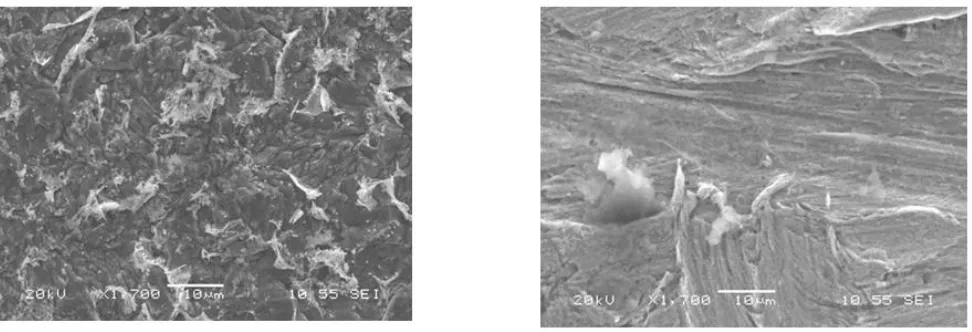
The steel samples used for the surface morphology examination were immersed in 1.0 M HCl in the absence and existence of 2.0 g/L LKS extract at 20 ºC for 24 h. The analysis was accomplished by means of a Jeol 6360 (Japan) scanning electron microscope. Accelerating voltage of 20 kV was used.
3. RESULTS AND DISCUSSION 3.1 Weight loss tests
The spontaneous dissolution of C-steel in 1.0 M HCl in the presence of LKS as corrosion inhibitor was studied by gravimetric measurements.
Table 1. Weight loss and inhibition efficiency of Mahogany extract at 293 K
Conc. (g/L) υ (mg. cm−2.h-1) EIwt (%)
θ
Blank 1.58 - -
0.25 0.62 60.8 0.608
0.50 0.35 77.8 0.778
1.00 0.27 82.9 0.829
2.00 0.14 91.1 0.911
Table 1 presents the corrosion rate of the C-steel samples in HCl acid medium without and with various concentrations of LKS after 6 hrs of immersion at 293 K. The results revealed that the corrosion rate is decreased as the extract concentration increased, i.e. the corrosion resistance was improved with increasing extract concentration. The measurement of weight loss was used to determine inhibition efficiency (IE%) of LKS using the following equation:
IE% = wo - wi x 100 (3)
wo
where wo and wi are the mass losses in the absence and existence of extract respectively. It was
3.2 Tafel polarization curves
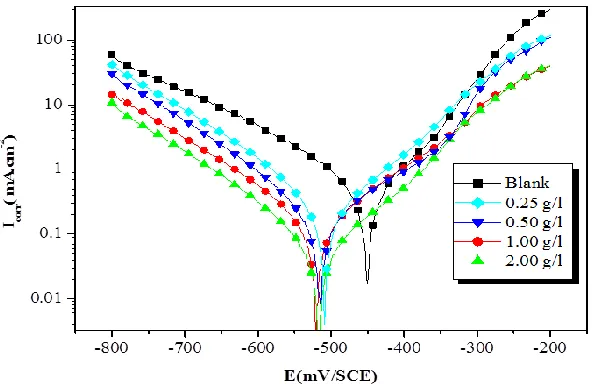
[image:5.596.73.523.201.288.2]The potentiodynamic polarization curves for C-steel in 1.0 M HCl solution at 293 K in the existence of different concentrations of LKS are shown in Fig. 1.
Table 2. Electrochemical parameters obtained at different concentrations of LKS in 1.0M hydrochloric acid at 293 K
Conc. (g/L) Icor(µA/cm2) Ecor (mV/SCE) ba (mV/dec) -bc (mV/dec) EIIcor (%)
Blank 743 -450 133 166 --
0.25 332 -510 108 135 55.3
0.50 157 -516 104 133 78.9
1.00 123 -520 110 147 83.4
2.00 82 -516 109 136 89.0
Table 2 reveals that both cathodic and anodic current densities are reduced with the extract increase. This proves that the addition of LKS diminishes metallic dissolution and consequently hinders the reaction that produces hydrogen gas [24,25].
Figure 1. Polarization curves of C-steel in 1.0 M HCl in the existence of various concentrations of LKS at 293K
Electrochemical corrosion kinetics factors, for example, corrosion potential (Ecor), cathodic
cathodic Tafel slopes (bc), anodic Tafel slopes (ba) and corrosion current density (Icor) as well as
inhibitor efficiency are given in Table 2. The anodic (ba) and cathodic (bc) Tafel slopes did change
[image:5.596.145.442.410.602.2]
blocking the active sites in the surface of carbon steel by components of inhibitor. It has been reported that the inhibitor can be classified as cathodic or anodic if the displacement of Ecor is <85 mV,
otherwise the inhibitor can be considered as mixed type [26,27]. In this study, the maximum displacement in Ecor value was 66mV for LKS extract which indicates that the inhibitor acts as mixed
sort inhibitor with major anodic effectiveness. It is concluded from the data of Table 2 that the addition of LKS extract reduces obviously the corrosion current density. This behavior proves its capability to inhibit the corrosion of carbon steel in HCl solution.
Table 3. Electrochemical Impedance parameters for corrosion of C-steel in acid medium at various contents of LKS
Conc. (g/L) Rt (Ω.cm²) Cdl(µF.cm-2) ERt (%)
Blank 18 98.27 --
0.25 45 48.37 60.00
0.5 90 18.18 80.00
1.0 122.5 3.70 85.30
2.0 143 2.47 87.41
It is obvious that the inhibitory effect is enlarged as the concentration of LKS increases. The anodic (ba) and cathodic Tafel constants (bc) are, almost, not affected by addition of LKS, which shows that the hydrogen production mechanism does not change by LKS addition. The results attained by electrochemical and weight loss measurements are in excellent agreement.
3.3 Electrochemical impedance spectroscopy (EIS) measurements
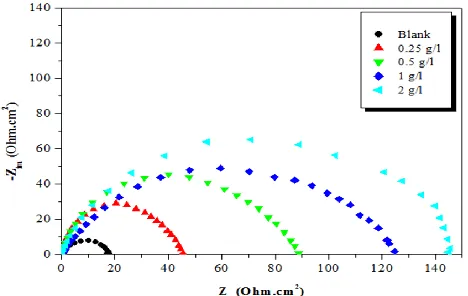
Another investigation of inhibitory effect of LKS extract was performed by using EIS measurements. Nyquist plots obtained for carbon steel in 1.0 M HCl solutions in the absence and existence of various concentrations of LKS at 293K are shown in Fig. 2.
Figure 2. Nyquist plots for C-steel in the absence and existence LKS at Ecor after 45min of immersion
[image:6.596.170.404.569.717.2]
Fig.2 shows that each impedance diagram exhibits only one capacitive loop, which shows that the steel corrosion is mostly controlled by a charge transfer process. These capacitive loops in acid solution are not perfect semicircles. This phenomenon can be ascribed to the frequency dispersion effect as a consequence of the inhomogeneous and roughness of surface of the electrode [28-33]. The impedance parameters obtained from Fig.2 are shown in Table 3. Charge transfer resistance presented by diameter of Nyquist plots increases as LKS concentration increases. This proposed that the inhibitive film formed on the electrode surface was strengthened by addition of the extract.
The increase in inhibitory effect of LKS as its concentration increases can be ascribed to the increase in the number of adsorbed organic particles on the surface of the C-steel.
The results obtained from EIS are almost identical to those obtained by using polarization curves and weight loss procedures.
3.4 Effect of temperature
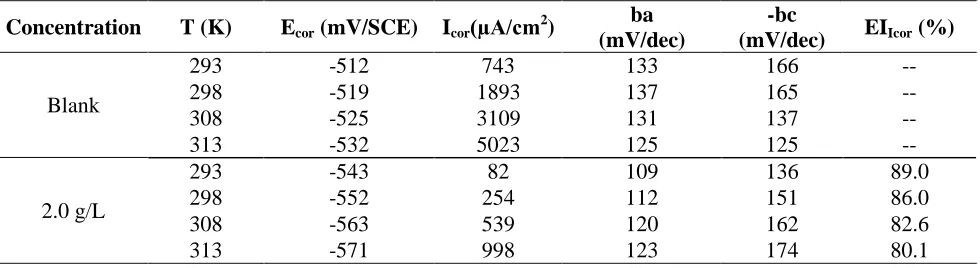
Figure 3. Potentiodynamic polarization curves of C-steel in 1.0 M HCl at different temperatures The effect of temperature in the range 293–313 K is given in Table 4.
Table 4. Various electrochemical parameters for C-steel in 1.0 M HCl in absence and existence of 2.0g/L of LKS at different temperatures
Concentration T (K) Ecor (mV/SCE) Icor(µA/cm 2
) ba (mV/dec)
-bc
(mV/dec) EIIcor (%)
Blank
293 -512 743 133 166 --
298 -519 1893 137 165 --
308 -525 3109 131 137 --
313 -532 5023 125 125 --
2.0 g/L
293 -543 82 109 136 89.0
298 -552 254 112 151 86.0
308 -563 539 120 162 82.6
[image:7.596.58.548.609.743.2]
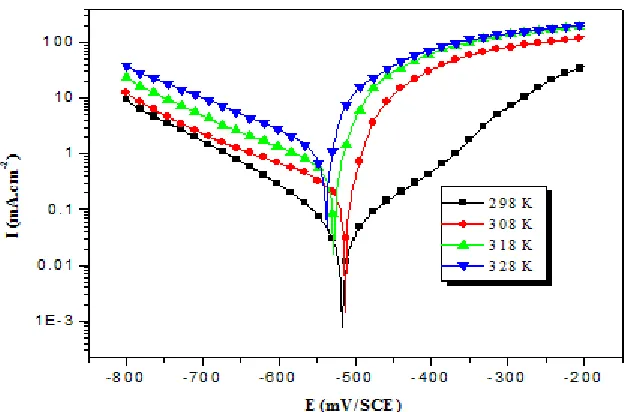
Thermodynamic activation parameters of the corrosion processes were calculated from measurements of polarization which were carried out at different temperatures in the existence and absence of LKS at 2.0 g/L (Figs.3 and 4).
It is obvious from the results that the corrosion rate increases as the temperature of uninhibited solution increases.
Figure 4. Potentiodynamic polarization curves of C-steel in 1.0 M HCl in the presence of 2.0 g/L of LKS inhibitor at different temperatures
The presence LKS leads to a reduction in the corrosion rate. It is also observed that the inhibitory action of inhibitor is slightly increased at elevated temperatures. This can be attributed to desorption of the some molecules from the surface of C-steel at high temperatures.
Table 5. Activation parameters Ea, Ha* and S a* for C-steel in 1.0 M HCl in the absence and existence of 2.0 g/L of LKS
Ea (kJ.mol-1) Ha* (kJ.mol-1) S a* (J.mol-1.K-1) Ea -∆Ha (kJ/mol)
Blank 72.7 70.2 - 329.8 2.5
2.0g/L 95.6 93.1 -389.3 2.5
Thermodynamic parameters for the corrosion process were evaluated from Arrhenius equation (Eq. 5) and Erying equation (Eq. 6) [34,35]
Icor = Ae(-Ea/RT) (5)
where Icor is the corrosion current density, Ea is the apparent activation energy, A is the
frequency factor and R is the gas constant.
[image:8.596.139.454.178.384.2]
where h is Planck’s constant, N is Avogadro’s constant, ΔSa* is the entropy change of activation, and ΔHa*
is the enthalpy change of activation. Figs. 5 and 6 are plots of ln (Icor) versus
103/T and ln (Icor/T) versus 103/T, respectively, in the existence and absence of optimum concentration
of LKS. Values of Ea, ΔHa* and ΔSa * are shown in Table 5. From this table, the values of ΔHa* and
Ea were higher in the presence of LKS than those obtained in the absence of LKS, meaning that the
[image:9.596.179.407.224.376.2]energy barrier of the corrosion process increased in the existence of LKS without altering the mechanism of dissolution [36].
Figure 5. Arrhenius plots of steel in 1.0 M HClwith and without 2.0 g/L of LKS
The large negative value of entropy ΔSa * in the existence of LKS implies that the rate determining step represents an association instead of a dissociation step, indicating that a reduction in disordering takes place on going from reactants to the activated complex [37]. In the existence of inhibitor, it can be noticed that the values of Ea and ΔHa* vary in the same way (Table 5). These
results permit to verify the known thermodynamic relation between the Ea and ΔHa* [38]: Ha* = Ea – RT (7)
Eqs. (6) and (7), were used to determined values of enthalpy of activation. These values were found to be nearly the same, proving the relation mentioned above.
[image:9.596.185.402.599.749.2]
3.5 Adsorption isotherm
The behavior of adsorption LKS on the electrode surface can help in understanding the mechanism of inhibition.
Figure 7. Langmuir isotherm adsorption of LKS on the C-steel electrode in 1.0 M HCl
The extent of surface coverage (θ) at various concentrations of LKS in hydrochloric acid 1.0 M has been assessed using electrochemical impedance spectroscopic measurements, where θ is the ratio ERt (%)/100. Plots (Cinh/θ) versus Cinh give a straight line (Fig. 7) with correlation coefficient nearly equal to 1 and slope of 1.08. The obtained plot clearly shows that the results exhibit good fitting with Langmuir adsorption isotherm which obeys:
1 inh
inh ads
C
C k
(8)
where Cinh is the concentration of LKS and kads is the adsorption equilibrium constant of the
adsorption process.
3.6 Surface analysis
The surfaces of some C-steel samples were investigated by uing scanning electronic microscope (SEM). Surfaces that were immersed in 1.0 HCl for 24 hours in the absence and in the presence of 2.0g/L of LKS extract at 25 °C are shown in Figs. 8A and 8B, respectively.
[image:10.596.184.398.164.327.2]
Figure 8. SEM micrographs (1700x) of C-steel immersed in 1.0 M HCl in the absence (a) and presence of 2.0 g/L of LKS (b)
From the above results; it is concluded that Mahogany extract acts as effective, natural and environmentally friend corrosion inhibitor for carbon steel in 1.0 M HCl solution. The potentiostatic polarization results reveal that Mahogany extracts acted as a mixed sort inhibitor with predominant cathodic efficiency. The inhibition efficiencies of LKS obtained by EIS, polarization and gravimetric methods were in good agreement where the highest inhibition is about 87.41-90.18%. Adsorption of Mahogany extract on the surface of carbon steel was found to follow the Langmuir isotherm model. Moreover, the efficiency of LKS on corrosion combating was confirmed by using scanning microscope.
ACKNOWLEDGEMENTS
I am grateful to Physics Department, College of Science, King Khalid University, Saudi Arabia, Abha for help in conducting SEM analysis.
References
1. F. Bentis, M. Lagrence and M. Traisnel, Corros. Sci., 56 (2002) 733 2. R. P. Bothi, M. G. Sethuraman, Mater. Lett., 62 (2008) 113
3. H. Zarrok, A. Zarrouk and B. Hammouti, Corros. Sci., 64 (2012) 243 4. A. Ganash, Int. J. Electrochem. Sci., 10 (2015) 4439
5. B. Hammouti, A. Dafali and R. Touzani, J. Saudi Chem. Soc., 16 (2012) 413 6. S. E. Nataraja, T. V. Venkatesha and K. Manjunatha, Corros. Sci., 53(2011) 2651
7. O. I. El Mouden, A. Anejjar, M. Messali, R. Salghi, I. H. Ali and A. Hammouti, Chem. Sci. Rev. Lett., 3(2014) 579
8. N. Soltani, M. Behpour and S. M. Ghoreishi, Corros. Sci., 52 (2010) 135
9. P. Lowmunkhong, D. Ungthararak and P. Sutthivaiyakit, Corros. Sci., 52 (2010) 30 10.G. Quartarone, L. Ronchin and A. Vavasori, Corros. Sci., 64 (2012) 82
11.S. P. Niketan, J. Hadlicka, B. Pavel, R. Salghi, H. Bouya, I. H. Ali and B. Hammouti, Port. Electrochim. Acta, 32 (2014) 395
[image:11.596.59.545.71.237.2]
13.L. Herrag, B. Hammouti and S. Elkadiri, Corros. Sci., 52 (2010) 3042
14.T. F. Souza, M. Magalhães, V. V. Torres and E. D’Elia, Int. J. Electrochem. Sci., 10 (2015) 22 15.K. P. Vinodkumar, M. Sangaranarayanapillai and G. Rexinthusnavis, J. Mater. Sci. Technol., 27
(2011) 1143
16.Z. V. P. Murthy, K. Vijayaragavan, Green Chemistry Letters and Reviews, 7 (2014) 209 17.I. M. Iloamaeke, T. U. Onuegbu, U. C. Umeobika and N. L. Umedum, IJISME, 1(2013) 48 18.P. Muthukrishnan, B. Jeyaprabha and P. Prakash, Int. J. Ind. Chem., 5 (2014) 5
19.F. Suedile, F. Robert, C. Roos and M. Lebrini, Electrochimica. Acta, 133 (2014) 631 20.L. B. Molina-Ocampo, M. G. Valladares-Cisneros and J. G. Gonzalez-Rodriguez, Int. J.
Electrochem. Sci., 10 (2015) 388
21.U. Garg, R. K. Tak, E-Journal of Chemistry, 7 (2010) 1220
22.R. Karthik, P. Muthukrishnan, S. Chen, B. Jeyaprabha and P. Prakash, Int. J. Electrochem. Sci., 10 (2015) 3707
23.A. Khadraoui, A. Khelifa, H. Boutoumi, B. Mettai, Y. Karzazi and B. Hammouti, Port. Electrochimica. Acta, 32 (2014) 271
24.A. Y. Musa, A. Bakar Mohamad and H. K. Amir, Corr. Sci., 53 (2011) 3672 25.A. V. Torres, R. S. Amado, Corr. Sci., 53 (2011) 2385
26.Y. Tang, X. Yang, W. Yang, Corr. Sci., 52 (2010) 1801
27.A. Y. Musa, A. A. H. Kadhum, A. B. Mohamad and M. S. akriff, Corros. Sci., 52 (2010) 3331 28.H. Shih, H. Mansfeld, Corr. Sci., 29 (1989) 1235
29.S. Martinez, M. Metikos-Hukovic, J. Appl. Electrochem., 33 (2003) 1137
30.J. R. Macdonald, W. B. Johanson, in: J. R. Macdonald (Ed.), Theory in Impedance Spectroscopy, John Wiley& Sons, New York, 1987.
31.H. Ma, X. Cheng and G. Li, Corros. Sci., 42 (2000) 1669
32.S. Murlidharan, K. L. N. Phani and S. Pitchumani, J. Electrochem. Soc., 142 (1995) 1478 33.F. Bentiss, M. Traisnel and M. Lagrenee, Corros. Sci., 42 (2000) 127
34.A. Ostovari, S. M. Hoseinieh, Corros. Sci., 51 (2009) 1935
35.L. Del Campo, R. B. Perez-Saez, and L. Gonzalez-Fernandez, Corros. Sci., 51 (2009) 707 36.S. T. Arab, K. M. Emran, Inter. J. App. Chem., 3 (2007) 69
37.X. Li, S. Deng, H. Fu, Corros. Sci., 50 (2008) 2635
38.F. Bentiss, M. Bouanis and B. Mernari, Appl. Surf. Sci., 253 (2007) 3696