This is a repository copy of
Point of View: Data science for the scientific life cycle
.
White Rose Research Online URL for this paper:
http://eprints.whiterose.ac.uk/152327/
Version: Published Version
Article:
Ezer, Daphne and Whitaker, Kirstie (2019) Point of View: Data science for the scientific life
cycle. eLife. e43979. ISSN 2050-084X
https://doi.org/10.7554/eLife.43979
[email protected]
https://eprints.whiterose.ac.uk/
Reuse
This article is distributed under the terms of the Creative Commons Attribution (CC BY) licence. This licence
allows you to distribute, remix, tweak, and build upon the work, even commercially, as long as you credit the
authors for the original work. More information and the full terms of the licence here:
https://creativecommons.org/licenses/
Takedown
If you consider content in White Rose Research Online to be in breach of UK law, please notify us by
POINT OF VIEW
Data science for the scientific
life cycle
AbstractData science can be incorporated into every stage of a scientific study. Here we describe how data science can be used to generate hypotheses, to design experiments, to perform experiments, and to analyse data. We also present our vision for how data science techniques will be an integral part of the laboratory of the future.
DAPHNE EZER†‡AND KIRSTIE WHITAKER†
Introduction
A
key tenet of the scientific method is that we learn from previous work. In principle we observe something about the world and generate a hypothesis. We then design an experiment to test that hypothesis, set up the experiment, collect the data and ana-lyse the results. And when we report our results and interpretation of them in a paper, we make it possible for other researchers to build on our work.In practice, there are impediments at every step of the process. In particular, our work depends on published research that often does not contain all the information required to repro-duce what was reported. There are too many possible experimental parameters to test under our time and budget constraints, so we make decisions that affect how we interpret the out-comes of our experiments. As researchers, we should not be complacent about these obstacles: rather, we should always look towards new technologies, such as data science, to help us improve the quality and efficiency of scientific research.
Data science could easily be dismissed as a simple rebranding of "science" – after all, nearly all scientists analyse data in some form. An alter-native definition of a data scientist is someone who develops new computational or statistical analysis techniques that can easily be adapted to a wide range of scenarios, or who can apply these techniques to answer a specific scientific question. While there is no clear dividing line
between data science and statistics, data science generally involves larger datasets. Moreover, data scientists often think in terms of training predictive models that can be applied to other datasets, rather than limiting the analysis to an existing dataset.
Data science emerged as a discipline largely because the internet led to the creation of incredibly large datasets (such as ImageNet, a database of 14 million annotated images;
Krizhevsky et al., 2012). The availability of these datasets enabled researchers to apply a variety of machine learning algorithms which, in turn, led to the development of new techniques for analysing large datasets. One area in which progress has been rapid is the automated anno-tation and interpreanno-tation of images and texts on the internet, and these techniques are now being applied to other data-rich domains, including genetics and genomics (Libbrecht and Noble, 2015) and the study of gravitational waves (Abbott et al., 2016).
It is clear that data science can inform the analysis of an experiment, either to test a spe-cific hypothesis or to make sense of large data-sets that have been collected without a specific hypothesis in mind. What is less obvious, albeit equally important, is how these techniques can improve other aspects of the scientific method, such as the generation of hypotheses and the design of experiments.
Data science is an inherently interdisciplinary approach to science. New experimental techni-ques have revolutionised biology over the years,
†These authors contributed equally to
this work
‡Corresponding author
Copyright Ezer and Whitaker. This article is distributed under the terms of theCreative Commons Attribution License, which permits unrestricted use and redistribution provided that the original author and source are credited.
from DNA sequencing and microarrays in the past to CRISPR and cryo-EM more recently. Data science differs in that it is not a single technique, but rather a framework for solving a whole range of problems. The potential for data science to answer questions in a range of different disci-plines is what excites so many researchers. That said, however, there are social challenges that cannot be fixed with a technical solution, and it is all too easy for expertise to be "lost in transla-tion" when people from different academic backgrounds come together.
In October 2018, we brought together statis-ticians, experimental researchers, and social sci-entists who study the behaviour of academics in the lab (and in the wild) at a workshop at the
Alan Turing Institute in London to discuss how we can harness the power of data science to make each stage of the scientific life cycle more
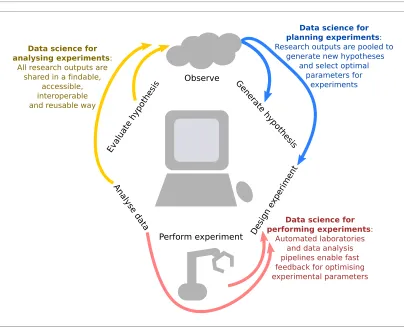
efficient and effective. Here we summarise the key points that emerged from the workshop, and propose a framework for integrating data science techniques into every part of the research process (Figure 1). Statistical methods can optimise the power of an experiment by selecting which observations should be col-lected. Robotics and software pipelines can automate data collection and analysis, and incor-porate machine learning analyses to adaptively update the experimental design based on incoming data. And the traditional output of research, a static PDF manuscript, can be enhanced to include analysis code and well-documented datasets to make the next iteration of the cycle faster and more efficient. We also highlight several of the challenges, both techni-cal and social, that must be overcome to
Observe G
en era
te hy
poth es
is
Des ign
ex peri
men t
Perform experiment
An a
ly se
d ata
Ev alu
ate hy
po thes
is
Data science for analysing experiments:
All research outputs are shared in a findable,
accessible, interoperable and reusable way
Data science for planning experiments: Research outputs are pooled to
generate new hypotheses and select optimal
parameters for experiments
Data science for performing experiments:
[image:3.612.169.573.321.650.2]Automated laboratories and data analysis pipelines enable fast feedback for optimising experimental parameters
translate theory into practice, and share our vision for the laboratory of the future.
Data science for planning
experiments
Hypothesis-driven research usually requires a sci-entist to change an independent variable and measure a dependent variable. However, there are often too many parameters to take account of. In plant science, for instance, these parame-ters might include temperature, exposure to light, access to water and nutrients, humidity and so on, and the plant might respond to a change in each of these in a context-dependent way.
Data scientists interested in designing opti-mal experiments must find ways of transforming a scientific question into an optimisation prob-lem. For instance, let us say that a scientist wants to fit a regression model of how temperature and light exposure influence wheat growth. Ini-tially they might measure the height of the wheat at a number of combinations of tempera-ture and light exposure. Then, the scientist could ask: what other combinations of temperature and light exposure should I grow the wheat at in order to improve my ability to predict wheat growth, considering the cost and time con-straints of the project?
At the workshop Stefanie Biedermann (Uni-versity of Southampton) discussed how to trans-form a wide range of experimental design questions into optimisation problems. She and her colleagues have applied these methods to find optimal ways of selecting parameters for studies of enzyme kinetics (Dette and
Bieder-mann, 2003) and medical applications
(Tompsett et al., 2018). Other researchers have used data science to increase the production of a drug while reducing unwanted by-products (Overstall et al., 2018). The process iteratively builds on small number of initial experiments that are conducted with different choices of experimental parameters (such as reagent con-centrations, temperature or timing): new experi-mental parameters are then suggested until the optimal set are identified.
Optimal experimental design can also help researchers fit parameters of dynamical models, which can help them develop a mechanistic understanding of biological systems. Ozgur Akman (University of Exeter) focuses on dynamic models that can explain how gene expression changes over time and where the model param-eters represent molecular properties, such as
the transcription rates or mRNA degradation rates. As an example he explained how he had used this approach to find the optimal parame-ters for a mathematical model for the circadian clock (Aitken and Akman, 2013). Akman also described how it is possible to search for possi-ble gene regulatory networks that can explain existing experimental data (Doherty, 2017), and then select new experiments to help distinguish between these alternative hypotheses (Sverchkov and Craven, 2017). For instance, the algorithm might suggest performing a cer-tain gene knockout experiment, followed by RNA-seq, to gain more information about the network structure.
A clear message from the workshop was that statisticians need to be involved in the experi-mental design process as early as possible, rather than being asked to analyze the data at the end of a project. Involving statisticians before data collection makes it more likely the scientist will be able to answer the research questions they are interested in. Another clear message was that the data, software, infrastruc-ture and the protocols generated during a research project were just as important as the results and interpretations that constitute a sci-entific paper.
Data science for performing
experiments
In order to effectively plan an experiment, it is necessary to have some preliminary data as a starting point. Moreover, ensuring that the data collected during a particular experiment is used to inform the planning process for future experi-ments will make the whole process more effi-cient. For standard molecular biology experiments, this kind of feedback loop can be achieved through laboratory automation.
Ross King (University of Manchester) and co-workers have developed the first robot scientists – laboratory robots that physically perform experiments and use machine learning to gener-ate hypothesis, plan experiments, and perform deductive reasoning to come to scientific conclu-sions. The first of these robots, Adam, success-fully identified the yeast genes encoding orphan enzymes (King et al., 2009), and the second, Eve, intelligently screened drug targets for neglected tropical diseases (Williams et al., 2015). King is convinced that robot scientists improves research productivity, and also helps scientists to develop a better understanding of science as a process (King et al., 2018). For
instance, an important step towards building these robotic scientists was the development of a formal language for describing scientific dis-coveries. Humans might enjoy reading about sci-entific discoveries that are described in English or some other human language, but such lan-guages are subject to ambiguity and exaggera-tion. However, translating the deductive logic of research projects into the formal languages of "robotic scientists" should lead to a more pre-cise description of our scientific conclusions (Sparkes et al., 2010).
Let us imagine that a research team observe that plants with a gene knockout are shorter than wild type plants. Their written report of the experiment will state that this gene knockout results in shorter plants. They are likely to leave unsaid the caveat that this result was only observed under their experimental set-up and, therefore, that this may not be the case under all possible experimental parameters. The mutant might be taller than a wild type plant under certain lighting conditions or tempera-tures that were not tested in the original study. In the future, researchers may be able to write their research outcomes in an unambiguous way so that it is clear that the evidence came from a very specific experimental set-up. The work done to communicate these conditions in a com-puter-readable format will benefit the human scientists who extend and replicate the original work.
Even though laboratory automation technol-ogy has existed for a number of years, it has yet to be widely incorporated into academic research environments. Laboratory automation is full of complex hardware that is difficult to use, but a few start-ups are beginning to build tools to help researchers communicate with their labo-ratory robots more effectively. Vishal Sanchania (Synthace) discussed how their software tool Antha enables scientists to easily develop work-flows for controlling laboratory automation. Fur-thermore, these workflows can be iterative: that is, data collected by the laboratory robots can be used within the workflow to plan the next experimental procedure (Fell et al., 2018).
One benefit of having robotic platforms per-form experiments as a service is that researchers are able to publish their experimental protocols as executable code, which any other researcher, from anywhere around the world, can run on another automated laboratory system, improv-ing the reproducibility of experiments.
Data science for reproducible data
analysis
As the robot scientists (and their creators) real-ised, there is a lot more information that must be captured and shared for another researcher to reproduce an experiment. It is important that data collection and its analysis are reproducible. All too often, there is no way to verify the results in published papers because the reader does not have access to the data, nor to the informa-tion needed to repeat the same, often complex, analyses (Ioannidis et al., 2014). At our work-shop Rachael Ainsworth (University of Manches-ter) highlighted Peng’s description of the reproducibility spectrum, which ranges from “publication only” to "full replication" with linked and executable code and data (Peng, 2011). Software engineering tools and techniques that are commonly applied in data science projects can nudge researchers towards the full replication end of the spectrum. These tools include interactive notebooks (Jupyter,
Rmarkdown), version control and collaboration tools (git, GitHub, GitLab), package managers and containers to capture computational envi-ronments (Conda, Docker), and workflows to test and continuously integrate updates to the project (Travis CI). See Beaulieu-Jones and Greene, 2017for an overview of how to repur-pose these tools for scientific analyses.
Imaging has always been a critical technology for cell and developmental biology (Burel et al., 2015), ever since scientists looked at samples through a microscope and made drawings of what they saw. Photography came next, fol-lowed by digital image capture and analysis. Se´bastien Besson (University of Dundee) pre-sented a candidate for the next technology in this series, a set of open-source software and format standards called the Open Microscopy Environment(OME). This technology has already supported projects as diverse as the develop-ment a deep learning classifier to identify patients with clinical heart failure (Nirschl et al., 2018), to the generation of ultra-large high reso-lution electron microscopy maps in human, mouse and zebrafish tissue (Faas et al., 2012).
The OME project also subscribes to the phi-losophy that data must be FAIR: findable, acces-sible, interoperable and reusable (Wilkinson et al., 2016). It does this as follows: i) data are madefindableby hosting them online and providing links to the papers the data have been used in; ii) data are made accessible
interface) and the availability of highly curated metadata; iii) data are made interoperable via the Bio-Formats software, which allows more than 150 proprietary imaging file formats to be converted into a variety of open formats using a common vocabulary (Linkert et al., 2010); iv) data, software and other outputs are made reus-ableunder permissive open licences or through "copyleft" licences which require the user to release anything they derive from the resource under the same open licence. (Alternatively, companies can pay for private access through Glencoe Software which provides a commercially licenced version of the OME suite of tools.).
Each group who upload data to be shared through OME’s Image Data Resource can choose their own license for sharing their data, although they are strongly encouraged to use the most open of thecreative commons licenses
(CC-BY or CC0). When shared in this way, these resources open up new avenues for replication and verification studies, methods development, and exploratory work that leads to the genera-tion of new hypotheses.
Data science for hypothesis
generation
A hypothesis is essentially an "educated guess" by a researcher about what they think will hap-pen when they do an experiment. A new hypothesis usually comes from theoretical mod-els or from a desire to extend previously pub-lished experimental research. However, the traditional process of hypothesis generation is limited by the amount knowledge an individual researcher can hold in their head and the num-ber of papers they can read each year, and it is also susceptible to their personal biases (van Helden, 2013).
In contrast, machine learning techniques such as text mining of published abstracts or elec-tronic health records (Oquendo et al., 2012), or exploratory meta-analyses of datasets pooled from laboratories around the world, can be used for automated, reproducible and transparent
hypothesis generation. For example, teams at IBM Research have mined 100,000 academic papers to identify new protein kinases that inter-act with a protein tumour suppressor (
Span-gler, 2014) and predicted hospital
re-admissions from the electronic health records of 5,000 patients (Xiao et al., 2018). However, the availability of datasets, ideally datasets that are FAIR, is a prerequisite for automated hypothesis generation (Hall and Pesenti, 2017).
The challenges of translating
theory into practice
When we use data science techniques to design and analyse experiments, we need to ensure that the techniques we use are transparent and interpretable. And when we use robot scientists to design, perform and analyse experiments, we need to ensure that science continues to explore a broad range of scientific questions. Other chal-lenges include avoiding positive feedback loops and algorithmic bias, equipping scientists with the skills they need to thrive in this new multidis-ciplinary environment, and ensuring that scien-tists in the global south are not left behind. We discuss all these points in more detail below.
Interpreting experimental outcomes
When data science is used to make decisions about howto perform an experiment, we need to ensure that scientists calibrate their level of trust appropriately. On one hand, biologists will need to relinquish some level of control and to trust the computer program to make important decisions for them. On the other hand, we must make sure that scientists do not trust the algo-rithms so much that they stop thinking critically about the outcomes of their experiments and end up misinterpreting their results. We also want to ensure that scientists remain creative and open to serendipitous discoveries.
We discussed above the importance of hav-ing a formal (machine-readable) language that can be used to describe both scientific ideas and experimental protocols to robots. However, it is equally important that the results and conclu-sions of these experiments are expressed in a human-understandable format. Ultimately, the goal of science is not just to be able to predict natural phenomenon, but also to give humans a deeper insight into the mechanisms driving the observed processes. Some machine learning methods, such as deep learning, while excellent for predicting an outcome, suffer from a lack of interpretability (Angermueller et al., 2016). How to balance predictability and interpretabil-ity for the human reader is an open question in machine learning.
Positive feedback loops and algorithmic bias
As with all applications of data science to new disciplines, there are risks related to algorithmic bias (Hajian et al., 2016). Recently there have been some concerns over algorithmic bias related to face-recognition of criminals – the
face-recognition software was more likely to report a false-positive of a black face than a white face due to biases in the dataset that the software was trained on (Snow, 2017;
Buolamwini and Gebru, 2018). Societal param-eters shape the input data that is fed into machine learning models, and if actions are taken on the basis of their output, these societal biases will only be amplified.
There are parallel issues with data science for experimental biology – for instance there are certain research questions that are popular within a community through accidents of history. Many people study model organisms such as roundworms and fruit flies because early genet-ics researchers studied them, and now there are more experimental tools that have been tried and tested on them – a positive feedback loop (Stoeger et al., 2018).
We need to be careful to ensure that any attempt to design experiments has the correct balance between exploring new research ideas and exploiting the existing data and experimen-tal tools available in well-established sub-disciplines.
Implementation and training
According to Chris Mellingwood (University of Edinburgh), some biologists areamphibiousand fluidly move between "wet" laboratories and "dry" computing (Mellingwood, 2017). How-ever, many biologists do not know how to code or do not have the required mathematical back-ground to be able to reframe their research questions as data science problems, so it may be difficult for biologists to find ways of using these new tools to design experiments in their own laboratories. They might not even realise that there is a tool available to help them resolve the experimental design problems that they face. Researchers may need specialised training in order to learn how to interact with data sci-ence tools in a efficient and effective way.
Reproducible data analysis alone requires an understanding of version control, at least one, if not multiple, programming languages, techni-ques such as testing, containerisation and con-tinuous integration. Machine learning and optimisation algorithms require detailed statisti-cal knowledge along with the technistatisti-cal expertise – sometimes including high performance com-puting skills – to implement them. Requiring all these skills along with the robotics engineering expertise to build an automated lab is outside of the capacity of most researchers trained by the current system.
Infrastructure and accessibility
Even once a system is built, it needs to be con-stantly adapted as science progresses. There is a risk that by the time a platform is developed, it might be out of date. Sarah Abel (University of Iceland) discussed how university incentive sys-tems do not always reward the types of activities that would be required for incorporating data science into a laboratory, such as interdisciplin-ary collaborations or maintenance of long-term infrastructure.
Furthermore, due to the burden of develop-ing and maintaindevelop-ing the infrastructure needed for this new approach to science, some research-ers may be left behind. Louise Bezuidenhout (University of Oxford) explained that even though one of the goals of "data science for experimental design" is to have open and "accessible" data available around the world, scientists in the global south might not have access to computing resources needed for this approach (Bezuidenhout et al., 2017). There-fore, we need to consider how the benefits of data science and laboratory automation techni-ques are felt around the world.
Augmentation, not automation
As we discuss the role of data science in the cycle of research, we need to be aware that these technologies should be used to augment, not replace, human researchers. These new tools will release researchers from the tasks that a machine can do well, giving them time and space to work on the tasks that only humans can do. Humans are able think "out-of-the-box", while the behaviour of any algorithm will inher-ently be restricted by its code.
So where does this leave the biologist of the future? Experimentalists can continue to do cre-ative research by, for example, designing new protocols that enable them to study new phe-nomena and measure new variables. There are also many experimental protocols that are per-formed so rarely that it would be inefficient to automate them. However, humans will not need to carry out standard protocols, using as purify-ing DNA, but they might still need to know how
to perform various specialised tasks, such as dis-secting specimens. They will also need to con-stantly update the robotic platform to incorporate new experimental protocols.
Finally and most crucially, the biologist of the future will need to provide feedback into the cycle of research – providing insight into what hypotheses are interesting to the community, thinking deeply about how experimental results fit into the theories proposed by the broader
Box 1. What can you do now?
Planning an experiment
In the lab of the future, we envision that experimental parameters will be chosen in a
theoreti-cally sound way, rather than throughad hochuman decision making. There are already plenty
of tools to help researchers plan their experiments, including tools for selecting optimal time
points for conducting an experiment (Kleyman et al., 2017;Ezer and Keir, 2018), a collection
of R packages that enable optimisation of experimental design (CRAN) and the acebayes
pack-age, which takes prior information about the system as input, and then designs experiments
that are most likely to produce the best outputs (Overstall et al., 2017).
Performing an experiment
In the future, standard molecular biology experiments will be performed by robots, and execut-able experimental protocols will be published alongside each journal article to ensure repro-ducibility. Although many labs do not have access to laboratory automation, there are many associated techniques that will improve the reproducibility of research. For instance, systems likeProtocols.iocan help researchers to describe protocols in unambiguous ways that can be easily understood by other researchers. Sharing laboratory know-how, using tools such as OpenWetWare, will also enable a tighter feedback look between performing and planning experiments.
Analysing experimental data
In a few years, we hope that many more data formats and pipelines will be standardised, repro-ducible and open-access. For researchers who are most comfortable in a wet-lab environment, the article "Five selfish reasons to work reproducibly" makes a strong case for learning how to
code (Markowetz, 2015).Jupyter notebooksare an easy way to share data analyses with
embedded text descriptions, executable code snippets, and figures. Workshops run byThe
Carpentriesare a good way to learnsoftware skillssuch as the unix shell, version control with
git, and programming in Python or R ordomain specific techniquesfor data wrangling, analysis
and visualisation. Sharing your work
For anyone keen to know more about archiving their data, preprints, open access and the
pre-registration of studies, we recommend the "Rainbow of Open Science Practices" (Kramer and
Bosman, 2018) and Rachael Ainsworth’s slides from our workshop (Ainsworth, 2018). Generating new hypotheses
Pooling studies across laboratories and textual analysis of publications will help identify scien-tific questions worth studying. The beginning of a new cycle of research might start with an
automated search of the literature for similar research (Extance, 2018) with tools such as
Semantic Scholarfrom the Allen Institute for Artificial Intelligence. Alternatively, you could
search for new data to investigate using Google’sDataset Search, or more specific resources
from theEuropean Bioinformatics InstituteorNational Institute of Mental Health Data Archive.
community, and finding innovative connections across disciplinary boundaries. Essentially, they will be focused on the varied and interesting parts of science, rather than the mundane and repetitive parts.
Acknowledgments
We thank the speakers and attendees at the Data Science for Experimental Design Work-shop, and Anneca York and the Events Team at the Alan Turing Institute.
Daphne Ezeris at the Alan Turing Institute, London, and in the Department of Statistics, University of Warwick, Coventry, United Kingdom
http://orcid.org/0000-0002-1685-6909
Kirstie Whitakeris at the Alan Turing Institute, London, and in the Department of Psychiatry, University of Cambridge, Cambridge, United Kingdom
https://orcid.org/0000-0001-8498-4059
Author contributions:Daphne Ezer, Kirstie Whitaker, Conceptualization, Writing—original draft, Writing— review and editing
Competing interests: The authors declare that no competing interests exist.
Published06 March 2019
Funding
Funder
Grant reference
number Author
Engineering and Physical Sciences Re-search Council
EP/S001360/1 Daphne Ezer
Alan Turing In-stitute
TU/A/000017 Daphne Ezer Kirstie Whitaker
The funders had no role in study design, data collection and interpretation, or the decision to submit the work for publication.
References
Abbott BP, Abbott R, Abbott TD, Abernathy MR, Acernese F, Ackley K, Adams C, Adams T, Addesso P, Adhikari RX, Adya VB, Affeldt C, Agathos M,
Agatsuma K, Aggarwal N, Aguiar OD, Aiello L, Ain A, Ajith P, Allen B, et al. 2016. Observation of
gravitational waves from a binary black hole merger.
Physical Review Letters116:061102.DOI: https://doi. org/10.1103/PhysRevLett.116.061102,PMID: 2691 8975
Ainsworth R. 2018. Reproducibility and open science. Data Science for Experimental Design (DSED).
DOI: https://doi.org/10.5281/zenodo.1464853
Aitken S, Akman OE. 2013. Nested sampling for parameter inference in systems biology: application to an exemplar circadian model.BMC Systems Biology7:
72.DOI: https://doi.org/10.1186/1752-0509-7-72,
PMID: 23899119
Angermueller C, Pa¨rnamaa T, Parts L, Stegle O. 2016. Deep learning for computational biology.Molecular Systems Biology12:878.DOI: https://doi.org/10. 15252/msb.20156651,PMID: 27474269
Beaulieu-Jones B, Greene C. 2017. Reproducibility: automated.https://elifesciences.org/labs/e623676c/ reproducibility-automated[Accessed February 26, 2019].
Bezuidenhout L, Kelly AH, Leonelli S, Rappert B. 2017. ‘$100 Is Not Much To You’: Open Science and neglected accessibilities for scientific research in Africa.Critical Public Health27:39–49.DOI: https:// doi.org/10.1080/09581596.2016.1252832
Buolamwini J, Gebru T. 2018. Gender shades: intersectional accuracy disparities in commercial gender classification (PMLR81:77-91).http:// proceedings.mlr.press/v81/buolamwini18a/ buolamwini18a.pdf[Accessed February 26, 2019].
Burel JM, Besson S, Blackburn C, Carroll M, Ferguson RK, Flynn H, Gillen K, Leigh R, Li S, Lindner D, Linkert M, Moore WJ, Ramalingam B, Rozbicki E, Tarkowska A, Walczysko P, Allan C, Moore J, Swedlow JR. 2015. Publishing and sharing multi-dimensional image data with OMERO.Mammalian Genome26:441–447.
DOI: https://doi.org/10.1007/s00335-015-9587-6,
PMID: 26223880
Dette H, Biedermann S. 2003. Robust and efficient designs for the Michaelis–Menten model.Journal of the American Statistical Association98:679–686.
DOI: https://doi.org/10.1198/016214503000000585
Doherty K. 2017. Optimisation and landscape analysis of computational biology models: a case study. In: Proceedings of the Genetic and Evolutionary Computation Conference Companion (GECCO ’17) 1644–1651.DOI: https://doi.org/10.1145/3067695. 3084609
Extance A. 2018. How AI technology can tame the scientific literature.Nature561:273–274.DOI: https:// doi.org/10.1038/d41586-018-06617-5,
PMID: 30202054
Ezer D, Keir JC. 2018. Selection of time points for costly experiments: a comparison between human intuition and computer-aided experimental design.
bioRxiv.DOI: https://doi.org/10.1101/301796
Faas FG, Avramut MC, van den Berg BM, Mommaas AM, Koster AJ, Ravelli RB. 2012. Virtual nanoscopy: generation of ultra-large high resolution electron microscopy maps.Journal of Cell Biology198:457– 469.DOI: https://doi.org/10.1083/jcb.201201140,
PMID: 22869601
Fell T, Ward S, Gershater M, Watson M, Crane P, Wiederhold R. 2018. Computer-Aided biology.https:// static1.squarespace.com/static/
5af46322620b851d41f3f64f/t/
5bb1d987e5e5f08a8c7fb24a/1538383791006/ Computer_Aided_Biology_Synthace_10_18.pdf
[Accessed February 26, 2019].
Hajian S, Bonchi F, Castillo C. 2016. Algorithmic bias: from discrimination discovery to Fairness-Aware data mining part 1 & 2. Proceedings of the 22nd ACM SIGKDD International Conference on Knowledge Discovery and Data Mining.DOI: https://doi.org/10. 1145/2939672.2945386
government/publications/growing-the-artificial-intelligence-industry-in-the-uk[Accessed February 26, 2019].
Ioannidis JP, Munafo` MR, Fusar-Poli P, Nosek BA, David SP. 2014. Publication and other reporting biases in cognitive sciences: detection, prevalence, and prevention.Trends in Cognitive Sciences18:235–241.
DOI: https://doi.org/10.1016/j.tics.2014.02.010,
PMID: 24656991
Kasparov G. 2017.Deep Thinking: Where Machine Intelligence Ends and Human Creativity Begins. London: John Murray.
Keshavan A, Yeatman J, Rokem A. 2018. Combining citizen science and deep learning to amplify expertise in neuroimaging.bioRxiv.DOI: https://doi.org/10. 1101/363382
King RD, Rowland J, Aubrey W, Liakata M, Markham M, Soldatova LN, Whelan KE, Clare A, Young M, Sparkes A, Oliver SG, Pir P. 2009. The robot scientist Adam.Computer42:46–54.DOI: https://doi.org/10. 1109/MC.2009.270
King RD, Schuler Costa V, Mellingwood C, Soldatova LN. 2018. Automating sciences: philosophical and social dimensions.IEEE Technology and Society Magazine37:40–46.DOI: https://doi.org/10.1109/ MTS.2018.2795097
Kleyman M, Sefer E, Nicola T, Espinoza C, Chhabra D, Hagood JS, Kaminski N, Ambalavanan N, Bar-Joseph Z. 2017. Selecting the most appropriate time points to profile in high-throughput studies.eLife6:e18541.
DOI: https://doi.org/10.7554/eLife.18541,PMID: 2 8124972
Kramer B, Bosman J. 2018. Rainbow of open science practices.Zenodo.DOI: https://doi.org/10.5281/ zenodo.1147025
Krizhevsky A, Sutskever I, Hinton GE. 2012. ImageNet Classification with Deep Convolutional Neural Network. In: Weinberger K. Q, Pereira F, Burges C. J. C, Bottou L (Eds).Advances in Neural Information Processing Systems.25 Curran Associates, Inc. p. 1097–1105 .
Libbrecht MW, Noble WS. 2015. Machine learning applications in genetics and genomics.Nature Reviews Genetics16:321–332.DOI: https://doi.org/10.1038/ nrg3920,PMID: 25948244
Linkert M, Rueden CT, Allan C, Burel JM, Moore W, Patterson A, Loranger B, Moore J, Neves C, Macdonald D, Tarkowska A, Sticco C, Hill E, Rossner M, Eliceiri KW, Swedlow JR. 2010. Metadata matters: access to image data in the real world.Journal of Cell Biology189:777–782.DOI: https://doi.org/10.1083/ jcb.201004104,PMID: 20513764
Markowetz F. 2015. Five selfish reasons to work reproducibly.Genome Biology16:274.DOI: https:// doi.org/10.1186/s13059-015-0850-7,PMID: 26646147
Mellingwood C. 2017. What about the frogs?: reflections on ’Community and Identity in the Techno-Sciences’ workshop.https://blogs.sps.ed.ac.uk/ engineering-life/2017/03/30/what-about-the-frogs- reflections-on-community-and-identity-in-the-techno-sciences-workshop/[Accessed February 26, 2019].
Nirschl JJ, Janowczyk A, Peyster EG, Frank R, Margulies KB, Feldman MD, Madabhushi A. 2018. A deep-learning classifier identifies patients with clinical heart failure using whole-slide images of H&E tissue.
PloS One13:e0192726.DOI: https://doi.org/10.1371/ journal.pone.0192726,PMID: 29614076
Oquendo MA, Baca-Garcia E, Arte´s-Rodrı´guez A, Perez-Cruz F, Galfalvy HC, Blasco-Fontecilla H, Madigan D, Duan N. 2012. Machine learning and data mining: strategies for hypothesis generation.
Molecular Psychiatry17:956–959.DOI: https://doi.org/ 10.1038/mp.2011.173,PMID: 22230882
Overstall A, Woods D, Adamou M. 2017. Acebayes: an R package for bayesian optimal design of experiments via approximate coordinate exchange.
arXiv.https://arxiv.org/abs/1705.08096.
Overstall A, Woods D, Martin KJ. 2018. Bayesian prediction for physical models with application to the optimization of the synthesis of pharmaceutical products using chemical kinetics computational statistics & data analysis.https://eprints.soton.ac.uk/ 425529/[Accessed February 26, 2019].
Peng RD. 2011. Reproducible research in computational science.Science334:1226–1227.
DOI: https://doi.org/10.1126/science.1213847,
PMID: 22144613
Snow J. 2017. Amazon’s face recognition falsely matched 28 members of congress with mugshots.
https://www.aclu.org/blog/privacy-technology/ surveillance-technologies/amazons-face-recognition-falsely-matched-28[Accessed February 26, 2019].
Spangler S. 2014. Automated hypothesis generation based on mining scientific literature. In: Proceedings of the 20th ACM SIGKDD International Conference on Knowledge Discovery and Data Mining.DOI: https:// doi.org/10.1145/2623330.2623667
Sparkes A, Aubrey W, Byrne E, Clare A, Khan MN, Liakata M, Markham M, Rowland J, Soldatova LN, Whelan KE, Young M, King RD. 2010. Towards robot scientists for autonomous scientific discovery.
Automated Experimentation2:1.DOI: https://doi.org/ 10.1186/1759-4499-2-1,PMID: 20119518
Stoeger T, Gerlach M, Morimoto RI, Nunes Amaral LA. 2018. Large-scale investigation of the reasons why potentially important genes are ignored.PLOS Biology
16:e2006643.DOI: https://doi.org/10.1371/journal. pbio.2006643,PMID: 30226837
Sverchkov Y, Craven M. 2017. A review of active learning approaches to experimental design for uncovering biological networks.PLOS Computational Biology13:e1005466.DOI: https://doi.org/10.1371/ journal.pcbi.1005466,PMID: 28570593
Tompsett DM, Biedermann S, Liu W. 2018. Simultaneous confidence sets for several effective doses.Biometrical Journal60:703–720.DOI: https:// doi.org/10.1002/bimj.201700161,PMID: 29611627
van Helden P. 2013. Data-driven hypotheses.EMBO Reports14:104.DOI: https://doi.org/10.1038/embor. 2012.207,PMID: 23258258
Wilkinson MD, Dumontier M, Aalbersberg IJ, Appleton G, Axton M, Baak A, Blomberg N, Boiten JW, da Silva Santos LB, Bourne PE, Bouwman J, Brookes AJ, Clark T, Crosas M, Dillo I, Dumon O, Edmunds S, Evelo CT, Finkers R, Gonzalez-Beltran A, et al. 2016. The FAIR guiding principles for scientific data management and stewardship.Scientific Data3: 160018.DOI: https://doi.org/10.1038/sdata.2016.18,
PMID: 26978244
Williams K, Bilsland E, Sparkes A, Aubrey W, Young M, Soldatova LN, De Grave K, Ramon J, de Clare M, Sirawaraporn W, Oliver SG, King RD. 2015. Cheaper faster drug development validated by the
repositioning of drugs against neglected tropical
diseases.Journal of the Royal Society Interface12: 20141289.DOI: https://doi.org/10.1098/rsif.2014. 1289,PMID: 25652463
Xiao C, Ma T, Dieng AB, Blei DM, Wang F. 2018. Readmission prediction via deep contextual