Cryptographic Primitives and Design Frameworks
of Physical Layer Encryption for Wireless
Communications
WEI LI 1, (Member, IEEE), DES MCLERNON2, (Member, IEEE), JING LEI 1, (Member, IEEE),
MOUNIR GHOGHO2,3, (Fellow, IEEE), SYED ALI RAZA ZAIDI1, (Member, IEEE),
AND HUAIHAI HUI2, (Member, IEEE)
1Department of Communication Engineering, College of Electronic Science and Engineering, National University of Defense Technology, Changsha 410073,
China
2School of Electronic and Electrical Engineering, University of Leeds, Leeds LS2 9JT, U.K. 3Department of Computer Science, International University of Rabat, Rabat 51555, Morocco
Corresponding authors: Wei Li ([email protected]) and Jing Lei ([email protected])
This work was supported in part by the National Natural Science Foundation of China under Grant 61502518, Grant 61702536, and Grant 61601480, in part by the Hunan Natural Science Foundation under Grant 2018JJ3609, in part by the U.K. British Council (Newton Fund) through the project ‘‘Wireless Sensor Networks for Real Time Monitoring of Water Quality’’ under Grant IL3264631003, and in part by the Research England Global Research Challenges Fund.
ABSTRACT Security is always an important issue in wireless communications. Physical layer encryp-tion (PLE) is an effective way to enhance wireless communicaencryp-tion security and prevent eavesdropping. Rather than replacing cryptography at higher layers, PLE’s benefit is to enable using lightweight cryptosys-tems or provide enhanced security at the signal level. The upper cryptography is faced with a noise-free channel, and the processing object is bit data. In PLE, the effects of channel and noise can be exploited to enhance security and prevent deciphering. In addition, since the processing object is complex vector signals, there are more operational functions to select and design for PLE. The mathematical models, design frameworks, and cryptographic primitives of PLE are established. Two design frameworks are proposed: stream PLE and block PLE. For stream PLE, a new 3D security constellation mapping is derived. For block PLE, two types of sub-transforms are defined: isometry transformations and stochastic transformations. Furthermore, a practical system operation mode PLE-block chaining (PBC) is proposed to enhance the practical system security. The proposed PLE framework can resist known plaintext attacks and chosen-plaintext attacks. The simulation shows that the proposed isometry transformation method has good performances in terms of bit error ratio (BER) penalty and confusion degree.
INDEX TERMS Physical layer encryption, block PLE, stream PLE, isometry transformation, stochastic transformation, PLE-block chaining.
I. INTRODUCTION
Security is a serious problem in wireless communication sys-tems due to the broadcast characteristics of wireless channels. In Shannon’s pioneering work [1], security and reliability are considered and designed together. However, with the development of modern cryptography, security has become a research direction separate from communication design. While modern cryptography considers the encryption prob-lem in error-free channels, communication system design
The associate editor coordinating the review of this manuscript and approving it for publication was Prakasam Periasamy.
considers transmission reliability and effectiveness. In a prac-tical communication systems, such as the fourth-generation (4G) cellular standard and wireless LAN communication, the physical layer and the security layer are designed separately and so do not have much overlap with each other.
The emergence of physical layer security (PLE) tech-nology combines the communication physical layer and the security layer. Wyner’s original research took into account the secure transmission issues in noisy channels [2]. We call this information-theoretic security. This is a dif-ferent way from up-layer cryptography. After Wyner’s work, important research about PLS has been carried
out, including multi-antenna beamforming [3]–[5], artifi-cial noise techniques [6]–[9], and cooperative interference techniques [10], to name but a few. Over the last two decades, researchers have developed a significant number of mathe-matical theories, technologies, algorithms, and solutions for information theory based PHY-security challenges. Based on information theory, PLS is designed to achieve security through secure coding which does not require keys. The prob-lem faced by PLS is that it depends on the channel. When the security capacity is zero, that is, the eavesdropping channel is better than the legal channel, or if the eavesdropping chan-nel is unknown, security cannot be guaranteed. Therefore, it is necessary to find other ways to enhance security at the physical layer.
Unlike the above PLS works, physical layer encryp-tion (PLE) is another way to achieve security at the physical layer. PLE is a kind of security based on computational com-plexity, which needs to distribute keys on both the transmitter and receiver. The PLE system has no strict requirements on the number of antennas or channel conditions, and thus is more practical and can be applied to various types of wireless communication systems. Compared with traditional cryptography (that only considers perfect channels) it can take advantage of the effects of the channel and noise and provide security at the signal level rather than at the bit level. Rather than replacing cryptography at higher layers, one of PLE’s benefits is to enable using lightweight cryptosys-tems, an important issue in devices with limited resources. Researchers considered PLE in a variety of communica-tion systems including OFDM systems [11], [12], massive MIMO systems [13]–[15], Untrusted Relaying Systems [16], IEEE 802.15.4 protocols [17], rateless codes [18] and sparse code multiple access (SCMA) [19]. The work in [17] imple-mented a PLE system in ASIC and FPGA with low complex-ity and latency.
In general, the PLE technology has the following advan-tages:
1. Compared to PLS, PLE does not depend on the eaves-dropper channel conditions. Even if eaveseaves-droppers have more antennas and stronger reception capabilities, PLE can still guarantee secure transmission.
2. PLE has the characteristics of low latency. It also has low computational cost, so that the power consump-tion is small, the working time is long and the lifetime is suitable for application in the Internet of Things (IoT) network.
3. PLE provides enhanced security at the signal level. PLE operates in the complex signal domain, unlike traditional cryptography that only operates in the Boolean algebraic domain. Therefore, PLE has an enlarged ‘‘operating space’’, and more functions can be selected, which is conducive to the design and construction of a more secure encryption method.
4. PLE can introduce randomness functions that can be exploited against known plaintext attacks and linear attacks.
The main methods used in the existing PLE literatures are constellation rotation, subcarrier disturbance, symbol scrambling, training symbol reordering and so on. The above methods are based on the existing constellation modula-tion, and the output signal still leaks some information such as modulation. The output signal is not fully con-fused and may not be able to withstand known-plaintext attacks (KPAs) and chosen-plaintext attacks (CPAs) attacks.
In addition, the strict security definition of PLE is still lack-ing. Precise cryptographic primitive definitions and rigorous proofs of security are very important for building PLE-based practical cryptographic protocols. Rigorous proofs of secu-rity is one of the requirements for PLE schemes to be standardized.
In this paper, we will concentrate on the general mathe-matical model and framework of PLE, and consider how to define and measure the security of PLE. We will establish the cryptographic primitives of PLE and consider the basic design rules.
The main contributions of this paper are:
• According to different operating modes, we divide PLE into two categories: stream PLE and blockPLE. We will definecryptographic primitivesforstream PLEand
block PLE. Then we will give the definition of semantic security for PLE.
• We will proposedesign frameworksand the basic rules of both stream and block PLE.
• We will propose a new PLE function based onisometry transformation. We will define theisometry transfor-mationand thestochastic transformationin block PLE. Isometry transformation can fully confuse multiple sym-bols while ensuring BER performance.
• In order to resist both KPA and CPA, a practical system operation mode PLE-block chaining (PBC) is proposed to enhance practical system security.
• We propose using the information entropy to measure the information leak and confusion degree of constella-tions, and propose design principles for the implemen-tation of PLE.
The rest of the paper is organized as follows. The system model and security define is given is Section II. The design framework and rules of PLE are introduced in Section III. In Section IV, security analysis of KPA and CPA is dis-cussed. Performance comparison and numerical simulations are given in Section V. Finally, Section VI summarizes the conclusions.
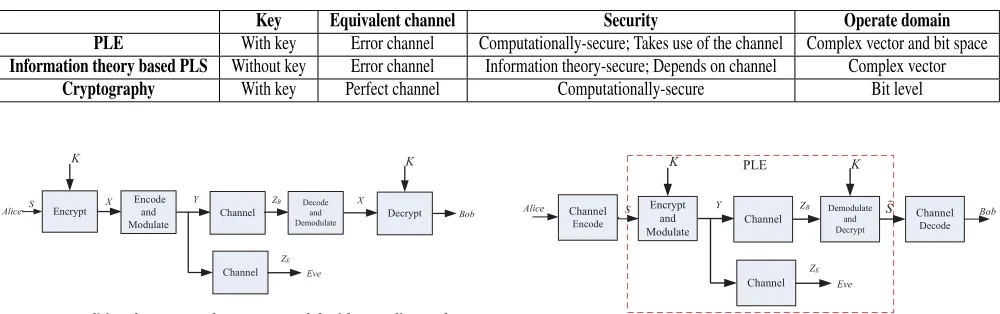
TABLE 1. Comparison of PLE, PLS and cryptography.
FIGURE 1. Traditional cryptography system model with encoding and modulation after encryption.
Section III-D. In Section IV, we present a more detailed security analysis. In addition, we give a design example and numerical simulations on a practical OFDM system in Section V.
Notation: XT, X−1, XH and X∗ denote respectively the transpose, inverse, conjugate transpose and conjugate of matrixX.IN denotes theN-dimensional identity matrix.|x|
is the absolute value of a complex scalarx.k. . .kdenotes the Euclidean norm of a vector.Cnrepresents the space ofn×1
vectors with complex elements.Cm×nandRm×nrepresent the
space of allm×nmatrices with complex elements and real elements respectively. For setsCandD,C×D= {(c,d)|c∈
C and d ∈ D}, where×is the Cartesian product between two sets.
II. PLE SYSTEM MODEL AND CRYPTOGRAPHIC PRIMITIVE
A. COMPARISON BETWEEN PLE AND A TRADITIONAL CRYPTOGRAPHY SYSTEM
The main task of PLE and traditional cryptography is design a mapping from plaintext space to cipher signal space. The design requirement is that the legal receiver can easily recover the plaintext from the cipher signal, but the eavesdropper is infeasible to recover the plaintext. In order to better under-stand PLE, we compare the differences between PLE and traditional cryptography.
The structures of traditional cryptography and PLE are shown in Fig.1. and Fig.2, respectively. Fig.1. is a tradi-tional cryptography system, whereS is a plaintext sequence and a ciphertext X (binary sequence) is generated by the encryption algorithm based on the keyK, and then sent to the channel by the coding modulation module. In the tradi-tional cryptography system, we assumed that the encryption and decryption blocks experience a perfect channel. Error correction is guaranteed by the channel encoder/decoder module.
The system model of PLE is shown in Fig 2, where S˜ is the recovered plaintext which may contain errors. PLE also
[image:3.576.316.513.273.361.2]FIGURE 2. PLE communication system model.
FIGURE 3. Stream PLE.
requires keys that needs to be sent from a secret channel in advance or extracted from wireless channels [21]–[24]. We can see that PLE is essentially a joint design of modu-lation and encryption. The PLE algorithm not only needs to consider security, but also needs to consider reliability and needs to combat the influence of channel and noise. Further, PLE needs to use the channel error to increase the difficulty of eavesdropper cracking. Furthermore, PLE deal with the complex signal which is different form the Boolean algebra based cryptography.
In Table 1, we summarize the differences between PLE, PLS, and cryptography. We can see that PLE is different from PLS and cryptography. We face new problems and need to propose new rules for PLE.
Then we consider two categories of PLE depending on the processing mode: Stream PLE and Block PLE.
B. STREAM PLE
Stream PLE uses the transmitted symbol as the basic encryp-tion unit and can be considered as a time-varying encrypencryp-tion transform. The structure of stream PLE is shown in Fig.3., whereP is a pseudorandom complex sequence generation function,rnis a complex sequence,f is the encryption
1) ENCRYPTION AND MODULATION
The pseudorandom complex sequences rn (where n is the
symbol index) are generated from the keyK:
rn=P(K)=an+jbn=Aneθn. (1)
Here,P is a pseudorandom complex sequence generation function. The function ofrnis used to change the transmitted
symbols, making the output symbols confusing and randomly distributed. The distribution ofrnneeds to be designed by the
user.
Definition 1 [Pseudorandom Complex Sequence Genera-tor (PRCSG)]:Considerξ a probability distribution onC(a
complex domain). We call a functionP : K → Cn(where K is the set of positive integers) a pseudo-random complex sequence generator if∀K ∈ K, P(K) = {r1,r2,r3. . .},
where {rn}is a sequence of complex independent random
variables which obeys theξ distribution.
PRCSG is an algorithm for generating complex random sequences. Butrnis not a true random number because it is
completely determined by the given initial keyK. The encryption function is:
Yn=f(sn,rn). (2)
The output encypted symbol sequence isY = {Y1,Y2, . . .}
whose nth element isYn (a complex number), andYn is a
function ofsnandrn. Here,S = {s1,s2, . . .}is the plaintext
binary sequence to be sent. ForM-ary modulation,sn(thenth
element ofS) is a log2M-length block of binary bits whose elements are ‘‘0’’ or ‘‘1’’.
There are two aspects to consider when designing an encryption function: first, it is easy for Bob (with K) to recoverS; second, it is infeasible for Eve (withoutK) to find outS.
We will discuss in detail how designf functions in section III.
2) DEMODULATION AND DECRYPTION
In the PLE system, it is a joint decryption and detection process, unlike traditional communication systems, where decryption and detection are two separate processes.
The decryption and demodulation algorithm is denoted as:
˜
S =D(ZB,K) (3)
where D is the joint decryption and detection algorithm. When designingDwe need to consider both reliability and complexity.
C. BLOCK PLE
Different from stream PLE, block PLE is only required to operate on plaintexts of a specific length. Block PLE maps fixed chunks of bits into complex vector signals. Here the mapping function can be random. Randomness can be against CPAs or KPAs.
Block PLE is modeled as a series of functions that map binary sequences to complex vectors according to the keyK:
S= {s1s2. . .sl} K
−→Y= {Y1Y2. . .YN} (4)
whereSis a binary message sequence of lengthl.K is thekl
bits key, andY∈CN×1is the cipher signal vector. Different from stream PLE,l is a fixed large number (for examplel= 256 or 512).
F2is the finite field of two elements andF2l denotes the l length vector space elements inF2. Then, the Block PLE
in (4) can be represented as the following mappingT:
T :F2l×Fkl
2 →CN (5)
Note thatT is not necessarily a deterministic function and it also allows for the introduction of randomness.
We also can consider (5) as a family of functions with one parameter, and represent it as
Y=TK(S).
The main job for PLE is to design the appropriate func-tionTK. Since the types of mapping functions are different,
the design of PLE is quite different from traditional cryptog-raphy. From a mathematical point of view, the set of functions that can be selected is infinite. We have more function types to choose from and also have a larger key space to combat brute force.
We need to make the functionTK have a pseudo-random
property, i.e., TK (with a randomly-chosen key K) cannot
be distinguished from and the function of random uniform selection with the same domain and value range.
D. CHANNEL MODEL
Returning to Fig.2, then after the cipher signal Y passes through the channel, the symbols received at the legal receiver and the eavesdropper are respectively: As shown in Fig.2the cipher signalY is transmitted to the wireless channel through the RF module. We useHBandHE to represent the channel
functions (including the effects of noise) of Bob and Eve, respectively. The signals received by Bob and Eve are
ZB =HB(Y) (6)
ZE =HE(Y). (7)
E. DEFINITIONS OF CRYPTOGRAPHIC PRIMITIVES OF THE PLE SYSTEM
Our next work is to establish the cryptographic primitives of PLE. The cryptographic primitive is the basic unit for building a secure protocol. Only the definition of a clear cryptographic primitive can guide the design of PLE and further apply PLE to the actual security standards.
Thecryptographic primitivesof PLE is defined as follows:
Definition 2: (Physical Layer Encryption System):
Message spaceM: the set of all possible plaintext
mes-sages, a finite set. All input messagesS∈M.
Key spaceK,K0: possible encryption key setK, and possi-ble decryption key setK0. For the symmetric PLE,K=K0.
The encryption keyKis chosen fromK, and the decryption keyK0is chosen fromK0, and soK ∈K,K0∈K0.
Key generation algorithmG:HB→K×K0.
G is a probabilistic algorithm that outputs a key pair (K,K0) ∈ K ×K0 chosen according to the channel H
B
between the transmitter and the receiver.
Encryption algorithmT :M×K→C.
Channel functionHB:C→ZandHE :C→Z
His the equivalent channel function between cipher signal
Y and received symbol ZB,ZB = HB(Y).Z is the set of
all possibleZB, andZB ∈ Z.HE is the channel function of
eavesdropper.
PRCNG:P :K→Cn.
Kis the key set andCnis a (n×1) complex vector space;
for stream PLE, complex sequence{rn} = {r1,r2, . . .} ∈Cn.
Decryption algorithmD:Z×K0→M.
From the above definition we can see two characteristics of PLE different from traditional encryption:
1. The cipher signal space is different. The cryptographic signal space in the PLE is a complex field, which requires us to design the PLE function of the complex field.
2. The input signal of the decryption algorithm is differ-ent. In the PLE system, the signal received by the receiver is affected by noise and channel fading. So the receiving algorithm is a joint detection and decryption algorithm. The decoding algorithm needs to meet the following conditions:
Pr(D(HB(TK(S)))=S)≥1−δe (8)
whereδeis a given error threshold.
Finally, the PLE system cryptographic primitives are expressed as follows:
Block PLE:Q
B=(G,T,D,HB,HE),
Stream PLE:Q
S=(G,T,D,HB,HE,P).
F. SECURITY DEFINITION
Evaluating the ‘‘security’’ of an encryption scheme is a very tricky business. The first task is to understand what ‘‘secu-rity’’ is. There are two types of security. The first one is Shannon’s definition of perfect security which requires that the ciphertext contains no information regarding the plain-text. The second one is semantic security which is based on computational-complexity. An encryption scheme is seman-tically secure if it is infeasible to learn anything about the plaintext from the ciphertext. Infeasible means that Eve can-not crack within a given computing complexity.
Here we give the definition of semantic security for PLE.
Definition 3 (Indistinguishability of Encryptions):An PLE scheme Q
=(G,T,D,HB,HE) is (t, ) message
indistin-guishable, if for every two messages S,S0, and for every binary output functionDE of complexity≤t, we have
|Pr[DE(HE(TK(S)))=1]−Pr[DE(HE(TK(S0)))=1]| ≤,
(9)
where the probability is taken over the randomness ofTK(S),
the choice ofK ∈Kand the channelHE. (Typical parameters
that are considered in practice aret=280and=2−60.) In realistic scenarios, Eve may have knowledge of plaintext-ciphertext pairs. If Eve is able to see encryptions of arbitrary messages of her choice, she may get some infor-mation of key or plaintext. An attack in this model is called a CPA. Now, we will give a security definition under CPA for PLE.
Definition 4 (Message Indistinguishability Against CPA):
An PLE schemeQ =
(G,T,D,HB,HE) is (t, )-message
indistinguishable against CPA if for every two messagesS,
S0and everyDE of complexity≤twe have
|Pr[DHE(TK(S))
E (HE(TK(S)))=1]
−Pr[DHE(TK(S))
E (HE(TK(S0)))=1]| ≤ (10)
whereDHE(TK(.))
E (HE(TK(S))) means the computation of
algo-rithmDE givenHE(TK(S)) as an input and given the ability
to executeHE(TK(.)).
In (9) and (10) HE is a random function that makes the
result of each encryption different even if the plaintext is the same. This is because the channel is random and we also can add artificial noise at the transmitter.
III. THE DESIGN FRAMEWORK AND RULES OF PLE In this section, we will study the design rules and framework of PLE. There are two aspects to consider when designing the PLE algorithms.
(i)Reliability
We need to make sure that the legitimate receiver can recover the received signal correctly and easily. When design-ing encryption and decryption algorithms, the effects of noise and channel need to be taken into account. We need to ensure the maximum constellation distance for better BER perfor-mance. We also need to consider reducing the complexity of the receiver.
(ii)Security
The PLE constellation should be diffusing and confusing. We should effectively use the influence of channel and noise to increase the difficulty of cracking. The designed PLE algorithm should be able to resist brute force attacks and various types of attacks.
In the design of the PLE, reliability and security need to be considered together. The encryption and decryption algorithms used in the PLE should not sacrifice bit error rate performance. The stream PLE and block PLE structures are quite different, so we will discuss them separately as follows.
A. STREAM PLE DESIGN FRAMEWORK
pseudo-random complex sequence from a short true random seed (Key). Pseudo-random number generation algorithms have been studied in many works such as [25].
The second part is the encryption function f in (2). In stream PLE, the encryption functionf maps the input infor-mation bits into a complex signal (constellation point) accord-ing to the pseudo-random complex sequencern. We need to
consider the design off from both a reliability and security perspective. Therefore, we use the following two indicators as the optimization goals of the designf function.
1) MINIMUM CONSTELLATION DISTANCE
d = min
(i,j)i6=j
f(si,rn)−f(sj,rn)
(11)
wheresi,sj ∈ Mare possible input messages and d is the
minimum distance between two different constellations. Like the traditional constellation design, d determines the error probability at the receiver. So our design goal is to maximize
d to minimize BER.
2) CONFUSION CHARACTERISTICS OF THE OUTPUT SIGNAL Note that if rn is truly random, then this forms a one-time
system which provides perfect security. However, in a prac-tical system, we cannot get a truly randomrnfrom a limited
length key. Sornis a pseudorandom complex sequence and
not truly random. Therefore, eavesdroppers have the possibil-ity of obtaining information aboutsior rnby accumulating
observations for Y over a long time. In order to avoid this situation, we need more confusion in the y-sequence, and there are more possible values fory=a+jb.
We use the continuous entropy to measure the confusion degree ofY as follows:
H(Y)= −
∞
Z Z
−∞
p(a,b) log2p(a,b)dadb, (12)
wherep(a,b) is the joint probability density function fora
andb.
Since continuous entropy is infinite, it is not easy to cal-culate the continuous entropy values. In addition, the actual digital system will quantize the signal Y, so we will use discrete source entropy to measure the confusion degree of
Y. A continuous Y is discretized into bins of size 1 (we can understand it as quantization accuracy). We thus have quantized entropy as:
H1(Y):= −
∞
X
i=−∞ ∞
X
j=−∞
Γ(i,j) log2Γ(i,j), (13)
whereΓ(i,j)=R(i+1)1
i1
R(j+1)4
j4 p(a,b)dadb.
We need to maximize H1(Y), given the domain of Y isC. According to maximum entropy theory,Y needs to be a uniform distribution within its given domainC[26]. This rule means that for an arbitrary input symbolS, after the
f-function transformation,Y can be any value in the entire given domain, and the probability of different values is equal.
According to the above two criteria, we present two design routes for encryption functions.
(i)PLE based on traditional modulation
The first design idea is implemented by transforming on the traditional constellation (BPSK,QAM, etc.). We just need to design the transform function for encryption and decryp-tion. The transform function needs to confuse the constella-tion as much as possible. In addiconstella-tion, in order not to change the BER performance of the original constellation, we need to ensure that the transformation function does not change the distance of the constellation points.
In a phase modulation system (QPSK, BPSK, M-PSK, etc.), a straightforward method is constellation rotation. A random complex signal e−jθn (θ ∼ U[0, 2π], uniform distribution) is generated by the PRCSG module, and then multiplied by the original constellation to obtain an encrypted constellation. The encryption process is as follows:
Yn=Xne−jθn. (14)
Obviously, the transformation in (14) does not change the constellation distance. This method is used in [27] and [14]. In [27], three candidate PLE methods based on traditional modulation are proposed and compared. The phase rotation method depends on the phase information shared by both Alice and Bob. The phase information can be extracted from the reciprocal channel or transmitted by a secure channel. The eavesdropper does not know this phase information.
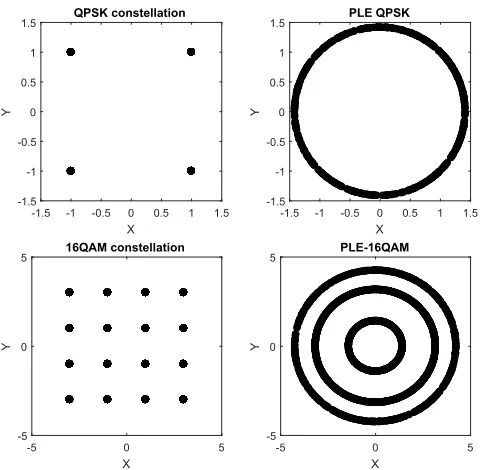
In the amplitude and phase modulation system (e.g.,QAM), both the phase and amplitude information needs to be pro-tected. Only phase rotation will leak the amplitude informa-tion. Therefore, we propose a disturbance-rotation method as follows.
First, the input symbolsnis scrambled to obtains0n. This
scramble operator destroys the correspondence relationship between the amplitude information and the number of bits.
Take 16QAM as an example, the information symbol is
sn = {b1b2b3b4}. First, we change the order of the bits
according to the pseudorandom number given by the random generator, and gets0n= {ba1ba2ba3ba4}, where{a1,a2,a3,a4}
is a permutation of{1,2,3,4}. Here there are 4! = 24 kinds of possible permutations. Then, we perform 16QAM mapping to getXn. Finally we use the rotation operation as (14) The
final constellation is now shown in Fig.4. (ii)New constellation for stream PLE
Another effective method is to design a new PLE constel-lation. This makes the constellation diagram have better con-fusing characteristics, which can resist brute force cracking.
FIGURE 4. PLE for QPSK and 16QAM systems.
First, we map each 2-bit messagesninto the vertex
coor-dinates of a regular tetrahedron{V1,V2,V3,V4}according to
equation (15), as shown in Fig.5, whereXn∈R3.
Xn=
V1 ifsn=00
V2 ifsn=01 V3 ifsn=11
V4 ifsn=10.
(15)
The regular tetrahedron constellation has better energy effi-ciency.
An example of appropriate vertices are:
V1 =(
p
8/9,0,−1/3)
V2 =(−
p
2/9,p2/3,−1/3)
V3 =(−
p
2/9,−p2/3,−1/3)
V4 =(0,0,1) (16)
Next, we use three-dimensional rotation to disturb the constellation for security.
Yn=R(α, β, γ)·Xn (17)
whereYn∈R3,R(α, β, γ)∈R3×3is the rotation matrix and
α, β, γ ∼U(0,2π) are phase parameters.R(α, β, γ) is given by (18) and (19), as shown at the bottom of the next page.
The distribution ofYn is shown in the Fig.5. These
con-stellation points (Yn) are distributed on the surface of the unit
sphere with centroid at the origin.
B. BLOCK PLE DESIGN FRAMEWORK
[image:7.576.318.509.69.483.2]The operating unit of the Block PLE is a fixed-length binary sequence. Unlike the traditional block cipher, block PLE converts bit blocks to complex vectors. The rules of Block
FIGURE 5. PLE for a 3-D constellation where constellation points lie on the surface of the sphere with a uniform probability density function for each of the two parametric angles.
PLE is different from upper layer block cipher. Traditional Block cipher is faced with an ideal noise-free channel (as show in Fig. 1, the error has been removed by the channel coding and modulate module). The Block PLE is faced with a channel with noise and channel fading as show in Fig. 2. It is designed not only to take into account the security but also to take into account the reliability. So the Block PLE design is a joint design of communication and encryption.
The design of block PLE needs to consider the following three aspects.
(i)Confusion
FIGURE 6. Block PLE.
(ii)Diffusion
We should make the statistical structure of the plaintext dissipate over the entire cryptographic signal. The corre-spondence between plaintext and cipher signals should be disturbed and complicated as much as possible. The diffusion feature is designed to prevent differential attacks. Note that this is a little different from the diffusion concept in tradi-tional bit-level encryption. In traditradi-tional bit-level encryption, changing one bit of plaintext will make the cipher text totally different. However in PLE, due to channel noise, we should ensure that the distances between the plaintext codes do not change after encryption to guarantee the bit error rate of the legal receiver.
(iii)Noise tolerance
Since the cipher signal passes through the wireless channel. The receiver needs to recover the message from the cipher sig-nal containing noise. Therefore, the design of the encryption and decryption functions should not amplify the noise.
Fig.6is the structure of block PLE. The key schedule is an algorithm that extends a short master keyK to three dif-ferent extended keys (K1,K2,K3) for the following three PLE
stages [29]. The three stages are: Bit Change, Modulation and Block Change.
The purpose of the bit change stage is to disturb and con-fuse binary sequences. We can use Boolean operations such as interleaving, replacement,permutation, etc. [30], [31]. The binary vectorSis changed toS0according toK1.
The modulation stage maps binary sequences to complex vectors:
S0= {s01s02. . .sl0} →X= {X1X2. . .XN},
where{s01s02. . .s0l}are binary numbers, and X ∈ CN is the output of the modulation.l is the bits length and N is the symbol number. ForM-ary constellation,l=Nlog2M.
Block change is the most important step in the PLE. Its function is to make the symbols interlace and confuse, so that the eavesdropper can not recover the original signal.
Essentially, it is a mapping functionebetween two complex vector spaces:
X= {X1X2. . .XN} →Y= {Y1Y2. . .YN} (20)
Y=e(X) (21)
whereY ∈ CN is the cipher signal vector. We can design multiple sub-transformse1,e2,e3. . .and then combine them
to forme.
e(X)=e1(e2(. . .(en(X)))). (22)
We provide three types of transforms for PLE, which are isometry transformation, stochastic transformation and non-linear transformations.
1) ISOMETRY TRANSFORMATION
In order to make the distance of the constellation points not change, we use the definition of isometry.
Definition 5: Let X and Y be metric spaces with
met-ricsdX anddY: A mapf : X → Y is called anisometry
ordistance preservingif for anya,b∈X one has
dY(f(a),f(b))=dX(a,b). (23)
ThenX andY are Euclidean spaces of the same dimension
N, and all the isometries betweenXandY can be denoted by premultiplyingX with a unitary matrixU∈CN where
UUH=UHU=IN. (24)
Obviously |det(U)| = 1. The columns or rows of U
form an orthonormal basis ofCN with respect to the usual
inner product. In fact anyN ×N unitary matrixUhasN2
independent real phase parameters. Thus, we can generate an
N×Nunitary matrixUfrom a given rotation direction vector, 8∈RN2.8can be generated fromK3(see Fig. 6), and both
are known by both Alice and Bob. The method of generation of anN×Nunitary matrix from8is given in [32].
TakingN = 2 as an example then the general expression for an 2×2 unitary matrix is:
U=eiφ/2
eiφ1cosθ eiφ2sinθ −e−iφ2sinθ e−iφ1cosθ
, (25)
which depends on 4 parameters8= {φ, φ1, φ2, θ}, where φ, φ1, φ2, θ ∈[0,2π].
Thusei(X)=UX(see (22) forei(X)) can be used as a
sub-transformation. We can also extend toN >2 to acquire more confusion.
Theorem 6: For any M-ary constellation diagramS =
{S1,S2, . . . ,SM}, an isometry transformation e(. . .) on S
R(α, β, γ)=
cosγ sinγ 0
−sinγ cosγ 0
0 0 1
1 0 0
0 cosβ sinβ 0 −sinβ cosβ
cosα 0 sinα
0 1 0
−sinα 0 cosα
(18)
=
cosαcosγ −cosβsinαsinγ sinαcosγ +cosβcosαsinγ sinβsinγ
−cosαsinγ−cosβsinαcosγ −sinαsinγ+cosβcosαcosγ sinβcosγ sinβsinα −sinβcosα cosβ
[image:8.576.40.274.65.134.2]does not change its average demodulation BER performance under Additive White Gaussian Noise (AWGN) channels.
Proof: We assume that after isometry transformation, the constellation diagram turns intoY = {Y1,Y2, . . . ,YM}.
According to Definition 1, for anyi,j≤M, we have
Si−Sj
=
Yi−Yj
.
We assume the channel output of theS system and theY
system arer =Si+n1and˜r=Yi+n2respectively, where n1andn2are i.i.d. Gaussian noise vectors.
The maximum likelihood (ML) receivers of constellation diagramSandYare
argmin Si
kr−Sikandargmin
Yi
k˜r−Yik.
The Si andYi (i = 1, . . .sM) are determined from the
decision regions:
Zi=(r: ||r−Si||<||r−Sj||,∀j=1, . . . ,M, j6=i) (26) ˜
Zi=(˜r: ||˜r−Yi||˜r−Yj||,∀j=1, . . . ,M, j6=i). (27)
According to Definition 3, for anyrwe have
r−Sj
=
r˜−Yj
,(j=1, . . . ,M) (28)
Thus according to (26), (27) and (28),ZiandZ˜iare in
one-to-one correspondence.
The error probability of the ML receiver of constellation diagramsSandYare
Pe= M X
i=1
p(r ∈/Zi|Sisent)p(Sisent)
=1/M M X
i=1
p(r ∈/Zi|Sisent)
=1−1/M M X
i=1
p(r∈Zi|Sisent), (29)
and
˜
Pe=1−1/M M X
i=1
p(r˜∈ ˜Zi|Yisent). (30)
Due toZiandZ˜ibeing in one-to-one correspondence,Pe=
˜
Pe, so the two constellation diagramsSandYhave the same
demodulation performance.
Although the above proof assumes an AWGN channel, the simulations section shows that the conclusions are also correct under multipath fading channels.
The phase rotation scheme, which has been used in [12], [14], [17], [33], is a specific example of isometry — i.e., diagonal matrix:
U=
eiφ1 eiφ2
...
eiφN
(31)
whereφ1φ2. . . φN ∈ [0,2π] are taken as keys. Multiplying
a vector by this matrix means that each element of the vector rotates at different anglesφ1φ2. . . φN ∈[0,2π].
However, it is not safe to use only phase rotation, which cannot resist known-plaintext attacks. We will analyze this issue in the section IV.C.2.
2) STOCHASTIC TRANSFORMATION
If the eavesdropper can obtain a large number of plain-text cipher signal pairs, then it can perform known-plainplain-text attacks or statistical analysis attacks. To combat these attacks, we should introduce a random transformation. The stochastic transformation makes the cipher signal different even if the plaintext is the same. A simple example of stochastic map-ping is to add some restricted artificial noise.
3) NONLINEAR TRANSFORMATIONS
Ordinary non-linear transformations will amplify the effects of noise. So squared functions and exponential functions cannot be applied directly to PLE systems. However, we can consider a system under low noise, and using some special non-linear transformations we will have a more secure effect. The purpose of these transformations is to make each input bit dispersed into the entire output signal block, and to make the output signal confusing, while ensuring that the BER performance of the system does not decrease. Similar to stream PLE, we can still use the quantized information entropy of the constellation as in (13) to measure the degree of confusion in the overall Block PLE system.
C. BLOCK PLE MODE OF PRACTICAL OPERATION
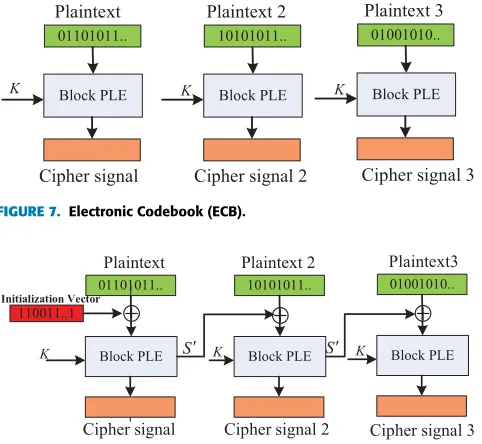
Block PLE by itself is only suitable for the secure trans-formation of one fixed-length group of bits called a block. In order to securely transform amounts of data larger than a block, we also need to design the mode of operation for block PLE. A mode of operation describes how to repeatedly apply a block PLE single-block operation. In this section we will introduce a natural and simple operation mode called Elec-tronic Codebook (ECB). We then propose a new operation mode PLE-block chaining (PBC).
1) ELECTRONIC CODEBOOK (ECB)
A simple encryption mode is the Electronic Codebook (ECB) mode as shown in Fig.7. The messages that need to be encrypted are divided into blocks according to the block size of the block cipher, and each block is independently encrypted. The disadvantage of this method is that the same plaintext block is encrypted into the same cipher signal block. Therefore, it does not hide data patterns well and can be easily cryptanalyzed.
2) PLE-BLOCK CHAINING (PBC)
FIGURE 7. Electronic Codebook (ECB).
FIGURE 8. PLE-block chaining (PBC).
encrypted by PLE. In this method, each cipher signal block depends on all plaintext blocks in front of it. At the same time, in order to ensure the uniqueness of each message, you need to use the initialization vector in the first block.
D. DESIGN PRINCIPLES FOR IMPLEMENTATION PLE
A good PLE should be hard to break and easy to imple-ment. Both the encryption function and the decoding function should be easily computable. PLE is usually implemented in hardware, such as a VLSI-chip. To reduce complexity and make it easier to standardize, the following design principles are required:
1) Independence and universality:Design PLE as a
sep-arate module embedded in the communication system that can be applied to various types of communication systems and modulation types.
2) Robustness and effectiveness: The performance of
the communication system should not be reduced by PLE, including synchronization performance, channel estimation performance, spectrum efficiency, energy efficiency, etc. And low latency is also important.
3) Protection of the communications system:In
addi-tion to protecting data, PLEs can also be designed to protect training symbols so that eavesdroppers can-not perform channel estimation and synchronization, thereby achieving stronger security effects.
IV. SECURITY ANALYSIS AND DISCUSSION
In this section we will discuss the security of the PLE system. We also use Kerckhoff’s assumption: the enemy knows all details of the system except for the value of the secret key.
A. EAVESDROPPER MODEL
Assume that Eve has the following capabilities:
• Eve can accurately estimate the channel functionsHB(.)
andHE(.).
• Eve knows the encryption function f and decryption functionD, but does not know the secret keyK.
Eve may use the following attack methods:
• Eve only knowsZEn and try to decode S or recover K
(ciphertext-only attack).
• Eve knows the plaintext S and its corresponding ciphertext signal ZEn, and attempts to recover K ( known-plaintext attack).
• Eve can obtain the cipher signal for any specified plain-texts for the current key, and attempts to recover K
(chosen-plaintext attack).
The PLE algorithm we designed needs to be able to resist the above attacks. From equation (7), we can see that even with the same transmission symbolSand the same keyK, due to noise and influence of the channel, at different transmission timings the resultsZE obtained will be different.S andZE
does not show a one-to-one correspondence, which makes eavesdropper cryptanalysis methods such as linear attacks and differential analysis more difficult.
B. STREAM PLE SECURITY DISCUSSION
First, we analyze the signals received by eavesdropper,
ZEn =HE(yn)=HE(f(sn,rn)).
The security of the stream PLE system is mainly guaranteed by the pseudorandom complex sequencernand the
encryp-tion funcencryp-tionf. Therefore, the security features that need to be considered during design are as follows:
1. We need the autocorrelation function ofrn to have a
distinct peak, and the period of the rn sequence should be
longer than the lifetime of the key.
2. The design of the functionyn =f(sn,rn) should make
the output signalynuniformly and randomly distributed. Its
distribution characteristics are not affected by the input signal
sn, and the eavesdropper cannot perform statistical analysis
from the received signals.
Shannon proved in theory that the one-time pad cipher is perfectly secure in the ciphertext-only scenario. But how to generate the pseudorandom complex sequencern which is
close to the completely random sequences becomes the key point.
In the stream PLE, the PRCS and the plaintext message are independent of each other. The internal state of the stream is only dependent on the internal state of the last time interval and is not related to the input plaintext. The advantage of the synchronization stream PLE is its limited error propagation. When the transmission error occurs in a symbol, it does not affect the subsequent symbol.
For the known plaintext attack, the attacker can only cal-culate the pseudorandom complex numberri at the current
or other plaintext. A well-designed stream PLE can withstand known plaintext attacks.
C. BLOCK PLE SECURITY DISCUSSION
1) KEY SPACE
Security in block PLE is mainly provided by Bit change and Block change. We assume a PLE scheme that maps l bit data intoN constellation symbols as in (5). For a block PLE to be secure, its block length l and key size kl must both
be large enough to deter statistical analysis and make the exhaustive key search attack infeasible. In order to facilitate the communication system, N can often be designed as a physical layer signal unit such as the frame length. Since the cipher signal spaceCN is a complex space with infinite
values, the available key space is almost infinite. In a practical system, we can choose the corresponding key length accord-ing to our needs.
Taking the IEEE 802.16 standard OFDM signal as an example, in a 256-point FFT system, 192 subcarriers carry signals and QPSK modulation is used. Thus,l = 384,N =
192, and so we can set the key length to 256. Then the key space is 2256. So, brute-force attack is practically impossible for block PLE.
2) KNOWN PLAINTEXT ATTACK AND CHOSEN-PLAINTEXT ATTACK
In order to combat KPA and CPA, we need to design the encryption functione(x) which make Eve cannot recoverK
from the accumulated large number of plaintext-cipher signal pairs. We consider the worst case that the noise received by Eve is very small and can be ignored. Thus, We assume that Eve can getYaccurately.
In the phase rotation method [14], [17], [19], each symbol is encrypted separately,Un,Xn,Yn∈C. Thus, we have
Yn=e(Xn)=UnXn.
If the eavesdropper knowsXnandYn, it can solveUn=Yn/Xn
and calculate the keyKfromUn. So just using phase rotation
is not enough to resist KPA and CPA.
In our proposed Block PLE frame, the signal is encrypted as a group. The unitary matrix U defined in the isometry transformation has N ×N matrix elements, so Eve cannot solve equationYN×1=UN×NXN×1to obtainU. Moreover, Uwill change between different symbols which is guaranteed byPLE-block chaining (PBC)as is shown in Fig.8. Thus, Eve cannot obtainUby accumulating a certain amount of bothY
andX.
V. PERFORMANCE COMPARISON AND NUMERICAL SIMULATIONS
A. PERFORMANCE COMPARISON OF DIFFERENT PLE SCHEMES
[image:11.576.301.529.66.264.2]To compare the performance of PLE, we considered five PLE algorithms: phase rotation scheme [14], [17], [19], intrinsic interference scheme [12], sub-carrier obfuscate
FIGURE 9. The constellation received by Bob and Eve, QPSK and 16QAM, isometry based block PLE OFDM system, SNR=16dB, SUI 1 channel [35].
and dummy [11], the proposed isometry based block PLE scheme, and the proposed stream PLE framework. We eval-uate algorithm performance from five perspectives: a) BER penalty, reduced BER performance compared to unencrypted systems; b) throughput decrease; c) key space; d) CPA secu-rity, the ability to prevent CPA; e) encryption and decryption complexity.
As shown in Table 2, the proposed PLE methods has advantages over other PLE methods. In the previous section we proved that PLE methods that only uses phase rotation cannot fight CPA. The intrinsic interference scheme and the dummy based scheme use some transmission power to send imaginary symbols or dummy data, so their BER or throughput performances decrease. Note that in the subcarrier obfuscate and dummy scheme two stream ciphers are used, so the CPA security depends on the stream cipher it chooses. Also, the CPA security of the stream PLE framework depends on PRCNG.
We also consider complexity of all the schemes. In the isometry based block PLE scheme, the main added compu-tational complexity isN ×Ncomplex matrix multiplication which is has mature method for hardware implementation. Here,nis the plaintext length. It is shown that all five PLE schemes have linear complexity that can be realized by soft-ware or hardsoft-ware implementation.
B. NUMERICAL SIMULATIONS ON A PRACTICAL OFDM SYSTEM
TABLE 2. Performance comparison of different PLE schemes.
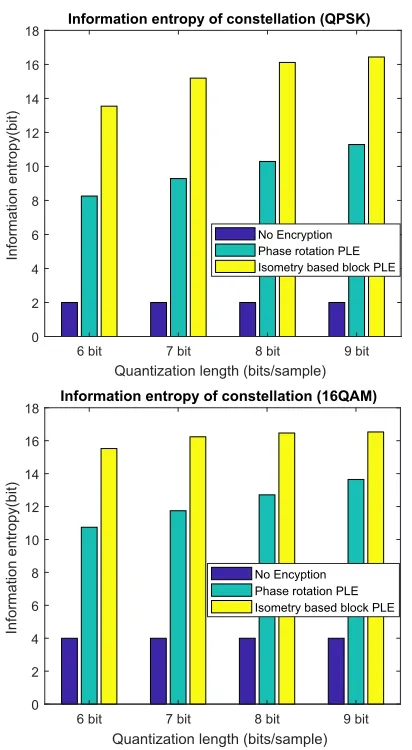
FIGURE 10. Information entropy of constellation.
[image:12.576.303.532.162.357.2]prefix length =64.We evaluate the BER performance over practical frequency selective fading channel SUI models [35]. Fig.9 shows the constellation received by Bob (after decryption recovery) and Eve. As an example, we consider QPSK and 16QAM modulation, the proposed isometry based block PLE OFDM system, SNR = 16 dB. We can see that the constellation symbols received by Eve are approximately uniformly distributed randomly within the given domain under the effects of isometry transformation, while Bob can recover the constellation correctly. Note that in a 16QAM modulation system, the amplitude information is protected in our proposed method. However, the phase rotation scheme in [14], [17], [19] leaks the amplitude information in the 16QAM system as shown in Fig.4.
FIGURE 11. BERs of the legitimate user and the eavesdropper in an OFDM system.
In order to measure the information leak and confusion degree of constellations, we calculate the information entropy of constellations according to (13). The bigger the entropy is, the more uncertainty the constellation information is, and the less leak information the constellation has. We con-sider different quantization length (i.e. bits/sample). Fig.10 shows that the information entropy increases with increasing quantization length of constellation coordinates. It is shown that our proposed isometry based method outperforms other methods, and can resist the attacks based on the information entropy.
Then, we evaluate the BERs of the legitimate user and the eavesdropper under an AWGN channel and a SUI channel. In Fig.11, we considered four situations: AWGN channel with no encryption, AWGN channel with PLE, SUI channel with no encryption, and SUI channel with PLE. We can see that in PLE system the eavesdropper’s BERs are very close to 0.5. It means that no information is leaked. Simulation also shows that our proposed isometry method nearly has the same BER as the non-encrypted system under both an AWGN channel and a fading channel. These simulation results are consistent with the Theorem 2 in section III.B which means that the isometry transformation does not affect the BER performance.
VI. CONCLUSIONS
cryptography, PLE is essentially a function design from a binary bit domain to a complex domain. Most of its oper-ations are performed in the complex domain. We defined semantic security for PLE. PLE is divided into two categories: stream PLE and block PLE. The design frameworks and guidelines for stream PLE and block PLE are proposed. For block PLE, we proposed three types of sub-transforms: isom-etry transformation, stochastic transformation and nonlinear transformation. We further proposed a new mode PLE-block chaining to resist CPA and KPA. Compared with traditional cryptography, PLE is still a new field to be explored and studied, which has more cryptographic signal space and key space. Our proposed PLE framework provides more freedom of design and is resistant to KPA and CPA. Simulation shows that the proposed isometry transformation method has good performances in terms of BER penalty and confusion degree. In future research, we will consider the impact of the error correction mechanism such as ARQ and FEC on the PLE. In addition, non-linear transformations provide better security to confront cryptanalysis. Whether or not there are non-linear transformations that guarantee the performance of the constellation is also a problem. Asymmetric PLE which does not need to perform key distribution on a private channel can also be cast into a similar framework. The detailed inves-tigation of such framework is beyond the scope of this article and is deferred for the future study.
ACKNOWLEDGEMENT
The authors would like to thank Dr. Junqing Zhang and Dr. Ying Huang for improving the quality of the paper.
REFERENCES
[1] C. E. Shannon, ‘‘Communication theory of secrecy systems,’’Bell Syst. Tech. J., vol. 28, no. 4, pp. 656–715, Oct. 1949. doi: 10.1002/j.1538-7305.1949.tb00928.x.
[2] A. D. Wyner, ‘‘The wire-tap channel,’’Bell Syst. Tech. J., vol. 54, no. 8, pp. 1355–1387, Oct. 1975.
[3] A. Khisti and G. W. Wornell, ‘‘Secure transmission with multiple antennas I: The MISOME wiretap channel,’’IEEE Trans. Inf. Theory, vol. 56, no. 7, pp. 3088–3104, Jul. 2010.
[4] N. Romero-Zurita, M. Ghogho, and D. McLernon, ‘‘Physical layer security by robust masked beamforming and protected zone optimisation,’’IET Commun., vol. 8, no. 8, pp. 1248–1257, May 2014.
[5] N. Romero-Zurita, M. Ghogho, and D. McLernon, ‘‘Physical layer security of MIMO frequency selective channels by beamforming and noise gener-ation,’’ inProc. 19th Eur. Signal Process. Conf., Aug. 2011, pp. 829–833. [6] W. C. Liao, T. H. Chang, W. K. Ma, and C. Y. Chi, ‘‘QoS-based transmit beamforming in the presence of eavesdroppers: An optimized artificial-noise-aided approach,’’ IEEE Trans. Signal Process., vol. 59, no. 3, pp. 1202–1216, Mar. 2011.
[7] W. Li, M. Ghogho, B. Chen, and C. Xiong, ‘‘Secure communication via sending artificial noise by the receiver: Outage secrecy capacity/region analysis,’’IEEE Commun. Lett., vol. 16, no. 10, pp. 1628–1631, Oct. 2012. [8] W. Li, Y. Tang, M. Ghogho, J. Wei, and C. Xiong, ‘‘Secure communications via sending artificial noise by both transmitter and receiver: Optimum power allocation to minimise the insecure region,’’IET Commun., vol. 8, no. 16, pp. 2858–2862, Nov. 2014.
[9] N. Romero-Zurita, M. Ghogho, and D. McLernon, ‘‘Outage probability based power distribution between data and artificial noise for physical layer security,’’IEEE Signal Process. Lett., vol. 19, no. 2, pp. 71–74, Feb. 2012. [10] J. Huang and A. L. Swindlehurst, ‘‘Cooperative jamming for secure com-munications in MIMO relay networks,’’IEEE Trans. Signal Process., vol. 59, no. 10, pp. 4871–4884, Oct. 2011.
[11] J. Zhang, A. Marshall, R. Woods, and T. Q. Duong, ‘‘Design of an OFDM physical layer encryption scheme,’’IEEE Trans. Veh. Technol., vol. 66, no. 3, pp. 2114–2127, Mar. 2017.
[12] M. Sakai, H. Lin, and K. Yamashita, ‘‘Intrinsic interference based physical layer encryption for OFDM/OQAM,’’IEEE Commun. Lett., vol. 21, no. 5, pp. 1059–1062, May 2017.
[13] T. R. Dean and A. J. Goldsmith, ‘‘Physical-layer cryptography through massive mimo,’’IEEE Trans. Inf. Theory, vol. 63, no. 8, pp. 5419–5436, May 2017.
[14] B. Chen, C. Zhu, W. Li, J. Wei, V. C. M. Leung, and L. T. Yang, ‘‘Original symbol phase rotated secure transmission against powerful massive MIMO eavesdropper,’’IEEE Access, vol. 4, pp. 3016–3025, 2016.
[15] S. Wang, W. Li, and J. Lei, ‘‘Physical-layer encryption in massive MIMO systems with spatial modulation,’’ China Commun., vol. 15, no. 10, pp. 159–171, Oct. 2018.
[16] H. Xu and L. Sun, ‘‘Encryption over the air: Securing two-way untrusted relaying systems through constellation overlapping,’’IEEE Trans. Wireless Commun., vol. 17, no. 12, pp. 8268–8282, Dec. 2018.
[17] A. K. Nain, J. Bandaru, M. A. Zubair, and R. Pachamuthu, ‘‘A secure phase-encrypted IEEE 802.15.4 transceiver design,’’IEEE Trans. Comput., vol. 66, no. 8, pp. 1421–1427, Aug. 2017.
[18] Y. Huang, W. Li, and J. Lei, ‘‘Concatenated physical layer encryp-tion scheme based on rateless codes,’’IET Commun., vol. 12, no. 12, pp. 1491–1497, Jul. 2018.
[19] K. Lai, J. Lei, L. Wen, G. Chen, W. Li, and P. Xiao, ‘‘Secure transmission with randomized constellation rotation for downlink sparse code multiple access system,’’IEEE Access, vol. 6, pp. 5049–5063, 2018.
[20] W. Li, D. McLernon, J. Lei, M. Ghogho, S. A. R. Zaidi, and H. Hui, ‘‘Mathematical model and framework of physical layer encryption for wireless communications,’’ in Proc. IEEE Global Commun. (GLOBECOM), Dec. 2018, pp. 1–7.
[21] J. Zhang, A. Marshall, R. Woods, and T. Q. Duong, ‘‘Efficient key gen-eration by exploiting randomness from channel responses of individual OFDM Subcarriers,’’IEEE Trans. Commun., vol. 64, no. 6, pp. 2578–2588, Jun. 2016.
[22] P. Xu, K. Cumanan, Z. Ding, X. Dai, and K. K. Leung, ‘‘Group secret key generation in wireless networks: Algorithms and rate optimization,’’IEEE Trans. Inf. Forensics Security, vol. 11, no. 8, pp. 1831–1846, Aug. 2016. [23] D. Qin and Z. Ding, ‘‘Exploiting multi-antenna non-reciprocal channels for
shared secret key generation,’’IEEE Trans. Inf. Forensics Security, vol. 11, no. 12, pp. 2693–2705, Dec. 2016.
[24] L. Cheng, W. Li, D. Ma, J. Wei, and X. Liu, ‘‘Moving window scheme for extracting secret keys in stationary environments,’’IET Commun., vol. 10, no. 16, pp. 2206–2214, Nov. 2016.
[25] J. E. Gentle,Random Number Generation and Monte Carlo Methods. Berlin, Germany: Springer, 2006.
[26] T. M. Cover and J. A. Thomas,Elements of Information Theory. Hoboken, NJ, USA: Wiley, 1991.
[27] S. Bi, X. Yuan, and Y. J. Zhang. (2012). ‘‘Pragmatic physical layer encryption for achieving perfect secrecy.’’ [Online]. Avabilable: https://arxiv.org/abs/1210.5599
[28] X. Li, W. Li, J. Lei, and L. Cheng, ‘‘A novel physical layer encryp-tion algorithm based on three dimensional constellaencryp-tion rotaencryp-tion in OFDM system,’’ (in Chinese),Acta Electronica Sinica, vol. 45, no. 12, pp. 2873–2880, 2017.
[29] J. Kelsey, B. Schneier, and D. Wagner, ‘‘Key-schedule cryptanalysis of IDEA, G-DES, GOST, SAFER, and triple-DES,’’ in Advances in Cryptology—CRYPTO. Berlin, Germany: Springer, 1996, pp. 237–251. [30] T. W. Cusick and P. Stanica,Cryptographic Boolean Functions and
Appli-cations. Boston MA, USA: Academic, 2009, pp. 157–191.
[31] M. A. Khan, M. Asim, V. Jeoti, and R. S. Manzoor, ‘‘On secure OFDM system: Chaos based constellation scrambling,’’ inProc. Int. Conf. Intell. Adv. Syst., Nov. 2007, pp. 484–488.
[32] D. Mortari, ‘‘On the rigid rotation concept in n-dimensional spaces,’’
J. Astron. Sci., vol. 49, no. 3, pp. 401–420, Jul. 2001.
[33] G. S. Kanter, D. Reilly, and N. Smith, ‘‘Practical physical-layer encryp-tion: The marriage of optical noise with traditional cryptography,’’IEEE Commun. Mag., vol. 47, no. 11, pp. 74–81, Nov. 2009.
[35] V. Erceg, Channel Models for Fixed Wireless Applications, IEEE Standard 802.16.3c-01/29rl, 2001. [Online]. Available: https://ci.nii.ac.jp/naid/10021333861/en/
WEI LI received the B.Sc. (Hons.), M.Sc., and Ph.D. degrees in communication engineering from the National University of Defence Technology (NUDT), Changsha, China, in 2002, 2006, and 2012, respectively. He is currently a Lecturer with the Department of Communication Engineering, School of Electronic Science and Engineering, NUDT. He is also a Visiting Researcher with the University of Leeds. His research interests include wireless communications, wireless net-work resource allocation, and physical layer security. He received the Exem-plary Reviewer Award from the IEEE COMMUNICATIONSLETTERS, in 2014.
DES MCLERNON received the B.Sc. degree in electronic and electrical engineering and the M.Sc. degree in electronics from Queen’s University Belfast, U.K., and the Ph.D. degree in signal pro-cessing from the Imperial College, University of London. He worked on radar systems research and development at Ferranti Ltd., Edinburgh, U.K. His research interest includes the domain of signal processing for wireless communications. He has published over 320 journal and conference papers in this area. He has supervised over 45 Ph.D. students. His current research interests include PHY layer security, M2M communications, energy har-vesting, robotic communications, machine learning for security in SDNs, distributed sensing, stochastic geometry, multi-packet reception, and drone small-cell communications. He was recently runner up in the 2018 Leeds Pub Piano Competition. He is an Associate Editor of theIET Signal Processing. Recent conference organization includes the IEEE SPAWC 2010, the Euro-pean Signal Processing Conference (EUSIPCO) 2013, the IET Conference on Intelligent Signal Processing 2013, 2015, and 2017, London, and the IEEE GLOBECOM 2014, 2015, and 2016 (Workshop on Trusted Communications with Physical Layer Security).
JING LEI received the B.Sc., M.Sc., and Ph.D. degrees from the National University of Defence Technology (NUDT), Changsha, China, in 1990, 1994, and 2009, respectively, where she is cur-rently the Leader of the Communication Coding Group. She was a Visiting Scholar with the School of Electronics and Computer Science, University of Southampton, U.K. She is also a Distinguished Professor with the Department of Communica-tions Engineering, College of Electronic Science, National University of Defence Technology. She has published many papers in various journals and conference proceedings and five books. Her research interests include information theory, LDPC, space-time coding, advanced multiple access technology, physical layer security, and wireless communi-cation technology.
MOUNIR GHOGHOreceived the Ph.D. degree from the National Polytechnic Institute of Toulouse, France, in 1997. He was an EPSRC Research Fellow with the University of Strath-clyde, U.K., from 1997 to 2001. In 2001, he joined the University of Leeds, where he was promoted to a Full Professor, in 2008. While still affiliated with the University of Leeds, he joined the Uni-versité Internationale de Rabat, in 2010, where he is currently the Director of the ICT Research Laboratory (TICLab) and a Scientific Advisor to the President. He was a member of the IEEE Signal Processing Society SPCOM, SPTM, and the SAM Technical Committee. He is a member of the Steering Committee of the IEEE TRANSACTIONS ONSIGNAL ANDINFORMATIONPROCESSING. He was a recipient of the 2013 IBM Faculty Award and the 2000 U.K. Royal Academy of the Engineering Research Fellowship. He chaired many conferences and workshops, including the European Signal Processing Conference (Eusipco) 2013 and the IEEE Workshop on Signal Processing for Advanced Wireless Communications (SPAWC) 2010. He is a EURASIP Liaison in Morocco. He served as an Associate Editor for the IEEE TRANSACTIONS ONSIGNAL PROCESSINGand the IEEE SIGNALPROCESSINGLETTERS. He is an Associate Editor of theIEEE Signal Processing Magazine.
SYED ALI RAZA ZAIDIreceived the Ph.D. degree from the School of Electronic and Electrical Engi-neering, University of Leeds, Leeds. From 2011 to 2013, he was a Lecturer with the International Uni-versity of Rabat. From 2013 to 2015, he was with the SPCOM Research Group, U.S. Army Research Laboratory, a funded project in the area of net-work science. In 2013, he was a Visiting Research Scientist with the Qatar Innovations and Mobility Centre, where he was involved in QNRF-funded project, QSON. He is currently an Assistant Professor in wireless communi-cation and sensing systems with the University of Leeds. He has published over 90 papers in leading IEEE conferences and journals. He is also an active member of the EPSRC Peer Review College. During his Ph.D. degree, he received the G. W. Carter Prize and the F. W. Carter Prize for the best thesis and best research paper, respectively. He is a EURASIP Local Liaison in U.K. and also a General Secretary of the IEEE Technical Subcommittee on Backhaul and Fronthaul networks. From 2014 to 2015, he served as an Editor for the IEEE COMMUNICATIONLETTERS. He was a Lead Guest Editor of the
IET Signal Processing–Special Issue on Signal Processing for Large-Scale 5G Wireless Networks. He is an Associate Technical Editor of theIEEE Communications Magazine.
![Fig. is the structure of block PLE. The key schedule isstages [29]. The three stages are: Bit Change, Modulation andBlock Change.ferent extended keys ( 6an algorithm that extends a short master key K to three dif-K1, K2, K3) for the following three PLEThe purpose of the bit change stage is to disturb and con-](https://thumb-us.123doks.com/thumbv2/123dok_us/1869814.144088/8.576.40.274.65.134/structure-schedule-isstages-modulation-andblock-extended-algorithm-following.webp)
![FIGURE 9. The constellation received by Bob and Eve, QPSK and 16QAM,isometry based block PLE OFDM system, SNR=16dB, SUI 1 channel [35].](https://thumb-us.123doks.com/thumbv2/123dok_us/1869814.144088/11.576.301.529.66.264/figure-constellation-received-isometry-based-block-ofdm-channel.webp)