Int. J. Electrochem. Sci., 7 (2012) 12110 - 12120
International Journal of
ELECTROCHEMICAL
SCIENCE
www.electrochemsci.org
Electrochemical and Physical Properties of Layered-Spinel
Composite Cathode Powders Prepared by Spray Pyrolysis
Chul Min Sim1, Young Jun Hong1, Min Ho Kim1, Yong Seung Jang1, Byung Kyu Park2, Yun Chan Kang1,*
1
Department of Chemical Engineering, Konkuk University, 1 Hwayang-dong, Gwangjin-gu, Seoul 143-701, Korea
2
Suncheon Center, Korean Basic Science Institute, Suncheon 540-742, Korea *E-mail: [email protected]
Received: 6 October 2012 / Accepted: 23 October 2012 / Published: 1 December 2012
The xLi2MnO3·(1-x)Li4Mn5O12 (x = 1, 0.5, 0.3, 0) composite cathode powders are prepared by spray
pyrolysis. The composite powders before and after post-treatment at 600oC have fine size and aggregated spherical morphologies of the nanometer-sized primary particles irrespective of the compositions of the cathode powders. The initial discharge capacity of the Li2MnO3 component is 258
mAh g−1, in which the Coulombic efficiency is 85%. The discharge capacity of the Li2MnO3 powders
drops from 258 to 115 after 10 cycles. The initial discharge capacities of xLi2MnO3·(1-x)Li4Mn5O12
composite powders are 225 ,219 and 211 mAh g−1 when the x values are 0.5 ,0.3 and 0. The capacity retentions of the composite powders are 88, 90, and 83 % after 30 cycles when the x values are 0.5, 0.3, and 0.
Keywords: composite material; cathode material; spray pyrolysis; lithium battery
1. INTRODUCTION
The spinel materials have been investigated as promising class of cathode materials because of their excellent rate capability, low cost, abundance, high safety, easily preparing and nontoxicity [1-9]. However, its application has been limited because of capacity fading at elevated temperatures and an innate low capacity at 4V [10]. Johnson et al. [11] introduced Li2MnO3-Li1+yMn2-yO4 spinel composite
material, and it showed a high rechargeable capacity >250 mAh g-1 when cycled between 2 and 5 V. The effect of composition of the layered-spinel composite cathode powders prepared by solid state reaction method on the electrochemical properties was mainly investigated.
surface area, morphology, and crystallinity [12-15]. The preparation process of the composite cathode powders affects the physical properties of the powders [16-22]. In addition, the physical properties of the powders were affected by the composition of the composite cathode materials even at the same preparation process. Therefore, the effect of composition on physical and electrochemical properties of the composite cathode powders should be investigated in the same preparation process.
Spray pyrolysis, a gas-phase reaction method, was profitable for the preparation of spinel LiMn2O4 cathode powders [23-25]. Although spray pyrolysis is easy to control the composition of the
cathode materials and synthesize highly pure, fine-sized and spherical cathode powders [26-32], it has not been applied to the preparation of Li-rich spinel cathode powders. In this study, the xLi2MnO3
·(1-x)Li4Mn5O12 (x = 1, 0.5, 0.3, 0) composite cathode powders were prepared by spray pyrolysis. The
effects of the ratio of Li2MnO3 and Li4Mn5O12 phases on the physical and electrochemical properties
of the composite cathode powders were investigated.
2. EXPERIMENTAL
The spray pyrolysis process consisted of three parts; a six-pack ultrasonic spray generator operated at 1.7 MHz, a 1000-mm-long tubular quartz reactor of 50-mm ID, and a bag filter for collecting particles. The precursor solution was prepared by dissolving a stoichiometric amount of lithium nitrate (98%, Junsei) and manganese nitrate hexahydrate (97%, Junsei) in distilled water. The overall concentration of the Li and Mn components in the solution was 0.5 M. The powders were obtained by spray pyrolysis at 900◦C. The flow rate of air used as the carrier gas was fixed at 20 L min
-1
. The precursor powders obtained by spray pyrolysis were post-treated in a box furnace at 600◦C. The crystal structures of the prepared cathode powders were investigated using X-ray diffractometry (XRD; RIGAKU DMAX-33) with Cu K = 1.5418 Å) at the Korea Basic Science Institute (Daegu). The morphological characteristics of the powders were investigated using scanning electron microscopy (SEM; JEOL, JSM-6060). The cathode electrode was prepared from a mixture containing 20 mg of xLi2MnO3·(1-x)Li4Mn5O12 and 12 mg of TAB (TAB is a mixture of 9.6
mg of teflonized acetylene black and 2.4 mg of a binder). Lithium metal and a polypropylene film were used as the counter electrode and the separator, respectively. The electrolyte was 1 M LiPF6 in a
1:1 mixture by volume of ethylene carbonate (EC)/dimethyl carbonate (DMC). The cell was assembled in a glove box in an argon atmosphere.
3. RESULT AND DISCUSSION
The morphologies of the precursor powders obtained by spray pyrolysis according to the ratio of Li2MnO3 and Li4Mn5O12 are shown in Fig. 1. The precursor powders had aggregated spherical
were post-treated at various temperatures to improve the electrochemical properties of the cathode powders. The optimum post-treatment temperature of the composite cathode powders showing the good electrochemical properties was 600oC. Fig. 2 shows the SEM images of the xLi2MnO3
·(1-x)Li4Mn5O12 powders post-treated at 600oC. The morphologies of post-treated cathode powders were
similar to those of the precursor powders in Figs. 1 and 2.
The XRD patterns of the xLi2MnO3·(1-x)Li4Mn5O12 (x = 1, 0.5, 0.3, 0) powders post-treated at
600oC are shown in Fig. 3. The pure Li2MnO3 have a monoclinic structure with a space group of C2/m,
which structure is the same as that of R3m layered rock-salt structures [33]. The clear splitting of (135) and (060) peaks located at 2θ = 64.5◦ and 65.5◦, which indicates the degree of development of the monoclinic structure of Li2MnO3, was shown in the pure Li2MnO3 [33]. The pure Li4Mn5O12 powders
had small impurity peaks of monoclinic Li2MnO3 at 2θ = 21◦ and 65.5◦ as shown by arrows in Fig.
3(d).
(a)
(c)
(d)
Figure 1. SEM images of the precursor powders prepared by spray pyrolysis: (a) Li2MnO3; (b)
0.5Li2MnO3-0.5Li4Mn5O12; (c) 0.3Li2MnO3-0.7Li4Mn5O12; (d) Li4Mn5O12.
Slight decomposition of the spinel Li4Mn5O12 phase formed the impurity phase of Li2MnO3.
The peak intensity of the monoclinic Li2MnO3 at 2θ = 21◦ and 65.5◦ increased when the x value
increased from 0 to 1. According to increasing the amount of Li2MnO3 component, XRD patterns
shifted to lower angles.
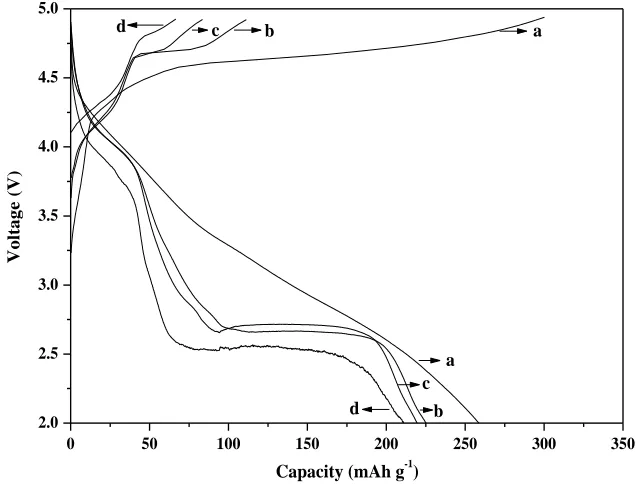
Fig. 4 shows the initial charge-discharge curves of xLi2MnO3·(1-x)Li4Mn5O12 powders
post-treated at 600oC at a constant current density of 23 mA g-1 between 2.0 and 4.95 V at room temperature. The initial charge and discharge capacities of xLi2MnO3·(1-x)Li4Mn5O12 powders
increased with increasing the amount of Li2MnO3 component. The initial charge and discharge
[image:4.596.150.445.68.544.2]
the pure Li4Mn5O12 powders were 68 and 211 mAh g-1, respectively. The Li2MnO3 component
commonly shows no electrochemical reaction at low operating voltages [33]. However, the pure Li2MnO3 powders prepared by spray pyrolysis show high initial charge/discharge capacities in the first
cycle. The prepared Li2MnO3 powders were activated and the two lithium ions were removed from
Li2MnO3 with concomitant loss of oxygen resulting in the formation of Li2O and MnO2 at a high
voltage, above 4.6 V, in the initial charge process [11,34]. The initial charge and discharge curves of the pure Li4Mn5O12 and xLi2MnO3·(1-x)Li4Mn5O12 composite powders showed the characteristics of
the layered and spinel composite powders irrespective of the composition. The initial charge capacities of the composite powders increased from 68 to 116 mAh g-1 when the x value increased from 0 to 0.5.
(a)
(c)
[image:6.596.151.445.68.543.2](d)
Figure 2. SEM images of the xLi2MnO3·(1-x)Li4Mn5O12 powders post-treated at 600oC: (a) Li2MnO3;
(b) 0.5Li2MnO3-0.5Li4Mn5O12; (c) 0.3Li2MnO3-0.7Li4Mn5O12; (d) Li4Mn5O12.
The composite powders had similar charge capacities due to the Mn3+/4+ redox reaction of the spinel component when they were initially charged to 4.5 V (about 35 mAh g−1). The small charge capacities of the powders below 4.5 V indicate that a small amount of Mn3+ exists in the pure Li4Mn5O12 and Li2MnO3·Li4Mn5O12 composite powders [35]. The voltage plateaus in the initial charge
curves near 4.75 V were attributed to the removal of Li2O from the layered Li2MnO3 component
[11,34]. The initial discharge capacity of the Li2MnO3 component was 258 mAh g−1, in which the
Coulombic efficiency was 85%. The pure Li2MnO3 had a low theoretical Coulombic efficiency [36].
However, the Li2MnO3 powders obtained by spray pyrolysis after post-treatment at 600oC had high
capacity below 4.5 V due to the Mn3+/4+ redox reaction of the Li2MnO3 component was shown in Fig.
4 (a). The Li2MnO3 component prepared by spray pyrolysis also had a layered-spinel composite
structure. The initial discharge capacities of the xLi2MnO3·(1-x)Li4Mn5O12 composite powders slightly
increased from 211 to 225 mAh g−1 when the x value increased from 0 to 0.5. The composite powders had high initial discharge capacities irrespective of the compositions.
10 20 30 40 50 60 70 80
Li2MnO3
(3 3 3 ) (0 6 0 ) (1 3 5 ) (2 0 4 ) (20 4 ) (13 3 ) (1 3 1 ) (1 3 1 ) (2 0 0 ) (0 0 2 ) (1 1 1 ) (5 3 1 ) (4 4 0 ) (5 1 1 ) (3 3 1 ) (4 0 0 ) (2 2 2 ) (3 1 1 ) d c b a In te n si ty 2
Figure 3. XRD patterns of the powders post-treated at 600oC: (a) Li2MnO3; (b) 0.5Li2MnO3
-0.5Li4Mn5O12; (c) 0.3Li2MnO3-0.7Li4Mn5O12; (d) Li4Mn5O12.
0 50 100 150 200 250 300 350
2.0 2.5 3.0 3.5 4.0 4.5 5.0 d c c b a
d b a
Capacity (mAh g-1)
[image:7.596.149.450.179.403.2]V o lt a g e ( V )
Figure 4. First charge-discharge curves of the powders: (a) Li2MnO3; (b) 0.5Li2MnO3-0.5Li4Mn5O12;
[image:7.596.135.455.483.725.2]
0 20 40
-50 0 50
-300 -150 0
2.0 2.5 3.0 3.5 4.0 4.5 5.0
-20 0
-20 0 20
a
b
c
d
Q
/d
V
(
m
A
h
g
-1 V
-1 )
Voltage (V)
d
c
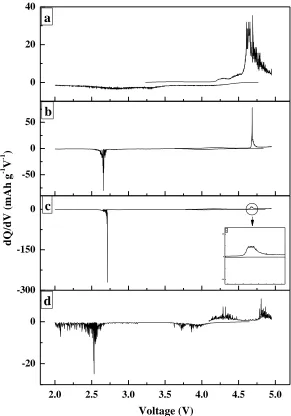
Figure 5. dQ/dV curves of the initial cycles of the powders: (a) Li2MnO3; (b) 0.5Li2MnO3
-0.5Li4Mn5O12; (c) 0.3Li2MnO3-0.7Li4Mn5O12; (d) Li4Mn5O12 post-treated at 600oC.
The initial charge/discharge profiles of the prepared composite powders were similar to those of the Li4Mn5O12 powders prepared by solid state reaction at 400oC [11]. The lithium extraction and
insertion mechanism in Li4Mn5O12 powders was described in the previous literature [37]. Fig. 5 shows
the differential capacity versus voltage (dQ/dV) curves of the first cycles as shown in Fig. 4. xLi2MnO3·(1-x)Li4Mn5O12 powders had oxidation peaks at around 4.7 V, and the peak intensities
increased with increasing the x values. It means that the removal of Li2O from Li2MnO3 phase to form
the MnO2 component increased with increasing the x values. The cathode powders had reduction peaks
[image:8.596.152.443.111.527.2]
0 5 10 15 20 25 30
50 100 150 200 250 300 C a p a c it y ( m A h g -1 ) Cycle a b c d
Figure 6. Cycling performance of the powders: (a) Li2MnO3; (b) 0.5Li2MnO3-0.5Li4Mn5O12; (c)
0.3Li2MnO3-0.7Li4Mn5O12; (d) Li4Mn5O12.
-80 0 80 0 200 0 60 0 40 -20 0 20
2 3 4 5
[image:9.596.171.441.74.266.2]-15 0 15 1st 2nd 5th 10th 20th d Q /d V ( m A h g -1 V -1 ) Voltage (V) 30th
Figure 7. dQ/dV curves according to the cycles of 0.5Li2MnO3-0.5Li4Mn5O12 powders post-treated at
[image:9.596.177.425.352.712.2]
Fig. 6 shows the cycle performances of xLi2MnO3·(1-x)Li4Mn5O12 composite powders
post-treated at 600oC at a constant current density of 23 mA g-1 between 2.0 and 4.95 V. Although the Li2MnO3 powders had high initial discharge capacity, it showed poor cycle performance. The pure
Li2MnO3 powders prepared by solid state reaction method had also poor cycle performance [36]. The
discharge capacity of the Li2MnO3 powders dropped from 258 to 115 after 10 cycles. In contrast, the
composite powders with low x values below 0.5 showed good cycle performance.
The discharge capacities of the pure Li4Mn5O12 and Li2MnO3·Li4Mn5O12 composite powders
increased slightly during first 3 cycles, and then the capacity monotonically decreased during cycling [11]. The initial discharge capacities of xLi2MnO3·(1-x)Li4Mn5O12 composite powders were 225, 219,
and 211 mAh g−1 when the x values were 0.5, 0.3, and 0. The discharge capacities of those compounds after 30 cycles were 205, 201, and 183 mAh g−1, respectively. The capacity retentions of the composite powders were 89, 90, and 83 % when the x values were 0.5, 0.3, and 0.
Fig. 7 shows the differential capacity vs. voltage (dQ/dV) curves of the 0.5Li2MnO3
-0.5Li4Mn5O12 composite powder post-treated at 600oC after various cycles. The oxidation peak near
4.7 V was not observed in the dQ/dV curve of the second cycle. Gradual activation of inactive MnO2
component formed from the Li2MnO3 in the first charging process to the active layered LiMnO2 or
spinel LiMn2O4 components increased the discharge capacities of the pure Li4Mn5O12 and
Li2MnO3·Li4Mn5O12 composite powders within 3 cycles as shown in Fig. 6. The dQ/dV curve of the
0.5Li2MnO3-0.5Li4Mn5O12 composite powders after 30 cycles had the same shape to that of the pure
spinel LiMn2O4 [33].
4. CONCLUSIONS
The layered-spinel xLi2MnO3·(1-x)Li4Mn5O12 composite cathode powders with various
compositions are prepared by spray pyrolysis. The prepared and post-treated xLi2MnO3
·(1-x)Li4Mn5O12 powders have aggregated spherical morphologies of the nanometer-sized primary
particles irrespective of the compositions of the cathode powders. The initial charge and discharge capacities of xLi2MnO3·(1-x)Li4Mn5O12 powders increase with increasing the amount of Li2MnO3
component. Except the Li2MnO3, other powders have good cycle performances. It is indicated that
although individual Li2MnO3 component have poor cycle performance, it can have enhanced the
cycling stability of spinel components. The layered-spinel xLi2MnO3·(1-x)Li4Mn5O12 composite
cathode powders prepared by spray pyrolysis have high initial discharge capacities and good cycle properties.
ACKNOWLEDGEMENT
References
1. J.M. Tarascon, W.R. McKinnon, F. Coowar, T.N. Bowmer, G. Amatucci, D. Guyomard, J. Electrochem. Soc., 141 (1994) 1421
2. R.J. Gummow, A. de Kock, M.M. Thackeray, Solid State ionics, 69 (1994) 59
3. M.M. Thackeray, M.F. Mansuetto, D.W. Dees, D.R. Visser, Mater. Res. Bull., 31 (1996) 133 4. T. Takada, H. Hayakawa, E. Aklba, J. Solid State Chem., 115 (1995) 420
5. T. Takada, H. Hayakawa, T. Kumagal, E. AkJba, J. Solid State Chem., 121 (1996) 79 6. M.N. Richard, E.W. Fuller, J.R. Dahn, Solid State lonics, 73 ( 1994 ) 81
7. J.M. Tarascon, D. Guyomard, Electrochim. Acta, 38 (1993) 1221 8. C.S. Johnson, J. Power Sources, 165 (2007) 559
9. J. Wang, Y. Xia, X. Yao, M. Zhang, Y. Zhang, Z. Liu, Int. J. Electrochem. Sci., 6 (2011) 6670 10.A. Du Pasquier, A. Blyr, P. Courjal, D. Larcher, G. Amatucci, B. Gerand, J.M. Tarascon, J.
Electrochem. Soc., 146 (1999) 428
11.C.S. Johnson, N. Li, J.T. Vaughey, S.A. Hackney, M.M. Thackeray, Electrochem. Commun., 7 (2005) 528
12.R. Santhanam, B. Rambabu, Int. J. Electrochem. Sci., 4 (2009)1770
13.C.S. Johnson, N. Li, C. Lefief, M.M. Thackeray, Electrochem. Commun., 9 (2007) 787. 14.Y. Wu, A. Manthiram, Electrochem. Solid-State Lett., 9 (2006) A221
15.C.S. Johnson, N. Li, C. Lefief, J.T. Vaughey, M.M. Thackeray, Chem. Mater., 20 (2008) 6095 16.C.S. Johnson, J.S. Kim, C. Lefief, N. Li, J.T. Vaughey, M.M. Thackeray, Electrochem. Commun.,
6 (2004) 1085
17.F. Wu, H. Lu, Y. Su, N. Li, L. Bao, S. Chen, J. Appl. Electrochem., 40 (2010) 783 18.P.S. Whitfield, S. Niketic, I.J. Davidson, J. Power Sources, 146 (2005) 617 19.B.L. Ellis, K.T. Lee, L.F. Nazar, Chem. Mater., 22 (2010) 691
20.J.S. Kim, C.S. Johnson, J.T. Vaughey, M.M. Thackeray, J. Power Sources, 153 (2006) 258
21.H. Deng, I. Belharouak, R.E. Cook, H. Wu, Y.K. Sun, K. Amine, J. Electrochem. Soc., 157 (2010) A447
22.T. Ohzuku, M. Nagayama, K. Tsuji, K. Ariyoshi, J. Mater. Chem., 21 (2011) 10179 23.I. Taniguchi, C.K. Lim, D. Song, M. Wakihara, Solid State Ionics, 146 (2002) 239 24.S.H. Ju, D.Y. Kim, E.B. Jo, Y.C. Kang, J. Mater. Sci., 42 (2007) 5369
25.I. Taniguchi, N. Fukuda, M. Konarova, Powder Technology, 181 (2008) 228
26.S.H. Park, C.S. Yoon, S.G. Kang, H.S. Kim, S.I. Moon, Y.K. Sun, Electrochim. Acta, 49 (2004) 557
27.S.H. Ju, H.C. Jang, Y.C. Kang, Electrochim. Acta, 52 (2007) 7286
28.Y.N. Ko, H.Y. Koo, J.H. Kim, J.H. Yi, Y.C. Kang, J.H. Lee, J. Power Sources, 196 (2011) 6682 29.I. Taniguchi, D. Song, M. Wakihara, J. Power Sources, 109 (2002) 333
30.S.H. Park, Y.K. Sun, Electrochim. Acta, 50 (2004) 431
31.Y.N. Ko, J.H. Kim, Y.J. Hong, Y.C. Kang, Mater. Chem. Phys., 131 (2011) 292 32.K. Matsuda, I. Taniguchi, J. Power Sources, 132 (2004) 156
33.S.H. Park, Y. Sato, J.K. Kim, Y.S. Lee, Mater. Chem. Phys., 102 (2007) 225
34.X.J. Guo, Y.X. Li, M. Zheng, J.M. Zheng, J. Li, Z.L. Gong, Y. Yang, J. Power Sources, 184 (2008) 414
35.T. Takada, E. Akiba, F. Izumi, B.C. Chakoumakos, J. Solid State Chem., 130 (1997) 74 36.D.Y.W. Yu, K. Yanagida, Y. Kato, H. Nakamura, J. Electrochem. Soc., 156 (2009) A417
37.T. Takada, H. Hayakawa, E. Akiba, F. Izumi, B.C. Chakoumakos, J. Power Sources, 68 (1997) 613 38.Z. Lu, J.R. Dahn, J. Electrochem. Soc., 149 (2002) A815