Telephone triage for management of same-day consultation
requests in general practice (the ESTEEM trial): a
cluster-randomised controlled trial and cost-consequence analysis
John L Campbell, Emily Fletcher, Nicky Britten, Colin Green, Tim A Holt, Valerie Lattimer, David A Richards, Suzanne H Richards, Chris Salisbury, Raff Calitri, Vicky Bowyer, Katherine Chaplin, Rebecca Kandiyali, Jamie Murdoch, Julia Roscoe, Anna Varley, Fiona C Warren, Rod S TaylorSummary
Background Telephone triage is increasingly used to manage workload in primary care; however, supporting evidence for this approach is scarce. We aimed to assess the effectiveness and cost consequences of general practitioner-(GP)-led and nurse-led telephone triage compared with usual care for patients seeking same-day consultations in primary care.
Methods We did a pragmatic, cluster-randomised controlled trial and economic evaluation between March 1, 2011, and March 31, 2013, at 42 practices in four centres in the UK. Practices were randomly assigned (1:1:1), via a computer-generated randomisation sequence minimised for geographical location, practice deprivation, and practice list size, to either GP-led triage, nurse-led computer-supported triage, or usual care. We included patients who telephoned the practice seeking a same-day face-to-face consultation with a GP. Allocations were concealed from practices until after they had agreed to participate and a stochastic element was included within the minimisation algorithm to maintain concealment. Patients, clinicians, and researchers were not masked to allocation, but practice assignment was concealed from the trial statistician. The primary outcome was primary care workload (patient contacts, including those attending accident and emergency departments) in the 28 days after the first same-day request. Analyses were by intention to treat and per protocol. This trial was registered with the ISRCTN register, number ISRCTN20687662.
Findings We randomly assigned 42 practices to GP triage (n=13), nurse triage (n=15), or usual care (n=14), and 20 990 patients (n=6695 vs 7012 vs 7283) were randomly assigned, of whom 16 211 (77%) patients provided primary outcome data (n=5171 vs 5468 vs 5572). GP triage was associated with a 33% increase in the mean number of contacts per person over 28 days compared with usual care (2·65 [SD 1·74] vs 1·91 [1·43]; rate ratio [RR] 1·33, 95% CI 1·30–1·36), and nurse triage with a 48% increase (2·81 [SD 1·68]; RR 1·48, 95% CI 1·44–1·52). Eight patients died within 7 days of the index request: five in the GP-triage group, two in the nurse-triage group, and one in the usual-care group; however, these deaths were not associated with the trial group or procedures. Although triage interventions were associated with increased contacts, estimated costs over 28 days were similar between all three groups (roughly £75 per patient).
Interpretation Introduction of telephone triage delivered by a GP or nurse was associated with an increase in the number of primary care contacts in the 28 days after a patient’s request for a same-day GP consultation, with similar costs to those of usual care. Telephone triage might be useful in aiding the delivery of primary care. The whole-system implications should be assessed when introduction of such a system is considered.
Funding Health Technology Assessment Programme UK National Institute for Health Research.
Copyright © Campbell et al. Open Access article distributed under the terms of CC BY-NC-ND
Introduction
Demand for UK primary care is rising, with an estimated increase in workload of about 62% between 1995 and 2008.1 An average UK practice of roughly 7000 patients
manages about 20 patients each day requesting a same-day appointment, representing about 35% of general-practice workload.2 Triage through initial
tele-phone consultation could expedite access to health-care advice. Although roughly 12% of general practitioner (GP) consultations are done on the telephone—an increase of four times since 19951—very little evidence
exists to support and inform the large-scale deployment
of telephone triage in primary care. Most evidence derives from nurse models; less research has assessed the potential use of GP triage. Four UK-based trials of primary care telephone consultation and triage3–6
included small populations or few practice settings. No large-scale studies in the UK or elsewhere have examined the potential value of GP-led or nurse-led triage in patients requesting same-day consultations, and the subsequent implications for patients, practices, or the wider health-care system.
Despite these uncertainties, many practices operate GP or nurse triage systems.7,8 We therefore aimed to provide
Published Online
August 4, 2014 http://dx.doi.org/10.1016/ S0140-6736(14)61058-8
This online publication has been corrected. The corrected version first appeared at thelancet.com on Month DD, 2014
See Online/Comment
http://dx.doi.org/10.1016/ S0140-6736(14)61173-9
Primary Care Research Group
(Prof J L Campbell MD, E Fletcher MSc, S H Richards PhD, R Calitri PhD, F C Warren PhD, Prof R S Taylor PhD) and
Institute of Health Service Research (Prof N Britten PhD,
Prof C Green PhD, Prof D A Richards PhD, R Kandiyali PhD), University of
Exeter Medical School, Exeter, UK; Department of Primary Care Health Sciences, University of Oxford, Oxford, UK (T A Holt PhD); School of Health Sciences, Faculty of Medicine and Health Sciences, University of East Anglia, Norwich, UK
(Prof V Lattimer PhD, J Murdoch PhD, A Varley MA);
Centre for Academic Primary Care, School of Social and Community Medicine, University of Bristol, Bristol, UK (Prof C Salisbury MD,
K Chaplin PhD); and
Department of Health Sciences, Warwick Medical School, University of Warwick, Coventry, UK (V Bowyer MSc,
J Roscoe MSc) Correspondence to: Prof John L Campbell, University of Exeter Medical School, Smeall Building, St Luke’s Campus, Exeter EX1 2LU, UK
definitive evidence about the effectiveness and cost-consequences of GP-led triage and nurse-led computer-supported triage, compared with usual care, in patients requesting same-day consultations in general practice.
Methods
Study design and participants
The ESTEEM trial was undertaken and reported in accordance with CONSORT guidelines.9
Details of our study design and implementation have been reported elsewhere.10 In summary, we did a
pragmatic, three-group, cluster-randomised controlled trial between March 1, 2011, and March 31, 2013, at 42 practices in four UK centres (Bristol, Exeter, Norwich, and Warwick). Eligible practices were not already routinely operating a triage system. After practice agreement to participate and training of practice staff, all patients telephoning to request a same-day, face-to-face, GP consultation were potentially eligible for inclusion. Reception staff excluded patients using routine clinical and administrative processes, including our written advice to exclude patients if they were seeking emergency care, could not speak English, or had difficulties communicating by telephone. Practice receptionists ascertained patients’ eligibility and managed patient requests. Temporary residents were excluded, as were patients aged 12–15 years (the questionnaire survey was sent to the patient’s home address, raising issues about the confidentiality of young teenagers consulting). For children younger than 12 years, the questionnaire was sent to the patient’s parent or guardian; individuals aged 16 years or older were deemed to be legitimate recipients of a questionnaire with no concerns about confidentiality.
Reception staff explained the consultation arrange-ments to patients and requested they complete a questionnaire about their experience of care (appendix), which would be posted to them in 4 weeks. Receptionists in active intervention practices asked patients for a contact telephone number and advised that a GP or nurse would call within 1–2 h. The clinician recorded the start and end times of each index triage consultation and could give self-care advice, book a face-to-face or telephone appointment with a doctor or nurse later that day or on another day, or book the patient any available routine appointment. Some appointments were reserved for triaging clinicians to use if necessary. In usual-care practices, patient management proceeded as usual after presentation of the consultation request.
At the end of the first (index) consultation after the consultation request, clinicians asked patients, or parents or guardians, for verbal consent to undertake a review of the patient’s clinical record about 12 weeks later and recorded responses on a case report form. The questionnaire also provided patients with an opportunity to give written consent to a review of their case notes. Non-responders were sent reminders after 2 weeks and,
if necessary, 4 weeks. Research ethics approval was obtained from South West No 2 Research Ethics Committee (reference number 09/H0202/53).
Randomisation and masking
Participating practices were randomly assigned (1:1:1), via a computer-generated randomisation sequence, to GP triage, nurse triage with computer decision support, or usual care. The randomisation sequence minimised for research centre, deprivation (deprived [below average Index of Multiple Deprivation 2010,11 based on practice
postcode] or not-deprived [average or above]) and list size (small [<3500 patients], medium [3500–8000 patients], or large [>8000 patients]). A stochastic element within the minimisation algorithm maintained concealment. Allocation was done by a statistician independent from the trial team.
To maintain balance between groups, any practices that withdrew after randomisation were replaced with a waiting-list practice that was from the same location, and of similar size and deprivation when possible. Because of the small numbers of waiting-list practices, replacements were purposively allocated according to minimisation criteria. Allocations were concealed from practices until after they had agreed to participate; this concealment also applied to practices replacing practices that had withdrawn from the study for whatever reason. Patients, clinicians, and researchers were not masked to allocation, but practice assignment was concealed from the trial statistician.
Procedures
The pragmatic nature of the trial allowed for some organisational flexibility in the delivery of the intervention—eg, in the number and distribution of any appointments prioritised for use by triage patients. All practices in the active groups were trained in delivery of triage by an expert trainer who was independent of the research team (appendix). Training workshops were provided in each region, or at individual practices. Training in the use of computer decision support software (Odyssey; Plain Healthcare, UK12) was provided
to practice nurses implementing triage. After this training, nurses were assessed on their use of the software. A 4-week run-in period preceded data collection, to provide an opportunity for preliminary stabilisation of all triage and research procedures. Practices delivering usual care had a 2-week run-in period to stabilise research procedures.
Research staff were trained in review of patients’ case notes; we assessed the reliability of researchers in coding of events.13 To allow all relevant information to reach the
procedures while others might wish to discontinue, we requested that all practices revert to their usual pre-trial care after the end of data collection.
Outcomes
Our primary outcome was primary care workload—ie, the total number of primary care contacts taking place in the 28 days after the patient’s index appointment request. We counted the index consultation as a separate consultation, including this contact in the primary outcome. We included within-practice consultations with a GP or nurse (face-to-face, telephone, home visits, or mode unspecified), or with another unspecified pro-fessional, and out-of-hours service consultations with a doctor or nurse (face-to-face, telephone, home visits), or with an unspecified professional. We also included walk-in centre contacts (doctor, nurse, unspecified) and attendances to accident and emergency departments.
Secondary outcomes were occurrences of each of the 20 individual consultation types contributing to the primary outcome; the profile of patient contacts and their distribution by health professionals; patient safety (ie, deaths, the occurrence and duration of any emergency hospital admissions within 7 days of the index request, and the number of patients with any attendances to accident and emergency departments within 28 days); patient-reported outcomes obtained via postal question naire, including participants’ experience of care after the same-day request (with questions modified from the national GP Patient Survey14),
problem resolution15,16 (5-point Likert scale), overall
satisfaction with care provided on the day of the consultation request, and health status (with the EuroQol Group 5-Dimension Self-Report Questionnaire [EQ-5D]).17 An independent adjudication committee
reviewed the circumstances of any deaths that happened during follow up, and their association with trial processes.
Statistical analysis
Our sample size was based on our primary outcome measure and drew on data from a previous UK study comparing nurse triage with usual care for patients requesting same-day consultations.3,10 On the basis of
90% power and an intracluster correlation coefficient of 0·05, 3751 patients and 14 practices per group were needed to detect a difference in means of 0·36 (ie, 1·02 [SD 0·78]) versus 1·38 (1·79) in the rate of contacts between nurse triage and usual care. In the absence of information about a minimum clinically important difference regarding primary care workload, we used the same estimate outlined for the nurse triage and usual care comparison above for the comparison of GP triage with usual care. On the basis of reported rates of eligibility, participation, and loss to follow-up from the scientific literature,10 21 138 patients (7046 per
group) would need to be recruited from 42 practices. As
such, medium-sized practices were asked to recruit 500 patients, whereas small and large practices were asked to recruit 350 and 550 patients, respectively.
We compared practice characteristics descriptively across groups; practices who withdrew after randomisation were assessed with regards to their key characteristics and allocated group. Patient characteristics (age, sex, ethnic origin, and deprivation), reports of the presence of a longstanding health disorder, and ease of taking time away from work for health purposes were reported descriptively by group. Age was reported both as a continuous variable and divided into six categories for reporting of frequencies and for use in inferential analyses: 0–4 years, 5–11 years, 16–24 years, 25–59 years (reference category), 60–74 years, and 75 years and older. Patient deprivation status was based on the score and rank of patients’ residential postcodes.11
The primary analysis used a hierarchical generalised linear model with the appropriate choice of family and link function incorporating a random effect to allow for potential clustering effect by practice, and adjusted for practice characteristics used in minimisation and for patient characteristics when imbalances were present between groups. For the primary outcome, we used a Poisson regression model with a log link and report rate ratios. All inferential analyses are reported with 95% CIs. On the basis of the intention-to-treat principle, models were initially run with usual care as reference, and then rerun with GP triage as reference, to derive the three between-group contrasts. Planned a-priori secondary analyses of the primary outcome were a per-protocol analysis of patients in the triage groups who received a telephone triage contact by the appropriate clinician type on the index day (all usual care patients were regarded as per protocol); exclusion of any intervention practices that did not revert to usual care after the end of the trial; and investigation of the effect of missing primary outcome data with various imputation methods,18 and assuming
that missing data for case-notes review were missing at random. Post-hoc analyses included regression models as for the primary outcome, using specific components only, such as GP face-to-face consultations only or GP face-to-face and telephone consultations combined. We elected to report analyses mainly from the perspective of GP workload.
Patient experience outcomes were linearised on a scale of 0–100 and analysed with hierarchical linear regression modelling for continuous data, analogous to the approach used in the analysis of the primary outcome. Marginal mean scores for patient experience outcomes were calculated on the basis of the assumption that all participants in the trial belonged to each group in turn; other covariates in the model
remained as reported. This trial is registered with the ISRCTN register, number ISRCTN20687662.
Economic evaluation
The economic evaluation compared costs incurred in each group over 28 days with regards to the primary outcome contacts from the perspective of the UK National Health Service (NHS). We estimated the mean
388 practices approached for inclusion
129 did not respond 133 declined 23 were ineligible
103 responded positively
5 were ineligible 27 declined
71 meetings held at practices
42 randomly assigned
GP triage Nurse triage
10 withdrew
10 were replaced*
2 withdrew
2 were replaced* Usual care
4 were ineligible 13 declined 12 waiting list*
Practices
13 practices received intervention
Practices
13 practices analysed Practices15 practices analysed Practices14 practices analysed Patients
7017 patients requested same-day appointment 236 were excluded (aged 12·0–15·9 years)
84 withdrew
6697 were eligible for intervention 93% received intervention†
Patients
7525 patients requested same-day appointment 261 were excluded (aged 12·0–15·9 years) 250 withdrew
7014 were eligible for intervention 89% received intervention†
Patients
7719 patients requested same-day appointment 255 were excluded (aged 12·0–15·9 years) 177 withdrew
7287 were eligible for intervention 100% received intervention†
Patients
6695 patients were sent a questionnaire 5202 consented to case notes review
Patients Primary outcomes 5171 notes reviewed 31 notes not reviewed
Secondary outcomes
4113 complete questionnaires returned 6032 patients with clinician form
Patients Primary outcomes 5468 notes reviewed 20 notes not reviewed
Secondary outcomes
3837 complete questionnaires returned 6598 patients with clinician form
Patients Primary outcomes 5572 notes reviewed 17 notes not reviewed
Secondary outcomes
4182 complete questionnaires returned 5984 patients with clinician form Patients
7012 patients were sent a questionnaire 5488 consented to case notes review
Patients
7283 patients were sent a questionnaire 5589 consented to case notes review Practices
15 practices received intervention Practices14 practices received intervention
Enrolment
Allocation (n=22
261)
Analysis (n=16
211)
Follow-up (n=20
[image:4.595.120.558.230.704.2]990)
Figure 1: Trial profile
cost per triage contact by use of within-trial data on costs for delivery of the triage interventions (staff triage time, computer decision support software [nurse triage only], and staff training). We attached published data of unit costs19 to patient-level quantities of resource use on
other primary care contacts. Statistical analysis followed the regression-based approach applied in the effectiveness analysis. A cost-consequences analytical approach was taken.20,21
Role of the funding source
A funder’s brief informed the development of this study. The sponsor of the study had no role in study design, data analysis, data interpretation, data collection, or writing of the report. The corresponding author had full access to all the data in the study and had final responsibility for the decision to submit for publication.
Results
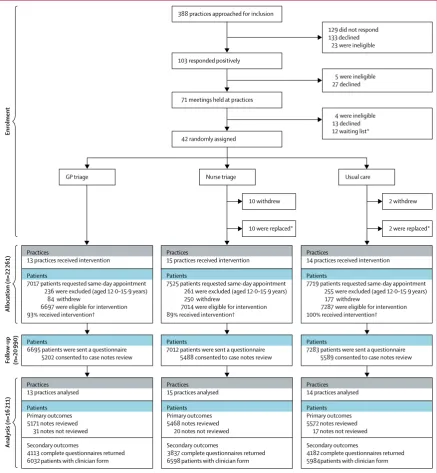
Figure 1 shows the trial profile. 42 practices were randomly assigned to GP triage (n=13; mean number of patients 540 [SD 69·5]), nurse triage (n=15; 502 patients [SD 133·5]), or usual care (n=14; 551 patients [SD 61·6]), and 13, 15, and 14 practices, respectively, were included in the primary analysis (515 [SD 69·5] vs 467 [SD 115·6] vs 520 patients [SD 59·6]; figure 1, appendix). 12 (29%) practices withdrew after randomisation (figure 1): 11 withdrew in the earliest stages after randomisation, usually before training in research procedures or the run-in period; only one practice withdrew during the data collection period. All withdrawing practices were purposively replaced with practices from the waiting list with similar characteristics and with allocation concealment preserved (figure 1).
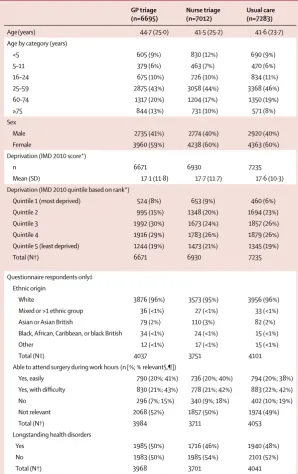
22 261 patients were eligible for inclusion, of whom 20 990 (94%) were sent a questionnaire (GP triage [n=6695], nurse triage [n=7012], usual care [n=7283; figure 1]). We obtained primary outcome data for 16 211 (99%) of 16 279 patients who consented to case-notes review (figure 1). Practice and patient characteristics were well balanced between groups (table 1; appendix). Most patients were female and those in the GP-triage group were slightly older (table 1). Questionnaire respondents were mainly white and about half of participants in each group had a longstanding health disorder (table 1). Of the roughly half of participants who responded that a question about accessibility of primary care services during working hours was relevant on the basis of their present employment status, most could attend the surgery during working hours, albeit largely only with difficulty (table 1).
We recorded an increase in the mean number of contacts per person after introduction of GP triage compared with usual care (rate ratio [RR] 1·33, 95% CI 1·30–1·36), a larger increase after introduction of nurse triage (1·48, 1·44–1·52), and a small increase for nurse
versus GP triage (1·04, 1·01–1·08; table 2). The intracluster correlation coefficient (0·015) was lower than that assumed in the original sample size calculation (0·05).
We did three planned secondary analyses of the primary outcome (data not shown). Findings from our
GP triage
(n=6695) Nurse triage (n=7012) Usual care (n=7283)
Age(years) 44·7 (25·0) 41·5 (25·2) 41·6 (23·7) Age by category (years)
<5 605 (9%) 830 (12%) 690 (9%)
5–11 379 (6%) 463 (7%) 470 (6%)
16–24 675 (10%) 726 (10%) 834 (11%)
25–59 2875 (43%) 3058 (44%) 3368 (46%)
60–74 1317 (20%) 1204 (17%) 1350 (19%)
≥75 844 (13%) 731 (10%) 571 (8%)
Sex
Male 2735 (41%) 2774 (40%) 2920 (40%)
Female 3960 (59%) 4238 (60%) 4363 (60%)
Deprivation (IMD 2010 score*)
n 6671 6930 7235
Mean (SD) 17·1 (11·8) 17·7 (11·7) 17·6 (10·3) Deprivation (IMD 2010 quintile based on rank*)
Quintile 1 (most deprived) 524 (8%) 653 (9%) 460 (6%)
Quintile 2 995 (15%) 1348 (20%) 1694 (23%)
Quintile 3 1992 (30%) 1673 (24%) 1857 (26%) Quintile 4 1916 (29%) 1783 (26%) 1879 (26%) Quintile 5 (least deprived) 1244 (19%) 1473 (21%) 1345 (19%)
Total (N†) 6671 6930 7235
Questionnaire respondents only‡ Ethnic origin
White 3876 (96%) 3573 (95%) 3956 (96%)
Mixed or >1 ethnic group 36 (<1%) 27 (<1%) 33 (<1%) Asian or Asian British 79 (2%) 110 (3%) 82 (2%) Black, African, Caribbean, or black British 34 (<1%) 24 (<1%) 15 (<1%)
Other 12 (<1%) 17 (<1%) 15 (<1%)
Total (N‡) 4037 3751 4101
Able to attend surgery during work hours (n [%; % relevant§,¶])
Yes, easily 790 (20%; 41%) 736 (20%; 40%) 794 (20%; 38%) Yes, with difficulty 830 (21%; 43%) 778 (21%; 42%) 883 (22%; 42%) No 296 (7%; 15%) 340 (9%; 18%) 402 (10%; 19%) Not relevant 2068 (52%) 1857 (50%) 1974 (49%)
Total (N†) 3984 3711 4053
Longstanding health disorders
Yes 1985 (50%) 1716 (46%) 1940 (48%)
No 1983 (50%) 1985 (54%) 2101 (52%)
Total (N†) 3968 3701 4041
[image:5.595.264.563.199.674.2]GP=general practitioner. IMD=Index of Multiple Deprivation. *IMD 2010 score and rank derived from residential postcode data mapped to lower super output area. †Missing data excluded. ‡4113 patients in the GP-triage group, 3837 patients in the nurse-triage group, 4182 patients in the usual-care group. §Denominators for proportion of relevant patients are 1916 for the GP-triage group, 1854 for the nurse-triage group, and 2079 for the usual-care group. ¶Relevance refers to patients who felt the question was relevant to them—ie, they worked during work hours as opposed to being retired.
Table 1: Baseline characteristics
For the English indices of
deprivation 2010 see https://
per-protocol analysis showed intensification of the noted effects of both GP triage and nurse triage (data not shown). All but two of the triage practices agreed to revert to usual care at the end of data collection; a sensitivity analysis showed this reversion had no effect on our results (data not shown). Analysis of cases with complete data yielded similar results to analyses including imputed data (data not shown).
Compared with usual care, introduction of GP triage substantially reduced the number of GP face-to-face contacts over the 28-day follow-up period (RR 0·61, 95% CI 0·54–0·69), increased mean numbers of GP telephone consultations per patient by ten times, and
slightly increased face-to-face consultations with a nurse (figure 2, appendix). Compared with usual care, introduction of nurse triage reduced GP face-to-face contacts over the 28-day follow-up period, which, although substantial (RR 0·80, 95% CI 0·71–0·90) was smaller than that noted with GP triage (figure 2, appendix). Furthermore, we recorded a small increase in mean numbers of GP telephone consultations per patient, a small increase in face-to-face consultations with a nurse, and an increase of 100 times in the mean number of nurse telephone contacts per patient (figure 2, appendix).
About half of patients who received usual care had just one contact after their initial consultation request compared with 23% in the GP-triage group and 12% in the nurse-triage group (appendix). Details of the 20 individual contact types that contributed to the primary outcome are presented in Supplementary table 2. Rates of failed consultations and non-attendance were similar between groups, but represented a slightly higher proportion of the total number of within-practice contacts in the usual-care group compared with the triage groups (appendix). The proportions of patients who reported contact with NHS Direct in the 28-day follow up, and the mean numbers of contacts reported, were similar between the three groups (appendix).
Eight patients died within 7 days of the index request (table 3). Two independent adjudicators deemed that the circumstances of the deaths were not associated with the trial group or procedures. We noted no significant increase in the proportion of patients with at least one emergency admission within 7 days of the index consultation request in either triage group compared GP triage (N=5171) Nurse triage (N=5468) Usual care (N=5572)
n (%) Contacts or costs
per person n (%) Contacts or costs per person n (%) Contacts or costs per person Total contacts (N)* 13 720 2·65 (1·74) 15 400 2·81 (1·68) 10 616 1·91 (1·43)
Within-practice contacts 13 238 (96%) 2·56 (1·60) 14 899 (97%) 2·72 (1·55) 10 182 (96%) 1·83 (1·31) Primary care out-of-hours 270 (2%) 0·05 (0·35) 287 (2%) 0·05 (0·33) 215 (<1%) 0·04 (0·27) Walk-in centre 32 (<1%) 0·01 (0·08) 31 (<1%) 0·01 (0·09) 32 (<1%) 0·01 (0·08) Accident and emergency department 180 (1%) 0·03 (0·19) 183 (<1%) 0·03 (0·22) 187 (<1%) 0·03 (0·21) Costs†
Practice level costs (triage, GP, nurse) ·· £69·18 (55·02) ·· £69·54 (50·33) ·· £69·78 (44·97) Total costs (primary outcome) ·· £75·21 (65·45) ·· £75·68 (63·09) ·· £75·41 (57·19)
Triage contacts (GP or nurse) ·· £13·01 (3·64) ·· £6·83 (2·40) ·· 0 GP contacts (excluding triage) ·· £51·66 (53·75) ·· £57·25 (48·79) ·· £66·39 (43·02)
Nurse contacts ·· £4·51 (10·84) ·· £5·46 (11·67) ·· £3·39 (9·73)
Primary care out-of-hours ·· £1·88 (13·66) ·· £2·16 (14·70) ·· £1·63 (12·40)
Walk-in centre ·· £0·25 (3·31) ·· £0·23 (3·54) ·· £0·24 (3·10)
Accident and emergency department ·· £3·90 (21·57) ·· £3·75 (24·28) ·· £3·76 (23·95)
[image:6.595.122.557.130.331.2]Data are mean (SD), unless otherwise indicated. GP=general practitioner. *After adjustment for practice (list size, location, and deprivation status) and patient characteristics (sex, age [categorised], and deprivation quintile). †No difference between groups after full adjustment for age (by category), sex, study site, practice size, deprivation by quintile, practice deprivation, and cluster by practice; regression methods for base case analyses used multilevel random-effects model (xt mixed), with Stata Corp 12.0.
Table 2: Primary care contacts and costs after index consultation request over the 28-day follow-up period, by group
GP triage Nurse triage Usual care 0
0·5 1·0 1·5 2·0 2·5 3·0
Mean number
of contacts
Nurse telephone Nurse face-to-face consultation GP home visit GP telephone GP face-to-face consultation
Figure 2: Primary care workload in the 28 days after index consultation request (within-practice contacts) by type of contact
[image:6.595.119.333.388.572.2]with usual care (table 3). The number of emergency admissions was small; however, participants in the triage groups had a slightly increased, albeit non-significant, risk of admission compared with those receiving usual care (table 3). Admissions in the nurse-triage group were, on average, slightly longer than those in the usual-care or GP-triage groups (table 3). We recorded no difference between the triage groups and usual care in the risk of a participant having at least one attendance to accident and emergency across 28 days’ follow-up (table 3).
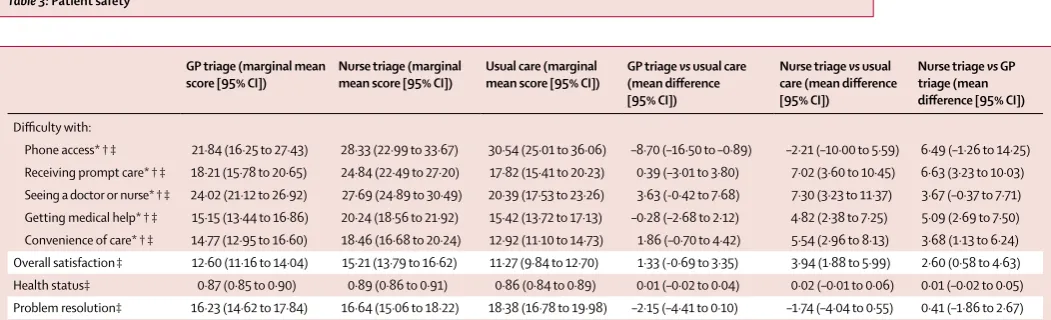
Patients in the GP-triage group reported that it was easier to get through to the practice on the telephone compared with usual care (table 4). Although there was no difference between the usual-care and GP-triage groups in ease of access to prompt care, patients in the nurse-triage group reported that access was more difficult (table 4). Patients in the nurse-triage group also reported increased difficulty in seeing a GP or nurse compared with those who received usual care, and in getting medical help or advice compared with those in either the usual-care or GP-triage groups (table 4).
Patients in nurse triage considered their care to be less convenient and reported lower overall satisfaction than patients in the other groups. We recorded no difference at follow-up in participants’ self-reported health status (EQ-5D score) or in problem-resolution between the three trial groups.
In the GP-triage group, 5120 (99%) of 5171 patients had their first management contact within the practice on the day of the index consultation request; 4796 (94%) of these patients received GP telephone triage. Of patients receiving GP triage, 1017 (21%) had no further primary health-care contacts within 28 days and no hospital admissions within 7 days of the index consultation request.
In the nurse-triage group, 5416 (99%) of 5468 patients had their first management contact within the practice on the day of the index consultation request; 4860 (90%) of these patients received nurse telephone triage. Of patients receiving nurse triage, 394 (8%) 4860 had no further primary health-care contacts within 28 days and no hospital admissions within 7 days of the index consultation request.
GP triage Nurse triage Usual care GP triage vs usual care
(OR [95% CI])
Nurse triage vs usual care (OR [95% CI])
Nurse triage vs GP triage
(OR [95% CI])
Total (case notes reviewed) 6695 (5171) 7012 (5468) 7283 (5572) ·· ·· ·· Total deaths (n/1000 patients) 5 (0·7) 2 (0·3) 1 (0·1) ·· ·· ·· Patients with at least one emergency
hospital admission (n [%]) 59 (1%) 69 (1%) 52 (<1%) 1·17 (0·75–1·85) 1·31 (0·83–2·07) 1·12 (0·73–1·72) Number of bed days for patients
admitted to hospital (mean [SD]) 3·4 (3·7) 4·5 (5·7) 3·8 (6·4) ·· ·· ·· Patients with at least one accident and
emergency attendance within 28 days of index day (n [%])
171 (3%) 156 (3%) 166 (3%) 1·18 (0·87–1·61) 1·09 (0·80–1·49) 0·92 (0·67–1·26)
[image:7.595.39.565.281.441.2]Mortality, and number and duration of emergency hospital admissions within 7 days, and patients with at least one accident and emergency department attendance within 28 days of index consultation request. GP=general practitioner. OR=odds ratio.
Table 3: Patient safety
GP triage (marginal mean
score [95% CI]) Nurse triage (marginal mean score [95% CI]) Usual care (marginal mean score [95% CI]) GP triage vs usual care (mean difference [95% CI])
Nurse triage vs usual care (mean difference [95% CI])
Nurse triage vs GP triage (mean difference [95% CI])
Difficulty with:
Phone access* † ‡ 21·84 (16·25 to 27·43) 28·33 (22·99 to 33·67) 30·54 (25·01 to 36·06) –8·70 (–16·50 to –0·89) –2·21 (–10·00 to 5·59) 6·49 (–1·26 to 14·25) Receiving prompt care* † ‡ 18·21 (15·78 to 20·65) 24·84 (22·49 to 27·20) 17·82 (15·41 to 20·23) 0·39 (–3·01 to 3·80) 7·02 (3·60 to 10·45) 6·63 (3·23 to 10·03) Seeing a doctor or nurse* † ‡ 24·02 (21·12 to 26·92) 27·69 (24·89 to 30·49) 20·39 (17·53 to 23·26) 3·63 (-0·42 to 7·68) 7·30 (3·23 to 11·37) 3·67 (–0·37 to 7·71) Getting medical help* † ‡ 15·15 (13·44 to 16·86) 20·24 (18·56 to 21·92) 15·42 (13·72 to 17·13) –0·28 (–2·68 to 2·12) 4·82 (2·38 to 7·25) 5·09 (2·69 to 7·50) Convenience of care* † ‡ 14·77 (12·95 to 16·60) 18·46 (16·68 to 20·24) 12·92 (11·10 to 14·73) 1·86 (–0·70 to 4·42) 5·54 (2·96 to 8·13) 3·68 (1·13 to 6·24) Overall satisfaction‡ 12·60 (11·16 to 14·04) 15·21 (13·79 to 16·62) 11·27 (9·84 to 12·70) 1·33 (-0·69 to 3·35) 3·94 (1·88 to 5·99) 2·60 (0·58 to 4·63) Health status‡ 0·87 (0·85 to 0·90) 0·89 (0·86 to 0·91) 0·86 (0·84 to 0·89) 0·01 (–0·02 to 0·04) 0·02 (–0·01 to 0·06) 0·01 (–0·02 to 0·05) Problem resolution‡ 16·23 (14·62 to 17·84) 16·64 (15·06 to 18·22) 18·38 (16·78 to 19·98) –2·15 (–4·41 to 0·10) –1·74 (–4·04 to 0·55) 0·41 (–1·86 to 2·67)
GP=general practitioner. *All models include random effect on practice. †Adjusted models adjust for practice variables: location (Devon, reference: Bristol, Warwick, Norwich); practice list size (large
[>8000 patients], reference: medium [3500–8000 patients], small [<3500 patients]); practice deprivation: non-deprived, at or below average deprivation for England by Association of Public Health Observatories [APHO] ratings, reference: deprived (above average for England by APHO ratings); and patient variables: age (categorised 0–4, 5–11, 16–24, 25–59, reference; 60–74, 75 and older), sex (reference: female), and Index of Multiple Deprivation 2010: deprivation based on residential postcode categorised into quintiles by rank (reference: least deprived, quintile 5). ‡Linearised on a scale of 0–100 (positive–negative outcome).
Mean clinician contact times for triage interventions were 4·00 min (SD 2·83) for GP triage and 6·56 min (3·83) for nurse triage, based on review of 5567 and 5535 clinician contact forms, respectively. Estimates of cost for the triage interventions (including staff training and set-up of the interventions, cost of computer decision support software in nurse triage, and clinician triage time) showed that GP triage had a mean cost of UK£14·03 per triage contact compared with £7·62 with nurse triage. The staff training cost component for GP triage represented a small proportion of triage cost (3·2%) compared with nurse triage. The training and software costs associated with computer decision support software represented 24·0% of the estimated cost for the nurse-triage intervention. Mean 28-day cost estimates for primary outcome contacts were similar for all three groups, at roughly £75 per index consultation request (table 2). The mean total 28-day cost associated with the primary outcome was comprised of mainly within-practice primary care contacts, which accounted for 92–93% of the estimated cost.
Discussion
Our findings show that, compared with usual care, introduction of GP triage or nurse triage was associated with an increase in the number of primary care contacts in the 28 days after a patient’s request for a same-day GP consultation. Although introduction of GP triage was associated with an increase in overall GP workload compared with usual care, we recorded a substantial reduction in GP face-to-face contacts. Nurse triage was also associated with an overall increase in total primary care workload; however, it too was associated with a reduction in GP contacts. These changes indicate a redistribution of GP workload from face-to-face to telephone consultations after introduction of GP triage, and a redistribution of workload from GPs to nurses after introduction of nurse triage. Despite these changes in patterns of workload, no difference was shown between groups in the average costs of health care in the 28 days after a same-day consultation request.
Most service use in all groups happened within practice settings. We noted low rates of patient non-attendance, in line with findings reported elsewhere,22
which provides no support for the suggestion23 that
triage might be associated with reductions in non-attendance. Overall, triage seemed to be safe, with no evidence of excess deaths, hospital admissions, or attendance at accident and emergency departments attributable to triage. However, our trial was not powered to inferentially test safety outcomes and we cannot conclusively rule out differences between study groups. In view of this factor and of other evidence,24,25
caution is needed before firm conclusions can be drawn from these results, and further studies, possibly
including different study methods such as significant event audit, might provide useful additional evidence about the safety of triage.
The absence of an increase in attendance in accident and emergency departments or in use of out-of-hours GP services after introduction of either GP triage or nurse triage suggests that triage is not regarded as a sufficient barrier that could result in patients seeking care outside of their practice;26 nor does easier access to telephone
advice in general practice seem to reduce patient contacts in other settings. Introduction of nurse triage was associated with a reduction in overall patient satisfaction, but more substantial reductions in some individual components of satisfaction were suggestive of patients’ experience of care. There was no evidence of any difference in health outcomes associated with either form of triage compared with usual care.
Because most contacts were in general practice, our data provide important evidence about general practice workload. Past research has suggested that telephone triage or consultation by a GP or a nurse might be associated with a reduction in GP same-day consultations of about 40% (panel).3,6 However,
recons-ultation rates within the few weeks after telephone consultation increased by a similar magnitude.3,5 Any
reduction in GPs’ workload from reduced numbers of face-to-face contacts was more than compensated for by a substantial increase in the number of telephone contacts undertaken in GP triage. By contrast, introduction of nurse triage seemed to result in an overall reduction in GP workload, but with no reduction in overall costs.
After a same-day consultation request, most primary care contacts were in the practice on the index day. GPs undertaking telephone care have been reported to definitively manage roughly 29% of same-day requests 6
and nurses to definitively manage roughly 26%.3,28 In our
study, about half of patients in the usual-care group had only one primary care or accident and emergency contact in the 28 days after their consultation request; in GP triage this proportion was one-quarter, and in nurse triage, it was about one-tenth.
This trial included a large number of practices and patients. The size and focus of the trial, targeting a group of patients who represent about 30% of GP workload,2 the few exclusion criteria, and the
geographical spread of participating practices increases the generalisability of the findings. The trial was fully powered and we exceeded our recruitment target in gaining access to the primary outcome data, partly because of a process of obtaining initial verbal consent to participate.
Because we recruited in four geographical centres, and recruited practices with a range of practice characteristics and settings, we believe that the external validity of the study is reliable. Of the twelve practices that withdrew from the study, ten had been randomised to deliver nurse triage. The study seemed to be of interest to many practices; however, recruitment of practices with little or no triage experience could have meant some were not fully aware of the practical and organisational implications of taking part, especially if randomised to nurse triage. Although only one practice withdrew after starting the intervention, we believe that practices only fully appreciated the challenge of delivery of nurse triage after randomisation, because this intervention necessitated sufficient availability of nurse time every day from nurses who were trained to undertake computer-assisted triage. Time and practical constraints restricted our ability to match replacements on the stratification variables of withdrawal practices. However, we feel that our method of replacing practices, which carefully ensured allocation concealment throughout, substantially protected our findings against concerns regarding recruitment bias.
We used a pragmatic approach to examine GP triage or nurse triage for a specific group of patients, over a specific period of time, and with a modified approach to introduction of triage compared with some alternative models23 (eg, we did not incorporate a substantial
clearing of the appointment system at the outset of triage implementation). Future research might usefully explore the use of telephone triage for a much broader group of patients, such as is proposed by some advocates of doctor-first models of care;29,30 might
examine outcomes after a longer period of intervention; or might adopt alternative approaches to triage implementation. Such investigation would probably be usefully informed by the findings of this study. We feel unable to speculate on the relevance of our findings to contexts that have different arrangements for access to primary care than exist in the UK, with its almost universal registration of patients with a primary care practice and overall high levels of patient satisfaction with the accessibility of primary care.31 However, we
believe our findings will be of interest in the many settings where primary care is being prioritised as a means of meeting health-care needs in cost-constrained environments.
Our findings suggest that, overall, triage whether by a GP or by a nurse using computer decision support software should be introduced with full awareness of whole-system implications, particularly with regards to distribution of practice workload and in consideration of patients’ experience of care. Our results might be of varying relevance for different practices. For example, if the priority is to reduce demand on GPs, then introduction of nurse triage might be worthy of consideration. However, if the priority is to reduce GP
face-to-face workload, introduction of either GP triage or nurse triage might be of relevance, while recognising that substitution of telephone consultations for face-to-face consultations does not reduce overall workload but changes the nature of that workload. Individual practices and health organisations might thus wish to consider the implications of these results to their particular setting, circumstances, and challenges in delivery of care. Telephone triage of patients seeking same-day consultations with a GP could support the delivery of patient care, and potentially offers a useful approach in the armamentarium of methods aiding the delivery of effective primary care.
Panel: Research in context
Systematic review
In the past few years, primary care workload has increased in the UK. One approach to management of this additional workload has included use of telephone consultation and
triage. In 2009, Bunn and colleagues27 reported the results of a systematic review
examining the effects of telephone consultations and triage on health-care use and
patient satisfaction. Nine studies were identified, four of which were in UK primary care.3–6
We searched Medline (OVID), the Cochrane database, CINAHL, and DARE from July 1, 2007, to April 11, 2014, with the keywords “telephone triage”, “hotlines”, “telephone consultation”, “emergency medicine”, “primary care”, “general practice”, and “family practice”, to identify whether any additional randomised controlled trials had been done since this review. We included trials that assessed telephone consultations undertaken by a doctor or a nurse, compared face-to-face consultation with usual care (not including telephone consultation), or compared telephone consultations undertaken by a doctor with those undertaken by a nurse. We excluded studies of disease-specific care provided via phone services. Outcomes of interest were general practice workload, health resource use, safety, patient satisfaction, and cost. We screened titles and abstracts of citations identified by the electronic searches, but identified no additional trials to those reported by Bunn and colleagues. Important methodological differences precluded the possibility of doing a meta-analysis combining our data with data from these smaller trials and observational studies.
Bunn and colleagues’ research concluded that telephone consultations might reduce general practice workload, but emphasised that, in view of the methodological flaws and small sample sizes, more rigorous assessments were necessary, especially of service use, safety, and patient satisfaction. No subsequent large-scale studies have examined the effectiveness or cost-consequences of telephone consultation and triage in routine primary care.
Interpretation
Contributors
JLC was chief investigator; NB, CG, TAH, VL, DAR, SHR, CS, RST, and JLC were coapplicants for funding and designed the original study protocol; TAH, VL, CS, and JC were principal investigators for the four recruitment centres; CG led the economic evaluation; EF and RC coordinated the trial over the four centres and was responsible for obtaining research ethics and governance approvals; EF, RC, VB, KC, JR, and AV collected and managed the data; RST, CG, and FCW developed the statistical analysis plan; and FCW and RK analysed the data. All authors contributed to interpretation of results and drafting of the final article, including critique for important intellectual content.
Declaration of interests
We declare that we have no competing interests.
Acknowledgments
The project was funded by the National Institute for Health Research Health Technology Assessment programme (project 08/53/15). The views and opinions expressed herein are those of the authors and do not necessarily reflect those of the Health Technology Assessment programme, the National Institute for Health Research, the National
Health Service,or the Department of Health. We thank the members of
the Trial Steering Committee: Brian McKinstry (University of Edinburgh), Sandra Eldridge (Queen Mary University of London), Brendan Delaney (King’s College London), Louise Locock (University of Oxford), Barbara Tilbury (patient representative), Geoff Barr (patient representative); the Data Monitoring Committee: Bruce Guthrie (Dundee University), Ben Carter (Cardiff University), and Paul Kinnersley (Cardiff University); the Cochrane Effective Practice and Organisation of Care group for supporting literature searching; our Patient and Public Involvement group, staff and patients of our participant practices, South West 2 Research Ethics Committee and the primary care trusts, and comprehensive local research networks and primary care research networks across the four centres; Denis Pereira-Gray for his comments on the draft of the manuscript; Donna Poade, Amy Gratton, Julia Carver, Gillian Blunt, and Vivienne Owen for their administrative support; Claire Telford, Sue Rugg, and Linnie Price for their contribution as researchers; Jeremy Dale and Plain Healthcare who provided the computer decision support software and training to support the nurses’ triaging decisions; and Steve Clay and Dillon Sykes from Productive Primary Care for training and advising intervention practices.
References
1 Hippisley-Cox J, Vinogradova Y. Trends in consultation rates in general
practice 1995/1996 to 2008/2009: analysis of the QResearch® database. September, 2009. http://www.hscic.gov.uk/catalogue/PUB01077/tren-cons-rate-gene-prac-95-09-95-09-rep.pdf (accessed July 17, 2014).
2 Stoddart H, Evans M, Peters TJ, Salisbury C. The provision of
‘same-day’ care in general practice: an observational study.
Fam Pract 2003; 20: 41–47.
3 Richards DA, Meakins J, Tawfik J, et al. Nurse telephone triage for
same day appointments in general practice: Multiple interrupted time series trial of effect on workload and costs. BMJ 2002; 325: 1214–17.
4 Lattimer V, George S, Thompson F, et al. Safety and effectiveness of
nurse telephone consultation in out of hours primary care: randomised controlled trial. The South Wiltshire Out of Hours Project (SWOOP) Group. BMJ 1998; 317: 1054–59.
5 McKinstry B, Walker J, Campbell C, Heaney D, Wyke S. Telephone
consultations to manage requests for same-day appointments: a randomised controlled trial in two practices. Br J Gen Pract 2002;
52: 306–10.
6 Jiwa M, Mathers N, Campbell M. The effect of GP telephone triage
on numbers seeking same-day appointments. Br J Gen Pract 2002;
52: 390–91.
7 NHS Information Centre. GP workload survey 2007. 2008. http://
www.ic.nhs.uk/pubs/gpworkload. (accessed June 6, 2014).
8 Mohammed MA, Clements G, Edwards E, Lester H. Factors which
influence the length of an out-of-hours telephone consultation in primary care: a retrospective database study. BMC Health Serv Res 2012; 12: 430.
9 Campbell MK, Piaggio G, Elbourne DR, Altman DG. Consort 2010
statement: extension to cluster randomised trials. BMJ 2012;
345: e5661.
10 Campbell JL, Britten N, Green C, et al. The effectiveness and cost-effectiveness of telephone triage of patients requesting same day consultations in general practice: study protocol for a cluster randomised controlled trial comparing nurse-led and GP-led management systems (ESTEEM). Trials 2013; 14: 4. 11 UK Government. Indices of multiple deprivation 2010. 2013.
https://www.gov.uk/government/publications/english-indices-of-deprivation-2010 (accessed June 6, 2014).
12 Plain Healthcare. Odyssey clinical decision support software. 2008. http://www.plain.co.uk/index.php?option=com_content&task=view &id=20&Itemid=34 (accessed June 6, 2014).
13 Campbell JL, Britten N, Green C, et al. The effectiveness and cost-effectiveness of telephone triage of patients requesting same day consultations in general practice: study protocol for a cluster randomised controlled trial comparing nurse-led and GP-led management systems (ESTEEM). HTA (in press). 14 GP Patient Survey. 2013. www.gp-patient.co.uk (accessed
June 6, 2014).
15 Venning P, Durie A, Roland M, Roberts C, Leese B. Randomised controlled trial comparing cost effectiveness of general practitioners and nurse practitioners in primary care. BMJ 2000; 320: 1048–53. 16 Kinnersley P, Anderson E, Parry K, et al. Randomised controlled
trial of nurse practitioner versus general practitioner care for patients requesting “same day” consultations in primary care. BMJ 2000; 320: 1043–48.
17 EuroQol group. EuroQol--a new facility for the measurement of health-related quality of life. Health Policy 1990; 16: 199–208. 18 White IM, Royston P, Wood AM. Multiple imputations using
chained equations: Issues and guidance for practice. Stat Med 2011;
30: 377–99.
19 Curtis L. Unit costs of health and social care 2012. University of Kent at Canterbury: PSSRU, 2012.
20 National Institute for Health and Clinical Excellence (NICE). Assessing cost impact: methods guide. London, UK: NICE, 2011. 21 Craig D, Rice S. CRD Report 6: NHS economic evaluation database
handbook. York, UK: Centre for Reviews and Dissemination, 2007. 22 Salisbury C, Montgomery AA, Simons L, et al. Impact of Advanced
Access on access, workload, and continuity: controlled before-and-after and simulated-patient study. Br J Gen Pract 2007; 57: 608–14. 23 NHS Institute for Innovation and Improvement. Stour Access
System: a new way to manage GP appointments. Better for GPs, better for patients, better all-round. 2008. http://www.institute.nhs. uk/care_outside_hospital/care/finding_supporting_knowledge_ and_information.html (accessed June 6, 2014).
24 McKinstry B, Hammersley V, Burton C, et al. The quality, safety and content of telephone and face-to-face consultations: a comparative study. Qual Saf Health Care 2010; 19: 298–303.
25 Richards DA, Meakins J, Tawfik J, Godfrey L, Dutton E, Heywood P. Quality monitoring of nurse telephone triage: pilot study.
J Adv Nurs 2004; 47: 551–60.
26 Zhou Y, Abel G, Warren F, Roland M, Campbell J, Lyratzopolous G. Do difficulties in accessing in-hours primary care predict higher use of out-of-hours GP services? Evidence from an English National patient survey. Emerg Med J 2014; published online May 21. DOI:10.1136/emermed-2013-203451.
27 Bunn F, Byrne G, Kendall S. Telephone consultation and triage: effects on health care use and patient satisfaction.
Cochrane Database Syst Rev 2009; 4: CD004180.
28 Gallagher M, Huddart T, Henderson B. Telephone triage of acute illness by a practice nurse in general practice: outcomes of care.
Br J Gen Pract 1998; 48: 1141–45.
29 Patient Access. 2013. http://www.patient-access.org.uk (accessed June 6, 2014).
30 Productive Primary Care. 2013. http://www.productiveprimarycare. co.uk (accessed June 6, 2014).
31 Campbell J, Smith P, Nissen S, Bower P, Elliott M, Roland M. The GP Patient Survey for use in primary care in the National Health Service in the UK—development and psychometric characteristics.