0
"'
,.
OF THE EUROPEAN COMMUNITIES
t\IPll
IRISH BORDER AREAS
INFORMATION
REPORT
ed the publication of this Information Report at its 213th Plenary Session, which was held on 14 and 15 December 1983.
1J-0-s-
)6'-;-
J-)
+· 7''-f/,I"
\_ECONOMIC AND SOCIAL COMMITTEE
OF THE EUROPEAN COMMUNITIES
~IRISH
BORDER AREAS
INFORMATION
REPORT
Brussels, 1983
A bibliographical slip can be found at the end of this volume.
The assistance of local government and other organisations in the compilation of this Information Report is gratefully acknowledged.
Texts appearing in this document may be reproduced freely in whole or in part provided their source is mentioned.
Preface ... I
PART I INFORMATION REPORT
Introduction ... .
Distinguishing Features of the Irish Border Areas ... 1
Study Visit Programme . . . 2
A Summary of the Findings . . . 3
Priority Objectives . . . 4
Joint Projects to Receive Priority Attention .. .. .. .. .. . . .. .. .. .. .. .. .. . .. .. 5
Other Highly Recommended Projects .. .. .. .. .. .. .. .. .. .. .. .. .. .. .. .. . .. .. .. 7
Development Schemes . . . 9
Summary of Recommendations 10 PART II BACKGROUND PAPERS Demographic Features 11 General Infrastructure ... 12
Industry . . . 13
Agriculture . . . 17
Arterial Drainage . . . 20
Forestry ... 23
Tourism 24 List of Local Submissions . .. .. .. . .. . .. .. .. .. .. .. .. .. .. .. .. .. .. . .. .. . .. .. .. .. .. . 27
Bibliography . . . ... . . 28
TABLES MAPS PART III AREAS SUMMARIES Donegal ... . Londonderry ... . Strabane Lei trim Cavan Fermanagh ... . Omagh ... . Dungannon Monaghan 29 31 33 35 37 39 41 43 45 Newry & Mourne . . . .. .. . . .. . .. . . .. . . .. .. . .. . .. .. .. . . . .. . .. . . .. . . .. . . .. . . . .. . 47
On 27 October 1982, the Bureau of the Economic and Social Committee authorised its Section for Regional Development to prepare an Information Report on the Development of the Irish Border Areas.
The preparatory work was assigned to the following Study Group:
Chairman:
Rapporteur:
Members:
Experts:
Giancarlo Zoli
Jean Barnard
Dietmar Cremer
Italy: Bureau of the Council of Euro-pean Municipalities
France: President, French Christian Workers' Association (CFTC)
Germany: German Trade Union Confederation
Henry J. Cur lis Ireland: Past-President Irish Congress of Trade Unions
Michael T. Fuller United Kingdom: South Lancashire, Cheshire and North Wales Engineering Employers' Association.
Athanassios Kamizolas Greece: Secretary General, Council for Economic and Social Policy (SKOP)
Sean Kelly Ireland: President, Irish Creamery Milk Suppliers Association
Patrick Murphy Ireland: Assistant General Secretary, Federated Workers Union of Ireland
Gordon Pearson Ireland: Executive Committee Member of the Federated Union of Employers
Moyra A. Quigley United Kingdom: Member of the Livestock Marketing Commission for Northern Ireland
Giacomo Regaldp Italy: Head of Brussels Office, Italian Trade Confederation
Roland Wagner France: President, Chamber of Com-merce and Industry of Strassbourg and the Lower Rhine
Terry Carlin
Malcolm Mclennan
Frank Keelaghan
Anthony Leddy
Northern Ireland Officer, Irish congress of Trade Unions
Senior Lecturer in Economics, Univer-sity of Glasgow
Senior Official Monaghan County Council
Former President, Irish Creamery Milk Suppliers Association
The Section for Regional Development adopted the Information Report on 11 November 1983.
The Economic and Social Committee authorised the publication of the Information Report at its Plenary Session held on 13 December 1983.
PART
I
In embarking on a study of the Irish border areas, the Economic and Social Committee's intention was to ascertain what the Community could do to assist these areas which, besides being amongst the least economically and socially developed in Europe, have the additional disadvantage of being cut in half by a frontier that hampers normal economic development.
This Report is concerned with an area of 20-30 miles on both sides of the frontier, encompassing the district council areas of Londonderry, Strabane, Omagh, Fermanagh, Dungannon, Armagh and Newry-Mourne (N. Ireland), and the counties of Donegal, Leitrim, Cavan, Monaghan and Louth (Republic).
Distinguishing Features of the Irish Border Area
The area covers 1,697,000 hectares spanning a 343 km land frontier and has a population of 747,000 (540Jo in Northern Ireland and 46% in the Republic).
Statistics indicate that the area is particularly handicapped and has a special claim on Community assistance. Farming is the lynchpin of the economy-particularly in the south - and there is relatively little industrial employment. Very low incomes, acute unemployment, outward migration and in some parts, falling population, are further features. Small farms, poor soil, population structure and inheritance and marriage patterns combine to impede the introduction of modern farming methods.
At present, cooperatives, tourism and small business appear to hold out the best hopes for development.
In many parts, road infrastructure, domestic water supply networks and drainage systems are clear-ly inadequate and those which do exist are sometimes disrupted by damage caused by the troubles in the area.
These geographical and social drawbacks are ag-gravated by the existence and proximity of the fron-tier, which restricts scope for development and trade.
The Community's, and the Committee's, con-cern with frontier areas in the context of regional development policy is not new. One criterion for grants from the quota section of the European Regional Development Fund (ERDF) specifically mentioned in Regulation 724/75 (Article 5.1.(d)) establishing the Fund is whether the investment falls within a frontier area, that is to say, within regions adjacent to one or
1) OJ No. C 178, 15 July 1982, page 38.
more otherMember States. In its Opinion on the revised ERDF Regulation1, the Committee urged that the development of frontier areas be taken into account in the allocation of aid from the quota-free section in the same way as in the allocation of aid from the quota section.
The Community has not been inactive with regard to this particular frontier area: a number of studies (e.g. Londonderry/Donegal Communications Study, Erne Catchment Area Study) have been co-financed by the EEC; and at least two measures specific to the area have been adopted, namely
a) a programme to promote drainage in catchment areas covering land on both sides of the border (Direc-tive 79/197);
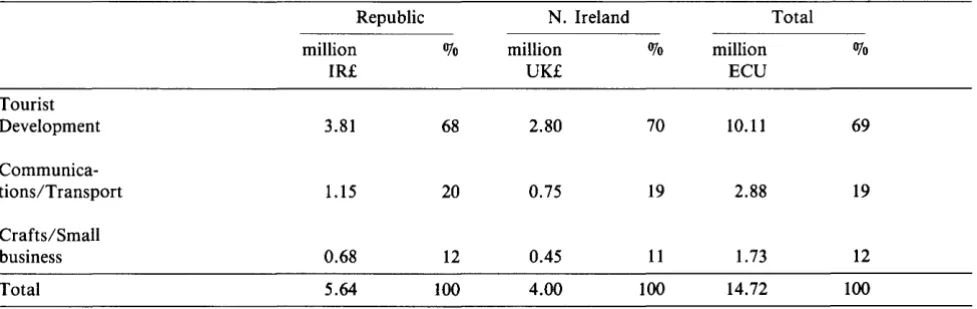
b) a specific regional development measure (quota-free) for the improvement of the economic and social situa-tion of the border areas with special aids for tourism, small business and handicrafts (Regulation 2619/80).
In addressing itself to the economic and social difficulties of these frontier areas, the Committee is thus concerned to assess not only whether the Com-munity is doing all it can to help one of its particularly disadvantaged areas. It is also concerned to ascertain what else, if anything, can be done to alleviate the par-ticular obstacles to economic development arising out of the existence of the border. This is particularly im-portant because such economic effects are a major preoccupation of the Community.
Study Visit Programme
The Study Group set up by the Section for Regional Development toured the entire border area. The Group was received by Lord Gowrie, Minister of State, who preceeded Mr Adam Butler at the Northern Ireland Office, and by the following local authorities:
Dundalk Urban District Council (in Dundalk)
Newry and Mourne District Council (in Newry)
Monaghan County Council (in Monaghan)
Cavan and Leitrim County Councils (in Cavan and Ballinamore)
Representatives of the Fermanagh, Omagh and
Dungannon District Councils (in Enniskillen)
Donegal County Council (in Letterkenny)
Strabane District Council (in Strabane)
Londonderry District Council (in Londonderry).
Talks were also held with Mr Peter Barry, Irish Minister for Foreign Affairs. In the preliminary stages,
contacts were established with Mr Barry's predecessor, Mr Gerry Collins.
In each area, reports were submitted in various forms by representatives of local government, farm-ing, industry, tourism, public services, trade unions, local and regional development agencies, education and training bodies, and a broad cross-section of all sec-tors of economic and social activity.
This was the first visit to the Irish border areas by a Community delegation. The Committee party received a warm welcome everywhere and the reports submitted by the various groups on the ground were of an extremely high calibre.
A Summary of the Findings
The border areas are distinguished by a large number of common features in respect of population, amenities, economic activities and soil types.
Although compartmentalization is necessarily somewhat arbitrary, the twelve areas in question can be grouped together in three broadly homogenous groups:
East: Armagh, Newry-Mourne and Louth
Centre: Omagh, Fermanagh, Dungannon, Leitrim, Cavan and Monaghan
West: Londonderry, Strabane and Donegal.
A table summarizing the needs pinpointed by the local interests in each area is given below. A more detailed summary of the data collected on the spot is
provided in Parts II and III.
As a general rule, the report reflects the situa-tion as of early 1983. Cost estimates are given in Euro-pean Currency Units (ECU s) at 1983 prices ( 1 ECU =
UK£ 0.61; = IR £ 0.69). It must however be understood that the figures given are orders of magnitude. Detailed costings would need to be work-ed out for each project by the appropriate authorities.
In every area visited, the highest priority which emerged, directly or indirectly, was employment. In many cases it was mentioned as the top priority. In other cases it was the basic motivation behind the pro-posals contained in the submissions. The creation of employment should therefore be regarded as underly-ing all of the recommendations and all of the requests received. The latter are summarized in the following table:
Summary of the Principal Requests
WEST CENTRE EAST
Londonderry Strabane Omagh Fermanagh Dungannon Armagh Newry-Mourne
Rural develop- Small business Tourism Drainage (Erne) Agriculture Dual
car-ment riageway to
programme Roads (by-pass) Roads Roads (Belfast) Drainage Dundalk with
Newry by-pass Industrial Animal Small business St. Angelo Small
development feedstuffs Airport business Railway station
North zone Agriculture
Customs posts Vocational Customs
Urban renewal Less-favoured training clearance
(inner city) Areas Tourism facilities
Extension of Agriculture
airport (drainage,
forestry)
Industry Development of the Erne Roads
Joint
Tourism Agricultural services Railways
projects
Drainage
Donegal Leitrim Cavan Monaghan Louth
Roads Roads Transport Roads Roads (Newry)
(Derry /Dublin)
Drainage Agriculture Agriculture Agriculture
Water supply
Landing strip Cooperatives Cooperatives, Water supply
South Telephone
Tourism Forestry Drainage (Erne) system Small business
products
Telephone system Water supply Small business
Telephone
system Telephone Agriculture
system (pigs, poultry)
Priority Objectives
Throughout the visit, it was clear that several factors were of priority importance in developing the region and solving the abovementioned predominant problem of unemployment which varies in intensity in different areas.
The priorities are:
Communications Infrastructure
Communications are clearly a key priority for developing the region which is undoubtedly put at a disadvantage by its peripheral location in relation to both countries and to the Community as a whole.
Improved communications are a precondition for industrial development and the expansion of agriculture and tourism.
Improvements should focus inter alia on the following areas:
I. first and foremost on roads and the improvement of certain trunk routes in particular. The lack of ade-quate customs clearance facilities is however a major-problem here. The situation would also be improved in some areas by the re-opening, where circumstances permit, of certain more important cross-border roads whose closure is a major obstacle to the normal flow of traffic; there is moreover a paucity of public transport in the area, particularly south of the border, where private transport is no longer a luxury but a necessity. The crippling taxes on fuel and vehicles are a specific factor in the high cost of public transport;
2. telecommunications;
3 . rail links in some areas;
4. inland waterways: a more comprehensive network could have numerous benefits for tourism;
5 . air transport.
Agriculture and Industry
Agriculture, which is the major economic activi-ty in the area, particularly in the south, is badly in need of modernization, but industry must provide the widest scope for job creation.
Agriculture has a wide variety of needs:
1 . first and foremost, land drainage;
2 . farm modernization (a task which is complicated by the small scale of holdings) and improvement of far-ming methods;
3. processing and marketing of agricultural produce;
4 the need for a regular supply of reasonably priced feedstuffs for intensive livestock and poultry production;
5. more effective stockfarming methods and preven-tion of animal diseases;
6. development of forestry and processing of forestry products;
7 . improved retirement incentives for elderly farmers to pave the way for young people who wish to come into farming.
Acute problems are generated by some aspects of the Common Agricultural Policy, such as: the classification and extension of hill-farming areas and of less-favoured areas (Directive 75/268), the level of financial support under this scheme, and the distortion of trade owing to price and MCA discrepancies (ex-change rate fluctuations).
The agricultural classification of the entire area should therefore be reviewed.
There are also considerable difficulties created by the frequent exchange rate fluctuations on both sides of the border. They affect not only agricultural tran-sactions but the entire range of trade.
Priority areas for industry include:
1 . developing suitably equipped industrial zones back-ed up by appropriate marketing facilities;
2. processing farm products (see above);
3 . aiding agencies which are active in job creation, in-ter alia by encouraging appropriate cross-border cooperation;
4 . developing the craft industries which are necessary in small communities;
5. vocational and industrial training centres.
Tourism is one of the major potential assets and must be encouraged by action on several fronts.
The abovementioned improvements to the transport and inland waterway networks are vital in promoting tourism. In addition specific action must be taken to:
1 . equip holiday sites (forest-parks, lakes, etc.)
3 . prepare and distribute maps and joint promotional material for the entire area.
Development of Rural Towns
Much could be done to improve the appearance, physical use and amenity value of small towns in border areas. Such action would make a major contribution to improving the quality of life and stimulating civic pride and initiative, as well as creating conditions con-ducive to attraction of tourists and industrial development.
Other Factors
Reference was frequently made to difficulties connected with:
1 . energy: e.g. price differences between North and South; need for natural gas supply and interconnec-tion of the electricity systems North and South
2 . housing: improvements necessary in both rural and urban areas
3. education and training.
Joint Projects to receive Priority Attention
Bearing in mind the above requirements and the need to alleviate the handicaps to economic develop-ment created by the existence of the border, three areas of action would seem to merit priority attention on ac-count of (a) their crucial importance for the develop-ment of the areas concerned and (b) the cross-border cooperation and joint projects already underway in these spheres.
Eastern Zone:
Communications and Energy supply
Links between Newry and Dundalk are a vital component in the major Dublin-Belfast axis. At the moment there are serious physical and administrative barriers to traffic in the area even though the Newry-Dundalk stretch has been designated as part of a Euro-route from Larne to Rosslare.
A package of measures is therefore proposed including:
1 . widening the Newry-Dundalk road (app. 13 miles);
2. the Newry-Dundalk road scheme must be accom-panied by improved customs clearance facilities and simplification of formalities; at the moment, cross-ing the border within an urban area causes serious congestion and often takes several hours; improv-ed clearance facilities are however not necessarily contingent on upgrading the Dundalk-Newry road;
3 . the railway station at Bessbrook should be refurbish-ed and re-openrefurbish-ed to serve Newry and district. A con-necting bus service to Newry town centre should be provided.
Following the hydrocarbons finds off the south coast of Ireland, the two governments have recently reached agreement on the extension of the gas pipeline northwards from Dublin to Belfast and Londonderry. The Route, whether overland or under sea will have to pass close to the urban areas of Dundalk and Newry. Spurs serving these towns would not only substantial-ly aid their development but would also increase the return on the pipeline. The cost of the spurs would be substantially reduced by an overland routing which would also open up the supply to other important population centres in the Republic (Drogheda) and in Northern Ireland (Portadown, Lurgan and Lisburn). The network could then be extended to other areas (Ar-magh, Monaghan, etc.) as far as economically feasible.
At a rate of 1.5 million ECU per mile, the new Newry-Dundalk road would cost approximately 20 million ECU. The European Investment Bank and the NCI could support this scheme by providing loans coupled with interest rebates3• The European Regional
Development Fund could also provide grants of up to
30% from either quota or non-quota funds. Aid may also be available under the multiannual transport in-frastructure programme proposed by the European Commission. Approval will be subject to the conclu-sions of the EEC co-financed study currently underway4
• It also presupposes agreement on the route and the consequent cost-sharing.
There should be no great difficulty in funding the railway station and customs clearance projects at an approximative cost of 400,000 ECU and 1.6 million ECU respectively.
The Newry and Dundalk gas pipeline spurs (casted at approximately 8 million ECU) could be part-financed by the NCI.
The proposed package would undoubtedly pro-vide a significant boost for the development of both Newry and Dundalk. It would also have considerable spin-off benefits for (a) the entire Newry-Mourne and County Louth area and (b) general traffic and trade between Dublin and Belfast and between north and south.
Central Zone: Erne Development Scheme
First and foremost, and in line with the conclu-sions of the Erne Catchment Study, Community funds should be used to assist the completion or development of the following three inland waterway links: Ballyconnell-Ballinamore (priority project), Lough Oughter-Upper Lough Erne and Lough Head-Lisnaskea. These projects would extend the navigable inland waterway system, in particular between the Erne and Shannon catchment areas. This would create an important fishing and tourist centre which would in-evitably attract a large number of tourists and thus benefit the entire region. The projects must however be designed both to allow the work to be carried out independently of drainage and to fit in with subsequent drainage proposals.
Secondly, appropriate drainage schemes should be used to develop the entire Erne catchment area. This development would undoubtedly make a major con-tribution to improving farm incomes in an area which is seriously handicapped by difficult land and poor draining soil and where agriculture is the principal economic activity.
In view of the size of the scheme and the number of complex, inter-related issues wh,ich have to be taken into account, the detailed design and planning of the project must first be completed. This would clear the way for a firm decision and any necessary amendments to both northern and southern legislation on drainage projects. The necessary work could then be undertaken in stages, over a number of years, with due regard for agricultural interests around Upper Lough Erne as well as for environmental conservation, and for fishing and tourism.
The proposed drainage scheme has been casted at approximately 50 million ECU but it should be im-plemented in stages, as and when funds become available. Finally, the completion of the Blackwater-drainage scheme should be speeded up by ensuring that the project is adequately funded.
The EAGGF must provide substantial funding for all these projects. The European Regional Develop-ment Fund should also play its part. This would preferably entail a special quota-free programme (in-land waterway projects to assist the tourist industry).
The Industrial Triangle of the Western Zone
An industrial development zone based on the Letterkenny-Londonderry-Strabane triangle should be established. This is essential to the development of the north-western zone.
The difficulties which this would entail should not be underestimated since the triangle is already draw-ing maximum benefit from existdraw-ing aids which could not easily be increased. On the northern side, the re-cent creation of the Londonderry Enterprise Zone, backed by LEDU (Local Economic Development Unit) and the IDB (Northern Ireland Industrial Development Board) shows the importance attached to efforts to pro-mote employment there. However, there is a need for a qualitative shift. This could be sought by pooling ef-forts within a cross-border development agency. This agency should be set up by representatives of economic and social activity in the area and should enjoy the full backing of the Belfast and Dublin authorities (in par-ticular, the Northern Ireland Industrial Development Board and the Republic's Industrial Development Authority). The agency's task would be to coordinate the financial incentives for industry provided by the northern and southern authorities and by the European Community. It would launch technical and commer-cial promotion schemes, provide advice and back-up facilities for small business in the area, and in general, endeavour to promote investment and create employment.
The European Community could fund the agen-cy's activities under a special quota-free programme.
In addition, the drive to develop cross-border road links which was launched some years ago5 should
be completed, with particular emphasis on the follow-ing stretches:
Letterkenny /Londonderry
Letterkenny /Strabane
Londonderry /Strabane (including the Strabane through-pass).
The Londonderry /Dublin trunk road
connec-tion would be improved by the upgrading of the Londonderry /Strabane stretch, the construction of a through-pass for Omagh and improvements near the border.
These improvements to the road network could also make an important contribution to the expansion of tourism in Donegal, particularly i;.:m Londonderry airport. Of course the entire package has still to be costed since all factors are not available at the moment.
Other Highly Recommended Projects
Development of Rural Towns
Funds totalling 20 million ECU should be ear-marked to finance development of rural towns. Com-munity participation should be as high as possible with support being available for programmes designed to im-prove appearance and remedy shortage of basic amenities. The projects falling within such program-mes could include: road improvements to ease bot-tlenecks, clearance of abandoned sites, removal of eyesores, provision of offstreet parking, creation of open space and play areas, and generally, provision of such other types of environmental infrastructure as would be necessary to revitalize and refurbish these focal regional centres (sewerage, domestic water supply networks, domestic and industrial drainage schemes). Action of this kind would have an extremely valuable contribution to make to the difficult task of job crea-tion: firstly by giving much needed employment in car-rying out the work; and secondly, by providing the type of general climate in which tourist and industrial development initiatives would have a greatly enhanc-ed chance of success.
Biomass Research
The research being undertaken on both sides of the border into development of biomass based on willow growing is noted with considerable interest. It is understood that much of the land in the border areas is particularly suited to this purpose and that scientific results to date indicate that biomass production might well prove to be a worthwhile economic alternative to existing types of land use. However, further work re-mains to be done. Appropriate financing should accor-dingly be made available by the Community to enable present enquiries to be brought to a speedy and, hopefully, an economically viable conclusion.
Cluster Units
It is recommended that the appropriate develop-ment authorities establish and manage cluster units of workshops specially designed to promote small-scale local industry in the region.
Local Projects
At the same time, support for a number of locally-submitted projects would be desirable as a useful complement to the larger undertakings set out above, and as a contribution to the overall development of the areas in question. By way of illustration a list has been drawn up, to the best of available knowledge, on the basis of following factors:
1 . cost/benefit ratio;
2. financial constraints;
3 . physical and geographical complementarity with the larger-scale projects recommended in the foregoing paragraphs;
4. local priorities;
5 . follow-up to certain schemes which have already been given limited European Community backing.
The list is as follows:
Donegal Ballyshannon Interpretive Centre (0.8 million ECU). The centre would considerably strengthen the tourist infrastructure by providing a comprehensive guide to the natural and cultural landscape of the South Donegal area and the Erne Basin.
Londonderry Eglinton Airport (0.3 million ECU). In 1978, the Economic and Social Committee backed the development of Eglinton as the regional airport for the area. It has subsequently received support from the ERDF. The present project involves land acquisition to allow investment in further development, in par-ticular the extension of the runway.
Strabane Enterprise House (0.15 million ECU). The plan involves the development of a small workshop in the town centre to act as a focal point for craft-based industry.
Leitrim Research on Wet Land Drainage and develop-ment of special machinery (0.85 million ECU). The im-pervious soils of the region require the development of specific draining techniques and special machinery to upgrade the quality of much of the agricultural land.
Cavan Pigs and Poultry Demonstration Unit (0.5 million ECU). The agricultural college at Ballyhaise is a natural centre for the development of intensive pig and poultry farming systems which play a major role in farming activity in the region.
Cavan Bus Station in Cavan Town (0.3 million ECU). Adequate facilities are necessary because of the dependence of the region on bus services as the sole means of public transport.
Fermanagh Craft Design Centres (1.0 million ECU). Support should be given to the Erne Catchment Study recommendation on the establishment of a craft design, advice and information centre based at Enniskillen together with associated SME clusters in other towns in the region.
Omagh Through-pass (4.0 million ECU). The con-struction of a through-pass would be of major benefit to the town as well as providing as a key link on the north-west/south-east road axis.
Omagh Sperrins Tourist Development (1.4 million ECU). The Sperrins area which incor-porates the Ulster-American Folk-Park has con-siderable local tourist potential. Some limited im-provements have been carried out with European Com-munity support under Regulation 2619/80. These should be followed up by further work, in particular the development of a wildlife park at Gartin Glen.
Dungannon Small Business Industrial Estate (2 million ECU). Assistance to LEDU (Local Economic Development Unit) with extension of Gran-ville Industrial Estate.
Dungannon Specific Road Improvements (1.5 million ECU). The improvement of the 6 km stretch between Ballygawley and Aughnacloy would remove a serious impediment on the north-west/south-east route, which elsewhere achieves a much higher standard.
Monaghan Muckno Lake Regional Park (1.5 million ECU). The project is centred on a 35 hec-tare park adjacent to a large lake. It is designed to cater for a wide-range of tourist and recreational activities.
Development Schemes
Funding will have to be commensurate with the very substantial requirements of the entire area. It must therefore be given priority for Community assistance.
A special instrument or a new line in the EEC Budget could be helpful in tackling such wide and varied areas of action, and also in securing priority for implementation of proposals.
As regards the immediate future, the European Commission should consider a higher rate of assistance when implementing the various Community in-struments, particularly when an investment undertaken in one area may be of particular benefit to the other.
A broad development programme could be drawn up for the border area. This 3-4 year programme would provide for implementation of a set of schemes and set out financial arrangements accompanied by a schedule, as recommended for the Integrated
Develop-ment Operations (IDOs). The Community could also
specify what contributions it could make to the UK and Irish Governments in respect of schemes which it ranks as top priorities. Possible sources of Community fun-ding have in any event been indicated for all schemes considered to warrant particular attention.
When the various financial instruments are be-ing implemented, attention should be given not only to the major projects listed above but also to smaller-scale schemes with recognized development potential which by this token also have a claim on special Com-munity assistance.
A small group should be set up to monitor the progress of each project, to facilitate its implementa-tion and pave the way for the necessary measures. These groups could comprise representatives of the local authorities involved on both sides of the border, assisted by a representative from both Governments and the Commission.
It is necessary to stress the urgency of action in this area which could provide meaningful proof of the Commission's determination to alleviate the handicaps besetting disadvantaged areas and border regions in particular.
Summary of Principal Project Recommendations
Heading Project Location Total Cost1
(million ECU)
Regional East Road Upgrading Newry - Dundalk 20.00
Natural Gas Supply Newry, Dundalk, etc. 8.00
Customs Clearance Facilities Newry 1.60
Railway Station Newry 0.40
Total East 30.00
Centre Arterial Drainage Erne Catchment 50.00
Inland Waterways Canal Ballinamore - Ballyconnell 5.00 Arterial Drainage (Completion) River Blackwater 17.00 Inland Waterways Canal Lough Oughter - Upper Lough Erne 1.00 Inland Waterways Link Lough Head - Lisnaskea 0.20
Total Centre 73.20
West Industrial Development Zone Londonderry, Letterkenny, Strabane 30.00 Road Improvements Londonderry, Letter kenny, Strabane 10.00
Total West 40.00
General Development of Rural Towns 20.00
Biomass Research
Total General 20.00
Micro-Projects Ballyshannon Interpretive Centre Donegal 0.80
Eglinton Airport Extension Londonderry 0.30
Tourist Projects Londonderry 0.80
Crafts (Enterprise House) Strabane 0.15
Wet Land Drainage & Machinery Lei trim 0.85 Pigs & Poultry Demonstration Units Cavan 0.50
Bus Station Cavan Town Cavan 0.30
Craft Design Centres Fermanagh, etc. 1.00
Road Through-pass Omagh 4.00
Tourist Development, Sperrins Omagh 1.40
Small Business Industrial Estate Dungannon 2.00
Specific Road Improvements Dungannon 1.50
Regional Park-Muckno Lake Monaghan 1.50
Water Reservoir Louth 0.75
Total Micro-Projects 15.85
Total 179.05
PART
II
Demographic Features
Population
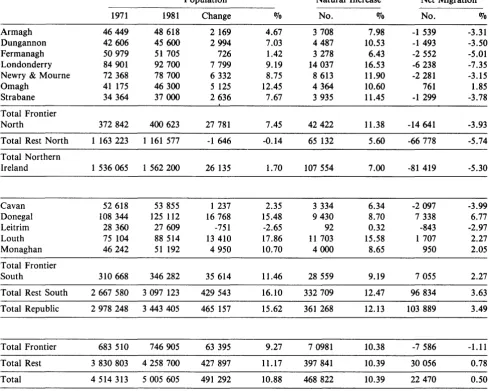
The principal demographic features of the ad-ministative units in the border area are shown in Table 1. The figures for both Northern Ireland and the Republic are based on the results of the 1981 census. In Northern Ireland, the statistics were officially ad-justed to take account of the effect of non-enumerated households. However, following publication of the cen-sus report, a number of local authorities maintained that the corrective element had been inadequate. Fur-ther estimates were then made by an Interdepartmen-tal Working Party, whose conclusions were released by
the Northern Ireland Government Information Service
on 29 July 1983. Since these latter figures represent the most accurate official estimates of the actual popula-tion in the districts in 1981 , they are accordingly taken into account.
The natural increase in population is measured
by the excess of registered births over deaths during the intercensal period. The statistics do not therefore re-quire adjustment. The data for net migration represent the difference between the natural increase in popula-tion and the actual change in population based on the census results. The use of the updated population figures for 1981 is therefore similarly likely to improve the accuracy of estimates for net migration.
The results show that the border areas have a slightly higher natural increase than the rest of the island. But there are marked differences within the border region itself. In general the natural growth rates in population in the northern areas (particularly Lon-donderry, Newry and Mourne, Strabane, Omagh and Dungannon) and Louth (on the southern side) are above average. The more predominantly rural districts (Leitrim, Donegal, Cavan, Fermanagh, Armagh and Monaghan) on the other hand, have substantially lower natural growth. The statistics for net migration, which is generally more pronounced in Northern Ireland, show a net outflow of 1.1% for the border area bet-ween 1971 and 1981, as against a net inflow of 0.80Jo
elsewhere.
Unemployment
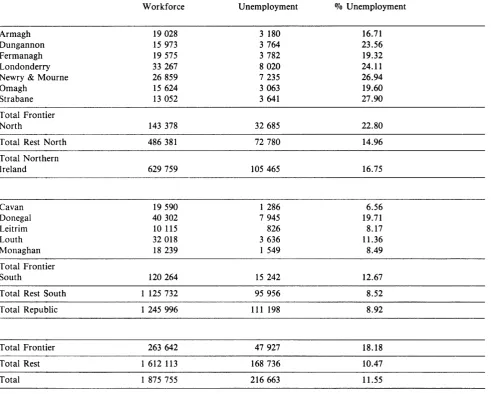
The figures for workforce and unemployment shown in Table 2 are likewise derived from the results of the 1981 census. This approach was chosen because it provides a convenient statistical basis for measuring
relative unemployment on both sides of the border, and because the regional data coincide exactly to the ad-ministrative areas covered by the Information Report. However, the unemployment figures derived from cen-sus returns are known to somewhat underestimate the levels of unemployment as measured by the normal Unemployment Benefit/Live Register methods. The latter, for example, showed unemployment in June
1981 as standing at 18.8% in Northern Ireland and
10.0% in the Republic, compared with the census figures of 16.80Jo and 8.9% respectively. It should also be noted that the situation has deteriorated significantly since then. In January 1983, registered unemployment in Northern Ireland was 21.50Jo, and 14.1 OJo in the Republic. There is also a degree of underestimation in the case of the Republic, in that first-time job seekers are not included. A regional breakdown of unemploy-ment in 1981 is provided in Map IX.
From the regional comparison shown in Table 2, two conclusions clearly emerge. Firstly, the unemployment rate in the border area in 1981 was significantly higher than that of the rest of the island
(18% as against lOOJo). Secondly, there are important differences within the border region itself. Unemploy-ment is particularly acute in Strabane, Londonderry and Donegal on the one hand, and in Newry and Mourne and Dungannon on the other. The lower unemployment rates recorded in the more rural districts may however, to some extent, reflect the smaller numbers in the economically active age groups remain-ing in the areas.
Age Structure
The population in the border area has a higher proportion in the dependent age groups (i.e. under 15
General Infrastructure
Roads
Despite its considerable size, the border area has a low population density. There are a number of ur-ban concentrations but, with the exception of Lon-donderry, these are small in size and often distant from one another. In addition, the area is removed from the main population centres of Dublin to the south and Belfast to the north, although the situation improves in the eastern part of the region. There are only two railway lines, one running between Londonderry and Belfast, the other between Belfast and Dublin. These cannot however be regarded as serving the area as a whole. There is also an air link between Dublin and Belfast and some executive air services from Lon-donderry to various destinations. As a result, the bulk of passenger and freight traffic has to travel by road. The road system is therefore vital to industry, trade and tourism and hence to overall economic development.
In Northern Ireland, the general standard of road development is noticeably higher than in the Republic. This directly leads to an imbalance in the road system. There are relatively good connections from the border area northwards and towards Belfast. Towards the south, the connections are in many cases weaker. Within the border area (both north and south) there are instances where particular stretches fall short of general standards. These create bottlenecks which reduce the value of the improved sections of the net-work and impede access to ports and airports.
Demographic and topographic factors make the building, improvement and maintenance of roads an expensive business, placing a heavy burden on national and local authorities. Indeed, all the submissions receiv-ed placreceiv-ed roads high on the list of local priorities. The requests involved a total estimated cost of 500 million ECU equal to 60o/o of the cost of all projects submit-ted. Clearly, expenditure at this level would not readi-ly be borne by the existing financial instruments of the European Community. Nor of course is it likely that all the projects have an equally high cost-benefit rating. Nevertheless, the figure does provide an indication of the magnitude of work which could usefully be done and of the costs involved.
It would not be realistic to suggest that the Euro-pean Community should take over full financial responsibility for normal work on roads, which is the primary task of the relevant authorities in both parts of Ireland. In any case, some financial assistance for road works is already provided though the quota sec-tion of the European Regional Development Fund
(see Table 14) and some small work is eligible for assistance from the non-quota section under
Regula-tion 2619/80 (see Table 11). Accordingly,- it is preferable that additional Community support should concentrate on specific projects where there are major regional policy benefits, where there is a high cost-benefit ratio, where significant bottlenecks need to be removed and where Community participation might be crucial in persuading the authorities north and south to proceed with the work.
In line with such a selective approach, a number of schemes can be identified. These are shown in red on Map III. The priority given to these projects should however be taken in conjunction with the specific ob-jectives of the Information Report. The choice does not therefore imply a judgement on the need and value of other road schemes in the border area.
Rail Services
The Londonderry-Belfast line mainly serves Londonderry city. Although, the Belfast-Dublin line runs within a mile of Newry, the latter has no station. The economic grounds for providing a rail service to the area which has a large population catchment seem particularly strong. The main costs involved would be in the construction or refurbishing of a station and the provision of customs clearance facilities (total estimated cost 400,000 ECU). A connecting bus service to Newry town centre would also be needed. Plans to this effect which have already been drawn up, should be im-plemented immediately.
Air Services
Regional air services between Belfast and Dublin and Londonderry to various points have recently been provided. The submissions received also suggested three airport developments. These included the extension of Eglin ton airport in Londonderry, the construction of a new regional airport at Letterkenny and the upgrading of St. Angelo airport, Fermanagh.
In its Opinion of 12 July 1978 on the Lon-donderry/Donegal Communications Study, the
Housing
Several submissions referred to housing needs. It is difficult, however, to find a single statistical criterion for measuring housing quality throughout the area on a comparable basis. In Northern Ireland, the Housing Executive carries out exhaustive periodic reviews, which provide a detailed and accurate picture. The summary shown in Table 4 indicates that the quali-ty of housing in the border area (where 200Jo of the housing stock requires renewal) is somewhat lower than in the rest of Northern Ireland (140Jo), with rural districts such as Fermanagh (31%) faring less favourably than their more urban counterparts. In the Republic, there are no survey data of matching quali-ty. But the limited statistical material available would seem to suggest a mirror-image regional pattern, bas-ed on somewhat lower overall standards (see also Table 5).
Water
In Table 5 a measure of the adequacy of public
water supply is provided by the percentage of households connected to the public water service. The table does not however give an indication of the quali-ty of the service (e.g. flow rates, water puriquali-ty). In the more rural districts, a proportion of households have an independent water supply without being connected to the public service1•
The pattern emerging from the comparison, in-dicates that the Republic as a whole fares less favourably than Northern Ireland. In the border area itself, the difference is particularly evident, with the southern sector having a 61 OJo connection rate, as against 93 OJo in the northern sector. This was borne out by the fact that water supply problems were raised in
most of the southern submissions. These reveal that there is still work to be done in providing water con-nections to households particularly in the outlying areas. For instance, the data indicate that some 300Jo of households in Leitrim have no running water (either public or private connection). There is also a need in some places to augment flow rates in existing services. In certain localities, such as Louth, it was considered that inadequate water supply for industrial purposes was hampering economic development.
A framework for European community assistance already exists in Regulation (EEC) No. 1820/80 for the Stimulation of Agricultural Develop-ment in the West of Ireland which includes four of the five southern border counties (Donegal, Leitrim, Cavan, and Monaghan) and initially applied to group water schemes. Although some such work has been car-ried out, the record of the measure in this particular respect has been mixed, with be likely to arise.
The legal aspects are also important. Although changes to water levels would probably be small, a com-prehensive arterial drainage scheme would almost cer-tainly require some revision of the Erne drainage and development acts of 1950 in Northern Ireland and in the Republic. While this would involve a considerable amount of administrative work, it would probably be justified and feasible in the context of an overall scheme.
The acquisition, regulation, and safege southern border area where 180Jo of households still lack these amenities. At the same time, it must be noted, that in the southern section of the border area, the proportion of households with sanitary facilities increased from
540Jo to 820/o between 1971 and 1981.
Industry
Background
The border areas covered by the Information Report must, by general European standards, be regarded as having a relatively low level of industrial development. With the exception of Louth, the entire area is recognised by the respective industrial develop-ment authorities in both the Republic and Northern Ireland as being in need of major assistance.
However the situation has not always been as
it is today. In the late 19th and early 20th centuries, substantial industrial development took place at the two
extremities of this area. At one end, in Londonderry, there was the establishment of a textile sector based originally on the shirt industry. At the other, in Louth, there was the setting up of the railway works at Dun-dalk, supplemented by other industries such as footwear, textiles, and cement.
By contrast, in the central area situated between these extremities, there has never been a strong in-dustrial tradition. Some significant indigenous agriculture-based industries were established mainly on the southern side. On the northern side, there was some localised industrial progress based on textiles and other
traditional activities such as brickmaking in the case of Dungannon. There have been several other in-dividual new ventures, but the total does not represent a significant level of industrialisation.
For reasons which are connected more with the growth of free trade, the international division of labour, and changing technologies, than with any domestic factors, many of the original industries in the area as a whole have declined and in some cases disappeared.
In this respect, the Londonderry area, relying too heavily on clothing and textiles, fared worst. Even with the introduction of synthetic fibres in the 1950s and 1960s, it still remained vulnerable due to its nar-row industrial base. As a result, in the general dif-ficulties experienced by European textiles in the last decade, the area was particularly hard hit.
In the Louth region the railwayworks, footwear and textile industries also ran into difficulties leading to several closures, but sufficient other industry sur-vived to keep the local economy afloat.
Furthermore most of the agriculture-based in-dustry centred on Monaghan, Cavan and Leitrim has survived, helped partly by increased activity in the dairy sector brought about by the CAP. An additional fac-tor lessening the adverse impact in the central area was that, being much less densely populated, it did not have to support a large unemployed urbanised workforce as in Londonderry.
Industrial incentives
Responsibility for promoting industrial invest-ment in the Republic lies with the Industrial
Develop-ment Authority (IDA) which also runs a specific Small
Industries Programme. In the north, the task is assigned
to the Northern Ireland Industrial Development Bord
(IDB) together with the Local Enterprise Development
Unit (LEDU) which concentrates on small business.
In the Republic, four of the five counties in the border area (the exception again being Louth) are classified as Designated Areas. In Northern Ireland, it would appear that most of the area covered by the seven District Councils qualifies for the highest rate of sup-port. This means that, excepting Louth, virtually the entire border region is eligible for the maximum finan-cial aids and incentives available.
These aids include substantial non-repayable capital grants on plant and machinery (up to 40 - 6011/o in the Republic, 500Jo in the north) plus negotiable ex-tras such as training grants, per-capita employment grants, interest relief, accelerated depreciation,
preferential treatment for priority sectors, etc. In the Republic, corporation tax is 100Jo for manufacturing. In the north it is nominally 520Jo, but with a substan-tial number of off-setting factors including a recently introduced corporation tax relief grant. On both sides of the border, ready-built factories are available at favourable rents, and special facilities are available for small business, through LEDU in the north and the
Small Industries Division of the IDA in the south.
Whether the total package in the north is better than the total package in the south or vice-versa, would depend on the circumstances of each case, but the package in either instance is substantial.
These incentives are available to both domestic and outside investors. However, until recently, there appeared to be a certain tendency to concentrate on at-tracting outside investment, which was seen as the fastest road to industrialisation.
Despite these incentives, however, the response from outside investors has been limited. On the nor-thern side, even in the more prosperous early period, most investment in manufacturing industry tended to locate away from the border areas. In 1981, the nor-thern border areas had 58 jobs in manufacturing in-dustry per thousand of population, compared with 98 jobs per thousand in the rest of Northern Ireland (see Table 6). In the Republic, the manufacturing base is generally smaller. But the regional differences are also less marked. The southern border area, with 76 manufacturing jobs per thousand, is actually marginal-ly better placed than the rest of the south, where the figure is 75. This is due to the dominant influence of Louth, which has the highest proportion of manufac-turing jobs in the Republic. The other southern border counties lie below the national average. Thus in the border area as a whole, the number of manufacturing jobs per thousand in 1981 was 66, compared with 81 elsewhere.
While it is difficult to see how either the pro-motional agencies themselves or a different set of in-centives, could have substantially altered the historical pattern, it has meant that with a few exceptions there has been little industrial investment in the border areas. The principal exception is Louth, which is favoured from a communications viewpoint by its location on the eastern seaboard.
The reasons for this general reluctance to invest in the border areas might be identified as follows:
2. the inadequacy of communications, especially roads, and the distance from the major airports of Belfast, Dublin, Shannon and Cork, as well as from the main seaports. (These points have already been dealt with under General Infrastructure);
3. a factor less frequently mentioned, but never-theless significant, is that the border areas north and south are in competition with other underdeveloped, but perhaps more attractive, areas in the Republic, and Development Zones not only in other parts of Northern Ireland but also in the rest of the UK;
4. the recurring civil disturbances, which have made it difficult to attract outside investment.
The first problem is hopefully temporary. The fourth lies outside the terms of reference of the Infor-mation Report. It is therefore the second and third pro-blems (i.e. communications infrastructure and regional promotion) which should become the focal points of future policy.
Future Policy
Against the background of the problems outlin-ed, it might appear at first sight that most of the area under consideration could not be considered likely to attract significant industrial investment in the present economic climate, and that the best that could be done would be to preserve the existing level of activity until the general economic conditions improved. However, such an approach would be both too pessimistic and too short-sighted.
The areas concerned are in a category meriting maximum EEC aid, and together with the range of na-tional incentives and support at government level local-ly, the foundations can be laid for a long term policy which should bear fruit, once general conditions im-prove. The important point is that the necessary groundwork should be done as of now, so that the area can reap the maximum benefit that a general upturn would bring.
The Creation of a North West Industrial Zone
One of the proposals put forward in the local submissions was for the creation of one (or more) in-dustrial zone(s) in the general area Londonderry/Let-terkenny /Strabane/Lifford, which would stimulate economic development on both sides of the border. A further suggestion was that the industrial development agencies on both sides of the border, instead of operating in competition, might, with EEC aid, pro-mote this zone jointly through a new agency. In this way, a concentrated effort could be made in a par-ticularly disadvantaged area which has a long-standing history of high unemployment and which has lost more
industrial jobs recently than any other part of the border area. A number of observations on the feasibili-ty of such a proposal are set out below.
Although there is no guarantee that such an in-itiative would solve the problem, there is almost cer-tainly an advantage in bringing together in a joint ef-fort the available resources for promoting the area. The area forms a natural economic unit and is therefore par-ticularly well suited to a joint regional initiative. On the other hand, if no new initiative is taken the socio-economic climate is likely to worsen, particularly in places where there is high urban unemployment. There is therefore a strong case for the creation of an in-dustrial zone under the responsibility of a new agency created specifically for the purpose.
The agency responsible for such a regional zone should be given a sufficient degree of local autonomy, power of decision over projects and final authority over the disbursement of grant funds. This is essential, par-ticularly in the light of the frequently expressed local view, that decisions are too often taken by remote cen-tral authorities without regard to their local conse-quences. Strong emphasis should be placed on local in-itiative and self-reliance, qualities not unknown in the area in the past. The agency should therefore build as far as possible on the available local human resources. In particular, it should be closely responsive to local needs and views.
Faced with the question of geographical spread, there are good administrative grounds for selecting a relatively limited area, at least in the initial stage. It would also be necessary to guard against the dissipa-tion of effort which would arise if a series of similar development zones were set up simultaneously in other border areas, competing with each other for the limited available investment.
The industrial development zone could therefore be based on the Letterkenny-Londonderry-Strabane triangle, thus taking in the city of Londonderry and its natural hinterland on both sides of the border.
Following the example of the Shannon Free Air-port Development Company (SFADCO) in the
Republic, the agency could have responsibility for con-centrated industrial development on a specific location as well as having a broader remit taking in the develop-ment of the surrounding area as a whole.
As far as possible, the headquarters of the new agency should be located in a modern building within the zone, in order to act as a focal point and to create the idea of a sense of purpose.
board. Given that the IDA already has a regional of-fice in Co. Donegal, the latter would have to delegate some responsibility to the new authority. The IDB does not have a corresponding local office on the northern side although there is an office for the existing Lon-donderry Enterprise Zone, so that some similar delega-tion of responsibility would also be required.
While respecting the principles of European Community policy on the creation of new tax conces-sions, duty-free zones etc., some new fiscal/ad-ministrative arrangements, including additional incen-tives would probably have to be introduced for the zone. In this connection, it is noted that the non-tariff barriers between the two parts of the island have ac-tually increased in recent years (e.g. different levels of VAT, fluctuating exchange rates). Reasonably free movement of goods, services and persons would be essential for the efficiency of the operation.
With the accent placed on developing local in-itiative, it is essential that the agency be equipped to provide advice and back-up facilities for small business in line with the special programmes adopted under the non-quota section of the European Regional Develop-ment Fund, and drawing on the experience gained elsewhere in the European Community.
Finally, it should also be recognized that, with the advent of new technologies, the nature and scale of industrial employment is changing. The new authori-ty could therefore have a role in the development of a range of non-industrial activities, such as service in-dustries and tourism. In view of the importance of ac-cess to export markets, the agency might perhaps also be given a say in the development of transport and communications.
The overall cost of such a plan is difficult to estimate and would have to be worked out in detail. However, it would be possible to envisage an annual grant of the order of 3 million ECU to the agency, amounting to a total of 30 million ECU over a 10 year period.
Craft industry
Besides undertaking a major scheme in the Lon-donderry area, there is also a need to encourage job creation in other localities through the development of small and medium sized enterprises. Craft industries in particular combine several elements which are very appropriate to the border areas. Being small and flexi-ble they can more easily integrate in a local context. They often rely on local initiative, and they can be fre-quently linked to tourist development. In some cases, it may also be possible to use local raw materials. Ef-forts are currently being made by both the IDA and LEDU to establish such craft industries in the border areas. While not a solution for all problems, such developments, if based on local initiative, may have a stronger commitment to stay in the area than larger, more mobile international concerns.
For this reason, several of the proposals con-tained in the local submissions (see Part III), including the recommendations already set out in the Erne Cat-chment Study in relation to small business and craft industry, seem particularly relevant and worthy of support.
Agriculture
Physical Conditions
The Irish land frontier follows the drumlin belt, a wide band of hilly country formed by glacier ice about
15,000 years ago. These hills, which average about 30
hectares in size, are heavily concentrated in the border area (see Map IV) and dominate much of the land-scape, particularly on the southern side. A study of one part of this area showed that about 400Jo is flat, with
230Jo too steep for machinery operation. The remain-ing 37% slopes to varying degrees.
Rainfall is high by continental European and British standards, while evaporation is low. In an average year, the soil is dry from early May to the end of July 2• Consequently, without drainage, there is a
very short season in which the land can be used.
While the temperature is generally moderate, summer growing conditions are less favourable than for continental Europe 3• Wind levels are among the
highest in the Community, equalled only in the north west of Scotland. Slopes on hilly terrain are particularly exposed.
Soils in Ireland are strongly influenced by the rocks from which they were formed. Along the Donegal/Londonderry and Tyrone border, the rocks are schist and gneiss. These give rise to soils low in fer-tility. In high ground they are peaty. Along the re-mainder of the border, the soils are fine-grained, be-ing derived from Carboniferous and Silurian shales and sandstones. Going west from the Louth/Mourne area, the soils become increasingly fine until in Leitrim and parts of Cavan and Fermanagh, up to 97% of the soil is less than 0.02 mm. Very fine-grained soils have thin topsoils and are nearly impervious to water flow. As a result, they have little storage capacity and waterlog easily.
It is this combination of hilly ground, high rain-fall, low evaporation, and slow-draining soil which makes farming difficult in the border area.
The Pattern of Farming
The physical conditions exert a strong influence on the pattern of farming activity. The overall dif-ferences which exist between the Republic (where agriculture employs 15% of the workforce) and Nor-thern Ireland, (where the figure is about lOOJo) become
somewhat less evident in the border area. Agriculture still employs significant numbers (see Table 7). Farm holdings tend to be correspondingly small and fragmented.
While dairying is the most profitable grassland enterprise, the herd-size on average compares un-favourably with other regions of the EEC. Dairying ac-counts for about 30% of the total cattle grazing livestock units in the area, as against 500Jo in some of the southern counties of the Republic. The emphasis on the less intensive grazing enterprises, suckling cows and drystock, is correspondingly greater. Sheep play a complementary role, with hill sheep being important in Donegal. Apart from certain specific localities, the soil types and topography make the land generally un-suitable for tillage crops.
In the face of these difficulties, there has been significant development of pigs and poultry for which the area is now noted. While these enterprises, make an important contribution to some farming incomes, they tend to be large-scale units concentrated on a relatively small number of farms. Otherwise the overall picture of farming in the border area is one of small holdings on difficult land, with a low level of specialisa-tion and, as a consequence, low incomes.
Social Conditions
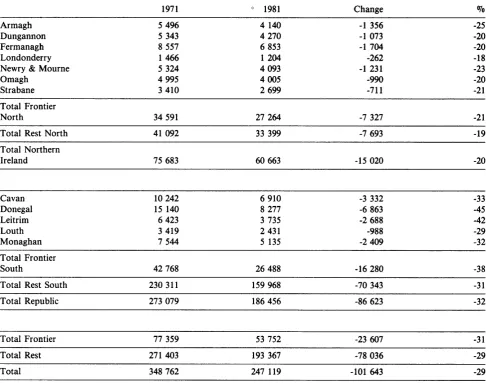
Low incomes mean that there is little encourage-ment for young people to remain on the land. There is a drain from the rural areas, resulting in an elderly farmer profile, lower productivity and a loss of vitali-ty in the rural social environment. In some cases, it can mean entire family holdings falling into decay. Although the problem is universal, it is particularly acute in the border area. In the last decade, the numbers working in agriculture have fallen by 38% in the southern border area (see Table 8). On the northern side, there has been a similar but less pronounced pattern.
The small numbers who stay on the land often lack a formal agricultural education. While northern training facilities are generally of a high standard, there is a need on the southern side to develop part-time train-ing schemes with suitable demonstration facilities. Trained socio-economic advisors could also do much to help on educational counselling, career information, advising on farm succession and in developing com-munity groups.