A WIMPy baryogenesis miracle
The Harvard community has made this
article openly available.
Please share
how
this access benefits you. Your story matters
Citation
Cui, Yanou, Lisa Randall, and Brian Shuve. 2012. “A WIMPy
Baryogenesis Miracle.” Journal of High Energy Physics 2012 (4).
https://doi.org/10.1007/jhep04(2012)075.
Citable link
http://nrs.harvard.edu/urn-3:HUL.InstRepos:41412181
arXiv:1112.2704v3 [hep-ph] 19 Mar 2012
A WIMPy Baryogenesis Miracle
Yanou Cui,a,b1 Lisa Randalla2 and Brian Shuvea3
a Center for the Fundamental Laws of Nature
Jefferson Physical Laboratory Harvard University Cambridge, MA 02138, U.S.A.
b Department of Physics, University of Maryland, College Park, MD 20742, USA.
Abstract
We explore models in which weakly interacting massive particle (WIMP) dark matter annihilation is directly responsible for baryogenesis, thereby connecting dark matter with baryogenesis. We call this process “WIMPy baryogenesis”. The dark matter relic density in these models, as with conventional WIMP models, is obtained with only order one couplings and TeV-scale masses according to the WIMP miracle. Thus, WIMPy baryogenesis models naturally accommodate weak-scale dark matter. Furthermore, an extension of the WIMP miracle simultaneously explains the observed baryon asymmetry and the correct dark matter abundance. The models we present have the further feature that they create the baryon number asymmetry at the weak scale, thereby avoiding the problems in some models of baryogenesis associated with high reheat temperatures in supersymmetric theories. Some of these models yield observable consequences in ongoing and future experiments.
1E-mail:[email protected] UMD-PP-011-015
Contents
1 Introduction 1
2 General Analysis of WIMPy Baryogenesis 3
2.1 Boltzmann Equations and Solutions . . . 4
2.2 Estimates of Baryon Asymmetry . . . 6
3 WIMP Annihilation to Leptons 8 3.1 Model Overview . . . 8
3.1.1 Field Content and Lagrangian . . . 9
3.1.2 Asymmetry generation . . . 10
3.1.3 Washout . . . 11
3.1.4 Boltzmann equations . . . 12
3.2 Numerical Results . . . 14
4 WIMP Annihilation to Quarks 17 4.1 Model Overview . . . 17
4.2 Numerical Results . . . 19
5 Experimental Constraints and Detection Prospects 20 5.1 Dark Matter Detection . . . 21
5.1.1 Direct Detection . . . 21
5.1.2 Indirect Detection . . . 22
5.2 Collider Detection . . . 23
5.3 Electric Dipole Moment Constraints . . . 26
6 Conclusions 27
1
Introduction
Generally, baryogenesis and the establishment of the dark matter number density are treated as independent processes. With the notable exception of one class of models [7], it has largely been overlooked that models with symmetric, weakly interacting massive particle (WIMP) dark matter can connect dark matter physics with baryogenesis. We present a new mechanism that creates such a link and is based on a simple premise: if WIMP annihilation satisfies the Sakharov conditions, a non-zero baryon number asymmetry can be generated from dark matter annihilation, and in some instances, can account for the entire observed baryon asymmetry. We call this process WIMPy baryogenesis. Our models are distinct from models of asymmetric dark matter, which propose that dark matter and baryons have their origins in a common asymmetry. In our models, the energy densities of baryons and dark matter are more loosely linked but can accommodate the observed dark-matter-to-baryon ratio.
[1, 2, 3, 4, 5, 6]
We list below the Sakharov conditions and how they are satisfied in WIMPy baryogenesis:
1. Baryon number violation: WIMP annihilations violate baryon or lepton number. A preserved U(1) symmetry is allowed if the baryon asymmetry is balanced by a negative asymmetry in a decoupled sector that restores the net global symmetry. We have such a U(1) symmetry in most models we present.
2. CP violation: WIMP couplings to Standard Model fields violateCP.
3. Departure from thermal equilibrium: The cooling of the universe provides the necessary departure from thermal equilibrium. Net dark matter annihilation begins around temperatures T .mDM, resulting in
DM
DM SM baryons sterile antibaryons
B
conserving decay exotic
antibaryon
DM
DM
SM baryons
B
violating decay exotic
[image:4.612.118.501.77.177.2]antibaryon
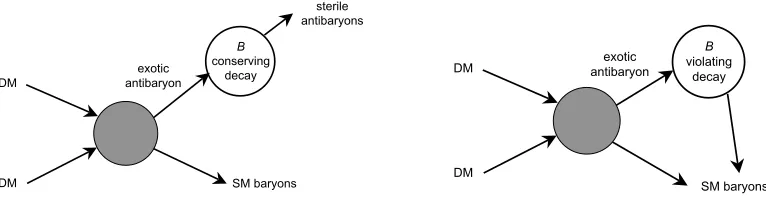
Figure 1: Schematic diagrams showing the evolution of the asymmetry created by dark matter annihilation. (left)Model where asymmetry created in exotic antibaryons is sequestered in a sterile sector through baryon-number-conserving decays. (right)Model where asymmetry created in exotic antibaryons is converted into a Standard Model baryon asymmetry through baryon-number-violating decays.
generate a baryon asymmetry that depends on the amount of dark matter annihilation occurring during washout freeze-out, which is comparable to the dark matter density at that time.
We present models that satisfy all three Sakharov conditions, and that simultaneously generate the observed baryon asymmetry and WIMP relic density. In particular, we find that there exist successful models of WIMPy baryogenesis withO(1) couplings and CP phases, and weak-scale masses for all new fields. This is an extension of the WIMP miracle to also include baryogenesis, although we show that the size of the generated asymmetry is sensitive to the parameters in the theory and can vary by several orders of magnitude from the observed asymmetry.
Although WIMP annihilation can generate a baryon asymmetry, there are other processes that have the potential towash out the asymmetry, and their freeze-out is crucial to create the observed baryon asymmetry. In our models, the two leading sources of washout are inverse annihilations of baryons into dark matter and baryon-to-antibaryon processes. Washout scatterings must be suppressed to generate a sizeable baryon asymmetry because, as we show in Section 2, any asymmetry generated prior to washout freeze-out1is rapidly
damped away. After washout processes freeze out, dark matter annihilations can efficiently create a baryon asymmetry, and the final asymmetry depends on how much dark matter remains when washout scatterings freeze out. Washout freeze-out must occur before that of WIMP annihilation, at which point dark matter annihilation is no longer efficient and no sizeable asymmetry can be created. Thus, we find our central result:
if washout processes freeze out before WIMP freeze-out, then a large baryon asymmetry may accumulate, and its final value is proportional to the WIMP abundance at the time that washout becomes inefficient.
The early freeze-out of washout processes can occur for kinematic reasons. Inverse annihilations will be Boltzmann-suppressed for T < mDM because the thermal baryon fields are no longer energetic enough to
annihilate back into dark matter. Baryon-antibaryon scatterings, however, can remain rapid at temperatures well belowmDM. The only way to suppress baryon-to-antibaryon washout is if all washout processes involve a
heavy exotic baryon field in the initial state. We illustrate this scenario in Figure 1, showing how dark matter annihilates to Standard Model baryons plus an exotic baryon, as well as the possible decays of the exotic baryon (either through baryon-preserving or baryon-violating interactions). If this exotic field has a mass
&mDM, its abundance is Boltzmann-suppressed atT < mDM and suppresses the washout rate. Meanwhile,
dark matter annihilations are not kinematically allowed if the heavy baryon field has mass&2mDM, so the
mass condition mDM . mexotic baryon . 2mDM is essential to generate a large baryon asymmetry through
WIMPy baryogenesis.
Dark matter annihilations generate a positive baryon asymmetry stored in Standard Model quarks along with an equal negative asymmetry stored in the exotic baryon field. It is important that the decays of the
1The time of washout freeze-out is defined as when the rate of washout processes falls below the Hubble expansion rate. This
exotic baryon do not eliminate the Standard Model baryon asymmetry. In models of WIMPy baryogenesis with a preserved U(1) baryon symmetry, the exotic baryon-number-carrying field is charged under an additional discrete symmetry, while Standard Model fields are uncharged, preventing the exotic baryon from decaying into Standard Model baryons and destroying the asymmetry. The heavy baryon-number-carrying field decays instead into light gauge singlet fields that are charged under the discrete symmetry and decoupled from Standard Model fields at temperatures below the scale of WIMPy baryogenesis. We also present a model where the exotic baryon decays to Standard Model quarks through baryon-number-violating couplings, and such models manifestly satisfy the first Sakharov condition.
For many years, the WIMP miracle – the fact that dark matter fields with weak-scale masses and annihila-tion cross secannihila-tions give the correct dark matter thermal relic density – has been a compelling paradigm for dark matter model-building. WIMPy baryogenesis preserves the WIMP miracle while also offering an explanation for the observed baryon asymmetry. While WIMPy baryogenesis models do not predict the precise relation-ship between the dark matter and baryon number densities, natural models do restrict the baryon asymmetry to a range of about seven orders of magnitude (see Section 2), and the observed asymmetry is within this range. Since baryogenesis arises from WIMP annihilations, WIMPy baryogenesis is also necessarily connected to weak-scale physics. While we do not discuss an embedding of WIMPy baryogenesis in a particular solution of the hierarchy problem, we assume that whatever new physics lies at the weak scale stabilizes any scalar potentials in our theory and gives a natural explanation for their weak-scale masses. A consequence of this is that, with weak-scale masses, some of the new fields necessary for baryogenesis may give signals at future experiments. Additionally, the present-day dark matter is symmetric, leading to the possibility of the indirect detection of dark matter annihilations as in conventional WIMP models. This is in contrast with generic asymmetric dark matter models, in which the majority of dark matter annihilations ceased long before the present day, although it is also noteworthy that there do exist scenarios in which the symmetric component of dark matter is regenerated at late times, giving indirect detection signals for some asymmetric dark matter models [6].
A further advantage of this scenario is that bounds on the reheat temperature in supersymmetric models do not constrain WIMPy baryogenesis. Typical reheat temperature constraints come from overproduction of gravitinos and are in the rangeTRH .106−109GeV [8], andTRHis consequently below the scale required for
conventional leptogenesis through the decay of heavy, Majorana right-handed neutrinos. Although low-scale mechanisms for baryogenesis are known, such as electroweak baryogenesis, WIMPy baryogenesis is a new way of generating the baryon asymmetry atT ∼TeV while satisfying the reheat bound.
We discuss the general conditions for successful WIMPy baryogenesis in Section 2, finding that interactions washing out the baryon asymmetry must become ineffective prior to WIMP freeze-out in order to generate the observed asymmetry. In Section 3, we focus on a particular model where dark matter annihilates through a lepton-number-violating interaction and the asymmetry is subsequently transferred to baryons by sphalerons. Because sphaleron processes are only rapid in the unbroken electroweak phase, such baryogenesis must occur before the electroweak phase transition. We compute the dark matter relic density and baryon asymmetry, and find the range of masses and couplings that agrees with the observed densities of both. We also consider the implications of additional lepton-number-conserving dark matter annihilation channels. In Section 4, we consider models with WIMPs annihilating directly to quarks, where baryogenesis can occur over a wider range of temperatures because sphalerons are no longer needed to establish the baryon asymmetry. We discuss experimental constraints and possible signals for models of WIMPy baryogenesis in Section 5. Finally, we summarize in Section 6.
2
General Analysis of WIMPy Baryogenesis
that washout freeze-out occurs at such a time when one of the baryon-number-carrying products of WIMP annihilation is heavier than the dark matter mass, as described in the introduction. In Section 2.2, we estimate the magnitude of the baryon asymmetry for input parameters consistent with the WIMP miracle and show that it can lie within a range of approximately seven orders of magnitude.
2.1
Boltzmann Equations and Solutions
We consider a theory with dark matter speciesX whose annihilation violates baryon number, creating one quark (or anti-quark) along with other field(s)ψi. In this section we will not specify the precise interactions
mediating dark matter annihilation in order to avoid specific model dependence. X can be either Majorana or Dirac, and the results derived below remain the same up toO(1) multiplicative factors. All manifestations of the Boltzmann equation for baryon number evolution in WIMPy baryogenesis models have two important terms: one that describes the annihilation of dark matter and the consequent generation of a baryon asymmetry, and another that drives the asymmetry towards its equilibrium value of zero through baryon-number-violating washout scatterings. The full Boltzmann equations describing the evolution of the various particle abundances are model-dependent and can have many terms, which we give explicitly for concrete models in Sections 3 and 4. However, in the models of interest to us, namely models where the asymmetry arises predominantly from WIMP annihilations, the overall dynamics are well-described by the inclusion of only these terms.
Consider the limit where WIMP annihilations are the dominant source of the baryon asymmetry and for which the asymmetry is small as observed. We derive the Boltzmann equations in terms of dimensionless quantities: the number density per comoving volume of fieldi, Yi =ni/s(sis the entropy density), and the
temperature, which we express asx=mX/T. The dark matter number density is denotedYXand the baryon
asymmetry is denotedY∆B. TheYXevolution equation has one term that is important in all models of WIMPy
baryogenesis, namely the conventional WIMP annihilation term that is proportional to the annihilation cross sectionσann and drivesYX to its equilibrium value. This term arises from bothXX →baryon processes and
the inverse processes, baryons→XX. TheYX Boltzmann equation with this term is
dYX
dx =− 2s(x)
x H(x)hσannvi
Y2
X−(Y
eq
X )
2
, (1)
whereH(x) is the Hubble scale.
We neglect a back-reaction term in the YX Boltzmann equation ǫ s(x)hσannviY∆B(YXeq)2/(2Yγx H(x)),
whereǫis the net baryon number created per dark matter annihilation and is a measure of the magnitude of CP-violation (it is defined more precisely in Section 3). This term accounts for the modification of the inverse scattering rate of baryons intoX when there is a baryon asymmetry. This approximation is valid because this term is small when Y∆B ≪ 1, as is true in our universe (Y∆B ∼10−10). This simplification also decouples
the equations forYX and Y∆B, which makes it easier to get an approximate analytic solution forY∆B. The
equation (1) in this limit is the same as the familiar Boltzmann equation for conventional WIMPs. YXis then
obtained from the standard WIMP relic density calculation [9] and is approximately inversely proportional to the annihilation cross section.
The Boltzmann equation for the evolution of the baryon asymmetry has two important terms. In the first term, a baryon asymmetry is generated throughX annihilations, and is proportional toǫ/2×dYX/dx,
which is the annihilation rate multiplied by the fractional asymmetry generated per annihilation. The factor of 1/2 arises because the annihilation term in (1) includes the sum of annihilation into baryons and antibaryons, whereas the term generating the asymmetry includes the difference. The second term in the baryon asymmetry Boltzmann equation reduces the existing baryon asymmetry and is thewashoutterm. It is proportional toY∆B
multiplied by the cross section of processes that eliminate the baryon asymmetry σwashout. The Boltzmann
equation is
dY∆B
dx = ǫ s(x)
x H(x)hσannvi
YX2−(Y
eq
X )
2
−x Hs(x()x)hσwashoutviY∆B
2Yγ
Y
i
Yieq. (2)
The factor ofY∆B/2Yγ comes from the the fact that the chemical potential µ∆B for the baryon asymmetry
are other terms that we have not included, such as washout terms proportional toYexoticeq −BYX that come from
scattering of baryon-number-carrying fields off dark matter fields. Typically, the suppression coming from the small value ofYX for x≫1 makes this term subdominant to other washout terms. In the models of Section
3 and 4, theYexoticeq −BYX term can be ignored without substantially affecting the numerical results.
As expected, the Boltzmann equations show that the total baryon number is zero when all fields are in equilibrium and with the initial conditionY∆B = 0. A solution for Y∆B can be written in integral form in
terms of theX density:
Y∆B(x) =
Z x
0
dx′ ǫ s(x′)
x′H(x′)hσannvi
YX2−(Y
eq
X )
2
(x′) exp
" − Z x x′ dx′′ x′′
s(x′′) 2YγH(x′′)h
σwashoutvi
Y
i
Yieq(x′′)
#
(3)
≈ −2ǫ Z x
0
dx′ dYX(x ′)
dx′ exp
" − Z x x′ dx′′ x′′
s(x′′) 2YγH(x′′)h
σwashoutvi
Y
i
Yieq(x′′)
#
. (4)
Equation (4) explicitly shows thatY∆B(x) can be expressed in terms of a source term from dark matter
anni-hilations, and an exponential term that attempts to erase any asymmetry generated by WIMP annihilations. The source term can be written asdYX/dx, as in [10]. AtT &mX, orx.1, WIMP annihilations are balanced
by inverse scattering processes and dYX/dx ≈0, meaning no asymmetry is generated according to (4). At
x&1, the expansion and cooling of the universe result in net WIMP annihilations (dYX/dx6= 0), providing
the departure from equilibrium necessary for baryogenesis. The net asymmetry at any xis sensitive to the rate of washout processes during the epoch of WIMP annihilations.
The integrand in the exponent (4) is the washout rate Γwashout(x) normalized to the Hubble scaleH(x),
Γwashout(x)
H(x) = s(x) 2YγH(x)h
σwashoutvi
Y
i
Yieq(x). (5)
Washout freezes out when Γwashout/H <1. In the limit where Γwashout is a rapidly decreasing function ofx,
(4) takes a particularly simple form. This is true if, for example, the washout rate freezes out becausemi/T
becomes large and yields an exponential suppression ofYieq. In this case, we can model the exponential in (4) as a step function and obtain
Y∆B(∞)≈ −
ǫ 2
Z ∞
xwashout
dx′dYX(x ′)
dx =
ǫ
2[YX(xwashout)−YX(∞)], (6) wherexwashout=mX/Twashoutis the point at which washout processes freeze out, andYX(∞) is the late-time
dark matter relic density.
Equation (6) has a very clear physical interpretation: after washout scatterings freeze out, all subsequent WIMP annihilations generate a baryon asymmetry with efficiency ǫ. This is why, according to (6), Y∆B
is proportional to ǫ times the total number of WIMP annihilations that happen after xwashout, which is
YX(xwashout)−YX(∞). The observed baryon asymmetry isY∆B ≈9×10⁻¹¹ [11]. Since dark matter at late
times satisfies the relation
YX(∞)≈
(5 GeV)Y∆B(∞)
mX
, (7)
we require thatYX(∞)< Y∆B(∞) for weak-scale dark matter. Along with the requirementǫ <1, (7) and (6)
imply thatYX(xwashout) ≫YX(∞). In other words, the washout interactions must become ineffective prior
to XX annihilation freeze-out in order to generate a sufficiently large baryon asymmetry through WIMPy baryogenesis. As an example of the numerical scales in WIMPy baryogenesis: for a WIMP of mass 1 TeV, YX(∞) ≈ 4×10⁻¹³ and WIMP freeze-out happens at xf.o. ≈ 27, or T ≈ 37 GeV. For ǫ = 0.1, washout
scatterings must freeze out atxwashout ≈20 orT ≈50 GeV. The final baryon asymmetry is proportional to
the WIMP density at the time when washout ceases to be important, withY∆B(∞)≈9×10⁻¹¹.
For what parameters do we expect washout processes to freeze out prior to WIMP annihilation freeze-out? We compare Γwashoutin (5) to the corresponding rate of WIMP annihilation, which is [9]
ΓWIMP(x)
H(x) = 2s(x)
We then find that
Γwashout(x)
ΓWIMP(x) ≈
hσwashoutviQiY
eq
i (x)
4hσannviYXeq(x)Yγ
. (9)
This ratio must be less than one at the time of washout freeze-out for washout processes to freeze out prior to WIMP freeze-out. This can be realized if either of the following is true for every process washing out the baryon asymmetry:
1. One of the baryon states is heavier than dark matter so QiY eq i (x)
YXeq(x)Yγ ≪1. 2. The baryon-number-violating coupling is small sohσwashoutvi ≪ hσannvi.
The second scenario is challenging to realize, because the same baryon-number-violating couplings appear in both the washout and annihilation cross sections, and hσannvi is fixed by the dark matter relic density.
Furthermore, as we show in Section 3.1.3, suppressing the washout cross section also suppresses the fractional asymmetry generated per annihilation,ǫ, and the resulting baryon asymmetry is typically too small. Therefore, we expect that viable models of WIMPy baryogenesis have at least one baryon-number-carrying field with mass &mX.
2.2
Estimates of Baryon Asymmetry
In this section, we derive an estimate of the baryon asymmetry generated by a WIMP dark matter candidate with massmX ∼TeV, and we determine the size of the baryon energy density compared to the WIMP relic
density. In the following, we assume for simplicity that a dark matter field X annihilates into a Standard Model quarkQplus an exotic baryon fieldψ (see Sections 3 and 4 for specific model details). We find that the baryon asymmetry depends strongly on the mass mψ and is constrained to lie within a seven or eight
order-of-magnitude window, with the observed baryon asymmetry within an order of magnitude of the upper limit. Therefore, WIMPy baryogenesis does not predict the value of the dark matter-baryon ratio, but neither is the relationship between the two energy densities completely arbitrary.
To determine the range of baryon asymmetries obtained from WIMPy baryogenesis, we use the result from the last section that the final baryon asymmetry is proportional to the number of dark matter annihilations that occur after washout freeze-out, as shown in (6). The largest possible asymmetry is generated when the exotic baryon field is heavy relative to dark matter (mψ &mX) so that washout processes freeze out while
there is still a large dark matter abundance. To determine the upper bound on the asymmetry, we use the fact that mψ <2mX for WIMP annihilation to be allowed kinematically, and this limits how many dark matter
particles can remain when washout freezes out. By contrast, the baryon asymmetry is small when washout processes turn off at a late time (mψ≪mX) after dark matter annihilation has frozen out. To calculate the
lower bound, we determine the rate of residual dark matter annihilation after dark matter freezes out and use this to determine the size of the asymmetry.
For both the upper and lower limits, we first calculate the allowed baryon asymmetry and then determine the corresponding dark matter-baryon ratio. In both scenarios, the baryon asymmetry depends on two time scales: the point of washout freeze-out,xwashout =mX/Twashout, and the point at which WIMP annihilation
freezes out,xann=mX/Tann.
Estimate of upper limit: We first estimate the upper limit of the baryon asymmetry generated within our framework, which occurs when mψ is heavy to suppress washout and is therefore also at the TeV-scale.
Kinematically, dark matter annihilation occurs only ifmψ <2mX, which bounds how earlyxwashout can be
relative toxann. For a TeV-scale dark matter field, WIMP annihilation freezes out when the temperature is
about 1/30 of its mass. Thereforexwashout≈xann(mX/mψ)&15. We also know that, when washout freezes
out while WIMP annihilation is still active,YX(xwashout)≫YX(∞). We then obtain from (6):
Y∆B(∞)≈
ǫ
2YX(xwashout)< ǫ 2Y
eq
X (15)≈ǫ×10
−8. (10)
According to (10), the asymmetry is independent ofmX and depends only on the ratio xwashout≈mψ/mX,
To compare the baryon density to the dark matter energy density, recall that the WIMP density changes little after annihilation freezes out, and soYX(∞)≈YX(xann)≈YX(30). We then find that
ΩB
ΩX
= mprotonY∆B(∞) mXYX(∞) ≈
ǫ 2
YX(xwashout)
YX(xann)
GeV mX
≈2ǫ Y
eq
X (15)
YXeq(30)
GeV mX
.10 ǫ
10−2
TeV
mX
. (11)
Therefore, for a model with weak-scalemX, O(1) couplings (in accordance with the WIMP miracle), and the
loop-suppressedǫ ∼10−2 as in (24), we find that the energy density of baryons can be at most an order of
magnitude larger than the energy density of dark matter.
Estimate of lower limit:In deriving the upper bound, we assumed thatmψsaturated the boundmψ<2mX
and we found that dark matter annihilation could generate the observed baryon asymmetry. Whenmψ≪2mX,
washout processes remain in equilibrium until after dark matter freeze-out, and the asymmetry from WIMPy baryogenesis is too small to account for the observed asymmetry. We now estimate the full range of baryon asymmetries achieved in our models whenmψ ≪2mX. In this case, the equilibrium number density of X is
much smaller than the actual, frozen-outX abundance. As a result of this overabundance ofX relative to its equilibrium value, some residual dark matter annihilations continue at late times, even though the annihilation rate is insufficient to appreciably change YX after xann. Such annihilations can, however, generate a small
baryon asymmetry. According to (6), this asymmetry can be estimated by calculatingYX(∞)−YX(xwashout),
wherexwashout> xann.
To determine the asymmetry, we solve the Boltzmann equation (1), neglecting the subdominant term (YXeq)2in equation (1). Furthermore, ifXXannihilation iss-wave, thenhσ
annviis approximately constant in
the domainxann< x < xwashout. The only x-dependence comes from the factor
s(x) x H(x) =
s(xann)
H(xann)
xann
x2 . (12)
Integrating (1) fromx=xwashout tox=∞gives
YX(xwashout)−YX(∞)≈
2s(xann)xannhσannviYX(xann)2
H(xann)
1 xwashout
. (13)
Using the definition of ΓWIMP in (8), together with the fact that ΓWIMP(xann) = H(xann), gives the simple
result
YX(xwashout)−YX(∞)≈
2xann
xwashoutYX(xann)≈
2xann
xwashoutYX(∞). (14)
Notice that forxwashout> xann,YX is constant at leading order fromxwashoutto∞. Also as mentioned earlier,
by assuming bothX andψ have weak-scale masses and interactions,xann/xwashout∼mψ/mX. We can then
obtain an estimate for the baryon asymmetry:
Y∆B≈
ǫ xann
xwashout
YX(∞)≈ǫ
mψ
mX
YX(∞). (15)
We see that the baryon asymmetry decreases linearly withmψ whenmψ≪mX.
The ratio of the baryon energy density to the dark matter energy density is
ΩB
ΩX ∼
10−3×ǫ
mψ mX TeV mX . (16)
If there is no large hierarchy inmX andmψ (i.e.mψ/mX &0.1), and using our earlier estimate ofǫ∼10−2
for O(1) couplings that give the correct WIMP relic density, we find that ΩB/ΩX & 10−6. We emphasize,
!"#$%&'()$&(*+,-./
01 $$!2
!"#$%*.3,45$&(*+,-./$
[image:10.612.165.449.57.229.2]!2'6
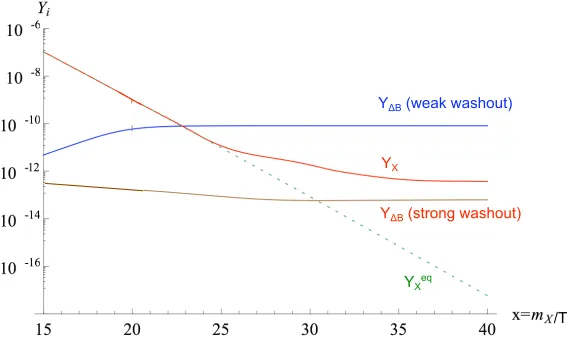
Figure 2: The evolution of the number density per comoving volume for fieldi(Yi) as a function ofx=mX/T.
The numerical solutions shown here are based on the WIMPy leptogenesis model discussed in Section 3, where the dominant annihilation process is XX → Lψ and the dominant washout is Lψ → L†ψ†. The input parameters areyX= 2.7, λL = 0.8, ǫ= 0.2, mX = 3 TeV, andmS = 5 TeV. mψ= 4 TeV gives the behavior
when washout freezes out well before WIMP annihilation freezes out (“weak washout”). mψ = 2 TeV gives
the behavior when washout becomes ineffective subsequent to WIMP freeze-out (“strong washout”).
Considering equations (11) and (16), we find that the expected range for the baryon-to-dark matter ratio in WIMPy baryogenesis is
10−6. ΩB
ΩX
.10, (17)
assumingO(1) couplings, and weak-scale masses for all new fields, i.e. mX, mψ ∼ O(0.1−1TeV). The
ob-served value of ΩB/ΩX≈0.2 falls within this range, and thus WIMPy baryogenesis can account for the entire
observed baryon asymmetry, but it does fall toward the upper end of the allowed region.
To summarize, models of WIMPy baryogenesis predict a dark matter relic density inversely proportional to the WIMP annihilation cross section, as in conventional WIMP models, and a baryon asymmetry proportional to the dark matter density at the time when washout processes freeze out. In Figure 2, we illustrate the evolution of the dark matter abundance and the baryon asymmetry in one model of WIMPy baryogenesis for the two limiting washout cases.
3
WIMP Annihilation to Leptons
3.1
Model Overview
X X¯ ψ ψ¯ S n Standard Model Z4 +i −i −1 −1 −1 −1 +1
Table 1: Z4 charges of fields in the WIMPy leptogenesis model described by (18).
3.1.1 Field Content and Lagrangian
We consider a simple model with the minimal ingredients for WIMPy leptogenesis. Dark matter consists of a pair of gauge singlet Dirac fermions2 X and ¯X that annihilate to the Standard Model lepton doublet L
i
and new weak-scale fieldsψi. X annihilates through weak-scale gauge singlet pseudoscalars3 Sα. By gauge
invariance,ψi has charge (2,1/2) under the SU(2)L×U(1)Y gauge interactions. The Lagrangian is
L=Lkin+Lmass−
i
2 λXαX
2+λ′
XαX¯2
Sα+i λL αiSαLiψi+ h.c. (18)
To satisfy the Sakharov conditions, dark matter annihilation must also violateCP, andλL αimust be complex.
To have physicalCP violation, there must be more than one scalarSα so there is a relative phase in their
amplitudes. XXannihilation can then generate an asymmetry inLi, and the lepton asymmetry is subsequently
converted to a baryon asymmetry by sphalerons. Because the symmetry preserved by sphalerons isB−L, a negative lepton asymmetry must be generated to account for the observed positive baryon asymmetry.
A positive lepton number asymmetry also accumulates inψi, and it is important that this positive
asymme-try does not erase the negative asymmeasymme-try in Standard Model leptons. In our model,ψidecays into light gauge
singletsni that are decoupled from Standard Model fields at low temperatures. The asymmetry produced in
ψis therefore sequestered in a sterile sector and the Standard Model asymmetry persists to the present time4.
AZ4symmetry, with charges in Table 1, forbids other operators that allowψto decay directly into Standard
Model leptons, thus preventing the erasure of the Standard Model lepton asymmetry. TheZ4symmetry also
makes dark matter stable.
In the simplest model,ψi decays toni+H through the interaction
∆L=λiH†niψi+ h.c. (19)
We assume that ψi is vectorlike with a partner ¯ψi in order to more readily satisfy electroweak precision
constraints. Its mass is restricted by the LEP boundmψ&100 GeV (see Section 5.2).
After electroweak symmetry breaking, ψi mixes with the sterile neutrino ni, and we must ensure that
the sterile neutrino satisfies overclosure constraints. Sinceψ is Dirac, we also include ¯ψ when diagonalizing the mass matrix and find that there remains a massless eigenstate even after the Higgs condenses. This is good, because light, weakly interacting thermal relics (such as sterile neutrinos) with masses&O(eV) would overclose the universe. n could have a Majorana mass mn . eV and still satisfy observational constraints,
since the light eigenstate would have a mass.eV as well, but we takento be massless in our model. The Lagrangian (18) is also invariant under a U(1)3 lepton flavor symmetry that prohibits flavor-changing
neutral currents but allows flavor-dependent couplings. Li, ni, andψi have charges +1, +1, and−1,
respec-tively, under the U(1)i factor of the flavor symmetry. We assume that the only source of flavor-breaking in
the low-energy theory is through the neutrino mass matrices, and this effect is very small.
2A Majorana dark matter fieldXdoes not work in this case becauseXmust carry a complex charge for the model to generate
a non-zero lepton asymmetry, as we show later in this section.
3We consider pseudoscalars instead of scalars because they do not have a velocity-suppressedXXannihilation cross section.
A scalarSwith couplings toX that areCP-violating with a large imaginary part would work as well.
4Ifm
ψ L
S1
ψ L
S 1
S2
L†
ψ† ψ
L
S1 S2
ψ†
[image:12.612.89.534.63.152.2]L†
Figure 3: Diagrams of tree and loop contributions to S decay. The difference between these rates and their conjugates generates a lepton asymmetry.
X
X ψ
L
S1
X
X ψ
L
S
1 S2
L†
ψ†
X
X ψ
L
S1
S2 ψ†
L†
Figure 4: Diagrams of tree and loop contributions to theXXannihilation cross section. The difference between these rates and their conjugates generates a lepton asymmetry.
3.1.2 Asymmetry generation
In this model, a lepton asymmetry can in principle be generated through two processes: the more conventional process of Sα decay into Liψi and their conjugates (or directly into Li+ni +H if mψ > mS), and XX
annihilation into the same final states. We show these in Figures 3 and 4, respectively, assuming that decay and annihilation occur predominantly through the lightest scalar S1. Existing work discusses the relevant
processes for generating a lepton asymmetry through 2 → 2 scattering [12], although the authors consider only high-scale models (T & 109 GeV) with qualitatively different features than WIMPy leptogenesis. CP
-violating phases in our model appear in the interference between tree-level and one-loop diagrams. We define asymmetry factors for the decay of the lightest scalar S1 and for WIMP annihilations, respectively, in the
manner of conventional leptogenesis:
ǫ1 =
Γ(S1→ψiLi)−Γ(S1→ψ†iL
†
i)
Γ(S1→ψiLi) + Γ(S1→ψ†iL
†
i)
, (20)
ǫ2 =
σ(XX→ψiLi) +σ( ¯XX¯ →ψiLi)−σ(XX→ψi†L
†
i)−σ( ¯XX¯ →ψ
†
iL
†
i)
σ(XX→ψiLi) +σ( ¯XX¯ →ψiLi) +σ(XX→ψi†L
†
i) +σ( ¯XX¯ →ψ
†
iL
†
i)
. (21)
ǫ1 gives the fractional asymmetry generated perS1 decay, whileǫ2 gives the fractional asymmetry generated
perXX annihilation. The precise values of ǫ1, ǫ2 in this case depend on the masses mSα and the couplings
λαi.
To reduce the number of arbitrary parameters in our analysis, we make the following assumptions:
• Dark matter annihilation occurs dominantly to only one flavor of lepton, and the couplings of all other leptons toSα are zero. The non-zero couplings of the single lepton flavor are denotedλLα.
• Dark matter annihilation and washout occur mostly through the lightest scalar,S1, and we consider the
[image:12.612.69.541.208.274.2]roughly λ4 L2 m4 S2 . λ 4 L1
5m4
S1
, (22)
λ2
X2λ2L2
m4
S2
. λ
2
X1λ2L1
5m4
S1
. (23)
We also assume thatmS1≪mS2, so that the loop integrals inǫ1andǫ2can be put in a simple analytic
form (24).
• The physical CP phases are large i.e. Im(a) ≈ a where a is some product of couplings appearing in scattering and decay amplitudes.
None of these assumptions are required by WIMPy leptogenesis, and we make them only to simplify the analysis and its interpretation. Relaxing these assumptions would introduce much complexity into the Boltzmann equations while giving qualitatively similar results. The phenomenology does, however, depend to some extent on the flavor of leptons to which dark matter predominantly annihilates (see Section 5 for details). With the above assumptions5,
ǫ2≈ −
1 6π
Im(λ2
L1λ∗L22)
|λL1|2
(2mX)2
m2
S2
"
7−15
m
ψ
2mX
2
+ 9
m
ψ
2mX
4 −
m
ψ
2mX
6#
. (24)
The expression forǫ1 is the same but with 2mX → mS1. Since we are most interested in the asymmetry
from annihilation,ǫ2 is the relevant parameter for WIMPy baryogenesis and we denote its asymmetry factor
by ǫ ≡ ǫ2. ǫ is suppressed by 1/mS22 from the S2 propagator, and is proportional to (2mX)2 because the
momentum flowing through theS1propagator inXXannihilation is
√ ˆ
s= 2mX+O(T), whereT ≪mX, mS1
at freeze-out. Note that (24) vanishes whenmψ= 2mX, at which point the particles in the loop cannot go on
shell and there is no imaginary part of the amplitude (and, hence, noCP violation). Using (22), (24), and the assumption of largeCP phases, we can boundǫ from above:
|ǫ|. 2λ
2
L1
3π√5 m2
X
m2
S1
"
7−15
m
ψ
2mX
2
+ 9
m
ψ
2mX
4 −
m
ψ
2mX
6#
. (25)
We treatǫ as a free parameter, subject to (25), and we can now express all rates and cross sections in terms ofλX ≡λX1,λL≡λL1,ǫ, mX,mψ, andmS≡mS1.
We have assumed that the lepton asymmetry fromXX annihilations dominates over that fromS decays. We find that this assumption is true whenevermX < mS. Since the asymmetry is proportional to the number
density ofX orSat the time of washout freeze-out, the ratio of asymmetry from decay vs. annihilation is the same as the ratio of the number ofS particles to the number ofX particles at the time of washout freeze-out. The assumption of annihilation-dominated asymmetry is therefore equivalent tomX< mS.
3.1.3 Washout
As we demonstrated in Section 2, the final baryon asymmetry depends on the time of washout freeze-out. We now discuss the implications for WIMPy leptogenesis, finding that we need mψ & mX for successful
WIMPy leptogenesis. We show the lepton number washout processes in Figure 5. They include inverse annihilations, lepton→antilepton scatterings, andψX→L†X processes. The dominant washout is typically
5This expression is derived in the narrow-width approximation. For TeV WIMPs,λ
X&1 is often necessary to obtain the correct dark matter relic abundance, which may lead to ΓS1,ΓS2∼mS. When 2mX> mS1,S1is kinematically forbidden from decaying
intoXX and the S1 width is narrow (because typicallyλL.1). S2 may be broad, but the imaginary part of its self-energy
correction ImΠ(p2) as substituted into (24) must be evaluated atp2 = 4m2X ≪m2S2 and satisfies ImΠ(4m2X)∼4m2X ≪m2S2. Similarly, if 2mX< mS1, then the partial width ofS1toXcan be very large for 2mX≪mS1, but once again ImΠ is evaluated in
(24) as ImΠ(4m2
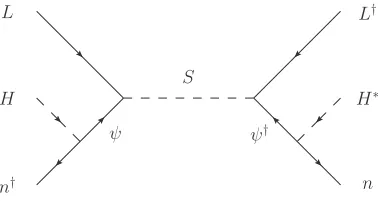
Figure 5: Diagrams leading to washout of the lepton number from (top row) s-channel and (bottom row) t-channel scatterings.
from Lψ → L†ψ† scatterings, because the inverse annihilation Lψ → XX is kinematically suppressed for T < mX andψX →L†X gets more Boltzmann suppression. Applying (5) for the specific model of WIMPy
leptogenesis, the washout rate is proportional to
Γwashout(x)≈
s(x) Yγ h
σLψ→L†ψ†viYLeqYeq
ψ (x), (26)
wheres(x) is the entropy density atx. Washout freezes out when its rate is about equal to the Hubble scale, Γwashout(xwashout)≈H(xwashout). Γwashout(xwashout) can be small for one of two reasons:
1. mψ&mX so thatYψeq(xwashout) is Boltzmann-suppressed while dark matter is annihilating.
2. hσLψ→L†ψ†viis small relative to the annihilation cross section so that washout freezes out before anni-hilation. The washout cross section can be small ifλL≪1.
One of these two conditions must hold for each washout process. We find that option #1 leads to viable WIMPy leptogenesis. Option #2, on the other hand, does not give a large asymmetry. According to (25), the asymmetry efficiency factor ǫ is also suppressed when λL ≪ 1, and the potential gain in the baryon
asymmetry from early washout freeze-out in option #2 is offset because leptogenesis occurs less efficiently. Therefore,mψ&mX is generally required to generate the observed baryon asymmetry.
Whenmψis much larger thanmX(we find this is typically true formψ&2mX), the exponential suppression
ofYψ is so large that 3→3 scatterings ofL n H →L†n†H∗ become important (see Figure 6). This region
is, however, kinematically inaccessible in WIMPy leptogenesis since 2mX > mψ for efficient annihilation to
occur, and we neglect 3→3 processes.
3.1.4 Boltzmann equations
We consider the evolution of a single componentLa, wherea is a gauge index (flavor indices are suppressed
since we consider only one flavor). We define BrL (BrX) as the total branching fraction of S into leptons
n† H
L L†
H∗
n S
[image:15.612.215.404.60.163.2]ψ† ψ
Figure 6: 3→3 washout process that can dominate over 2→2 scattering whenT ≪mψ.
the amount of La asymmetry generated for each La directly created/annihilated (this accounts for the fact
that the asymmetry spreads among all baryons and leptons by rapid thermalization). We calculated the cross sections and widths analytically and checked them with CalcHEP [13].
The Boltzmann equations describing the evolution of the various particle species and the asymmetry in oneof the components of theLa doublet are
H(mX)
x dYX
dx =−4shσXX→Laψavi[Y
2
X−(YXeq)
2]−2
sǫξ Y∆La
Yγ hσXX→Laψavi(Y
eq
X)
2
−Br2XhΓSiYSeq
YX YXeq
2
+ BrXhΓSi(YS−BrLYSeq)−ǫ ξ Y∆La
2Yγ BrXBrLhΓSiY
eq
S ; (27)
H(mX)
x dYS
dx = −hΓSiYS+hΓSiY
eq
S "
BrL+ BrX
YX YXeq
2#
; (28)
H(mX)
x η
dY∆La dx =
ǫ
2BrLhΓSi
YS+YSeq
1−2BrL−BrX
1 + Y
2
X
(YXeq)2
+ 2s ǫhσXX↔Laψavi
YX2−(YXeq)
2
−ξ Y∆La
Yγ
shσXX↔Laψavi(Y
eq
X)
2+ 2s[hσ
Laψa↔L†aψa†vi+hσ
(a6=b)
Laψa↔L†bψb†vi]Y
eq
L Y
eq
ψ + 2shσLaψb↔L†bψ † aviY
eq
L Y
eq
ψ
−ξ Y∆La
Yγ
shσXψ
a↔XL†aviYXY
eq
ψ + 2shσψaψa↔L†aL†avi(Y
eq
ψ )
2+ 2
shσ(a6=b) ψaψb↔L†aL†b
vi(Yψeq)2
+ξ Y∆La
4Yγ BrLhΓSiY
eq
S ǫ
2Br
L+ BrX
. (29)
We assume that all abundances are in thermal equilibrium atx= 1 and that all fields remain in equilibrium except forS andX. In the evolution of the scalarS, we only include the decay terms, as they dominate over SS annihilation forT ≪mS.
To determine the relationship betweenµψa andµLa, we assume that all abundances other thanS,X and ∆La are in thermal equilibrium and that all processes except those involvingS are in chemical equilibrium.
We also take sphaleron processes to be in equilibrium. The non-S couplings in (18) distribute theL and ψ asymmetries among the light fields. Solving the chemical potential relations gives
ξ = 16 + 12n
eq
ψa/n
eq
La
3 + 12neqψa/neqLa , (30)
η = 2(7 + 28n
eq
ψa/n
eq
La)
79 + 355neqψa/neqLa. (31)
The assumption of thermal equilibrium forψ is consistent provided the decay width Γψ> H(Tlep), which
in our model constrains
λ2
i &
16πH(Tlep)
mψ i ≈
80√g∗T2 lep
MPlmψ i
. (32)
ForTlep = 100 GeV and mψ i = 2 TeV, this givesλi &3×10⁻⁸. This is not a very stringent requirement,
since this value is smaller than any of the Standard Model Yukawa couplings.
The final lepton asymmetry is also determined by the chemical potential relations. The relation between the total lepton asymmetry ∆Ltot and the asymmetry in a single component of the doublet field ∆La as
determined by equation (29) is
Y∆Ltot =
51 + 243neqψa/neqLa
7 + 28neqψa/neqLa Y∆La. (33) The final baryon asymmetryY∆B follows from the sphaleron chemical potential relations, and is
Y∆B(x) =−4
7 + 28neqψa/neqLa 51 + 243neqψa/neqLa
!
Y∆Ltot=−4Y∆La. (34) In the limitx→ ∞, the ratio of total baryon to lepton number reduces to the same expression as conventional leptogenesis [14].
The total dark matter relic abundance is
YDM(∞) =YX(∞) +YX¯(∞) = 2YX(∞). (35)
3.2
Numerical Results
There are six free parameters in our model: three masses (mS,mX, andmψ) and three dimensionless
param-eters (λX,λL, andǫ). To determine over what range of parameters WIMPy leptogenesis can be successful, we
perform scans over two parameters at a time while holding others fixed. In particular, we are interested to see what range of masses is allowed, and if any tuning of the mass and coupling constant relations is necessary to generate the correct baryon asymmetry and WIMP relic density.
Range of allowed masses: We holdmS fixed and determine for whichmX and mψ masses there existssome
perturbative couplings that give the observed dark matter density and baryon asymmetry. We place no other restrictions on the couplings. If mψ > mS, we assume that the S width is dominated by the three-body
decay S → L H n. We show in Figure 7 the masses that give rise to successful WIMPy leptogenesis. The viable ψ masses satisfy mψ ≈ (1−2)mX, while there is no correlation between mX and mS as long as
mX < mS. For smaller values ofmψ/mX, the Boltzmann suppression of the washout rate is insufficient to
generate the observed baryon asymmetry, whilemψ &2mX is not allowed because dark matter annihilation
is not kinematically allowed and because the asymmetry efficiencyǫis zero (CP violation is zero if Land ψ cannot go on-shell in the dark matter annihilation loop diagrams).
The lower boundary of the allowed region has a meandering shape aroundmψ ≈mS. The reason is thats
-channel washout processes have a resonant enhancement in this region, leading to a smaller baryon asymmetry and a restricted parameter space. Above resonance,t-channel washout processes are also important, explaining why the bend in the curve is centered atmψ slightly larger thanmS.
The principal reason that it is difficult to generate a large baryon asymmetry is because the efficiency of asymmetry generationǫis tied to the washout cross section through its dependence on λ2
L in (25). A large
asymmetry can only be generated when washout effects are also large, limiting how much of an asymmetry can be generated. The viable parameter space is larger if (25) can be relaxed, as is the case whenS1 andS2
are nearly degenerate and the asymmetry is resonantly enhanced, but this is not a required feature of WIMPy leptogenesis.
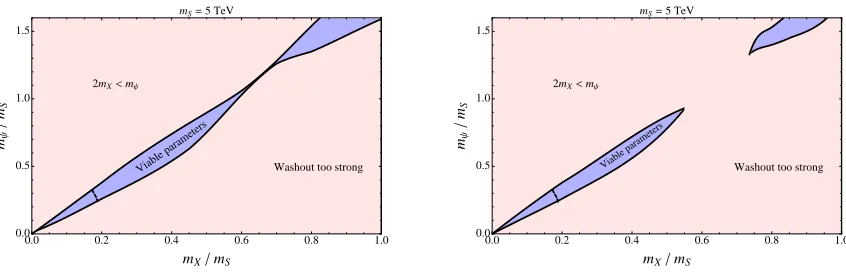
2mX<mΨ
Viable parameters
Washout too strong
0.0 0.2 0.4 0.6 0.8 1.0
0.0 0.5 1.0 1.5
mXmS
mΨ
mS
[image:17.612.182.431.56.227.2]mS=5 TeV
Figure 7: Regions in the mX-mψ plane with the correct WIMP relic density and baryon asymmetry from
WIMPy leptogenesis, withmS = 5 TeV and some choice of perturbative couplings. The masses giving both
observed abundances are shown in blue (middle stripe). We plot the ratios mX/mS, mψ/mS to show the
relationship between theX andψmasses and the mediator scalemS. The excluded regions are shown in red:
the upper region is not viable because 2mX < mψ and the thermal annihilation cross section is
Boltzmann-suppressed, while the lower region hasYψ too large to prevent rapid washout of the asymmetry. The dashed
line indicates the lower boundary of allowedmX and mψ; below the line, the electroweak phase transition
occurs before the baryon asymmetry is large enough to account for the observed value. FormX/mS >1, the
asymmetry is dominated byS decay.
leptogenesis is a weak-scale model, the timing of the asymmetry generation relative to the phase transition is important. To illustrate this, we computed the critical temperatureTc of the phase transition assuming a
Standard Model Higgs with massmh= 120 GeV, and we required that the baryon asymmetry atTcbe equal
to the observed asymmetry6. This typically yields a much smaller baryon asymmetry than lepton asymmetry
at late times because the baryon asymmetry stops accumulating atTc. Accounting for the effects of the phase
transition, the allowed region is above the dashed line in Figure 7. If the phase transition is modified by additional Higgs fields or other new physics, then this boundary line changes.
Range of allowed couplings: We choose representative values of the masses, with mS = 5 TeV for all cases,
andmX andmψchosen in the middle of the allowed bands in Figure 7. For one set of parameters, dark matter
annihilates above theS resonance, with parametersmX= 4.25 TeV, mψ= 7.5 TeV, and |ǫ|= 0.075, and we
determine the dark matter relic abundance and baryon asymmetry as functions of the two couplings. We also studyXX annihilation below resonance, withmX = 1.5 TeV,mψ = 2.25 TeV, and|ǫ|= 0.0075. We plot the
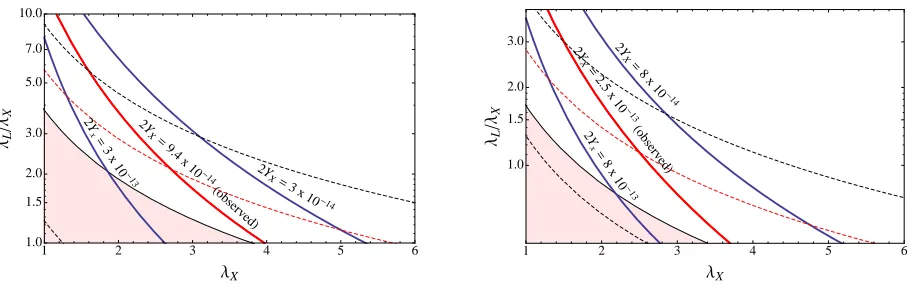
results in Figure 8 as contours of constant relic density and baryon asymmetry. We focus on the ratioλL/λX
because we are interested in seeing if any relationship between these two theoretically unrelated quantities is required to obtain a particular relic abundance and asymmetry. In both cases shown, WIMPy leptogenesis gives the correct dark matter relic abundance and asymmetry when both couplings areO(1). Thus, a perfectly natural choice of couplings, and the very same couplings that satisfy the WIMP miracle, can also generate the correct baryon asymmetry if CP phases are large! Specifically, with mX = 4.25 TeV, mψ = 7.5 TeV,
and|ǫ|= 0.075, the observational constraints are satisfied withλX= 2.7 andλL= 5.7; withmX = 1.5 TeV,
mψ= 2.25 TeV, and |ǫ|= 0.0075, the couplings areλX = 2.8,λL= 2.5.
6Since the Standard Model phase transition is of second order, sphalerons do not suddenly shut off, and a more proper treatment
2YX =
3 x10
-14 2Y X= 9.4 x10 -14 Hobserved L 2Y x= 3 x 10 -13
1 2 3 4 5 6
1.0 10.0 5.0 2.0 3.0 1.5 7.0 ΛX ΛL ΛX 2Y X = 8 x10 -14 2Y X = 2.5 x 10 -13 Hobserved L 2Y x= 8 x 10 -13
1 2 3 4 5 6
[image:18.612.82.538.55.198.2]1.0 2.0 3.0 1.5 ΛX ΛL ΛX
Figure 8: Dark matter relic density(solid lines)and baryon asymmetry(dotted lines)as functions of couplings λX andλL/λX. We consider two sets of massses, withmS = 5 TeV for both: (left)mX= 4.25 TeV,mψ= 7.5
TeV, and|ǫ| = 0.075;(right) mX = 1.5 TeV, mψ = 2.25 TeV, and |ǫ|= 0.0075. The asymmetry contours
are, from top to bottom: (left)Y∆B= 5×10⁻¹¹, 8.5×10⁻¹¹(observed asymmetry), and 3×10⁻¹⁰; (right)
Y∆B = 3×10⁻¹¹, 8.5×10⁻¹¹(observed asymmetry), and 3×10⁻¹⁰. The dark matter abundances are printed
on the plots. In the shaded regions, the numerical value ofǫis not consistent with our assumptions according to the bound (25).
In deriving our results, we assumed that dark matter only annihilates through lepton-number-violating interactions. In a more general model, dark matter may also have lepton-number-preserving interactions that contribute to the total annihilation cross section. We parameterize this possibility with the quantity
α≡ hσXX→anythingvi hσXX→Lψvi ≥
1. (36)
Whenα >1, the asymmetry generated by WIMPy leptogenesis is smaller, because only 1/α of dark matter annihilations proceed through lepton-number-violating couplings and can create an asymmetry7. As a result,
the viable parameter space for WIMPy leptogenesis is reduced. In Figure 9, we show the masses mX, mψ
giving successful WIMPy leptogenesis with α > 1. In particular, we find that the lepton asymmetry from WIMPy leptogenesis is too small in regions with large washout (mψ∼mS, where wash-out scattering is
on-shell). While WIMPy leptogenesis is possible with lepton-preserving annihilation channels,mψ lies in a more
restricted region whenα >1.
To summarize, we have presented a model of WIMPy leptogenesis where the WIMP miracle has been extended to the WIMPy baryogenesis miracle: the correct baryon asymmetry and WIMP relic density can be generated simultaneously with TeV-scale masses andO(1) couplings. We find that, depending on the ratio mψ/mX and the Yukawa couplings, larger and smaller asymmetries are also possible over a range of about
seven orders of magnitude. Generating the observed baryon asymmetry does require some correlation between mXandmψ, which may be explained if the masses have some common dynamical origin. FormX lighter than
about 1 TeV, sphalerons decouple in the middle of asymmetry generation and the resulting baryon asymmetry is typically smaller than the observedY∆B.
7Whenα >1, the WIMP annihilation cross section is also larger, andλ
2mX<mΨ
Viable parameters
Washout too strong
0.0 0.2 0.4 0.6 0.8 1.0
0.0 0.5 1.0 1.5
mXmS
mΨ
mS
mS=5 TeV
2mX<mΨ
Viable parameters
Washout too strong
0.0 0.2 0.4 0.6 0.8 1.0
0.0 0.5 1.0 1.5
mXmS
mΨ
mS
mS=5 TeV
Figure 9: Regions in the mX-mψ plane for viable WIMPy leptogenesis with additional
lepton-number-preserving dark matter annihilation modes: (left) α = 2, (right) α = 3. The masses giving the correct dark matter density and baryon asymmetry for some choice of perturbative coupling are shown in blue (mid-dle stripe). As the lepton-number-preserving annihilation cross section increases, the efficiency of asymmetry generation drops, and the marginal regions of parameter space become inaccessible, particularly the enhanced washout regionmψ∼mS. The descriptions of the regions on the plot are the same as those in Figure 7.
4
WIMP Annihilation to Quarks
4.1
Model Overview
If the final products of dark matter annihilation are quarks, WIMP annihilation can directly generate a baryon number asymmetry. The lower bound of∼TeV onmX in WIMPy leptogenesis (the dashed line in Figure 7)
does not apply when WIMPs annihilate to quarks, since the production of baryon number no longer depends on efficient sphaleron interactions. Just as the leptogenesis model included new weakly charged vectorlike doublets, this model requires new vectorlike colored states to couple to quarks. Such states can be pair-produced at the LHC, leading to much stronger constraints and better detection prospects, which we discuss in Section 5.2.
The model content is similar to the leptogenesis model discussed in Section 3: vectorlike gauge singlet dark matter X and ¯X, singlet pseudoscalars Sα, and vectorlike exotic quark color triplets ψi and ¯ψi. The
Lagrangian is
L=Lkin+Lmass−
i
2 λXαX
2+λ′
XαX¯
2
Sα+iλB αSαuψ.¯ (37)
A baryon asymmetry can be generated in ¯ualong with an equal negative baryon asymmetry in ψ. ψ must decay, because it would otherwise overclose the universe and violate bounds on stable colored particles.
The negative baryon asymmetry inψmust not destroy the positive baryon asymmetry in ¯uwhen it decays. This can happen in two ways:
1. ψ decays into a sector decoupled from Standard Model quarks at low energies. Total baryon number is preserved, but the negative baryon number carried by ψ is sequestered from quarks at late times and does not eliminate the Standard Model asymmetry.
2. ψ decays into Standard Model quarks through baryon-number-violating couplings. The final baryon asymmetry is different from the asymmetry created initially in ¯ufrom WIMP annihilations because ψ decays give an additional contribution to the baryon asymmetry.
We now implement each of the above scenarios.
1. ψi decays to light, baryon-number-carrying singlets ni plus Standard Model antiquarks. It can do so
[image:19.612.97.520.54.190.2]X X¯ ψ ψ¯ S u¯ d¯ φ/d˜ Q H n leptons Z4 +i −i +1 +1 −1 −1 −1 −1 −1 +1 +1 +1
Table 2: Z4charges of fields in models with WIMP annihilation to quarks.
in the Lagrangian are
∆L=λiψ¯id¯iφ∗+λ′iφd¯ini+ h.c. (38)
A Z4 symmetry prevents ψ from decaying directly into Standard Model quarks through a QHψ¯ term
and eliminating the baryon asymmetry. We show the charges in Table 2. This Lagrangian has a U(1)3
flavor symmetry and satisfies all quark flavor constraints. In particular, ¯ui,ψi, andni have charges−1,
+1, and−3, respectively, under the U(1)i factor of the flavor symmetry. φhas charge−2 under all U(1)
flavor symmetries. We assume that the only sources of flavor violation are the Standard Model Yukawa matrices.
2. In this scenario,ψi also decays to two antiquarks plus a singletn, butnis a Majorana fermion that does
not carry any charge. Baryon number is now explicitly violated, and dark matter annihilations generate −1 unit of baryon number for eachψ+ ¯uproduced from dark matter annihilations (becauseψ→d¯dn¯ ). There is a new colored scalar ˜di in the (3,1,−1/3) representation of the Standard Model gauge group
that mediatesψdecays. The additional terms in the Lagrangian are
∆L=λ ǫijkψ¯id¯jd˜∗k+λ′id¯id˜in+ h.c. (39)
A Z4 symmetry, with charges given in Table 2, prevents ψ from decaying to Standard Model quarks
through other interactions that would destroy the baryon asymmetry. This Lagrangian can be naturally realized in supersymmetric models, where ˜d is the down squark andnis the neutralino, although this is not the only possible realization of this scenario. (39) has a U(3) flavor symmetry, which is the diagonal subgroup of the full U(3)u×U(3)d flavor group. The quark, ψi and ˜di fields transform in
the fundamental of U(3). The Yukawa couplings between S¯uψ in (37) have a flavor-independent piece and a flavor-dependent piece proportional to the up Yukawa matrixYu, consistent with minimal flavor
violation.
In both scenarios,ψ decays to a singlet nplus quarks. Operators allowing ψ to decay entirely to quarks (such asφ∗d¯¯uor ˜d∗d¯u¯) are forbidden by the Z
4 symmetry. The Z4 symmetry also ensures the stability of
dark matter and of the proton. The proton is stable providedmp <2mX, mS because baryons have charge
(−1)3=−1 and can never decay into the lighter meson and lepton fields, which are uncharged under theZ 4.
The Z4 symmetry in principle allows neutral baryons to oscillate into one another. For scenario #1, the
generalized baryon number symmetry prohibits neutron-antineutron oscillation. In scenario #2, the baryon-number-violating term is antisymmetric in flavor indices, and the dominant contribution to neutron-antineutron mixing involves loops ofW bosons and off-diagonal CKM matrix element insertions Vbd and Vsd. Since the
bound on the neutron-antineutron oscillation operatorc/Λ5(¯ud¯d¯)2is Λ&10−100 TeV forc= 1 [15], the
loop-and CKM-suppression is sufficient to lower the oscillation rate well below current constraints formS, mψ, md˜∼
TeV andO(1) couplings.
The Boltzmann equations for WIMP annihilation to quarks are changed only by group theory factors from the corresponding equations for leptons. Similarly, the chemical potentials relations are modified to reflect the new interactions (38) or (39).
As with WIMPy leptogenesis, we assume that ψ is in equilibrium, and this places constraints on the couplings through which it decays. In scenario #1, we considered the decay ofψaccording to interactions given in equation (38). Ifmψ> mφ, theψdecay is two-body and the constraint (32) applies, givingλi&6×10⁻⁸.
Ifmψ< mφ,ψundergoes a three-body decay to ¯dd n¯ , and the constraint is
(λiλ′i)2&
80√g∗T2 lepm2φ
MPlm3ψ
Washout 2mX<mΨ
Viable parameters
LHC gluino constraint
too strong
0.0 0.2 0.4 0.6 0.8 1.0
0.0 0.5 1.0 1.5
mXmS mΨ
mS
mS=1.5 TeV
2mX<mΨ
Viable parameters
Washout too strong
LHC gluino constraint
0.0 0.2 0.4 0.6 0.8 1.0
0.0 0.5 1.0 1.5
mXmS mΨ
mS
[image:21.612.82.537.56.203.2]mS=5 TeV
Figure 10: Regions in themX-mψ plane with the correct WIMP relic density and baryon asymmetry from
WIMPy baryogenesis, with (left)mS = 1.5 TeV and (right)mS = 5 TeV, and any choice of perturbative
couplings. The masses giving both observed abundances are shown in blue (middle stripe). The descriptions of the regions on the plot are the same as those in Figure 7.
ForTlep= 50 GeV and mψ= 1 TeV, we find that the constraint on the geometric mean of the couplings is
p
λiλ′i&6×10−
5
r
mφ
2 TeV. (41)
The constraints on scenario #2 are comparable.
4.2
Numerical Results
Because of its similarity to leptogenesis, we use the quark flavor structure of scenario #1 in our analysis, since it allows for a more direct comparison of numerical results in both cases. We consider two scenarios: mS = 5 TeV,
to compare the results for quarks with that for leptons, andmS = 1.5 TeV, because dark matter can be much
lighter than in WIMPy leptogenesis since there are no constraints from sphaleron decoupling. For simplicity, we consider sphalerons to be out of equilibrium for the 1.5 TeV case and in equilibrium for the 5 TeV case to avoid considering sphaleron decoupling effects, although the calculation can be easily extended to include them.
Range of allowed masses: We show the range of allowed masses in Figure 10. Gluino searches at the LHC constrain this scenario (see Section 5.2), in contrast with the leptogenesis model, for which the entire parameter space is unconstrained by collider searches. This is particularly true formS = 1.5 TeV, where LHC searches
will cover almost the entire parameter space for dark matter annihilation to quarks during the 14 TeV run. The WIMP mass is already constrained to bemX &295 GeV by the gluino bound discussed in Section 5.2
along with the kinematic requirement that 2mX > mψ. This is true independent of all other parameters.
In both cases, the results are qualitatively similar to leptogenesis. With WIMP annihilation to quarks, the annihilation and washout cross sections are enhanced because the final states are charged under SU(3)C. As
a result, the baryon asymmetry is suppressed by the increased washout rate. This is partially offset by the fact that the self-energy contribution toǫis enhanced by a group theory factor as well. WithmX = 0.9 TeV,
the parameter space is actually larger than formX = 4.25 TeV or WIMPy leptogenesis. Since in this case,
sphalerons no longer inter-convert baryon and lepton number, the asymmetry created in quarks is distributed among fewer fields, enhancing the asymmetry.
2YX =
3 x10
-14
2Y
X=
9.5 x10
-14
Hobserved
L 2Y
x=
3x 10
-13
1 2 3 4 5
1.0 10.0
5.0
2.0 3.0
1.5 7.0
ΛX
ΛB
ΛX 2YX=
10-13
2Y X=
4.4 x10
-13
Hobserved
L 2Y
x= 10
-12
0.1 0.2 0.3 0.4 0.5
10 50
20 30
15
ΛX
ΛB
[image:22.612.82.537.54.197.2]ΛX
Figure 11: Dark matter relic density (solid lines) and baryon asymmetry (dotted lines) as functions of couplings λX and λB/λX. We consider two sets of massses: (left), mX = 4.25 TeV, mψ = 7.25 TeV, mS = 5 TeV,
and|ǫ|= 0.075. The asymmetry contours are, from top to bottom: Y∆B = 4×10⁻¹¹, 8.5×10⁻¹¹ (observed
asymmetry), and 1.5×10⁻¹⁰. (right)m
X = 0.9 TeV, mψ = 1.2 TeV, mS = 1.5 TeV, and|ǫ|= 0.075; the
asymmetry contours are, from top to bottom: Y∆B = 5×10⁻¹¹, 8.5×10⁻¹¹ (observed asymmetry), and
3×10⁻¹⁰. In the shaded regions, ǫis not consistent with our assumptions according to the bound (25).
corresponding point with lightSand broken phase chemical potential relations:mX = 0.9 TeV,mψ= 1.2 TeV,
mS = 1.5 TeV, and |ǫ|= 0.075. We show the results in Figure 11. The parameter points giving the correct
dark matter density and baryon asymmetry areλX = 2.7, λB = 4.5 for mX = 4.25 TeV, and λX = 0.22,
λB = 2.8 for mX= 0.9 TeV.
5
Experimental Constraints and Detection Prospects
In this section, we survey the possible experimental constraints and signals for models of WIMPy baryogenesis, considering both annihilation to leptons and annihilation to quarks. For WIMP annihilation to leptons, the experimental bounds on mX and mψ are too weak to constrain leptogenesis because mX, mψ & TeV are
required to generate a sufficiently large baryon asymmetry. The prospects are better for WIMP annihilation to quarks, which predicts signals at indirect and direct detection experiments, as well as at the LHC. We first give a preview of our results in Table 3.
Annihilation to leptons Annihilation to quarks Direct detection −− mX.5 TeV for some parameters8
(σX−nucleon∼10−46−10−44cm2)
Indirect detection mX.200 GeV mX .1 TeV
(antideuterons)
Colliders mψ.few hundred GeV, mψ.1.44 TeV with
possible improvements 100 fb−1 LHC (14 TeV)
with targeted searches
EDM −− −−
[image:22.612.116.496.482.618.2]X X
q X
q
Z/γ Li
S
ψi S
X X
e
S
e X
[image:23.612.110.506.61.157.2]ψ− S
Figure 12: Feynman diagrams for dark matter scattering off(left) nucleons and (right)electrons in direct detection experiments for WIMPy leptogenesis.
X X
¯
u†
S
¯
u† X
ψ S
X X
nj
¯
u† i
φ∗
¯
dj ¯
di
ψi S
Figure 13: Feynman diagrams for dark matter scattering off nucleons in direct detection experiments when WIMPs annihilate to quarks: (left)standard signal and(right)inelastic induced nucleon decay.
We provide details for each class of experiment in the following sections.
5.1
Dark Matter Detection
5.1.1 Direct Detection
Dark matter direct detection experiments are typically important probes of weak-scale dark matter models. As we show in this section, however, only WIMPy baryogenesis with dark matter annihilation to quarks is expected to give a signal in conventional direct detection experiments. This is because the dark matter scattering cross section is suppressed by loops of heavy fields, and it is only when dark matter couples directly to quarks that the WIMP-nucleon cross section is large enough to give a signal in upcoming experiments. We assume in this section that dark matter annihilates predominantly to first generation quarks/leptons. The baryon-number-violating interactions in WIMPy baryogenesis can also induce proton decay due to WIMP scattering, but we find that our models are consistent with all current and projected experimental bounds.
We first present the Feynman diagrams for the leading processes relevant to direct detection. With WIMP annihilation to leptons, we show the diagrams for scattering in direct detection experiments in Figure 12. We show the corresponding diagrams with WIMP annihilation to quarks in Figure 13.
WIMP annihilation to leptons: X can elastically scatter off electrons at one loop and nucleons at two loops. However, direct detection experiments are on the verge of testing dark matter models with nucleon scattering at one loop [16, 2, 3, 5] and electron scattering at tree level [17]. Therefore, the elastic scattering signals from our models are too small to be detected at near-future experiments.
As we discussed in Section 3.2, there can be lepton-number-preserving dark matter annihilation channels
8Precise reach depends onm
[image:23.612.111.504.222.320.2]