www.atmos-meas-tech.net/8/4243/2015/ doi:10.5194/amt-8-4243-2015
© Author(s) 2015. CC Attribution 3.0 License.
Intercomparison of the comparative reactivity method (CRM)
and pump–probe technique for measuring total OH reactivity
in an urban environment
R. F. Hansen1,3,a, M. Blocquet4, C. Schoemaecker4, T. Léonardis1,2, N. Locoge1,2, C. Fittschen4, B. Hanoune4, P. S. Stevens3,5, V. Sinha6, and S. Dusanter1,2,4
1Mines Douai, SAGE, 59508 Douai, France 2Université de Lille, Lille, France
3Department of Chemistry, Indiana University, Bloomington, IN, USA
4Université de Lille, PhysicoChimie des Processus de Combustion et de l’Atmosphère (PC2A) UMR 8522 CNRS/Lille 1,
Cité scientifique, 59655 Villeneuve d’Ascq Cedex, France
5School of Public and Environmental Affairs, Indiana University, Bloomington, IN, USA
6Department of Earth and Environmental Sciences, Indian Institute of Science Education and Research Mohali, Sector 81,
S. A. S. Nagar, Manauli PO, Punjab 140306, India
anow at: School of Chemistry, University of Leeds, Leeds, LS2 9JT, UK Correspondence to: R. F. Hansen ([email protected])
Abstract. The investigation of hydroxyl radical (OH) chem-istry during intensive field campaigns has led to the devel-opment of several techniques dedicated to ambient measure-ments of total OH reactivity, which is the inverse of the OH lifetime. Three techniques are currently used during field campaigns, including the total OH loss rate method, the pump–probe method, and the comparative reactivity method. However, no formal intercomparison of these techniques has been published so far, and there is a need to ensure that mea-surements of total OH reactivity are consistent among the different techniques.
An intercomparison of two OH reactivity instruments, one based on the comparative reactivity method (CRM) and the other based on the pump–probe method, was performed in October 2012 in a NOx-rich environment, which is known to be challenging for the CRM technique. This study presents an extensive description of the two instruments, the CRM instrument from Mines Douai (MD-CRM) and the pump– probe instrument from the University of Lille (UL-FAGE), and highlights instrumental issues associated with the two techniques.
It was found that the CRM instrument used in this study underestimates ambient OH reactivity by approximately 20 % due to the photolysis of volatile organic compounds (VOCs) inside the sampling reactor; this value is dependent
on the position of the lamp within the reactor. However, this issue can easily be fixed, and the photolysis of VOCs was successfully reduced to a negligible level after this intercom-parison campaign. The UL-FAGE instrument may also un-derestimate ambient OH reactivity due to the difficulty to ac-curately measure the instrumental zero. It was found that the measurements are likely biased by approximately 2 s−1, due to impurities in humid zero air.
Two weeks of ambient sampling indicate that the measure-ments performed by the two OH reactivity instrumeasure-ments are in agreement, within the measurement uncertainties for each in-strument, for NOx mixing ratios up to 100 ppbv. The CRM technique has hitherto mainly been used in low-NOx envi-ronments, i.e. environments with ambient NOxmixing ratios lower than a few ppbv, due to a measurement artifact gener-ated by ambient NO inside the sampling reactor. However, this study shows that this technique can also be used under NOx-rich conditions if a NOx-dependent correction is care-fully applied on the OH reactivity measurements.
1 Introduction
A detailed understanding of atmospheric oxidation processes is key to tackling fundamental issues related to air quality and climate change. For instance, the oxidation of volatile organic compounds (VOCs) in the presence of NOx leads to the formation of photochemical pollutants such as ozone and secondary organic aerosols, which can have detrimen-tal effects on both human health (Gryparis et al., 2004) and ecosystems (Ashmore, 2005). In addition, the lifetime of climate-related trace gases such as methane (Ehhalt, 1998) is mainly controlled by the atmospheric oxidative capacity; thus, the reliability of climate projections will strongly de-pend on the ability of models to correctly describe atmo-spheric oxidation processes.
While several free radicals initiate the oxidation of trace gases, the hydroxyl radical (OH) is the dominant oxidant in the daytime troposphere. It is therefore important to ensure that the initiation, propagation, and termination processes of OH are well understood and well-described in current atmo-spheric chemical models.
The loss of OH due to a reactive chemical species X can be quantified by the OH reactivity (kX), which is defined as
the product of the appropriate rate constant for the reaction of X with OH (kX,OH) and the concentration of X, as shown
in Eq. (1). The total OH reactivity (kOH) can be calculated
by summingkXfor each chemical species Xithat reacts with OH in ambient air (Eq. 2).
kX=kX,OH[X], (1)
kOH=
X
i
kXi,OH[Xi] (2)
Total OH reactivity (kOH) is a useful metric to test our
under-standing of OH chemistry, since it represents the total first-order loss rate of OH, i.e. the inverse of its lifetime. Indeed, total OH reactivity has been widely used in combination with OH and VOC concentration measurements to investigate the budget of OH sources and sinks as discussed below.
To determine the contribution of identified OH sinks to the total loss rate of OH, the OH reactivity calculated from trace gas measurements (Eqs. 1, 2) is compared to the measured total OH reactivity. Any discrepancy between measured and calculated total OH reactivity values represents OH sinks that have not been characterized by trace gas measurements and indicates that potentially important unmeasured reactive species and chemical processes associated with these species may impact our understanding of OH chemistry. Summaries of OH reactivity measurements performed during field cam-paigns (e.g., Table 1 in this work and Table 1 in Lou et al., 2010) show that discrepancies between measured and cal-culated OH reactivity have indeed been seen in a variety of environments. For example, two field campaigns, one con-ducted in a boreal forest (Nölscher et al., 2012a) and one conducted in a European megacity (Dolgorouky et al., 2012), have shown that the missing OH reactivity could represent
more than 50 % of the total OH reactivity. These studies high-light that our understanding of OH sinks is still incomplete.
Concomitant measurements of OH concentrations and OH reactivity can also be used to investigate the completeness of OH sources. Based on the assumption that the concentration of OH is in steady state, due to its short lifetime (<1 s), the total OH loss rate calculated from the measuredkOHand OH
concentrations (kOH×[OH]) can be compared to OH
produc-tion rates calculated from known OH producproduc-tion pathways such as O3+hν, HONO+hν, and HO2+NO, using
measure-ments of trace gases and photolysis frequencies. Only a few studies have employed this approach, as collocated measure-ments of OH and OH reactivity, both made by complex in-struments, are needed. Two of these studies, which compared OH production and loss rates for Beijing (Lu et al., 2013) and the Pearl River Delta (Hofzumahaus et al., 2009; Lu et al., 2012), found that OH production rates calculated from OH precursors were lower than the measured OH loss rates in both locations. These results suggest that there are still un-known sources of OH in these environments.
Total OH reactivity can also be used to examine ozone for-mation by determining if an air mass is NOx- or VOC-limited with respect to ozone production (Kirchner et al., 2001). This can be used to determine ozone production regimes on lo-cal and regional slo-cales and to lo-calculate instantaneous ozone production rates as shown for the DOMINO field campaign (Sinha et al., 2012). More recently, Kumar and Sinha (2014) have shown that CRM coupled to sequential ambient VOC measurements using a new “VOC-OHM” system can be used to constrain the rate coefficient of the reactive nominal iso-baric compound contributing to a givenm/zratio (e.g. iso-prene and furan at m/z=69), adding more specificity to mass spectrometers with unity mass resolution.
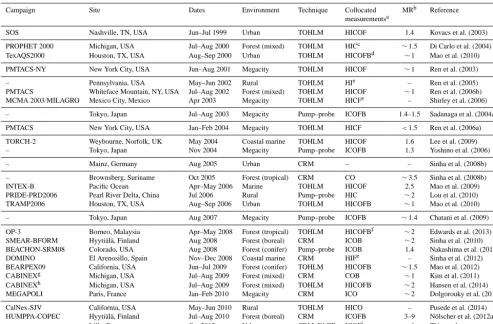
Three techniques have been proposed in the literature to measure total OH reactivity: the total OH loss rate method (TOHLM) (Kovacs and Brune, 2001), the pump– probe method (Sadanaga et al., 2004b), and the comparative reactivity method (CRM) (Sinha et al., 2008b). As shown in Tables 1 and 2, all three techniques have been developed in different laboratories (Table 2) and total OH reactivity has been measured in several field campaigns encompassing a wide variety of environments (Table 1). The summary of am-bient OH reactivity measurements, presented as Table 1, in-dicates that measurements of OH reactivity are now an estab-lished component of many atmospheric field campaigns.
The total OH loss rate method (Kovacs and Brune, 2001) was the first approach developed for OH reactivity measure-ments; this method uses a flow tube reactor to monitor OH kinetics in a flow of ambient air. OH radicals are generated in a movable injector located within the reactor by the pho-tolysis of water vapor at 184.9 nm, leading to the production of both OH and HO2radicals. The injector is moved within
Table 1. Listing of previous OH reactivity field measurement campaigns (updated from Lou et al., 2010 and Hansen et al., 2014).
Campaign Site Dates Environment Technique Collocated MRb Reference
measurementsa
SOS Nashville, TN, USA Jun–Jul 1999 Urban TOHLM HICOF 1.4 Kovacs et al. (2003)
PROPHET 2000 Michigan, USA Jul–Aug 2000 Forest (mixed) TOHLM HICc ∼1.5 Di Carlo et al. (2004) TexAQS2000 Houston, TX, USA Aug–Sep 2000 Urban TOHLM HICOFBd ∼1 Mao et al. (2010)
PMTACS-NY New York City, USA Jun–Aug 2001 Megacity TOHLM HICOF ∼1 Ren et al. (2003)
– Pennsylvania, USA May–Jun 2002 Rural TOHLM HIe – Ren et al. (2005)
PMTACS Whiteface Mountain, NY, USA Jul–Aug 2002 Forest (mixed) TOHLM HICOF ∼1 Ren et al. (2006b) MCMA 2003/MILAGRO Mexico City, Mexico Apr 2003 Megacity TOHLM HICFe – Shirley et al. (2006)
– Tokyo, Japan Jul–Aug 2003 Megacity Pump–probe ICOFB 1.4–1.5 Sadanaga et al. (2004a)
PMTACS New York City, USA Jan–Feb 2004 Megacity TOHLM HICF <1.5 Ren et al. (2006a)
TORCH-2 Weybourne, Norfolk, UK May 2004 Coastal marine TOHLM HICOF 1.6 Lee et al. (2009) – Tokyo, Japan Nov 2004 Megacity Pump–probe ICOFB 1.3 Yoshino et al. (2006)
– Mainz, Germany Aug 2005 Urban CRM – – Sinha et al. (2008b)
– Brownsberg, Suriname Oct 2005 Forest (tropical) CRM CO ∼3.5 Sinha et al. (2008b) INTEX-B Pacific Ocean Apr–May 2006 Marine TOHLM HICOF 2.5 Mao et al. (2009) PRIDE-PRD2006 Pearl River Delta, China Jul 2006 Rural Pump–probe HIC ∼2 Lou et al. (2010) TRAMP2006 Houston, TX, USA Aug–Sep 2006 Urban TOHLM HICOFB ∼1 Mao et al. (2010)
– Tokyo, Japan Aug 2007 Megacity Pump–probe ICOFB ∼1.4 Chatani et al. (2009)
OP-3 Borneo, Malaysia Apr–May 2008 Forest (tropical) TOHLM HICOFBf ∼2 Edwards et al. (2013) SMEAR-BFORM Hyytiälä, Finland Aug 2008 Forest (boreal) CRM ICOB ∼2 Sinha et al. (2010) BEACHON-SRM08 Colorado, USA Aug 2008 Forest (conifer) Pump–probe ICOB 1.4 Nakashima et al. (2014) DOMINO El Arenosillo, Spain Nov–Dec 2008 Coastal marine CRM HIFe – Sinha et al. (2012) BEARPEX09 California, USA Jun–Jul 2009 Forest (conifer) TOHLM HICOFB ∼1.5 Mao et al. (2012) CABINEXg Michigan, USA Jul–Aug 2009 Forest (mixed) CRM COB ∼1 Kim et al. (2011) CABINEXh Michigan, USA Jul–Aug 2009 Forest (mixed) TOHLM HICOFB ∼2 Hansen et al. (2014)
MEGAPOLI Paris, France Jan–Feb 2010 Megacity CRM ICO ∼2 Dolgorouky et al. (2012)
CalNex-SJV California, USA May–Jun 2010 Rural TOHLM HICO – Pusede et al. (2014) HUMPPA-COPEC Hyytiälä, Finland Jul–Aug 2010 Forest (boreal) CRM ICOFB 3–9 Nölscher et al. (2012a) – Lille, France Oct 2012 Urban CRM, FAGE ICOFi ∼1 This work
aMeasurements made at the same location. Key: H = HO
x, I = inorganics (including CO), C = anthropogenic NMHCs (including isoprene), O = OVOCs (excluding formaldehyde), F = formaldehyde,
B = biogenic VOCs (BVOCs).bMissing OH reactivity fraction, expressed as a ratio of measured OH reactivity to calculated OH reactivity (Lou et al., 2010).cOVOCs, Formaldehyde, and BVOCs estimated from 1998 PROPHET campaign for OH reactivity calculation.dBased on description from Mao et al. (2010).eMeasurements not used to calculate OH reactivity for this campaign.fMeasurements of isoprene oxidation products not used in OH reactivity calculations.gBranch enclosure measurements.hAmbient measurements.iNo measurements of CO, limited coverage of measurements for OVOCs, formaldehyde.
Table 2. Summary of OH reactivity instruments.
Technique Reference LOD (s−1)a Institution Comments time res. (min)
Total OH loss rate method Kovacs and Brune (2001) 2.4/4 Penn State University (USA) Laminar-flow reactor (TOHLM) Ingham et al. (2009) 2.0/5 University of Leeds (UK) Turbulent-flow reactor
Hansen et al. (2014) 2.1/2.5 Indiana University (USA) Turbulent-flow reactor
Pump–probe
Sadanaga et al. (2004b) –b/3c Tokyo Metropolitan University (Japan) – Lou et al. (2010) 0.9d/1–3 Forschungszentrum Jülich (Germany) – This work, Parker et al. (2011) 3.6–0.9/1–3 Université Lille – PC2A (France) – Stone et al. (2015) 1–1.5/1–3 University of Leeds (UK) –
Sinha et al. (2008b) 3.5–6e/1 Max Planck Institute Mainz (Germany) PTR-QMSffor pyrrole meas. Kim et al. (2011) 15/–b NCAR (USA) PTR-QMS Branch enclosure meas. Comparative reactivity method Nölscher et al. (2012b)g 3–6h/1 Max Planck Institute Mainz (Germany) GC-PID for pyrrole meas. (CRM) Dolgorouky et al. (2012) 3.0/2i LSCE (France) PTR-QMS
Kumar and Sinha (2014) 4/1 IISER Mohali (India) PTR-QMS This work 3.4/5 Mines Douai (France) PTR-ToFMS
aLimit of detection: 3σunless otherwise stated;bvalue not reported;cvalue reported by Yoshino et al. (2006);dLOD determined from 3σon zero-air decays reported by Lou et al. (2010);eLOD of 6 s−1reported
by Sinha et al. (2008b), LOD of 3.5 s−1reported by Sinha et al. (2010);fProton Transfer Reaction-Quadrupole Mass Spectometry;gall values taken from Table 2 of this reference;hvalue reported for 2σ, relative to
C2;ibased on frequency measurements reported in Fig. 8 of this reference.
into an OH detection cell employing the Fluorescence Assay with Gas Expansion (FAGE) technique (Faloona et al., 2004; Dusanter et al., 2009).
[image:3.612.55.542.475.630.2]sample flow rates on the order of 100–400 L min−1 to es-tablish turbulent conditions within the reactor (Ingham et al., 2009; Hansen et al., 2014). The TOHLM technique is susceptible to measurement artifacts from ambient NO due to the formation of OH inside the sampling reactor from the HO2+NO reaction. However, a correction procedure has
been developed (Ren et al., 2003; Shirley et al., 2006), using simultaneous measurements of ambient NO and HO2within
the reactor. TOHLM instruments have relatively low limits of detection (1–2 s−1; see Table 2), and total OH reactivity val-ues up to 200 s−1have been measured (Shirley et al., 2006).
The pump–probe method (Sadanaga et al., 2004b) is a sec-ond technique proposed for measuring total OH reactivity. Ambient air is sampled into a quasi-static photolysis cell at a flow rate of approximately 10–20 L min−1. OH is generated within the reactor from the in situ photolysis of ozone using the emission from a pulsed UV “pump” laser at 266 nm and a frequency of 0.5–10 Hz. OH radicals generated in the pho-tolysis cell react with trace gases from ambient air and time-resolved OH decays are recorded using a FAGE detection. Unlike the TOHLM, in which a steady-state concentration of OH is established for each reaction time (i.e., each position of the injector), the use of a laser to generate OH permits the OH decays to be recorded in real time. This increases the time resolution of the measurement due to the short time needed for OH to react fully (∼10–200 ms). In practice, OH decays are averaged over a timescale of 30 s to 5 min to im-prove the signal-to-noise ratio. An advantage of the pump– probe technique is that ozone photolysis does not generate HO2; this reduces potential artifacts from the HO2
conver-sion into OH in the presence of ambient NO. Pump–probe instruments exhibit detection limits of 1–4 s−1(Table 2), and
measurements of ambient OH reactivity up to 120 s−1(Lou
et al., 2010) have been reported.
The comparative reactivity method (Sinha et al., 2008b) is the most recently developed method for ambient OH reactiv-ity measurements. CRM instruments consist of a small sam-pling reactor whose operating conditions are varied to mon-itor competitive reactions of OH with ambient trace gases and a reference compound (pyrrole). Similar to TOHLM, OH is generated by the UV photolysis of water vapor us-ing a mercury lamp, which also leads to the formation of HO2. In contrast to the two previous techniques, OH is not
directly detected in the CRM instrument. Instead, the loss of OH from reaction with ambient trace gases is derived from a modulation of the pyrrole concentration when zero air and ambient air are successively sampled. The use of a tracer molecule allows for a wider range of detection methods to be used, including mass spectrometry (Sinha et al., 2008b) and gas chromatography (Nölscher et al., 2012b). Compared to laser-based instruments, CRM instruments require smaller flow rates (50–250 cm3min−1) (Sinha et al., 2008b; Nölscher et al., 2012b), and their design can be simpler and more com-pact. CRM instruments are sensitive to the secondary forma-tion of OH from HO2+NO due to the relatively large HO2
concentrations in the CRM reactor, similar to the TOHLM instrument. However, it must be noted that the large concen-tration of peroxy radicals resulting from pyrrole oxidation competes with HO2 for the consumption of NO and, to a
certain extent, buffers the regeneration of OH in the CRM reactor (Sinha et al., 2008a). In addition, several corrections are required to derive OH reactivity measurements, as de-scribed in Sect. 2.2. CRM instruments can easily measure large OH reactivities, as high as 160–300 s−1, as reported by Dolgorouky et al. (2012) and Sinha et al. (2008b), but exhibit higher limits of detection than the TOHLM and pump–probe instruments (on average, 3–4 s−1; see Table 2). On the other hand, in laser-based instruments, extremely high OH reactiv-ities are more difficult to quantify due to the fast decay of OH radicals inside the reactor.
While the use of OH reactivity instruments during field campaigns has increased, no intercomparison of the three techniques has been reported so far. Given the importance of OH reactivity as a metric of OH chemistry, it is crucial to test the consistency of OH reactivity measurements among techniques to assess their reliability.
The main objective of this work was to compare the CRM and pump–probe techniques in an urban environment ex-hibiting elevated mixing ratios of NOx. As discussed above, measurement artifacts could arise from the reaction of HO2
with NO in the different instruments, and urban conditions are therefore challenging for ambient OH reactivity mea-surements. Two instruments, a CRM instrument from Mines Douai and a pump–probe instrument from the University of Lille, were intercompared by sampling urban ambient air and multicomponent standard mixtures. The results presented be-low are used to evaluate both techniques.
2 Experimental
2.1 Description of campaign/site
The intercomparison was performed on the campus of the University of Lille in Villeneuve d’Ascq, France, from 9 to 24 October 2012. The sampling location was adjacent to the
Laboratoire de PhysicoChimie des Processus de Combustion et de l’Atmosphère (PC2A). This site is located in the
south-east portion of the Lille metropolitan area and is less than 1 km from several major highways, as shown in Fig. S1 in the Supplement. Due to its location, the site is heavily influ-enced by anthropogenic emissions of VOCs and NOx from vehicular exhaust, residential and light industrial areas, and emissions from laboratory facilities on the university cam-pus.
Table 3. Summary of ancillary measurements used for OH reactivity calculations.
Species Technique LOD (ppb)a/ Mixing ratios Sampling inletb time resolution (min) (ppbv)
Min. Max. Avg.c Outer Length Flow rate Inlet diameter (m) (cm3min−1) residence
(mm) time
(s)
54 VOCs: GC-FID (NMHCs) 0.01–0.06/60 12
d 1080 33 3.2 10 35 40
GC-MS (OVOCs) 0.02–0.09/90
14 Alkanese; 13 Alkenes/Alkynese; 7 Aromaticse; 22 OVOCsf
NO Chemiluminescence 0.05/2 <LOD 290 12±36 6.35 5 2700 1g (Thermo 42i-TLE)
NO2
Chemiluminescence
0.1/2 <LOD 56 13±8 6.35 5 2700 1 (Thermo 42i-TLE)
Ozone UV absorption 0.1/2 <LOD 37 10±9 6.35 5 2700 1 (Thermo 49)
aLimit of detection (3σ);ball inlets were made of Teflon;cfor entire campaign;dsum of all VOCs;emeasured by the NMHC-GC;fmeasured by the OVOC-GC;gNO, NO 2, and Ozone
instruments used a common inlet.
all instruments were gathered into a funnel located approx-imately 50 cm away from the PC2A laboratory building to ensure that all instruments sampled the same air masses.
2.2 Description of the Mines Douai CRM (MD-CRM) instrument
2.2.1 Technique and instrumentation
As mentioned previously, CRM is a technique based on monitoring competing reactions of OH with a reference compound (pyrrole) and ambient trace gases. Pyrrole was initially chosen as the reference compound for CRM by Sinha et al. (2008b) for several reasons. First, the only known atmospheric source of pyrrole is biomass burning (Karl et al., 2007), and due to its high OH reactivity, am-bient concentrations of pyrrole are usually negligible. The rate constant for the reaction of pyrrole with OH (1.28× 10⁻¹⁰cm3molecule−1s−1) (Dillon et al., 2012) has also been well-established and is sufficiently fast to compete with the reactions of other trace gases with OH. Finally, pyrrole can easily be detected by mass spectrometric methods.
[image:5.612.308.548.317.594.2]A schematic of the MD-CRM instrument is shown as Fig. 1. The instrument consists of a glass reactor that is sup-plied with various gases (zero air, high purity nitrogen, pyr-role, standard gases) and interfaced to a mass spectrometer, as shown in Fig. 1a. Gas flows are directed through the instru-ment with solenoid valves (Burkert 6606) and mass flow con-trollers (MKS 1179A), which are driven by an analog/digital conversion board (National Instruments NI PCI-6024E). The OH reactivity measurements are fully automated and coor-dinated by a software program written within the LabVIEW environment (National Instruments).
Figure 1. Schematic of (a) the entire CRM instrument and (b) the
The glass reactor is based on the design proposed by Sinha et al. (2008b) and features multiple arms (numbered 1 through 4 in Fig. 1b), through which all the required gases are introduced. Approximate flow rates through all four arms are indicated in Fig. 1b. Pressure and temperature within the CRM reactor are recorded by a pressure gauge (MKS Bara-tron) and a thermocouple attached to arm 3. To produce OH, humidified nitrogen (Praxair, 6.0 purity) is passed through an ultraviolet mercury pen lamp (UVP Pen-Ray, 11sc1) located in arm 2. Water vapor is photolyzed by the 184.9 nm emis-sion of the lamp to produce OH via Reaction (R1).
H2O+hν (λ≈184.9 nm)−→Hq+OHq (R1)
However, this source of OH also leads to the formation of HO2, since H atoms produced in Reaction (R1) can rapidly
react with oxygen at the exit of arm 2 via Reaction (R2). Hq+O2
M
−→HO2q. (R2)
OH can also be produced by the photolysis of ozone in the CRM reactor and the subsequent reaction of excited oxygen atoms with water vapor.
Humid zero air is produced by sampling ambient air through a catalytic converter, which consists of a stainless steel tube (1.27 cm diameter, 20 cm length) filled with 2 g of platinum wool (Shimadzu) and heated to a temperature of 350◦C. The platinum wool leads to the complete oxidation of ambient VOCs to water and carbon dioxide. The zero air hu-midity is therefore close to ambient relative huhu-midity (RH). The air passes through a 2.6 m of tubing before entering the CRM reactor; this should ensure that the air going through the catalytic converter has been thermalized. While there is the possibility of a slight temperature change between the C2 and C3 conditions (see Sect. 2.2.2), the mercury lamp used to generate OH also releases some heat through arm 1 and tends to buffer the reactor temperature between the C2 and C3 con-ditions. Measurements of temperature within the CRM reac-tor (ranging from 24 to 30◦C) suggest that any increase in temperature compared to ambient is lower than 10◦C. Over this range of temperatures, the rate constant for OH+pyrrole differs by less than 5 % based on the temperature-dependent relationship derived by Dillon et al. (2012); this is within the measurement uncertainty for the CRM instrument. The catalytic converter was tested with mixtures made of several tens of hydrocarbons (a few ppbv of each) and was found to efficiently remove VOCs to levels lower than 5–10 pptv (i.e., the detection limits of GC analyzers). During ambient measurements, ambient air is pulled through a 3 m long sam-pling inlet made of Teflon tubing (0.64 cm o.d.) at a rate of 415 cm−3min−1 (Fig. 1b). This air (zero or ambient) is mixed with pyrrole and introduced into the reactor through arm 1. A small flow of a calibration gas (up to 50 cm3min−1 of ethane, 50 ppmv, Praxair) can be added in the sampling line to track the performance of the CRM system during am-bient measurements.
A second-generation Proton Transfer Reaction-Time-of-Flight Mass Spectrometer (PTR-ToFMS) (Kore Technology, Ely, UK) samples from the CRM reactor through arm 4. The PTR-ToFMS is used as a detector of pyrrole; the protonated form of pyrrole is detected over anm/zrange of 68.0±0.4 Dalton. During the intercomparison, the PTR-ToFMS was operated at a reactor temperature of 40◦C and an E/N ra-tio of 136 Td.
As highlighted by Sinha et al. (2009), the sensitivity of PTR-MS instruments toward pyrrole is dependent on humid-ity, and the pyrrole signal must be carefully calibrated for relative humidity changes within the CRM reactor. The ap-proach described by de Gouw and Warneke (2007) was em-ployed in this study to account for the effect of water va-por on the PTR-ToFMS sensitivity. This approach involves a normalization of the pyrrole signal to a sum of reagent ion signals (H3O++XR×H3O+ qH2O) that leads to a
normal-ized signal for pyrrole that is independent of humidity.XR, a
scaling factor for the H3O+ qH2O signal, is determined
ex-perimentally by measuring the pyrrole signal from a standard mixture under different humidity conditions. For the MD-CRM instrument,XRwas determined to be 0.6 (Fig. S2).
2.2.2 Measurement sequence
The CRM measurement sequence is described in detail by Sinha et al. (2008b) and summarized below. There are three distinct steps in this sequence with the pen lamp on (referred as C1, C2, and C3 below). Another step (C0) is defined as the pyrrole concentration inside the CRM reactor when the mercury pen lamp is off. Each step represents a particular set of operating conditions, which in turn yields a corresponding steady concentration of pyrrole within the reactor (Fig. S3).
During the first (C1) step, pyrrole and dry zero air are in-troduced into the reactor through arm 1 together with dry nitrogen through arm 2. In the absence of water, OH rad-icals are not produced, and a baseline C1 concentration is recorded. The relative difference between C0 (lamp off) and C1 (lamp on), i.e. (C0–C1)/C0, is used to estimate the frac-tion of pyrrole that is lost from direct photolysis inside the reactor, due to photons leaking through arm 2. For the ver-sion of the MD-CRM instrument used in this study, approx-imately 25 % of pyrrole is lost when the lamp is turned on; this is discussed further below.
During a second (C2) step, dry zero air (arm 1) and dry nitrogen (arm 2) are replaced by humid zero air (same RH as in ambient air) and humid nitrogen, respectively. These wet conditions lead to the formation of OH and HO2radicals
C2). For the MD-CRM instrument, this ratio ranges from 1.5 to 1.8; this is discussed further in Sect. 2.2.3.
During the third (C3) step, humid zero air flowing into arm 1 is replaced by ambient air, keeping the same flow of humid nitrogen in arm 2. Trace gases present in ambient air compete with pyrrole for the available OH radicals. The de-crease of pyrrole observed between step 1 and 2 (C1–C2) is offset by the reaction of OH with trace species in the ambi-ent air, and the pyrrole concambi-entration increases from C2 to C3. The magnitude of this increase depends on the amount of OH reactivity in ambient air.
Sinha et al. (2008b) showed that based on pseudo first-order assumptions (i.e., [pyrrole][OH]), the total OH re-activitykOHcan be calculated from measurements of C1, C2,
and C3: kOH=
(C3−C2)
(C1−C3)kpC1, (3)
wherekprepresents the bimolecular rate constant for the
re-action of OH with pyrrole (1.28×10⁻¹⁰cm3molecule−1s−1) (Dillon et al., 2012).
The measurement scheme used during this study for ambi-ent OH reactivity measuremambi-ents is described below and sum-marized in Fig. S3. Measurements of C0 were performed ap-proximately once per day by manually turning off the mer-cury lamp during the C1 (dry conditions) and C2 or C3 (wet conditions) measurement steps. The measurements of C0 were used to calculate the sensitivity factor of the PTR-MS instrument toward pyrrole (denoted as RF) under humid and dry conditions, as shown in Fig. S4. Measurements of C0 were performed 11 times during the intercomparison period and were used to track the sensitivity of the PTR-MS and the stability of the flow rates over the course of the intercompari-son. This figure shows that the stability of the sensitivity was better than 4 %.
C1 was measured every 12 h for a duration of 2 h. As sug-gested by Sinha et al. (2008b), dry air was used to measure C1 during the intercomparison. The length of this step is nec-essary to reach the driest conditions possible to minimize residual OH in the reactor, as shown by a plot of the pyr-role signal over time during a C1 measurement (Fig. S5). However, this procedure could result in an underestimation of C1, as it is difficult to remove all trace amounts of water in the reactor. An alternative method to determine C1, which involves the addition of a VOC to scavenge OH in the reac-tor, has been proposed by Zannoni et al. (2015). The use of this method after this intercomparison study showed that C1 measurements made using dry air in the MD-CRM reactor were higher by about 10 % than those determined using the OH scavenger (Michoud et al., 2015; Zannoni et al., 2015). It is likely that the difference can be attributed to OH rad-icals produced by photolysis of residual humidity. For this study, the loss of pyrrole under near-dry conditions when the mercury lamp is turned on was determined to be constant (Fig. S9) throughout the campaign at approximately 25 %.
However, this value of 25 % likely represents an upper limit of pyrrole photolysis for this version of the CRM instrument. The impact of an underestimation of C1 on OH reactivity measurements is discussed in Sect. 3.2.1.
After a C1 measurement is completed, C2 and C3 are mea-sured alternately every 2.5 min. The time interval of 2.5 min consists of two subintervals. First, there is 30 s of flush-ing/equilibration time after a change in the sampling condi-tions, which ensures that pyrrole has reached a steady con-centration in the reactor. After the equilibration is complete, 2 min of pyrrole signal measurements are made at a time res-olution of 10 s. An automated calibration test is carried out every 3 h by adding 50 cm3min−1of ethane (50 ppmv, Prax-air) during a C3 measurement. The additional OH reactivity due to the standard addition is determined by subtracting an average value of ambient OH reactivity from the two sur-rounding measurements made before and after the standard addition. This test is further discussed in Sect. 3.2.1 and al-lows instrumental performance to be tracked during the cam-paign.
2.2.3 Instrument characterization
Several tests were carried out to characterize the MD-CRM instrument, both in the laboratory before the intercomparison and during the field measurements. These tests are necessary to correct known measurement artifacts associated with the CRM technique and are discussed below.
Sinha et al. (2008b) and Dolgorouky et al. (2012) showed that a variation of humidity between the C2 (wet zero air) and C3 (ambient air) measurements could lead to a change in OH production in the CRM reactor, which in turn could result in a C2 measurement that is not representative of the OH pro-duction rate observed during the C3 measurement. For ex-ample, as relative humidity increases, the OH concentration increases in the reactor and the pyrrole signal decreases. This artifact is corrected for by first calibrating the C2 sensitivity to humidity and then by correcting C2 to match humidity lev-els observed during C3.
difference in RH between C2 and C3. Because of this, a cor-rection was still necessary.
Tests were conducted throughout the campaign to in-vestigate the C2 sensitivity to humidity by varying RH in the CRM reactor. The absolute water concentration in the CRM reactor was tracked using the m37/m19
(H3O+ qH2O/H3O+) ratio calculated from PTR-ToFMS
signals. This ratio has been shown to be a suitable metric to track humidity (Inomata et al., 2008) and was found to be proportional to RH for the PTR-ToFMS instrument used in this study. Figure S6 shows that C2 decreases linearly with the m37/m19 ratio for the range of humidity investigated
(≈20–60 % RH, 25◦C). It must be noted that this depen-dence is not due to the humidity dependepen-dence of the PTR-MS sensitivity toward pyrrole, but is only due to a change in OH production in the reactor, as the normalization procedure described in Sect. 2.2.1 was applied to all pyrrole measure-ments.
The slope of the linear relationship observed between pyr-role concentration and the m37/m19 ratio was used to
cor-rect the C2 measurements as shown in Eq. (4).
C2corr=C2raw+p
m37
m19
C3
− m37
m19
C2
(4)
The value ofpused to correct the C2 measurements (C2raw),
calculated as an average of the slopes of the two plots shown in Fig. S6 (made on two different days during the campaign), is 0.503 ppbv per percent of change of the m37/m19 ratio.
As discussed previously, ambient NO can generate a mea-surement artifact due to the formation of OH in the reac-tor from the reaction of HO2with NO. This artifact affects
C3, as ambient NO is introduced into the reactor during this step, leading to an underestimation of the pyrrole concen-tration, since additional OH reacts with pyrrole. In order to determine the correction for C3, the dependence of the pyr-role signal on NO mixing ratios was investigated at an ap-parent pyrrole-to-OH ratio of 1.7 using zero air alone and zero air mixed with ethane. The HO2+NO artifact was
char-acterized by adding NO at mixing ratios ranging from 5 to 180 ppbv. The decrease in the pyrrole concentration was pa-rameterized as a function of NO, as shown in Fig. S7. This figure shows that the same response is observed for both zero air and zero air+ethane, suggesting that this artifact is inde-pendent of ambient OH reactivity. Additional tests performed during laboratory experiments showed that the NO artifact is independent of ambient OH reactivity using compounds other than ethane, including propene and isoprene (Michoud et al., 2015). For NO mixing ratios lower than 50 ppbv, the decrease in C3 is linear with NO and is characterized by a slope aNO of 0.122 ppbv of pyrrole per ppbv of NO and a
zero intercept (bNO=0 ppbv of pyrrole). For NO mixing
ra-tios higher than 50 ppbv, a second linear regime is observed, and a different correction is applied using a slope aNO of
0.066 ppbv of pyrrole per ppbv of NO and an interceptbNO
of 4.51 ppbv of pyrrole. Similar correction curves were de-termined for another CRM instrument deployed during the MEGAPOLI field campaign (Dolgorouky et al., 2012). This correction was recently investigated through computer mod-eling for the MD-CRM instrument and was found to be con-sistent with our understanding of the CRM chemistry (Mi-choud et al., 2015). The correction applied on C3 for the im-pact of NO is calculated using Eq. (5).
C3corr=C3+aNO[NO] +bNO (5)
In addition to the correction for NO, it was observed that an addition of NO2 into the reactor also leads to a further
decrease of the pyrrole signal. This behavior is due to the conversion of NO2to NO from heterogeneous reactions on
surfaces such as stainless steel and photolysis (caused by leakage of photons from the mercury lamp inside the reac-tor). It must be noted that the degree of conversion of NO2
to NO within the reactor is sensitive to the position of the lamp within the reactor. Because of this, the conversion of NO2to NO should be characterized for each instrument. The
change in the pyrrole signal observed when NO2is added in
the CRM reactor suggests that approximately 46 % of NO2is
converted into NO. A procedure similar to that described for NO above was applied to correct C3 for this additional NO2.
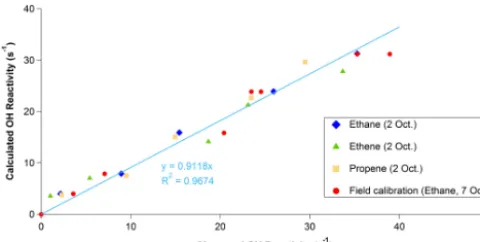
A third correction must be applied to account for a de-viation from first-order conditions as discussed by Sinha et al. (2008b). The derivation of total OH reactivity via Eq. (3) assumes that [pyrrole] [OH] (i.e., pseudo first-order conditions). However, this assumption is not fulfilled within most CRM instruments, as the concentration ratio of pyrrole to OH is usually maintained at a value lower than 2 to enhance the C2–C3 modulation, which in turn improves the detection limit. To correct the CRM measurements for a deviation from pseudo first-order conditions, different concentrations of standards were added inside the reactor to derive a relationship between the CRM measurement and the OH reactivity added in the reactor (Fig. 2). We found that by running the reactor with an apparent pyrrole-to-OH ratio of 1.7, the measured OH reactivity values agree to within 10 % of the OH reactivity expected from the addition of a standard in zero air under both laboratory and field conditions. Furthermore, the correlation between the measured and calculated OH reactivity values seems to be linear, based on the use of three different compounds: ethane (kC3H8+OH=2.4×10
−13cm3molecule−1s−1 at
298 K) (Atkinson et al., 2006), ethene (kC2H4+OH=
7.9×10⁻¹²cm3molecule−1s−1 at 298 K and 1 bar
pressure) (Atkinson et al., 2006), and propene (kC3H6+OH=2.9×10
−11cm3molecule−1s−1 at 298 K
Figure 2. Experimental investigation of the deviation from pseudo
first-order kinetics for the MD-CRM measurements. Laboratory (2 October) and field (7 October) additions of standard gases are shown on this figure. Ambient measurements must be multiplied by 0.91 when the CRM instrument is run at an effective pyrrole-to-OH ratio of 1.7.
of the MD-CRM instrument and show that experimental determinations of this correction agree relatively well with a modeling of the CRM chemistry.
OH reactivity values calculated from Eq. (3), following the C2 and C3 corrections, were multiplied by 0.912 (the slope of Fig. 2) to derive the OH reactivity in the CRM re-actor and to take into account the deviation from first-order conditions for an apparent pyrrole-to-OH ratio of 1.7. Dur-ing ambient measurements, the apparent pyrrole-to-OH ratio changed from 1.5 to 1.8 due to changes in ambient humid-ity that impact the production of OH in the reactor. How-ever, subsequent characterizations by Michoud et al. (2015) have shown that this correction factor does not change sig-nificantly over this range of pyrrole-to-OH ratios. OH reac-tivity values were finally corrected for each measurement by a factor of approximately 1.25 to account for ambient air di-lution based on the sampling (416 cm3min−1from Fig. 1b) and total (517 cm3min−1from Fig. 1b) flow rates inside the reactor.
In practice, the limit of detection (LOD) is governed by the minimum detectable difference between C2 and C3. The LOD for the CRM instrument was estimated by determining the standard deviation (σC2) on groups of five successive C2
measurements. An OH reactivity was calculated for each am-bient C2 measurement using the corresponding C1 value and assuming a C3 greater than C2 by 3σC2. From the median of
these calculated values, it was determined that the MD-CRM instrument has a 3σ LOD of 3.4 s−1. This LOD is compa-rable to those reported for other CRM instruments, which range from 3 to 6 s−1 (Sinha et al., 2008b, 2010; Dolgor-ouky et al., 2012; Nölscher et al., 2012b). The measurement precision is discussed in Sect. 3.2.1, based on an assessment of the different corrections that must be applied to ambient measurements.
Figure 3. Schematic of the UL-FAGE instrument, as configured for
OH reactivity measurement.
2.3 Description of the University of Lille FAGE (UL-FAGE) pump–probe instrument
2.3.1 Technique and instrumentation
The UL-FAGE instrument can be used in a quantification mode to measure ambient concentrations of OH and HO2
radicals or in an OH reactivity mode using the pump–probe method described by Sadanaga et al. (2004). For the latter, the FAGE instrument is coupled to a photolysis cell (Fig. 3), in which a plume of OH is generated by laser photolysis of ozone. Time-resolved OH decays are monitored at a resolu-tion time of 200 µs using the high repetiresolu-tion rate probe laser (5 kHz) of the FAGE instrument. Three other instruments, based on the same technique, are used for field measurements (Sadanaga, 2004b; Lou et al., 2010; Stone et al., 2015). A comparison of the specifications of the different instruments can be found in Table 2.
[image:9.612.48.288.67.188.2]at a pulse repetition rate of 1 Hz.
O3+hν(266 nm)−→O2+O
1D (R3)
O1D+H2O−→OH+OH. (R4)
An ozone mixing ratio of at least 60 ppbv is maintained inside the photolysis cell by injecting a small flow rate of 20 cm3min−1(negligible compared to the main flow through the reactor) of concentrated ozone using an ozone genera-tor (Scientech). The pulse repetition rate of 1 Hz represents a good compromise between the reaction time (1 s or less), the time needed for air exchange in the cell (6.6 s), and the acqui-sition time (sum of 30 acquiacqui-sitions of 1 s). The energy of the photolysis laser was set to 20 mJ pulse−1for a beam diameter of 2.5 cm, which was achieved after expansion through a tele-scope. This expansion of the beam permits the generation of OH in a cylindrical volume that is larger than the FAGE noz-zle (1 mm) in order to probe a more homogeneous volume with respect to the OH concentration, even if the shape of the beam involves a Gaussian distribution. The pulse duration of the photolysis laser is 20 ns (full-width half maximum).
The photolysis cell is coupled with an airtight connection to the FAGE nozzle where OH is measured by LIF (Laser In-duced Fluorescence) using the Q1(3) transition (A26+(v=
0)−X25(v=0)) at 308 nm after gas expansion into a low pressure cell (1.7 mbar). The laser light is generated using a frequency-doubled dye laser (Sirah Laser PrecisionScan PRSC-24-HPR) pumped by the frequency-doubled output of a Nd:YVO4laser (Spectra Physics Navigator II
YHP40-532QW). The laser power used to probe OH was approxi-mately 2 mW.
UL-FAGE is composed of two consecutive low-pressure cells based on the Penn State instrument design (Faloona et al., 2004), one being used to measure OH and the other one to measure HO2. The laser beam is delivered to the OH cell by
a set of optical lenses and fibers. Air from the photolysis cell is pumped by a BOC Edwards GX6/100L pump through a 1 mm orifice after gas expansion into the low-pressure cells. The gas expansion makes it possible to freeze chemical reac-tions and to extend the fluorescence lifetime of OH. The flu-orescence signal is measured perpendicular to the excitation beam by a CPM module (Channel Photomultiplier, Perkin Elmer), which detects photons and converts them to TTL pulses. In the OH reactivity mode, only the first cell dedi-cated to the measurement of OH is used. The pulses gener-ated from the laser-induced fluorescence of OH are counted by an acquisition card (National Instruments) coupled to ac-quisition software coded in the LabVIEW environment to au-tomate the measurement sequence, to acquire data, and to process the OH reactivity measurements in real time. The data analysis procedure, based on the exponential fit of a de-fined number of OH decays, is described in Sect. 2.3.3.
2.3.2 Measurement sequence
The OH decay observed is a sum of losses due to chemical reactions, diffusion out of the probed volume, and wall reac-tions. Under ambient conditions, the OH concentration will follow Eq. (6):
[OH]=[OH]0exp(−(kambient+klosses) t ) , (6) kambient and klosses represent first-order losses of OH due
to gas-phase and non-gas-phase chemical reactions, respec-tively. In order to determine the ambient reactivity, two steps are required. First, zero air is introduced in the photolysis cell to quantify the losses (klosses) due to physical processes and
wall reactions in the absence of gas-phase chemical reactiv-ity. Then, ambient air is pumped though the photolysis cell to measure the sum of the above-mentioned losses and losses due to the ambient OH reactivity (kambient). The total
ambi-ent OH reactivity is the difference between the first order loss rates of OH measured in ambient air (kambient+klosses) and in
zero air (klosses).
To measureklosses, approximately 8.3 L min−1of clean air
(99.9 %, Praxair 3.0) was provided to the photolysis cell, comprising 6.3 L min−1of dry zero air and 2 L min−1of zero air humidified with high-purity (Milli-Q) water, which pro-vides enough water (approximately 3000 ppmv) for OH gen-eration. The water concentration was measured by a hygrom-eter (Michell S8000). As mentioned previously, an additional flow of 20 mL min−1 of dry zero air and ozone is injected into the photolysis cell to maintain a minimum ozone mix-ing ratio of approximately 60 ppbv in this cell. Care is taken to perform zero measurements at the same working pressure as during ambient measurements. The OH reactivity in zero air was measured once or twice per day and was found to be 6.6±1.2 s−1(n=16) over the campaign. However, the min-imum OH reactivity observed during ambient measurements before the zero subtraction was 4.8 s−1, which suggests that the measured zero may be biased high due to residual impu-rities in zero air.
Tests performed using synthetic mixtures of VOCs (see Sect. 3.1) started and ended with humidified zero air (from a zero air generator and a water bubbler filled with HPLC-grade water). OH reactivity measurements performed with this humid zero air led to a klosses value of 5.6 s−1, most
likely due to the higher quality of the zero air used. For this reason, theklosses value of 5.6 s−1 was used as the pump–
probe zero reactivity for the entire intercomparison. It should also be mentioned that during later separated measurements, changing the zero air quality for a higher purity (Air liq-uid, Alpha1 grade: 99.999 %) led to a lowerklosses value of
4.5±0.4 s−1. However, the configuration of the pump–probe instrument (in particular, the laser type and beam shape) was different during the subsequent measurements; thus, the value ofklossesmeasured during the campaign (i.e., 5.6 s−1)
measurements reported for the pump–probe instrument may be biased low by approximately 1–2 s−1, due to impurities in
zero air, in the water bubbler, and on the Teflon tubing. These observations highlight the difficulty to accurately determine klosses.
2.3.3 Instrument characterization
As OH is generated by pulse photolysis and is subsequently probed by the FAGE instrument, the OH profile shows a rapid increase followed by a decrease depending on the OH reac-tivity. Observed decays were multi-exponential, with a first rapid decrease over a few ms, likely due to the fast diffusion of OH within the photolyzed volume before homogeniza-tion. This behavior was previously observed for other pump– probe instruments (Sadanaga et al., 2004b; Lou et al., 2010). In order to quantify the OH reactivity, it is therefore nec-essary to delay the time at which the mono-exponential fit, representative of the chemistry, starts. A discussion on the choice of the mono-exponential fit for derivation of the total OH reactivity is addressed in the following paragraph.
The UL-FAGE instrument is regularly tested using a gas standard, such as carbon monoxide (CO), whose rate con-stant with OH is well-known (Parker et al., 2011). Monitor-ing a kinetic parameter allows for the optimization of experi-mental conditions such as the beam size, the laser power, and the OH decay fitting window. During these tests, CO is intro-duced in large excess in the cell at different known concen-trations. These tests are carried out under NOx-free condi-tions, and a single exponential decay of the OH signal down to zero is observed after the first few ms. The pseudo first-order rate constants from the measured OH decays are plot-ted against the CO concentrations; a linear regression of this plot yields the second-order rate constant. The shortest delay between the photolysis pulse and the start of the fit (0.025 s), during which additional physical losses without chemical in-terest are observed, was determined by comparing the mea-sured and recommended rate constants for the CO+OH re-action (at 298 K and 1 bar), based on a recommended value of 2.31×10⁻¹³cm3molecule−1s−1(Atkinson et al., 2006). A delay of 0.025 s leads to a value of 2.41× 10⁻¹³cm3molecule−1s−1 for the CO +OH reaction rate constant, determined from OH reactivity values ranging from 10 to 90 s−1 (R2=0.997). This delay has been used dur-ing the present study. Varydur-ing the delay from 0.025 to 0.07 s leads to a difference of 7 %, which was accounted for in the total uncertainty calculation and considered as the un-certainty due to the choice of the delay. The delay used in this work is higher than the value used in previous studies (0.008 s in Parker et al., 2011) due to differences in the beam shape, the beam expansion, and the alignment. These results stress that a systematic measurement of OH reactivity using a gas standard should be performed before each campaign and ideally during the campaign. For this study, several tests
were carried out using complex synthetic mixtures of known OH reactivity (Sect. 3.1.2).
During ambient measurements, the duration of the expo-nential fit is adjusted depending on the OH reactivity level. kOHis first estimated (kOH,estimated) by fitting the decay on a
duration of 0.038 s, starting after the chosen delay. The de-cay is then fitted a second time on a duration corresponding to 15 timeskOH,estimated. A background signal (due to noise)
is subtracted considering the signal level after this delay. In practice, the decay is fitted after averaging acquisitions from subsequent photolysis laser pulses (in general 30) to get a signal-to-noise ratio higher than 5.
The performance of the UL-FAGE instrument is similar to that of other pump–probe instruments (Table 2). This instru-ment can measure OH reactivity values up to 150 s−1. Oper-ating conditions described above lead to a precision (1σ) of 8 % at 20 s−1(30 s acquisition) and 10 % at 100 s−1(1 min
acquisition). The accuracy is estimated to be 20 % (1σ) from the CO tests. The 3σ detection limit determined from zero air measurements is 3.6 s−1.
The method to generate OH in the pump–probe tech-nique does not lead to HO2formation. However, HO2can be
formed during the reaction of ambient trace gases with OH in the photolysis cell. It is observed that the OH signal does not decay to zero, but instead a slowly decaying residual signal is observed even at long reaction times (Fig. 4). This residual OH signal is estimated to be 0.03 %, due to the recycling of OH radicals from the reaction of HO2with NO, and its
inten-sity, generally a few percent of the initial OH concentration, depends on the NO concentration.
The OH decays are analyzed using a mono-exponential fit in this study. In order to estimate the impact of the recycling chemistry mentioned above on the derivation of OH reac-tivity measurements, detailed modeling has been carried out below for some observed OH decays. To estimate the bias due to the use of a mono-exponential fit, we carried out a comparison of the decay rates resulting from mono- and bi-exponential fits for several OH decays acquired in a range of different NOx concentrations to decay rates derived from model calculations. In Fig. 4 is shown a decay recorded on 23 October at 21:00 LT, a time period characterized by high NO (91 ppbv) and NO2(38 ppbv) mixing ratios; the residual
OH signal due to recycling of peroxy radicals with NO is clearly visible on the logarithmic scale. The bi-exponential least square fit captures the slow decay and closely repro-duces the experimental data; taking the fast decay as the OH reactivity leads to a value of 66 s−1fork
OH. A fit to a
mono-exponential decay, using only a subset of the data (in this example up to 0.25 ms, obtained such as explained above as 15 times a preliminary decay rate deduced from a linear regression of ln(signal)=f (t ) in the time window 0.025– 0.063 s) leads to a value forkOH of 59 s−1, i.e. 10 % below
the value obtained from the bi-exponential fit.
Figure 4. Typical OH decay monitored by the UL-FAGE instrument under high NOx conditions. Left panel: mono (red, fitting window: 0.025–0.2 s) and bi-exponential (blue, fitting window: 0.025–0.9 s) fits of the experimental data shown as plain lines. Right panel: compar-ison of the experimental trace with model simulations (see text and Table S3), VOC concentrations have been adjusted to reproduced the experimental decay. Plain red line: measured NO and NO2mixing ratios. Plain blue line: NO and NO2mixing ratios calculated after addition of O3within the photolysis cell. Dotted blue line: VOC reactivity at the value deduced from the bi-exponential decay.
model used for these calculations is given in the Supplement. OH profiles are shown for two different NO/NO2mixing
ra-tios: the measured ambient mixing ratios (91/38 ppbv), and mixing ratios (77/51 ppbv) calculated based on the conver-sion of a fraction of NO into NO2 due to the addition of
60 ppbv of O3into the photolysis cell and a residence time of
6.6 s. In both cases, the VOC reactivity has been set to best reproduce the measured ambient OH decay. The top trace, simulated using ambient NOxmixing ratios, overpredicts the recycled OH concentration, while experimental data are bet-ter reproduced using the NO/NO2partitioning calculated to
be present in the cell. Indeed, the addition of high concen-trations of O3combined with the rather long residence time
before intake into the FAGE cell decreases the impact of NO on the retrieved OH decay.
The first fast decay is mainly due to the reaction of OH with primary species. The second, slow decay is mostly gov-erned by the loss of the recycled OH radicals through reac-tion of RO2radicals with NO2and to a lesser extent by the
reaction of HO2with NO2as well as OH with NO and NO2.
Diffusion and wall losses of radicals have very minor contri-butions. Both modeled traces do not follow a bi-exponential decay, but exhibit a short plateau after the first fast decay before starting the second slower decay. Such a shape repro-duces the experimental data very well, as can be seen in par-ticular for the blue trace, but cannot be assimilated to a bi-exponential decay anymore. From the VOC reactivity, used in the model to best reproduce the experimental trace, akOH
of 57 s−1is obtained, which is closer to the result from the
single exponential decay. Using kOH such as that obtained
from the bi-exponential decay and introducing a correspond-ing OH reactivity due to reaction with VOC into the model overpredicts the OH decay (dotted blue line in Fig. 4).
Testing this analysis on different traces characteristic of different NOx levels shows that the mono-exponential fit leads to an underestimation only during extreme condi-tions (30 % at high NOx mixing ratios: 150 ppbv and high
NO/NO2: 2.7), whereas the bi-exponential fit overestimates
(by 10–20 %) the reactivity for all the conditions tested by the model (NOx>45 ppbv, NO/NO2>1.2). From these
con-siderations, we have chosen a single exponential decay as the analysis method for this study, even under high NOx concen-trations, rather than applying a bi-exponential fit for traces measured under conditions with NO concentrations above a pre-defined threshold, such as proposed by Lou et al. (2010). However, it should be noted that the differences between the mono- and the bi-exponential fits are within the accuracy of the technique. Laboratory experiments are planned in the fu-ture to perform a detailed investigation of the impact of this OH recycling on the reactivity measurements.
2.4 Measurements of VOCs and ancillary measurements
Ancillary measurements made during the intercompari-son are summarized in Table 3. VOC measurements were performed using two online gas chromatographs (GC) from Mines Douai (referred to hereafter as “NMHC-GC” and “OVOC-GC”). These two GCs detected more than 34 NMHCs (C2–C10) and 22 OVOCs (C2–C10), as reported
in Table 3.
The NMHC-GC has been described elsewhere (Badol et al., 2004). Ambient air is sampled through a NAFION mem-brane and VOCs are trapped at a temperature of −30◦C inside a quartz tube filled with Carbosieve SIII and Car-bopack B. Ambient VOCs are trapped at a sampling flow rate of 20 cm3min−1for a duration of 30 min, leading to a sampling volume of 600 cm3. The trap is located inside a thermodesorption unit (Perkin Elmer, ATD 400) that allows a fast injection of the sample into two columns (PLOT alumine and CPSil 5CB) to separate C2–C6and C6–C10compounds.
in-strumental failure precluded NMHCs measurements from 17 to 23 October.
The OVOC-GC has been described by Roukos et al. (2009). A sampler unit (Markes International, air server Unity 1) allows continuous sampling of ambient air and the trapping of VOCs inside a quartz tube held at 12◦C and filled with Carbopack 1B and Carbopack X. The sampling flow rate was adjusted to 15 cm3min−1for a duration of 30 min to sample 450 cm3of ambient air. Following the thermodesorp-tion, the GC separation is performed using a high-polarity CP-Lowox column (Varian, France) specially designed for this application. The effect of ambient water on the column separation is minimized by diluting ambient air with dry air (50:50) and a trap purge before injection. The identification and quantification of VOCs is performed using a FID/MS coupling. This system exhibits limits of detection in the range 10–90 pptv for a time resolution of 90 min.
Ambient formaldehyde mixing ratios were measured using a pulsed quantum cascade laser mid-infrared (λ∼5.8 µm) absorption spectrometer (Aerodyne Research, Inc.) equipped with thermoelectrically cooled detectors. In this spectrometer, sampled air continuously flows through a low-pressure multipass absorption cell (76 m optical length) installed in the spectrometer housing. Details about the gen-eral characteristics and layout of the spectrometer, as well on the principle of operation, can be found in McManus et al. (2010). The thermoelectrically cooled laser is repeatedly swept at high frequency between 1721.6 and 1722.2 cm−1. Formaldehyde mixing ratios are derived by fitting the ab-sorption feature using the pressure and temperature measured inside the cell (∼54.5 Torr,∼305 K) and the HITRAN pa-rameters for formaldehyde (Rothman et al., 2009). Absolute calibration of the instrument is achieved using a 50.6 ppbv sample generated with a permeation device. The 1 min de-tection limit (2σ) of the instrument is∼0.7 ppbv.
Ambient NO and NO2 mixing ratios were measured
by a commercial analyzer based on chemiluminescence (Thermo 42i Trace Level, LOD: 50 pptv). Ozone was mea-sured by UV absorption (Thermo 49, LOD: 0.1 ppbv) and SO2 by pulsed UV fluorescence (Thermo 43i, LOD:
0.05 ppbv). Meteorological data (ambient temperature, rel-ative humidity, wind speed and direction, precipitation) was acquired from a meteorological station (Vantage Pro 2, Davis Instruments) located on the roof of a building at a distance of approximately 100 m from the sampling inlet.
CO and methane mixing ratios were not measured during the campaign but are necessary to calculate the total OH reac-tivity for budgetary analysis. For CO, a constant mixing ratio of 250 ppbv reported as a baseline for Paris by Dolgorouky et al. (2012) was used in this study. However, the measure-ment site described in Dolgorouky et al. (2012) is considered as a background site, and the CO mixing ratio used may rep-resent a lower limit. A methane background mixing ratio of 1770 ppbv was assumed for this study.
3 Results/discussion
3.1 OH reactivity measurements from synthetic VOC mixtures
Two complex standard mixtures of VOCs, one containing 32 NMHCs with mixing ratios of 1–7 ppmv each (Table S1 in the Supplement), and the other containing 29 OVOCs with mixing ratios of 2–3 ppmv each (Table S2), were used to gen-erate diluted mixtures with OH reactivity ranging from 16 to 105 s−1. These synthetic mixtures were overflowed into all
the sampling inlets. This ensured that the synthetic mixtures were sampled simultaneously by the CRM instrument, the pump–probe instrument, and the two online GC instruments under the same inlet conditions as ambient measurements to investigate the accuracy of the OH reactivity measurements. 3.1.1 MD-CRM instrument
OH reactivity values measured by the CRM instrument were found to be (39±2) % lower than that calculated for the NMHC mixture (Fig. S8b) and (53±0.4) % lower than cal-culated for the OVOC mixture (Fig. S8a). These values are greater than the 2σ uncertainties of 24 and 22 % calculated from a quadratic propagation of uncertainties on the rate constants and the VOC concentration measurements for the NMHC and OVOC mixtures, respectively. Uncertainty cal-culations were performed assuming that errors on rate con-stants are independent from each other and that errors on measured VOC concentrations are characterized by an inde-pendent random error of 5 % and a similar systematic error of 10 % for each VOC that cannot cancel out through the quadratic propagation of uncertainties on individual OH re-activity values. As discussed below, the OH rere-activity mea-sured by the pump–probe instrument for the NMHC mixture, however, agreed well with the calculated OH reactivity val-ues. These results suggest that the MD-CRM instrument un-derestimates the OH reactivity of complex VOC mixtures, while tests performed using ethane, ethene, and propene did not reveal an underestimation (see Sect. 2.2.3).
un-derestimation of the VOC reactivity during this intercom-parison experiment was due to photolytic processes inside the reactor, and care must be taken to minimize this issue on CRM instruments, to evaluate these processes, and to en-sure agreement between meaen-sured and calculated reactivity by performing tests with complex VOC mixtures.
It is interesting to note that if the photolysis of VOCs in-side the reactor leads to less reactive species, an underestima-tion of the OH reactivity is expected. However, the photoly-sis of VOCs will first lead to the formation of two organic peroxy radicals. If these peroxy radicals quickly react with OH (k≈10−10cm3s−1), as recently measured for CH3O2
(Bossolasco et al., 2014) and C2H5O2(Faragó et al., 2015),
an overestimation of the OH reactivity would be expected. This point will need to be investigated further.
3.1.2 UL-FAGE instrument
Figure S8 shows a comparison between the measured and calculated OH reactivity values. For NMHCs, the linear re-gression gives a slope of 0.99±0.01 (1σ) and a R2 value of 0.99, indicating a very good agreement between the mea-sured and calculated OH reactivity for this synthetic mixture. These results confirm that the fitting procedure described above is robust and suggest that NMHC photolysis can be neglected.
Due to technical issues, only two measurements were made with the OVOC mixture. A close inspection of Fig. S8 may suggest that UL-FAGE overestimates the OH reactiv-ity by 30 % for the measurement made at a calculated OH reactivity of approximately 40 s−1. However, only two
mea-surements are shown on this figure, and more experiments are needed to confirm this observation.
An estimation of the VOC fraction that can be photolyzed by the pump laser can be derived from absorption cross sec-tions at 266 nm and the laser photon density. Benzaldehyde is used as an example, as its absorption cross section at 266 nm (2.14×10⁻¹⁸cm2) (Etzkorn et al., 1999) is among the largest for the VOCs present in the OVOC mixture (Ta-ble S2). Taking into account the UL-FAGE operating con-ditions (20 mJ pulse−1), less than 2.6 % of benzaldehyde is photolyzed per laser shot. If the photolysis of benzaldehyde leads to unreactive species, the OH reactivity from this com-pound will be decreased. Considering the residence time in the cell and the ratio of the photolyzed volume to the total volume, this would lead to a decrease of 7.8 % (0.23 s−1).
On the other hand, as mentioned above for the CRM in-strument, the photolysis of benzaldehyde could produce two RO2 radicals, which can then quickly react with OH (k≈
10−10cm3s−1). These conditions correspond to the worst-case scenario, since the rate constant of benzaldehyde with OH is slow (1.2×10⁻¹¹cm3s−1) (Atkinson and Arey, 2003) compared to the reaction of CH3O2 with OH. The change
in the OH reactivity for this compound, considering the OH consumption by RO2(lifetime shorter than 1 s), would be an
increase of approximately 37 %. For 10 ppbv of benzalde-hyde, the resultant increase in the OH reactivity would be 1.2 s−1, which is within the measurement uncertainty.
If we consider the highest OH reactivity measurements made during these experiments, the same calculation can be done for all NMHCs/OVOCs. The calculations indicate a de-crease of 0.15 s−1for all NHMCs and 0.32 s−1for all OVOCs if the species formed are assumed to be unreactive. If the RO2
pathway is considered, this leads to an increase of 0.5 s−1 for all NMHCs and 1.17 s−1for all OVOCs. These results suggest that photolysis of VOCs inside the reactor has a mi-nor impact on the measurements. However, a more complex chemistry may have to be considered if the overestimation of the reactivity is confirmed with OVOC mixtures.
It is interesting to note that if the regression line for the CRM measurements in Fig. S8b (red squares) is not con-strained to zero, there is an intercept of 1.4±1.0 s−1. While
the uncertainty on the offset is large, this offset would be con-sistent with an OH reactivity of 2 s−1 in the zero air. How-ever, it must be noted that any discrepancy in the determi-nation ofklosses (discussed in Sect. 2.3.2) should not affect
the OH reactivity measured by the pump–probe instrument during these tests. This is because the same zero air that was used to measureklosses was also used to dilute the standard
mixtures. Furthermore, the OH reactivity from the zero air was subtracted from all measurements.
3.2 Comparison of ambient OH reactivity measurements
Collocated measurements of ambient OH reactivity with the MD-CRM and UL-FAGE instruments, as described in Sect. 2.1, are discussed below.
3.2.1 Performance of the two instruments