This is a repository copy of
Saying It with Light: A Pilot Study of Affective Communication
Using the MIRO Robot
.
White Rose Research Online URL for this paper:
http://eprints.whiterose.ac.uk/107018/
Version: Accepted Version
Proceedings Paper:
Collins, E.C., Prescott, T.J. and Mitchinson, B. (2015) Saying It with Light: A Pilot Study of
Affective Communication Using the MIRO Robot. In: BIOMIMETIC AND BIOHYBRID
SYSTEMS, LIVING MACHINES 2015. 4th International Conference, Living Machines
2015, July 28 - 31, 2015, Barcelona, Spain. Lecture Notes in Computer Science, 9222 . ,
pp. 243-255. ISBN 978-3-319-22978-2
https://doi.org/10.1007/978-3-319-22979-9_25
[email protected] https://eprints.whiterose.ac.uk/
Reuse
Unless indicated otherwise, fulltext items are protected by copyright with all rights reserved. The copyright exception in section 29 of the Copyright, Designs and Patents Act 1988 allows the making of a single copy solely for the purpose of non-commercial research or private study within the limits of fair dealing. The publisher or other rights-holder may allow further reproduction and re-use of this version - refer to the White Rose Research Online record for this item. Where records identify the publisher as the copyright holder, users can verify any specific terms of use on the publisher’s website.
Takedown
If you consider content in White Rose Research Online to be in breach of UK law, please notify us by
Saying it with light: A pilot study of affective
communication using the MIRO robot.
Emily C. Collins1 and Tony J. Prescott1and Ben Mitchinson1
The University Of Sheffield, Sheffield, UK.
Abstract. Recently, the concept of a ‘companion robot’ as a healthcare tool has been popularised, and even commercialised. We present MIRO, a robot that is biomimetic in aesthetics, morphology, behaviour, and control architecture. In this paper, we review how these design choices affect its suitability for a companionship role. In particular, we consider how emulation of the familiar body language and other emotional ex-pressions of mammals may facilitate effective communication with na¨ıve users through the reliable evocation of intended perceptions of emotional state and intent. We go on to present a brief pilot study addressing the question of whether shared cultural signals can be relied upon, simi-larly, as components of communication systems for companion robots. Such studies form part of our ongoing effort to understand and quantify human responses to robot expressive behaviour and, thereby, develop a methodology for optimising the design of social robots by accounting for individual and cultural differences.
[image:2.612.146.471.462.559.2]1
Introduction
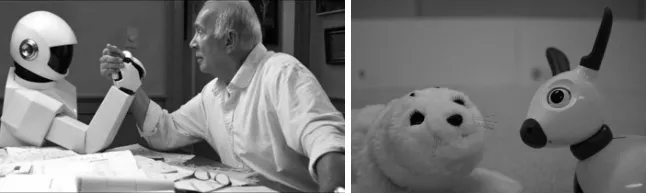
Fig. 1. Left panel: ‘Robot and Frank’ (from the 2013 film). Right panel: PARO the robot seal (left) and MIRO the robot mammal (right) are examples of ‘social’ robots.
inbetween performing physical assistance tasks such as transporting food. The importance of this role to healthcare scenarios in real life is exemplified by the successes already achieved with ‘simple’ companion robots such as PARO [1] and Kaspar [2]. These robots are defined as ‘social’ robots, robots designed to interact and communicate with humans—usually, in a naturalistic way by using biological communication channels (e.g. body language or vocalisation rather than a keypad). What marks them out as companion robots is that they not only communicate, but play a role in their user’s emotional life through these interactions (other examples of commercially available companion robots include Sony’s AIBO [3], Omron’s NeCoRo [4], and MobileRobots Inc.’s PeopleBot).
Robots like Frank’s may be some way off yet, but on what principles is a contemporary companion robot built? One starting point is the large body of research that exists on the benefits of animal therapy for lowering stress [5], reducing heart rates [6], elevating mood, and social facilitation [7]. Robot therapy borrows from this branch of healthcare by creating robots with the capacity to act as pet surrogates for those who do not have access to animals [8]. PARO is one of the most active commercial examples, and is marketed as a therapeutic tool for use in nursing home settings. It is sold on the premise that it will “interact with human beings (...) to make them feel emotional attachment to the robot” [9]. It does this by engaging its user with basic capabilities: sensing touch, recognising a limited amount of speech, expressing small utterances and moving its head, flippers and tail. The relationship that develops between a user and the robot is built upon the limited reactions the robot makes to the user’s spoken and physical actions [10]. PARO is designed for, amongst other things, use in therapy sessions attended by individuals suffering from dementia and other conditions of cognitive decline. In such individuals emotional capability does not decline in a one-to-one fashion with cognition [11] allowing for meaningful application of psychological and emotional therapy. PARO does not locomote, and is designed to be held and fussed over.
biomimetics promises to drive forward both functional and relational aspects of performance.
In the remainder of this paper, we introduce a new robot platform, ‘MIRO’, which follows biomimetic design principles aesthetically, morphologically, and behaviourally, as well as with respect to control architecture. MIRO is intended to act as an accessible biomimetic research platform, providing an opportunity to explore all aspects of that functional/relational synergy. One research role MIRO plays for us, then, is as an engaging robot companion. Below, we describe how we are beginning to use empirical data from human interaction studies to contribute to the iterative design process of channels for emotional expression. Specifically, we present a pilot for a study assessing the performance of pulsating patterns of coloured lights as intuitive signals of affective state. Biological analogues for such a signalling modality are less easy to identify, but it is commonplace to use lights for signalling conditions across human cultures. This study will address the twin hypotheses: (i) Signals with culturally-agreed meaning can communicate affect between a robot and a na¨ıve human and (ii) The effectiveness of that commu-nication will depend on the tailoring of signals to the interactee, individually and/or culturally. Results from our pilot tend to support hypothesis (i); results from the larger study will be required to begin to address hypothesis (ii).
2
MIRO
The MIRO robot was commissioned as a commercial pedagogical and leisure product, targeted particularly at the domestic and school markets. Through the encouragement of exploration of its construction and operation (the flagship con-figuration has ‘build-it-yourself’ form and is accompanied by an extensive series of magazines). MIRO is also intended as a artefact to drive public engagement with science, robotics in particular, and biomimetic robotics most of all (this agenda being reflected also in the magazine).
[image:4.612.143.475.534.631.2]2.1 Aesthetics and morphology
MIRO’s aesthetics and morphology (Figure 2) were chosen to be engaging through evocation of a mammalian identity. Design choices explicitly avoided targeting a particular mammal so that the end result is intended to be somewhat of a ‘generic mammal’, though some specificity is naturally unavoidable. The platform is equipped with some of the same expressive appendages available to many mammals (ears, tail, eyelids) allowing mammal-like direct signalling of emotional state and responses to stimuli.
2.2 Platform
The MIRO platform is built around a core of a differential drive (plus caster) base and a three-DOF (lift, pitch, yaw) neck. Additional DOFs include two for each ear (curl, rotate), two for the tail (droop, wag), one for the caster (raise/lower), and one for the eyelids (open/close). Whilst these latter DOFs target only communication, the movements of the neck and body that serve locomotion and active sensing play a significant role in communication as well. Finally, the platform is equipped for sound production.
All DOFs are equipped with proprioceptive sensors (potentiometers for ab-solute positions and optical shaft encoders for wheel speed). Four light level sensors are placed at each corner of the base, two task-specific ‘cliff sensors’ point down from its front face, and four capacitive sensors are arrayed along the inside of the body shell providing sensing of direct human contact. In the head, stereo microphones (in the base of the ears) and stereo cameras (in the eyes) are complemented by a sonar ranger in the nose and an additional four capacitive sensors over the top and back of the head (behind the ears).
Peripherals are reached on an I2C bus from the ‘spinal processor’ (ARM Cortex M0), which communicates via SPI with the ‘brainstem processor’ (ARM Cortex M0/M4 dual core), which in turn communicates via USB with the ‘fore-brain processor’ (ARM Cortex A8). Division of the processing in this way is partly pedagogic and partly aesthetic, in service of the product’s standard con-figuration, and plays no direct functional role. Nonetheless, it does align closely with the layered control architecture design (see below). All peripherals and a level of control over processing are accessible from off-board through WiFi con-nectivity, and the forebrain processor is open if lower-level access is required (all processors can be re-programmed if desired, though with more onerous require-ments to respect the specifics of the platform).
2.3 Control architecture and gross behaviour
MIRO’s control system is a brain model with a layered architecture [19]. That is, its most fundamental organising feature is the presence of sensorimotor loops layered on top of one another, so that lower loops function without the help of higher loops, but higher loops can modulate the behaviour of those lower down. Low-level loops implement reflex-like behaviours, immediate responses to sensory information that make use of neither memory nor signal analysis and can be im-plemented simply (for instance, soft threshold units respond to cliff sensor signals to inhibit forward wheel motion). Mid-level loops make use of short-term mem-ory and within- and cross-modal signal relationships to implement ‘hard-wired’ behaviours that require co-ordination across motor systems (a major centre is a model of superior colliculus that represents recent salient events in a multi-modal map of egocentric space and responds to specific ‘innate’ stimuli with directed action [20]). High-level loops use arbitrarily deep memory and inter-signal relationships to implement cognitive competences (reinforcement learning provides the ability to ‘train’ MIRO to perform simple stimulus-response tasks, for example).
Whilst this three-level break-down is simplified, it conveys well the archi-tectural principle of layers of increasingly sophisticated processing, with each layer making an important contribution to overall behaviour rather than being obsoleted by higher processing. In order to arbitrate between behavioural sub-systems at mid and high levels we implement a model of the basal ganglia [21] in an abstract form as used in several of our previous robots [22]. Thus, MIRO’s gross behaviour emerges from the competition between various sub-systems to explore locations with high sensory salience, escape from stimuli that are per-ceived as threatening, seek out goals (such as a charging station), have social exchanges with an interacting human, and so on.
2.4 Modelling and expressing affect
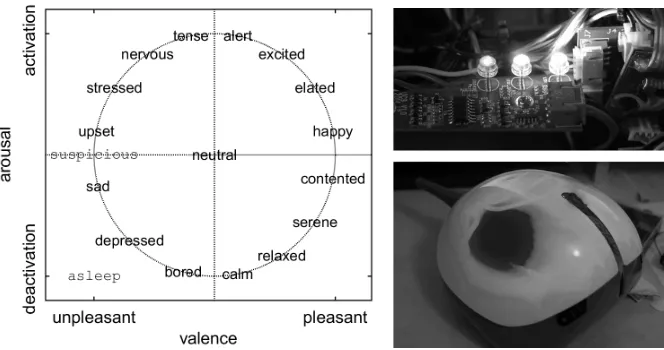
MIRO represents affective state using the circumflex model [23]. This model represents emotions (as well as, on the longer term, moods and temperaments) as points in a space having dimensions of valence and arousal (Figure 3). These dimensions are purported to have neural correlates whilst terms used to describe emotions (such as ‘excited’) are cast as locations in this space. This stands in contrast to ‘basic emotions’ theory which considers individual emotions (such as ‘excitement’) to correspond to discrete neural systems. Whilst continuum models of this sort have overwhelmingly received attention in human studies, recently they have begun to be transposed into the domain of non-human animals [24]. These models are also remarkable for their clarity and accessibility for the non-psychologist, as well as for their light computational weight, and have, accordingly, received some attention from roboticists [12, 25, 26].
Fig. 3.(Left) Circumplex model of affective state is a space with valence and arousal dimensions. Names for states (sans serif font) are taken from Posner et al. (2005), except for two suggested by experiment participants (typewriter font, described below). (Top right) One way in which MIRO expresses affect is through a changing pattern of coloured lights. (Bottom right) False colour image of one of the lights as it appears through MIRO’s body shell.
or flight) have unambiguous emotional correspondences and are, correspond-ingly, facilitated or suppressed by affective state. Affect is also communicated directly and explicitly through its encoding in MIRO’s non-locomotory move-ments. MIRO has mobile ears, eyelids, and tail expressly for the communication of affect, but body configuration movements are also driven by emotions (acti-vation tending to lead to raised posture, for instance). Body language has been shown to be effective for the communication of emotions between humans [27] and consistent interpretation of the body language of animals by humans has been demonstrated [28], though there is considerable variation between species in expression [29]. Moreover, the use of human-like body language in humanoid robots is effective for communication of emotion to na¨ıve humans [25].
has not emerged [33, 34]. Moreover, it is not clear in what way such associations would translate to perception of the affective state of a robot, nor whether these perceptions would be reliable in a na¨ıve interactee. Work addressing this question to date has been somewhat informal and results variable [35]. Below, we report a pilot of a methodology to address this question.
3
Experimental study
3.1 Methods
In many cultures, red signals danger and green safety; we therefore proposed red/white/green for encoding negative/neutral/positive valence. Red is also a signal for sexuality, and for the ripeness of fruit, and green for nausea and decay (the degree to which these associations are biological or cultural is not always clear), so we could equally well have proposed the opposite encoding; such ob-servations underline the uncertainty in these associations and the need for em-pirical study. The rate of change of a light pattern may be intuitively linked to arousal—both breathing and heartrate, for example, increase in frequency with increasing physiological arousal—so we proposed slow/medium/fast to encode deactivation/neutral/activation (specifically, 0.25/0.5/2.5Hz, reflecting the fre-quency range of human breathing/heartrate). Thus, nine points in affect space could be encoded, in total.
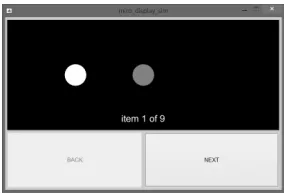
We arbitrarily selected the remaining parameters of a pulsating light pat-tern that could physically be presented through the three RGB LEDs available on each side of MIRO. Specifically, the pattern at each parameter point was monochromatic, with sinusoidal intensity, and with a fixed phase offset between adjacent LEDs ofπ/2 radians. Whilst the pattern was chosen to be deliverable through MIRO’s LED arrays, patterns were actually delivered to participants through a simulation of one of the arrays on a computer monitor. This choice re-flects the more general nature of our experimental question, and was intended to eliminate possible sources of confound stemming from participants’ perceptions of other aspects of MIRO’s design and presentation (its shape, positioning, etc.). The actual colours delivered ranged, in each case, from zero intensity (black) to maximum intensity of either pure red (i.e. [255,0,0]), pure green, or white.
Our methodology for measuring the effectiveness of these encodings for evok-ing emotional perceptions was similar to that established by Beck et al. (2010) [25]. Na¨ıve participants (n = 5, 2 female; M age = 30,SD = 5) were recruited
informally from The University Of Sheffield Robotics Laboratory. Prior to study participation written informed consent was obtained from each participant. Par-ticipants were then asked to view simulated light patterns and indicate their perceptions on nominal and interval scales.
combina-Fig. 4.Stimulus presentation tool. Stimuli (N = 9) were presented in random order for each participant, who clicked NEXT when ready to move on.
tion of negative, neutral, and positive valence and arousal (for analysis, nega-tive/neutral/positive were assigned the values -1/0/+1). Participants were first exposed, over the course of thirty seconds, to all nine points, with instructions to watch the patterns. They were then presented with each of the nine points again, in random order—these we refer to as the ‘presented’ affect values. Participants were asked to fill a response sheet for each presentation, comprising:
1. Which of the following words best describes your perception of the emotional state represented by the pattern of light? Please circle one:
Happy – Depressed – Calm – Stressed – Relaxed – Sad – Alert – Upset – Elated – Nervous – Contented – Bored – Serene – Excited – Neutral – Tense 2. If you think another word or phrase better describes your perception of the emotional state represented by the pattern of lights please write it here: — 3. Place a vertical mark on the line to indicate your perception of the level of
arousal represented by the pattern of lights, from relaxed to aroused: Relaxed ———————————————— Aroused
4. Place a vertical mark on the line to indicate your perception of the level of happiness represented by the pattern of lights, from unhappy to happy: Unhappy ———————————————— Happy
The terms used in question 1 were taken from Posner et al. 2005 [23], with the addition of ‘neutral’, following Beck et al. (2010) [25], and presented in a randomised order. At the end of the response phase the experimenter conducted a short informal interview in which participants were asked whether they found the question 1 word list adequate. If the participant had answered any question two with a word or phrase of their own this was also discussed. The interview was conducted to establish whether the participants had perceived the patterns in emotional terms at all and, if so, whether the word list had allowed them to express their perception. At the end of the interview participants were debriefed. For numerical analysis, we associated numerical values in [−1,+1] for valence
[image:9.612.236.378.114.211.2]responses, we refer to as the ‘reported’ affect values. Analyses of the reliability of the relationships between presented and reported affect values were conducted independently for valence and arousal.
[image:10.612.150.464.199.518.2]3.2 Results
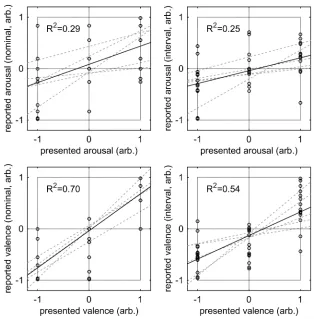
Fig. 5. Reported affect values against presented affect values. Top/bottom: arousal/valence. Left/right: nominal/interval reporting. All units arbitrary (arb.). In-dividual trials (circles,N = 45). Trend line (solid) andR2values are from simple linear regression of pooled data (N = 45). Trend lines over samples from each participant (N= 9 per participant) are also shown (dashed grey).
We then exploratively reviewed the relationships identified above on an indi-vidual basis (see also Figure 5). Data from each participant displayed relation-ships of the same polarity as those displayed by the pooled data, indicating that pooled results reflected the responses of all participants in this sense.
In response to question 2, only two responses were received (of a possible 45). These are the terms indicated in typewriter font in Figure 3, and they are placed in the affect space at the location of the presented stimulus for each of those 2 trials. Informal interviews generally indicated a high level of satisfaction with the word list for expressing participants’ perceptions.
4
Discussion
To be an effective companion, a robot must be able to convey affect [12]. Work with humanoid robots has shown that affect can be communicated well using body language (gesture) based directly on that observed in humans [25]. For robots that are non-humanoid, different expressive channels are needed; even for those that are humanoid, multi-modal expression can be more effective than uni-modal [26]. One possibility is to mimic the biological languages used by non-human animals (those used by canines and felines, for example, have been particularly well explored [29]), another is to use biomimetic vocalisations; MIRO will use both of these channels. One of the most accessible (in terms of cost and practicality) of all expressive modalities, however, is coloured lighting patterns. Dynamic lighting patterns may not have direct biological analogues (though see cephalopods [36]), but colours are strong situational signals (being indicative of the presence of ethologically-relevant items such as blood and food), and rate of change may be associated with physiological markers of arousal; colour also has cultural associations, which may be more or less reliable depending on participant and context. Developing an understanding of how to use patterns of light to convey affect has the potential both to bring intuitive emotional expression to low cost platforms and to firm up our ability to design ‘emotional expression’ into our robots, whatever form they take.
not, as here, preconceived. In addition, we will investigate the degree to which perceptions formed in response to a simulated light display under test condi-tions translate to the case of signalling through the light displays of MIRO, as an example of an interacting robot.
Emotional expression is so deeply a function of the response of human in-teractees that deriving design principles is not a trivial process. Simply copying known examples (such as human body language, vocal patterns) is, no doubt, an excellent starting point. However, broadening the gamut of possible expressive modalities is only one way in which we can benefit from empirical studies of the communication of affective states. It is our intent, therefore, to develop a methodology for distilling descriptions of effective expression channels through empirical study, accounting for individual and cultural differences between in-teractees. One of the long term aims of this work has to be adaptation of the communication strategy based on the responses of the interactee; that is, to adapt to the individual differences specific to a person with whom the robot must interact [37].
We also hope to make MIRO, the platform, widely available. With low cost and extensive suites of sensory and motor peripherals, MIRO is an attractive research platform for many investigations and at all levels.
References
1. T. Shibata, M. Yoshida, and J. Yamato, “Artificial emotional creature for human-machine interaction,” in Systems, Man, and Cybernetics, 1997. Computational Cybernetics and Simulation., 1997 IEEE International Conference on, vol. 3, pp. 2269–2274, IEEE, 1997.
2. K. Dautenhahn, C. L. Nehaniv, M. L. Walters, B. Robins, H. Kose-Bagci, N. A. Mirza, and M. Blow, “Kaspar–a minimally expressive humanoid robot for human– robot interaction research,” Applied Bionics and Biomechanics, vol. 6, no. 3-4, pp. 369–397, 2009.
3. T. Tamura, S. Yonemitsu, A. Itoh, D. Oikawa, A. Kawakami, Y. Higashi, T. Fuji-mooto, and K. Nakajima, “Is an entertainment robot useful in the care of elderly people with severe dementia?,”The Journals of Gerontology Series A: Biological Sciences and Medical Sciences, vol. 59, no. 1, pp. M83–M85, 2004.
4. A. V. Libin and E. V. Libin, “Person-robot interactions from the robopsychologists’ point of view: the robotic psychology and robotherapy approach,”Proceedings of the IEEE, vol. 92, no. 11, pp. 1789–1803, 2004.
5. K. M. Allen, J. Blascovich, J. Tomaka, and R. M. Kelsey, “Presence of human friends and pet dogs as moderators of autonomic responses to stress in women.,”
Journal of personality and social psychology, vol. 61, no. 4, p. 582, 1991.
6. G. Ballarini, “Pet therapy. animals in human therapy,” Acta Bio Medica Atenei Parmensis, vol. 74, no. 2, pp. 97–100, 2003.
7. G. Collis and J. McNicholas, “A theoretical basis for health benefits of pet owner-ship,”Companion animals in human health, pp. 105–22, 1998.
9. T. Shibata, ““Mental commit robot (PARO)”.” [Online], http://www.paro.jp. 10. C. D. Kidd, W. Taggart, and S. Turkle, “A sociable robot to encourage social
interaction among the elderly,” in Robotics and Automation, 2006. ICRA 2006. Proceedings 2006 IEEE International Conference on, pp. 3972–3976, IEEE, 2006. 11. C. Magai, C. Cohen, D. Gomberg, C. Malatesta, and C. Culver, “Emotional ex-pression during mid-to late-stage dementia,”International Psychogeriatrics, vol. 8, no. 03, pp. 383–395, 1996.
12. C. Breazeal and B. Scassellati, “How to build robots that make friends and influ-ence people,” inIntelligent Robots and Systems, 1999. IROS’99. Proceedings. 1999 IEEE/RSJ International Conference on, vol. 2, pp. 858–863, IEEE, 1999. 13. A. Bruce, I. Nourbakhsh, and R. Simmons, “The role of expressiveness and
atten-tion in human-robot interacatten-tion,” inRobotics and Automation, 2002. Proceedings. ICRA’02. IEEE International Conference on, vol. 4, pp. 4138–4142, IEEE, 2002. 14. B. Mutlu, T. Shiwa, T. Kanda, H. Ishiguro, and N. Hagita, “Footing in
human-robot conversations: how human-robots might shape participant roles using gaze cues,” in Proceedings of the 4th ACM/IEEE international conference on Human robot interaction, pp. 61–68, ACM, 2009.
15. M. R. Banks, L. M. Willoughby, and W. A. Banks, “Animal-assisted therapy and loneliness in nursing homes: use of robotic versus living dogs,” Journal of the American Medical Directors Association, vol. 9, no. 3, pp. 173–177, 2008.
16. M. J. Pearson, B. Mitchinson, J. C. Sullivan, A. G. Pipe, and T. J. Prescott, “Biomimetic vibrissal sensing for robots,”Philosophical Transactions of the Royal Society of London B: Biological Sciences, vol. 366, no. 1581, pp. 3085–3096, 2011. 17. E. Guizzo and E. Ackerman, “The rise of the robot worker,” Spectrum, IEEE,
vol. 49, no. 10, pp. 34–41, 2012.
18. N. F. Lepora, P. Verschure, and T. J. Prescott, “The state of the art in biomimet-ics,”Bioinspiration & biomimetics, vol. 8, no. 1, p. 013001, 2013.
19. T. J. Prescott, P. Redgrave, and K. Gurney, “Layered control architectures in robots and vertebrates,”Adaptive Behavior, vol. 7, no. 1, pp. 99–127, 1999. 20. P. Dean, P. Redgrave, and G. Westby, “Event or emergency? two response systems
in the mammalian superior colliculus,” Trends in neurosciences, vol. 12, no. 4, pp. 137–147, 1989.
21. K. Gurney, T. J. Prescott, and P. Redgrave, “A computational model of action selection in the basal ganglia. i. a new functional anatomy,”Biological cybernetics, vol. 84, no. 6, pp. 401–410, 2001.
22. M. J. Pearson, A. G. Pipe, C. Melhuish, B. Mitchinson, and T. J. Prescott, “Whiskerbot: a robotic active touch system modeled on the rat whisker sensory system,”Adaptive Behavior, vol. 15, no. 3, pp. 223–240, 2007.
23. J. Posner, J. A. Russell, and B. S. Peterson, “The circumplex model of affect: An integrative approach to affective neuroscience, cognitive development, and psy-chopathology,” Development and psychopathology, vol. 17, no. 03, pp. 715–734, 2005.
24. M. Mendl, O. H. Burman, and E. S. Paul, “An integrative and functional framework for the study of animal emotion and mood,”Proceedings of the Royal Society B: Biological Sciences, vol. 277, no. 1696, pp. 2895–2904, 2010.
25. A. Beck, A. Hiolle, A. Mazel, and L. Ca˜namero, “Interpretation of emotional body language displayed by robots,” inProceedings of the 3rd international workshop on Affective interaction in natural environments, pp. 37–42, ACM, 2010.
interac-tion,” inProceedings of the Workshop on Affective Social Speech Signals (WASSS 2013), Grenoble, France, 2013.
27. H. G. Wallbott, “Bodily expression of emotion,” European journal of social psy-chology, vol. 28, no. 6, pp. 879–896, 1998.
28. F. Wemelsfelder, A. Hunter, E. Paul, and A. Lawrence, “Assessing pig body lan-guage: Agreement and consistency between pig farmers, veterinarians, and animal activists,”Journal of animal science, vol. 90, no. 10, pp. 3652–3665, 2012. 29. C. Darwin,The expression of the emotions in man and animals. Oxford University
Press, 2002.
30. A. J. Courtney, “Chinese population stereotypes: color associations,”Human Fac-tors: The Journal of the Human Factors and Ergonomics Society, vol. 28, no. 1, pp. 97–99, 1986.
31. A. C. Hurlbert and Y. Ling, “Biological components of sex differences in color preference,”Current Biology, vol. 17, no. 16, pp. R623–R625, 2007.
32. M. A. Maier, P. Barchfeld, A. J. Elliot, and R. Pekrun, “Context specificity of implicit preferences: the case of human preference for red.,”Emotion, vol. 9, no. 5, p. 734, 2009.
33. P. Valdez and A. Mehrabian, “Effects of color on emotions.,”Journal of Experi-mental Psychology: General, vol. 123, no. 4, p. 394, 1994.
34. B. Manav, “Color-emotion associations and color preferences: A case study for residences,”Color Research & Application, vol. 32, no. 2, pp. 144–150, 2007. 35. M. Haring, N. Bee, and E. Andr´e, “Creation and evaluation of emotion expression
with body movement, sound and eye color for humanoid robots,” in RO-MAN, 2011 IEEE, pp. 204–209, IEEE, 2011.
36. L. M. M¨athger and R. T. Hanlon, “Malleable skin coloration in cephalopods: se-lective reflectance, transmission and absorbance of light by chromatophores and iridophores,”Cell and tissue research, vol. 329, no. 1, pp. 179–186, 2007.