White Rose Research Online URL for this paper:
http://eprints.whiterose.ac.uk/114797/
Article:
Barr, M. (2015) Games for Communication Final Report. Working Papers of the
Communities & Culture Network+, 6. ISSN 2052-7268
[email protected] https://eprints.whiterose.ac.uk/
Reuse
Unless indicated otherwise, fulltext items are protected by copyright with all rights reserved. The copyright exception in section 29 of the Copyright, Designs and Patents Act 1988 allows the making of a single copy solely for the purpose of non-commercial research or private study within the limits of fair dealing. The publisher or other rights-holder may allow further reproduction and re-use of this version - refer to the White Rose Research Online record for this item. Where records identify the publisher as the copyright holder, users can verify any specific terms of use on the publisher’s website.
Takedown
If you consider content in White Rose Research Online to be in breach of UK law, please notify us by
Games for Communication
Final Report
June 2015
Matthew Barr
Humanities Advanced Technology Institute, University of Glasgow [email protected]
Introduction ... 3
Aims ... 4
Format ... 4
Case Study: Minecraft ... 5
Case Study: Gone Home ... 7
Case Study: Never Alone ... 8
Case Study: Portal 2 ... 10
Results ... 11
Discussion... 13
Conclusion ... 14
Introduction
The Games for Communication project sought to explore the use of commercial video games and
Understanding the potential impact of digital games is more important than ever, when considering their popularity: UKIE (The Association for UK Interactive Entertainment) has found that 1 in 3
1 O C M ‘ 2
also highlights the pervasiveness and social inclusivity of gaming: half of UK households contain at least one video games console, while games consoles have some of the smallest differences in take-up between social groups compared with other internet-enabled devices. Further, DE households are more likely to own a games console (46%) than a smartphone (38%). Games are not the exclusive domain of teenage boys: the average age of those who play games is estimated to be around 30 (Entertainment Software Association)3, while female players account for 46% of players in Great Britain4 and are expected to become as numerous as (or more so than) their male counterparts5.
The rise of digital gaming has been rapid, while widespread adoption of broadband internet has seen the proportion of gamers in the UK who play online competitively or collaboratively rise to 80% (Ofcom, 2013). Networks and online communities of practice have emerged around gaming, using wikis, fora and Facebook groups to co-ordinate play sessions and to facilitate discussion and documentation of the games played6. Communication is essential to successful collaboration in games ranging from MMORPG (Massively Multiplayer Online Role Player Game) World of Warcraft to physics-based puzzle title Portal 2. Even oft-derided online multiplayer FPS (First-Person Shooter) titles such as Call of Duty feature squad-based exercises which require constant communication of tactics to succeed. With eminent scholars such as James Paul Gee7, Henry Jenkins8, and John Seely Brown9 suggesting that games and gamers have a great deal to offer (Brown who has worked with Xerox, Amazon and Deloitte has famously stated that he would prefer to hire a high-level World of Warcraft player than an MBA from Harvard10), it
for developing such key skills, especially with games consoles already in more than half of UK households.
Consoles such as PlayStation 3 and Xbox 360 cost less than £200 and a pilot project such as this using two PlayStation 3 consoles and existing PC hardware can be established on a very modest budget. Hardware may also be shared and re-used. This is to say nothing of the flexibility that video games can offer: with gaming-capable devices enjoying unprecedented ubiquity, a high proportion of the population already has access to games. Falling costs, the rising pervasiveness of internet-connected video games, and increasing industry emphasis on communication skills (which not all
1 http://ukie.org.uk/sites/default/files/documents/UKIE_Fact_Sheet.pdf 2 http://stakeholders.ofcom.org.uk/binaries/research/cmr/cmr13/2013_UK_CMR.pdf 3 http://www.theesa.com/facts/pdfs/ESA_EF_2013.pdf 4 http://www.isfe.eu/sites/isfe.eu/files/attachments/great_britain_-_isfe_consumer_study.pdf 5 http://www.bbc.co.uk/news/technology-21039062 6
Barr, M. (2014). Learning through collaboration: video game wikis. Int'l Journal of Social Media and Interactive Learning Environments.
7
Gee, J. P. (2003). What Video Games Have to Teach Us About Learning and Literacy. Palgrave Macmillan.
8
Jenkins, H. (2006). Convergence Culture: Where Old and New Media Collide. New York University Press.
9
Thomas, D., & Brown, J. S. (2011). A new culture of learning: cultivating the imagination for a world of constant change. CreateSpace.
10
higher education courses are designed specifically to develop) make a project that critically assesses
Aims
Many commercial games require players to communicate in order to succeed. This project aimed to
investigate
The research question may be stated as: C
communication skills? We identified a number of instruments for measuring communication skills (in terms of competence and style) in a cohort of game-playing students. Such measures are an essential component of any research that seeks to critically assess the efficacy of games for skills development. Indeed, such empirical data are largely absent from the literature11,12
enormous influence on several generations of players. The project also provided an insight into this culture and the still largely undocumented behaviours and outcomes associated with playing collaborative and competitive digital games. In practical terms, the outcomes of the project will provide educational institutions with guidance on how the potential transformative power of digital games may be used to develop increasingly sought-after non-
focussing on communication skills). If the idea is proven viable, the pilot described here could inform the development of self-directed game-based activities which students (and others) may work through without intervention from already over-committed (and costly) academic staff; capacity may be further increased by encouraging students to work through game-based activities using their own gaming hardware, thus alleviating pressure on university and college space and hardware resources. The project also provides some insight into how games, on which the UK public now spends over three billion pounds annually13, may be developing useful communication skills in those who play them.
Format
The project saw student volunteers engage in a series of collaborative and competitive game-based exercises with self-reported levels of communication competence measured pre- and
post-intervention. These measures were drawn from established literature: The Self-Perceived Communication Competence Scale14 and the Communicative Adaptability Scale15 are
well-established empirical means of measuring self-reported communication abilities. Communication competence (and style) were benchmarked using these quantitative measures at the beginning of the 8-week programme of game-based activities, and measured again at the end of the project. An attempt to recruit a control group comprising students with similar characteristics to those in the experiment group was made, but insufficient volunteers were recruited. This limitation is discussed in more detail below. Additional characteristics recorded at the beginning of the project included
11 De Freitas, S. (2007). Learning in Immersive worlds: A review of game-based learning. JISC. Retrieved from
http://www.jisc.ac.uk/media/documents/programmes/elearninginnovation/gamingreport_v3.pdf
12
Thomas, M. (2012). Contexualizing digital game-mediated L2 learning and pedagogy: Transformational paradigm or business as usual? In H. Reinders (Ed.), Digital games in language learning and teaching (pp. 11 31). New York, NY: Palgrave Macmillan
13
http://www.mcvuk.com/news/read/uk-games-market-leaps-20-per-cent-to-3-48bn/0133131
14
M C J C M C L L “ to measuring communication
competence. Communication Research Reports, 5(2), 108 113.
15
Duran, R. L. (1992). Communicative adaptability: A review of conceptualization and measurement.
age, gender, existing gaming habits, and degree subject. Qualitative data was collected throughout the project by means of debriefing sessions and of blog posts made by staff and student
volunteers16.
A typical lab session (lasting 2-3 hours) began with introductory comments from staff followed by a loosely-defined task or series of tasks to be carried out using the specified game. The project worked with existing, high-quality commercial games to develop skills in areas games already excel at honing17. The activities closed with a short group discussion. Staff and student participants were encouraged to blog about their experiences between meetings, too, with the intention that the blog function as a forum for frank, informal reflection and a means of rapid dissemination by which the wider community can engage with the project. It is hoped that student volunteers will also be involved in dissemination via participation in the presentation of the project at a suitable academic conference.
Case Study:
Minecraft
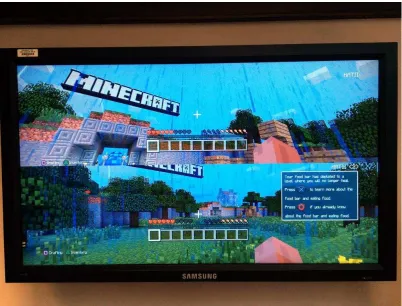
[image:6.595.98.501.377.683.2]The first lab session involved playing Minecraft on PlayStation 3. Our student volunteers were split up into pairs with a mixture of previous Minecraft experience in each pair e.g. one coupling comprised a highly experienced player and a complete novice; another comprised two beginners. Each pair played the game for two hours in split-screen multiplayer mode (as shown in Figure 1 below), beginning with the built-in tutorial world.
Figure 1: Split-screen multiplayer mode in Minecraft.
16
See http://videogames.arts.gla.ac.uk/category/games-for-communcation/ for blog entries.
17
Squire, K. (2011). Video Games and Learning: Teaching Participatory Culture in the Digital Age T
Split-screen multiplayer mode situates both players in the same, shared environment but imposes no demands on what the players should do: they are free to ignore each other and explore the world on their own, or they may opt to work together to construct a house or other structure, for example.
For this session, players were given a short worksheet that instructed them to explore the tutorial world which guides new players through world of Minecraft. When both players were comfortable with the mechanics of the game, they were asked to create a new world (complete with monsters!) and to carry out a range of suggested collaborative tasks. These tasks included building a home that could house both players, constructing matching sets of armour and hunting down one of the
It is fair to say that the progress made varied from group to group. An obvious factor affecting progression was experience: the pair which included an expert player took to the task with some relish, with others experiencing varying degrees of frustration and, perhaps, even despondency. The expert-and-novice group also differed from the others in terms of how well the pair knew each other, with communication between the two made easier by their existing friendship. This
communication could be characterised as a form of peer tutoring, with the expert player guiding the novice through the tutorial (and forgetting to complete his own tutorial tasks in the process!)
Indeed, it appeared as though the expert-and-novice pair was the only to truly collaborate, or make any meaningful attempt at completing the suggested tasks, their efforts culminating in the
and rather homely two-bedroom cave. Discrepancies in Minecraft experience and ability were a source of humour rather than frustration.
Two hours of play was simply not sufficient for the other groups to become familiar enough with the
game and perhaps each other T
that the other pairs did not communicate at all, however. Occasional questions were asked of one another, while (not always successful) attempts to rendezvous within the game world were made.
A wooden
sword in hand when she became the victim of a creeper attack.
From a practical point of view, a number of issues were encountered. These ranged from the relatively trivial challenge of using multiple wireless controllers with multiple PS3s in the same room (using wired USB connections made it more straightforward to ensure that each controller was synced with the intended PS3) to the last-minute realisation that Minecraft requires a high definition display for split-screen multiplayer (thus rendering useless the large, but standard definition, screen intended for one of the groups). Technical issues are to be expected when video games are used in a research or teaching environment, of course, and none of those encountered on this occasion proved insurmountable.
Potentially more problematic, however, was
be possible to schedule an additional session for these two to run through the exercise. But what if a single participant misses the session, leaving one attendee without a partner on the day and the missing participant without a fellow straggler with whom to catch up? Another solution might be to devise exercises that are as far as possible equivalent to those carried out in the lab environment but which may be carried out at home. Aside from the challenge of ensuring the equivalence of the alternative task, access to the required game software and hardware must also be considered. A
student may borrow a copy of Minecraft
online multiplayer, for example, but only if they have access to a PS3 at home.
These are issues that any concerted effort to use video games in a formal learning environment would have to address. The problem, however, is perhaps more serious in a research context such as this, where the aim is to measure the effects of playing video games. The solution to be adopted here, for now, is to devise equivalent tasks which may be carried out by participants in a more independent fashion, either at home or at an alternative time using campus-based equipment, if they cannot attend the scheduled session.
Case Study:
Gone Home
The Fullbright Company Gone Home18 was, perhaps, always going to divide opinion amongst our group of volunteers. Generally very well received it currently boasts a Metacritic rating of 8619 Gone Home has irked some who feel it challenges their personal definition of what a video game is.
O
This situation is illustrative of another of the problems that can arise when using a prescribed game within a formal learning environment: not everyone is going to like it. Squire20 and
Egenfeldt-Nielsen21
interested in I
here have volunteered to take part in a game-based study and all have at least some interest in video games.
18 http://fullbright.company/gonehome/ 19
http://www.metacritic.com/game/pc/gone-home
20
Squire, K. (2011). Video Games and Learning: Teaching Participatory Culture in the Digital Age T
College Press.
21
Figure 2: I T F C Gone Home.
The intention was to examine how the game communicates its story to the player, and to ask whether playing such a game might help hone our investigative skills, as the player is required to locate and synthesise information from a range of in-game sources in order to figure out what has happened. The extent to which
with them was generally rather limited, recalling J B Indie Game: The Movie22, wherein the designer revealed that he had hoped to speak to his audience through his game, Braid, but that this conversation had not really taken place.
The idea that Gone Home
with somewhat greater enthusiasm. However, broadly speaking, those players who enjoyed the game to a lesser extent also saw less value in its investigative aspects. Those players who became
scattered around the abandoned home in which the game is set did appear to feel as though their investigative abilities were being exercised. A blog post by one of our student volunteers provided an insight into how she felt the game relied upon deft communication and helped to exercise her investigative and critical thinking skills23.
Case Study:
Never Alone
Never Alone (Kisima Ingitchuna)24 is a BAFTA award-winning25 game created by Upper One Games in collaboration with Alaskan Native storytellers and elders. The game draws heavily on the traditional
I
lly upon the richness of unique cultures to create complex and fascinating game
22
http://indiegamethemovie.com
23
http://videogames.arts.gla.ac.uk/investigating-gone-home/
24
http://neveralonegame.com/
25
Like Gone Home, we could argue that the makers of Never Alone are using the game to
communicate with the player, to tell us a story. Never Alone is also intended to provide players with a unique insight into the culture and ethics of the Iñupiat people. And, the game may be played cooperatively, requiring effective communication between players as they traverse the Alaskan landscape together.
Our post-game discussion was structured around the following questions:
To what extent are the makers of Never Alone communicating with us, the player?
o How much do you feel you learned about Alaskan native culture?
Did the opportunity to learn about his culture add to your enjoyment of the game?
If you were able to play the game co-operatively, did doing so exercise your communication and collaborative skills?
As a recent release, Never Alone was the first game that none of our project volunteers had played before, and it was well-received across the group. Most of our players took the time to watch the documentary footage and interviews with the Iñupiat elders that intersperse the game.
[image:10.595.143.455.453.685.2]Furthermore, engaging with these materials was generally deemed to have been interesting and worthwhile: the players learned something of Alaskan native culture as they played and, in at least one instance, garnered gameplay hints from the interview material. Those players who habitually skipped the videos were driven by a desire to complete more of the game than their peers but conceded that, had this element of competition been absent, they would have taken the time to watch. Indeed, the relatively unobtrusive nature of the video material, coupled with a strong underlying game concept, was thought to create opportunities for learning about Iñupiat culture without compromising on fun.
Figure 3: Cooperative play in Never Alone.
controlling the other character (the small girl) was less actively engaged in proceedings. It was clear, however, that the less involved player enjoyed commenting on his col .
“ Iñupiat collaborators communicated successfully
with the players at least those who engaged with the video material but that, perhaps,
communication between cooperating player O
certainly came away having enjoyed the game and feeling that they had learned something of another culture.
Case Study:
Portal 2
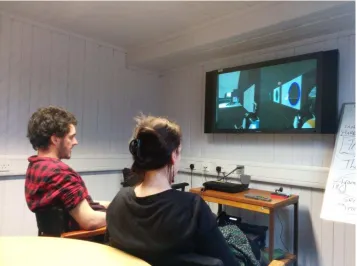
[image:11.595.119.477.320.586.2]V -loved Portal 2 was, perhaps, one of the more obvious commercial games to play as part of a project that looks at communication and collaboration skills, as it features a particularly robust and inventive cooperative mode. From a practical point of view, it is also worth noting that the cooperative portion of the game allows for split-screen play, meaning two people can play together on the same machine without the need for a solid internet connection to the PlayStation Network (an impossibility due to our institutional firewall).
Figure 4: Split-screen cooperative play in Portal 2
Our first pair of players had both experienced the game to some extent before, but, in one case, on PC rather than PS3. This lack of familiarity with the console-based controls immediately led to frustrations with the control scheme that no amount of communication could address (in fact, the nature of the inter-player communication at this point might have been rather unhelpful). Issues with the PlayStation controller aside, communication quickly became an integral part of play. In this case, the more experienced player took the lead and directed the less experienced player, using a
mixture of verbal and vis -dimensional space. In
D
Y
I
The pair that followed, however, demonstrated how communication if not impeded by barriers such as unfamiliar control schemes and limited patience was absolutely vital to progressing in the game. Using the same mixture of verbal and visual communication, this pair quickly and efficiently worked their way through the puzzles presented by the game, although not without the occasional moment of mischief one player was observed deliberately crushing his teammate using a handy elevator.
B
differing amounts of experience of the game at hand is an appealing approach. Such disparities can certainly result in an interesting dynamic and create the need for significant communication. However, when the disparity is too great, cooperation may quickly give way to frustration and, ultimately a breakdown in communication between players, rather than creating opportunities to exercise and develop such skills. This, perhaps, points to a more general consideration when planning to use commercial video games in a formal learning environment: it is important to
B
observations made here, the experience gap between a pair of players can be quite significant if progress through the game does not require explicit collaboration (as Portal 2 -solving does).
A game such as Minecraft,
even when inhabiting the same game world are free to work alone if they wish, provides a more relaxed environment for collaborative play.
The worst possible combination might be a pair of players with no experience of the game (or gaming, more generally) between them. When players spend the majority of the session wandering aimlessly or struggling to grasp the controls, there is little opportunity for meaningful play, and
A how game-based learning of this sort
might be organised in a formal learning environment but, even if further experimentation is required to determine a best practice approach, the importance of balancing player experience is clear.
Results
For each measure, the change in score on the associated tests was recorded, for each participant, over the course of the eight-week study. The following tables summarise the results for each of the attribute-specific measures, including the calculated 95% confidence interval. The 95% confidence interval of 2.5 to 12.2 for differences in Communicative Adaptability Scale scores, for example, indicates that the mean change in results may be expected to fall between 2.5 to 12.2 in 95% of cases, should the experiment be repeated. So, that the confidence interval, in this case, does not fall
TABLE 1:COMMUNICATIVE ADAPTABILITY SCALE SCORES
ID Week 1 Week 8 Difference
A 104 113 9
B 110 116 6
C 94 99 5
D 102 114 12
E 97 109 12
F 105 105 0
Min 0.0
Max 12.0
Median 7.5
Mean 7.3
95% confidence interval 2.5 to 12.2
TABLE 2:SELF-PERCEIVED COMMUNICATION COMPETENCE SCALE SCORES
ID Week 1 Week 8 Difference
A 77.50 90.83 13.33
B 73.33 89.17 15.83
C 69.42 65.00 -4.42
D 56.67 72.08 15.42
E 58.33 69.17 10.83
F 60.00 66.67 6.67
Min -4.42
Max 15.83
Median 12.08
Mean 9.61
95% confidence interval 1.57 to 17.65
Discussion
Mean values of both communication measures were observed to increase between baseline and repeat testing. 95% confidence intervals for change in mean communication scores did not cross zero, suggesting this was not a chance occurrence. While the small sample size means it is difficult to prove that the games played were the cause of gains in communication ability, this finding is
consistent with such a hypothesis, and motivates a further, hypothesis-testing, controlled study.
In addition to the calculated confidence intervals, the correlation co-efficients between each measure used in the project were calculated in terms of Pearson's r. The correlation between the two communication measures is moderately strong (r = 0.76), which, as they are intended to measure aspects of the same attribute, indicates good validity but also, potentially, suggests that there is an element of redundancy in using both tests. The Rosenberg Self-Esteem Scale produced some of the strongest correlations with other measures, including a moderately strong positive correlation (r = 0.69) with neuroticism (as measured by the Big Five Inventory) and strong negative correlations with both communication measures (-74 for the Self-Perceived Communication Competence Scale and -0.87 for the Communicative Adaptability Scale). Whether or not these correlations are intuitive is, perhaps, open to debate. It is conceivable, certainly, that individuals with high self-esteem may also be more neurotic than those with low self-esteem; a more
interesting question is whether high self-esteem should be associated with better communication skill (or, more precisely, with self-perceived communication skill). It does follow that extroverts might find themselves to be capable communicators, in line with the moderately strong positive correlation between extroversion and the two communication measures (0.664 and 0.62).
From a practical point of view, the pilot project proved instructive and highlighted a number of challenges and concerns that must be addressed in any subsequent study. Chief among these concerns and by no means unique to this work is the issue of volunteer recruitment and retention. As noted above, no control group was recruited (or, rather, a small group was recruited but only one volunteer took the tests at both the beginning and the end of the study). An
experiment group of eight volunteers was sought, and seven recruited; however, only six of these completed all of the tests in time to be included in the study (due to overseas travel at the end of the semester). Without a control group, the study did not test the effect of the intervention (i.e. the game playing sessions): it provided a trial run of the exercise, and some indication of the measures that should be employed in a subsequent study. However, on reflection, the flawed approach taken to recruitment can be identified and addressed in relation to any subsequent experiment: too few prospective participants were contacted in the first instance, and the response rate over-estimated. Further, the students contacted about the study were not only drawn from a small number of classes, but also from Honours-level (third or fourth year undergraduate) classes. By the second semester, when the pilot was conducted, students at this stage in their academic careers are, quite justifiably, preoccupied by dissertations and final exams. However, this narrow focus was, to some extent, deliberate: conscious of the need to recruit a potentially much larger cohort for a
available for any follow-up activities, such as further testing or interviews for at least another year after the initial study has been completed. Logistical concerns aside (a greater number of
participants will place greater demands on the limited hardware and software available for gaming sessions, should an identical approach to that taken in the pilot be adopted), it is essential that the main study attract and maintain a large cohort of volunteers, if meaningful statistical analyses are to be performed on the data.
Technical issues encountered during the pilot were infrequent and relatively slight (as described
G T research staff were
familiar with the chosen platforms (PC and PS3) and most of the games, and, where there were unknown factors (such as the restrictions imposed by the U IT ) extensive testing of configurations was undertaken in advance. The related issue of scalability aside, the pilot study did not reveal any significant technical difficulties associated with the approach taken.
Conclusion
This pilot has been instructive. However, it also revealed a number of areas for further
consideration, and questions that must still be addressed before conducting a larger study. First, it is unclear whether the two hours per week of gaming session is sufficient and, related to this concern, is the question of how best to account for games played by participants at home. It is conceivable that participants in a larger study may be asked perhaps optimistically to document the games they play outside of the study and for how long. The nature of the control group may also need to be explored: it may not be sufficient to recruit a group of students that broadly reflects those involved in the study (in terms of gender, age, year of study, subjects studied, etc.): a control group should, perhaps, be asked to play trivial games, e.g. computer-based solitaire, for a duration equivalent to that spent by the experiment group playing the selected games.
The empirical data collected and analysed here, however, does appear to warrant further
investigation. These data, coupled with informal feedback from student participants, suggest that commercial video games may have a role to play in developing communication skills in our graduates.