Rochester Institute of Technology
RIT Scholar Works
Theses
Thesis/Dissertation Collections
7-18-2002
Masters thesis
Sarah Laveck
Follow this and additional works at:
http://scholarworks.rit.edu/theses
This Thesis is brought to you for free and open access by the Thesis/Dissertation Collections at RIT Scholar Works. It has been accepted for inclusion
in Theses by an authorized administrator of RIT Scholar Works. For more information, please contact
Recommended Citation
ROCHESTER INSTITUTE
OF TECHNOLOGY
A Thesis Submitted
to the
Faculty
ofThe
College
ofImaging
Arts
andSciences
In
Candidacy
for
theDegree
ofMASTER OF
FINE ARTS
MASTERS THESIS
By
Sarah
E. Laveck
CONTENTS
SIGNATURE
PAGE
ii
LIST OF ILLUSTRATIONS
iii
APPENDIX
17
I.
INTRODUCTION
1
JJ.
NEW IDEAS
3
-Dealing
withSpace
-Struggles,
Complexity
vs.Simplicity
JJJ.
EXPLANATION
OF
WORK
8
IV.
CONCLUSION
16
V.
BIBLIOGRAPHY
18
SIGNATURE PAGE
Approvals
Chief Advisor: Luvon Sheppard
________
---,?,.L-~_L2.-~~
2
-_
(Signature)
7
Date:
Sen
I<-J-
jto
>-Associate Advisor: Bob Cole
(Signature)
Date:
_
Associate Advisor: Alan Singer
L::2
A
-
r ; , - ,
(Signature)
Date:
~~
7
LbO
~
Department Chairperson: Tom Lightfoot
/ , ]
(Signature)
Date:
-+i-/(--+---€!rq~/l-",,---()
- - L -
_
I,
S=a=..ra=h==----=E=--=---.
=L::..:a;.:..v"'-e~c..::.;k=-
,
prefer to be contacted each time a
request for reproduction is made. I can be reached at the following address:
203 Alverstone Way
W. Henrietta, NY 14586
Date:
j
I
113)
()?--r
ILIST
OF
ILLUSTRATIONS
Figure
Page
1
.Study
for Inside Out
8,19
2.
Untitled
9,20
3.
Untitled
10,21
4.
Untitled
12,22
5.
Inside
Out
14,23
6.
Feelings
ofSeptember
15,24
INTRODUCTION
Thesis Proposal:
The
purpose ofthisthesis
is
todevelop
a visuallanguage
inspired
by
microscopicorganic
life forms. I
willdo
this
by
creating
andviewing
slidesunderneath amicroscope.From
themicroscopeI
willvisually
recordwhatinspires
mefrom
thatmicroscopicworld.
I
willthen usethose
drawings for inspiration
and create paintingsbased
onthoselife
forms.
Ultimately
creating for
myselfavisuallanguage
offorms
thatI
usetocommunicate artistically.
Along
withthescientific researchofcreating
andviewing
slides onthemicroscope,
I
will researchabstractexpressionists and colorfield
artistslike Helen
Frankenthaler,
Georgia
O'Keeffe,
theearly
worksofJackson
Pollock,
andLee Krasner. I
will usethisresearchto
determine how I
usecolorandform
aspart ofmy
visuallanguage
andhow
I
expressmyselfthroughit.
In
thisbody
of workmy first
goal wastolook
atmicroscopicliving
things.To
do this, I
purchasedabasic
microscope andbegan
toutilizethepre-madeslides aswellasonesthat
I
mademyselfofliving
things.My
goalin
doing
this wastotry
tomaketheconnection
between different
living
things andthebasic
building
blocks
oflife. I began
noticing
that therewere somebasic
organicforms
that were consistentamong
living
organisms.
These
weretheforms I began
todraw
andpaint.I had
three
othergoalsin
doing
thisbody
ofresearch.The
second goal wastowork
in
acrylic paint.I
chose acrylic paintbecause
it is less
toxic thanother paints andit
studio andschool.
And
lastly,
acrylicis
a mediumI hadn't
used much andI
wantedtosee what
I
coulddo
withit
andhow far I
could push themedium.The
thirdgoalI had
wasto
workin
a stylethatwasdifferent
yet relatedto
whatI
had done in
the
past.The fourth
goalI
had
set outtoexplore wastheissue
of spacein
NEW IDEAS
As I
wasgetting
startedI
made alist
ofideas
orthings
I
wantedtobegin
sketching
from
the
microscope.The
list
included
plantlife,
water samplesfrom
varioussources,
human
bodily
fluid,
skin,
fingernails
andhair. As
statedin my introduction
someof
these
slides were pre-made and someI
created.Immediately,
I
thought
oflooking
atblood
anddoing
portraits offriends
andfamily.
One
problem wasthat
no one wanted meto
prickhis
orher finger
andI
couldn'teven prick
my
ownfinger.
So,
thatidea
wasscratched.I decided
toconcentrateon plantlife,
saliva,
hair
andskin,
asmy
samples weremoreeasily
obtained.In my early
paintingsI
experimentedwithawatereddown
acrylic,
layering,
creating
a seamlessblend
of colors.I
began
withexpanding
the
possibilities oftheacrylic paint
by
adding Goldens
syntheticpolymermediumin
gloss and mattetomy
acrylicpaint.
This
has
allowedmetoworkin
rich
glazes and achievethelook
of an oilpainting.
It has really been
quitefascinating
and ahuge
learning
experiencefor
metoexperiment withthese
different
blending
techniques.One
challengein
the
workI
ampresenting
andin
theworkI have
createdin
the
past
is
depicting
theillusion
of spacein my
paintings.I
have
struggledtodecide if I
shouldrendertheshallow space ofthemicroscopic
forms
thatinspire
meorif I
shouldexaggeratethatspacetoappear much
deeper. I
tendto
combinethe shallow space andthe
deep
space,
therendered volumetricforms
withtheflat
graphicforms. I
seemto
be
fascinated
by
their
relationship
andstruggleto
makethem
successfulin
thesame pictorialspace
in
theroundformat
is
theuse ofgradients,
theidea
of atubeortunnellike
affectin
the
background,
andusing
avariety
of sized and shaped organicforms
thatdiminish in
size and
fade in
intensity
asthey
goback into
space.This
technique
ofcreating
theillusion
ofdepth
wasn'tdeveloped
by
meit's been
usedfor hundreds
ofyears,
I have just
applied
it
tothe
abstract realm andmy
own unique visuallanguage. As I have been
struggling
withvolumetric andflat
objectsin
thesameworkI
have
enjoyedexperimenting
withthe
play
of soft andhard
edges,
texture and smoothpaint,
andthickandthinareas
in
the
same painting.I have
alsobeen experimenting
withdifferent
typesofmark
making,
using
thingsotherthan abrush
orpaletteknife
toapply my
paint.I have
been printing
onthecanvasesandboards,
using my
hands,
cardboard,spray
paint andtincans.
This
experimentationhas really
openedthedoor for
metovisually begin
tolet
goof
the
tightly
renderedvolumetricforms
and replacethemwith morebasic
elementslike:
lines,
shapes andforms in
space.These
forms
truly
reflectthepainting
processandthey
seemto
have
a more raw energeticfeeling. This
explorationhas been
ahuge
breakthrough
andhas been my
majordiscovery
in my
own artwork(and in
myself).I
struggledearly
onworking
withacrylic painttrying
toachievethe
resultsI
desired. I
wantedtolayer like
watercolor,with washes andin
some areas andin
othersI
wantedto
build up
animpasto
(a thick,
rich, buttery,
texture).I
had
success withthisin
oil paint.
I
wantedto workandhave
abetter understanding
of acrylic paintfor
a numberof reasons.
I
wantedfirst
andforemost
toconcentrateonsomething
different,
althoughrelated, to
my
undergraduate work.I
wantedtowork with asafe,
fast
drying,
andeasy
cleanup
mediumthatwas alittle
outsideofmy
comfortlevel. These
qualitieshave
when
I
had
to
transportmy
paintingsback
andforth from
campusevery
two
weeks.I
experienced a
degree
of paintconsistency
I
liked
by
using Goldens Gloss Polymer
Medium. I
usedthe
mediumto
increase
the
fluidity
andtexture
ofthe
acrylic paint.Another
problemI
raninto
during
my
exploration withthepossibilities ofachieving
space andworking
with acrylicpaintwasthatmy
color relationshipsandcompositions
became
asecondary
concern and wereultimately
suffering.This
wasonly
remedied
by drawing
andsketching
alot. Those basic
visual relationshipsI
oncesawin
my head
werefading
asI
wasstruggling
todevelop
a newstyle,
relatedtomy
past,
but
definitely
in my future.
My
colorrelationships were unsuccessful aswell,
I
realizedI
was so concernedwith experimental mark
making
possibilitiesanddifferent
mediumsthat
my
color choices werebecoming
arbitrary
and unsuccessful.The
first step I
tookin
alleviating
thatproblemwasto
severely limit
my
oncelimitless
palette.My
inner
strugglefrom complexity
toward
simplicity in my
artworkhas been
also aquest
in my life. As I look
outthewindowofmy
studiotothe
rolling
hills,
woodedforestland, farmland,
andhouses
spottedhere
andthereonthehills,
I
noticethe
calmnessI
long
for
anddread
atthesametime.The simplicity
oftheforms
andtheirrelationshipsto
one anotherare sofluid
sobasic,
andyetso quiet.As in my
artworksimplicity has
been
athing
I have
strivedfor,
somewhat unsuccessfully.Could it be
that thesimplewould require morethoughtmore
inner searching for
meanings thatdo
notwantto
be
uncovered?
It is
easier,for
me, to
become
socomplexin
life
andmy
expression ofit in
art that
I
seemtobe running away from
thetrue soulofmy
work,my
true
soul."One of
themosttragic thingsI know
abouthuman
natureis
thatallof
ustend tohorizon-instead ofenjoying
the
rosesthat
areblooming
outside our windowstoday. "-
Dale
Carnegie.1
It's
easy
to
paint whatis
natural,
comfortable.I
have been
searching
for
simplicity
ofthe
paint,
the
soul ofit,
how it
reacts withwater,
how it
reactswithmedium,how it
reacts with a simplepalette,
simple ground.Painting
for
painting's sakefor
the
pure simple
beauty
ofits
texture, translucency,
opaqueness,
andillusionary
qualitiesis
not as
easy
asit looks. It's like
opening up my
soul andsearching
for
my
true self, the
raw,
bare
bones,
nitty gritty
me.And
sometimesopening up
that
inner
self erupts alot
ofinner
struggle and conflictbetween
whatis
comfortable andeasy,
my
complexity,
orwhat
is
raw, untamed,
somewhatscary
to
my inner psyche,
calmnessandsimplicity.In
life it
is
soeasy
to
fill
yourday,
week, month, year,
life
withthings that
youclassify
asprioritiesand after years and years of
this
constant stress and cluttereddays
youbegin
to
lose
sight ofthe
simplethings
in
life,
whatreally
matters.Sometimes
whatyourheart
and soul
longs for is
scary
to
yourmorerationalmind.Painting
has
alwaysbeen
therapeutic
for
me andI
think
I have
reached avery
important
andinsightful
turning
pointas an artist and
in my
life.
The
simple yetimportant
structuresin
art,
like
the
elements of art:
line,
shape, color,
texture,
value,
space andform
canbe
relatedto the
basic
elementsto
sustainlife,
sobasic
we seemto
forget,
oxygen, water, sunlight,
nourishment, shelter, protection,
family,
andlove. Things like
our questfor
greatersocio-economic status and possessions often cloud what
life
is
really
about.That
has been
true
ofmy
life. The
pastsix monthsI
have been
trying
to
changethat.
1
Dale
Carnegie,
"Quotes
andQuips,
InsightsonLiving
theSevenHabits,""All
menshouldstrive tolearn before
they
die
whatthey
arerunning
from,
andto,
and why. "-
James
Thurber2
Making
aless
chaoticlife for
myself wouldforce
metodevelop
strongerrelationships with
people,
something
thatscares me abit,
because
thereis
agreaterchance
for
thosepeopletohave
more of an effect over me or chancefor
themto taketheir
love
orfriendship
away.I have found
thatif I
ambusy
andconstantly
goal orientedI
limit
therelationshipsI
build
with othersthuslimiting
my
potentialtodeal
withfeelings
regarding
thoserelationships whethergood orbad.
"
There
is
more tolife
thanincreasing
its
speed. "-
Mohandas K. Gandhi
The
quoteby
Gandhi
canbe
trueofpainting.A
greatpainting
canbe
createdwitha
limited
palette,painting for painting
sake,andaless
chaotic,
cluttered composition.This
journey
has been
ahelpful
onein my life
andart.I've learned
theonly way
tolive
is
to
live. I
needtolet my
guarddown
andtakerisks. In
thepast,
althoughI
paintedin
anabstractmanner,
I
struggledtocontroltheway
thepaint was applied.Now I
amletting
thepaintspeak
for
itself,
letting
it
takeonalife
ofits
own.2
EXPLANATION OF
ARTWORK
"Every
painting
might appearto
be differentfrom
the
next whenit is actually
partof
abody
of
workthat
is
similarin
feel
and approach."
-
Helen
[image:13.540.50.303.174.309.2]Frankenthaler4
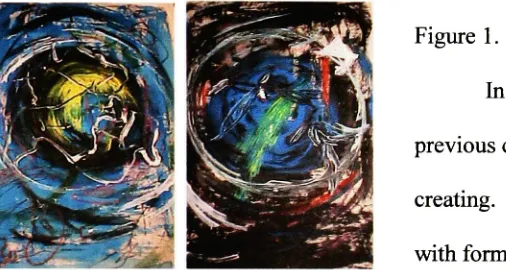
Figure 1
.Study
for Inside Out.
In
figure
1
,1
wantedto
diverge from
the
previous
drawings
and sketchesthat
I
had
been
creating.
Up
untilthispointI
was still concernedwith
form
andline
creating something
somewhatrecognizable
to
explaineverything
to the
viewerinstead
ofjust
letting
the
essence ofthe
painting
andthe
conceptout,
in
afresh,
notoverworked or analytic manner.It
was alsoat
this time that
I
startedto
look back
atthe
workofthe
artiststhat
inspired
metobecome
a painter
in
the
first
place.Artists
like
O'Keeffe, Frankenthaler, Krasner,
andPollock
gave me perspectiveon someof
the
ideas I had been struggling
with.At
this
pointI
alsobegan
to
explorethe
possibilities of notusing
the
circle(that I
had
originally
set outto
use)
asthe
format
for my
composition.I
alsofelt
getting away
from
the
circle allowed meto
free
up my
drawing
and painting.In
this
workI
strivedto
suggest
the
circle.I
played with afigure/ground
spacerelationship
and colorscheme,
something
that
directly
influenced
untitled#3.
3
Mohandas K.
Gandhi,
"QuotesandQuips,
InsightsonLiving
the7
Habits"Franklin
Covey Corporation,
USA. 63.
4Helen
Frankthaler,
"After MountainsandSea: Frankenthaler1956-1959"
"Very
often,
theartist spells outfor
the
viewer what shouldinstead
be
piecedtogether
consciously
or subconsciously.A
painting,
nomatterhow labored
it
is,
shouldhave
akind
of
immediacy,
afreshness
and shorthandthat
leave
it
for
theviewerto
fill
in
the
rest. "(After Mountains
andSea: Frankenthaler
1956-1959).5I
wantedto
break
the
circle open alittle
andkind
oflet
it flow
out andmorphitself into
the
foreground
andbackground.
I
deliberately
used a coldgray
neutral paperas
the
ground andI consciously
tried to
makethe
paperplay
less
of a graphic negativespace role as
it had in
some ofmy
earlierdrawings
and sketches.It
was also atthis time
I
began
to
explorethe
possibilities ofthe
diptych
asbeing
aplay
oninside,
outside,
positive and negative.
I
limited
my
paletteaccordingly
to
achievethis
effect.I
tried to
focus
onthe
line
quality, the
brush
stokes andthe
way
paint reactsnaturally
whenit is
applied
to
a groundusing
a painttool.
As
in
someofmy
earlier workI
wantedto
stillkeep
somehint
ofdrawing
in
the piece,
soI drew
into
the
acrylic paint with awater-soluble crayon.
The
line
quality
in
this
painting
sketchis
directly
relatedto the
strandlike
organicforms found in
allliving
objects(part
ofmy
earlier research).This
sketchwas a
breakthrough
for
me whereI
finally
realizedhow
allthe
pieces of whatI
wantedto
do
and achievein
the
painting
research cametogether.
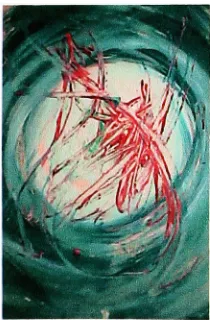
Figure
2
In
his
painting
sketchI
wasagainworking
withbreaking
away
from
the
circleformat
but
stillsuggesting
the
circlein
the
pictorial space.
I
alsofocused
onhaving
alimited
palette of5Helen
Frankthaler,
"After MountainsandSea:Frankenthaler
1956-1959."
[image:14.540.63.168.540.700.2]twocolorsplus white and
working in
a moreminimalmanner,
keeping
thecompositionsimple.
The energy
thispiecehas
comesfrom
the
intuitive brush
marks andscrape marksonthepaper.
The
limited
palettehelps
notto
distract from
this
raw energeticquality.Also
the
strong
diagonals
in
the
brush
marks as well asthe
way
they
break
outofthecircle shape
helps
activatethespace and add movementto
the composition.The
colorthough
limited is
attractivetomebecause
the
red and greencomplimenteachotherthat,
along
withthestrong diagonal lines
makethispainting very dynamic. The way in
whichthegreenwasapplied suggests atunnel orcavernous space.
This helps
adddepth
as well [image:15.540.65.165.326.601.2]as
mystery
ofwhatthatspaceholds.
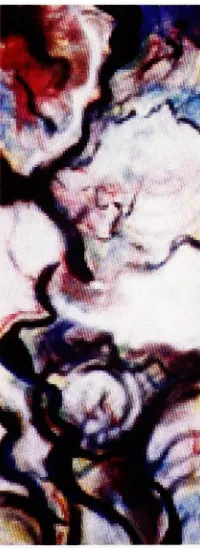
Figure 3.
I began making painting
sketchesexperimenting
withalternative waysto
apply
paintonto ground.I
usedaroller,
spray
paint,
printedthe
ridges
ofatincan,
printedcardboard,
and ringswith
jar lids.
Combining
these techniqueswithmy
biomorphic line quality
anddrawing-like
approachtopainting
really began
tojump-start my
researchofmy
self as an artistand an artmaker.
It
openedmy ideas
tothe
different
possibilitiesand
how
somuch canbe
achievedby
just
playing.My
sketchesweren'tlabored,
they
werefresh
and playful andI
really
enjoyedlooking
atthemandexploring
theirsurfacequality,
space andline. I
let
myselfgo,
loosened
up,
andlet
an artisttake
over.The
scary
thing
wasthat
I actually
enjoyedthe
paintingsI
wasproducing
that
wereless
controlled.
A
pointI
thought
I
would never getto.
From
these
sketches and experimentsI
began
this
painting
withonelayer
of paintputon with
cans, cardboard,
and aroller.Then I
added another andanother,
somemoredefined line
workthanfigure 1.
And,
ofcourse somecircularelements paintedin
anadditive and subtractive way.
Actually
it
wasthis
piecethatI
realizedhow
torepair oneof
my
majorstumbling
blocks,
my
tendency
towardchaos and excess.I
usedtheblack
spray
paint asanatmospherictoolin creating my line
andthe whitespray
paint as a moresubtractive
tool,
deleting
areasunnecessary
to
theoverallflow
andfeel
ofthecomposition.
This painting in
that
way
also allowedtometo
grow.Usually
in my
painting I
reach a point whereit just
gels andthenI
gofar beyond
thatpoint andoverwork
it.
Suddenly
it
becomes
amess andI
getdiscouraged,
because I knew it
startedas
something
thatreally
workedandmy
mindmessedit
up.I
sharedthis
withmy
mentor,
Luvon
Sheppard,
andhe helped
meto slowdown
andtakeaway,
thengetaway,
before adding
anything.Then coming back
to
it
andreflecting
on whetherit's
finished
ornot.
The
layers in
thispainting
alsoplay
withthespace,
yetthe
black lines in
the
foreground
seemflat
orshallowin
their
space.I
alsobegan
to thinkof color as valueto
achieve space.
Using
tints
and shades aswell asthe
originalhue. This
allows meto
achieve space without
tightly
rendered organicforms. In
this
painting
and as an artistI
just
saidto myself,
"so
what".That
is,
I
let
myselfjust
paint without as muchthought
andconsideration of
the
exactness ormeaning
of eachbrush
stroke.My
painting
canbe
and
have
space atthe
sametime,
any
attempt at metrying
tospell thatoutto theviewerwouldtake
away its
freshness,
the
naturalquality
ofthepaint,
andI
wouldfall into my
old
habits. Through my
research of other artiststhis
ambiguous spaceis something
that [image:17.540.66.304.192.330.2]Frankenthaler
workedtoward,
as well.Figure 4.
In
thispainting I consciously
thoughtof
my influences
and whatI
had learned from
thepreviousthreepaintings.
I
startedwith raw canvaslaid
outonthefloor
ofmy
studio.I
enjoyedits
textureandits
natural color.I
didn't
wantto
destroy
it. I had
readthatFrankenthaler
usedraw canvas andI loved
theeffectit
gaveto
her
paintings.But I
wasalsoconcerned withits
archivalquality
aswell.So I
primedtherawcanvas withaclearpolymer.
In my
undergraduateworkI
rememberedwatching
films
of variousartistsworking in
theirstudios,
I
wasfascinated
by
thecreativeway
they
appliedtheirpaints tocanvas.
I
wasprimarily
fascinated
withJackson Pollack
andHelen
Frankenthaler.
At
the time theidea
of notbeing
abletocompletely
controlit (the paint)
bothered
me,
scaredme,
I
neverwouldlet
myself go enough untilthis
painting.I began
to
pour paintright
onto
thecanvaslaid
outonthefloor,
letting
thecolorsbleed
naturally
into
oneanother;
I became intoxicated
by
theaffect.The
look
andfeel
ofthepaint wasso enjoyable
for
meI didn't
wanttooverworkmy
line,
shape andform.
I
wanted someofthatnice poured paintto
have
thespotlight.This
is
like
having
thethings that
matterthe
most,
the
basic
elements,
have
the spotlight,
like in
life,
love
andfriendships
areimportant.
Like
the
other paintingsin
this
body
ofwork,
it
wasrenderedin
unconventional ways
(drawing
onthe
canvas with water solublecrayon, staining,
printing,
andspray
painting).This helped
maintainthe
soul andatmosphericquality
thatthe
painting
has.
Looking
atthis
painting
aftertime
andthroughout
critiquesI
have
realizedthe
surrealistic
quality
ofthe
atmospherein
the
color and value.It
is less
cosmic and more surrealthan the
onesbefore
it. I
was curious andI
looked
back
atmy
earlierundergraduate
work,
andI
discovered
I
had
some surrealisticcharacteristicslike
atmosphere, symbolism,
fantasy,
dream
like,
andambiguous space.In
this
painting
the
expressive
marks,
naturalflowing
andblending
paint,
and colorcompliment crayondrawing.
The
modeled, stylistic,
volumetrictype
drawing
I
had been
drawn
to
in
the
pastkind
ofleaked
outin
this piece,
making
it,
to me,
a moredirect link
to the
symbolic nature ofmy
undergraduate work.The
symbolismin
this work,
asin
othersin
my
previouswork
is
perceivedto
be
somewhat sexualin
nature.This I
have
concludedto
be
mostly
subconscious onmy
part,
because
that
is
notmy
intent
whenI
paint, these
areforms
that
areinside
of me and with abrush
ordrawing
tool,
I
intuitively
incorporate
these
forms into
my
art.These
forms
arederived from
nature andthrough
somerudimentary
researchwith a microscopeI
have
noticedsimilarity
ofbasic
organicform
found
in
mostliving
things.
Therefore,
the
forms
being
perceived as sexual whetherintentional
or notis
relatedto
the
realm ofthe
biomorphic,
something
whichI
amdrawn
to.
,aiAAr - *^eia L'v
>*
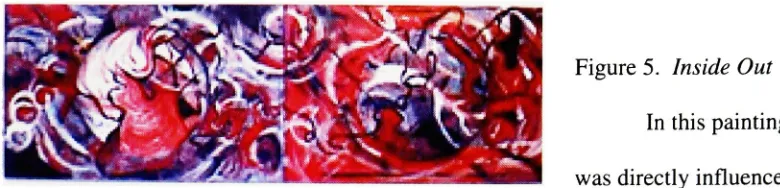
Figure 5.
//7.v/d<?
0m?
^^rSM^^^^y1-
BSHi^S
RflH
wasdirectly
influenced
by
figure
1
.I
enjoyedtheplay
ofinside
and outside.In
thatdrawing
I
wasreally drawn
to the
limited
palette andtheoppositeforeground/background
colorscheme.I began
thispiecewith
that
opposite color schemein
mind.I began
to
under painteach panel.The
panelonthe
left had
a red-orange circlein
thecenter and ablue background
withapatternofred-orange circles paintedovertop.
The
panel ontheright has
anunderpainting
of red-orangein
thebackground
andthecircleis
paintedblue
with analloverpattern of red-orange circles overtop.
From
thereI
usedthe techniquesof markmaking
and
painting
thatI
had
cometodiscover in
thisoverallbody
ofwork.In
this
pieceI
alsowanted
to
pushthat
inside
outthemeeven more.I
constructedthisdiptych
out oftwopanels.
The
panelontheleft has
a circlecut out ofthe center and recessed abouttwoinches from
thesurface.The
panel ontheright has
acircle cut outofthecenterandthecircle
is protruding
outabouttwoinches.
Again,
in
thispieceI
played withdifferent
ways ofapplying
painttoground,
using
spray
cans, rollers,printing
onthepanels,
anddrawing
onthemwith crayon.I
originally
thoughtI
mightpaint each paneltipped vertically, sothatwhenthey
werepushed together
they
would createa moresquarecomposition.With
thestrong
color andline
workin
this
diptych I discovered early
onby
making
themonelong
horizontal
I
couldmake
them
feel
morerestful,
which would counteractthe
chaotic and expressivebrush
strokes. [image:19.540.85.475.51.145.2]Figure
6.
I
began
thispainting
in
somewhatthesamemanneras
figure
4,
pouring
paintonto
fabric
onmy
studiofloor. I had
paintedona cotton
fabric like
thisin
thepast and when
it
was gessoedit felt
rough andbumpy
like
texturecoatpaint.The fabric's
original color was a
deep
rich
orange.The
gessodidn't completely
coverup
theorangecolor and
left
ahint
ofthe
hue behind. As I had in
thepreviousworkin
thisexplorationI
limited my
paletteto threecolors.I
alsoincorporated
thecircularinto
thecomposition.This painting
was completed afterSeptember 1
1,
atragicday
in
ournation'shistory,
andthis
helped
mekeep
it
simple.There
wasno struggleto
fill it
withlines
and marksthatweren't
important
to thewhole.The
experience ofSeptember 1
1,
made merealize,
asI
am sure
it did
others, thesimplebasic
things thatareimportant in life
andtoenjoy
them.So
thatis why
thisone,
for
me,
wasn'taschaotic,wasless
tortureto paint,less
push andpullthantherest.
It
is
unfortunatethatit
tooksuch ahorrific
eventtoreally
make merealizewhat's
important
in life
andmy
artwork,
but it is
so. [image:20.540.83.477.55.176.2]CONCLUSION
In
this
body
of workI
exploredthe
possibilities of organicforms
andlines
in my
work.
I
struggledtodevelop
anewvisuallanguage in
a newmedia,
acrylic.I
alsostruggled with
the
expressions andinner
feelings,
emotions thatbegan
topouroutintuitatively
ontothepainting
surface.I
grappled withmy
tendency
towardschaosin
life
and art and
I
tried togofor something less
chaotic,but just
as stimulating.I
have
achievedthegoalsI
have
set outfor
myselfin
thisresearch andI have
grown
tremendously
artistically
andpsychologically.I have
used varioustechniquesofapplying
acrylic painttoachievetheresultsI
wanted.I
workedoutsidemy
comfort zonein my
choice ofmedia,
technique,
andformat. I have developed
anew styledifferent in
feel,
yet relatedtomy
past work.The
new visuallanguage I developed
canbe
referredtoas
cosmic,
microscopic,andpurely
expressiveI
feel
thatmy
work cannolonger be
labeled
ascompletely
anexpression ofbiomorphic
form. I have
studiedtheworks,
interviews,
andbiographies
of artiststhatI
admireandfeel have influenced my direction
in
thisbody
ofwork.And
lastly,
I
feel
thatin
thispiece ofwriting,I have
pushedmy
selftoanalyze
my
soul as anartist.APPENDIX
BIBLOGRAPHY
Brown,
Julia. After Mountains
andSea: Frankenthaler 1956-1959.
Harry
N.
Abrams,
Inc., Publishers,
New York. 1998.
Carnegie, Dale;
Gandhi,
Mohandas
K.; Thurber,
James. Quotes
andQuips,
Insights
onLiving
theSeven Habits.
.Franklin
Covey
Corporation,
USA. 1998.
Hobbs,
Robert. Lee Krasner.
Harry
N. Abrams
Inc., Publishers,
New York.
1999.
Mintz
Messinger, Lisa; Novak, Barbara; Rose,
Barbara. The Georgia O'Keeffe Museum.
Harry
N.
Abrams, Inc.,
Publishers
in
assistance withtheGeorgia O'Keeffe
Museum,
New
York. 1997.
1L
%*
1&PL7