R E S E A R C H
Open Access
Central venous-to-arterial carbon dioxide
difference combined with arterial-to-venous
oxygen content difference is associated with
lactate evolution in the hemodynamic
resuscitation process in early septic shock
Jaume Mesquida
*, Paula Saludes, Guillem Gruartmoner, Cristina Espinal, Eva Torrents, Francisco Baigorri
and Antonio Artigas
Abstract
Introduction:Since normal or high central venous oxygen saturation (ScvO2) values cannot discriminate if tissue perfusion is adequate, integrating other markers of tissue hypoxia, such as central venous-to-arterial carbon dioxide difference (PcvaCO2gap) has been proposed. In the present study, we aimed to evaluate the ability of the PcvaCO2 gap and the PcvaCO2/arterial-venous oxygen content difference ratio (PcvaCO2/CavO2) to predict lactate evolution in septic shock.
Methods:Observational study. Septic shock patients within the first 24 hours of ICU admission. After restoration of mean arterial pressure, and central venous oxygen saturation, the PcvaCO2gap and the PcvaCO2/CavO2ratio were calculated. Consecutive arterial and central venous blood samples were obtained for each patient within 24 hours. Lactate improvement was defined as the decrease≥10% of the previous lactate value.
Results:Thirty-five septic shock patients were studied. At inclusion, the PcvaCO2gap was 5.6 ± 2.1 mmHg, and the PcvaCO2/CavO2ratio was 1.6 ± 0.7 mmHg · dL/mL O2. Those patients whose lactate values did not decrease had higher PcvaCO2/CavO2ratio values at inclusion (1.8 ± 0.8vs. 1.4 ± 0.5,p0.02). During the follow-up, 97 paired blood samples were obtained. No-improvement in lactate values was associated to higher PcvaCO2/CavO2ratio values in the previous control. The ROC analysis showed an AUC 0.82 (p< 0.001), and a PcvaCO2/CavO2ratio cut-off value of 1.4 mmHg · dL/mL O2showed sensitivity 0.80 and specificity 0.75 for lactate improvement prediction. The odds ratio of an adequate lactate clearance was 0.10 (p< 0.001) in those patients with an elevated PcvaCO2/CavO2ratio (≥1.4). Conclusion:In a population of septic shock patients with normalized MAP and ScvO2, the presence of elevated PcvaCO2/CavO2ratio significantly reduced the odds of adequate lactate clearance during the following hours.
Introduction
Current guidelines for hemodynamic management of severe sepsis and septic shock recommend the use of glo-bal markers of tissue hypoxia as resuscitation endpoints [1,2]. In the initial resuscitation period, targeting either central venous oxygen saturation (ScvO2) normalization or
lactate clearance, or the combination of both, is accepted [1,3,4]. However, each one of these two variables has their own limitations. Although the use of ScvO2seems to pro-vide more real-time information than lactate clearance, the nature of septic conditions, characterized by microcir-culatory heterogeneity that generates capillary shunting, is frequently accompanied by elevated ScvO2values. Indeed, abnormally high ScvO2 values have been associated with increased mortality in septic shock patients [5,6]. Achieve-ment of the recommended normalized ScvO2 values * Correspondence:[email protected]
Critical Care Center, Hospital de Sabadell, Corporació Sanitària Universitària Parc Taulí, Universitat Autònoma de Barcelona, Parc Tauli, 1, Sabadell 08208, Spain
during the initial resuscitation therefore does not rule out persistent tissue hypoxia, and some authors consider that ScvO2 should be used in combination with other tissue perfusion endpoints [7]. On the other hand, despite lactate clearance being proven to be as beneficial as ScvO2 in guiding resuscitation in sepsis, at the bedside the clinician has to face the uncertainty of a high lactate value, without knowing whether this lactate reflects persistence of hypo-perfusion or whether its normalization is just a matter of time [8]. On the whole, elevated lactate values could lead to unnecessary interventions, with their potential deleteri-ous effects, such as tissue edema and increased fluid bal-ance, which have consistently been associated with worse outcome [9].
Recently, some authors have advocated that the mixed and/or central venous-to-arterial carbon dioxide differ-ence (PcvaCO2 gap) might be complementary tools to identify patients with persistent global hypoperfusion [10]. Certainly, both partial pressure of carbon dioxide gaps have demonstrated their prognostic value in different conditions [11-14], and a cutoff value of 6 mmHg seems to reflect whether global flow is adequate (gap >6 mmHg) or insufficient (gap≥6 mmHg). In addition, some authors have suggested that correcting the PcvaCO2gap by an ap-proximation of the oxygen consumption, the PcvaCO2 /ar-terial-to-venous oxygen content difference (CavO2) ratio, might be superior to the PcvaCO2gap to detect anaerobic metabolism [15], and therefore should be a more reliable parameter to guide the resuscitation process.
In the present study, we addressed the question of whether the PcvaCO2 gap and the PcvaCO2/CavO2 ratio are useful in predicting the evolution of lactate, reflecting the persistence of tissue hypoperfusion and/or anaerobic metabolism. For that purpose, we studied a well-defined population of patients with severe sepsis or septic shock, once normalized ScvO2values were achieved.
Preliminary data from this study were presented at the 27th European Society of Intensive Care Medicine (ESICM) Annual Congress.
Methods Setting
We conducted a retrospective observational study in a 30-bed mixed ICU at a university hospital. Study approval and waived consent were authorized by the local ethics committee (Comitè Ètic d’Investigació Clínica, Fundació Parc Taulí; Reference CEIC 2014637).
Patients and data collection
Septic shock patients within the first 24 hours of ICU admission were studied. Severe sepsis and septic shock were defined according to international sepsis definitions [16]. All patients were resuscitated following the Surviving Sepsis Campaign guidelines [1]. Exclusion criteria were:
age under 18 years, and the presence of an uncontrolled source of infection. Once normalized values of mean ar-terial pressure (MAP≥65 mmHg) and ScvO2(≥70%) were achieved, and the medical team in charge decided not to perform further resuscitation interventions (such as vol-ume expansion and/or changes in inotropic or vasopres-sor drugs), simultaneous blood samples were obtained from a central venous line and an arterial catheter. The investigators confirmed the correct positioning of the ven-ous catheter tip on chest X-ray examinations. Measured variables included arterial oxygen tension (PaO2), arterial carbon dioxide tension (PaCO2), central venous oxygen tension (PcvO2), and central venous carbon dioxide ten-sion (PcvCO2). Arterial oxygen saturation (SaO2) and ScvO2 were calculated from the oxyhemoglobin disso-ciation curve. Arterial and central venous lactate, and hemoglobin concentration (Hb) were also measured. The arterial oxygen content (CaO2), central venous oxygen content (CvO2), CavO2, oxygen extraction ratio (O2ER), PcvaCO2gap, and PcvaCO2/CavO2ratio were calculated ac-cording to the following formulas:
CaO2¼ð1:34SaO2HbÞ þð0:003PaO2Þ
CcvO2¼ð1:34ScvO2HbÞ þð0:003PcvO2Þ
Cða−vÞO2¼CaO2−CcvO2
PcvaCO2gap¼PcvCO2−PaCO2
PcvaCO2=CavO2ratio¼PcvaCO2gap=Cða−vÞO2
O2ER¼CavO2=CaO2
All consecutive paired blood samples (arterial and cen-tral venous) obtained for each studied patient within the following 24 hours, as indicated by the medical team, were also collected.
Patient demographics, diagnosis at ICU admission, sepsis origin, and Simplified Acute Physiology Score II score were recorded at inclusion. Hemodynamic vari-ables (heart rate and arterial pressure) were recorded by routine bedside monitoring (Monitor Intellivue MP 70; Phillips Medizinsystems, Boeblingen, Germany). Arterial and central venous blood gas samples were analyzed using point-of-care equipment (ABL 700 series; Radiom-eter Medical, Copenhagen, Denmark).
Patients were followed during the whole ICU stay, and the ICU length of stay and ICU mortality were computed.
Statistical analysis
mean ± standard deviation, and categorical variables were expressed as the absolute number and proportions (%). A descriptive analysis was performed. Correlations between PcvaCO2 gap, PcvaCO2/CavO2 ratio, ScvO2, and lactate were explored using the Pearson test. According to previous published studies exploring the value of lac-tate clearance, laclac-tate improvement was defined as the decrease of at least 10% of the previous lactate value [3,17]. Comparisons between lactate improvers and non-improvers were performed with the Mann–Whitney U test (first set of measurements) and Student’s ttest (for the whole paired measurements) for continuous vari-ables, and with the chi-square test or Fisher’s exact test for categorical variables. The ability of the PcvaCO2/ CavO2 ratio for predicting a decrease in lactate ≥10% was calculated using a receiver operator characteristic (ROC) curve, and a clinically relevant cutoff value was computed. Binary logistic regression was used to deter-mine the odds ratio of an adequate lactate clearance for the PcvaCO2gap and the PcvaCO2/CavO2ratio. Two-tailed
P<0.05 was taken to indicate statistical significance.
Results
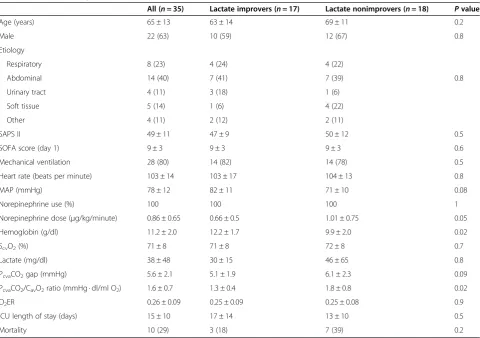
[image:3.595.58.539.370.708.2]Thirty-five septic shock patients were studied. Demo-graphic, hemodynamic, and metabolic characteristics are presented in Table 1. At inclusion, patients had values of MAP 78 ± 12 mmHg, ScvO271 ± 8%, and venous lactate 39 ± 49 mg/dl. The calculated PcvaCO2 gap was 5.6 ± 2.1 mmHg, and the PcvaCO2/CavO2 ratio was 1.6 ± 0.7 mmHg · dl/ml O2. No correlation between simultaneous ScvO2and lactate was observed. The PcvaCO2gap at inclu-sion was inversely correlated to ScvO2(r=–0.7,P<0.001), whereas the PcvaCO2/CavO2 ratio directly correlated to lactate values (r= 0.73, P <0.001). The first consecutive paired blood samples were obtained after 3 ± 2 hours, none of them following additional resuscitation interven-tions. When compared with patients whose lactate values decreased, those patients whose lactate values did not de-crease showed similar baseline PcvaCO2gap values at in-clusion (6.1 ± 2.3 vs. 5.1 ± 1.9 mmHg, P= 0.09), whereas significantly higher PcvaCO2/CavO2 ratio values at inclu-sion were observed (1.8 ± 0.8 vs. 1.3 ± 0.4 mmHg · dl/ml O2, P= 0.02). No differences in initial ScvO2 or lactate
Table 1 Patient demographic, hemodynamic, and metabolic characteristics at inclusion
All (n= 35) Lactate improvers (n= 17) Lactate nonimprovers (n= 18) Pvalue
Age (years) 65 ± 13 63 ± 14 69 ± 11 0.2
Male 22 (63) 10 (59) 12 (67) 0.8
Etiology
Respiratory 8 (23) 4 (24) 4 (22)
Abdominal 14 (40) 7 (41) 7 (39) 0.8
Urinary tract 4 (11) 3 (18) 1 (6)
Soft tissue 5 (14) 1 (6) 4 (22)
Other 4 (11) 2 (12) 2 (11)
SAPS II 49 ± 11 47 ± 9 50 ± 12 0.5
SOFA score (day 1) 9 ± 3 9 ± 3 9 ± 3 0.6
Mechanical ventilation 28 (80) 14 (82) 14 (78) 0.5
Heart rate (beats per minute) 103 ± 14 103 ± 17 104 ± 13 0.8
MAP (mmHg) 78 ± 12 82 ± 11 71 ± 10 0.08
Norepinephrine use (%) 100 100 100 1
Norepinephrine dose (μg/kg/minute) 0.86 ± 0.65 0.66 ± 0.5 1.01 ± 0.75 0.05
Hemoglobin (g/dl) 11.2 ± 2.0 12.2 ± 1.7 9.9 ± 2.0 0.02
ScvO2(%) 71 ± 8 71 ± 8 72 ± 8 0.7
Lactate (mg/dl) 38 ± 48 30 ± 15 46 ± 65 0.8
PcvaCO2gap (mmHg) 5.6 ± 2.1 5.1 ± 1.9 6.1 ± 2.3 0.09
PcvaCO2/CavO2ratio (mmHg · dl/ml O2) 1.6 ± 0.7 1.3 ± 0.4 1.8 ± 0.8 0.02
O2ER 0.26 ± 0.09 0.25 ± 0.09 0.25 ± 0.08 0.9
ICU length of stay (days) 15 ± 10 17 ± 14 13 ± 10 0.5
Mortality 10 (29) 3 (18) 7 (39) 0.2
were observed according to lactate clearance (Table 1). The PcvaCO2/CavO2 ratio ROC analysis showed an area under the curve of 0.75 (95% confidence interval = 0.6 to 0.92, P= 0.01) for adequate initial lactate clearance prediction.
Twenty-four-hour follow-up
During the follow-up period, 97 paired blood samples were obtained. The number of paired samples for each studied patient is shown in Figure 1. The elapsed time between consecutive measurements was 3 ± 2 hours. No improvement in lactate values was associated with higher PcvaCO2/CavO2 ratio values in the previous measurement (1.9 ± 0.9 vs. 1.2 ± 0.4 mmHg · dl/ml O2,
P <0.001), while PcvaCO2 gap values did not statisti-cally differ (6.0 ± 2.3 vs. 5.0 ± 2.1 mmHg, P= 0.08). Higher ScvO2values were also observed in those patients whose lactate did not decrease within the following hours (73 ± 8% vs. 68 ± 9%, P= 0.01). When exploring the ability of these parameters in predicting adequate lac-tate clearance, for the whole 97 paired samples the PcvaCO2/CavO2 ratio ROC analysis showed an area under the curve of 0.82 (95% confidence interval = 0.73 to 0.92,P<0.001), and a cutoff value of 1.4 had the best relationship between sensitivity (0.8) and specificity (0.75). The PcvaCO2 gap ROC analysis showed an area under the curve of 0.62 (P= 0.07) for lactate improve-ment prediction. The odds ratio of an adequate lactate clearance was 0.10 (95% confidence interval = 0.03 to 0.3, P <0.001) in those patients with an elevated PcvaCO2/CavO2ratio (≥1.4), whereas it did not reach statistical significance (P= 0.1) for those patients with a PcvaCO2gap≥6 mmHg.
Outcome
The mortality in the studied population was 29% (10 pa-tients). Patients who died had similar lactate, ScvO2, and PcvaCO2gap values at inclusion, but showed significantly increased PcvaCO2/CavO2 ratio values (1.9 ± 0.9 in non-survivors vs. 1.4 ± 0.45 in non-survivors,P= 0.03) (Table 2).
Discussion
The main result of our study is that, in a population of septic shock patients, once MAP and ScvO2values were normalized, high PcvaCO2/CavO2ratio values were asso-ciated with the lack of lactate clearance within the fol-lowing hours, and this condition was associated with patient mortality. In our population, the ability of the PcvaCO2/CavO2 ratio to predict lactate evolution was stronger than that of the PcvaCO2 gap. To our know-ledge this is the first study exploring this issue, and our data validate that integration of the PcvaCO2/CavO2ratio within the resuscitation process of septic shock might have relevant clinical utility.
[image:4.595.59.540.510.704.2]The present study aimed to add some information for a daily clinical question, such as whether to stop or continue resuscitating those patients suffering from sep-tic shock once MAP and ScvO2 endpoints have been reached but lactate values are still elevated. According to current international guidelines [1], normalization of ScvO2 as a global marker for the adequacy of tissue oxygenation would be sufficient. On the other hand, using lactate clearance as guidance for the resuscitation process has been demonstrated to be as effective as ScvO2 guid-ance [3]. However, the real-time nature of ScvO2 monitor-ing has been decisive for its widespread use above lactate monitoring. In clinical practice, an adequate knowledge of
the value and limitations of both variables would be desir-able in order to understand each scenario, and take deci-sions accordingly. In recent years, some studies have corroborated the prognostic value of the PcvaCO2gap in several clinical conditions [11-14], and this parameter has been proposed as an additional marker of tissue perfusion adequacy [10]. Importantly, its value seems to persist even when ScvO2has been normalized [11,13,14]. According to these observations, it has been suggested that adding the PcvaCO2gap as a supplementary endpoint in the resuscita-tion process of septic shock might prove beneficial [10], but to date prospective interventional studies exploring this issue are still lacking. Moreover, some authors have suggested that correcting the PcvaCO2 gap by the CavO2 (PcvaCO2/CavO2ratio) might enhance its value as a marker of anaerobic metabolism [15,18]. The PcvaCO2/CavO2ratio has been proposed as an approximation of the respiratory quotient, the relationship between global carbon dioxide production and global oxygen consumption (VO2). Ac-cording to Fick’s equation, VO2is equal to the product of cardiac output and the CavO2. Similarly, global carbon di-oxide production is equal to the product of cardiac output and the central venous-to-arterial carbon dioxide content difference. The respiratory quotient is therefore equal to the central venous-to-arterial carbon dioxide content dif-ference/CavO2ratio. Increased carbon dioxide production, relative to oxygen consumption, occurs under conditions of tissue hypoxia, and the presence of anaerobic metabol-ism may be inferred when the respiratory quotient rises above 1. Since over the physiological range of carbon di-oxide contents the partial pressure of carbon didi-oxide is linearly related to carbon dioxide content, using the PcvaCO2as a surrogate for the carbon dioxide content dif-ference has been previously accepted [15,18]. In the
present study, we aimed at exploring whether an increased PcvaCO2 gap and its combination with the CavO2at the end of early goal-directed therapy would be predictive of an inadequate lactate clearance, and thus a ready-to-use tool for the decision-making process.
The PcvaCO2/CavO2ratio as a marker of anaerobic
metabolism
[image:5.595.57.544.100.282.2]Mekontso-Dessap and coworkers suggested that the PcvaCO2/CavO2 ratio might be a reflection of anaerobic metabolism, demonstrating a positive correlation be-tween this parameter and lactate [15]. Indeed, in their study the PcvaCO2/CavO2 ratio was superior to ScvO2 and the PcvaCO2 gap for predicting elevated lactate values. Our study was designed to go one step further, and we explored the ability of the PcvaCO2/CavO2ratio to predict the adequacy of lactate clearance. Again, our results support the hypothesis that the PcvaCO2/CavO2 ratio is a better predictor of anaerobic metabolism than the PcvaCO2 gap. Of note, lactate values at inclusion were not associated with lactate evolution, strengthening the concept that an elevated lactate value at a given time point does not infer the presence of anaerobic metabol-ism. In a recent study, Monnet and coworkers nicely showed that, after performing a volume expansion, among those patients who were considered to be re-sponders (increase in cardiac output) only patients with an elevated PcvaCO2/CavO2 ratio at baseline increased their VO2 [18]. In other words, the ability to increase the metabolic rate, after increasing oxygen availability, was only observed in those patients with an altered PcvaCO2/CavO2ratio. According to their results, the au-thors introduced the idea that VO2might only increase in response to an increase in global oxygen delivery Table 2 Patients’main characteristics according to ICU survival
Survivors (n= 25) Nonsurvivors (n= 10) Pvalue
Age (years) 65 ± 13 67 ± 13 0.6
SAPS II 47 ± 10 53 ± 12 0.5
SOFA (day 1) 9 ± 3 9 ± 3 0.7
Heart rate (beats per minute) 103 ± 15 103 ± 12 0.9
MAP (mmHg) 81 ± 11 69 ± 12 0.07
Norepinephrine dose (mcg/kg/min) 0.85 ± 0.65 0.93 ± 0.73 0.7
Hemoglobin (g/dl) 11.7 ± 1.8 9.6 ± 2.1 0.1
ScvO2(%) 71 ± 9 71 ± 6 0.9
Lactate (mg/dl) 25 ± 10 69 ± 83 0.8
PcvaCO2gap (mmHg) 5.4 ± 2.3 6.0 ± 1.5 0.3
PcvaCO2/CavO2ratio (mmHg · dl/ml O2) 1.4 ± 0.5 1.9 ± 0.9 0.03
ΔSOFA (day 4) –3 ± 3 1 ± 4 0.02
when VO2is limited (global oxygen delivery dependency), as suggested by an elevated PcvaCO2/CavO2ratio. Regret-tably, we did not calculate VO2or global oxygen delivery in our patients. However, on the whole our data are in accordance with these previous observations, and we might hypothesize that those patients whose PcvaCO2/ CavO2ratio was high might have a limited VO2, causing anaerobic metabolism, and consequently were not able to decrease their lactate values within the following hours.
Outcome
Although the present study was not powered to explore the prognostic value of the PcvaCO2gap and the PcvaCO2/ CavO2ratio in terms of organ failure evolution or survival, our data suggest a significant association between mortal-ity and the presence of an elevated PcvaCO2/CavO2ratio at the end of early goal-directed therapy. The association between the PcvaCO2gap and outcome has been demon-strated consistently in several scenarios, even in the pres-ence of a normalized ScvO2 [11-14]. Although we were not able to reproduce the prognostic value of the PcvaCO2 gap, our data suggest that the prognostic significance is enhanced when correcting the PcvaCO2gap for the oxygen content difference. Independently of our results regarding mortality, the demonstration that the PcvaCO2/CavO2ratio can predict the evolution of lactate strengthens its value, and brings this parameter closer to clinical practice. Since lactate clearance adequacy has already, and repeatedly, been associated with outcome [4,17], the ability to predict lactate evolution might prove useful in order to perform further resuscitation maneuvers, or to avoid unnecessary interventions and in doing so elude their potential dele-terious effects.
Study limitations
Several limitations might be taken into account when considering our results. Firstly, this is a single-center study, so our results might have limitations when trying to generalize for other ICUs or other settings. On the other hand, the homogeneity of our resuscitation process would strengthen the value of the observed results. Secondly, we failed to demonstrate a relationship between the PcvaCO2 gap and lactate clearance, but the observed tendency to higher PcvaCO2gap values in those patients unable to de-crease their lactate might suggest that the limited number of patients studied would account for this lack of signifi-cance. An additional limitation would derive from the lack of standardization of the time points of lactate measure-ment. Since this is an observational study, paired blood gas analyses were performed according to the medical team, without intervention from the researchers. Although current practice in our ICU includes the verification of a persistent normalized ScvO2and confirming an ad-equate lactate clearance, the timing of this verification is
inconstant. Therefore, our second pair of measurements was associated with time variability. Nevertheless, the elapsed time between measurements was 3 ± 2 hours, which is in accordance with previous clinical works pro-spectively evaluating lactate clearance and outcome [3,4]. When exploring the prognostic value of the PcvaCO2/ CavO2 ratio, we might be cautious with the observed results. As discussed above, the present study was not designed for this purpose, and the reduced sample size might limit the significance of the association with mortal-ity, as suggested by the absence of prediction of mortality by the Simplified Acute Physiology Score II. Although the existing literature has proposed the PcvaCO2/CavO2 ratio as a surrogate of the respiratory quotient, several situa-tions might affect the relasitua-tionship between carbon dioxide content and partial pressure of carbon dioxide, such as the Haldane effect [19]. Oxygen saturations were calculated from partial pressure of oxygen values, not measured by co-oximetry, with a potential source of error in the dis-played ScvO2values. Finally, we analyzed the value of the PcvaCO2 gap and the PcvaCO2/CavO2ratio once the rec-ommended ScvO2 goal was reached. However, since the ScvO2value might be limited in septic conditions, when oxygen extraction deficit occurs, whether the PcvaCO2gap and the PcvaCO2/CavO2 ratio might be useful independ-ently of ScvO2deserves further study. Regrettably, this issue was not addressed in our study.
Conclusions
In a population of septic shock patients with normalized MAP and ScvO2, the presence of elevated PcvaCO2/CavO2 ratio values significantly reduced the odds of adequate lactate clearance during the following hours. Integrating this parameter in future resuscitation algorithms might prove useful in order to obtain real-time information on the adequacy of tissue perfusion, helping in the decision-making process, such as when to continue resuscitating the tissue and/or when to stop interventions, despite high lactate levels.
Key messages
In the presence of an elevated PcvaCO2/CavO2ratio, the odds of adequate lactate clearance are significantly reduced.
The PcvaCO2/CavO2ratio might be a useful parameter in the resuscitation process, complimentary to ScvO2 and lactate.
Abbreviations
CavO2:arterial-to-venous oxygen content difference; MAP: mean arterial
pressure; PcvaCO2gap: central venous-to-arterial carbon dioxide difference;
PcvaCO2/CavO2: central venous-to-arterial carbon dioxide
Competing interests
The authors declare that they have no competing interests.
Authors’contributions
All authors contributed to the elaboration of this manuscript. JM and PS conceived, designed, and coordinated the study. JM, PS, GG, CE and ET performed data extraction. JM, PS and GG analyzed the data, and drafted the manuscript. FB and AA participated in the design of the study, and in the manuscript review. All authors read and approved the final version of the manuscript.
Received: 24 November 2014 Accepted: 5 March 2015
References
1. Dellinger RP, Levy MM, Rhodes A, Annane D, Gerlach H, Opal SM, et al. The Surviving Sepsis Campaign Guidelines Committee including The Pediatric Subgroup. Surviving Sepsis Campaign: International Guidelines for Management of Severe Sepsis and Septic Shock, 2012. Intensive Care Med. 2013;39:165–228.
2. Mesquida J, Borrat X, Lorente JA, Masip J, Baigorri F. Objectives of hemodynamic resuscitation. Med Intensiva. 2011;35:499–508.
3. Jones AE, Shapiro NI, Trzeciak S, Trzeciak S, Arnold RC, Claremont HA, et al. Lactate clearance vs central venous oxygen saturation as goals of early sepsis therapy: a randomized clinical trial. JAMA. 2010;303:739–46. 4. Jansen TC, van Bommel J, Schoonderbeek FJ, SleeswijkVisser SJ, van der
Klooster JM, Lima AP, et al. Early lactate-guided therapy in intensive care unit patients: a multicenter, open-label, randomized controlled trial. Am J Respir Crit Care Med. 2010;182:752–61.
5. Pope JV, Jones AE, Gaieski DF, Arnold RC, Trzeciak S, Shapiro NI. Multi-center study of central venous oxygen saturation (ScvO2) as a predictor of mortality in patients with sepsis. Ann Emerg Med. 2010;55:40–6. 6. Textoris J, Fouché L, Wiramus S, Antonini F, Tho S, Martin C, et al. High
central venous oxygen saturation in the latter stages of septic shock is associated with increased mortality. Crit Care. 2011;15:R176.
7. van Beest P, Wietasch G, Scheeren T, Spronk P, Kuiper M. Clinical review: use of venous oxygen saturations as a goal–a yet unfinished puzzle. Crit Care. 2011;15:R232.
8. Andersen LW, Mackenhauer J, Roberts JC, Berg KM, Cocchi MN, Donnino MW. Etiology and therapeutic approach to elevated lactate. Mayo Clin Proc. 2013;88:1127–40.
9. Boyd JH, Forbes J, Nakada TA, Walley KR, Russell JA. Fluid resuscitation in septic shock: a positive fluid balance and elevated central venous pressure are associated with increased mortality. Crit Care Med. 2011;39:259–65. 10. Vallet B, Pinsky MR, Cecconi M. Resuscitation of patients with septic shock:
please‘mind the gap’! Intensive Care Med. 2013;39:1653–5. 11. Vallée F, Vallet B, Mathe O, Parraguette J, Mari A, Silva S, et al. Central
venous-to-arterial carbon dioxide difference: an additional target for goal-directed therapy in septic shock? Intensive Care Med. 2008;34:2218–25. 12. Futier E, Robin E, Jabaudon M, Guerin R, Petit A, Bazin JE, et al. Central
venous O2 saturation and venous-to-arterial CO2 difference as complementary tools for goal-directed therapy during high-risk surgery. Crit Care. 2010;14:R193.
13. van Beest PA, Lont MC, Holman ND, Loef B, Kuiper MA, Boerma EC. Central venous-arterial pCO2 difference as a tool in resuscitation of septic patients. Intensive Care Med. 2013;39:1034–9.
14. Ospina-Tascon GA, Bautista-Rincon DF, Umaña M, Tafur JD, Gutierrez A, Garcia AF, et al. Persistently high venous-to-arterial carbon dioxide differences during early resuscitation are associated with poor outcomes in septic shock. Crit Care. 2013;17:R294.
15. Mekontso-Dessap A, Castelain V, Anguel N, Bahloul M, Schauvliege F, Richard C, et al. Combination of venoarterial PCO2 difference with arteriovenous O2 content difference to detect anaerobic metabolism in patients. Intensive Care Med. 2002;28:272–7.
16. Levy MM, Fink MP, Marshall JC, Abraham E, Angus D, Cook D, et al. 2001 SCCM/ESICM/ACCP/ATS/SIS International Sepsis Definitions Conference. Crit Care Med. 2003;31:1250–6.
17. Nguyen HB, Rivers EP, Knoblich BP, Jacobsen G, Muzzin A, Ressler JA, et al. Early lactate clearance is associated with improved outcome in severe sepsis and septic shock. Crit Care Med. 2004;32:1637–42.
18. Monnet X, Julien F, Ait-Hamou N, Lequoy M, Gosset C, Jozwiak M, et al. Lactate and venoarterial carbon dioxide difference/arterial-venous oxygen difference ratio, but not central venous oxygen saturation, predict increase in oxygen consumption in fluid responders. Crit Care Med. 2013;41:1412–20. 19. Jakob SM, Kosonen P, Ruokonen E, Parviainen I, Takala J. The Haldane
effect–an alternative explanation for increasing gastric mucosal PCO2 gradients? Br J Anaesth. 1999;83:740–6.
Submit your next manuscript to BioMed Central and take full advantage of:
• Convenient online submission
• Thorough peer review
• No space constraints or color figure charges
• Immediate publication on acceptance
• Inclusion in PubMed, CAS, Scopus and Google Scholar
• Research which is freely available for redistribution