Rochester Institute of Technology
RIT Scholar Works
Theses
Thesis/Dissertation Collections
2006
Interactive, tree-based graph visualization
Andrew Pavlo
Follow this and additional works at:
http://scholarworks.rit.edu/theses
This Thesis is brought to you for free and open access by the Thesis/Dissertation Collections at RIT Scholar Works. It has been accepted for inclusion in Theses by an authorized administrator of RIT Scholar Works. For more information, please [email protected].
Recommended Citation
Interactive, Tree-Based Graph Visualization
Andy Pavlo
March 17, 2006
Abstract
Contents
1 Introduction 3
2 Graph Theory 6
3 Graph Drawings 8
3.1 Graph Drawing Parameters . . . 9
3.1.1 Drawing Conventions . . . 9
3.1.2 Aesthetics . . . 10
3.1.3 Drawing Constraints . . . 13
3.2 Drawing Algorithms . . . 14
3.2.1 Force-Directed Layout . . . 15
3.2.2 Hyperbolic Layout . . . 15
3.2.3 Radial Layout . . . 16
4 Graph Animation 20 4.1 Viewer Mental Map . . . 21
4.2 Animation Algorithms . . . 21
4.2.1 Rigid-Body Animation . . . 22
4.2.2 Clustered Movement Animation . . . 23
4.2.3 Radial Graph Animation . . . 24
5 User Interaction 26 5.1 Zooming and Panning . . . 26
5.2 Focus+Context . . . 26
5.3 Incremental Exploration . . . 27
6 Interactive Spanning Tree Visualization 28 6.1 Context-Free Radial Layout . . . 29
6.1.1 Graph Drawing Parameters . . . 33
6.1.2 Layout Algorithm . . . 33
6.2 Animated Tree Transition . . . 38
6.2.1 Animation Goal . . . 41
6.2.2 Animation Algorithm . . . 42
6.2.3 Auxiliary Visual Enhancements . . . 44
7 Experimental Analysis 48 7.1 Measurements . . . 49
7.1.1 Edge Crossings . . . 49
7.1.2 Sibling Edge Lengths . . . 50
7.2 Experiments . . . 50
7.3 Methodology . . . 52
7.4 Testing Environment Constants . . . 53
7.5 Results . . . 54
7.5.1 Experiment 1 – Isomorphic Tree Transitions . . . 54
7.5.2 Experiment 2 – Spanning-Tree-to-Spanning-Tree Transitions 56 7.5.3 Experiment 3 – Full-Graph-to-Spanning-Tree Transitions . . 58
7.5.4 Experiment 4 – Spanning Tree Sibling Edge Lengths . . . 58
8 Discussion & Future Work 60
1
Introduction
Many real world problems can be modeled by graphs. By using graph
visual-ization [34, 39, 71] to represent entities and relationships in these problems,
one can see patterns that may be hard to detect nonvisually [45, 47, 67].
This is because humans are highly attuned to extracting information from
a visual representation of a graph [5]. Graph visualization is important
in many research areas of computer science, including software engineering
[13, 14, 60], database design [1, 12], and networking [2, 3, 9, 26].
A major concern in graph visualization is how to create meaningful and
useful representations of graphs automatically. Prior usability studies have
shown that minimizing the number edge crossings in a graph enhances its
readability [39, 58, 70]. However, it is usually impossible to draw complex
graphs without crossings.
Our research is thus concerned with how to address the problems of
edge crossings in graph drawings. We look to trees as an inspiration: (1)
tree structures occur in nature, (2) trees can always be drawn without edge
crossings, and (3) trees explicitly convey connectivity and distance
rela-tionships between elements of a graph. We developed a drawing algorithm
that creates radial vertex-centric drawings of graphs using spanning trees
extracted by breadth-first search. By reducing a graph to a spanning tree
view, users can perceive a coherent segment of the graph’s structure without
being overwhelmed. In each drawing, the root of the tree is placed at the
center of the viewing plane surrounded by its children vertices in a circle.
The subtree rooted at each child in the graph is drawn on a series of
overlap-ping circles. The graph’s layout in the drawing has a recursive, self-similar
structure found in natural trees.
to visualize a graph. First, the view of the tree is heavily dependent on the
root chosen; it is difficult to define the properties of a root vertex that will
result in an informative spanning tree drawing. Second, removing edges
from a graph to extract a spanning tree removes information.
To rectify these problems, we created an interactive visualization system
on top of our drawing algorithm that allows users to explore a graph by
viewing a sequential number of spanning tree drawings of the graph rooted
at different vertices. An interactive environment helps mitigate the loss of
information by reintroducing it over time via user interaction, graph
anima-tion, and multiple graph drawings. Users can select any vertex to become
the root of a breadth-first spanning tree used in a vertex-centric drawing.
We also developed an animation algorithm to generate smooth transitions
as users select new drawings for viewing. Allowing users to view a graph
in many different spanning tree layouts can facilitate the discovery of what
makes one tree layout better than another.
A large collection of work exists on how to create drawings for graphs [8,
7, 27, 46, 52], including using three-dimensional images [40, 43, 44, 71]. Our
system only creates two-dimensional drawings; creating a three-dimensional
image does not alleviate the problems of edge crossings since the drawings
are always projected down into two-dimensions. Previous research also uses
graph drawings in an interactive environment to enhance users’
understand-ing of a graph [33, 35, 41, 50, 54, 72, 73]. Interactive systems often use
graph animation to transition the visualization display to a new view that
reflects changes made to the graph [10, 17, 21, 25, 29, 30, 37, 38, 53, 73].
Usability studies have also been conducted to help understand how humans
perceive graphs [39, 49, 51, 58, 70].
method for visualizing rooted trees [20, 41, 48, 66, 72, 73]. These approaches
often construct drawings using concentric circles emanating from a focal
point in the graph [20, 73]. Our drawing algorithm also uses circles to
organize vertices but each circle is centered at the root of different subtrees
in the graph and not the root of the entire tree. Other radial layout drawing
algorithms use a similar approach to ours but instead position vertices on the
entire length of circles and place subtree circles within one another [48, 72].
In our drawings, only the root’s circle is used entirely for the placement of
its children and no circle is completely contained inside another.
Previous research on interactive systems visualize graphs in
spanning-tree-based layouts, but many of these systems require users to explicitly
provide a single tree decomposition of a graph as its input and do not let
users return to a view of the original graph [40, 46, 50]. In contrast, our
system does not limit users to a single spanning tree drawing, and lets users
switch back to view the full graph drawing at anytime.
To validate our drawing and animation algorithms, we conduct four
ex-periments on random graphs that measure two aspects of graph
visualiza-tions. We measure the number of edge crossings that occur during three
transition scenarios and the edge lengths of sets of sibling vertices in static
drawings. For comparison, we implement the radial graph drawing and
an-imation algorithms from Yee, Fisher, Dhamija, and Hearst’s Gnutellavision
graph visualization system and run the experiments under the same
condi-tions [73]. One nice property of our graph drawings is that sibling vertices
are always equidistant to their parent. In our experimental analysis, we
eval-uate the degree to which Yee et al.’s algorithms fail to create drawings with
this property. Our data shows that our algorithms are able to transition
Our system can also transition between multiple drawings of the same tree
with no crossings but Yee et al.’s system cannot.
This thesis is organized in the following manner. In Section 2 we provide
an overview of the key graph theory concepts used in our work. In Section
3 we discuss graph drawings and graph drawing algorithms. In Section
4 we discuss graph animation and graph animation algorithms. Section 5
contains a brief overview of user interaction facilitates in graph visualization
systems. In Section 6 we discuss the specifics of our graph visualization
system including our context-free radial graph drawing and graph animation
algorithms. Lastly, in Section 7 we present our results from the experimental
analysis of our work.
2
Graph Theory
The definitions that follow are adopted from Diestel [18].
A graph Gis a pair (V, E) whereV is a set called the vertices ofGand
E is a set of two-element subsets ofV called theedges ofG. For a graphG,
the vertex set ofGis sometimes denoted asV(G) and its edge set as E(G).
For an edge {u, v} ∈E, the two vertices u and v are the endpoints of
{u, v},uandvare said to beadjacent to each other, andu(orv) and{u, v}
are said to beincident to each other. Thedegreeof a vertexuis the number
of edges incident tou. The order of a graph is the total number of vertices
within the graph.
For a graph G, a graph G0
is a subgraph of G if V(G0
) ⊆ V(G) and
E(G0) ⊆ E(G). A graph G is complete if an edge exists in G for every
unique pair of vertices of G.
A path is a non-empty graph P = (V, E) where V ={v0, v1, v2, . . . , vk}
r
v
(a)
r
v
(b)
r
v
[image:8.612.136.466.121.259.2](c)
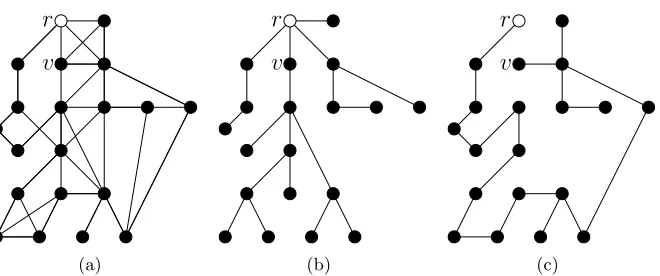
Figure 1: For a given graphGin Figure 1(a), Figure 1(b) contains a breadth-first spanning tree rooted atr extracted fromG, and Figure 1(c) contains a depth-first spanning tree rooted at r extracted from G.
is a cycle if the edge {vk, v0} is added to V(P). A graph that contains no
cycles as subgraphs isacyclic. A graph that has every unique pair of vertices
in some path in the graph is connected.
A tree is an acyclic, connected graph. Every tree with n vertices has
exactly n−1 edges. The vertices of a tree with a degree 1 are called its
leaves. Arooted tree is a tree where one vertex is designated as the root of
the graph. The depth of a vertex v in a tree rooted at r is the number of
edges in the path fromr tov. Theheight of a rooted tree is the number of
edges in the longest path from the root to some leaf vertex in the tree. A
vertexuin a rooted tree is theparent of vertexv if and only ifuis adjacent
to v and the depth of u in the tree is exactly one less than the depth of v.
If u is the parent of v, then v is a child of u and its siblings are the set of
all other children vertices of u. This relationship between a parent vertex
and its children is one-to-many: a vertex can only have one parent but it
can have many children.
Aspanning treeof a graphGis a tree where its vertices are exactly all the
vertices of Gand its edges are a subset of the edges ofG. Every connected
using traversal algorithms, such as depth-first or breadth-first search. The
breadth-first spanning tree in Figure 1(b) and the depth-first spanning tree
in Figure 1(c) illustrate how different traversal algorithms extract different
trees for the same graph shown in Figure 1(a). Breadth-first spanning trees
are particularly useful in graph theory and computer science because they
preserve the distance from the root vertex to any other vertex: the shortest
path distance from vertex v to the root r in Figure 1(b) is the same as it
is in the original graph in Figure 1(a), however, v’s shortest path distance
from v to r is much greater in Figure 1(c) than in Figure 1(a) and Figure
1(b).
A graph drawing represents pictorially the structure of a graph by placing
vertices at points on a plane and representing edges with curves between
these points [18]. More formally, a drawing Γ :V(G)∪E(G) → R2 ∪2R2
for a graphGis a function that maps each vertexv∈V(G) to a point Γ(v)
and each edge {u, v} ∈E(G), where u, v ∈ V (G), to a open Jordan curve
Γ({u, v}) with endpoints Γ(u) and Γ(v) [8].
Two graphs G = (V, E) and G0
= (V0, E0
) are said to be isomorphic if
there exists a bijectionϕ:V →V0 such that for all u, v ∈V, {u, v} ∈E ⇔
{ϕ(u), ϕ(v)} ∈ E0. That is, G and G0 are isomorphic if they contain the
same number of vertices connected by edges in the same way.
3
Graph Drawings
The art and science of graph drawing is matching problem domains with
algorithms and heuristics for producing visual representations of graphs.
In Section 3.1, we discuss three types of graph drawing parameters that
describe how a graph is drawn. In Section 3.2, we examine three examples of
and edges in a graph drawing.
3.1 Graph Drawing Parameters
Graph drawing parameters describe the visual characteristics of a graph
drawing. A graph drawing algorithm can use these parameters to produce
drawings that help users identify relevant attributes of a graph and facilitate
quick recognition of its important properties [8]. Graph drawing parameters
can accommodate the differences in spatial memory, reasoning abilities, and
visual predilections that users may have [63]. This may limit the scope of
a graph drawing system, and as such, many graph drawing parameters can
only be used for specific kinds of graphs or produce better results for graphs
of a certain type [8].
We now consider Battista, Eades, Tamassia, and Tollis’s division of graph
drawing parameters into three categories [8]: (1) general conventions for the
geometric representation of a graph (Section 3.1.1), (2) layout aesthetics
for producing a readable drawing (Section 3.1.2), and (3) constraints that
subgraphs in drawing may be required to satisfy (Section 3.1.3).
3.1.1 Drawing Conventions
Drawing conventions are application-dependant criteria that a graph
draw-ing must satisfy. When defined, conventions specify how vertices and edges
are represented in a graph drawing. Below we include a list of drawing
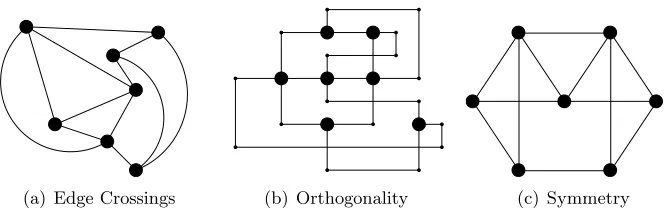
con-ventions from Battista et al. [8]. Figure 2 illustrates the differences of three
drawings of the same graph using different drawing conventions.
Straight Line: Edges must be drawn as a single line segment without any bends.
(a) Straight Line (b) Polyline (c) Grid Drawing
Figure 2: Three drawings of the same graph using different drawing conven-tions. The small circles at edge bends in Figure 2(b) and Figure 2(c) are added for emphasis.
Grid Drawing: Vertices must be positioned only at integer Cartesian co-ordinates on the drawing plane.
Planar Drawing: No two edges are allowed to intersect or overlap in the drawing.
Orthogonal Drawing: The graph must be drawn as a polyline grid draw-ing where the edges are only allowed to bend at right angles and are
comprised of alternating horizontal and vertical segments.
3.1.2 Aesthetics
Aesthetics are measurable properties used to evaluate the quality of a graph
drawing [6, 64]. Research suggests that if a drawing algorithm strongly
adheres to one or more carefully chosen aesthetic goals, it can create more
meaningful drawings [39, 58, 70]. Included below is Battista et al.’s list of
common graph drawing aesthetics [8]. When developing a graph drawing
algorithm, one seeks to optimize the presence of a particular aesthetic by
either minimizing or maximizing the measurable quality of the aesthetic.
Figure 3 shows three drawings of the same graph that emphasize different
(a) Edge Crossings (b) Orthogonality (c) Symmetry
Figure 3: Three drawings of the same graph that adhere to different aes-thetic goals. The drawing in Figure 3(a) is constructed to minimize the number of edge crossings. The drawing in Figure 3(b) is constructed to maximize the orthogonal properties of the graph. The drawing in Figure 3(c) is constructed to maximize the symmetrical nature of the graph.
Planarity / Edge Crossings: The number of edge crossings in the draw-ing.
Area: The total area of a drawing.
Edge Length: Measuring the variance, the maximum length, or the sum total of edge lengths for all vertices or sets of vertices in a drawing.
Edge Bends: The number of separate line segments in a polyline edge.
Angular Resolution: Measuring the size of the angle between edges inci-dent to the same vertex.
Symmetry: Measuring the symmetrical properties of a graph drawing.
Orthogonality: Measuring the orthogonal nature of the graph drawing.
It is not always possible to optimize certain aesthetics within a graph
drawing. For instance, not every graph admits a planar drawing and when
no planar drawings exist it can be difficult to even find layouts that minimize
edge crossings. One might attempt to turn a graph into a planar graph by
a graph in order to make it planar. However, the problem of determining
for a given numberkand a graphGwhether it is possible to makeGplanar
by removing fewer thank of its edges is NP-hard [31].
Furthermore, as hard as it can be to optimize one aesthetic in a graph
drawing, it is often more difficult or impossible to simultaneously optimize
two or more [8]. A graph drawing algorithm must establish priorities for
the aesthetics that it uses because aesthetics may conflict. For instance,
although the drawings in Figure 3 depict the same graph, the drawing in
Figure 3(b) contains edge crossings but the drawing in Figure 3(a) does not.
It is a NP-hard problem in a straight-line graph drawing on an orthogonal
grid to minimize crossings while trying to minimize the total number of
edge bends [32]. An algorithm’s preference of one aesthetic over others will
influence the visual properties of the drawings it generates.
Purchase conducted studies on the effectiveness of various graph drawing
aesthetics [58]. Her experiments test which aesthetics best predicts a user’s
ability to answer questions about a graph. For each aesthetic, two graph
drawings were created; one having a strong presence of the aesthetic, and
the other a weak presence. Users were asked simple questions about each
drawing, such as what is the shortest path between two vertices. The
reac-tion times and error rates for the quesreac-tions determine how well a drawing
aesthetic improves a user’s ability to discern information from a graph.
Purchase concluded that the most significant factor for improving both
reaction times and error rates for graph drawings is minimizing the number
of edge crossings [58]. Additionally, minimizing the number of edge bends
substantially improved error rates and maximizing perceptual symmetry
slightly improved reaction times. Maximizing the orthogonal structure of
did not appear to have a significant effect on a user’s performance.
Ware, Purchase, Colpoys, and McGill extended Purchase’s work and
studied the impact of multiple aesthetics within a single graph drawing
instead of testing drawings representing the extremes of an aesthetics as
Purchase did [70]. Ware et al.’s also found that minimizing the number of
edge crossings in a graph drawing has the greatest positive impact on users.
A study by Huang and Eades used an eye tracking system to observe users’
eye movement patterns when viewing a graph drawing [39]. Like Ware et al.,
their results show that minimizing the number of crossings improves a user’s
ability to make judgments about a graph.
3.1.3 Drawing Constraints
Unlike drawing conventions and aesthetics, which are rules and criteria
ap-plied to the entire graph drawing, graphical drawing constraints are rules
that refer to specific subgraphs and subdrawings [8]. Constraints often
spec-ify the position of elements based on semantic information about the graph.
For instance, a constraint might specify that the most important vertex of
a graph is positioned at a particular location in the drawing. The list below
from Battista et al. contains commonly used constraints for drawing
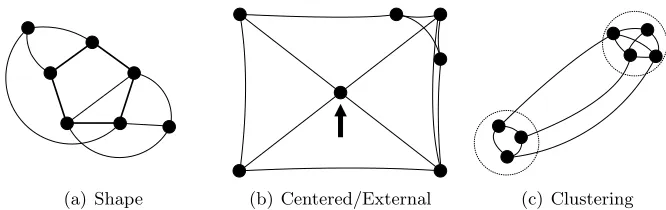
algo-rithms [8]. Figure 4 shows three drawings of the same graph conforming to
different drawing constraints.
Centered Placement: Place a specific vertex at the center of the drawing.
External Placement: Place specific vertices at the outer areas of the drawing.
Clustered: Position vertex subsets close together.
(a) Shape (b) Centered/External (c) Clustering
Figure 4: Three drawings of the same graph using different graph drawing constraints. In the drawing in Figure 4(a), a subgraph forms the shape of a pentagon. In the drawing in Figure 4(b), a single vertex is placed at the center of the drawing (indicated by the arrow), while all other vertices are placed on the external edges of the drawing plane. The drawing in Figure 4(c) contains two subgraph clusters of vertices positioned together (indicated by the circle outlines).
Shape: Draw a subgraph in a pre-defined shape. Vertices can be positioned on the outline of the shape or edges can be drawn to conform to the
shape.
3.2 Drawing Algorithms
A drawing algorithm reads the description of a graph as its input, calculates
the positions of the graph’s elements on a viewing plane using graph drawing
parameters as guidelines, and outputs a drawing [8]. There are many
differ-ent classes of drawing algorithms [7]. We now examine a force-directed
lay-out algorithm that creates drawings using a physical system model (Section
3.2.1), a hyperbolic layout algorithm that creates fisheye-distorted drawings
(Section 3.2.2), and a radial layout algorithm that creates
3.2.1 Force-Directed Layout
A force-directed drawing algorithm creates graph drawings by simulating
repulsive and attractive forces [19]. Each vertex is assigned a repulsive force
and an initial position, and each edge is given an attractive force between
its endpoints. The resulting drawing represents a layout of the vertices and
edges in a locally minimal energy state. Eades’ original implementation of
the force-directed algorithm models vertices as electrically charged particles
that repel other vertices and edges as metal springs that pull adjacent
ver-tices toward one another [19]. Each spring’s pulling force becomes greater
as adjacent vertices repel each other, causing the spring to stretch. These
opposing forces cause non-adjacent vertices to move away from each other
while adjacent vertices are held close together. The simulation eventually
converges to an equilibrium state, where the pull at each vertex from the
springs is equivalent to the repulsion of the vertices. Other, more complex
force-directed models have been developed to use a more accurate
represen-tation of Hooke’s law for the behavior of springs [42], and reduce energy
factors through simulated annealing [16].
3.2.2 Hyperbolic Layout
Hyperbolic layout algorithms embed a graph’s elements in hyperbolic space
to produce drawings that have a distinct “fisheye” appearance. Like
Eu-clidean space, hyperbolic space consists of points, lines, planes and surfaces.
In hyperbolic space, however, there are many lines through a given point
which do not intersect a given line [15, 56]. A hyperbolic graph layout
algo-rithm creates a new drawing by first constructing a layout of the graph in
hyperbolic space, and then projecting this layout on to the Euclidean plane
r
Figure 5: A hyperbolic layout graph drawing for a tree rooted atr(adapted from [46]). In hyperbolic drawings, a graph’s elements are represented in space proportional to their distance to the root vertex; as vertices are posi-tioned further away from the root they become vanishingly small.
in space proportional to their distance from origin of the drawing; as an
ele-ment gets farther away from the origin, it is represented by smaller amounts
of space. An example of a hyperbolic layout graph drawing is shown in
Figure 5.
This distorted view of the graph is useful for viewing large hierarchies and
data sets [34]. Lamping, Rao, and Pirolli’s hyperbolic graph visualization
system generates two-dimensional drawings for subsections of the World
Wide Web [46]. Munzner expanded on their approach to project the graph
onto a three-dimensional viewing plane [50]. More recently, the Walrus
visualization tool by Hyun produces stunning hyperbolic visualizations for
trees with over a million vertices [40].
3.2.3 Radial Layout
Radial layout graph drawing algorithms are a well known method for
v
r
[image:18.612.134.462.125.298.2](a) (b)
Figure 6: A radial layout graph drawing of a tree rooted atr (Figure 6(a)) and the division levels ofv’s annulus wedge (Figure 6(b)).
6(a), the root vertex of a tree is positioned at the center of the drawing
with descendant vertices situated on concentric circles emanating from it.
For a tree T with a height k, the layers of concentric circles are labeled as
C1, C2, . . . , Ck and each vertex is placed on circle Ci, where i is the depth
of the vertex in the rooted tree [20, 59]. Using a defined heuristic, a radial
layout drawing algorithm allocates each vertex space in the drawing, known
as itsannulus wedge. This wedge confines the layout of a vertex’s subtree to
particular area in the drawing. A vertex’s annulus wedge is divided among
its descendants at subsequent levels in the subtree (Figure 6(b)).
For a tree T rooted at a vertexr, the radial positionsalgorithm (page
18) outputs a new radial layout graph drawing Γ forT. The algorithm first
places the root vertex at the center of the viewing plane and allocates it an
annulus wedge of the entire drawing (360◦
). This space is divided among
the root’s descendants: the annulus wedge for a child vertexc ofv is based
on the number of leaf vertices in the subtree rooted atcproportional to the
number of leaf vertices in the subtree rooted at v. Each vertex is placed at
Algorithm 1radial positions(T, v, α, β,Γ)
if (v is the root of the treeT)then
Γ (v)⇐(0,0)
end if
D⇐the depth ofv in T
Θ⇐α
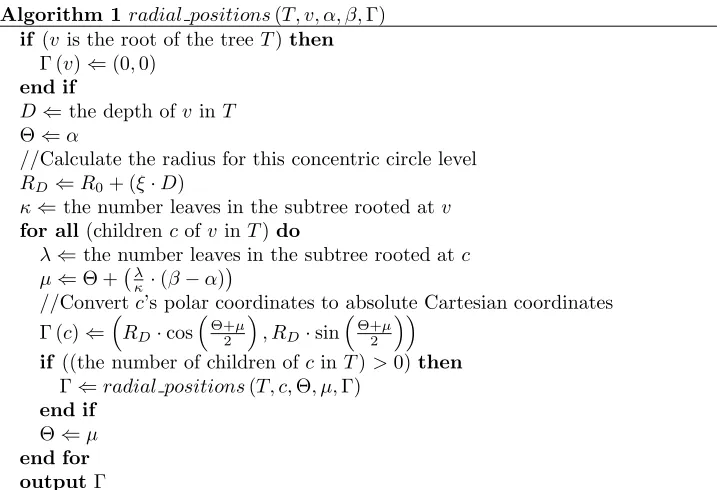
//Calculate the radius for this concentric circle level RD⇐R0+ (ξ·D)
κ⇐the number leaves in the subtree rooted atv
for all(childrencofv inT)do
λ⇐the number leaves in the subtree rooted atc
µ⇐Θ + λ
κ ·(β−α)
//Convertc’s polar coordinates to absolute Cartesian coordinates Γ (c)⇐RD·cos
Θ+µ
2
, RD·sin
Θ+µ
2
if ((the number of children ofcin T)>0)then
Γ⇐radial positions(T, c,Θ, µ,Γ)
end if
Θ⇐µ
[image:19.612.118.478.129.374.2]end for outputΓ
Figure 7: Given a rooted treeT, a vertexv∈V (T), and the anglesα andβ
that definev’s annulus wedge, the algorithm calculates the position of every child vertex c ofv in a new graph drawing Γ. R0 is the user-defined radius
of the innermost concentric circle. ξ is the user-defined delta angle constant for the drawing’s concentric circles. The initial values for α and β for the root’s annulus wedge are 0◦
and 360◦
, respectively.
depth in the tree. The algorithm continues down each subtree until positions
for all of the graph’s vertices in the new drawing Γ are calculated.
Yee et al.’s Gnutellavision graph visualization tool uses theradial positions
algorithm to provide an overview of a peer-to-peer network [73]. In their
system, users select a host from the network to be the root of a
spanning-tree-based drawing. The concentric circles in their drawings represent the
network distance from the root to all other hosts; Each vertex is placed on
a circle corresponding to its shortest network distance to the root. A new
view of the network is constructed every time the user selects a new focal
point vertex.
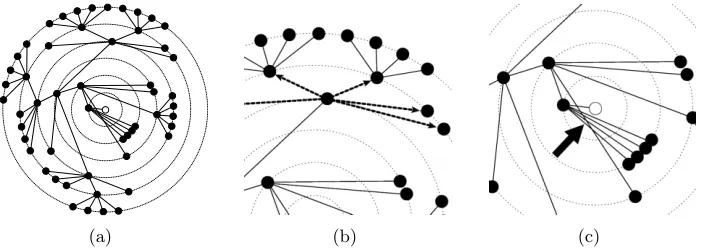
(a) (b) (c)
Figure 8: A radial layout graph drawing of the same tree from Figure 6, but with a different root vertex as the focal point. Figure 8(b) illustrates how sibling vertices have variable edge lengths to their parent, and Figure 8(c) highlights edge crossings in the drawing.
that help in creating sequences of drawings where a new drawing bears
some resemblance to the previous [73]. For example, their algorithm
man-dates that the direction of the edge between a newly selected root vertex
to its parent from the previous drawing is preserved. The new drawing also
preserves the rotational ordering of children vertices around their parent
from the previous drawing. Yee et al. believe that these features of their
system help users relate one drawing of a graph to the next.
However, like with any graph drawing algorithm, the drawings generated
by radial layout algorithms do have some drawbacks. Although the use of
concentric circles does make it easier for users to ascertain the depth of a
vertex in a tree, these circles confine vertices to positions that may not be
optimal and can make it difficult for users to visually distinguish siblings
from their parent. This is because sibling vertices may be spread out widely
on their corresponding circle, and thus the lengths of the edges to their
parent are dramatically different. For example, the drawings in Figure 8
depict the same tree from Figure 6 but based on a different root vertex. In
Figure 8(b), the edges marked by arrows illustrate edges for sibling vertices
can still allow edge crossings, even if the graph is planar (Figure 8(c)). As
the aesthetic usability studies have shown in Section 3.1.2, these flaws can
degrade the readability of a graph.
We now examine how graph animation aids in the visualization of graphs.
4
Graph Animation
In a graph animation, each frame in the animation sequence is a single graph
drawing that contains a subtle change from the previous drawing in the
sequence. When the frames are viewed in succession at an adequate speed,
the slight changes from one frame to the next is perceived as movement.
The entire animation sequence creates the illusion of the graph moving from
one layout to another.
Animation is an important feature in interactive graph visualization
sys-tems. Graph drawings in such system are susceptible to change by users and
outside stimuli, and users need to be informed of these changes in a way that
does not overwhelm them. Instead of instantaneously updating a drawing
for every change that occurs, a well-designed animated transition can
facili-tate visual continuity over multiple drawings of a graph [17, 29, 30]. Graph
animation should provide a smooth, continuous movement of a graph as a
means for revealing structural differences between two drawings while
pre-serving users’ mental maps [29]. A transition that is both visually appealing
and easy to follow helps users relate two separate graph drawings to one
an-other [21, 29].
Our discussion of graph animation used in visualization systems is as
follows. In Section 4.1, we discuss mental maps as they relate to graph
ani-mation. In Section 4.2, we discuss graph animation algorithms and present
4.1 Viewer Mental Map
Amental mapis a cognitive model of the spatial relationships between graph
elements that users form when viewing a graph [4, 22, 49, 65]. The concept
of a mental map is important to graph animation research because one seeks
to create a transition between multiple drawings of a graph that preserves
users’ mental maps. A good graph animation should not hinder users from
applying pre-existing knowledge about a graph to the new drawing. If it
is too difficult to relate a new drawing to the previous, users may have to
exert effort for each new drawing to regain familiarity with the graph [22].
Eades, Lai, Misue, and Sugiyama propose models for evaluating how well
two graph drawings resemble each other as an indicator for whether users
will be able to maintain mental map continuity when a visualization system
switches from one drawing to another [22]. For graph animation, Friedrich
and Eades propose models and metrics for how well an animation algorithm
transitions a graph, however, they do not conduct any experiments [29]. To
our knowledge, these metrics have not been used in human experiments.
4.2 Animation Algorithms
Given a graph and two drawings, which we call the initial and new layouts
of the graph, a graph animation algorithm generates a series of drawings,
called frames, of the graph that viewed sequentially, provides the illusion
of a smooth, continuous transition from the initial layout to the new
lay-out. As with graph drawing, animation algorithms are typically tailored to
emphasize the characteristics of the graph that are most important to the
intended audience [49].
One simple class of graph animation algorithms creates intermediate
ver-tices in the initial and new layouts [28, 38]. Although such algorithms may
work well on graphs with few elements, they are not practical for graphs
where hundreds of vertices may need to move great distances. This kind of
transition causes vertices to congregate together at particular locations in
the drawing, creating large swarms. These swarms reduce a user’s ability
to maintain his or her mental map of the graph; it is difficult to determine
which vertex came from which position when they are densely grouped
to-gether.
Alternative methods devised for generating animated graph transitions
seek to avoid the drawbacks found in the previous linear interpolation
exam-ple. We now describe three more sophisticated methods. First, in Section
4.2.1 we discuss an animation algorithm that creates rigid-body motion for
graphs. Next, we discuss a derivative work in Section 4.2.2 that generates
similar movements for individual subgraphs rather than a single movement
for the entire graph. Finally, in Section 4.2.3 we discuss an animation
algo-rithm for radial layout graph drawings.
4.2.1 Rigid-Body Animation
To alleviate vertex swarming problems that often occur in a transition
de-rived from a linear translation of Cartesian coordinates, Friedrich and Eades’
animation algorithm generates transition sequences that move a graph as a
solid object instead of as a collection of individual vertices moving
sepa-rately and erratically [29]. Such an approach is motivated by the belief that
the human brain is predisposed to follow uniform movements of objects [51].
The transition is divided into separate rigid motion and force-directed layout
stages. The graph first moves as a rigid object to position that is close to
algo-rithm then completes the transition using a force-directed simulation where
vertices are attracted to their destinations (instead of adjacent vertices).
Additionally, Friedrich and Eades use visual cues to help users anticipate
the animation better. When vertices or edges are to be removed from the
drawing during a transition, they gradually fade from view before the graph
begins to move. Likewise, when new vertices or edges are being added to the
drawing, they gradually fade into view only after the graph has reached its
final destination. Friedrich and Eades remark that the removal and addition
of graph elements before and after the transition reduces the amount of
visual distractions to users [29].
4.2.2 Clustered Movement Animation
Friedrich and Eades’ rigid-body animation is effective when a graph’s
ver-tices are uniformly distributed. The algorithm, however, performs poorly
for graphs that contain subgraphs whose optimal movement conflict with
the average optimal movement of the entire graph [30]. For example, even
if only a small part of a graph is altered, rigid-body animation algorithm
moves all vertices in the graph as a result. A derivative animation algorithm
by Friedrich and Houle adopts the same rigid-body-motion techniques from
Friedrich and Eades’ previous work, but apply it individually to subgraphs
[30]. Their algorithm uses clustering heuristics to identify subgraphs to share
uniform motion. The resulting animation sequences transition a graph as
separate components, each with its own unique movement. Users mentally
group subgraphs as separate objects and can follow the movements more
4.2.3 Radial Graph Animation
There are different animation methods for radial layout graph drawings
[41, 73]. Although many of the same animation criteria still apply, radial
layout transitions can have additional goals of maintaining vertex rotational
ordering and preserving the boundaries of subtrees.
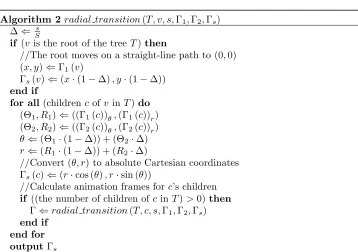
Given a rooted treeT, a vertexv∈V (T), a time stepsin the animation
sequence, an initial drawing Γ1 of T and a new drawing Γ2 of T generated
by the graph drawing algorithm in Section 3.2.3, theradial transition
al-gorithm (page 25) computes the positions of v’s children at time step s
and outputs an intermediate drawing frame Γs. The algorithm calculates
the graph’s movement by interpolating the polar coordinates of vertices’
positions from Γ1 to Γ2. To generate all the intermediate frames for an
ani-mation, one would invoke this algorithm from time steps 1 toS, whereS is
the last frame in the animation sequence.
This animation algorithm creates two distinct types of motion for the
vertices of T. The root of the tree moves in a straight-line path from its
original position in Γ1 to the center of the new drawing. All other
non-root vertices move along radial paths to their new positions in Γ2. The
algorithm’s interpolation of vertices’ polar coordinates creates smooth
tran-sitions for radial graph drawings while avoiding occlusion problems that
can occur using a linear translation of Cartesian coordinates [73]. This
movement prevents vertices from amassing at the center of the drawing and
occluding one another.
Yee et al.’s Gnutellavision application uses the radial transition
algo-rithm to generate animated transitions when users select a vertex to become
the focal point of a new vertex-centric perspective of the Gnutella network
Algorithm 2radial transition(T, v, s,Γ1,Γ2,Γs)
∆⇐ s
S
if (v is the root of the treeT)then
//The root moves on a straight-line path to (0,0) (x, y)⇐Γ1(v)
Γs(v)⇐(x·(1−∆), y·(1−∆))
end if
for all(childrencofv inT)do
(Θ1, R1)⇐((Γ1(c))θ,(Γ1(c))r)
(Θ2, R2)⇐((Γ2(c))θ,(Γ2(c))r)
θ⇐(Θ1·(1−∆)) + (Θ2·∆)
r⇐(R1·(1−∆)) + (R2·∆)
//Convert (θ, r) to absolute Cartesian coordinates Γs(c)⇐(r·cos (θ), r·sin (θ))
//Calculate animation frames forc’s children
if ((the number of children ofcin T)>0)then
Γ⇐radial transition(T, c, s,Γ1,Γ2,Γs)
[image:26.612.118.476.241.493.2]end if end for outputΓs
Figure 9: Given a rooted treeT, a vertexv ∈V (T), the initial drawing Γ1for T, a new drawing Γ2 ofT, and the current time stepsin the animation, the
algorithm calculates the positions ofv’s children at time stepsand outputs an intermediate frame Γs. For any pointp~in a Cartesian coordinate system,
let (~pθ, ~pr) denote the polar coordinates of ~p. Let ∆ be the interpolation
algorithm’s interpolation factor (Section 6.2.3). Although only informal
hu-man experiments were conducted to validate this variable speed approach
in radial graph animations, Yee et al. claim users’ prefer exploring graphs
with this feature.
We now discuss user interactivity as it applies to graph visualization
systems.
5
User Interaction
Interactive visualization systems can often help users explore a graph more
easily than a single, static drawing. Herman, Melan¸con, and Marshall’s
survey of graph visualization discusses some of the more prevalent user
in-teraction techniques and facilities in graph visualization systems [34]. We
would now like to highlight three important concepts from their work.
5.1 Zooming and Panning
Herman et al. first discuss two user interaction capabilities found in many
visualization systems: zooming and panning. Visualization zooming can be
either geometric or semantic. Geometric zooming scales a visualization
sys-tem’s viewing plane to create either coarse overviews or detailed perspectives
of graphs. Semantic zooming alters the information content of a graph’s
el-ements according to some heuristic. Panning is simply a translation of the
viewing plane for a graph drawing.
5.2 Focus+Context
The focus+context graph visualization scheme creates drawings where an
area of interest in a graph is enlarged while other portions are shown with
focal point in greater detail and/or representing it with more geometric
space in the drawing [41]. Users interact with the visualization system by
changing the parameters that govern the focus+context distortion.
Herman et al. splits focus+context graph visualization implementations
into two categories: (1) the distortion is applied to a graph drawing after
it is generated, and (2) the distortion is integrated into the graph drawing
algorithm [34]. An example of applying the distortion after the drawing is
generated is the popular fisheye distortion technique [61, 62]. This approach
imitates a wide-angle lens to enlarge the area surrounding the focal point
in a display and shows peripheral areas of the graph with decreasing detail.
The drawback to this implementation, according to Herman et al., is that
because the distortion is applied after the drawing is generated, aesthetic
adherence may be degraded. Other visualization paradigms implement the
focus+context distortion directly in the graph drawing algorithm, such as
the hyperbolic layout algorithm in Section 3.2.2. This type of approach
allows systems to better control the effects of a focus+context distortion on
the drawing and mitigate the loss of aesthetic fulfillment.
5.3 Incremental Exploration
Inincremental exploration visualization systems, large graphs are displayed
in small portions instead overwhelming users with a single view of the entire
graph [34, 36, 38, 73]. These system create a “visible” window for a drawing
that allows users to explore subsections of the graph by moving the focus of
this window. Since the entire graph no longer needs to be known or
consid-ered all at once, incremental exploration systems are often more responsive
and computationally efficient.
37, 38, 53]. Eklund, Sawers, and Zeiliger’s NESTOR application creates
subgraph views of the World Wide Web; users are shown subsections of
the graph based on their web browsing histories [23]. Huang, Eades, and
Wang’s visualization system creates similar drawings but extend the visible
subgraph to include neighboring web pages that the user might visit [38].
6
Interactive Spanning Tree Visualization
Our graph visualization system allows users to explore the structure and
properties of a graph via multiple spanning-tree-based drawings. Given a
graph, the system first displays a force-directed layout of the entire graph,
using Eades’ simulation model of charged particles for vertices and metal
springs for edges [19]. A user then click on any vertex of the drawn graph.
A spanning tree rooted at the selected vertex is extracted from the graph
using breadth-first search. The system computes a drawing for the graph
based on this spanning tree, and then uses animation to transition from the
full graph drawing to this new drawing. Once this transition is complete,
users can select a new root vertex for a different layout or return to the full
graph view.
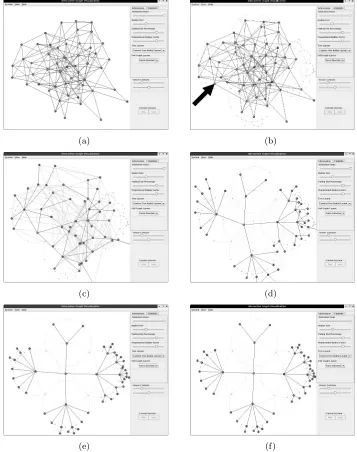
The screen captures in Figure 10 demonstrate how our visualization
sys-tem generates a force-directed layout drawing for the full graph, and then
transitions to a spanning tree drawing. The screen captures in Figure 11
demonstrate how our system generates a different spanning-tree-based
draw-ing rooted at a different vertex for the same graph in Figure 10, and then
transitions from the original drawing to the new drawing.
We now present our work on creating our graph visualization system in
two parts. First, in Section 6.1 we present our graph drawing algorithm,
we present our animation algorithm, which generates smooth, continuous
transitions between two graph drawings.
6.1 Context-Free Radial Layout
Given a graph G, a user-selected vertex r ∈ V (G), and an initial graph
drawing Γ for G, our graph drawing algorithm generates a new drawing of
G based on a spanning tree rooted at r extracted from G. We call our
algorithm “context free” because the placement of children, relative to the
frame of reference of the parent, only depends on the parent’s position.
We use this term loosely; drawing schemes that also have this property,
called shape grammars, have been studied more rigorously by other authors
[55, 57].
Our visualization system creates a new drawing for a graph G with an
initial drawing Γ in three stages. First it extracts a spanning treeTrooted at
r from G using breadth-first search. Using this tree, the system calculates
the graph’s vertices’ relative polar coordinates from their positions in Γ.
Based on these initial positions, the system then calculates the vertices’
relative polar coordinates in the new drawing. Instead of using concentric
circles where one circle is used for positioning all the vertices for a given
depth in the tree (Section 3.2.3), our algorithm creates drawings using a
series of overlapping circles that we call containment circles. Each
non-leaf vertexv ∈V (T) is given its own containment circle centered at v and
only v’s children are positioned on this circle. This approach enables the
drawing algorithm to position sibling vertices close together and emphasize
the parent-child relationships in the tree.
Before discussing the specifics of our new drawing method in Section
(a) (b)
(c) (d)
[image:31.612.118.475.138.590.2](e) (f)
(a) (b)
(c) (d)
[image:32.612.118.475.144.596.2](e) (f)
Algorithm 3initialLayoutAngleAndDelta(T, v,Υ1,Ω)
κ⇐The number of children ofv
if (v is the root of the treeT)then
//The root is allocated 360◦for its annulus wedge
Ψ⇐ 360
κ
ϑ⇐the sum of all of the root’s children’s angles in Υ1
//Θ is the position of the root’s first child
Θ⇐ 1
κ·
ϑ−Ψ·κ·(κ+1) 2
else
//Calculate the bounding angles (α, β) forv’s annulus wedge of size Ω α⇐θ+ 360−12Ω
β⇐α+ Ω
//v’s annulus wedge is divided evenly between its children Ψ⇐ (β−α)
κ
//The initial angle Θ is the angle in the center of the first division Θ⇐α+12Ψ
end if
[image:33.612.118.476.278.500.2]output(Θ,Ψ)
Figure 12: Given a rooted treeT, a vertexv∈V (T), and the initial drawing polar coordinate mapping Υ1, the algorithm outputs the angle position Θ
drawings.
6.1.1 Graph Drawing Parameters
Graph drawing parameters describe the visual characteristics of a graph
drawing (Section 3.1). The only convention our graph drawings follow is that
a graph’s edges are drawn as straight-line segments. The drawings adhere
to three aesthetic goals: (1) minimize the number of edge crossings, (2)
minimize the total angular difference between the root’s children’s positions
from the initial drawing to the new drawing, and (3) maximize the angular
resolution of parent-child edges. Our drawings conform to two constraints:
(1) the root vertex is placed at the center of the drawing, and (2) vertices
are equidistant to their parent vertex in the tree.
6.1.2 Layout Algorithm
Our context-free radial layout graph drawing algorithm computes a new
drawing for a spanning tree extracted from a graph. Instead of using
ab-solute Cartesian coordinates to position vertices, our algorithm computes a
mapping Υ :V (T) →(θ, r), where (θ, r) are polar coordinates for a vertex
v∈V (T) andT is a spanning tree extracted from a graphG. Our drawing
algorithm computes a mapping Υ1for the vertices’ coordinates in the initial
drawing Γ of a graph and a mapping Υ2 for the vertices’ coordinates in the
new drawing being generated. We use a polar coordinate system because
our animation algorithm computes animation sequences where vertices move
on radial paths by interpolating coordinates from Υ1 to Υ2 (Section 6.2.2).
One only needs Υ2 to convert the vertices’ polar coordinates to Cartesian
coordinates to generate the new static drawing of the graph.
Algorithm 4calculateP olarCoordsRelativeT oP arent(T, v, p, R,Ω,Γ,Υ1,Υ2) if (v is the root of the treeT)then
Υ1(v)⇐((Γ (v))θ,(Γ (v))r)
Υ2(v)⇐((Γ (v))θ,0) end if
if ((the number of children ofv inT)>0) then
//Calculatev’s childrens’ polar coordinates relative tov’s position in Γ
for all(childrencofv inT)do
Υ1(c)⇐((Γ (c)−Γ (v))θ−(Υ1(v))θ,(Γ (c)−Γ (v))r) end for
//Calculate the initial angle Θ and the delta angle Ψ forv’s children (Θ,Ψ)⇐initialLayoutAngleAndDelta(T, v,Υ1,Ω)
if ((the number of children ofv inT) = 1)then
λ⇐ R
2 else
λ= 2R·sin Ψ2
end if
//Calculatev’s childrens’ positions in the new drawing Υ2
for all(childrencofvinT, chosen according to the counterclockwise rotational ordering in Υ1of the children ofv)do
Υ2(c)⇐(Θ, R)
(Υ1,Υ2)⇐calculateP olarCoordsRelativeT oP arent(T, c, v, λ,Ω,Γ,Υ1,Υ2)
Θ⇐Θ + Ψ
end for end if
[image:35.612.117.478.216.535.2]output(Υ1,Υ2)
Figure 13: Given a rooted tree T, a vertex v ∈ V (T), v’s parent vertex
p ∈ V (T), the radius R of v’s containment circle, and the initial graph drawing Γ, the algorithm calculates the relative radial coordinates of every child vertexc of v in the initial drawing mapping Υ1 and the new drawing
mapping Υ2. For any point ~p in a Cartesian coordinate system, let (~pθ, ~pr)
Algorithm 5initialLayoutAngleAndDelta(T, v,Υ1,Ω)
κ⇐The number of children ofv
if (v is the root of the treeT)then
//The root is allocated 360◦for its annulus wedge
Ψ⇐ 360
κ
ϑ⇐the sum of all of the root’s children’s angles in Υ1
//Θ is the position of the root’s first child
Θ⇐ 1
κ·
ϑ−Ψ·κ·(κ+1) 2
else
//Calculate the bounding angles (α, β) forv’s annulus wedge of size Ω α⇐θ+ 360−12Ω
β⇐α+ Ω
//v’s annulus wedge is divided evenly between its children Ψ⇐ (β−α)
κ
//The initial angle Θ is the angle in the center of the first division Θ⇐α+12Ψ
end if
[image:36.612.118.476.279.500.2]output(Θ,Ψ)
Figure 14: Given a rooted treeT, a vertexv∈V (T), and the initial drawing polar coordinate mapping Υ1, the algorithm outputs the angle position Θ
drawing Γ for T, the calculateP olarCoordsRelativeT oP arent algorithm
(page 34) computes the positions ofv’s children in the new drawing in four
parts: (1) if v is the root of T, position v at the center of the drawing,
(2) calculate v’s children’s relative polar coordinates in Υ1 based on the
children’s positions in Γ, (3) allocate a containment circle and an annulus
wedge to position v’s children in the new drawing, and (4) calculate v’s
children’s relative polar coordinates in Υ2 such that they are positioned
evenly onv’s containment circle within the bounds ofv’s annulus wedge.
First, the algorithm positions the root at the center of the new drawing
at (0,0). The root’s coordinates in Υ1 are derived by converting Γ (v) to
absolute polar coordinates. The root’s polar coordinate radius in Υ2 is set
at zero, but its polar coordinate angle is the same as in Υ1. This ensures
that the root moves on a straight-line path towards the origin of the drawing
during the animated transitions in our system (Section 6.2).
After the root’s coordinates are calculated in both Υ1 and Υ2, the
algo-rithm calculatesv’s children vertices’ polar coordinates in Υ1based on their
positions in Γ. For a child vertex c of v, c’s polar coordinate radius is the
Euclidean distance from Γ (c) to Γ (v) and its angle is relative tov’s position
in Γ.
Next, the system calculates the initial angle Θ for the first child of v,
and the delta angle Ψ separating v’s children on v’s containment circle in
the new drawing. For a tree T, a vertex v ∈ V (T), the initial drawing
mapping Υ1 forT, and the user-defined size of all non-root annulus wedges
Ω, theinitialLayoutAngleAndDeltaalgorithm (page 35) calculates relative
position of v’s annulus wedge and outputs the angle set (Θ,Ψ).
Ifv is the root of the tree,v’s annulus wedge is the entire angle space of
such that the angular difference from the root’s children’s positions in Υ1
to their positions in the new drawing is minimized. Although other layout
configurations may result in lower overall movement for the entire graph, our
algorithm only considers minimizing the rotational movement of the root’s
children.
Ifv is not the root of the tree,v’s annulus wedge is a portion ofv’s
con-tainment circle. The user-defined angle Ω specifies the size of v’s annulus
wedge, and the anglesα and β denote where on v’s containment circle the
wedge begins and ends. In order to adhere to our aesthetic goal of
maxi-mizing the angular resolution of parent-child edges, Ω is always less than or
equal to 180◦ (Ω is fixed at 180◦ in the examples in Figure 15 and Figure
16). The size of Ω influences the visual characteristics of the graph drawing:
smaller annulus wedges produce tighter and more narrow subtree layouts,
while larger wedges causes trees to fan out and use more space. The center
point ofv’s annulus wedge is the center of the arc onv’s containment circle
that is outside ofv’s parent’s circle. The size ofv’s annulus wedge is always
less than the size of this outer arc, and thusv’s children are not positioned
at overlapping circles’ intersection points (otherwise vertices would occlude
other vertices in neighboring circles). TheinitialLayoutAngleAndDelta
al-gorithm calculates the angles α and β using the angle from v to its parent
as the relative 0◦ in space onv’s containment circle.
The vertexv’s annulus wedge is now divided into equal-sized portions for
each ofv’s children. Each child vertex is allocated the same amount of space
on v’s containment circle regardless of the size of its subtree. The initial
angle Θ is the center angle for the first subdivision of v’s annulus wedge.
The delta angle Ψ is the angular size of these annulus wedge subdivisions.
v’s entire annulus wedge.
Next, thecalculateP olarCoordsRelativeT oP arentalgorithm computes
the radius λof the containment circles for the next level of children in the
subtree. This radius λ is passed as the input for R in the next recursive
iteration of the drawing algorithm. If the number of children of v > 1,
then λ is the length of the chord from Θ to Θ +Ψ2
on v’s containment
circle. If the number of children ofv= 1, thenλis R2; this ensures that the containment circles in the drawing get progressively smaller as vertices are
positioned further away from the root.
The algorithm now iterates throughv’s children based on their
counter-clockwise rotational ordering in Υ1, and assigns each child a position in Υ2.
Like their coordinates in Υ1,v’s children’s positions in Υ2 are relative tov’s
position, but are now based onv’s new position in Υ2. For each child vertex
c of v, c’s polar coordinate radius in Υ2 is R, which is passed as input to
the algorithm, andc’s angle in Υ2 is Θ, which is incremented by Ψ for each
child. If v is the root of the tree, then the initial value for R is defined by
the user.
The drawing algorithm continues recursively down each subtree in a
depth-first fashion until all the vertices’ polar coordinates in Υ1 and Υ2 are
calculated. ThecalculateP olarCoordsRelativeT oP arentalgorithm runs in
O(n) time.
Figure 15 and Figure 16 provide a visual example of how our drawing
algorithm constructs a new spanning-tree-based drawing for a graph.
6.2 Animated Tree Transition
In our interactive graph visualization system, we provide animated
Ψ
Θ
R
r
(a)
v
r
(b)
α β
Ω
λ v
r
(c)
Θ
α+ Ψ
α v
r
[image:40.612.148.447.159.473.2](d)
Figure 15: The above diagram illustrates how our graph drawing algorithm constructs a new drawing for a treeT rooted atr. In Figure 15(a), the root is first placed at the center of the drawing along with its containment circle with a radius of R. The root’s annulus wedge is divided into three equal portions of size Ψ and its first child is positioned at Θ. In Figure 15(b), the root’s children are positioned on its containment circle. Next, in Figure 15(c) each of the root’s children is allocated a separate containment circle with a radius of λ. The algorithm then allocates space in the drawing to positionv’s children. v’s annulus wedge of size Ω is centered on the arc of
Ω
β
α
v
r
(a)
v
r
(b)
λ=R
2
R
(c)
v
r
(d)
[image:41.612.142.459.166.518.2]present our graph animation algorithm that computes a sequence of frames
to transition any graph drawing to one of our spanning-tree-based drawings.
In Section 6.2.1, we first outline the particular goal we seek to
accom-plish with our graph animation algorithm. In Section 6.2.2, we discuss the
implementation specifics of our algorithm. In Section 6.2.3, we discuss two
auxiliary visual cues we incorporate into our system to further help users
maintain continuity during transitions.
6.2.1 Animation Goal
The principles of our animation algorithm are guided by previous graph
drawing aesthetic studies that suggest users are better able to comprehend
drawings that minimize the number of edge crossings [39, 58, 70]. Although
we are not aware of research that measures the effectiveness of drawing
aesthetics as applied to graph animation, we believe that the results of
these studies are certainly applicable to our work. Thus, the main goal in
our transitions from one drawing to another is to minimize the number of
crossings.
This goal is difficult to achieve because it is not a trivial task to
gen-erate an animation sequence for tree drawings with no edge crossings. For
example, the radial layout animation algorithm in Section 4.2.3 produces
crossings even when transitioning between two drawings of the same tree.
Rather than try to prevent all crossings, our animation algorithm is
de-signed to prevent two specific types: (1) crossings between sibling vertices,
and (2) crossings between the edge of a vertex to its parent with one of its
edges to its children. Our visualization system eliminates these crossings
because vertices’ positions are calculated relative to their parent and the
initial drawing.
In preventing these crossings, our algorithm does not calculate
move-ments simply by choosing the shortest path to move a vertex from one point
to another. We believe that the benefits of avoiding an edge crossing
out-weigh any increased movement in the animation.
6.2.2 Animation Algorithm
Our graph animation algorithm computes a series of frames that transition
a graph from an initial layout to a new drawing generated by our drawing
algorithm in Section 6.1.2. Given rooted tree T, a vertex v ∈ V (T), v’s
parent vertex p ∈ V (T), a time step s in the animation sequence, and
an initial drawing mapping Υ1 and a new drawing mapping Υ2 for T, the
transition algorithm (page 43) computes the positions of v’s children in
the animation sequence at time step s, and outputs a graph drawing frame
Γs. This frame is calculated by interpolating each vertex’s relative polar
coordinates from Υ1 to Υ2 using the parent’s position at the current time
step as a frame of reference. To generate all the intermediate frames for the
animation, one would invoke our algorithm from time steps 1 toS, where S
is the last frame in the animation sequence.
The algorithm first calculates the straight-line path movement of the root
vertex from its position in Υ1 to the center of the drawing at (0,0). The
difference between this straight-line movement and the radial movement of
all other vertices creates a visual contrast that allows users to easily identify
the new root of the tree.
Now the animation algorithm computes v’s children’s positions in Γs.
For a child vertex c of v, the algorithm first calculates c’s relative polar
in-Algorithm 6transition(T, v, p, s,Υ1,Υ2,Γs)
∆⇐ s
S
if (v is the root of the treeT)then
//The root moves on a straight-line path to (0,0) (θ, r)⇐Υ1(c)
(x, y)⇐((r·(1−∆))·cos (θ),(r·(1−∆))·sin (θ)) Γs(v)⇐(x, y)
ϕ⇐((0,0)−Γs(v))θ
else
(x, y)⇐Γs(v)
ϕ⇐(Γs(p)−Γs(v))θ
end if
for all(childrencofv inT)do
(Θ1, R1)⇐Υ1(c)
(Θ2, R2)⇐Υ2(c)
//Calculatec’s relative polar coordinates for this time-step θ⇐(Θ1·(1−∆)) + (Θ2·∆)
r⇐(R1·(1−∆)) + (R2·∆)
//Convert (θ, r) to absolute Cartesian coordinates for frame Γs
Γs(c)⇐(x+ (r·cos (θ+ϕ)), y+ (r·sin (θ+ϕ)))
//Calculate animation frames forv’s children
if ((the number of children ofcin T)>0)then
Γs=transition(T, c, v, s,Υ1,Υ2,Γs)
[image:44.612.117.476.210.523.2]end if end for outputΓs
Figure 17: Given a rooted tree T, a vertex v ∈ V (T), v’s parent vertex
p∈V (T), the current time step sin the animation, and an initial drawing mapping Υ1 and a new drawing mapping Υ2, the algorithm calculates the
positions of v’s children at time steps and outputs an intermediate frame Γs. For any point~pin a Cartesian coordinate system, let (p~θ, ~pr) denote the
polar coordinates of~p. Let ∆ be the interpolation factor at time steps. Let
terpolation factor at time steps. These polar coordinates are then offset by
the reference angleϕandv’s position in Γs. If vis the root of the tree, then
ϕis the angle from Γs(v) to the center of the drawing at (0,0). Ifv is not
the root of the tree, thenϕ is the relative angle of v’s parent in Γs using v
as a point of reference. Ifchas children of its own, the algorithm recursively
invokes itself to calculate the positions for the vertices in the subtree rooted
at c.
The algorithm finishes once positions for all the vertices in the graph are
calculated for Γs. Thetransitionalgorithm runs inO(n) time.
Figure 18 and Figure 19 provide a step-by-step example of the how
ani-mation sequences are calculated by our aniani-mation algorithm.
6.2.3 Auxiliary Visual Enhancements
A graph drawing transition may visually overwhelm users with information
[29]. Although good graph animation alleviates many problems, additional
visualization techniques can further help users maintain their mental
conti-nuity between drawings. We now summarize the auxiliary visual
enhance-ments we use to improve the usefulness of the transitions created by our
animation algorithm.
First, we adopt the slow-in, slow-out timing used by Yee et al.’s
Gnutellav-ision system for the movements of vertices [73]. Variable speed approaches
such as this provide adequate visual constancy for users. This type of
move-ment mimics the acceleration and deceleration of massive objects in the real
physical world, which research suggests that the human brain is pre-disposed
to understand more easily [51]. To achieve this effect, our animation
algo-rithm calculates the interpolation factor ∆ from the curve of the arctangent
v
r
(a)
R2
R1
v
r
(b)
Θ1
Θ2
v
r
[image:46.612.132.436.167.492.2](c) (d)
Figure 18: The above diagram is an example of how our graph animation algorithm generates an animated transition for a treeT rooted atrto a new graph drawing. The algorithm first calculates the straight-line movement of the root, shown in Figure 18(a), from its initial position to the center of the drawing (denoted by the cross). The movement of vertex v is derived by interpolating from the radiiR1 to R2, shown in Figure 18(b), and from the
angles Θ1 to Θ2, shown in Figure 18(c). v’s movement is also based on its
(a)
r v
(b)
c1
c2
c4
c3
v
(c)
c3 c2
c1
c4
(d)
Figure 19: (Continued from Figure 18) The root’s children vertices move to their positions in the new drawing, shown in Figure 19(a) and Figure 19(b). The movements ofv’s children verticesc1,c2,c3, andc4’s are derived
[image:47.612.129.396.203.521.2]in the animation and let S be the total number of steps in the animation
sequence:
∆⇐ 1
2
tan−1 s·10
S −5
tan−1(5)
!
+1
2 (1)
Using this method of interpolation provides a “slow-start” movement
in the animation, allowing users to anticipate the general paths of vertices
in the ensuing transition. The movement of the graph accelerates to the
midpoint of the transition, and then decelerates as vertices reach their final
positions in the new drawing. With this timing, users are presented with a
transition that seems neither too fast nor too slow.
The second visual enhancement is the fading in and out of graph elements
used by Friedrich and Eades [29]. Our implementation differs from Friedrich
and Eades in that we fade elements during the transition, rather than before
and after. We believe that including transient edges during the animation
may allow users to study a graph more carefully; by having graph elements
gradually materialize and disappear as the graph moves, users also may be
able see the structural differences between two graph drawings with greater
ease.
The calculation of the fading factor during an animation sequence is
different for the two types of transition scenarios in our visualization system.
When transitioning from a spanning tree drawing back to the full graph, the
fading factor is based on a fixed delta for a finite time period. Because our
force-directed algorithm implementation is non-deterministic, we are unable
to fade relative to when the simulation will reach equilibrium.
The fading factor for spanning-tree-to-spanning-tree transitions in our
animation algorithm is relative to the current time step in the animation

![Figure 5: A hyperbolic layout graph drawing for a tree rooted at rfrom [46]). In hyperbolic drawings, a graph’s elements are represented inspace proportional to their distance to the root vertex; as vertices are posi- (adaptedtioned further away from the root they become vanishingly small.](https://thumb-us.123doks.com/thumbv2/123dok_us/120574.11608/17.612.209.386.128.305/hyperbolic-hyperbolic-elements-represented-proportional-vertices-adaptedtioned-vanishingly.webp)