R E S E A R C H A R T I C L E
Open Access
The knowledge, attitude and behavior about
public health emergencies and the response
capacity of primary care medical staffs of
Guangdong Province, China
Zhou Zhiheng
1,2, Wang Caixia
3, Wang Jiaji
2, Yang Huajie
2, Wang Chao
1and Liang Wannian
1*Abstract
Background:Primary care medical staffs’knowledge, attitude and behavior about health emergency and the response capacity are directly related to the control and prevention of public health emergencies. Therefore, it is of great significance for improving primary care to gain in-depth knowledge about knowledge, attitude and behavior and the response capacity of primary care medical staffs. The main objective of this study is to explore knowledge, attitude and behavior, and the response capacity of primary care medical staffs of Guangdong Province, China. Methods:Stratified clustered sample method was used in the anonymous questionnaire investigation about knowledge, attitude and behavior, and the response capacity of 3410 primary care medical staffs in 15 cities of Guangdong Province, China from July, 2010 to October 2010. The emergency response capacity was evaluated by 33 questions. The highest score of the response capacity was 100 points (full score), score of 70 was a standard. Results:62.4% primary care medical staffs believed that public health emergencies would happen. Influenza (3.86 ± 0.88), food poisoning (3.35 ± 0.75), and environmental pollution events (3.23 ± 0.80) (the total score was 5) were considered most likely to occur. Among the 7 public health emergency skills, the highest self-assessment score is“public health emergency prevention skills”(2.90 ± 0.68), the lowest is“public health emergency risk management (the total score was 5)”(1.81 ± 0.40). Attitude evaluation showed 66.1% of the medical staffs believed that the community awareness of risk management were ordinary. Evaluation of response capacity of health emergency showed that the score of primary care medical staffs was 67.23 ± 10.61, and the response capacity of senior physicians, public health physicians and physicians with relatively long-term practice were significantly better (P <0.05). Multiple linear stepwise regression analysis showed gender, title, position, type of work, work experience and whether to participate relative training were the main factors affecting the health emergency response capacity.
Conclusions:The knowledge, attitude and behavior about public health emergencies and the response capacity of primary care medical staffs of Guangdong Province (China) were poor. Health administrative departments should strengthen the training of health emergency knowledge and skills of the primary care medical staffs to enhance their health emergency response capabilities.
Keywords:Primary care medical staffs, Public health emergencies, Knowledge, Attitude and behavior, Emergency response capacity
* Correspondence:[email protected] 1
School of public health and family medicine, Capital medical university of China, No.10 Xitoutiao, You An Men, Beijing 100069, P.R. China
Full list of author information is available at the end of the article
Background
In recent years, the world's public health emergencies continue to occur and seriously affect people's health physically and mentally. Among all public health emer-gency response agencies, hospital is the key place to pro-vide medical and psychological services [1-3], and medical staffs are the main force involved in response to public health emergencies. The knowledge, skills, atti-tudes and behavior of the medical staffs have a direct im-pact on regional or national public health emergency management [4]. Studies have shown that 80% of the world public health emergencies occurred in the commu-nity [5], in turn, primary health care institutions plays an important role in the emergency management system and they are the first hurdle to effectively reduce devasta-tion from disasters [6,7]. China is implementing the na-tional policy of "community public health service package" which requires primary health services to han-dle community public health emergencies collaboratively. However, there were few reports concerning on commu-nity health emergencies response in China. Moreover, there were no reports that comprehensive analyzed the knowledge, attitude and behavior, and the response cap-acity of primary care medical staffs of China. Some pub-lished reports were only concerning on the portion of knowledge, attitude and behavior, or response capacity. Studies have indicated that the knowledge, attitude and behavior of primary care medical staffs for public health emergency were not satisfactory, the response capacity of primary care medical staffs are relatively low [3,8-12]. Their knowledge and attitude on emergency reflect their level of theoretical knowledge and belief. Their behavior reflects their practice and experience of public health emergencies. The knowledge, attitude and behavior are the parts of the health emergency response capacity, and directly affect the capability of their response capacity. Therefore, improvement of the emergency response cap-acity of primary care medical staffs is the key element for handling public health emergencies effectively [13]. It is of great significance to explore knowledge, attitude and behavior, and the response capacity of primary care med-ical staffs, and analyze the main factors. Here, we investi-gated the knowledge, attitude and behavior, and the emergency response capacity of 3410 medical staffs from primary care hospitals.
Methods
Objects
As an economically developed coastal province of south-ern China, the first known cases of SARS occurred in Guangdong province, 2003. Since then, its response of health emergency is of great concern. 3410 primary care medical staffs from 120 primary hospitals in 15 cities of
Guangdong participated in this study, including doctors, nurses and other medical staff.
Sampling methods
Stratified random cluster sampling method was used and the regions surveyed were divided into three types of regions based on economic conditions, including devel-oped regions, regions of middle economic level, econom-ically underdeveloped regions. Five cities in each type of region were investigated and 8 primary care hospital (the town hospital or community health service center) of each city were chosen, namely, all medical staffs (except for the staff without job title or support staff ) in the 120 hospital were conducted a questionnaire survey.
Survey contents
Survey methodology
Trained, qualified investigators were separately sent to each primary health care sector. After gathering the medical staffs in the primary care hospital, the investiga-tors introduced the purpose of this survey and notified the precautions about the questionnaire. Then, the med-ical staffs surveyed filled the anonymous self-administered questionnaires and the investigators col-lected the questionnaires at the scene.
Statistical methods
After checking the questionnaire, epiData 3.0 software was used for the data entry procedure. To ensure the ac-curacy of data entry, double-entry method was adopted. SPSS 13.0 statistical software (Version13.0; SPSS Inc., Chicago, IL, USA) was applied for statistical analysis. The data are presented as mean values ± standard devi-ation. Differences of the mean values between groups were analyzed with t test or analysis of variance. Count-ing data are presented with rate or composition ratio and the differences between groups were compared with chi-square test. Health emergency response capacity associated factors were analyzed using backward linear stepwise regression analysis. P <0.05 was considered sta-tistically different.
Ethical approval
All research carried out was conducted with integrity and in line with generally accepted ethical principles and approved by Research Ethic Committee of Capital Med-ical University, Guangzhou MedMed-ical University and the First Hospital of Guangzhou, China. We did the survey under the agreement of the medical staffs. All the per-sonal information of the medical staffs involved in the survey was not open.
Results
General conditions
3500 survey questionnaires were sent and 3410 valid questionnaires were collected with a recycling rates of 97.4%, of which 3356 were male (33.9%), 2254 were fe-male (66.1%). The age was 32.47 ± 8.83 (ranged from 18– 72 years of age). The detailed information of the medical staff were as follows, community general practitioners, 934 people (accounting for 27.4%), medical specialists, 1026 (30.1%), community public health physicians, 109 (3.2%), nurses, 791 (23.2%), other health professionals, 550 (16.2%); The composition included junior, 1995 (58.5%), intermediate grade, 771 (22.6%), senior, 644 (5.6%). The education composition was as follows: 689 people of secondary education (20.2%), 1449 people with college degree (42.5%), 1272 people with a bachelor's de-gree or higher (37.2%). The length of service of the med-ical staffs surveyed in primary health care units were
8.35 ± 8.10 years (ranged from 1–45 years). There were 1442 people (42.3%) who worked less than 5 years, 1064 people (31.2%) who worked less than 5–10 years, and 904 people (26.5%) worked for more than 10 years.
Analysis of primary care medical staffs’risk awareness of public health emergencies
In our study, the risk awareness was analyzed in two aspects, including the overall risk awareness and the awareness of 18 kinds of public health emergencies. 62.4% of respondents believed that public health emer-gencies would occur in the locality. The overall risk awareness between medical staffs of different titles and different length of service were significantly different (P <0.05). However, there was no significant difference of the overall risk awareness between staff for different types of jobs and from different regions (P > 0.05, Table 1). In the 18 kinds of public health emergencies (total score was 5), the top three of the risk awareness were influenza (3.86 ± 0.876 points), food poisoning (3.35 ± 0.75 points), and environmental pollution events (3.23 ± 0.80 points). The urban primary hospital medical staff had a better risk awareness of avian influenza and AIDS than medical staffs from rural areas. However, regarding to cholera, typhoid, encephalitis, plague and anthrax, risk awareness of rural medical staff was signifi-cantly higher than urban medical staffs (P <0.05). There was no significant difference of risk awareness in the remaining 11 kinds of public health emergencies be-tween rural and urban doctors (P > 0.05, Table 2).
Medical staffs self-assessment of emergency knowledge and skills
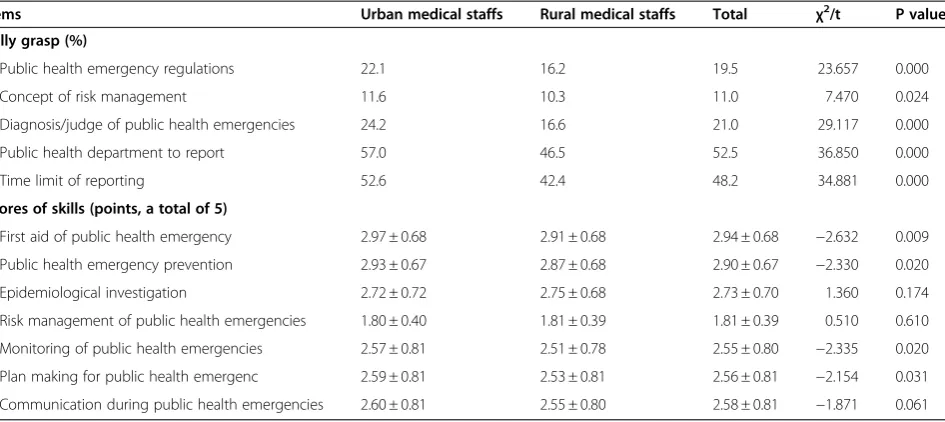
management showed no statistically difference between urban and rural doctors (P > 0.05, Table 3).
Attitude of primary care medical staffs towards issues related to public health emergencies
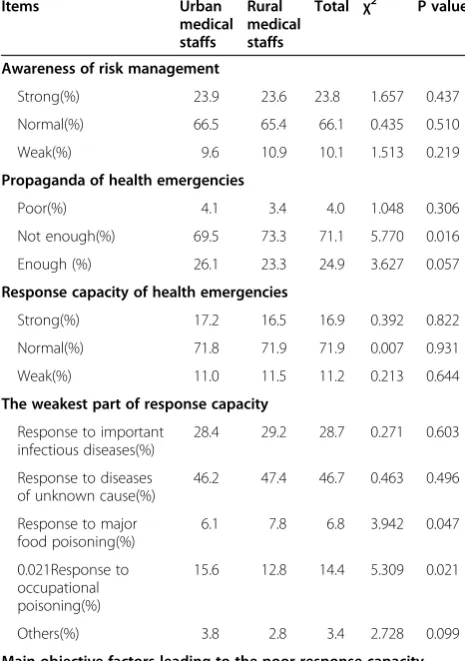
The attitude evaluation showed 66.1% of the medical staffs believed that the community awareness of risk
[image:4.595.56.538.99.329.2]management were ordinary. 71.1% of the medical staffs considered that the propaganda of health emergency was not doing enough. 71.9% of the medical staffs sug-gested that the response capacity of health emergency was normal. 46.7% of the medical staffs believed that it would show the weakest response capacity when facing diseases of unknown causes. About 80% of people
Table 2 Comparison of the risk awareness of 18 different types of public health emergencies between urban and rural
primary health care medical staffs (χ± s, the total score is 5)
Items Urban medical staffs Rural medical staffs Total t P value
Chemical poisoning 2.86 ± 0.01 2.90 ± 0.02 2.88 ± 0.61 1.884 0.060
Food poisoning 3.36 ± 0.73 3.33 ± 0.77 3.35 ± 0.75 −1.131 0.258
Radiological accidents 2.54 ± 0.70 2.58 ± 0.70 2.56 ± 0.70 1.548 0.122
Environmental pollution 3.21 ± 0.76 3.25 ± 0.85 3.23 ± 0.78 1.309 0.191
Nuclear accident 2.05 ± 0.81 2.10 ± 0.86 2.07 ± 0.83 1.833 0.067
Zoonosis 3.01 ± 0.88 3.03 ± 0.63 3.02 ± 0.65 1.130 0.259
Influenza 3.87 ± 0.88 3.85 ± 0.88 3.86 ± 0.88 −0.384 0.701
Cholera 2.84 ± 0.68 2.89 ± 0.65 2.87 ± 0.67 2.182 0.029
Typhoid 2.93 ± 0.64 2.98 ± 0.62 2.95 ± 0.63 2.328 0.020
Avian Influenza 3.07 ± 0.54 3.03 ± 0.57 3.05 ± 0.56 −2.031 0.042
Epidemic encephalitis 2.98 ± 0.56 3.01 ± 0.57 2.99 ± 0.57 1.146 0.252
Epidemic encephalitis B 2.97 ± 0.55 3.04 ± 0.62 3.00 ± 0.58 3.914 0.000
SARS 2.88 ± 0.56 2.86 ± 0.57 2.87 ± 0.57 −1.027 0.304
Plague 2.62 ± 0.67 2.68 ± 0.67 2.65 ± 0.67 2.310 0.021
Anthrax 2.51 ± 0.68 2.58 ± 0.67 2.54 ± 0.67 2.999 0.003
AIDS 3.22 ± 0.75 3.13 ± 0.78 3.15 ± 0.75 −3.651 0.000
Unknown infectious diseases 3.09 ± 0.55 3.08 ± 0.56 3.09 ± 0.56 −0.742 0.458
[image:4.595.65.537.467.734.2]Other infectious diseases 3.14 ± 0.57 3.16 ± 0.57 3.13 ± 0.57 −0.315 0.753
Table 1 Comparison of the overall risk awareness of different types of primary health care medical staffs
Staff definitely
will not
impossible possible will happen
definitely will χ
2
P value
Job title①Junior(%) 22.1 38.8 30.7 6.5 1.9 32.104 Ptotal= 0.000
②intermediate grade(%) 27.7 21.2 22.2 12.2 9.6 P①-②= 0.000 , P①-③= 0.363
③senior(%) 27.3 40.7 25.6 4.7 4.7 P②-③= 0.340
Job type①Nurses(%) 26.1 37.9 26.2 6.2 1.6 18.331 Ptotal= 0.106
②Medical specialists(%) 25.6 40.8 26.2 5.9 1.4 P①-②= 0.784, P①-③= 0.285
③Community general practitioners(%)
22.4 38.7 32.1 5.2 1.6 P①-④= 0.081, P②-③= 0.784
④Public health physician(%) 19.2 33.7 41.3 3.8 1.9 P②-④= 0.784, P③-④= 0.053
Length of service①<5 years(%) 20.6 41.3 30.5 5.9 1.7 43.304 Ptotal= 0.000
②5-10 years(%) 32.0 40.0 29.2 6.8 1.1 P①-②= 0.377, P①-③= 0.000
③>10 years(%) 30.2 35.2 30.1 2.6 2.0 P②-③= 0.000
The sources of physicians of primary care hospitals
①Urban Physicians (%) 24.4 39.0 28.6 6.0 2.0 7.091 Ptotal= 0.131
②Rural Physicians (%) 23.1 38.7 31.9 5.0 1.3
considered that the main objective reasons that led to the poor response capacity of primary hospital emer-gency were a shortage of staff (83.0%),a lack of equip-ment (80.6%) and aging equipequip-ment (77.6%). The vast majority of medical staffs thought that the primary hos-pital should be involved in early warning and monitor-ing, assisting epidemiological investigations and providing emergency training (Table 4).
Behavior of primary care medical staffs towards public health emergencies
Regarding to behavior, 33.3% of the medical staffs has never participated in the training of health and the rate of rural medical staffs was significantly higher than urban doctors (P < 0.05). In addition, organizational learning unit (38.4%), media (32.4%) and the accumulation of practical work (31.6%) were their main sources to gain health emergency associated knowledge. 25.7% of respondents had participated in treatment of public health emergency cases at the scene, and it showed no significant difference between urban and rural medical staffs (P>0.05). 57.3% of the medical staffs believed that they would carry out mu-tual aid work when facing public health emergencies. The rate of "mutual aid" in rural medical staffs was significantly higher than in urban medical staffs (P <0.05). In the mean time, 39.4% of the medical staffs suggested that they would carry out self-aid and the percentage of urban medical staffs choosing "self-aid" was significantly higher than that of rural medical staffs (P <0.05, Table 5).
Training needs analysis of primary care medical staffs towards public health emergencies
Training needs analysis indicated that 78.4% of the med-ical staffs believed it was necessary to implement public health emergency training for all medical staff. 8.8% of the respondents indicated that the infectious diseases medical staffs should be trained (Ranked second accord-ing to the analysis). The most needed trainaccord-ing contents were emergency health laws and regulations (54.8%), risk management (50.0%) and health emergency monitoring and early warning (45.5%).Rural primary care medical staffs had significant higher training needs of risk man-agement, monitoring and early warning, plan making, media communication than urban doctors. However, there was significant difference of training needs of the epidemiological investigation between rural and urban medical staffs and it showed higher needs in urban prac-titioners (P <0.05). Health care medical staffs suggested that the top three appropriate training methods were practical exercise (27.3%), academic lectures (21.4%) and desktop deduction (19.7%), as shown in Table 6.
Analysis of health emergency response capacity based on the questionnaire results
[image:5.595.65.538.111.322.2]Both assessment questionnaire scoring and self-assessment scoring of the overall emergency response capacity were used for the evaluation of the emergency response capacity of medical staffs. Evaluation of re-sponse capacity of health emergencies (A total of 100 points) showed that the score of primary care medical staffs was 67.23 ± 10.61, and the response capacity was related to their titles and working experience or length
Table 3 Comparison of self-assessment of emergency health knowledge and skills between urban and rural primary care medical staffs
Items Urban medical staffs Rural medical staffs Total χ2/t P value
Fully grasp (%)
Public health emergency regulations 22.1 16.2 19.5 23.657 0.000
Concept of risk management 11.6 10.3 11.0 7.470 0.024
Diagnosis/judge of public health emergencies 24.2 16.6 21.0 29.117 0.000
Public health department to report 57.0 46.5 52.5 36.850 0.000
Time limit of reporting 52.6 42.4 48.2 34.881 0.000
Scores of skills (points, a total of 5)
First aid of public health emergency 2.97 ± 0.68 2.91 ± 0.68 2.94 ± 0.68 −2.632 0.009
Public health emergency prevention 2.93 ± 0.67 2.87 ± 0.68 2.90 ± 0.67 −2.330 0.020
Epidemiological investigation 2.72 ± 0.72 2.75 ± 0.68 2.73 ± 0.70 1.360 0.174
Risk management of public health emergencies 1.80 ± 0.40 1.81 ± 0.39 1.81 ± 0.39 0.510 0.610
Monitoring of public health emergencies 2.57 ± 0.81 2.51 ± 0.78 2.55 ± 0.80 −2.335 0.020
Plan making for public health emergenc 2.59 ± 0.81 2.53 ± 0.81 2.56 ± 0.81 −2.154 0.031
of service. The scores of response capacity of different job types ranked as follows, public health physicians > community general practitioners > medical specialists > nurses > other medical staff and the scores between dif-ferent groups were statistically significant (P <0.05). However, there was no significant difference between rural and urban medical staffs (P >0.05, Table 7) Self-assessment of health emergency response capacity indi-cated that 15.2% of the medical staffs believed that they had a strong response capability. 70.8% of the respon-dents felt their response capacity was general and there
were 14.0% of the medical staffs having poor health emergency response capacity. The results of assessment questionnaire scoring and self-assessment of the overall emergency response capacity were positively correlated (r = 0.48, P = 0.000).
Analysis of health emergency response capacity associated factors
Stepwise multiple regression analysis was performed. The dependent variable (y) represented the score of re-sponse capacity. Independent variables were age(x 1), gender (x 2), education(x 3),title(x 4), position (x 5), job type (x 6),length of service(x 7), sources(x 8),emergency training (x 9). The regression equation was written as y = 59.712 + 7.331 x9+ 3.244 x5+ 1.881 x6-1.080 x2+ 1.045 x4+ 0.733 x7, as shown in Table 8.
Discussion
[image:6.595.56.289.115.446.2]Primary care medical staffs are gatekeepers to health care success and are also the first response to public
Table 4 The attitude of primary care medical staffs towards public health emergencies associated problems
Items Urban
medical staffs
Rural medical staffs
Total χ2 P value
Awareness of risk management
Strong(%) 23.9 23.6 23.8 1.657 0.437
Normal(%) 66.5 65.4 66.1 0.435 0.510
Weak(%) 9.6 10.9 10.1 1.513 0.219
Propaganda of health emergencies
Poor(%) 4.1 3.4 4.0 1.048 0.306
Not enough(%) 69.5 73.3 71.1 5.770 0.016
Enough (%) 26.1 23.3 24.9 3.627 0.057
Response capacity of health emergencies
Strong(%) 17.2 16.5 16.9 0.392 0.822
Normal(%) 71.8 71.9 71.9 0.007 0.931
Weak(%) 11.0 11.5 11.2 0.213 0.644
The weakest part of response capacity
Response to important infectious diseases(%)
28.4 29.2 28.7 0.271 0.603
Response to diseases of unknown cause(%)
46.2 47.4 46.7 0.463 0.496
Response to major food poisoning(%)
6.1 7.8 6.8 3.942 0.047
0.021Response to occupational poisoning(%)
15.6 12.8 14.4 5.309 0.021
Others(%) 3.8 2.8 3.4 2.728 0.099
Main objective factors leading to the poor response capacity (multiple choices)
a shortage of staff(%) 83.9 78.6 83.0 6.799 0.147
a lack of equipment(%) 80.9 80.3 80.6 8.228 0.084
aging equipment(%) 77.7 77.5 77.6 2.318 0.678
Primary hospital should be involved in warning and monitoring (%)
84.9 88.8 86.6 34.359 0.000
should assist epidemiological investigations(%)
90.5 88.5 89.7 11.228 0.024
should provide emergency training(%)
[image:6.595.305.538.115.473.2]87.1 83.0 85.3 13.131 0.011
Table 5 Behavior analysis of primary care medical staffs towards public health emergencies
Items Urban
medical staffs
Rural medical staffs
Total χ2 P value
The frequency of emergency response training since work
Once a year(%) 32.5 29.7 31.3 3.014 0.083
Once every 2 to 5 years(%)
30.0 20.3 25.8 40.982 0.000
Interval of more than 5 years(%)
9.3 10.0 9.6 0.453 0.501
Never (%) 28.2 40.1 33.3 53.279 0.000
Sources to gain health emergency associated knowledge (multiple choice)
School education(%) 25.2 29.2 26.9 8.695 0.003
Self-learning(%) 17.7 18.7 18.1 0.570 0.450
Organizational learning unit(%)
40.3 35.8 38.4 7.013 0.008
Media(%) 38.6 27.3 32.4 47.763 0.000
Continuing education(%) 25.1 15.6 20.5 45.927 0.000
Accumulation of practical work(%)
29.2 36.1 31.6 18.290 0.000
Other sources(%) 17.2 23.0 19.3 16.831 0.000
Participated in treatment at the scene(%)
25.2 26.3 25.7 0.510 0.475
Response to public health emergencies(Single-choice)
Self-aid(%) 45.9 31.0 39.4 83.743 0.000
Mutual-aid(%) 51.7 64.5 57.3 56.314 0.000
Escape(%) 1.5 1.9 1.7 0.847 0.358
Don’t know what to do(%)
health emergency. They play an important role in public health emergency preparedness and response [13]. Be-sides, their knowledge, attitude and behavior about health emergencies and the response capacity are dir-ectly related to the control and prevention of public health emergencies. However, research have indicated that primary care medical staffs of many countries are not ready to deal with the public health emergencies [8,9,14,15], which mainly due to the lack of training and experience about public health emergencies [16-18]. The public health emergencies are usually sudden, unpredict-able and with considerunpredict-able severity. Thus, it put forward
Table 6 Training needs analysis of primary care medical staff towards public health emergencies
Items Urban
medical staffs
Rural medical staffs
Total χ2 P value
The most needed physicians that should be trained
All medical staff(%) 78.2 78.6 78.4 0.079 0.778
Infectious diseases physicians(%)
8.5 9.1 8.8 0.376 0.540
Occupational diseases physicians(%)
1.9 3.1 2.4 4.721 0.030
Emergency Doctors(%) 5.2 3.0 4.2 8.308 0.004
Personnel in Disease Control Agency(%)
5.6 6.1 5.8 0.376 0.540
Other staff(%) 0.6 0.1 0.4 4.763 0.029
Necessary training contents (Multiple choices)
Emergency health laws and regulations(%)
48.3 52.1 50.0 4.124 0.534
General First-Aid Principles(%)
35.0 28.7 32.4 10.791 0.214
Knowledge of risk self-protection(%)
47.3 35.2 42.1 10.013 0.188
Epidemiological investigation(%)
35.4 25.5 31.1 13.428 0.037
Risk management(%) 51.8 58.7 54.8 101.623 0.000
Monitoring and warning(%)
42.2 49.8 45.5 91.596 0.000
Plan making(%) 29.6 38.4 33.4 65.091 0.000
Media
communication(%)
20.6 29.2 24.3 45.522 0.000
The most appropriate training methods (Single choice)
Full-time study(%) 10.9 11.2 11.1 29.082 0.000
Academic lectures(%) 21.1 21.9 21.4 0.315 0.575
Case Study(%) 15.8 20.9 18.0 0.096 0.757
Practical exercise(%) 29.8 24.0 27.3 12.235 0.000
Desktop deduction(%) 20.5 18.7 19.7 1.401 0.237
Distance Education(%) 1.7 2.7 2.1 4.132 0.042
[image:7.595.294.540.111.467.2]Other methods(%) 0.3 0.5 0.4 0.271 0.603
Table 7 Assessment of health emergency capacity of different types of physicians
Physicians Scores (χ± s, full score = 100)
F /t value
P value
Titles
Junior 66.61 ± 10.73 51.337 Ptotal= 0.000
Intermediate grade 69.40 ± 9.74 P①-②= 0.000,
P①-③= 0.000
Senior 72.92 ± 10.30 P②-③= 0.000
Job type
Other medical staff 63.86 ± 12.10 24.236 Ptotal= 0.000
Nurse 67.560 ± 9.93 P①-②= 0.000,
P①-③= 0.000,
P①-④= 0.000
Medical specialists 66.80 ± 10.30 P①-⑤= 0.000,
P②-③= 0.143,
P②-④= 0.022 Community general
practitioners
68.77 ± 9.92 P②-⑤= 0.000,
P③-④= 0.000,
P③-⑤= 0.000 Public health physicians 72.55 ± 11.03 P④-⑤= 0.001
Length of service
<5 years 65.57 ± 10.80 35.592 Ptotal= 0.000
5-10 years 68.41 ± 9.91 P①-②= 0.000,
P①-③= 0.000
>10 years 69.24 ± 10.46 P②-③= 0.009
The sources of the physicians
Urban 67.48 ± 10.56 1.649 0.099
Rural 66.85 ± 10.80
Summary 67.23 ± 10.61
Table 8 Stepwise multiple regression analysis of health emergency response capacity
Items B S.E Beta t value P value
Constant 59.712 1.186 0.368 50.357 0.000
Gender −1.080 0.443 −0.049 −2.439 0.015
Title 1.045 0.370 0.061 2.825 0.005
Position 3.244 0.580 −0.109 5.549 0.000
Job type 1.881 0.396 0.095 4.750 0.000
Length of service 0.733 0.252 0.057 2.915 0.004
Emergency training 7.331 0.415 0.336 17.676 0.000
[image:7.595.305.538.554.666.2]higher requirements to the primary care professionals and health institutions to prevent and control the emer-gencies [19]. There were only a few reports about health emergencies response in China. In our study, anonym-ous questionnaire investigation of 3410 primary care medical staffs of Guangdong was performed to explore their risk awareness, knowledge, attitude and behavior, training needs about emergency response, the emer-gency response capacity and its main related factors.
Of the 3410 doctors surveyed, primary care medical staffs were mostly women and represented a shortage of medical staffs with higher titles or education. Regarding to risk awareness, 62.4% of the medical staffs believed that public health emergencies would happen in the re-gion. Influenza (3.86 ± 0.88), food poisoning (3.35 ± 0.75), and environmental pollution events (3.23 ± 0.80) were considered most likely to occur in 18 kinds of public health emergencies (the total score was 5). These results suggested the low awareness of risk of medical staffs in Guangdong. The urban primary hospital medical staff had a poor risk awareness of cholera, typhoid, encephal-itis, plague and anthrax and the rural medical staffs were lack of risk awareness about avian influenza and AIDs, which was similar to the results of Jiangou Shen [20]. Risk awareness is the starting point of crisis early warn-ing. A low awareness of risk would affect collection of information related to the crisis, in turn, hampers the identification and early warning [21]. Therefore, the cul-tivation of a sense of crisis should be strengthened.
Furthermore, the investigation results of knowledge, attitude and behavior of primary care medical staffs were not optimistic. Regarding to the grasp of emergency knowledge, only 11.0% of the respondents knew the con-cept of risk management and 24.2% of the medical staffs grasped the diagnosis/judge of public emergencies. The total score of emergency response skills was 4 and all the skills surveyed were less than 3. The skills of public health emergency risk management, monitoring and warning, plan making were the weakest. Only a few medical staffs had the response skills of public health emergencies. Most medical staffs grasped only a small part of the knowledge and skills related to emergency re-sponse. The attitude evaluation showed 66.1% of the medical staffs believed that the community awareness of risk management were ordinary. 71.1% of the medical staffs considered that the propaganda of health emer-gency was not doing enough. 71.9% of the medical staffs suggested that the response capacity of health emer-gency was ordinary and it would show the weakest re-sponse capacity when facing diseases of unknown causes. Only 25.7% of respondents had participated in treatment of public health emergency cases which indicated the poor response capacity and the lack of ex-perience [22,23].
Training plays an important role for the development of public health emergency response capacity [24], but the investigation has shown that the training was appar-ently not enough. About a third of the respondents have never participated in primary care training and the rate of rural medical staffs (40.1%) was even higher. Training needs analysis indicated that 85.3% of the respondents suggested it was necessary to provide public health emergency training. 78.4% of the medical staffs believed it was necessary to implement training for all medical staff. Health care medical staffs suggested that most ap-propriate training methods were practical exercise. These indicated a wide demand for training, however the opportunities of training were few and present train-ing is usually lack of new ideas. The physicians are will-ing to participate in practical trainwill-ing rather than classroom teaching which in accordance with previous reports [25,26].
It has been shown that the response capacity of med-ical staffs in Beijing [22] was weak which was similar to the results of Guangdong. Evaluation of response cap-acity of health emergency (the total score of 100 points) showed that the score of primary care medical staff was 67.23 and the response capacity of senior medical staffs, public health physicians and physicians with relatively long-term practice were relatively better. Stepwise mul-tiple regression analysis showed that the influence of the factors related to response capacity was ranked in des-cending order as follows: emergency response training, length of service, position, job type, gender, title, sug-gesting that training was the most needed method for improvement of response capacity [24]. In the past, it was mainly required for clinical medical diagnosis and treatment of clinical disease in China, and the require-ments of health emergency response capacity were low. Therefore, it is essential to carry out targeted training to enhance the prevention and control capabilities of pri-mary care practitioners. The second main factor was the length, indicating that health emergency response cap-acity is positively related to the experience of physicians [20]. Position and job type ranked the 3rd and 4th, indi-cating that the position of a medical staff and his re-sponsibilities directly affected the emergency response capacity. Therefore, the head of the hospital are usually having higher risk awareness. Similarly, public health physicians who are responsible for community public health work show significantly higher response capacity than other health care staff.
prevention and control during public health emergencies which need further verification.
Conclusions
Here, we identified the knowledge, attitude and behavior about public health emergencies and the response capacity of primary care medical staffs of Guangdong Province (China) were in a poor situation. Health administrative departments should strengthen the training of primary care health emergency knowledge and skills, establish a mechanism of regular training and provide them with free health emergency training opportunities to enhance their risk awareness and health emergency response capabil-ities. There is a perceived need to build an excellent team of primary health care. However, the survey only limited in one province in China, and could partially reflect the situation in China and some of the results need to be fur-ther test and by ofur-ther forms of research.
Competing interests
We declare no competing interests.
Authors’contributions
ZZ participated in the design of the study, and carried out epidemiological investigation and drafted the manuscript. CW, YH, CW participated in epidemiological investigation. WL participated in the design and performed the statistical analysis. JW conceived of the study, and participated in its design and coordination and helped to draft the manuscript. All authors have read and approved the final manuscript.
Acknowledgements
We thank the Guangdong Medical Doctor Association of China for their collaboration in this study.
Author details
1School of public health and family medicine, Capital medical university of
China, No.10 Xitoutiao, You An Men, Beijing 100069, P.R. China.2School of public health, Guangzhou medical university, Guangzhou, China. 3
Department of internal medicine of the first hospital of Guangzhou city, Guangzhou, China.
Received: 1 February 2012 Accepted: 31 August 2012 Published: 25 September 2012
References
1. Robert F, Knouss MD:National Disaster Medical System.Public Health Rep 2001,115(Suppl 2):49–52.
2. Niska RW, Burt CW:Bioterrorism and mass casualty preparedness in hospitals:United States, 2003.Adv Data2005,27(364):1–14.
3. Zhang H, Huang J, He X,et al:An analysis of the current status of hospital emergency preparedness for infectious disease outbreaks in Beijing. Chins Am J Infect Control2007,35:62–67.
4. Gavagan TF, Noji E:Hurricane Katrina: response at the Houston Astrodome.South Med J2007,100(9):926–927.
5. Baoshen M:Overview for the forum of hazard and social administration, 2006.City and Disaster Reduction2006,5:4–5.
6. Douglas Bass C:Emergency Manager Emergency management in the U.S.. Fairfax County, Virglnia; 2005.
7. Lichterman JD:A“community as re-source”strategy for disaster respons. Public Health Rep2000,115(2–3):262–265.
8. Stankovic C, Mahajan P, Ye H, Dunne RB, Knazik SR:Bioterrorism: evaluating the preparedness of pediatricians in Michigan.Pediatr Emerg Care2009,25(2):88–92.
9. Bagatell S, Wiese J:The elite code grey team: a new model for residency preparedness and training in advance of a disaster.Am J Med Sci2008, 336(2):174–178.
10. Roebers S, Wagner M, Ritter MA, Dornbach F:Attitudes and Current Practice of Primary Care Physicians in Acute Stroke Management.Stroke 2007,38:1298–1303.
11. Elena S, Stoto MA, Biddinger PD, Paul C:Risk-communication capalibity for pubilc health emergencies varies by community diversity.BMC Research Notes2008,1(6):1–4.
12. Sarkar U, Bonacum D, Strull W, Spitzmueller C:Challenges of making a diagnosis in the outpatient setting: a multi-site survey of primary care physicians.BMJ Qual Saf2012,21:641–648.
13. Spranger CB, Villegas D, Kazda AM, Harris MJ, Shane M, Migala W: Assessment of physician preparedness and response capacity to bioterrorism or other public health emergency events in a major metropolitan area.Disaster Manag Response2007,5(3):82–86. 14. Uddin SG, Barnett DJ, Parker CL, Links JM, Alexander M:Emergency
preparedness: addressing a residency training gap.Acad Med2008, 83(3):298–304.
15. Shealy RM, Simpson WM Jr, Lee FW:The gaping hole: physicians are missing from the front line of disaster preparedness training.J S C Med Assoc2006,102(1):11–13.
16. Martin SD, Bush AC, Lynch JA:A national survey of terrorism
preparedness training among pediatric, family practice, and emergency medicine programs.Pediatrics2006,118(3):e620–e626.
17. Pesik N, Keim M, Sampson TR:Do US emergency medicine residency programs provide adequate training for bioterrorism.Ann Emerg Med 1999,34(2):173–176.
18. Ablah E, Tinius AM, Konda K:Pediatric emergency preparedness training: are we on a path toward national dissemination.Trauma2009, 67(2 Suppl):S152–S158.
19. Slepski LA:Emergency preparedness and professional competency among health care providers during hurrcanes katrina and rita:Pilot study results.Disaster Manag Response2007,5(4):99–110.
20. Jianguo S:A survey of awareness and capability for public health emergency of medical staff in Kunshan city of China.Journal of Preventive Medicine Information2008,24(2):139–141.
21. Dewaill YE, Ayotte P, Muckle G, Oery S, Furgal C:Neurotoxicants in the Arctic:a public health perspective oll risk management.Neurotoxicology 2004,25(4):712–712.
22. Aiping Z, Lln H, Xuezong L,et al:The analysis of medical workers’ cognition of the weakness of public health emergency in Beiqing area. Chinese HospItaI Management2005,25(10):34–36.
23. Drain PK, Holmes KK, Skeff KM, Hall TL, Gardner P:Global health training and inter¬national clinical rotations during residency: current status, needs, and opportunities.Acad Med2009,84(3):320–325.
24. Savoia E, Massin-Short SB, Rodday AM, Aaron LA, Higdon MA, Stoto MA: Public health systems research in emergency preparedness: a review of the literature.Am J Prev Med2009,37(2):150–156.
25. Williams J, Nocera M, Casteel C:The effectiveness of disaster training for health care workers: a systematic review.Ann Emerg Med2008, 52(3):211–222.
26. Subbarao I, Lyznicki JM, Hsu EB, Gebbie KM, Markenson D, Barzansky B,et al: A consensus-based educational framework and competency set for the discipline of disaster medicine and public health preparedness.Disaster Med Public Health Prep2008,2(1):57–68.
doi:10.1186/1472-6963-12-338