R E S E A R C H A R T I C L E
Open Access
Development of modelling method selection tool
for health services management: From problem
structuring methods to modelling and simulation
methods
Gyuchan T Jun
1,2, Zoe Morris
2, Tillal Eldabi
3*, Paul Harper
4, Aisha Naseer
3, Brijesh Patel
5and John P Clarkson
2Abstract
Background:There is an increasing recognition that modelling and simulation can assist in the process of
designing health care policies, strategies and operations. However, the current use is limited and answers to
questions such aswhatmethods to use andwhenremain somewhat underdeveloped.
Aim:The aim of this study is to provide a mechanism for decision makers in health services planning and
management to compare a broad range of modelling and simulation methods so that they can better select and use them or better commission relevant modelling and simulation work.
Methods:This paper proposes a modelling and simulation method comparison and selection tool developed from
a comprehensive literature review, the research team’s extensive expertise and inputs from potential users.
Twenty-eight different methods were identified, characterised by their relevance to differentapplication areas,
project life cycle stages, types of outputandlevels of insight, and four input resources required (time, money, knowledge and data).
Results:The characterisation is presented in matrix forms to allow quick comparison and selection. This paper also
highlights significant knowledge gaps in the existing literature when assessing the applicability of particular approaches to health services management, where modelling and simulation skills are scarce let alone money and time.
Conclusions:A modelling and simulation method comparison and selection tool is developed to assist with the
selection of methods appropriate to supporting specific decision making processes. In particular it addresses the issue of which method is most appropriate to which specific health services management problem, what the user might expect to be obtained from the method, and what is required to use the method. In summary, we believe the tool adds value to the scarce existing literature on methods comparison and selection.
Background
There is an increasing recognition that modelling and simulation can assist in the process of redesigning health services to reconcile expanding demands for health care with cost-containment [1-10]. Policymakers are also keen to capture the benefits of modelling and simulation to healthcare managers [1,2,11-16]. In the English National Health Service (NHS), for example,
Primary Care Trusts (PCTs) which purchase health care on behalf of their citizens face a mandatory requirement to undertake some“predictive modelling”to ensure they factor health need into their decisions [10]. Various tools are being developed to assist healthcare managers to model need [17,18]. One example is the Scenario
Generator, designed to help PCT managers assess the
needs of their population and plan care accordingly [19]. The tool allows commissioners to make changes to service provision “virtually” and assess the impact on costs, waits, etc.
* Correspondence: [email protected]
3Business School, Brunel University, Uxbridge, Middlesex UB8 3PH, UK Full list of author information is available at the end of the article
Whilst it is not possible to fully gauge the use of modelling and simulation in health services manage-ment, it is apparent to expert modellers that the use of modelling and simulation is currently not widespread in the UK [20]. The lack of desire or skill of health care managers to use modelling and simulation, particularly mathematical methods has been highlighted as one of the practical challenges [3,7,11,12,21]. In addition, a need for better awareness and use of a broader set of methods has been recognised to deal with complex and very often political healthcare services management [22-25]. The most appropriate method may be that which fits the problem and the experience of the client and the circumstances in which the modelling and simulation takes place [11-13].
There is value therefore in finding a means to assist healthcare managers to know what methods are avail-able, how they are different, what methods to use and when. The aim of this study is to propose a tool for decision makers in health services planning and man-agement to compare a broad range of modelling and simulation methods so that they can better select and use them or better commission relevant modelling and simulation work. This paper reports on the tool development process and results, specific outcomes are published in a form of a workbook [26] as a part of the results of the RIGHT project (Research Into Global Healthcare Tools); a team of researchers of five UK universities investigated the use of modelling and simu-lation in health care with a grant from the UK Engineer-ing and Physical Sciences Research Council (EPSRC).
The next section presents the methodology followed for developing the tool and its steps. This is followed by detailed description of results and the paper ends with a discussion and conclusions including lessons learned and future research plans.
Methods
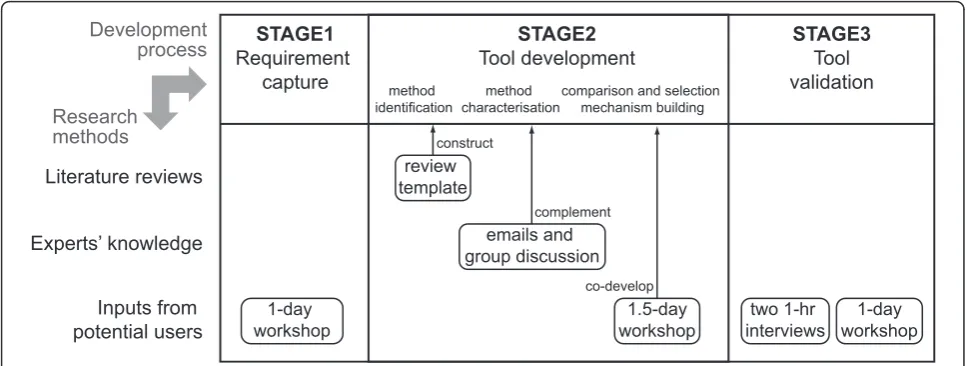
Figure 1 shows three levels of the tool development pro-cess and research methods used in each stage. The tool development was primarily based on an extensive review of the literature on the application of modelling and simulation to health care, as well as manufacturing, aerospace and military. The method-related information unobtainable from the literature review was complemen-ted by the research team’s extensive expertise in model-ling and simulation. Inputs from potential users (health care managers and modelling practitioners) were obtained to capture requirements for the tool, and co-develop and validate it mainly through workshops.
This section explains in further details the three phases of the research process: a comprehensive litera-ture review; use of expert knowledge; and inputs from potential users.
Literature review
The aim of undertaking the literature review in the RIGHT project was twofold. First, it provided an up-to-date review of simulation and modelling application in health care and other industries. Second, it fed information on the methods (what, where and how they are used) into the comparison and selection tool development. This paper is intended to show the literature review from the perspective of the tool devel-opment. The literature review methodology is briefly covered in this paper but more detailed methodology and findings can be found in separate papers [20,27,28].
In summary, the following four topics were searched to find relevant papers using refined search criteria for inclusion and exclusion:
Topic 1. Simulation and modelling in health care; Topic 2. Simulation and modelling in manufacturing industry;
Topic 3. Simulation and modelling in aerospace and military;
Topic 4. Management and planning methods in health care.
In order to provide a base for tool development, each paper was summarised using a review template which consists of the three categories and sub-fields: method (name, purposes, strength and limitations); problem (specific issue, type, functional area, layer, scenario and setting); resources (time, data, people, expertise, others).
Experts’knowledge
Inputs from potential users
Three user engagement workshops in combination with in-depth interviews were carried out to get inputs from potential users. They were by no means a formal test evaluating the effectiveness of the tool, but were meant to provide valuable insights into users’requirements for the tool.
At the early stage of the project, the potential users’ requirements for the tool were captured in a one-day workshop, where a dozen health care managers attended. The research team introduced the research objectives and project plans. Then, the health care man-agers shared their previous modelling experience and expectation for the project through group discussion.
In the middle of the project, i.e. after developing a prototype tool, the research team organized another one and a half day workshop. Sixteen delegates (nine national or local-level health care managers and seven professional modellers) attended and were asked to first review and then redesign the prototype tool. Various suggestions were made from specific wording changes to new overall comparison and selection mechanism. The prototype tool was, then, revised to reflect some of the suggestions from the workshop and printed in the form of a workbook. The workbook was redistributed by post to the health care managers for another review. Then, two one-hour following-up interviews were car-ried out with local and national level health care man-agers to investigate their responses in depth.
At the end of the project (after iterative revision of the tool), the national level health care manager at the NHS Institute of Innovation and Improvement (UK’ national institute for supporting the National Health Service transformation by developing and spreading new ways of working) wanted to use the workbook
[26] for its workshop,‘Building capability in modelling and simulation for commissioning and strategic plan-ning.’ The purpose of the workshop was to increase awareness of various modelling and simulation meth-ods and have discussion on how to build capability in these methods. Approximately sixty health care man-agers (mostly commissioners) attended a full one-day workshop. The tool in the form of the workbook was distributed to each delegate and used as a reference point for group discussion. One of the project team researchers (G. Jun) helped lead group discussion and captured the comments on the utility and usability of the tool throughout the workshop (mostly group feed-back session).
The potential users’inputs at these various occasions have been reflected in the tool presented in this paper. Besides, their inputs for the future development of the tool are summarized in the results section. Twenty-eight methods, ranging from problem structuring methods, conceptual modelling methods, mathematical modelling methods to simulation methods, were identified from a commonly applied method list in the literature and through the iterative discussions between the research team members.
Results
Method Identification
Table 1 lists simulation and modelling methods applied to different industries in order of popularity: health care; manufacturing; aerospace and military. The general management and planning methods used in health care are listed at the bottom of Table 1, with no particular order. Although the types of methods and the order of popularity were different for each industry to meet their specific needs, commonly applied methods are identified Experts’ knowledge
Literature reviews
Inputs from potential users
1-day workshop
1.5-day workshop
1-day workshop two 1-hr
interviews review
template
emails and group discussion
STAGE2
Tool development
STAGE3
Tool validation
STAGE1
Requirement capture
Development process
Research
methods construct
complement
co-develop method
identification
method characterisation
[image:3.595.56.540.89.272.2]comparison and selection mechanism building
such as Discrete Event Simulation, System Dynamics, Monte Carlo Simulation and Agent-Based Simulation.
In addition to these commonly applied methods, the research team with expertise in different methods agreed to include additional methods. Qualitative mod-elling approaches such as various problem structuring methods [29] and conceptual modelling methods [30] were especially expanded based on the expertise of the research team since these types of methods had not been extensively searched in the literature review. It was agreed to identify a broad range of indicative modelling and simulation methods in this project, rather than a full list of comprehensive methods. The method list defined in this project was also agreed to remain open to the possibility of adding or removing at the later stage.
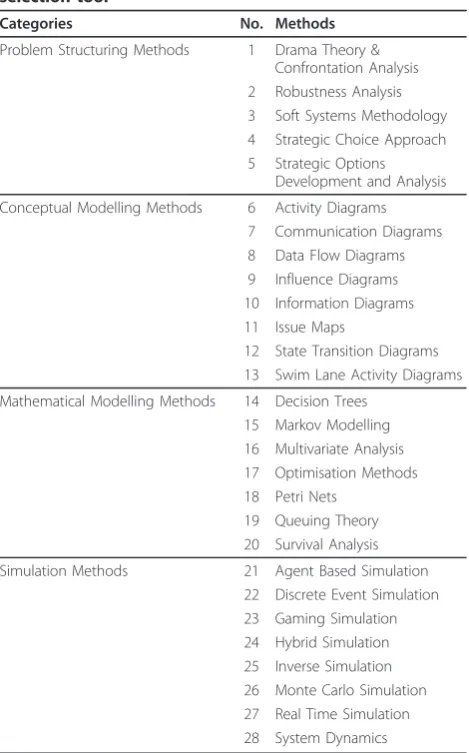
In the end, twenty eight methods were agreed and categorised into four different groups as shown Table 2: five problem structuring methods; eight conceptual modelling methods; seven mathematical modelling methods; eight simulation methods.
Method Characterisation by Application Area and Project Life Cycle Stage
First, the list of the eight application areas, drawn from MeSH Terms (Medical Subject Headings), was used for characterising the twenty eight methods (the first col-umn of Table 3). This list was considered most suitable since it covers a broad range of application area without too much overlapping and presumably uses terminology familiar to health care professionals. The lists from the different review topics were found less suitable owing to the industry-specific nature of them e.g. aerospace, mili-tary and manufacturing.
Second, theeight project life cycle stages, which were drawn from Royston [31], were used for characterising the twenty eight methods (the second column of Table 3).
The matches between the twenty eight methods and application area/project life cycle stage were initially made based on the literature and additionally
[image:4.595.58.544.101.205.2]complemented by the experts’knowledge of the research team. Figure 2 shows the matches of which methods are suitable for different combinations of project life cycle stageandapplication areausing 8 × 8 matrix. Each cell in this matrix consists of a smaller matrix (4 × 8) to
Table 1 Methods identified for each topic
Topics Primary methods identified
1. Simulation and modelling in health care
Regression Analysis, Discrete Event Simulation, Mathematical Programming/Optimisation Methods, Markov Models, Queuing Theory, Structural Equation Modelling, System Dynamics, Process Mapping,
Spatial Mapping, Monte Carlo Simulation, Cognitive Mapping, Soft Systems Methodology 2. Simulation and modelling in aerospace
and the military
Distributed Simulation, Discrete Event Simulation, System Dynamics, Real Time Simulation, Monte Carlo Simulation, Agent Based Simulation, War Gaming, Hybrid Simulation, Inverse Simulation, Petri-net,
Markovian Model, Stochastic Combat Simulation 3. Simulation and modelling in
manufacturing
Discrete Event Simulation, System Dynamics, Agent-Based Simulation, Monte-Carlo Simulation, Petri-nets, Simulation Gaming, Virtual Simulation, Distributed Simulation
4. Management and planning methods in health care
Lean, Six sigma, Rapid-cycle improvement, Theory of Constraints, Benchmarking, Focus group, Interviews, Narrative approach, Observation, Process analysis, Questionnaire survey, Cognitive task analysis, Action
research, Risk analysis
Table 2 Twenty eight methods identified for the selection tool
Categories No. Methods
Problem Structuring Methods 1 Drama Theory & Confrontation Analysis 2 Robustness Analysis 3 Soft Systems Methodology 4 Strategic Choice Approach 5 Strategic Options
Development and Analysis Conceptual Modelling Methods 6 Activity Diagrams
7 Communication Diagrams 8 Data Flow Diagrams 9 Influence Diagrams 10 Information Diagrams 11 Issue Maps
12 State Transition Diagrams 13 Swim Lane Activity Diagrams Mathematical Modelling Methods 14 Decision Trees
15 Markov Modelling 16 Multivariate Analysis 17 Optimisation Methods 18 Petri Nets
19 Queuing Theory 20 Survival Analysis Simulation Methods 21 Agent Based Simulation
[image:4.595.305.540.353.730.2]show suitable methods. The four rows of the 4 × 8 matrix correspond to the four different groups of ods: the first row to the five problem structuring meth-ods (1~5); the second row to the eight different conceptual modelling methods (6~13); the third row to the seven mathematical modelling methods (14~20); the fourth row to the eight simulation methods (21~28). For example, a problem is about managing risk by identify-ing and analysidentify-ing potential hazards and adverse occur-rences (third row:3. risk management) and at a project life cycle stage of planning new service development
(second column: 2. new service development). Then, the thick black line box in Figure 2 shows that twenty meth-ods are potentially suitable: five problem structuring methods (1~5); eight conceptual modelling methods (6~13); six mathematical modelling methods (14, 15, 16, 18 and 20); two simulation methods (23 and 28).
Methods Characterisation by Level of Insight and Type of Output
[image:5.595.58.539.100.220.2]The twenty eight methods were also characterised in terms of two different output parameters,level of insight
Table 3 Method characterisation categories by application areas and project lifecycle stages
Application areas Project lifecycle stages
1 Policy and strategy planning Identifying consumer needs for health services 2 Quality management Developing a new service to meet those needs 3 Risk management Forecasting the demand for services
4 Financial management Allocating resources for delivering services
5 Facility planning Developing plans that will use these resources in delivering services 6 Personnel management Developing criteria for delivery performance
7 Technology management Managing the performance of delivery 8 Information/material management Evaluating the results of health care delivery
2 3 4 5 9 11
28 1 2 3 4 5
9 11 14 15 18
23 28 15 18
28
9 11 14 15 18 21 22 24 26
9
21 22 23 24 26
9
14 15 18 15 18
3
22 24 1 2 3 4 5
9 11
28 1 2 3 4 5 6 7 8 9 10 11 12 13 14 15 16 18 20
23 28
15 16 18 20 28
9 11 13 14 15 16 18 20 21 22 24 26
6 7 8 9 10 11 12 13
21 22 23 24 26 27
8 9 10
14 15 16 18 15 16 18 27
3
16 22 24 1 2 3 4 5
9 11
28 1 2 3 4 5 6 7 8 9 10 11 12 13
15 20 28
15 20 28
9 11 12 13 15 20 21 26
6 7 8 9 10 11 12 13
21 26
8 9 10
15 15
3
1 2 3 4 5 11
28 1 2 3 4 5
11 15 17 18 20
23 28
15 18 20 28
11 15 17 18 20
21 22 24 26 21 22 23 24 26 27
15 18 15 18 27
3
22 24 1 2 3 4 5
28 1 2 3 4 5 6 8 14 15 16 17 18 19
23 28
15 16 18 19 28
14 15 16 17 18 19 21 22 24 26
6 8
21 22 23 24 26 27 8
14 15 16 18 19 15 16 18 19 27
3
16 22 24 1 2 3 4 5
9 11
28 1 2 3 4 5 6 7 9 10 11 13
15 20 28
15 20 28
9 11 13 15 20
6 7 9 10 11 13
27
9 10
15 15
27 3
1 2 3 4 5 9 11
28 1 2 3 4 5
8 9 10 11 15 20 23 28 15 20 28 9 11 15 20 21 22 26
8 9 10 13
21 22 23 25 26
8 9 10
15 15
3
22 25 1 2 3 4 5
9 11
28 1 2 3 4 5 6 7 8 9 10 11 13 14 15
28 15
28
9 11 13 14 15
21 22 26
6 7 8 9 10 13
21 22 26
8 9 10 14 15 15
3
22 1
Project life cycle stage
1. Needs and issues identification
2. New service development 3. Demand forecasting 4. Resource allocation 5. tation plan 6. Performance criteria development 7. Performance management 8. Performance evaluation Application area 1. Policy and strategy 2. Quality management 3. Risk management 4. Financial management 5. Facility planning 6. Personnel management 7. Technology management 8. Information /material management
1 2 3 4 5 6 7 8 910 11 13 14 15
28 12 19 23 16 17 18 20 22 24 25 2627 21
Problem structuring methods Conceptual modelling methods Mathematical modelling methods Simulation methods
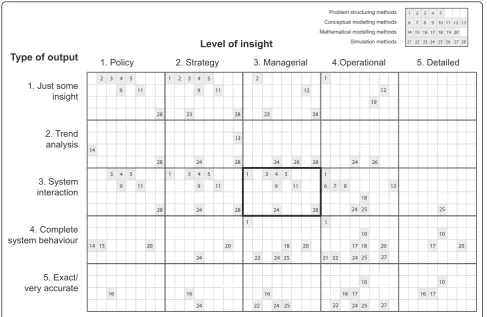
[image:5.595.59.543.392.713.2]andtype of output. The definitions of the five attributes for each output parameter are summarised in Appendix 1. Figure 3 shows the matches of which methods are suitable for different combination of level of insightand
type of outputusing 5 × 5 matrix in the same way with Figure 2. For example, you expect outputs at managerial
level of insight(third column: 3. managerial) and want a relatively well-characterised view of the system and how it interacts with the rest of the health care system (third column: 3. system interaction). Then the thick black line box in Figure 3 shows that eight methods are potentially suitable: four problem structuring methods (1, 3, 4 and 5); two conceptual modelling methods (9 and 11); two simulation methods (24 and 28).
Method Characterisation by Four Input Resources
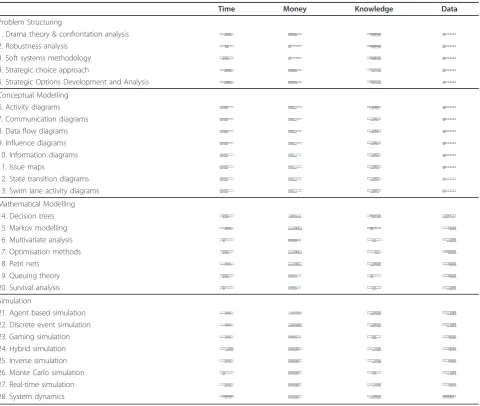
The twenty eight methods were characterised by four different input resource parameters such as time, money, knowledge and data. A five scale index was used to show the ranges of the requirements for each para-meter and help users promptly compare them between different methods. Table 4 shows the five scale indices for each parameter, which were determined through internal discussion between the research team and con-sultation with health care professionals [32]. Our
intention was to determine input requirement ranges for conventional application rather than quick-and-dirty application.
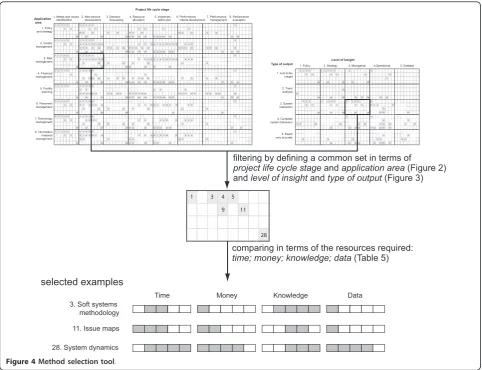
Time is the amount of time required with expertise available, whereas money is the amount of money required to purchase hardware, software and expertise.
Knowledgeis not knowledge about specific methods, but qualitative knowledge about problems.Data refers to quantitative data required. The definitions of the former two input parameters (time and money) are straightfor-ward as shown in Table 4, but the definitions of the lat-ter two input paramelat-ters (knowledge and data) are summarised in detail in Appendix 2.
Table 5 shows the ranges of the requirements for each method and identifies constraints on the use of candi-date methods. For example, one of the simulation meth-ods, 28. System Dynamics is indexed to require the following ranges of the resources: from as short as days to more than a year; from as small as £10s to £10,000s; from moderate to complete knowledge about problems; from no quantitative data to good statistics.
Method Comparison and Selection Mechanism Building
Figure 4 shows a two-stage method comparison and selec-tion mechanism using two matrices (Figures 2 and 3) and 2 3 4 5
9 11
28
1 2 3 4 5
9 11
23 28 28
28
13
28 28 24 26
3 4 5
9 11
28
1 3 4 5
9 11
28 28
13
20 18 20 17 18 20
21 22 24
16 16 16 17
24 14
20 14 15
16
24
24
24
24
2
23
12
24 26
3 4 5
9 11
24 1
1
22 24
22 24 25
1
12
19
1
7 6 8
18
24 25
25 1
10
22
27
25 10
27 25
Level of insight
1. Policy 2. Strategy 3. Managerial 4.Operational
Type of output
1. Just some insight
2. Trend analysis
3. System interaction
4. Complete system behaviour
5. Exact/ very accurate
17 20
16 17 25
10
10 5. Detailed
1 2 3 4 5 6 7 8 9 10 11 13 14 15
28 12 19 23 16 17 18 20 22 24 25 26 27 21
Problem structuring methods
Conceptual modelling methods
Mathematical modelling methods
[image:6.595.55.543.88.405.2]Simulation methods
one table (Table 5). The first stage is to filter potential methods using two matrices (Figures 2 and 3) and the sec-ond stage is to compare the filtered methods in terms of the four resource requirements (time, money, knowledge and data).
The tool is designed to assist selection and compari-son of methods appropriate to supporting particular
[image:7.595.55.542.101.199.2]problem situation. For example, a team of health care professionals face the challenge of identifying potential hazards and adverse occurrences (application area: risk management) when planning a new service development (project life cycle stage: new service development). They want to understand how their new services would inter-act with the rest of the services (type of output: system
Table 4 Method characterisation categories by input resource requirements
Five scale
Input parameters 1 2 3 4 5
Time hours
(t≤a day)
days (a day < t≤a week)
weeks (a week < t≤a month)
months (a month < t≤a year)
years (t > a year)
Money £tens
(m≤£100)
£hundreds (£100 < m≤£1 k)
£thousands (£1 k <m≤£10 k)
£10 thousands (£10 k < m≤£100 k)
£100 thousands (m > £100 k)
Knowledge None Limited Moderate Expert Complete
Data None Guesstimate Some raw Good statistics All types
Table 5 Method characterisation by the range the input resources required
Time Money Knowledge Data
Problem Structuring
1. Drama theory & confrontation analysis 2. Robustness analysis
3. Soft systems methodology 4. Strategic choice approach
5. Strategic Options Development and Analysis Conceptual Modelling
6. Activity diagrams 7. Communication diagrams 8. Data flow diagrams 9. Influence diagrams 10. Information diagrams 11. Issue maps
12. State transition diagrams 13. Swim lane activity diagrams Mathematical Modelling 14. Decision trees 15. Markov modelling 16. Multivariate analysis 17. Optimisation methods 18. Petri nets
19. Queuing theory 20. Survival analysis Simulation
[image:7.595.59.540.326.732.2]interaction) at a managerial level (level of insight: man-agerial). Then, the corresponding common set from two matrices (Figures 2 and 3) shows seven potential methods (1, 3, 4, 5, 9, 11 and 28) as in Figure 4.
The team has not much quantitative data, but they think they know the problems relatively well. Taking into account these constraints, influence diagrams or
issue maps can be applied with moderate investment of
time (hours~months) and money (£tens~hundreds). If data, time and money more available, system dynamics
can be applied, which can additionally support trend analysis. This comparison and selection process enables the selection of methods most suited to the needs and constraints of the particular decision process.
Tool Validation
Many of the inputs from the co-development workshop were reflected in the current tool, but in-depth inter-views and additional workshop provided insight into what is this tool for and how to improve it. What echoed around between the potential users was that the
tool was very informative rather than prescriptive. The tool that put a broad range of modelling and simulation methods together with a consistent structure was con-sidered very instrumental in increasing awareness of var-ious methods and their differences. However, many considered that the tool needs to be further improved to convince them to use for the selection of methods. The comments on the further tool development are sum-marised into the following three main aspects.
First, it was observed that the tool, although originally intended to help identify appropriate methods to pro-blem solving, needs to aid more in propro-blem structuring. A more systematic and phased approach was suggested to understand/formulate problems first before deciding whether or which modelling and simulation may apply. To do that, more exhaustive questions on the symptoms of the problems or the use of the problem structuring methods were proposed to be applied as a part of the tool.
Second, additional information on each method was suggested crucial to the intended use of the tool. In the
2345 9 11
28 12345
9 11
23 28 28
28 13
28 28 24 26 345
9 11 28
1 345 9 11
28 28
13
20 18 20 17 18 20 21 22 24
16 16 16 17
24 14 20 14 15 16 24 24 24 24 2 23 12 24 26 345
9 11 24 1
1
22 24
22 24 25 1 12 19 1 7 6 8 18 24 25 25 1 10 22 27 25 10 27 25
Level of insight
1. Policy 2. Strategy 3. Managerial 4.Operational
Type of output
1. Just some insight 2. Trend analysis 3. System interaction 4. Complete system behaviour 5. Exact/ very accurate 17 20 16 17 25 10 10 5. Detailed 2345
9 11 28
12345 9 11 14 15 18
23 28 15 18
28 9 11 14 15 18 21 22 24 26
9 21 22 23 24 26
9 14 15 18 15 18
3
22 24 12345
9 11 28
12345 678910 11 12 13 14 15 16 18 20
23 28 15 16 18 20
28 9 11 13 14 15 16 18 20 21 22 24 26
678910 11 12 13 21 22 23 24 26 27
8910 14 15 16 18 15 16 18
27 3 16 22 24 12345
9 11 28
12345 678910 11 12 13
15 20 28
15 20 28
9 11 12 13 15 20 21 26
678910 11 12 13 21 26
8910
15 15
3
12345 11
28 12345
11 15 17 18 20
23 28 15 18 20
28 11 15 17 18 20 21 22 24 26 21 22 23 24 26 27
15 18 15 18 27
3
22 24 12345
28 12345 6 8 14 15 16 17 18 19
23 28 15 16 18 19
28 14 15 16 17 18 19 21 22 24 26
6 8 21 22 23 24 26 27
8
14 15 16 18 19 15 16 18 19 27
3 16 22 24 12345
9 11 28
12345 67 910 11 13
15 20 28
15 20 28
9 11 13 15 20
67 910 11 13 27
910
15 15
27 3
12345 9 11
28 12345
8910 11 15 20 23 28 15 20 28 9 11 15 20 21 22 26
8910 13 21 22 23 25 26
8910
15 15
3
22 25 12345
9 11 28
12345 678910 11 13 14 15
28 15
28 9 11 13 14 15 21 22 26
678910 13 21 22 26
8910 14 15 15
3
22 1
Project life cycle stage
1. Needs and issues
identification 2. New service development 3. Demand forecasting 4. Resource allocation 5. Implemen- tation plan 6. Performance criteria development7. Performance management8. Performance evaluation
Application area 1. Policy and strategy 2. Quality management 3. Risk management 4. Financial management 5. Facility planning 6. Personnel management 7. Technology management 8. Information /material management 1
filtering by defining a common set in terms of
project life cycle stage and application area (Figure 2) and level of insight and type of output (Figure 3)
comparing in terms of the resources required:
time; money; knowledge; data (Table 5)
11
28
3. Soft systems methodology
11. Issue maps
28. System dynamics
3 4 5 9
Time Money Knowledge Data
[image:8.595.57.540.88.458.2]selected examples
workbook presentation of the tool [26], each method was additionally described briefly in a page per method regarding its typical functions, purposes and example
application areas. However, more specific case examples describing how and where each method was applied were considered essential to convince users to push for-ward with selected methods. In addition, information proving the reliability/authenticity of selected methods such as reference to literature or experts was considered important. Information on practical supports for method application was also suggested needed such as modelling tools and modelling expertise in commercial and aca-demic communities.
Third, there were divergent opinions about the scope of methods. One group of the participants suggested that the current aim for a generic tool across health care may be overambitious. They suggested that the tool be more specific to certain problems and target users, e.g. com-missioning, waiting-time target. On the other hand, the other group suggested including general change manage-ment methods as well so that they can have a better understanding how the modelling and simulation meth-ods fit with their existing management tools.
Discussion
Contributions of the research
We are still far from a definitive tool, if such a tool is indeed possible, but believe that the tool makes a contri-bution in two major ways. The first is to fill a research practice gap in evidence-based health care management [22] by providing a practical support for the method comparison and selection. Not only can the tool help health care professionals commission more appropriate modelling work, but may also assist health care ling consultants and researchers to expand their model-ling repertoire in order to meet the diverse needs of their health care clients. Research shows that modelling practitioners and researchers tend to select their approaches based on previous experience and compe-tences, despite awareness of other methods [33-35]. They also tend to select from within either a ‘hard (quantitative)’or‘soft (qualitative)’paradigm, when they use a number of approaches [36]. Whether the tool helps health care managers find better methods to aid decision-making remains to be seen, but the early feed-back from the potential users has been positive and gave valuable insight into the further development.
The second contribution is that the development of the tool has also highlighted significant gaps in knowl-edge which could be usefully filled. Building the tool from the extant literature proved challenging because studies were often vague when reporting their modelling and simulation process, meaning that information on input resource requirements, such as time, money and
data, was often missing. These are important gaps in knowledge when assessing the applicability of particular approaches to health care, where modelling and simula-tion skills are scarce let alone money and time.
Extensions to the research
In spite of many debates and discussions throughout the tool development process, we identified the following two research areas to be further addressed.
First, during the development of the tool it became clear that more efforts need to be made in defining the “problem space.” Figure 2 shows that the application area does not effectively differentiate the methods, whereas the project life cycle stage better differentiates the methods. It means that the application area used in the tool clearly do not capture the complexity and vari-ety faced by health care managers from the perspective of modelling and simulation application, and nor is there an existing literature which provides adequate insight. Identifying effective parameters and developing meaningful categories requires further characterisation and differentiation by different aspects of problem types. Taxonomy of more specific problem types was sug-gested to be further developed from the current applica-tion area categories and added to the future tool so that candidate methods can be mapped to more specific pro-blem situations. It can also help specify the input resources required and the outputs expected for each method in specific problem situation.
Second, whether and how a comparison and selection tool of this type will actually encourage them increase the range of methods they apply to a problem is an empirical question which we hope to further investigate in time. In the same context, the interface design of this tool, i.e. how different interfaces interact with users dur-ing the method comparison and selection, remains an important question that need to be further addressed. In general, health care managers we engaged showed more interest in informative interactions rather than defini-tive. For example, the two matrices could be informative since they allow users to effectively explore not only methods filtered from their problem and output tions, but also alternative methods around their defini-tions. The provision of such overall information was considered to help users redefine their problem and out-put and learn about capabilities of different methods. Further research in understanding usability and utility of different information visualisation/presentation is needed for the tool to be genuinely accepted by health care users.
Conclusions
professionals to commission more appropriate modelling work and health care modelling practitioners or researchers to broaden their selection of methods appro-priate to supporting specific decision making processes. In particular it addresses the issue of which method is most appropriate to which specific health care manage-ment problem, what the user might expect to be obtained from the method, and what is required to use the method. In summary, we believe the tool adds value to the scarce existing literature on methods comparison and selection. However, we also recognise the limita-tions of the tool, many of which are reflected in the feedback from the potential users: a more structured problem formulation/structuring stage; and more detailed case examples. Further research is proposed to help address these issues by evaluating and refining the tool closely with healthcare professionals.
Appendices
Appendix 1 Definitions of the five attributes of two output parameters
• Level of insight: what level of insight do you require from the modelling?
1) Policy: decisions made at national or regional level, e.g. design of public health initiatives with long-term impact such as cancer screening programmes
2) Strategy: major decisions with medium-term impact, e.g. permanently closing a hospital ward, buying an MRI scanner or opening a Walk-in Centre
3) Managerial: e.g. determining nursing staff levels across different specialties in a hospital 4) Operational: e.g. deciding how many fracture clinics to run per week, or how many ICU beds to staff
5) Detailed: e.g. nurse rostering or operating theatre list scheduling
• Level of detail: what level of detail do you require from the modelling?
1) Just some insight: I need to be able to link causes and effects in a general way
2) Trend analysis: I would like to do some simple what-if analysis and to predict any adverse out-comes and patient flows
3) System interactions: I want a relatively well-characterised view of my system and how it interacts with the rest of the health care system
4) Complete system behaviour: I need to under-stand the complete behaviour of my system and make accurate predictions in terms of intended and unintended outcomes
5) Exact/very accurate: I want an accurate real-time representation of my system running to support an operational decision
Appendix 2 Definitions of five scales of two input parameters
•Knowledge: what knowledge do you or others have of this problem?
1) New problem: I have no prior knowledge of this problem
2) Limited knowledge: I understand some aspects of this problem, but not others
3) Moderate knowledge: I have access to relevant expertise relating to this problem, but my views of the wider implications are not clear
4) Expert knowledge: I have access to expertise regarding this problem
5) Complete knowledge: I have access to a team of experts capable of understanding this problem •Quantitative data: what data do you have in order to inform this decision-making?
1) None: I do not have any quantitative data 2) Guesstimate: I can guess a number of vari-ables and have a feel for some trends
3) Some raw data: I am an expert in the field and have access to expert views and some relevant statistics
4) Good statistics: I have good statistics on all aspects of this service, including financial and operational histories
5) Access to all types of data: I can furnish any data that is required and have access to all rele-vant expertise
Acknowledgements
The authors would like to thank all the RIGHT team members for their support and contributions to discussion. We also acknowledge support for this work from the Engineering and Physical Sciences Research Council (award reference EP/E019900/1). Any views or opinions presented herein are those of the author(s) and do not necessarily represent those of RIGHT, its associates or its sponsors.
Author details
1Loughborough Design School, Loughborough University, Loughborough, LE11 3TU, UK.2Engineering Department, University of Cambridge, Trumpington Street, Cambridge CB2 1PZ, UK.3Business School, Brunel University, Uxbridge, Middlesex UB8 3PH, UK.4School of Mathematics, Cardiff University, Senghennydd Road, Cardiff CF24 4AG, UK.5School of
Management, University of Southampton, Southampton SO17 1BJ, UK. Authors’contributions
authors were involved in drafting, revising and approving the final submitted manuscript.
Competing interests
The authors declare that they have no competing interests.
Received: 14 September 2010 Accepted: 19 May 2011 Published: 19 May 2011
References
1. Dangerfield BC:System dynamics applications to European health care issues.Journal of the Operational Research Society1999,50:345-353. 2. Harvey S, Liddell A, McMahon L:Windmill 2007: The future of health care
reforms in EnglandLondon: King’s Fund; 2007.
3. Pitt M:Simulation for Strategic Planning in Healthcare: The State of the Art.[http://www.institute.nhs.uk/images//documents/BuildingCapability/ ScenarioGenerator/state-of-the-art.pdf].
4. Taylor-Robinson DC, Milton B, Lloyd-Williams F, O’Flaherty M, Capewell S:
Planning ahead in public health? A qualitative study of the time horizons used in public health decision-making.BMC Public Health2008,
8:415.
5. Reid PP, Compton WD, Grossman JH, Fanjiang G, (Eds.):Building a better delivery system: a new engineering/health care partnership.Washington DC: National Academies Press; 2005.
6. Brailsford SC, Harper P, Patel B, Pitt M:Healthcare literature and classifications.Proceedings of 34th Annual meeting and conference of Operational Research Applied to Health Services (ORAHS34)Toronto, Canada; 2008.
7. Fone D, Hollinghurst S, Temple M, Round A, Lester N, Weightman A, Roberts K, Coyle E, Bevan G, Palmer S:Systematic review of the use and value of computer simulation modelling in population health and health care delivery.J Public Health Med2003,25:325-335.
8. Sinreich D, Marmor Y:Emergency department operations: The basis for developing a simulation tool.IIE Transactions2005,37:233-245. 9. NHS Institute for Innovation and Improvement:Process Modelling and
Simulation.[http://www.institute.nhs.uk/scenariogenerator/general/ process_modelling_and_simulation.html].
10. Department of Health: World Class Commissioning: Competencies: 2008. 11. Harper PR, Pitt M:On the challenges of healthcare modelling and a
proposed project life cycle for successful implementation.Journal of the Operational Research Society2004,55:657-661.
12. Barnes CD, Benson C, Quiason JL, McGuiness D:Success stories in simulation in health care.InWinter Simulation Conference; Atlanta, Georgia, USAEdited by: Andradottir S, Healy KJ, Withers DH, Nelson BL 1997. 13. Singh AJ, May PRA:Acceptance of operations research/systems analysis
in the health care field.Interfaces1977,7:79-86.
14. Linder JA, Rose AF, Palchuk MB, Chang F, Schnipper JL, Chan JC, Middleton B:Decision support for acute problems: The role of the standardized patient in usability testing.Journal of Biomedical Informatics 2006,39:648-655.
15. Connell N:Evaluating soft OR: some reflections on an apparently unsuccessful implementation using a soft systems methodology (SSM) based approach.Journal of the Operational Research Society2001,
52:150-160.
16. Lattimer V, Brailsford S, Turnbull J, Tarnaras P, Smith H, George S, Gerard K, Maslin-Prothero S:Reviewing emergency care systems I: insights from system dynamics modelling.Emergency Medicine Journal2004,21:685-691. 17. King’s Fund:PARR Case Finding Tool.[http://www.kingsfund.org.uk/
current_projects/predicting_and_reducing_readmission_to_hospital/ #inbrief].
18. C-Port: Chemotherapy Planning Oncology Resource Tool.[http://www. abpi.org.uk/our-work/library/medical-disease/Documents/CPORTBrochure. pdf].
19. The Scenario Generator Project: Learning Capture for Phase 1b.[http:// www.institute.nhs.uk/scenariogenerator/general/
what_is_the_scenario_generator.html].
20. Brailsford SC, Harper P, Patel B, Pitt M:An analysis of the academic literature on simulation and modelling in healthcare.Journal of Simulation2009,3:130-140.
21. Lane DC, Monefeldt C, Husemann E:Client involvement in simulation model building: hints and insights from a case study in a London hospital.Health Care Management Science2003,6:105-116. 22. Walshe K, Rundall TG:Evidence-based management: from theory to
practice in health care.Milbank Quarterly2001,79:429-457, IV-V. 23. Haynes RB:What kind of evidence is it that evidence-based medicine
advocates want health care providers and consumers to pay attention to?BMC Health Services Research2002,2:1-7.
24. Begun JW:Realistic evidence-based management.Health Care Management Review2009,34:214-215.
25. Arndt M, Bigelow B:Evidence-based management in health care organizations: A cautionary note.Health Care Management Review2009,
34:206-213.
26. Jun GT, Clarkson J, (Eds.):Modelling and simulation techniques for supporting healthcare decision making: a selection framework.
Cambridge, UK: Engineering Design Centre, University of Cambridge;, 2 2009.
27. Jahangirian M, Eldabi T, Garg L, Jun GT, Naseer A, Patel B, Stergioulas L, Young T:A rapid review method for extremely large corpora of literature: Applications to the domains of modelling, simulation, and management.International Journal of Information Management2011,
31:234-243.
28. Naseer A, Eldabi T, Jahangirian M:Cross-sector analysis of simulation methods: a survey of defense and healthcare.Transforming Government: People, Process and Policy2009,3:181-189.
29. Rosenhead J, Mingers J, (Eds.):Rational analysis for a problematic world revisited.Chichester: John Wiley & Sons Ltd;, Second 2001.
30. Jun GT, Ward J, Morris Z, Clarkson PJ:Health care process modelling: which method when?International Journal for Quality in Health Care2009,
21:214-224.
31. Royston G:Shifting the balance of care into the 21st century.In Proceedings of ORAHS21 Conference: Managing health care under resource constraints; Eindhoven.Edited by: Kastelein A, Vissers J, Merode GGv, Delesie L. Eindhoven University Press; 1995:45-59.
32. Naseer A, Eldabi T, Young T:RIGHT: A toolkit for selecting healthcare modelling methods.Journal of Simulation2010,4:2-13.
33. Brocklesby J:Let the jury decide: assessing the cultural feasibility of total systems interventions.Systems Practice1994,7:75-86.
34. Ormerod J:Mixing Methods in Practice.InRational Analysis for a Problematic World Revisited..2 edition. Edited by: Rosenhead J, Mingers J. Chichester: John Wiley 2001:311-336.
35. Corbett CJ, Overmeer JAM, van Wassenhoe LN:Strands of practice in OR (the practitioner’s dilemma).Operational Research in Europe1999,
87:484-499.
36. Munro I, Mingers J:The use of multimethodolgy in practice-results of a survey of practitioners.Journal of the Operational Research Society2002,
53:369-378. Pre-publication history
The pre-publication history for this paper can be accessed here: http://www.biomedcentral.com/1472-6963/11/108/prepub
doi:10.1186/1472-6963-11-108
Cite this article as:Junet al.:Development of modelling method
selection tool for health services management: From problem
structuring methods to modelling and simulation methods.BMC Health