ISSN 0252-8266
1
eurostat
EUROSTATISTIK
Daten zur Konjunkturanalyse
EUROSTATISTICS
Data for short-term economic analysis
EUROSTATISTIQUES
Données pour l'analyse de la conjoncture
Monatlich D Monthly Π Mensuel
7 D 1992
eurostat
OFICINA ESTADÍSTICA DE LAS COMUNIDADES EUROPEAS
DE EUROPÆISKE FÆLLESSKABERS STATISTISKE KONTOR
STATISTISCHES AMT DER EUROPÄISCHEN GEMEINSCHAFTEN
ΣΤΑΤΙΣΤΙΚΗ ΥΠΗΡΕΣΙΑ ΤΩΝ
ΕΥΡΩΠΑΪΚΩΝ ΚΟΙΝΟΤΗΤΩΝ
STATISTICAL OFFICE OF THE EUROPEAN COMMUNITIES
OFFICE STATISTIQUE DES
COMMUNAUTÉS EUROPÉENNES
ISTITUTO STATISTICO DELLE COMUNITÀ EUROPEE
BUREAU VOOR DE STATISTIEK DER EUROPESE GEMEENSCHAPPEN
SERVIÇO DE ESTATÍSTICA DAS COMUNIDADES EUROPEIAS
L2920 Luxembourg Tél. 43011 Télex : Comeur Lu 3423
B1049 Bruxelles, bâtiment Berlaymont, rue de la Loi 200 (bureau de liaison) Tél. 2351111
Las publicaciones de Eurostat están clasificadas por temas y por series. La clasificación se encuentra al
final de la obra. Para mayor información sobre las publicaciones, rogamos se pongan en contacto con
Eurostat.
Para los pedidos, diríjanse a las oficinas de venta cuyas direcciones figuran en la página interior de la
contracubierta.
Eurostats publikationer er klassificeret efter emne og serie. En oversigt herover findes bag i hæftet.
Yderligere oplysninger om publikationerne kan fås ved henvendelse til Eurostat.
Bestilling kan afgives til de salgssteder, der er anført på omslagets side 3.
Die Veröffentlichungen von Eurostat sind nach Themenkreisen und Reihen gegliedert. Die Gliederung ist
hinten in jedem Band aufgeführt. Genauere Auskünfte über die Veröffentlichungen erteilt Eurostat.
Ihre Bestellungen richten Sie bitte an die Verkaufsbüros, deren Anschriften jeweils auf der dritten
Umschlagseite der Veröffentlichungen zu finden sind.
Οι
εκδόσεις της Eurostat ταξινομούνται κατά θέμα και κατά σειρά. Η ακριβής ταξινόμηση αναφέρεται στο
τέλος κάθε έκδοσης. Για λεπτομερέστερες πληροφορίες σχετικά με τις εκδόσεις, μπορείτε να απευθύνεσθε
στην Eurostat.
Για τις παραγγελίες μπορείτε να απευθύνεσθε στα γραφεία πώλησης, των οποίων οι διευθύνσεις αναγράφονται
στη σελίδα 3 του εξωφύλλου.
Eurostat's publications are classified according to themes and series. This classification is indicated at the
end of the publication. For more detailed information on publications, contact Eurostat.
Orders are obtainable from the sales offices mentioned on the inside back cover.
Les publications d'Eurostat sont
classées par thème et par série. Cette classification est précisée à la fin
de l'ouvrage. Pour des informations plus détaillées sur les publications, contactez Eurostat.
Pour les commandes, adressez-vous aux bureaux de vente dont les adresses sont indiquées à la page 3
de la couverture.
Le pubblicazioni dell'Eurostat sono classificate per tema e per serie. Tale classificazione è precisata alla
fine dell'opera. Per informazioni più dettagliate sulle pubblicazioni rivolgersi all'Eurostat.
Per eventuali ordinazioni rivolgersi a uno degli uffici di vendita i cui indirizzi figurano nella 3
apagina
della copertina.
De publikaties van Eurostat zijn ingedeeld naar onderwerp en serie. Deze indeling is achter in het boek
opgenomen. Voor nadere informatie over de publikaties kunt u zich wenden tot Eurostat.
Gelieve bestellingen op te geven bij de verkoopbureaus, waarvan de adressen op bladzijde 3 van de
omslag zijn vermeld.
EUROSTATISTIK
Daten zur Konjunkturanalyse
EUROSTATISTICS
Data for short-term economic analysis
EUROSTATISTIQUES
Données pour l'analyse de la conjuncture
ACHTUNG: Analyse und Kommentar auf S. 5
ATTENTION: Analysis and commentary on p. 9
ATTENTION: Analyse et commentaires à la page 13
Luxembourg: Office des publications officielles des Communautés européennes, 1992
© EGKS-EWG-EAG, Brüssel — Luxemburg, 1992
Nachdruck — ausgenommen zu kommerziellen Zwecken — mit Quellenangabe gestattet.
© ECSC-EEC-EAEC, Brussels — Luxembourg, 1992
Reproduction is authorized, except for commercial purposes, provided the source is acknowledged.
© CECA-CEE-CEEA, Bruxelles — Luxembourg, 1992
Reproduction autorisée, sauf à des fins commerciales, moyennant mention de la source.
Vorwort
Mit der monatlich erscheinenden Veröffentlichung „Eurostatistik" - Daten zur
Konjunk-turanalyse werden innerhalb kürzester Frist die neuesten statistischen Daten über die
Europäische Gemeinschaft als Ganzes (EUR 12), über jedes Mitgliedsland sowie über
die Vereinigten Staaten und Japan bekanntgegeben.
„Eurostatistik" enthält nicht die Gesamtheit des bei Eurostat verfügbaren statistischen
Materials, sondern eine Auswahl der relevantesten Reihen über die konjunkturelle
Ent-wicklung.
Die Reihen werden jeweils für die letzten 15 Monate, die letzten fünf Quartale und die
letzten vier Jahre veröffentlicht, um eine kurz- oder mittelfristige Analyse -
gegebenen-falls mit überarbeiteten Zahlen - zu ermöglichen.
Schnelligkeit und Pünktlichkeit sind die wichtigsten Vorzüge dieser Veröffentlichung.
Aus diesem Grunde wurde sie im Umfang bewußt klein gehalten und enthält keine
Anmerkungen zur Methodik, die im übrigen in den spezialisierten Veröffentlichungen
von Eurostat zu finden sind.
„Eurostatistik" besteht aus drei Teilen:
- Die Rubrik „kurz notiert" gibt die wichtigsten Ereignisse und Entwicklungen der
jüngsten Zeit im wirtschaftlichen, finanziellen und sozialen Bereich wieder.
- Im Schaubilderteil werden die wichtigsten Reihen über die wirtschaftliche
Entwick-lung in der Gemeinschaft, den Mitgliedstaaten, den Vereinigten Staaten und Japan
veranschaulicht.
- Im Konjunkturdatenteil werden die Daten, die von Eurostat auf der Grundlage
gemeinsamer Kriterien harmonisiert wurden, für sämtliche Mitgliedstaaten
darge-stellt und mit den Daten der Vereinigten Staaten und Japans verglichen.
Die in „Eurostatistik" veröffentlichten Daten stammen aus dem ,,ICG"-Bereich der
On-Iine-Datenbank „Cronos" von Eurostat.
Wer Zugang zu Cronos besitzt, kann jederzeit die Tabellen dieser Veröffentlichung
abfragen, wobei die Daten täglich auf den neuesten Stand gebracht werden. Hinweise zur
„on-line"-Benutzung finden sich auf der letzten Seite.
Weitere Informationen über „Eurostatistik" können bei folgender Stelle angefordert
werden:
1
Inhaltsverzeichnis
Zeichen und Abkürzungen
„KURZ NOTIERT"
SCHAUBILDER .
KONJUNKTURDATEN
1. Volkswirtschaftliche Gesamtrechnungen
2. Beschäftigung
3. Arbeitslosigkeit
4. Industrielle Produktion
5. Meinungsumfrage in der Industrie
6. Industrieerzeugnisse
7. Einzelhandel
8. Landwirtschaftliche Erzeugnisse
9. Außenhandel
10. Verbraucherpreise
11. Landwirtschaftliche Erzeugerpreise
12. Löhne und Gehälter
13. Finanzstatistiken
14. Zahlungsbilanz
5
15
35
38
41
44
51
55
59
60
62
83
86
87
88
92
Eurostat ¡st dabei, ein neues System der konjunkturellen Infor
mation bereitzustellen.
In diesem Zusammenhang wird der Teil „Ländertabellen" ab der
Nummer 2/92 dieser Veröffentlichung nur noch entweder on line
oder auf Diskette verfügbar sein.
%
%,
T4/T0
%,T12/T0
%,T/T12
%,SALDO
1965=100
EUR 10= 100
EUR 12= 100
MIO
MRO
Τ
TR0EE
GWH
M3
Β
DK
D
GR
E
F
IRL
I
L
NL
Ρ
UK
USA
JAP
USD
ECU
SZR
EG
Eurostat
EUR 10 I
EUR 12 I
UEBL/BLEU
ACP
ESVG
NACE
SITC
Weniger als die Hälfte der verwendeten
Einheit
Prozent
Prozentualer Zuwachs eines Vierteljahres
gegenüber dem entsprechenden Vierteljahr
des Vorjahres
Prozentualer Zuwachs eines Monats
gegenüber dem entsprechenden Monat
des Vorjahres
Saldo zwischen den positiven Antworten
(Zunahme, Verbesserung der Situation) und
den negativen Antworten (Abnahme,
Verschlechterung der Situation) der
Konjunkturbefragung bei den
Unternehmern in der Gemeinschaft,
Saisonbereinigt (Ländertabellen)
Basisjahr
Prozentuale Angaben im Verhältnis zur
Gemeinschaft der 10 oder 12 ( = 100)
Million
Milliarde
Metrische Tonne
Tonne Rohöleinheiten
Gigawattstunde = 10
6kWh
Kubikmeter
Belgique/België
Danmark
BR Deutschland
Ελλάδα/Griechenland
España
France
Ireland
Italia
Luxembourg
Nederland
Portugal
United Kingdom
United States of America
Japan
US-Dollar
Europäische Währungseinheit
Sonderziehungsrechte
Europäische Gemeinschaft[en]
Statistisches Amt der Europäischen
Gemeinschaften
Gesamtheit der Mitgliedsländer der
Europäischen Gemeinschaften vor bzw.
nach dem Beitritt Spaniens und Portugals
Belgisch-luxemburgische Wirtschaftsunion
Länder Afrikas, der Karibik und des Pazifiks
— Abkommen von Lomé
Europäisches System Volkswirtschaftlicher
Gesamtrechnungen
Allgemeine Systematik der
Wirtschaftszweige in den Europäischen
Gemeinschaften
KURZ NOTIERT
m
Soweit nicht anders angegeben, beziehen sich die Angaben auf den Gebietsstand der Bundesrepublik Deutschland vor dem 3. 10. 1990; sie schließen Berlin (West) ein.
WECHSELKURSE: Dollar verliert weiterhin an Wert
Auch im Mai verlor der US-Dollar gegenüber den in dieser Veröffentlichung erfaßten
Wahrungen an Wert. Am stärksten ging er gegenüber dem portugiesischen Escudo und
dem Pfund Sterling zurück, am wenigsten gegenüber der griechischen Drachme.
Der Dollar-Kurs ging im Mai gegenüber den hier erfaßten Währungen um durchschnittlich
2,1 % zurück, war damit aber immer noch höher als am Jahresanfang. Der Wertverlust der
amerikanischen Währung setzte sich jedoch in den ersten Juniwochen fort; am 24. Juni
1992 schloß der Dollar in London bei DM 1,552, fast 8 % unter dem am 20. März
verzeichneten Jahreshöchststand.
Nachdem sich die dänische Bevölkerung am 2. Juni gegen den Vertrag von Maastricht über
die Europäische Union ausgesprochen hatte, zeigte der Wechselkursmechanismus des EWS
noch größere Unsicherheiten als in den vergangenen Monaten. Als unmittelbare
Auswir-kung des negativen Abstimmungsergebnisses in Dänemark auf die EWS-Währungen war
ein Kursanstieg der deutschen Mark, der traditionellen EWS-.Ankerwährung",
festzustel-len, vor allem gegenüber der dänischen Krone und der Italienischen Lira. Die Behörden in
diesen beiden Ländern reagierten auf die Abschwächung ihrer Währungen mit einer
Erhöhung der kurzfristigen Zinssätze: in Dänemark wurden die Geldmarktsätze um 0,65%
angehoben, in Italien erhöhte die Banca d'Italia in den ersten Juniwochen mehrfach ihre
kurzfristigen Interventionssätze, zuletzt am 18. Juni auf 14,8 %; er liegt damit um etwa
2,5% über dem Stand, der vor Bekanntgabe des Ergebnisses des dänischen Referendums
verzeichnet wurde.
Die Lira stieg nach dem positiven Ergebnis des irischen Referendums zum Vertrag über die
Europäische Union wieder leicht an; am 24. Juni war die Lira die zweitschwächste Währung
im EWS-Paritätenraster, sie lag leicht über dem Pfund Sterling und unter der dänischen
Krone. Der portugiesische Escudo hatte vor der Peseta unter den am Wechselkurs
teilnehmenden Währungen die stärkste Position inne.
In Japan sind die Aktienpreise weiter gefallen: am 22. Juni schloß der Nikkei-Index zum
ersten Mal seit Oktober 1986 bei einem Wert unter 16000. Weltweit vollzog sich an den
übrigen Aktienmärkten allerdings nicht die gleiche Entwicklung wie in Japan.
RENDITEN VON STAATSANLEIHEN: Anleiherenditen im Vereinigten Königreich
auf dem niedrigsten Stand seit fünf Jahren
Im Mai lagen die Renditen von Staatsanleihen im Vereinigten Königreich bei durchschnittlich
9,0 %, nach 9,3 % im April. Dies ¡st die niedrigste monatliche Durchschnittsrendite seit
fünf Jahren. Die Renditen von Staatsanleihen erreichten im Vereinigten Königreich im April
1990 mit 11,8 % einen Höchststand, seitdem sind sie nach und nach auf den derzeitigen
Stand gefallen. Diese rückläufige Entwicklung hat sich nach dem Eintritt des Pfund Sterling
in das EWS im Oktober 1990 leicht beschleunigt.
In allen anderen EG-Ländern waren die Renditen von Staatsanleihen im Mai im wesentlichen
unverändert, nur in Frankreich wurde eine Änderung um mehr als 1 % verzeichnet; die
Renditen von Staatsanleihen fielen dort von 9,1 % auf 8,9 %.
In den USA und in Japan gingen die Renditen von Staatsanleihen ebenfalls leicht zurück,
auch wenn die Zinsertragskurve für die USA nach wie vor eine sehr ausgeprägte Steigerung
aufweist (die langfristigen Zinssätze liegen weit über den kurzfristigen Zinssätzen): der
maßgebende Tagesgeldsatz der amerikanischen Notenbank lag im Mai bei durchschnittlich
3,8% und damit etwa 4% unter der Rendite von Staatsanleihen.
GELDVOLUMEN: Geringe M2-Wachstumsraten in Frankreich
In Frankreich war die auf das Jahr umgerechnete M2-Zuwachsrate in acht der letzten neun
Monate negativ; im Februar 1992 lag die Wachstumsrate (auf Jahresbasis gerechnet)
bei—2,3 %. In den letzten Monaten waren die Zinssätze in Frankreich höher, als es rein'
innenpolitische Überlegungen erfordert hätten, um die Parität des französischen Franc im
EWS aufrechtzuerhalten.
In Spanien sind die Angaben zur Geldmenge ALP (liquide Mittel von Nichtbanken) von 1983
an überarbeitet worden. Zusätzlich zu dem vorher in diesem Aggregat enthaltenen
Komponenten sind nun auch Anleihen, die von sonstigen amtlichen Kreditinstituten und von
anderen, Banken gleichgestellten Institutionen (Hypothekendarlehen- und
Finanzleasing-gesellschaften usw.) herausgegeben werden, sonstige, von amtlichen Kreditinstituten
ausgegebene liquide Aktiva und sonstige, von Regionalregierungen herausgegebene,
kurzfristige Staatspapiere inbegriffen.
Unter Zugrundelegung dieser neuen Definition belief sich die ALP-Zuwachsrate bis März
1992 auf 6,7 % p.a. und lag damit unter dem von der Banco de España für 1992
festgelegten Zielkorridor von 8-11 %.
AMTLICHE WAHRUNGSRESERVEN: Im April Zufluß von Reserven in die meisten
EG-Staaten
Im April') war in allen EG-Mitgliedstaaten (mit Ausnahme Italiens) sowie in den USA und
Japan ein Anstieg der amtlichen Währungsreserven festzustellen. Am stärksten erhöhten
sich die Reserven in Dänemark ( + 11,2 %).
Als einziges EG-Mitgliedsland verzeichnete Italien, dessen Währung auf den amtlichen
Devisenmärkten in jüngster Zeit unter Druck geraten ist, im April einen Abfluß von
Reserven. Der Eintritt Spaniens und später dann auch Portugals in das EWS haben bewirkt,
daß Anleihen in Lira nicht mehr die höchsten Renditen aller EWS-Währungen bieten.
VIERTELJÄHRLICHE GESAMTRECHNUNGEN: Viertes Quartal 1991: Stagnation
der wirtschaftlichen Entwicklung in der Gemeinschaft (BIP + 0 , 1 % ) bei
unverän-derter Inflationsrate ( + 1 , 2
% ) .
Die Wirtschaft der Gemeinschaft insgesamt war im vierten Quartal 1991 durch ein sehr
schwaches Wachstum der Produktion (BIP +0,1 %) gekennzeichnet. Infolgedessen lag
das auf der Grundlage der Daten der vierteljährlichen Gesamtrechnungen geschätzte
Wirtschaftswachstum 1991 mit +1,2 % geringfügig unterhalb der Wachstumsprognose
von + 1 , 3 % . Die diese Phase der Stagnation bestimmenden Faktoren wurden in den
an dieser Stelle auf einen weiteren Faktor hinzuweisen, der für die zweite Hälfte des Jahres
bezeichnend war, nämlich die Schwierigkeiten der japanischen Wirtschaft. Dieser neue
Faktor hat sicher dazu beigetragen, daß sich der Wiederaufschwung der Weltwirtschaft
verzögert hat. Nach dem derzeitigen Stand der Dinge könnte eine Tendenzumkehr ab 1992
möglich sein, die Konjunkturforscher selbst ziehen es Indessen vor, sich nicht zu diesem
Wiederaufschwung zu äußern, da er von zahlreichen Faktoren abhängig sei, zu denen
insbesondere die von den Mitgliedstaaten eingeschlagene Währungspolitik zählen dürfte.
Bei der anhand des impliziten BIP-Deflators gemessenen Preisentwicklung ist eine sowohl
jährlich als auch vierteljährlich gleichbleibende Inflation ( + 1,2 % bzw. +5,3 %)
festzu-stellen. Dieses Ergebnis veranschaulicht einmal mehr die Bedeutung der von den meisten
Mitgliedstaaten ergriffenen währungspolitischen Maßnahmen, die sich in einem erneuten
Anstieg der Zinssätze gegen Ende Dezember niederschlugen.
Bei den BIP-Komponenten stellte der Rückgang der Investitionstätigkeit ( - 0 , 5 %) nach
zwei eher positiven Quartalen die herausragende Entwicklung dieses Quartals dar.
Andererseits war sowohl beim privaten Verbrauch als auch beim Staatsverbrauch eine
leichte Aufwärtsbewegung (+0,5 % bzw. +0,7 %) festzustellen.
Was die Situation in den einzelnen Mitgliedstaaten betrifft, liegen uns für das erste Quartal
1992 vollständige Ergebnisse für die Bundesrepublik Deutschland, mengenmäßige Angaben
für Frankreich sowie BIP-Daten für die Niederlande vor. Diese Daten deuten, auf einen
spürbaren allgemeinen Wiederaufschwung des Wirtschaftswachstums hin (Bundesrepublik
Deutschland +1,5 %, Frankreich +1,0 %, Niederlande +1,1 %). Auf der Nachfrageseite
ist vor allem eine deutliche Zunahme der Investitionstätigkeit in der Bundesrepublik
Deutschland ( + 1,6 %) hervorzuheben, während sie sich in Frankreich erneut verlangsamt
hat ( - 0 , 1 %).
In den Vereinigten Staaten war das 1. Quartal 1992 durch ein Wiedereinsetzen des
Wirtschaftswachstums (+0,5 %) bei gleichzeitigem leichten Anstieg der vierteljährlichen
Inflationsrate (+0,7 %), jedoch rückläufiger jährlicher Inflationsrate ( + 2,5%),
gekenn-zeichnet. Bei allen Komponenten der Inlandsnachfrage war im 1. Quartal 1992 ein deutlicher
Anstieg zu erkennen, der besonders stark beim privaten Verbrauch und beim
Staatsver-brauch ausfiel ( + 1,3 % bzw. +0,7 %). Die Investitionstätigkeit wies erstmals seit 1990
eine deutliche Zunahme aus (+0,7 %).
In Japan konnte im 1. Quartal 1992 ein BIP-Wachstum von +1,1 % verzeichnet werden; im
gleichen Zeitraum stagnierte die Preisentwicklung ( + 0,0 %), die jährliche Inflationsrate ist
mit +1,7 % leicht rückläufig. Bei den Komponenten der Inlandsnachfrage ist ein merklicher
Anstieg sowohl des privaten als auch des Staatsverbrauchs festzustellen (+0,8% bzw.
+ 1,1 %), während sich die Investitionstätigkeit eher schwach entwickelt (+0,1 %).
PREISE: Im Mai jährliche Inflationsrate in der EG 4 , 8 %
Die auf die letzten zwölf Monate bezogene Inflationsrate für die Gemeinschaft Insgesamt ist
zwischen April und Mai leicht, von 4,7 %" auf 4,8 %, gestiegen, womit sich die seit
vergangenen Herbst zu verzeichnende relativ stabile Entwicklung der Inflationsrate in der
EG fortsetzte.
Für EUR 12 erhöhte sich der Index zwischen April und Mai 1992 um 0,4 %.
Dies ist auf einen Anstieg des Index in den meisten Mitgliedstaaten zurückzuführen. So
hatten Portugal und Dänemark eine spürbare Erhöhung um 1,0% bzw. 0 , 7 % zu
verzeichnen, während sich der Anstieg in den übrigen Mitgliedstaaten zwischen 0,5 % in
Italien und Luxemburg, 0,4 % in Belgien, Deutschland sowie dem Vereinigten Königreich
und 0,3 % in Frankreich und Spanien bewegte.
Die Indizes der Niederlande und Griechenlands blieben zwischen April und Mai unverändert,
während der Index für Irland bei Redaktionsschluß noch nicht vorlag.
Über dem Gemeinschaftsdurchschnitt von 4,8 % liegt die jährliche Inflationsrate derzeit in
Italien (5,4 %), Spanien (6,5 %), Portugal (9,8 %) und Griechenland (15,8 %), in den
übrigen Mitgliedstaaten liegt sie darunter (s. Schaubild S. 3).
Nachstehend eine Übersicht über die jährlichen Inflationsraten in den Mitgliedstaaten (nach
der derzeitigen Inflationsrate in aufsteigender Reihenfolge geordnet):
Dänemark
Belgien
Frankreich
Luxemburg
Irland***
Niederlande
Mai
92/91
2,5 %
2,8 %
3,1 %
3,6 %
3,7 %
4,2 %
Mai
91/90
2,5 %
3,2 %
3,2 %
3,2 %
3,1 %
3,4 %
Vereinigtes Königreich
Bundesrep. Deutschland*
Italien
Spanien
Portugal
Griechenland
Mai
92/91
4,3 %
" 4 , 6 %
5,4 %
6,5 %
9,8
%
15,8
%
Mal
91/90
5,8 %
3,0 %
6,7 %
6,2 %
11,3%
19,2 %
Korrigiertes Ergebnis.
" Der IVP für die Bundesrepublik Deutschland bezieht sich weiterhin auf den Gebietsstand vor dem 3.
Oktober 1990.
* " Irland: Februar 1992 im Vergleich zum Februar 1991.
Auch die Inflationsraten für die Vereinigten Staaten (3,0 %) und für Japan (2,2 %) liegen
unter dem Gemeinschaftsdurchschnitt.
INDUSTRIELLE PRODUKTION: Leichte Erholung in Europa spürbar
In den USA sinkt nach wie vor die Industrieproduktion mit einer Rate von - 1 , 0 %
(Veränderungsrate gegenüber dem letzten Quartal 1991); in Japan setzt sich mit - 1 , 4 %
(geschätzt) der Abschwung der Industrieproduktion fort.
Aufgeteilt nach Güterarten zeigt sich dabei folgendes Bild (Wachstumsrate der letzten drei
Monate gegenüber den Vormonaten):
Grundstoff- und Produktionsgüterindustrie: + 1 , 0 % (USA - 0 , 3 % )
Investitionsgüter-industrie: 0,0 % (USA - 1 , 1 %)KonsumgüterInvestitionsgüter-industrie: +1,2 % (USA - 1 , 0 %)
Demnach wird in der Europäischen Gemeinschaft der leichte Aufschwung von der
Konsumgüterindustrie getragen und nicht von der Investitionsgüterindustrie.
Betrachtet man die einzelnen Wirtschaftszweige der Industrie und stellt eine Rangfolge der
Veränderungsraten des ersten Quartals 1992 gegenüber dem letzten Quartal 1991 auf, so
ergibt sich folgendes Bild, das den obigen Befund bestätigt: Fahrzeugbau außer KFZ (Nace
36) +8,6 %, Metallerzeugung (Nace 22) +3,4 %, Holzindustrie (Nace 46) +3,3 %,
Automobilbau (Nace 35) + 2 , 8 % , Chemieindustrie (Nace 25) + 1 , 6 % , Textilindustrie
(Nace 43) +1,3 %, Elektroindustrie (Nace 34) +0,5 %, Nahrungsmittelindustrie (Nace
41/42) +0,0 %, Feinmechanische Industrie (Nace 3 7 ) - 0 , 6 %, Gummi- und
Kunststoff-industrie (Nace 48) - 1 , 9 %.
ZAHLUNGSBILANZ
Gesamttendenzen - vorläufige Zahlen für 1991: Verschlechterung der
Leistungsbilanz der Gemeinschaft um 35 Mrd. ECU, das Leistungsbilanzdefizit
beläuft sich damit auf - 4 6 , 5 Mrd. ECU. Die amerikanische Leistungsbilanz ist
nahezu ausgeglichen, sie hat sich um fast 64 Mrd. ECU auf - 8 , 4 Mrd. ECU
verbessert. Der japanische LeistungsbilanzüberschuB erhöht sich um 31 Mrd.
ECU auf nahezu 60 Mrd. ECU.
In den Zahlungsbilanzen der Gemeinschaft, der USA und Japans haben sich 1991
tiefgreifende Änderungen vollzogen. Das Leistungsbilanzdefizit der Gemeinschaft liegt bei
-46,5 Mrd. ECU, nach einem Defizit von 11,1 Mrd. ECU im Jahr 1990. Der amerikanische
Saldo beläuft sich auf - 8 , 4 Mrd. ECU (-10,4 Mrd. Dollar) nach - 7 2 Mrd. ECU
(-91,7 Mrd. Dollar) im Vorjahr; in Japan wird ein Leistungsbilanzüberschuß von 59,4 Mrd.
ECU (9890 Mrd. Yen) nach 28,4 Mrd. ECU (5216 Mrd. Yen) verzeichnet.
Ein Teil dieser Kapitalbewegungen ist auf Übertragungen in Zusammenhang mit dem
Golfkrieg zurückzuführen. Der Saldo der amerikanischen Übertragungsbilanz erhöhte sich
um 34 Mrd. ECU, in Japan ging dieser Saldo um 6,7 Mrd. ECU zurück. In der
Gemeinschaft haben sich diese Zahlungen zum Teil ausgeglichen und der
Übertragungsbi-lanzsaldo verschlechterte sich um fast 4 Mrd. ECU.
Die größeren Veränderungen wurden allerdings auf der Ebene der Handelsbilanz
verzeich-net. 1991 hat sich der Handelsbilanzüberschuß Deutschlands um 38,5 Mrd. ECU
verringert; ein Teil dieser Summe floß zwar anderen
EG-Mitgliedstaaten zu, insgesamt hat sich die gemeinschaftliche Handelsbilanz aber um 27
Mrd. ECU verschlechtert und beläuft sich nunmehr auf-28,6Mrd. ECU. Die amerikanische
Handelsbilanz hat sich hingegen um 24.8 Mrd. ECU auf nunmehr - 5 9 , 8 Mrd. ECU ( - 7 4 , 1
Mrd. Dollar) verbessert. Der japanische Handelsbilanzüberschuß stieg um 33,8 Mrd. ECU
auf 83,6 Mrd. ECU (13919 Mrd. Yen).
Das Defizit der gemeinschaftlichen Dienstieistungs- und Übertragungsbilanz hat sich um 8,3
Mrd. ECU auf - 1 7 , 9 Mrd. ECU verschlechtert. In den USA erhöhte sich der Saldo der
Dienstieistungs- und Übertragungsbilanz um 38,9 Mrd. ECU auf 51,4 Mrd. ECU (63,7 Mrd.
Dollar). In Japan verringerte sich der Saldo geringfügig und beläuft sich nunmehr auf
- 2 4 , 1 Mrd. ECU (4012 Mrd. Yen).
Auch in den Leistungsbilanzen der Mitgliedstaaten haben sich 1991 erhebliche Änderungen
vollzogen. Die deutsche Leistungsbilanz weist - nach einem Überschuß von 37,1 Mrd. ECU
im Jahr 1990 - ein Defizit in Höhe von 16 Mrd. ECU auf und ist damit zum ersten Mal seit
1981 negativ. Die Handelsbilanz weist nach wie vor einen Überschuß auf (18,7 Mrd. ECU),
im Vergleich zu 1990 hat sich dieser Überschuß allerdings um 38,5 Mrd. ECU verringert.
Im Vereinigten Königreich hat sich die Leistungsbilanz im Jahr 1991 kräftig erholt: der
Saldo betrug 1990 - 2 1 , 4 Mrd. ECU, 1991 - 6 , 3 Mrd. ECU. Das Handelsbilanzdefizit hat
sich um 11,5 Mrd. ECU verringert und liegt nunmehr bei - 1 4 , 5 Mrd. ECU. Der Überschuß
der Dienstieistungs- und Übertragungsbilanz hat sich dank des starken Abbaus des
Übertragungsbilanzdefizits praktisch verdoppelt (auf 8,2 Mrd. ECU).
In Frankreich konnte das Leistungsbilanzdefizit kräftig abgebaut werden, es beläuft sich auf
- 5 , 2 Mrd. ECU nach - 1 1 , 9 Mrd. ECU im Jahr 1990. Das Handelsbilanzdefizit hat sich um
2,6 Mrd. ECU verringert, der Saldo der Kapitalübertragungen fiel sehr viel günstiger aus als
1990.
In Italien hat sich das Leistungsbilanzdefizit erheblich ausgeweitet (von - 1 1 , 6 Mrd. ECU
im Jahr 1990 auf - 1 7 , 1 Mrd. ECU). Die Handelsbilanz ist - nach einem geringen
Überschuß im Vorjahr - leicht defizitär. Diese Verschlechterung ¡st im wesentlichen auf das
Defizit der Dienstieistungs- und Übertragungsbilanz, das sich auf-16.5 Mrd. ECU beläuft,
und insbesondere auf die Posten Kapitalerträge und Übertragungen zurückzuführen In
Spanien und Dänemark haben sich die Leistungsbilanzen leicht verbessert, in den
Niederlanden und Portugal hingegen geringfügig verschlechtert.
AUSSENHANDEL
Im Februar 1992 belief sich das Außenhandelsdefizit der Gemeinschaft auf 5,7 Mrd.ECU bei
einem amerikanischen Defizit von 3 Mrd. ECU und einem japanischen Überschuß von 8,3
Mrd. ECU.
Im Februar 1992 war das Außenhandelsdefizit der Gemeinschaft genau so hoch wie im
Februarl99l. Die Bilanz des außergemeinschaftlichen Handels der Bundesrepublik
Deutschland schloß gegenüber dem Vergleichsmonat des Vorjahres mit einem etwas
niedrigeren Überschuß ab (0,3 Mrd. ECU gegenüber 0,4 Mrd. ECU). Portugal, die BLWU
und Spanien erzielten in etwa das gleiche Ergebnis wie im Februar 1991. In Griechenland,
Frankreich, Italien und Dänemark verbesserte sich der Saldo des außergemeinschaftlichen
Handels um 0,1 Mrd. bis 0,2 Mrd. ECU. wodurch der Anstieg des Defizits des Vereinigten
Königreichs (um 0,7 Mrd. ECU) ausgeglichen wurde.
Im Vergleich zu Februar 1991 stiegen die Ausfuhren stärker als die Einfuhren ( + 7,6 %
bzw. +6,6 %), wobei die Situation im Vergleichsmonat Februar 1991 allerdings stark vom
Golfkrieg geprägt war. So waren die Ausfuhren der Gemeinschaft in diesem Monat
besonders niedrig, während sich der Golfkrieg auf die Einfuhren weniger stark auswirkte.
Der Preis für Rohöllieferungen in die EG war im Februar 1992 in US-Dollar um 11 %
niedriger als im gleichen Vorjahresmonat, während er in Ecu im wesentlichen unverändert
blieb.
Das Defizit der amerikanischen Außenhandelsbilanz betrug im Februar 1992 3 Mrd. ECU
(gegenüber 4,2 Mrd. ECU im Vergleichsmonat des Vorjahres). Die Einfuhren erhöhten sich
- in Ecu ausgedrückt - um 15,7 %, und erreichten damit das gleiche Niveau wie vor dem
drastischen Rückgang im Februar 1991. In Dollar gerechnet, belief sich ihr Anstieg auf
knapp 6 %.
Die Ausfuhren der USA nahmen im Vergleich zum entsprechenden Vorjahresmonat in Ecu
um 23,4 % und in Dollar um 13 % zu.
Der japanische Handelsbilanzüberschuß war im Februar1992 mit 8,3 Mrd. ECU mehr als
doppelt so hoch wie vor 12 Monaten. Die japanischen Ausfuhren erhöhten sich in Ecu um
23,2 %, in Yen um 11 % und in Dollar um 12 %. Die Einfuhren Japans verringerten sich
gegenüber Februar 1991 in Ecu um 1,5 %, was in Yen bzw. Dollar ausgedrückt einem
deutlichen Rückgang um 13 % bzw. 10 % entspricht.
Foreword
Eurostatistics - data for short-term economic analysis -
is a monthly publication aimed
at providing, as rapidly as possible, the latest statistical data on the European
Com-munity as a whole (EUR 12), each Member State, the United States and Japan.
Eurostatistics
does not present all the statistics held by Eurostat, but a selection of the
most relevant series on the economic situation.
The series are published for the last 15 months, the last five quarters and the last four
years, thus permitting short- or medium-term analysis with figures that may have been
revised where necessary.
Speed of publication and punctuality are the main features of this publication; that is
why it is deliberately streamlined and does not contain any methodological notes, which
are given in Eurostat's specialized publications.
Eurostatistics
comprises three sections:
- The 'In brief' section outlines the main recent events and trends in the economic,
financial and social fields.
- The 'Graphs' section illustrates the most significant economic series for the
Com-munity, its Member States, the United States and Japan.
- The 'Short-term trends' section presents data harmonized by Eurostat on the basis
of common criteria for the Member States as a whole, with comparisons with the
USA and Japan.
The data published in
Eurostatistics
are taken from the ICG domain of Eurostat's
on-line data bank, Cronos.
By linking up to Cronos it is possible to obtain daily the tables presented in this
publication, containing data updated daily. The method of consultation can be found at
the end of this publication.
Further information about
Eurostatistics
can be obtained from the following address:
Eurostat - Directorate A
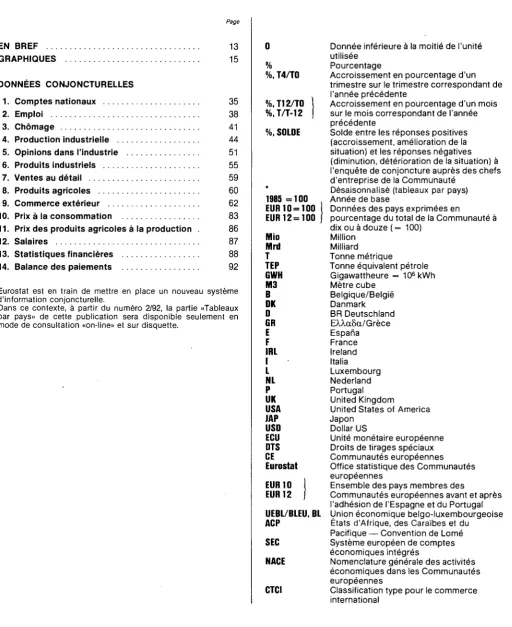
Contents
Symbols and abbreviations
'IN BRIEF'
GRAPHICS
SHORT-TERM TRENDS
1. National accounts
2. Employment
3. Unemployment
4. Industrial production
5. Opinions in industry
6. Industrial products
7. Retail sales
8. Agricultural products
9. External trade
10. Consumer prices
11. Producer prices of agricultural products
12. Wages and salaries
13. Financial statistics
14. Balance of payments
Page
9
15
35
38
41
44
51
55
59
60
62
83
86
87
88
92
Eurostat is actually elaborating a new shortterm information
system.
Consequently, starting from the 2/92 number the 'tables by
country' will only be available by online consultation or on
floppy disk.
0
%
%,
T4/T0
%PT12/T0 }
%,T/T12 J
%.BALANCE
1985 =100
EUR 10= 100
EUR 12=100
MIO
MRD
Τ
TOE
GWH
M3
Β
DK
D
GR
E
F
IRL
I
L
NL
Ρ
UK
USA
JAP
USD
ECU
SDR
EC
Eurostat
EUR 10
EUR 12
UEBL/BLEU
ACP
ESA
NACE
SITC
Data less than half the unit used
Percent
Percentage increase on the corresponding
quarter of the previous year
Percentage increase on the corresponding
month of the previous year
Balance between positive replies (increase,
improvement in the situation) and negative
replies (reduction, worsening of the
situation) in the shorttermtrends inquiry
conducted among heads of enterprises in
the Community
Seasonally adjusted (Tables by country)
Reference year
Data for countries expressed as a
percentage of the Community of
10
or
12
( = 100) '
Million
Thousand million
Tonne
Tonne of oil equivalent
Gigawatt hour ( =
10
6kWh)
Cubic metre
Belgique/België
Danmark
BR Deutschland
Ελλάδα/Greece
España
France
Ireland
Italia
Luxembourg
Nederland
Portugal
United Kingdom
United States of America
Japan
US dollar
European currency unit
Special Drawing Right
European Communities
Statistical Office of the European
Communities
Total of the member countries of the EC
before and after the accession of Spain and
Portugal
Belgo-Luxembourg Economic Union
African, Caribbean and Pacific countries of
the Lomé Convention
European System of Integrated Economic
Accounts
General Industrial Classification of
Economic Activities within the European
Communities
IN BRIEF
Unless otherwise stated, data for the Federal Republic of Germany, Including West Berlin, as constituted prior to 3 October 1990.
EXCHANGE RATES: Dollar's depreciation continues
The US dollar continued to depreciate against all currencies surveyed in May. The greatest
depreciations were against the Portuguese escudo and sterling, and the least against the
Greek drachma.
The average dollar depreciation in May against the currencies surveyed was 2 . 1 % , but it
remains stronger than it was at the beginning of the year. The American currency continued
to depreciate in the first weeks of June however, and on June 24th it closed in London at
DM 1.552, some 8% down on its 1992 peak value which occurred on March 20th.
Following the Danish vote on June 2nd against the Maastricht Treaty on European Union,
the exchange rate mechanism (ERM) of the EMS experienced more uncertainty than has
been the case in recent months. The immediate effect on ERM currencies of the 'no' vote
was to strengthen the deutschemark, the traditional ERM anchor currency, particularly
against the Danish krone and the Italian lire. Authorities in these two countries responded to
the weakness of their currencies by increasing short-term interest rates: in Denmark, money
market rates were increased by 0.65%, and in Italy the Banca d'Italia increased its
short-term intervention rate several times in the first weeks of June, most recently on June
18th when it was increased to 14.8%, around 2.5% points above its level before the Danish
referendum result.
The lire strengthened slightly after the positive result of the Irish referendum on the Treaty
on European Union, and on June 24th it was the second weakest currency in the ERM grid,
slightly above sterling and below the Danish krone. The Portuguese escudo was at the top of
the grid, followed by the peseta.
Japanese share prices have continued to fall: on June 22nd the Nikkei average of leading
stocks closed below 16000 for the first time since October 1986. In general however, other
world stock market have not followed the Japanese pattern.
GOVERNMENT BOND YIELDS: UK bond yields at a 5 year low
In May UK government bond yields averaged 9.0%, down from 9.3% in April. This is the
lowest monthly average for 5 years. UK bond yields peaked at 11.8% in April 1990, and
have since fallen gradually to their present levels: the fall accelerated slightly after sterling's
entry into the ERM in October 1990.
Yields in other EC countries remained more or less constant in May, with only France
recording a change of more than 1 % ; government bond yields fell from 9.1 to 8.9%.
Yields also fell slightly in the US and in Japan, although in the US the yield curve is still very
steeply positively sloped (ie long-term rates are much higher than short-term rates): the key
short-term Federal Funds rate averaged 3.8% in May, some 4 percentage points lower than
the yield on government bonds.
MONEY SUPPLY: Low M2 growth rates in France
The annualised growth rate of M2 in France has been negative in 8 out of the last 9 months;
in February 1992, the annualised rate was - 2 . 3 % . Interest rates in France have been
higher in recent months than purely domestic policy considerations demanded in order to
maintain the French franc's ERM parity.
For Spain, data on ALP (liquid assets in the hands of the public) have been revised from
1983 onwards. In addition to the instruments previously included in this aggregate, it now
also includes bonds issued by Other Official Credit Institutions and by other bank-like
institutions (mortgage loan companies, financial leasing companies, etc), other liquid assets
issued by Official Credit Institutions and short-term government securities issued by regional
governments.
Under the new definition, the growth rate of ALP in the year to March 1992 was 6.7%,
below the Banco de Espaha's '92 target range of 8-11%.
FOREIGN OFFICIAL RESERVES: inflow of reserves into most EC countries in
April
There was an inflow of foreign official reserves into all EC countries except Italy and into the
US and Japan in April'. The largest percentage inflow was into Denmark, which gained
11.2%.
Alone of the EC countries, Italy, whose currency has been under pressure recently in the
foreign exchange markets, experienced an outflow of reserves in April. The entry of Spain
and more recently of Portugal into the ERM has meant that lira-denominated assets no
longer give the highest returns of ERM currencies.
QUARTERLY ACCOUNTS: fourth quarter of 1991 sees European Community
economy stagnate (GDP + 0 . 1 % ) and no change in inflation (-1-1.2%)
The fourth quarter of 1991 saw a very slight growth of output for the European Community
economy as a whole (GDP +0.1%). As a result, economic growth for 1991, estimated on
the basis of the quarterly accounts, was 1.2%, slightly below the forecast growth of 1.3%.
The factors determining this period of stagnation have been analysed in detail in previous
months. However, it is worth highlighting a new factor which featured in the second half of
the year, i.e. the crisis in the Japanese economy. This renewed slowdown undoubtedly
played a part in delaying the upturn in the world economy. As things stand, 1992 may see a
reversal of the trend, but even expert economic opinion is reticent on this point on the
grounds that many factors are involved, in particular - ft seems - the monetary policy
adopted by the Member States.
As regards inflation measured by the implicit deflator of GDP, it is stable according to both
the annual and quarterly figures ( + 5 . 4 % and + 1 . 2 % respectively). These figures once
again underline the importance of the tight monetary policies adopted by most Member
States, which were characterized by a further rise in interest rates just before the end of
December.
Looking at the components of GDP, this quarter was marked by the decline in investment
(-0.5%) after two fairly positive quarters. Both private and public consumption picked up
As regards the situation in the Member States, we have the results of the first quarter of
1992 for Germany and France (in volume only) and the Netherlands (GDP only). These data
show a noticeable overall upturn in economic growth (Germany +1.5%, France +1.0%
and the Netherlands +1.1%). What Is striking on the demand side is the appreciable
upturn in investment in Germany ( + 1.6%), while there was a renewed slowdown in France
( - 0 . 1 % ) .
Results for the first quarter of 1992 for the United States show an upturn in economic
growth (+0.5%) accompanied by a slight increase in quarterly inflation (+0.7%), whereas
the annual figure shows inflation to be falling ( + 2.5%). The first quarter of 1992 saw a
marked increase for all components of domestic demand, particularly for private and public
consumption ( + 1.3% and +0.7% respectively). Investment grew significantly for the first
time since 1990 ( + 0.7%).
In Japan there was sound growth in GDP ( + 1.1%) in the first quarter of 1992, with prices
remaining stable ( + 0.0%), while annual inflation was slightly down ( + 1.7%). Among the
components of demand, there was a considerable increase in both private and public
consumption ( + 0 . 8 % and + 1 . 1 % respectively), while there was only a slight increase in
investment (+0.1%).
PRICES: EC annual inflation at 4 . 8 % in May
The inflation rate over the last 12 months for the EC as a whole rose slightly from 4.7% (*)
in April to 4.8% in May , again confirming the relative stability of the inflation rate for the
Community since last autumn.
On a month-to-month basis, the EUR 12 index rose by 0.4% between April and May
1992.
This rise was the result of sharp increases in Portugal (1.0%), Denmark (0.7%), as well as
increases in the index of most other EC countries, ranging from 0.5% in Italy and
Luxembourg, 0.4% in Belgium, Germany and the United Kingdom and 0.3% in France and
Spain.
The index for the Netherlands and Greece remained unchanged between April and May.
whilst the May index for Ireland was not available at the closing date of this bulletin.
At present the annual inflation rate is higher than the EC average of 4.8% in Italy (5.4%),
Spain (6.5%), Portugal (9.8%) and Greece (15.8%), whereas it is lower than the
Community average in the other countries (see also graph on page 3).
In increasing order of current inflation the annual inflation rates for the EC Member States
are ase follows:
(May 1992 compared with May 1991 and May 1991 with May 1990)
Denmark
Belgium
France
Luxembourg
Ireland**
Netherlands
APRIL
92/91
2.5%
2.8%
3.1%
3.6%
3.7%
4.2%
APRIL
91/90
2.5%
3.2%
3.2%
3.2%
3.1%
3.4%
United Kingdom
Germany***
Italy
Spain
Portugal
Greece
APRIL
92/91
4.3%
4.6%
5.4%
6.5%
9.8%
15.8%
APRIL
91/90
5.8%
3.0%
6.7%
6.2%
11.3%
19.2%
The corresponding rates for the USA (3.0%) and Japan (2.2%) are also under the
EC-average.
mor lo 3
Revised ligure
Ireland : February 1992 compared with February 1991
The CPI lor the Federal Republic of Germany continues to reflect the geographic borders prior to 3
October 1990
INDUSTRIAL PRODUCTION: Europe sees slight recovery
March 1992 saw signs of a slight recovery in industrial production in the European
Community (EUR12): in the major Member States, with the exception of the United
Kingdom, industrial production increased slightly again after a lengthy period of stagnation.
The production index for the European Community, adjusted for the number of working
days, was 122.9 (1985=100) for March 1992, representing a rate of increase of 1.9%
compared with the figure for March 1991. After seasonal adjustment, the index for March is
115.1. The seasonally-adjusted figure for EUR12 production in the first three months of
1992 rose by 1.0% compared with the cumulative figure for the last quarter in 1991. The
following rates of growth were recorded (where available) for the individual EC Member
States:
Greece 4.0% (estimate), Ireland 3.9% (estimate), Denmark 2.6%, Italy 2.0%, (West)
Germany 1.1%, the Netherlands 0.6%, France 0.4% and the United Kingdom - 0 . 9 % . The
stagnation of industrial production therefore seems to be over.
In the USA industrial production is still falling at a rate of 1.0% (rate of change compared
with the last quarter of 1991), whilst in Japan the downturn in industrial production is
continuing at an (estimated) rate of - 1 . 4 % .
The situation for the various types of goods was as follows (rates of growth for the last three
months compared with the previous quarter):
Commodities and intermediate goods: +1.0% (USA -0.3%)
Capital goods: 0.0% (USA -1.1%)
Consumer goods: +1.2% (USA -1.0%)
The above figures show that the slight upturn in the European Community is being driven by
consumer and not capital goods.
1
BALANCE OF PAYMENTS
Balance of payments: global figures and preliminary trends for 1991: The Community's
current account deficit deteriorated by ECU 35 billion to ECU 46.5 billion. The US current
account deficit was nearly eliminated, shrinking by almost ECU 64 billion to ECU 8.4 billion.
Japan's current account surplus rose by ECU 31 billion to nearly ECU 60 billion.
It can be seen from the above that the respective current account positions of the
Community, the USA and Japan underwent dramatic changes in 1991: the Community's
current account deficit of ECU 46.5 billion compares with a deficit of ECU 11.1 billion in
1990; the US deficit of ECU 8.4 billion ($ 10.4 billion) in 1991 followed a much larger one of
ECU 72 billion ($ 91.7 billion), while Japan's 1991 surplus was ECU 59.4 billion (Y 9 890
billion), compared with ECU 28.4 billion (Y 5 216 billion) the year before.
These movements are attributable in part to transfers relating to the Gulf War. Official
payments to the USA, for example, rose by ECU 34 billion, while those to Japan fell by ECU
6.7 billion. In the case of the Community, payments of this type partly cancelled each other
out, and the balance of official transfers deteriorated by about ECU 4 billion.
Trade in goods showed even larger changes, however. Germany's trade surplus fell by ECU
38.5 billion in 1991. Although some of this fall benefited the other Member States, the
Community's balance of trade with the rest of the world worsened by ECU 27 billion to ECU
- 2 8 . 6 billion. The US trade deficit, by contrast, improved by ECU 24.8 billion to ECU 59.8
billion ($ 74.1 billion). Japan's trade surplus increased by ECU 33.8 billion to stand at ECU
83.6 billion (Y 13 919 billion).
The Community's deficit on invisibles deteriorated by ECU 8.3 billion to ECU 17.9 billion.
The US surplus on invisibles improved by ECU 38.9 billion to ECU 51.4 billion ($ 63.7
billion). Japan's deficit on invisibles worsened slightly to ECU 24.1 billion (Y 4 012
billion).
The current account position of individual Member States underwent some significant
changes in 1991. Germany's current account was in deficit to the tune of ECU 16 billion,
after a surplus of ECU 37.1 billion in 1990. This was Germany's first current account deficit
since 1981. The country's overall trade balance showed a surplus of ECU 18.7 billion,
although this was ECU 38.5 billion less than the year before. The UK posted a clear
improvement in its current account deficit, which fell to ECU 6.3 billion from ECU 21.4
billion in 1990. The UK's trade deficit improved by ECU 11.5 billion to ECU 14.5 billion. The
country's surplus on invisibles nearly doubled to ECU 8.2 billion, thanks to a big reduction
in the deficit on transfer payments. The French current account deficit fell considerably,
from ECU 11.9 billion in 1990 to ECU 5.2 billion in 1991. France's trade deficit fell by ECU
2.6 billion, the balance of capital transfers being much more favourable than in 1990. Italy
saw its current account deficit grow from ECU 11.6 billion in 1990 to ECU 17.1 billion.
Italy's trade with the rest of the world posted a small deficit, following a modest surplus the
year before. This deterioration was basically due to the country's deficit on invisibles, which
reached ECU 16.5 billion, and in particular to reduced capital inflows from investments and
transfers. The Spanish and Danish current accounts showed a small improvement, while
those of the Netherlands and Portugal deteriorated slightly.
EXTERNAL TRADE
Extra-Community trade deficit of ECU 5.7 billion in February 1992, with a United States
deficit of 3 billion and a Japanese surplus of 8.3 billion.
In February 1992, the extra-Community trade deficit was exactly the same as in February
1991. The German surplus was slightly lower than in February 1991 (0.3 billion compared
with 0.4 billion). The trade balances of Portugal, the BLEU and Spain were similar to those
of February 1991. The trade balances of Greece, France, Italy and Denmark improved by
between ECU 0.1 and 0.2 billion, thus offsetting the worsening of the UK deficit, which
increased by 0.7 billion.
Exports rose more rapidly than imports compared with February 1991 (7.6% as against
6.6%), but the circumstances during the reference month were unusual because of the Gulf
War. Indeed, in February 1991 exports outside the Community were at a particularly low
level, whereas imports were less affected.
The cost per barrel of the Community's crude oil supplies was 1 1 % lower in dollar terms
than in February, but it remained at a comparable level in ecu terms.
In February 1992, the United States recorded a deficit of ECU 3 billion, compared with 4.2
billion in February 1991. Imports rose by 15.7% in ecu terms, returning to the level
achieved prior to the slump in February 1991. In dollar terms this increase is reduced to
almost 6%.
Exports from the United States were up on those of February 1991 by 23.4% in ecu terms
and 13% in dollar terms.
The Japanese surplus in February 1992 was more than double that of February 1991, at
ECU 8.3 billion. Japanese exports rose by a healthy 23.2% in ecu terms, which
corresponded to 1 1 % in yen and 12% in dollars. Japanese imports fell by 1.5% in ecu
terms compared with February 1991 but by 13% in yen and 10% in dollars.
February 1992 saw the end of the decline in Germany's intra and extra balances, which
were slightly down on those of February 1991. Germany's trade balance with the rest of the
world showed a surplus of ECU 1 billion in February 1992, higher than for any other
Member State for this period. Denmark and Ireland each had a surplus of half a billion ecus.
while the other Member States of the Community had deficits for their total trade in February
1992. The deficits of the Netherlands and Portugal were relatively small (ECU-0.2
and-0.5 billion respectively), while those of Greece, France and the BLEU were under a
billion ecus. France's trade deficit was reduced by half compared with February 1991,
largely owing to intra trade. Spain and Italy each had a deficit of ECU 1.5 billion. The Italian
position was considerably worse than in February 1991 owing to the slump In the intra
balance (ECU - 1 billion). The United Kingdom had a deficit of ECU 2.3 billion for total trade:
its extra trade balance worsened by 0.7 billion between February 1991 and February
1992.
Avant-propos
«Eurostatistiques - Données pour l'analyse de la conjoncture» est une publication
men-suelle qui a comme but de fournir dans les meilleurs délais les données statistiques les
plus récentes pour la Communauté européenne en tant qu'ensemble (EUR 12), pour les
pays membres ainsi que pour leurs principaux partenaires extracommunautaires
(États-Unis d'Amérique et Japon).
«Eurostatistiques» ne publie pas d'une manière exhaustive toutes les statistiques
dispo-nibles auprès d'Eurostat, mais les importantes parmi celles-ci.
Afin de permettre des analyses diverses et, si nécessaire, à plus long terme, sont
publiées généralement des données annuelles sur une période de quatre ans, des
don-nées trimestrielles pour les cinq derniers trimestres et des dondon-nées mensuelles pour
les quinze derniers mois disponibles.
Cette publication se veut rapide et facilement maniable. Pour cette raison, elle ne
comporte pas de notes méthodologiques, disponibles d'ailleurs dans les publications
spécialisées d'Eurostat.
«Eurostatistiques» contient trois types d'informations, actualisés mensuellement:
- la rubrique «en bref» commente les principaux événements et tendances résultant
des évaluations récentes;
- la partie «Graphiques» illustre les séries économiques les plus importantes pour la
Communauté, les États membres, les États-Unis et le Japon;
- la partie «Données conjoncturelles» présente des données harmonisées par Eurostat
sur la base des critères communs, pour l'ensemble des États membres et avec des
comparaisons avec les États-Unis et le Japon;
Les données publiées dans «Eurostatistiques» proviennent du domaine «ICG» de la
base de données Cronos.
En se connectant à Cronos, il est possible de suivre la mise à jour des tableaux de
cette publication journellement en consultant les données en temps réel. Le mode de
consultation «on line» se trouve a la fin de cette publication.
De plus amples informations concernant «Eurostatistiques» peuvent être obtenues à
l'adresse suivante:
[image:14.595.49.562.156.784.2]