COMMISSION OF THE EUROPEAN COMMUNITIES
COM (90) 201 final
Brussels, 7 May 1990
GENERAL
0 B
J
E C T I V E S
TABLE OF CONTENTS
INTRODUCTION
SUMMARY AND CONCLUSIONS
PART
1 :Chapter
Chapter
Chapter
Chapter
PART 2:
Chapter
Chapter
Chapter
Chapter
PART 3:
Chapter
Chapter
The key factors for Identifying future trends
I: The main factors determining steel consumption In the
CommunIty
II: New trends In the world steel market
Ill: Technological Innovation
IV:
The steel Industry and the Internal market
The market for steel products In the Community:
analysis and
forecasts for 1992 and 1995
V:
VI:VII:
VIII:Internal demand forecasts
Ex terna I trade
Supply
Price trends
Factors of production:
the market
INTRODUCTION
1. "General ObJectives Steel 1995" Is being written In a radically different economic and political climate from the General ObJectives for 1985 and 1990.
Together, the lasting macroeconomic boom coinciding with the ending of the measures to combat the crisis In the steel industry have restored normal conditions of competition for most steelmakers.
Henceforth the common steel ways and means of the
Industrial strategies for w I I I be I aId down at a tIme by the crisis measures.
policy will raven to the normal ECSC Treaty: the medium-term the Community's steel Industry free of the constraints Imposed
2. These strategies must take Into account the results, as they now appear, of the crisis period, and In particular the period during which steel undertakings, while eligible for several types of aid (under the Aid Code), were subJect to very strict regulation of the market (Article 58), price controls (Article 60) and capacity-shedding obligations. The results can be quantified briefly as follows:
production capacity (MPP) for hot-rolled products fell from 194.5 million tonnes In 1980 to 165 million tonnes at the end of 1988 (EUR 12);
employment fel 1 from 672 000 In 1980 to 409
ooo
In 1988. This trend Is alI the more remarkable by comparison with 1975, when the workforce of the steel Industries of the twelve countries which are now Member States of the ECSC exceeded 870 000;the State aids authorized between 1980 and 1988 under the Aid Code (for EUR 10 and for Spain and Portugal) was In the order of ECU 40 000 million. This figure does not Include the aid recently authorized for the publicly owned Italian steel Industry;
Investment In the steel Industry, Including coking
and 1988 amounted to
plants, between 1982 ECU 21 200 million (EUR 10); between
casting tonnes Twe I ve) .
1980 and 1988, MPP (EUR 10) for continuous rose from 70.9 million tonnes to 134.2 million (151.2 million tonnes In the Community of
These figures call for some explanatory comments. At this stage, we wi II simply say that, while the trend in capacities and employment and the large sums of public money
2.
being made by the various operators Involved, the last two figures the overall Investment trend during the restructuring period and especiallY the maximum possible production for continuous casting show the major role played by the "modernization and adaptation of plant" In the restructuring policy.
3. Another significant achievement wa~ the major Improvement In the financial situation of the large majority of Community undertakings. This was helped by the abovement Joned State aids and by the fact that, thanks to the organization and control of the Community market, Community steel prices did not fall too low. These definite
improvements, however, do not mean that restructuring Is now complete. The crisis has also brought home the fact that the steel undertakings' results (In terms of profit or loss) depend very largely on the efficient use of the factors of production. This Is one aspect of restructuring which calls for further progress to reestablish a balance between the various stages In the overal I production process. Hitherto, the Inflexibility Imposed by the quota system has, despite the easing of the rules since 1986, delayed ce~taln
strategic decisions on Industrial and commercial cooperation between undertakings. Such decisions began to gather pace only In 1988, as the quota system was drawing to Its end and the economic situation became exceptionally favourable.
Although the results for 1988 and 1989 are extremely good -In particular with regard to the financial situation of steel undertakings - It must not be forgotten that the steel Industry, Just like other basic sectors, faces fluctuating market conditions: relatively smal I changes In demand together with a commensurate weakening of prices, can once again place certain steel manufacturers In a difficult position.
4. This Is why the Commission Is proposing to Jay down the broad lines for a common steel policy. But a policy must be based on principles: competitiveness, productivity and respect of the competition rules as well as the regular supply of the market and Improvement In working conditions will be the basis for the arguments put forward throughout this document. This Is precisely the policy line laid down In the ECSC Treaty, and It accords enllrely with the current political and economic environment of the Internal market.
In addition to stating Its essential principles, any sectoral pol Icy must be based on an analysis of the economic factors which characterize i t .
3.
particular attention to scrap metal), new product lon short term and, techniques likely to be Introduced In the
finally, workforce skills.
Both the quantitative and qualitative aspects of these factors wl I I be analysed.
5. In the spirit of Article ·46 of main purpose of "General Objectives out as accurately as possible qualitative medium-term scenario for terms not only of the products market for the factors of production.
the Steel
ECSC Treaty, 1995" Is to
the set the quantItatIve and the steel Industry In but also of the market
In the I ight of these analyses and forecasts, the Commission will propose the policy gutdel ines which It Intends to apply in the years to come, using the Instruments aval table to guide and back up steelmakers' strategies.
The document Is divided Into three analytical sections, summed up In a-concluding chapter.
Part seeks to define the qualitative scenario. In Its four chapters an attempt Is made to ldent lfy the factors which may be crucial to the development of the steel
Industry over the next few years.
Chapter examines the relationship between trends In steel consumption and trends In GOP within the Community. In particular, an analysis Is made of probable trends In steel consumption and Its relative share of GOP and Industrial production. Another Important factor to be studied Is the trend In specific consumption of steel and substitution. Chapter I I analyses the possible changes of scenario on the world market by studying the quantitative and qualitative trends In world supply and demand In order to Identify specialization possibilities for the Community steel
Industry, which will be Increasingly based on the quality of Its products and the services offered to Its customers.
Chapter II I examines the main trends In technological progress which will affect the steel Industry by 1995 in both product lon processes and products, to which an every
larger research effort Is being devoted.
Steelmakers can become more competitive only by exploiting one of these factors, I.e. either Increasing their productivity ( .. cutting costs) or Improving the QUality of their products or marketing new or highly differentiated products that make a profit from innovation. Technological
4.
Chapter IV analyses the Impact on steelmaking of the new legal and economic framework. which will be created by the completion of the Internal market. The Impact may be economIc and f I nanc I a I: I ncr eased demand, hIgher or 1 ower costs (of energy, environmental protection, transport, financing, customs formalities, etc.), and tougher competition will have an Influence on commercial strategy. But there may also be an Impact In terms of economic thlnk.lng: a trend towards less Interventionist economic policies and the development of competition policy on mergers, and specialisation and rationalisation agreements:
Part 2 deals essentially quantitative forecasts for, Community In
1992
and1995.
with the analysts of, the products market within
and the
Chapter V examines the outlook for Internal demand using two k.lnds of approach. The first consists of an overal 1 statistical model based on the relationship between GOP and the apparent consumption of raw steel: the second consists of a sectoral model based on trends In steel-using sectors and the quantities of steel they consume I.e. specific consumption.
Chapter VI examines the outlook for the Community's external trade In s~eel. Forecasting the medium-term trends In Community Imports and exports Is particularly difficult since they wl I I depend on several factors which can sometimes have opposite effects. For Instance, some traditional tendencies towards International specialization may be curbed or even halted, at least temporarily, by the deliberate strategies of Individual firms.
Chapter VI I analyses Community supply, Its present structure and future trends and prospects. From these considerations and from the results of Chapters V and VI (regarding Internal demand and the external trade balance) certain conclusions can be drawn as to the necessary conditions for achieving an equl I lbrlum between supply and demand.
Chapter VIII rounds off Part 2 with a br lef look at past trends In steel prices and presents a few Ideas which might pro v I de a bas I s for a future p r I c e s p o-1 I c y •
Part 3 examines the market for the main factors of production. A detailed analysis Is made of future trends on the raw materials markets (Iron ore, scrap and ferro-alloys) and in energy Inputs. The k.lnds of workforce skills and Investment that will be required by the steel Industry are also considered.
5.
1 .
SUUUARY AND CONCLUSIONS
I .
INTRODUCTION
1. The main purpose of the policy guidelines based on the 1985 and 1990 "General Objectives for Steel" was to ensure the success of the crisis measures taken under Articles 58, 61 and 95 of the ECSC Treaty; the goal was to restructure, In as orderly and coherent manner as possible, the Community's iron and steel sector, which had seen the crisis beginning in 1975 worsen after 1980. AI f concerned have made a major effort and accepted very great sacrifices:
The national and Community authorities have spared neither effort nor resources. Whether directly, by applying the Aids Code, or Indirectly, by organizing and monitoring the Internal market, by external trade measures or by bearing a great part of the social expenditure and the costs of regional readjustment, the Member States and the Commission have played their part.
The labour force did not go consequences of the crisis regions concerned very hard, regional flanking measures mitigating Its effects.
unscathed either. The hit employment In the although the social and went some way towards
Steel undertakings, for their part, have transformed their financial structures, their industrial and sales strategies, and their production methods to face· the new situation both within and outside the Community. All this has been accompanied by major change In the business philosophy and management style of most managers in the Community steel
Industry.
2. At the time of writing, the economic and political environment of the Community steel Industry Is radically altered:
2.
Faster progress towards the full lnterna I market has set economic policy In an environment which Is more open to free competition and less susceptible to public Intervention, thereby encouraging steelmakers,
like all Industry, to exercise Initiative.
3. "General Objectives for Steel 1995", drafted by the Commission In compliance with Article 46 of the ECSC Treaty, attempts, In a climate totally different from that conditioning previous ones, to analyse the key factors which could determine the sector's development until 1995. On the basis of these qualitative analyses and quantitative forecasts for 1992 and 1995, which have been prepared as objectively as possible and concern both the markets for steel products and the main factors of production, the Commission proposes the main I lnes of the policy which It Intends to apply, using Its powers and Instruments under the ECSC Treaty, to guide and back up steelmakers' strategies In the years to come.
I I. SUMMARY OF THE RESULTS OF ANALYSIS
4. Part 1 of "General Objectives for Steel 1995" (GOS-95) seeks to analyse the factors considered crucial for making realistic medium-term forecasts for the Community stee I sector:
A. The relationship between the main macroeconomic variables and steel consumption In the Industrialized countries and the Community In particular
Despite the acknowledged 'existence of a statistical reI at lonsh lp between the growth rates of GOP and apparent steel consumption, the statistical model should be used with great caution to allow for the effects of such variables as stock changes, which can dIstort and render meanIng I ess forecasts of stee I consumption based only on the trends In macroeconomic variables.
3.
B. Changes on the world market and the effect of macroeconomic-and sectoral policies on the structures and lnternat lonal trade In steel products
The world steel market has been characterized for 10 years by rapid growth In production capacity In the NICs (mirrored by their domestic consumption) and by
~restructuring which has followed stagnating
demand In the OECD countries. These structural trends are the mainspring for the dynamic exports of certain NICs and the declining market share of traditional exporters (the Community and Japan).
The continuation of these trends and the expected buoyancy of wor I d demand forecast for 1995 (on a par with 1988) should reduce Imbalances between supply and demand at world level (which had until 1987 been forcing steel prices down) and lead to a growing reglonallzatlon (Into large zones) of International trade In steel.
The political and economic development of the Eastern European countries need to be followed carefully, even more so In that, In most of these countries, the steel Industry Is a very Important Industrial sector and the changes which might occur In this sector wl I I have an Important Impact In the world steel situation.
World trade In steel has also been Influenced by government Intervention aimed, in the OECD at facilitating restructuring, and In other countries, at encouraging expansion of the Industry. Renewed growth In demand and the consequent reduction In global Imbalances between supply and demand wl I I see government's role gradually diminish, allowing trade to develop In a more orderly fashion.
Nevertheless, the endur lng macroeconomic Instability foreseeable In some countries or regions of the world could lead to fluctuations of greater or lesser abruptness, whether or not cyclical, In the steel trade, particularly because these countries do not always adhere to fair competition and pricing practices In either their domestic market or their exports.
C. The Influence of continuous _technological Innovation on relations between producers and customers
Despite the considerable effort made during the recent quantI tat lve phase of restructur lng (cutt 1 ng
capacity, Jobs and costs), steel undertakings In the
I
4.
In constant and accelerated technological Innovation aimed at a more qualitative restructuring to meet the ever more exacting requirements of their customers. As In most sectors of Industry,
demanding higher quality throughout concrete reinforcing bars to coated steels, and service which Is comprehensive and, often, cheaper.
customers are the range, from sheet or special faster, more Community steelmakers must therefore increase
Investment In Innovation and applied research.
This must encompass both processes at the different production stages (Including, Increasingly, processes to conform to env I ronmenta I standards) and products; for the latter, close cooperation with users to improve quality and especially to find new applications or outlets for steel products has become even more essential.
D. The Impact of the Internal market
Although the Single Act makes no direct reference to the steel Industry, completion of the Internal market Is bound to have an IndIrect Impact on two areas In particular: production costs and, therefore, the conditions of competition.
Where costs are concerned, current and future policies on the Internal energy market, on liberalizing the transport sector, and the capital market will probably lead to Increasing uniformity of the unit costs of energy, transport and finance, where differences between certain Member States can a! present be as great as 80% (e.g. In electricity). The growing harmonization of economic, fiscal and monetary policies will mean a more competitive environment which will facilitate certain lndustr Ia I cooperation projects between steel undertakings (even outside the national framework) already begun In 1988, which could make a positive contribution to the rationalization efforts s t i l l necessary In the sector.
5. Part 2 of "General Objectives", comprises quantitative forecasts for the market In steel products In 1992 and 1995 which take account of this qualitative analysis. A. The Internal-demand forecasts are based on the
foreseeable development of user sectors, on the consumption by each of steel products and on trends
B.
5.
Demand for steel from the construction, civil engineering and machine manufacturing sectors, and parts of the transport equipment Industry will be sustained by Investment; car production should also exceed the present high level In the medium term. In sectors such as packaging, where there Is less potential for expansion, It would be realistic to expect quantitative demand to stabl I lze.
Furthermore, ~the downward trend In specific consumption should be less significant than In the past.
These changes will mean:
real consumption of ECSC products at 110.7 million tonnes In 1992 and 114.7 million In 1995 (compared with apparent consumption of 111.7 million tonnes In 1988), representing annual growth of 1.4% on the reference per lod ( 1986-88), a rate of growth markedly lower than that of GOP;
a shift In demand towards more elaborate products, e.g. coated and special steels.
These fore~asts therefore Indicate a structural trend towards stability over the period until 1995, (compared with 1988 levels), although this does not rule out normal cyclical fluctuations (such as that starting in late 1989), on a scale which will depend on variables that are d i f f i c u l t to pin down such as stockpiles, the trading behaviour of producers, dealers and users, and, finally, any pressure from
Imports.
The Community's exports and Imports have genera I I y been remarkably stable over the last ten years, and their structure too has remained relatively stable (with the exception of semi-finished products), but wIth considerable geographical concentration In certain parts of the world.
From here to 1995, the most reasonable scenario seems to be one of stability. In fact, even I f certain I o n g - t e r_m , a I b e I t t h e o r e t I c a I , t r e n d s p o I n t t ow a r d s greater'' specialisation by product between Industrialised countries and those new to production, which could lead to a slight deterioration In tonnage terms of the commercial balance, the companies' new-found dynamism and the overal I good competitive
posit ton of the sector may nevertheless
6.
This scenario of stability, compared with recent developments (the reference period being the average of the years 86-87-88) would therefore mean an overall commercial balance of around 13 million tonnes In 1995, resulting from an export level of 22.5 million tonnes, and an Import level of 9. 5 m I I I I on tonnes.
The sensitivity of these assessments to factors such as fluctuating exchange rates and the knock-on effect on exports of developments In non-Community economies which have yet to stab I I lze nevertheless demands that these forecasts be regarded with considerable caution.
As far as the process of openlnlg up to Eastern Bloc countries and the prospect of German unification are concerned, It seems premature to try to quantIfy their mid-term or long-term Impact on the level of trade In steel products; this Impact will most probably be Influenced by the difference, .notably from the aspect of quality, between the Community and the Eastern European countr les In steel consumpt ton as wet I as production. A certain pressure from exports of bottom-of-the-range products Into the Community may be seen In the short term.
C. The above assessments give rise to estimates for output of hot-rolled products In 1995 of around 117 million tonnes, slightly above the figure of 115.4 million tonnes achieved In 1988 (Eurostat). Compar lng these product I on forecasts wl th the MPP
(maximum possible production) of steelworks In 1992, recently confirmed by undertakings at the special request of the Commission, the following overall conclusions can be drawn (see table In Annex):
The forecast average capacIty ut I l l zat I on rates during the period 1992-95 for colt and strip mills (77%) and wire-rod mills (68%),.1 are Just within
the accepted norms for financing plant
replacement: but from this overview emerges a certain concern about hot-rolled wide strip mills
In particular, where disparities between undertakings' technical and financial structures are stl J I great enough for new difficulties to be
feared should there be even a short-term fall in product I on or prIces for thIs product whIch Is highly sensitive to market fluctuations.
7.
The forecast average utI 1 lzat ion rates dur lng the period 1992-95 for mills producing heavy sheet
(65~), heavy sect Ions (62%) and even for the most
flexible mills producing light sections (63%) seem unsatisfactory and show that further significant cuts In capacity ~ust be made to ensure the medium-term stabl I lty of undertakings making these P,roducts.
6. Part 3 of GOS-95 comprises a study of two highly sensitive factors of production (alongside those already mentioned, I.e. plant and energy) affecting steel undertakings' competitiveness: raw materials and labour. A. Metallic raw materials (Iron ore, ferro-alloys and scrap) are a major factor In the sector·s economy because the Community depends heavily on Imports. Considerations of quality and low production costs dictate that most Iron ore Is Imported from outside the Community, often under long-term contracts or through direct participation by our Industries In mining ventures. Exhaustion of some deposits and, In some Instances, political Instability mean that Community steelmakers, to ensure continuity of supply at competitive prices, will have to Increase their Involvement by stepping up Investment, In cooperation with those countries outside the Community most
I lkely to welcome such projects. Most of the canst I tuents of
Imported from outside the countries (exporting chrome, virtually dominant position.
ferro-alloys Community; for example)
are also certain enjoy a
Finally, the collection in the Community of high-grade scrap may be insufficient in the short term to guarantee adequate supplies for the electr lc-steel Industry and the development of new products and processes; new sources must be found, either by new recycling methods or Importing.
In this respect, future standards for the protection
I I I.
7.
8.
As can be seen, external trade plays a major part In supplying the steel Industry and security of supply Is a constant prob I em In an envIronment where the Community's Industries are In direct competition with the other Industrial lzed countries on the world market for raw materials.
B. Restr;ucturlng has transformed the employment situation; the steel Industry Is now much less
labour-Intensive: 1988 on I y 409 000 apprentices).
In 1975 It employed 870 000, In (Community of Twelve, Including
However, the labour force Is now much more highly skI I I ed and w I I I become even more so as techno I og I ca 1 Innovations are Introduced on to production lines. The correlation between the Increase In the sector's capital Intensiveness, the sophistication of Its products and the skills skills of Its workforce will therefore continue to cause significant change In vocational training In the steel Industry.
The job losses that could s t I l l be expected up to 1995, will be spread over the entire period, and will not have by any means the same scale as during the
last decade.
CONCLUSIONS: FUTURE STRATEGIES AND POLICIES
The economic and political environment of the Community's steel Industry In the future
A. The present macroeconomic situation and the forecasts on which GOS-95 Is based are quite dlffereht from those underpinning GOS-90.
The 1985 forecasts for 1990, which In the optimistic scenar lo put hot-ro lied sheet product ion at 109 million tonnes, were already being exceeded by a considerable margin In 1988 (114 ml I I ton tonnes) because of a boom In alI major steel-consuming sectors.
The sectoral policy, defined In the GOS-90 was mainly aimed at shedding the steel Industry's surplus capacity, estimated at almost 30 million tonnes p.a. over the period 1986-90, and making the capacity retained technically and financially viable.
9.
compared with those of 1988. When these forecasts are compared with the MPPs for 1992 announced by steelmakers, the theoretical overcapacltles revealed are much smaller than those forecast In GOS-90, but they are static, since they Ignore the fact that steelmakers' continuing Investment In modernization and Improving productivity wl II lead to some Increase
In the capacity of the plants concerned.
~!though the climate Is generally favourable, several
points of uncertainty emerge from a dynamic analysis; steelmakers and the Commission should keep these points In mind when formulating strategies and policies for the years ahead. The main areas of uncertainty or Instability requiring close monitoring are:
the Impact of cyclical fluctuations In demand for Community steel and the effect of Imports on the volume and prices of Community steelmakers' deliveries;
the effect, already mentioned, of the Investment needed to modernize, and Improve productivity on steelworks' actual capacity, where there remains an overal I surplus for certain products (for heavy sheet and long products in particular, and to a degree for hot-rolled wide str lp).
B. The political and legal framework for the Community steel Industry wl I I by 1995 be characterized by:
continuing liberalization of economic policies; a clearly less Interventionist stance on the part of the Community and a fully competitive environment will give steelmakers the Initiative but also the responsablllty for all decisions affecting their Industrial structures and commercial practices; a greater commitment by the Commission to secure compliance with the rules of free competition both. within the Community, by firms (agreements or concerted practIces) and by Member States (state aids), and In International trade; this has already started with the signature of a bilateral consensus with the USA;
8.
1 0.
CommunIty stee I undertakings and their strategic responslblllt les
The aim of any Industrial undertaking (and therefore of every steel company) which wants to maintain a stable position on the market In the long term Is certainly to preserve or If possible to Improve Its competitiveness so that It can:
meet the demand of Its present and future customers in terms of volume, quality and price;
generate sufficient cash flow to ensure through Its own resources the reinvestments needed to guarantee an adequate return on capital Invested and to mitigate the effects of cyclical fluctuations.
To achieve this objective, the Community's steel companies wl I be faced with Important strategic choices on their own responslbl l l t y , of which the main elements to be considered are the following:
generally strong prices from 1988 to the end of 1989 certainly masked the surviving overall excess capacity In most steel products and different ·levels of corporate economIc performance, espec I a I I y as regards depreciation and financial costs: the ability to resist a greater or lesser fall of longer or shorter duration In prIces will therefore vary significantly from one undertaking to another;
given this sensitivity to cyclical change, t r a d I t 1 o n a 1 r 1· s k I I m I t a t I o n s t r a t e g I e s a r e no t applicable to all firms: diversification Into different subsectors of steel, the possibility of Joint ventures for new Investments or agreements making for synergies In the use of exlst_lng plant will depend heavily not only on each company's management traditions and style (joint stock companies, family firms) but also on their Industrial structure (Integrated; electric, coastal and concentrated; Inland and dispersed) and their commercial structure (diversified distribution system; high level of Integration with dealers; close ties with major users);
1 1 .
The Immediate Implication of these comments Is that It w 1 I I be up to each company to determIne, dependIng on Its Industrial and commercial structure and Its economic and financial situation, the structural adaptations It must st I I I make In order to be prepared for I ess
favourable conditions (In volume terms, but especially In prices) than those obtaining since 1987-88.
In any event the undertakings must be aware that the persistence of certain overall excess capacities In some steel products could disturb the market to an even greater extent If Investment strategies are not adapted
to market realities.
Accordingly, undertakings must understand that the Commission will pursue a very str let policy regarding state aids and monitoring compliance with Articles 65 and 66 of the ECSC Treaty. Similarly, they will no longer be able to count on an Interventionist policy for the organization of the Community market (based on Article 58), which Is not applicable In the event of normal cyclical fluctuations In a period of economic stability, as Is expected for the steel market over the next few years.
9. The Commission's main policy lines
Taking account of the future economic and legal framework described In this document, the Commission wi II pursue Its efforts to guide and support undertakings· Initiatives in the following fields.
A. Continuous review of the Internal market
The Community's steel market wl I I Increasingly be the fundamental element for most Community steel undertakings. The Commission wl I I therefore continue to devote special attention to the continuous study of market trends In the short and medium term. It will use the Instruments available to I t under Article 46 of the ECSC Treaty.
1 2.
B. Monitoring of International steel trade practices
*
*
*
When renewing the arrangement on the exports of steel products . to the United States, the Community undertook with the American Government to abolish all similar voluntary export restraint arrangements (including the Community external steel trade policy system) by 31 March 1992 at the latest.
In 1990 the Commission proposed to the Council a progressive liberalization of this external trade system (already started in 1989), to facilitate a smooth transition to the post-1992 environment.
But the Commission will also Immediately seek to obtain, If possible In the current Uruguay Round and In any case before 1992, a multilateral agreement Imposing strict and effective discipline in International steel trade as regards state intervention and t a r i f f and non-tariff barriers to access to steel markets, as already agreed In the bilateral consensus signed with the USA.
In the context of the growing llberallzat Jon of trade In steel products, the Commission wi II try to prevent unfair practices having a negative Impact on prices on the Community market. It will exhaust all the possibilities under GATT to Improve the effectiveness of anti-dumping procedures.
c.
Analysis of structural change*
*
*
In cooperation with the steelmakers, the Commission will continue its periodic reviews of changing production structures, mainly through steel plant census and through the analysis of the production capacities (MPP) and the Investment projects notified by the firms.
As regards the MPP, the Commission will ensure that the criteria for defining them are correctly applied and that their evaluation takes account of every possible productivity improvement obtained, where appropriate, from investment, new management techniques or verifiable changes in the product mix or in the normal operation of the plant.
*
*
*
1 3.
Through Its opinions the Commission will consider as a positive element the Introduction of more efficient new technologies. It will also Inform Investors of the updated forecasts for the markets In the steel products In question and I f necessary will remind them of their responslbl I lty for any market Imbalance which their Investment could cause.
At the company's request, a loan may be granted to finance the Investment I f , on examination of the preceding conditions, the Impact on the balance of the market Is Insignificant, or If the Impact results from Innovative technological elements In the
Investment.
The Commission leaves the Initiative and
responslbl I lty for Investment decisions to the firms, while considering that the possibilities for Industrial and technological cooperation between Community firms which can mitigate the negative impact on the market of an Investment causing a significant Increase In production capacities, and also help to rationalize Community steel supply.
As regards Industrial structures, the Commission will In any case ensure that the present developing trends towards Industrial concentration does not Impede effective competition on the markets.
Nevertheless there Is s t i l l a number of steel firms Cor rather groups) In the Community where certain possibilities of complementary operation can be studied. The Imminent prospect of a single market from 1993, and especially of a single capital market open to alI Community economic operators, should facilitate the s t i l l necessary Industrial readjustments and the sector dynamics.
In this spirit the Commission will be In favour of complementary operations between Community steel firms, where such operations pursue the objective of facilitating the rationalization decisions and Improving the Industrial, commercial and financial structures of the firms concerned In the face of market conditions that could be less favourable than
they are at present.
D. General policy lnes with financial consequences
*
1 4 .
since 1980 the emphasis has been on the necessities particular the dictated by restructuring and In
flanking social measures.
In the context of a dynamic steel policy, the financial operations of the ECSC should be steadily shifted towards objectives more directly I Inked with production structures and Improving productivity, especially towards research and certain types of Investment, and therefore social measures should be complet_ed, following the guidelines descrIbed hereafter, and In the limits of the available resources.
The criteria for these operations should therefore be reviewed; the Commission considers that projects which could be submitted by undertakings, whether for research or for Investment, should be Individually larger than In the past and of greater significance for the whole structure of the undertaking concerned. This reasoning will of course apply to all fields covered by the ECSC Treaty, the Iron and steel
Industry proper as we I 1 as supp I y ( 1 ron ore, scrap, certain ferro-alloys), as policy for the sector must be planned on the basis of an overal I strategy covering the entire Industrial cycle.
ECSC research: the Co11_1mun It y poI Icy which has been pursued since 1955 WII I be continued; a larger contribution will be made to the technological development of the sector on the basis of the following conslderat Ions:
the unremitting need for reductions and productivity
further cost price Improvements,
continued promotion of steel in its competition with substitute materials,
the growing pressure of environmental protect ion measures to reduce harmful emissions and to recycle waste and industrial effluent,
the 1993 single market, which necessitates research and adaptation studies for establishing rules and standards for manufacturing and construction;
*
1 5.
Developing cross-border and Interdisciplinary cooperation In order to
of joint research and I I nl< s.
reinforce the advantages to forge genuIne European
To this end the Commission Intends to promote projects, quality being equal, which Involve the greatest possible degree of cooperation.
Promoting long-term hlgh-rlsl< community projects In areas of strategic Interest for the Community steel Industry, such as new steel production technologies I ll<e reduction casting and continuous casting of thin products, or their advanced applications- coated steel, stainless steel, etc. Encouraging complementarity with other national and/or Community programmes: launching large-scale programmes, of the sort already run by our direct competitors, the USA and Japan, will demand considerably larger budgetary resources than are available for ECSC steel research at present.
BrIngIng the research effort In a I I European producer countries up to the level of Intensity of the most efficient, and encouraging each country to play Its part In the common effort. The aim would be to reduce the disparities between countries and companies, facilitating better distribution of the efforts In this field. The result would also be a substantial Increase in resources devoted to research. A target of ECU 5 per tonne of steel would be realistic, and would s t i l l represent only about 40% of Japan's expenditure.
The Commission could encourage this trend by promoting projects involving the participation of producers, firms, universities and users with smaller capacities and resources.
With regard to Article 54 ECSC loans, the Commission Is planning, In order to expand Its financial intervention, to bring back a system of Interest rebates with a view to channelling Investments towards priority fields In line with Community objectives and corresponding criteria. At the outset I t could concentrate on loans for environmental protection measures.
For alongside their efforts to Improve
*
*
16.
continue to rise: the estimate for 1989 Is 4% of total Investment expenditure. The Commission has launched a preliminary study to determine the scale, In financial and cost terms, of the environment protection obligations. This study will give the Commission the specific background for the steel sector which must be taken Into account In any change In the criteria for granting aid for pollution control purposes (after the present Aids Code expires). In this context, particular attention will be paid to the polluter-pays principle, without, however, losing sight of the financial significance of the problem which Is characteristic of this basic Industry, and of the fact that steel Is one of the most recyclable of Industrial products.
In this respect, a particular effort will be made as far as regulatIons are concerned, so that there will be as few obstacles as possible to scrap collection, which In Itself already constitutes a measure of respect for the environment. It Is therefore appropriate that means be found within the framework of Community law for this type of operation to be encouraged.
Finally, with regard to the Investments to promote the consumption of Community steel, the Commission will continue to facilitate the financing of these Investments pursuant to two sect Ions In the communication of 31 October 1987:
industrial projects leading to an Increase In consumptIon of CommunIty stee I or · a t least preventing Its decline;
major Infrastructure projects of European Interest; this aspect
consIder ab I e Interest In
has already aroused the national Industries and
a
number of projects haveapproved suggests financial
by the Commission and the that Increased use will be
assistance available Instrument In the very short term.
already Counc I I .
made of under
been This the this
17.
Faced wl th these two Issues, the ECSC has several ways of supporting the strategies launched by the undertakings and underpinned In many ways by the Member States as regards the management of human resources.
The ECSC can fac I I Ita te the ana I ys Is and study of adequate solutions by means of research on 'Industrial health and safety and through the work of the Joint Committee for the Improvement of working conditions. One example Is the very detailed survey of vocational training requirements In the sector carried out among several firms In the Community and presented to steel experts at a briefing In Luxembourg last October. This survey will be supplemented by an Initiative to
Incorporate the views of employees and their representative organizations Into the conclusions to be drawn.
Secondly, under Article 56 of the Treaty the ECSC runs a compensation scheme for making up the Income lost by workers redeployed within the firm or elsewhere, Including those taking early retirement, and to cover the cost. of their retraining. As much as two thirds of the ECSC annual budget has been used for these measures over the last 10 years. However, this compensation scheme Is restricted by the application criteria of Article 56: In line with the restructuring policies defined In the General ObJectives for 1990, It applies only to workers affected by capacity closures or permanent cuts In act·lvlty; a second limitation stems from the high cost of this type of operation compared with the budget resources available.
In the light of the new economic and social context out lined In the present document, the Commission will study, as In fact I t has already do'ne at successive stages throughout the existence of the ECSC, the possibility to adjust the scope of Article 56 by emphasizing more the actions In favour of the objective of improving skills adjustments made necessary by the adaptations and changes In activity
*
*
18.
Regional pol Icy measures: the RESIDER assistance programme runs untl I 31 December 1992. Under the 1989 reform of the structural Funds, Member States may continue and step up regional aids In steel-producing areas that are eligible for objectives 1 and 2.
The operational rules for granting conversion loans under Article 56(2)(a) of the ECSC Treaty have been amended so that they can be Incorporated Into the Communi-ty support frameworks In the steel-producing areas covered by objective 2.
The Commission must fix the budgetary priorities annually, at the time when It takes Its decisions on the draft budgets for the following financial year. It will therefore determine how far the new political orientations sketched out above, wl II be put Into operation on financial and budgetary levels.
10. Conclusion: encouraging prospects and responslblllt les for undertakings
The general economic background to the Commission's decisions for the General Objectives for steel 1995 Is encouraging, both In the macroeconomic growth rate and in the resulting stab! I ity for steel, and the fluctuations wl I I probably be no more than are normal In a cyclical market llk.e steel.
These economic prospects offer a good opportunity to firms to finalize their structures and secure their position on the market. The clear trend away from intervention by Member States and the Commission, fostered by the momentum created by the Single Market, gives them a greater capacity for initiative, and also a greater responsibility, given the influence that their investment strategies and commercial practices could have on the stabl I lty expected for the medium term.
PROllJ'I<N CAPACI1Y AND PROU:fi<N <F
S1m
1992-95
(Million tonnes)
MPP
Production Utiliza-
Production
Utiliza-1992-95
1992
tion
1995
tion
rate
rate
% %
I.
CR!DE
STEfl
186.0
138.6
74.5
143.0
76.9
~--II.
1-IJf-Ra I
:ED
S'I EElWide and narrow strip
79.0
6"0. 2
76.2
62.9
79.6
Reversing-Drill plate
13.9
9.0
64.7
9.1
65.5
Total: hot-rolled flat
92.9
69.2
74.5
72.0
77.5
products
Heavy sections
14.5
9.0
62.1
9.1
62.8
Light sections
35.2
22.0
62.5
22.3
63.4
Wire rod
19.8
13.2
66.7
13.8
69.7
Total: long products
69.5
44.2
63.6
45.2
65.0
Total: hot-rolled proudcts
162.4
113.4
69.8
117.2
72.2
II
I.
OIHER EINISHID PR<ll.ITS
Cold-rolled sheet
47.3
32.6
68.9
34.3
72.5
P A R T
1
CHAPTER I
THE MAIN FACTORS DETERMINING STEEL CONSUMPTION
IN THE COMMUNITY
1.
THE
RELATIONSHIP
CONSUMPTION\
BETWEEN
GOP
AND
APPARENT
1/1 .
STEEL
The f i r s t oil shock In 1973 brought about far-reaching changes In Industry In general and the steel Industry In particular. These began to manifest themselves In 1975 (see Graph 1.1) when there was a sharp break In the trend In crude steel consumption, which until then had grown steadily since the early 1950s.
Graph 1.2 shows that crude Community of Twelve followed other western lndustr lallzed seen that:
steel the same countries
consumption pattern as (OECD). It
In In can
1: h-e
the be
(a) there was a dramatic slump decline In 1982/83, In each preceding ol I shock;
In 1975 and a less marked case some t lme after the
(b) there has been a general downward trend since 1974 which flattened out ,In the early 1980s; afterwards, consumption remained virtually constant until 1987.
Consumpt lon fell by over 20 million tonnes (15.8%) between the f i r s t five years of the reporting period and the five years around
consumption In 5% band either Table 1.1).
1981. Howev.er, between 1981 and 1987 the Community of Twelve fluctuated within a side of 104 million tonnes per year (see
In the United States demand followed a similar pattern to that in Europe until 1976, since when It has fluctuated widely but always In a very sharp downward direction, with a 35% drop from the average In 1977-81 to that In 1982-86.
In Japan, however, there was no sign downward trend In apparent consumption. followed a fairly cyclical pattern since peaks In 1973, 1979/80, 1984 and 1988.
of any structural Demand In Japan has 1970 with regular
This trend Is attributable to:
(a) a general slowing down In growth In the Industrialized countries since the end of the 1960s which became particularly marked when oil prices rose. One phenomenon which Is not often mentioned but Is very relevant to an explanation of the behaviour of steel demand from 1974 to 1984, Is the cutback In Investment in capacity expansion; this Is a regular feature of periods of recession and particularly of the recent slump;
(b) a genera I trend towards conservatIon of energy and raw materials which has been reflected In the steel sector by more efficient use of steel. Where the level of use remains constant, the savings achieved permit a sharp
(c)
cut In crude steel consumption. This phenomenon has been accompanied by the Impact of technological Innovation: steel has been replaced by other materials such as aluminium or plastic In numerous Industrial applications. To the extent that these alternative materials have a cost advantage (costs Including not only the cost of Intermediate products but also that of adapting production plants and processes), the possibilities opened up by technological Innovation will be exploited and steel wl I I continue to be replaced. The computer revolution has brought about dramatic changes In the product mixes of sectors using steel. New electrical household and electromechanical products are making greater use of software and by-products of R&D, and less use of hardware and materials.
As a result of the efficiency gains achieved In steel plants by technical Improvements In the liquid
(continuous casting) and rolling phases, It Is now possible to produce the same tonnage of final products using less I iquid steel. This explains why the apparent consumption of rolled finished products has followed a healthier trend than crude steel.
It Is also thanks to Innovation in steel technology that lighter and better quality products can be made, with smaller average volumes of steel needed to meet a particular demand;
1/3.
engineering, transport equipment, electrical engineering
and
the building sector.
The relative size of
these
sectors In a country's productive structure wl I I partly
determine the ratio of steel consumption to GOP.
Since
the 1960s there has been a steady relative decline In
steel-user sectors and a concomitant expansion of the
tertiary sector In highly developed economies.
This trend towards a more sparing use of steel was seen:
Ca) In the steel companies themselves where wastage has been
reduced
In
the conversion of crude steel
Into rolled
products;1
(b)
In
companies
which
process
steel
components.
SavIngs have been achIeved
as a result of the Introduction of new
reduce
the
number
of
rejects
and
processes, thus reducing waste;
products
Into
In this sector
t e c h no I o g I e s --to
Improve
cutting
(c) among users, who use less steel for the same purpose by
reducing
the
thickness of components.
This
has
been
made
possible by
the use of
products with
Improved
properties In terms of average and spread2.
This trend towards a more sparing use of steel was more
marked during the reporting period by an order of magnitude
than the trend towards the substItutIon of stee
1by other
materials (car Industry) or that of other materials by steel
(building).
The overall Impact of such substitution Is very
difficult to quantify.
The
following
Community steel
produced) wll I
Table showing scrap production
In
the
Industry (as a percentage of crude steel
I
1lustrate this trend.
Community (10)
Spain
Source: Europe
1972
21
21
1981
1 617
1983
15
16
1989
1 3 14
2
The following Tahle shows the trend In the thickness of
tin cans and thA number of cans which can be made from
one tonne of cut hot-dipped tin.
Example of a m I I
I<tin
-
diameter: 63 mm
height:
62 mm
Thickness
Thickness
No of cans
body (mm)
I I d bottom (mm)
per tonne tin
1973
0. 15
0. 17
32 800
[image:30.583.83.507.366.716.2]1/4.
The effect of these trends has been a steady reduction In the steel Intensity of GOP which, as we have seen, depends on the sectoral structure of the economy as well as on technological factors. Structural factors have reduced production by steel-user sectors In overall· production, whereas technological factors (with an obvious mlcroeconomlc component) have reduced the average tonnage of crude stee 1 needed to meet user sectors' demand, I.e. they have reduced specific consumption.
The steel Intensity of GOP has declined In the three major areas of the Industrialized world, although the decline has been slower since the beginning of the last cycle (1984). In the case of the Community, Table 11.2 would even suggest a reversal of this trend. It Is probably a sign of recovery rather than reversal, which Is normal In phases of cyclical upturn and In this case Is even more significant In vlew·-of the deep recession which followed the oil shocks. In other words, the downward trend In the steel Intensity of GOP, espec I a I I y If expressed In terms of crude stee I, w I I I continue but wl I I be slower than In the period from 1974 to 1984.
2.
EXPLANATION FOR 1988 AND MACROECONOMIC PROJECTIONS FOR
1993No full and detailed explanation can be given for the high rate of Increase In apparent consumption In 1988 until much more sectoral data are obtained. An I n i t i a l Interpretation can, however, be advanced on the· basis of the factors described In the previous section.
Observers have been struck not only by the large increase in apparent steel consumption (14.1% over 1987) but a l s o - and especially - by the fact that the increase Is much higher than GOP growth. Does this observation cast doubt on the stability of the statistical relationship between GOP and apparent steel consumption? Does It reflect a far-reaching and unexpected (but very positive) change In the structure of this relationship? If so, can we expect a period of growth In the steel sector In the years ahead? Can GOP trends continue to be used as an Indicator of steel consumption trends?
Various studies have sought to relationship between growth In steel
in GOP and/or some of Its components.
1/5.
The 1982/83 OECO study1 came to the conclusion that steel demand In the OECO tended to fall when the GOP growth rate was less than 3%, and tended to r i s e - but more slowly than GDP when GOP Increased by between 3% and 4.5% and rose
faster than GOP when the growth rate exceeded 4.5%.
The 1988 OECO study2 found a remarkable stability In the relat lonshlp between the growth rates of GOP and apparent consumption throughout the OECO over a thirty year period. These General Objectives examine this statistical relationship for the Community of Twelve over the period 1973-88. As will be seen In the following Chapter, the results suggest that GOP growth rates of 2.4% and 3.1% are required to ensure the same or higher rates of Increase In steel consumption.
Although the relationship has proved to statistical adjustment Is not sufficiently provide accurate forecasts: 20% of the trend steel consumption remains unexplained (R2a0.80).
be stable, reliable to In apparent
These findings confirm a certain positive relation between steel consumption and GOP and the existence of a significant negative trend over time which reflects the gradual decline of steel Intensity In GDP. They must, however, be treated with extreme caution and cannot be used automatically to explain a particular phenomenon or, even less, to make a specific forecast. In addition to these statistical constraints there are a number of factors, already outlined, which call for caution In Interpretation:
(1) these thresholds reflect long-term trends;
(2) their value declines over time, mirroring structural economic changes;
( 3) variations In stock levels cannot be Identified If apparent consumption Is used as an Independent variable; (4) in periods of economic upturn, the downward trend In the steel Intensity of GOP may slow down, and even be temporar I I y reversed as Investment and consumptIon of durables picks up.
In the light of these remarks, 1988 should be seen in the context of the general economic upswing already described above. Any general comment on 1988 will hence cover a number of cyclical aspects, of which the "abnormal" stockpiling observed Is not the least. It can be concluded that there was not a significant change In the structural "Long-term demand for stee I: determInIng factors and forecasting methodologies", OECD, 1983.
relationship between GOP and steel trend will always be an Interest lng happen to stee I demand. It can be that the medium-term sectoral outlook
1/6.
consumptIon. The GOP Indicator of what will
concluded, therefore, Is reassuring.
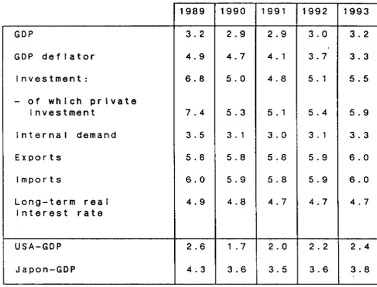
The Commission's medium-term macroeconomic forecasts
(1989/93) (see Table IV.1 In Chapter IV) point to a period
of relatively high growth (+3% on average for GOP) In the Community which wilt be fuelled essentially by Investment
(+5%
a
year).This good macroeconomic outlook will be a key positive factor In the medium-term prospects for the steel sector and should keep the demand for steel at a high level. Significant Increases In demand cannot, however, be expected
TABLE 1.1
Apparent consumption of ECSC and non-ECSC steel
In terms of crude steel equivalent
Year
EUR 1 2
1970
130.745
1971
122.504
1972
130.151
1973
139.905
1974
134.998
1975
113.100
1976
126.059
1977
118.305
1978
113.632
1979
122.936
1980
118.566
1981
109.285
1982
104.299
1983
99.236
1984
102.282
1985
101.592
1986
104.514
1987
103.637
1988(*)
118.138
(*)
Provisional
Source
Eurostat (EUR-12)
lSI (USA, Japan)
'000 t
USA
JAPAN
126.186
70.864
126.885
59.095
137.581
70.621
149.205
88.467
143.433
77.295
115.978
66.783
128.987
65.220
1~3.043
63.205
EUR 12
USA
JAPAN
Source
TABLE 1.2
Average annual growth rates
Per capita consumption
1 2
3
+0.2
-2.2
-3.9
+2.2
-1.5
-5.5
+0.6
-0.8
-1.7
1 : 1970/74
Eurostat (EUR-12)
lSI (USA, Japan)
4
+3.0
-2.2
+3.0
2
Per capIta product
1 2
3
4+3.3
+2.0
+1.0
+2.6
+2.0
+2.0
+1.1
+2.5
+3.2
+3.6
+3.2
+3.7
1974/79
31979/84
Steel Intensity
1 2
3
4-3.1
-4.2-4.9
+0.4
+0.2
-3.5
-6.6
-4.7
-2.6
-4.4
-4.9
-0.7
aoo
700
-m 600
-a. VI
~ 500 -c
0
..., tOO
-
't-o
~ 300
-0
....
--'
200
100
-WORLD CRUDE STEEL CONSUMPTION
I
-~'
j
~
.E
\\brld
Western industrialised
J\
countries
,:Y 1;/\ )
I
\]'~ ~:
. , r '
State-pl~
/
ecoromes
.../~
--~
Developing countries
1890 1900 1910 1920 1930 19W 1950 1960 1970 1980 1990
750
m
700
-a.
Ill
<lJ
c c
0 ...
't-o
Ill
c
0
....
--'
50
World development of crude steel production
(Source : IISI)
Crude steel production in the 12 countries
of the EEC
1970 1975 1980 1985
Development of crude steel production in the EEC
(Source : IISI)
Year
Year
I I I 1 .
CHAPTER I I
NEW TRENDS IN THE WORLD STEEL MARKET
1. TRENDS IN WORLD STEEL CONSUMPTION DISTRIBUTION OF STEEL DEMAND
NEW. GEOGRAPHICAL
Over the last two decades, world steel consumption has been character I zed by a slowing down of long-term growth and considerable changes In regional distribution. t.Aost OECD markets have seen a stagnation or decline In steel demand, while consumption In the developing regions of the world has
increased substantially.
World steel production (and demand) Increased at a rate-o-r about 6% per annum between 1950 and 1970 (6.1% In the 1950s and 5.6% In the 1960s). This slowed during the 1970s to 1.9% per annum following the f i r s t oil crisis, and declined further In the 1980s when consumption Increased by only 1% (and, In fact, decreased In the Industrialized world, not regaining Its 1980 level until 1988).
There has been a major change ·over the last 30 years In the geographical distribution of steel consumption.
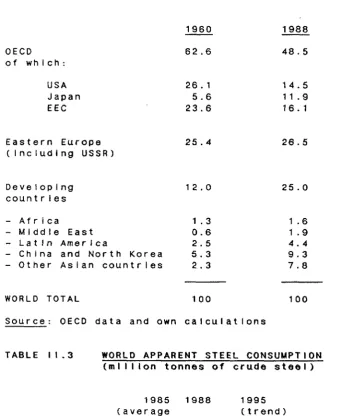
In 1960, consumption In the OECD countries accounted for 63% of the world total, that In the USSR and Eastern Europe 25%, and the remaining 12% was consumed by the developing countries.
In 1988, the OECD countries accounted for only 48% of world stee I consumptIon, the share of the USSR and Eastern Europe was practically unchanged at 26%, and the rest of the world accounted for 25% of the total (see Table I 1 .2).
Thus, during this period, the developing countries' share of world steel consumption had more ·than doubted, reducing that of the OECD by the same amount, and almost matching that of the Soviet Union and Eastern Europe.
Within the OECD, the period 1960-88 was characterized by the emergence of Japan as a major steel country, and by the relative decline of the USA and the European Community. Japan's share of world steel consumption Is now almost 12%, as agaInst on I y 5% In 1960. The share of the USA dropped from 26% to 14% during the same period.