APPROVAL
“I / we admit was read this report and on my view this report is sufficient from scope and quality for purpose the certificate Bachelor of technology Management
(Innovation Technology) with Honours”
Signature : ………..
Supervisor’s Name : Dr Hazmilah Binti Hasan
Date : ………..
Signature : ………..
Panel’s Name : PM Dr Chew Boon Cheong
THE RELATIONSHIP BETWEEN 4 NLP PILLARS AND JOB SATISAFCTION
NORAMALINA NAJWA BINTI MOHD SOH
This report submitted in partial fulfilling of the requirement of a Bachelor of Technology Management (Innovation Technology) with Honours
Faculty of Technology Management and Technoprenuership Universiti Teknikal Malaysia Melaka
DECLARATION
“I admit that this report is the result of my own except a summary and excerpts of everything I have explain the source”
Signature :
Name : Noramalina Najwa Binti Mohd Soh
iii
DEDICATION
Dedicated to
My beloved parents, Mohd Soh Bin Saamah and Norrizam Binti Mohd Yusoff, My supervisor, Dr. Hazmilah Binti Hasan, panel and my friends
iv
ACKNOWLEDGEMENT
In the name of ALLAH, the most gracious, the most merciful, with the highest praise to Allah that I manage to complete this final year project successfully without difficulty.
My respected supervisor, Dr. Hazmilah Binti Hasan for the great mentoring that was given to me throughout the project. Besides that, I would like to express my gratitude to my parents for their kindness, advice and guidance as well as praying for me and give me support to complete this study.
Last but not least, I would like to give a special thanks to my friends who gave me much motivation and cooperation mentally in completing this report. They had given their suggestion and comments throughout my research. Thanks for the great friendship.
Finally, I would like to thank everybody who was important to this FYP report, as well as I want to express my apology that I could not mention personally each one of you.
v
ABSTRACT
Neuro-linguistic programming (NLP) is a set of technique designed to make you better at what you do. NLP in organization can help employees to achieve job satisfaction by going to training. The main purpose of this study is to analyse the relationship between 4 NLP pillars and job satisfaction on academic staff. This study focus on the objective on the significant relationship between variables. This study used quantitative method to describe the variable, analyse the relationship among 4 NLP pillars and impact of NLP. A survey questionnaire was developed to collect the data from 127 respondent in UTeM. This research study on four independent variable based on NLP pillars; 1) Rapport, 2) Sensory Awareness, 3) Behavioural Flexibility and 4) Outcome towards the job satisfaction. The sample technique used is simple random sampling. Data collected was analysed using Statistical Package Social Science (SPSS) to find out the relationship of NLP pillars towards the job satisfaction. The findings indicates that the four NLP pillars play a big role in order to increase the job satisfaction.
vi
ABSTRAK
Neuro-linguistik Program (NLP) adalah satu set teknik yang direka untuk menjadikan anda lebih baik pada apa yang anda lakukan. NLP dalam organisasi boleh membantu pekerja untuk mencapai tahap kepuasan kerja dengan pergi ke latihan. Tujuan utama kajian ini adalah untuk menganalisis hubungan antara 4 pilar NLP dan kepuasan kerja terhadap staf akademik. Kajian ini memberi tumpuan kepada objektif mengenai hubungan signifikan antara pembolehubah. Kajian ini menggunakan kaedah kuantitatif untuk menerangkan pembolehubah, menganalisis hubungan di antara 4 pilar NLP dan kesan NLP. Soal selidik kaji selidik telah digunakan untuk mengumpulkan data daripada 127 responden di UTeM. Kajian penyelidikan ini pada empat variabel bebas berdasarkan pilar NLP; 1) Hubungan, 2) Kesedaran Sensori, 3) Fleksibiliti Kelakuan, 4) Hasil dan kepuasan kerja. Teknik sampel yang digunakan adalah persampelan rawak mudah. Data yang dikumpul dianalisis menggunakan Sains Sosial Pakej Statistik (SPSS) untuk mengetahui hubungan pilar NLP terhadap kepuasan kerja. Penemuan menunjukkan bahawa empat tiang NLP memainkan peranan besar untuk meningkatkan kepuasan kerja.
vii
TABLE OF CONTENT
DECLARATION ii
DEDICATION iii
ACKNOWLEGEMENT iv
ABSTRACT v
ABSTRAK vi
TABLE OF CONTENT vii
LIST OF TABLES xi
LIST OF FIGURES xii
LIST OF ABBREVIATION xii
LIST OF SYMBOL xiv
LIST OF APPENDIX xv
CHAPTER 1 1
INTRODUCTION 1
1.1 Introduction 1
1.2 Background of study 2
1.3 Problem statement 2
1.4 Research questions 3
1.5 Research objectives 3
1.6 Research scope 4
1.7 Research limitation 4
1.8 Significant of study 4
1.9 Summary 5
CHAPTER 2 6
LITERATURE REVIEW 6
2.0 Introduction 6
2.1 Neuro-linguistic Programming (NLP) 7
2.1.1 NLP History 9
2.2 Four pillars of NLP 10
viii
2.2.2 Outcome 12
2.2.3 Sensory Awareness 13
2.2.4 Behavioural Flexibility 14
2.3 Job Satisfaction 14
2.4 Employee Job Satisfaction 15
2.5 Research Framework 16
2.5.1 Theoretical Framework 16
2.5.2 Conceptual Framework 17
2.6 Hypothesis 18
2.7 Summary 19
CHAPTER 3 20
RESEARCH METHOD 20
3.0 Introduction 20
3.1 Research Framework 21
3.1.1 Positivism 21
3.1.2 Methodological Choice 22
3.1.2.1 Quantitative method 22
3.2 Research Design 22
3.2.1 Research Scope 23
3.3 Population / Sample 23
3.3.1 Population 23
3.3.2 Sampling Method 24
3.2.2.1 Sampling Technique 24
3.4 Research Instrument 25
3.4.1 Diagram Phase of Research Design 27
3.4.2 Survey Method 28
3.4.3 Data Collection Strategies 28
3.4.3.1 Primary Data 29
3.4.3.2 Secondary Data 29
3.4.3.3 Questionnaires 30
3.5 Data Analysis 31
3.5.1 Principle Component Analysis 31
3.5.2 Pearson’s Correlation Analysis 32 3.5.2.1 Relationship between Independent and Dependent Variables 33
ix
3.5.3.1 Hypothesis Testing 34
3.6 Reliability and Validity 35
3.6.1 Reliability 35
3.6.2 Validity 37
3.6.2.1 Construct Validity 37
3.6.2.2 Internal Validity 37
3.6.2.3 External Validity 38
3.7 Pilot Report 38
3.8 Summary 40
CHAPTER 4 41
DATA PRESENTATION 41
4.0 Introduction 41
4.1 Reliability Statistics 42
4.2 Analysis of demographic Information of Respondents 42 4.2.1 Distribution of Respondent by Gender 43 4.2.2 Distribution of Respondent by Age 44 4.2.3 Distribution of Respondent by Procession 45 4.2.4 Distribution of Respondent by “Since you are working in UTeM, is there
any motivation program that you have been?” 46 4.2.5 Distribution of Respondent by knowing Neurolinguistic Programming
(NLP) 47
4.2.6 Distribution of Respondent by where they know the Neurolinguistic
Program (NLP) 48
4.2.7 Distribution of Respondent by how many time they have been to NLP
training before 49
4.2.8 Distribution of Respondent by program that is good to improve work and
job satisfaction 50
“How do you think the NLP will impact your life?” 51
4.3 Principle Component Analysis 52
4.3.1 Declared Attitude (A) 52
4.3.2 Outcome (B) 53
4.3.3 Rapport (C) 54
4.3.4 Sensory Awareness (D) 55
4.3.5 Behavioural Flexibility (E) 56
4.3.6 Job Satisfaction (F) 57
x
4.5 Multiple Linear Regression 59
4.5.1 The Model Summary Results by using Linear Regression 59 4.5.2 The Anova Results by using Linear Regression 60
4.6 Hypothesis Testing 61
4.7 Summary 64
CHAPTER 5 65
DATA DISCUSSION 65
5.0 Introduction 65
5.1 Discussion of Objective and Hypothesis Test 66 5.1.1 Objective 1: To identify the factor of 4 NLP pillars that have more
significant towards job satisfaction 66
5.1.1.1 Outcome 66
5.1.1.1 Rapport 66
5.1.1.1 Sensory Awareness 67
5.1.1.1 Behavioural Flexibility 67 5.1.2 Objective 2: To study the most selected impact of NLP in person’s
life. 68
5.1.3 Objective 3: To analyse the relationship between NLP 4 pillars and
job satisfaction 69
5.3 Summary 69
CHAPTER 6 70
CONCLUSION & RECOMMENDATION 70
6.0 Introduction 70
6.1 Impact of research framework 71
6.2 Impact of methodology 71
6.3 Factor 71
6.4 Conclusion 71
6.5 Recommendation 72
REFERENCES 73
xi
LIST OF TABLES
Table 2. 1: Neuro-linguistic Programming Term 7 Table 2. 2: List of independent variable with hyphothesis 18
Table 3. 1: Determining sample size (S) from a given population (N) 24
Table 3. 2: Questionnaire Design 30
Table 3. 3: Method of Data Analysis according the Research Question 31 Table 3. 4: Strength of the correlation coefficient 33 Table 3. 5: Guidelines for Cronbach’s Alpha Source: (George & Mallery, 2003) 37 Table 3. 6: Reliability Statistics for Pilot Test 39
Table 3. 7: Questionnaire Correction 39
Table 4. 1: Reliability Statistics for Variables 42
Table 4. 2: Respondent’s Gender 43
Table 4. 3: Respondent’s Age 44
Table 4. 4: Respondent’s Profession 45
Table 4. 5: Respondent’s Motivation Program that they have been 46 Table 4. 6: Respondent’s knowing Neurolinguistic Programming (NLP) 47 Table 4. 7: Respondent’s where they know Neurolinguistic Programming (NLP) 48 Table 4. 8: Respondent’s how many time they have been to NLP training before 49 Table 4. 9: Respondent’s by program that is good to improve work and job
satisfaction 50
xii
LIST OF FIGURES
Figure 2. 1: The Trust Buiding 11
Figure 3.1: The Research Process 27
Figure 4. 1: Distribution of Respondents by Gender 43 Figure 4. 2: Distribution of Respondents by Age 44 Figure 4. 3: Distribution of Respondents by Profession 45 Figure 4. 4:Distribution of Respondents by Motivation Program that they have been
46 Figure 4. 5:Distribution of Respondents by knowing Neurolinguistic Programming
(NLP) 47
Figure 4. 6: Distribution of Respondents by where they know Neurolinguistic
Programming (NLP) 48
Figure 4. 7: Distribution of Respondents by how many time they have been to NLP
training before 49
Figure 4. 8: Distribution of Respondents by program that is good to improve work
and job satisfaction 50
xiii
LIST OF ABBREVIATION
xiv
LIST OF SYMBOL
% = Percentage < = Less than > = More than = = Equal
xv
LIST OF APPENDIX
Appendix 1: Questionnaire 77
1
CHAPTER 1
INTRODUCTION
1.1 Introduction
2
1.2 Background of study
A research background is one of the preliminary steps to completing a study includes a review of area that being researched, current information surrounding the issue, previous studies and also the relevant history that related to the topic.
NLP training increasingly became accepted and popular all through the 1960’s, although it was initially developed as a practical approach of communication attracting only psychotherapists. Afterwards, these events receive the attention from business and marketing people, artists, and salespersons. (Zulkifli, 2015)
Initially, the essence of NLP is to find an individual who had successfully overcome an issue, and sketch out a model comprising of the individual’s behaviour and frame of reference.(Vickers, 2009) (Yemm, 2006).
1.3 Problem statement
Job satisfaction represents the affective reactions of employees towards their jobs or employees’ positive feeling towards their jobs (Ohtsuka, Dagang, Bakar, 2014). Employee job satisfaction is increasing in importance, as the competition for talent is high and still growing. It is not hard for a competitor to compete with individual elements of employment such as salaries and benefits. Boyens (2007), focuses on the reasons of involuntary turnover, voluntary turnover, and promotion for employees to leave a particular company.
3
1.4 Research questions
A research question is an answerable inquiry into a specific issue. It is the first step in a research project. As the early step of the research, the researcher generates the ideas of what have been studied according to the related research and the research question is the first active step in the research project.
1. What is the factor of 4 NLP pillars that have more significant towards job satisfaction?
2. What is the most selected impact of NLP in person’s life?
3. What are the relationship between NLP 4 pillars and job satisfaction?
1.5 Research objectives
Research objective provide a clear path and focus for researcher. By having research objective, it will give researcher conduct the study on the right path and avoid unrelated information. According to Sunders (2012), research objective will express ‘how’ we intend to structure the research process which linked with your research question. Furthermore, the research objective should also relate with the questions that affect the results at the end of this research. This research objective has been designed by the researcher based on the research topic and research problems.
1. To identify the factor of 4 NLP pillars that have more significant towards job satisfaction.
2. To study the most selected impact of NLP in person’s life.
3. To analyze the relationship between NLP 4 pillars and job satisfaction.
1.6 Research scope
4
Pillars and job satisfaction. The respondent of this study is the educators and administrators of in UTeM.
1.7 Research limitation
The researcher face constraints in term of data obtained from the respondents. This is because, the respondent’s knowledge and the researcher’s knowledge are the same. The respondent gave very honest answer to the researcher while collecting the data. The researcher also have some difficulty in finding the respondent because the respondent was listed.
1.8 Significant of study
5
1.9 Summary
6
CHAPTER 2
LITERATURE REVIEW
2.0 Introduction
7
2.1 Neuro-linguistic Programming (NLP)
As an intention of studying people who were excellent, in order to understand how they achieved remarkable results, Neuro-Linguistic Programming (NLP) was developed by Richard Bandler and John Grinder (1979). Linder-Pelz and Hall (2007) described it with the following words:
‘[t]he “neuro” refers to the way humans experience the world through their senses and translate sensory experiences into thought processes, both conscious and unconscious, which in turn activate the neurological system; “linguistic” refers to the way we use language to make sense of the world, capture and conceptualize experience and then communicate that experience to others; and “programming” addresses the way people code (mentally represent) their experience and adopt regular and systematic patterns of response’.
NLP has also been defined by Brown and Turnbull (2000, p. 5) as:
‘A term used to refer to a range of ideas and techniques that relate to how we communicate with each other and with ourselves.'
[image:23.595.113.526.487.749.2]
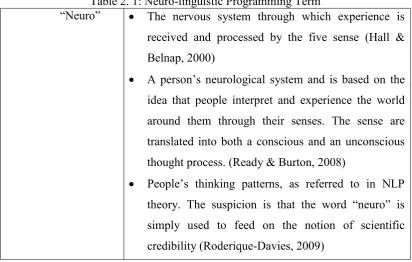
Table 2. 1: Neuro-linguistic Programming Term
“Neuro” The nervous system through which experience is received and processed by the five sense (Hall & Belnap, 2000)
A person’s neurological system and is based on the idea that people interpret and experience the world around them through their senses. The sense are translated into both a conscious and an unconscious thought process. (Ready & Burton, 2008)
8
relates to the approach individuals absorb and filter data through their senses, specifically sight, hearing, taste, smell and kinaesthetic (touch or emotional feeling) (Burn, 2005)
Neurology or human brain and nervous system, in which relates to the ways human process information gathered from the five senses. (Zulkifli, 2015)
“linguistic” Relating to language and non-verbal communication that the human mind files, codes and give meaning to. (Hall & Belnap, 2000)
How words and body language influence a person’s experience, how they conceptualise it and how they subsequently communicate in to others. (Ready & Burton, 2008)
Relates to the method individuals interpret their experiences through language, not only in words however through symbols, as well as gestures and postures. (Burn, 2005)
Language systems, including the verbal and nonverbal language used to code, organise, and attribute meanings to human’s internal representations of the world, and to interact or communicate both internally and externally. (Zulkifli, 2015)
“Programming” The ability to achieve specific desired goals and results by organising one’s communication and neurological system. (Hall & Belnap, 2000)
How experiences are internally coded, meaning how internal processes, strategies and thinking patterns are used to make decision, solve problems and assists in learning. (Ready & Burton, 2008)