Alexander C. Block and Benedikt L¨owe
We provide a general framework to study modal logics of mul-tiverses and survey the results on the modal logic of forcing, the modal logic of grounds, and the modal logic of inner models. We also provide new results on the modal logic of symmetric exten-sions.
1. Introduction
This paper is a survey on modal logic of multiverses. It summarizes known results by Hamkins, Inamdar, Leibman, and the second author about the modal logics of forcing, grounds, and inner models in a general abstract setting. Most results in this survey come from a series of papers co-authored by the second author [19,20,
18, 24]. Exceptions are the discussion of spiked Boolean algebras and the modal logic of c.c.c. forcing in§7.1 (these results were obtained by Inamdar in his Master’s thesis [23] supervised by the second author) and the determination of the modal logic of symmetric extensions in§7.4 due to the first author.
The study of modal logics of set theoretic constructions started with [15] and [19]. Various other aspects of the modal logic of forcing are considered in [29,21,
9, 10, 30, 32, 8, 7, 20, 18]. In §2, we explain the natural (and very general) setting for the study of modal logics of forcing: set theoretic multiverses. After providing some general background in modal logic in§3 and the abstract definition of modal logics for multiverses in§4, we then discuss the main result of [19] in§5 and provide the general proof strategy adapted to our general multiverse setting in
§6. Finally, in §7, we survey various generalisations in the multiverse setting.
2. Set theoretic multiverses
The context in which the investigation of the modal logic of forcing is most naturally seen is the investigation of theset theoretic multiverse:
The continuum hypothesis CH had been the most prominent open problem of set theory since Hilbert had listed it as the first problem on his list of problems for the 20th century [22]. In 1963, Cohen showed that it can not be solved on the basis ofZFC[3]. In our context, the following is the most appropriate formulation of this impossibility result:
Theorem 1. If M |=ZFC, then there are N, N0 such that M ⊆N and M ⊆N0 and
N |=ZFC+CHandN0|=ZFC+¬CH.
The philosophy of mathematics literature abounds with discussions about what Cohen’s result means:1 Does it mean that the question of the continuum hypothesis is an unsolvable problem? Does it mean that ZFCis a deficient axiom system and we need to search for new axioms?
Recently, a new view, called themultiverse view, was proposed by Hamkins [17]: on the multiverse view, Cohen’s result is not a problem, but rather (part of) the answer. Set theorists gain understanding about the truth values of statements in set theory by understanding their behaviour in the multiverse of models of set theory. The fact thatCHcan be made true or false in an extension of every model of set theory is one important component of understanding the meaning ofCH: it contrastsCHwith other statements, e.g., statements that are true in all models of set theory, statements that are false in all models of set theory, and statements that can be false, but once they are true, they remain true in forcing extensions:2
The multiverse view [...] holds that there are diverse distinct con-cepts of set, each instantiated in a corresponding set-theoretic uni-verse, which exhibit diverse set-theoretic truths. Each such universe exists independently in the same Platonic sense that proponents of the universe view regard their universe to exist. [...] In particular, I shall argue [...] that the question of the continuum hypothesis is settled on the multiverse view by our extensive, detailed knowledge of how it behaves in the multiverse. [17, p. 416-417]
Studying the multiverse as a mathematical entity is not restricted to researchers who subscribe to the philosophical position of the multiverse view. In his own work onCH, Woodin (who is not an adherent of the multiverse view) has studied a particular substructure of the multiverse, thegeneric multiverse, which is also the main playing field for the study of modal logics of forcing. In general,multiverses
are collections of models of set theory, linked by relations that reflect that one model was constructed from another. In full generality, the multiverse should contain all models of set theory: this makes it meta-mathematically difficult to describe since it will become a higher-order object.3 In contrast with these very general and foundational multiverse concepts, we’ll be looking at fragments of the multiverse generated by a fixed collection of construction methods. These fragments will live in second order set theory:
Suppose that we have a meta-universeVof set theory in which we interpret all statements of our meta-language, like, e.g., “ZFC`ϕ”. We shall assume that our meta-universe is rich enough to have (countable) set models of set theory, which will become our main objects of study.4 Of course, this means that we must work
1The literature on the philosophical implication of independence results is vast and we shall
not be able to do it justice by giving references.
2These latter statements will be called buttons later whereasCHwill be called a switch; cf.
Definition 11.
3However, cf. [12].
4Note that we use the slightly ambiguous phrase “models of set theory” rather than “models
in a relatively strong meta-theory (e.g.,ZFC+“ZFCis consistent”), but we shall not be worried by this.
A model construction in our meta-universe V is a class function C that gets pairs (M, p) as input where M ∈ V is a model of set theory and p ∈ V is a parameter. Only for some choice of (M, p) will C(M, p) be an appropriate object. We shall call those pairs C-good. In particular, we shall assume that if (M, p) is
C-good, then C(M, p) is a model of set theory. We may add further restrictions, though. IfV ∈Vis a model of set theory, we can define theC-multiverse ofV by closing under the operationM 7→C(M, p) (of course, this recursion happens in the meta-universeV):
MultC0(V) :={V},
MultCn+1(V) := MultCn(V)∪ {C(M, p) ; M ∈MultCn(V), p∈V and (M, p) isC-good}, and MultC(V) := [
n∈N
MultCn(V)
The C-multiverse comes with a natural accessibility relation generated by C
where we say that a modelM C-accesses another modelN (in symbols,M ≤CN) if there is a psuch that (M, p) is C-good and N =C(M, p). Depending on C, it could be that this relation is not transitive. In that case, we could also consider the transitive closure of≤Cas an accessibility relation.
A natural generalization of this is a multiverse produced by more than one construction method. We shall not deal with these multiverses in this paper, but give the appropriate definitions as a reference. Suppose that C is a collection of construction methodsC: (M, p)7→C(M, p) as before. Then
MultC0(V) :={V},
MultCn+1(V) := Mult C
n(V)∪ {C(M, p) ; C∈ C,M ∈Mult
C
n(V), p∈V, and
(M, p) isC-good}, and MultC(V) := [
n∈N
MultCn(V)
Such a multiverse has several accessibility relations: for each C∈ C, we would have the notion≤C ofC-accessibility as defined above. In addition to these paths
corresponding to a single construction method, we can consider mixed paths: if
C∗ ⊆ C is nonempty, we say that a model M C∗-accesses another model N (in symbols, M ≤C∗ N) if there is a finite sequence (Mi;i ≤ n) with M0 = M,
Mn=N, and for eachi < nthere is some C∈ C∗ such thatMi
+1=C(Mi, p) for some psuch that (Mi, p) is C-good.5 These accessibility relations can be studied either individually or with a focus on their interactions (the results in §7.2, in particular, Theorem 14, can be seen as an example of a bimodal setting with two modalities).
5Note that ifC∗={C}, then≤
3. Modal logic and its applications
The propositional language of modal logic consists of∧,∨,¬,⊥,2and3and propo-sitional variables from a set Prop. Typically we read2ϕas “it is necessary that
ϕ” and 3ϕas “it is possible that ϕ”. The following semantics for modal logic is calledKripke semantics and was introduced by Kripke in [26]:
We call any directed graph (K, E) a Kripke frame; if v : Prop → ℘(K) is a function (called avaluation function), we shall call (K, E, v) aKripke model. For any Kripke model (K, E, v) andx∈K, we define a satisfaction relation for modal formulas recursively as follows:
(K, E, v, x)|=p ⇐⇒ x∈v(p),
(K, E, v, x)|=ϕ∧ψ ⇐⇒ (K, E, v, x)|=ϕand (K, E, v, x)|=ψ,
(K, E, v, x)|=ϕ∨ψ ⇐⇒ (K, E, v, x)|=ϕor (K, E, v, x)|=ψ,
(K, E, v, x)|=¬ϕ ⇐⇒ (K, E, v, x)6|=ϕ,
(K, E, v, x)|=2ϕ ⇐⇒ for ally such thatxEy,
we have that (K, E, v, y)|=ϕ,
(K, E, v, x)|=3ϕ ⇐⇒ there is ay such thatxEy
and (K, E, v, y)|=ϕ.
If ϕ is a modal formula, we say that it is valid in (K, E, v) if (K, E, v, x) |= ϕ
for every x ∈ K. We say that it is valid in (K, E) if it is valid in every Kripke model on (K, E). IfK is a class of Kripke frames, we write ML(K) for the set of modal formulas valid in all frames (K, E)∈ K. Clearly, ifK ⊆ K0, thenML(K0)⊆
ML(K).
A set Λ of modal formulas is called amodal logic if it contains all propositional tautologies, is closed under modus ponens (i.e., if ϕ ∈ Λ and ϕ → ψ ∈ Λ, then
ψ∈Λ), uniform substitution (of propositional variables in a formula by arbitrary formulas) and necessitation (if ϕ ∈ Λ, then 2ϕ ∈ Λ). It is called normal if it contains all instances of the scheme
(K) 2(ϕ→ψ)→(2ϕ→2ψ).
It satisfiesduality if it contains all instances of the scheme
(Dual) 3ϕ↔ ¬2¬ϕ.
If is easy to see that for any classK of Kripke frames, the setML(K) is a normal modal logic satisfying duality.
The following modal formulas are not theorems ofK, as can be easily seen using Theorem 2 by providing a Kripke model that invalidates them:
2ϕ→ϕ
(T)
2ϕ→22ϕ
(4)
32ϕ→23ϕ
(.2)
32ϕ→ϕ
(5)
The modal logic T is the minimal normal modal logic satisfying duality and including all instances of (T). Similarly,S4is the minimal normal modal logic sat-isfying duality, extendingTand including all instances of (4),S4.2is the minimal normal modal logic satisfying duality, extendingS4 and including all instances of (.2), andS5 is the minimal normal modal logic satisfying duality, extendingS4.2
and including all instances of (5).
The fundamental idea of Kripke semantics is that properties of the relationEof a Kripke frame (K, E) directly correspond to the validity of modal formulas. This idea is due to Kripke [26] and was the beginning of a rich literature of completeness theorems for modal logics using the technique of canonical models (cf. [2, §4.2]). Let us give a number of examples [2, Theorems 4.23, 4.28 & 4.29]:
Theorem 3. LetKrbe the class of all Kripke frames(K, E)with a reflexive relation
E, Krt be the class of all Kripke frames (K, E) with a reflexive and transitive
relation E (also called partial pre-orders), Krtd be the class of all Kripke frames (K, E) with a reflexive, transitive and directed relationE, andKrts be the class of
all Kripke frames(K, E)with a reflexive, transitive and symmetric relationE (also called equivalence relations). Then
(1) T=ML(Kr),
(2) S4=ML(Krt),
(3) S4.2=ML(Krtd), and
(4) S5=ML(Krts).
It is important to note that Theorem 3 does not mean that every Kripke model of a theory has to have the relational properties of the corresponding frame class: e.g., there can be models (K, E, v) |= S4 where the relation E is not transitive. This is important in our context, since we shall interpret the multiverses of§2 not simply as Kripke frames, but as Kripke frames with a restriction on the valuations on them we want to consider.6
A second crucial property of Kripke semantics is that for many examples of modal logics (in particular, the modal logicsK,T,S4,S4.2, andS5defined above), the class of finite frames with the appropriate property is enough to define the modal logic. Theorems like this are usually proved with the technique offiltration(cf. [13, pp. 267-268] or [2, pp. 77–82]). All of the modal logics listed in Theorem 3 have the finite model property and the finite frame property:7
6Structures like this are known asgeneral frames, cf. [2,§1.4].
7Cf. [2, Definitions 2.27 & 3.23], respectively. For normal modal logics, the finite model
Theorem 4. LetKfin
r be the class of all finite Kripke frames(K, E)with a reflexive
relation E,Kfin
rt be the class of all finite Kripke frames(K, E)with a reflexive and
transitive relation E, Kfin
rtd be the class of all finite Kripke frames (K, E) with a
reflexive, transitive and directed relationE, andKfin
rtsbe the class of all finite Kripke
frames(K, E)with a reflexive, transitive and symmetric relationE. Then (1) T=ML(Kfin
r ),
(2) S4=ML(Kfin rt ),
(3) S4.2=ML(Kfin rtd), and
(4) S5=ML(Kfin rts).
4. Modal Logics of Multiverses
As in§2, we fix a meta-universeVand a construction methodC. For every model of set theory V, we can consider (MultC(V),≤C) as a Kripke frame. In our set theoretic context, we are not interested in the purely algebraic properties of this frame, but want to restrict our attention to valuations that connect with the set theoretic properties of the multiverse under investigation. A valuation function
v : Prop →℘(MultC(V)) is called set theoretic if there is an assignment p7→ σp
assigning a sentence in the language of set theory to any propositional variable in such a way that v(p) = {N ∈ MultC(V) ;N |=σp}. We call a Kripke model
(MultC(V),≤, v)set theoreticifvis a set theoretic valuation function. We can now define themodal logic of the multiverse MultC(V) by
MLCV :=
{ϕ; ϕis satisfied atV in all set theoretic Kripke models on (MultC(V),≤C)}.
The following is a syntactic reformulation of the same concept (these definitions are due to Inamdar and the second author [24]): Call a functionH atranslationif it assigns to eachp∈Prop a sentenceH(p) of the language of set theory. Then for each model of set theoryV and every translationH, we define by recursion in the meta-universeV:
V |=HC p:⇐⇒ V |=H(p),
V |=HC ϕ∧ψ:⇐⇒ V |=HCϕandM |=HCψ, V |=HC ϕ∨ψ:⇐⇒ V |=HCϕorM |=HCψ,
V |=HC¬ϕ:⇐⇒ notV |=HC ϕ, and
V |=HC2ϕ:⇐⇒ ∀W(V ≤CW →W |=HC ϕ).
Proposition 5. Let V ∈ V be a model of set theory and ϕ be a formula in the language of modal propositional logic. Then the following are equivalent:
(1) The formula ϕ is satisfied at V in every set theoretic Kripke model
(MultC(V),≤C, v), and
(2) for every translation H, we haveV |=HCϕ.
We can now define themodal logic of the construction methodC by
MLC:=\{MLCV;V |=BSTis a countable model}
whereBST is our basic set theory (i.e.,ZFCin almost all cases; cf. Footnote 4).
5. The Modal Logic of Forcing
We now phrase the modal logic of forcing, as investigated by Hamkins and the second author in [19] in terms of our general framework. In this section, our base theory isZFC. As before, we fix a meta-universeVand letFbe the operation that assigns to a pair (M, G) the generic extension F(M, G) := M[G] if there is some forcing partial orderP∈M such thatGisP-generic overM. Then for every model
V ∈V, we consider the Kripke frame (MultF(V),≤F).
5.1. Some words of caution about multiverses as structures.Since we are emphasizing the second order set theory aspect of multiverses in this paper, it is interesting to have a closer look at these forcing multiverses MultF(V) that are concrete structures from the point of view of the meta-universe V. The first observation is that they may trivialize: suppose that the meta-universe is a model ofV=L+“κis an inaccessible cardinal”. Let V :=Lκ. Supposeγis the statement “there is a Cohen real over L”, then this statement is false everywhere in the multiverse MultF(V). This means that the structure MultF(V) does not capture the intuition of what is possible to achieve by forcing very well at all; in fact, in the case of the forcing multiverse, we should restrict ourselves to countable models
V in order to have that MultF(V) is a structure that represents the “worlds made possible by forcing” (since in this case, generics for all forcing partial orders in V
exist inVby [27, Lemma VII.2.3]).
But even ifV is countable, we have to be careful with our structure MultF(V): if P and Q are forcing partial orders in some W ∈ MultF(V) and G and H are P-generic andQ-generic overW, respectively, we cannot assume thatG×H would be P×Q-generic. In fact, G×H is P×Q-generic if and only if G and H are mutually generic, i.e.,GisP-generic overW[H] andH isQ-generic overW[G] [27, VIII.1.4]. But by a simple argument due to Woodin, ifV is countable andx∈ωω
witnesses the countability of V, then there are two Cohen reals c1 andc2 over V such that any model of set theory containing both c1 and c2 will also contain x (we call the generic extensions V[c1] and V[c2] non-amalgamable). Consequently, there can be no forcing extension ofV that contains both c1 and c2. This means that the preorder (MultF(V),≤F) is not directed. Since we are restricting our attention to set theoretic valuations, this does not preclude the scheme (.2) from being valid in the modal logic of forcing: suppose thatP forces some statementσ to be necessarily true andQforces some other statementτ to be necessarily true, then there are pairs of mutual generics and P×Q forces σ∧τ to be necessarily true, even if for some choices of genericsGandH, the extensionsV[G] and V[H] may be non-amalgamable in the above sense.
extensions are again transitive countable models of set theory. In particular, if P in V and ˙Q in VP is a name for a forcing partial order and if H is
P∗Q˙-generic over V, then H splits into aP-generic filter G0 over V and a Q-generic filter G1 overV[G0] such thatV[G0][G1] =V[H].
IfV is not wellfounded, then we shall not be able to produce a transitive model corresponding to its generic extension, i.e., we have to work with the quotient structure on the set of names itself. This means that in the above situation,V[H] will be isomorphic toV[G0][G1], but will not be the same set. As a consequence, the multiverse is not literally transitive, but only transitive up to isomorphism. A similar observation can be made with respect to reflexivity. For more on forcing over non-wellfounded models, cf. [4].
5.2. The syntactic description of the modal logic of forcing.The character-isation via translations from Proposition 5 becomes highly relevant in this context since the Forcing Theorem [27, Theorem VII.3.6] tells us that for every sentenceσ
of the language of set theory, we have thatσis true in every generic extension of a countable modelM of set theory if and only if
M |=∀P(P ϕ)
where P ranges over all partial orders and P is the forcing relation recursively
defined with parameter P [27, Definition VII.3.3]. This means that the second order definition of |=HC from §4 can be replaced by a purely syntactic first order transformation of formulas:
A function H ∈ V that takes a formulaϕ of the language of modal logic and assigns a sentence of the language of set theoryH(ϕ) is called aHamkins translation
if
H(⊥) =⊥, H(¬ϕ) =¬H(ϕ),
H(ϕ∨ψ) =H(ϕ)∨H(ψ), and
H(2ϕ) =∀P(PH(ϕ)).
Proposition 6. Suppose that V is a countable model of set theory and H is a Hamkins translation. Then H0 :=HPropis a translation in the sense of §4 and
furthermore, for all formulas ϕ in the language of modal propositional logic, the following are equivalent:
(1) V |=H(ϕ) and (2) V |=H0
F ϕ.
Proof. Induction on the complexity of formulas, where the only nontrivial step is
ϕ=2ψ:
V |=H0F ϕ ⇐⇒ ∀W(V ≤FW →W |=H0F ψ) ⇐⇒ ∀W(V ≤FW →W |=H(ψ))
where the second line is the induction hypothesis and for the third equivalence we use the Forcing Theorem and the fact that for any countable model of set theory there are generic filters for every forcing. Furthermore we use that any forcing extension of a countable model is countable again, which follows from the fact that there is a surjection from the class of names in the ground model to the elements
of the forcing extension.
Using Propositions 5 and 6, we obtain that
MLF=\{MLFV ;V |=ZFCis a countable model}
={ϕ; V |=HF ϕfor all countable modelsV |=ZFCand all translations H}
={ϕ; ZFC`H(ϕ) for all Hamkins translationsH}.
Theorem 7(Hamkins). For every modelV |=ZFC,S4.2⊆MLFV. Consequently, S4.2 ⊆ MLF. There are models W and W0 such that S5 ⊆ MLFW and S5 6⊆ MLFW0.8
The validity ofS4.2is closely connected to closure properties of the multiverses MultF(V); e.g., the validity of (4) related to theiteration lemma in the theory of forcing [27, VIII.5.5], which essentially expresses that forcing is transitive (up to isomorphism), and the validity of (.2) is related to theproduct lemma[27, Theorem VIII.1.4].9
Theorem 8(Hamkins-L¨owe). The modal logic of forcing is exactly S4.2.
In§6, we shall sketch the general proof strategy for Theorem 8 in our setting. In order to motivate why results like Theorem 8 are relevant, we show that it implies that there can be no pure forcing proof for the mentioned result by Hamkins and Stavi-V¨a¨an¨anen (Theorem 7 and Footnote 8).
Corollary 9. There can be no pure forcing proof of the existence of a model N such that S5⊆MLFN.
Proof. By a pure forcing proof, we mean thatZFC proves that you can force the modal logic of forcing to include S5. This statement itself can be rendered as 3(32p→p)∈MLF. But 3(32p→p) is not a theorem ofS4.2in contradiction
to Theorem 8.
6. The general proof strategy
Theorem 8 is the prototypical result we are going to discuss in this paper in the multiverse setting. We give a description of the proof strategy for Theorem 8 in such a way that it can be generalized to modal logics of multiverses for any other construction methodC:
Step 1.: We first guess a candidate modal logic Λ of which we aim to show thatMLC= Λ.
Step 2.: For the lower bound, we show Λ⊆MLCby showing the validity of all axioms of Λ in every modelV |=BST.
8The existence of a modelW such thatS5⊆MLF
W was proved independently in [33].
Step 3a.: For the upper bound, we first find an appropriate classKof Kripke frames such that Λ =ML(K).
Step 3b.: We prove a transfer lemma by giving a condition Ξ in terms of so-called control statements (cf., e.g., Lemma 12 (3)) under which modal truth from one of the frames inK can be transferred to a modelV |=BST validating Ξ.
Step 3c.: We find a modelV |=BST validating Ξ.
Concerning the lower bounds (Step 2), these are typically connected with the closure properties of the relation ≤in the investigated multiverse. For instance, if
≤C is reflexive (up to isomorphisms), then T⊆MLC. This was investigated for classes of forcing in [29] (cf. also [18, Theorem 7]).
Hamkins, Leibman, and the second author also provided the abstract background for the transfer lemmas needed forStep 3b[18]: Let (K, E) be a Kripke frame with
g ∈K andv : Prop→℘(K) be a valuation function. Furthermore, letV |=BST and letH be a translation. We say that thatH transfers truth between(K, E, v, g)
andV with respect to Cif for every modal formulaϕwe have that (K, E, v, g)|=ϕ ⇐⇒ V |=HCϕ.
If (K, E) is a finite Kripke frame,V a model of set theory, andg0∈K. We say that{Φg;g∈K}is aC-labelling of(K, E, g0)forV if each of the Φgis a sentence
in the language of set theory such that
(1) in each model of set theoryW ∈MultC(V) exactly one Φg is true,
(2) V |= Φg0
(3) if h, h0 ∈K and W |= Φ
h then hEh0 if and only if there is some W0 with W ≤CW0 and W0|= Φh0.
We give an example of how this general proof strategy works in terms of the modal logic of forcing given in§5:
The candidate modal logic for MLF was S4.2 (Step 1) and Theorem 7 had established thatS4.2⊆MLF(Step 2). ConcerningStep 3a, Theorem 3 already provides us with a class of Kripke models, viz. the class of finite directed partial pre-orders. However, this class can be slightly refined in order to allow us to prove the transfer lemma.
As usual, pre-orders (reflexive and transitive relations) carry a natural notion of equivalence: If (K,≤) is a pre-order, let ≡be defined by v ≡w if and only if
v≤w≤v. Clearly,≤is well-defined on the≡-equivalence classes, so with a slight abuse of notation, we can consider the quotient structure (K/≡,≤). For any classO
of ordered structures, we say that a pre-order (K,≤) ispre-Oif (K/≡,≤)∈ O. E.g., pre-lattices or pre-Boolean algebras are pre-orders such that the natural quotient by≡becomes a lattice or a Boolean algebra, respectively.
Theorem 10 (Hamkins-L¨owe; [19, Theorem 11]). A modal formula is in S4.2if and only if it is valid in all Kripke frames whose edge relation is a finite pre-Boolean algebra.
Definition 11. A sentence b in the language of set theory is a button if it is necessarily possibly necessary;10 it is unpushed in a model V of set theory, if
V |=¬b. A sentencesis called aswitch if bothsand¬sare necessarily possible. An example button in the case of forcing isωL
1 < ω1which is unpushed inL, but can be pushed by collapsingωL
1 by forcing (note that it remains true in all further forcing extensions; cf. Footnote 2); an example switch isCHwhich can be forced to be true or false over every model of set theory (cf. Theorem 1).
Suppose that V is a model of set theory. If B is a set of buttons and S is a set of switches, thenB∪S is called anindependent family of buttons and switches overV if all buttons are unpushed inV and for every V∗,B0 ⊆B andS0 ⊆S, if
V ≤CV∗ and B∗ is the set of buttons pushed in V∗, then there is some V0 such thatV∗≤CV0 andB∗∪B0 is the set of buttons pushed inV0 andS0 is the set of switches true inV0.
Lemma 12 (Transfer Lemma). (1) If there is a V |=ZFCsuch that for every finite pre-Boolean algebra(K,≤), every valuation functionv, and everyg∈ K, there is a Hamkins translation that transfers truth between (K,≤, v, g)
andV with respect toF, then the modal logic of forcing is contained inS4.2. (2) Let (K,≤) be a finite pre-Boolean algebra, V a model of set theory, and g0∈K such that there is anF-labelling of (K,≤, g0)forV. Then for every
valuation functionv there is a a Hamkins translationH that transfers truth between(K,≤, v, g0)andV with respect toF.
(3) Let (K,≤) be finite pre-Boolean algebra with g ∈ K and V a model of set theory with an independent family of buttons and switches of sufficient size11
then there is anF-labelling of(K,≤, g)forV.
Proof. (1) Supposeψ is not a theorem of S4.2. Then by Theorem 10, there is a finite pre-Boolean algebra (K,≤), a valuationv, and ag∈Ksuch that
(K,≤, v, g)|=¬ψ.
By the assumption, there is a Hamkins translation H transferring truth between (K,≤, v, g) andV, soV |=¬H(ψ). Consequently, ψ /∈MLF.
The proofs of (2) and (3) can be found in [18, Lemma 9] and [18, Theorem 13],
respectively.
Finally, inStep 3c, Hamkins and the second author proved that any model sat-isfyingV=Lhas an independent family with infinitely many buttons and switches, thus completing the proof [19, Lemma 6.1]. It should be mentioned that we do not know how to prove independence of the buttons given in the original proof of [19, Lemma 6.1] (this was observed in [32]), but numerous other infinite families of buttons have been provided of which independence can be proved (cf. [18,§4]).12
10I.e., ifH is a translation such thatH(p) =b, then for every modelV of set theory,V |=H
C
232p.
11It is sufficient that the family has as many buttons as the quotient Boolean algebraK/≡
has atoms and as many switches as the largest≡-class inKhas elements.
12The independence of the original list of buttons remains an interesting problem: Inamdar
observed that a theorem by Abraham from [1] implies a certain fragment of independence [23,
• •
•
OO BB • • •
•
OO BB
•
OO
\\
•
BB
\\
• • • •
•
\\ BB
•
\\ OO
•
\\ OO
•
BB 99
•
\\ BB
•
ee \\
•
[image:12.612.223.391.121.213.2]\\ OO BB
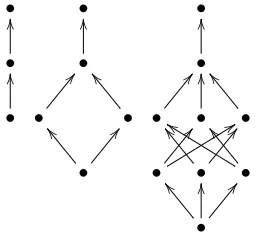
Figure 1. The first three spiked Boolean algebras
7. Generalizations and open questions
7.1. Restricting the class of forcings.The first generalisation that was pro-posed in the original paper [19] was fragments of the forcing multiverse generated by particular types of forcing. Fix any class Γ of forcing partial orders and letFΓ be the construction that only allows generic extensions with partial orderP ∈Γ. Examples are the classes of proper forcings or c.c.c. forcings.
As mentioned before, the lower bounds in Step 2 of our proof strategy are very closely related to closure properties of the class Γ [18, Theorem 7]. Hamkins, Leibman and the second author have provided a number of other control statements that give rise to proofs of upper bounds and the appropriate transfer theorems, showing that the modal logic of proper forcing and of c.c.c. forcing are contained within a modal logic called S4.3, which properly extends S4.2[18, Corollary 33 (1)].13
The most interesting open problem in this direction is to determine the modal logic of c.c.c. forcing MLFc.c.c.. Here, we know that the axiom (.2) is not valid
[19, Theorem 34], so the upper bound given by Hamkins, Leibman and the second author cannot be optimal. The currently best known result is due to Inamdar: if (B,≤) is a finite Boolean algebra with natoms and n co-atoms {ci; 1≤i≤n}, we define a spiked Boolean algebra by adding n additional nodes {di; 1≤i ≤n}
such that for everyb∈B, we haveb≤di if and only ifb≤ci. The spiked Boolean algebras for the Boolean algebras with two, four and eight elements can be seen in Figure 1. We let S4.sBA be the set of all modal assertions which are true on all Kripke models whose frame is a finite pre-spiked Boolean algebra. It can be checked thatS4.sBAis properly contained inS4.2[23, Theorem 121].
Theorem 13 (Inamdar; [23, Theorem 150]). S4⊆MLFc.c.c.⊆S4.sBA.
7.2. Reversing the arrows.The operationFcorresponds to the relation of “be-ing a generic extension”. The inverse of this relation is the relation of “be“be-ing a ground model”. More precisely, the operation G is defined on pairs (M, G) such that there is some inner model N ⊆ M such that there is some partial order P ∈ N and we have that G is P-generic over N and M = N[G]. In that case, 13The modal logic S4.3 is generated from S4.2 by including all instances of 3p∧3q →
G(M, G) :=N. Themodal logic of grounds MLGV is defined by using the general definitions of§4 applied toG.14
The multiverses MultG(V) can look quite different from the multiverses MultF(V): ifV is a countable transitive model of set theory, then MultF(V) will not have a
≤F-largest element since for each M ∈MultF(V), there are many proper generic
extensions; on the other hand, ifV is a generic extension ofLV, thenLV will be a ≤G-largest element in the multiverse MultG(V). In such a≤G-largest element of the multiverse, all statements that are true are necessarily true, and hence
(Top) 3((2ϕ↔ϕ)∧(2¬ϕ↔ ¬ϕ))
is a valid principle in V. Note that (Top) is not a theorem of S5 and compare this to the result by Hamkins and the second author that for every modelV of set theory ,MLFV ⊆S5[19, Theorem 15].
The phenomenon just discussed is closely related to what Hamkins calls set theoretic geology [16,11]: a≤G-largest element of the multiverse MultG(V) would be abedrock [11, Definition 2]; if MultG(V) contains a bedrock, then (Top) is in
MLGV. Using the so-calledbottomless models of Reitz, Hamkins and the second author have been able to show thatS4.2is an upper bound for the modal logic of grounds. In fact,
Theorem 14(Hamkins-L¨owe; [20, Theorems 7–10]). There are modelsV,W, and U of set theory such that
(1) MLFV =S4.2andMLGV =S4.2, (2) MLFW =S4.2andMLGW =S5, and (3) MLFU =S5andMLGU =S4.2.
Furthermore there isnomodelV of set theory such thatMLFV =S5andMLGV =
S5.
With the upper bound established, we wonder about the lower bound forMLG. It is easy to check that S4 ⊆ MLG, but the scheme (.2) is equivalent to the following set theoretic statement:
(DDG)
LetV be a model of set theory, andW andU two grounds ofV, i.e., V = W[G] =U[H] for some generic filters G and H. Then there is some model K which is a ground of both W andU, i.e., there areK-generic filtersG∗ and H∗ such thatK[G∗] =W and
K[H∗] =U.
Clearly, if a multiverse has a≤G-largest element, then (DDG) is trivially true (e.g., in multiverses generated from a generic extension of L or any other core model). There are multiverses without such a≤G-largest element (Reitz’s bottomless model from [31]) where we still know that (DDG) is true (cf. [20, Theorem 6]). However, the general status of (DDG) is unknown and is an interesting question in its own right. E.g., is it consistent to have a grounds multiverse with two separate bedrocks?
14As in the case of the modal logic of forcing, the modal logic of grounds admits a purely
•
•
OO
•
OO
•
•
OO
•
BB
•
\\
•
\\ BB
•
•
OO
•
BB
•
OO
•
\\
•
BB 99
•
\\ BB
•
ee \\
•
[image:14.612.242.370.127.247.2]\\ OO BB
Figure 2. Three inverted lollipops
7.3. Inner models.The following example is similar and yet different to the modal logic of grounds from §7.2. We consider the operation that takes a model
V of set theory, a formula Φ, and some parameters p to form the V-class X :=
{x∈V ; Φ(x, p)}, defined in our meta-universeV. We say that the pair (V,(Φ, p)) isI-good ifX is an inner model ofV, i.e., a model of set theory having the same ordinals asM. As before, the construction operationIdefines multiverses for every modelV of set theory in our meta-universeV.
For a model V, there is a close relationship between MultI(V) and MultG(V). Clearly, all grounds are inner models, but moreover, Grigorieff’s theorem tells us more about the relationship between≤Gand≤I:
Theorem 15 (Grigorieff; [14]). Let V be a transitive model ofZFC,W a forcing extension ofV andU a transitive model ofZFCsuch thatV ⊆U ⊆W. ThenU is a forcing extension of V.
Consequently, the relation ≤G is an initial segment of the relation ≤I in the following sense: ifV ≤IU,U ≤IW, and V ≤GW, thenV ≤GU.
So, MultG(V) nicely embeds into MultI(V), but in general, the inner model multiverse can be quite different from the grounds multiverse: the inner mod-els multiverse always has a ≤I-largest element, viz. LV (of course, LV is only in
MultG(V) ifV is a generic extension ofLV). As discussed in§7.2, this means that
the axiom scheme (Top) is valid in MultI(V) for all models of set theoryV. We letS4.2Topbe the modal logic obtained fromS4.2by adding all instances of (Top). The above argument tells us thatS4.2Topis a lower bound for the modal logic of inner models MLI. In order to show that it is also an upper bound, we need to follow Step 3a,Step 3b, andStep 3cof§6.
Inamdar and the second author did this analysis in [24]. A partial pre-order is topped if it has a unique largest element; it is called aninverted lollipop if it is topped and after removal of the largest element, the remainder is a pre-Boolean algebra (cf. Figure 2 to see three inverted lollipops). If Kfin
IL is the class of finite inverted lollipops, thenS4.2Top=ML(Kfin
IL) [24, Theorem 6].
7.4. Symmetric extensions.In this section, we shall work in ZF as the base theory (cf. Footnote 4). As before, we fix a meta-universeVof a reasonably strong set theory and remind the reader of the basic definitions of symmetric extensions:15
Let Γ be a group. Then a setF ⊆ {∆ ; ∆ is a subgroup of Γ}is called anormal filter over Γ iff it satisfies the following four properties:16
(1) Γ∈ F;
(2) if ∆∈ F and ∆0 is a subgroup of Γ such that ∆⊆∆0, then ∆0 ∈ F; (3) for any two ∆,∆0 ∈ F, also ∆∩∆0∈ F;
(4) for any ∆∈ F andg∈Γ we have thatg∆g−1:={f df−1;d∈∆} ∈ F. LetV be a transitive model17 ofZF, P ∈M a forcing partial order, Γ∈ V a subgroup of the group Aut(P) of automorphisms of Pand F ∈ V a normal filter over Γ. We call aP-nameτhereditarilyF-symmetriciff symΓ(τ) :={g∈Γ ;g(τ) =
τ} ∈ F and for everyhσ, pi ∈τwe have thatσis already hereditarilyF-symmetric. LetG⊆P be a generic filter overV. Then we set
VF[G] :={τG;τis hereditarilyF-symmetric},
where τG denotes the interpretation of the name τ in the forcing extension V[G].
We callVF[G] thesymmetric extension ofV viaF andG.
It is not hard to see that in the notation of the above definitionV ⊆VF[G]⊆
V[G]. Also,VF[G]|=ZF. Contrary to forcing extensions, symmetric extensions do not necessarily satisfy the axiom of choice whenever the ground model does.
LetV be a model of set theory. We say that (V,(G,F)) is S-good if there is a partial orderP∈M for whichGisP-generic overV, Γ is a subgroup of Aut(P), and
F is a normal filter over Γ. We then define the operation S(V,(G,F)) :=VF[G]. The multiverse defined using the operation S is called the symmetric extension multiverse. Note that every forcing extensionV[G]—whereGisP-generic overV— is a symmetric extension by taking the trivial normal filter containing all subgroups of Aut(P).
As in the case of the forcing multiverse and the grounds multiverse, we can provide a purely syntactic description of the modal logic of symmetric extensions:
By restricting quantifiers to hereditarily symmetric names (cf. [6]) we can define for every formulaϕ(v1, . . . , vn) of set theory a formula vn+1,vn+2 ϕ(v1, . . . , vn) in
the language of set theory such that for any transitive modelV |=ZF, any forcing P ∈ M and any normal filter F ∈ M over a subgroup of Aut(P) and for names
σ1, . . . , σn∈MP we have an analogue of the forcing theorem:
Proposition 17. The following are equivalent: (1) V |= P,F ϕ(σ1, . . . , σn)and
(2) for every genericG⊆P: VF[G]|=ϕ(σG1, . . . , σGn).
15For more details, cf. [25].
16We alert the reader to the fact that this normality of filters is entirely different from the
normality condition of ultrafilters in the theory of measurable cardinals.
17The restriction to transitive models here and in the following only has the purpose to simplify
Using this, we can now say that a function S from the set of modal formulas into the set of sentences of set theory is asymmetric extension translationiff
S(⊥) = ⊥ S(¬ϕ) = ¬S(ϕ)
S(ϕ∨ψ) = S(ϕ)∨S(ψ)
S(2ϕ) = ∀P∀F(P,FS(ϕ)),
wherePranges over partial orders andFranges over normal filters over a subgroup of Aut(P). We then get that
MLS=\{MLSV ;V |=ZFis a countable model}
={ϕ;ZF`S(ϕ) for all symmetric extension translationsS}. Theorem 18 (Block). MLS=S4.2.
The remainder of this paper will be a proof of Theorem 18. We start withStep 2, the lower bound.
Theorem 19 (Grigorieff; [14]). If V is a transitive model ofZF,P∈V a forcing, F ∈V a normal filter over a subgroup of Aut(P)and G⊆P a generic filter over
V, thenV[G] is a forcing extension ofVF[G].
Lemma 20. S4.2⊆MLS.
Proof. The relation≤S is reflexive and transitive (up to isomorphisms), so we get
that S4⊆MLS (cf. [18, Theorem 7]). In order to show (.2), we fix a sentenceσ
and suppose that in some countable model V, σ is possibly necessary, i.e., there is some P and some filter F over a subgroup of Aut(P) such that P,F 2σ.18 Towards a contradiction, we suppose that σis also possibly necessarily false, i.e., there is someQand some filterGover a subgroup of Aut(Q) such thatQ,G 2¬σ. Then consider the forcing P×Q; sinceV was countable, we find a P×Q-generic
G×H such that GisP-generic overV[H] andH is Q-generic over V[G]. By our assumption, VF[G] |=2σ and VG[H] |= 2¬σ, but by Theorem 19, we have that
VF[G]≤SV[G×H] andVG[H]≤SV[G×H]. Contradiction. Now, for the upper bound we shall give an independent families of infinitely many switches and buttons with respect to symmetric extensions over any model of V=L. Here and in the following, we use the notation L for one such model, arbitrarily chosen. As in [18, Theorem 15], we can construct independent switches from a uniform independent family of buttons, indexed by the ordinals.
Let
b(α) :=ℵLα+1 is not a cardinal orT
L
α is not an ℵ L
α+1-Suslin tree,
where TαL denotes theL-least well-pruned ℵL
α+1-Suslin tree
19 . These statements
are due to Friedman, Fuchino, and Sakai who proved in ZFC that they form an independent family of buttons with respect to forcing [8]. If we live in an inner 18Once more, by 2σ, we mean S(2p) for any symmetric translation S such that
S(p) =σ.
model of a set forcing extension of L, then a proper class of the buttons b(α) are unpushed. Letλb be the least limit ordinal such b(λb) is not pushed. Forn∈ω, we now define buttonsbn:=b(n) and switches sn:=b(λb+n+ 1). Clearly, thebn
are buttons with respect to symmetric extensions and are unpushed inL. Also we have the following:
Lemma 21. LetM be a symmetric extension of L. Working inM, let A:={α < λb;b(α)} and let B ⊃ A be an arbitrary superset of ordinals. Then there is a forcing P(B)such that P(A,B)( ˇB={α; b(α)}).
Proof. We work in M. Let P(B) := Qfinα∈B\AT L α, where
Qfin
denotes the finite support product. Then for anyα∈B we have thatP(B)b( ˇα).
Now we note that for any α∈ Ord\A, the forcing TL
α is <ℵα+1-closed and
ℵα+2-Knaster (using the canonical well-ordering ofTαLinL). Now letβ∈Ord\B.
Then we get thatQ
α∈B\A,α<βTαLisℵβ+1-Knaster andQα∈B\A,α>βTαLis<ℵβ+1
-closed. Therefore P(B) preserves the Suslinness ofβ by [5, Proposition 5], where we use a well-ordering ofTβL. Hence we have for anyβ ∈Ord\BthatP(B)¬b(β),
which shows the claim.
As a consequence we get that thesn are indeed switches overL with respect to symmetric forcing. Moreover we get the following:
Lemma 22. The set {bn; n∈ω} ∪ {sn n∈ω} is an independent set of buttons and switches overL with respect to symmetric extensions.
Proof. That{bn;n∈ω}is an independent family of buttons overLwith respect to symmetric extensions follows directly from Lemma 21. Now we work in a symmetric extensionM ofLand letS⊆ω. Then letµbe the least limit ordinal such that for allα≥µ,b(α) is not pushed, and letB :={α;ω ≤α < µ} ∪ {µ+n+ 1 ;n∈S}. Then by Lemma 21 in any forcing extension ofM viaP(B), we haveλb=µand the switches in{sn;n∈S}hold and the switches in{sn;n∈ω\S} do not hold. This lemma together with Lemma 12 for symmetric forcing and Lemma 20 es-tablishes Theorem 18.
References
1. Uri Abraham,On forcing without the continuum hypothesis, Journal of Symbolic Logic48
(1983), no. 3, 658–661.
2. Patrick Blackburn, Maarten de Rijke, and Yde Venema, Modal logic, Cambridge Tracts in Theoretical Computer Science, vol. 53, Cambridge University Press, Cambridge, 2001.
3. Paul Cohen, The independence of the continuum hypothesis, Proceedings of the National Academy of Sciences of the United States of America50(1963), 1143–1148.
4. Paul Corazza,Forcing with non-wellfounded models, Australasian Journal of Logic5(2007), 20–57.
5. Ren´e David,Some results on higher suslin trees, Journal of Symbolic Logic55(1990), no. 2, 526–536.
7. Leo Esakia and Benedikt L¨owe,Fatal Heyting algebras and forcing persistent sentences, Studia Logica100(2012), no. 1-2, 163–173.
8. Sy Friedman, Saka´e Fuchino, and Hiroshi Sakai,On the set-generic multiverse, 2012, Submit-ted.
9. Gunter Fuchs, Closed maximality principles: implications, separations and combinations, Journal of Symbolic Logic73(2008), no. 1, 276–308.
10. ,Combined maximality principles up to large cardinals, Journal of Symbolic Logic74
(2009), no. 3, 1015–1046.
11. Gunter Fuchs, Joel David Hamkins, and Jonas Reitz,Set-theoretic geology, Annals of Pure and Applied Logic166(2015), no. 4, 464–501.
12. Victoria Gitman and Joel David Hamkins,A natural model of the multiverse axioms, Notre Dame Journal of Formal Logic51(2010), no. 4, 475–484.
13. Valentin Goranko and Martin Otto,Model theory of modal logic, Handbook of Modal Logic (Patrick Blackburn, Johan F. A. K. van Benthem, and Frank Wolter, eds.), Studies in Logic and Practical Reasoning, vol. 3, Elsevier, 2007, pp. 249–330.
14. Serge Grigorieff, Intermediate submodels and generic extensions in set theory, Annals of Mathematics101(1975), no. 3, 447–490.
15. Joel David Hamkins,A simple maximality principle, Journal of Symbolic Logic68(2003), no. 2, 527–550.
16. ,Some second order set theory, Logic and its applications. Proceedings of the Third Indian Conference, ICLA 2009, held in Chennai, January 7–11, 2009 (R. Ramanujam and Sundar Sarukkai, eds.), Lecture Notes in Computer Science, vol. 5378, Springer-Verlag, 2009, pp. 36–50.
17. ,The set-theoretic multiverse, Review of Symbolic Logic5(2012), 416–449.
18. Joel David Hamkins, George Leibman, and Benedikt L¨owe,Structural connections between a forcing class and its modal logic, Israel Journal of Mathematics (2015), in press.
19. Joel David Hamkins and Benedikt L¨owe, The modal logic of forcing, Transactions of the American Mathematical Society360(2008), no. 4, 1793–1817.
20. ,Moving up and down in the generic multiverse, Logic and Its Applications, 5th Inter-national Conference, ICLA 2013, Chennai, India, January 10-12, 2013, Proceedings (Kamal Lodaya, ed.), Lecture Notes in Computer Science, vol. 7750, Springer-Verlag, 2013, pp. 139– 147.
21. Joel David Hamkins and W. Hugh Woodin, The necessary maximality principle for c.c.c. forcing is equiconsistent with a weakly compact cardinal, Mathematical Logic Quarterly51
(2005), no. 5, 493–498.
22. David Hilbert, Mathematische Probleme. Vortrag, gehalten auf dem internationalen Mathematiker-Kongreß zu Paris 1900, Nachrichten der K¨oniglichen Gesellschaft der Wis-senschaften zu G¨ottingen. Mathematisch-physikalische Klasse3(1900), 253–?297.
23. Tanmay C. Inamdar,On the modal logics of some set-theoretic constructions, Master’s thesis, Universiteit van Amsterdam, 2013, ILLC Publications MoL-2013-07.
24. Tanmay C. Inamdar and Benedikt L¨owe,The modal logic of inner models, submitted.
25. Thomas J. Jech,The axiom of choice, Studies in Logic and the Foundations of Mathematics, vol. 75, North-Holland, 1973.
26. Saul A. Kripke,A completeness theorem in modal logic, Journal of Symbolic Logic24(1959), 1–14.
27. Kenneth Kunen,Set theory. an introduction to independence proofs, Studies in Logic and the Foundations of Mathematics, vol. 102, North-Holland, 1980.
29. George Leibman,Consistency strengths of modified maximality principles, Ph.D. thesis, City University of New York, 2004.
30. ,The consistency strength of MPCCC(R), Notre Dame Journal of Formal Logic51
(2010), no. 2, 181–193.
31. Jonas Reitz,The Ground Axiom, Ph.D. thesis, City University of New York, September 2006.
32. Colin Jakob Rittberg, The modal logic of forcing, Master’s thesis, Westf¨alische Wilhelms-Universit¨at M¨unster, 2010.
33. Jonathan Stavi and Jouko V¨a¨an¨anen, Reflection principles for the continuum, Logic and algebra, Contemporary Mathematics, vol. 302, American Mathematical Society, Providence, RI, 2002, pp. 59–84.
(A.C.B. & B.L.)Fachbereich Mathematik, Universit¨at Hamburg, Bundesstrasse 55, 20146 Hamburg, Germany
E-mail address: [email protected]
(B.L.) Institute for Logic, Language and Computation, Universiteit van Amsterdam, Postbus 94242, 1090 GE Amsterdam, The Netherlands
E-mail address: [email protected]
(B.L.) Corpus Christi College, University of Cambridge, Trumpington Street, Cam-bridge CB2 1RH, United Kingdom