Impact on households:
distributional analysis to
accompany Spring Budget 2017
Impact on households:
distributional analysis to accompany Spring
Budget 2017
© Crown copyright 2017
This publication is licensed under the terms of the Open Government Licence v3.0 except where otherwise stated. To view this licence, visit nationalarchives.gov.uk/doc/open-government-licence/version/3 or write to the Information Policy Team, The National Archives, Kew, London TW9 4DU, or email: [email protected].
Where we have identified any third party copyright information you will need to obtain permission from the copyright holders concerned. This publication is available at www.gov.uk/government/publications Any enquiries regarding this publication should be sent to us at [email protected]
1
Contents
Page
Chapter 1 Trends in the distribution of household incomes 3
Chapter 2 Distributional analysis of tax, welfare and public spending decisions
9
3
1
Trends in the distribution
of household incomes
1.1The government makes decisions about how to raise revenue and where to spend it, and these decisions often directly affect households’ incomes. As part of an open and transparent policy-making process, the government publishes detailed analysis of how such changes to tax, welfare, and spending policy impact upon households of different incomes. This analysis is presented in chapter 2.
1.2While the direct impact of tax and spending measures forms an important part of the overall effect of government decisions on households, household incomes are also strongly determined by wider trends in the economy such as changes in employment and earnings. This chapter outlines this wider economic context by looking at recent trends in overall household incomes, earnings and employment.
1.3Many of the charts included in this document are presented by household equivalised income decile. This means that a household’s net income (income after taxes and benefits) is adjusted to take account of the size and composition of the household. Households are then ranked from lowest to highest equivalised net income and divided into 10 equally sized groups.
Distributional trends in household incomes
1.4According to the Office for National Statistics (ONS) real household disposable income (RHDI) per head grew at its fastest rate in 14 years in 2015. RHDI per head rose further in the first half of 2016, reaching its highest ever level and remained close to this in Q3 2016. Looking forward, the Office for Budget Responsibility (OBR) forecasts RHDI per head will fall by 0.7% in 2017, as the recent sterling depreciation raises inflation while nominal earnings growth
increases slightly. RHDI per head is expected to return to growth in 2018 and be 2.0% higher in 2021 than 2016.
1.5In order to look at the distribution of historical income growth we need to use an alternative measure, as RHDI is not available by household income decile. Chart 1.A shows the growth in equivalised median disposable income across the household income distribution from the Department for Work and Pensions’s (DWP) Households Below Average Income series.
4
Chart 1.A:Cumulative percentage change in equivalised median real disposable household income, from 2010-11 to 2014-15
Source: DWP, Households Below Average Income
1.7Focusing on trends in labour incomes,1 which are determined by a combination of employment
and earnings growth, allows us to compare international trends. Chart 1.B shows that between 2010 and 2014 (the latest available data), growth in labour income for the lowest household income decile has been higher in the UK than any other G7 country and the OECD average.
1 Labour income is defined as the total income from employment and self-employment.
-1.0% -0.5% 0.0% 0.5% 1.0% 1.5% 2.0% 2.5% 3.0% 3.5%
Bottom
Decile 2 3 4 5 6 7 8 9 DecileTop All
5 Chart 1.B:Real terms change in household labour income as a percentage of 2010 income,
by income decile, across the G7, 2010 to 2014
Source: OECD
Employment
1.8The incomes of working age households are also strongly determined by the ability of households to move into and remain in work. Reductions in unemployment and economic inactivity are key to raising household incomes sustainably, particularly for those at the bottom of the income distribution.
1.9The employment rate has been rising since 2010 and stood at a record high of 74.6% in the three months to December 2016, with employment at 31.8 million. Over the same period, the unemployment rate has fallen to 4.8%, the lowest since 2005. The inactivity rate stood at 21.6%, down from 23.5% in Q2 2010.
1.10According to the ONS there are over 2.7 million more people in work and 865,000 fewer workless households since 2010.2 The fall in worklessness particularly benefits households in the
bottom half of the income distribution. Chart 1.C shows the percentage point change in the share of families3 in work in each equivalised income decile, between 2010-11 and 2014-15 (the
latest available data). In the bottom half of the income distribution, the percentage of families who were in work increased from 60.3% in 2010-11 to 65.7% in 2014-15, while for the top half the percentage did not change.
2 Figure on workless households compares Q2 2016 to Q2 2010.
3 Families are here defined as working age benefit units. A benefit unit means a single adult or a couple living as married, including same-sex partners
(civil partners and cohabitees), and any dependent children. It does not indicate receipt of benefits. -20% -15% -10% -5% 0% 5% 10% 15% 20%
Italy Canada Germany G7
average France averageOECD Japan UnitedStates KingdomUnited
6
Chart 1.C:Percentage point change in working age families in each income decile that contain an individual in work, 2010-11 to 2014-15
Source: DWP, Households Below Average Income
-4 ppts -2 ppts 0 ppts 2 ppts 4 ppts 6 ppts 8 ppts 10 ppts
Bottom
Decile 2 3 4 5 6 7 8 9 DecileTop All
7
Earnings
1.11Productivity determines living standards in the long term and improving it is key to increasing wages. Total pay rose 2.6% in the year to the three months to December in nominal terms, and by 1.4% in real terms, marking 27 months of positive real wage growth. Looking forward, the OBR now forecasts slightly slower earnings growth than previously expected, but with average earnings growth still expected to remain at or above 3.0% from 2019 onwards.
1.12Chart 1.D shows that workers at the fifth earnings percentile saw their wages grow by over 6% in the year to April 2016. This was the highest wage growth at this point in the distribution in 20 years, supported by the government taking action to increase the earnings of the lowest paid through the National Living Wage (NLW).
Chart 1.D:Percentage change in individual full-time gross weekly nominal earnings 2015-16 at example percentile points
Source: ONS, Annual Survey of Hours and Earnings: 2016 provisional results
0.0% 1.0% 2.0% 3.0% 4.0% 5.0% 6.0% 7.0%
9
2
Distributional analysis of
tax, welfare and public
spending decisions
2.1This chapter looks at the tax, welfare and public service spending changes implemented since the start of this Parliament that carry a direct, quantifiable impact on households.
2.2These tax and spending decisions have been taken in the context of the need to control public debt to reduce the burden on future generations, who would otherwise need to service higher debt interest payments paid for by lower public spending or higher taxation.
2.3The following analysis captures decisions on tax, welfare, and spending on public services (where the cash value spent on the public service is converted into an identical cash gain to households), and looks at the impact of such changes on different household net income deciles. To create these deciles, households are ordered by their net income from lowest to highest, and then divided into 10 equally sized groups.
2.4Households of different sizes are compared on a consistent basis, known as equivalisation. Equivalisation is a process that adjusts a household’s net income to take into account the size and composition of the household. This reflects the fact that larger households will require a higher net income to achieve the same economic well-being and standard of living as a household with fewer members. To help understand where different households sit in the income distribution, chapter 3 includes the median gross income for each decile, as well as a more detailed explanation of the data sources, methodology, and the equivalisation process.
2.5This analysis continues the format of distributional analysis presented at Autumn Statement 2016. Every format of distributional analysis has advantages and disadvantages and it remains important to note that the charts presented here take no account of the effect on households of additional government borrowing. An additional pound of borrowing will show up in these charts as an unequivocal gain for households, which it is not.
2.6While the economic and fiscal forecast presented at the Spring Budget extends to 2021-22, Charts 2.A to 2.E show the impact of measures in 2019-20 as most Resource Departmental Expenditure Limits (RDEL) are allocated in the years to 2019-20, and not beyond.
2.7Spring Budget 2017 measures included in Charts 2.A to 2.E are: 16-19 Technical Education: implement Sainsbury reforms
Social Care: additional funding
Free school transport: expand eligibility to selective schools
Class 4 NICs: increase to 10% from April 2018 and 11% from April 2019
Dividends Allowance: reduce to £2,000 from April 2018
Child Tax Credit: targeted exceptions to two child limit
Further Education maintenance loans
10
2.8A number of Spring Budget measures are excluded from this analysis either because they are out of scope or because there is insufficient data to robustly model the distributional impact of the measure. The criteria for measures excluded from the analysis for being out of scope are listed in chapter 3.
2.9The analysis of public service spending presented here captures the frontline services from which households benefit, but does not cover capital investment, public goods or central administration costs. The analysis also does not include the indirect impact of regulations or reduced tax evasion. Measures excluded can nevertheless have a tangible impact on households’ living standards. Spring Budget 2017 measures that are not captured in Charts 2.A to 2.E
because they are out of scope include schools and health capital spending. Additional social care spending in 2017-18 and 2018-19 is also not included because the year modelled in these charts is 2019-20.
2.10Charts published at consecutive fiscal events are not directly comparable, as they are based on the latest OBR forecast which is updated at every fiscal event. The charts also include a number of modelling updates to more accurately reflect the impact of past policy decisions on household incomes. Notable modelling changes since Autumn Statement 2016 include: an update to the impacts of Universal Credit (UC), which now take into account the effect of transition to UC for couples where one person is above and one person is below the State Pension age; updated estimates of departmental spending on benefits-in-kind from public services; and the inclusion of Tax-Free Childcare and Employer-Supported Childcare in the model. Details of other methodological changes can be found in chapter 3.
Overall level of tax, welfare and public service spending
2.11Overall, government policy continues to be highly redistributive. Chart 2.A shows the overall level of public spending received, and tax paid, by households. It shows that:
on average, households in the lowest income decile receive over £4 in public spending for every £1 they pay in tax
on average households in the highest income decile contribute over £5 in tax for every £1 they receive in public spending
11 Chart 2.A:Overall level of public spending received, and tax paid, as a percentage of net
income (including households’ benefits-in-kind from public services), by income decile, in 2019-20
Source: HMT distributional analysis model, DWP and HMRC modelling
Analysis of decisions announced at Autumn Statement 2016 and subsequently
2.12Charts 2.B and 2.C set out the impact of decisions announced at Autumn Statement 2016 and Spring Budget 2017. Chart 2.B shows the impact as a percentage of net household income (including benefits-in-kind from public services), while Chart 2.C shows the impact in annual cash terms.
-60% -40% -20% 0% 20% 40% 60% 80% 100%
Bottom
Decile 2 3 4 5 6 7 8 9 DecileTop House-All
holds Equivalised Net Income Decile
12
Chart 2.B:Impact of decisions announced at Autumn Statement 2016 and subsequently on households in 2019-20, as a percentage of net income (including households’ benefits -in-kind from public services), by income decile
Source: HMT distributional analysis model, DWP and HMRC modelling
Chart 2.C:Impact of decisions announced at Autumn Statement 2016 and subsequently on households in 2019-20, in cash terms (£ per year), by income decile
Source: HMT distributional analysis model, DWP and HMRC modelling
-0.5% -0.3% -0.1% 0.1% 0.3% 0.5%
Bottom
Decile 2 3 4 5 6 7 8 9 DecileTop House-All
holds Equivalised Net Income Decile
Tax Welfare Benefits-in-kind from public services Overall
-£500 -£400 -£300 -£200 -£100 £0 £100 £200 £300
Bottom
Decile 2 3 4 5 6 7 8 9 DecileTop House-All
holds Equivalised Net Income Decile
13
Analysis of measures implemented during this Parliament
2.13Charts 2.D and 2.E show the cumulative impact of measures implemented (or planned to be implemented) over the course of this Parliament, up to 2019-20. They show the impacts on households in 2019-20 compared to a hypothetical world in which modelled government policies implemented since May 2015 had not been introduced. This includes changes that were
announced before May 2015 but have been implemented (or will be implemented) during this Parliament. Chart 2.D shows the impact as a percentage of net household income, while Chart 2.E shows the impact in cash terms.
Chart 2.D:Cumulative impact of modelled tax, welfare and public service spending changes on households in 2019-20, as a percentage of net income (including households’
benefits-in-kind from public services), by income decile
Source: HMT distributional analysis model, DWP and HMRC modelling
-2.5% -2.0% -1.5% -1.0% -0.5% 0.0% 0.5% 1.0% 1.5% 2.0%
Bottom
Decile 2 3 4 5 6 7 8 9 DecileTop House-All
holds Equivalised Net Income Decile
14
Chart 2.E:Cumulative impact of modelled tax, welfare and public service spending changes on households in 2019-20, in cash terms (£ per year), by income decile
Source: HMT distributional analysis model, DWP and HMRC modelling
-£2,250 -£2,000 -£1,750 -£1,500 -£1,250 -£1,000 -£750 -£500 -£250 £0 £250 £500 £750
Bottom
Decile 2 3 4 5 6 7 8 9 DecileTop House-All
holds Equivalised Net Income Decile
15
3
Data sources and
methodology
3.1The tables below set out the data sources and methodology used to produce the charts and statistics presented in this document. All modelled figures and forecasts in this document are calculated as economic estimates and are therefore not official statistics.
Table 3.A:Data sources for charts
Chart Source
1.A DWP Households Below Average Income 2014-15 data series
1.B OECD Income Distribution Database. Figures for the UK are based on DWP’s Family
Resources Survey, though differences in the underlying methodology (particularly the equivalisation factors used) mean the figures are not directly comparable with those in Chart 1.A.
1.C Analysis of Households Below Average Income statistics, 2010-11 to 2014-15. Families are defined here as working age benefit units.
[image:19.595.70.520.381.539.2]1.D ONS data series: Annual Survey of Hours and Earnings (2016 provisional results) 2.A-2.E HMT distributional analysis model. See 3.2 to 3.34 for more information.
Table 3.B:Data sources for statistics
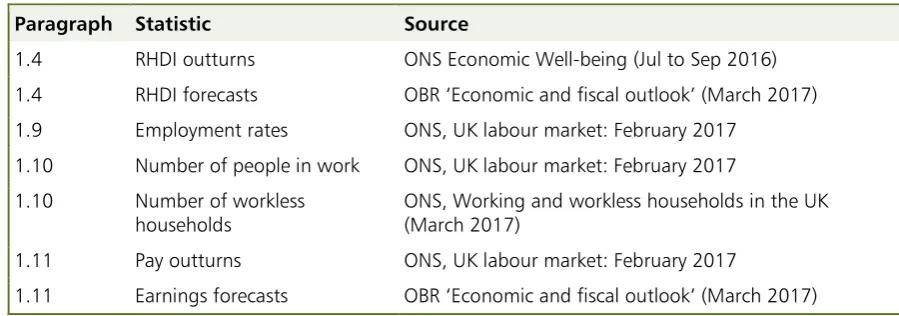
Paragraph Statistic Source
1.4 RHDI outturns ONS Economic Well-being (Jul to Sep 2016) 1.4 RHDI forecasts OBR ‘Economic and fiscal outlook’ (March 2017) 1.9 Employment rates ONS, UK labour market: February 2017
1.10 Number of people in work ONS, UK labour market: February 2017 1.10 Number of workless
households ONS, Working and workless households in the UK (March 2017) 1.11 Pay outturns ONS, UK labour market: February 2017
1.11 Earnings forecasts OBR ‘Economic and fiscal outlook’ (March 2017)
Constructing Charts 2.A to 2.E
Defining income
3.2This distributional analysis uses equivalised net household income, before housing costs, as the key measure through which to rank households from lowest income to highest income. This measure comprises a number of details:
16
net: household incomes are ranked after deductions from direct taxes, and after additions from welfare benefits. Deductions from indirect taxes, or additions through benefits-in-kind from public services, are not used to rank households
household: incomes are assessed in aggregate at the household, not individual level. A household can comprise a single individual, a single family or multiple families. Comparing household rather than individual incomes reduces the subjectivity of this analysis; it means that no assumptions are made about how incomes or expenditure are shared between separate individuals within the household
before housing costs: housing costs such as rent or the cost of servicing a mortgage are not deducted from household incomes
The household income distribution
3.3The household income distribution is created by ranking households from the lowest
equivalised net income to the highest equivalised net income, and then dividing this ranking into 10 equally sized groups called deciles, across which the analysis is produced.
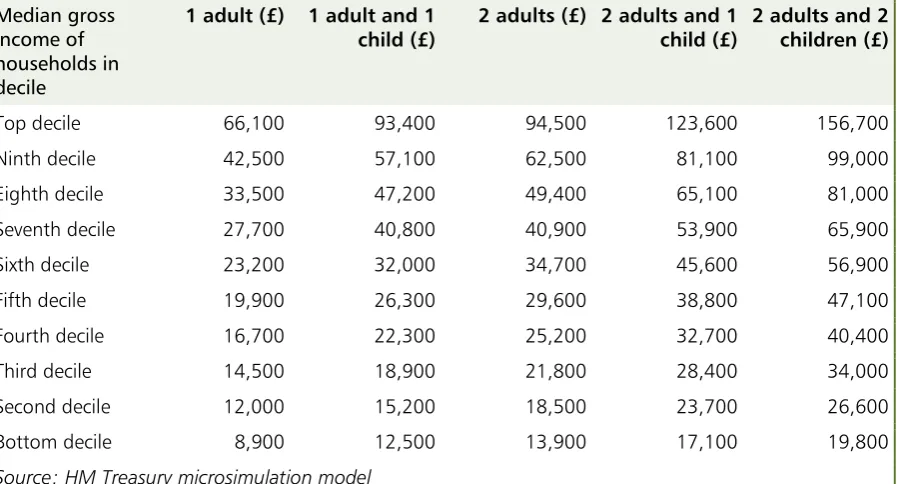
3.4Table 3.C below shows median gross incomes (pre-tax private income including earnings, private pensions, savings and investments, plus benefit income) within each decile. This gives a less precise estimation of a household’s position on the income distribution than net income but, because many people think about their incomes or salaries in gross rather than net terms, is easier to understand.
3.5Table 3.C should therefore be used to approximate where a household will be found in the income distribution. For example, if a household consisting of two adults earns £21,800 per year between them, there is a high likelihood that this household will be found in the third income decile. However this is not guaranteed, as different gross household incomes can result in different net household incomes, depending on how many earners there are in the
[image:20.595.80.529.483.725.2]household, the size of the household, and which benefits the household qualifies for.
Table 3.C:Median gross income for each decile (£ per year, 2019-20) for different household compositions
Median gross income of households in decile
1 adult (£) 1 adult and 1
child (£) 2 adults (£) 2 adults and 1 child (£) 2 adults and 2 children (£)
Top decile 66,100 93,400 94,500 123,600 156,700
Ninth decile 42,500 57,100 62,500 81,100 99,000
Eighth decile 33,500 47,200 49,400 65,100 81,000
Seventh decile 27,700 40,800 40,900 53,900 65,900
Sixth decile 23,200 32,000 34,700 45,600 56,900
Fifth decile 19,900 26,300 29,600 38,800 47,100
Fourth decile 16,700 22,300 25,200 32,700 40,400
Third decile 14,500 18,900 21,800 28,400 34,000
Second decile 12,000 15,200 18,500 23,700 26,600
Bottom decile 8,900 12,500 13,900 17,100 19,800
17
Modelling methodology
3.6Charts 2.A to 2.E are created using an internal HMT model which combines analysis of tax, welfare, and public services spending changes. These charts compare the effect of policy changes in tax, welfare and public service spending against a counterfactual of no policy changes.
3.7This information is presented both as a percentage change in net income, and as cash impacts in 2019-20. For public service spending, the cash value spent on public services is converted into an identical cash gain to households. The analysis of public service spending captures the frontline services from which households benefit, but does not cover capital investment, public goods, or central administrative costs. All public service spending analysis is for England only.
3.8HM Treasury continues to update the microsimulation modelling which underpins this analysis. Since the publication that accompanied Autumn Statement 2016, the following methodological changes have been made:
improved modelling of household expenditure on childcare (which allows for the inclusion of measures such as Employer Supported Childcare and Tax-Free Childcare)
inclusion of the removal of the National Insurance contracted out rebate for those in defined benefit pension schemes from April 2016
updated estimates of RDEL spending on benefits-in-kind from public services
updated modelling of UC in DWP’s Policy Simulation Model (PSM)
updates in line with the OBR’s latest forecast
Microsimulated analysis of the tax and welfare system
3.9Where possible, tax and welfare policy changes are analysed using HMT’s Intra
-Governmental Tax and Benefit microsimulation model (IGOTM), which is underpinned by data from the ONS’s Living Costs and Food survey (LCF). The small sample size of the LCF means that in order to produce robust analysis three years of data have been pooled together, specifically 2011-12 to 2013-14. This data is then projected forward to reflect the financial year being modelled, using historical Annual Survey of Hours and Earnings data on earnings growth at different points across the income distribution as well as the latest OBR average earnings and inflation forecasts. The impact of tax and welfare measures that can be modelled robustly at a household level are derived using this projected data.
3.10Throughout the analysis, individual employees are assumed to be paid at least the appropriate level of the National Minimum Wage or National Living Wage, which has been uprated from announced levels to 2019-20 based on the OBR forecast for average earnings. The model makes no changes to the underlying demographics, employment levels, or expenditure patterns in the base data.
3.11The following policy changes are out of scope for this type of comparative analysis:
the impact of changes to regulation (e.g. the National Living Wage), which are not direct changes to the distribution of tax or public spending
18
Exchequer impacts resulting from reduced fraud, error, or debt in the welfare system, as full compliance with the rules of the welfare system is assumed throughout the modelling
Exchequer impacts resulting from reduced tax evasion, as full compliance with the rules of the tax system is assumed throughout the modelling. Avoidance measures are captured where they result in a change in tax liability in the year being analysed
levies, such as the soft drinks industry levy or apprenticeship levy, that do not have a direct impact on households
3.12Not all households take up all of the benefits to which they are entitled. HMT
microsimulation modelling takes this into account when calculating the effects of policy changes by using information on the take-up of benefits in the underlying survey data. By doing so, this analysis provides a more accurate estimate of the impact on households.
3.13Within the tax system, the main taxes microsimulated in this analysis are: Income Tax, employee National Insurance contributions, Council Tax, VAT, Insurance Premium Tax, Fuel Duty, Alcohol Duty, Tobacco Duty, Stamp Duty Land Tax, and Air Passenger Duty.
3.14Within the welfare system, the most significant welfare benefits microsimulated in this analysis are: the State Pension, Pension Credit, Winter Fuel Payments, Attendance Allowance, Jobseeker’s Allowance, Employment and Support Allowance, Income Support, Working Tax Credit, Child Tax Credit, Child Benefit, Disability Living Allowance, Personal Independence Payments, Tax-Free Childcare and Housing Benefit.
Apportioned analysis of tax and welfare measures
3.15Not all measures can be reliably modelled using IGOTM due to data and/or modelling constraints. Tax and welfare changes that cannot be modelled robustly using microsimulation modelling are apportioned to household equivalised income deciles, according to the Exchequer costs or savings from the measures, based on assumptions about where the impacts are likely to fall.
3.16The IGOTM model is a model of the legacy welfare system. As such HMT microsimulation modelling cannot currently capture the effects of UC, or any changes to it. Instead these impacts are apportioned across household income deciles using analysis from DWP’s PSM to ensure that the impact of policy is reflected in the charts.
3.17The fact that UC will be partially rolled out by 2019-20 means that many households will be receiving different welfare payments in 2019-20 than they would have done in the absence of UC; this is referred to as the marginal impact of UC over the legacy system. In order to capture this marginal impact in 2019-20, DWP’s microsimulation modelling of the legacy benefits that people would have received is compared to DWP’s estimate of what the same households will receive in 2019-20 after the partial rollout of UC. These impacts are then apportioned to the income deciles that households would have fallen into, had the legacy system been in place.
3.18The net impact used for this analysis excludes Exchequer savings from reductions to fraud, error, and debt which result from the introduction of UC, because the modelling assumes full compliance with the rules of the tax and welfare systems. Transitional protection for claimants who are managed migrated onto UC, as well as UC’s increased sensitivity to changes in claimants’ earnings, are included in the distributional impacts.
19
policy announced as part of the Spring Budget only takes into account the estimated impact for new births and excludes the marginal impact in UC. The use of two different models, DWP’s PSM and HMT’s IGOTM, also means that the underlying household data is inconsistent. Each model will have different cut-off points for boundaries between income deciles, and interactions between tax and welfare measures are not fully captured. To address such issues HMT is
developing the capability to model UC alongside the rest of the tax and welfare system, and looks to integrate this modelling at a future fiscal event.
Analysis of public services spending
3.20The analysis of the benefits-in-kind provided by public service spending is also derived from HM Treasury’s IGOTM model. However, the modelling approach taken for public services is slightly different. There are two general approaches to the modelling of resource spending on public services depending on whether service use is reported in the LCF, which underpins the modelling. Where this is the case, no additional data is required and the approach is similar to that used for most tax and welfare modelling. An example of this is spending on schools, which can be modelled directly because the LCF contains information on the number of children by age in each household who attend a state-funded school. The spending on schools is then allocated between all those households who are expected to use this public service, in proportion to each household’s expected use of the service.
3.21Where the LCF does not contain information about use of the service, additional data sources are required. This additional data is used to identify characteristics associated with the use of the service and then to derive probabilities of service use conditional on these
characteristics. This could include a wide range of characteristics, although the variables considered must be common to both the additional data and the LCF data used in the microsimulation model.
3.22As an example, the likelihood of an individual using a service such as visiting a GP will be influenced by factors such as the individual’s age, sex, level of income, family composition, and so on. Through regression analysis of ONS surveys, it is possible to estimate how strongly these factors affect the likelihood of an individual visiting a GP over a given timeframe. This regression analysis shows, for example, that the older an adult is, the more likely he or she is to visit the GP. The regression model estimated on ONS survey data is then applied to the LCF data that
underpins the rest of HMT’s distributional analysis modelling. The adjusted LCF data, therefore, then contains estimates of each individual’s likelihood of using this particular public service.
3.23Where possible the probability of using a given public service is estimated through the regression approach above. However, because of data limitations, this is not always possible and many probabilities have instead been estimated by cross-tabulating these various factors which predict service use, and using this cross-tabulation to weight the survey population’s likelihood of service use accordingly.
3.24Spending (both actual and for the baseline) is then allocated according to each
household’s relative likelihood of using the service, where the relative likelihood of use acts as a weight to allocate total spending to individual households. Therefore, the spending will be skewed to those individuals and households who are most likely to use a public service over a given time period. In the example of visiting a GP above, the total public spending on this service will be skewed (but not allocated entirely) to those individuals who are estimated to be most likely to use this service over a given time period. Impacts of changes in RDEL spending are calculated alongside tax and welfare and presented across the income distribution.
20
Local Government, the Department for Business, Energy and Industrial Strategy, the
Department for Transport, the Ministry of Justice, and the Department for Culture, Media and Sport and local government.
3.26This RDEL analysis only includes spending on frontline public services with a direct benefit to households. The analysis excludes:
administrative spending
capital spending (with the exception of student loans), and the depreciation of capital assets
spending funded through the reserve
public sector pay and public service pensions policy
administrative spending or spending on public goods because it is not possible to identify the direct benefits from these areas of spending for specific households
reductions to departmental spending committed to in the Efficiency Review but not yet allocated to departments
3.27To align with the definition of income used in the Households Below Average Income publication, the analysis of spending on public services also includes financial transactions through student loans. To account for this source of income, estimates of student loan outlay in a given financial year are counted as household income from public spending. Likewise,
estimates of student loan repayments in that same financial year are reflected as a loss to households, again through the public spending bars. Where a policy change affects the relative generosity of student loans, either by affecting the amount an individual can borrow, or the amount individuals will repay, this will be reflected as a change to household income. The analysis presented in this document includes measures announced or confirmed at Spring Budget 2017 on Further Education maintenance loans, and part-time maintenance loans. Due to the lack of available data on the income levels of PhD students, the additional Spring Budget 2017 spending on doctoral loans is not included in this analysis.
3.28Charts are on a United Kingdom basis, but only include RDEL spending in England. RDEL spending is devolved to the governments in Scotland, Wales, and Northern Ireland, and is not reflected in this analysis. This has two effects. First, any changes to devolved spending – whether positive or negative – has no impacts in this analysis. Second, where change is expressed as a proportion of household income, the income denominators which underpin this calculation do not include any income from spending devolved to Scotland, Wales, and Northern Ireland.
3.29This analysis of RDEL spending compares spending in 2015-16 and 2019-20. For the counterfactual, spending in 2015-16 is assumed to increase in real terms to 2019-20, in line with the OBR’s latest forecasts for the GDP deflator.
Chart 2.A
21
Charts 2.B and 2.C
3.31These charts compare the incomes of households in a world in which policy decisions up to and including those taken at Spring Budget 2017 have been implemented, against a
counterfactual scenario in which all non-inherited policy decisions announced at Autumn Statement 2016 and subsequently have not been implemented.
3.32Chart 2.B expresses this change as a proportion of household income (including benefits-in-kind from public services), while Chart 2.C shows the cash change in each income decile.
Charts 2.D and 2.E
3.33These charts compare the incomes of households in a world in which all policy decisions up to and including those taken at this Spring Budget have been implemented against a
counterfactual scenario which excludes all tax, welfare, and public service spending measures implemented since May 2015.
HM Treasury contacts
This document can be downloaded from www.gov.uk
If you require this information in an alternative format or have general enquiries about HM Treasury and its work, contact: Correspondence Team
HM Treasury
1 Horse Guards Road London
SW1A 2HQ
Tel: 020 7270 5000