https://doi.org/10.1007/s00355-019-01230-5
O R I G I N A L P A P E R
Neutrality and relative acceptability in judgment
aggregation
Zoi Terzopoulou1 ·Ulle Endriss1
Received: 20 March 2019 / Accepted: 28 November 2019 © The Author(s) 2019
Abstract
One of the fundamental normative principles in social choice theory is that of neu-trality. In the context of judgment aggregation, neutrality is encoded in the form of an axiom expressing that, when two possible judgments enjoy the same support amongst the individuals, then either both or neither of them should be accepted. This is a reasonable requirement in many scenarios. However, we argue that for scenarios in which individuals are asked to pass judgment on very diverse kinds of propositions, a notion of relative acceptability is better suited. We capture this notion by a new axiom that hinges on a binary “acceptability” relation A between propositions: if a given coalition accepting a proposition p entails the collective acceptance of p, then the same should be true for every other propositionqrelated topviaA. Intuitively,p Aq means that pis at least as acceptable asq. Classical neutrality is then a special case where all propositions are equally acceptable. We show that our new axiom allows us to circumvent a classical impossibility theorem in judgment aggregation for certain scenarios of practical interest. Also, we offer a precise characterisation of all scenarios that aresafe, in the sense that any aggregation rule respecting the relative acceptability between propositions will always return logically consistent outcomes.
1 Introduction
How can we ensure that a group of individuals, despite having diverse views, will be able to make collective decisions in a manner that is fair and that guarantees that those decisions are internally coherent? Judgment aggregation is a formal framework
The authors are grateful to the associate editor and the two reviewers for their comments and suggestions. We especially thank Franz Dietrich for first directing our attention towards the concept of relative acceptability during a presentation of this work in Paris.
B
Zoi Terzopoulou [email protected]1 Institute for Logic, Language and Computation (ILLC), University of Amsterdam,
for group decision making in logically rich domains, modelling situations where the judgments of several individuals need to be aggregated into a single collective judg-ment. The development of judgment aggregation was originally inspired by problems in legal theory (Kornhauser and Sager1993). Since then, judgment aggregation has attracted the interest of scholars in a variety of disciplines at the interface of economics and philosophy (see, e.g., List and Pettit 2002; Dietrich 2006; Pauly and van Hees 2006; Nehring and Puppe2008; List and Puppe2009a; Dokow and Holzman2010; List2012), and has also been studied within the areas of computer science and artificial intelligence (see, e.g., Grossi and Pigozzi2014; Baumeister et al.2016; Endriss2016a). Uniformly across all research fields where judgment aggregation can be applied, important considerations concern the properties—also known asaxioms (Thomson 2001)—of the specific aggregation rules that are employed (List and Pettit2002; Diet-rich and List2010). Axioms in judgment aggregation play anormativerole, meaning that they formally define requirements that we would like an aggregation rule to satisfy, motivated by philosophical, political, or ethical concerns.
In this paper we delve deeply, both conceptually and technically, into one of the axioms that are prominent in the literature on judgment aggregation, namely neutral-ity(Dietrich and List2007a,2008; List2012; Endriss2016a).1Neutrality demands that all the propositions judged by the individuals should be treated symmetrically during aggregation—without any kind of differentiation. This clearly is a natural requirement for some applications, as it encodes a basic notion of fairness. But, as we are going to argue, in most domains in which judgment aggregation can be applied the proposi-tions to be judged will be very diverse in nature and, therefore, the classical neutrality axiom is too strong a requirement. In particular, different propositions are often asso-ciated with different standards of acceptance—respecting their relative acceptability does not necessarily mean treating them symmetrically. To prepare the ground for this argument, let us consider an example.
Example 1 Suppose the governor of Arizona has to make two decisions concerning the state:
(i) Should a wall be constructed separating Arizona and Mexico? (ii) Should the tuition fees for the state colleges be increased?
It is publicly known that in order for the wall to be built a very high budget is required, so for that budget to be covered money has to be collected (also) through more tuition. Since there is a lot at stake for the governor, he puts together a committee of counselors to help him settle the issues, and the committee happens to be quite diverse, consisting of four pure democrats and six extreme conservatives. Suppose the counselors—not deviating from their party lines—express the judgments depicted in the table that follows.
Thus, the governor observes that 60% of the committee members agree with building the wall, and that exactly the same counselors who want the wall support the increase on college tuition as well. As expected, everyone also acknowledges that they cannot accept the wall construction without a tuition raise (as can be seen from the table
1 In fact, in the early literature on judgment aggregation, neutrality is often combined with anindependence
Wall? Tuition?
6 Counselors Yes Yes
4 Counselors No No
above, nobody saysyeson wall andnoon tuition). But given these judgments of the committee, how will the governor make a final decision? First, regarding the tuition, it makes sense that the governor is determined to simply follow the opinion of the majority of the counselors; this is an issue that will only have some local effects in the state of Arizona, so a simple majority by the committee members suffices for the governor to make a decision in favour of an increase. However, constructing a wall will have much more serious consequences to Arizona’s finances and international relations with Mexico, so the governor only feels confident to decide in favour of it if he has at least a 2/3 majority of the committee backing him on this (which he does not have in this case).2Overall, the governor would now like to increase tuition but not build a wall, even though the committee provided the same support on both issues. Apparently, in situations like the one described above, propositions may vary in meta-value:Judgments on certain propositions may have much more severe and large-scale effects than judgments on others. Then, we arguably should treat propositions of the same kind symmetrically, while we may still want to apply very different standards across the different kinds.
Our conceptual contribution in this paper is to propose a new family of axioms that can account for such diversity between the propositions under consideration, providing a refinement of the standard notion of neutrality in judgment aggregation.3 Our axioms capture a plethora of scenarios based on an acceptability relation, which is a binary relation expressing the relative acceptability of the different propositions in a decision-making domain. Given such an acceptability relationA, anA-respecting aggregation rule imposes equal treatmentonlyfor those propositions that are linked to each other byA. However, if one propositionϕis related to another propositionψ viaA, but the converse is not true, then anA-respecting rule merely has to ensure that the standards for acceptingϕare at least as demanding as those for acceptingψ. We provide multiple application-driven examples for concrete definitions of relations.4
Our technical contribution is twofold. First, knownimpossibility theoremsstate that no aggregation rule satisfies certain combinations of desirable axioms (List and Pettit 2002, 2004; Pauly and van Hees2006; Dietrich2007; van Hees2007). We investi-gate to what extent this pessimistic finding can be avoided by relaxing neutrality as far as the original impossibility theorem in the field, due to List and Pettit (2002),
2 It is actually the case in many legislative systems, like the German one, that simple laws can be changed by
getting the approval of a simple majority in the parliament, while constitutional laws require, for instance, a 2/3 majority.
3 We have previously outlined this idea in a preliminary version of this paper (Terzopoulou and Endriss 2019).
4 In the judgment aggregation literature, binary relations between propositions have also been employed
is concerned. We focus on a family of simple yet powerful scenarios (so-called con-junctiveanddisjunctive agendas), which are the most extensively studied scenarios in the literature (Chapman1998; Pettit2001; Dietrich and List2007c; Chapman2002; Hartmann and Sprenger2012; Terzopoulou and Endriss2018), and we find that the classical impossibility can be circumvented for several cases of practical interest. Sec-ond, we provide a precisecharacterisationof scenarios for which it issafeto require individuals to use an aggregation rule that is A-respecting (given an acceptability relation Abetween the propositions), in the sense of never resulting in a logically inconsistent outcome. This subsumes known results regarding the special case of the standard neutrality axiom (Endriss et al.2012).
Although we are the first to formalise the concept of weakening neutrality in judg-ment aggregation, the idea was already briefly judg-mentioned more than fifteen years ago in Footnote 4 of the the seminal paper by List and Pettit (2002). Having said this, List and Pettit only discuss the option of limiting neutrality to propositions that belong to the same equivalence class, while our definition accounts for a much broader spectrum of relations that may occur, motivated by the immense diversity of possible aggregation domains. More recently, Slavkovik (2014) also noted that judgment aggregation often deals with propositions of diverse types and, to account for this, argued for considering non-neutral aggregation rules. But her focus is on proposing new rules, rather than on studying the neutrality axiom itself. Others have observed that certain intuitively reasonable aggregation rules in fact violate the standard neutrality axiom. For exam-ple, contrary to what one might expect, even though the well-knownKemeny ruleis neutral in the context of preference aggregation, this rule—which is also known as the median rule—is not neutral in judgment aggregation (Costantini et al.2016). More-over, in many classical examples of judgment aggregation (like some versions of the doctrinal paradox due to Kornhauser and Sager1993) propositions are distinguished, being eitherpremisesorconclusions—as Mongin (2012) observes in his Footnote 13, standard neutrality (the part of the so-called systematicity axiom discussed by Mongin that is relevant here) is not sensitive to this distinction. In conclusion, while neutrality clearly is a debatable property and while that point has been made repeatedly in the literature, relaxing this overly demanding axiom has not yet received the attention it deserves. In this paper we close this gap.
2 The model
In this section we present the basic framework of judgment aggregation (List and Pettit 2002; Dietrich 2007; List and Puppe 2009a; List 2012; Grossi and Pigozzi 2014; Endriss2016a) and introduce the relevant notation and terminology.
2.1 Preliminaries
Consider a finitegroup of individualsN = {1,2, . . . ,n}, withn ≥ 2, who make judgments on a finite number of propositions. Each proposition is defined as a formula
ϕin propositional logic. AnagendaΦ =Φ+∪Φ−is a collection of all such formulas, whereΦ+contains only non-negated ones andΦ− = {¬ϕ | ϕ ∈ Φ+}. We define
∼ϕ, thecomplementofϕ, as follows: ifϕ∈Φ+, then∼ϕ= ¬ϕ, and ifϕ= ¬ψfor someψ∈Φ+(soϕ∈Φ−), then∼ϕ =ψ.
An individuali’sjudgment set(or simplyjudgment)Ji ⊆Φis the set of formulas in
Φwith which she agrees. We assume that all individual judgment sets areconsistent, i.e., consistent sets of formulas in the standard sense of logic, and complete, i.e., they contain one member of each formula-complement pair in Φ. A profile J = (J1, . . . ,Jn)is a vector of judgment sets, one for every individual in the group. We
use NϕJ = {i ∈ N | ϕ ∈ Ji}to denote the set of individuals who accept ϕ in J.
Since individual judgments are complete and consistent, it holds thatN∼Jϕ =N\NϕJ. Finally, anaggregation rule F is a function that maps every profile J of individual judgments to a set of collective judgments (not necessarily complete or consistent). If F(J)is a singleton independently of the input profile, thenFis calledresolute. All our formal results in this paper concern resolute rules; thus, slightly abusing notation, we will usually treatF(J)as a collective judgment itself (rather than as a set containing a single collective judgment).
Example 2 Recall the scenario of Example1. Formally, the ten counselors constitute a groupN = {1, . . . ,10}and are asked to express opinions on propositionsw,¬w andt,¬t (capturing the questions about the wall and the tuition). To be precise, the counselors also judge the pair of propositionsw → t and¬(w → t)(capturing the constraint that for the wall to be built an increase on tuition is necessary), but for simplicity we omit the relevant judgments, since all individuals agree with proposition
w→tin this case and it does not affect the outcome. Then, given the profileJdepicted in the table of Example1, a conservativei’s and a democrat j’s judgments will be Ji = {w,t}andJj = {¬w,¬t}, respectively, while the setsNwJ = NtJ will contain
all conservatives and the setsN¬Jw=N¬Jtwill contain all democrats.
2.2 Specific agendas and aggregation rules
to denote thereasonsbehind a final decision that has to be made, and the conclusion is true if and only if all the premises are. Formally, the premises in a conjunctive agenda are taken to be literals p1,¬p1, . . . ,pk,¬pk, withk≥2, and the conclusion
is of the formc=(1∧ · · · ∧k), wherej ∈ {pj,¬pj}for every j ∈ {1, . . . ,k}.
Analogously, the conclusion of adisjunctiveagenda is a disjunction of premises. It is also well-known that judgment aggregation can describepreference aggre-gationproblems, including those of voting (List and Pettit2004; Dietrich and List 2007a). It does so viapreference agendasΦthat contain a formula for each (ranked) pair of alternatives in a given setA. That is,Φ= {pa b|a,b∈A,a=b}. Omitting
technical details, we can assume that the complete and consistent subsets of a prefer-ence agenda are exactly those corresponding to the linear orders over the alternatives (Dietrich and List2007a).
Directing our attention back to aggregation rules, let us define the resolute premise-based rule Fpr, which functions on conjunctive and disjunctive agendas (Pettit2001; Chapman 2002; Dietrich and List 2007c; Hartmann and Sprenger2012). Given a profile J (for an odd number of individuals), Fpr accepts a premise p if and only if a majority of individuals do. Then for the conclusion, Fpr accepts eithercor¬c, depending on what is implied by the accepted premises. The premise-based rule is very popular not only due to its intuitive appeal, but also because it provides a natural way to resolve thediscursive dilemma(Pettit2001), i.e., cases where simply following the majority both on the premises and on the conclusion leads to inconsistent outcomes.
Next, an oligarchy FN, associated with a non-empty subset of the individuals N ⊆ N, is a resolute aggregation rule that does not distinguish between premises
and conclusions, while it still guarantees consistent outcomes for conjunctive and disjunctive agendas (Dokow and Holzman2009).5TakeΦto be a conjunctive agenda. For a profile Jand for every formulaϕ∈Φ, it holds that:
ϕ ∈FN(J)if and only if
NϕJ ⊇N forϕ∈Φ+ N∼Jϕ N forϕ∈Φ−
From the definition above we see that an oligarchy isbiasedtowards negated formulas
¬ϕ ∈ Φ−. Speaking informally, the default is to accept¬ϕ, andϕ is accepted only
if all oligarchs inNaccept it.6WhenN=N, the corresponding oligarchic rule is theunanimity rule FN: for every pair of formulas, it accepts the positive formula if and only if all individuals do. For disjunctive agendas instead, Dokow and Holzman (2009) define an oligarchy to be biased towards non-negated formulas.
Finally, we abstract away from special agendas and define the non-resoluteKemeny rule FK (Miller and Osherson2009). For a profile J =(J1, . . . ,Jn):
FK(J)= argmax
J⊆Φ Jcomplete and consistent
i∈N
|Ji ∩J|
5 Following Dokow and Holzman (2009), we present a particular definition of an oligarchy that treats
positive and negative formulas differently.
In words, the Kemeny rule tries to maximise agreement with all the individual judgment sets, with the constraint of producing only complete and consistent outcomes.
2.3 Axioms
A resolute aggregation ruleFmay or may not satisfy a number of normatively desirable properties, known as axioms. We say thatF is:
– Independent if and only if for all profiles J,Jand formulasϕ ∈ Φ, if NϕJ = NϕJ, thenϕ ∈ F(J)⇔ϕ ∈ F(J). This means thatF treats each proposition separately.
– Anonymous if and only if for all permutationsπ : N → N and profiles J = (J1, . . . ,Jn), F(J1, . . . ,Jn) = F(Jπ(1), . . . ,Jπ(n)). That is, the names of the
individuals do not play a role forF.
– Unanimous if and only if for all profiles J =(J1, . . . ,Jn)and formulasϕ∈Φ,
it is the case thatϕ ∈ F(J)wheneverϕ ∈ Ji for alli ∈ N. Thus,F respects all
unanimous judgments of the group.
– Complement-free if and only if for all profilesJ, there is no formulaϕ∈Φsuch that bothϕ∈ F(J)and∼ϕ∈ F(J).
– Collectively rational if and only if for all profilesJ, the collective judgmentF(J)
is complete and consistent.
Next, the idea that aneutralaggregation rule advocates is the following: what should matter for the collective outcome is not a proposition itself (for example its semantic value), but only who agrees with it. We provide the dominant definition of this prop-erty in the judgment aggregation literature to date (Grandi and Endriss2013; Grossi and Pigozzi2014; Endriss2016a). Note also that, in the literature, neutrality can often be found not as an axiom itself, but as a property that functions in addition to inde-pendence, defining the new axiom ofsystematicity(Dietrich and List2007a; List and Polak2010).
Definition 1 The aggregation ruleFisneutralif and only if for all profilesJand all formulasϕ, ψ ∈Φ, it is the case that:
NϕJ=NψJ implies thatϕ ∈F(J)⇒ψ∈F(J)
By symmetry, Definition1entails the more common formulation withϕ ∈F(J)⇔
ψ∈ F(J)on the right-hand side of the formal condition.
We include a discussion about a few other reasonable approaches with respect to the definition of theneutralityproperty and we compare them in logical terms in the Appendix.
3 Relaxing neutrality by respecting relative acceptability
propositions, captured by an acceptability relation A(that is, a binary relation on the agenda). We first motivate and then formalise the new family of resulting axioms.
3.1 Motivation
In the introduction we already discussed that various aggregation situations may involve decisions on propositions that are different in nature. We now shed light on several more such cases.
To start off, the propositions that the individuals are asked to judge in a given scenario may be eithersubjectiveorobjectivein character, meaning that they are or are not associated with a ground truth (Slavkovik2014). For instance, propositions may expresspreferencesrather thanopinions, as in a case where friends decide together what kind of food to have for dinner. Preferences are subjective. On the other hand, when a committee of doctors need to evaluate whether a patient has cancer or not, their collective judgment will obviously be either right or wrong, depending on reality. It is reasonably fair to ask that when two propositions of the same kind receive the same support from a group, they should be treated equally by an aggregation rule. However, this is not so straightforward when their kinds differ.
Besides what the propositions in a judgment aggregation scenario stand for concep-tually, within the formal model they are associated with specific logical formulas. We can thus look at their structural similarities and differences. For instance, propositions of the same kind may be considered those that are logically equivalent or those that make use of the same syntactical connectives (e.g., formulas that are conjunctions of literals, or formulas that do not involve negation). An example of this kind can be found in the work of Porello and Endriss (2014), who discuss the case of judgment aggregation for description logics, where the agenda is naturally separated into two kinds of formulas (referred to as Tbox andAbox).7 Moreover, in a conjunctive or disjunctive agenda, the premises also form a natural collection of propositions whose role during aggregation is much more similar to each other than to the conclusion.
Finally, distinctions may be made with respect to theamount of evidencedifferent propositions require for their acceptance. For instance, a proposition can be very easy to agree with because the logical formula representing the proposition is true in a large number of models, while another proposition may be easy to reject, because it is true in a smaller set of models. In many cases it makes sense that easily acceptable propositions require at least as much support as easily rejectable ones to be collectively accepted; but the other way around can be reasonable too.
Example 3 Think of a group of movie experts judging the quality of films based on three criteria. Proposition (pj)“film j passes at least one criterion” asks for less
evidence to be satisfied than proposition(qj)“film j passes all criteria”. Suppose
now that a subset S of the experts agree with propositions paandqb for two films
a andb, and based on the support received by S, the whole group announces that
7 More generally,agenda separabilityis discussed by Lang et al. (2016). In their framework, it could
filma passes at least one criterion (pa). Butqb gathered exactly the same support,
and, most essentially, the evidence needed for that support was harder to obtain. So, one could argue, the group should also announce that filmbpasses all criteria, as a matter of fairness for the two films. On the other hand, it could also be argued that for the group to make a logically stronger announcement likeqb, it should be harder
(formally requiring more support) than a weaker announcement like pa. Our new
axioms will be able to capture both points of view.
3.2 Formalisation
By looking at different acceptability relationsA⊆Φ×Φ, we will be able to formally describe the various scenarios that triggered our interest, as explained at the beginning of this section. The main definition of this paper follows.
Definition 2 The aggregation ruleF isA-respectingfor a given relation A⊆Φ×Φ
if and only if for all profiles J and all formulasϕ, ψ ∈ Φ withϕAψ, it is the case that:
NϕJ=NψJ implies thatϕ ∈F(J)⇒ψ∈F(J)
In words, for two propositionsϕandψ,ϕAψshould be read as “ϕis associated with higher (or equal) standards of acceptance thanψ”. Then, anA-respecting aggregation rule F complies with the relative acceptability of different propositions as follows: provided thatϕ andψ receive the same support in a given profile, F includesϕin the outcome only ifψis included as well. Definition2directly modifies the standard neutrality axiom (Definition 1) by limiting the scope of its main quantifier. More precisely, instead of talking about all formulas ϕ, ψ ∈ Φ, we now only refer to formulas withϕAψ.
Fact 1 The following are true:
– for any relation A⊆Aid(where Aid= {(ϕ, ϕ)|ϕ ∈Φ}is the identity relation),
an A-respecting aggregation rule does not impose any restriction on the treatment of different propositions.
– for the total relation A=Φ×Φ, an aggregation rule is A-respecting if and only if it is classically neutral.
The second statement of Fact 1 sheds light on a way of thinking about classical neutrality that is new to the literature: neutrality can now be seen as presupposing the existence of one single relation between all formulas in an agenda (which is not always a well-founded assumption).
Some further fundamental properties ofA-respecting aggregation rules are derived from Definition2(note that the last one implies the first two):
Fact 2 For all relations A1,A2⊆Φ×Φ,
– if A1⊇A2, then every A1-respecting rule is A2-respecting.
– if a rule is both A1-respecting and A2-respecting, then it is also(A1∪ A2) -respecting.
The second statement (in combination with the first one) of Fact2allows us to restrict attention to the reflexive closure of given relations, whenever needed, since this can be done without any impact on the induced axiom. It is worth stressing here that the transitive closure of a relationAdoes not necessarily induce the same axiom. However, almost all relations corresponding to interesting applications will already be transitive themselves. Note, furthermore, that when the relation Ais symmetric and transitive, the corresponding axiom operates on a partition of the agenda and states that formulas in the same equivalence class should be treated equally.
Next, Lemmas 1 and2 show that the definition of an A-respecting aggregation rule is wide enough to even include the axiom of unanimity, which is simulated for a specific relation Aand for any agenda that contains some formula that is a tautology (we denote an arbitrary such formula by).
Lemma 1 Consider an agendaΦwith ∈Φand the relation A= {(, ϕ)|ϕ∈Φ}.
Then, every collectively rational aggregation rule is unanimous if and only if it is A-respecting.
Proof Let A = {(, ϕ) | ϕ ∈ Φ}. A collectively rational aggregation ruleF is A-respecting if and only if for every profile J and formulaϕ ∈ Φ, ∈ F(J)implies
ϕ ∈ F(J), whenever NJ = NϕJ. Equivalently (since both the individual and the collective judgments are complete and consistent), F is A-respecting if and only if N =NϕJimplies thatϕ∈ F(J), which is the case if and only ifFis unanimous.
Lemma 2 Consider an agendaΦ with ∈Φ and a relation A with A⊇ {(, ϕ)|
ϕ∈Φ}. Then, every collectively rational A-respecting aggregation rule is unanimous.
Proof Follows from the first statement of Fact2and Lemma1.
So, for any agenda that contains a tautology, Lemma2tells us that standard neutrality implies unanimity for every collectively rational rule.8
Let us now define atype T ⊆Φas a subset of the agendaΦ. Then, the (symmetric) relation AT = {(ϕ, ψ) | ϕ, ψ ∈ T}relates all formulas that are of type T and
an aggregation rule being AT-respecting simply means that all formulas of type T
will be treated equally. The formulas in an agenda may belong (simultaneously) to different types. Defining suitable typesT and making use ofAT-respecting rules, we
can model all scenarios described in Sect. 3.1, except for the last one, concerning semantically weaker and stronger formulas. For instance, for all formulasϕ1, . . . , ϕm
in the agendaΦ, we can take the equivalence relationsAϕ↔j, with 1≤ j ≤m, induced by the typeT↔ϕj = {ψ ∈Φ|ϕj ↔ψ}.9Then, taking the union of these relations,
we can obtain the bigger relation A↔ = Aϕ1
↔∪ · · · ∪ Aϕm
↔, according to which any
8 Endriss et al. (2010) observe a similar fact, namely that in such agendas neutrality together with
inde-pendence imply unanimity for every complete and complement-free rule (for which at least one collective outcome contains the tautology).
two logically equivalent formulas inΦare related.10Analogously, we can defineApr,
which relates all premises in an agenda to each other using the typeTpr = {ϕ ∈Φ |
ϕis a premise}.
Finally, by employing a non-symmetric relation, we can also capture the last sce-nario discussed in Sect.3.1, where formulas are related via their varying semantical strength. The semantics-based relations hinge on comparisons between the (num-ber of) models of the formulas involved. We consider eight such relations. Given an agendaΦ, we denote withMΦϕ the set of models ofϕ, taking into account all valua-tions on propositional symbols that appear in formulas ofΦ. Whenever the relevant agenda is clear from the context, we will omit the superscript and simply writeMϕ. For∈ {≥, >,≤, <}and• ∈ {⊇,⊃,⊆,⊂}, we define:
A={(ϕ, ψ)∈Φ×Φ | |Mϕ||Mψ|} A•={(ϕ, ψ)∈Φ×Φ |Mϕ•Mψ}
For example, we have thatA≥= {(ϕ, ψ)∈Φ×Φ | |Mϕ| ≥ |Mψ|}.
3.3 Examples
To conclude this section, we demonstrate howA-respecting rules—more than neutral rules—are relevant in specific scenarios of practical interest.
Example 4 Suppose that a governmental agendaΦcontains both formulas with impor-tant potential consequences (starting a war) and ones with less significance (what the president will have for dinner). Using equivalence relations Awe can partition the agenda into classes of formulas of the same type. Then, an aggregation rule that accepts a formula in a given class if its support exceeds a fixed (class-specific) quota isA-respecting but not neutral.
Example 5 Consider a conjunctive agenda Φ with a set of premises Φpr =
{p,q,r,z,¬p,¬q,¬r,¬z}, and the relation Apr = {(ϕ, ψ) | ϕ, ψ ∈ Φpr}. The
premise-based rule isApr-respecting, but it is not neutral in general. Here is a scenario
violating neutrality:
p q r z c=p∧q∧r∧z
Agent 1 Yes No Yes Yes ⇒ No
Agent 2 Yes Yes No Yes ⇒ No
Agent 3 Yes Yes Yes No ⇒ No
In the above profile premisepreceives the same support as¬c. However, the premise-based rule will accept pand all other premises, so it will also accept the conclusionc instead of¬c.
10 The relationA
Example 6 This example is about the Kemeny rule, which is not resolute. For the purposes of illustration, we consider the following (strong) neutrality axiom (Slavkovik 2014):11A non-resolute ruleFis neutral if for all profiles Jand formulasϕ, ψ∈Φ, NϕJ = NψJimplies thatϕ ∈ J ⇒ ψ ∈ Jfor allJ ∈ F(J). Remarkably, although its voting counterpart is trivially neutral (Zwicker2016), in judgment aggregation the Kemeny rule is not neutral even for preference agendas. Consider the following scenario:
Agent 1a1 a2 a3 a4 a5 Agent 2a1 a2 a3 a4 a5 Agent 3a2 a1 a4 a3 a5 Agent 4a2 a1 a5 a4 a3
The Kemeny outcomes area1 a2 a3 a4 a5,a1 a2 a4 a3 a5, a2 a1 a3 a4 a5,a2 a1 a4 a3 a5. Note that in the profile J above, we have that NJ
pa1 a2 = N J
pa3 a4, but there is an outcome Jwith pa1 a2 ∈ J andpa3 a4 ∈/ J.
Now, consider a formulaϕin an agendaΦsuch that neitherϕnor∼ϕare logically implied by any consistent subset of the agenda that does not contain them. Define the typeTindcontaining all such formulas and the relationAindassociated with it. Formally,
Tind= {ϕ ∈Φ |ϕand∼ϕare logically independent ofS\{ϕ,∼ϕ}, for all consistent
S ⊆ Φ}. Recall that a formulaϕ is logically independent of a set of formulasS if bothS∪ {ϕ}andS∪ {∼ϕ}are logically consistent. The Kemeny rule just follows the majority’s opinion on propositions inTind, trying to maximise agreement with them,
and hence it must beAind-respecting.
4 (Im)possibilities
Recall Example1in the introduction, where the governor of Arizona had to disregard neutrality if he wanted to make a decision in accordance with his majority standards concerning building a wall and increasing college tuition. In fact, we can find numer-ous such problematic scenarios. To make matters worse, it is known that there exists no collectively rational aggregation rule that is simultaneously unanimous, anony-mous, neutral, and independent (List and Pettit2002).12So, we have to compromise on some of these properties. But collective rationality simply requires a consistent col-lective judgment about all propositions, and unanimity is a highly appealing axiom. Anonymity is a basic requirement we cannot compromise on in many applications either, be it out of fundamental fairness considerations or because we have no means for ascribing different levels of expertise to different individuals. Weakening the more debatable property of independence has already been examined in prior work (Mongin
11 The axiom of neutrality for non-resolute rules certainly deserves further investigation, but this is beyond
the scope of this paper.
2008; Grossi and Pigozzi2014). In this section we put neutrality into the spotlight, and ask:
For a given agendaΦ,what relations A guarantee the existence of a unanimous, anonymous, A-respecting, independent, and collectively rational aggregation rule?
We answer this question for the family of conjunctive agendas.13
4.1 General characterisation
We show that the relations associated with impossibility results are exactly those that have a non-empty intersection with a specific relation A∗. For a given agendaΦ, we define:
A∗= {(ϕ, ψ)∈Φ−×Φ+|ϕ∧ψand∼ϕ∧ ∼ψare consistent}
The relationA∗may be thought of as “mixing” between positive and negative formulas, which can cause trouble if in addition those formulas are mutually consistent (i.e., can be satisfied together). To illustrate, consider the following example starring a conjunctive agenda, inspired by the famous doctrinal paradox of Kornhauser and Sager (1993).
Example 7 A committee of three reviewers, Alice, Bob, and Carol, are judging the work of a colleague in terms of excellence. The work can be rendered excellent(e)if and only if it is both novel(ϕ)and sound(ψ). That is, the propositionsϕandψare the premises towards the conclusione=(ϕ∧ψ). In this setting, we have that:
A∗= {(¬ϕ, ψ), (¬ψ, ϕ)}
Note that no other pair of formulas can be in A∗. For instance,(¬(ϕ∧ψ), ϕ) /∈ A∗ becauseϕ∧ψis not consistent with¬ϕ.
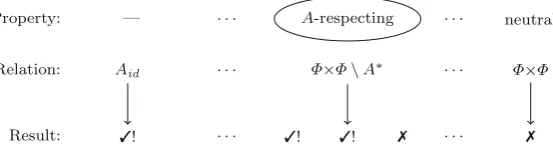
Figure 1 instantiates our findings. Before we are able to prove our main theorem, we will need a lemma characterising all situations where the unanimity rule is A-respecting:
Lemma 3 For a conjunctive agendaΦ, the unanimity rule FN is A-respecting if and
only if A∩A∗=∅.
Proof (⇒) We show the contrapositive. Suppose thatA∩ A∗ = ∅. Then, there are two mutually consistent formulas ϕ ∈ Φ−, ψ ∈ Φ+with∼ϕ,∼ψ also mutually consistent, such thatϕAψ. We can then construct a profile J where one individual accepts bothϕandψand everyone else accepts both∼ϕand∼ψ. In such a case, the unanimity rule will includeϕ in the outcome (becauseϕ ∈Φ−) but notψ. But this violates neutrality sinceNϕJ =NψJandϕAψ.
13 Our results immediately extend to disjunctive agendas as well: simply flipΦ+andΦ−in the relevant
Property:
Relation:
Result:
Aid Φ×Φ\A∗ Φ×Φ
! . . . ! ! . . .
. . . . . .
. . . . . .
— A-respecting neutral
Fig. 1 Every column describes an (im)possibility result, regarding the existence of an aggregation rule that has the relevant property of the first row and is also unanimous, anonymous, independent, and collectively rational. The corresponding relations in the middle row ordered from smaller to larger according to set inclusion. The non-existence of a desirable rule is indicated by✗, while✓! indicates a unique existence
(⇐) Observe that theonlyway for the unanimity rule to not be A-respecting is by having a negative and a positive formulaϕ ∈Φ−andψ∈Φ+withϕAψ, that receive exactly the same support in a profile J, but this support does not come from all the individuals. Then, as unanimity rule is defined,ϕwill belong to the collective outcome butψwill not. Furthermore, since individual judgments are complete and consistent andn ≥2, in order to be able to construct such a profile J withNϕJ =NψJ =N, we must have that both pairs of formulasϕ, ψ and∼ϕ,∼ψare mutually consistent. All of these conditions can be satisfied whenA∩A∗=∅.
Theorem 1 For a conjunctive agenda, there exists a unanimous, anonymous,
A-respecting, independent, and collectively rational aggregation rule if and only if A∩A∗=∅. Moreover, that rule is unique.
Proof By Theorem 5.1 due to Dokow and Holzman (2009), we know that the only independent, unanimous, and collectively rational aggregation rules for a conjunctive agenda are the oligarchies. Adding anonymity, we deduce that the only rule satisfying the above properties is the unanimity rule. Now, from Lemma3we also have that the unanimity rule isA-respecting if and only ifA∩A∗=∅, which completes the proof.
Theorem 1 can be compared to the impossibility result of List and Pettit (2004). Specifically, we obtain the known impossibility (for the somewhat restricted case of conjunctive agendas) by simply replacing A with the total relation. Moreover, Theorem1equips us with a powerful tool we can utilise in different scenarios. For instance, suppose that a group of individuals has to make a decision on a number of propositions. They want to employ an aggregation rule that is unanimous, anonymous, independent, and of course collectively rational. But such a rule can never be neutral, even though fair treatment of the decisions to be made is important for the group as well. A solution rests in the way the propositions may be related to each other with regard to their standards of acceptance—a suitableA-respecting rule may exist, which is all the individuals need.
[image:14.439.82.359.58.131.2]Table 1 (Im)possibility results for aggregation rules that respect relations of practical interest (and that are also unanimous, anonymous, independent, and collectively rational)
Relation Apr A≥ A≤ A> A< A⊃ A⊇ A⊂ A⊆
Result ✗ ✗ ✗ ✓! ✓! ✓! ✓! ✓! ✓!
rational. Of course, even when we provide a positive answer, we have to keep in mind (from the proof of Theorem1) that the rule satisfying all our axioms will be the— arguably disputable—unanimity rule. Note, though, that this makes our findings even more interesting: that this specific rule is the only one circumventing the impossibility is worth showing. Our results are summarised in Table1.
4.2 Specific impossibilities
We now enlarge the corpus of impossibility theorems in the judgment aggregation literature (List and Pettit2004; Pauly and van Hees2006; Dietrich2007; van Hees 2007) simply by instantiating Theorem1.
Proposition 1 For a conjunctive agenda, there exists no unanimous, anonymous,
A≥(or A≤)-respecting, independent, and collectively rational aggregation rule. Proof Consider a conjunctive agendaΦ with¬p,q two of its premises. Then, take
ϕ = ¬p ∈ Φ− andψ = q ∈ Φ+ and note that it holds that ϕA∗ψ, since both
¬p∧qandp∧¬qare consistent. But we also have thatϕA≥ψ(andϕA≤ψ), because
|M¬p| = |Mq|. Thus, (¬p,q) ∈ A∩ A∗ = ∅, and the statement follows by
Theorem1.
Proposition1 makes evident that relaxing neutrality in a manner that still asks for propositions with the same number of models to be treated equally cannot circumvent the impossibility of List and Pettit (2004) associated with the standard neutrality axiom. Moreover, for any agendaΦthat contains a tautology, we obviously have that
(, ϕ)∈ A≥for all formulasϕ∈Φ. Thus, by Lemma2, we know that—for agendas with tautologies—the impossibility of Proposition1holds even if we drop the axiom of unanimity from our requirements. Nonetheless, in Sect.4.3we will see that in order to achieve a possibility result, we only need to weaken our demands one step further. Next, Proposition2shows that, unfortunately, requesting a neutral aggregation rule only with respect to the premises in a conjunctive agenda—although being a very natural requirement—also leads to an impossibility.
Proposition 2 For a conjunctive agenda, there exists no unanimous, anonymous, Apr
-respecting, independent, and collectively rational aggregation rule.
Proof Analogous to the proof of Proposition1.
4.3 Specific possibilities
aggregation rule for all our semantics-based axioms—except for those that relate propositions with the same number of models (they are covered by Proposition1).
Proposition 3 For a conjunctive agenda, there exists a (unique) unanimous,
anony-mous, A-respecting, independent, and collectively rational aggregation rule for any relation A∈ {A>,A<,A⊇,A⊆,A⊃,A⊂}.
Proof For all relationsAin the statement, the proof is similar. Consider a conjunctive agendaΦ. By Theorem1, we need to check thatA∩A∗=∅, or equivalently that there are no formulasϕ∈Φ−,ψ∈Φ+such thatϕAψ,ϕ, ψare mutually consistent, and
∼ϕ,∼ψalso are mutually consistent. Let us sketch the proof for A= A>. It suffices to note that we can only haveϕA>ψfor formulasϕ∈Φ−andψ∈Φ+in three cases:
(i):ϕ = ¬candψ =c(so|M¬c|>|Mc|);(ii) ϕ = ¬candψis a premise p(so
|M¬c|>|Mp|);(iii):ϕ= ¬pfor some premisepandψ=c(so|M¬p|>|Mc|).
But in the first case it is obviously not true thatϕ andψare mutually consistent. In the second case, we have that∼ϕ=cand∼ψ= ¬pare not mutually consistent, and similarly in the last case,ϕ = ¬pandψ =care not mutually consistent either (by definition of a conjunctive agenda). This means thatA>∩A∗=∅.
Recall once more that the unique rule the existence of which is established by Propo-sition3is the unanimity rule.
5 Safety of the agenda
In this section we address a different problem and are interested in knowing for which exact combinations of decision-making domains and A-respecting rules paradoxical scenarios involving logical inconsistencies canneveroccur.
Consider a group of individuals that engage in collective decision making, like the members of a company’s board during one of their meetings. We may be uncertain about the specific aggregation rule that the individuals will use to reach a collective judgment, and we may also be ignorant about their precise judgments in a given scenario. But what if we know that, valuing highly the fair treatment of propositions of the same type, the board will always employ someA-respecting rule? Can we then guarantee that—no matter what the individuals’ individual judgments actually are— the collective outcome will always be consistent? More broadly, we ask the following question:
Given an aggregation domain (captured by an agenda Φ with an associated relation A ⊆ Φ×Φ), which A-respecting rules provide a safety net against inconsistent outcomes?
The above question corresponds to the safety of the agenda problem in judgment aggregation (Endriss et al.2012).
For the remainder, we assume that the agendaΦdoes not contain any tautologies.14We also stress that in this section we examine all possible agendas (not only conjunctive or disjunctive ones). Let us now define some relevant notions. We say that a subsetS⊆Φ of the agenda isminimally inconsistent(mi) if(i)it is inconsistent and(ii)all its strict subsets S ⊂ S are consistent. For example, the set{ϕ, ψ,¬(ϕ∧ψ)}is minimally inconsistent, since by removing any single formula from it, it becomes consistent.
An agendaΦ has theMedian Property (MP) if all mi subsets of Φ are of size two (Nehring and Puppe2007; List and Puppe2009a). For instance, the agendaΦof Example7withΦ+= {ϕ, ψ, ϕ∧ψ}does not have the MP, since as we saw above, it contains a mi subset of size three. Furthermore,Φhas theSimplified Median Property (SMP) if, for all mi subsets{ϕ, ψ}it holds thatϕ ↔ ¬ψ; andΦhas theSyntactic Simplified Median Property(SSMP) if all its mi subsets{ϕ, ψ}are of the form{ϕ,∼ϕ} for someϕ ∈Φ(Endriss et al.2012). An example of an agendaΦthat has the MP but not the SMP is the one withΦ+= {ϕ, ϕ∧ψ}: note that{¬ϕ, ϕ∧ψ}is a mi subset of size two but it does not hold thatϕ ↔(ϕ∧ψ). On the other hand, for the agenda withΦ+= {ϕ, ϕ∧(ψ∨ ¬ψ)}, the SMP holds but the SSMP does not.
To begin with, note that if a rule is not complement-free, then it is also not consistent, for any agenda. So, it is sensible to restrict attention to complement-free rules. From Endriss et al. (2012) we learn that an agendaΦis safe for all neutral and complement-free aggregation rules if and only ifΦhas the SMP.15In the sequel, we will in addition provide a uniform characterisation of the agendas that are safe for all complement-free andA-respecting rules, based on a notion that we call theA-Median Property(A-MP).
5.1 TheA-median property
Definition 4 The agendaΦ has theA-Median Property (A-MP)for some relation
A⊆Φ×Φif all its mi subsets are of the form{ϕ, ψ}, where for someχ∈Φ:
ϕ↔χ and ϕAχ as well as ψ↔ ¬χ and ψA∼χ.
In words, the A-MP says all the agenda’s mi subsets have to contain exactly two formulas that are related viaAto two complementary formulas.
Example 8 Consider the agendaΦ = {p,p∧ p,¬p,¬(p∧p)}and denote byc(ϕ) the number of connectives that appear in the formulaϕ ∈ Φ. Then, consider the relations A= {(ϕ, ψ)∈ Φ×Φ | |c(ϕ)−c(ψ)| ≤ 1}and A = {(ϕ, ψ)∈ Φ×Φ | c(ϕ)=c(ψ)=1}. That is,Arelates formulas that are close regarding their number of connectives, whileAsimply relates formulas with exactly one connective. In practical applications these relations could capture interesting distinctions between formulas, like in the case, for example, where we would want to talk about how “easy” a formula is for a human to grasp, thereby assuming that the number of connectives in a formula
14 This assumption is crucial for our formal results—without it, the only-if direction of our characterisation
theorem would not hold.
15 Specifically, Theorem 17 of Endriss et al. (2012) concerns all complete, anonymous, unanimous,
tells us something about how complicated the formula is (which, of course, is not always realistic). Note that Arelates all semantically equivalent formulas inΦ, and henceΦhas theA-MP if and only if it has the SMP. Moreover, it is trivial to check that
Φsatisfies the SMP. However, we have that the formulaspandp∧pare semantically equivalent, but it does not hold thatp A(p∧p)(and neither that¬p A¬(p∧p)). By examining the mi set{p,¬(p∧ p)}, we can then conclude thatΦ does not have the
A-MP.
Definition4implies Fact3.
Fact 3 For all agendasΦand all relations A1,A2⊆Φ×Φ, such that A1⊆A2, the A1-MP implies the A2-MP.
In order to compare theA-MP to the properties of the SMP and of the SSMP, we note that for all reflexive relationsA, the SSMP implies theA-MP, which implies the SMP (Fact4): When an agenda has the SSMP, each of its mi subsets is of the form{ϕ,∼ϕ}. So, we can takeχ =ϕ and see that, for a reflexive relation A, Definition 4holds. Even more straightforwardly, if an agenda has theA-MP, Definition4implies that all its mi subsets are of the form{ϕ, ψ}withϕ↔χandχ↔ ¬ψfor someχ∈Φ. Thus, we have thatϕ ↔ ¬ψ, and the SMP is satisfied.
Fact 4 For all agendasΦ and all reflexive relations A⊆Φ×Φ,
– the SSMP implies the A-MP. – the A-MP implies the SMP.
Moreover, by looking carefully at Definition4, the following is immediate:
Fact 5 For all agendasΦ, the SMP is equivalent to the A↔-MP.
Using Facts3,4, and 5, Corollary 1 clarifies that the A-MP differs from the SMP only for relationsAthat differentiate between (at least some) semantically equivalent formulas in the agenda.
Corollary 1 For all agendasΦ and all relations A⊆Φ×Φ such that A↔⊆ A, the
SMP is equivalent to the A-MP.
Note that in general, the weaker the axioms we require for a ruleFto satisfy, the more restricting the properties of the agendas that are safe forF.
5.2 The characterisation result
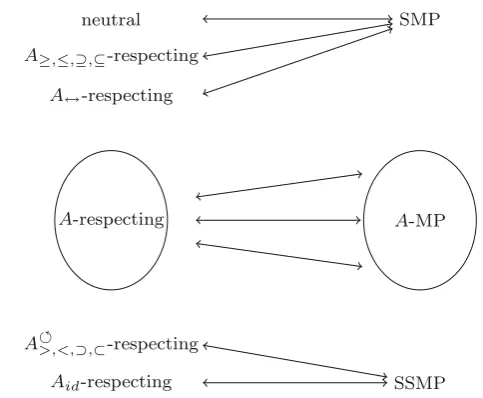
Having familiarised ourselves with theA-MP, we are ready to provide the main result of this section. Theorem2generalises existing results regarding the safety of the agenda, which only examine the extreme cases of standard neutrality and of no neutrality at all, corresponding to the agenda properties SMP and SSMP, respectively (Endriss et al. 2012).
certain axioms will be consistent. A slightly different question corresponds to what is sometimes called an “existential agenda characterisation” problem. In that setting, we are interested in finding what are the conditions on the agenda for whichthere exists some aggregation rule satisfying certain axioms that is also consistent. Work on the latter problem has been done, e.g., by Dokow and Holzman (2010) and several results if this kind have been reviewed by List and Puppe (2009b).
Recall thatnis the number of individuals.16
Theorem 2 Consider a reflexive and transitive relation A⊆Φ×Φ. An agendaΦwith
|Φ| ≤n is safe for all A-respecting and complement-free rules if and only ifΦhas the A-MP.
Proof (⇒)We show the contrapositive. First, note that if the agendaΦdoes not have the SMP, then we know that there is some neutral rule (hence also A-respecting) for whichΦis not safe (Endriss et al.2012). Thus, let us assume thatΦhas the SMP, but does not have the A-MP. This means that Definition4does not hold. So, there exists a mi subset{ϕ, ψ} ⊆ Φfor which there is noχ ∈ Φ withϕ ↔χ andϕAχ and
ψ↔ ¬χandψA∼χ.
Let us define the (possibly empty) set X = {χ ∈ Φ | ϕAχ andψA∼χ}.17 For everyχ ∈ X it is the case that ϕ ↔χ orψ ↔ ¬χ. In other words, for every
χ ∈ X we can define the nonempty set of modelsM(χ) = {M | M ϕ ↔χ or
M ψ↔ ¬χ}.
Now, according to our assumption, we have a large enough group of individualsN, with|N| ≥ |X|. We can then construct a profileJ =(J1, . . . ,Ji, . . . ,Jn)as follows.
First, we consider an enumeration ofX = {χ1, χ2, . . . , χk}. Then, for each individual
i ≤ |X|, we choose arbitrarily one of the models Mi ∈ M(χi)and we take Ji =
{ϕ ∈ Φ | Mi ϕ}. In this way, we have established that for every formulaχi ∈ X
there is some individualiwho cannot accept simultaneously the formulasϕ, χ,∼ψ, neither the formulas∼ϕ,∼χ, ψ. For the individualsi withi >|X|, we can assume they submit any judgment set—this assumption does not affect the proof.
Next, consider the aggregation ruleFthat maps the profileJto the set{ϕ, ψ}∪{χ ∈
Φ |ϕAχandNϕJ=NχJ} ∪ {χ∈Φ|ψAχandNψJ =NχJ}, and all the other profiles to the empty set. By the definition ofF, and recalling that the relationAis transitive, it is straightforward to see thatFisA-respecting. In addition, we can show thatFis complement-free. First, note that the set{ϕ, ψ}is already complement-free. Indeed, if (without loss of generality) we had thatψ= ∼ϕ, then we would also have thatϕAϕ, and thatψA∼ϕ(because Ais reflexive),ϕ ↔ϕandψ ↔ ¬ϕ. But this would imply thatΦalso has the A-MP, which contradicts our assumption. Second, we can show that it is not possible to have{χ,∼χ} ⊆ F(J)for anyχ∈Φ, since this would require thatNϕJ =NχJandNψJ=N∼Jχfor someχ∈ X. But by the construction of the profile J, we cannot have thatNϕJ=NχJ =N∼Jψ(because there is some individuali withi ≤ |X|who cannot accept simultaneously the formulasϕ, χ,∼ψ, neither the formulas∼ϕ,∼χ, ψ). However,F(J)will obviously be inconsistent because{ϕ, ψ}
16 Theorem2holds under two mild assumptions that very naturally apply in a number of realistic scenarios:
that the sizenof the group is sufficiently large, and that the propositions are related in a transitive manner.
is inconsistent, which means that the agendaΦ is not safe for all A-respecting and complement-free rules.
(⇐)Assume thatΦhas theA-MP and (aiming for a contradiction) that there exist an A-respecting and complement-free rule, as well as a profile J such that F(J)is inconsistent. That is,F(J)⊇ {ϕ, ψ}, for some mi set{ϕ, ψ}. As individual judgment sets are complete and consistent, using the formulaχthat appears in the definition of the A-MP, it must hold that NϕJ = NχJ andNψJ = N∼Jχ. So F being A-respecting implies thatχ,∼χ ∈F(J), contradicting complement-freeness.
To emphasise the significance of Theorem2, we apply it to obtain new safety results. Interestingly, we find that relaxing neutrality to any non-strict semantics-based neutral-ity axiom has no effect on the conditions that make an agenda safe, and the same holds when moving from the complete absence of neutrality to any strict semantics-based axiom (Propositions4and5).
Proposition 4 Let A∈ {A≥,A≤,A⊇,A⊆)}. An agendaΦwith|Φ| ≤n is safe for all A-respecting and complement-free aggregation rules if and only ifΦhas the SMP.
Proof To be able to apply Theorem2, we need to show that theA≥-MP (and accord-ingly for theA≤-MP, theA⊇-MP, and theA⊆-MP) is equivalent to the SMP. Since we have that A↔⊆ A≥, this follows from Corollary1, but we will also provide a direct proof here. We know that theA≥-MP implies the SMP, so we only need to prove that it is also implied by it. Consider an agendaΦ with the SMP: all its mi subsets are of the form{ϕ, ψ}, where ϕ ↔ ¬ψ. So, we have thatMψ = M¬ϕ, and hence
|Mψ| = |M∼ϕ|, which implies thatψA≥∼ϕ. Then, takingχ =ϕ in Definition4,
we see that the A≥-MP is satisfied.
Proposition 5 Let A∈ {A>,A<,A⊃,A⊂)}. An agendaΦwith|Φ| ≤n is safe for all A-respecting and complement-free aggregation rules if and only ifΦhas the SSMP.
Proof Again, in order to apply Theorem 2, we need to show that the A>-MP (and accordingly for the A<-MP, the A⊃-MP, and the A⊂-MP) implies the SSMP (since we already know that it is also implied by it). Take an agendaΦ with theA>-MP: all its mi subsets are of the form{ϕ, ψ}, whereϕ ↔χ,ψ ↔ ¬χ,ϕA>χ, and
ψA>∼χ for someχ ∈Φ. Now,ϕA>χmeans that eitherϕ =χor|Mϕ|>|Mχ|. But ϕ ↔ χ implies thatMϕ = Mχ, so it must hold thatϕ =χ. Analogously, fromψA>∼χandψ ↔ ¬χ we conclude thatψ= ∼χ. Hence,ϕ = ∼ψand the
SSMP holds.
Figure2summarises the results of this section.
6 Conclusion
Aid-respecting
A>,<,⊃,⊂-respecting
A-respecting
A↔-respecting
A≥,≤,⊇,⊆-respecting
neutral
SSMP
A-MP SMP
Fig. 2 On the right side we see the requirements that are imposed on the agenda if we want to guarantee its safety (i.e., consistent outcomes) for all complement-free aggregation rules that satisfy the properties appearing on the left side
making. Besides the conceptual analysis of the neutrality axiom we have conducted, we have also investigated two classes of important technical problems, providing uni-form answers that generalise existing results in judgment aggregation. First, we have shown exactly how weakening neutrality affects known impossibility results, and sec-ond, we have characterised all aggregation domains for which the new axioms do not cause any inconsistencies.
Our work opens up many directions for future research. Does weakening neutrality affect other technical results as well? For instance, instead of asking what domains are safe forall A-respecting neutral rules, we can ask which are safe forat least onesuch rule. Are there judgment aggregation rules, beyond the ones presented in this paper, that are not neutral, but are A-respecting with regard to some interesting relation A? And more generally, what other relations can we design, and what application domains can be modelled by them? All these are intriguing questions one can explore further.
[image:21.439.94.336.51.250.2]Appendix: Variants of neutrality in judgment aggregation
In this Appendix we collect and present all the alternative definitions that may be used to capture the notion of neutrality in the framework of judgment aggregation, and we discuss the logical relations between them. We start with repeating the standard definition which we have also used in this paper.
Definition 5 The aggregation ruleF satisfiesneutrality (N)if for all profiles J and all formulasϕ, ψ∈Φ, it is the case that:
NϕJ=NψJ implies thatϕ ∈F(J)⇒ψ∈F(J)
Another appealing property is inspired by the way neutrality is usually defined in the context of voting (Brams and Fishburn2002; Zwicker2016), requiring invariable outcomes under permutations. Any permutationπ :Φ →Φ of the agenda induces a mapping on judgment sets as usual, i.e., by lettingπ(Ji) = {π(ϕ) | ϕ ∈ Ji}for
all judgment sets Ji. Note that even ifJi is consistent,π(Ji)could be inconsistent.
For example, consider the judgment set Ji = {ϕ, ϕ ∧ψ}and the permutation π
withπ(ϕ) = ¬ϕ andπ(ϕ∧ψ) = ϕ∧ψ. Then,π(Ji) = {¬ϕ, ϕ∧ψ}. For any
profile J =(J1, . . . ,Jn), letπ(J)=(π(J1), . . . , π(Jn)).
Definition 6 The aggregation ruleFsatisfiespermutation neutrality (PN)if, for all
profilesJ =(J1, . . . ,Jn)and permutationsπ :Φ →Φsuch thatπ(Ji)is consistent
for everyJi, with 1≤i ≤n, it holds that:
F(π(J))=π(F(J))
The third neutrality axiom only applies when judgment aggregation simulates prefer-ence aggregation. Consider a preferprefer-ence agendaΦbased on a set of alternativesA. We say that the permutationπ :A→Anaturally inducesthe permutationπ :Φ →Φ if π(pa b) = pπ(a) π(b) for every a,b ∈ A and pa b ∈ Φ. For example, for
three alternativesa,b,cwhere π(a)= bandπ(b) = c, it must be the case that
π(pa b)= pb c.
Definition 7 Consider a preference agendaΦbased on alternatives inA. The
aggrega-tion ruleF satisfiesalternative-permutation neutrality (APN)if, for all profilesJ
and permutationsπ : A → Athat naturally induce permutationsπ : Φ → Φ, it holds that:
F(π(J))=π(F(J))
How do the different neutrality axioms logically relate to each other? Figure3 illus-trates graphically our findings, and we proceed with the proofs.
Proposition 6 PN implies N.
Proof Consider an arbitrary rule F that satisfies PN, a profile J, and two formulas
Fig. 3 Logical relations between the different variants of neutrality in judgment aggregation. An arrow points from the logically stronger axiom to the logically weaker one
PN
N APN
deduce thatψ∈ F(J). Take the permutationπ :Φ→Φwithπ(ϕ)=ψ, π(ψ)=ϕ, andπ(α) =αfor allα= ϕ, ψ. Since NϕJ = NψJ, for every judgment setJi in the
profile J we have thatπ(Ji) = Ji, soπ(Ji)is consistent. Hence, F satisfying PN
implies thatF(π(J))=F(J). Butψ=π(ϕ)∈π(F(J))by definition. We conclude
thatψ∈ F(J).
Proposition 7 PN implies APN (for any preference agendaΦ).
Proof It is immediate that PN implies APN, as every permutation π : A → A naturally induces a permutationπ : Φ → Φthat satisfies the condition required by PN (intuitively, for individual preferences being linear orders, any permutation over the alternatives will retain the linear orders and consistency is preserved).
So, permutation neutrality is logically stronger than both standard neutrality and (for preference agendas) alternative-permutation neutrality. Moreover, we show that there is no other logical relation between these axioms by constructing relevant counterex-amples.18
Example 9 N does not imply APN (soN does not imply PN): Consider the preference agendaΦ = {pa b,pb a}for a set of alternativesA= {a,b}and the rule F such
that for every profileJ:
F(J)=
Φ if J1= {pa b}
∅ if J1= {pa b}
F satisfiesN, since for any two formulasϕ, ψ ∈Φ it is the case thatϕ ∈ F(J)⇔
ψ ∈ F(J). However, we may consider a permutationπ : A→ Awithπ(a)=b andπ(b)= a, and a profile J with J1 = {pa b}. Then, takingπ : Φ → Φ to be
naturally induced byπ, we will have thatπ(J1)= {pb a}, soπ(F(J))=π(Φ)=
Φ =∅=F(π(J)). Thus,Fdoes not satisfy A P N.
Example 10 APN does not imply N(soAPN does not imply PN): Consider the pref-erence agendaΦ based on the set of alternativesA = {a,b,c}. Then, construct the ruleF such thatpa1 a2 ∈ F(J)ifpa1 a2 ∈ Ji for everyJiin J, but in case a linear ordera1 a2 a3 appears in the outcome, the pair pa1 a3 is deleted.F satisfies APN, since renaming the alternatives would derive the same renaming in the outcome. However, taking the unanimous profileJwithJi =(a b c)for alli, we have that
F(J)= {pa b,pb c}(because the formulapa cwill be deleted). Thus, even though
it is the case thatNpJa b = N J
pa c, it will hold that pa b ∈ F(J)and pa c ∈/ F(J),
implying thatFdoes not satisfy N.
18 Analogous observations have been made by Endriss and Grandi (2017) in the framework of graph