Rochester Institute of Technology
RIT Scholar Works
Theses
Thesis/Dissertation Collections
2004
Design Literacy for Children
John L. O'Neill
Follow this and additional works at:
http://scholarworks.rit.edu/theses
This Thesis is brought to you for free and open access by the Thesis/Dissertation Collections at RIT Scholar Works. It has been accepted for inclusion
in Theses by an authorized administrator of RIT Scholar Works. For more information, please contact
.
Recommended Citation
Design
Literacy
For Children
A
thesis
submitted
to the
Faculty
of
the
College
of
Imaging
Arts
and
Sciences
in candidacy for
the
degree
of
Master
of
Fine Arts
John Leonard O'Neill
July
2004
Graduate Graphic Design MFA Program
School
of
Design
Table
of
Contents
Thesis
Project Definition
Precedents
2
Research
5
Synthesis
11
Ideation
15
Implementation
23
Dissemination
28
Retrospective Evaluation
35
Conclusion
36
Glossary
of
Terms
37
Bibliography
39
Appendices
Appendix A
New York State
Department
of
Education
English Language Arts
Learning
Standards
Appendix B
U.S.
Department
of
Labor
SCANS
Report
Appendix C
Graphic
Design
Methods Examples
That Do Not Appear In The
Guidebook
Appendix D
Design
Literracy:
Thesis Project
Definition
Thesis
Changed Direction
As
the thesis
was
developing,
the
project
goals shifted
over
the
course
of
time.
In its early
development,
the
goal was
to
examine
how
three
areas of
design
could
help
define
and
improve
visual and verbal communi
cation skills
for elementary
school-age children.
The
three
areas of
design
were visual
thinking, design
process,
and
information design. Once
the
skills
were
defined,
they
were studied
to
better
understand
how
they
might
serve as a supplement
to the
New York
State
Learning
Standards. After
the
initial
research
and
synthesis
stages,
it
was recognized
by
the
designer
and
the
committee members
that the
scope of
the
project was
too
large
and required
further definition.
New
York State
Learning
Standards
Subjects
Languages Other Than English
Health
and
Physical Education
Math,
Science
and
Technology
The Arts
Career Development
and
Occupational
Study
English Language
Arts
Social Studies
Learning
Levels
The
standards
for
each
subject
have
three
different
levels,
and each grade within
K-12 fits
within
one of
these
levels.
Once
the
scope was
narrowed, the
designer
redirected
this thesis
by
examining how
graphic
design
methods
might
be
used as a supplement
to the
New York State
Learning
Standards specifically for English Language
Arts
(ELA)
at
the
Intermediate level. Relevant
graphic
design
methods could
have been identifed for
all
seven subjects of
the
New York State
Learning
Standards;
however,
English Language Arts
was
chosen
because
the
graphic
design
methods researched
have strong
connections
to
the
goals
for ELA.
Graphic design
methods gathered
for
this thesis
match
the
objectives
for
the
ELA
Learning
Standards
by
allowing 8th
grade
students
to
synthesize and
visually
organize
information
to
discover
relationships
among
content
areas,
use simple
imagery
and
text to
convey
a
message,
and use written
language
for
effective social communication.
As
a result
of
using
these
graphic
design
methods,
8th
grade
students could
have
a
better understanding
of
how
to
use
language in
a
variety
of ways
in
order
to
gain effective communication skills.
Goals
1
To
propose
specific graphic
design
methods
that
can
be
a useful supplement
to
enhance
the
intermediate
(8th
grade)
English Language
Arts
Learning
Standards
of
the
New York
State Department
of
Education.
Elementary
kindergarten-5
Intermediate
grade
6-8
Commencement
grade
9-12
The
are
four
Learning
Standards
within
the
Intermediate level
of
English Language Arts:
Standard
1
Language for Information
and
Understanding
Standard 2
Language
for
Literary
Response
and
Expression
Standard 3
Language for Critical Analysis
and
Evaluation
Standard
4
Language for Social Interaction
Standard 1
Language for Information
and
Understanding
Graphic design
methods chosen
for English
Language
Arts Standard 1
are
proposed
to
help
8th
grade students
learn how
to
understand
information
once
they
have
collected
it
from
several
different
sources.
As
a
result,
students will
be
able
to
synthesize
the
information
to
discover
relationships
and
concepts.
Students
will
also
be
able
to
use words and
images
to
verbally
communicate
information.
2
To
provide a guidebook
for
educators.
3
To
contribute
to the
ongoing
efforrt
to
demonstrate
the
value
of
design
principles
in
mainstream
early
education.
Standard
4
Language
for
Social Interaction
Precedents
Black Mountain College
Black
Mountain,
North
Carolina,
1933
Black Mountain College
was
an
experimentalschool
located in Black
Mountain,
North Carolina.
Educator
John A.
Rice
and others established
the
college
in 1933.
Many
of
the
early
faculty
and students arrived on
campus
from Rollins College in Florida. The
goal
of
the
college was
to
educate
the
'whole
person,'with
an
emphasis on
the
role of
the
arts
and creative
thinking.
The
college was closed
in
1957.
Since
the
closing
of
the school,
alumni and
former
faculty
have
made a
huge impact
on
the
creative arts profession.
Although Black Mountain
College
closed
its doors
many
years
ago, the
school's
philosophy
of
using
the
arts and other creative skills
to
educate
the
whole
person was valuable
to this thesis.
Like
most
schools.
Black Mountain College
taught
verbal
skills,
but
what made
them
different
was
they
made visual
arts
an
integral
part of
the
students'lives. This
approach
to
education was
experimental,
as
they
used
art and
fundamental design
principles
to teach
different
subject matter.
As
a
result,
students were
fully
able
to
learn
and
develop
their
minds
by
gaining
verbal skills
and visual skills
throughout the
arts.
With
these skills,
many Black Mountain
students went on
to
have
successful careers
in
art and
design fields.
Black Mountain College
serves as a model
for
this thesis
with
its
focus
fully
on
educating
the
whole person
through
teaching
art and
design
principles,
regardless
of
subject
matter.
K-12
students
Precedents
Design
as a
Catalyst For
Learning
Meredith
Davis,
1996
The
book,
Design
as
a
Catalyst For
Learning,
co-authored
by
Meredith
Davis,
Peter
Hawley,
Bernard
McMullan,
and
Gertrude
Spilka,
gives an overview
of
how design has
supplemented
K-12
education
throughout
the
United States because it helps
children gain
the
verbal
and visual skills needed as
adults.
It does
this
by
showing how
the
design
process
can
be
used
to
help
students understand abstract
concepts
in
each subject
taught
in
school.
It
allows students
to
put
ideas
to work,
and engages
students
to
assess each other's processes.
Students
do
this
by identifying
and
defining
problems
to
understand
the
goals
and
the
scope of
their
projects.
Once
students
define
problems,
they
gather
and analyze
information
to
better
understand
the
best
method
to
communicate
information. After design
solutions
have been
developed,
students can evaluate and select
the
best
solution
that
fits
the
goals of
the
project.
This book has informed
this thesis
by
showing how
design
processes can aid active
learning,
and can
be
adaptable
to
different
learning
styles
because
they
combine
both
verbal and visual components.
These
visual
components,
such as
diagrams,
use
imagery
and
text to
convey information
most effectively.
In
addition
to
discussing
the
introduction
of visual
design
principles
into
teaching,
the
book
also gives an
overview of
the
history
of
implementing
design in
Precedents
I Know What You
Mean,
Children
at
Work
with
Visual
Information
Steve
Moline,
1998
The
book,
/ Know What You
Mean,
Children
at
Work
with
Visual
Information,
by
Steve
Moline,
discusses
teaching
children
how
to
understandand present
information through the
use of
information
design
components,
including
charts,
diagrams,
timelines,
etc.
Moline
presents
different
examples of
how many
children
in
grades
K-12
across
the
United States
are
gaining
verbal
and visual
information
skills
by
designing
and
using
several
information
design
components.
Children
can
easily learn
these
skills
because information design
components often combine
the
use of verbal and visual
information.
By
gaining
these
skills,
children
are
better
able
to
gather
information,
organize
and synthesize
information,
and communicate
information. Moline
shows a wide
variety
of children's school work.
For
example,
illustration
diagrams
made
by
1st
graders show
how
pictorial
and
diagrammatic
imagery
can reveal
the
internal
structure of objects.
The
caption
text
within
the
illustration diagrams
points
to the
imagery
and conveys
verbal
information
about
the
object.
This book
serves as a model
for
this thesis
by
showing
how exploring information design
components can
benefit
children.
Information design
components
are
often used and
designed
by
professional
designers
to
solve complex communication problems.
However,
Moline illustrates
through
his
body
of examples
that
information design
components can serve as an
Research
There
were
five primary
sources
of
information
sought
in
the
process
of
this thesis:
i
New York State
Department
of
Education
Learning
Standards.
This
information
helped
this
graphic
designer
to
understand
the
main
objectives
of what students
are
required
to
learn in
all
subject
areas
in New York
State
schools.
2
English Language Arts
Learning
Standards 1-4
This information helped
this
graphic
designer
understand
the
specific verbal and visual
communications
skills
8th
grade students are
required
to
learn. With
this
understanding he had
a
better idea
of
how
graphic
design
methods can
enhance an
8th
grade education.
3
Literature
about
Key
Graphic Design Methods
that
could
Enhance
the
English Language Arts
Learning
Standards.
This information
reminded
this
designer how
useful
the
graphic
design
methods are when
solving
a
visual communication problem.
4
Literature
about
What is
Currently Being
Done
with
Visual Design in K-12 Education.
This information helped
this
graphic
designer
understand
how his
own research can make a
contribution
to
graphic
design
by discovering
that
no one
has
used graphic
design
methods
to
supplement
K-12
education.
5
Literature from Jane Alexander:
Why
Design
Literacy
is Important
to
K-12 Education.
The
statements of
Jane
Alexander,
Chairperson
of
the
National Endowment for
the
Arts,
helped
support
this
graphic
designer's
argument
that
verbal and
visual skills
are
important
to
children's
education.
The
workforce
is
now
requiring
workers
to
communicate
both verbally
and visually.
New York State
Learning
Standards
The
standards are
divided into
seven
subjects,
from
the
arts
to
social studies.
Each
subject
lists
its
own
set of
learning
standards
in
an attempt
to
give students
a well-rounded education.
The
standards'main objectives are
listed in
the
Research
section,
page
5,
while
the
full
text
version
is listed in Appendix A. The list
of
the
standards'
objectives was
gathered
from
the
New York State
Department
of
Education
website.
usny.nysed.gov/teachers/nyslearningstandards.html
Website
reviewed:
Janurary 10-May
30,
2004
The
Learning
Standards
represent
the
core of
what all students should
know,
understand
and
be
able
to
do
as a result of
their
schooling.
Each
subject
taught
in
grades
K-12 in
New
York has its
own standards.
Subjects
are:
Languages Other Than English
Health
and
Physical Education
Math,
Science
and
Technology
The Arts
Career Development
and
Occupational
Study
English Language Arts
Social Studies
Learning
Levels
The
Learning
standards
for
each
subject
have
three
different
levels,
and each grade within
K-12 fits
within
one of
these
levels.
Elementary
Intermediate
Commencement
kindergarten-5
grade
6-8
Research
English Language Arts
Learning
Standards
1-4
Main Objectives
Standard
1
Language
for
Information
and
Understanding
Students
will
listen,
speak,
read and write
for information
and understanding.
As listeners
and
readers,
students
will collect
data,
facts
and
ideas;
discover
relationships,
concepts and
generalizations;
and use
knowledge
generated
from
oral,
written
and
electronically
produced
texts.
As
speakers
and
writers,
they
will
use oral and
written
language
that
follows
the
accepted conventions
of
the
English language
to acquire,
interpret,
apply
and
transmit
information.
Standard
2
Language for
Literary
Response
and
Expression
Students
will read and
listen
to oral,
written
and
electronically
produced
texts
and performances
from
American
and world
literature;
relate
texts
and
performances
to their
own
lives;
and
develop
an
understanding
of
the
diverse
social,
historical
and cultural
dimensions
the texts
and performances
represent.
As
speakers and
writers,
students will use
oral and written
language
that
follows
the
accepted
conventions of
the
English language for
self-expression
and artistic creation.
Standard
3
Language for Critical Analysis
and
Evaluation
Students
will
listen,
speak,
read and write
for
critical
analysis and evaluation.
As listeners
and
readers,
students will analyze
experiences,
ideas,
information
and
issues
presented
by
others
using
a
variety
of
established
criteria.
As
speakers
and
writers,
they
will
use oral and written
language
that
follows
the
accepted conventions of
the
English
language
to
present,
from
a
variety
of
perspectives,
their
opinions
and
judgments
on
experiences,
ideas,
information
and
issues.
Standard
4
Language for Social Interaction
Students
will
listen,
speak,
read and write
for
social
Research
Literature
about
Key
Graphic Design Methods
That Could Enhance
the
ELA
Learning
Standards
This
graphic
designer
was
influenced
by
the
graphic
design
methods
he
used
during
his
graduate
studies.
Throughout his
time
at
Rochester Institute
of
Technology
he has learned
about
these
methods
in
several of
his
graduate graphic
design
courses,
such as
Design
Theory
and
Methods,
Graduate
Information
Design,
and
Graduate Design Topics.
This
graphic
designer
collected as much
information
as posssible about
these
methods
from
past course
material
and other resources.
Gathering
Design Methods
Ten
graphic
design
methods were selected
from
course materials
taught
in
the
RIT School
of
Design.
These
methods
have been
a part of
this
graphic
designer's
graduate
experienceand
have helped him
develop
effective
design
solutions
for
class projects.
This designer's
communicationand
design
skills
were enhanced
through
his
personal
experienceusing
these
methods.
Specific
graphic
design
methods
have
a
strong
corrolation with
the
goals of
the
English
Language Arts
Learning
Standards. These
methods
could supplement
8th
grade education
to
ensure
that
children
improve
their
verbal and visual
communication
skills
Graphic design
methods gathered
for
this
thesis
match
the
objectives
for
the
ELA
Learning
Standards
by
allowing 8th
grade students
to
synthesize and
visually
organize
information
to
discover
relationships
among
content,
use
simple
imagery
and
text to
convey
a
message,
and use written
language for
effective social
communication.
As
a result of
using
these
graphic
design
methods,
8th
grade students could
have
a
better understanding
of
how
to
use
language
in
a
variety
of ways
in
order
to
gain effective
communication skills.
Examples
that
Best Illustrate How
Graphic Design Methods
are
Used
Once
the
methods were
selected, the
designer
found
examples
that
demonstrate how
these
graphic
design
methods are used
by
professional
designers
and college
design
students.
The
examples
can
help
8th
grade
teachers
better
understand
how
these
graphic
design
methods
work and
how
they
benefit
the
individual
that
uses
them.
The
examples
were
gathered
from different
sources,
including
books,
the
RIT Graphic Design
Archive,
and
information
from
Research
Sources for
Examples
of
Graphic
Design Methods
Specific
examples
from
these
sources appear
in
the
final application, Design Literacy: Graphic Design
Methods
Guidebook. Examples
that
were not used
in
the
final
application can
be found in Appendix C.
Matrix
Understanding
USA
Richard Saul Wurman
TED
Conference Inc.,
2000
Illustration Diagram
Information Graphics
Innovative Solutions in
Contemporary
Design
Peter Wildbur
and
Michael Burke
Thames
and
Hudson,
1998
Timeline
/
See What You Mean
Children
at
Work
with
Visual Information
Steve Moline
Stenhouse
Publishing,
1995
Wurman's
Organazing
Hatracks
Graphic Design Archive
at
Rochester Institute
of
Technology
http://design.rit.edu
Date
reviewed:
June 2004
Team Design
Agnew Moyer Smith
www. amsite. com
Date Reviewed: June 2004
Studio
Critiquing
www.aiga.org
What Goes
on
in Design School?
Date Reviewed: June 2004
Project Proposal
www.aiga.org
Design Business
Date Reviewed:
June 2004
Designing
Business
Clement Mok
Adobe Press
1996
Presentation Methods
Graduate Graphic Design Program
Rochester Institute
of
Technology
2003-2004
Case Studies
Information
Graphics
Peter Wildbur
Van Nostrand
Reinhold,
1989
Typography Hierarchy
Project
Professor Karen Moyer
Research
Literature
about
What is
Currently
Being
Done
With Visual Design K-12 Education
This designer
researched sources
that
discuss
the
relationship
between
design
and
K-12
education
to
get an
understanding
of
how design has been
used
to teach
children
communication
skills.
The
book.
Design
as a
Catalyst for
Learning,
gives a clear
overview of
the
research
that
has been
conducted
in
this
area.
The book
was written
by
four
authors,
most
notably Meredith
Davis, Professor,
Graphic
Design,
North
Carolina State
Unversity,
and
K-12 design
consultant.
This book
provides an outline of
the
hisory
of
how
design has been
used within
K-12
education:
The
1960s
Educational
programs were
developed
to
bring
designers into
schools
to train teachers
how
to
conduct
design
activities
for
their
students.
This
resulted
in
developing
professional networks
between designers
and educators who were
interested in design.
These design
activities were
generally
taking
place at
the
secondary level
to teach
young
students
technical
skills
necessary
for
a career
in design. These
activities
were pre-professional
and
highly
technical.
Literature from Jane
Alexander
Explaining
Why
Design
Literacy
is
Important to
K-12
Education
The U.S. Education
Department
website
does
not
discuss
children's
reading
and
writing
information
in
a
visual manner.
However,
important
figures
within
the
arts and
governmentstated
the
benefits
of
design
education
for
children.
In
the
book,
Design
as a
Catalyst for
Learning,
Jane
Alexander,
Chairperson
of
the National
Endowment for
the
Arts,
made
the
following
statements:"The
world
into
which students now graduate
is
changing rapidly
as global competition
increases..."
"Information
technology
transforms
the
way
work
is
conducted.""The 'knowledgeable
worker'is
now
in
demand...""Such
workers
also
know
how
to access, evaluate,
interpret
and communicate
information in
a
variety
of
media."
"How do
children
gain
these
skills?
Education in
the
arts
is
an essential
component."
1970s
and
1980s
New
educational programs were
put
into
place
to
inform K-12
students about well-designed
products,
buildings
and visual communication.
These
programs
helped
students understand and
participate
in
designing
environments.
These
programs were short-lived and
their
publications
are out
of print
today.
1
990s
to
Present
As
computer software
technology
was
developed
more students
began
to
use
digitally-based
graphs,
charts,
etc.
New
educational programs were
put
into
place
to teach
students
how
to
design
new computer
technology.
An
educational programs was
developed
to teach
children
how
the
design
process can
help
increase
understanding in
a
variety
of
disciplines.
One
of
these
Research
10
U.S. Dept.
of
Labor: SCAN Report
What Works Require
of
Schools
While
reviewing
Meredith
Davis'book.
Design
as
a
Catalyst
for
Learning,
the
designer
read
information
about
a report
that
was
developed
by
the
U.S.
Secretary
of
Labor's Commission
on
Achieving
Necessary
Skills (SCANS).
SCANS's
report
entitled.
What Work
Requires
of
Schools,
was
first developed in
1990
and
later
updated
in 2000. The
report examined
the
demands
of
the
workplace
to
determine
whether
the
current
and
future
workforce was capable of
meeting
those
demands. It described
to
educators
and
employers
what
students
and workers need
to
know
and
be
able
to
do in
order
to
succeed
in
the
workplace.
The information
gathered
from
the
SCANS
report
helped determine if design
could
help
students achieve
these
skills.
Davis'
book
gives an
informative
overview of
the
detailed information
contained
in
the
report.
However,
the
designer
reviewed
the
529
page
document
to
understand
if
the
SCANS
report
had any
conclusions
regarding
verbal
and visual
communication skills
being
used
in
the
workforce.
During
the
development
of
the report,
SCANS
assembled
a
team
of experts
to
identify
the
necessary
skills required
to
enter employment.
Once
the
skills were
identified
and
defined,
SCANS
analyzed
different
kinds
of
jobs.
The
objective of
the
job
analysis was
to
demonstrate
the
level
of
importance
of
the
skills
that
were
identified
by
the
experts.
The
report states
that
many
skills required
for future
workers were
described
as communication
skills,
including:
evaluating information
organizing
and
maintaining information
interpreting
and
communicating information
processing information
visual
thinking
skills
The
chart
from
the
2000
SCANS Report
shown
below
categorizes
the
kinds
of skills
that
effective workers
must
have.
Key
Worker
Competencies,
Skills,
and
Qualities Identified
by
Scans
Competencies for Productive
Work
The Foundation for
Effective
Mastery
and
Use
of
Key
Competencies
Use
ofResources
Use
ofInformation
Interpersonal
Skills
Using
Systems
Using Technology
Allocates
time, money, materials, space,
and staffto achievedesired
endsAcquires
andffialuatesinformation;
Organizes
and maintainsinro>mation;fmterpretsjand
communicatesinformation;
Uses
computers tororocessinrormationj
Participates
as amemberof ateam;
Teaches
others;
Serves
clients/customers;
Exercises
leadership;
Negotiates
toarrive atadecision;
Works
with peoplewithculturally
diverse backgrounds
Understands
systems;
Monitors
andcorrectsperformance;
Improves
anddesigns
systemsSeleccs
technology;
Applies
technology
totask;
Maintains
andtrobleshootstechnology
Basic
Skills
Reading
Writing
Arithmetic
Mathematics
Listening
Speaking
Thinking
Skills
I
Creative
thinking
]
Decision-making
Problem-solving
Seeing
things
in
the
mind's eye
Synthesis
11
The
systhesis stage
of
this thesis
had
three
phases:
1
Using
a matrix
to
group
each graphic
design
method
into
seperate
English Language
Arts
Learning
Standards
2
Developing
definitions
for
each graphic
design
method,
and
synthesizing
the
English Language Arts
Learning
Standards.
3
Developing
a new
format
to
make stronger
connections
between how
the
graphic
design
methods can supplement
the
English
Language
Arts
Learning
Standards.
Linking
each
Graphic
Design
Method
with
the
ELA
Learning
Standards
A
matrix was made
to
examine
how
graphic
design
methods can
be
used
to
supplement
the
New
York State
Learning
Standards for English Language
Arts (ELA). The
matrix grouped each of
the
found
graphic
design
methods
into four
separate
lists.
Using
the matrix,
each
list
of graphic
design
methods
correlated with a specific
Learning
Standard.
The
correlation
between
the two
items
was
based
on whether
the
graphic
design
methods could
help
8th
grade
students meet one of
the
four ELA
Learning
Standards
objectives.
Developing
Definitions For Each Method
This
graphic
designer began
to
write
definitions
for
the
graphic
design
methods.
This
allowed
the
designer
to
understand
the
main objectives of each
graphic
design
method and
how
they
can
be
used.
Synthesizing
The
Learning
Standards
When
this
graphic
designer identified
and
grouped specific graphic
design
methods
for
each
English Language Arts
Learning
Standard,
he began
to
summarize main objectives
for
all
four
of
the
ELA
Learning
Standards in
the
form
of
bulleted lists.
These lists helped
this
graphic
designer
to
understand
the
main objectives of
the
ELA
Learning
Standards.
With
an
understanding
of
the
objectives of
the
graphic
design
methods and of
the
ELA
Learning
Standards,
the
designer
was
better
able
to
see
how
the
graphic
design
methods coud serve as
an educational supplement.
The
matrix was structured
into
three
parts:
1
Notes
that
explain
the
main goals and objectives
of each
New York
State
Learning
Standard for
English Language Arts.
2
The
skill sets
that
a graphic
designer
must
have
to
accomplish
the
goals and objectives of
each
Learning
Standard.
3
The
graphic
design
methods
that
can
help
students achieve
the
goals and objectives of
each
Learning
Standard.
Note:
page
12.
1,
foldout
of
full
matrix
Written Text
was
Developed for
each
Graphic Design Method Example
Text
was written
to
describe
an
example
for
each
of
the
ELA
Learning
Standards. This
text
helped
illustrate how
graphic
design
methods
are used and
Synthesis
12
Phase 1
Matrix Format
Phase 2
Definitions
Synthesis Notes that
List
the
Goals
Within the New York
State
Learning
Standards
(Most
ofthe
Goals
areVerbal
Based)
This Standard Is Based On
Reading,Writing, Listening,andSpeakingfor Information AndUnderstanding KeyObjectives Gathered From The Standard collectdata,facts,andideas fromseveral sources discoverrelationships, concepts,end generalizations
useknowledgegeneratedfrom oral, written, andelectronicallyproduced text
use a widevarietyof strategiesforselecting, organizing, andcategoring Information
distinguish betweenrelevant andIrrelevant Information
use textfeatures thatmakeinformation acccessible and clear
organizeinformation toconvey internalrelationships
-usevisualforms tosupportfactsanddata KeyWord.
<AcquireInformation ' Interpretinformation
Transmit Information
Objectives Related to
Conceptual
Thinking,
Art
andDesign
That Can Be
Intergradate Into
The
New York
State
Learning
Standards
Havingthe ability tounderstandvisual relationships withinthe Information
Chartsand matrixdiagrams illustrate therelationship betweenpieces ofinformation.
FormattingInformationsoIt Isaccassable and clearto theuser
Gridstructures,tabs, boldheadings,andbulletshelp organizethe text whilehighlightingthemain points ofthetext.
Developingvisualformstounderstand concepts thatare often communicatedthroughverballanguage Aperson can write aboutthehistoryofRochester andhow its landscapechanged,however, mapsthatIllustrate the landscapethroughouthistory putsthat Information intocontext.
Processes, Theories,
andPrinciples
That Can Be Use
By
The Students
To
Learn The Objectives
oftheThe New York State
Learning
Standards
Matrix Diagram
Thismethodencourages,orforces,theuserto cross-referenceand compare charactericsor attributes of subjectsthatotherwise Bra notlinked toone another OrganizationalDiagram
These diagrams illustrateageneral pattern oflinks and showinterrelationshipsbetween items. The Hems displayed inthediagramneed nottobe physicalentitles;theycanbeabstract concepts or activities. Time Diagrams
These diagrams illustratea general pattern oflinke and showInterreletionahipsbetweentimeperiods. WurmanOrganizingHatrack
Thismethodisausefulproblemsolvingtoolthat revealsinformationand relationshipsbyorganizing andreorganizing factaand observations.Asaresult, new conclusions orinterpretationscanbe developed.
Phase 3
New Format
Standard 1
Language for InformationandUnderstanding
OverviewofObjectives for Standard1
OverviewofProposal Design Methods for Standard1
StructuringandOrganizingObjectives . collectdata,facts,andIdeas fromsaveral sources
-discoverrelationships,concepts,and generalizations
< useknowledgegeneratedfromoral, written, andelectronicallyproducedtext
usea widevarietyof strategiesforselecting,organizing, andcategorizing information
distinguish betweenrelevantandirrelevant information
usetextfeaturesthatmakeinformation scccesEibleend clear
organizeinformation to conveyinternalrelationships use vieualformatosupportfacteanddata KeyWords
Gatheringinformation Organizinginformation Structuringinformation
StructuringandOrganizingMethods Matrix Diagram
Thinmethodencourages,orforces,theuserto cross-referenceand compared characteristics or attributes of subjectsthatotherwise are not linkedtoone another.Thedifferentsets ofInformation beingcompareareformattedon aXandY grid structure.Thecomparsonismadewhere theXandYaxis overlaps.
IllustrationDiagrams
ThisvisualInvolvesusingsimpleImagerytoillustrate thaconcept of enobject,or process.Theimageryis oftendrawntorepresenttheobject or processit ie illustrating.It ismosthelpfulwhenillustrationdiagrams are combined withtexttoreinforces whattheimage isconveying.Text Isalso usedtoexplain certain parts oftheimagery. Throughtheuse ofimageryand text,theviewersreceivetheInformation visually and verbally.
TituoDiagrams
These diagrams illustrateageneral pattern oflinks
hiidshowinterrelationships between timeperiods. WurmanOrganizingHatrack
ThismethodIsa useful problemsolvingtoolthat revealsinformationand relationshipsbyorganizing andreorganizing factsand observations.Thesame setofinformation IsputInto differentcetegorles todrawnewconclusions or viewpoints. Typography
Typographyhas itsown methods and principleswithin theareaof graphicdesignthaihelpcommunicate languageina visual manner.Typographyinvolves formattingheadingsandbodytext ona grid structure usingtypesize andweight,tabs,andbulletpoints. ColorCoding
This organizingmethodisused on several visual forms,suchas amaps,diagramsor charts.ItIsa helpful waytoorganize and make relationshipsto other pieces ofinformation.Oncethe textorimages are categorizedintoa colorkey,itcen mBke referenceto thatinformationInother parts ofthevisualforms,
Phase 3:
Developing
A New Format
Although the
matrix
helped
generate
and
separate
the
graphic
design
methods
into
each
of
the
four
Learning
Standards,
it
was
realized
through
discussions
with
the
chief
advisor
that
some of
the
method
definitions
did
not provide enough
detailed
information
to
allow non-designers
to
fully
understand
the
methods and
how
they
can
be
used.
It
was
also
determined
that the
sections on
the processes, strategies,
communication
components,
and skill sets
blended
too
much with
the
information. It
was
hard
to
differentiate
the two.
To
solve
this
problem,
these
sections were
deleted from
the
matrix.
This
resulted
in
a more
focused
and
direct
relationship between
the
graphic
design
methods and
the
English Language Arts
Learning
Standards.
To
make
this
understanding
clear
to others,
the
information
that
appeared on
the
matrix
was reformated
to
a new
layout
using
a
two
column grid system.
As
a
result, the
relation
ship between
the
English Language Arts
Learning
Standards
and
the
graphic
design
methods
was more
easily
seen.
This
new
(A
l
n
w
IB
o
o
= "0
0>E
3
mC
Ifl (A
> 0)
V
.
DJ
>
gSgw
M
S^i-
3
u
*<o
g
J,
i. 9l
0.HJI-"O
n
o
c
c
.9"B
a
I
II"
t
".
IS
a>
o
-i"0J
2
g>2*
**
!k
2
<=_
o
o
w (0CO
>
4>
3
e a,>
?*3
5o
8z
S
?*._
c
03 a>5 R
==0)
IS
w
0
IB
0
CO
4)Tn
j
?*0)
i ?* ?"a>
01
HI>
-1<A
ai
IB
a>
k3
O
-.IB
O
kIB
J
IB
O
0
2
100)
e
(9
z
0)
IB
"B
A.c
0)
c
<*-0
+* * ine
+*IB
0
>
(A
3
_iE
IB
2
3
U.1
1
8* i:
I
2 9o'
I
I
S
-sI
f
I
E|
o|
2*- ^ c : 8 8
S
if'ill
o 62
HI
5 2 5I
! 8,
|:
I
I
|
i
%i1
?-2 2c
|
S=J
:lllfl
fills
i
i
si
n
' .8 s s C 5is
|iiI. 8 1 Ss
I
illi
ill*
'
I
III
2
1(3 o 5 OS' .si
".
*Iff
*M
E <i S
I
iill
ii
i
sf
-5 5^
I
s
1
1
!
s o sz c0
<2
00
t
V)
w<
0
2
v
IB
C
<HIB
a)
en
(A
*"(A
^1
0-1E
.20
IB
O
0.
C
IB
(A
II
1
I
: 1*141
f 1 1
III
HI
. n aS
ill
||l
iflii i*l s2-ee-o ,S - "o
ifais
ii f
s1
is
1
11
i
*i
o sI*
Ui
**g s5 p E
4
^5J? *
si
:
loss
is!!
E =
S g^-s E"5ag
'
I
t
5
=1
;
ss:
?
I 6
s?
|ISt "ll'f!
I I
3^
1
1
II
*
.II
I
S
E|
II
||
I
i
a
-g !|
11
sI
I
i
I?
If
o
kIB
o
C
IB
CO
c EII
;sI Si
loo"s:
1
i o"o
a
I
Si
S5E^
|
? 8^ "
S
so
I
s o~^Is
S
S
1
II
Jill
J
S* Sot:=- a
1-: 1
55H
-k soaE 5
I
oll
1 3
Slli
It
U
:t!
sI
III
IS' 3s
1
5 ^oMl!
13uII
{
i *8
J
I
11
4
"J
I
si * 8.V OT
(0
o
kIB
o
c
IB
(A
5ills
*1
I
'I
:*1
552*
I
*o"S *I
&-i
-s 21
i
I
Sfl
g
b9I
g f
?
S
"S
I
'g".s
os
I
ill]
iii
Is
s1
EJI=
5
"SEi^J Ea o2 o=a
I I
II
E 1 S|I
||
o
ga*
If!
if
t_ " ==
5
1
1
&
x2
I
58K E
Synthesis
13
Synthesis Standard 1
Language for Informationand
Understanding
OverviewofObjectives for Standard1
OverviewofProposalDesignMethods for Standard1
Structuring
andOrganizing
Objectives collectdata, facts,
andideas fromseveralsourcesdiscover relationships,concepts, and generalizations
useknowledgegeneratedfrom oral,written, andelectronicallyproducedtext
use awidevarietyofstrategiesforselecting,organizing, andcategorizing information
distinguish betweenrelevant andirrelevant information
usetextfeatures thatmakeinformation acccessibleand clear
organizeinformation toconvey internalrelationships
usevisualformstosupportfactsanddata
Key
WordsGathering
informationOrganizing
informationStructuring
informationStructuring
andOrganizing
Methods Matrix DiagramThismethod encourages, or
forces,
theuserto cross-reference and compared characteristicsor attributes of subjectsthat otherwisearenot linkedtoone another.Thedifferentsets ofinformation
being
compare areformattedonaXandYgrid structure.Thecomparsonismadewhere
theXandYaxisoverlaps.
IllustrationDiagrams
Thisvisualinvolves usingsimple
imagery
toillustrate theconcept of anobject, or process.Theimagery
isoftendrawnto represent the objector processit is illustrating. It ismosthelpfulwhenillustration diagrams are combinedwithtext to reinforces what theimage isconveying.Text isalso usedto explaincertainparts oftheimagery. Throughtheuse of
imagery
and text,theviewers receivetheinformationvisuallyand verbally.
Time Diagrams
These diagrams illustrateageneral pattern oflinks andshowinterrelationships betweentimeperiods.
Wurman
Organizing
HatrackThismethodisa useful problemsolvingtool that
revealsinformationand relationships
byorganizing
andreorganizing factsand observations.Thesameset ofinformation isputinto differentcategories to drawnewconclusions orviewpoints.
Typography
Typographyhas its
own methods andprincipleswithinthe area ofgraphicdesignthat
help
communicate language inavisualmanner.Typography
involvesformatting
headingsandbody
textona grid structure usingtypesize andweight,tabs,andbulletpoints. ColorCoding
This organizingmethodisused on several visual
forms,
suchas amaps, diagramsor charts.Itisa helpful wayto organize and make relationships tootherpiecesofinformation. Oncethe text orimages are categorizedintoacolor
key,
itcanmake referenceto thatinformation inotherpartsofthevisualforms.Linking
each
Graphic Design Method
with
the
ELA
Learning
Standards
This
page
shows
how
the
graphic
design
methods
were
linked
with one of
the
four English Language Arts
Learning
Standards.
The
example
shown
above
illustratives
that the
main
objectives
for ELA
Learning
Standard
1
are about
structuring
and
reorganizing
information.
The
graphic
design
methods
link
with
Synthesis
14
IllustrationandPicture Diagrams E
p7^
[image:18.558.174.525.88.574.2]w
H^P
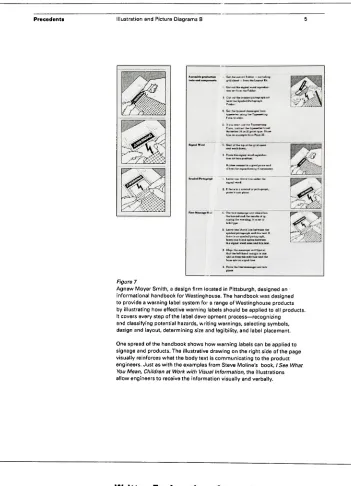
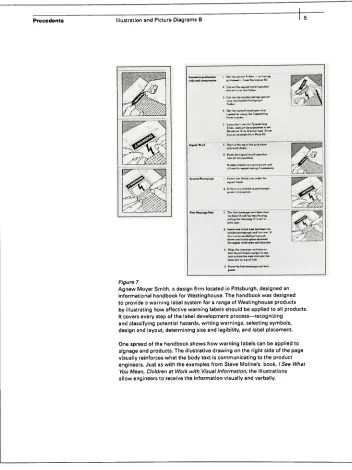
Figure 7
Agnew Moyer
Smith,
adesign firmlocated
inPittsburgh,
designedaninformational handbook for Westinghouse. The handbookwasdesigned to provide awarning labelsystemfora rangeofWestinghouseproducts
by
illustrating
howeffectivewarning labelsshouldbeappliedtoallproducts. Itcoversevery stepofthelabel deve'opmentprocessrecognizing andclassifyingpotential
hazards,
writingwarnings,selecting symbols, designandlayout, determining
size andlegibility,
andlabelplacement.Onespread ofthehandbookshowshow warning labelscanbeappliedto signage and products.The illustrative
drawing
onthe rightside ofthe page visuallyreinforces whatthebody
textis communicatingto the product engineers.Justaswiththe examplesfrom Steve Molina'sbook,
I See What YouMean,
ChildrenatWorkwithVisualinformation,
theillustrationsallowengineersto receivetheinformation visuallyandverbally.
Written
Explanations
for
each
Graphic Design
Method Example
Paragraphs
were written
to
describe
how
the
graphic
design
methods
are
used
in
the
graphic
design
profession
or
in
college-level
design
education.
Ideation
15
Three Ideation Stages
In
the
ideation
phase of
this
thesis,
several
formats
were
explored
to
accomodate
information explaining
the
main objectives
for
the
English Language Arts
Learning
Standards 1
and
4,
and
the
definitions
and
examples of
the
graphic
design
methods associated with
each
Learning
Standard. These
are
the
primary ideation
activities
for
the
overview pages and
the
graphic
design
methods example pages.
Overview Pages
The design
of
the
new
format helps
makes
the
connection
between how
the
graphic
design
methods can
be
a supplement
for
each
of
the
ELA
learning
Standards.
New headings
help
make
the
connection
between
the
Learning
Standards
and
the
graphic
design
methods.
The
synthesis notes
for
each
Learning
Standard
were
deleted
on each overview page.
Text
decribing
the
objective of each
Learning
Standard,
taken
from
the
New York State Department
of
Education
website,
took their
place.
Method Example Pages
Paragraphs
were written
in
order
to
describe how
the
graphic
design
methods are used
in
the
graphic
design
profession.
Throughout
the
design
process
these
written
descriptions
of
the
methods not
only
showed
how
they
are used
by
professional graphic
designers,
but how
8th
grade students can use
the
very
same methods
in
their
own work.
New
text
was added
to the
method
example
pages
called
Objective
Summaries.
This
new
body
of
text
conveys
how
the
graphic
design
methods
can
supplement an
8th
grade education
by
showing
how
students
may be
able
to
use
them to
improve
verbal and visual
communication
skills.
Direct
text
from
each of
the
Learning
Standards
was added
to the
Summary
Objective.
This helped
Ideation
Early
Development
16
This is
a
preliminary
ideation
sketch
for
the
Graphic
Design
Methods Guidebook
(application).
Information Design
Withnewvisuallanguageskills andnewly developed performanceindicators, students canbesuccessful adults.
They
willbeable toread and writeinformation using differentvisualforms and media.Thevisuallanguageskills were categorizedinto threedifferent designprinciples. This helped todetirminehow a studentmay learn theseskills.
Current
Ing
Standards Thenewvisuallanguageskills were addedto thecurrentNewYork State learningstandards.With theadditionofthe new visuallanguage skills, new performanceindicators weredeveloped.
The
project
goals
shifted over
the
course
of
time.
In its
early
development,
the
goal
was
to
examine
three
areas
of
design
and
how
they
could
help
improve
visual and
verbal
communication skills
for elementary
school-age
children.
The
three
areas
of
design
were
visual
thinking,
design process,
and
information
design. Once
the
skills
were
defined, they
were studied
to
better
understand
how
they
might
serve as a
supplement
to the
New York
State
Learning
Standards.
After
the
initial
research and
synthesis
stages,
it
was
recognized
by
the
designer
and
the thesis
committee
members
that the
scope of
the
Ideation
1st
Exploration
Overview
Pages
17
Synthesis Standard 1
Language for Informationand
Understanding
OverviewofObjectives Design Methods
Structuring
andOrganizing
Objectivescollect
data, facts,
andideas fromseveralsourcesdiscover relationships, concepts,and generalizations
useknowledgegeneratedfromoral, written, andelectronicallyproducedtext
use awidevarietyofstrategiesforselecting, organizing, andcategorizing information
distinguish betweenrelevant andirrelevant information
usetextfeaturesthat makeinformation
acccessible andclear
organizeinformation
toconvey internalrelationships
use visualformsto supportfactsanddata
Key
WordsGathering
informationOrganizing
informationStructuring
informationStructuring
andOrganizing
Methods Matrix DiagramThismethod encourages,or
forces,
theusertocross-reference andcomparedcharacteristics
or attributes ofsubjectsthatotherwise are not linkedto one another.Thedifferentsets ofinformation
being
compare areformattedon aXandYgrid structure.Thecomparsonismade where theXandYaxisoverlaps.
Illustration Diagrams
ThisvisualInvolves usingsimple
imagery
toillustratethe concept of an object,or process.The
imagery
isoftendrawnto represent the objector processit is illustrating. It ismosthelpfulwhenillustration diagrams
arecombinedwithtext to reinforceswhattheimage isconveying.Text isalso usedtoexplain certain parts
oftheimagery. Throughtheuse of
imagery
and text,theviewersreceivetheinformationvisually andverbally.Time Diagrams
These diagrams illustrateageneral pattern oflinks
and showinterrelationships betweentimeperiods.
Wurman
Organizing
HatrackThismethodisauseful problemsolvingtool that
revealsinformationand relationships
by
organizing andreorganizing factsandobservations.Thesameset ofinformation isputinto differentcategories todrawnew conclusionsorviewpoints.
Typography
Typography
has itsownmethods and principleswithinthe area of graphicdesign that
help
communicatelanguage inavisual manner.
Typography
involvesformatting
headingsandbody
text ona gridstructureusingtype size and weight,tabs,andbulletpoints.
Color
Coding
This organizingmethodisused onseveralvisual
forms,
such as a maps,diagramsorcharts.It isahelpful way toorganize and make relationships to other pieces ofinformation. Oncethetextorimages
are categorizedintoa color
key,
itcanmakereferenceto thatinformation inother parts of the visualforms.Overview Pages
The
20"by
30"wide
matrix was
too
large
a
format
to
be easily distributed
to teachers
and school systems within
New York State.
The
new
8.5
by
11
inch
format,
shown
above,
makes
the
information
more accessible
to
all
teachers.
In
addition
to
the
new
format's
accessbilty,
it clearly
makes
the
connection
between
the
graphic
design
methods
and
the
English Language Arts
(ELA)
Learning
Standards.
Understanding
the
Format
Each
Learning
Standard
for
English Language
Arts
(ELA)
and
its
corresponding
graphic
design
methods
were
given
its
own
individual
page.
The
page
was
labelled
with
the
name
of
the
specific
Learning
Standard.
An
overview
of
the objectives
appeared
Ideation
2nd Exploration
Overview
Pages
18
The
heading
above
the
Learning
Standards
and
the
graphic
design
methods
has been
improved
in
this
version.
With
the
additional
text
readers
can understand
that the
graphic
design
methods
are
to
be
a
supplement
for
the
Learning
Standards,
Overviews Standard 1
Language for
Information
andUnderstanding
MainObjective
Current English Language Arts
Learning
Standard 1Design Methods
Proposed to beaddedtotheEnglishLanguage Arts
Learning
Standard 1collect
data, facts,
andideas fromseveral sourcesdiscoverrelationships, concepts, and generalizations
useknowledgegeneratedfrom oral,written, andelectronicallyproducedtext
use a widevarietyofstrategiesforselecting,organizing, andcategorizing information
distinguish betweenrelevant andirrelevant information
usetextfeaturesthatmakeinformation acccessibleandclear
organizeinformation toconvey internalrelationships
use visualformsto supportfactsanddata
Key
WordsGathering
informationPrioritzing
informationStructuring
information1Matrix
Amalixisarectangular system ofhorizontalrows and verticalcolumnswheretwoormore setsofinformation canbecompared.Attributesof a subjectlistedinthe verticaly-axiscanbecomparedor cross-referenced withdifferentattributeslisted inthehorizontalx-axis. Thismethod allowstheusertocomparecharacteristic orattributesthat otherwise are notlinkedto one another.Thecomparisonismadewherethex andy axisintersect
2Illustration Diagrams
This kindofdiagramusessimple
imagery
toexplain anIdea,
a concept,anabject,or process.Theimagery
isoftenhighly
representationaltorepresentthe actualobject.It ismosthelpfulwhenillustration diagrams drawnimagery
withtext.Textcanreinforce, explain,andlabelparts of animage,
sotheviewer receivesinformation visuallyandverbally.3Timeline
Atimeline represents a period oftime., usually visually depictedashorizontal line that is divided in increments oftime
(days,
months,years,decades,
etc.) tomark specificinformation,
highlighteventsinhistory,
trace majoraccomplishment-anyconceivable
fisting
of informationacrossatimeperiod.4Wurman's
Organizing
Hatracks ArchitectandInformation designer Richard Saul Wurman developedthis methodoforganizing information in five differentways:alphabetically,by
time,by
magnitude,by
category,andby
chronology. Thismethodisa usefulproblemsolvingtool that revealsinformationandrelationshipsby
organizing andreorganizing factsand observations.Thesame set ofinformation isputinto differentcategories todrawnew conclusions orviewpoints.5Typographic
Hierachy
Thismethodusesthefundamental typographic variables andhow
they
revealthehierarchy
ofinformation inherant inamessage.As
the
application
developed,
the
layout
remained
largely
the
same.
New
headings,
body
text,
and
bullet
point
items
were
added.
The
heading
at
the
top
of
the
page
naming
the
Learning
Standard
was now
enlarged and made
bold
to
emphasize
the
specific standard
being
addressed.
The
purpose
of
these
pages
is
to
give
the
reader
an
overview
of
the
Learning
Standards'
objectives
and
the
description
of
the
Ideation
3rd Exploration
Overview Pages
19
Standard 1
Languagefor Informationand
Understanding
MainObjective CurrentEnglish Language Arts
Learning
Standard 1Design Methods
An EducationalSupplementtoEnhancethe English Language
Arts, Learning
Standard 1Studentswill
listen,
speak, read, andwritefor informationandunderstanding.As listeners and readers,students willcollect
data,
facts,
andideas;
discoverrelationships, concepts, and generalizations; anduseknowledgegenerated fromoral, written,andelectronicallyproduced texts.Asspeakers and writers,they
will useoral and writtenlanguagethatfollowsthe accepted conventions oftheEnglish language toacquire,interpret,
apply, and transmitinformation.1.1 Matrix
Amatixisa rectangularsystem ofhorizontalrows and verticalcolumns where twoor more sets ofinformation canbecom