Extreme Programming Explained
ForewordPreface
This Book
What Is XP?
Enough
Outline
Acknowledgments I: The Problem
1. Risk: The Basic Problem
Our Mission
2. A Development Episode
3. Economics of Software Development
Options
Example
4. Four Variables
Interactions Between the Variables
Focus on Scope 5. Cost of Change 6. Learning to Drive 7. Four Values
Communication
Simplicity
Feedback
Courage
The Values in Practice 8. Basic Principles
9. Back to Basics
Coding
Testing
Listening
Conclusion II: The Solution
10. A Quick Overview
The Planning Game
Small Releases
Metaphor
Simple Design
Testing
Refactoring
Pair Programming
Collective Ownership
Continuous Integration
40-Hour Week
On-Site Customer
Coding Standards
11. How Could This Work?
The Planning Game
Short Releases
Metaphor
Simple Design
Testing
Refactoring
Pair Programming
Collective Ownership
Continuous Integration
40-Hour Week
On-Site Customer
Coding Standards
Conclusion
12. Management Strategy
Metrics
Coaching
Tracking
Intervention
13. Facilities Strategy
14. Splitting Business and Technical Responsibility
Business
Development
Choice of Technology
What if It's Hard? 15. Planning Strategy
The Planning Game
Iteration Planning
Planning in a Week 16. Development Strategy
Continuous Integration
Collective Ownership
Pair Programming 17. Design Strategy
The Simplest Thing That Could Possibly Work
How Does "Designing Through Refactoring" Work?
What Is Simplest?
How Could This Work?
Role of Pictures in Design
System Architecture 18. Testing Strategy
Who Writes Tests?
Other Tests
III: Implementing XP 19. Adopting XP 20. Retrofitting XP
Testing
Design
Planning
Management
Development
In Trouble?
21. Lifecycle of an Ideal XP Project
Exploration
Planning
Iterations to First Release
Productionizing
Maintenance
Death
Programmer
Customer
Tester
Tracker
Coach
Consultant
Big Boss 23. 20–80 Rule
24. What Makes XP Hard
25. When You Shouldn't Try XP 26. XP at Work
Fixed Price
Outsourcing
Insourcing
Time and Materials
Completion Bonus
Early Termination
Frameworks
Shrinkwrap Products 27. Conclusion
Expectation
A. Annotated Bibliography
Philosophy
Attitude
Emergent Processes
Systems
People
Project Management
Programming
Foreword
Extreme Programming (XP) nominates coding as the key activity throughout a software project. This can't possibly work!
Time to reflect for a second about my own development work. I work in a just-in-time software culture with compressed release cycles spiced up with high technical risk. Having to make change your friend is a survival skill. Communication in and across often geographically separated teams is done with code. We read code to understand new or evolving subsystem APIs. The life cycle and behavior of complex objects is defined in test cases, again in code. Problem reports come with test cases demonstrating the problem, once more in code. Finally, we continously improve existing code with refactoring. Obviously our development is code-centric, but we successfully deliver software in time, so this can work after all.
It would be wrong to conclude that all that is needed to deliver software is daredevil programming. Delivering software is hard, and delivering quality software in time is even harder. To make it work requires the disciplined use of additional best practices. This is where Kent starts in his thought-provoking book on XP.
Kent was among the leaders at Tektronix to recognize the potential of man in the loop pair
programming in Smalltalk for complex engineering applications. Together with Ward Cunningham, he inspired much of the pattern movement that has had such an impact on my career. XP
describes an approach to development that combines practices used by many successful developers that got buried under the massive literature on software methods and process. Like patterns, XP builds on best practices such as unit testing, pair programming, and refactoring. In XP these practices are combined so that they complement and often control each other. The focus is on the interplay of the different practices, which makes this book an important contribution. There is a single goal to deliver software with the right functionality and hitting dates. While OTI's successful Just In Time Software process is not pure XP, it has many common threads.
I've enjoyed my interaction with Kent and practicing XP episodes on a little thing called Junit. His views and approaches always challenge the way I approach software development. There is no doubt that XP challenges some traditional big M approaches; this book will let you decide whether you want to embrace XP or not.
Preface
This is a book about Extreme Programming (XP). XP is a lightweight methodology for small-to-medium-sized teams developing software in the face of vague or rapidly changing requirements. This book is intended to help you decide if XP is for you.
To some folks, XP seems like just good common sense. So why the "extreme" in the name? XP takes commonsense principles and practices to extreme levels.
● If code reviews are good, we'll review code all the time (pair programming).
● If testing is good, everybody will test all the time (unit testing), even the customers
(functional testing).
● If design is good, we'll make it part of everybody's daily business (refactoring).
● If simplicity is good, we'll always leave the system with the simplest design that supports its
current functionality (the simplest thing that could possibly work).
● If architecture is important, everybody will work defining and refining the architecture all the
time (metaphor).
● If integration testing is important, then we'll integrate and test several times a day
(continuous integration).
● If short iterations are good, we'll make the iterations really, really short—seconds and
minutes and hours, not weeks and months and years (the Planning Game).
When I first articulated XP, I had the mental image of knobs on a control board. Each knob was a practice that from experience I knew worked well. I would turn all the knobs up to 10 and see what happened. I was a little surprised to find that the whole package of practices was stable,
predictable, and flexible.
XP makes two sets of promises.
● To programmers, XP promises that they will be able to work on things that really matter,
every day. They won't have to face scary situations alone. They will be able to do
everything in their power to make their system successful. They will make decisions that they can make best, and they won't make decisions they they aren't best qualified to make.
● To customers and managers, XP promises that they will get the most possible value out of
In short, XP promises to reduce project risk, improve responsiveness to business changes,
improve productivity throughout the life of a system, and add fun to building software in teams—all at the same time. Really. Quit laughing. Now you'll have to read the rest of the book to see if I'm crazy.
This Book
This book talks about the thinking behind XP—its roots, philosophy, stories, myths. It is intended to help you make an informed decision about whether or not to use XP on your project. If you read this book and correctly decide not to use XP for your project, I will have met my goal just as much as if you correctly decide to use it. A second goal of this book is to help those of you already using XP to understand it better.
This isn't a book about precisely how to do Extreme Programming. You won't read lots of
checklists here, or see many examples, or lots of programming stories. For that, you will have to go online, talk to some of the coaches mentioned here, wait for the topical, how-to books to follow, or just make up your own version.
The next stage of acceptance of XP is now in the hands of a group of people (you may be one) who are dissatisfied with software development as it is currently practiced. You want a better way to develop software, you want better relationships with your customers, you want happier, more stable, more productive programmers. In short, you are looking for big rewards, and you aren't afraid to try new ideas to get them. But if you are going to take a risk, you want to be convinced that you aren't just being stupid.
XP tells you to do things differently. Sometimes XP's advice is absolutely contrary to accepted wisdom. Right now I expect those choosing to use XP to require compelling reasons for doing things differently, but if the reasons are there, to go right ahead. I wrote this book to give you those reasons.
What Is XP?
What is XP? XP is a lightweight, efficient, low-risk, flexible, predictable, scientific, and fun way to develop software. It is distinguished from other methodologies by
● Its early, concrete, and continuing feedback from short cycles.
● Its incremental planning approach, which quickly comes up with an overall plan that is
expected to evolve through the life of the project.
● Its ability to flexibly schedule the implementation of functionality, responding to changing
business needs.
progress of development, to allow the system to evolve, and to catch defects early.
● Its reliance on oral communication, tests, and source code to communicate system
structure and intent.
● Its reliance on an evolutionary design process that lasts as long as the system lasts.
● Its reliance on the close collaboration of programmers with ordinary skills.
● Its reliance on practices that work with both the short-term instincts of programmers and
the long-term interests of the project.
XP is a discipline of software development. It is a discipline because there are certain things that you have to do to be doing XP. You don't get to choose whether or not you will write tests—if you don't, you aren't extreme: end of discussion.
XP is designed to work with projects that can be built by teams of two to ten programmers, that aren't sharply constrained by the existing computing environment, and where a reasonable job of executing tests can be done in a fraction of a day.
XP frightens or angers some people who encounter it for the first time. However, none of the ideas in XP are new. Most are as old as programming. There is a sense in which XP is conservative—all its techniques have been proven over decades (for the implementation strategy) or centuries (for the management strategy).
The innovation of XP is
● Putting all these practices under one umbrella.
● Making sure they are practiced as thoroughly as possible.
● Making sure the practices support each other to the greatest possible degree.
Enough
In The Forest People and The Mountain People, anthropologist Colin Turnbull paints contrasting pictures of two societies. In the mountains, resources were scarce and people were always on the brink of starvation. The culture they evolved was horrific. Mothers abandoned babies to roving packs of feral children as soon as they had any chance of survival. Violence, brutality, and betrayal were the order of the day.
for themselves. If one person accidentally killed another (deliberate crime was unknown), they were exiled, but they only had to go a little ways into the forest, and only for a few months, and even then the other tribespeople brought them gifts of food.
XP is an experiment in answer to the question, "How would you program if you had enough time?" Now, you can't have extra time, because this is business after all, and we are certainly playing to win. But if you had enough time, you would write tests; you would restructure the system when you learned something; you would talk a lot with fellow programmers and with the customer.
Such a "mentality of sufficiency" is humane, unlike the relentless drudgery of impossible, imposed deadlines that drives so much talent out of the business of programming. The mentality of
sufficiency is also good business. It creates its own efficiencies, just as the mentality of scarcity creates its own waste.
Outline
The book is written as if you and I were creating a new software development discipline together. We start by examining our basic assumptions about software development. We then create the discipline itself. We conclude by examing the implications of what we have created—how it can be adopted, when it shouldn't be adopted, and what opportunities it creates for business.
The book is divided into three sections.
● The Problem—The chapters from "Risk: The Basic Problem" to "Back to Basics" set up the
problem Extreme Programming is trying to solve and present criteria for evaluating the solution. This section will give you an idea of the overall worldview of Extreme
Programming.
● The Solution—The chapters from "Quick Overview" to "Testing Strategy" turn the abstract
ideas in the first section into the practices of a concrete methodology. This section will not tell you exactly how you can execute the practices, but rather talks about their general shape. The discussion of each practice relates it to the problems and principles introduced in the first section.
● Implementing XP—The chapters from "Adopting XP" to "XP at Work" describe a variety of
topics around implementing XP—how to adopt it, what is expected from the various people in an extreme project, how XP looks to the business folks.
Acknowledgments
I write in the first person here, not because these are my ideas, but rather because this is my perspective on these ideas. Most of the practices in XP are as old as programming.
Thanks to Ron Jeffries for trying it, then making it much better. Thanks to Martin Fowler for explaining it in a nonthreatening way. Thanks to Erich Gamma for long talks while watching the swans in the Limmat, and for not letting me get away with sloppy thinking. And none of this would have happened if I hadn't watched my dad, Doug Beck, ply his programming craft all those years.
Thanks to the C3 team at Chrysler for following me up the hill, then storming past me on the way to the top. And special thanks to our managers Sue Unger and Ron Savage for the courage to give us the chance to try.
Thanks to Daedalos Consulting for supporting the writing of this book.
Champion reviewer honors go to Paul Chisholm for his copious, thoughtful, and often downright annoying comments. This book wouldn't be half of what it is without his feedback.
I have really enjoyed my interactions with all my reviewers. Well, at least I have gained
tremendous help from them. I can't thank them enough for wading through my 1.0 prose, some of them in a foreign language. Thanks to (listed in the random order in which I read their reviews) Greg Hutchinson, Massimo Arnoldi, Dave Cleal, Sames Schuster, Don Wells, Joshua Kerievsky, Thorsten Dittmar, Moritz Becker, Daniel Gubler, Christoph Henrici, Thomas Zang, Dierk Koenig, Miroslav Novak, Rodney Ryan, Frank Westphal, Paul Trunz, Steve Hayes, Kevin Bradtke, Jeanine De Guzman, Tom Kubit, Falk Bruegmann, Hasko Heinecke, Peter Merel, Rob Mee, Pete
Part I: The Problem
Chapter 1. Risk: The Basic Problem
Software development fails to deliver, and fails to deliver value. This failure has huge economic and human impact. We need to find a new way to develop software.
The basic problem of software development is risk. Here are some examples of risk:
● Schedule slips—the day for delivery comes, and you have to tell the customer that the
software won't be ready for another six months.
● Project canceled—after numerous slips, the project is canceled without ever going into
production.
● System goes sour—the software is successfully put into production, but after a couple of
years the cost of making changes or the defect rate rises so much that the system must be replaced.
● Defect rate—the software is put into production, but the defect rate is so high that it isn't
used.
● Business misunderstood—the software is put into production, but it doesn't solve the
business problem that was originally posed.
● Business changes—the software is put into production, but the business problem it was
designed to solve was replaced six months ago by another, more pressing, business problem.
● False feature rich—the software has a host of potentially interesting features, all of which
were fun to program, but none of which makes the customer much money.
● Staff turnover—after two years, all the good programmers on the project begin to hate the
program and leave.
In these pages you will read about Extreme Programming (XP), a software development discipline that addresses risk at all levels of the development process. XP is also very productive, produces high-quality software, and is a lot of fun to execute.
How does XP address the risks listed above?
● Schedule slips—XP calls for short release cycles, a few months at most, so the scope of
Finally, XP calls for implementing the highest priority features first, so any features that slip past the release will be of lower value.
● Project canceled—XP asks the customer to choose the smallest release that makes the
most business sense, so there is less to go wrong before going into production and the value of the software is greatest.
● System goes sour—XP creates and maintains a comprehensive suite of tests, which are
run and re-run after every change (several times a day), to ensure a quality baseline. XP always keeps the system in prime condition. Cruft is not allowed to accumulate.
● Defect rate—XP tests from the perspective of both programmers writing tests
function-by-function and customers writing tests program-feature-by-program-feature.
● Business misunderstood—XP calls for the customer to be an integral part of the team. The
specification of the project is continuously refined during development, so learning by the customer and the team can be reflected in the software.
● Business changes—XP shortens the release cycle, so there is less change during the
development of a single release. During a release, the customer is welcome to substitute new functionality for functionality not yet completed. The team doesn't even notice if it is working on newly discovered functionality or features defined years ago.
● False feature rich—XP insists that only the highest priority tasks are addressed.
● Staff turnover—XP asks programmers to accept responsibility for estimating and
completing their own work, gives them feedback about the actual time taken so their estimates can improve, and respects those estimates. The rules for who can make and change estimates are clear. Thus, there is less chance for a programmer to get frustrated by being asked to do the obviously impossible. XP also encourages human contact among the team, reducing the loneliness that is often at the heart of job dissatisfaction. Finally, XP incorporates an explicit model of staff turnover. New team members are encouraged to gradually accept more and more responsibility, and are assisted along the way by each other and by existing programmers.
Our Mission
If we accept project risk as the problem to be solved, where are we going to look for the solution? What we need to do is invent a style of software development that addresses these risks. We need to communicate this discipline as clearly as possible to programmers, managers, and customers. We need to set out guidelines for adapting it to local conditions (that is, communicate what is fixed and what is variable).
Chapter 2. A Development Episode
Day-to-day programming proceeds from a task clearly connected to a feature the customer wants, to tests, to implementation, to design, and through to integration. A little of each of the activities of software development are packed into each episode.
But first a little peek ahead to where we are going. This chapter is the story of the heartbeat of XP—the development episode. This is where a programmer implements an engineering task (the smallest unit of scheduling) and integrates it with the rest of the system.
I look at my stack of task cards. The top one says "Export Quarter-to-date Withholding." At this morning's stand-up meeting, I remember you said you had finished the quarter-to-date calculation. I ask if you (my hypothetical teammate) have time to help with the export. "Sure," you say. The rule is, if you're asked for help you have to say "yes." We have just become pair programming partners.
We spend a couple of minutes discussing the work you did yesterday. You talk about the bins you added, what the tests are like, maybe a little about how you noticed yesterday that pair
programming worked better when you moved the monitor back a foot.
You ask, "What are the test cases for this task?"
I say, "When we run the export station, the values in the export record should match the values in the bins."
"Which fields have to be populated?" you ask.
"I don't know. Let's ask Eddie."
We interrupt Eddie for 30 seconds. He explains the five fields that he knows about that are related to quarter-to-date.
We go look at the structure of some of the existing export test cases. We find one that is almost what we need. By abstracting a superclass, we can implement our test case easily. We do the refactoring. We run the existing tests. They all run.
We notice that several other export test cases could take advantage of the superclass we just created. We want to see some results on the task, so we just write down "Retrofit
AbstractExportTest" on our to-do card.
"Let's get the test case finished first," you interrupt. While we're writing the test case, ideas for three variations come to mind. You write them on the to-do card.
We finish the test case and run it. It fails. Naturally. We haven't implemented anything yet. "Wait a minute," you say. "Yesterday, Ralph and I were working on a calculator in the morning. We wrote five test cases that we thought would break. All but one of them ran first thing."
We bring up a debugger on the test case. We look at the objects we have to compute with.
I write the code. (Or you do, whoever has the clearest idea.) While we are implementing, we notice a couple more test cases we should write. We put them on the to-do card. The test case runs.
We go to the next test case, and the next. I implement them. You notice that the code could be made simpler. You try to explain to me how to simplify. I get frustrated trying to listen to you and implement at the same time, so I push the keyboard over to you. You refactor the code. You run the test cases. They pass. You implement the next couple of test cases.
After a while, we look at the to-do card and the only item on it is restructuring the other test cases. Things have gone smoothly, so we go ahead and restructure them, making sure they run when we finish.
Now the to-do list is empty. We notice that the integration machine is free. We load the latest release. Then we load our changes. Then we run all the test cases, our new ones and all the tests everyone else has ever written. One fails. "That's strange. It's been almost a month since I've had a test case break during integration," you say. No problem. We debug the test case and fix the code. Then we run the whole suite again. This time it passes. We release our code.
That's the whole XP development cycle. Notice that:
● Pairs of programmers program together.
● Development is driven by tests. You test first, then code. Until all the tests run, you aren't
done. When all the tests run, and you can't think of any more tests that would break, you are done adding functionality.
● Pairs don't just make test cases run. They also evolve the design of the system. Changes
aren't restricted to any particular area. Pairs add value to the analysis, design,
implementation, and testing of the system. They add that value wherever the system needs it.
Chapter 3. Economics of Software
Development
We need to make our software development economically more valuable by spending money more slowly, earning revenue more quickly, and increasing the probable productive lifespan of our project. But most of all we need to increase the options for business decisions.[1]
[1] Thanks to John Favaro for the analysis of XP with options pricing.
By adding up the cash flows in and out of the project, we can simply analyze what makes a software project valuable. By taking into account the effect of interest rates, we can calculate the net present value of the cash flows. We can further refine our analysis by multiplying the
discounted cash flows by the probability that the project will survive to pay or earn those cash flows.
With these three factors—
● Cash flows in and out
● Interest rates
● Project mortality
we can create a strategy for maximizing the economic value of the project. We can do this by
● Spending less, which is difficult because everyone starts off with pretty much the same
tools and skills.
● Earning more, which is only possible with a superior marketing and sales organization, not
topics we will cover in this book (thank goodness).
● Spending later and earning sooner, so we pay less interest on the money we spend and
we earn more interest on the money we receive.
● Increasing the probability that the project will stay alive, so we are more likely to get the big
payoff late in the project.
Options
● Option to abandon—you can get something out of the project even if you cancel it. The
more value you can take from the project without actually delivering it in its originally envisioned form, the better.
● Option to switch—you can change the direction of a project. A project management
strategy is more valuable if halfway through a project the customers can change the requirements. The more often and the more violently the requirements can change, the better.
● Option to defer—you can wait until the situation has sorted itself out before investing. A
project management strategy is more valuable if you can wait to spend money without completely losing the opportunity to invest. The longer the deferral and the more money that can be deferred, the better.
● Option to grow—if a market looks to be taking off, you can grow quickly to take advantage
of it. A project management strategy is more valuable if it can gracefully scale up to greater and greater production given greater investment. The faster and longer the project can grow, the better.
Calculating the worth of options is two parts art, five parts mathematics, and one part good old-fashioned Kentucky windage.
There are five factors involved:
● The amount of investment required to get the option
● The price at which you can purchase the prize if you exercise the option ● The current value of the prize
● The amount of time in which you can exercise the options ● The uncertainty in the eventual value of the prize
Of these, the worth of options is generally dominated by the last factor, the uncertainty. From this we can make a concrete prediction. Suppose we create a project management strategy that maximizes the value of the project analyzed as options by providing
● Accurate and frequent feedback about progress
● Many opportunities to dramatically change the requirements ● A smaller initial investment
● The opportunity to go faster
The greater the uncertainty, the more valuable the strategy will become. This is true whether the uncertainty comes from technical risk, a changing business environment, or rapidly evolving requirements. (This provides a theoretical answer to the question, "When should I use XP?" Use XP when requirements are vague or changing.)
Example
$15. So the net present value of adding this feature is $5.
Suppose you knew in your heart that it wasn't clear at all how much this new feature would be worth—it was just your guess, not something you really knew was worth $15 to the customer. In fact, you figure that its value to the customer could vary as much as 100% from your estimate. Suppose further (see Chapter 5, Cost of Change, page 21) that it would still cost you about $10 to add that feature one year from now.
What would be the value of the strategy of just waiting, of not implementing the feature now? Well, at the usual interest rates of about 5%, the options theory calculator cranks out a value of $7.87.
The option of waiting is worth more than the value (NPV = $5) of investing now to add the feature. Why? With that much uncertainy, the feature certainly might be much more valuable to the
customer, in which case you're no worse off waiting than you would have been by implementing it now. Or it could be worth zilch—in which case you've saved the trouble of a worthless exercise.
Chapter 4. Four Variables
We will control four variables in our projects—cost, time, quality, and scope. Of these, scope provides us the most valuable form of control.
Here is a model of software development from the perspective of a system of control variables. In this model, there are four variables in software development:
● Cost
● Time
● Quality
● Scope
The way the software development game is played in this model is that external forces
(customers, managers) get to pick the values of any three of the variables. The development team gets to pick the resultant value of the fourth variable.
Some managers and customers believe they can pick the value of all four variables. "You are
going to get all these requirements done by the first of next month with exactly this team. And quality is job one here, so it will be up to our usual standards." When this happens, quality always goes out the window (this is generally up to the usual standards, though), since nobody does good work under too much stress. Also likely to go out of control is time. You get crappy software late.
The solution is to make the four variables visible. If everyone—programmers, customers, and managers—can see all four variables, they can consciously choose which variables to control. If they don't like the result implied for the fourth variable, they can change the inputs, or they can pick a different three variables to control.
Interactions Between the Variables
Cost—More money can grease the skids a little, but too much money too soon creates more problems than it solves. On the other hand, give a project too little money and it won't be able to solve the customer's business problem.
Time—More time to deliver can improve quality and increase scope. Since feedback from systems in production is vastly higher quality than any other kind of feedback, giving a project too much time will hurt it. Give a project too little time and quality suffers, with scope, time, and cost not far behind.
weeks) by deliberately sacrificing quality, but the cost—human, business, and technical—is enormous.
Scope—Less scope makes it possible to deliver better quality (as long as the customer's business problem is still solved). It also lets you deliver sooner or cheaper.
There is not a simple relationship between the four variables. For example, you can't just get software faster by spending more money. As the saying goes, "Nine women cannot make a baby in one month." (And contrary to what I've heard from some managers, eighteen women still can't make a baby in one month.)
In many ways, cost is the most constrained variable. You can't just spend your way to quality, or scope, or short release cycles. In fact, at the beginning of a project, you can't spend much at all. The investment has to start small and grow over time. After a while, you can productively spend more and more money.
I had one client who said, "We have promised to deliver all of this functionality. To do that, we have to have 40 programmers."
I said, "You can't have 40 programmers on the first day. You have to start with one team. Then grow to two. Then four. In two years you can have 40 programmers, but not today."
They said, "You don't understand. We have to have 40 programmers." I said, "You can't have 40 programmers." They said, "We have to."
They didn't. I mean, they did. They hired the 40 programmers. Things didn't go well. The
programmers left; they hired 40 more. Four years later they are just beginning to deliver value to the business, one small subproject at a time, and they nearly got canceled first.
All the constraints on cost can drive managers crazy. Especially if they are focused on an annual budgeting process, they are so used to driving everything from cost that they will make big
mistakes ignoring the constraints on how much control cost gives you.
The other problem with cost is that higher costs often feed tangential goals, like status or prestige. "Of course, I have a project with 150 people (sniff, sniff)." This can lead to projects that fail
because the manager wanted to look impressive. After all, how much status is there in staffing the same project with 10 programmers and delivering in half the time?
On the other hand, cost is deeply related to the other variables. Within the range of investment that can sensibly be made, by spending more money you can increase the scope, or you can move more deliberately and increase quality, or you can (to some extent) reduce time to market.
Spending money can also reduce friction—faster machines, more technical specialists, better offices.
2000 being the most recent example. The end of the year; before the quarter starts; when the old system is scheduled to be shut off; a big trade show—these are some examples of external time constraints. So, the time variable is often out of the hands of the project manager and in the hands of the customer.
Quality is another strange variable. Often, by insisting on better quality you can get projects done sooner, or you can get more done in a given amount of time. This happened to me when I started writing unit tests (as described in Chapter 2, A Development Episode, page 7). As soon as I had my tests, I had so much more confidence in my code that I wrote faster, without stress. I could clean up my system more easily, which made further development easier. I've also seen this happen with teams. As soon as they start testing, or as soon as they agree on coding standards, they start going faster.
There is a strange relationship between internal and external quality. External quality is quality as measured by the customer. Internal quality is quality as measured by the programmers.
Temporarily sacrificing internal quality to reduce time to market in hopes that external quality won't suffer too much is a tempting short-term play. And you can often get away with making a mess for a matter of weeks or months. Eventually, though, internal quality problems will catch up with you and make your software prohibitively expensive to maintain, or unable to reach a competitive level of external quality.
On the other hand, from time to time you can get done sooner by relaxing quality constraints. Once, I was working on a system to plug replace a legacy COBOL system. Our quality constraint was that we precisely reproduce the answers produced by the old system. As we got closer and closer to our release date, it became apparent that we could reproduce all the errors in the old system, but only by shipping much later. We went to the customers, showed them that our answers were more correct, and offered them the option of shipping on time if they wanted to believe our answers instead.
There is a human effect from quality. Everybody wants to do a good job, and they work much better if they feel they are doing good work. If you deliberately downgrade quality, your team might go faster at first, but soon the demoralization of producing crap will overwhelm any gains you temporarily made from not testing, or not reviewing, or not sticking to standards.
Focus on Scope
Lots of people know about cost, quality, and time as control variables, but don't acknowledge the fourth. For software development, scope is the most important variable to be aware of. Neither the programmers nor the business people have more than a vague idea about what is valuable about the software under development. One of the most powerful decisions in project management is eliminating scope. If you actively manage scope, you can provide managers and customers with control over cost, quality, and time.
One of the great things about scope is that it is a variable that varies a lot. For decades,
requirements are never clear at first. Customers can never tell you exactly what they want.
The development of a piece of software changes its own requirements. As soon as the customers see the first release, they learn what they want in the second release...or what they really wanted in the first. And it's valuable learning, because it couldn't have possibly taken place based on speculation. It is learning that can only come from experience. But customers can't get there alone. They need people who can program, not as guides, but as companions.
What if we see the "softness" of requirements as an opportunity, not a problem? Then we can choose to see scope as the easiest of the four variables to control. Because it is so soft, we can shape it—a little this way, a little that way. If time gets tight toward a release date, there is always something that can be deferred to the next release. By not trying to do too much, we preserve our ability to produce the required quality on time.
If we created a discipline of development based on this model, we would fix the date, quality, and cost of a piece of software. We would look at the scope implied by the first three variables. Then, as development progressed, we would continually adjust the scope to match conditions as we found them.
This would have to be a process that tolerated change easily, because the project would change direction often. You wouldn't want to spend a lot on software that turned out not to be used. You wouldn't want to build a road you never drove on because you took another turn. Also, you would have to have a process that kept the cost of changes reasonable for the life of the system.
If you dropped important functionality at the end of every release cycle, the customer would soon get upset. To avoid this, XP uses two strategies:
1.
You get lots of practice making estimates and feeding back the actual results. Better estimates reduce the probability that you will have to drop functionality.Chapter 5. Cost of Change
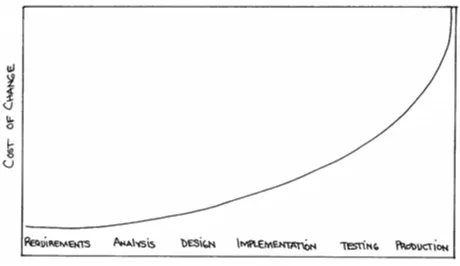
Under certain circumstances, the exponential rise in the cost of changing software over time can be flattened. If we can flatten the curve, old assumptions about the best way to develop software no longer hold.
[image:24.612.76.536.255.521.2]One of the universal assumptions of software engineering is that the cost of changing a program rises exponentially over time. I can remember sitting in a big linoleum-floored classroom as a college junior and seeing the professor draw on the board the curve found in Figure 1.
Figure 1. The cost of change rising exponentially over time
"The cost to fix a problem in a piece of software rises exponentially over time. A problem that might take a dollar to fix if you found it during requirements analysis might costs thousands to fix once the software is in production."
I resolved then and there that I would never let a problem get through to production. No sirree, I was going to catch problems as soon as possible. I would work out every possible problem in advance. I would review and crosscheck my code. No way was I going to cost my employer $100,000.
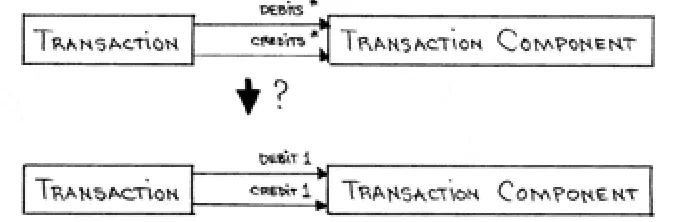
1700—I discover that as near as I can tell, the fabulous feature of our system where a single transaction can have debits from several accounts and credits to several accounts simply isn't used. Each transaction comes from one account and goes to one other. Is it possible to simplify the system as in Figure 2?
Figure 2. Can we have a single component each for debit and credit?
1702—I ask Massimo to come sit with me while we examine the situation. We write a query. Out of the 300,000 transactions in the system, every single one of them has a single debit and a single credit account.
1705—If we were going to fix the mistake, how would we do it? We would change the interface of the Transaction and change the implementation. We write the required four methods and start the tests.
1715—The tests (more than 1,000 unit and functional tests) still run 100%. We can't think of any reason the changes won't work. We start working on the database migration code.
1720—The nightly batches are finished and the database has been backed up. We install the new versions of the code and run the migration.
1730—We run a few sanity tests. Everything we can think of works. Unable to think of anything else to do, we go home.
The next day—The error logs are clear. No complaints from the users. The change worked.
Over the next couple of weeks we discovered a series of further simplifications enabled by the new structure that allow us to open up the accounting part of the system to entirely new functionality, all the while making the system simpler, clearer, and less redundant.
The software development community has spent enormous resources in recent decades trying to reduce the cost of change—better languages, better database technology, better programming practices, better environments and tools, new notations.
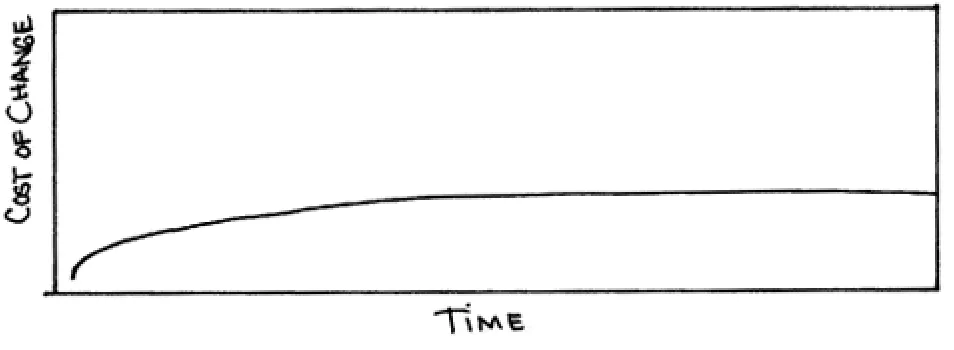
time, but rose much more slowly, eventually reaching an asymptote? What if tomorrow's software engineering professor draws Figure 3 on the board?
Figure 3. The cost of change may not rise dramatically over time
This is one of the premises of XP. It is the technical premise of XP. If the cost of change rose slowly over time, you would act completely differently from how you do under the assumption that costs rise exponentially. You would make big decisions as late in the process as possible, to defer the cost of making the decisions and to have the greatest possible chance that they would be right. You would only implement what you had to, in hopes that the needs you anticipate for tomorrow wouldn't come true. You would introduce elements to the design only as they simplified existing code or made writing the next bit of code simpler.
If a flattened change cost curve makes XP possible, a steep change cost curve makes XP
impossible. If change is ruinously expensive, you would be crazy to charge ahead without careful forethought. But if change stays cheap, the additional value and reduced risk of early concrete feedback outweighs the additional cost of early change.
Keeping the cost of change low doesn't just happen magically. There are technologies and practices that keep software pliable.
On the technology side, objects are a key technology. Message sending is a powerful way to cheaply build many opportunities for change. Each message becomes a potential point for future modification, a modification that can take place without touching the existing code.
Object databases transfer this flexibility into the realm of permanent storage. With an object
database, it is possible to migrate objects in one format into objects in another format easily, since the code is attached to the data, not separated as in earlier database technologies. Even if you can't find a way to migrate the objects, you can have two alternative implementations coexisting.
experience is that the cost of change rises more steeply without objects than with objects.
This is not to say that objects are enough. I have seen (and probably written, if truth be known) loads of object-oriented code that no one wanted to touch.
Several factors come out of the story about what made our code easy to modify, even after years of production:
● A simple design, with no extra design elements—no ideas that weren't used yet but were
expected to be used in the future.
● Automated tests, so we had confidence we would know if we accidentally changed the
existing behavior of the system.
● Lots of practice in modifying the design, so when the time came to change the system, we
weren't too afraid to try it.
With these elements in place—simple design, tests, and an attitude of constant refinement of the design—we experienced the flattened curve in Figure 3. A change that would have taken a few minutes before much coding had occurred took 30 minutes after we had been in production for two years. And I see projects spending days or weeks making the same sort of decision, rather than doing what they need to do today and trusting themselves to fix it tomorrow if they need to.
With this shift in assumption about the cost of change comes the opportunity to take an entirely different approach to software development. It is every bit as disciplined as other approaches, but it is disciplined along other dimensions. Instead of being careful to make big decisions early and little decisions later, we can create an approach to software development that makes each
decision quickly, but backs each decision with automated tests, and that prepares you to improve the design of the software when you learn a better way to design it.
Chapter 6. Learning to Drive
We need to control the development of software by making many small
adjustments, not by making a few large adjustments, kind of like driving a car. This means that we will need the feedback to know when we are a little off, we will need many opportunities to make corrections, and we will have to be able to make those corrections at a reasonable cost.
Now we have the general shape of the problem—the tremendous cost of risk, and the opportunity to manage that risk through options—and the resource needed to shape the solution: the freedom to make changes later in the cycle without significantly increased cost. Now we need to begin to bring the solution into focus. The first thing we need is a metaphor, a shared story that we can turn to in times of stress or decision to help keep us doing the right thing.
I can remember clearly the day I first began learning to drive. My mother and I were driving up Interstate 5 near Chico, California, a straight, flat stretch of road where the highway stretches right to the horizon. My mom had me reach over from the passenger seat and hold the steering wheel. She let me get the feel of how motion of the wheel affected the direction of the car. Then she told me, "Here's how you drive. Line the car up in the middle of the lane, straight toward the horizon."
I very carefully squinted straight down the road. I got the car smack dab in the middle of the lane, pointed right down the middle of the road. I was doing great. My mind wandered a little...
I jerked back to attention as the car hit the gravel. My mom (her courage now amazes me) gently got the car back straight on the road. Then she actually taught me about driving. "Driving is not about getting the car going in the right direction. Driving is about constantly paying attention, making a little correction this way, a little correction that way."
This is the paradigm for XP. There is no such thing as straight and level. Even if things seem to be going perfectly, you don't take your eyes off the road. Change is the only constant. Always be prepared to move a little this way, a little that way. Sometimes maybe you have to move in a completely different direction. That's life as a programmer.
Everything in software changes. The requirements change. The design changes. The business changes. The technology changes. The team changes. The team members change. The problem isn't change, per se, because change is going to happen; the problem, rather, is the inability to cope with change when it comes.
The driver of a software project is the customer. If the software doesn't do what they want it to do, you have failed. Of course, they don't know exactly what the software should do. That's why software development is like steering, not like getting the car pointed straight down the road. Our job as programmers is to give the customer a steering wheel and give them feedback about exactly where we are on the road.
simplicity, feedback, and courage—described in the next chapter tell us how software
Chapter 7. Four Values
We will be successful when we have a style that celebrates a consistent set of values that serve both human and commercial needs: communication, simplicity, feedback, and courage.
Before we can reduce the story of learning to drive to a set of software development practices, we need some criteria for telling us if we're going in the right direction. It would be no good coming up with a style of development and then discovering that we didn't like it or it didn't work.
Short-term individual goals often conflict with long-term social goals. Societies have learned to deal with this problem by developing shared sets of values, backed up by myths, rituals,
punishments, and rewards. Without these values, humans tend to revert to their own short-term best interest.
The four values of XP are:
● Communication
● Simplicity
● Feedback
● Courage
Communication
The first value of XP is communication. Problems with projects can invariably be traced back to somebody not talking to somebody else about something important. Sometimes a programmer doesn't tell someone else about a critical change in the design. Sometimes a programmer doesn't ask the customer the right question, so a critical domain decision is blown. Sometimes a manager doesn't ask a programmer the right question, and project progress is misreported.
Bad communication doesn't happen by chance. There are many circumstances that lead to a breakdown in communications. A programmer tells a manager bad news, and the manager punishes the programmer. A customer tells the programmer something important, and the programmer seems to ignore the information.
XP aims to keep the right communications flowing by employing many practices that can't be done without communicating. They are practices that make short-term sense, like unit testing, pair programming, and task estimation. The effect of testing, pairing, and estimating is that
This doesn't mean that communications don't sometimes get clogged in an XP project. People get scared, make mistakes, get distracted. XP employs a coach whose job it is to notice when people aren't communicating and reintroduce them.
Simplicity
The second XP value is simplicity. The XP coach asks the team, "What is the simplest thing that could possibly work?"
Simplicity is not easy. It is the hardest thing in the world not to look toward the things you'll need to implement tomorrow and next week and next month. But compulsively thinking ahead is listening to the fear of the exponential cost of change curve. Sometimes the coach has to gently remind the team that they are listening to their fears, "Maybe you're so much smarter than I am that you can make all this complicated dynamically balancing tree stuff work. I would naively assume a linear search would work."
Greg Hutchinson writes:
One person I was consulting to decided that we needed a general purpose dialog for displaying text. (OK, like we don't have enough already, but I digress.) We talked about the interface to this dialog and how it would work. The programmer decided that this dialog should be fairly smart and modify its size and the number of line breaks in the string based on the font size and other variables. I asked this person how many programmers needed this part currently. This programmer was the only one that needed it. I suggested that we make the dialog not so smart yet and make it work for their case (20 mins work), we could make the Class and the interface known and always make it smarter when a second case came along that needed those requirements. I couldn't convince this programmer, and they spent 2 days making this code. On the 3rd day even their requirements had changed and they no longer needed this part. 2 man days gone on a project that was already tight. However, please let me know if you could use this code. (Source: e-mail.)
XP is making a bet. It is betting that it is better to do a simple thing today and pay a little more tomorrow to change it if it needs it, than to do a more complicated thing today that may never be used anyway.
Simplicity and communication have a wonderful mutually supporting relationship. The more you communicate, the clearer you can see exactly what needs to be done and the more confidence you have about what really doesn't need to be done. The simpler your system is, the less you have to communicate about, which leads to more complete communication, especially if you can
simplify the system enough to require fewer programmers.
Feedback
system is absolutely priceless. Optimism is an occupational hazard of programming. Feedback is the treatment.
Feedback works at different time scales. First, feedback works at the scale of minutes and days. The programmers write unit tests for all the logic in the system that could possibly break. The programmers have minute-by-minute concrete feedback about the state of their system. When customers write new "stories" (descriptions of features), the programmers immediately estimate them, so the customers have concrete feedback about the quality of their stories. The person who tracks progress watches the completion of the tasks to give the whole team feedback about
whether they are likely to finish everything they set out to do in a span of time.
Feedback also works at the scale of weeks and months. The customers and testers write
functional tests for all the stories (think "simplified use cases") implemented by the system. They have concrete feedback about the current state of their system. The customers review the
schedule every two or three weeks to see if the team's overall velocity matches the plan, and to adjust the plan. The system is put into production as soon as it makes sense, so the business can begin to "feel" what the system is like in action and discover how it can best be exploited.
Early production needs a little explanation. One of the strategies in the planning process is that the team puts the most valuable stories into production as soon as possible. This gives the
programmers concrete feedback about the quality of their decisions and development process that never comes until the rubber meets the road. Some programmers have never lived with a system in production. How can they possibly learn to do a better job?
Most projects seem to have exactly the opposite strategy. The thinking seems to go, "As soon as the system is in production, you can no longer make 'interesting' changes, so keep the system in development as long as possible."
This is exactly backwards. "In development" is a temporary state, one that the system will only be in for a small percentage of its life. Far better to give the system independent life, to make it stand and breathe on its own. You are going to have to live with supporting production and developing new functionality simultaneously. Better to get used to juggling production and development sooner rather than later.
Concrete feedback works together with communication and simplicity. The more feedback you have, the easier it is to communicate. If someone has an objection to some code you have written and they hand you a test case that breaks it, that is worth a thousand hours of discussion about design aesthetics. If you are communicating clearly, you will know what to test and measure to learn about the system. Simple systems are easier to test. Writing the test gives you a focus for just how simple the system can be—until the tests run, you're not done, and when the tests all run, you're done.
Courage
eat your lunch.
Here is a story of courage in action. In the middle of iteration 8 of a 10-iteration engineering
schedule (25 weeks out of 30) of the first release of the first large XP project, the team discovered a fundamental flaw in the architecture. The functional test scores had been rising nicely, but then had flattened out far below where they needed to be. Fixing one defect caused another one. The problem was an architectural flaw.
(For the curious, the system computed payroll. Entitlements represented things the company owed employees. Deductions represented things the employees owed other people. Some people had been using negative Entitlements when they should have been using positive Deductions.)
The team did exactly the right thing. When they discovered that there was no way forward, they fixed the flaw. This immediately broke half of the tests that had been running. A few days of concentrated effort later, however, and the tests scores were again headed toward completion. That took courage.
Another courageous move is throwing code away. You know how sometimes you work all day on something, and it isn't going very well, and the machine crashes? And how the next morning you come in and in half an hour reconstruct all of the previous day's work but clean and simple this time?
Use this. If the end of the day is coming and the code is a little out of control, toss it. Maybe save the test cases, if you like the interface you've designed, but maybe not. Maybe just start over from scratch.
Or maybe you have three design alternatives. So, code a day's worth of each alternative, just to see how they feel. Toss the code and start over on the most promising design.
XP's design strategy resembles a hill-climbing algorithm. You get a simple design, then you make it a little more complex, then a little simpler, then a little more complex. The problem with
hill-climbing algorithms is reaching local optima, where no small change can improve the situation, but a large change could.
What is to say that you won't ever develop yourself into a corner? Courage. Every once in a while someone on the team will have a crazy idea that just might slash the complexity of the whole system. If they have courage, they'll try it out. It will work (sometimes). If they have courage, they'll put it into production. Now you're climbing a whole new hill.
If you don't have the first three values in place, courage by itself is just plain hacking (in the pejorative sense of that word). However, when combined with communication, simplicity, and concrete feedback, courage becomes extremely valuable.
a simple system. You are much less likely to break it unknowingly. Courage supports simplicity because as soon as you see the possibility of simplifying the system you try it. Concrete feedback supports courage because you feel much safer trying radical surgery on the code if you can push a button and see the tests turn green at the end (or not, in which case you throw the code away).
The Values in Practice
I asked the C3 team (that first big XP project I mentioned earlier) to tell me stories about their proudest moment on the project. I was hoping to get stories about big refactorings, or being saved by tests, or a happy customer. Instead, I got this:
The moment I was proudest of was when Eddie moved to a job closer to home, avoiding a two-hour daily commute, so he could spend more time with his family. The team gave him total respect. Nobody said a word against him leaving.
Everybody just asked what they could do to help.
This points to a deeper value, one that lies below the surface of the other four—respect. If members of a team don't care about each other and what they are doing, XP is doomed. So probably are most other approaches to writing software (or getting anything done), but XP is extremely sensitive to this. Given some basic compassion and interest, XP might provide some ongoing lubrication for all those pieces moving against each other. If members of a team don't care about the project, nothing can save it. Given some minimal passion, XP provides some positive feedback. This is not manipulative; it's just enjoying being part of something that works, instead of part of something that doesn't work.
Chapter 8. Basic Principles
From the four values we derive a dozen or so basic principles to guide our new style. We will check proposed development practices to see how they measure up to these principles.
"Learning to Drive" reminds us to make lots of small changes and never take our eyes off the road. The four values—communication, simplicity, feedback, and courage—give us our criteria for a successful solution. However, the values are too vague to give us much help in deciding which practices to use. We need to distill the values into concrete principles we can use.
These principles will help us as we choose between alternatives. We will prefer an alternative that meets the principles more fully to one that doesn't. Each principle embodies the values. A value may be vague. One person's simple is another person's complex. A principle is more concrete. Either you have rapid feedback or you don't. Here are the fundamental principles:
● Rapid feedback
● Assume simplicity
● Incremental change
● Embracing change
● Quality work
Rapid feedback—Learning psychology teaches that the time between an action and its feedback is critical to learning. Animal experiments show that even small differences in the timing of feedback result in large differences in learning. A few seconds delay between stimulus and response and the mouse doesn't learn that the red button means food. So, one of the principles is to get feedback, interpret it, and put what is learned back into the system as quickly as possible. The business learns how the system can best contribute, and feeds back that learning in days or
weeks instead of months or years. The programmers learn how best to design, implement and test the system, and feed back that learning in seconds or minutes instead of days, weeks, or months.
Assume simplicity—Treat every problem as if it can be solved with ridiculous simplicity. The time you save on the 98% of problems for which this is true will give you ridiculous resources to apply to the other 2%. In many ways, this is the hardest principle for programmers to swallow. We are traditionally told to plan for the future, to design for reuse. Instead, XP says to do a good job (tests, refactoring, communication) of solving today's job today and trust your ability to add complexity in the future where you need it. The economics of software as options favor this approach.
You'll find incremental change applied many ways in XP. The design changes a little at a time. The plan changes a little at a time. The team changes a little at a time. Even the adoption of XP must be taken in little steps.
Embracing change—The best strategy is the one that preserves the most options while actually solving your most pressing problem.
Quality work—Nobody likes working sloppy. Everybody likes doing a good job. Of the four project development variables—scope, cost, time, and quality—quality isn't really a free variable. The only possible values are "excellent" and "insanely excellent," depending on whether lives are at stake or not. Otherwise you don't enjoy your work, you don't work well, and the project goes down the drain.
Here are some less central principles. They still will help us decide what to do in specific situations.
● Teach learning
● Small initial investment
● Play to win
● Concrete experiments
● Open, honest communication
● Work with people's instincts, not against them
● Accepted responsibility
● Local adaptation
● Travel light
● Honest measurement
Teach learning—Rather than make a bunch of doctrinaire statements like "Thou must do testing like XYZ," we will focus on teaching strategies for learning how much testing you should do. Also how much design, and refactoring, and everything else you should do. Some ideas that we will state with certainty. There will be others that we don't have quite so much confidence in, and those we will state as strategies with which the reader can learn their own answers.
budgets force programmers and customers to pare requirements and approaches. The focus a tight budget generates encourages you to do a good job of everything you do. However, resources can be too tight. If you don't have the resources to solve even one interesting problem, then the system you create is guaranteed not to be interesting. If you have someone dictating scope, dates, quality, and cost, then you are unlikely to be able to navigate to a successful conclusion. Mostly, though, everyone can get by with fewer resources than they are comfortable with.
Play to win—It was always wonderful to watch John Wooden's UCLA basketball teams. They were usually crushing the opposition. However, even if the game was close going into the final minutes, UCLA was absolutely certain that they were going to win. After all, they had won so many, many times before. So, they were relaxed. They did what they needed to do. And they won again.
I remember an Oregon basketball game that provides a stark contrast. Oregon was playing a nationally ranked Arizona team that was destined to send four players to the NBA. At halftime, amazingly, Oregon was up by 12 points. Arizona couldn't do anything right, and Oregon's offense had them baffled. After the half, however, Oregon came out and tried to play as slowly as possible to reduce the number of points scored and preserve the victory. The strategy didn't work, of
course. Arizona found ways to use their huge advantage in talent to win the game.
The difference is between playing to win and playing not to lose. Most software development I see is played not to lose. Lots of paper gets written. Lots of meetings are held. Everyone is trying to develop "by the book," not because it makes any particular sense, but because they want to be able to say at the end that it wasn't their fault, they were following the process. CYA.
Software development played to win does everything that helps the team to win and doesn't do anything that doesn't help to win.
Concrete experiments—Every time you make a decision and you don't test it, there is some probability that the decision is wrong. The more decisions you make, the more these risks
compound. Therefore, the result of a design session should be a series of experiments addressing the questions raised during the session, not a finished design. The result of a discussion of
requirements should also be a series of experiments. Every abstract decision should be tested.
Open, honest communication—This is such a motherhood statement that I almost left it out. Who wouldn't want to communicate openly and honestly? Everybody I visit, it seems. Programmers have to be able to explain the consequences of other people's decisions, "You violated
encapsulation here and it really messed me up." They have to be able to tell each other where there are problems in the code. They have to be free to express their fears, and get support. They have to be free to deliver bad news to customers and management, to deliver it early, and not be punished.
If I see someone looking around to see who is listening before answering a question, I take it as a sign of deep trouble on the project. If there are personal matters to be discussed, I can understand the need for privacy. But which of two object models to use is not a matter that is helped by a "top secret" stamp.