B 0 L T BERANEK
AND
N E W M A N INCC O N S U L T I N G D E V f L O P M E N T
THE BBN - LISP SYSTEM
REFERENCE MANUAL
APR I l 1969
( D.G.
Bobrow,D.l.
Murphy,W.
Teitelman:)Bolt Beranek and Newman Inc
THE BBN - LISP SYSTEM
REFERENCE MANUAL
APRIL 1969
( D.G. Bobrow, D.L. Murphy, W. Teitelman:)
ACKNOWLEDGEMENTS
The design, construction and documentation of this system was sponsored by the Information Processing Techniques section of the Advanced Research Projects Agency. The basic design and implementation of this paged LISP was done by D.G. Bobrow and D.L. Murphy. L.P. Deutsch also participated in the program-ming of the system and wrote the first versions of our LISP compiler and editor. Many of the extended interactive features are the work of Warren Teitelman and the existence of this ex-panded revised edition of the reference manual is due primarily to his perseverence and effort. The authors are grateful to Rita Doherty and Karen O'Sullivan for their hard work and patience through endless revisions of the text.
Copyright April 1969
by
BOLT BERANEK AND NEWMAN INC
50
Moulton StreetCambridge, Massachusetts 02138
TABLE OF CONTENTS
SECTION I
Introduction... ... 1.1
SECTION II
Using the LISP Subsystem on the
940 ...
2.1SECTION III
Data Types and the Organization of
Virt ual Memo ry • . . . . • . . . 3 . 1
Literal Atoms ..•...•.•...•... 3.3
Numerical Atoms ...•... 3.4
Arrays . . . • . . . 3.6 Shared LISP . . . 3.8
Garbage Collector . . . 3.9
SECTION IV
Function Types... 4.1
SECTION V
Primitive Functions and Predicates
Primitive Functions . . . • Predicates and Logical Connectives
SECTION VI
List Manipulation and Concatenation ....•...
SECTION VII
5.1
5.9
6.1
Property List Functions ...••..•.... 7.1
SECTION VIII
TABLE OF CONTENTS (cant.)
SECTION IX
Editing Facilities
SECTION X
Editor Language Structure ...•... 9.1
Attention Commands ...•.••...• 9.3
Modification Commands ... . . ... 9.9
Structure Changing Commands .... •...•... 9.12
Printing Commands . . . • . . . 9.13
Edit Macros... 9.15
Using the Editor . . . • . . . • . . . 9.18
Internal Organization of the Editor •...•. 9.20
Summary of Edit Commands . . . ... 9.22
The Expanded Editor •....••..•...•.•.... 9.26
The 'Location Routine ...•...•. 9.27
UP . . . • . . . • . . • . . . 9 • 29 Insertion, Replacement and Deletion
Commands . . • . . . Switch . . . .
Move . . . • . . . • . . . • . • . . • . • . . .
Extract . . . .
Miscellaneous Commands . . . . Sentence Format ...•...•••... Summary of New Commands ....•...•..
Ed ita ...•...•..•....•.••... Using Edita on Compiled Functions ... .
9.30 9.32 9.33 9.34 9.35 9.38 9.40 9.41 9.48
Atom, Array, and Storage Manipulation ... 10.1
SECTION XI
Functions with Functional Arguments •... 11.1
SECTION XII
Variable Bindings and Push Down List Functions. The Push Down List and Interpreter ...•. The Push Down List and Compiled Functions. Push Down List Functions ..•...•.... Push Down Handles ...•...•...•.•
TABLE OF CONTENTS (cont.)
SECTION XIII
Arithmetic Functions
Integer Arithmetic •. ... •...• 13.1 Floating Point Arithmetic .•...•.. 13.4
SECTION XIV
Input/Output Functions
SECTION XV
Opening and Closing Files . . . . Input/Output Transmission ...••..••...• Input/Output Functions ..•.•.•..•..•....• Input/Output Control Functions ...•.•.. Special Functions . . . • . . . Symbolic File Input . . . • . . . . • . . . Symbolic File Output (prettyprint) .•....
Debugging and Error Handling
Debugging Facilities . . . • . . . • . . . Breakl .•...•...•...•...•. Brkcoms . . . • . . . • . . • . . • . . . . Bre akmac ro s . . . • . . • • . . . Break Functions . . . • . • . . . • . . .
Error Handling in LISP ...•...•.. Unbound Atoms and Undefined Functions ...• Undefined Function Calls from Compiled
Code . . . • . . . Inducing an Interrupt . . . . "Real" Errors . . . • . . . • . . . Error Type s . . . • . . . • . . . • . Error Functions . . . .
SECTION XVI
The Compiler and LAP
The Compiler • . . . • . . . Compiler Functions
Compiler Questions . . . • . . .
TABLE OF CONTENTS (cont.)
Compiler Structure . . . . Open Functions . . . . Affecting the Compiled Code . . . . Changing the Binary Program Buffer ... .
Assemble Assemble
Assemble Statements • . . . Macros • . . . Machine Instructions . . . • . . . Compiler Conventions . . . • . . . Compiler rllacros • . . . Lap Macros . . . " ... .
SECTION XVII
Using Forks and the Hybrid Processor in LISP Fo r k s . . . • . . . LISP Memory Allocation . . • . . . Hybrid Processor and Fork Functions ..•..
SECTION XVIII
Display Capabilities
Initialization . . . ' . . . • The Display Language . . . • . . . Generating Functions . . . • . . . Displaying Text . . . • . • . . . Decoding Figure s ... , . . . • . . . • Low-Level Functions . . . •
SECTION XIX Advising
SECTION XX
Automatic Error Correction
Un b 0 un d At 0 m s •••••••••••••••••••••••••••
Undefined Functions •. , •...•...••... Interaction on Parenthesis Errors .•... Interaction on Spelling Errors . . . . Summary of Interaction by Modes . . . . Nofix .•...•...•••...•...•..•.•
SECTION XXI
Print structure
SECTION XXII
Miscellaneous
TABLE OF CONTENTS (cont.)
...
T irne . . • . . . • . . . • • . .
Breakdown ... .
Timex . . . .
Enlarging the System (f1ushcode) ... . Dumping Circular List Structure (savecl). Group •••••••••..•.•••••••.•••••.•••.••.•. Arm . . . .
SECTION XXIII Appendices
Converting LISP 1.5 Programs to BBN-LISP. BBN-LISP Interpreter . . . . Control Characters . . . . Index to Variables ...•... Property Lists •....•...
SECTION XXIV
21.1
22.1 22.3 22.5 22.8 22.10 22.13 22.14
23.1 23.7 23.9 23.12 23.17
SECTION I
INTRODUCTION
This document describes the BEN-LISP system currently implemented on the SDS 940. It is a dialect of LISP 1.5 and the differences
between IBM 7090 version and this system are described in Appendix 1 and 2. Principally, this system has been expanded from the
LISP 1.5 on the 7090 in a number of different ways. BBN-LISP is
designed to utilize a drum for storage and to provide the user a
large virtual memory, with a relatively small penalty in speed
(using special paging techniques described in Bobrow and Murphy
1967). Secondly, this system has been designed to be a good
on-line interactive system. Some of the features provided include sophisticated debugging facilities with tracing and conditional
breakpoints, a sophisticated LISP oriented editor within the
system, and compatible compiler and interpreter. Utilization of
a uniform error processing through a user accessible function has
allowed the implementation of a do-what-I-mean feature which can
correct errors without losing the context of the computation.
The philosophy of the DWIM feature is described in Teitelman 1969. In addition to the sUb-systems described in this manual, a
com-plete format directed list processing sUb-system (FLIP, Teitelman,
1967) is available within BBN-LISP. There is also an assembler for
inserting machine code sub-routines within BEIJ-LISP, and facilities
for using the CRT display and CALCOMP nlotter.
Although we have tried to be as clear and complete as possible,
this document is not designed to be an introduction to LISP.
Therefore, some parts may only be clear to people who have had
LISP has been written by Clark Weissman (1967). Although not
completely accurate with respect to BUN-LISP, the differences
are small enou~h to be mastered by use of tilis manual and on-line
interaction. Another useful introduction is given by Berkeley
(1964) in the collection of Berkeley and Bobrow (1966).
Changes to this manual will be issued by replacin~"sections or pages which are faculty and reissuing the index~rr~ table of
contents at periodic intervals.
Bibliography
Berkeley, E.C. (1964) "LISP, A Simple Introduction" in Berkeley, E.C. and Bobrow, D.G. (1966).
Berkeley, E.C. and Bobrow, D.G. (editors), (1966), The Programming Language LISP, Its Operation and Applications, MIT Press, 1966.
Bobrow, D.G. and Murphy, D.L. (1967) "The Structure of a LISP System Using Two Level Storage", Communications of the ACM, V15 3, March 1967.
r·1cCarthy, J. et aI, LI~P 1.:3 Programmers Manual, MIT Pre ss, 1966 ~
Teitelman, H. "Toward a Programming Laboratory" in Walker, D. (ed) International Joint Artificial Intelligence Conference. May, 1969.
Teitelman, W. FLIP, A Format,Lirected List Processor in LISP, BBN Report "1967.
Weissman, C. (1967) LISP 1.5 Primer, Dickenson Press (1967).
SECTION II
USING THE LISP SUBSYSTEM ON THE
940
Call LISP by typing LIS; the system will respond P; then type ., ---
-when LISP finally responds READY, and types +, you are talking
to the LISP supervisor, usually called evalguote. The system
so obtained contains all of the basic functions and programming and debugging aids described in the manual, including the LISP
compiler and FLIP. Typing SYSGET(T) to evalguote will return you
to this initial system at any time. Typing control-C will take
you instantly back to the LISP executive at any time except during
garbage collection. To get the effect of typing to a Lisp executive
eval, type E and a space followed by the expression to be evaluated.
This effect is achieved by the function e described in section 8.
When typing in to the LISP read function (used by evalquote and most other programs), typing a control-Q will clear the input line buffer erasing the entire line up to the last carriage return.
Typing control-A erases the last character typed in, echoing a t
and the erased character; it will not go beyond the last carriage
return. Pressing control-R while in the middle of a typein to
the LISP executive, evalquote,will clear the entire read buffer
of everything to the last +, and LISP will again type + . Several
other control characters are interpreted by the LISP input fork,
SECTION III
DATA TYPES AND THE ORGANIZATION OF VIRTUAL MEMORY
LISP operates in a 2l-bit address space, though only that portion
currently in use actually exists on the drum. A portion of the
address space above that actually allocated for structures is
used for representation of small integers, as described below.
All data storage is contained within this virtual memory,
including literal atoms, list structure, arrays and compiled code,
large integers, floating point numbers, and pushdown list storage.
This virtual memory is divided into pages of 256 words. References
to the virtual storage are made via an in-core map which supplies the address of the required page if it is in core, or traps to a
supervisory routine if the page is not in core. This drum
super-visory routine selects an in-core page, writes i t back on the drum if i t has been changed, and reads the required page from the
drum. Closed subroutine references to an in-core word through
the map take approximately 40 microseconds. A reference to a
word not in core, which must be obtained from the drum, takes up
to 33 milliseconds, the drum maximum access time. It takes twice
as long if a page must be written out on the drum before the
referenced page can be read in.
Type Determination of Pointers
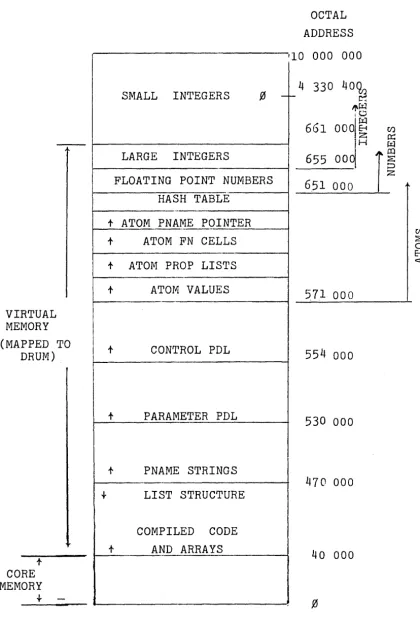
The virtual memory is divided into a number of areas as shown in
Fig. 1. As can be seen from this map of storage, simple
VIRTUAL MEMORY (MAPPED TO
DRUM)
t
CORE MEMORY
'"
SMALL INTEGERS 0
LARGE INTEGERS
FLOATING POINT NUMBERS HASH TABLE
..
t ATOM PNAME POINTER
---t ATOM FN CELLS
-t ATOM PROP LISTS
t ATOM VALUES
t CONTROL PDL
t PARAMETER PDL
t PNAME STRINGS
-
-'"
LIST STRUCTURECOMPILED CODE
t AND ARRAYS
OCTAL ADDRESS
'10 000 000
4 330 40~
-- ~
~.~
661
OOOI~
}H 655
ooq
651 000
5.11 000
554 000
530 000
470 000
40 000
FIG. 1 MEMORY ALLOCATION IN LISP
(/) 0:::
~
[image:16.621.105.525.69.695.2]Literal Atoms
A literal atom is constructed from any strirg of characters not
interpretable as an integer or a floating point number. When a
string of characters representing a literal atom is read in, a search is made to determine i f an atom with the same print-name has been seen before. If so, a pointer to that atom is used for the current atom. If not, a new atom is created~ Thus, as in all
LISP systems, a literal atom has a uni~ue representation determined by its print name. Special syntactic characters can be included
in ,print names through the use of the quote mark, ~ (see the des-cription of the function read).
Four cells (940 words) are associated with each literal atom. These cells contain pointers to the print-name of the atom, the
function which i t identifies, its top level or global value, and
its property list. Since atoms occur in only one part of the
address space, one can tell from a pointer (address) whether or not it is pOinting to a literal atom.
Instead of having the four cells associated with each atom on the same page, e'ach is put in a separate space in a position
compu-table from the pointer to the atom.
Separating value cells and function cells, for example, is useful
because most users will not use the same name for a global
variable as they will for a function. Therefore, if the four
cells were brought in whenever anyone was asked for, it is
likely that the other three cells would never be referenced. Yet~
they use up room in core which could be used for other storage.
Similarly, the print-name pointers associated with atoms are
needed during input and output, but rarely during a computation.
Car of a literal atom usually contains the top level binding of the atom. If the atom has not yet been set the value cell contains the special atom NOBIND. Cdr of the atom is a pointer to the atom property list, initially NIL. The PNAME cell contains a pointer to a packed character table which contains the print_ name of the atom. The function cell contains NIL until
a
function by that name is defined. It has been defined that car[NIL] andcdr[NIL] are NIL, and cannot be changed. These latter two va.lues are a significant convenience in programming.
Numerical Atoms
Integers
In LISP, most numerical atoms (numbers) do not have a unique re-presentation; that is, a number of different pointers may reference numbers with the same value. This implies that for comparison of numbers, or for arithmetic operations, the values of the numbers must be obtained. The values of floating point numbers and large integers are stored in a "full word" space. Pointers to these values are used in list structure.
However, we utilize the fact that not all addresses in the 21 bit
virtual address space can legitimately appear as pointers in list structure. These "illegal" pointers are therefore used in the context of list structure to represent "small" integers directly, offset by a constant, as indicated in Fig. 1.
The input format for an integer is any string of digits, option-ally preceded by a
"+"
or "_". Integers must have magnitude less than 223. "Small" integers are those of magnitude below approxi-mately 218 (an assembly parameter). A string of digits followed by a "Q" will be interpreted as an octal number.Floating Point Numbers
Floating point numbers and operations are available in BBN LISP.
They are stored in two contiguous 24 bit words in standard 940
format, in full word space. When creating an atom with read, ratom or pack, LISP will recognize as a floating point number a
string of digits containing a decimal point. The letter liE"
(exponent of 10; i.e. yyExx=yy
*
10xx) will also serve todesig-nate a floating point number if preceded and followed by one or
more digits. The following are legal floating point input strings.
5. 5.0 5EO 5E-3 5.2E+6 · 3
The floating pOint/string conversion, and the floating point arithmetic are performed by the POP's and BRS's available in the 940 system. Additional information concerning conversion and prec1sion is available from the system documentation of these
routines.
The atom printing routine (used by prinl, prin2, prin3, unpack) will call the system conversion routine when it encounters a
floating point datum. The output format is controlled by the
Arrays
Arrays in BBN LISP have the following format.
! Lengtn -+
Block Oriqir! Header Block Pointer Start
Reloc Start
(- Array Origin
Non-Pointer Area
~
Pointer Area
~
i<elocation Information
Typical Array
The HEADER BLOCK 1s four cells long and contains:
Cell:
o
Length of entire block=arravsize + ~.1 Address of first word of nrotActert ~oint~rR,
relative to Array Origin.
2 Address of first worn of 'rploca.tion tnfoTT.'1ation, relative to Block Origin.
3 Used for temporary storage during garbage
collection.
An array may contain both pointer and non-pointer data, separated as shown. Pointer data is assumed to be one of the standard LISP
types, and the pointer data cells in all arrays are used as base
cells for tracing during garbage collection. The non-pointer
data, beginning in the fifth cell.of the array, is of unrestricted
type, and will not be used as trace pOinters during garbage
collection.
Relocation information contains the relative addresses of cells
in the array which are to be relocated when the array is used as
a compiled function, and is placed in core memory.
Examples:
1. Compiled code.
a. Machine instructions and unboxed numeric
literals are in the non-pointer area.
b. Other literals and variable name pointers are
in the pointer area.
c. Relocation information area addresses all machine instructions whose address is within
the same program, e.g., branch instructions.
2. Array of lists.
All data would be in the pointer area; the other areas would be of length 0.
3. Array of unboxed numbers.
All data would be in the non-pointer area; the
List Structure
List Structure is created in list space as shown in the memory
map. Lists can contain pointers to all data types. As can be
seen from the map, list space and array space grow toward each
other. The total space available 1s an assembly parameter.
The space available in the 4-1-68 LISP system is 144K (K=1024)
SDS 94~ 24 bit words, which i f used all for list storage would provide 72K word~ of free storage.
Shared LISP
The LISP System as presently implemented contains nearly 90,000
words of compiled code constituting the miscellaneous functions,
Editor, Compiler, Break and other service packages. A sharing
mechanism enables one copy of this code residine; on the drum to
be used by all active users of LISP. This nractice results in a considerable saving of drum space over that required if each user had a separate, private copy of these functions. When a user starts
a LISP on his console, the virtual memory is set to contain all
the shared pages wtich constitute the basic system. In addition, roughly 1,000 words of private list storage are also provided. As
the user adds his own private functions and data to the system,
private pages are assigned to contain them. Thus a running
system will typically contain some number of private pages and the shared pages of the basic LISP system.
Fundamental to the proper operation of the sharing mechanism is
the requirement that no individual user be permitted to change
the contents of a shared page. Therefore, the shared pages in
the virtual memory are initially set to be read-only. This means
that the user can do car of the list structure on a shared page
but not !:Elaca. However, circumstances do arise when i t is
necessary for the user to change his virtual memory in a place where a shared page has been mapped. For example, the user may
set the top level value of an atom contained in the original
shared system, i.e. change the contents of the value cell. To
properly handle this situation, the LISP page turning routine
takes special note of any attempt to store data into a shared
page and makes a private copy of the page, assigning it to a new
place on the drum. This nrocedure is invoked automati~ally and is invisible to the user.
Garbage Collector
The garbage collector is a routine which serves to locate cells
no longer in use by the running program and make them again
avail-able for storage. The various data snaces in LISP which may
need to be garbage collected in this way include lists, arrays
(and compiled-code), large integers, floating point numbers, atoms,
and print-names.
An automatic garbage collection is usually initiated whenever a
cell is needed in a space which has become exhausted. This
hap-pens most frequently when the allocated free list words have
be-come exhausted by repeated conses. A garbage collection will also be initiated whenever print-name space is exhausted. The garbage
collection initiated for either of these reasons will reclaim
lists, numbers, atoms, and print-names. A garbage collection
initiated when array space is exhausted will collect these spaces,
and in addition, will compact array space. This means that unused
arrays will be eliminated, and still-in-use arrays will be moved . so as to be contiguous.
When either large integers or floating-point numbers are
is initiated. This operation identifies still-in-use numbers by performing a linear sweep over all spaces. This may result
in the retention of some numbers which are no longer in use.
Therefore, if a number collection is unsuccessful in obtaining free number cells, a regular garbage collection is initiated.
The user can initiate a regular garbage collection at any time via the function reclaim described in Section 10. Note that the
depletion of atom space will not cause an automatic garba8e
col-lection. Instead, the error ATOM SPACE FULL is generated.
However, in this case, an explicit reclaim may be successful in
recovering atoms.
Allocation of List Space
Normally, a user will have in use for list structure only a small
portion of the total space available for this purpose. In order
to prevent scattering lists over many pages(which·increases access
time), LISP allocates and places on the free list only a portion of the total list structure space~ A garbage collection will be
initiated whenever this allocated portion becomes exhausted,
whether or not additional space is available. After a garbage collection, additional pages will be allocated to list space if
necessary to raise the total number of available free words to
the minimum, a parameter set bY,minfs (described in Section 10).
The two number spaces, atom space, and print name space have
fixed boundaries, and an error will be generated if additional spnce is needed and none is available. N6te that list space
and array space are allocated from a common area. Array space
recovered by a garbage collection can be subsequently used by
list space because array space is compacted. However list space
is not and cannot reasonably be compacted, so acquiring all of
LISP's memory for list structure will prevent any further allocation
of arrays for compiled functions.
Shared Areas
The garbage collector takes special note of the shared areas of
virtual memory. Specifically, compiled functions and arrays re-siding on shared pages are not traced for the purpose of
identify-ing list structures and numbers to be retained. Instead, a
separate list, created at the time that the shared system was loaded, serves this purpose. ~r\is results in a consideratle
saving of time over what would be required if the garbage collector had to trace through all 90,000 words of compiled code in the
shared system.
Initially, LISP memory is over half allocated to the shared portion
of the systems. If a particular user requires more than the
re-maining space for his program, it is possible to remove portions of the shared system using the function flushcode (described in
Section 22). The portion flushed is automatically available for
allocation to array space. Atoms in this portion that are now
no longer used, e.g. function and argument names, can be reclaimed
SEc'rION .IV
FUNc'rION TYPES
There are basically twelve function types in the BBN LISP System.
These twelve types reflect three characteristics. A function may independently have:
1. its arguments evaluated or unevaluated,
2. a fixed number of arguments or an indefinite number of
arguments.
3. be defined by a LISP expression,
by permanent system code, or compiled machine code.
Expressions used to define functions must start with either
LAMBDA, or NLA~BDA; indicating that the arguments of this func-tion are to be evaluated, or not evaluated, respectively.
Following the LAMBDA or NLAMBDA may be a list of atoms (possibly
empty) or any literal atom (except NIL). If there is a list of atons
each atom in the list is the name of an argument for the function
defined by the expression. Arguments for the function will be evaluated or unevaluated, as dictated by LAMBDA or NLAMBDA, and
paired with these argument names. This is called "spreading" the
arguments, and the function is called a LAMBDA or
spread-NLAMBDA. If an atom follows the LAMBDA or NLAMBDA, this function has an indefinite number of arguments.- If it is an NLArv'lBDA
expres-sion, then the atom is paired to the list of arguments (unevaluated)
of the function; that is, to cdr of the form in which this function name was car. Such a function is called a Ilnospread" function.
If a LAMBDA is followed by an atom, each of its !2 arguments vlill
the value of th.e mth argument of this function from the push
down list. For m>n or m~o, arg[m] is undefined.
Functions defined by expressions can be compiled by the LISP
com-piler"", as described in the section on the compiler and lap. They may also be written directly in machine code using the ASSEMBLE
directive of the compiler. Functions created by the compiler,
whether from S-expressions or ASSEMBLE dir~ctives. are referred to as compiled functions. Built-in system cOded functions are called subroutines. To determine the type of any
function fn, you can use the function fntyp[fn]. The value of
fntyp is one of the following 12 types:
EXPf{
EXPR*
FEXPR FEXPR*
CEXPR
CEXPR* CFEXPR
CFEXPR*
SUBR
SUBR* FSUBR
FSUBR*
The types in the first column are all defined by expressions. The * suffix indicates an indefinite number of arguments (i.e. an
atom following the LAMBDA or NLAMBDA). The types in the second column are compiled versions of the types in the first column, ,as
indicated by the prefix
Q.
In the third column are the parallel types for built-in subroutines. Functions of types in the firsttwo rows evaluate their arguments. The prefix ~ in the third and fourth rows indicates no evaluation of arguments. Thus, for
example, a CFEXPR* is a compiled form of an NLAMBDA expression with
an atom following the NLAMBDA.
A standard feature of the BBN LISP system is that no error
occurs if a function is called with too many or too few arguments.
If a function is called with too many arguments, the extra
argu-ments are evaluated but ignored. If a function is called with
too few arguments, the unsupplied ones will be delivered as NIL.
This applies to both built-in and defined functions.
There is a function progn of an arbitrary number of arguments which evaluates the arguments in order and returns the value of
the last (i.e., it resembles and is an extension of prog2).
The conditional expression has been generalized so that instead
of doublets it accepts n+l-tuplets which will be interpreted in
the following manner:
(COND
(PI Ell E12 E13) (P2 E21 E22) (P3)
(p4 E41))
will be taken as equivalent to (in LISP 1.5):
(COND
(PI (PROGN Ell E12 E13) (P2 (PROGN E21 E22» (p3 P3)
(P4 E41) (T NIL)
This is not exactly true, but only because P3 is not evaluated
second conditional expression. ':ehus, a list in a .£Q!!.9. wi th only
a predicate and no following expressions causes the value of the
predicate itself to be returned. Note also that NIL is returned if all the predicates have value NIL. No error is invoked.
LAMBDA and NLAMBDA expressions also have implicit progn's; thus
for example
(LAMBDA (VI V2) (Fl VI) (F2 V2) NIL)
is interpreted as
(LAMBDA (VI V2) (PROGN (FI VI) (F2 V2) NIL))
The value of the last expression following LAMBDA (or NLAMBDA)
is returned as the value of the expression. In this example,
the function would always return NIL.
PRIr·1ITIVE FUNCrrIOHS AND PREDICArrES
Primitive Functions
car[x]
cdr[x]
caar[x]
=
car[car[x]]cadr[x]
=
car[cdr[x]]=
car gives the first element of a
list ~, or the left element of a dotted pair~. lJominally unde-fined for literal atoms, it usually gives the top level
binding (value) of a literal
atom x. For the usually undefined
case of a number, its value is
the number itself.
cdr gives the tail of a list (all
but tne first element). This is
also the right member of a dotted
pair. If x is a literal atom, cdr[~] gives the property list
of x. Property lists are usually
NIL unless modified by the user.
If ~ is a number, cdr returns NIL.
All 30 combinations of nested cars and cdrs up to 4 deep are
included in the system. Levels 1,
cons[x;yJ
cons[x;y] is placed
cons constructs a dotted pair of
x and~. If ~ is a list, ~ be-comes the first element of that
list. To minimize drum accesses
the following algorithm is used for finding a page on which to
put the constructeG LISP word.
1) on the page with y if Y is a list and there is room;
otherwise
2) on the page with ~ if x is a list and there is room; otherwise
3) on the same page as the last~C?_~_~ if there is room;
otherwise
4) on a page in core if one is available with a specified minimum of storage; otherwise
5) on any page with a specified minimum of storage. The specified minimum is presently 20 LISP words in
both cases.
The user may effect the operation of cons with the following
function:
conspage[x] causes the page on which ~
re-sides to be used for alternative
3 above instead of the result of the previous ~~~~. If x is an
atom, alternative 4 or 5 will be taken.
conscount[J
rplacd[x;y]
rplaca[x;y]
quote[x]
Returns the number of conses
since LISP started up.
This SUBR places in the
decrement of the cell
pointed to by ~ the pointer ~.
Thus it changes the internal list
structure physically,as opposed
to cons which creates a new list
element. This is the only way
to 8et a circular list inside of
LISP; that is by placing a
pointer to the beginning of a
list in a spot at the end of the
list. Using this function
care-lessly is one of the few ways to
really clobber the system. The
value of rplacd is x.
This SUBR is similar to rplacd,
but it replaces the address
pointer of ~ with~. The same caveats which applied to using
£.2.!acd apply to rplaca. l1he
value of rnlaca is x. Rplaca
and rplacd of NIL are illegal.
This is a function that prevents
its argument from being evaluated.
The conditional function of LISP,
cond, takes an indefinite number
of arguments, £1'£2' ... £k' called clauses. Each clause £i is a list (el . . . . e .) of n>l items. ~he
- l - n l
clauses are considered in sequence
as follows: the first expression
~li of the clause £i is evaluated and its value is claSSi1"1ed as
false (equal to NIL) or true (not
equal to NIL). If the value of
~li is true, the expressions
e2 . ••• e i that follow in clause
- l -n
c. are evaluated in sequence, and - l
the value of the conditional is
the value of e ., the last
ex-- n l
pression in the clause. In
par-ticular, if n=l, i.e., if there is
only one expression in the clause
£i' the value of the conditional
is the value of ~li.
If e
l " is false, then the remainder
- l
of clause £i is ignored, and the
next clause c.+l is considered. - l If
no ~li is true for any clause, the value of the conditional expression
is NIL.
This conditional expression form
gives the same value as LISP 1.5
for clauses of exactly two items
but allows additional flexibility.
This very useful function is used
to select a sequence of
instruc-tions based on the value of its first argument x. Each of the
~i is a list of the form
(s. e-J. - l J. -· e 2 · ... eke) J. - J.
where s. is the selection key. -J.
If ~i is an atom the value of x is tested to see if it is eq to
s. (not evaluated). If so, the -J.
expressions el., ... e
k. are
eval-- J. - J.
uated in sequence, and the value of the selectq is the value of
the last expression evaluated,
i.e. ~ki.
If ~i is a list, and i f any ele-ment of s. is en to the value of -J.
=-::1..
~, then e
l . to eke are evaluated
- J. - J.
in turn as above.
If ~i is not selected in one of the two ways described then
~i+l is tested, etc. until all
the ~'s have been tested. If
none is selected, the value of
the selectq is the value of z.
prog2[x;y]
progn[x;y; ..• ;z]
An example of the form of a selectq is:
(SELECTQ (CAR X)
(Q (PRINT Faa) (FIE X»
«A
E IOU) (VOWEL X»(Y (TRY-AGAIN X» (COND«NULL X)NIL)
(T (QUOTE STOP»» which has 3 cases, Q,(A E IOU) and Y, and a default condition which is a cond.
selectq compiles open, and is therefore very fast; however it will not work for lists, large integers or floating point num-bers since it uses a 24 bit open compare (an open eq).
This function evaluates its
arguments in order, that is, ~l
then ~2 etc. It returns the
value of its first argument ~l.
Evaluates ~, then ~ and returns
~.
progn evaluates each of its arguments in sequence, and re-turns the value of its last
argument as its value. It is an
extension of prog2.
rpt[n;form]
go[x]
Evaluates the expression form
n times. Returns the value of
the last evaluation.
This feature allows the user to write an ALGOL-like program con-taining LISP statements to be executed and is identical to the
~ in LISP 1.5. The first
argument is a list of program
variables. The rest is a
se-quence of (non-atomic) state-ments (expressions), and atomic symbols used as labels· for
trans-fer points. The value of a prog
is determined by the function
return. If no return is
exe-cuted, the value of the prog is not guaranteed, but will not give an error, if flow of control
"falls off the endtl.
go is the function used to cause
a transfer in~. (GO A) will
cause the program to continue at the label A. A gQ can be used at
any level in a~. rr a g£ is
executed in an interpreted function
which is not a ~, it will be
executed in the last interpreted
return[x]
set[x;y]
setq[x;y]
setqq[x;y]
A return is the normal end of a
~. Its argument is evaluated
and is the value of the prog in which it appears. If a return is executed in an interpreted function which is not a prog, the return will be executed in the last interpreted ~ entered.
This function sets the atom which is the value of ~, to the value of ~, and returns the value of ~.
This FSUBR is identical to set, except that the first argument is not evaluated.
Example: If the value x is
£,
and the value of ~ is ~, then set [x;y] would result in c having value ~, and b returned~setq[x;y] would result in x having value b, and b returned. In both cases, the value of ~
is unaffected.
Identical to setq except that neither argument is evaluated.
Predicates and Logical Connectives
atom[x]
arrayp[x]
listp[x]
nlistp[x]
eq[x;y]
atom[xJ=T if x is an atom; NIL otherwise.
is T if x is an array; NIL otherwise.
is T if x is a nonatomic list-structure, i.e., created
by one or more CONSes NIL
otherwise. Since arrays are
not atoms, and will fail an atom test, listp should be used to distinguish bona fide list structure from atoms, numbers, arrays, et ale
not[listp[x]]
The value of ~ is T if ~ and ~ are pointers to the same structure in memory, and NIL otherwise.
~ is compiled open by the
com-piler as a 24 bit compare of
pointers. Its value is not
guaranteed T for equal. numbers which are not small integers.
eqp[x;y]
neq[x;y]
nill[]
null[x]
equal[x;y]
and[XI ; • • · xn ' ]
The value of egp is T if ~ and y are pointers to tl1e same structure ,in memory, or if ~ and yare
num-bers and have the same value. Its
value is NIL otherwise.
The value of this function is T
if x is not ~ to ~, and NIL otherwise.
Defined as (LAMBDA,NIL NIL)
eq[x;NIL]
The value of this function is T if x and ~ are isomorphic, that
is, ~ and y print identically;
the value of equal is NIL otherwise.
This function is an FSUBR and can take an indefinite number
of arguments (including 0). Its
value is the value of its last argument if all of its arguments have non-null value, otherwise
NIL. and[]=T. Arguments past
the first null argument are not evaluated.
not [x]
memb[x;y]
member[x;y]
intersection[x;y]
union[x;y]
This function is also an FSUBR and can take an indefinite number of arguments (including 0). Its value is that of the first argu-" ment whose value is non-null, otherwise NIL. or[J=NIL. Argu-ments past the first non-null arguments are not evaluated.
Same as ~; that is, eq[x;NILJ.
This function determines if x is a member of list ~, i.e. if there is an element of ~ eq to x. If so it returns the portion of the list starting with that element. If not it returns NIL.
Identical to memb except that it uses equal instead of eq to check membership of x in ~.
This function returns with a list whose elements are members of both lists x and ~.
This function is entered with two lists. It returns with a list consisting of all elements included on either of the two original lists. If the same
append[x;y]
·.nconc[Ujv]
nconcl[lstjx]
SECTION VI
LIST MANIPULATION AND CONCATENATION
The value of list is a list of the values of its arguments.
Returns a list of the value of
all arguments (same
as
LIST),~ut deletes all NIL's at the end of this list. Example:
(NLI~T T ~ NIL T
Ntt
N!t)
=(T T NIL T)
This function copies the top level of list ~ and appends list
~ to this copy. The value is
the combined list. If x is NIL, it returns -:L.
This function is similar to append in effect, but· it causes
this effect by actually modifying
the list structure ~, and making
the last element in the list x
point to the list~. The value
of nconc is a pointer to the first
list ~, but since this first list
has now been modified, it is a pointer to the concatenated list.
If ~ is TIlL, it returns ~ itself.
performs nconc[lstjlist[x]]. The
tconc[x;p]
lconc[x;p]
attach[x;y]
This function provides an
effi-cient way for placing an item x at the end of a list. This list
is the first item on ~, that is, car[pJ; cdr[pJ is a pointer to
the last element in this list; ~
is placed on the end of the list
by modifying this structure, and
~ is placed on the list as an
item. The effect of this function
is equivalent to
nconc[car[p]; list[x]], with cdr[p]
updated to point to the last
ele-ment of the modified list.
This function is similar to tconc,
except that in this case x is, a list. An entire list will be
tacked on the end of car[p], and
cdr[p] will be adjusted to be a
pointer to the last element of
this new combined list. Both tconc and lconc work correctly
given null arguments.
This function attaches the element
x on the front of the list ~ by doing an rplaca and an rplacd. This will not work correctly if
~ is an atom. Thus i t is similar to cons, except that i t modifies
the contents of the first element of the non-null list ~.
remove[x;IJ
dremove[x;IJ
copy[xJ.
reverse[IJ
dreverse[IJ
subst[x;y;zJ
The function remove removes all
occurrences of x from list
!,
gi ving a copy of 1 wi th all
ele-ments egual to ~ removed.
This function is identical to remove, but actually modifies the list
!
when removing !, and thus does not use any additionalstorage.
This function makes a copy of the
list~. The value of copy is the (~cation of thcl copied list. All levels of x are copied.
This is a function to reverse the top level of a list. Thus, using reverse on
(A B (C D)) gives «C D) B A)
Identical to reverse but dreverse destroys the list I while reversing by modifying pointers, and thus does not use any additional . storage.
This function gives the result of substituting the S-expression x for all occurrences of the
S-expression ~ in the S-expression
z. Substitution occurs whenever
'sub-subst[x;y;z] (cont.)
dsubst[x;y;z]
sublis[x;y]
both atomic and eq to cdr of some subexpression of z. For example:
subst[A;B;(C B (X . B»)] gives (C A (X •
A»
subst[A;(B C);«B C) D B C)] gives (A D B C), not (A D . A)
The value of subst is a copy of z with the appropriate changes.
Identical to subst, but physically inserts a copy of x for ~ in ~,
thus changing the list structure z itself.
Here x is a list of pairs:
(Cul·v I ) (u2 ·v2 ) (un'vn»
with each u atomic. i
The value of sublis[x;y] is the result of substituting each
y
for the corresponding ~ in ~.Copies the structure ~ with changes.
lsublis[x;y] x is a list of pairs as for sublis, except that the vi are substituted as segments of a list,
not as items. For example,
sublis[((A Be»; (X A y) ]
=
(X (B C) Y) butlsublis[((A B C»;(X A Y)]
=
(X Bey).Note also that
lsublis[((A); (X A y)]
=
(X Y)lsublis is destructive: it physically changes the list
subpair[x;y;z;fl]
last[x]
nth[x;n]
length[x]
count[x]
Similar to sublis, except that
elements on Yare substituted for
corresponding atoms on X in ~.
New structure is created only i f
needed, or if fl=T.
This function has as its value a
pointer to the last cell in the
list ~, and returns NIL if ~ is an atom. i.e. if x=(A B C) then
last [x] = (C)
The arguments of nth are a list x
and a positive integer g. Its
value is a list whose first
ele-ment is the nth eleele-ment of list x. Thus if n = 1, it returns
the list x itself. - If n = 2,
i t returns cdr[x] . If n = 3, it returns cddr[x], etc.
If n = 0 it returns cons[NIL,x].
This function has as a value the
length of the list x. If x is
an atom, it returns 0.
Returns the number of LISP words
in the list structure x. Returns
ldiff[x;y;z]
editnth[x;n]
li[n;x]
ri[m;n;x]
bi[m;n;x]
lo[n;x]
~ is a tail of ~, i.e., the result
of applying some number of CDRs to
x ldiff[x;y] gives a list of all
elements in ~ but not in ~, i.e.,
the list difference of x and
K.
Thus (LDIFF X (NTH X (ADDI M)))
gives the first M elements of X, (LDIFF X (MEMBER (QUOTE FOO) X»)
gives all elements in X up to the
first FOO.
If z is not NIL the value of ldiff
is effectively
nconc[z;ldiff[x;y]], i.e. the list difference is added at the end of z.
similar to the function nth except
n may be positive or negative. If
n is positive, car of value is nth
element of x. If n is negative, car of value is nth element of x
counting from the end. i.e.,
editnth[x;-l]
=
last[x]. If n is too large (or too small), editnthgenerates an error. Note that nth does not.
equivalent to executing the edit
command (LI N) when x is the current
level list.
makelist[n;m] makes a list of length m consisting
of the contents of cells n, .•• n+m-l.
For example, if FOO is an array pointer,
(MAKELIST (PLUS (LOC FOO) 4) 3)
is a list consisting of the first three elements in the array FOO.
SECTION VII
PROPERTY LIST FUNCTIONS
put[x;y;z]
remprop [x;y]
prop[x;y;u]
changeprop[x;propl;prop2]
This function puts on the
pro-perty list of ~, the label ~
followed by the property~. The
current value of ~ replaces any
previous value of ~ with label ~ on this property list. Its value
is z.
This function removes all
occur-rences of the property with label
~ from the property list of x.
The function prop searches the
list x for an item that is equal
to~. If such an element is
found, the value of prop is the
rest of the list beginning
immediately after that element.
Otherwise, the value is u[],
where ~ is a function of no argu-ments. Its effect is similar to
memb and member, and they are
more efficient when usable.
Changes name of property propl
to proo2.on atom x, (does not
affect the value of the property).
get[x;y]
getp[x;y]
getl[x;y]
deflist[x;p]
This function gets from the list x the item after the atom ~ on
list x. If ~ is not on the list
~, this function returns NIL. For example, get[(A B C D);B] = C.
This function gets the ~roperty
with label ~ from the property list of x.
NOTE: Both getp and ~ may be used on property lists. However,
since getp searches a list two at a time, the latter allows one to
have the same object as both a
property and a value. e.g., if
the property list of ~ is (PROPl A PROP2 B A C)
then get[x;A]
but getp[x;A]
= PROP2,
=
c.
~ is a list of properties. getl searches the property list of ~,
two at a time, and returns the
property list as of the first
property on ~ that i t rinas, e.g., with above property list,
getl[x;(PROP2 PROP3)]=(PROP2 B A C).
This function is used to put items on property lists. Its
first argument ~ is a list of two element lists. The first of
each is a name. The second
ele-ment is the value to be stored
after the property ~ on the pro-perty list of the name. The
second argument
£
is the propertythat is to be used.
add[x;y;zJ
assoc[x;aJ
sassoc[x;y;uJ
This function adds the value z to the list appearing under the
property ~ on the atom x. If x does not have a property ~, the effect is the same as
put[x;y;list[zJJ.
If a is a list of dotted pairs, then assoc will produce the first pair whose first item is eq to x.
such an item is not found, assoc will return NIL.
The function sassoc searches ~,
which is a list of dotted pairs, for a pair whose first element is equal to x. \ If such a pair is found, the value of sassoc is this pair.
Otherwise, the function u of no no arguments, if given, is taken
If
as the value of sassoc. Otherwise, its value is NIL.
SECTION VIII
FUNCTION DEFINITION AND EVALUATION
getd[x]
putd[x;y]
. putdq[x;y]
movd[from;to;copyflgl
This function ~ets the ~efinition
of the function whose name is
the value of x. If x is not a defined function, the value of
getd[x] is NIL; if x is a machine code function, the value is a
number.
putd places the value of ~ into the function cell of the atom
which is the value of x. This
is the basic way of defining functions. putd is mnemonic for
put ~efinition on~. The value of
putd is the definition (value of
~)
.
':Phis function is similar to putd, but both arguments are considered
quoted, and its value is x.
Moves definition of from to to
i.e., redefines to. If copyflg=T,
a cony of the definition of from
fntyp[fn]
define[xJ
This function returns NIL if fn if not the name of a
de-fined function, or a function
defi-nitiQn. Otherwise fntyp returns one of
the following as defined in the section on function types:
EXPR EXPR* FEXPR FEXPR* CEXPR CEXPR* CFEXPR CFEXPR* SUBR SUBR* FSUBR FSUBR*
The prefix F indicates
unevalu-ated arguments; the prefix C
in-dicates compiled code; and the
suffix
*
indicates an indefinitenumber of arguments.
The argument of define is a list.
Each element of the list is
it-self a list containing two
or more items. In a two-item list, the first item of each
ele-ment of the list is the name of a function to be defined, and the
second item is the defining
LAMBDA or NLAMBDA expression. In
longer lists, the first item
is again the name of the function
to be defined. The second is the
LAMBDA list of variables and the
remainder of the lists are forms for evaluation. As an example, consider the following two equivalent
expressions for defining the function null.
1) (NULL (LAMBDA (X) (EQ X NIL»)
2) (NULL (X) (EQ X NIL»
define will generate an error on
encountering an atom where a
defining list is expected.
If dfnflg=T, its normal setting, an attempt to redefine a function fn will cause define to print the message (fnREDEFINED) and to save the old definition of fn using savedef before redefining it.
Note: define will operate correctly if the function is already
defined and broken, advised, or broken-in.
savedef[fn]
unsavedef[fn;prop]
Saves the definition of fn on its property list under property
EXPR, CODE~ or SUBR depending on
its type. If fn is a list, savedef
operates on each function in the list.
Restores the definition of fn
from~. If ~ is not given,
unsavedef looks under EXPR, CODE, and SUBR, in that order, before
giving an error. If dfnflg=T, the
current definition of fn is
defineq[x; ..• z]
eval[x]
evala[x;a]
If fn is a list, unsavedef operates on each function in the list.
This FEXPR is closely related to
define. However, it takes an
indefinite number of arguments
which are not evaluated. Each of
the arguments must be a list, of the form described in define. Using defineq instead of define allows one to eliminate two pairs of parentheses in writing func-tions to be defined for loading with the function load.
Since defineq calls define, dfnflg affects its operation as well as that of define.
eval evaluates the expression x and returns this value.
This is the regular eval from
7094 LISP. Its first argument is
a form which is evaluated by
us-ing the values obtained from ~,
a list of dotted pairs. That is,
any variables appearing free in
~, that also appear on ~, will be given the value indicated on a.
evalr[x;a]
e[x]
apply[fn;args]
nargs[fn]
arglist[fn]
Same as evala except with list a
reversed. Used by evala.
This FEXP,R is defined as eval; however, it is shorter and it re-moves the necessity for the extra pair of parentheses for the list
of arguments for eval. Thus,
when typing into evalquote one
can simply type ~ followed by
whatever one would type into eval and have it evaluated.
apply applies the function fn to
the arguments args. i.e. the
arguments of fn, args, are not evaluated but given to fn direct-ly.
Returns NIL if fn is not a func-tion, and the number of arguments of fn if it is. It returns 1 for functions of type
EXPR*, FEXPR*, CEXPR*, CFEXPR*, CSUBR* and CFSUBR*.
fn is either the name of a function
or
its definition. Value of arglistis the list of names of the arguments, or in the case of a non-spread function, the single atom that is the name of
the argument. By convention,arguments
to all functions of type SUBR are
func-arg[n]
setarg[n;v]
This function works with a func-tion of type EXPR* or CEXPR*.
It returns argument g of that function. It is undefined if
n~o or n~m wherem is the number
of arguments bound.
Sets argument g of an EXPR*
function to v.
SECTION IX
THE LISP EDITOR
The LISP editor allows rapid, convenient modification of list structures.' Most often it is used to edit function definitions (often while the function itself is running) via the function
editf, e.g. EDITF(APPEND). However, it can be used to edit
vari-ables, via editv, property lists, via editp, or arbitrary ex~
presSions, viaedite. (Editf, editv and editp all use edite, see
p. 9.18). It is another important feature which allows good on-line interaction in the BBN-LISP system.
Editor Language Structure
Let us take a concrete example of a list (not necessarily a
func-tion definifunc-tion) to be edited. Suppose we are editing the
follow-ing incorrect definition of the append function:
(LAMBDA (X) Y (COND «NUL X) Z) (T (CONS (CAR) (APPEND (CDR X Y»»».
At any given moment, the editor's attention is confined to a
single list (generally a subcomponent of the original list being,
edited), which it will print when given the command P. To avoid
printing of confusing detail, sublistsof sUblists will be printed simply as &. Thus:
*p
(LAMBDA (X) Y (COND
& &».
Only the list on which attention is currently focused may be
changed. Commands thus fall naturally into four classes: moving
around in the list structure; making changes in the current list; printing parts of the list being edited; and entering and leaving the editor.
Many commands use the convention that an integer designates a
sublist of the current list· For example, if an integer alone
is typed, attention is focused on the designated sub list of the current list.
Thus:
*2
*p
(X)
The converse command is the number 0, which causes the current
list to revert to its former state. For example, starting again
with the list at the beginning of the section:
*3 P Y *0 P
(LAMBDA (X) Y (COND &
&».
Note the use of several commands on a single line. In BBN LISP,
a carriage return is printed automatically whenever a right paren-thesis is typed which causes the parenparen-thesis level to become a
zero. Therefore, a non-atomic command is necessarily the last
command on its line. No commands on a line are performed until
the user or the system types a carriage return.
In the remaining examples, unless mentioned specifically, it is assumed that the state of the edit is that which existed at the end of the previous example. As above, lines typed by the user are prefixed with an asterisk.
Attention Commands
The two fundamental commands for moving araund the structure have already been mentioned: a positive integer g, to examine the nth sublist, and 0, to revert to the superlist. If n is a positive integer, then -n examines the nth sublist of the-current list starting from the end and counting backWards, i.e. -1 examines the last sublist of the current list.
A more drastic command is t, which clears the editor's memory of descent through the structure and reestablishes the top level of the entire list structure being edited as current. Thus:
*4
2 1 t P(LAMBDA (X) Y (COND &
&».
A command similar to n is (NTH n) which caused the list starting with the nth element of the current list to become current. Thus:
*(NTH 3) *p
(Y (COND &
&».
*0 P(NTH -n) may also·be used, with the expected result:
*(NTH -3)
*p t
«x)
Y (COND &&»
The command (F e), where ~ is any S-expression, searches for an
instance of e in the current list, and then acts like NTH, so that for example:
*(F Y) *p
(Y (COND
& &».
A more thorough (and time-consuming) search is provided by (F e T)
which searches through the entire structure. Thus:
*t(F Z T) *p
(Z) *~ p
«NUL X) Z) *0 p
(COND
(&
Z) (T&»
*0 p(LAMBDA (X) Y (COND
& &».
One more variation is provided by (F en), which finds the nth occurrence of ~ anywhere in the structure. The search is done in printout order, so for example:
*t (F X 1) *p
(X)
*t (F X 2) *p
(X)
*0 P
(NUL X) *t (F X 3) *0 P
(CDR X Y)
Both the (F e T) and (F e n) commands will automatically ascen,j to higher level expressions if the structure ~ is not found in the current list. The entire search is done in printout order,
starting with the current list, and, if ~ is not found, proceeding to those portions of higher level lists that would be printed
subsequently to the current list. Thus:
*
4 2 P «NUL X) Z)*(F X T) *p
(X)
*(F CONS T) *P