Cyclodextrins in Conjunction with
and as Alternatives to Enzymes
A thesis presented for the degree of Doctor of Philosophy
in the
Research School of Chemistry
by
Jason Brian Harper
B.Sc.
Adelaide
(Hons)
ANU
The Australian National University
Julius ixebek, 3fr.
Cn?pmes are things inbenteb bp biologists to explain tljings
tljat otfjertuise require Ijarber thinking.”
Cyclodextrins in Conjunction with
and as Alternatives to Enzymes
Contents
Acknowledgements
iAuthor's Statement
iiPublications
HiAbstract
ivIntroduction
1
Results and Discussion, Chapter I
26
A Metallocyclodextrin as a Possible Enzyme Mimic
Results and Discussion, Chapter II
34
Rational Design of a Molecular Template for Condensation Reactions
Results and Discussion, Chapter III
47
Effect of Cyclodextrins on Product Inhibition of (S')-Phenylalanine Ammonia Lyase
Results and Discussion, Chapter
IV
63
Effect of Cyclodextrins on Equilibrations Catalysed by (53-Phenylalanine Ammonia Lyase
Results and Discussion, Chapter V
74
Acylase I Catalysed Hydrolysis of /?ara-Substituted (53-Phenylalanine Derivatives from Mixtures of the Racemic ortho-
and /rara-Substituted Isomers
Results and Discussion, Chapter VI
86
Effect of Cyclodextrins on the Digestion of
Ring-Substituted Phenylalanine Derivatives by Protease VIII
Results and Discussion, Chapter VII
99
Effect of Cyclodextrins on Substrate Inhibition of Carboxypeptidase A
C onclusion
120
Experimental
122
R eferences
205
tyix itly, th a n k i m u it yo to m y iupeXoUoA, Ibx GhxU Gaston jpx a il h ii i u p p o d and yuldance thxouyhout m y Phlb and, in had, jpx the yeaxi pxoceediny it. 9 w ou ldn't haue y e t to wheAe 9 am now w ith o u t h ü help,. A lio th a n k you to m y co-iupeXoHox, PxoJ. Steue Jßincoln, who h o i pAoulded a ioundiny loaxd hoX euexythiny we haue done.
9 m u it a lio ex ten d m y yxatitude to Shell A u itxalia hox pAouldiny me w ith the S h ell A u itxalia Poityxaduate ScholaXihip which iuppoxted me (px th eie l a d hew yeaxi. tf-uxtheA, the Peieaxch School oj Ghem iitxy i i thanked (px a ih od-texm extension to m y icholaxihip an d th e Qolden Key N ational Jlonoux Society i i th an ked hox the inauyuxal Aila-Pacif/ic Q olden Key Scholar Awaxd.
9 m u it alio acknowledge the i u p p o d oh euexyone a t the Peieaxch School oh GhemiAlxy who h o i h elp ed me thxouyhout m y tim e heXe. Special th a n k i to
AJlJß. oh
the S aiten axoup, lo th p a i t a n d pXeient, w ith notei oh commendation to the m em lexi oh J la l 213 a n d Qeoxye, m y hallow inm ate in 2 0 4. 9 iwoAe n o t to do th u l o t a hew people y d Special m entioni -(Jamei Kelly a n d t o n y J te x lt jpx inualualle technical oiAHtance, V ick i WitheAA jpx a ll hex help w ith m icxoanalyiei, M auleen, Penny and P olyn hoi adulce on euexythiny jpon1 GouAleAiexuicei to ilip -ititc h in y , jb x i A dam MeyeX, IbaXAen Manch, P o lln ßuXchaie a n d P hil
Goyhlan (pX pxooh-xeadiuy iection i oh th u th e ili (a n d not lauyhin y too much) an d Ibx Jßiny 9(ia (px txa n ila tin y a cxuclal papex hex me.
A ip ec la l th a n k you to an old mate who helped out w ith a k e y i te p in the inteyxation jpx the G a x lo x yp ep tld a ie A woxk. th a n k i Saxye, even i( you d id hp“d i t hnn 'w atchiny amateuxi do m a th i.’
'th a n k i to
all
oh m y homily hox the moxal iu p p o d thxouyhout m y education, even thouyh 9 haue leen a haix w a y aw ay jpx theie la it hew yeaxi. t o M um a n d lb ad, th a n k i jpx yiuiny me a place to 'yo home to', t h a n k i alio to AlUon who, jpx iome unknown xeaion, i t i i l ieem i y la d to iee hex l i y IxotheX.f i n a l l y , 9 could n ot haue done th u w ithout m y hxiendi, whexeuex th e y m iy h t le. t h a n k i yo to Saxye (a y a in ), GhxUtine, Colleen, S tu , A n th on y, Kell, M atthew , Jßynn, M att, Phil, to x le n , Jam ei, (Jß, IbjJ, Anna, Kent, rf-leii, Jan, Sim on, ß x ltt, KaXen, Sean an d A liion G. Soexyone p la y e d a p a d
Author’s Statement
The work described in this thesis is original and has not previously been submitted for a
degree or diploma in this or any other University or College, with the exception that the
material discussed on pages 47-53 was contained in an undergraduate honours thesis
submitted in the Department of Chemistry, Australian National University, 1995. It is
resubmitted here for completeness. To the best of my knowledge, this thesis does not
contain material previously published or presented by another person, except where due
reference is made in the text. Further, I give consent for a copy of this thesis to be
deposited in the University Library and be available for loan or photocopying.
Jason Harper
July 1999
Some of the work described in this thesis has been reported in the following publications:
“Use of Cyclodextrins to Limit Product Inhibition of (5)-Phenylalanine Ammonia Lyase”
C. J. Easton, J. B. Harper and S. F. Lincoln,
J. Chem. Soc., Perkin Trans. 1,
1995,
2525.
“Acylase I Catalysed Hydrolysis of para-Substituted (,S)-Phenylalanine Derivatives from
Mixtures of the Racemic
ortho-
and
para-
Substituted Isomers” C. J. Easton and
J. B. Harper,
Tetrahedron Lett.,
1998, 39, 3269.
‘W ,A'-Bis(6A-deoxy-ß-cyclodextrin-6A-yl)urea as a Molecular Template in the
Formation of Indigoid Dyes” C. J. Easton, J. B. Harper and S. F. Lincoln,
New
J. Chem.,
1998, 22, 1163.
Abstract
The use of cyclodextrins in conjunction with enzymes, to increase their utility, and
as models of enzyme behaviour has been investigated.
Metallocyclodextrins formed from 6A-(3-aminopropyl)amino-6A-deoxy-ß-
cyclodextrin were investigated as possible esterase mimics to catalyse the enantioselective
hydrolysis of O-acetyltyrosine. Under conditions where enantioselective complexation of
O-acetyltyrosine was anticipated, the metal(II) ions were found to be insoluble. Altering
the reaction conditions revealed that enantioselective hydrolysis of O-acetyltyrosine does
not occur in reaction mixtures containing a metal(II) ion and 6A-(3-aminopropyl)amino-
6A-deoxy-ß-cyclodextrin.
AL/V’-Bis(6A-deoxy-ß-cyclodextrin-6A-yl)urea was shown to act as a molecular
template in the competing reactions of indoxyl anion in the presence of either isatin or
isatin-5-sulfonate. The preferred alignment of the cyclodextrin annuli in this dimer results
in the reagents being complexed in an orientation that disfavours the formation of the
linear dye indigo, but allows formation of the non-linear dyes indirubin and
indirubin-5'-sulfonate. In the case where indirubin-5'-sulfonate is produced, the
proportion of the non-linear dye formed increases by four thousand times on addition of
AL/V’-bis(6A-deoxy-ß-cyclodextrin-6A-yl)urea.
a-Cyclodextrin and ß-cyclodextrin were demonstrated to increase the efficiency of
the elimination of ammonia and a proton from (S)-phenylalanine to afford
frcms-cinnamate, catalysed by (S)-phenylalanine ammonia lyase (PAL). These
cyclodextrins remove frans-cinnamate from solution preferentially, reducing the amount
free in solution to act as a product inhibitor of the enzyme and hence the activity of the
enzyme increases.
PAL was shown to catalyse the deamination of
(S)-4'-chlorophenylalanine and (S)-2'-chlorophenylalanine to the corresponding
frans-chlorocinnamates. The effect of a-cyclodextrin and ß-cyclodextrin on enzyme
activity in these cases was shown to be dependent on the extent of product inhibition,
which differed from that observed on digestion of (S)-phenylalanine.
The effect of cyclodextrins on the relative amounts of (S)-phenylalanine and
trans
-cinnamate present at equilibrium in solutions containing PAL was examined. The
addition of either a-cyclodextrin or ß-cyclodextrin to a reaction mixture increased the
amount of rrans-cinnamate present in the mixture at equilibrium. This is in agreement
with the known association constants of the complexes of (S)-phenylalanine and
trans
-cinnamate with these hosts. 6A-Amino-6A-deoxy-ß-cyclodextrin was found to
increase the amount of (S)-phenylalanine present in solution at equilibrium. Calculation
of the association constants for the complexes of this host with (S)-phenylalanine and
rraas-cinnamate gave values inconsistent with this result, suggesting that the association
of (^-phenylalanine with 6A-amino-6A-deoxy-ß-cyclodextrin may be non-inclusive in
nature.
The digestion of a range of
ortho-
and para-substituted V-acetylphenylalanines by
acylase I was investigated. The enzyme was found to exhibit selectivity for the digestion
of the para-isomers of (S)-./V-acetylphenylalanines for a range of substituents. Kinetic
experiments established that this selectivity was controlled by steric effects. This
selectivity was shown to be synthetically useful through the isolation of para-substituted
(S)-phenylalanines from racemic mixtures of the corresponding
ortho-
and
para-substituted V-acetylphenylalanines.
The effects of cyclodextrins on the hydrolysis of
meta-
and para-substituted
phenylalanine derivatives by protease VIII were studied. 6A-Amino-6A-deoxy-ß-
cyclodextrin and hydroxypropyl-ß-cyclodextrin affected the rates of digestion of the
para-substituted isomers by protease VIII to a greater extent than for the corresponding
meta-substituted isomers. This was shown to be due to the cyclodextrins complexing the
substrates and decreasing their concentrations free in solution. This affected the
hydrolysis of the
meta-
and para-isomers to different extents, due to the different
stabilities of the enzyme-substrate complexes.
Introduction
Enzym es are highly efficient biological catalysts, with the rate of an enzyme
mediated reaction being greatly enhanced relative to that of the corresponding uncatalysed
reaction.1 With the exception of a small group of catalytic RNA molecules, enzymes are
proteins, being made up of a series of amino acids joined by amide bonds. The catalytic
activity o f an enzyme is based on its ability to effectively complex the molecule
undergoing reaction, the substrate, in its 'active site'. The active site o f an enzyme is
complementary to the conformation of the substrate and binding of the substrate to this
site brings catalytically significant residues of the peptide adjacent to the site of reaction of
the substrate. As such, the primary, secondary, tertiary and quaternary structures of the
protein are crucial in the action of an enzyme.
W hile many different enzymes have been identified, which catalyse a wide range
of reactions, each enzyme tends to be quite specific in terms of the substrate digested and
the resultant product.1 This substrate specificity arises from the ability of the enzyme to
discriminate between molecules on binding to form the Michaelis complex.2 An enzyme
only catalyses the reaction o f a substrate bound in such a m anner, to form an
enzyme-product complex that dissociates to give the enzyme and the product. This is
illustrated in Scheme 1 where E represents an enzyme, S the substrate of that enzyme and
P the product of reaction.
E + S
^
E.S
—
E.P
^
— E + P
(Michaelis complex)
Scheme 1. The formation of a Michaelis complex precedes the enzyme catalysed reaction.
The basis of the selectivity of complexation by the enzyme is the nature of the
enzyme active site. To illustrate this, consider the proteolytic enzyme Chymotrypsin
which is responsible for the hydrolysis of peptides in the small intestine.3 It is selective
for the hydrolysis of peptide bonds on the carboxyl side of (S)-amino acids with a large
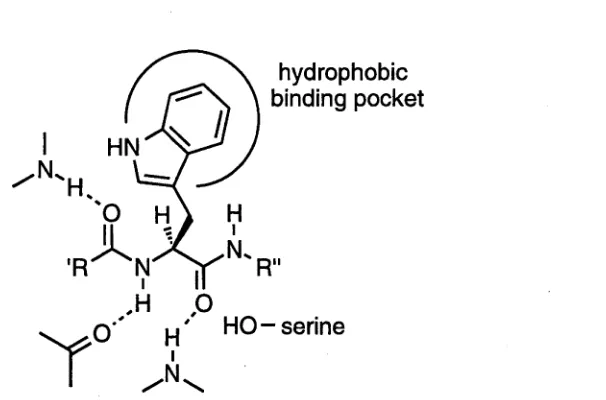
hydrophobic side chains.4 The nature of the active site (Figure 1) determines how this
selectivity is achieved.4
hydrophobic
binding pocket
'O
H
[image:10.525.142.445.59.259.2]H O - serine
Figure 1. A peptide containing a tryptophan residue complexed in the active site of Chymotrypsin.
The active site of Chymotrypsin is lined with the amide hydrogens and carboxyl
oxygens of the enzyme's peptide backbone.4 These are positioned such that they can form hydrogen bonds with molecules bound in the active site. As a result, molecules
with suitable hydrogen bond donors and acceptors, such as peptides, bind efficiently to
the active site.
An im portant structural feature of the active site of Chymotrypsin is a large
hydrophobic pocket, positioned such that the side chains o f am ino acids o f
(^ -c o n fig u ra tio n are accom m odated but the side chains o f the corresponding
(tf)-enantiomers are not.4 That is, the position of this binding pocket determines the enantioselectivity of the enzyme as only peptides containing amino acids with the
(^-configuration are able to bind to the active site. Further, the hydrophobic interactions
of large aromatic side chains such as those of phenylalanine, tryptophan and tyrosine, and
to a lesser extent bulky aliphatic side chains such as that of leucine, with the pocket
stabilise the complexes of substrates containing these residues.4 The result is that these substrates are bound more efficiently and selectivity is observed.
Finally, the substrate is complexed in such a way that the residues responsible for
catalysis have the necessary orientation. In this case a serine residue which plays a key
role in the catalysis is proximal to the carboxyl group of the amino acid residue 4 As a result, hydrolysis of the corresponding amide linkage is carried out in preference to
reaction of any other amide bonds in the substrate.
From this information it is clear that the precise structure of the active site of an
enzyme is responsible for the significant enantio-, regio- and substrate-selectivity
Introduction
importance to the catalytic activity of the enzyme as dem onstrated by the residues
responsible for the catalytic activity of chymotrypsin. As mentioned above, there is a
serine residue of the enzyme adjacent to the amide bond of the substrate being cleaved.
The nucleophilicity of this serine is greatly enhanced by the presence of a histidine residue
next to it in the active site. This, in turn, is stabilised in the protonated form by an
adjacent aspartate residue. This 'catalytic triad' is an excellent example of how the precise
arrangement of the residues of an enzyme results in effective catalysis. The mechanism
of hydrolysis by chymotrypsin is illustrated as Scheme 2.4 This particular catalytic motif
is present in a range of enzymes, collectively termed serine proteases.5
FT
serine—
aspartate
histidine
0 .
^
— R"s e r—CK
fl
R'
ser—0
H
2
N—R'-/
his
-
<7 1
H
s
° Y ° “
° Y ° "
asp
asp j l -R’NH
2
u +h2oScheme 2.
The mechanism of hydrolysis o f a peptide by chymotrypsin showing the effect of the catalytic triad of serine, histidine and aspartate.Having discussed the effect of enzyme structure on the selectivity o f substrate
binding and the nature o f the catalysis, the effect on regioselectivity needs to be
addressed. Many enzymes, particularly those that involve the condensation of two
substrates, catalyse reactions regioselectively, with reaction occurring at only one of
many potential reaction centres. This regioselectivity is observed because the substrates
are bound with exact orientations in the active site, resulting in reaction occurring at only
one point. An example of this is the formation of glycogen (2) in the liver and skeletal
muscle by glycogen synthase.6 This enzyme catalyses the addition of UDP-glucose (1),
an activated form of glucose, to glycogen (2) (Scheme 3). This addition occurs
regioselectively, at the 4-position of the terminal glucose unit, and stereoselectively, to
form an a - 1,4-glycosidic linkage. This regio- and stereo-selectivity is controlled by the
orientation of the substrates in the enzyme active site.
glycogen synthase
^ n + l
Scheme 3. The stereo- and regio-selective addition of a glucose unit to glycogen (2) catalysed by glycogen synthase.
Since enzymes are highly evolved biological molecules, they exhibit specific
regulatory mechanisms based on the organisms from which they are derived.1,7
Typically these involve molecules binding to an enzyme, which either compete for the
active site or bind to alternative sites on the enzym e.1,7 The former tend to have an
inhibitory effect on enzyme activity as they compete with the substrate for a single
binding site. The latter form of binding, often referred to as allosteric,1,7 usually results
in a conformation change in the enzyme which may increase or decrease the catalytic
Introduction
which this control is based is regulation of digestion of the substrate.1,7 For example,
this regulation may prevent unwanted accumulation of an intermediate in a synthetic
pathway or prevent over digestion of an abundant substrate.
An excellent example of this type of regulation is product inhibition of enzyme
catalysis. Also known as feedback inhibition, this is a key form of metabolic control in
biological systems, where the product of the enzyme catalysed reaction reduces enzyme
activity, preventing wasteful metabolism of the substrate.1,7 The product can bind at the
active site of the enzyme (competitive inhibition) or at another site on the enzyme
(non-competitive or uncompetitive inhibition). The former is more common as the
product of an enzyme catalysed reaction often structurally resembles the substrate and
hence will be recognised by the active site of the enzyme.1,7 Each of these forms of
inhibition has the effect of reducing the amount of the enzyme-substrate complex in
solution (Scheme 4). Since the amount of the enzyme-substrate complex decreases, the
rate of reaction and hence the extent of reaction in a given time also decrease.
E
-
ES
--- ►
EP
^
w
E + P
r
EP1
r
E P S T
Scheme 4.
The equilibria associated with a system which demonstrates product
inhibition.
^This complex forms when the product binds to the enzyme at an allosteric site in the
absence of the substrate (non-competitive inhibition).
*This complex forms when the product binds to the enzyme at an allosteric site in the
presence of the substrate (non-competitive or uncompetitive inhibition).
Scheme
5. The removal of ammonia and a proton from (5)-phenylalanine ((S)-3) as
catalysed by PAL.
Another form of regulation of enzyme catalysis is substrate inhibition, where the
activity of the enzyme decreases at high concentrations of the substrate.1,7
Physiologically, this prevents wasteful digestion of an abundant substrate and the
accumulation of the corresponding product. Typically, substrate inhibition is due to the
binding of a second substrate molecule to the enzyme, which can take place either at the
active site or elsewhere, and which alters the conformation of the enzyme.1,7 This
allosteric change decreases the activity of the ternary enzyme-substrate complex, hence
reducing the rate of digestion of the substrate. Substrate inhibition can be described
kinetically as in Scheme 6, where Si and S
2represent substrate molecules bound at two
binding sites, with
S\being bound at the active site and able to react.1,7 The rate
constants for reaction of the bound species (
k) will differ depending on whether a second
substrate molecule is bound to the enzyme and, in the case of substrate inhibition,
k\> &2-1,7 At low concentrations of the substrate, the ESi complex dominates so the rate
of reaction increases with increasing substrate concentration. As the substrate
concentration increases further, more of the ternary complex forms and the rate of
reaction decreases.
k \
E
-
-
ES,
--- ►-
EP
E + P
I I
1 I
k2
ES2
— :=±r.
E S^S2
--- EPS2
e s2 +
pScheme 6.
The equilibria associated with an enzyme that is affected by substrate
inhibition (
k\ > k2).
Introduction
readily if the carboxyl-terminal residue has an aromatic or bulky aliphatic side chain
(Schem e 7 ).3 In vitro, it has been shown to also hydrolyse esters with similar
configurations to the natural peptide substrates.16 In both cases, the enzyme is
enantiospecific, hydrolysing only the (S)-enantiomers of the substrates.
carboxypeptidase A
Scheme 7. The hydrolysis of a peptide with a carboxyl-terminal phenylalanine residue, catalysed by carboxypeptidase A.
This enzyme has been shown to exhibit substrate inhibition on catalysis of
reaction o f a range of substrates.17' 26 Of note is the inhibition observed in the hydrolysis
of (S)-carbobenzoxyglycylphenylalanine (5) and the structurally related lactate esters,
including (S ^-A -benzoylglycyl-ß-phenyllactate (6). These tw o substrates offer a
comparison of the effects of binding a second substrate molecule. In the case of the
peptide derivative 5, while they still differ, the rate constants k\ and k i are of comparable
magnitude and, as a result, the rate of reaction observed at high concentrations of
substrate is approximately half of the maximum rate observed. Thus, the inhibitory effect
of the second substrate molecule binding to the enzyme is small. In the case of the
lactate 6, k\ » ki, so at high concentrations of the substrate, enzyme activity is reduced
to negligible levels. The inhibitory effect of the second substrate molecule binding to the
enzyme is clearly very large in this case.
0
6
It should be noted that, despite their biological complexity, enzymes are simply
catalysts. 1 They offer an alternative pathway to reaction with a lower energy of activation than is observed in their absence. The free energies of the substrates and products remain
unchanged. Thus, the position of equilibrium, which is determined by the relative free
energies of the substrates and products, remains unchanged while the rate at which the
equilibrium is attained, which is dependent on the energy of activation of the reaction, is
increased. W hile some enzyme catalysed reactions can be considered essentially
irreversible under the conditions where they operate, such as the hydrolysis of peptides
described above, this is simply because the difference in free energies of the substrates
and products is so great that the equilibrium constant is very large.
Enzymes are efficient catalysts and this makes them attractive for use in organic
synthesis. Further, the growing availability of enzyme preparations, their safety, ease of
handling and the mild conditions (typically room temperature and around neutral pH)
under which they operate means that they are being considered more frequently for use in
organic synthesis. 16,27' 30 However, almost invariably, the enzymes are required to operate under conditions that are inconsistent with their biological origin. These
biological origins place notable restrictions on the use of enzymes in organic synthesis.
Modification of enzymes has been used to overcome these limitations in some
cases. Total synthesis o f enzymes, while academically feasible, is im practical.31 Of more utility is the overproduction of enzymes in bacterial cells using recombinant DNA
te c h n o lo g y. 32 In such cases, modifying an enzyme involves mutating the gene responsible for the it, so that there is a change in the peptide chain of the protein
produced.33,34 The residues that make up the active site are often targeted, in an effort to change the nature of the active site and the selectivity of the enzyme. This method is quite
time consuming, since the effect of such a point mutation is difficult to predict, with the
potential to disrupt the entire tertiary and quaternary structure of the enzyme. Further, the
effect of multiple point mutations is not necessarily additive.
Given the difficulties associated with the modification of enzymes, much work
has gone into the developm ent of synthetic enzymes not based on proteins. These
enzyme models or enzyme mimetics must exhibit the same properties described above as
being characteristic o f enzyme behaviour. That is, they must exhibit selectivity on
binding o f the desired substrate, they must have appropriate functional groups for
catalysis, the bound species must undergo reaction stereoselectively and the enzyme
mimetics must be regenerated unchanged. A class of compounds which have been
Introduction
Naturally occurring cyclodextrins are homochiral 1-4 linked cyclic oligomers of
a-D-glucopyranose.35 They are formed through the degradation of starch by the enzyme
cyclodextrin glucosyl transferase.36 Cyclodextrins were originally isolated by Villiers
from the digest of potato starch by Bacillus am ylobacter17 and later characterised by
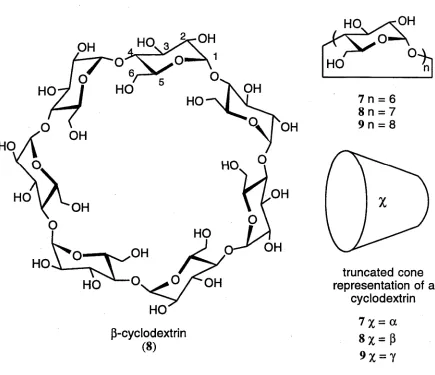
Schardinger.38’39 The most common of the series are the six, seven and eight membered
hom ologues, being referred to as a -c y c lo d e x trin (7), ß -cy clo d ex trin (8) and
y-cyclodextrin (9), respectively.40 Conformational restrictions cause these cyclodextrins
to be toroidal in shape (Figure 2),f with a hydrophilic exterior and a hydrophobic
cavity.41 These properties of cyclodextrins make them well suited for the formation of
water soluble inclusion complexes of hydrophobic molecules.42'46
ß-cyclodextrin
(
8
)7 n = 6
8 n = 7
9 n = 8
truncated cone
representation of a
cyclodextrin
7 x = a [image:17.525.27.462.266.641.2]8 z = ß
9 X =7
Figure 2. Structure and conformation of the three most common naturally occurring cyclodextrins.
t Cyclodextrins are commonly represented by truncated cones. When a substituent is shown on the narrow end, it represents a moiety that has replaced one of the C(6) primary hydroxyl groups, while a substituent shown on the wider end represents a moiety that has replaced either a C(2) or C(3) secondary hydroxyl group.
An inclusion complex is said to form when a molecule with a cavity, or capable of
form ing one (the host), encapsulates a sm aller m olecule (the guest) by purely
non-covalent interactions.43,45,47 These complexes can be thermodynamically quite
stable and each is characterised by a thermodynamic stability constant or association
constant (K) defined by the position of equilibrium between the host, the guest and the
complex (Equation l) 43<45>47 This is illustrated in Scheme 8 for the case where the host
is a cyclodextrin. It should be noted that, as expressed below, AT is a concentration
stability constant rather than a true stability constant where activities of the equilibrium
participants are employed instead of concentrations. However, concentration stability
constants are usually determined in solutions where a constant ionic strength is
maintained by a supporting electrolyte.46
K = [complex] [guest], [host]
guest
complex
Scheme 8.
The inclusion of a guest within a host to form a complex.10
The size, shape and nature of the guest involved will affect the stability o f the
complex and hence the value of the association constant.45 The former two constraints
are easily understood, as for the guest to be included within the cyclodextrin cavity, it
must be able to be accommodated. On the first point, the more closely matched the size
of the guest to the size of the cavity, the less distortion of the host occurs on inclusion and
the more thermodynamically stable the resulting inclusion complex. This is illustrated by
Introduction
annuli vary in size (Table 1). For the formation of the inclusion complex with the
smallest host
7,
the guest
10
cannot include completely into the host cavity. The cavity
size of the seven membered homologue 8 is larger and the guest 10 fits well within it.
The result is a more stable complex and a markedly higher value for the association
constant of the complex. A further increase in size of the host, however, increases the
degrees of freedom of the guest
10
complexed in the host
9,
decreasing the stability of
the complex and hence decreasing the value of the association constant of the complex.
This relationship between the size of the guest and the size of the host cavity has been
referred to as the “Goldilocks' Effect”.45
C y c lo d e x trin 7 8 9
A n n u la r d ia m e t e r m e a s u r e d f ro m th e C (5 )
h y d ro g e n s (A )49
4 .7 6 .0 7 .5
A n n u la r d ia m e t e r m e a s u r e d f ro m th e C (3 )
h y d ro g e n s (A )49
5 .3 6 .5 8.3
A n n u l a r d e p t h f ro m th e p r im a r y to th e
se c o n d a ry h y d ro x y l g ro u p s (Ä )49
7 .9 ± 1 7 .9 ± 1 7 .9 ± 1
A n n u la r v o lu m e (Ä 3)49 174 2 6 2 4 2 7
A s s o c ia tio n c o n s ta n t o f th e c o m p le x fo rm e d w ith th e g u e s t 1 0 ( m o l '1 d m 3)3
150 ± 2 0 2 0 0 0 0 ± 2 0 0 0 3 3 0 0 ± 4 0 0
Table 1.
Geometric dimensions of the cyclodextrins
7-9,
and the association constants
of the complexes formed with adamantane-l-carboxylate (10).
Calculated from data presented by Cromwell and co-workers.50
The influence of the shape of a guest on the association constant of the complex it
forms with a given cyclodextrin is probably best demonstrated by considering the two
steroids, 5a-cholanic acid 3-ß-ol
(11)
and lithocholic acid
(12).
The association
constants of the complexes formed with ß-cyclodextrin (8) differ by a factor of twenty
(Table 2) with the complex of the
cis
-fused steroid
12
being more stable. Molecular
modelling indicates that the
cis
ring fusion of the AB ring system causes the A ring of the
steroid 12 to better fit the wider end of the cyclodextrin cavity than is the case when the
AB ring fusion is
trans.51
In both cases, the remaining rings thread through the cavity.
Hence, the stability of the association complex formed is dependent on the shape of the
guest that is included.
Table 2. A ssociation constants for the complexes o f ß-cyclodextrin (8) with the steroids 11 and 12.51
in hydration of the host and the guest in the complexation process, since almost all
association constants are measured in aqueous solution.45,46 The number o f waters that
hydrate the guest will depend on its nature. Upon formation o f the complex, the guest
displaces water molecules from the cyclodextrin cavity, while also losing some of the
water molecules associated with it. The result is that several molecules of water enter the
bulk phase. Since water within the cavity of a cyclodextrin cannot form hydrogen bonds
as in bulk water and is often termed “high energy”, its expulsion from the cavity is a
driving force for guest complexation. Clearly, the guest which can shed its hydration
shell to the greatest extent and expel the most water molecules from the cavity of the
cyclodextrin will form the more stable complex, all other factors being equal. The latter
effect is again related to the size of the guest, while the former is more dependent on the
nature of the guest. The more hydrophobic a molecule, the lesser the degree to which it is
hydrated and hence the greater the stability constants for the complexes that it forms. For
example, the stability constant for the complex of adam antane-l-carboxylate (
10
) and ß-cy clo d ex trin (8) is fifteen times sm aller than the association constant of thecorresponding complex with the parent acid 13 (Table 3).52
While guest discrimination by a host can be qualitatively assessed by considering
the factors discussed, it is necessary to quantify the association constants to accurately
gauge the relative stability of inclusion complexes. The spectroscopic properties of guest
Introduction
Guest K (mol' 1 dm'3)
13
Table 3. A ssociation constants for the com plexes o f a d am an ta n e-1-carboxylate (10) and adam antane-1-carboxylic acid (13) with the cyclodextrin 8.52
m e th o d s have b een u sed to c a lc u la te a s s o c ia tio n c o n s ta n ts fo r in c lu sio n com plexes.45,53' 67 The use o f nuclear m agnetic resonance (N M R) spectroscopy for this pu rp ose is w ell do cu m en ted.60' 67 W hen no cy clo d ex trin is present, the observed chem ical shift of a given nucleus is that of the free guest, while varying the concentration o f the host changes the chem ical shift, w hich is generally observed as a w eighted average o f th at for the free and included species (E quation 2). E x trap o latio n to infinite cyclodextrin concentration gives the chem ical shift o f the included guest. The stability constant o f the com plex can then be quantified by applying non-linear regression analysis to Equations 1 and 2 (See Appendix 1).
'observed
([guest] . 5 ^ + [com plex).geomple>ed)
([guest] + [com plex]) (
2
)For a given cyclodextrin, if the value o f the association constant for one com plex differs from that of another, this difference is an indication o f guest discrim ination by the host. This discrim ination is the basis for selective b ind in g and hence an elem ent necessary in the formation of enzyme mimics.
A good example of a naturally occurring cyclodextrin acting as an enzyme mimic
is the hydrolysis o f 3'-nitrophenyl 2-phenylpropanoate (14) by ß-cyclodextrin (8)
(Scheme 9).70 The ester 14 includes within the cavity of the cyclodextrin 8. Hydrolysis
occurs through nucleophilic attack of a secondary hydroxyl group of the host 8, which is
deprotonated under the reaction conditions, on the carboxyl group of the guest 14. The
product cyclodextrin ester is subsequently hydrolysed to regenerate ß-cyclodextrin (8).
The cyclodextrin discriminates between the enantiomers of the guest 14 on formation of
the inclusion complex, with the ester (/?)-14 being com plexed in preference to its
enantiom er (S)-14, though the magnitude of this discrimination is small. A greater
discrim ination is observed on reaction o f the com plexed ester 14, with the
(7?)-enantiomer (/?)-14 being hydrolysed ca. fifteen times faster than the (S)-enantiomer
( S ) -14. The overall enantioselectivity in the hydrolysis o f 3'-nitrophenyl
2-phenylpropanoate (14) by ß-cyclodextrin (8) is a factor o f nineteen, with the
(/?)-enantiomer (/?)-14 being hydrolysed preferentially.
M odification o f the hydroxyl functionalities of the naturally occurring
cyclodextrins provides a way to increase the utility of cyclodextrins as enzyme mimics.
Modifications have been shown to affect the solubility of the cyclodextrins, but the major
advantages are for introducing specific catalytic functionality and to modify the selectivity
o f the complexation.71’72
O f particular note has been the work carried out by the research group of
Breslow .73’74 As an example, the modified cyclodextrin 15, with two imidazole units
attached to adjacent glucose residues (designated A and B), was synthesised to introduce
the potential for concerted acid-base catalysis. Many enzymes, notably the ribonucleases,
use the cooperative functioning of an imidazole base and an imidazolium ion acid, present
in the protein as the side chains of histidine residues, for this form of catalysis.3 The
hydrolysis of the cyclic phosphate ester 16 as catalysed by the modified cyclodextrin 15
demonstrates this effect.75
The modification of a cyclodextrin also allows the introduction of functionality
that may complex a metal, to form a metallocyclodextrin. In enzymes, metals are used to
complex reagents at the active site, such as in peroxidases, or act as Lewis acids and
increase the reactivity of the bound substrate, such as in the hydrolysis o f peptides by
carboxypeptidase A.3 Both of these effects have been mimicked by metallocyclodextrins
based on the modified cyclodextrin 17. The lanthanum(III) complex of the modified
cyclodextrin 17 was shown to dramatically increase the rate of hydrolysis of the
phosphate ester 18 in the presence of hydrogen peroxide, with rate accelerations greater
Introduction
-C6H5CH(CH3)C 02H
+ 0H
-Scheme 9.
Enantioselective hydrolysis of 3'-nitrophenyl 2-phenylpropanoate
(14)
by
ß-cyclodextrin (8) at pH 10.5.
15
O
M etallocyclodextrins based on the modified cyclodextrin 19 have been widely
studied and shown to exhibit enantioselectivity on complexation of the anions of the
naturally occurring arom atic amino acids.77-79 The orientation o f each of these
complexes is controlled by interaction of the amino and carboxylate moieties of the amino
acid with the metal centre and inclusion of the aromatic moiety within the annulus of the
cyclodextrin. This is illustrated in Figure 3 for the complex of tryptophan anion (20)
with the nickel(II) metallocyclodextrin based on the modified cyclodextrin 19. The
enantioselectivity on form ation of this complex is the greatest reported, with the
association constant of the complex of the guest (.S)-20 being ten times larger than that of
the complex of its enantiomer (R)-20.78,79 It was envisaged that the chiral discrimination
exhibited by m etallocyclodextrins based on the modified cyclodextrin 19 might be
exploited in the development of enantioselective enzyme mimics. Studies towards this
Introduction
Figure 3. Orientation of the guest 20 in the association complex form ed with the nickel(II) metallocyclodextrin based on the modified cyclodextrin 19.
Native cyclodextrins have been reported to alter the ratio of products formed on
photoirradiation of (£ )-4 ,4 ’-bis(dim ethylam m oniom ethyl)stilbene ((£ )-2 1 ).80 On
photoirradiation, the (£T)-isomer (E)-21 can dimerise to give the cyclobutanes trans-22
and cis-22 or undergo reversible isomerisation to give the (Z)-isomer (Z)-21, which can
cyclise to give the phenanthrene 23 (Scheme 10). The ratios of the products of the
reaction in the absence of a cyclodextrin and in the presence of the cyclodextrins 7-9 are
sum m arised in Table 4. In the presence of the cyclodextrins 7 and 8, none of the
cyclobutanes trans-22 and cis-22 is observed. This suggests that the cyclodextrins 7 and
8 complex the stilbene (£)-21 and prevent it from dimerising. The effect of adding
y-cyclodextrin (9) to the reaction mixture is a dramatic increase in the amount of the
dimers tra n s-22 and cis-22 produced. Two molecules of the stilbene (£ )-2 1 were
shown to be accommodated in the cavity of y-cyclodextrin (9) by microcalorimetric
titration.80 The results suggest formation of this ternary complex favours dimerisation of
the stilbene (E)-21, presumably due to the proximity of the reagents. Similar results have
subsequently been reported for the photochemical reactivity of a fra/i.s-2-styrylpyridine. 81
C y c lo d e x tr in ( £ > 2 1 (Z> 2 1 tra n s-2 2 c is - 2 2 2 3
10 6 2 7 2 19
7 2 0 6 0 0 0 2 0
8 16 83 0 0 1
9 0 0 7 9 19 2
2 3 cis-22
Scheme 10. Competing reactions to form the phenanthrene 23 and the dimers trans-22 and cis-22 on irradiation of the stilbene {E)~21 (R=CH2NH(CH3)2+).
W hile in these cases the natural cyclodextrin 9 is shown to act as a molecular
template, the effects observed must be considered serendipitous as the host 9 was not
designed for such a purpose. In contrast, recent work using cyclodextrins as
molecularscaffolds for nitrile oxide cycloadditions involved a cyclodextrin host being
specifically designed and synthesised to template a reaction.82'84
Nitrile oxides 24 undergo [3+2] cycloadditions with alkynes and alkenes to give
isoxazoles and 4,5-dihydroisoxazoles, respectively.85 The use of a mono-substituted and
therefore asymmetric dipolarophile gives the possibility of a mixture o f products,
how ever steric effects are found to predom inate producing mainly 5-substituted
isoxazoles 25 and dihydroisoxazoles 26 (Scheme 11).
The attachment of a dipolarophile to ß-cyclodextrin (8) gives the modified
cyclodextrin 27. This cyclodextrin has been used to predetermine the regioselectivity of
Introduction
R"
Scheme 11. Usual regioselectivity of the addition o f m ono-substituted alkenes and alkynes to nitrile oxides 24.
nitrile oxides through the formation of inclusion complexes. This is illustrated by the
reaction o f the modified cyclodextrin 27 with 4-terr-butylbenzonitrile oxide (28)
(Scheme 12). The orientation of the complex of the guest 28 with the host 27 favours
formation o f the 4-substituted product 29. It is produced in 67% yield, compared to 4%
for the corresponding 5-substituted product 30. Thus, attachment of the dipolarophile to
a cyclodextrin reverses the normal regioselectivity of nitrile oxide cycloaddition through
preassembly of the reagents.
It was envisaged that an alternative method for controlling the regioselectivity of
reactions using cyclodextrins might be through the use of linked cyclodextrins, which
have been studied widely due to the cooperative guest binding displayed by cyclodextrin
annuli in such species.86' 94 It has been shown that the extent of the cooperativity is
dependent on the match of the shape of the guest to the alignment of the host cavities.
This is illustrated by the work of Breslow and Chung,90 in which the complex formation
properties o f the cyclodextrin dimers 31 and 32 were studied. In these doubly linked
cyclodextrins, the relative positions of the cyclodextrin annuli are well defined. The
dimer 31 is referred to as the aversive or ‘loveseat’ isomer, while the dimer 32 is referred
to as the occlusive or ‘clamshell’ isomer. In the latter case, the annuli are positioned such
that they may close on a guest in much the same way as a clamshell, while the annuli act
independently in the former case. Hence, the relative orientation of the annuli determines
whether cooperative binding can take place. The complexes formed between the dimer
32 and each of the guests 33 and 34 demonstrate the effect of matching the shape of the
guest to the alignment of the annuli in the host. The guest 33 is ‘bent’ and has a shape
corresponding to the relative orientation of the cyclodextrin annuli in the dimer 32,
'f
Scheme 12.
Cyclodextrins can be used to reverse the normal regioselectivity of nitrile
oxide cycloaddition.
The dependence of the extent of cooperativity on the match of the shape of the
guest to the relative orientation of the host cavities has been used to determine the
preferred alignment of the annuli of the cyclodextrin dimers 35-37.91,92 The
complexation of the anions of methyl orange (38) and Tropaeolin 000 No. 2 (39) by the
cyclodextrins 35-37 shows maximum binding of the linear dye 38 in the oxalamide 36
and of the non-linear guest 39 in the host 35. This implies a preferred non-linear
orientation of the cyclodextrin annuli in the urea 35 while the annuli of the host 36 are
arranged more linearly. The succinamide 37 is observed to complex both of the
guests 38 and 39 less strongly than the dimers 35 and 36 though still to a greater degree
than the parent cyclodextrin 8.
37 n = 2
Introduction
annuli o f the urea 35 might be used to complex reagents in a non-linear arrangement,
resulting in preferential formation of a non-linear product. Studies examining the use of
the cyclodextrins 35-37 as molecular templates for condensation reactions are described
in Chapter II of the Results and Discussion
As an alternative to the development of enzyme mimetics, improving the use of
enzymes which are normally o f limited utility, due to restrictions associated with their
biological origins, was also considered. An enzyme that is affected by product inhibition
is inappropriate for use in synthetic chemistry as the extent of reaction in a given time is
limited by the inhibitory effect of the product. It was anticipated that if the product of
reaction was removed from solution, in preference to the substrate, the amount free in
solution would decrease. This would result in less product being able to bind to and
inhibit the enzyme, without substantially affecting the concentration of the substrate,
hence resulting in an increase in the activity of the enzyme and in the extent of reaction in
a given time. It was envisaged that a method to remove the product o f an enzyme
catalysed reaction from solution preferentially might be through inclusion within a
molecular host, such as a cyclodextrin.
Consider the elimination of ammonia and a proton from (^-phenylalanine ((5)-3)
to give the cinnamate 4 catalysed by PAL, which is affected by product inhibition. An
examination of the substrate (5')-3 and the product 4 suggests that both may be included
within a cyclodextrin as the aromatic moieties provide hydrophobic sites of similar size to
the cavity of the cyclodextrins 7 and 8. However, it was expected that the cinnamate 4
would include in the cyclodextrins 7 and 8 in preference to the substrate (S)-3, due to its
reduced ionic character and hence reduced degree of hydration. The reported association
constants for the complexes of the substrate (S)-3 with the native cyclodextrins 7 and 8
are 8 and 3 m ol'1 dm3, respectively,95 while the equivalent complexes with the cinnamate
4 as the guest have association constants o f 109 and 313 m oH dm3, respectively.96 It
was therefore envisaged that the cyclodextrins 7 and 8 could be used to sequester the
cinnam ate 4 preferentially, reducing the amount free in solution to inhibit PAL.
Accordingly, the work described in Chapter III of the Results and Discussion investigates
the use of cyclodextrins to reduce product inhibition of enzyme activity.
In the previous discussion, only naturally occurring cyclodextrins were
considered. W hile the cyclodextrins 7, 8 and 9 are readily available, each has low
aqueous solubility, being lim ited to 14.5 g / 100 cm 3, 1.85 g / 100 cm3 and
23.2 g / 100 cm 3, respectively.97,98 This places a constraint on the amount of host that
can be present in solution, restricting the degree to which the host can sequester a guest.
The limited solubility of the cyclodextrins 7-9 has provided some of the impetus for the
investigation of chemically modified cyclodextrins, as they have been shown to have
increased aqueous solubility.71,72 These modifications may also alter the thermodynamic
stability of any complexes formed, relative to the case where the host is the parent
cyclodextrin. It was envisaged that modification of a cyclodextrin might be used to
increase or decrease the degree to which a particular guest is sequestered and hence alter
the effect o f the cyclodextrin on an enzyme catalysed reaction. The work described in
Chapter IV of the Results and Discussion compares the effects of the naturally occurring
cyclodextrins 7 and 8 and the modified cyclodextrin 40 on the reaction catalysed by
PAL.
NH2
Many enzym es exhibit high specificity for a group of substrates, yet there is
limited selectivity within this group. Enzymes which catalyse the reactions of amino
acids and peptides are examples of this, as are those involved with the phosphorylation of
aldohexaoses.3,16 As a result, in these cases digestion of a mixture of substrates tends to
lead to a mixture of products which is unsuitable as a synthetic procedure, as the products
then have to be separated.
Two exam ples o f enzymes which digest a class of molecules are acylase I
(also known as aminoacylase or hog renal acylase) and protease VIII (also known as
Subtilisin Carlsberg). Acylase I has long been used as a tool for resolution of amino
acids, as it selectively deacylates the (S)-enantiomers of acylated amino acids, the
products being easily separable from the acylated (/?)-forms (Scheme 1 3 )." Further, it
has been shown to have a broad specificity, digesting a wide range of substrates.100,101
Protease VIII has also been shown to be useful for resolution of amino acids, selectively
hydrolysing the (S)-enantiomers of a range of amino acid esters (Scheme 14).102-104
O HR
k
A ' V
H
acylase I
O RH+
N' H
HR
+ X
-H3N
c o
2
Introduction
HR
X
protease VIII
jf
RH
C 0 2R"
+
R'HN
jjf
HR
c o2_
R'HN
C 0 2R"
R'HN
Scheme 14.
Hydrolysis of the (S)-enantiomers of amino acid esters by protease VIII. It was anticipated that if all but one of the components of a mixture being digestedby one of these enzymes were removed from solution then only one substrate would
remain in solution to be digested, resulting in only one product. Thus, it was envisaged
that cyclodextrins might be used to affect the digestion of a mixture of substrates by an
enzyme. Chapters V and VI of the Results and Discussion of this thesis examine the
digestion of mixtures of substrates by enzymes and investigate the effect of cyclodextrins
on these systems.
Finally, consider an enzyme that is affected by substrate inhibition. While this
form of inhibition prevents excessive digestion of an abundant substrate in biological
systems, it limits the utility of the enzyme for synthesis as, at the low concentrations of
substrate necessary to maintain enzyme activity, the scales required for reactions are
impractical. It was envisaged that if the substrate being digested was removed from
solution, then the amount free in solution would decrease. As a result, the proportion of
the enzyme present in the less productive ternary complex would decrease, the rate of
reaction would increase and the substrate concentration at which enzyme activity was
maintained would increase, increasing the practical utility of the process. Further, it was
expected that if the substrate was removed from solution by reversible encapsulation in a
molecular host, then this host would act as a 'substrate reservoir'. It was anticipated that
a cyclodextrin might be used to reduce substrate inhibition and hence increase the utility
of enzym es that are adversely affected in this manner. Studies examining this are
described in Chapter VII of the Results and Discussion.
Chapter I
A Metallocyclodextrin as a Possible Esterase Mimic
As described in the Introduction, metallocyclodextrins based on the modified
cyclodextrin 19 exhibit enantioselectivity on complexation of naturally occurring aromatic
amino acids77' 79 and it was envisaged that this selectivity might be exploited in the
development of an enantioselective enzyme mimic. The reaction chosen to examine this
was the hydrolysis o f O acetyltyrosine (41) to afford tyrosine (42) (Scheme 15).
Scheme 15. The hydrolysis of O-acetyltyrosine (41).
Since the acetate 41 is a derivative of phenylalanine (3), it was anticipated that its
complexation with a metallocyclodextrin would occur with significant enantioselectivity.
The orientation of this complex would be controlled by the interaction of the amino and
carboxylate moieties of the amino acid derivative 41 with the metal centre and inclusion
of the aromatic ring within the annulus of the cyclodextrin (Figure 4).77' 79 In this
orientation, the electrophilic site of the acetate 41 is adjacent to the secondary hydroxyl
groups of the metallocyclodextrin. Under basic conditions, the secondary hydroxyl
groups of cyclodextrins are deprotonated and have been shown to act as nucleophiles in
the cleavage of phenyl esters.105,106 Thus, under basic conditions it was envisaged that
the com plexed tyrosine derivative 41 would be hydrolysed by the deprotonated
secondary hydroxyl groups of the metallocyclodextrin. Since the acetate 41 might be
Results and Discussion, Chapter I
complexed, it was thought suitable to examine the possible application of
metallocyclodextrins as enantioselective esterase mimics.
Figure 4.
Predicted orientation of O-acetyltyrosine
(41)
in the association complex
formed with a metallocyclodextrin of the modified cyclodextrin
19.
The reactions were carried out in buffered solutions to ensure that the pH did not
change as they proceeded. A pH value of 10.0 was used as speciation plots of solutions
containing a naturally occurring aromatic amino acid, a metal(II) ion and the modified
cyclodextrin
19
indicate that the major species present in solution at this pH is the
monocationic metallocyclodextrin complex of the amino acid.77'79 It is on formation of
this complex that enantioselectivity is observed.77'79 Thus, at pH 10.0 in the equivalent
system containing the tyrosine derivative
41
it was envisaged that the major species
present in solution would be that shown in Figure 4 and that enantioselectivity would be
observed on its formation. The secondary hydroxyl groups of the naturally occurring
cyclodextrins
7
and
8
have
p K a
values of 12.2.68,69 Thus, at pH 10.0 approximately
1% of the secondary hydroxyl groups of the metallocyclodextrin complex would be
expected to be deprotonated and able to facilitate hydrolysis of the complexed acetate
41.
Sodium tetraborate has a
p K a\
value of 9.14,107 so a borate buffer was used in the
reactions as it has a large buffering capacity at pH 10.0.
Each of the tyrosine derivatives
(/?)-41
and
(S)-41
was prepared using a variation
of the method of Sakami and Toennies,108 through treatment of the corresponding
tyrosines
(R)-42
and
(S)-42
with acetic anhydride in a solution of perchloric acid / acetic
acid (Scheme 16).109 Under these strongly acidic conditions, the amino group of each of
the tyrosines
(R)-42
and
(S)-42
is completely protonated and not nucleophilic. As a
result, the phenolic oxygen was the only nucleophilic site in the substrate able to be
acetylated. Each of the esters
(R)-41
and
(S)-41
was isolated in zwitterionic form
through precipitation from diethyl ether / acetone, using butylamine to neutralise the acid
present. The physical data for each of the esters
(/?)-41
and
(S)-41
are consistent with
those reported.108 The !H NMR spectrum of each of the products
(/?)-41
and
(*S)-41
No signals were observed at ca. 51.8, at which frequency the protons of an acetamide
might be expected to resonate,110 confirming that only the phenol of the starting materials
(R)-42 and (S)-42 had been acetylated. Enantiomeric purity of each of the esters (/?)-41
and (S)-41 was established by optical rotation measurements.108
(CH3C0)20
---►CH3CO2H / HCIO4
H (S)-42 R ’ = H, R" = C 0 2*
(R)-41 R' = C 0 2', R" = H (5)-41 R’ = H, R" = CO2
Scheme 16. Synthesis of the tyrosine derivatives (/?)-41 and (S)-41 from the corresponding tyrosines (R)-42 and (S)-42.
6A-(3-A m inopropyl)am ino-6A-deoxy-ß-cyclodextrin (19) was prepared from
ß-cyclodextrin (8) via the tosylate 43 (Scheme 17), as described in the literature.111,112
Treatm ent o f the parent cyclodextrin 8 with 4-toluenesulfonyl chloride in pyridine
afforded the tosylate 43. This was purified to remove residual starting material 8 through m ultiple recrystallisations of the crude product from water. The tosylate 43 was
identified through com parison of the observed spectroscopic information with that
reported in the literature.111 Reaction of the tosylate 43 with 1,3-diaminopropane in
A-methylpyrrolidinone gave the product 19. The crude product 19 was contaminated
with ß-cyclodextrin (8), a byproduct resulting from hydrolysis o f the tosylate 43, so it
was purified using ion exchange chromatography. The modified cyclodextrin 19 was
identified through comparison of the observed and reported spectroscopic data.112 The
^ NMR spectrum of the amine 19 included characteristic resonances corresponding to
the hydrogen nuclei of the pendant arm methylene groups at 51.7, 2.6 and 2.8.
Reactions involving hydrolysis of the esters (R)-41 and GS)-41 were monitored
by observing the change in absorbance at 283 nm. Com parison of the absorption
spectrum of the starting material 41 and that o f the product 42 indicated that this
wavelength corresponds to the maximum difference in absorbance between these two
species.
Each o f the esters (R)-41 and (S)-41 underwent hydrolysis under the reaction
conditions in the absence of a cyclodextrin. This is presumably due to nucleophilic attack
of the hydroxide ions present in solution on the acetate moiety and was taken into account
Results and Discussion, Chapter I
Scheme 17. Synthesis of the pendant arm cyclodextrin 19 from ß-cyclodextrin (8) via the tosylate 43.
The effect of the cyclodextrin 19 (1.4 x lO 3 mol dm 3) on the hydrolysis of the
acetyltyrosines (/?)-41 and (S)-41 was examined as a control. The concentration of the
esters (R)-41 and (S)-41 was varied over the range 0.2-1.0 x lO 3 mol dm '3. The initial
rates of reaction (vq) were quantified at each concentration o f the esters (/?)-41 and (S)-41. The rates of reaction in the absence of cyclodextrin (vun) were subtracted from
the initial rates of reaction to quantify the rate increase due to the cyclodextrin 19. This
inform ation was interpreted using a modified Linew eaver-B urk analysis.113 The
reciprocal of the observed initial rate after subtraction o f the rate in the absence of
cyclodextrin (l/(vo-vun)) was plotted against the reciprocal of the concentration of the
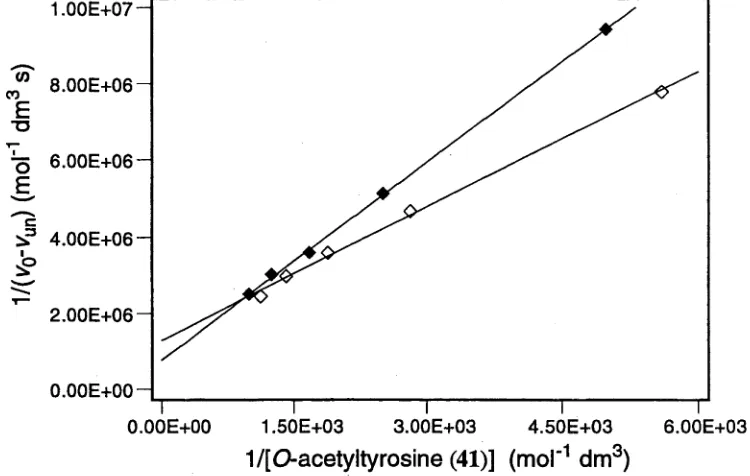
tyrosine derivative 41 for each of the esters (/?)-41 and (S)-41 (Figure 5). These data
describe a straight line in each case. This indicates that the hydrolysis of each enantiomer
o f the tyrosine derivative 41 is preceded by the formation of an association complex with
the host 19. The information for each of the acetates (/?)-41 and (S)-41 was fitted to
Equation 3, and values for the rate constant of the reaction of the bound guest (hmc) and
the association constant of the host-guest complex (K) were calculated for each case using
the values of the coordinate axis intercept and the slope (Table 5).
1 .0 0 E + 0 7
-8.00E+06 —
6 .0 0 E + 0 6
4 .0 0 E + 0 6
2 .0 0 E + 0 6
-1.50E+03 3.00E+03 4.50E+03
1/[0-acetyltyrosine (41)] (m ol'1 dm3)
0.00E+00 6.00E+03
Figure 5. Lineweaver-Burk plot for the hydrolysis o f each o f the acetyltyrosines (/?)-41 ( ♦ ) and (S)-41 (0) in the presence of the m odified cyclodextrin 19 (1.4 x 10~3 mol dm '3) in 0.01 mol dm '3 pH 10.0 borate buffer at 298 K.
1 1 1
\
J
1
c
1 [cyclodextrin ] I kinc A dcyclodextrin] [substrate]
S u b strate ^“in c
(x 103 S ' 1)
K
( m o l'1 d m 3)
h'xn cR
( m o l'1 d m 3 s '1)
(* )-4 1 C S > 4 1
0.84 ± 0.06 0.56 ± 0.04
480 ± 40 1100 ± 100
0.40 ± 0.06 0.6 ± 0.1
Table 5. Kinetic parameters for interaction between each of the tyrosine derivatives (/?)-41 and (S)-41 and the modified cyclodextrin 19 in 0.01 mol d m '3 pH 10.0 borate buffer at 298 K.
The association constants for the complexes formed between the tyrosine
derivatives (/?)-41 and (S)-41 and the modified cyclodextrin 19 were determined to be
480 and 1100 m ol'1 dm3, respectively, indicating an enantiodiscrimination on binding of
ca. 2.3. The rate constants for the reactions of the bound species (0.84 x 10'3 and
0.56 x 10'3 s '1 for the acetates (/?)-41 and (S)-41, respectively) indicate an
[image:38.525.70.445.136.374.2]