Astro2020 Science White Paper
Pulsars in a Bubble?
Following Electron Diffusion in the Galaxy
with TeV Gamma Rays
Thematic Areas:
3
Formation and Evolution of Compact Objects3
Cosmology and Fundamental Physics3
Multi-Messenger Astronomy and AstrophysicsPrincipal Author: Name: H. Fleischhack
Institution: Michigan Technological University (MTU)
Email: [email protected]
Phone: 906 487 2124
Co-authors/Endorsers: A. Albert (Los Alamos National Lab [LANL]), C. Alvarez (UN-ACH, M´exico), R. Arceo (UNACH, M´exico), H. A. Ayala Solares (Pennsylvania State Uni-versity [PSU]),J. F. Beacom (The Ohio State University [OSU]),R. Bird(University of Cal-ifornia, Los Angeles), C. A. Brisbois (MTU), K. S. Caballero-Mora (UNACH, M´exico), A. Carrami˜nana (INAOE, M´exico), S. Casanova(Institute of Nuclear Physics Polish Academy of Sciences [IFJ]), P. Cristofari (Gran Sasso Science Institute), P. Coppi (Yale University), B. L. Dingus (LANL),M. A. DuVernois (University of Wisconsin), K. L. Engel (University
of Maryland [UMD]), J. A. Goodman(UMD),T. Greenshaw(University of Liverpool, UK),
J. P. Harding (LANL),B. Hona(MTU), P. H. Huentemeyer (MTU), H. Li(LANL), T. Lin-den(OSU),G. Luis-Raya(Universidad Polit´ecnica de Pachuca, Mexico),K. Malone(LANL), J. Mart´ınez-Castro (Centro de Investigaci´on en Computaci´on-IPN, M´exico), M. A. Mostaf´a (PSU), M. U. Nisa (University of Rochester), C. Rivi`ere (UMD), F. Salesa Greus (IFJ), A. Sandoval (Instituto de F´ısica, UNAM, M´exico), A. J. Smith (UMD), W. Springer (Univer-sity of Utah), T. Sudoh (University of Tokyo),K. Tollefson(Michigan State University), A. Zepeda (Cinvestav), H. Zhou (LANL)
Abstract: TeV Halos, extended regions of TeV gamma-ray emission around middle-aged pulsars, have recently been established as a new source class in gamma-ray astronomy. These halos have been attributed to relativistic electrons and positrons that have left the acceler-ation region close to the pulsar and are diffusing in the surrounding medium.
Measuring the morphology of TeV Halos enables for the first time a direct measurement of the electron diffusion on scales of tens of parsecs. There are hints that the presence of relativistic particles affects the diffusion rate in the pulsars’ surroundings. Understanding electron diffusion is necessary to constrain the origins of the apparent “excess” of cosmic-ray positrons at tens of GeV. TeV Halos can also be used to find mis-aligned pulsars, as well as study certain properties of the Galaxy’s pulsar population.
Future VHE gamma-ray instruments will detect more of those TeV Halos and determine how much pulsars contribute to the observed cosmic-ray electron and positron fluxes, and how they affect diffusion in their environments.
1
Science
1.1
TeV Halos
The HAWC observatory has discovered ‘halos’ of extended (several degrees) TeV gamma-ray emission around the Geminga and Monogem pulsars [1]. For Geminga, this emission is orders of magnitudes more extended than what is expected from the PWN.
These objects, dubbed ‘TeV Halos’, constitute a new source class [2]. The emission is consistent with inverse Compton (IC) emission from electrons and positrons1 that were originally accelerated by the pulsar or in the pulsar wind nebula (PWN), but have since escaped the acceleration region and are diffusing in the surrounding medium. In the region around Geminga, the diffusion radius of electrons with energies below 1 TeV is limited by the pulsar age; for higher energies, it is limited by the electron cooling time. The largest diffusion radius of about 70 pc is reached by 1 TeV electrons [1].
HAWC was able to measure the diffusion coefficient inside the Geminga and Monogem Halos. The results were significantly lower than what expected for the interstellar medium (ISM) [1]. Assuming the diffusion coefficient is constant over a larger region, these measure-ments indicate that Geminga and Monogem can not be the primary sources of the apparent excess in cosmic-ray positrons (see section1.3), as the electrons accelerated by these pulsars would cool long before reaching Earth.
However, there are models by which the streaming of the relativistic electrons itself sup-presses the diffusion coefficient near the pulsars [3]. There could be ‘bubbles’ of suppressed diffusion extending for tens of parsecs around middle-aged pulsars, with increased diffusion in the rest of the Galaxy. In that case, electrons leaving this bubble could still propagate to Earth and significantly contribute to the local positron fraction [4].
It has been proposed that all middle-aged pulsars should have such halos with approx-imately the same efficiency to produce TeV gamma rays and the same electron diffusion coefficient [2]. The TeV gamma-ray flux would then only depend on the pulsar’s spindown luminosity and its distance. In that case, many more such objects should be discovered in future searches [2]. Since the discovery of the first TeV Halos, HAWC has already reported at least two more TeV Halo candidates [5, 6]. Some of the unidentified or PWN-associated sources seen by HAWC and H.E.S.S. in the galactic plane may also be TeV Halos [2].
The presence of TeV Halos may be the best observational signature for the discovery mis-aligned pulsars, whose radio beam does not strike Earth [2]. The total number of TeV Halos can provide constraints on some properties of the Galactic pulsar population and the time it takes for a TeV Halo to form [7], which is not yet known. An upper limit for the halo formation time is given by the characteristic age of the Monogem pulsar (110 kyr).
Unresolved TeV Halos would contribute to the diffuse gamma-ray background. It has been proposed that they indeed make up a significant fraction of the measured Galactic diffuse flux at TeV energies [8]. That could explain the apparent discrepancies between the measured TeV diffuse flux and extrapolations from measurements at lower energies [9, 10].
1.2
Particle acceleration in pulsars and their environments
Pulsars are rapidly rotating neutron stars with strong magnetic fields capable of particle acceleration [11]. They can produce pairs of electrons and positrons and accelerate them up to TeV energies via polar cap cascades [12]. These particles escape the light cylinder and propagate in the surrounding medium along open field lines. Many young and middle-aged pulsars are surrounded by pulsar wind nebulae, parsec-scale regions energetically dominated by relativistic e+e− winds from the pulsar. Once in the PWN, electrons can be further
accelerated to higher energies. They emit X-rays via synchrotron emission and gamma rays via IC scattering [13]. Existing instruments have seen gamma rays at tens of TeV from such systems (e.g., [1, 14, 15]). In at least one system it is possible to observe the escape of electrons from the PWN seen in X-rays [16] and their subsequent cooling as they travel further from the pulsar [14]. More recent work has suggested pulsars may inject particles as high as∼30 TeV into its PWN [12], although there is evidence to suggest electron energies in the PWN reach at least as high as 100 TeV [14, 15,17].
1.3
Cosmic-ray electrons and the positron excess
While the bulk of cosmic rays constantly bombarding Earth are protons and nuclei, they also contain electrons (and positrons). Cosmic-ray electrons (CREs) have been observed with energies up to tens of TeV by space- and ground-based detectors. Their energies follow a soft, broken-powerlaw spectrum, with the index softening from -3 to -3.8 at around 1 TeV [18, 19, 20]. At TeV to PeV energies, electrons propagating through the Galaxy cool very efficiently via synchrotron emission and IC scattering. Thus,primary CREs at these energies must be produced in nearby sources (within hundreds of parsecs). There is also a component
ofsecondary electrons, produced in interactions of hadronic cosmic rays with the interstellar
medium (ISM).
At TeV energies, cosmic-ray positrons are expected to consist mainly of secondary par-ticles, with a softer spectrum than primary electrons, and the positron fraction is expected to decrease with energy. However, several experiments have observed an increase in the positron fraction above about 10 GeV, continuing up to at least 100 GeV [21,22,23], consis-tent with a hardening in the positron spectrum [24]. Possible explanations comprise physics beyond the standard model, for example dark matter decay or annihilation processes (see e.g., Ref. [25]), as well as the presence of one or several nearby positron accelerators (see e.g., Ref. [26]). As described in section 1.2, pulsars and their environments are good candidates for such accelerators. The study of particle acceleration in pulsars and their environment will provide important clues about the origin of the positron excess.
2
Future Research
TeV Halos have only recently been described as a source class, and not much is known about them. In this section, we propose three key projects, to be conducted over the next decade or two, that will help answer the following questions:
1. How do TeV Halos form and evolve?
2. How do they affect electron diffusion in the Galaxy?
3. What can we learn about the Galactic pulsar population from studying TeV Halos? The TeV gamma-ray channel is ideally suited for the study of TeV Halos. Their VHE IC emission is dominated by interactions with the CMB, a photon field of known magnitude and spectrum. Thus, there is little uncertainty in inferring the properties of the electron population from the measured IC emission.
The electrons in the Halo can also emit synchrotron radiation in the hard X-ray/soft gamma-ray range. Detection of this emission could also lead to important physics results as it is sensitive to the magnitude of the magnetic field in the halo region.
2.1
Deep observations of well-resolved TeV Halos
Further studies of bright, well-resolved TeV Halos, such as the prototypical Geminga Halo, are needed. Future observations should cover a larger energy range (tens of GeV to hundreds of TeV) with high sensitivity, have improved angular and energy resolution, and be able to address the following questions:
• Does electron diffusion proceed homogeneously in the pulsar environment, or are there any signs for asymmetries/inhomogeneities?
• Is there an ‘edge’ to the bubble, beyond which diffusion coefficient increases to the expected levels from the ISM? How far does the bubble extend?
• (How) does the diffusion coefficient depend on electron energy?
• What is the maximum energy up to which electrons can be found in the Halo?
Answers to these questions will help determine the processes that lead to the suppressed diffusion and the formation of TeV Halos, and let us better constrain the number of electrons from such sources that could make it to Earth.
2.2
Survey of known pulsars
A deep survey, looking for extended TeV emission around known radio and gamma-ray pulsars, will provide a larger sample of TeV Halos and enable population studies. The following questions should be addressed:
0 30 60 90 120 150 180 210 240 270 300 330 360
0.1 1.0 10.0
Source Count 10yr HAWC (North)
HAWC-like (All sky)
0 30 60 90 120 150 180 210 240 270 300 330 360 l [deg]
1013 1012
Diffuse Flux above 3.5 TeV
[c
m
2 s 1]
Milagro
10yr HAWC (North) HAWC-like (All sky)
101 100 101 Outside HAWC
Declination Range Edge of HAWC FoV
1013 1012
0 30 60 90 120 150 180 210 240 270 300 330 360
0.1 1.0 10.0
Source Count 10yr HAWC (North)
HAWC-like (All sky)
0 30 60 90 120 150 180 210 240 270 300 330 360 l [deg]
1013 1012
Diffuse Flux above 3.5 TeV
[c
m
2 s 1]
Milagro
10yr HAWC (North) HAWC-like (All sky)
101 100 101 Outside HAWC
Declination Range Edge of HAWC FoV
[image:5.612.81.533.70.187.2]1013 1012
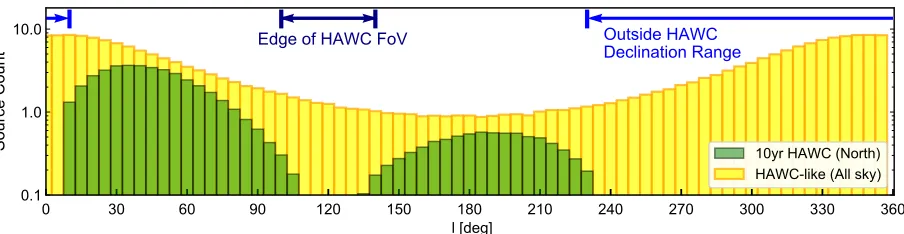
Figure 1: Prediction for the number and Galactic Longitude distribution of TeV Halos to be discovered with current or future instruments. A “HAWC-like” 10 year sensitivity is modeled as a theoretical instrument with a sensitivity of 3% of the Geminga flux across the entire sky. Figure from Ref. [7] (see there for more details about the model), reproduced with permission.
Under the hypothesis that all pulsars have TeV Halos with the same efficiency to produce gamma rays as Geminga, an all-sky VHE gamma-ray survey of with milli-Crab sensitivity should be able to discover several tens, up to hundreds of such objects, depending on how long it takes for a TeV Halo to form [2]. The study of younger pulsars in the age range of 10 kyr–100 kyr is especially crucial to constrain the minimum age and formation mechanisms. If no or few new TeV Halos are detected, we will be able to place constraints on the electron acceleration/escape efficiency and the diffusion coefficients around known pulsars.
2.3
Blind searches for new pulsars
So far, most pulsars have been detected via searches for periodic radio pulses. Some have also been found via their pulsed gamma-ray emission. However, there is an unknown fraction of ‘mis-aligned’ pulsars, whose radio-beam does not sweep Earth and from which we do not observe any pulsed emission. Blind searches for TeV Halos in the Milky way and neighboring galaxies such as the Large Magellanic Cloud are expected to lead to the discovery and identification of tens or hundreds new pulsars (see Figure 1 and Ref. [7]). In addition to further improving our understanding of TeV Halos and their evolution, blind searches will lead to a better understanding of pulsar populations and improve measurements of (see Ref. [7]):
• the total number of pulsars and the pulsar beaming fraction,
• the distribution of pulsar parameters such as the initial spin period and the magnetic field strength, and how these distributions depend on the host galaxy, and
3
Instrumentation
3.1
Current and planned instrumentation
While space-based gamma-ray detectors typically have large fields-of-view (FoVs), very good angular and energy resolution, and low backgrounds, they are limited in detector volume and thus cannot compete with ground-based observatories at TeV energies and above.
For ground-based gamma-ray detectors, the dominant detection techniques are imaging air-Cherenkov telescope (IACT) arrays, which record stereoscopic images of gamma-ray and cosmic-ray induced air showers via Cherenkov light emitted as the shower propagates through the atmosphere, and particle detector ground arrays, which detect air shower particles as they reach the ground. IACTs typically have smaller instantaneous FoVs (few degrees radius) compared to ground arrays (∼45◦), but better resolution and background suppression. Both techniques are sensitive to gamma-ray showers from tens/hundreds of GeV to hundreds of TeV, depending on the detector altitude. Both are inherently modular: the instruments’ sensitivities can be increased by increasing the number of telescopes/detector units.
The current generation of IACTs (VERITAS [28], MAGIC [29], and FACT [30] in the northern hemisphere and H.E.S.S. [31] in the south), sensitive in the energy range from tens of GeV to tens of TeV and beyond, will continue operating for the next few years. HAWC [32] in the northern hemisphere is the only active ground array gamma-ray detector. It was recently extended by an outrigger array and there are plans to run until at least 2025.
Two instruments are currently in the prototype/construction phase: LHAASO [33], a
hybrid ground/air Cherenkov array located in the northern hemisphere, will start partial operations this year (full operations in 2020). It is planned to operate for at least 10–15 years. LHAASO will have a wide FoV and be sensitive to gamma rays from 100 GeV to 1 PeV. The Cherenkov Telescope Array CTA [34] will start partial operations in 2022 and full operations in 2025. It comprises two sites, one in each hemisphere, covering an energy range from 20 GeV to at least 300 TeV. CTA is an array of pointing instrument with FoVs of several degrees radius and its observing program includes a combination of pointed and survey observations.
3.2
Recommendations for future projects
To perform the studies outlined in section 2, improvements in VHE gamma-ray detection
are necessary. We need both sensitive pointing instruments with good angular resolution for precise measurements of the TeV Halo morphology, as well as surveys covering the Galactic plane and nearby galaxies to discover more TeV Halos and characterize their populations. Due to the distributions of pulsars in the Galaxy, more Galactic TeV Halos are expected to be found closer to the Galactic center, visible in the southern sky (see Figure 1).
References
[1] A. U. Abeysekara et al. “Extended gamma-ray sources around pulsars constrain the
origin of the positron flux at Earth.” In: Science 358.6365 (2017), pp. 911–914. doi:
10.1126/science.aan4880.
[2] T. Linden et al. “Using HAWC to discover invisible pulsars”. In: Phys. Rev. D 96.10 (2017), p. 103016.doi: 10.1103/PhysRevD.96.103016.
[3] C. Evoli, T. Linden, and G. Morlino. “Self-generated cosmic-ray confinement in TeV halos: Implications for TeVγ-ray emission and the positron excess”. In: Phys. Rev. D 98 (6 2018), p. 063017.doi: 10.1103/PhysRevD.98.063017.
[4] D. Hooper, I. Cholis, and T. Linden. “TeV gamma rays from Galactic Center pulsars”.
In: Phys. Dark Universe 21 (2018), pp. 40–46. doi: 10.1016/J.DARK.2018.05.004.
[5] C. Riviere, H. Fleischhack, and A. Sandoval. HAWC detection of TeV emission near
PSR B0540+23. The Astronomer’s Telegram No. 10941. 2017. url: http : / / www .
astronomerstelegram.org/?read=10941.
[6] C. Brisbois et al.HAWC detection of TeV source HAWC J0635+070. The Astronomer’s
Telegram No. 12013. 2018. url: http : / / www . astronomerstelegram . org / ?read = 12013.
[7] T. Sudoh, T. Linden, and J. F. Beacom.TeV Halos are Everywhere: Prospects for New
Discoveries. Published on the ArXiv. 2019. url: https : / / arxiv . org / abs / 1902 .
08203.
[8] T. Linden and B. J. Buckman. “Pulsar TeV Halos Explain the Diffuse TeV Excess
Observed by Milagro”. In: Phys. Rev. Lett. 120.12 (2018), p. 121101. doi: 10.1103/
PhysRevLett.120.121101.
[9] A. A. Abdo et al. “A Measurement of the Spatial Distribution of Diffuse TeV Gamma
Ray Emission from the Galactic Plane with Milagro”. In: Astrophys. J. 688 (2008), pp. 1078–1083. doi: 10.1086/592213.
[10] T. Prodanovic, B. D. Fields, and J. F. Beacom. “Diffuse gamma rays from the galactic plane: probing the gev excess and identifying the TeV excess”. In:Astropart. Phys.27
(2007), pp. 10–20.doi: 10.1016/j.astropartphys.2006.08.007.
[11] P Goldreich and W. H. Julian. “PULSAR ELECTRODYNAMICS”. In: Astrophys. J.
157 (1969). doi:10.1086/150119.
[12] A. K. Harding et al. “Multi-TeV Emission from the Vela Pulsar”. In: Astrophys. J.
869.1 (2018), p. L18. doi: 10.3847/2041-8213/aaf3b2.
[13] B. M. Gaensler and P. O. Slane. “The Evolution and Structure of Pulsar Wind
Neb-ulae”. In: Annu. Rev. Astron. Astrophys. 44.1 (2006), pp. 17–47. doi: 10 . 1146 /
annurev.astro.44.051905.092528.
[14] F. Aharonian et al. “Energy dependent γ-ray morphology in the pulsar wind nebula
HESS J1825137”. In: Astron. Astrophys. 460.2 (2006), pp. 365–374. doi: 10 . 1051 /
[15] A. U. Abeysekara et al. “A Very High Energyγ-Ray Survey toward the Cygnus Region of the Galaxy”. In: Astrophys. J. 861.2 (2018), p. 134. doi: 10 . 3847 / 1538 - 4357 / aac4a2.
[16] F. A. Aharonian et al. “A possible association of the new VHE γ-ray source HESS
J1825137 with the pulsar wind nebula G18.00.7”. In:Astron. Astrophys. 442.3 (2005),
pp. L25–L29. doi:10.1051/0004-6361:200500180.
[17] H. Y¨uksel, M. D. Kistler, and T. Stanev. “TeV Gamma Rays from Geminga and the
Origin of the GeV Positron Excess”. In:Phys. Rev. Lett. 103.5 (2009), p. 051101.doi:
10.1103/PhysRevLett.103.051101.
[18] DAMPE Collaboration et al. “Direct detection of a break in the teraelectronvolt
cosmic-ray spectrum of electrons and positrons”. In: Nature 552 (2017), pp. 63–66.
doi: 10.1038/nature24475.
[19] O. Adriani et al. “Extended Measurement of the Cosmic-Ray Electron and Positron
Spectrum from 11 GeV to 4.8 TeV with the Calorimetric Electron Telescope on the International Space Station”. In: Phys. Rev. Lett. 120 (26 2018), p. 261102. doi: 10.
1103/PhysRevLett.120.261102.
[20] D. Kerszberg et al. The cosmic-ray electron spectrum measured with H.E.S.S.
(pre-sented at the 35th ICRC, Busan, South Korea). 2017.url:https://indico.snu.ac.
kr/indico/event/15/session/5/contribution/694/material/slides/0.pdf.
[21] O. Adriani et al. “An anomalous positron abundance in cosmic rays with energies
1.5-100 GeV”. In:Nature 458 (2009), pp. 607–609. doi:10.1038/nature07942.
[22] M. Ackermann et al. “Measurement of Separate Cosmic-Ray Electron and Positron
Spectra with the Fermi Large Area Telescope”. In:Phys.Rev.Lett.108, 011103 (2012),
p. 011103. doi: 10.1103/PhysRevLett.108.011103.
[23] L. Accardo et al. “High Statistics Measurement of the Positron Fraction in Primary Cosmic Rays of 0.5500 GeV with the Alpha Magnetic Spectrometer on the Interna-tional Space Station”. In: Phys. Rev. Lett. 113 (2014), p. 121101. doi: 10 . 1103 /
PhysRevLett.113.121101.
[24] M. Aguilar et al. “Towards Understanding the Origin of Cosmic-Ray Positrons”. In:
Phys. Rev. Lett. 122 (4 2019), p. 041102. doi: 10.1103/PhysRevLett.122.041102.
[25] M. Pospelov and A. Ritz. “Astrophysical Signatures of Secluded Dark Matter”. In:
Phys. Lett. B671 (2009), pp. 391–397. doi:10.1016/j.physletb.2008.12.012.
[26] D. Hooper et al. “HAWC observations strongly favor pulsar interpretations of the
cosmic-ray positron excess”. In: Phys. Rev. D 96.10 (2017), p. 103013. doi:10.1103/
PhysRevD.96.103013.
[27] J. Hinton and W. Hofmann. “Teraelectronvolt Astronomy”. In: Annual Review of
As-tronomy and Astrophysics 47.1 (2009), pp. 523–565. doi:
[29] J. Aleksi et al. “The major upgrade of the MAGIC telescopes, Part I: The hardware
improvements and the commissioning of the system”. In: Astroparticle Physics 72
(2016), pp. 61 –75.doi:https://doi.org/10.1016/j.astropartphys.2015.04.004.
[30] H Anderhub et al. “Design and operation of FACT – the first G-APD Cherenkov
telescope”. In:Journal of Instrumentation8.06 (2013), P06008–P06008.doi:10.1088/
1748-0221/8/06/p06008.
[31] J. A. Hinton. “The Status of the H.E.S.S. project”. In: New Astron. Rev. 48 (2004),
pp. 331–337.doi: 10.1016/j.newar.2003.12.004.
[32] A. U. Abeysekara et al. “The 2HWC HAWC Observatory Gamma Ray Catalog”. In:
Astrophys. J. 843.1 (2017), p. 40. doi: 10.3847/1538-4357/aa7556.
[33] H. He. “Design of the LHAASO detectors”. In: Radiation Detection Technology and
Methods 2 (2018). doi: 10.1007/s41605-018-0037-3.
[34] The CTA Consortium. Science with the Cherenkov Telescope Array. World Scientific, 2019. doi:10.1142/10986.
[35] A. Albert et al. Science Case for a Wide Field-of-View Very-High-Energy
Gamma-Ray Observatory in the Southern Hemisphere. Published on the ArXiv. 2019. url: