Pumping an atom laser
Graham Russell Dennis
A thesis submitted for the degree of Doctor of Philosophy
at The Australian National University
In memory of those we have lost these past few months:
Declaration
Except where acknowledged in the customary manner, the material presented in this thesis
is, to the best of my knowledge, original and has not been submitted in whole or part for a
degree in any university.
Graham Russell Dennis
May 2010
Acknowledgements
First and foremost, I would like to thank my supervisors: Joe, John and Craig. I have
learnt much these past few years, and that could not have happened without your guidance.
My supervisors have been invaluable in the writing of this thesis, as have my other
proof-readers: Andr´e, Cristina, Daniel, Mattias, Michael, Rob, Robin, and Stuart.
I have had many interesting and enlightening discussions with people too numerous to
count, but I must particularly thank Nick for his endless patience explaining the goings on
of experimental physics, and Mattias & Simon for teaching me the tricks with performing
numerical simulations.
Over the past several years, I have had the great pleasure to work with an incredible
group of people in the Physics Olympiad program. In particular, I would like to thank
Kate, Matt, Alix & Lucy. Who could ever thought it was possible to have fun while writing
an exam? As strange as it sounds, you have helped keep me sane.
Throughout my PhD, I have collaborated closely with the Rubidium and Helium BEC
experimental groups at the ANU. In particular, I would like to thank John, Nick & Cristina
from the Rubidium group and Andrew & Rob from the Helium group for helping me learn
the ‘language’ of experimental physics.
I would like to thank the many people with whom I have shared my time at the
‘department of many names’: Andr´e, Ben, Cristina, Daniel, Emily, Finn, Gordon, JD,
Jean-Fran¸cois, Julien, Justin, Kate, Mahdi, Matthew, Mattias, Michael, Nick, Oliver,
Paul A., Paul S., Rachel, Robin, Simon, Stuart, Sven and Tom. You have been excellent
company. In time, perhaps, I can repay my debt of baked goods and chocolate.
Finally, I would like to thank my parents Greg & Lynda. You have encouraged me to
delve into the nature of things, and to seek the satisfaction of understanding.
Abstract
Measurement is our fundamental tool for learning about the world around us. It is
from observing trends in measurements that we develop the theories that enable us to
predict future behaviour, and it is against measurements that we determine the validity
of these theories. Increases in the precision of our measurements are fundamental to our
understanding.
Atom interferometry is a new method for performing precision measurements that
uses the matter-wave nature of atoms to perform interferometry experiments analogous to
those performed with photons. However, in contrast to optical interferometry, which uses
coherent sources of photons, atom interferometry uses thermal atomic sources, in part due
to the unavailability of high-flux coherent atomic sources. Although pulsed coherent atomic
sources are presently available, continuous sources are not. Creating a truly continuous
coherent source for atoms is tricker than for photons. One of the largest challenges is
that atom number is conserved. A source of atoms is therefore necessary to produce a
truly continuous atom laser. This source must be used to replenish the lasing mode of the
atom laser, and the process must operate without significantly disturbing the coherence
properties of the lasing mode. It is this replenishment or pumping process that has been
investigated theoretically in this thesis.
There are only two choices for the reservoir that makes the replenishment (or pumping)
process of an atom laser irreversible: the empty modes of the optical field, and the empty
modes of the atomic field. Processes of both forms are considered. Using an optical reservoir
has the advantage that atoms are not necessarily lost as part of the pumping process,
which is necessary when using an atomic reservoir. The efficiency of processes using an
optical reservoir can therefore be higher. Using an atomic reservoir, however, has the
advantage that it is easier to implement as one can use the standard experimental technique
of evaporation which is commonly used in the production of pulsed coherent atomic sources.
We show theoretically in this thesis that although it is possible to produce a continuous atom
laser using an atomic reservoir, the flux achieved in the geometry considered is insufficient
to compete with pulsed coherent atomic sources for precision measurement. The results for
the pumping process using an optical reservoir are more promising. Although condensed
sources were used as the source for this process, a detailed comparison of the theoretical
calculations and experimental results indicate that the detrimental reabsorption processes
are suppressed. This suggests that it may be possible to use higher-flux thermal atomic
Contents
1 Introduction 1
1.1 Photon lasers and Atom lasers . . . 3
1.1.1 The resonator . . . 4
1.1.2 The lasing mode . . . 4
1.1.3 The outcoupling process . . . 6
1.1.4 The pumping mechanism . . . 8
1.2 Matter wave amplification. . . 13
1.2.1 . . . using an optical reservoir . . . 13
1.2.2 . . . using an atomic reservoir . . . 13
1.3 Thesis overview . . . 14
2 Background Theory 17 2.1 Indistinguishability and Bose-Einstein condensation . . . 17
2.2 Hamiltonian . . . 20
2.3 Atomic scattering . . . 22
2.4 The Gross-Pitaevskii equation . . . 24
2.4.1 Thomas-Fermi approximation . . . 29
2.4.2 Application: Transverse profile of the atom laser . . . 30
2.5 Loss processes and the master equation . . . 37
2.5.1 Application: Penning ionisation . . . 38
2.6 Beyond the Gross-Pitaevskii equation . . . 40
2.6.1 Stochastic phase-space methods . . . 41
2.6.2 Bogoliubov-type methods . . . 47
2.6.3 Methods applicable near the critical temperature . . . 50
2.7 Numerical Techniques . . . 50
2.7.1 Absorbing boundary layers . . . 51
3 On the production of entangled beams from a metastable helium BEC 55
3.1 Introduction . . . 55
3.2 The metastable helium ‘Peaks’ experiment . . . 57
3.3 Overview of Bogoliubov theory . . . 58
3.4 Condensate excitations in the perturbative regime . . . 64
3.4.1 The dynamical steady-state . . . 65
3.4.2 Excitation dynamics . . . 69
3.4.3 Excitation spectra in theκ= 1 limit . . . 70
3.4.4 Floquet’s theorem . . . 72
3.4.5 Determination of the dynamical instabilities . . . 73
3.4.6 Discussion of the dynamical instabilities . . . 77
3.5 Full 3D calculation . . . 79
3.5.1 Choice of artificial boundary conditions . . . 81
3.5.2 Calculation of the momentum flux density . . . 82
3.5.3 Equations of motion . . . 85
3.5.4 Verification of semianalytical model . . . 88
3.5.5 Comparison of Theory and Experiment . . . 92
3.5.6 Entangled beams? . . . 95
3.6 Conclusion . . . 98
4 Optical pumping of an atom laser 101 4.1 Introduction . . . 101
4.2 Pumping mechanism . . . 103
4.3 The continuous pumping experiment . . . 107
4.4 Simple single-mode model . . . 113
4.5 Multimode model . . . 117
4.5.1 Model derivation . . . 118
4.5.2 Two overlapping condensates model . . . 129
4.5.3 Simple atom laser model . . . 138
4.5.4 3-level atom laser model . . . 147
4.5.5 An aside on 5-level atom lasers . . . 156
4.5.6 The pulsed pumping experiment . . . 159
4.6 The contribution of reabsorption . . . 167
Contents xiii
5 Evaporation-induced pumping of an atom laser 173
5.1 Introduction . . . 173
5.2 Scheme . . . 174
5.3 Model . . . 176
5.4 Simulation results . . . 181
5.4.1 Typical dynamics and parameter studies . . . 181
5.4.2 Behaviour in the high-temperature limit . . . 185
5.5 Conclusion . . . 190
6 Conclusion 193 A Elementary excitations of temporally periodic Hamiltonians 197 A.1 Evolution of the excitations . . . 197
A.2 EPR entanglement of unstable excitations . . . 202
B Penning ionisation in metastable condensates 205 B.1 Penning ionisation master equation . . . 205
B.2 Gross-Pitaevskii Penning ionisation terms . . . 207
B.3 Truncated Wigner Penning ionisation terms . . . 207
C Derivations and calculations 211 C.1 Proof of the periodicity of the nonlinear optical Bloch equations . . . 211
C.2 Example calculation of the momentum density flux . . . 213
C.3 Solving the Quantum Kinetic Theory model . . . 217
C.3.1 Density of states . . . 218
C.3.2 Collision and energy-redistribution in Quantum Kinetic Theory . . . 219
C.3.3 Three-body loss in Quantum Kinetic Theory . . . 220
D Calculational tools 225 D.1 xpdeint . . . 228
D.1.1 Tools and packages used by xpdeint . . . 231
Chapter 1
Introduction
Measurement is an essential part of our developed world. We measure the quantities of
ingredients when following a recipe, the sizes of pieces of wood when making a cabinet,
and we obsessively measure time for fear of running out of it. Many of these measurements
are quite imprecise: “The recipe only asks for 100 g of chocolate, but a little more won’t
hurt,” “I can sand it down later if it doesn’t quite fit,” or the notorious, “I’ll be with you
in a minute. . . ” Very precise measurements are, however, making an increasing impact
on our lives, although usually without our realising it. Perhaps the best example of this
is the Global Positioning System (GPS), which uses a system of satellites orbiting the
Earth, each of which contains an atomic clock for the very precise measurement of time.
By comparing the arrival times of the precisely synchronised signals of these satellites, it
is possible to determine one’s position on Earth to an accuracy of better than 1 m, even
without a precision clock at the receiver.
One way of performing precise measurements is to compare the quantity to be measured
against a known scale and count the number of divisions. For example, when measuring
the length of a piece of string with a ruler, one counts the number of divisions between the
ends of the string. Fortunately, many of the divisions are numbered, making this an easier
task. The precision of this kind of measurement is limited by the smallest division on the
ruler. If I want to know how long my piece of string is to the nearest micron, I will need a
measurement device with a smaller division.
An alternative way of performing precise measurements is using interferometry. At its
heart, interferometry is about the measurement of the difference in the readings of two
oscillators. This difference can be measured to much less than a single division (a cycle
of the oscillator). The precision with which this difference can be measured increases as
more oscillators are compared. While using oscillators with smaller divisions improves
interferometric measurements, the precision can also be improved by comparing more
oscillators. This is the advantage of using interferometry for precision measurements.
Many different kinds of oscillators can be used in interferometry measurements. Most
use the phase oscillations of photons, however some use the matter-wave oscillations of
electrons [1], neutrons [2], or atoms [3–6]. Using photons has the advantage that they are
easy to produce in large numbers using lasers, while using any of the matter-wave oscillators
has the advantage of a significantly higher oscillation frequency, and therefore shorter scale
division. The heaviest of these matter-oscillators, the atom, has an oscillation frequency
of approximately M c2/~ω ∼ 1010 times larger than that of a visible photon. The flux
difference between photon sources and atom sources is significant however. While the count
rate for a watt of photons is approximately 1019s-1, typical atom interferometers offer only
107s-1. Without using entangled sources, the precision of interferometric measurements
scales as the square-root of the number of particles measured, so there is still a potential
improvement in sensitivity of 1010×p107/1019= 104. It is the aim of atom interferometry
to make use of this improvement in sensitivity for precision measurements.
Since the development of the first separated path atom interferometers in 1991 [3–6],
atom interferometers have become competitive for the precision measurement of rotations
[7] and gravity gradients [8], with sensitivities within about an order magnitude of the best
experiments [9–11]. For the absolute measurement of the gravitational field strength, atom
interferometry is world-leading [12], with sensitivities more than an order of magnitude
below that of competing technologies.
In comparison to optical interferometry experiments, which typically usecoherentoptical
sources such as (photon) lasers, the above atom interferometry experiments are performed
with coldthermal atomic sources (the optical equivalent would be black-body radiation).
Coherent sources — which are characterised by a macroscopic occupation of a single
quantum state, and typically have a narrow spectral distribution — are useful in optical
interferometry experiments in which the interaction time is independent of wavelength,
as the measured phase difference depends on the optical frequency and therefore the
wavelength. Sagnac interferometers, gravitational wave sensors, and any interferometer
that measures path-length differences are all examples of interferometers that fall into this
class. For atom interferometers however, it is more common that the phase difference for
§1.1 Photon lasers and Atom lasers 3
will beindependent of the de Broglie wavelength. The reason for this difference is due to
the different dispersion relations (the expression for energy — or equivalently, frequency
— as a function of wavenumber) of photons and atoms. While it is therefore important
that optical interferometers use sources with a narrow range of wavelengths, this is not
necessarily the case for atom interferometers.
Coherent atomic sources were developed in 1995 with the achievement of Bose-Einstein
Condensation (BEC) in dilute atomic gases [13–15]. Such sources offer several advantages
for atom interferometers: a narrower momentum distribution allows better control of
systematic uncertainties related to the initial position and velocity; more efficient operation
of large-momentum transfer beam splitters, which are highly velocity selective, increasing
the interaction time; and quantum degeneracy offers the possibility of increasing sensitivity
through the use of squeezed or entangled atomic sources. Unfortunately, the lower fluxes of
currently available coherent atomic sources leads to a higher shot noise, which more than
offsets the increases in sensitivity discussed above. To access these potential advantages
of coherent atomic sources, in particular the interesting possibilities involving the use
of squeezed and entangled atomic sources (which are interesting in their own right for
fundamental tests of quantum mechanics), it will be necessary to produce a truly continuous
high-flux source of coherent atoms: the pumped atom laser.
Pulsed (or quasi-continuous) atom lasers have been produced before. These are sources
of highly degenerate coherent atoms outcoupled from a Bose-Einstein condensate. These
coherent atomic sources are limited by the atom number of the source condensate; once
the atoms run out, the atom laser stops. The condensate must be replenished (or pumped)
to produce a truly continuous coherent atomic source. We focus our attention on this
pumping process in this thesis.
1.1
Photon lasers and Atom lasers
The basic features necessary of a continuous atom laser are analogous to the features of
a continuous photon laser: a resonator, a lasing mode, an outcoupling process, and a
Bose-stimulated pumping mechanism (see Figure 1.1). The first three of these features
are well understood for an atom laser; experimentally realising the fourth, the pumping
Pumping mechanism
(Photon) laser
Outcoupling mirror
Lasing mode
Lasing cavity (resonator)
Pumping mechanism
Trap (resonator)
Outcoupling
Atom laser
BEC (lasing mode)
(a) (b)
Figure 1.1: Schematic diagrams of (a) a photon laser, and (b) an atom laser.
1.1.1 The resonator
In a photon laser, the resonator is typically a cavity formed between two (or more) mirrors
trapping the photons within a region of space. The optical mode trapped within the
resonator is the lasing mode. For an atom laser, the resonator is an ‘atom trap’, either an
optical trap using the ac Stark shift to trap the atoms in a region of high optical intensity,
or a magnetic trap using the Zeeman shift to selectively trap certain magnetic hyperfine
states near a local minimum of the magnetic field strength.
1.1.2 The lasing mode
The necessary property for the lasing mode of a laser — be it optical or atomic — is that
it have an occupation much greater than one [17]. For photons, such a highly-degenerate
mode was first achieved with the development of the maser [18]; a photon condensate
cannot exist in equilibrium as total photon number is not conserved [16, 19]. Total atom
number is, however, conserved and Bose-Einstein condensation occurs below a critical
temperature [20]. Below this critical temperature, a significant fraction of the atoms in the
system occupy a single spatial mode; exactly what is required of the lasing mode of an
atom laser.
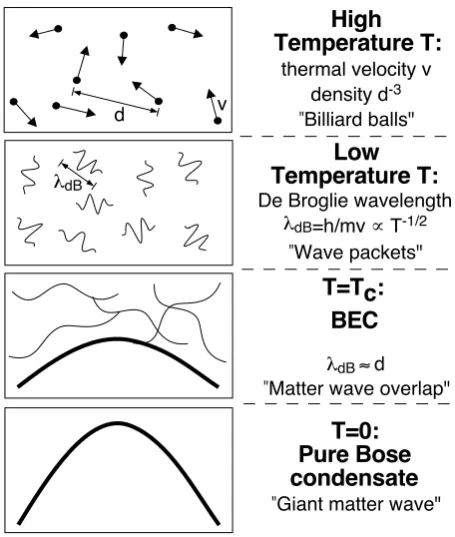
The process of Bose-Einstein condensation can be understood in a simplified picture in
which the atoms are viewed as wave-packets with an extent of the order of the thermal
de Broglie wavelength λdB = (2π~2/M kBT)1/2, where M is the mass of the atom, kB
is Boltzmann’s constant, and T is the temperature of the atoms. At room temperature,
the de Broglie wavelength is sufficiently small (∼ 5×10⁻¹¹m for 4He at T = 300 K)
that the atoms behave as point-like billiard balls (upper panel of Figure 1.2). As the
§1.1 Photon lasers and Atom lasers 5
High Temperature T:
Low Temperature T:
T=Tc: BEC
T=0: Pure Bose condensate
hdB
De Broglie wavelength hdB=h/mv | T-1/2
v
thermal velocity v density d-3
d
hdB 5d "Billiard balls"
"Wave packets"
"Matter wave overlap"
[image:19.595.217.445.99.368.2]"Giant matter wave"
Figure 1.2: Comparison of the behaviour of a Bose gas at different temperatures. See main text.
Reproduced from Ketterleet al. [16].
As the temperature continues to decrease, the de Broglie wavelength approaches the mean
interparticle separationd and the atomic matter waves begin to overlap (third panel of
Figure 1.2). Below this temperature, a Bose-Einstein condensate begins to form, until at
T = 0 K, all atoms are in the condensate (lower panel of Figure 1.2). Conservation of total
number is necessary for BEC, as it is because of this that the interparticle separationd
remains constant as temperature is decreased (in a box of constant volume); for photons,
as the temperature is decreased the total number of photons in the system decreases,
increasing the mean interparticle separationdfaster than the photon wavelength increases.
Hence photon condensation cannot occur in equilibrium.
Bose-Einstein condensation is a macroscopic quantum phenomenon with a broad range
of applications beyond the production of atom lasers. Perhaps the most interesting of these
are the development of quantum simulators [21, 22], experiments which directly realise
theoretical condensed matter models, which were initially proposed as approximations to
other systems. For example, the Bose-Hubbard model [23] of interacting bosons was realised
by loading a BEC into an optical lattice. By changing the depth of the optical lattice, the
ratio of the tunnelling and interaction terms was changed, permitting direct observation
a variety of other systems, including Josephson junctions [25], and reduced-dimension
systems such as the Tonks-Girardeau model of 1D hard core bosons [26–28]. Dilute gas
BECs have also been used in the direct observation of persistent currents in the form
of vortices and vortex lattices [29], the coherent control of optical information [30], the
observation of quantum optical effects in atoms such as the Hanbury-Brown-Twiss effect
[31], and four-wave mixing [32].
One of the advantages of dilute gas BEC that gives these systems such a broad range
of applications is the extraordinary degree to which these systems can be controlled and
manipulated: their effective dimensionality can be changed by changing shape of the
confining potential [28, 33, 34]; the de Broglie wavelength is controllable over many orders
of magnitude 1 nm.λdB .10µm; the sign and magnitude of interparticle interactions can be controlled [35], from attractive interactions through to almost infinitely repulsive
interactions, including the non-interacting limit; essentially ‘pure’ potentials (minimal
absorption) may be constructed in a range of forms, including highly regular potentials
such as harmonic or lattice potentials and random potentials with controllable statistical
properties [36–40]. Dilute gas BEC also has a range of available observational tools for
probing the system [16] including absorptive imaging, phase-contrast imaging, Bragg
scattering [41], and ion detection for metastable species [42].
The goal of atom optics is to use the fundamental differences between atoms and
photons in the application of the principles of laser optics to new fields of research.
1.1.3 The outcoupling process
The outcoupling of light from the lasing mode of a photon laser is achieved by making one of
the cavity mirrors partially transparent. The emitted light is the output mode of the photon
laser. For atom lasers, an analogous technique can be used in optical traps by lowering
the depth of the trap until some atoms can tunnel out of the trap with the assistance
of gravity. In magnetic traps, electromagnetic radiation is applied to transfer the atoms
(either directly with radio-frequency radiation [43, 44], or indirectly via a multi-photon
Raman transition [45–47]) into a magnetically-insensitive state in which they fall freely
under gravity. These outcoupled atoms form the atom laser beam.
Contemporary atom optics experiments operate in pulsed mode. Without a pumping
mechanism, the atom laser beam is limited by the size of the condensate. Once all of
§1.1 Photon lasers and Atom lasers 7
fundamental limit on the linewidth (related to the longitudinal velocity-spread) of the
atomic pulse produced: the Fourier limit, proportional to the inverse of the outcoupling
time [48]. This limit can be made arbitrarily small (until the energy uncertainty in the BEC
due to interatomic scattering becomes significant [49]) at the expense of an arbitrarily low
atom flux. Practically however, this trade-off cannot be made because the signal-to-noise
ratio for atom laser experiments depends critically on the atomic flux [50]. The only way
to achieve a high-flux atom laser with a narrow linewidth is with a continuous pumping
process, which has yet to be achieved experimentally.
The outcoupling process for atom lasers displays a range of behaviour. While intuitively
one might expect that increasing the outcoupling strength would continuously increase the
atom laser flux, this is only true up to a point. In the limit of large outcoupling rates, a
bound state forms [51], and the atom laser shuts down [52].
The outcoupling process also strongly affects the transverse profile of the atom laser. Due
to the mean-field repulsion the atoms experience as they leave the condensate, significant
interference fringes are observed on the atom laser profile [53, 54]. These interference fringes
complicate the spatial profile of the atom laser, making any atom interferometry experiment
that relies upon separated beam paths more challenging. The interference fringes on the
transverse profile increase the sensitivity of the experiment to imperfections in the spatial
overlap of the previously-separated beams when they are combined for detection. These
interference fringes may be reduced by outcoupling from the bottom of the condensate [55]
or by giving the atoms a significant momentum kick as they leave the condensate [56]. The
transverse profile of the atom laser is discussed in greater detail in Section 2.4.2.
Even in the absence of a pumping process, atom lasers can be used for a variety of
interesting experiments. The correlation and counting statistics of an atom laser have been
measured [57], an atom laser has been guided with optical waveguides [58], and a BEC has
been probed using an atom laser outcoupled from a separate BEC [59]. There have also
been interesting theoretical proposals to produce non-classical atom laser states using the
interatomic interaction of the atom laser [60], or by outcoupling with squeezed light [61].
Pump R
|4�
|3�
|2�
|1�
Lasing transition Fast
Fast Slow
Slow
Figure 1.3: Schematic diagram of the atomic levels of a 4-level photon laser. The dashed lines indicate decay processes, and the ‘slow’ and ‘fast’ labels indicate the relative speed of the decay processes. Once atoms decay to the|1iground state, they are pumped to the state|4iwith a rate R. This process drives the population inversion on the|2i ↔ |3itransition. Diagram derived from Figure 13.2-6 of Saleh and Teich [63].
1.1.4 The pumping mechanism
The photon laser
The pumping mechanism of a laser acts as an amplifier for the lasing mode. It is what
replenishes the losses of the lasing mode due to outcoupling and any other loss processes.
Without a pumping mechanism, an optical laser is simply a leaky cavity emitting an
exponentially-decreasing amount of light. The linewidth of this emitted light is limited
by the linewidth of the optical cavity. The pumping mechanism for an optical laser not
only permits continuous operation of the laser, it also narrows the linewidth of the laser
in a process known asgain-narrowing. Gain-narrowing results from the saturation of the
pumping process for large signals; no physical amplifier can amplify a signal indefinitely.
A pumping mechanism contains excitations that can each increase the occupation of
the lasing mode by one. These excitations are replenished at a finite rate, limiting the rate
at which the lasing mode may be increased. For example, in the 4-level photon laser model
illustrated in Figure 1.3, atoms are pumped from the ground state |1ito the short-lived
state|4i at a rateR. The atoms in state|4imay decay into the|3istate, the excited state
of the lasing transition. The occupation of the lasing mode cannot therefore be increased
at a rate greater thanR. Any physical pumping mechanism will also exhibit saturation,
and therefore the lasing mode will exhibit gain-narrowing.
Another necessary property of the pumping mechanism is that it be irreversible; once
the occupation of the lasing mode has been increased, the probability that the process will
essentially-§1.1 Photon lasers and Atom lasers 9
empty modes known as a reservoir. In the case of the 4-level photon laser model depicted
in Figure 1.3, once an atom in the excited state |3i of the lasing transition has undergone
stimulated emission into the|2istate by emitting a photon into the lasing mode, it rapidly
decays into the ground state|1i. By ensuring that the ground state of the lasing transition
|2i decays to the true ground state |1i faster than it can absorb a lasing photon, the pumping process is made irreversible. The reservoir is comprised of the essentially-empty
modes of the optical field coupled to the |1i ↔ |2i transition, as once a photon on this
transition is emitted spontaneously, it does not return. This reservoir ensures that the
modes of the |2i atomic level are also essentially empty.
Finally, in many circumstances it is desirable that the photon laser have only one lasing
mode. If the resonator supports many different modes, and if the gain bandwidth of the
pumping mechanism encompasses more than one of these modes, multiple lasing modes may
result. As the photon–photon interaction is negligible, these lasing modes do not directly
interact, and may operate independently. Multiple-mode operation in a photon laser is
naturally suppressed if the pumping process ishomogeneously broadened. In homogeneously
broadened gain media, every excitation of the pumping mechanism contributes to the
gain of the lasing modes in the same way, i.e. every excitation is resonant with the same
lasing modes. If the gain medium isinhomogeneously broadened, some classes of pumping
excitations will contribute differently to the total gain profile than others. A classic example
of this is Doppler-broadening. Atoms in a gain medium have a finite temperature, and their
motion affects what frequencies they are resonant with (in the laboratory frame) due to the
Doppler effect. If the size of this frequency broadening is greater than the natural linewidth
of the lasing transition, not all of the pumping excitations will be resonant with a given
lasing mode. It will therefore only be those pumping excitations resonant with a given
lasing mode that are saturated by it; lasing modes resonant with the remaining unsaturated
pumping excitations will continue to experience gain and may lase independently. In this
case, thse lasing modes will experience gain independently, each without saturating the
other. If the pumping process is inhomogeneously broadened, undesirable modes can be
removed by increasing their loss in the optical resonator. This is naturally achieved by
the addition of a second, smaller cavity inside the resonator that is only resonant with the
desired mode. If the pumping process is homogeneously broadened however, while multiple
modes may initially experience gain, only the mode with the largest net gain will survive
Atom removed from system by forced evaporation
|
g
�
|
e
�
Photon escapes system
(a)
(b)
Optical reservoir
Atomic reservoir
Lasing mode
Lasing mode
E
n
er
gy
Figure 1.4: Classes of pumping mechanism for an atom laser as defined by the reservoir. The crossed circle indicates which excitation in the process irreversibly leaves the system.
The atom laser
There are two choices of reservoir for the pumping mechanism of an atom laser: the empty
modes of the optical field, or the empty modes of the atomic field. Each choice corresponds
to a different class of pumping mechanism. These two classes are illustrated in Figure 1.4.
In the first, an atom in an excited internal state is brought into resonance with the lasing
mode such that it can decay into the lasing mode. It is Bose-stimulated to do so by the
occupation of the atomic lasing mode. Once the emitted photon leaves the system, this
decay is irreversible. In the second, two atoms scatter into different energy states, one
going into the lasing mode, while the other gains sufficient energy to be removed from the
system (for example, due to forced evaporation, the same process used in the formation of
BEC).
Single-mode operation is not simply desirable for an atom laser, it is necessary. Due to
the large interatomic interactions, multiple lasing modes in an atom laser could not operate
independently. Significant scattering would occur between the lasing modes, increasing the
linewidth of both, possibly destroying any laser-like qualities in the process. While the
interatomic interactions can be ‘switched off’ with the use of a Feschbach resonance [35],
the loss processes are such that higher energy modes experienceless loss than the lower
modes in this case, making the atom laser unstable [64]. This instability can be resolved by
increasing the interatomic interactions [64], adding a position-dependent loss near the edge
of the lasing mode [65], and in the case of non-zero interatomic interactions, by increasing
the pumping rate [66].
In all of the phenomenological atom laser pumping models discussed in the previous
§1.1 Photon lasers and Atom lasers 11
that all pumping excitations contributed equally to the gain of all modes. This is more
difficult to achieve for atom lasers than for photon lasers. In the case of photon lasers, the
dispersion relation for the by-product of the gain process (the de-excited atom) is relatively
flat by comparison to that of the lasing mode. This is a useful property, as it means that
pumping excitations with a wider range of momenta are resonant with the lasing mode,
as variations in the momentum difference between the pumping excitation and the lasing
mode can be compensated for by the by-product with minimal energy cost. In the limit of a
perfectly flat dispersion relation for the by-product, pumping excitations of any momentum
can result in gain if the decay process conserves energy, and due to the finite linewidth
of the transition, energy need only be conserved to within this energy uncertainty. As a
concrete example, consider the photon laser pumping mechanism illustrated in Figure 1.3
and the atom laser pumping mechanism illustrated in Figure 1.4(a). The fundamental
difference between these two pumping mechanisms is that for the photon laser, the emitted
photon goes into the lasing mode with the atom as the by-product, while for the atom
laser, it is the decayed atom that enters the lasing mode with the emitted photon as the
by-product. The decay process of these pumping mechanisms is illustrated in Figure 1.5.
If a violation of energy conservation is permitted in this process of up to±~∆ω where ∆ω
is the linewidth of the |gi ↔ |ei transition, excited atoms with a wider range of momenta
can contribute gain to the lasing mode in the case of the photon laser than in the case of
the atom laser. Specifically, for the photon laser, the wavenumber of the excited atom in
the direction parallel to the lasing mode may vary by
∆ki,k
ph≈
2M∆ω
~|kγ| ,
whereM is the mass of the atom. The wavenumber of the atom in perpendicular directions
is unconstrained. However, for the atom laser, the magnitude of the wavenumber of the
excited atom may only vary by (assuming a stationary lasing mode of size d)
(∆|ki|)at≈ 2∆ω
c +
π d,
where the second term is due to the momentum-width of the lasing mode. For the
λ= 633 nm lasing transition of the Helium-Neon gas laser, ∆ω ≈100 MHz [67], MNe =
3.3×10⁻²⁶kg, giving ∆k i,k
ph ∼10
10m-1for the photon laser and (∆|k
i|)at∼106m-1for
|
e
�
�
k
i�
k
f�
k
γ|
g
�
[image:26.595.183.349.103.234.2]Before After
Figure 1.5: Excited state atom in the|eistate with momentum~ki decays into an atom in the
ground state |giwith momentum~kf, and a photon with momentum~kγ. In the photon laser
pumping mechanism, the photon is in the lasing mode and the atom decays into a mode that is essentially unoccupied (the atom is the by-product of the gain process), while in an atom laser pumping mechanism, the decayed atom is in the lasing mode and the emitted photon is part of the reservoir which is essentially unoccupied (the photon is the by-product of the gain process).
the possible momentum width of the pumping excitations for the pumping mechanism to
operate in the ‘homogeneously broadened’ limit. If the momentum width of the pumping
excitations is greater than this, gain for modes other than the main lasing mode will not be
saturated by the main lasing mode. The remaining modes experiencing gain will increase
the linewidth of the atom laser.
In Chapter 4, a pumping mechanism for an atom laser using an optical reservoir is
considered. We attempt to solve the problem of the narrow permissible momentum width
of the pumping excitations by making their momentum distribution sufficiently narrow
that it can be guaranteed that every atom will be momentum-resonant with the pumping
process at some point.
In Chapter 5, a pumping mechanism using atomic modes as the reservoir is considered.
Although their dispersion relation cannot be considered flat with respect to that of the
lasing mode atoms, it is far more so than that of the photons. The difficulty with this
pumping mechanism is that it is inescapable that thermal atoms will be in the vicinity of
the lasing mode. Scattering between the lasing and thermal atoms will contribute to the
collisional broadening of the lasing mode. Using a Feschbach resonance to cancel these
interactions is not an option as the pumping mechanism itself relies upon interatomic
§1.2 Matter wave amplification. . . 13
1.2
Matter wave amplification. . .
A number of matter-wave amplification processes using the two possible reservoirs have
been proposed and demonstrated. These are discussed in this section. While none of these
matter-wave amplification processes constitute an atom laser pumping mechanism, it is
envisaged that an atom laser pumping mechanism would be based on a similar process.
1.2.1 . . . using an optical reservoir
A number of previous experiments observing the process of super-radiant Rayleigh
scat-tering seem to offer a physical mechanism for providing pumping through matter-wave
amplification [68, 69]. Super-radiant Rayleigh scattering occurs when a far off-resonant laser
illuminates an elongated BEC. A matter-wave grating forms along the long axis of the BEC
and atoms are preferentially scattered into non-stationary momentum states. By providing
a moving ‘seed’, researchers were able to demonstrate pulsed coherent amplification via
the Rayleigh super-radiance mechanism. However, this type of matter-wave amplification
is a transient phenomena, observed over timescales ranging from tens [68] to hundreds of
microseconds [69]. On longer timescales, scattering into successively higher momentum
modes seems unavoidable [70], resulting in a ‘fan’-shaped scattering pattern [71].
Two promising mechanisms for providing a pumping mechanism consistent with a
continuous atom laser have recently been demonstrated. The first is far-detuned stimulated
Raman scattering [72, 73], in which atoms in one internal atomic state are Bose-stimulated
to make transitions into an alternative atomic state. The second, reported by Ginsberg
et al.[30], is a resonant coupling driven by electromagnetically-induced transparency (EIT),
demonstrated as stimulated decay of atom pulses into a condensate in a freely falling frame.
In both cases, the coupling from the source mode is irreversible and the laser mode is dark
to the photons produced by the stimulated transitions.
In Chapter 4, we consider a pumping mechanism for an atom laser derived from the
Raman superradiance and EIT matter-wave amplification processes. A discussion of related
theoretical proposals is given in that chapter.
1.2.2 . . . using an atomic reservoir
The production of BEC using the standard technique of evaporation [74, 75] is a matter-wave
amplification process [76–78]. In this process, atoms with energy greater than a threshold
between the remaining atoms lead to rethermalisation at a lower temperature. This process
has been experimentally demonstrated to give exponential gain of the condensate mode
until the thermal cloud becomes significantly depleted [78].
Four-wave mixing of matter-waves [32] is a fundamentally similar process in which
two atoms undergo a collision and scatter into different momentum modes. When one
of the final momentum modes is already occupied, this process is Bose-enhanced, and
is a matter-wave amplification process [79]. If neither of the final momentum modes is
occupied, the scattering process gives rise to entanglement between the atoms in the final
momentum modes, although only classical correlations have been observed to date [80].
In Chapter 5, we consider a pumping mechanism for an atom laser driven by evaporation.
In particular, we consider the temperature and flux requirements of the atomic source that
must be used to replenish the thermal cloud.
1.3
Thesis overview
In this thesis, we focus on an investigation of atom laser pumping mechanisms, both
using an optical reservoir, which is discussed in Chapter 4, and with an atomic reservoir,
which is discussed in Chapter 5. In Chapter 3, we discuss an unusual process in which
atomic interaction energy is directly converted into kinetic energy, potentially leading to
the formation of entangled atomic beams. An overview of the common theoretical tools
and techniques is given in Chapter 2, and concluding remarks to the thesis are given in
Chapter 6.
R
The following is a list of publications written as part of the author’s PhD.
1. ‘Observation of transverse interference fringes on an atom laser beam’; R. G. Dall,
L. J. Byron, A. G. Truscott, G. R. Dennis, M. T. Johnsson, M. Jeppesen, and
J. J. Hope, Opt. Express15, 17673 (2007).
2. ‘Multibeam atom laser: Coherent atom beam splitting from a single far-detuned laser’;
J. Dugu´e, G. Dennis, M. Jeppesen, M. T. Johnsson, C. Figl, N. P. Robins, and
J. D. Close, Phys. Rev. A77, 031603 (2008).
3. ‘A pumped atom laser’; N. P. Robins, C. Figl, M. Jeppesen, G. R. Dennis, and
§1.3 Thesis overview 15
4. ‘Approaching the Heisenberg limit in an atom laser’; M. Jeppesen, J. Dugu´e,
G. R. Dennis, M. T. Johnsson, C. Figl, N. P. Robins, and J. D. Close, Phys. Rev. A
77, 063618 (2008).
5. ‘Paired-atom laser beams created via four-wave mixing’; R. G. Dall, L. J. Byron,
A. G. Truscott, G. R. Dennis, M. T. Johnsson, and J. J. Hope, Phys. Rev. A 79,
011601 (2009).
6. ‘Pulsed pumping of a Bose-Einstein condensate’; D. D¨oring, G. R. Dennis,
N. P. Robins, M. Jeppesen, C. Figl, J. J. Hope, and J. D. Close, Phys. Rev. A
79, 063630 (2009).
7. ‘Creating EPR entangled matter beams via instabilities in Bose-Einstein condensates’;
G. R. Dennis and M. T. Johnsson, in preparation (2010).
8. ‘Quantum kinetic theory model of a continuous atom laser’; G. R. Dennis, M. Davis,
and J. J. Hope, in preparation (2010).
In this thesis, the work of papers 1, 3, and 5–8 are presented. Specifically, the work of paper
1 is presented in Section 2.4.2, that of papers 5 and 7 are presented in Chapter 3, that of
Chapter 2
Background Theory
In this chapter we discuss the theoretical tools and techniques that will be employed in this
thesis. In Section 2.4.2, the results of an application of one of these techniques is discussed.
These results have been published in Dallet al. [81].
2.1
Indistinguishability and Bose-Einstein condensation
All fundamental particles fall into one of two classes determined by their intrinsic spin:
bosons, which have integral spin (0, 1, 2, 3, . . . in units of~), and fermions, which have
half-integral spin (12, 32, 52, . . . ). Quantum-mechanically these two classes of particles
behave very differently. Due to a deep property of the relationship between quantum
mechanics and (special) relativity known as the spin-statistics theorem [82], the many-body
wavefunction of a system of identical bosons is invariant under particle interchange,
Ψbosons(x1,x2, . . . ,xi, . . . ,xj, . . . ,xN) = Ψbosons(x1,x2, . . . ,xj, . . . ,xi, . . . ,xN), (2.1)
while for a system of identical fermions it changes sign,
Ψfermions(x1,x2, . . . ,xi, . . . ,xj, . . . ,xN) =−Ψfermions(x1,x2, . . . ,xj, . . . ,xi, . . . ,xN).
(2.2)
The consequence of this difference is that while there may be more than one boson in
a mode, there cannot be more than one fermion in any mode. Were two fermions to
occupy the same mode, (2.2) would require the wavefunction to be identically zero. This
difference between fermions and bosons is not always noticed however. For a gas at room
temperature and pressure, the average occupancy of any mode is sufficiently small (∼10−6
for Helium at T = 300 K, p = 105Pa) as to make the probability that one such mode
will be multiply-occupied (in the case of a bosonic gas) entirely negligible. Under these
conditions bosonic and fermionic systems behave identically.
In the previous paragraph it was neglected that Helium is not a fundamental particle,
but acomposite particle. If the typical energy of particles in a system is sufficiently low
that the composite structure of individual particles is not significantly affected during
collisions or interactions with other particles, the composite particles may be treated as
effectively indivisible. For the room temperature sample of Helium discussed above, the
mean kinetic energy of each atom is 3.9×10⁻²eV, while the energy required to excite an electron in the atom (and therefore significantly alter the internal state of the atom) is
significantly larger at 20 eV.
Bose-Einstein condensation occurs in the opposite limit in which the lowest energy
mode of the system gains a significant fraction of the total population of the system. This
macroscopically-occupied mode is known as the condensate. Bose-Einstein condensation
was originally predicted by Einstein [83, 84] in 1924 who was inspired by Bose’s description
of photons as identical particles symmetric under interchange [85]. Bose showed that it
follows from this property, i.e. (2.1), that the average occupation of a state with energy E
in a system of identical non-interacting bosons is
n(E)= 1
e(E−µ)/kBT −1, (2.3)
wherekB is Boltzmann’s constant, and µ is the chemical potential of the system, which is
determined by the normalisation condition N =Pin(Ei)
, where N is the number of
particles in the system. If the zero of energy is chosen to be the lowest energy state in the
system, the positivity of n(0)requires that the chemical potential µmust be negative.
Equation (2.3) is known as the Bose-Einstein distribution and reduces to the classical
result e−(E−µ)/kBT in the limit that |µ| k
BT, i.e.
n(0) 1. For a gas of Helium at
room temperature and pressure, n(0)≈10−6.
Bose-Einstein condensation in weakly-interacting gases occurs below a phase-transition
at a critical temperature Tc. In the infinite-particle limit, this transition is sharp, however
in any real finite system, it is smooth. While Bose-Einstein condensation occurs in a range
of systems, the temperature dependence of the condensate occupation depends on the form
§2.1 Indistinguishability and Bose-Einstein condensation 19
is such that a condensate can only form at T = 0, and so true Bose-Einstein condensation
does not occur; while for a free three-dimensional gas, the critical temperature is finite
and Bose-Einstein condensation occurs forT < Tc. While it was the latter case in which
Bose-Einstein condensation was originally derived, most BEC experiments are performed in
either magnetic or optical traps, which are approximately harmonic near the trap minimum.
For a Bose gas trapped in a three-dimensional harmonic trap with trapping frequencies ωx,
ωy and ωz the condensate fraction is [20]
N0
N =
"
1−
T Tc
3#
, (2.4)
whereN0 =
n(0)is the occupation of the ground state, and the critical temperature is
given by
kBTc≈0.94~ωN1/3, (2.5)
and ω = (ωxωyωz)1/3 is the geometric mean of the trapping frequencies. For typical
parameters of the 87Rb experiment considered in this thesis (N = 5×10⁵, ω
x =ωy =
2π×130 Hz,ωz = 2π×13 Hz),Tc≈220 nK. At the critical temperature, the condensate is
unoccupied (N0 ≈0), however the condensate occupation increases sharply with decreasing
temperature until all particles are in the ground state1 at T = 0. In this limit, all particles
in the system are in the same single-particle mode, and the many-body wavefunction of
the system is
Ψ(x1,x2, . . . ,xN) = N
Y
i=1
φ(xi), (2.6)
whereφ(x) is the macroscopically-occupied mode. In Section 2.4, a more accurate
descrip-tion of the state of a BEC will be considered, however (2.6) is a useful approximadescrip-tion in
many circumstances.
1
Technically this is only true for a gas of non-interacting bosons. For weakly-interacting bosons, a
non-zero fraction of the atoms are not in the condensate atT= 0. However this fraction has never been
2.2
Hamiltonian
After second-quantisation [87], the Hamiltonian describing an interacting multi-component
field of bosonic atoms is
ˆ
H=X
i
ˆ
dxΨˆ†i(x)
−~
2∇2
2M +Vi(x)
ˆ Ψi(x)
+1 2
X
ijmn
ˆ ˆ
dxdx0Ψˆ†i(x) ˆΨ†j(x0)Vijmn(x−x0) ˆΨm(x0) ˆΨn(x),
(2.7)
where ˆΨi(x) is the bosonic annihilation operator that removes an atom of massM in the
internal state iat positionx. These fields obey the commutation relations
h
ˆ
Ψi(x),Ψjˆ (x0)i= 0, (2.8)
h
ˆ
Ψi(x),Ψˆ†j(x0)i=δijδ(x−x0). (2.9)
The potentialVi(x) describes the external potential experienced by atoms in the internal
state i, and includes contributions from gravity and any optical or magnetic trapping
fields present. A common example encountered in this thesis is the cylindrically symmetric
harmonic trap of the form
V(x) = 1
2M ω
2
rx2+ω2ry2+ωz2z2
, (2.10)
where ωr is the radial trapping frequency, and ωz is the trapping frequency in the z
direction. In this thesis,ωr is always significantly larger thanωz. In this case,x and y are
referred to as the ‘tight’ trapping dimensions, andz the ‘weak’ trapping dimension.
The interatomic interaction potentialVijmn(∆x) describes scattering processes between
two particles in the m andn internal states separated by ∆xthat scatter into the iandj
internal states. If the atoms have only a single internal state, this is simply the interatomic
potential.
Atoms do, however, have internal structure: the quantum numbersn, l andml for the
orbit of each electron; the projectionsms for the spin of each electron; and the quantum
numbers describing the state of the atom’s nucleus. Due to the couplings between these
different states, none of these are ‘good’ quantum numbers in the sense that they label
eigenstates of the full single-atom Hamiltonian. The set of good quantum numbers depends
§2.2 Hamiltonian 21
which is the only case encountered in this thesis, the good quantum numbers are the
principal quantum number for the outermost electronn, the total electronic orbital angular
momentum L, the total electronic spinS, the total electronic angular momentumJ, the
nuclear spin I, the total atomic angular momentumF, and its projectionmF [88].
In practice, most of the quantum numbers that determine the internal atomic
state are constant for experimentally relevant states, and are omitted when
describ-ing the atomic states. For alkali gases, the experimentally relevant states fall into
two classes: long-lived ‘ground’ states, and optically-accessible states which rapidly
decay to the ‘ground’ states. The former are completely determined by the
quan-tum numbers F and mF (e.g. |F = 1, mF =−1i denotes the magnetically-trapped
n= 5, L= 0, S = 1 2, J =
1 2, I =
3
2, F = 1, mF =−1
state of 87Rb), while the
optically-accessible excited states are determined by the quantum numbers J,F andmF. For the
alkali gases, the quantum numberJ for these excited states may take two values,J = 1 2 and
J = 32. Due to the fine-structure splitting between states with different values ofJ (7 THz
for 87Rb), only excited states with a single value of J are typically accessed in a given
experiment. The states with J = 32 are the most relevant experimentally as these have a
closed transition with the ground states (|F = 2, mF = 2i ↔
J = 3
2, F
0 = 3, m
F = 3
for
atoms withI = 32, such as87Rb), which can be used for optical cooling and trapping [89].
As only a single value ofJ describes the excited states accessed in a given experiment, the
excited states are typically denoted only by the quantum numbers F andmF, with the F
quantum number primed to distinguish it from the ground states as in|F0 = 3, mF = 3i.
This notation is used in this thesis, with the excited states belonging to the D2 transition
(i.e. the relevant 87Rb excited states have J = 3 2).
It is the internal structure of atoms that enables them to be manipulated using a rich
variety of techniques. In the presence of a magnetic field, the different mF levels have
different energies separated by the Zeeman splitting. This enables atoms in certain mF
levels to be trapped in a local magnetic field minimum. In the presence of radio-frequency
radiation resonant with this Zeeman splitting, themF levels within a givenF manifold are
coupled, causing a transfer of population between levels. In the presence of intense optical
radiation far-detuned from resonant transitions, depending on the polarisation, all mF
levels can receive the same energy shift and be trapped equally. In the presence of pairs
of optical fields, momentum can be coherently transferred to the atoms, and depending
term is discussed in detail in Section 4.5.
In the absence of additional coupling terms, the equations of motion for the atomic
field operators ˆΨi are determined by the Hamiltonian (2.7),
i~∂
∂tΨi(ˆ x) =
−~
2∇2
2M +Vi(x)
ˆ Ψi(x)
+X
jmn
ˆ
dx0Vijmn(x−x0) ˆΨ†j(x0) ˆΨm(x0) ˆΨn(x).
(2.11)
The most complicated part of this evolution is the non-local term governed by the
inter-atomic interaction potential Vijmn(∆x). The following section discusses an approximation
in which this potential may be approximated by alocal interaction, simplifying the evolution
described by (2.11).
2.3
Atomic scattering
The Hamiltonian (2.7) neglects the composite structure of atoms, approximating atoms
with different internal states as different ‘fundamental’ particles. This Hamiltonian is
therefore an effective field theory, which is only valid on length scales larger than the
atomic size. At the low temperatures and densities typical of ultracold atom experiments,
these structures are not probed, and the effective field theory is a good approximation.
Indeed, it is usual that the details of the interaction potentialVijmn(∆x) are not probed
either, and the potential can be approximated by a contact interaction [86]
Vijmn(∆x)≈Uijmnδ(∆x), (2.12)
where Uijmn = 4π~2aijmn/M, and aijmn is the scattering length for the corresponding
interaction. The scattering length is chosen to reproduce the long-range scattering behaviour
of the exact potential Vijmn(∆x). Equation (2.12) is known as the s-wave scattering
approximation, as only collisions in which the atoms have zero relative motional angular
momentum occur. This neglects collisions between particles having non-zero relative angular
momentum that would otherwise occur due to the finite extent of the full potential. These
collisions contribute negligibly at the temperatures typical of ultracold atom experiments
(particularly for non-polar particles), as atoms with non-zero relative motional angular
§2.3 Atomic scattering 23
In alkali atoms there are two ground-stateF manifolds2, which are separated by the
hyperfine splitting. The energy difference between these two manifolds is sufficiently large
that collisions between atoms in the lower manifold cannot scatter atoms into the upper
manifold. As a result of this restriction, it can be shown [90] that the scattering only
depends on the total angular momentum of the colliding atoms. The interaction term of
(2.7) can be written as
ˆ Hint=
1 2
X
S,mS
gS
ˆ
dxΞˆ†S,m
S(x)ˆΞS,mS(x), (2.13)
wheregS = 4π~2aS/M is the nonlinear interaction strength, andaS is thes-wave scattering
length for the total (of the two colliding atoms) hyperfine spin S channel. For bosons, the
total hyperfine spinSis restricted to even values due to symmetry [90]. The quasi-molecular
operator ˆΞS,mS is defined in terms of the atomic annihilation operators and the appropriate
Clebsch-Gordan coefficients
ˆ
ΞS,mS(x) =
X
mF,m0F
F, mF;F, m0F
S, mS
ˆ
ΨF,mF(x) ˆΨF,m0F(x), (2.14)
where (j1, m1;j2, m2|J, M) is a Clebsch-Gordan coefficient. For the metastable noble gases,
the interaction term is also in the form of (2.13) as only one F manifold is accessible. In
metastable Helium, the scattering lengths aS differ by 25%. The consequences of this
difference are considered in Chapter 3. For 87Rb, however, the scattering lengths for
collisions betweenF = 1 atoms differ by at most 1% [91], permitting the approximation
g0 ≈g2. In this limit, the nonlinear interaction Hamiltonian can be written in the simple
form
ˆ Hint=
1 2Uint
X
ij
ˆ
dxΨˆ†i(x) ˆΨ†j(x) ˆΨj(x) ˆΨi(x). (2.15)
When interatomic scattering is well-described by the simple interaction (2.15), the
operator evolution of (2.11) may be simplified to
i~∂
∂tΨˆi(x) =
−~2∇2
2M +Vi(x) +Uint
X
j ˆ
Ψ†j(x) ˆΨj(x)
Ψˆ
i(x). (2.16)
2
An F manifold is a set levels sharing all quantum numbers exceptmF. An example is theF = 1
While the approximation made to the nonlinear interaction term of the Hamiltonian has
made these equations local, they cannot be solved exactly for the general case. In the
absence of the nonlinear term, the atoms do not interact with one another, and the energy
eigenstates do not depend on the number of atoms in the system. In this limit, the field
operator ˆΨi may be decomposed as
ˆ
Ψi(x, t) =
X
j ˆ
aijφij(x, t), (2.17)
where the φij(x, t) are a set of orthogonal basis functions (the single-particle modes)
obeying
i~∂
∂tφij(x, t) =
−~
2∇2
2M +Vi(x)
φij(x, t), (2.18)
and ˆaij are stationary bosonic annihilation operators for the corresponding single-particle
modes.
With the addition of the nonlinear interaction term, the evolution of the field operator
may not be decomposed into the sum of stationary bosonic annihilation operators and
time-dependent basis functions; the evolution of each ‘mode’ would necessarily depend on
the occupation of the other modes. It is this complication that makes (2.16) difficult to
solve in the general case, either analyticallyor numerically. The difficulty numerically is
the sheer amount of information needed to describe ˆΨ(x). For a system with N = 100
atoms that can each occupy one of m= 100 spatial modes, ∼10117 complex numbers are
needed to describe ˆΨ(x). Typical BEC’s haveN &105. This complexity is a double-edged
sword: it is what gives quantum computers their tremendous potential, but it is also what
makes it hard to solve interacting many-body quantum problems with classical computers.
The following section discusses a limit in which the field operator can be approximated
by a complex-valued function, whose evolution can feasibly be simulated numerically.
2.4
The Gross-Pitaevskii equation
For the moment, we consider the simpler case of a single-component atomic field ˆΨ(x).
§2.4 The Gross-Pitaevskii equation 25
may seek to simplify the problem by considering its expectation value instead,
i~∂ ∂t
ˆ
Ψ(x)=−~ 2∇2
2M
ˆ
Ψ(x)+V(x)Ψ(ˆ x)+Uint
ˆ
Ψ†(x) ˆΨ(x) ˆΨ(x). (2.19)
This equation certainly does not contain all of the information about the quantum field
ˆ
Ψ(x); at best it can describe classical properties of the condensate, such as its density and
mean local velocity. Neither is it a closed system; (2.19) cannot be solved without knowing
the evolution of the higher-order expectation value Ψˆ†(x) ˆΨ(x) ˆΨ(x). This higher-order expectation value should be well-approximated by Ψ(ˆ x)2Ψ(ˆ x) in the limit that the
atomic field ˆΨ(x) has a large classical component,
ˆ
Ψ(x) = Ψ(x) +δΨ(ˆ x), (2.20)
where Ψ(x) =Ψ(ˆ x), andδΨ(ˆ x) is ‘small’ in some sense (e.g. δΨˆ†(x)δΨ(ˆ x) |Ψ(x)|2).
In this limit, certain quantum-mechanical properties such as entanglement have been
neglected. However, as the system is described in terms of an atomic field amplitude
(and not a density), Eq. (2.19) will include single-particle interference phenomena; it is a
semi-classical description of a BEC.
We might expect that the description of the BEC in terms of the many-body
wavefunc-tion (2.6) includes a large classical component in the sense defined above as all N particles
are in the same single-particle modeφ(x). In this case, the expectation value of the field
operator is
ˆ
Ψ(x)=DN,0,0, . . .Ψ(ˆ x)N,0,0, . . .E
=DN,0,0, . . .√N φ(x)N −1,0,0, . . .E
= 0. (2.21)
This perhaps unexpected result is a consequence of the symmetry of the initial state. The
state is unchanged if the single-particle modeφ(x) is modified by an arbitrary global phase
φ(x)7→eiθφ(x). This symmetry is preserved by the Hamiltonian (2.7) and results from
the conservation of the total number of atoms in the system by Noether’s theorem [92].
If we suppose for the moment that it is possible to create states that do not possess this
value of the field operator acquiring the non-zero value
ˆ
Ψ(x)= Ψ(x). (2.22)
In this case, (2.19) becomes
i~∂
∂tΨ(x) =
−~
2∇2
2M +V(x) +Uint|Ψ(x)|
2
Ψ(x), (2.23)
where the condensate expectation value Ψ(x) has normalisationN =´ dx|Ψ(x)|2. Equa-tion (2.23) is known as the Gross-Pitaevskii (GP) equaEqua-tion.
It has been assumed in deriving the GP equation that the condensate will remain in
a coherent state. This is an approximation as the nonlinear scattering term gives rise to
collapse and revival of the global phase, exactly as occurs in the case of the anharmonic
oscillator (see Section 2.6.1). This effect has been observed in BECs held in optical
lattices [93], however the time-scale for collapse when BECs are held in magnetic or optical
dipole traps is much larger than typical experimental timescales. For a 87Rb condensate
of N = 5×10⁵ atoms held in a trap with trapping frequencies ω
r = 2π×130 Hz and
ωz = 2π×13 Hz, the time-scale for the collapse of the global phase is 120 ms, significantly
longer than typical experimental timescales of the order of tens of milliseconds.
It must be stated at this point that the BEC cannot be created with the kind of broken
phase-symmetry necessitated by (2.22). A coherent state is a particular superposition of
number states,
|αi=e−12|α|
2X∞
n=0
αn
√
n!|ni, (2.24)
however any Hamiltonian that conserves number cannot couple states of different total
number, and therefore cannot affect the total number distribution. A coherent state
therefore cannot be formed by any number-conserving Hamiltonian.
Although derived using the concept of broken symmetry, it will be shown in the following
that the GP equation is a good description of condensates where Ψ(x) is known as the
order-parameter of the condensate, and its global phase has no physical significance.
In reality, BECs are not formed in isolation, but a large sample of atoms is evaporatively
cooled until a much smaller number of atoms remain in a Bose-condensed state. If the
§2.4 The Gross-Pitaevskii equation 27
be in the condensate, the state of the system after evaporation is given by
|Ψi= N
X
n=0
s
N n
pn2 (1−p) N−n
2 eiθn|ni
condensate|N−nirest, (2.25)
where|nicondensateis the state of the condensate withnatoms in it,|N −nirestdescribes the
rest of the system (the evaporated atoms) with N−natoms, andθnare phases associated
with the different elements of the superposition. The prefactors in (2.25) describe a
Binomial distribution in which each atom has a probabilityp of being in the condensate
mode. On average, there will beN0 =pN atoms in the condensate. Note that as this state
has a fixed total number of atoms N, it does not possess any of the unphysical broken
symmetry assumed previously.
Once the evaporation process is complete, it is only the condensed part of the system
that we are interested in. This part of the system is described by a reduced density matrix
that is obtained by tracing over the rest of the system,
ˆ
ρcondensate= Trrest{|ΨihΨ|}
= N
X
n=0
N n
pn(1−p)N−n(|nihn|)condensate
≈ ∞
X
n=0
Nn 0e−N0
n! (|nihn|)condensate, (2.26)
where in the last line we have used the result that in the limitN → ∞ withpN =N0 fixed,
the Binomial distribution approaches a Poisson distribution with mean N0. Regardless of
how one motivates it, (2.26) is a reasonable approximation to the state of a BEC produced
evaporatively; it seems unlikely that a lossy process such as evaporation would leave the
system in a pure state, either a pure number state or a pure coherent state.
As a coherent state has a Poisson number distribution, a density matrix which is a
Poisson-distributed mixture of number states is equal to a mixture over global phase of
coherent states. Thus:
ˆ
ρcondensate=
ˆ 2π 0
dθ 2π
eiθΨ(x)EDeiθΨ(x), (2.27)
where´ dx|Ψ(x)|2 =N0. We now have a description of the condensate in terms of coherent states once more, but this representation respects the global phase symmetry enforced by

![Figure 3.1: Observed transverse atom laser profiles from the ANU He* experiment [146]. Thedifference between (a) and (b) is that the outcoupling Rabi frequency has been increased by anorder of magnitude in (b) to Ω = 2π × 500 Hz.](https://thumb-us.123doks.com/thumbv2/123dok_us/8080103.228734/72.595.146.388.98.316/observed-transverse-proles-experiment-thedierence-outcoupling-increased-magnitude.webp)