DEVELOPMENT STRATEGY
by
K.M. EJAZUL HUQ
A dissertation submitted in partial fulfilment of the requirements for the degree of Master
of Agricultural Development Economics in the Australian National University
ii
DECLARATION
Except where otherwise indicated in the text, this dissertation is my own work.
K.M. Ejazul Huq
ACKNOWLEDGEMENTS
My first debt is to the Government of Bangladesh and to the
Government of Australia, without whose assistance studying for the M.A.D.E would not have been possible.
I am grateful to Dr Dan Etherington for always responding to my need for help and advice. To Dr David Evans and Dr Satish Chandra I wish to express my sincere thanks for their friendly encouragement and support.
Dr D.P. Chaudhri, to my mind, was more than a supervisor and the intellectual debt I owe him is greater than he may be willing to admit.
My sincere thanks are due to my friends and colleagues, particularly Mr Sohail J. Malik, who were always willing to serve as a ’sounding board'
I wish to thank Mrs Dawn Beresford-Wylie-Pukuni and Mrs Alice Thorman for contributing to our pleasant stay in Australia.
To Nusrat, my wife, without whose help and understanding this work would not have been possible, I can hardly express the extent of my
gratitude. Our two-year old son, Raihan, deserves tribute for being less of a nuisance than he is priviledged to be.
iv
ABSTRACT
This study is concerned with exploring the prospect of adopting the Basic Needs Approach as a tool of development strategy for Bangladesh. It is suggested that food, health and education constitute the core of a basic needs programme. Also, development planning should be reoriented
to meet these core needs as a step to economic development.
As a method of examining the magnitudes of these core needs at the end of the century, as a guidance to target-setting and planning, the study uses projections under varying assumptions. In this illustrative study attempts have been made to bring out the relevant policy directions.
The major conclusion of this study is that the key to successfully meeting basic needs lie in curbing population growth, and increasing
productivity of food output. Redistributing income in favour of the poor is obviously required but has not been explicitly examined in the study.
CONTENTS
Page
ACKNOWLEDGEMENTS iii
ABSTRACT iv
LIST OF TABLES vii
LIST OF FIGURES viii
LIST OF APPENDIX TABLES ix
GLOSSARY x
CHAPTER
1 THE PROBLEM 1
2 BANGLADESH: THE ECONOMY AND THE EXTENT OF POVERTY 4
2.1 The Area and the Population 5
2.2 Structure of the Economy 8
2.3 Agriculture in Bangladesh 10
2.4 Physical Infrastructure 12
2.5 Extent of Poverty 13
2.6 Economic Development Planning in Bangladesh 14 2.7 Institutional Arrangements for Rural Development 17
2.8 The Role of the State 24
2.9 Summary 28
3 BASIC NEEDS APPROACH: LITERATURE SURVEY 30
3.1 Historical Background 30
3.2 The Stage-setting for Basic Needs 35 3.3 Advent of the Basic Needs Approach (BNA) 37 3.4 Basic Needs Approach - the Concept 38 3.5 The Objective of Basic Needs Approach 39
3.6 Target-setting for Basic Needs 40
3.7 Material and Non-material Basic Needs 42 3.8 Inter-relatedness, Linkages and Complementarities 44 3.9 Is Basic Needs an Alternative to Other Strategies? 45
3.10 Basic Needs Technology 48
3.11 Indicators of Basic Needs 49
vi
CHAPTER Page
4 OPERATIONALIZING THE BASIC NEEDS CONCEPT 52 4.1 Normative Aspects of the Basic Needs Concept
and Operationalizing the Basic Needs Approach 52 4.2 Views on Operationalizing the Basic Needs
Approach 55
4.3 Deciding a Basic Needs Bundle: Conceptual Problems 56 4.4 Statistical Requirement for Defining Basic Needs 57
4.5 Hierarchy of Basic Needs 60
4.6 Proposed Projections and Quantifications 63
4.7 Summary 66
5 CORE BASIC NEEDS: PROJECTIONS AND IMPLICATIONS 67
5.1 Food (Nutrition) 67
5.2 Implications of Food Need 75
5.3 The Distributional Aspect 83
5.4 Health Needs 86
5.5 Implications for Health Planning 89
5.6 Education Needs 91
5.7 Implications for Education Planning 98 5.8 Interrelatedness of Nutrition, Health and
Education (Summary) 98
6 SUMMARY, CONCLUSIONS AND POLICY IMPLICATIONS 100
6.1 Summary 100
6.2 Conclusions 104
6.3 Policy Implications 107
* -k *
REFERENCES 108
LIST OF TABLES
Table Title Page
2.1 Percentage Distribution of Labour Force (age 10 years
and over) of Bangladesh, 1961 and 1974 7
2.2 Structure of the Bangladesh Economy 9
2.3 Size Distribution of Land Owned (Other Than Homestead
Land) in Rural Bangladesh 11
2.4 Development Outlay and Financing, FFYP (1973-78) and
SFYP (1980-85) 18
2.5 Internal and External Procurement of Foodgrains by
Government and Distribution Through Public System 26 5.1 Per Capita/Day Calorie Requirement by Age and Sex,
Population and Rice Equivalent of Calorie Requirement
Per Capita/Day by Age and Sex, Bangladesh, 1978 70 5.2 Trend in the Use of Modern Inputs in Agriculture 79 5.3 Index of Rice Yield in Selected Countries, 1965-67
and 1979 81
5.4 Infant Mortality Rates in Selected Countries in 1978 87 5.5 Sub-sectorwise Allocation in Health Sector 90
5.6 World School Enrolment Rates 93
5.7 International Comparison of Selected Countries of
viii
LIST OF FIGURES
Figure Title Page
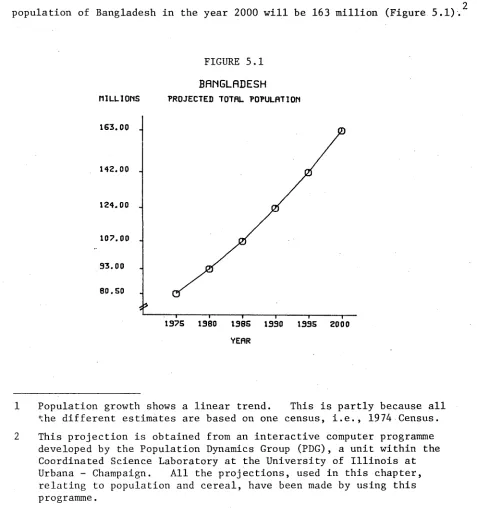
5.1 Bangladesh - Projected Total Population 72
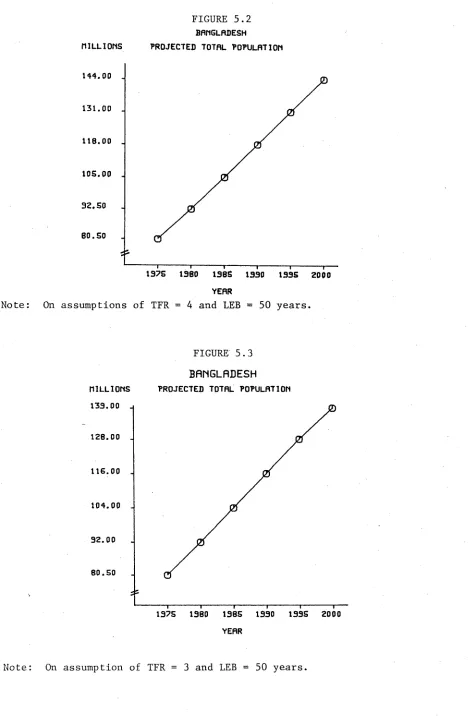
5.2 Bangladesh - Projected Total Population 74
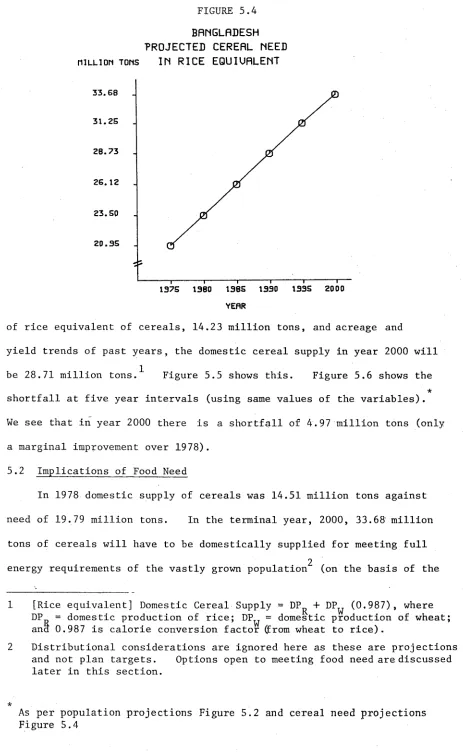
5.3 Bangladesh - Projected Total Population 74
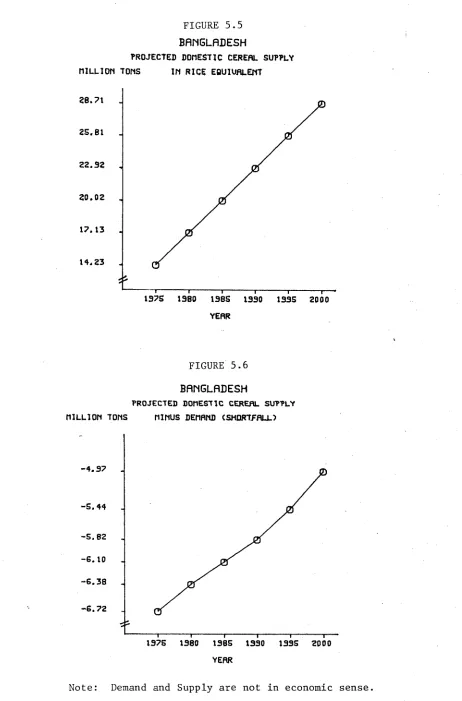
5.4 Bangladesh - Projected Cereal Need in Rice Equivalent 75 5.5 Bangladesh - Projected Domestic Cereal Supply in
Rice Equivalent 76
5.6 Bangladesh - Projected Domestic Cereal Shortfall 76 5.7 Bangladesh -
Population
Projected Primary School Age Group
(5 to 9 years) 97
Appendix Figure
A. 1 Trends in Population, Rice Production and Rice
Table
A. 1
A.2
A. 3
A.4
A.5
A.6
A. 7
A.8
A.9
A. 10
A.11
A.12
A.13
A. 14
A. 13
A.16
LIST OF APPENDIX TABLES
Title
Area, Production and Per Acre Yield of Rice and Wheat
Trends in Labour and Land Productivity in the Agricultural Sector: 1965-1977
Extent of Poverty in Bangladesh
Extent of Poverty in Bangladesh Nutritional Need)
Personal Income Distribution in of Bangladesh, 1963-64
Personal Income Distribution in of Bangladesh 1973-74
Per Capita Availability of Food
Composition of the Average Diet 1975-76
(Different Estimates)
(Based on 100%
the Rural Area
the Rural Areas
(Cereal)
in Rural Bangladesh,
Per Capita Cereal Intake by Their Sub-Groups in 1962-64 and 1975-76
Page
Per Capita Consumption of Cereals, Calories and Protein of Rural Households by Per Capita Monthly Income in Bangladesh, 1975-76
Bangladesh - Summary of Projection Results (Under Varying Assumptions of Income Growth)
Bangladesh. Income Redistribution Effects on Calorie Intake
Overall Ranks of Basic Needs Indicators by Different Statistical Methods
Sensitivity of the Elasticity and Social Gains to the Social (Calorie) Norm
Literacy Rates in Bangladesh by Age and Sex for 1961 and 1974
GLOSSARY
1 Crore = 10 million
1 Lakh = 100,000
Taka = Bangladesh Currency 1 US$ = Approx. Taka 15.50
NOTE
THE PROBLEM
Bangladesh is one of the poorest countries on the globe. She shares aspirations of economic development with all other countries, especially
those which are underdeveloped, and which are inhabited by large
populations who are victims of abject poverty, deprivation, ill-health, unsanitary living conditions and lack of education. For these countries, poverty perpetrates a lack of national self-esteem. Bangladesh’s
economy, particularly the agricultural sector which is the major source of national income, has been growing rather slowly. In its previous identity, as at present, little of the fruits of growth percolated down to the poor. Pauperization of the peasantry has been, and is, an increasing phenomenon, and wealth finds increasing concentration in the rich.
It is evident that a pursuit of conventional growth strategy is not likely to assuage the economic maladies of the nation nor mitigate the poverty that has engulfed the multitude of the people. At any rate, Bangladesh has not been enjoying the growth that is deemed necessary for
the alleviation of absolute poverty within a generation, through
redistribution processes, nor is it likely to in the near future, especially with its narrow resource base and numerous other constraints. It appears,
therefore, that a change in development strategy is necessary if an
inordinate delay in providing the mass of the people with the basic minimum goods and services (that make living conditions socially acceptable) is to be avoided.
2
the opportunity for full lives.^ The proponents of the Basic Needs Approach (BNA) argue that this approach, by directly attacking the causes of deprivation, is a more effective approach to development, because its orientation is motivated and guided by the concern for the poor. It makes less demand on resources and its impact is maximized on account of linkages and complementarities among the basic needs sectors (investment in one will reinforce the others).
The promises that BNA theoretically holds make Bangladesh eminently qualified for adopting it. The International Labour Organization (ILO) and the World Bank have conducted some country studies in Basic Needs
(BN) terms. Their findings are encouraging and indicate serious consideration on the part of individual countries for adopting it. Some countries have achieved considerable success in providing basic
needs to their people, by and large, among which Sri Lanka is particularly
2
noted in South Asia.
However, so far the basic needs question has been dealt with largely as a conceptual issue, and on a global scale. The diversity of conditions among countries demands investigation and formulation of the concept on an operational level, leading to a specific policy package for each. Not much work on this has been done. Another problem is (this being a
relatively new area having some specific data requirements),that the
available data serves poorly for analytical purposes and in operationalizing the concept with country-specificity. Therefore, prior to any meaningful
1 "Full lives’ can be debated on absolute and relative viewpoints, as, indeed, the concept of basic needs has been debated. Higgins (1979, 1980) carries a discussion on it. The objective of basic needs has been defined by most writers on the subject, a review of which will be found in Chapter III.
to be conducted. The present task is much constrained by unavailability of suitable statistical information. Therefore published macro data is relied on to arrive at indications whether or not:
(a) the concept, within the present data constraint, can be operationalized, and
(b) BNA is likely to be a suitable development strategy for the objective of removing absolute deprivation from Bangladesh in the next two decades.
The structure of the study is as follows: Chapter II describes the economy of Bangladesh, the extent of poverty and, briefly, the mechanism of planning; Chapter III reviews BNA through a survey of literature; Chapter IV deals with (i) a selective review of the operational concept existing in the literature and (ii) an attempt to operationalize the concept for Bangladesh; Chapter V attempts to estimate the resource requirement for meeting BN by the year 2000, analyse the findings and evaluate the prospects for Bangladesh; and Chapter VI records the conclusions of the study, and states the policy
CHAPTER II
BANGLADESH: THE ECONOMY AND THE EXTENT OF POVERTY
The objective of this chapter is to briefly describe Bangladesh, its people, the size and structure of its economy and the dimensions of its problems and poverty. A brief description of the planning machinery and the fundamental philosophy of planning are also
presented. No evaluation of planning is attempted, for such is not the objective of the study. However, planning is relevant because it has a bearing on public sector involvement in the provision of basic needs goods and services. The first on the list of the objectives of the Second Five Year Plan (SFYP), 1980-85, reads: ' To bring about a noticeable improvement in the standard of living by ensuring adequate supplies of the basic needs' (p.II-1).
Bangladesh - a new nation but an ancient land - was born a decade ago through the pangs of a nine-month long war of liberation into the eighth largest nation on earth. Impoverished as it was by years of neglect and underdevelopment, limited resources and a rapidly growing population, Bangladesh's birth was attended upon by the devastations of a protracted war.^
1 For a detailed evaluation and analysis of the economy of Bangladesh, in the past, present and future context, see A.R.Khan (1972),
Nurul Islam (1974) and Mohiuddin Alamgir (1978). Some facts and figures in this chapter are drawn from these publications. The other sources relied upon are: 1979 Statistical Yearbook of Bangladesh (SYB); Bangladesh Economic Survey (BES) 1979-80; and World Development Report (WDR) 1980. Many discrepancies are noted
in the figures presented by different sources for the same item with the same time reference. The variation is unimportant because the purpose of this chapter is to show only magnitudes, which is adequately brought out by any set of figures. However,
it may be noted that variations are perhaps due to varying assumptions (apart from errors).
2.1 The Area and the Population
The area of Bangladesh, comprising the world’s largest delta, awash by the Ganges-Brahmaputra river system, stretches latitudinally between 20°35'N and 26°75’N and longitudinally between 88°03’E and 92°75’E (Rashid, 1977). Ethnically, culturally and linguistically Bangladesh is
remarkably homogeneous.
Today over 90 million (estimated) people inhabit the 35,598 square mile area of Bangladesh, giving it one of the world's highest population densities, about 1636 persons per square mile.^ The population of the country was in 1961 53.4 million, in 1971 72 million and in 1974 76.4
2
million. The urban population in 1961 was 5.19 per cent and in 1971
3
was 6.5 per cent of the total population. According to the 1974 census the shares of rural and urban population stood at 91.22 per cent and 8.78 per cent respectively. The average household consists of 5.83 members - the average family size in urban areas is 5.78 and in rural
areas is 6.52. The Household Expenditure Survey (HES) of 1973-74
reveals that the number of household members is higher in the categories of households with a higher consumption expenditure.
Labour force estimates show that the income earning classes in Bangladesh bear a considerable dependency burden. Whereas the strict definition of labour force is difficult, some estimates are available
1 The area includes river surfaces, excluding which, the area is . 51,975 square miles. The country’s population at the turn of the
century is variously projected to be between 121 and 163 million (on varying assumptions of fertility rate). The density of population shown in the 1974 Census was 1511 persons per square mile.
2 For 1961 and 1971 (when the census was due but could not take place due to the war - finally conducted in 1974) Khan (1972) discusses the adjustment procedures.
6
of labour supply and actual employment. Urban and rural participation rates in Bangladesh were estimated to be 35.27 per cent and 34.44 per cent respectively for 1966-67. Using these rates Khan (1972) estimated a 1970-71 labour force of 1.64 million and 23.20 million respectively
2
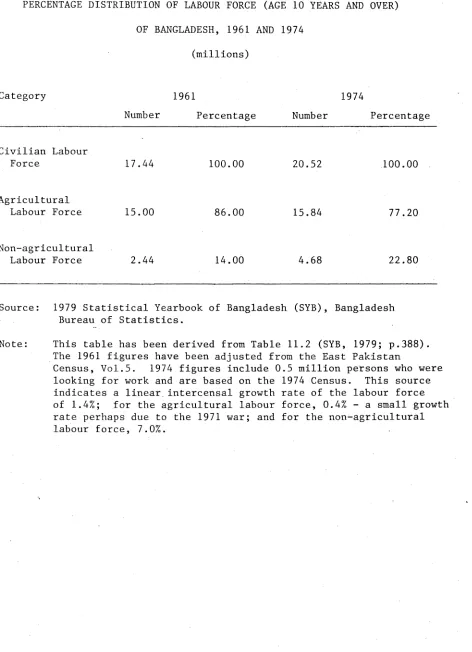
for urban and rural areas. The 1974 Census shows 20.52 million people in die civilian labour force - 15.84 million (77.2%) in the agricultural sector and 4.6 million (22.8%) in the non-agricultural sector. The number of males and females in the agricultural labour force was 15.23 million and 0.61 million respectively. Table 2.1 gives a comparative labour force picture between 1961 and 1974 (two census years). The 1979 Statistical Yearbook of Bangladesh shows the civilian labour force as a percentage of the population at 35.20 per cent - 50.60 in the case of
3 males and 18.70 in the case of females (p.4).
Unemployment and underemployment in Bangladesh is substantial. In a predominantly agrarian economy like Bangladesh where large numbers of people are self-employed and unpaid family workers, who do not consider themselves to be unemployed but may be working only a few hours a week, it is difficult to estimate the magnitude of underemployment (Ahmed, 1974).
1 Khan (1972) discusses this issue at some length. Iftekhar Ahmed (1974) discusses the definitional question of unemployment. Both of them emphasize the fact that underemployment is a more crucial issue than unemployment per se. Anyone of 10 years of age and above is part of the labour force. Figures used in this section are drawn from their writings (they have used Central Statistical Office, Summary of Population and Labour Force (1966-67), Pakistan, figures).
2 He points out that arguments can be found on both sides regarding the accuracy of such estimates but, together with population growth rates, it would be a reasonable indicator of employment requirement. Assuming that to generate a unit of income is possible through
an incremental capital-output ratio of 2.25 at the margin and replace ment of capital is a mere 3 per cent of current output, then 10 per cent of GDP will have to be saved and invested to provide for the population the dismally low present standard of living (p.11).
3 World Development Report, 1980 shows the percentage of the population of working age (15-64 years) as 53 for 1960 and 54 for 1978. 87% of the labour force was in agriculture, 3% in industry and 10% in services in 1960, and the corresponding figures for 1978 are 74%,11% and 15%. The annual growth rate for the periods 1960-70 and 1970-80
TABLE 2.1
PERCENTAGE DISTRIBUTION OF LABOUR FORCE (AGE 10 YEARS AND OVER) OF BANGLADESH, 1961 AND 1974
(millions)
Category 1961 1974
Number Percentage Number Percentage
Civilian Labour
Force 17.44 100.00 20.52 100.00
Agricultural
Labour Force 15.00 86.00 15.84 77.20
Non-agricultural
Labour Force 2.44 14.00 4.68 22.80
Source: 1979 Statistical Yearbook of Bangladesh (SYB), Bangladesh Bureau of Statistics.
Note: This table has been derived from Table 11.2 (SYB, 1979; p.388). The 1961 figures have been adjusted from the East Pakistan
[image:17.551.49.521.141.793.2]8
Ahmed (1974) estimates,32.4% of the agricultural labour force was unemployed in 1969-70.^
2.2 Structure of the Economy
The economy of Bangladesh is predominantly agricultural. Over 90 per cent of the people live in the rural areas, agriculture provides employment for about 80 per cent of the labour force and contributes about 55 per cent of GDP. Table 2.2 summarizes the structure of the Bangladesh economy.
Bangladesh suffered a severe famine in 1974 and is frequently a victim of natural disasters, like floods and cyclones. These coupled with a rapid growth in population virtually offsets the growth in GDP which has been erratic between 1969-70 and 1979-80. Agriculture's
share of GDP has declined but only marginally, industry's share has remained virtually static (with minor fluctuations) between 1976-77 and 1979-80 and the shares of housing, construction, transport and power, and trade and services have merely crawled up.The growth of per capita
income, with initial negative rates, has registered an increase but with serious fluctuations between 1977-78 and 1979-80.
The average annual growth rates of GDP during the periods 1960-70 and 1970-78 were 3.6 and 2.9 per cent respectively. For these periods respectively, the percentage growth rates for agriculture were 2.7 and 1.6, for industry were 7.9 and 5.9, for manufacturing were 6.6 and 5.3 and for services were 3.8 and 4.7. The average annual growth rate of private consumption during the periods 1960-70 and 1970-80 were 3.4 and
3.1 per cent respectively. The average annual growth rate of gross domestic investment were, respectively, 11.1 and -1.4 per cent. Gross domestic investment in 1978 was 12 per cent as against 7 per cent in 1960. Value added in manufacturing (in million 1970 US$) in 1976 was 320 against
1 He works out labour inputs for the major crops in Bangladesh (in million mandays), derives million manyears employed and
S T R U C T U R E O F T H E BA NG LA D E S H E C O N O M Y o 3 o P-I Q O 3 3 •H 3
a,B -X
4-1 3 O UP 40 CM <4 r-H CN
O u U o- 1 • • • • • •
3 O O r-H 44 r-H co
3 M CM 1 1
3 1
P3
-3 sx
3 3 /—N 40 o 4 4 CP O r-H
P 3 6^S ON 1 • • • • • •
o 3 '—x CM CM r-H 4 4 44 M3
3 Pi r— 1
O 1
CO 3
3 3 <4 0 0 CM o CP 4 4 CP
X) •H 44 M3 CD cp (4 CM 44
3 > 0 0 • • • • • • •
3 3 vD 0 0 CP ON CP O O
H 3 *—H r—H r-H r—H r-H CM CM
3 in
3 o a 3 3 cd 3 3 H 3 4-J CO
c c
O -H V CO
3 O >•> 3 3 CO 3 to 3 I—I a) 3 3 4-J i—I 3 a •H 3 60 3 4-1 •H a. cd 3 (3 o
- P-I 60
PU Q O O
3 3 C3 3 O •H 4-i .
3 I—I 3 a o pp
pp • q e o •
PcJ H 3 3 3 >-| 44 oo LT| CM CM 44 CM >45 o 44 44 s£> 44 O 00 CM 00 O O vO 44 44 44
o ocp
M0
cp
00
ro cpcN cp <r O'. s£> 00 UP 00 cp MO up 44 44 MO up 44 40 CM 00 40 04 00 CM oo up 00 O I"» M3 oo p-UP m up sO 00 00 CM r-* oo oo up 44 UP
CM CM up
I— I CM 44
44 [4 14
o CP
o O O O o O o
CO O O 44 CP 44 o
oo CP M3 44 oo CP CM
es rs e\ es es es r*
r-H up o 40 o CP 44
up 44 UP UP so M3 40
O CP UP 44 oo CP o 3 • •
r4 r4 r4 44 r4 44 oo 3 3 3 • •
1 1 1 1 1 1 1 w W 3 3
CP CM 44 M3 44 00 CP 3 3
M3 44 r4 r4 (4 44 44 3 3
CP CP CP CP CP CP CP •X o O
r-H r-H r-H r—H r-H r-H r-H •X •X m 5S
3 o •H 4-1 3 U O I—I CO •H "3 X) 3 3 3 60 3 e 3 TO 3 3 £ 4-4 o 3 U 3 3 3 Cr TO
3 3
10
324 in 1970. For these years, respectively, gross manufacturing output per capita (in 1970 US$) was 13 and 11 (WDR, 1980). Per capita GNP is
1
estimated at US$90. The rate of investment in the late 1960s was between 10 and 11 per cent of GNP.
2.3 Agriculture in Bangladesh
Agriculture in Bangladesh is characterised by small subsistence
2
farming. In the past agriculture has suffered considerable neglect. The performance of agriculture, the main component of income, has been uncertain and erratic. This situation of agriculture coupled with rapidly growing population led to a persistent food shortage, typically around 15 per cent of total food availability.
There are 11.85 million rural households in Bangladesh (out of which 3.86 million households or roughly 32.79 per cent of total
households, own no farm land) against an availability of 18.17 million acres of cultivable land (excluding homestead land) (LOS,1977, Summary
Report, Table II). The average size turns out to be about 1.53 acres of owned land per household. The average size of operated holding is about
3
1.90 acres per household. Table 2.3 summarizes the size distribution of owned land (other than homestead land) in rural Bangladesh. Over 4 million acres of land is taken in by tenants and owner-cum-tenant farmers - about 81.84 of the households in these two categories together
1 With Kravis’ adjustment, GNP per capita is US$200. Sen (1980) uses GNP per capita with Kravis’ adjustment with other indicators of poverty to rank countries. In a list of countries with an ascending order of income, Bangladesh ranks second.
2 The land-man ratio in agriculture (acre/person) in 1970-71 was 0.445, which has since worsened. The cropping intensity is 148%.
■k
3 Estimated from LOS (1977), Summary Report, Tables II and V. The striking feature of the ownership distribution is that a vast proportion of farms are small by any standard while only a very small proportion can really be called big. According to the 1968 Master Survey of East Pakistan Agriculture only 30,000 farms are bigger than 25 acres, accounting for 4^% of cultivable land (Khan,
1972; p.39). LOS (1977) shows 1.75 per cent of rural households owning 19.31 per cent of total cultivable land.
TABLE 2.3
SIZE DISTRIBUTION OF LAND OWNED (OTHER THAN HOMESTEAD LAND)
IN RURAL BANGLADESH
Number of Acres Per Cent of Total Per Cent of Total
Households Cultivated Area
Zero 32.79
-0.01 to 3.00 52.54 37.76
3.01 to 6.00 9.65 26.59
6.01 to 10.00 3.27 16.34
10.01 and above 1.75 19.31
Total 100.00 100.00
[image:21.551.60.518.122.797.2]12
rent in less than 2 acres, accounting for over 50 per cent of tenanted land. Rural landlessness has increased from 17 per cent of all rural households in 1960 to 38 per cent of all rural households in 1977.
The crop subsector is the most dominant and important in the
agricultural sector. Rice is the major food crop grown in Bangladesh (less than a million tons of wheat - among other minor cereals - is also grown). Currently about 13 million tons of rice is grown in the country. The average yield per acre is subject to considerable
fluctuation (Appendix Table 1). Jute is the most important cash crop, followed by tea. In 1979-80 1.87 million acres were devoted to jute and 5.96 million tons were produced, earning over 67 per cent of total export earnings (jute goods plus raw jute exports). In 1975-76 and 1976-77 the yield per acre averaged 1102 lbs. and 1061 lbs. respectively. In 1975-76 12.3 per cent of the total cultivated area was under HYV seeds and
11 per cent under irrigation. Chemical fertilizer consumption per acre rose from 12.3 lbs in 1966-67 to 31.2 lbs. in 1975-76: for the same period, institutional credit rose, respectively, from Taka 2.19 to Taka 15.92 per acre.1
Agricultural labour productivity per worker rose from Tk 1659 in 1972-3 to Tk 1890 in 1976-77 (Hossain, 1978; Table 1 - Source: Bangladesh Bureau of Statistics . See Appendix Table 2). The value added share of agriculture' ior the period 1965-77 increased by only 1.5 per cent per annum whereas population grew by 2.6 per cent.
2.4 Physical Infrastructure
The poverty of the Bangladesh economy is reflected in the physical infrastructure, particularly transport and communications. The first railway line was laid in 1862. By 1977 Bangladesh had about 1800 miles
of railway line (3.3 miles per square mile), has about 380 locomotives, 1352 passenger coaches, 16,343 freight cars and 345 other coaches. The country has 2885 miles of all weather roads with 7359 buses and 9956 trucks (in 1977). A riverine country, Bangladesh has 5,000 miles of perennial waterways.^ The sea port at Chittagong and anchorage at Chalna have a handling capacity of 370,000 tons of cargo per month.
Bangladesh has a very narrow base of natural resources. The country has no major known natural resource except natural gas (proven reserve of
12
9.175 x 10 eft). A limited amount of coal and limestone is present. Exploitation of coal is presently economically unviable.
2.5 Extent of Poverty
2
Poverty in Bangladesh is manifest in too low a standard of living. Life expectancy at birth is 47 years; infant mortality (aged 0-1 years) is 139 per thousand live births (compared to 20 in developed countries); the literacy rate is about 22 per cent; there is one physician per 9,260 persons and one nursing person per 42,080 persons. On average people meet 93 per cent of the calorie requirement and only 60 per cent of the protein
3
requirement. The condition of rural housing is such that the people are
4
hardly protected from the elements of nature. In the urban areas, an average family of 6.52 members shares on average a 1.5 roomed house, more than
70 per cent of which are temporary constructions without any sanitary 1 The numerous rivers are also an obstacle to physical infrastructure
development.
2 Bangladesh is ranked as the second poorest country in the world (World Development Report, 1980).
3 Estimated in the Nutrition Survey of Rural Bangladesh, 1975-76. Though the national average intake meets 93% of the calorie requirement, only 41% of the families have an adequate (above
requirement) intake. The per capita requirement of calorie intake for the rural population is set at 2248 calories (taking the activity factor into consideration). For an average Bangalee* the per capita requirement (on height, weight, climate, etc.) estimated by the FAO is 2150 calories per day. The per capita daily calorie requirement is a much-debated issue. See, for example, Sukhatme (1978).
* Bangalee and Bangladeshi (the nationality) are used interchangeably. For a discussion on rural housing, see A.R. Khan (1977); p.75.
14
facilities, 80 per cent without water connection and 97 per cent without electricity.
Income per capita (about US$90 in current Taka) has registered a negative average annual growth rate of 0.4 per cent. About 75 per cent of population is below the poverty line."^ For 1975 Khan (1977) estimated the incidence of poverty for Bangladesh, showing that 61.8 per cent of the population were in absolute poverty and 41 per cent in extreme poverty
(those in this group met 80 per cent of the calorie requirement). (See Appendix Tables 3 and 4). The agricultural wage in 1975 was Taka 9.43
(about 62 US cents) per day (real wage = Taka 1.28) when the cost of
living index registered 735.6 (1963-64 = 100). Rural income distribution in 1968-69 was such that the bottom 20 per cent of the population earned 10.4 per cent of total personal income, against 9.6 per cent in 1966-67; the highest 20 per cent of the population earned 37 per cent in 1968-69 against 41.4 per cent in 1966-67 (the concentration ratios for the two periods were 0.34 and 0.27 respectively (Islam, 1978). (See Appendix Tables 5 and 6).
2.6 Economic Development Planning in Bangladesh
The political party, Awami League, which came to form the government in the wake of the traumatic war of liberation in 1971 was committed to
2
socialism and parliamentary democracy, in principle. As a first step
1 For 1963-64 Khan (1977) defined the poverty line for the absolutely poor at Taka 23.61 (and Taka 17.02 for the extremely poor)per month. The former yielded 90 per cent of the calorie requirement. For a
discussion on the poverty line in Bangladesh see Griffin and Ghose (1979) and Griffin and Khan (1978). For the extent of poverty see Appendix Tables 3 and 4.
2 Rahman (1974) points out that internal contradiction existed because socialism was sought to be attained through parliamentary democracy, not standing up to Marxist - Leninist tradition. A nationalized public sector embraced all key factors of the economy but not
to install socialism in the economic sphere, the government nationalized all large industries, all jute and cotton textile industries and all domestic financial institutions. The government sought to transform what Alamgir (1978) calls 'a society with predominantly pre-capitalist
production relations into a socialist society by-passing the intermediate I
stage of capitalist development'. The Bangladesh economy, notwithstanding the socialist objectives, remained a mixed economy and continues to remain so (successive governments abandoned socialist ideology). The public sector, excluding agriculture, remains overwhelmingly dominant.
The government promulgated a Presidential order (No.98) in 1972
whereby a ceiling on family cultivable land holding was placed at 33.3 acres. This reform in land holding had little redistributive impact.^ However, land reform was to create production relations complementing socialist development planning.
Bangladesh opted for a centralized planning system, within the
framework of a mixed economy. The central planning machinery, The Planning Commission, was set up in 1972 to fulfill the socio-economic planning
task. The planning machinery, manned chiefly by economists and
technocrats, was intended to be closely linked to the political government
2
with ideological orientation.
The First Five Year Plan (FFYP) - formulated on the basic assumption of a mixed economy in a state of transition to a socialist system, using a thirty-three sector conventional input-output consistency model(Islam,1977) was launched in 1973. The plan provided for a financial outlay of
Tk.44,500 million (about US$5.57 billion) in 1972-73 prices. It aimed at a GDP growth rate of 5.5 per cent per annum and an increase of per
1 For an analysis of agrarian and land reform in Bangladesh see Abdullah (1976).
16
capita income by 2.5 per cent annually. The main stated objective of the plan was to reduce poverty through the expansion of opportunity for the unemployed and the underemployed, the acceleration of the rate of national income growth and the promotion of a more equitable income distribution via fiscal and pricing policies (FFYP document, p.9).
The complex question, particularly in the Bangladesh context, of accelerating domestic resource mobilization, which depends on numerous interactive factors, confronts the development planners and policy makers. On this key question not only the intricate balancing of resources
allocation depends, but also the eventual economic progress and success of planning. In Bangladesh this area is infinitely compounded by heavy and increasing reliance on external assistance, which it is argued, appears as an easy substitute for domestic resource mobilization.^- Gross domestic financial saving was to reach 4.5 per cent of GDP in the first year of the plan and about 14.2 per cent in the terminal year but this remained unachieved.
Whereas the five year plans lay down the broad economic objectives reflecting the aspiration of the nation's economic goals on the basis of certain predictions and,growth and other assumptions, the Annual Development Plan, for each year of the Five Year Plans, is formulated as an instrument of implementation of the Five Year Plan. This provides an opportunity to adjust to changes in circumstances and assumptions, and also to embody the concrete details of the Five Year Plan on a year to year basis.
Between the period intervening the end FFYP, 1977-78, and beginning of the Second Five Year Plan (SFYP), 1980-81, a Two-Year Approach Plan
(TYAP) was formulated and launched, primarily to complete the unfinished
1 Rahman (1974) goes further and, in effect, says, this not only denudes self-respect of a nation but also makes it prey to questionable
designs of donor nations; and suggests acceptance of aid from ideological peers. The resource allocation pattern of the SFYP
schemes spilled over from the FFYP which, having to be carried into the SFYP, would have restrained the SFYP's choice. TYAP had envisaged a GDP growth target of 5.6 per cent but achieved an estimated five per cent.
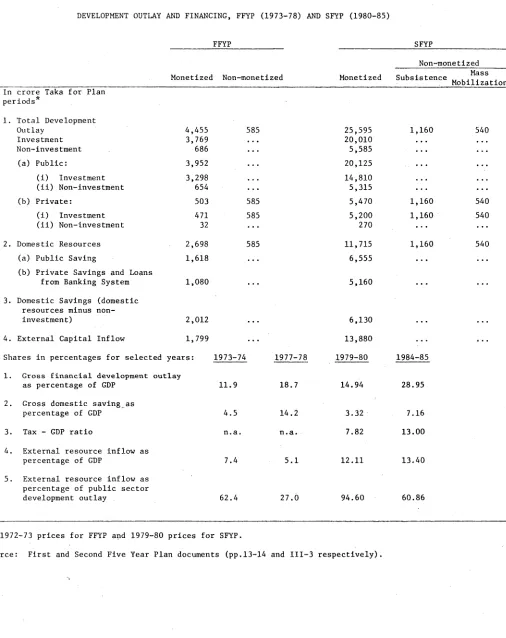
The Second Five Year Plan came into action in July 1980. Table 2.4 shows the planned development outlay of the two five year plans and their finaneing.^
2.7 Institutional Arrangement for Rural Development
The existing institutions dealing with rural development in Bangladesh aim primarily at raising agricultural production, basically, through
introduction of HYV seed-fertilizer-irrigation technology. This section
2
contains a brief description of these institutions.
The period from 1949-50 to 1959-60 saw Bangladesh agriculture in complete stagnation, when output and value added trailed way behind population growth rate. The following period, from 1960-61 to 1969-70, saw improvement when parametric growth rate of value added almost equalled estimated population growth rates.
The area which now constitutes Bangladesh received little attention to agricultural development from the previous government (Pakistan) which
3 pursued a policy of industrialization (for the west wing primarily). Government policies ensured a merciless squeeze on agriculture in the interest of "primitive capital accumulation", and exchange rate was kept artificially low to benefit the importers at the cost of the exporters
1 It may be noted that the FFYP fell short of its targets. It is not our purpose to evaluate the performance of the plan; we do not go into the shortfalls.
2 For detailed and critical discussion on the subject see Abdullah et al, (1976), Jones (1979) and Vylder and Asplund (1979), among others.
18
TABLE 2.4
DEVELOPMENT OUTLAY AND FINANCING, FFYP (1973-78) AND SFYP (1980-85)
FFYP SFYP
Non-monetized Monetized Non-monetized Monetized Subsistence Mass
Mobilization In crore Taka for Plan
periods*
]. Total Development Outlay
Investment Non-investment
4,455 3,769 686
585 25,595
20,010 5,585
1,160 540
(a) Public: 3,952 20,125
(i) Investment (ii) Non-investment
3,298 654
14,810 5,315
(b) Private: 503 585 5,470 1,160 540
(i) Investment (ii) Non-investment
471 32
585 5,200
270
1,160 540
2. Domestic Resources 2,698 585 11,715 1,160 540
(a) Public Saving 1,618 6,555
(b) Private Savings and Loans
from Banking System 1,080 5,160 . . .
3. Domestic Savings (domestic resources minus non
investment) 2,012 6,130
4. External Capital Inflow 1,799 13,880
Shares in percentages for selected years: 1973-74 1977-78 1979-80 1984-85 1. Gross financial development outlay
as percentage of GDP 11.9 18.7 14.94 28.95
2. Gross domestic saving as
percentage of GDP 4.5 14.2 3.32 7.16
3. Tax - GDP ratio n . a . n.a. 7.82 13.00
4. External resource inflow as
percentage of GDP 7.4 5.1 12.11 13.40
5. External resource inflow as percentage of public sector
development outlay 62.4 27.0 94.60 60.86
* 1972-73 prices for FFYP and 1979-80 prices for SFYP.
[image:28.551.25.531.63.701.2]who were in agriculture. In an agriculture characterized by small holdings and subsistence farming, there were relatively few large surplus generating farmers who could invest in improved techniques. When in the 196Gs attention
of the government turned to rural areas to find a political base, in order to countervail an increasingly intractable urban elite, and, probably, also because of growing awareness of agriculture’s importance as a precondition for industrial development, institutional credit began to be made available to meet at least part of the credit requirement. The major beneficiaries were the surplus farmers who saw the opportunity to grow and market more.
The Rural Works Programme (RWP) helped enlarge the market as new link- roads were built, increasing rural-urban contact. The surplus farmers also benefited from raising of landholding ceiling from 33 acres (1951) to about 124 acres (1962). The cooperatives which then existed became a channel of cheap credit for the rich farmers. "Cooperative Credit
Societies had become pliant tools in the hands of rich farmers who probably re-lent a good deal of the cheap loan so obtained - at low rates to
followers, and at high rates to others."^
The Bangladesh - formerly Pakistan - Academy for Rural Development (BARD) was established in 1959 in Comilla (came to be known as the Comilla Experiment) under the leadership of Dr. Akhter Hameed Khan. The Comilla Cooperative Programme was started in 1961 upon "examination of past failure in rural development". The previous cooperative societies, due to weak organisational structure, had failed; the Union Multipurpose Cooperative Societies, like their predecessors, "rather than generate internal capital to become self-reliant became channels for subsidised credit". The task BARD defined for itself, was to accomplish'bomplete reorganization of the social and economic structure of the village" to create conditions for
20
introduction of "new skills and new implements and new methods". The Comilla cooperatives were designed to avoid the weaknesses of the previous
2
organisational attempts (Abdullah et al, 1976; p.222).
The Comilla model envisaged integrated approach towards rural development with the following four components together (Vylder and Asplund, 1979; pp.136-7):
1) The two-tier cooperative structure: (a) the primary cooperative at the village level, and (b) a federation of the village cooperatives at the thana level, into a Thana Center Cooperative Association (TCCA).
2) The Thana Training and Development Center (TTDC): to train primary cooperative managers and model farmers who would act as "change agents" at village level. 3) The Thana Irrigation Programme (TIP) to be responsible
for the supply of cheap credit and subsidized equipment for the installation of irrigation facilities, mainly, tube-wells and low-lift pumps.
A) The Rural Works Programme (RWP), the main objective of which should be to mobilise idle manpower for infra structural investment. The costs of the programme were to be borne by the government.
The structure of Comilla (cooperative) model engendered internal capital formation. The close proximity of the Thana level organisation enforced necessary discipline. The 'model farmer' emerged as one of the principle
1 From a speech by Dr. Khan, Director, BARD, in 1973, quoted by Abdullah et al (1976); p.221.
2 The Comilla cooperatives were established in the Kotwali Thana. (Thana - literally police station - is a low level administrative unit,
innovations who, being a resident of the village, enjoying the confidence of the villagers, liaising between the academy and the village farmers, receiving training and being a vehicle of feed-back, served as an extremely important ’’change agent” from within rather than, usually, from without.
Abdullah et al (1976) wrote: ” ... Comilla approach attempted to correct the fundamental weaknesses in the previous rural development efforts. Credit made available to village society was to be linked (a) to local planning and productive investment in new techniques; and (b) to a disciplined programme of internal capital formation through purchase of shares and weekly thrift deposits” (p.222).
Comilla Programme's success was manifest in doubling of rice production in ten years through adoption of HYV technology, increase in yields,
impressive expansion of irrigation and an increase in employment rates (Vylder and Asplund, 1979; pp.137-41). The progress was impressive. Although the small farmers did well they remained underrepresented and the landless did not benefit directly.
As a rural development effort by the government, the Comilla
Cooperative Model began to be replicated under the appellation Integrated Rural Development Programme (IRDP) in 1970-71. The War of Liberation in 1971 temporarily interrupted the expansion of the programme. From a coverage of 33 thanas in 1971-72 IRDP covered 250 thanas in 1977-78
(with 25,777 primary societies and 708,000 individual members).
Like the Comilla Cooperative structure IRDP has a two-tier cooperative structure: village-base Krishi Samabaya Samitis (KSS) or agricultural
cooperatives, which federate at thana level in Thana Central Cooperative Association (TCCA).
22
facilities through a cooperative arrangement of the villagers enabling them to receive cheap credit. The TIP acted as the nucleus of the KSS. The Bangladesh Agricultural Development Corporation (BADC) is responsible for supply, installation and maintenance of the irrigation equipments.
The IRDP's key official at Thana Level, the Project Officer, is responsible for (a) forming the villagers into primary societies, and (b) organising the Thana Level Federating Association. Having no control over supply of modern inputs, and there being inadequate inter-agency coordination IRDP is unable to enforce the cooperative discipline that characterises Comilla cooperatives (Abdullah et al, 1976).
The quick expansion of IRDP cooperatives has put severe strains on administrative and supervisory capacity of the organisation. Also, resources have been spread too thinly. The security for credit being land the cooperatives prove to be rather useless for the landless labourers and share-croppers. The membership is dominated by large and medium
farmers, so much so that a Bangladesh Planning Commission Report (1974) was inspired to call the cooperatives "closed clubs of Kulaks".^
Located at the Thana Level, Thana Training and Development Centre (TTDC) serves as a centre for diffusion of new technologies to the farmer- members of primary societies through training of "model farmers". It also has the role of coordinating various Thana Level government agencies.
The TIP was launched in the late sixties to consolidate the irrigation effort for higher agricultural production. It operated through formation of irrigation groups (who were entitled to cheap credit from cooperative banking institutions).
The Rural Works Programme (RWP) was started in the early 1960s with
the objective of building rural infrastructure, utilizing landless
labourers. A.H. Khan (1971) defined the purpose of R W P :
"The Rural Works Programme was an attempt to tackle two
fundamental problems: construction of a network of roads, drainage channels and embankments, and provision of
employment during the dry idle months to the landless
labourers. Roads, drainage and embankments are the
infrastructure of rural development. Without link roads, without good drainage and without protective embankments there cannot be much agricultural development. And without employment for the rapidly increasing landless
villagers, no government can hope for stability" (pp.3-4).
For over 15 years RWP formed part of the rural development strategy
launched by the Bangladesh Academy for Rural Development (Vylder and
Asplund, 1979, p.191). On one hand, Bangladesh is infrastructure poor
and, on the other, it has a large resource of underutilized
labour.^-Using this abundant factor for socially beneficial work seems to be a
logical answer. But, the programme's intensity or popularity has varied
over time. In the sixties one of the main sources of funds came from the
counterpart source of the US Government's PL480 Programme. During this
decade the then military regime used this programme to establish political
linkage with the rural areas.
The RWP was complemented, in response to the 1974 famine situation,
by the Food for Works Programme (FWP). Those employed on FWP - mainly a
relief oriented programme - receive in-kind wages, paid out of the wheat
grant by overseas donors. Since the independence RWP has been financed
over the ordinary development budget.
"Total employment created by both programmes, may (annually) be some
400,000 man-years, can be estimated to correspond to some 3-4 per cent of
total employment in agriculture. The programmes were able to absorb
24
some 4-5 per cent of the existing unemployment in the agricultural sector" (Clay and Khan, 1977)."*"
The evaluation of performance and impact of RWP by different sources reach different conclusions. One source terms it to be a great success while another sees it as no more than an elaborate relief programme. Yet another observes, reliability of quantitative results notwithstanding, the
2
programme is on balance an economically sound one.
The projects under RWP are planned either centrally and executed through government agencies (e.g. Water Development Board), or locally planned and initiated by grass-root level local governments. (The latter category projects are centrally approved.) The local project committee members, who share large responsibilities in executing the projects, are assisted by Thana Level government officials. The expansion of the programme is mainly constrained by lack of finance. The projects are seasonal, operative only in the dry season. The employment opportunity offered by the programme to the rural landless labourers is only limited to this season. Given the rural power structure, the rich farmers dominate the project committees. These rich farmers are also the main beneficiaries of outcome of these projects, but they contribute next to nothing.
2.8 The Role of the State
The discussion on planning in Bangladesh in Section 2.6 (and Table 2.4) reveals to some extent the government's role in the national economy. This is stated a bit more specifically, but briefly, in this section.
All major industries and financial institutions (following
nationalisation in the wake of independence) are in the public sector.
1 Clay, E.J. and Khan, S. Agricultural Employment and Underemployment in Bangladesh: The Next Decade. Working Paper, Dacca, June 1977
All jute and textile spinning and weaving industries, which constitute the bulk of the industrial sector, are part of the public sector. In the transport and communication sector shipping, railways, airways and telecommunication are under government corporations. International trading is also dominated by the government. In fiscal 1978-79
government (including the nationalised sector, other government agencies and corporations) shared 46.43 per cent of total exports and 65.10 per cent of total imports.
More important, in development spending the government typically contributes between 75 and 90 per cent of the total expenditure. Out of the total financial development outlay during the First Five Year Plan period public sector's share was 89 per cent; during the Second Five Year Plan period it is 78 per cent.
Agriculture, characterised mostly by subsistence level operation but contributing about 55 per cent of GDP, remains a private activity. However, procurement and distribution of modern agricultural inputs is almost entirely controlled by the government. The Bangladesh
Agricultural Development Corporation (BADC) is responsible for procurement and distribution of HYV seeds, chemical fertilizers, irrigation equipments and plant protection material.^
Government provides agricultural output subsidy for foodgrains. This is done through an internal rice/paddy and wheat procurement programme. Usually, the procurement price is announced before harvesting of the crops and the price offered is above the expected market price. Foodgrains are also procured from external sources. These are distributed through the rationing system, mostly urban-based, at a price lower than the market
1 Pesticide distribution has recently been handed over to the private sector but aerial plant protection service remains with the government
26
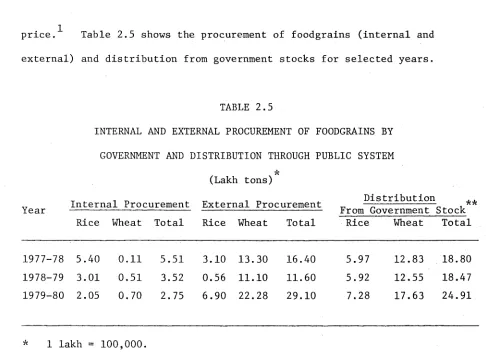
price. Table 2.5 shows the procurement of foodgrains (internal and external) and distribution from government stocks for selected years.
TABLE 2.5
INTERNAL AND EXTERNAL PROCUREMENT OF FOODGRAINS BY GOVERNMENT AND DISTRIBUTION THROUGH PUBLIC SYSTEM
*
Year
(Lakh tons)
Internal Procurement External Procurement Distribution i From Government Stock Rice Wheat Total Rice Wheat Total Rice Wheat Total
1977-78 5.40 0.11 5.51 3.10 13.30 16.40 5.97 12.83 18.80 1978-79 3.01 0.51 3.52 0.56 11.10 11.60 5.92 12.55 18.47 1979-80 2.05 0.70 2.75 6.90 22.28 29.10 7.28 17.63 24.91
* 1 lakh = 100,000.
** Sum of figures for April, May and June 1980 (rice = 1.75, wheat = 3.95) included in total are estimated.
Source: Bangladesh Economic Survey, 1979-80. From tables 18 (pp.23-4) and 20 (pp.26-7).
The role of state in the following four areas can hardly be overstated. These roles are crucial for provision of basic needs.
(i) Infrastructure creation: Construction of roads and bridges - generally improving transport links - expands marketing opportunity for rural producers of agricultural commodities as well as urban producers of industrial goods. It encourages private investment in both
1 Since beneficiaries of subsidized food rationing are concentrated in large urban centres government's food subsidy policy reflects an urban bias. Estimated nominal foodgrain subsidy as a percentage of total expenditure was: 1973-74 81 per cent; 1964-75 54 per cent; 1975-76
[image:36.551.39.525.29.381.2]the agricultural and industrial sector creating greater demand for labour and inputs. With greater marketing opportunity, and demand, marginal farmers, for example, would have the incentive to grow marketable surplus by using more labour and improved inputs. As employment opportunity increases more people would be able to meet their basic needs.
(ii) Education planning: In its present stage of development of Bangladesh, the private sector is simply unable to supply the full educational need of the country.
State’s role in providing education, particularly primary education, must continue to be dominant. In 1979-80, out of a total of 43,739 primary schools only 7,271 were non-government schools. The secondary and higher
education is widely funded by the government grants. To provide for the educational need, the government's role must remain crucial, with more intensive planning and increasing resource allocation.
(iii) Health planning: The people, by and large, cannot
28
Appendix Table 16). Adequate health planning and resource commitment to this area is an unavoidable government function if the health need of the country has to be met.
(iv) Direct intervention of the government for alleviation of poverty: Given the level of poverty in Bangladesh and historical rates of income growth it cannot be expected that the economic system would, in the short- run, at least, reduce the incidence of poverty. In a pre-dominantly rural economy, as in Bangladesh, to attack poverty government intervention on a large scale is essential. The following efforts of government to this end will have to be intensified:
(a) Rural Works Programme: so that landless people, whose number is increasing rapidly, directly benefit.
(b) Employment Guarantee Schemes: so that year round employment opportunities increase, enabling people to earn income to demand basic goods and services (RWP complements this).
(c) Rural Development Programmes: so that agricultural productivity rises, resulting in higher incomes and removal of poverty. 2.9 Summary
of the people live in poverty. Agriculture, the dominant sector in the
country’s economy, has long been stagnant, with low agricultural
productivity. The rural institutions are weak and they are presently
unable to effect the transformation that is necessary for provision of
basic needs of the people. The government of the country has a major
role to play in the country's development under the present system and
CHAPTER III
BASIC NEEDS APPROACH: LITERATURE SURVEY
3.1 Historical Background
In recent years the Basic Needs Approach (BNA) has gained a good deal of attention as a strategy for economic development in the Third World. To examine the process leading to the advent of BNA it is appropriate to briefly review the development strategies of the past.
Kuznets (1959), while examining the historical evidence, defined a set of conditions upon the fulfillment of which economic growth and
1 2
development is contingent. The conditions are:
(a) a substantial increase in the output of products; (b) a sustained and substantial rise in population; and (c) a sustained and substantial rise in product per capita. Thus, in the historical context, the coincidence of these three conditions led to economic growth and development. The emphasis on
'sustained and substantial' is notable. Empirical support for this theory was found in a subset of developed countries for which dependable time series data was available. The terminal period of the estimates was the early 1950s.
Now, the question arising out of this is: do the development-seeking developing countries enjoy the socio-politico-economic conditions under
1 See Lecture 1 in Simon Kuznets (1959) .
2 Condition (a) so that growth is not biased by cyclical expansion or some transient phenomenon, and (b) and (c) so that even when the population has risen, for per capita product to rise, the total product rise must be much higher. For this to happen the occurence of technological innovation is a necessary condition.
which the developed countries attained their economic growth? The answer to this question seems to be unclear. This is so because in the post-World War II era the world’s political map has altered, the colonial colours have rapidly receded, the world trade complexion has considerably changed, protective flags have gone up, and the international movements of the factors of production have become more and more restricted. The advantages the present day developed countries historically enjoyed in the process of their economic development are unavailable to the developing countries or have indeed never been available to them. The following few paragraphs outline some of the facts which differentiate the developing countries in the present context from their predecessors, the developed countries of today.
In the colonial era, the colonial powers were able to move factors of production as it was seen to be profitable. The relative advantage of producing a particular commodity or commodities could be created, as indeed it was, wherever the immobile factor existed in quality and quantity, by moving there the mobile factor (viz., the British moved Indian labour to Malaysian rubber plantations and to Fijian sugarcane fields). Similarly, investible funds from the colonies were moved to the ’mother' country for its economic well-being. The mobility of factors, in fact, was only limited by the point of economic unviability. The colonial powers often created home industries based entirely on raw materials supplied from the colonies (viz., the jute industry in Dundee and the cotton textile industry in Lancashire). Inasmuch as that the traditional economic wisdom of ’locational factors' was ignored in favour of politico-economic expediency.
32
the international factor market (as of the product market). The terms of trade have been consistently unfavourable to the factor (labour) in which they enjoy abundance.^
The colonial powers found in their colonies captive markets for their products and investment. The demand generation of imports to the colonies was ensured even at the destruction of their traditional
industries (e.g., in British India the muslin weavers of Bengal could continue their trade on pain of losing their hands). In contrast, in the post-colonial era, the developing countries have insufficient and
insignificant access to international markets. Moreover, a substantial portion of their gross national product (GNP) is derived from the export of primary products of a non-mineral nature (except the OPEC countries), to markets which are unstable. Therefore, they carry an undesirable
2
proportion of risk and uncertainty. If international trade is an ’engine of growth' then the developing countries are still at a great disadvantage.
As compared to the developed countries, the developing countries are severely disadvantaged in the area of competitive technology. The
latter are trying to develop quickly with little of their own technology at their disposal, and with whatever they can buy. The former's long time path of economic progress was attended upon by numerous technological innovations. During the colonial period little technology was transferred to the colonies. As a result, the newly independent developing countries started off with a low stock of technology, and negligible indigenous technology subsequently developed due to various constraints.
In the early stages of industrialization in the developed
countries, the industries had a low capital intensity, using then the more abundant factor, i.e., labour. As the demand for labour grew in